щішмжм
шшшЁШ ш шттм'ШШ5 шшшпті^'шштшш.
•2S2ÏÎJѢ.И5Л€й^
ÏÏiO 2М0Йаа?ВВЬ '[В ’ B £ » 2 í ü E í á ; föS£S> Cu*£:1¿JS
í!^¡
jíФі^
' ' i '' ' ‘" 5 i T / v ^ ί"·?ν ' f ; ·,. V ■ ' i J 'Т ! ·: : ,·■ “VS23
/3S$
FRESHMAN STUDENTS AT MIDDLE EAST TECHNICAL UNIVERSITY (METU) WHILE READING IN ENGLISH
A THESIS PRESENTED BY EBRU BAYOL ŞAHİN
TO THE INSTITUTE OF ECONOMICS AND SOCIAL SCIENCES IN PARTIAL FULFILLMENT OF THE REQUIREMENTS
FOR THE DEGREE OF M ASTER OF ARTS IN TEACHING ENGLISH AS A FOREIGN LANGUAGE
BILKENT UNIVERSITY JUNE 1998
' T í
SZ2
М 2
я
Title: The Relationship between Secondary and High School Education in Reading and the Reading Strategy Use o f Freshman Students at Middle East Technical University (METU) While Reading in English
Author: Ebru Bayol Şahin Thesis Chairperson: Dr. Patricia Sullivan
Bilkent University, MA TEFL Program Committee Members: Dr. Bena Gül Peker
Dr. Tej B. Shresta Marsha Hurley
Bilkent University, MA TEFL Program
The importance o f use o f strategies by the learners in the learning process has been recognized due to the developments in cognitive psychology and the relationship between cognition and language learning. Learning strategies are actions taken by the learners to facilitate learning and make it more effective. Among the strategies used by language learners, reading strategies are o f great significance. Especially in second/foreign language learning contexts for academic purposes, reading is very often required as university students have to read exhaustively in their studies. Their comprehension o f the texts they read depends on their effective approach to them. Therefore, researchers in the field o f second/foreign language reading have identified reading strategies used by good readers.
many content areas and acquire quite a large amount o f knowledge. It can be argued that learners’ educational background plays an important role on their university education where they are confronted with complex reading and learning.
This study investigated the relationship betweeen education in reading in secondary and high school and the reading strategy use o f freshman students at M ETU while reading ir English. D ata were collected from the students through a three-part questionnaire and
think-aloud protocols (TAPs). The first part o f the questionnaire consisted o f questions related to reading practices in secondary and high school. The second part included questions directed towards reading strategies encouraged in pre-university education and reading strategies use by the students at university while reading in English. The last part o f the questionnaire was related to reading practices in English at university. TAPs were used in order to support the data obtained from the questionnaires.
The findings o f the study revealed that the students in this study were ‘usually or always’ encouraged to use reading strategies in secondary and high school. With this particular group o f students this encouragement proved to have positive impact on their strategy use at university; they said that they use the same strategies ‘usually or always’ at university while reading in English, although they reported that practices related to reading were not satisfactory in their pre-university education.
MA THESIS EXAMINATION RESULT FORM June 26, 1998
The exarniiiing committee appointed by the Institute o f Economics and Social Sciences for the thesis examination o f the MA TEFL student
Ebru Bayol Şahin
has read the thesis o f the student.
The committee has decided that the thesis o f the student is satisfactory.
Thesis Title: The Relationship between Secondary and High school Education in Reading and the Reading Strategy Use o f Freshman Students at Middle East Technical University (METU) While Reading in English
Thesis Advisor Dr. Bena Gül Peker
Bilkent University, MA TEFL Program Committee Members : Dr. Patricia Sullivan
Bilkent University, MA TEFL Program Dr. Tej B. Shresta
Bilkent University, M A TEFL Program Marsha Hurley
Bena Gul Peker (Advisor) (Committee Member) Marsha Hurley
(/
(Committee Member) Patricia Sullivan (Committee Member)Approved for the
Institute o f Economics and Social Sciences
Metin Heper Director
Acknowledgements
I would like to thank my thesis advisor, Dr. Bena Gül Peker, for her positive attitude and invaluable feedback. Her guidance and encouragement have been most helpful in the writing o f this thesis.
I wish to thank Dr. Patricia Sullivan, Dr. Tej B. Shresta and Marsha Hurley for their encouragement.
My thanks are also due to my colleagues at the Department o f M odern Languages, M ETU who spared their most valuable time for the administration o f the questionnaire.
I would like to acknowledge my debt to the M ETU freshman students who participated in this study.
I am grateful to my MA TEFL friends for their cooperation, friendship and moral support throughout this program.
I am deeply indebted to my husband who has been most supportive throughout this study in every way. This study could not have been completed without his continuous encouragement, patience and understanding.
Finally, I must express my deepest gratitude to my family for their love and support.
TABLE OF CONTENTS
LIST OF TABLES... xi
LIST OF FIGURES... xii
CHAPTER I INTRODUCTION... 1
Background o f the Study... 2
Statement o f the Problem... 4
Purpose o f the Study... 5
Significance o f the Study... 5
Research Questions... 6
CHAPTER II REVIEW OF THE LITERATURE... 7
Introduction... 7
Definition o f Language Learning Strategies... 8
Classification o f Language Learning S trateg ies... 9
Classification by Naiman et al. (1 9 7 8 )...9
Classification by Rubin (1 9 8 1 )...10
Classification by O ’Malley and Chamot (1 9 9 0 )... 11
Classification by Oxford (1 9 9 0 )...12
Models o f the Reading P ro c e ss... 13
Bottom-up Reading M odel... 13
Top-down Reading M odel... 14
Interactive Reading M odel... 15
Research on Reading Strategies... 16
Research on Reading Strategy Instruction in Turkish Pre-university E d u catio n ... 24
CHAPTER III M ETHODOLOGY... 27
Introduction... 27 Subjects... 27 M aterials... 28 Questionnaires... 28 Think-aloud Protocols... 30 Procedure... 31 Questionnaires... 31 Think-aloud Protocols... 31 Data Analysis... 33
CHAPTER IV DATA ANALYSIS... 35
Overview o f the Study... 35
Analysis o f Questionnaires... 36
Analysis o f Think-aloud Protocols... 37
Results o f the Study... 38
Analysis o f Questionnaire: Part A ... 38
Course M aterial... 38
Reading in the Classroom... 40
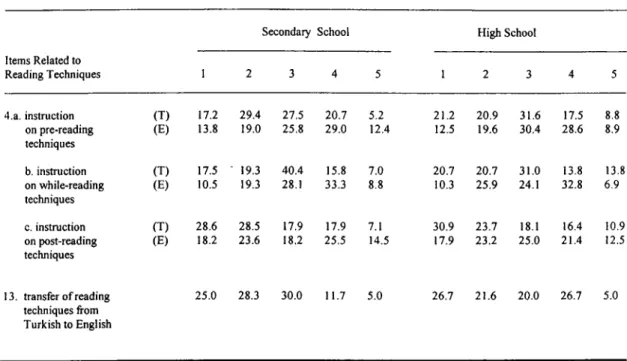
Reading Techniques... 41
Reading Outside the Classroom ... 43
Motivation for Reading... 44
Turkish and English C ourses... 45
Students’ Perception o f Themselves as a R eader.... 45
Analysis o f Questionnaire: Part B ... 45
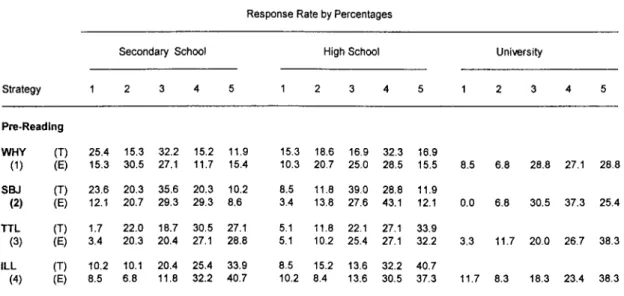
Pre-reading Strategies... 46
While-reading Strategies... 48
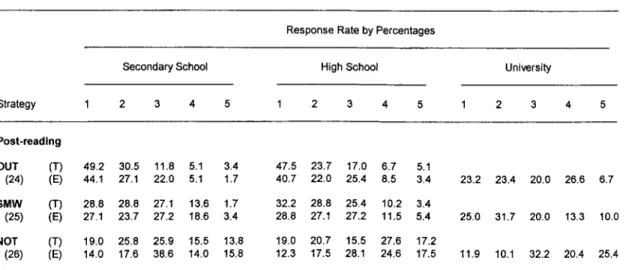
Post-reading Strategies... 54
Analysis o f Think-aloud Protocols... 56
CHAPTER V CONCLUSION... 65
Overview o f the Study... 65
Summary o f the Findings... 67
Previous Education o f Freshman Students at M E T U ... 67
Course Books, Reading Texts, Motivation for Reading... 67
Training in Reading Strategies and Assignments to Do Outside R ea d in g ... 68
Encouragement toUse Reading Strategies in Secondary and High School, and Reading Strategy Use at U niversity... 69
The Relationship between Secondary and High School Education in Reading and the Reading Strategy Use o f Freshman Students at M E T U ... 71
Limitations o f the Study... 72
Implications for Further Research... 74
R E FE R E N C E S... 76
APPENDICES ... 79
Appendix A: The Q uestionnaire... 79
Appendix B: Reading Text Used in the Warm-up for the TA Ps... 84
Appendix C: Reading Text Used in the T A P s ... 85
Appendix D: Strategy Profile for Each S tu d e n t... 88
Appendix; E: Coding Scheme for 26 Reading Strategies... 94
Appendix G:
Percentages o f Responses to Questions 1 and 2 in Part B
o f the Questionnaire... 98 Percentages o f Responses to Questions 1-5 in Part C
o f the Questionnaire... 99 Appendix H:
A Sample Think-aloud Protocol Transcript in Turkish... 100 Analysis o f the English Translation o f the Think-aloud
LIST OF TABLES TABLE
1 Percentage o f Student Responses in Relation to Course M aterial... 38 2 Percentage o f Student Responses in Relation to Reading in the Classroom 40 3 Percentage o f Student Responses in Relation to Reading Techniques... 41 4 Percentage o f Student Responses in Relation to Outside Reading... 43 5 Percentage o f Student Responses in Relation to Strategy U se... 46
(Pre-reading)
6 Percentage o f Student Responses in Relation to Strategy U se... 49 ( While-reading)
7 Percentage o f Student Responses in Relation to Strategy U se... 54 (Post-reading)
LIST OF FIGURES FIGURE
1 Type and Frequency o f the Strategies Used by the Readers
in the TA Ps... 61 2 Percentages o f Strategy Use at University (usually or always).... 63 3, 4, 5, 6, 7, 8 Strategy Profile for Each Student in the T A Ps.... 88-93
developments in cognitive psychology and in the relationship between cognition and language learning. Learning a foreign language is said to be a complex process; it is not automatic and the learners are not passive, but are cognitively and affectively involved in the process. Therefore, the use o f strategies by the learners is seen essential in order for the learning to take place. In fact, Oxford’s (1990) definition o f learning strategies as "specific actions taken by the learner to make learning easier, faster, more enjoyable, more self-directed, more effective and more transferable to new situations" (p.7) indicates that there is a positive relationship between effective use o f learning strategies and language learning. As Oxford (1992/1993) states, learning strategies can "facilitate the internalization, storage, retrieval or use o f the new language " ( p .l8 ) (see chapter 2 for a discussion o f classification o f learning strategies).
Among the strategies used by language learners, reading strategies are o f great significance. In second language teaching/learning contexts for academic purposes, especially in English medium universities or in other contexts where academic
materials written in English are extensively used, reading is important (Carrell, 1990). Eskey (1990, cited in Carrell, 1990, p .l) has also emphasized the importance o f reading especially at advanced proficiency levels in a second language: "th e ability to read the written language at a reasonable rate and with good comprehension has long been recognized to be as important as oral skills.” University students have to read many different kinds o f texts (" te x t” is used to mean "passage” in this study) in their
texts on different topics related to their fields.
Many researchers have specifically identified reading strategies used by good readers. For example, Barnett (1988) and Dubin (1982) have suggested lists o f common reading strategies. Barnett talks about text-level strategies such as
‘’considering background knowledge, p redicting,. . .reading with a purpose” (p. 150) and word-level strategies which involve, for example ‘’using context to guess word meanings, and . . . following reference w ords” (p.l50). Similarly, Dubin has found ten strategies used by people who read well : ‘’adjusting attention according to the material, using the total context as an aid to comprehension, skimming, search
reading, predicting/guessing/anticipating, critical reading, receptive reading, scanning, using textual-discourse devices and synthesizing knowledge” (p.l26-127) (see
Chapter 2 for a discussion o f reading strategies). The same kinds o f strategies will be investigated in this study as they are commonly used in academic reading and the inability to use them effectively results in failure in reading comprehension. This study aims at exploring the relationship between secondary and high school education in reading and the reading strategy use o f fi'eshman students while reading in English at university.
Background o f the Study
The acquisition o f certain learning strategies and the ability to use them
appropriately start in pre-university years. In particular, in secondary and high school education learners are required to read in many content areas and acquire quite a large amount o f knowledge. Therefore, it can be argued that learners’ educational
This study was carried out at Middle East Technical University (METU) in Ankara, Turkey, with freshman students. Students involved in the study were from private high schools or Anatolian High Schools, where instruction in mathematics and science courses is in English and students have English courses for about 8 hours a week. They study at various departments at METU, such as international
relationships, economics, management, mechanical engineering, environmental engineering, food engineering, civU engineering and chemistry.
Since M ETU is an English medium university, jointly with the Department o f Basic English (DBE), the Department o f M odern Languages aims to provide students with the required English language skills which will enable them to pursue their studies in various departments. At the Department, the initial required courses for freshman students are English 101 (Eng. 101) and English 102 (Eng. 102) which are academic integrated reading and writing courses. After a proficiency exam, while some o f the students take these two required English courses, others are exempted from one or both o f them.
Especially in English 101, students are required to read academic texts in which they have to use certain reading strategies such as predicting, skimming, scanning, inferencing, making use o f contextual and lexical clues, identifying the main idea and supporting ideas, and paying attention to cohesive markers. These strategies are thought to be the most important ones which they will need in their content courses in order to be successful in reading comprehension. In Eng. 102, besides reading,
the DBE and who have not taken English 101 have difficulties with reading comprehension due to their inability to use effective reading strategies. Since it is thought that students’ pre-umversity education has an impact on their university education, in this study it is hypothesized that reading comprehension problems are also carried over to the university.
Students in the Turkish education system are not made aware o f learning strategies and are not taught how to use strategies given that memorization and rote learning are the dominant modes o f learning. For example, Bursahoğlu (1973, cited in Akyüz,1997), based on the results o f his study, argues that the Turkish education system fails to teach certain skills such as critical thinking. In another study. Tekin (1980, cited in Gündüz, 1987) argues that the eleven-year Turkish language education seems to fail to teach the required reading skills. Osam (1992) further discusses tasks designed to develop reading skills in the course books prepared for primary,
secondary, and high schools in Turkey. She argues that questions that develop or encourage the use o f prediction, inferencing and interpretation skills are insufficient in quantity in these books. These statements in fact remind one o f what Grabe (1991) has stated about the relationship between the reader and the written material in the process o f reading, which is relevant to the Turkish context: “ Students who come from cultures where written material represents ‘truth’ might tend not to challenge or reinterpret texts in light o f other texts but will tend to memorize ‘knowledge’ ’’ (p.389). To sum up, given the above mentioned research evidence, there seems to be
Purpose o f the study
The purpose o f this study is to determine the relationship between secondary and high school education in reading and the reading strategy use o f freshman students at METU, Department o f Modern Languages while reading in English. Therefore, data about the teaching and learning situation regarding reading
comprehension in Turkish Language and Literature, and English courses at Turkish secondary and high schools will first be collected from university students. Then, the relationship between this previous education and reading strategies used by the students reading in English at university level will be investigated.
Significance o f the Study
The use o f learning strategies at university and its relationship to the Turkish schooling system is an issue that has not been investigated in Turkey. It is hoped that the data collected on Turkish learners will help university level Turkish teachers in determining their language teaching methodologies, designing better curricula or syllabi suitable to learners’ needs, and helping learners overcome their difficulties and inadequacies in language learning. In this way, understanding the relationship between previous schooling experience and the effective use o f learning strategies might have positive implications on the teaching o f English as a Foreign Language in Turkish
universities.
A study on the reading strategies used by freshman students at Middle East Technical University ( M E T U ) in Ankara can benefit students in that it can be useful in helping them develop the appropriate strategies for reading comprehension when
findings o f this study.
Research Questions The main research question in this study was as follows:
What is the relationship between secondary and high school education in reading and reading strategy use o f fi-eshman students at METU while reading in English?
There were two sub-questions related to the mam research question:
1. How do the freshman students at M ETU define their previous education in reading m secondary and high school in both their Turkish and English courses?
a. What do they report about their course books m general, about reading texts in them and about motivation for reading?
b. Do they report any training in reading strategies and any assignments to do outside reading?
2. H ow fi-equently were the fi-eshman students at M ETU encouraged to use reading strategies in secondary and high school and how fi-equently do they use them in reading comprehension in English at university?
strategies. Second, classification systems that relate to these definitions are presented. In the third section, the focus o f discussion is on reading as one o f the four language skills in which learning strategies can be used to facilitate language learning. Sinee reading is one o f the most important skills, especially in academic settings where success depends mostly on the comprehension o f written materials, the following sections review reading comprehension, models o f reading and strategies used in reading academic texts. The last section reviews the available research evidence concerning the reading strategy instruction in Turkish pre-university education.
Introduction
The idea that language acquisition is aided by ‘special learner techniques or strategies’ came to be recognized in the research literature in the 1980s. The
proposition that a ‘good language learner’ has a special or different way o f learning a language ‘’contrasts sharply with the idea t h a t . . . some individuals have an inherent ability for language learning” (O ’Malley and Chamot,1990, p.2). Cognitive
psychologists found out that competence ia an area depends on some special ways o f processing information. This finding implied that ‘’ strategies are not the preserve o f highly capable individuals, but could be learned by others who had not discovered them on their ow n” ( O ’Malley and Chamot, 1990, p.2).
The recent emphasis on the process by which learning occurs rather than the product or outcome o f language learning (Oxford, 1990) has also increased the interest in language learning strategies. Oxford sees strategies as one o f the various important factors or input in this learning process. They are crucial in the learning
objective.
Definition o f Language Learning Strategies
Various researchers have tried to explain what learning strategies are. For example, Rigney (1978) and Dansereau (1975) have defined learning strategies as ‘’operations employed by the learner to aid the acquisition, storage, retrieval and use o f information” (cited in Oxford, 1990, p.8). O ’Malley and Chamot (1990), who derive their definition o f learning strategies from a cognitive theoretical model, have defined them io a similar way, as ‘‘special ways o f processing information that enhance comprehension, learning or retention o f the information” (p .l).
Oxford (1990) sees learning strategies as behaviours, actions or steps taken by students to make learning ‘’more successful, self-directed and enjoyable” (cited in Ellis, 1994, p.531) and stresses the important role o f the use o f appropriate learning strategies in a student’s proficiency and self confidence. Her definition includes also
an affective purpose.
Some common features o f learning strategies, as provided by Oxford (1990) and Ellis (1994), can be summarized as follows:
• Strategies are both general plans and specific actions or techniques used to learn a foreign language.
• They are often conscious on the part o f the learner.
• Strategies are flexible, that is, their uses change according to the type o f task the learner is engaged in.
• Strategy training is effective. • Strategies are problem oriented.
• Finally, they involve metacognitive, emotional and interpersonal aspects o f the learner besides a cognitive one.
In brief, strategies are any actions taken by the learners to aid the learning process. They are essential as an input in this process.
Next section will present major classification schemes proposed by various researchers.
Classifications o f Language Learning Strategies
As a result o f various studies focusing on ‘good language learner’, strategies reported by students or strategies observed in language learning situations were identified. Based on these strategies some classifications were made.
Classification bv Naiman et al.t 19781
Naiman et al. used the interviews they made with thirty-four good language learners and an initial strategy scheme provided earlier by Stem (1975) to develop their own scheme. This scheme includes five broad categories o f learning strategies and a number o f secondary categories. These broad categories include: ‘’An active task approach, realization o f a language as a system, realization o f language as a means o f communication and interaction, management o f affective demands and monitoring o f second language performance” (cited in O ’Malley and Chamot, 1990, p.6). Secondary categories are actually referred to as ‘techniques’ as they focus on
specific aspects o f language learning such as sound acquisition, grammar, vocabulary, learning to listen, talk, write and read.
Classification bv Rubin 1198 H
Another researcher who categorized the learning strategies at about the same time as Naiman et al. is Rubin (cited in O ’Malley and Chamot, 1990). She collected data extensively in different settings, through classroom observations, self-reports from students and journals written by students. Rubin collected strategies under two groups, as strategies that directly affect learning and ones that indirectly enhance learning. Direct strategies consist o f actions or thoughts such as clarification / verification, monitoring, memorization, guessing/ inductive reasoning, deductive reasoning and practice. The other group includes creating practice opportunities and using production tricks such as communication strategies.
Categories developed by Rubin and Naiman et al. have been criticized by some researchers. For instance, according to O ’Malley and Chamot, (1990) although Rubin and Naiman et al. have identified a number o f very useful deliberate approaches to learning a second language, their classification systems are not based on any theory o f second language acquisition or cognition. Therefore, it does not seem easy ‘’to
winnow out from the extensive listing o f strategies and techniques which ones are fundamental for learning, which ones might be most usefiil to other learners, and which should be combined with others to maximize learning effectiveness” (O ’Malley and Chamot, 1990, p.7). Furthermore, Ellis (1994) considers these early researches as lists o f strategies in contrast to ‘’comprehensive, multi-levelled, and theoretically motivated taxonomies” (p.540) developed later on. He thinks that later frameworks developed by O ’Malley and Chamot (1990), Wenden (1991), and Oxford (1990) are
significant in that they assist us in deciding which strategies or combinations o f strategies are effective in improving learning.
Classification by O ’Malley and Chamot
(1990)
As mentioned earlier, O ’Malley and Chamot (1990) base their definition o f learning strategies on ‘’a cognitive information processing view o f human thought and action ” (p .l). They mention studies o f learning strategies with first language learners in cognitive psychology whose findings generally indicated that performance o f students trained in strategy use on a variety o f reading comprehension and problem solving tasks is improved (e.g. Brovra et al. 1983; Chipman, Segal, and Glaser 1985; Dansereau 1985; Segal Chipman, and Glaser 1985). O ’Malley and Chamot (1990) state that ‘’one o f the more important outcomes o f these psychological studies was the formulation o f learning strategies in an information-processing theoretical m odel” ( p.8). This model consists o f an executive, or metacognitive, function besides an operative, or cognitive-processing, function. Metacognitive strategies are used for planning for, monitoring o f or evaluating learning. Cognitive strategies, according to Brown and Palincsar (1982, cited in O ’Malley and Chamot, 1990), are used in individual learning tasks where learning materials are manipulated or transformed. A third type o f learning strategy discussed in the literature on cognitive psychology is social/affective strategies, in which “ the learner calls on another person for assistance or works cooperatively with others on a common task” (Chamot, 1992, p.4). These are the main groups o f learning strategies which O ’Malley and Chamot have also used in classifying strategies used by foreign language learners. Selective attention,
summarizing, elaboration, imagery and rehearsal are cognitive strategies. Self-talk, cooperation and questioning for clarification are included in social/afifective strategies.
Classification bv Oxford (19901
The most recent classification o f learning strategies is Oxford’s (1990)
taxonomy which is a very comprehensive one in that it has six major categories, three o f which directly involve the target language and necessitate mental processing o f the language, whereas the other three support learning indirectly. Oxford’s classification scheme is similar to Rubin’s (1981) in that Oxford also divides strategies into two, as direct and indirect ones. However, Oxford’s system is a new one which is ‘’more comprehensive and detailed ” and ‘’more systematic in Unking individual strategies, as weU as, strategy groups, with each o f the four language skills” (Oxford,1990, p.
14). Direct strategies include memory, cognitive and compensation strategies which are further divided into sub-categories. Indirect strategies involve metacognitive, affective and social strategies which again have sub-categories. As can be seen, Oxford’s taxonomy includes aU the previously discussed categories o f the strategies and it has been expanded to include broader categories. Oxford has developed The Strategy Inventory for Language Learning (SILL) which ‘’uses a very wide definition o f strategy, including almost any decision taken in the process o f language learning” (McDonough, 1995, p.94).
To summarize, learning strategies are special ways used by learners to aid learning and make it more efficient. The way learners approach a task and perform it and the outcome received are affected by the strategies chosen by them and by how effectively learners employ them. In language learning, strategies are used to facUitate learning in aU four skills - hstening, reading, writing and speaking. Understanding
language learning strategies requires an understanding o f the nature o f language learning process. Similarly, understanding reading strategies necessitates an
understanding o f the nature o f reading process. Therefore, models o f reading which aim to explain the nature o f reading process will be reviewed next.
Models o f the Reading Process
Attempts to define the nature o f reading process have led to the formulation o f three basic models o f reading: bottom-up, top-down, and interactive. Reading in a second or foreign language has been influenced by these approaches to reading in the first language (L I).
Bottom-up Reading Model
This early, rather passive, view o f second language reading defined the process o f reading as decoding the author’s intended meaning through recognition o f the printed letters and words. The meaning for a text was thought to be built up by the reader ‘’from the smallest textual units at the ‘bottom ’ (letters and words) to larger and larger units at the ‘to p ’ (phrases, clauses, intersentential linkages) ‘’ (Carrell, 1990, p.2).
The bottom-up model o f reading was criticized by some researchers. For
example, Eskey (1973) considered this early bottom-up decoding model as inadequate because he argued that this model ‘’underestimated the contribution o f the reader; it failed to recognize that students utilize their expectations about the text based on their knowledge o f language and how it w orks” (Carrell, 1990, p.3). In addition, a series
o f research studies done by Goodman and Burke (1972, cited in Nunan, 1991) have provided evidence against this model which considers reading as a ‘’serial processing o f ever larger units o f language” (p. 65). The analysis o f errors, ‘miscues’ as termed
by Goodman and Burke (1972), made by the readers while reading aloud have revealed that reading is more than a mechanical decoding process. They found that ‘’in many instances deviations from what was actually written on the page made sense semanticaUy for example a child might read the sentence ‘My father speaks Spanish’ as ‘My Dad speaks Spanish’ ‘’(Nunan, 1991, p.65). The child could read the sentence as ‘My feather speaks Spanish’, which would suggest that he/she is decoding mechanically rather than reading for meaning.
Top-down Readme Model
In the 1970s, the psycho linguistic model o f reading proposed by Goodman (1971, cited in Carrell,1988) began to influence second language reading. Goodman described reading as a ‘’psycholinguistic guessing game” in which the ‘’reader reconstructs . . . a message which has been encoded by a writer as a graphic display” (Goodman, 1971, p.l35). According to Goodman’s model, all o f the textual cues are not necessarily used by the efficient reader. The grapho-phonic, syntactic and
semantic systems o f the language are merely utilized for the purpose o f predicting the meaning o f the text. The reader’s past experiences and knowledge o f the language play an important role in the confirmation o f these predictions by the reader (Carrell,
1990). Several reading experts such as Anderson (1978) and Cziko (1978) have accepted Goodman’s model as basically a concept-driven top-dow n pattern (cited in Carrell, 1990).
Thus, with the influence o f the top-down model, the second language reader started to be seen as actively involved in reading, processing the information by predicting while sampling only parts o f the actual text. Second language reading specialists such as Clarke and Silberstein (1977), Clarke (1979), Mackay and
Mountford (1979), and Widdowson (1978,1983) (cited in Carrell, 1990, p.3), all prescribed to this active role o f the reader in the reading process.
The top-down model has also been found to have limitations. Eskey (cited in Carrell, 1990) has stated that ‘the top-dow n’ “ revolution has resulted in major improvements in both our understanding o f what good and many not so good readers do, and in the methods and materials that we now employ” (p.93). However, Eskey also believes that ‘top-dow n’ models have some limitations since they ‘’de-emphasize the perceptual and decoding dimensions” ( p.93) o f the reading process. According to him, these lower level skills such as the rapid and accurate perception o f lexical and grammatical forms are considered as essential as higher-level skills. Therefore, what Eskey has supported is an interactive model o f reading.
Interactive Reading Model
The interactive model was proposed by Rumelhart (1977). This model, in contrast to the top-down model, assumes a constant interaction between higher-level and lower-level skills in processing information for the reconstruction o f the meaning o f the text rather than overemphasizing the role o f top-dow n processing skills in reading. In this view, good readers are considered as ‘’both good decoders and good interpreters o f the text, their decoding skills becoming more automatic but no less important as their reading skill develops” (Carrell, 1990, p.94). Thus, both the top- down and bottom-up skills are utilized by the efficient readers in a fluent and accurate reading. Stanovich (1980) also emphasizes the superiority o f the interactive model as it “ allows for deficiencies at one level to be compensated for at another” (cited in Nunan, 1990, p. 67).
In conclusion, the reading model which will provide the readers with an utmost understanding o f what they read is an interactive t)^ e o f reading. In the interpretation o f a reading text, decoding o f the written message is the initial step which should lead to the use o f higher-level processes. As Day and Bamford (1998) have stated, an accurate and automatic w ord recognition “ is the precursor o f a number o f other interactive, concurrent processes that, together with high-level cognitive reasoning, result in the construction o f meaning’ ’ (p. 15). Therefore, developing both top-down and bottom-up reading skills is essential in learning to read.
As mentioned earlier, in the development o f skills in a language, strategies are used as tools. As a result o f various studies with learners, many useful reading strategies have been found. Next section wUl present these reading strategies and discuss their importance in relation to the reading process..
Research on Reading Strategies
The role o f strategies used in reading is now accepted as a legitimate research goal and the identification o f strategies used by good readers for effective
comprehension is on-going.
Definitions o f reading strategies all focus on their role in the comprehension o f what one reads. For example, Duffy (1993, p.232, cited in Janzen, 1993) defines them as “ plans for solving problems encountered in constructing meaning” (p.6). Janzen states that these strategies both include bottom-up ones such as consulting a
dictionary for an unfamiliar word and more comprehensive strategies like relating new material being read to one’s background knowledge (p.6). In a similar way, Barnett (1988) defines reading strategies as “ the mental operations involved when readers
approach a text efficiently and make sense o f what they read” (Barnett, 1988, p.l5 0 ). According to Barnett, these problem solving techniques involve:
• guessing word meaning from context and evaluating those guesses, • recognizing cognates and word families,
• skimming, • scanning,
• reading for meaning, • predicting,
• activating general knowledge,
• making inferences, • following references,
• separating main ideas from supporting details.
Barnett (1988) states that these effective strategies are further divided into two major categories, as text-level and word-level. According to her definitions, text-level strategies are “ those related to the reading passage as a whole or to large parts o f the passage” . Word-level ones are more focused on words. She states that classifications given in some other studies follow a similar principle in division: e.g. Block’s (1986) ‘general comprehension’ and ‘local linguistic’, Hosenfeld’s (1977) ‘main meaning line’ and ‘word-solving strategies’ and, in LI reading theory, Olshavsky’s (1976-77) ‘clause-related’ and ‘word-related’ strategies (p.150).
Hosenfeld (1984) conducted one o f the earliest research studies on reading strategies. She interviewed readers in their native language on strategies that they used while they were trying to understand what they, were reading. Her aim was to
find what good readers do that poor readers do not to comprehend the text. She then used think-aloud protocols o f a kind in a case study format. Good readers were found to be using the following kinds o f strategies according to her protocols (1984,
pp.233-4):
• keep the meaning o f the passage in mind, • read in broad phrases,
• skip inessential words,
• guess from context the meaning o f unknown words, • have good self-concept as a reader,
• identify the grammatical category o f words, • demonstrate sensitivity to a different word order, • examine illustrations,
• read the title and make inferences from it,
• use orthographic information (e.g. capitalization) • refer to the side gloss,
• use a glossary as a last resort, • look up words correctly,
• continue if unsuccessful at decoding a word or phrase,
• recognize cognates,
• use their knowledge o f the world,
• follow through with proposed solution to a problem,
The think-aloud method is a common method used in reading strategies studies (see Chapter 3 for a discussion o f TAPs). It enables the researchers to gather rich data as the readers are encouraged to think aloud everything that goes on in their minds during the reading process itself Another researcher who used a think-aloud method is Block (1986). She used it with both non-native and native readers o f the same educational level (college first-years who had failed a college reading ability text) and organized the strategies she identified into two:
(general)
•anticipate content, •recognize text structure, •integrate information,
•question information m the text,
•interpret the text,
•use general knowledge and associations,
•comment on behaviour or process, •m onitor comprehension, •correct behaviour, •react to text (local) •paraphrase, •reread,
•question meaning o f clause or sentence, ^
•solve vocabulary problem, (cited in McDonough, 1995, p.51).
Block refers to Danger (1982) v^^ho defines strategies as ” a reader’s resources for understanding’’(cited in Block, 1986, p.465). According to Danger,
‘’comprehension strategies indicate how readers conceive a task, what textual cues they attend to, how they make sense o f what they read, and what they do when they do not understand” (p. 465). Block reviews the findings o f some studies which suggest that monitoring comprehension, awareness o f strategy use and using strategies flexibly are the characteristics o f good readers that distinguish them fi'om poor ones. She also refers to Smith (1967), and Strang and Rogers (1965) who state that the type o f text being read and the purpose for which it is being read determine the strategies good readers use. In other words, readers change the strategies they employ depending on these factors.
Other researchers who Block cites are Olson et. al (1984) who attract attention to good readers’ ability to differentiate between important information and details as well as using clues in the text to predict what will be stated further and/or find
relationships between new information and information previously stated. Some o f the reading strategies grouped by Block, namely anticipating content, integrating
information, using general knowledge and associations, and monitoring comprehension share the characteristics stated by these researchers.
The identification o f reading strategies has continued in both D1 and D2 research. Another researcher who was interested in reading strategies was Sarig (1987). In Sarig’s research, readers (17-18 year old girls at the end o f their school career) who had Hebrew as D1 and English as foreign language were found to use
highly similar strategies and the relation between the strategies used and actual success in comprehension was similar in both languages ( cited in McDonough, 1995).
Sarig classified the strategies which she calls ‘moves’ into four categories: technical aid moves, clarification and simplification moves, coherence-detecting moves, and monitoring moves. These categories include the following strategies:
1. Technical aids • skimming,
• scanning,
• marking the text,
• making a paragraph summary in the margin, • using glossary,
2. Clarification and Simplification • syntactic simplification,
• producing synonyms and circumlocutions,
• using paraphrase o f rhetorical function, 3. Coherence detection
• identifying the macrofirame, • using background knowledge,
• identifying key information, 4. Monitoring
• consciously changing the plan,
• deserting a hopeless utterance,
• identifying misunderstanding, • correcting mistakes,
• skipping in a controlled fashion, • self-directed dialogue.
• questioning meaning o f a clause, sentence, or word (McDonough, pp. 57- 58).
Sarig’s classification differed fi'om the previous researchers’ grouping; however, there are some common strategies identified as well as newly introduced ones. For example, identifying misunderstanding and correcting mistakes, skipping in a controlled fashion, questioning meaning o f a clause, sentence, or word, deserting a hopeless utterance, using background knowledge, identifying key information, skimming, and scanning have also been emphasized by Barnett, Hosenfeld, or Block. This would seem to suggest that every new study in the field o f reading strategies identifies new strategies used by learners besides confirming the validity and value o f the previous ones.
As Cohen (1990) argues, despite the fact that there may not be ‘’inherently good reading strategies, there are a series o f general strategies that do seem to come up time and again as strategies that have merit for readers in various texts under differing circumstances” (p. 84). Cohen has drawn a list o f such strategies from the work o f Baker and Brown (1984a, 1984b) in LI and Hosenfeld (1977, 1979, 1984), Hosenfeld et. al (1981) in foreign language:
• Clarifying their purpose for reading the material at hand: This helps the reader determine what kind o f reading to use - skimming, receptive reading ( trying to understand everything the writer presents), responsive reading
( ‘’using the author’s material as a prompt for your own critical reflection” ) and so forth.
• Looking for how the reading material is organized: The reader can rapidly skim the text, take notes about the features in the text such as tables, figures, pictures, and subtitles or make an outline o f the main parts. When used as a pre-reading strategy, it gives the reader a chance to have an idea where the text is going.
• Reading for meaning: This means activating one’s background
information, which is called
schemata
(Anderson and Pearson 1984, Carrell and Eisterhold 1983). This schemata might be about the readers’knowledge o f a specific subject matter, their world knowledge or their knowledge o f language. This kind o f an approach to the reading text, that is top-down reading as discussed before, might help a reader who has poor
bottom-up reading skills to make sense o f a reading material.
• Focusing on major content: This means distinguishing important points fi’om trivial ones.
• Parsimonious use o f a dictionary: This strategy emphasizes the fact that readers should not overuse the dictionary because it diverts the reader’s attention away from the reading text.
• Judicious use o f context: Using contextual clues such as the ones in the grammatical context (‘’the occurrence o f certain forms as context due to obligatory or optional grammatical relationships” ) and conceptual context (‘’contextual material based exclusively on meaningful - not
grammatical-ties) can help the readers to guess the meaning o f unknown words or phrases, thus reduce dictionary usage.
• Reading in broad phrases: This strategy encourages reading in chunks rather than reading word-for-word. This kind o f reading enables readers to take in more information at a time and thus leads to better comprehension. • Ongoing summaries: An ongoing summary in the form o f thoughts,
verbalizations or written notes every few lines helps the reader keep the meaning o f already read information while continuing reading.
• Making predictions: According to Cohen (1990), trying to guess what will come next in the text might help the readers in a target language stay alert as well as lead to a continuous questioning. This kind o f an approach can also encourage more and continuous interaction with the text.
• Looking for markers o f cohesion: This strategy assists the reading process as the reader can make meaning out o f the text by the help o f a series o f words and phrases that connect and relate the ideas in a written text. Cohen states that if good readers understand that they have not been successful in getting the meaning, they usually take ’corrective action’ by applying a combination o f certain strategies.
Most o f these strategies explained by Cohen appear in the hsts o f previous researchers. These are commonly used strategies by good language learners both in LI and L2.
Research on Reading Strategy Instruction in Turkish Pre-university Education Despite the fact that the plans are not as specific as the ones prepared for the English courses (see Appendbc F), the curriculum for Turkish courses in secondary
and high schools (see Osam,1992) as determined by the Ministry o f National Education in Turkey aims at developing reading skills and reading com prehension; however, no current research evidence was found on what is being done in the classroom in terms o f strategy instruction. Different institutions such as the Ministry o f National Education, Talim Terbiye Dairesi Başkanlığı (a branch o f the Ministry responsible from organizing the content o f the co u rses), the State Institute o f Planning (DPT), the Education Faculty o f METU and METU secondary and high school were visited in search o f some studies done with secondary and high school students. However, no research documents were available.
Tekin (1980, cited in Gündüz, 1987) argues that the eleven-year Turkish language education seems to fail to teach the required reading skills. In a study conducted with freshman students at different universities to measure reading
comprehension proficiency, he found out that the students lacked the necessary skills to understand what they read in Turkish. The reason behind this might be the loaded program in the Turkish education system, which forces the students to depend on textbooks only, without having time and motivation to read on their own.
Osam (1992) discusses tasks designed to develop reading skills in the course books prepared for primary, secondary, and high schools in Turkey. She has found that these course books as well as the reading texts in them are dull and unattractive. She has also observed differences in authors’ approaches to reading in course books written by different authors. While some writers provide pre-reading tasks to activate schemata, some others give only reading comprehension questions to be answered after reading. M oreover,these questions are mostly scanning and skimming type o f questions. Osam concludes that questions that develop or encourage the use o f
prediction, inferencing and interpretation skills should be included to a great extent from secondary school onwards.
In the light o f such limited literature, this study set out to investigate the
relationship between secondary and high school education in reading and the reading strategy use o f freshman students while reading in English at METU.
CHAPTER III: M ETHODOLOGY Introduction
The aim o f this study was to find the relationship between secondary and high school education in reading and the reading strategy use o f fi-eshman students while reading in English at Middle East Technical University (METU). Data were collected jfrom the students through a three-part questionnaire and think-aloud-protocols (T A P s). The first part o f the questionnaire was designed to elicit information about the previous education o f fi-eshman students. The second part consisted o f questions which investigated reading strategies encouraged in secondary and high school and the reading strategies used by the same students in reading English texts at university. The last part o f the questionnaire was related to reading in English at university.
In the following sections o f this chapter, subjects, materials, procedures and data analysis will be discussed in detail.
Subjects
This study was conducted at Middle East Technical University, the Department o f Modern Languages which provides English courses to all students in various departments. The aim o f these English courses is to enable students to follow lectures and read written materials effectively since M ETU is an English-medium university. As mentioned in Chapter 1, one o f these English courses is English 102 (Eng. 102), a continuation o f English 101 (Eng. 101), both o f which are academic integrated reading and writing courses. After a proficiency exam, while some o f the students take these two required first-year courses, others are exempted fi-om one or both o f them. Some students are required to study in preparatory school at the Department o f Basic English, where they have a one-year intensive English programme. Students who
receive between 70 -74 out o f 100 are exempted from Eng. 101 and required to take Eng. 102. Those who receive between 75 -79 are exempted from both Eng. 101 and Eng. 102.
The subjects for this study were chosen from among students who were
exempted from both preparatory school and Eng. 101 to enable the investigation o f the relationship between their previous education and their strategy use at university. Students involved in the study were from private high schools or Anatolian High Schools, where instruction in mathematics and science courses is in English and students have English courses for about 8 hours a week They study at various departments at METU, such as international relationships, economics, management, mechanical engineering, environmental engineering, food engineering, civil
engineering and chemistry.
Materials Questionnaires
In this study, a three-part questionnaire, think-aloud-protocols, and reading texts were used. The questionnaires (see Appendix A) were administered in English as the students’ language proficiency level was thought to be adequate. Part A o f the questionnaire consisted o f 1 open-ended and 14 structured questions. Structured questions included 1 yes/no, 1 multiple choice and 12 rating scale questions.
Questions in part A were prepared to elicit information about subjects’ secondary and high school education in terms o f what they did in their Turkish and English courses. In this part, questions about reading in class, outside reading, course material, reading techniques, courses, motivation for reading and students’ evaluation o f themselves were asked. Items in part B were directed towards eliciting reading strategies students
were encouraged to use in secondary and high school as well as strategies they use at university while reading m English. The strategies investigated were the same for pre university and university education categories.
Twenty-six strategies in Part B were divided into three categories: pre- reading, while reading and post-reading strategies. While-reading strategies were further divided into two: text-level and word-level. Students were required to use a 5- point Likert-type scale in each section. The questions were based on the
questionnaires used by the following researchers in different studies on reading strategies:
• Barnett (1988), Questionnaire to Elicit Perceived Strategy Use,
• Oxford (1989, in Oxford, 1990), Strategy Inventory for Language Learning (SILL), version 7.0 (ESL/EFL),
• Carrell (1989), Metacognitive Questionnaire,
• Miholic (1994), Metacognitive Reading Awareness Inventory,
• Rusciolelli (1995), Reading Strategies Survey,
Having reviewed the studies on the strategies used by good readers, some o f the items m the above questionnaires that were found to correspond with the commonly used strategies were chosen and modified, and some more strategies were added (see Chapter 2 for Cohen’s (1990) list). Post-reading strategies were taken from Shih (1992) and Auerbach and Paxton (1997). Shih states that ‘’note-taking and summarizing are useful strategies for organizing and condensing information to be remembered . . . ” (p.306). Auerbach and Paxton refer to ‘making an outline o f the organization o f the text’ as an after-reading strategy. ‘Drawing conclusions’ and ‘separating fact from opinion’ were identified as critical reading by Jensen (1986,
cited iQ Dubiti et. al ,1986). These were also included in the questionnaire used in this study as they are ‘’essential for academic students who must read a variety o f writing styles for informational purposes” (p.l 19).
In part C o f the questionnaire, 6 items from part A were asked a g ain , but this time they were related to reading in Enghsh at university.
Think-aloud protocols
Another material used in the study was the think-aloud-protocol which is one type o f verbal reporting. In this method, subjects are required to verbalize
‘’everything they think and everything that occurs to them while performing the task, no matter how trivial it may seem” (Hayes and Flower, 1980, cited in Seliger and Shohamy, 1989, p . l 69). Seliger and Shohamy state that rich data are reached through the think-aloud since ‘’ it elicits information which is kept m short-term m em ory, and is thereby directly accessible for further processiog and verbalization” (1989, p . l 70). However, they also say that researchers attract attention to some problems encountered in verbal reporting and suggest that secondary data through questionnaires, for example, should be collected. Therefore, in this study both questionnaires and think-aloud-protocols were used to increase reliability.
Two reading texts were used in the TAPs. A two-paragraph text was used for the warm-up (see Appendix B). Given the level o f the students, a longer text was used in the actual study (see A ppendk C). Some parts o f the text were taken out without destroying the coherence and unity in order to make it shorter. Both texts were taken from a text-book designed for advanced students (1995, Baker-Gonzalez and Blau, p. 123 warm-up text and pp.98-101 longer text).
Procedure Questionnaires
Questionnaires were piloted with 6 students and they were revised according to the feedback received from the students. Some parts were modified and more
questions were added to part B.
The purpose o f the study was explained to colleagues who were teaching Eng. 102 and they were asked whether they would be willing to spare some time during one o f their class hours for the administration o f the questionnaire. M ost o f them consented. One week was allowed for the procedure. Each colleague gave the questionnaires during their class hours. The questionnaires were administered to 61 students.
Think-aloud protocols
The aim o f the TAPs was to determine what kinds o f strategies were used by the freshman students while reading in English. The candidates for the TAPs were volunteers from colleagues’ classes. These students were defined as extroverts and good at verbalizing their ideas by their teachers. Eight students volunteered for the study. TAPs were held with all o f them. However, 6 o f them were found to yield rich data as these students were better than the other 2 in verbalizing their thoughts. Therefore, the first 2 students were not included in the study. Furthermore, the researcher believed that she felt more confident after the initial TAPs, thus were more successful in conducting them.
A similar procedure to the one suggested by Seliger and Shohamy (1989, p .l7 1 )
1 .The aim o f the study was explained and a preparatory think-aloud was held with a short text to allow practice for each participant. It was not possible to hold a meeting with each participant before the study as the students were not available. The warm-up and the TAP were done on the same day successively. 2. Subjects performed the TAPs individually at the researcher’s oflBce at M ETU after 17.30 to ensure a quiet place.
3. Each participant was given the same text and asked to verbalize their thoughts while reading the text. They were ‘’encouraged to point out any difficulties they encoimter in comprehending the t e x t . . . and to express verbally any conftision or uncertainty they experience when reading” (p. 171). 4. Each session was held individually in L I . No time limit was given.
5. The protocols were tape recorded. There was as little intervention on the part o f the researcher as possible.
Ericsson and Simon (1987, cited in O ’Malley and Chamot, 1990, p.92) ‘’refer to the use o f interviewer reminders throughout the data collection when the
informant becomes silent or strays fiom talking about strategies” . During the TAPs in this study, students sometimes started to ‘’describe the content o f the passage to which they have attended when thinking aloud instead o f describing their thoughts while attending to the passage” , as mentioned by O’Malley and Chamot (1990, p.92). Therefore, comments such as ‘Keep talking’ and ‘What are you thinking about?’ were used to encourage them to continue describing their thoughts.
Another problem encountered was that one o f the students stated that she read more slowly than she normally does in order to think what she was going to verbalize. This issue was also mentioned by Ericsson and Simon (1987): ‘’rate o f thinking has
to be slowed down to allow for the additional time required for verbalization o f the thought” (p.51) (cited in O ’Malley and Chamot, 1990, p. 97).
D ata Analysis
Means, standard deviations and percentages were calculated for each item during the first stage o f the analysis o f the data obtained from the questionnaires. Percentages were chosen to display data in tables and discuss the results. Then, questions 4-15 in part A o f the questionnaire were analyzed under seven categories, namely course material, reading in the classroom, reading outside the classroom, reading techniques, Turkish and English courses, motivation for reading, and
students’ perception o f themselves as a reader (see Appendix G for the percentages o f the responses to questions 1 and 2). Items in each category were discussed in relation to one another.
Part B o f the questionnaire was analyzed in three categories: pre-
reading, while reading and post-reading strategies. Percentages in each category were displayed in separate tables. Then, in the second stage, comparisons between
secondary and high school, Turkish and English courses and pre-university level and university level were made.
In part C percentages for 5 questions were calculated (see Appendix G for the responses).
During the first stage o f the analysis o f the think-aloud protocols, tape-recorded protocol o f each subject was transcribed and translated into English. Next, a coding scheme based on the 26 strategies asked in the part B o f the questionnaire was formed. Then, each think-aloud protocol was read carefully several times; strategies identified according to the pre-determined coding scheme were underlined (see
Appendix H for a sample o f an analyzed protocol). The data analyzed were organized into tables o f ‘strategy categories with samples’, ‘strategy profiles for each
subject’(see Appendix D) and ‘frequencies o f the strategies used by the subjects’. In the final stage o f the analysis, a comparison between think-aloud protocols and the results o f the part B o f the questionnaire was made. In the next chapter, data analysis and the results o f the study will be discussed in detail.
CHAPTER IV: DATA ANALYSIS Overview o f the Study
This study investigated the relationship between secondary and high school education in reading and reading strategy use o f freshman students at Middle East Technical University (METU) while reading in English. The main research question in this study was as follows:
What is the relationship between secondary and high school education in reading and reading strategy use o f freshman students at M ETU while reading in English?
There were two sub-questions related to the main research question:
1. H ow do the freshman students at METU define their previous education in reading in secondary and high school in both their Turkish and English courses?
a. What do they report about their course books in general, about reading texts in them and about motivation for reading?
b. Do they report any training in reading strategies and any assignments to do outside reading?
2. How frequently were the freshman students at METU encouraged to use reading strategies in secondary and high school and how frequently do they use them in reading comprehension in English at university?
Data were collected through questionnaires and think-aloud protocols. Questionnaires were administered to 61 Turkish freshman students who were exempted from preparatory school at the Department o f Basic English (DBE) and English 101, and who were taking English 102 for the first time. The questionnaire
consisted o f three parts. Part A, which had 15 questions, was designed to get
information about the students’ educational background and reading practices in their Turkish and English courses in secondary and high school years. Part B o f the
questionnaire was composed o f questions to obtain information about the reading strategies students were encouraged to use in their Turkish and English courses in secondary and high school years, in addition to the reading strategies they use as they read in English at university. In this part, which used a 5-point Likert type scale, there were 26 items divided into three categories: pre-reading, while reading and post reading strategies. The while reading strategies were further divided into ‘text-level’ and ‘word-level’. Part C included 6 questions which were also asked in part A, but this time as applied to reading in Enghsh at university.
Think-aloud protocols (TAPs) were held with 6 o f the students (10 % o f the students who took questionnaires) who filled in the questionnaires in order to elicit more information on what reading strategies freshman students use. Before the protocols, a warm-up session was held with the students individually to familiarize them with the TAP. A two-paragraph text was used in the warm-up and a longer text was used in the TAP.
Data Analysis Procedures Analysis o f Questionnaires
During the first stage o f the analysis o f the data obtained fi'om the
questionnaires, percentages were calculated for each item. Then, the items which aimed at getting similar kind o f information were grouped. Seven categories were formed. Thus, questions 4-15 in part A o f the questionnaire were analyzed under seven categories.
These categories are as follows: • Course material
• Reading in the classroom • Reading techniques
• Reading outside the classroom • M otivation for reading
• Turkish and English courses
• Students’ perception o f themselves as a reader
Part B o f the questionnaire was analyzed in three categories, namely pre-reading, while reading and post-reading strategies, as they were divided in the questionnaire. It was thought that this would make the discussion o f the results easier. Then,
comparisons between secondary and high school, Turkish and English courses and pre-university level and university level were made.
See Appendix G for the responses to the questions which were not displayed in this chapter.
Analysis o f Think-aloud Protocols
During the first stage o f the analysis o f the think-aloud protocols, the tape- recorded protocol o f each subject was transcribed and translated into English. Next, a coding scheme based on the strategies asked in the questionnaire was formed. Then, each think-aloud protocol was read carefully several times to identify the strategies in the pre-determined coding scheme. The codes were underlined and this data were then displayed in tables: ‘strategy categories with samples’, ‘strategy profiles for each subject’ (see Appendbc D) and ‘fi’equencies o f the strategies used by the subjects’. In
the final stage o f the analysis, a comparison between think-aloud protocols and the results o f the part B o f the questionnaire was made.
Results o f the Study Analysis o f Questionnaire: Part A
As mentioned previously, part A was analyzed under seven categories. In the following section, tables for each category are displayed and significant findings are discussed in relation to one another.
Course Material
The two items in the first category, course material, aimed at eliciting information about what students think about their course books and whether they believe reading texts in the course books encouraged them to read more about the same topics outside the classroom. Table 1 shows the percentages o f the responses given to these questions. Numbers on the left hand indicate the number o f the item in the questionnaire.
Table 1
Percentage of Student Responses in Relation to Course Material N=61
Response Rate by Percentages
Secondary School High School
Items Related to Course Material 1 2 3 4 5 1 2 3 4 5
lO.a quality of the (T) 6.6 37.7 29.5 21.3 4.9 10.0 25.0 41.7 18.3 5.0 content o f the course books (E) 6.6 13.1 27.6 37.7 14.8 3.3 16.4 32.8 31.1 16.4 b. quality of the (T) 16.9 37.3 25.5 10.1 10.2 20.3 45.8 23.7 6.8 3.4 illustrations (E) 8.2 8.2 9.8 36.1 37.7 6.6 11.4 21.3 31.2 29.5 c. quality of the (T) 18.0 24.5 19.3 21.1 14.0 14.0 29.9 19.3 22.8 14.0 paper (E) 3.4 1.8 6.9 32.7 55.2 3.4 1.8 8.6 31.0 55.2
11. the role of texts in (T) 18.0 34.5 36.0 4.9 6.6 18.0 37.7 23.0 14.7 6.6 encouragement
for more reading about the same topics
(E) 23.0 19.6 42.6 11.5 3.3 23.0 27.8 27.9 18.0 3.3