1
A MACROECONOMIC ASSESSMENT OF U.S. AND E.U. INDUSTRIAL AGRICULTURE POLICIES AND THEIR EFFECTS ON WORLD FOOD
SECURITY, 1994-2010
ABD’NĠN VE AVRUPA BĠRLĠĞĠ’NĠN ENDÜSTRĠYEL TARIMSAL POLĠTĠKALARININ VE ONLARIN DÜNYA BESĠN GÜVENLĠĞĠ ÜZERĠNDEKĠ ETKĠLERĠNĠN MAKROEKONOMĠK DEĞERLENDĠRMESĠ
JOSH RAY BROWN 109674008
ĠSTANBUL BĠLGĠ ÜNĠVERSĠTESĠ SOSYAL BĠLĠMLER ENSTĠTÜSÜ
ULUSLARARASI EKONOMĠ POLĠTĠKASI YÜKSEK LĠSANS PROGRAMI
PROF. DR. AHMET TONAK 2011
2
Besin Güvenliği Analizi
Josh Ray Brown 109674008
Tez Danışmanı: Prof. Dr. Ahmet Tonak ... Jüri Üyesi: Prof. Dr. Oktar Turel ... Jüri Üyesi: Hakan Arslan ...
Tezin Onaylandığı Tarih : 26 /10 /2011
Toplam Sayfa Sayisi: 74
Anahtar Kelimeler: Key Words:
1) Tarım 1) Agriculture
2) Besin Güvenliği 2) Food Security
3) Küçük Çiftlikler 3) Small Farms
4) Sürdürübilirlik 4) Sustainability
3
Abstract:
Though an everyday harsh reality for more than a billion people, the concept of food security has recently entered the mainstream as a result of crises experienced
worldwide in 2008. Current production and trade dynamics do not seem to be aiding the development of a more food secure world, and in the opinion of many, are leading the way into a future of great risk. One of the primary arguments is that the modern, industrial production dynamics are unsustainable environmentally and rely too heavily on technological innovation to solve their woes. Furthermore, it is crowding out a highly undervalued and tradional unit of sustainable production: the small-hold farmer. This is leading to a significant drag on world development, increasing urbanization of the poor and adding to the burden of unemployment in urban areas and causing an important, multi-functional system of agricultural production to be pushed to the margins of society when it should be pushed to the center. This paper will discuss the role of the small hold farmer in the context of contemporary food issues and the effects market forces, agricultural policies and trade continue to have on food production in an increasingly food-insecure world.
Key topics: price volatility, speculation, trade, infrastructure, biodiversity and AE agricultural policies.
4
Özet
Her ne kadar dünya üzerinde yaşayan bir milyardan fazla insanın gündelik hayatlarının zor bir
parçası olsa da, gıda güvenliği kavramı dünyanın gündemine 2008’de ortaya çıkan ve dünyanın
bir çok yerinde görülen krizlerle girdi. Mevcut üretim ve ticaret pratiklerinin dünyamızı gıda güvenliği açısından daha iyi bir noktaya götürdüğünü söyleyemeyiz, daha da kötüsü, bir çok
insanın düşüncesi bu pratiklerin bizi daha da riskli bir geleceğe doğru götürdüğüdür. En temel
argümanlardan birisi, modern-endüstriyel üretim dinamiklerinin çevre ile olan ilişkisi göz önünde bulundurulduğunda sürdürülebilir olmaması ve buna ilaveten, yol açtığı sorunların
çözümünün de bir takım teknolojik yeniliklere bağlı olmasıdır. Daha da kötüsü, bu dinamikler,
çok daha az değer verilen, son derece geleneksel olan ve aslında bundan dolayı da sürdürülebilir
tarımsal üretim yapan küçük ölçekli çiftçileri yerinden etmekteler. Bu durum, kırsaldaki çiftçinin
şehre gelmesine ve şehirdeki işsizliğin artmasına yol açıyor ve sonuç olarak da çok yönlü bir
üretim sistemi olan tarımsal üretimin toplumun merkezinden toplumun dışına itilmesiyle karşı
karşıya kalıyoruz. Bu makalede, güncel gıda meseleleri bağlamında küçük ölçekli çiftçileri ve
bunun yanında, gıda güvenliği açısından daha da riskli hale gelmeye başlayan dünyada, pazar dinamiklerinin, tarım politikalarının ve ticaretin gıda üretimi üzerindeki etkilerini inceleyeceğiz.
Anahtar kelimeler: fiyat dalgalanmaları, spekülasyon, ticaret, altyapı, biyolojik çeşitlilik ve
5
Acronyms
UN: United Nations
UNDP: United Nations Development Programme UNFP: United Nations Food Programme
FAO: United Nations Food and Agriculture Organization USDA: U.S. Department of Agriculture
WB: World Bank
IMF: International Monetary Fund
EPA: Environmental Protection Agency (U.S.)
PGRFA: (Report on )Plant Genetic Resources for Food and Agriculture IAASTD: International Assessment of Agricultural Knowledge, Science and
Technology for Development GDP: Gross Domestic Product GNP: Gross National Product AEs: Advanced Economies DEs: Developing Economies
MDGs: Millennium Development Goals WFS: World Food Summit
CAADP: Comprehensive Africa Agriculture Development Programme GIEWS: Global Information and Early Warning System on Food and
Agriculture
CGIAR: Consultive Group on International Agricultural Research MCC: Millennium Challenge Corporation
MCA: Millennium Challenge Account
IFAD: International Fund for Agricultural Development FBOs: Fixed Based Operators
GMOs: Genetically Modified Organisms TNCs: Trans National Corporations MNCs: Multi-National Corporations
6
Index: Chapter 1. Poverty and Food Insecurity
1.1 Defining the Terms: Hunger and Food Security...1
1.2 Overview of Hunger...5
1.3 Overview of Food Securituy...8
1.4 The Transport Issue of the Industrial System ...9
1.5 Methodology...12
Chapter 2. The Multifunctionality of Small Farms 2.1 What is a “Small Farm”?...14
2.2 The State of Small Farm Dependents...16
2.3 The Production Benefits of Small Farms...20
Chapter 3. Price Volatility: Integrated World Markets and Speculation 3.1 The Dominant Regime...23
3.2 Causes of Crisis...25
3.2 Structural Adjustment in Agriculture...30
3.3 Price Volatility due to Speculation...32
Chapter 4. Price Distortions: Subsidies, Trade and Production 4.1 Free Trade and Development...36
4.2 The Neo-liberal Framework and Agriculture...38
4.3 The U.S. Case...41
4.4 Distortions on World Markets...45
Chapter 5. The Agro-Industrial Development of Ghana 5.1 Background...49
5.2 Structural Adjustment in Ghana...50
5.3 U.S. /Ghana Policy in the 2000’s...54
Chapter 6. Conclusions and Recommendations Concluding Remarks...56
Recommendations based on study...59
Appendix A. The Millennium Challenge Corporation “Ghana Compact” Appendix B: Accounting of Massive FDI in Agriculture Infrastructure Project
7
Chapter 1: Poverty and Food Insecurity
1.1 Defining the terms: Hunger and Food Security
In this introductory chapter, a few issues will be discussed relating to terminology. At the outset, it is important to understand that while many of the largest developmental, trade, governmental and civil institutions have consolidated data and statistics in the pursuit of understanding the nature of development and its progress, there is often dispute about these terms among scholars and these institutions and quite frequent revisions made to improve or otherwise alter them. This chapter discusses briefly the current global state of poverty and hunger as it pertains to food insecurity, a few of the most common terms associated with its study and some of the issues pertainingto the scope of how the development debate is viewed in this context.
The United Nations defines undernourishment as “existing when caloric intake is less than the minimum dietary energy requirement” (FAO, 2009). That is the minimum intake required for “light activity and minimum acceptable weight for an attained height” (ibid). The number of calories generally aacepted sometimes varies according to country as well as population, gender and age structure, yet is generally around 2,100 kcal. (UNFP) The words “hunger” and “undernourishment” are often used interchangeably in this context; however, this absolute number does not necessarily take into account the nutritional composition necessary for prolonged health which, if included as a factor, would push the number higher. Also, because the majority of the poorest worldwide are engaged in rather demanding agricultural or otherwise labor-intensive activities, it might be argued that a caloric intake reflecting minimum dietary needs for “light activity” would be insufficient, also pushing the margin for adequate nourishment higher as well as the numbers of malnourished.
8
Though the proportion of undernourished people has decreased over the period 1990 to 2008, the real number has slowly risen and was rising, even before the twin crises of 2007 and 2008 (FAO, 2010c). As the world population approaches 7 billion people in 2011, it is one sixth of humanity that does not have access to adequate food and a far greater proportion that are food insecure. If current consumption trends are forecasted into the future to 2025 and even until 2050 and similar, large-scale, non-sustainable agricultural practices continue, the outlook becomes far grimmer.
In keeping with the definitions used by the UN Food and Agricultural Organization, FAO, food security…
[…] exists when all people, at all times, have physical, social and economic access to
sufficient safe and nutritious food that meets their dietary needs and food preferences for an active and healthy life. (FAO, 2009)
According to this definition, one can say that all undernourished individuals are food insecure, because they do not have consistent access to adequate nutritional intake. However, according to the above definitions all those who are food insecure are not necessarily undernourished. Individuals who are subsisting at a level of nutritional consumption at or just above marginal in-take, would not be considered
malnourished. Yet, sudden shocks or price increases due to a wide range of possible factors including crises and fuel prices, would alter the spending priorities, diets and therefore the nutrition of hundreds of millions worldwide because they do not have the resources to compensate for the change in prices. For this reason, those who are food insecure are a significantly larger portion of the world population than the undernourished because they are all the undernourished, plus those individuals who do not have surplus income, reserves or a public safety net to absorb even many minor shocks to food prices.
9
This is precisely what happened in 2008 during a world oil and food price spike that left millions world-wide incredibly vulnerable. According to the director of the World Bank, more than 100 million people were pushed into poverty by the 2008 crisis. (World Bank Press Release, 2008) Despite a commitment of funds and action by developed countries in the aftermath of 2008, the same office estimates 44 million were again the victims of a similarly severe price increase in 2010. (Pugh, 2011) A number of factors may converge on world markets to affect prices, each having its impacts ripple through an increasingly integrated world economy. Therefore, when discussing food security, there must be a consideration as to real income, savings and the safety net that exists in each context. If there is no safety net, the burden for protection against shocks falls squarely to the consumer, who in many cases is ill-equipped to predict it or provide for it.
In geographic terms, the regions most plagued by chronic hunger are Southeast Asia and sub-Saharan Africa which together comprised more than 800 million of the estimated 1.2 billion who suffered from extreme poverty and hunger in 2009. Other significant populations are affected in Latin America, North Africa and the Near East. (FAO, 2009) Yet, food insecurity reaches into the poor households of every country, as exhibited in the U.S. in 2008. Many citizens were forced to, if only temporarily, take advantage of safety nets such as local charities, government programs and even – in the case of some college students – university food banks. (Fitzpatrick, 2008)
We can see that the concerns of hunger and food security often overlap in the ways that we study them, but that they are not necessarily the same thing. Resolving all food security issues would involve eradicating hunger and securing a sustainable global system. However, eradicating hunger in the short term would not necessarily create a food secure world. If enough funds were allocated to supply food to every hungry person for one week, they would be hungry again the day after. Yet food
10
security allows that individual to provide their own needs on the day after support fails. Therefore, one major point to keep in mind is the usage of these terms in the temporal context with which each is taken. Hunger is a persistent short-term problem, achieving food security is both a short-term and long term issue that requires
fundamental structural changes oriented to sustainably protect and improve the conditions and access to food of those vulnerable.
In the past, the world‟s small farmers had mainly to worry about the scourges of famine and calamity caused by natural phenomena. In today‟s economically integrated market arenas, it is a myriad of things including financial crises, trade disputes, soil deterioration, water, population pressure, the infringement of patented GMO genetics into one‟s crops, property rights, fluctuations in consumption habits and fuel-price spikes due to either demand or government policies that threaten the daily diet of nearly one billion people.
Large-scale production of a small number of hybrid staple crop varieties such as corn and wheat in countries such as the United States have served to increase “efficiency” in the short-term and keep prices low worldwide. Technology and advancements in genetic engineering of these varieties led to a “Green Revolution” whose benefits and legacy changed much for the agricultural industry and the nature of food production for billions around the globe. The Green Revolution made greater-yielding and often more resilient crops available to millions of farmers, yet it became evident years ago that many of the efficiency benefits of the technological revolution in agriculture came with some increasingly serious consequences. The herbicides and fertilizer necessary for this mode of production are contaminating surface and ground water on a grand scale and accumulating in bodies of water that collect runoff of agriculturual
watersheds - such as the Gulf of Mexico - causing significant damage and “dead zones” in oceans, lakes and major rivers. (Biello, 2008) (Blann et al., Nov 2009)
11
(Rabalais et al., Aug 2009) Furthermore, though the EPA has for more than a decade stated that by testing 100 sites throughout the Midwestern United States, it has found pesticide levels to be below those that would cause human health issues, the EPA during the Obama Administration has commissioned new research starting in 20091 on testing the most widely used pesticides (atrazine, simazene and triazene) in response to growing public concern – concern that has grown despite prior federal appeasement attempts. (EPA, 2006)
1.2 Overview of hunger
There are more chronically undernourished people in the world today than there were twenty years ago2. At present, more than one in six people on the planet are
malnourished due to extreme poverty, and the long-term trend is upward. Though part of this can be attributed to higher population growth rates in some of the world‟s poorer regions, the amount of food produced has out-stripped the pace of population growth. Therefore this gap is largely due to a failure of policy-makers to properly address development and food systems.
For all animals, the first issue of survival is access to water and food. For all humans on the planet, food is a daily pursuit; and for more than one billion, it is a daily struggle. In 1948, the UN Declaration on Human Rights stated that, “Everyone has the right to a standard of living adequate for the health and well-being of himself and his family, including food.”3 Yet more than sixty years later, progress in the acquisition of these rights has been slow at best. From an economic development standpoint,
1 The information on the site was updated in 2009.
2 The current estimate of malnourished is 925 million, “State of Food Insecurity: 2010” (FAO 2010b). The number
reported by the same source for 1990-1992 was 843 million. The proportion of malnourished to non-malnourished has decreased slightly, yet this is largely due to China’s growth. (FAO Report 2010)
12
billions of dollars worth of productive activity are lost each year in many countries, rich and poor alike, due to the malnutrition.4 From an ecological standpoint, the scale of the harm being done is gradually becoming evident through erosion and ocean pollution. From an ethical standpoint, the lack of unified political mobilization in the face of such dire need is distressing.
The increase in the number of malnourished in the last twenty years is unnecessary and has taken place during a period of massive accumulation of wealth and increased agricultural productivity throughout the world. It has been the reality despite the largest collective development expenditures in history and the constant and ever-growing efforts of international aid organizations, select governments and other agencies. So why is progress so feeble?
This study argues that current globally-integrated agricultural trade and production systems are ill-equipped to meet the needs of either the present or the future.
Dominant global actors have often ensured that linkages of agricultural trade, support and aid are exigently integrated in such a way as to have destabilized if not held back progress in the developing world. Furthermore, it argues that many policies of
advanced economies act in counter to efforts toward long-term food security and development, offsetting them with issues relating to a) sustainability, b) crises and price manipulation and d) subsidies and access to markets (trade). In analyzing how global food markets and farm systems affect the equitable development of
populations living closest to the margins of undernourishment and survival, it is possible to better understand why global hunger and food insecurity is on the rise. As the frequency of food price shocks increases and speculation in the world‟s commodity markets has been given more free rein, the effects are crowding out one of the most long-held and long-practiced of innovations: small-scale farming.
13
Farmers who possess labor-intensive small operations are often unable to compete on the changing terms of the world commodities markets. They are facing major
challenges in the new century that many are poorly prepared to face. One of many results of a new dynamic created by the greater industrialization of agricultural
production is a greater number of urban poor, relocated from previously agriculturally productive rural areas, made uncompetitive under the current model. Agriculturally skilled workers have been crowded out of the market and forced to seek unskilled labor work in urban areas. Such is the case with many Mexican corn farmers after the mid-1990‟s. Current dynamics disproportionately benefit capitalism in both finding cheap labor in the cities and expanding industrial agriculture in rural areas.(Boyce 1999) Yet the concentration of production in fewer hands and the reduced number of labor-intensive small farms is in direct contrast to a sustainable and effective food production dynamic.
In the continuing fallout of the advancements of the Green Revolution and its ongoing controversiality, the fruits of that progress still fail to benefit those most in need. In fact, though the cost and the price of food has decreased in many ways, it has done so by excluding the negative environmental and social impacts from the pricing system. It has fostered the dominance of input-intensive systems that are nearly the sole property of wealthy agro-industrial farmers rather than labor-intensive systems, which would benefit poorer small-holders. Without means of production or income, the small farmer is unable to compete and drops out of the market. In this way among others that will be discussed, the Green Revolution has largely contradicted its original aim in making food more accessible to the world‟s poor.
Several of the Millennium Development and World Food Summit Goals of 1992 have seen at least some progress, yet the progress of their first charge – hunger and poverty – has been negative for the world outside China. The persistence of hunger and
14
malnourishment renders other factors of development less efficient and in many cases irrelevant. When one is hungry or malnourished, they are ill-prepared to provide for their families or for themselves, even if work is available. Furthermore, when an individual does manage to overcome the oppression of poverty, he remains susceptible to the turbulence of the international pricing system. Such shocks – regardless the nature: financial, ecological, oil – affect demand and world prices, often forcing those who live at marginal income to reassess priorities and sacrifice health care, education and (if any) discretionary spending to cover food costs. This lack of investment in long-term needs is one aspect that perpetuates poverty. (FAO, 2009) There is little reason to suspect that the recent series of shocks will be the last. There are many factors that affect the state of current and future global food insecurity therefore hindering development and progress, but this study intends to focus primarily on those that originate in the developed world.
1.3 Overview of food insecurity
Hunger and malnutrition due to lack of nutrients is generally a scourge of the
developing world, but food insecurity is a global issue for the present and the future, and one that is multi-dimensional. The nature of the current crisis is one that is different than in the past and has largely emerged over the last 30 years from the production and trade policies of the developed countries.
For the purposes of this research, a review of much of the current literature shows that it is appropriate to break down and examine separately the forces suppressing the livelihood of a cornerstone of future food security, the small hold famer. One of these is acutely a global issue, the other two disproportionately affect developing countries: sustainability, price volatility and access to markets. These issues will be further broken down
15
and discussed in successive chapters as they represent the areas of the most prescient need for changes in policy and approach as it concerns long-term food security and sustainable production. It is a preface to this study that the current dynamics of development aid, primarily through the work of international organizations over the last fifty years, has done much to augment the effects of global economic turbulence brought about by shocks of all kinds. Yet developed and developing countries alike continue to be battered by the economic storms originating especially from inept policy, poor planning and minimal foresight. In the next forty years, it is estimated that the human population will peak5 at nearly 130% it current number. If current trends of soil degradation, unsustainable water consumption and contamination, the persistence of ever stronger pests and diseases combined with rising oil costs,
infrastructure inadequacies and profit-focused production of agricultural products continue to rule the discussion, there remains only nature to make its proper adjustments.
1.4 The Transport Issue of the Industrial System
The intensity of the argument pertaining to the sustainability of the current agro-industrial system and its logistical dependence on cheap transport has been rising considerably over recent years. This is the case particularly since the oil price spike of 2008 and ensuing world food prices. As the world‟s population gathers to the cities, evidenced by long-term urbanization trends, aggregate food transport miles increase. Urbanization and migration to the cities have separated populations from the
production sources of their food on a grander scale than at any time in history. In the process, it has created an ever-growing price-dependence not only on the supply of food, but even more so on the price of fuel to get it to market.
16
Given the increased importance of biofuels and the new linkages between agricultural and energy markets, increased cereal yields, if achieved may not necessarily continue to lead to lower prices. Because the world energy market is so much larger than the grain market, grain prices may be determined by oil prices in the energy market as opposed to being determined by grain supply. (FAO, 2009)(p.11)
Yet even this statement fails to clearly reflect that these prices will be determined by both fuel prices and a growing demand due to a largely urbanized world population projected to peak at 9.2 billion in 2050. (UN, 2011) The current agricultural
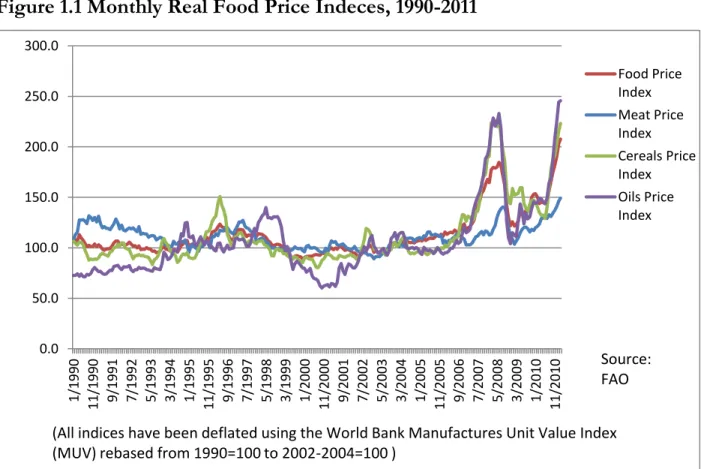
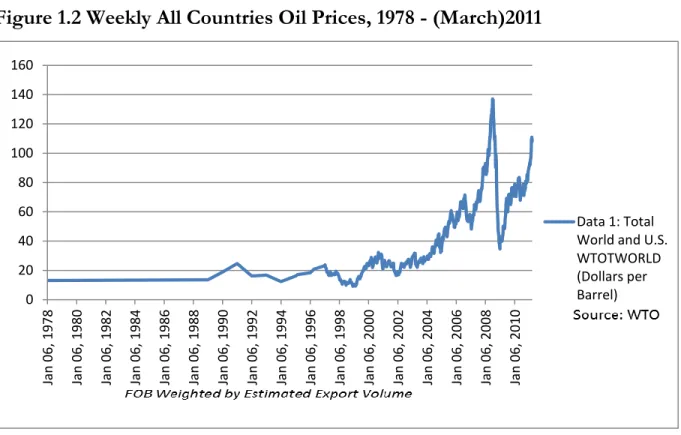
production regime relies heavily on high-input from the petroleum industry both for transport and for fertilizer. In the last few years especially, greater attention has been paid to the relationship between transport costs and food prices. This has largely been due to the swift increases in both food and the price of oil, disproportionate to the increases over previous decades. (See figures 1.1 and 1.2)
International agro-industrial companies, many based largely in the U.S. and operating at home and abroad, have sought to expand or found their production in countries where there may be factors working to their advantage. These often take the form of lower labor costs and minimal compensation for externalities such as pollution or a lack of adequate consideration for worker health. The avoidance or persistent “externalization” to different sectors or governments of these costs has been
profitable for many of the agro-industrial companies. Corporations, governments and indiviuals are then able to produce and consume food at costs which do not reflect the correct value or impact of their production. Given the current trends of the impacts of this system, it does not project well 25 or 50 years into the future. The word most typically used to describe this systemic fault is “unsustainable.”
17
As the number of hungry people increases and the food supply more unstable due to prices, climate change and production dynamics; it is possible to see the causes of increasing food insecurity on a global scale. A focus on research at the world‟s largest international development and lending institutions is intensifying in this area in an effort to better understand the growing crisis. In this way, the concepts of
sustainability and food security are inherently linked. To discuss food security without consideration for future generations to have the same would do nothing to settle the issue, but put the future in greater disadvantage.
Figure 1.1 Monthly Real Food Price Indeces, 1990-2011
0.0 50.0 100.0 150.0 200.0 250.0 300.0 1/1990 11/1990 9/1991 7/1992 5/1993 3/1994 1/1995 11/1995 9/1996 7/1997 5/1998 3/1999 1/2000 11/2000 9/2001 7/2002 5/2003 3/2004 1/2005 11/2005 9/2006 7/2007 5/2008 3/2009 1/2010 11/2010 Food Price Index Meat Price Index Cereals Price Index Oils Price Index Source: FAO (All indices have been deflated using the World Bank Manufactures Unit Value Index (MUV) rebased from 1990=100 to 2002-2004=100 )
18
Figure 1.2 Weekly All Countries Oil Prices, 1978 - (March)2011
1.6 Methodology
This study intends to examine the current dynamics of global agricultural production as it relates to current and future food insecurity via the small hold farmer. It will focus on the United States as a major producer and policy negotiator, its production dynamics and its relations with developing countries with which it has trade
agreements and official aid disbursements. It argues the need for a re-orientation of agrarian policy in advanced economies in favor of ecological sustainability, more egalitarian terms of trade and a re-think of subsidization that would have positive implications world-wide in real and diverse terms. It examines the most recent literature on global food security and attempts to frame the current debate between agricultural sustainability and food security through development of local best practice on one side and liberalization of domestic agricultural markets and industrial
agriculture on the other. It further attempts to make a case for absolving them from
0 20 40 60 80 100 120 140 160 Jan 06, 1978 Jan 06, 1980 Jan 06, 1982 Jan 06, 1984 Jan 06, 1986 Jan 06, 1988 Jan 06, 1990 Jan 06, 1992 Jan 06, 1994 Jan 06, 1996 Jan 06, 1998 Jan 06, 2000 Jan 06, 2002 Jan 06, 2004 Jan 06, 2006 Jan 06, 2008 Jan 06, 2010 Data 1: Total World and U.S. WTOTWORLD (Dollars per Barrel)
19
their political contexts which has for so long rendered them biased and unscientific. A more specific study in Chapter 5 will concern the relationship between the United States and a sub-Saharan West African agricultural context, with a special focus on Ghana. It intends to show that much of the commerce between this region and the U.S. has not produced the significant beneficial conditions for African small hold farmers or the nation at large that would meet proposed goals for development. The research will make analysis in the context of three key issues to be addressed for the progress of long-term food security and the plight of the small-hold farmer. Compiled here as a consensus taken from review of the current literature they are a) economic, ecological and social sustainability, b) the effects of crises and shocks and d) subsidies and terms of trade. It will conclude with an assessment of these factors in the global context.
20
Chapter 2. The Multifunctionality of Small Farms
2.1 What is a “small farm”?
Food insecurity and hunger has historically been the plight of the impoverished. It therefore affects those who have relatively little or no capital to establish production or purchase resources. This chapter will discuss the current state of farms and farm dependents which have relatively little capital and are working in small-scale
agriculture. This global group represents nearly 75% of the world‟s impoverished. Promoting the small-scale argicultural sector is increasingly seen as one of the most important, efficient and equitable ways to fight hunger and food insecurity. The reasons behind this recent turn in development thinking will be discussed in this chapter.
A primary issue for small-scale farmers is that there is so much disaggreement about what a small farm actually is. There are very few – if any – internationally recognized definitions of a small farm. Definitions vary widely internationally and differ
significantly over time even among the same domestic organizations. (Hubbard, 2009) (USDA, 1998) (USDA, 2007) Unfortunately, the current definition in use by the the USDA, the World Bank and several major international agencies narrowly focuses on the monetary value of production only and thus provides a very narrow preception of farm assets and value. In the United States for instance, in use is what could be
considered a rather broad definition of what constitutes a small farm. A small farm is defined as a farm with a gross farm income of less than $250,000 per year. (USDA, 2007) Subsequently, the claim is made that 94% of farms in the United States were small farms in 2007. (Ibid.) This threshold is set quite high to include as many farms as possible within the nomenclature and suggest the relative health of the small farm
21
community in the U.S. Therefore it is more of a political definition than one that corresponds to reality. A pertinent example of this bias toward vague description can be seen on the website of The Washington State Department of Agriculture. It makes neither a stipulation of size nor of any other quantification whatsoever in its
definition, “WSDA defines a small farm as one where the farmer or farm family participates in the day-to-day labor and management of the farm, and owns or leases its productive assets.”6 (WSDA)This in effect makes a “small farm” nearly any farm.
This paper would prefer to use a more precise definition of “small family farms” – one that more aptly reflects the production and asset-holding realities not only in the United States but internationally for small hold farmers. However, though definitions even in developed countries are vague and changed on a fairly regular basis, they vary further in dealing with international comparisons. For the purposes of this study, it is important to clarify this concept of a small-holder according to a more realistic
description. It must be more in keeping with what the reality of their day to day reality in the context that the world agricultural systems dictates. They comprise the largest group of farmers and are those specifically involved in owner/operator
labor-intensive, non-industrial food or commodity production on which the land under use constitutes that which can be managed by a small labor force without the use of large industrial equipment or major technological input. In monetary terms this means sales well under $250,000 dollars a year, though in nearly all countries, especially developing countries such as Ghana, the number will likely be far far less.
An apt analysis and literary review pertaining to the problems associated with defining small farms in the EU was carried out by Hubbard, 2009. He asserts that the
6
http://agr.wa.gov/Marketing/SmallFarm/smallfarmdefinition.aspx (WSDA) (Since 10/4/2011, this link has been removed)
22
Common Agricultural Policy (CAP) in the EU differentiates among small farms as substinence and semi-substinence and that the latter are “agricultural holdings
which produce primarily for their own consumption and also market a proportion of their output”7 (Hubbard, 2009)These definitions provide a theoretical basis for an assessment which is far closer to the mark in describing a majority of small farms worldwide.
Yet, the vagaries in defining the asset classes of farms are relevent in the much larger conversation of establishing non-monetary value assessments of agricultural
production. Given the enormous importance and wide scope of environmental impact both positive and negative in the agricultural sector, a broadening of the factors involved in farm-asset definitions is sorely needed. Though difficult to
quantify, many factors such as in situ biodiversity, soil replenishment, carbon capture and off-farm “externalities” must be included among them. Similar to the wider spectrum of indicators involved in Amartya Sen‟s “Capabilities Approach” to human development, such a spectrum must be adapted to the valuation of agricultural assets and production to include elements currently unaccounted for which are leading to a market failure in the real assessment of costs in food production.
2.2 The state of small farm dependents
“Over 75 % of the world‟s poorest people – 1.4 billion women, children and men – live in rural areas and depend on agriculture and related activities for their
livelihoods.”8 Small farms make up the bulk of this agricultural production and
therefore constitute perhaps the world‟s most populous productive economic activity. In the eyes of many, the way to sustainable food security and equitable rural
7
Council Regulation (EC) 1698/2005, Article 34 (1) on support for rural development by the EAFRD
23
development world-wide is the support, protection and empowerment of this most broad of human economic and ecological activities, small-scale agriculture.
Yet, they are to a great extent under assault both theoretically and in real terms by the present developmental paradigm. Samir Amin states in 2003, “Modern capitalist agriculture – encompassing both rich, large-scale family-farming and agribusiness corporations – is now engaged in a massive attack on third world peasant
production.” (Amin, 2003) Furthermore, despite their optimistic tone, the outlook assessment on food security of many international lending and development
organizations is fairly grim. Projections demand an increase in production by 70% to meet population demands with a modest to negligible increase in agricultural land and perhaps increasingly adverse growing conditions due to global climate change and water scarcity - given consumption demand trends remain stable. (FAO, 2010a)To solve this problem and to fill this gap the common rallying cry is to improve
productivity, efficiency and to engineer crops to suit this purpose. Yet the rallying cry is misleading. There is currently plenty of food to properly feed the world population and certainly enough agricultural infrastructure, if there were a re-orientation of policies and appropriate pricing. Increasing demand for meat in the developing world (especially in countries such as China, India, Brazil) has led to higher soy and wheat prices (since there is more being used as feed) as well as more potentially productive land being put under pasture. (Magdoff, 2008) Secondly, increased production of biofuels has crowded out food production and further driven up prices. (Ibid.) In a 2010 FAO report,
“Livestock is the world‟s largest user of land resources, with grazing land occupying 26 percent of the earth‟s ice-free land surface, and 33 percent of cropland dedicated to the production of feed. The quick expansion of the sector is a cause of overgrazing and land degradation and an important driver of deforestation. …It is also the largest global source of methane emissions.”(FAO, 2010a)
24
It would in fact not be difficult at all to produce enough food to feed the world
properly – in fact we are currently most likely doing it - but it would require a shift in priorities in the manner of consumption and in fuel provision and the political will to pursue improvements. In this way, international aid/food/development agencies and governments who send a distress call for greater production before addressing
misallocations of current resources seek to perpetuate the current unequal,
unsustainable and highly illogical system and its glut of wrongly-oriented susbsidies and special interest concessions.
Hand in hand with this improper stewardship of policy is the irresponsible
stewardship of land and financial resources. Indeed, many of the best arguments for a renewed orientation toward small farms are the effects of the large farms themselves - their effects on people and the environment. Much of this irresponsible stewardship is the lack of much stewardship at all. At fault is the permission of policy-makers for the agricultural sector to be oriented, directed and governed by short-term monetary profit margins rather than short-, middle- and long-term social, environmental and developmental considerations. This profit-oriented structure is exemplified in the large-scale industrial monoculture system, which is the dominant structure of the current global agricultural system. It has,
1) increased the need for inputs such as chemical fertilizers, insecticides and herbicides which have caused severe damage to land and sea ecosystems worldwide. (Blann et al., Nov 2009)
2) reduced biodiversity and produced a dependence on technological and genetic innovation as well as significant inputs (fertilizer) without which the system would fail to produce. (IAASTD, 2008)
3) kept trade prices low worldwide, hindering development in poorer, food-exporting countries and abetting worldwide urbanization trends. They have
25
marginalized the democratic involvement of rural populations and have
broadened rather than narrowed the inequality gap between the richest and the poorest. (Wade, 2001) (Amin, 2003)
4) created an environment of unnatural growing habitation where viruses and bacteria grow stronger and increasingly immune to many modern medicines, giving birth to super-contagions such as: avian flu, swine flu and mad-cow disease. (Altieri & Rosset, 1999)
These agricultural trends have occurred because it is the most efficient way to accumulate capital through farming and food production on a large scale, and they have done so often with the support of governments and other marketing agencies. Yet, this profit-based system of agricultural production continues to be a destabilizing factor in the world economy, it is debilitating not only to the environment through effects such as run-off and biodiversity loss, but to its own means of production in the form of soil degradation. (Blann et al., 2009) Furthermore it is depressing prices world-wide which hinders farmers in developing countries from realizing gains from non-depressed, non-distorted prices and from realizing maximum gains from their own domestic markets. At the same time, it invites speculation in major commodities which further distorts prices and creates development aid and price volatility – also shown to hinder development. (Ponczek, Markandya, & Yi, 2006) (IMF, 2005) An acceleration of the status quo system of production as promoted by many of the major actors presents no long-term answer to food insecurity. The system is in fact, a threat to itself and to future food supply. Perpetuation of this thinking creates a
dependence that moves us further and further away from sustainability for the sake of cheap production. The counter balance to this failing system is the small-scale farm and the traditional subsistence farmer; but of course, they cannot hope to compete on
26
an even field in commodities whose industrial producers enjoy subsidies and economies of scale.
Agriculture remains the primary source of employment, livelihood and income in developing countries, usually for between 50 and 90% of the population. From this percentage, “small farmers make the up the majority, up to 70 – 95% of the farming population.” (Kwa, 2001) Small farms continue to be one of the most important economic units on the planet consisting of a significant proportions of the
population of developing countries – and furthermore a significant proportion of the world‟s “food insecure.”
2.3 Production on small farms
One of the main arguments for large-scale monoculture is that it is very productive. However, it has been shown on numerous accounts that small farms are considerably more productive per acre of farmland.
Evidence from around the world demonstrates that small, owner-operated farms typically produce more output per acre than large farms cultivated by means of wage labor or tenants. A recent report on the relationship between farm size and total output in fifteen countries in the global South found that in all cases relatively smaller farms were more productive per unit area, by a factor of two to ten times. (Rosset, 1999)
There is greater production potential in small farms because they are more labor intensive and tend to produce more high value crops such as vegetables. (Rosset, 1999) Small farm production, being subsistence or semi-subsistence, generally
produces higher quality crops and vegetables due to the fact that since the farmers are typically growing for themselves and selling the surplus, they may in fact produce a higher quality product that will more likely be bought and sold and consumed locally.
27
While the argument over the benefits of genetically modified organisms (GMO‟s) continues and many major problems coming to light, new arguments are being made for the benefits of in situ biodiversity realized on small holder farms. (Bellon, 1997) (Boyce J., 2004) In situ, referring to biodiversity on the farm, is more natural and more resilient than ex situ diversity preservation in gene and seed banks. The preservation of seeds in seed banks is not an adequate substitute for diversity that is yearly exposed to changes in climate and soil, and with the decline of small farms in their prominent role as protectors of these “evolutionary gardens” as Boyce refers to them, fewer species become naturally resilient to these changes, potentially greatly altering the food system as a whole in the future. Furthermore, scientists often find the genes they need to create stronger species in the very diversity that the industrial system is
supplanting. As is noted in Boyce 2004:
In other words, the long-run sustainability of low-diversity agriculture rests on a continuing flow of biological inputs from the high-diversity agriculture.
As a case in point, he cites a1970 corn blight in the Southeastern US in a 2004 report:
The stakes in this „varietal relay race‟ are high, as was demonstrated in the United States in 1970,when the southern corn leaf blight destroyed one billion bushels of maize, including as much as half the harvest in some southern states. The epidemic was caused by a new strain of a fungus, Bipolaris maydis, which was virulent on plants with a genetic makeup shared by 85% of the maize grown in the US at the time. Plant breeders were able to respond in the following year by incorporating genetic resistance they found in some maize varieties grown in Africa. (Mann, 2004) reports that scientistswere „shaken by how close the system had come to disaster.‟And that „theyhad been lucky that the problem was quickly contained, and luckier still that the African maizehad not been supplanted by vulnerable modern hybrids.‟ (Boyce J. , 2004)
28
Small farms are often far more diverse in their production, a key factor that is often ignored in most studies done by major institutions when looking at farm-size
productivity. This biodiversity is important for reasons that are not easily quantified by economic research and are therefore largely left out of discussion. In fact nearly all farm research surveys done by major institutions such as the World Bank and the USDA include only a very limited range of factors for assessing farm efficiency and productivity. Therefore, nearly all measures of production – and perhaps more importantly the real value and harm of all inputs and outputs – are distorted and miscalculated. This reflects a bias for non-inclusion of many beneficial and or harmful factors and a perpetuation of a misguided status quo in development thinking. Often unincluded or underestimated in their valuation of developmental support and
progress is an accurate assessment of benefits and negative externalized elements. Though there is increasing awareness of this oversight, it has been slow in translating to real and effective shifts in policy. Instead of promoting more sustainable and ecologically-oriented systems of agriculture to augment negative effects in monoculture production (such as soil degradation, run-off of fertilizers and
biodiversity loss), the focus has been to offset (and subsidize!) these losses elsewhere in the system by allowing fields to lie fallow in “carbon capture” schemes or to offset them in markets through other trading schemes. (FAO, 2008) The chief international institutions of development have renewed their commitment in writing to a broader measurement of development and the goals supported by the indicators of the
Human Development Index (HDI). Yet, they largely fail to provide much assessment data on the real – non-monetary– values of production and perhaps more
significantly, the kind of ecological damage caused by non-sustainable agricultural production that is an unfortunate and prominent aspect of the developed world.
29
Chapter 3. Price Volatility: IntegratedWorld Markets andSpeculation “Developing countries have got to de-link from that global market and ensure their own food supplies as soon as possible through their own production, through regional arrangements and other means because the global market is simply too unstable.” –Jayati Ghosh, Interview with RealNews.com,2011
3.1 The Dominant Agricultural Regime
In this chapter, the current dominant industrial agricultural production regime is discussed as well as its relation to price volatility in world markets. The chapter examines briefly what the history and theoretical foundations of current policy are as well as the structure and charactersitics of operation. It discusses the inherent
weaknesses and negative impacts of a highly volatile system, which are multi-dimensional and include ecological, social and developmental aspects. It analyzes further the relationship that globalization trends share with food insecurity and the lack of development progress both in terms of inequality and hunger.
The current dominant economic philosophy of world markets and trade is free-market capitalism. It is the dominant ethos for policy-making in the world‟s largest economies and institutions, and is often the primary ideological driver for policies of international trade and development, such as the WTO rules. One of the most dominant forms of capitalistic regime (as it is held by the several of the largest
economies) is “neo-liberal” capitalism, and claims that any attempt by government to intervene in markets whether in promotion of growth or in a regulatory capacity is a corruption of a system seeking balance and a violation of consumer‟s freedom of choice. (Cato Institute, 2001) However, in practice, no market in the world is a “free-market”. Even its strongest proponents are often in contradiction with their ideals as
30
they support special agreements and maintain barriers in their own home markets. (McKinnon & Cumbers, 2007) Understanding this current neo-liberal global paradigm is important as the plight of the small hold farmer is discussed within the context of this greater economic framework. It is truly is a “David and Goliath” relationship. The current agricultural production and trade policy regime sought after in the global South by the advanced economies can be considered to be at best a tangled web of contrasting interests and questionable policies in the pursuit of liberalization and globalization. Globalization represents an increasing level of integration of the world‟s collective markets, however it is an umbrella term and its meaning ambiguous.
Therefore, in reflecting on these policies, it is necessary to break it down into more descriptive and useful parts to understand it more clearly in context. It is used here as a term referring to the composite of internationally integrating processes 1) financial arrangements 2) trade 3) FDI 4) monetary and other transfers 5) human capital transfers (skills, information, migration).
Agricultural policy is affected by all of these aspects, and to understand what is good policy is to understand the current and future requirements of agricultural production in this context. Agriculture is a unique enterprise. On a very basic level it is the
industry that provides our needs on a daily basis. In times of crises, an individual can do without a new car or a new t-shirt, but our agricultural systems produce that which all humans need in quality, quantity and quotidian regularity. Its constant supply is a basic requirement for life and – less tersely – all other forms of production. Its
production is dependent on sensitive ecological systems that must be maintained well within the limits of their survival. Removing all constraints on the regulation of such delicate systems in the name of releasing them to efficient, profit-oriented market forces is a dangerous and potentially disastrous notion. For since we as humans are
31
dependent on them for our survival, the failure of such systems is simply not an option.
3.2 Causes of Crisis
It stands to reason that to know what kind of boat one needs to build, it‟s important to know on what kind of seas one plans to sail. On the oceans of the world‟s global economy, those seas are becoming more turbulent and the strength in the designs of the ships is becoming of greater importance. In recent decades, a greater prevalence of crises has buffeted globally integrated markets with an uncertainty they have been and are currently ill-adapted to navigate. Several such factors of destabilization in world agricultural markets are listed in a 2010 FAO policy brief:
Increased vulnerability is being triggered by an apparent increase in extreme weather events and a dependence on new exporting zones, where harvest outcomes are prone to weather vagaries; a greater reliance on international trade to meet food needs at the expense of stock holding; a growing demand for food commodities from other sectors, especially energy; and a faster transmission of macroeconomic factors onto commodity markets, including exchange rate volatility and monetary policy shifts, such as changing interest rate regimes. (FAO, 2010b)
To be sure, in agriculture “weather vagaries” are an intrinsic element of instability. Droughts, disease and otherwise adverse conditions in changing climate dynamics can lead to unexpected yields and therefore fluctuations in prices due to supply and
demand conditions, and must be planned for as constituting the natural element of uncertainty in food security.Yet to a far greater extent than weather vagaries, an upward trend in the force and frequency of “storms” in other sectors and markets affect the amount of demand and capital in many agricultural markets. Speculation can and does cause abrupt and significant price fluctuations. Recently, these
32
fluctuations have reached levels that developing countries (DE‟s) and advanced economies (AE‟s) alike have proven to be either unable or ill-equipped to absorb. As Fred Magdoff outlines three major reasons for food price increases in a 2008 article,
“The reasons for these soaring food prices are fairly clear…increasing petrol prices…, …increased demand in countries that traditionally didn‟t import food like İndia and China, [a shift toward] production of corn for ethanol in that US rather than food, and an increase in prices of corn and soybeans and soy cooking oil is (due to) increasing demand for meat among the middle class in Latin America and Asia, especially China”. (Magdoff, 2008) We have seen pushback to this trend in the form of more loudly-voiced concerns from governments and international agencies. This has led to the formation of a few committees to carry out research such as the International Assessment of Agricultural Knowledge, Science and Technology for Development (IAASTD) and the (Report on) Plant Genetic Resources for Food and Agriculture (PGRFA). These committees were designed to pursue fairly specific yet universal concerns in food security and agriculture held by governments from around the world. Their findings, often calling for a far different approach than the current one, have been largely written off by many major agro-industrial firms and their political counterparts as inconclusive. (IAASTD, 2008)
Furthermore, price insecurities have been a significant contributing factor to riots in many parts of the world in 2008 and 2010 and regime change in Tunisia and Egypt (Observer, 2008) To a greater extent than hunger, food prices and their volatility.have been on the rise for more than a decade and in some countries, especially in the
Middle East, these shortfalls of security have proven to be a force for change, but not enough has yet been done to counter the trend.
33
Though prices in the world markets can be manipulated by the direct or indirect policies of the main producers of a commodity, the parallel inclining trends of both prices and volatility over the last ten years especially are due to three maincauses:
1) Climate change and increasingly “serious weather events” have caused conditions to change in many of the world‟s growing regions and they are forecasted to continue to do so. (PGRFA, 2009) (FAO, 2010a)
2) Increasing demand due to growing consumption, primarily in India and China has led to higher prices – as has greater consumption of biofuels and the higher price of oil. (Magdoff, 2008)
3) Increases in both the volume and kinds of financial instruments associated with commodities markets have allowed for greater speculation in commodities markets through the purchase of contracts in the world‟s largest commodities market – the Chicago Board of Trade. Passed in 2000, The Commodity Futures Trading Act of 2000 at the Commodity Futures Trading Commission, intended to “…lessen the regulatory burdens on U.S. futures markets by creating a more flexible regulatory framework.”(CCFT) In 2007, a merger of the Chicago Board of Trade and the Chicago Mercantile Exchange created the largest commodities market in history. In the months that followed, many commodity prices were driven up to the highest prices in history.This regulatory lax has led over the past ten years to speculation that has pushed futures markets up and – in tandem – real commodities prices have followed. (Ghosh & Pollin, 2011) The most recent notable example of this was the world food crisis of 2008. In conjunction with other factors such as mildly sub-expectation yields and greater demand in that year, the crisis was in many countries a result of massive transfers into
34
commodities speculation in agricultural markets and had very little to do with traditional production/demand dynamics that couldn‟t have been avoided.The ensuing run on food and fuel markets drove prices beyond the reach of millions world-wide and disproportionately so in regards to those living close to the margins in developing countries. As stated by the World Bank, the now well-known number of 100 million people plunged from relative stablility into poverty in 2008. Yet many more were forced to make priority-related adjustments, sacrificing previously accumulated assets, health care and education opportunities in order to have and afford food. These are long-term losses in development for short-term consumption needs. Therefore, as unregulated markets pass through crisis originating at the highest levels of income, it is the world‟s poorest who are set back years in their own plight for progress.
The effects of this speculation in commodities markets and the exposure to crises in other sectors are neither trivial fluctuations nor short term aberrations. Their
significance in recent crises is stated here by the IMF,
Recent commodity price developments are a reminder of the marked effects that broad financial market volatility has had on commodity prices during the global financial crisis and the early recovery. Such volatility spillovers from broader financial markets to commodity markets are not unusual, although their strength has varied depending on the underlying factors. When driven by rapidly changing expectations about future global economic prospects, as in May and June of this year, strong volatility spillovers are to be expected, given that commodities are both goods and real assets and that inventory demand is forward looking. Similarly, higher currency market volatility often leads to increased commodity price volatility. (IMF WEO, 2010)( p.63)
The extent to which regulators and their trader counterparts in liberalized
35
on a global scale in a matter of months has a historical context. It lies in trade and market relationships that have been established over decades and how within the last decade or two vulnerabilities have begun to manifest in increasingly real terms. These global linkages and the liberalization of speculation in agricultural markets and trade are crucial to understanding the nature of the “storms” that are causing chaos in many parts of the world where integration through liberalization programs has often left them vulnerable.
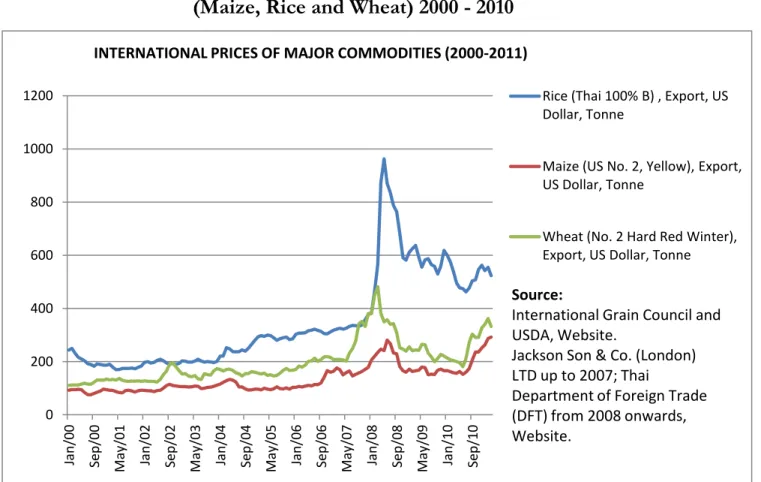
Figure 3.1 International Prices of Three Major Commodities (Maize, Rice and Wheat) 2000 - 2010
0 200 400 600 800 1000 1200 Jan /00 Se p /00 Ma y/01 Jan /02 Se p /02 Ma y/03 Jan /04 Se p /04 Ma y/05 Jan /06 Se p /06 Ma y/07 Jan /08 Se p /08 Ma y/09 Jan /1 0 Se p /1 0
Rice (Thai 100% B) , Export, US Dollar, Tonne
Maize (US No. 2, Yellow), Export, US Dollar, Tonne
Wheat (No. 2 Hard Red Winter), Export, US Dollar, Tonne Source:
International Grain Council and USDA, Website.
Jackson Son & Co. (London) LTD up to 2007; Thai
Department of Foreign Trade (DFT) from 2008 onwards, Website.
36
3.3 Structural Adjustment and Agriculture
During the 1980s and 90s in the aftermath of world debt crises, liberalization of agricultural markets was coupled with the structural adjustment reform
conditionalities of World Bank and IMF debt relief. It began the process of opening up the markets of many of the DE‟s to global competition. (Rao & Storm, 2002) Even before the Uruguay Round and the Agreement on Agriculture (AA) in the mid-90‟s, many of these structural programs had moved many DE‟s well on their way toward global market integration, international competition and institutionalized uniformity, reducing the options and resources available to them for controlof their own agricultural policy.(Ibid.) In many DE‟s where the agricultural sector represents (or represented at that time) a significant proportion of GDP, this became a very significant condition on overall macro-economic policy. “Agriculture-related pricing or trade policy conditionalities were part of 60 percent of all World Bank adjustment lending, 80 percent in the case of Africa.” (Rao & Storm, 2002)
These adjustments, which by and large created terms of trade favorable to the economies and policies of the AE‟s, continue to have major implications to both development and food security. In 2008 and 2009, the repercussions of these liberalizing reforms have been made visible by the fact that so many people were pushed into poverty across the developing world by crises originating in the markets of the western world. Reeling from a crisis in which commodities speculation played a major role in driving up world food prices in 2008, DE‟s and AE‟s alike resorted to emergency measures and safety nets to avert larger humanitarian crises.
Worldwide traditional agricultural production has been negatively affected by these conditions imposed by the recovery instruments of the major lending institutions. This has cleared the in-roads for many multi-national corporations and their
37
continuingly dynamic contribution to agricultural production. This has been largely the result of two main areas of liberalizing reforms:
a) the dismantling of the protections of DE‟s from world markets and trade rules set under the auspices of heavy lobbying initiatives from powerful firms based in AE‟s. This has created vulnerabilities so apparent, that the IMF has begun rating country systems according to their assessed exposure levels to world crisis potentials and vulnerabilities to transfer fluctuations. (IMF 2010)
b) altering the production dynamics of DE‟s away from “inefficient” smaller farms towards the “efficient” capitalist, industrial dynamic of agricultural production found primarily in countries that can afford the kind of high-input systems of the AE‟s. The small-scale production dynamic is at present unable to meet the needs of all growing demand in its current state, but it‟s slow eradication incurs invaluable losses in terms of rural poverty reduction, sustainability, crop diversification and food security. (Boyce, 2004); (Boyce, 2005); (Rao & Storm, 2002) (IAASTD, 2008) Another factor is the exploitation of the weak, post-debt crisis bargaining position of developing economies by the AE‟s to impose favorable terms of trade for the “North”. It was this which the Uruguay Round and the formation of the WTO were intended to remedy. The continuing absorption of valuable resources away from DE‟s to AE‟s will be discussed more in chapter 4.
The reality for many developing countries is that under the reforms that were made a condition for major institutional lending during the 1980‟s and onwards, the trade-off was greater exposure to increasingly volatile international markets and fewer tools (as well as incentives) to manage domestic agricultural policy according to long-term goals. This has often left them with little recourse but to accept less than favorable
38
terms of both trade and borrowing policies. The Agreement on Agriculture during the Uruguay Round was intended to restore more balanced benefits in addressing the inequities produced by these adjustment policies. Instead it produced further inroads for AE‟s in terms of trade and quotas and further reduced the capacity for
autonomous trade or agriculture policy for developing countries.
3.4 Price Volatility due to Speculation
However, it would be a mistake to consider developing economies as the only ones who are unhappy with the current state of world agricultural markets. In addition to the poverty and the human health concerns associated with massive price upheavals in food, many wealthy countries that are not agricultural producers and have strong social safety nets recognize their vulnerabilities as well. Many are seeking to secure price stability now and for the future through unconventional means. Though the countries of the Gulf Cooperation Council (GCC) have long enjoyed the benefits of low inflation and ample financial resources due to oil exports, inflation in food imports over the last several years has set wheels in motion for changes in policy.
Agriculture is not a significant sector in the economy of many GCC countries, roughly 1–4% of GDP. (Kotilaine, 2010) What little there is can be easily and heavily
susbsidized by the profits in other sectors. The typically arid countries of the GCC import between 60-90% of their food and are therefore quite vulnerable to
fluctuations in international markets. (Woertz, 2008) Due to ample capital and few domestic agricultural resources, they are eyeing investments in land and resources in poorer countries throughout Asia and Africa, not in the form of trade agreements –
39
which are limited by WTO regulations – but through lease agreements and contracts. (see Appendix B9.) (Ibid.)
Though this sort of investment is needed in many parts of the world, it raises an important issue about the nature of this foreign-owned infrastructure and these resources during a crisis. Given the event of a food crisis, these investments are intended to stabilize prices and secure food for the country that has provided the capital for the investment, not the country in which they exist. In such times, vital food resources may be removed from poor regions and transferred to wealthy areas, aggravating the crisis. This may then be a partial solution to food stability for wealthy countries that have minimal agricultural production, but for the poorest countries of Asia, Africa and South America, it represents a structural weakness in their own system in the long run.
South Korea is a country that has also sought unsuccessfully in the past to secure long-term leasing agreements in developing countries. The chaebol Daewoo secured a 99-year lease agreement for agricultural production in Madagascar in 2008. (Walt, 2008) When the agreement failed in 2009, it became clearer that often such arrangements are untenable. (Blas & Burgis, 2009) As a well-developed industrial economy, South Korea has a relatively small but high-cost agricultural production and
9
Since 2002, GCC countries have put extensive financing into the Merowe Dam, 350 km north of Khartoum at the fourth cataract of the Nile. The project was first conceived in 1993 and realization started in 2000. The private equity company Abraaj Capital and other UAE companies and
institutions have already acquired 800,000 acres of farmland in Pakistan, and GCC countries now engage in close dialogue with food-producing countries. At the first Middle East-Pakistan Agriculture and Dairy Investment Forum in Dubai in April 2008, investors pledged over $3billion worth of new investments in Pakistan's agriculture and dairy sectors, highlighting the country’s potential for milk and fruit production. “Forum Tackles Pakistani Role in Solving Global Food Crisis,” Arabian Business, May 1, 2008, available at: http://www.arabianbusiness.com/press_releases/detail/17551
40
a history until the late 1980‟s of protecting and supporting small-scale farming and agriculture. A disadvantage is that less than a quarter of its mountainous terrain is arable agricultural land and the legacy of price supports and other protection has gradually eroded since the late 1980s. The US has been a major contributor to
increasing pressure on South Korea to open its agricultural markets during this period. Most notably so toward the end of the recent decade when the US was at last
successful in prying open (again) the Korean market for cheap US beef. US beef was banned in Korea in 2003 because it was discovered that some of the beef had been inefcted by mad cow disease. At that time, Korea had been the third largest market for US beef with revenues in 2002 of US$816 million. (USMEF (website), 2009) The market was re-opened in 2008 amid intense South Korean citizen protests.
This sort of exposure to foreign markets and the lessons learned have prompted S. Korea to move on the offensive in promoting food and price security within its borders by measures other than protections considered unnacceptable by WTO rules. To do this, recently it has sought to buffer itself against speculation in the
commodities markets by opening its own trading house on the floor of the Chicago Board of Trade. The purpose is to secure certain price contracting agreements more directly rather than go through stratified brokerages. (Oliver & Blas, 2011) It is not alone. Abu Dhabi succeeded in establishing the same sort of trading entity to secure certain prices for metal and food in 2010.(Blas, 2010)
The continuing rise in the volumes of price contracts and derivatives in commodities markets has prompted these governments to take action and establish their own trading houses. They have done this for the simple reason of securing greater price stability and supply in their domestic markets in the context of greater instability. If the trend continues, more countries will attempt to establish their own trading houses in the major markets and their success will depend on the resources, negotiating