NATIONALISM VERSUS GLOBALIZATION:
The change of Political Messages from 1991 to 2007 in
Turkey
Prof. Dr. Şermin TEKİNALP - Beykent University*
ABSTRACT
The methodology of this research extends the content analysis of political party speeches made on the Turkish public television, TRT (Turkish Radio and Television) prior to the 1991 Parliamentary Elections. That study, made by the author of this paper, was based on the speeches of six party leaders broadcast the day before the voting for 1991 elections. We focused on those messages prior to the 1991 elections, because each party leader was allocated equal time (10 minutes each ) for their propaganda speeches. Therefore the issues to be discussed and the messages to be given to the public were crucial and considered very important by the party leaders. Indeed, it was their last opportunity to promote their manifestos outlining their unique policies to the public. Our hypothesis in this research is that there have been considerable changes in party stances from the 1991 to the 2007 elections. The parties of the 1990s gave almost no ideological, nationalistic and religious messages, whereas the parties of the 2007 elections moved to more nationalistic and ideological policies. The aim of this study is to present the cultural, ideological and sociological differences in political party messages made to the public in the past 16 years via the medium of TV and radio and comment on the possible reasons for the changes.
Key words: Nationalism, globalization. 2007 elections, political messages ÖZET
Bu çalışmanın metodolojisi 1991 Parlamento seçimleri öncesi Türkiyenin kamusal televizyonu TRT'de yapılan parti konuşmaları üzerine yapılan içerik analizini 2007 seçimlerine uygulayarak genişletmektir. Makalenin yazarı tarafından yapılan o çalışmada 1991 seçimlerinin altı parti liderinin oylama gününden bir gün önce televizyondan yayınlanan konuşmaları incelenmişti. Bu mesajlara odaklanmamızın nedeni her parti liderine televizyondaki parti propoganda konuşmaları için eşit süre (10 dakika) verilmesiydi. Bu nedenle, tartışılan sorunların ve halka verilecek mesajların parti liderleri için çok önemli ve can alıcı olması gerekiyordu. Gerçekten de bu konuşma, kendilerine özgü politikalarını özetleyen bildirilerini tutundurmak için elde ettikleri son şanstı. Bu araştırmadaki hipotezimiz 1991den 2007 seçimlerine kadar geçen süre içinde partilerin duruşlarında önemli değişimler olduğu şeklinde belirlenmiştir. 1991 seçimlerindeki partiler neredeyse hiç ideolojik, milliyetçi ve dini mesajlar vermezken, 2007 seçimlerindeki partiler milliyetçi ve ideolojik mesajlara daha çok kaymışlardır. Bu çalışmanın amacı son 16 yıl içinde televizyon ve radyo ile halka verilen politik mesajlardaki kültürel, ideolojik ve sosyolojik farklılıkları ortaya koymak ve bu değişimin olası nedenleri üzerinde yorum yapmaktır.
Anahtar Kelimeler: Milliyetçilik, küreselleşme, 2007 seçimleri, siyasal mesajlar. *
INTRODUCTION
The term performative society by Baz Kershaw (as argued in Craig 2004: 118) represents performances, which are central to contemporary public life. The images or, in another term, the extreme sophistication of image making, change the real meaning of politics. Substantial issues are insufficiently considered and the general public does not have adequate skills and knowledge to judge the constructed sophisticated media images. Craig argues that "contemporary politics is substantially centred around the production of media images and public judgments about those images. Public judgements about constructed selves is itself an important domain of contemporary politics and public life". Certainly, numerous forms or combinations of economic, sociological, psychological, and historical features play an important role in an electoral process. In other words, a variety of economic and situational needs, power relationships, demands and additional elements affect a campaign process or the outcome (Judith 2000).
As in every democratic country electoral campaigns in Turkey are designed before the elections by political parties or independent candidates to influence the decision making process of the electorate. The market-oriented liberal philosophy has had crucial effects on the broadcasting system of Turkey. Private business has overcome the state monopoly of broadcasting with popular and government support at the beginning of the 1990s, loosening - to a certain extent - previous strict rules on the content of programs, and political and commercial adverts of every kind were abundantly used in the broadcasts of private television since then. Previously, State Radio and Television (TRT) were the only television channels to broadcast party speeches for propagating their views. According to the 1987 electoral law, the total amount of time allocated to each party for propaganda speeches on radio and television was determined according to their share of vote during the previous election. But,
prior to the election day, political parties were allocated equal time for propaganda on radio and television. They were also allowed to air visual aids on state television as part of their propaganda.
In order to determine the prevailing political climate of the 1990s in Turkey, the political messages given through the public television TRT 1 the day before the elections were investigated. Our interest in those messages stemmed from the fact that each party was allotted equal time (10 minutes) for their propaganda speeches, and the issues discussed, along with the messages given to the public, were most likely to be regarded as very important core messages by the party leaders. The time allocated to the party leader or speaker had to be used very wisely, because they were to influence the maximum number of voters on the day before the elections.
Indeed, it was their last opportunity to promote their manifestos outlining their unique policies to the public. Its timing also provided an opportunity for the masses to change their party allegiance or motivate the undecided voters to go to the polls. The leaders in their last television broadcast attempted to convey over the course of those vital ten minutes the key points presented in their earlier campaign speeches. Our main hypothesis in this research is that there have been considerable changes in party stances between the 1991 and the 2007 elections. The parties of the 1990s gave less ideological, nationalistic and religious messages, whereas the parties of the 2007 elections, except for the AKP (Justice and Development Party), moved to more nationalistic and ideological policies. The AKP gave more global and positive messages for the development and welfare of the society, while others focused on nationalistic and negative messages, and it was the AKP who won the elections. This result, convincingly confirms the assumptions of the mainline theory.
The general view of television is that it has become a sphere of intensive and sophisticated knowledge management and also turned the whole area of politics into one which is dominated "by strategic personalisation". This well-known argument refers to the ability of television to present politics within a theatrical framework, where the personal qualities of individuals assume prominence. Finally "television represents the world through visual and oral conventions which work to invoke 'realist credibility'" (as argued by Craig in Corner: 95). On the other hand, television enhances the democratic process by providing political information to the masses, as it is more readily available to them. Another positive effect of television, Moog and Sluyter-Beltrado (2001:54) write, is the rising of television journalism. In many countries television journalists, in their news presentations follow the political agenda set by political leaders, reading official pronouncements and covering official events as they were provided by political elites
Buck (1993) argues that politicians became conscious of the meta-symbolic effect of television long ago, and, therefore, television's meta-symbolic function has two potential results: Not only does it influence viewers' subjective definition of reality, but the symbolic reality represented by television may eventually be influenced as well. This, he calls, using the term of D.N. Boorstin, a pseudo-event, "an event staged especially for the media, an event which would not have taken place had the media not been present." It is an event created by relevant political actors.
Wasburn (1995), in his study on democracy and media ownership puts focus on the power of the media to inhibit opposition to social order. The following approach supports the assumption of this paper:
The real power of the media lies, not in their imagined role providing neutral information for the formation of public opinion, nor in continued investigative journalism to 'keep the government honest',
nor in conscious manipulation for sinister interests. The power of the media lies mainly in the opposite direction - in inhibiting opposition to the social order, in constraining criticism, in maintaining and repairing social consensus and generally insuring that information unsettling to a climate of confidence, optimism, materialism, and consumerism is kept to the minimum. Party politics, electoral battles, and debates about unemployment, immigration, or high taxes, are all presented as part of 'the way things are': details to be settled democratically within the system, and not matters which might challenge the very rationale of the system itself. And we, as citizens, for the most part, accept all of this (Qualter as quoted in Wasburn, p. 667).
The main thrust of our analysis is to point out how television is increasingly becoming a potent instrument of global manipulation of meaning and ideology. It has been responsible for shifting the political messages in the line of the mainline market-oriented ideologies and techniques. In an economic system formally dependent on free competition, as in the case of Turkey, private enterprise can find a way to get around the monopoly of state controlled broadcasting and set up their own television and radio. At the beginning of private television broadcasting almost all the programs were foreign films and series, and the game shows, talk programs or even Turkish series, though limited compared to foreign series. The news programmes were imitations of foreign formats down to the smallest details like the way men and women presenters dressed or the way cameras zoomed in (Sahin & Aksoy, 1993).
Globalisation and Change of Politics
Suarez et al (2004: 117) argue that "global convergence is giving rise to a new pop cosmopolitanism. Cosmopolitians embrace cultural difference, seeking to escape the gravitational pull of their local communities in order to enter a
broader sphere of cultural experience. Pop cosmopolitanism does not constitute political consciousness, but it opens consumers to alternative cultural perspectives and the possibility of feeling what Matt Hills (as argued by Suarez et al: 117) calls semiotic solidarity with others worldwide who share the same tastes and interests.
Beginning in the last quarter of the 20th century, the conflict between "global interests" versus "national values" were the key issues in party propagandas. They disseminated messages for development and welfare depending on global economic cooperation. The masses were unconsciously brainwashed by market oriented global messages and shallow entertainment programs. Sugar-coated liberal commercial philosophy, taste and cultural changes were drummed into their minds. As a result of these changes, negative dialectics similar to those witnessed in the USA (choosing political actors from among the celebrity stars and figures) are developing in countries all around the world.
Political coverage increasingly came to be dominated by commercial media logic, which created a shift towards more symbolic and image oriented politics, towards more sensationalism and towards the personalization of politics. Celebrity leaders and actors were more appreciated than the party itself. These actors, in turn, have learned to tailor their communicative efforts according to the new climate of this commercial media logic. Global economy erased many of the significant differences between the traditional Left and Right in terms of their concrete political offering and ideology. Having lost their traditional social bases they learned to depend increasingly on the floating voters.
The transformation of political communication has been of great concern in political studies. Moog and Sluyter-Beltrao (2001) in their article "The Transformation of Political Communication" write about how liberalisation,
deregulation, intensified media commercialization and conglomeration have altered the ways politics are represented and presented. The transformation of politics and political communication can mainly be summarized as such: The heightening of the projection of personality and image over issue and idea, relying on image management techniques and apparatuses as political negotiation, competition and appeal, deterioration in the quality of public discourse and rising levels of public cynicism and the erosion of civic participation, increasing frustration with the politicians and the mass media as well.
2007 Parliamentary Elections
In Turkey, 2002 general elections (15th) on November 3rd, resulted in a
stunning victory for the new Justice and Development Party. The AKP received approximately 34% of the votes. This victory heralded a new unchartered territory for Turkish political history. Where was Turkey going? Was the AKP a threat to secularism? AKP's 2002 election victory prompted much optimism. In its editorial, The Guardian wrote: AK Victory Heralds New Dawn for It Takes the Plunge: Islam and Democracy Combine Forces (Rubin 2005: 6)
The 16th general election was held on July 22, 2007 and resulted in a resounding victory for the Justice and Development Party (AKP). The election was fought mostly on the issue of secularism. The victory of the AKP, which increased its votes by nearly 13 percent from the 2002 elections, can not be underestimated. Among the reasons behind this achievement the incapability of the opposition parties is generally believed to be the primary one. For that reason it is believed that those who could not sympathise with AKP's ideologies or its religious background had little choice. Throughout the election campaign AKP was the only party that promoted a reformist agenda and took a positive stance in regard to Turkey's membership of the EU.
Consequently, liberal and democrat votes went to the AKP mostly for this reason. Intellectuals making comments on the victory of AKP often argued that having been restricted to nationalist politics for so long the non-nationalist voters cast their ballots for the AKP, since it was the only party giving minimal attention to nationalist policies. Another factor, which affected the increase of votes, was the April 27 military ultimatum or "internet release".
Fifteen parties entered the election with their percentage of vote ranging from 46.66 % (AKP) to 0.08% (EMEP-Labour Party); but only three parties could manage to pass the 10% margin and could gain seats in the Parliament together with independent members.
Political Language and Content Analysis
Language is a means of communication in political campaigns. Language is a way for us to understand the difference of beliefs among political parties. When analyzing the language of a political speech or text, it is important to look at the way the language reflects the philosophy, ethics and ideology of the political party; or, as we are doing in this study, examine the way the language reflects the mainline streams of global culture, or on the contrary, the nationalistic stance against global interests. We also have to take into consideration the ideological position of the reader as well as the ideology of the creator.
Political language and discourse has always been an academic concern in political research. The classical tradition of rhetoric (from the ancient Greek) has, even to the present day, wrestled with the relationship between persuasion, truth and morality. Eloquent language is not always associated with truth and morality and often attracts deep suspicion especially when deployed during political discourse. Political scientists mostly deal with hard evidences such as voting figures, party configurations, economic statistics etc.
But in order to evaluate the efficiency of political discourse it is sometimes necessary to rely on empirical evidence to evaluate the effect on the public or indeed, to understand changes in political behaviour. In the past the analysis of political discourse has been neglected because of its complexity and the lack of theoretical definitions. As the discourse analysis or content analysis methods developed, parliamentary debates, party speeches, and the like have been the subject of study linked especially to ideology.
Parties rely on television consultants to help them utilize the medium. They have to learn what things they have to tell, what the most important things are and what the best way is to tell them. So speechmaking is fundamental to political campaigning. The Times was describing what political speakers call their "stock speeches" and what their speechwriters might also call their "module speeches". "Stock speech" is a speech that is delivered time and time again with little change. But it might vary in content depending on the place it is delivered and the audience addressed. A speech module is a single unit of a speech. Each module opens with some attention gaining device, and the candidates quickly move to a discussion of a problem. Having sketched the problem, they then present their policies as an appropriate solution to the problem. Thus a typical speech module is designed to (1) gain attention, (2) describe a problem, (3) present a solution, (4) visualize the solution (Judith 2000: 181).
Content analysis is not only quantitative research but also an interpretive work. "The language is closely bound up with culture and culture is in turn closely bound up with the practice of politics in a particular society" (Chilton 2002: 8). A discourse analyst knows that communication involves considerably more than transferring a message from a sender to a receiver. The sender puts ideas into words and the recipient has to make a certain amount of effort to interpret what might have been intended using many
contextual cues and mutually shared knowledge. This is why discourse analysts frequently speak interpretatively about their subject.
Theory and Hypothesis
The central framework of the study (Tekinalp 1996) which was made for the 1991 parliamentary elections was derived from the theory of "mainstreaming" by Gerbner and his colleagues (Gerbner, Gress, Morgan and Signorelly, 1982) and the replication of the theory carried out in England (Piepe, Carton and Morey,1990). Gerbner and his colleagues hypothesised that heavy television viewers of US programs opt for a moderate rather than a conservative or liberal nature and perceive themselves as belonging to a generalised middle class rather than an upper-middle or working class. Their theory maintains that US programming focuses on young, white, male, middle class, affluent characters, takes a left-of-center view on moral and social issues (Gerbner et al, 1982:102103). It is generally believed that in a market regulated system that has no effective institution to control television, television begins to control society by cultivating convergent social, political and moral values.
Much debate has been conducted on the homogenisation of views in the communication environment by the New World. To give a few recent examples, McLuhan and Powers (1989) defined the shift toward homogenisation as a robotic future and noted that "we will all merge into a robotic corporate entity devoid of true specialism"(p.129). Defining the homogenisation effect of television, Fiske (1987: 20) wrote that the mix of televisual (camera work, music, casting, etc), social and ideological codes come together to make a coherent, unified sense. In making sense of the program, we are maintaining and legitimating the dominant ideology. According to Fiske, the music that fills the channels deals with the product of bourgeois capitalism-urban landscapes, fast cars, and flashy and glitzy style in a parade of consumerist images which relate closely to television
commercials. On the other hand, Mcphail (1987: 18) writes that "electronic colonialism" seeks the mind; it aims at influencing attitudes, desires, beliefs, lifestyles, and consumer opinions.
Politicians express themselves through their personal, and cultural biases and the criteria they use for selecting and conveying their messages depend largely on the political culture in a given country. Cultural anthropologist Edward T. Hall described how culture affects the way a person sends or receives messages. Culture, he wrote, "is a mold in which we are all cast, and it controls our daily lives in many ways. Politicians select and interpret messages in terms of experience and the ways they have learned to respond to them" (Martin& Chaudhary 1983: 63). This argument implies that the messages of politicians may vary according to the current political culture and the needs of their society. In the evaluation of 1991 elections it was concluded that the prudent politician of the 1990s should be responsive to the voter's concerns and aspirations. The study of the propaganda speeches of six parties that entered the 1991 election provided some strong evidence to support the theory of mainstreaming.
In a study (Biocca 1991: 349) it was found that four voter types, based on the three relationship dimensions, react differently to political advertising for the candidate. Their support of the candidate is characterized on the basis of habit, rational judgment, passionate opposition or uninvolved opposition. These types are similar to those found in consumer research. In the study of the 2007 elections, which made AKP the primary party, it was hypothesised that the voters were divided into moderate mainline followers and passionate oppositions.
Huggins (2001:4) argues that there has been three main points to stress: "there has been significant extension and intensification of the role of the media in the framing, in the Castellsian sense, of social life in general and politics in
particular". He points out the second main point as the discussion on the quality of politics thus affected and the third point is that both of these developments are the consequences of major cultural shifts with the diffusion of media and promotional culture.
Based on these theories our hyphotheses on the 2007 Parliamentary elections are
H1: Parties that give more favourable welfare messages, if supported by other variables, have more chance than the others, because voters are more attracted to the picture of a happy world rather than a calamitous depiction.
H2: Parties of the 2007 elections have slid to a more nationalistic stance since the 1991 elections.
Methodology
15 parties entered the 2007 elections with only 3 parties gaining seats in the parliament we had evaluated all of the 6 parties in the 1991 General Elections. To allow direct comparisons, we have chosen our sample of research for the 2007 election as the first 6 parties, which were AKP, CHP, MHP, DP, GP, SP. The other 10 parties were either newly founded or marginal parties, which received votes in the spectrum of 0.51%- 0.08%. The independent candidates were not evaluated, because only political parties were allowed to make propaganda speeches on the State Television TRT. The minor parties other than the first six parties were marginalised and their rhetoric could be characterised as mostly criticisising the present situation in Turkey or giving ideological messages contrary to the mainline global development messages (such as socialism, labour rights, Islamic sheriah, imperialism, capitalism, etc.). Just to give an example of their standing in the 2007 election, we have
randomly chosen ODP (Freedom and Solidarity Party) and EMEP (Labour Party), and added them to the list of the parties evaluated to see the difference.
To determine the questions to be asked about the messages given by the party leaders or party speakers, the speeches to be evaluated were recorded and listened to repeatedly. The questions were categorised under 6 headings a) international, b) national, c) ideological, d) religious, e) reform and f) foreign. The international heading, for example, included topics such as democracy, human rights, equality and freedom, all of which have an international dimension. The national topic was related to the national concepts such as independence, national regime, power, unity, and so on. These were evaluated on a favourable and unfavourable basis. For instance, if the speaker spoke about economic reforms, social welfare or social reforms as their party prospectives, they were evaluated as favourable (+ve) messages. If they spoke against the government or previous governments on the basis of these concepts, then they were taken as unfavourable messages (-ve). Terrorism against the nation, national history, and Kemal Atatürk (the founder of Turkish Republic) were evaluated either as national power or national identity according to the focus of the speaker.
Under the ideological headings such labels as right, left, secularism, militarism, nationalism, the end of ideology were examined. Islam and Islamic unity and other religions were evaluated under the religious heading. As to speak against Islam was out of question, if the political Islam or the primitive and inhuman Islamic traditions in the other contries were criticised, it was labelled under the unfavourable heading. The Reform heading included topics such as political, cultural and economic change and development, modernity versus conventionalism (all those implying change along the line of the West). Messages under the foreign heading included topics such as the West, and the USA. All these concepts were carefully noted and coded on a pro and con
basis so as to measure the party's political stance on crucial national and international issues. Accusations directed to individuals or other parties that were not related at all to the previously defined categories were not evaluated.
Content analysis is not only a process of counting and calculating; it also involves judicious interpretation. Supporters of interpretative research claim that "boiling people's thoughts and activities down to numbers ignores exactly the complexity and creativity of social and cultural life which research should be illuminating" (Deacon et al: 1999: 8). Looking from this point of view, we have to admit that we made some interpretation in categorising the focus of the speeches depending on our experience of the prevailing culture in Turkey.
Findings
The number of messages evaluated varied in the range of 46-79 depending on the focus of speech in the context of topic units. Those which were not related at all to these topics were not evaluated. 8 parties were evaluated; the negativity response was the highest with SP (82 %), which gained 2.34 % of the votes and EMEP (80 %), which won only 0.08% of the votes. The other parties with higher negativity index are MHP (63%) and CHP (60%). The lowest negativity response was given by DP (7%) and in turn by GP (18%), AKP (%28), and ODP (28%).
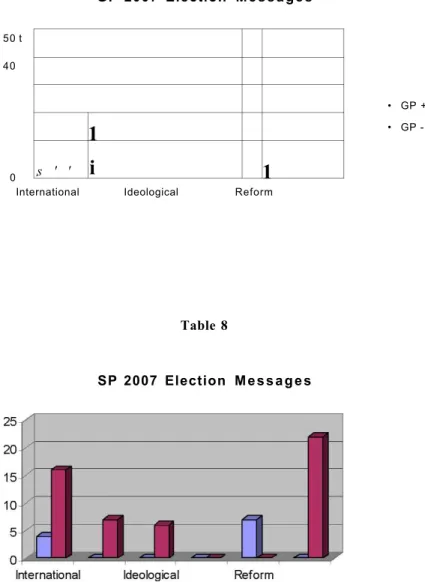
When we look at the topics on which the parties focus their criticism, we see that the party with the highest negativity index, the SP (Table 8), mainly criticised foreign relations and the USA, the West and Israel (in the context of the USA), capitalist ideology and the deterioration of national values (unity, moral values, etc); and regarding these, they criticised the government on violating stability, justice and freedom. EMEP (Table 10) criticised mainly capitalism, militarism, the USA, the West and the lack of democracy, equality, justice, stability and dependence of the country. MHP (Table 5), which is known to have the most nationalistic stance among all parties, principally
criticised the government for its incapability to protect national power, unity and regime mainly focusing on Abdullah Öcalan the imprisoned head of the Kurdish rebels and Kurdish terrorism. CHP's (Table 4) main focus of criticism was on economy, reforms, national unity and the regime, which was in danger. From the beginning it is the only party which spotlights every action of the government, and fiercely criticizes its activities. The party's strategy in general is mainly devoted to criticism. This approach is criticised by the opposition party actors and intellectuals who want the party to gain control. The CHP, whose founder was Mustafa Kemal Atatürk, has for years relied on a block percentage of votes, because of Atatürk and the republican nationalistic party politics. In order to protect that support, the party realigned to more nationalistic attitudes and discourse, although it was known as a center left party. AKP's antisecularist and liberal party politics gave lots of chances to CHP for opposition. More surprisingly, Islam, its prophet and his merits were praised by the party leader, Deniz Baykal. None of the other parties did so, not even known Islamic sympathetic parties such as AKP, SP and other right wing, conservative parties such as DP, GP or MHP.
Democratic Party (DP - Table 6) and Youth Party (GP - Table 7) must be evaluated separately, as they reflected a positive outlook to the audience; but failed. The leader of the newly founded GP, Cem Uzan, had won 7.2% of the votes in the November 2002 elections, which was a success for a new party, but failed to pass the 10% threshold to enter the Parliament. His populist and nationalistic messages using his newspaper and TV station mostly attracted the young poor sections of the big metropols. He was under investigation due to his business transactions abroad and in Turkey. The government after the 2002 elections closed his newspaper, TV station, bank and other interactions. He had lost his popularity before the 2007 elections and was proclaimed a swindler by the big media supporting the government. The messages he gave were the mainline liberal messages, mainly economic, social reforms, change
and development. Like all the mainline liberal parties, national unity, power and national identity was the main focus. Cem Uzan constructed his discourse on "stock speech" model, the "Why Am I Running" speech. He clearly and briefly visualised the things he would do if he became Prime Minister. Mostly positive messages were given.
The True Path Party (DYP), a historical right wing conservative party made an agreement to merge with Motherland Party (ANAP) and take the name Democratic Party (DP). Shortly before the 2007 elections their attempt failed and Mehmet Ağar , the leader of the newly founded DP, entered the elections alone. This created disappointment and distrust, and the party could only get 5.41% of the votes. After this outcome he resigned from the leadership. Mehmet Ağar was the one who gave the most favourable messages concentrating mostly nationalistic messages (national regime, unity, power and national, moral values) and reform messages (economic, political and social). He especially put great emphasis on economic reforms. The DP leader, like the GP leader, used a somewhat "stock speech" model, mainly focusing on himself and the party describing "Why Am I Running" (Table 6).
The leftist party ODP (Table 9) mainly focused on equality, freedom, justice (international) giving positive messages about their party ideology and about the change and reforms they would introduce. Their main criticism was on the deterioration of national moral values in the present Turkish regime. The speaker praised socialism and secularism efficiently.
Lastly, the ruling AKP's (Table 3) leader, Prime Minister Recep Tayyip Erdoğan, addressed the public on the pro and con basis. He first presented negative deeds of the previous governments, then described what they did during their rule one by one, and went on describing what they were going to do. He mainly focused on a depiction of Turkey, more peaceful, democratic, able to cope with the global race. He criticised those who hindered national
unity and power. Change and development, economic and social reforms were all favourable parts of the speech.
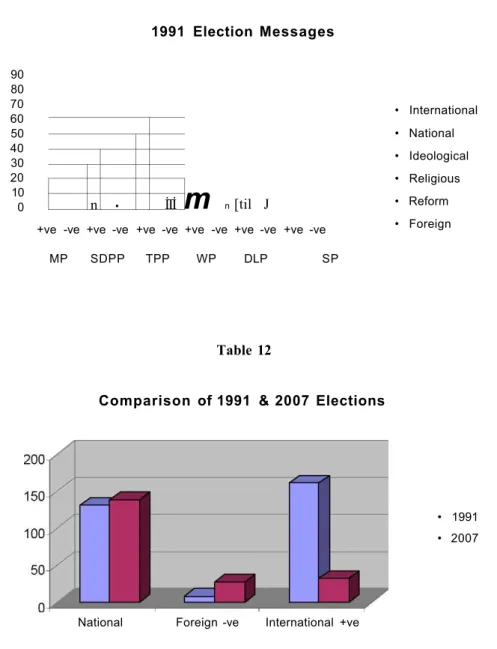
Our main hyphothesis under the light of this research is to show that parties have moved to a more nationalistic stance from the 1991 elections onward. As seen in Tables 11 & 12, the parties that entered the 1991 elections were the conservative liberal party Motherland Party-MP (ANAP); another conservative liberal True Path Party-TPP (DYP); religious Welfare Party-WP (SP); Social Democrat Populist Party SDPP (SDHP); Democratic Left Party-DLP (DSP) and Socialist Party-SP (SP). DYP won 119 seats; ANAP 177; SP 62; SDHP 11 and DSP 7. Table 13 clearly shows the percentage of cross-cultural humanistic messages against nationalistic messages.
Conclusion
Political actors seldom speak negatively about their own performances. This means that they describe things how they would like them to be. They fail to tell the voters the simple truth about the declining economy, and the growing problems of the country. In contrast, the opposition parties are highly critical of the ruling party and even exaggerate the deficiencies of the government. In this study we tested two hypotheses:
H1: Parties that give more favourable welfare messages, if supported by other variables, have more chance than the others, because voters are more attracted to the picture of a happy world rather than a calamitous depiction.
AKP (Table 3), DP (Table 6) and GP (Table 7) gave the most favourable messages. As previously explained in the findings, the DP and GP entered the elections with significant disadvantages that created disappointment and lack of trust for them and their leaders. They could only manage 4th and 5th positions respectively in the electoral battle. With exception of CHP (Table 4)
and MHP (Table 5), the rest of the 13 parties were highly critical (almost abusive) of the governing AKP.
Traditionally, opposition parties position themselves in the political arena as opposition, basing their strategy on finding deficiencies and generally disparaging the ruling party's actions and record. But they have to do this without breaking the hopes of the masses. AKP (Table 3) used this method in reverse. The leader of the party first put the cloudy, moody negative picture during the time of the previous governments and then depicted the sunshine. The other parties (except for DP and GP) started with a very dark picture of Turkey (mostly ideological and popular criticism regarding the poor, the unemployed, etc., and then described what they could do to solve the problems (all said in a hurry without any substance). Our hyphothesis mentions "if supported by other variables" (such as the present position of economy, the lack of opposition parties which could attract masses). This is a subject worthy of future analysis. But it can be said that before AKP's arrival, the Turkish political arena was ruled by coalition governments, the rate of inflation was much higher, and the political stability, unfavourably affecting the economy and the regime, was regarded risky by the masses. Other factors such as the demands of the conservative and religious sections of the country (which grew in number through the years by populist concessions of conservative right wing governments) were met openly by AKP, or they gave sufficient reassurance to placate the extremist demands of the religious sections, which constituted the power base of the party organisation. Together with these factors, peace, unity and development messages painted a picture of a powerful Turkey in the global arena, and increased the party's votes to an unexpected level. DP and GP were not supported by those favourable variables.
H2: Parties of the 2007 elections have slid to a more nationalistic stance since the 1991 elections.
It seems quite natural for the political parties in a political campaign to discuss national issues, reforms and development; but we take the nationalistic stance of the speakers into consideration here. National messages (unity, regime, power, identity, national moral values), foreign messages (criticism, mainly of the USA, and the EU and Israel), Islam, ideology (secularism which is a crucial issue of the continuation of the present regime, criticism of capitalism and praise of the national regime) made a significant showing in the total number of messages analyzed.
Table 2 shows the focus the parties put on reforms and change (economic, political, social) and the cross-cultural issues (democracy, peace, justice, freedom, equality, stability, globalisation, human rights, international agreements). This shift from the 1991 elections to 2007 elections is important because, as the country got more involved with global economic policies and relaxed control over strict national policies, the political discourse turned much more towards nationalistic messages.
In the conclusion of our study of the 1991 elections we pointed out that the mass parties of the 1990s gave less ideological, nationalistic and religious messages than they had done in the past. Even the radical parties of the right and left were conveying their nationalistic, ideological or religious messages in the context of democracy and human rights, well being and wealth to meet the requirements of a modern way of life" (Tekinalp 1996:161).
In Table 13 we compared nationalistic and global content of the party speeches of the 1991 and 2007 elections. We took nationalism and unfavourable foreign messages, which were critiques of imperialism against national independence, as "Nationalism", and all favourable messages of global content such as democracy, human rights, equality, freedom, justice,
stability, peace etc., as "Globalisation". The table clearly indicates the significant shift towards nationalism since the 1990s.
Two important findings in the research are worthy of note. Namely, though the military's role is an important factor in Turkish politics and it certainly received prominent attention in the media, no party dared to mention a single word against the military. Secondly, it was only a leftist party (CHP) that praised Islam and its Prophet Mohammed. These significant points are worthy of further comment and analysis.
Overall then, in the light of these conducted studies we are suggesting that parties in the first decade of the new millennium are sliding to a more nationalistic stance. On the other hand, the masses are still sympathising (holding their conservatism in reserve) with the parties that give mainline development and welfare messages in accordance with the new global cultural consumerist climate, which is created, multiplied and disseminated by media.
Table 1
Top 6 Parties analysed in the 2007 Election
50 45 40 35 30 25 20 15 10 5 0 f l 1 h h l i [ r
-
-
1 l r l r +ve A -ve KP +ve CH -ve P +ve MH -ve P +ve -ve P +v ; -ve GP +ve SF -ve • International • National • Ideological • Religious • Reform • Foreign Table 2Top 8 Parties analysed in the 2007 Election
50 45 40 35 30 25 20 15 10 5 0
I
e : a) r III e 1 a) 1 n e • a) e a) II • a) e e 1 II a) v > v > v > v > > v- v > + + + + + + CHP MHP DP GP SP ODP mtE
<D <D > > + 1 • International • National • Ideological • Religious • Reform • ForeignTable 3
AKP 2007 Election Messages
15n 10 /—j
1
1
0 International IdeologicalI
V Reform 5 • A K P +ve • A K P -ve Table 4 CHP 2007 Election Messages 20 t 15 10 5 0 _I I I
• CHP +ve • CHP -ve VTable 5 MHP 2007 Election M e s s a g e s 30 25 20 15 10 0
J
a .International Ideological Reform
• MHP +ve • MHP -ve Table 6 DP 2007 Election Messages 25 t 20 15 10 5 0
• L
• DP +ve • DP -veInternational Ideological Reform 5
Table 7 GP 2007 Election M e s s a g e s 50 t 40 0
-1
s ' 'i
1
International Ideological Reform
• GP +ve • GP -ve
Table 8
Table 9
ODP 2007 Election Messages
15- 105
-0-, , , ,
International Ideological Reform
Table 10
EMEP 2007 Election Messages
25 t 2 0 -x 1 5 -x 10--" 5--" 0 -/ 25 t 2 0 -x 1 5 -x 10--" 5--" 0 -25 t 2 0 -x 1 5 -x 10--" 5--" 0 - -
r
f—t • EMEP +ve • EMEP -ve 25 t 2 0 -x 1 5 -x 10--" 5--" 0 - -r
f—t • EMEP +ve • EMEP -ve 25 t 2 0 -x 1 5 -x 10--" 5--" 0 - -r
f—tI f
International Ideological Reform
• 11
0 ,
• ODP +ve • ODP -ve
Table 11 1991 Election Messages 90 80 70 60 50 40 30 20 10 0 n • İTİ
m
n [til J +ve -ve MP+ve -ve +ve -ve +ve -ve +ve -ve +ve -ve
SDPP TPP WP DLP SP • International • National • Ideological • Religious • Reform • Foreign Table 12
Comparison of 1991 & 2007 Elections
National Foreign -ve International +ve
• 1991 • 2007
Table 13
• Nationalism • Globalisation
REFERENCES
Bulck, V. den (1993). Television and the social construction of political reality. IAMCR, Dublin (June 25-26).
Biocca, F. (1991). Television and political Advertising: Psychological ProcessesVol. 1 :Lawrence Erlbaum Associates
Craig,G. (2004). The Media, Politics and Public. Alen &. Unwin
Chilton, Paul (2002) (Editor). Politics as Text and Talk. Analytic approaches to political discourse. Philadelphia, PA, USA: John Benjamins Publishing Company.
Deacon, David; M. Pickening; P. Golding; G. Murdock (1999).Researching Communications. New York: Oxford University Pres Inc.
Fiske,J. (1987) Television Culture.New York: Routledge.
Gerbner, G., L. Gross, M. Morgan, & Signorelly,N. (1982) "Charting the mainstreamtelevision's contributions to political orientations. Journal of Communication, 32(2).
Huggins, R.(2001). The transformation of the political audience In A. Berrie&R.Huggins (eds) New media and Politics. London: Sage.
Judith, T. S. (2000). Political Campaign Communication Principles and Practices. Geenweed. Publishing Group.
Martin, L.J. & Chaudhary,A.G. (1983) Comparative Mass Media Systems. NewYork: Longman.
11. McPhail, T.L. (1987). Electronic Colonialism: The Future of International Broadcasting and Communication. Newbury Park,CA:Sage. 12. McLuhan , M.&Powers,B. (1989) The Global Village. NewYork: Oxford University Press.
13. Moog, S.& Sluyter-Beltrao, J. (2001). The transformation of political communication. In A. Berrie&R.Huggins (eds) New Media and Politics. London:Sage.
14. Rubin, M. (2005). Green Money, Islamist Politics in Turkey. Middle East Quarterly. Winter.
15. Şahin, H. & Aksoy, A. (1993). Global media and cultural identity in Turkey, Journal of Communication.
16. Piepe, A.Charlton, P.&Morey,J. (1990). Politics and television viewing in England:Hegomony or pluralism? Journal of Communication. 17. Suarez-Orozco, M.M., Qin-Hillard,D.B. (2004). Globalization: Culture and Education in the New Millenium. Berkeley CA: University of California Press.
18. Tekinalp, Ş. (1996). Mainstream-centering political views in Turkish elections. In Political communication research (pp.145-163). New jersey: Ablex (eds.)
19. Wasburn, P. C. (1995). Democracy and media ownership: A comparison of commercial, public and government broadcast news, Media Culture and Society, 17 (4).