HUB LOCATION AND HUB NETWORK DESIGN
A THESIS
SUBMITTED TO THE DEPARTMENT OF INDUSTRIAL ENGINEERING
AND THE INSTITUTE OF ENGINEERING AND SCIENCES OF BILKENT UNIVERSITY
IN PARTIAL FULFILLMENT OF THE REQUIREMENTS FOR THE DEGREE OF
DOCTOR OF PHILOSOPHY
by
Sibel Alev Alumur June 2009
Philosophy.
Assoc. Prof. Bahar Yetiş Kara (Principal Advisor)
I certify that I have read this thesis and that in my opinion it is fully adequate, in scope and in quality, as a dissertation for the degree of Doctor of Philosophy.
Prof. Erhan Erkut
I certify that I have read this thesis and that in my opinion it is fully adequate, in scope and in quality, as a dissertation for the degree of Doctor of Philosophy.
Philosophy.
Assoc. Prof. Haldun Süral
I certify that I have read this thesis and that in my opinion it is fully adequate, in scope and in quality, as a dissertation for the degree of Doctor of Philosophy.
Assoc. Prof. Oya Ekin Karaşan
Approved for the Institute of Engineering and Sciences:
Prof. Mehmet Baray
HUB LOCATION AND HUB NETWORK DESIGN Sibel Alev Alumur
Ph.D. in Industrial Engineering Supervisor: Assoc. Prof. Bahar Y. Kara
June 2009
The hub location problem deals with finding the location of hub facilities and allocating the demand nodes to these hub facilities so as to effectively route the demand between origin–destination pairs. Hub location problems arise in various application settings in telecommunication and transportation. In the extensive literature on the hub location problem, it has widely been assumed that the subgraph induced by the hub nodes is complete. Throughout this thesis we relax the complete hub network assumption in hub location problems and focus on designing hub networks that are not necessarily complete. We approach to hub location problems from a network design perspective. In addition to the location and allocation decisions, we also study the decision on how the hub network must be designed. We focus on the single allocation version of the problems where each demand center is allocated to a single hub node. We start with introducing the 3-stop hub covering network design problem. In this problem, we aim to design hub networks so that all origin– destination pairs receive service by visiting at most three hubs on a route. Then, we include hub network design decisions in the classical hub location problems introduced in the literature. We introduce the single allocation incomplete hub median, hub location with fixed costs, hub covering, and
p-possibility of using different hub links, and allow for different transportation modes between hubs, and for different types of service time promises between origin–destination pairs, while designing the hub network in the multimodal problem. In this problem, we jointly consider transportation costs and travel times, which are studied separately in hub location problems presented in the literature. Computational analyses with all of the proposed models are presented on the various instances of the CAB data set and on the Turkish network.
Keywords: Hub location, incomplete hub network design, hub median,
ANA DAĞITIM ÜSLERİ İÇİN YER SEÇİMİ VE AĞ TASARIMI
Sibel Alev Alumur
Endüstri Mühendisliği Bölümü Doktora Tez Yöneticisi: Doç. Dr. Bahar Yetiş Kara
Haziran 2009
Ana Dağıtım Üssü (ADÜ) yer seçimi problemleri kaynak ve gidilecek yer arasında istenilen servisi sağlamak üzere ADÜ’lerin yerleştirilmesi ve talep noktalarının ADÜ’lere atanması problemlerini içermektedir. ADÜ yer seçimi problemlerinin çok çeşitli uygulamaları mevcuttur. Bu uygulamalar ulaşım ve telekomünikasyon alanlarında yoğunlaşmıştır. ADÜ yer seçimi literatüründeki birçok çalışmada tam serim bir ADÜ ağı varsayılmaktadır. Gerçek hayattaki çok çeşitli uygulamalarda tam serim bir ADÜ ağına gerek duyulmadığı gözlemlenmiştir. Bu çalışmada ADÜ yer seçimi problemlerindeki tam serim ADÜ ağı varsayımı gevşetilmiş ve ADÜ yer seçimi problemlerine ADÜ ağı tasarımı kararları da eklenmiştir. Bu bağlamda ilk olarak üç duraklı ADÜ kaplama problemi üzerinde çalışılmıştır. Bu problemde, kaynak ve gidilecek yer arasındaki servisin belirli bir zaman limiti içerisinde ve en fazla üç ADÜ’ye uğrayarak gerçekleşmesi sağlanmaktadır. Daha sonra, literatürde önerilen temel ADÜ yer seçimi problemlerine ADÜ ağı tasarımı kararları eklenmiştir. Yeni ADÜ yer seçimi ve ağ tasarımı problemleri tanımlanmış ve bu problemlere etkin matematiksel modeller önerilmiştir. Son olarak, çok yollu ADÜ yer seçimi ve ağ tasarımı problemi incelenmiştir. Bu problemde
ayrıca, ADÜ’ler arasında farklı taşıma yolları kullanılmasına ve farklı ikililerin farklı servis süreleri içinde servis almasına olanak sağlamaktadır. Önerilen tüm modeller literatürde yaygın olarak kullanılan CAB veri seti ve Türkiye verisi üzerinde denenmiş ve etkili sonuçlar alınmıştır.
Anahtar Kelimeler: ADÜ yer seçimi problemi, ADÜ ağı tasarımı,
First, I would like to express my sincere gratitude to Assoc. Prof. Bahar Yetiş Kara. I would not even considered a Ph.D. study if I was not working with such a great supervisor. She was there for me at all times, encouraged and trusted me, both in my professional and personal life, throughout my whole graduate study. ‘Bahar Hocam’, I feel lucky and privileged to have you as my academic mother.
I am also very grateful to Assoc. Prof. Oya Ekin Karaşan. She was always enthusiastic to share our problems and to find a better attitude. I certainly believe that her ideas upgraded my thesis. It was such a great pleasure to have worked with you ‘Oya Hocam’.
I am indebted to other members of my dissertation committee: Prof. Erhan Erkut, Prof. Barbaros Tansel, and Assoc. Prof. Haldun Süral for willingly accepting to be a member of my committee and to read and review this thesis. Their remarks and recommendations have been very helpful.
I would like to thank our department chair Prof. İhsan Sabuncuoğlu, who has helped me in every way that he can, and also from our department to Figen Eren, Prof. Ülkü Gürler, Yeşim Karadeniz and Assoc. Prof. Hande Yaman for their intimacy. I am very proud to be a graduate of Bilkent University Industrial Engineering Department.
I am also grateful to TÜBİTAK, who supported my research during my Ph.D. study.
and let me believe that I can handle. My mother Nural Alumur and brother Volkan Alumur always supported and believed in me. It is magnificent to feel that they are always proud of me. I am sure my father Demir Alumur would also be very proud and very eager to read and understand every word of this thesis. I also like to thank all the members of my rather new ‘Alev’ family. Finally, I would like to express my gratitude to my whole friends who have always been there for me, and to all the current and previous members of the room EA327. Life and the graduate study would not have been bearable without them.
I’m dedicating this thesis to my mother Nural Alumur, for all her sacrifice and for raising me to become the person that I am today.
1 INTRODUCTION... 1
2 THE HUB LOCATION LITERATURE ... 5
2.1 The p-hub Median Problem ... 9
2.1.1 Single Allocation ... 9
2.1.2 Multiple Allocation ... 12
2.2 The Hub Location Problem with Fixed Costs ... 13
2.3 The p-hub Center Problem ... 17
2.4 Hub Covering Problems ... 18
2.5 Other Studies ... 20
3 THE 3-STOP HUB COVERING NETWORK DESIGN PROBLEM 24 3.1 Motivation and Problem Definition ... 24
3.2 Mathematical Model ... 29
3.3 Linearizations ... 34
3.4 Computational Results ... 37
4 MINIMIZATION OF TOTAL TRANSPORTATION COSTS IN DESIGNING INCOMPLETE HUB NETWORKS ... 45
4.1 Motivation ... 45
Problem ... 52
4.4 Computational Analysis ... 54
4.5 Conclusions ... 63
5 INCOMPLETE HUB COVERING AND P-HUB CENTER NETWORK DESIGN PROBLEMS ... 65
5.1 The Incomplete Hub Covering Network Design Problem ... 65
5.1.1 Mathematical Formulation for the incomplete hub covering network design problem ... 67
5.1.2 Incorporating Valid Inequalities ... 72
5.1.3 Computational Results ... 76
5.2 The Incomplete p-hub Center Network Design Problem ... 83
5.2.1 Mathematical Formulation ... 84
5.2.2 Computational Results ... 85
5.3 Conclusions ... 88
6 MULTIMODAL HUB LOCATION AND HUB NETWORK DESIGN PROBLEM ... 90
6.1 Motivation and Problem Definition ... 90
6.2 Mathematical Model ... 92
6.3.2 Valid Inequalities ... 105
6.3.3 Lower Bound ... 114
6.3.4 Upper Bound ... 117
6.4 Computational Analysis ... 123
6.5 Conclusions ... 132
7 CONCLUSIONS AND FUTURE RESEARCH DIRECTIONS ... 134
BIBLIOGRAPHY ... 138
APPENDIX ... 151
A LOCATIONS OF DEMAND CENTERS AND POTENTIAL HUB NODES IN CAB AND TURKISH NETWORK DATA SETS ... 151
LIST OF FIGURES
1.1 (a) A completely interconnected network with 7 demand centers, (b) a
hub network with 3 hubs and 7 demand centers... 2
3.1 Decision variables of the mathematical model ... 31
3.2 Computational results on the Turkish network ... 40
3.3 Computational results on the CAB data set ... 42
4.1 CAB data set results with the transportation cost objective ... 59
4.2 Trade-off curve with α=0.8 and p=5 ... 60
5.1 Spanning tree idea ... 68
5.2 Incomplete hub covering results with the CAB data set ... 80
5.3 Incomplete hub covering results with the Turkish network ... 82
6.1 Resulting hub networks ... 131
A.1 Names and geographical locations of the cities in the CAB data set .. 152
A.2 Geographical locations of the 81 demand centers and names of the 16 candidate hub locations on the Turkish network ... 153
LIST OF TABLES
3.1 Parameters for the Turkish network ... 39
3.2 CPU times on the Turkish network ... 41
3.3 Parameters for the CAB network ... 42
3.4 The CPU times for the CAB data set ... 43
4.1 The results on the CAB data set with the incomplete p-hub median problem ... 57
4.2 Incomplete p-hub median results on the Turkish network ... 62
5.1 Test bed for valid inequalities ... 74
5.2 Solution times (in seconds) with valid inequalities ... 75
5.3 Incomplete hub covering results on the CAB data set ... 78
5.4 Incomplete hub covering results on the Turkish network ... 81
5.5 Performance of the hub covering model with CPLEX on large networks ... 83
5.6 Incomplete p-hub center results on the CAB data set ... 86
5.7 Incomplete p-hub center results on the Turkish network ... 88
6.1 Test bed for |N|=25, |H|=8 ... 125
6.2 The effect of valid inequalities ... 126
6.3 The effect of the lower bound and the performance of the solution with complete hub network ... 129
C h a p t e r 1
INTRODUCTION
Hubs are special facilities that serve as switching, transshipment, and sorting points in many-to-many distribution systems. Instead of serving each origin– destination pair with a direct link, hub facilities consolidate and disseminate flow. Establishing hub facilities thus results in a reduction in the number of links in the networks. Flows from the same origin with different destinations are consolidated on their route to the hub and are combined with flows from different origins but same destinations. The consolidation is on the route from the origin to the hub and from the hub to the destination as well as between hubs. This flow consolidation allows the hub facilities to take advantage of economies of scale. Figure 1.1 presents a comparison of a completely interconnected network with a hub network. As it can be observed from this figure, the number of links required to transport flow between demand centers is significantly fewer in hub networks, since the flow is transported via hub facilities.
The hub location problem is concerned with locating hub facilities and allocating non-hub nodes (demand centers) to these located hubs in order to route the flow between origin–destination pairs. The distinguishing features of the hub location problem from the basic facility location problems are thoroughly discussed in O’Kelly (1998).
Figur (b) a h Hub teleco locatio shipm specif these applic teleco for tra throug (Camp There and m (dema the in single receiv are af re 1.1 (a) A hub network location ommunication on problems ments and po fied as flows flows are tr cations inclu onferences, a ansmission o gh a variety pbell et al., 2 are two bas multiple allo and centers) coming and e hub; in m ve and send ffected by h (a) completely with 3 hubs problems n and trans s include ai ostal operati of passenge ransported w ude compute and distribute of informatio of media (s 2002). sic types of h ocation hub are allocated outgoing tra multiple alloc flow through hub location interconnect and 7 deman arise in sportation. T ir passenger ions. In the ers or goods b with some ty er communi ed computer on (such as d such as telep hub network networks. T d to hubs. In affic of every cation hub n h more than ns and optim ted network nd centers. various ap Transportatio r travel, air se applicatio between orig ype of vehi ication, tele r processing. data, voice, v phone lines, ks in the liter They differ n single allo y demand ce networks, ea n one hub. S
mal hub loc
(b with 7 dem pplication on applicati r freight trav ons, demand gin–destinati cle. Telecom ephone netw . In this area video, etc.) w fiber optic c rature – sing in how non cation hub n enter is route ach demand Since optima cations are b) mand centers, settings in ions of hub vel, express d is usually ion pairs and mmunication works, video a, demand is which occurs cables, etc.). gle allocation n-hub nodes networks, all ed through a d center can al allocations affected by , n b s y d n o s s . n s l a n s y
allocation decisions, location and allocation problems must be considered together in designing hub networks.
There are three basic assumptions present in standard hub location problems: 1. The hub network is complete with a direct link between every hub pair, 2. there is economies of scale incorporated by a discount factor (usually
referred to as α) for using the inter-hub connections, and
3. no direct service (between two non-hub nodes) is allowed; that is, the flow between all origin–destination pairs are to be routed using at least one hub.
Throughout this thesis we relax the first assumption in hub location problems and focus on designing hub networks that are not necessarily complete. We approach hub location problems from a network design perspective. In addition to the location and allocation decisions, we also study the decision on how the hub network must be designed. We only focus on the single allocation version of the problems where each demand center is allocated to a single hub node.
We start with introducing the 3-stop hub covering network design problem. In this problem, motivated by a specific cargo delivery company operating in Turkey, we aim to design hub networks so that all origin–destination pairs receive service by visiting at most three hubs on a route. Then, we include hub network design decisions in the standard hub location problems introduced in the literature. We introduce the single allocation incomplete p-hub median, hub location with fixed costs, hub covering, and p-hub center network design problems to the literature. Lastly, we introduce the multimodal hub location
and hub network design problem. We allow for different transportation modes between hubs, and for different types of service time promises between origin– destination pairs, while designing the hub network in the multimodal problem. In this problem, we also consider transportation costs and travel times simultaneously, which are studied separately in hub location problems presented in the literature.
The outline of this thesis is as follows. In the next chapter, we present an overview of the hub location literature. In Chapter 3, we introduce the 3-stop hub covering network design problem. In Chapter 4, we study the incomplete hub network design problems with transportation cost objectives and introduce the incomplete p-hub median and hub location with fixed costs network design problems. Chapter 5 presents the incomplete hub covering and p-hub center network design problems. In Chapter 6, we propose the multimodal hub location and hub network design problem. The thesis concludes with some final remarks and future research directions in Chapter 7.
C h a p t e r 2
THE HUB LOCATION
LITERATURE
In this chapter we classify and review the hub location literature. The problem of hub location attracted many researchers over the past two decades. The interest in hub location area is still strong with several papers pending. Recently a special issue of Computers and Operations Research is dedicated to new developments on hub location.
In hub location problems, there is a given node set with n nodes and the set of origins, destinations and potential hub locations are identified. The flow between origin–destination pairs, an attribute of interest associated with flows (cost, time, distance, etc.) and the hub-to-hub transportation discount factor α are known. The aim in hub location problems is to find the location of hub nodes and the allocation of demand nodes to these located hub nodes.
Perhaps Goldman (1969) is the first to address the hub location problem. However, interest in hub location began with the pioneering work of O’Kelly (1986a,b, 1987). O’Kelly (1987) presented the first recognized mathematical formulation for a hub location problem by studying airline passenger networks. His formulation is referred to as the single allocation p-hub median problem. Given n demand nodes, flow between origin–destination pairs, and the required number of hubs (p), the objective is to minimize the total transportation cost (time, distance, etc.) to serve the given set of flows. He
assumed that the hub network is complete with a link between every hub pair; that there is economies of scale incorporated by a discount factor (α) for using the inter-hub connections; and that no direct service (between two non-hub nodes) is allowed.
Let wij be the flow between nodes i and j, and cij be the transportation cost of a unit of flow between i and j. Define xik as 1 if node i is allocated to hub at k, and 0 otherwise; xkk takes on the value 1 if node k is a hub and it is 0 otherwise. The integer programming formulation of the single allocation p-hub median problem given by O’Kelly (1987) is:
Minimize (2.1) subject to 1 0 (2.2) 1 (2.3) (2.4) 0,1 , (2.5)
The objective function, (2.1), calculates the cost of flow. α in the third term is the economies of scale factor; the cost of flow between the hub facilities must be smaller than the original costs since hub facilities concentrate flow, so 0 ≤ α
< 1. Note that this objective function is quadratic due to the fact that the hub-to-hub discount is a product of the allocation decisions.
Constraint (2.2) ensures that no node is assigned to a location unless a hub is opened at that node. As suggested by Skorin-Kapov et al. (1996) this constraint can be replaced with:
, (2.6)
Constraints (2.3) and (2.5) guarantee that each node is allocated to exactly one hub, and Constraint (2.4) states that the number of hubs to be located is p. The quadratic nature of the objective functions in hub location problems distinguishes them from the classical location problems. In standard location problems when the locations of the facilities are determined each demand node receives service from their nearest facility. For hub location problems, when it comes to allocation decisions, the nearest allocation strategy – assigning each demand node to its nearest hub – does not necessarily give optimal solutions. Thus the optimal allocations of demand centers to the located hubs must also be determined.
The earliest reviews on hub location are by O’Kelly and Miller (1994) and Campbell (1994a). O’Kelly and Miller (1994) provided real world examples which violated some of the assumptions of the standard hub location model. They proposed eight classes of hub location problems corresponding to different decisions on allocation, hub interconnection, and non-hub routes; they included references and examples. Campbell (1994a) presented an extensive survey on the hub location problem that included both the transportation and computer-communication oriented models. Klincewicz (1998) offered another extensive review involving facility location, network design, telecommunication, computer systems, and transportation aspects in
hub location. O’Kelly (1998) reviewed some distinctive features of hub networks with special attention paid to the contrast between air passenger and air express freight applications. Later, Bryan and O’Kelly (1999) presented an analytical review of the studies on hub networks for passenger airlines and package delivery systems. A comprehensive review of hub location problems is a book chapter by Campbell et al. (2002). More recently, Alumur and Kara (2008a) presented a survey on hub location problems.
O’Kelly (1987) introduced a data set based on the airline passenger interactions between 25 U.S. cities in 1970 evaluated by the Civil Aeronautics Board (CAB). This data set has been used by almost all of the hub location researchers and will be referred to as the CAB data set. (Figure A.1 in Appendix A shows the geographical locations and names of the cities in the CAB data set.) Another commonly used data set is the Australia Post (AP) data set (first used in Ernst and Krishnamoorthy, 1996). AP data set is based on a postal delivery in Sydney, Australia and consists of 200 nodes representing postal districts. The main difference of the AP data set from the CAB data set other than the number of nodes is that the flow matrix of the AP data set is not symmetrical. More recently, a Turkish network data set is introduced (Tan and Kara, 2007, Yaman et al., 2007). (Figure A.2 in Appendix A shows the geographical locations of the 81 demand centers and names of the 16 candidate hub locations on the Turkish network.) The data on the CAB, AP, and Turkish network data sets are all available through the OR library (Beasley, 1990).
The hub location problem is also studied in telecommunication network design (also called backbone/tributary network design). The hub location problem in telecommunication network design differs from the classical hub location literature. The objective in telecommunication network design is to minimize
the total costs of building the hub networks rather than the minimization of transportation costs. The reader may refer to Klincewicz (1998) for an extensive review on hub location in network design, telecommunication and computer systems.
Almost all of the hub location models defined in the literature have analogous location versions. Campbell (1994b) defined a p-hub median and p-hub center on a network analogous to a p-median and p-center. He introduced four types of hub location problems to the literature: p-hub median, hub location with fixed costs, p-hub center, and hub covering problems. Our review of the literature follows this classification. The next four sections of this chapter are devoted in turn to the p-hub median problem, the hub location problem with fixed costs, the p-hub center problem, and hub covering problems. In the last section of this chapter, we present some other hub location studies that do not fit into the previous categories.
2.1 The
p-hub Median Problem
The objective of the p-hub median problem is to minimize the total transportation costs needed to serve the given set of flows, given n demand nodes, flow between origin–destination pairs, and the number of hubs to locate (p). The studies considering the p-hub median problem are analyzed here in two different subsections: single allocation and multiple allocation.
2.1.1 Single Allocation
Campbell (1994b) presented the first linear integer programming formulation for the single allocation p-hub median problem. If n is the given number of demand nodes, his formulation has O(n4) variables and constraints.
Skorin-Kapov et al. (1996) stated that the LP relaxation of Campbell’s (1994b) formulation resulted in highly fractional solutions. They proposed a new mixed integer formulation with O(n4) variables and O(n3) constraints. Skorin-Kapov et al. (1996) also presented the first attempt at optimally solving the single allocation p-hub median problem.
O’Kelly et al. (1996) presented a formulation that assumed a symmetric flow data, thus further reducing the size of the problem. An important aspect of O’Kelly et al. (1996) is its discussion of the sensitivity of the solutions to the inter-hub discount factor α. Sohn and Park (1998) formulation presents a further reduction in the number of variables and constraints for the case when the unit flow cost is symmetric and proportional to the distance.
Ernst and Krishnamoorthy (1996) proposed a different linear integer programming formulation which requires fewer variables and constraints in an attempt to solve larger problems. They treated the inter-hub transfers as a multicommodity flow problem where each commodity represents the traffic flow originating from a particular node. The authors observed and modeled how Australia Post uses different discount factors for collection and distribution. Their formulation has O(n3) variables and O(n2) constraints. So, they were able to reduce the problem size from the previous formulation by Skorin-Kapov et al. (1996), both in terms of variables and constraints, by a factor of n.
Ebery (2001) presented another formulation for the single allocation p-hub median problem that requires O(n2) variables and O(n2) constraints. This formulation uses fewer variables than all of the other models previously presented in the literature. However, the computational time required to solve
this new formulation was greater than that required to solve the formulation in Ernst and Krishnamoorthy (1996).
The p-hub median problem is NP-hard. Moreover, for the single allocation problem, even if the locations of the hubs are fixed, the allocation part of the problem remains NP-hard (Kara, 1999).
Various heuristics are proposed for the single allocation p-hub median problem. Earlier studies include the enumeration based heuristics of O’Kelly (1987), an exchange heuristic based on local improvement by Klincewicz (1991), a tabu search and a GRASP (Greedy Randomized Search Procedure) heuristic by Klincewicz (1992), and a tabu search heuristic by Skorin-Kapov and Skorin-Kapov (1994). O’Kelly et al. (1995) presented a lower bounding technique based on the linearization of the quadratic objective function, where distances are assumed to satisfy the triangle inequality. Campbell (1996) used the idea that the multiple allocation p-hub median solutions provide a lower bound for the optimal solution of the single allocation version to propose two new heuristics for the single allocation problem. Later, Ernst and Krishnamoorthy (1996) developed a simulated annealing heuristic and Pirkul and Schilling (1998) developed an efficient Lagrangean relaxation method, which finds tight upper and lower bounds in a reasonable amount of CPU time. Pirkul and Schilling (1998) were able to obtain the tightest bounds of any heuristic up to that date.
Ernst and Krishnamoorthy (1998b) proposed a branch-and-bound algorithm for the single allocation p-hub median problem in which they solved shortest-path problems to obtain lower bounds. They were able to solve the largest single allocation problems to that date to optimality with their new branch-and-bound algorithm.
As a synthesis of the existing literature, in terms of required number of variables and constraints, Ebery (2001) provided the best mathematical formulation for the single allocation p-hub median problem. However, the best mathematical formulation in terms of empirical computation time requirement is that of Ernst and Krishnamoorthy (1996). The most computationally efficient exact solution procedure is the shortest-path based branch-and-bound algorithm presented in Ernst and Krishnamoorthy (1998b). A very effective heuristic is the Lagrangean relaxation based heuristic presented in Pirkul and Schilling (1998). Finally, among the best metaheuristics are the tabu search heuristic presented in Skorin-Kapov and Skorin-Kapov (1994), and the simulated annealing heuristic presented in Ernst and Krishnamoorthy (1996).
2.1.2 Multiple Allocation
In the multiple allocation problem each demand center can receive and send flow through more than one hub; that is, each demand center can be allocated to more than one hub. In the multiple allocation p-hub median problem, if the hub locations are fixed the allocation decisions are straight forward: each pair of nodes sends flow from their shortest paths via the given hubs. Thus, after the locations of the hubs are determined one may solve the optimal allocation sub-problem by solving an all-pairs shortest path algorithm. However, as already mentioned, for the single allocation version, the allocation problem still remains NP-hard even if the hub locations are fixed (Kara, 1999).
Campbell (1992) was the first to formulate the multiple allocation p-hub median problem as a linear integer program. Skorin-Kapov et al. (1996) presented another formulation resulting in tighter LP relaxations. Ernst and Krishnamoorthy (1998a) proposed a more effective formulation for the
multiple allocation p-hub median problem based on the idea that they have proposed for the single allocation version in Ernst and Krishnamoorthy (1996). Their new formulation has O(n3) variables and O(n2) constraints. Boland et al. (2004) identified some characteristics of the optimal solutions to develop preprocessing techniques and tightening constraints, and applied these to the formulation proposed in Ernst and Krishnamoorthy (1998a).
Ernst and Krishnamoorthy (1998a) and Ernst and Krishnamoorthy (1998b) presented two new branch-and-bound algorithms for the multiple allocation p-hub median problem. In Ernst and Krishnamoorthy (1998a), they obtained lower bounds by using LP relaxations, whereas in Ernst and Krishnamoorthy (1998b) they obtained lower bounds by solving shortest path problems rather than LP relaxations. Their second algorithm turned out to be superior in computational analysis.
For the multiple allocation p-hub median problem the best formulation in terms of CPU time requirement is the one proposed in Boland et al. (2004) and the best exact solution algorithm is the branch-and-bound method proposed in Ernst and Krishnamoorthy (1998b).
2.2
The Hub Location Problem with Fixed Costs
In p-hub median problems, the fixed costs of opening hub facilities are ignored. O’Kelly (1992) introduced the single allocation hub location problem with fixed costs where the number of hubs is a decision variable.
In addition to having single/multiple allocation versions, since the number of hubs is not fixed it is possible to have uncapacitated/capacitated hub location problems with fixed costs. Campbell (1994b) presented the first linear integer
programming formulations for single/multiple allocation, uncapacitated/ capacitated hub location problems.
Several studies looked at the uncapacitated single allocation hub location problem. Abdinnour-Helm and Venkataramanan (1998) presented a new quadratic integer formulation based on the idea of multi-commodity flows in networks. Abdinnour-Helm (1998) proposed a heuristic method based on a hybrid of genetic algorithms and tabu search. Labbé and Yaman (2004) derived a family of valid inequalities that generalizes the facet-defining inequalities and that can be separated in polynomial time. Topcuoglu et al. (2005) proposed a genetic algorithm for the uncapacitated single allocation hub location problem. Later, Cunha and Silva (2007) proposed another genetic algorithm combined with a simulated annealing heuristic and Chen (2007) proposed a hybrid heuristic based on simulated annealing and tabu search. Recently, Silva and Cunha (2009) developed a multi start tabu search heuristic and a two-stage tabu search heuristic for the uncapacitated single allocation hub location problem. These heuristics are the best heuristics in terms of solution quality that are proposed for the problem up to this date. Silva and Cunha (2009) were also able to report, for the first time, the optimal solutions of almost all of the benchmark problems given by CAB and AP data sets, by using CPLEX.
For the uncapacitated multiple allocation version, Klincewicz (1996) presented an algorithm based on dual-ascent and dual adjustment techniques within a branch-and-bound scheme. Mayer and Wagner (2002) developed a new branch-and-bound method: the HubLocater. Cánovas et al. (2007) presented a heuristic based on a dual-ascent technique. Through computational analysis using CAB and AP data sets, they solved instances with up to 120 nodes.
These are the best computational results for the uncapacitated multiple allocation hub location problem up to now.
Hamacher et al. (2004) determined the dimension and derived some classes of facets for the polyhedron of the uncapacitated multiple allocation hub location problem. Marín (2005b) presented some facet-defining valid inequalities for the uncapacitated hub location problem with costs satisfying triangle inequality. Marín et al. (2006) presented a new formulation which is a generalization of the earlier formulations and relaxes the assumption of having a cost structure satisfying triangle inequality. By using polyhedral results they were able to tighten and reduce the number of constraints. Their formulation outperformed all of the previous formulations.
Aykin (1994) presented the capacitated version of the hub location problem with fixed costs where hubs have limited capacities. Ernst and Krishnamoorthy (1999) presented two new formulations for the capacitated single allocation hub location problem. Their formulations are modified versions of the previous mixed integer formulations developed for the p-hub median problem. They applied the capacity restrictions only to the traffic arriving at the hub directly from non-hub nodes. This capacity definition is usually used in postal service applications in order to represent the sorting capacity of hubs. Ernst and Krishnamoorthy (1999) also proposed two heuristics for the problem. Labbé et al. (2005) studied the capacitated single allocation hub location problem where each hub has a fixed capacity in terms of the traffic that passes through it. They investigated polyhedral properties of this problem and developed a branch-and-cut algorithm.
Costa et al. (2008) suggested a different approach to the capacitated single allocation hub location problem. Instead of using capacity constraints on the
amount of flow processed in the hubs the authors introduced a second objective function into their mathematical model, which minimizes the time hubs take to process flows. They considered two different bi-criteria problems. In addition to minimizing total cost in both of the problems, in the first one they minimized the total time of processing the flow (service time) at the hubs and in the second one they minimized the maximum service time on the hubs. Ebery et al. (2000) considered the multiple allocation version of the capacitated hub location problem and proposed a formulation which is very similar to the one proposed in Ernst and Krishnamoorthy (1998a) for the multiple allocation p-hub median problem. Boland et al. (2004) outlined some properties of the optimal solutions for both the uncapacitated and capacitated multiple allocation hub location problems. Marín (2005a) presented a new formulation for the capacitated multiple allocation hub location problem based on the same idea used in Ebery et al. (2000) but exploiting some of the ideas used inMarín et al. (2006) to reduce the size.
Considering that the p-hub median models are a special case of the hub location problem with fixed costs, there are more studies on solving the fixed cost problem (both heuristic and exact). For single/multiple allocation and capacitated/uncapacitated versions, different integer programming models, branch-and-bound algorithms, and heuristics have been developed. The p-hub median and hub location with fixed costs problems are the most frequently addressed hub location problems in the literature.
2.3 The
p-hub Center Problem
The p-hub center problem is a minimax type problem which is analogous to the p-center problem. The aim of the p-hub center problem is to locate p hubs, and to allocate all non-hub nodes to the located hubs to minimize the maximum cost (time, distance) between origin–destinations pairs.
Campbell (1994b) was first to formulate and discuss the p-hub center problem in the hub location literature. Later, Kara and Tansel (2000) provided various linear formulations for the single allocation p-hub center problem. They provided three different linearizations of the Campbell (1994b) model together with a new formulation that they proposed. Their new formulation has O(n2) variables and O(n3) linear constraints.
Kara and Tansel (2000) also provided a combinatorial formulation of the single allocation p-hub center problem and proved that it is NP-complete by a reduction from the dominating set problem.
Ernst et al. (2009) developed a new formulation for the single allocation p-hub center problem. This formulation has O(n2) variables and O(n2) linear constraints. Even though this model has n more continuous variables than the model proposed in Kara and Tansel (2000), it has fewer constraints. Computational analysis using CPLEX on the CAB and AP data sets showed that the Ernst et al. (2009) formulation is better in terms of CPU time requirements.
Baumgartner (2003) investigated the polyhedral properties of the single allocation p-hub center problem and proposed a branch-and-cut algorithm. Pamuk and Sepil (2001) presented a single-relocation algorithm with tabu-search. Hamacher and Meyer (2006) proposed solving hub covering problems
with binary search for the solution of the p-hub center problem. Recently, Meyer et al. (2009) proposed a two-phase algorithm for the single allocation p-hub center problem. They determined the set of potential optimal p-hub locations by using a shortest path based branch-and-bound algorithm followed by an allocation phase. They also developed a heuristic based on an ant colony optimization approach to provide good upper bounds for their branch-and-bound algorithm. They were able to solve instances consisting of up to 400 nodes optimally, which are the largest problems solved in the literature to date. Ernst et al. (2009) also studied the multiple allocation p-hub center problem. They proposed a new formulation and proved that the problem is NP-hard. For the multiple allocation version they proposed a shortest path based branch-and-bound algorithm which is similar to the algorithm developed for the multiple allocation p-hub median problem presented in Ernst and Krishnamoorthy (1998b).
Sim et al. (2009) studied a stochastic version of the p-hub center problem where they treated the travel times as random variables. In their model, the probability of providing service within the time limit to be minimized must be higher than a given service level parameter.
Gavriliouk (2009) proposed heuristic procedures for hub location problems based on aggregation techniques. She applied this heuristic for single and multiple allocation p-hub center problems.
2.4
Hub Covering Problems
In facility covering problems, demand nodes are considered to be covered if they are within a specified distance of a facility that can serve their demand.
Similarly in hub location, the origin–destination pair (o,d) is covered by hubs k and m if the cost (time, distance) from o to d via k and m does not exceed a specified value. The hub covering problem is to locate hubs and to decide on the allocations to cover all demand such that the cost of opening hub facilities is minimized.
Campbell (1994b) presented the first mixed integer formulation for the hub covering problem. Later, Kara and Tansel (2003) studied the single allocation hub covering problem and proved that it is NP-hard. The authors presented and compared three different linearizations of the original quadratic model as well as presenting a new linear model. Wagner (2008) proposed new formulations for both single and multiple allocation hub covering problems. By his proposed preprocessing techniques he rules out some hub assignments and thus the formulations require less number of variables and constraints than that of Kara and Tansel (2003) formulations. He further improved these formulations with a procedure for aggregating some constraints.
Ernst et al. (2005) presented a new formulation for the single allocation hub covering problem. Their new formulation performs better in terms of CPU time requirement than the Kara and Tansel (2003) formulation.
Ernst et al. (2005) also studied the multiple allocation version of the hub covering problem. They proposed two new formulations and an implicit enumerative method for this problem.
Hamacher and Meyer (2006) compared various formulations of the hub covering problem. They analyzed the feasibility polyhedron and identified some facet-defining valid inequalities. They solved the hub covering problem
for a given cover radius β and then iteratively reduced β to obtain the optimum solution of the p-hub center problem.
2.5 Other
Studies
In classical hub location problems, the hub-to-hub flows are typically discounted by a fixed discount factor α, such that 0 ≤ α < 1. However, the number and location of hubs may be seriously affected by the value chosen for α. Most hub location models have assumed that this inter-hub discount factor is not dependent on the amount of flow using the links. O’Kelly and Bryan (1998) pointed out that “the assumption of flow-independent costs not only miscalculates total network cost but may also erroneously select optimal hub locations and allocations”. They proposed a non-linear cost function which allows costs to increase at a decreasing rate as flows increase. There are some other studies proposing different cost functions to apply the economies of scale discount factor more realistically. These studies include Bryan (1998), Horner and O’Kelly (2001), Klincewicz (2002), Kimms (2005), Racunicam and Wynter (2005), and Cunha and Silva (2007).
Considering that the standard hub location models were developed mainly for airline applications, some more cargo-specific models have been developed recently. Kara and Tansel (2001) observed that the time spent at hubs for unloading, loading and sorting operations (transient times) may constitute a significant portion of the total delivery time for cargo delivery systems. They proposed new models, called the latest arrival hub location problem, for systems where the transient times are incorporated. Several versions of the latest arrival hub location problem are possible: single or multiple allocation minimax, covering and minisum versions.
The focus in Kara and Tansel (2001) was on the single allocation minimax (center) version. Later, Tan and Kara (2007) studied the latest arrival hub covering problem on an application for the cargo delivery sector in Turkey. Yaman et al. (2007) proposed a latest arrival hub center model which incorporates multiple stopovers and vehicle routes. A paper by Çetiner et al. (2007) studied a combined hubbing and routing problem in postal delivery systems, where they presented a case study using the Turkish postal delivery system data.
Nickel et al. (2001) presented new hub location model applicable to urban public transportation networks. They considered the hub location problem as a network design problem and incurred a fixed cost for locating hub arcs. Podnar et al. (2002) considered a new network design problem where they do not locate hubs but they decide on the links with reduced unit transportation costs. Yoon and Current (2008) studied the multiple allocation incomplete hub network design problem with fixed and variable arc costs. They also considered direct connections between non-hub nodes and incurred variable arc costs associated with demand on the arcs.
Campbell et al. (2005a) introduced a new model called the hub arc location model which assumes neither a fully interconnected hub network nor that the flow on every hub-to-hub arc is discounted. Rather than locating hub facilities, their model locates hubs arcs which have reduced unit costs. A companion paper, Campbell et al. (2005b), provided integer programming formulations for four special cases and optimal solution algorithms for these new hub-arc problems. Campbell et al. (2003) implemented the enumeration-based algorithm presented in Campbell et al. (2005b) in a parallel environment in an attempt to optimally solve larger hub arc location problems. Campbell (2009) proposed time definite models for both multiple allocation p-hub median and
hub arc location problems. He introduced a constraint for the maximum service distance between origin–destination pairs in his models.
Contreras et al. (2009a) introduced the tree of hubs location problem. This problem is a variant of the single allocation p-hub median problem in which the network connecting the hub nodes is an undirected tree. They proposed an O(n3) integer programming formulation for this problem. In a companion paper, Contreras et al. (2009b), the authors introduced an O(n4) formulation and a Lagrangean relaxation method based on this formulation to obtain tight upper and lower bounds.
Marianov and Serra (2003) modeled a hub network behaving as an M/D/c queuing network. They proposed capacity constraints based on the probability of waiting customers in the system.
Elhedhli and Hu (2005) considered congestion at hubs and proposed a non-linear convex cost function for the objective function of the single allocation p-hub median problem. Via comparison with the non-congestion problem on the CAB data set, the authors stated that the congestion model results in a more balanced distribution of flows through hubs. Similarly, Camargo et al. (2009) explored the congestion effects written as a convex cost function but addressing the multiple allocation hub location problem.
Some studies considered the hub location problem in a competitive environment. These studies include Marianov et al. (1999), Eiselt and Marianov (2009), and Sasaki et al. (2009).
In addition to the hub applications in airline transportation and postal delivery networks, some studies investigated the use of hub networks in marine and railway transportation as well. The difference in railway applications is that
the main focus is on routing and scheduling of the trains rather than the location of the hubs. One may refer to Crainic and Laporte (1997) and Cordeau et al. (1998) for reviews related to railway transportation.
C h a p t e r 3
THE 3-STOP HUB COVERING
NETWORK DESIGN PROBLEM
In this chapter, we introduce the 3-stop hub covering network design problem. The outline of this chapter is as follows. Section 3.1 provides the motivation and definition of the problem. Section 3.2 presents and explains the proposed mathematical model. In Section 3.3, some linearizations of the model are introduced. The last section compiles the computational analysis on both the CAB data set and the Turkish network, together with some concluding remarks.
3.1
Motivation and Problem Definition
In an attempt to model real life hub location problems encountered in the cargo sector, we aim to provide a tool for designing cost-effective hub networks for cargo companies. In order to observe the real life requirements in this sector, we held many interviews with various cargo companies operating in Turkey. We then found out that many of the hub location problems proposed in the literature lack some real life requirements from this sector. In this section, we present our main observations from the cargo sector and then we will define our problem based on these observations.
In cargo applications, the transportation of cargo from origin to destination is handled by operation centers. The journey of a cargo starts from a branch office. A customer either takes his cargo to the branch office of a cargo firm or phones the firm for pick-up. The collected cargo needs to be sorted at operation centers. Thus, branch offices are allocated to operation centers. At the end of each day, a branch office sends its whole cargo to its assigned operation center. At the operation center, the cargo is sorted according to the destination and is loaded into larger and more specialized vehicles based on the destination. When the cargo from every branch office allocated to that operation center is received, the vehicles are sealed and start their routes. These routes are previously determined by the cargo company, so that at the end, each cargo is transported to the operation center of its destination branch office. At the end of the journey, the branch offices pick up their cargo from the operation centers by themselves, and, finally, cargo reaches its destination point.
Because cargo companies use more special, faster, and larger trucks travelling between operation centers, economies of scale are generated by this transportation. This structure used by cargo companies is precisely the same as the hub network structure. Therefore, we identify the branch offices of a cargo company as demand points and the operation centers as hubs. As each branch office is allocated to a single operation center, in most of the cargo firms, we consider a single-allocation structure. In general this hub network structure is similar for most of the cargo companies; however, we note that each cargo company may have its own characteristics or requirements.
Through interviews with major cargo firms in Turkey, we determined that the cargo firms’ main objective is customer satisfaction. Customer satisfaction in this sector is directly related to reliability and guaranteed service time. In practice, the quicker and safer you send the cargo, the more likely the customers are to be satisfied. Most of the national and world wide cargo companies operate on a time basis. They provide different services to customers based on different delivery time guarantees. Thus, in this sector, time is a major concern. In reality, both the establishment of hubs and using hub links incurs some cost, while guaranteeing service time. Because it was observed that service time is the primary objective for cargo companies, in this study, the service time is treated as a hard constraint rather than as an objective.
Truck synchronization is an important concern in designing hub networks for cargo companies. If a cargo truck is to pick the cargo from a hub node on its route, the cargo consolidated at this hub cannot be transported before the truck arrives. Thus, the cargo needs to wait for that truck to arrive. Or conversely, the cargo may not be ready at a hub when the truck arrives. Given that there is an initial service time guarantee, a company needs to consider these waiting times so that the cargo is delivered within the promised service time.
In this study, while building our model, we focused on the needs of a major cargo company operating in Turkey, which we refer to as Company A. The Company does not wish to share its name or the details of its hub network for reasons of confidentiality. Company A is among the largest cargo companies operating in Turkey. The company provides service between every city pair in Turkey. The company administrators believe that building
hub facilities increases their service quality. Given that the company uses a high number of hubs, sending separate trucks from a hub to all other hubs is quite costly in terms of investment on the total number of trucks. Thus, they force some trucks to visit intermediate hubs to decrease this total investment cost. Hence, the company currently employs an incomplete hub network structure. Through our interviews with other companies in the region we found that almost all of the cargo firms operating in Turkey employ an incomplete hub network structure. The incomplete hub network design problem is commonly encountered in the cargo sector. Therefore, the basic assumption in the hub location literature of building complete hub networks (Assumption 1 introduced in Chapter 1) is not valid in these applications.
A general concern of the cargo companies is the safety of the cargo. Company A wishes to ensure that the cargo of each customer will arrive at its destination at the guaranteed time without any loss or damage to the cargo. For safety reasons, the cargo trucks travelling between hubs are sealed at the beginning of every route and unsealed at each stop at a hub. While using an incomplete hub network structure, a sealed truck can be unsealed at a hub other than the destination hub of a cargo in that truck. In these in-between stops at hubs a cargo may be mistakenly unloaded resulting in a delay in the service time or may get lost. Even though such instances are rarely met, many precautions are taken by the company to prevent any loss or delay of the cargo. One of their precautions is that they want to minimize the number of intermediate hub stops on any route. In a complete hub network structure, cargo trucks visit at most two hubs on a route. They are sealed in the origin hub and unsealed at the destination hub. In order to reduce the operational costs, Company A uses an incomplete hub network structure. On the other hand, regards to safety, a cargo truck is allowed to
make at most 1 additional stop in travelling between two hubs. So, they use a hub network on which each origin–destination pair receives service by visiting at most three hubs on a route.
With these observations, in this study, we propose a new mathematical model. This new model determines the location of hubs, allocates demand centers to these hubs, and designs a hub network by relaxing the assumption of having a fully interconnected hub network. We formulate a single-allocation hub covering model that permits visiting at most three hubs on a route. We have also considered the possible waiting times at the in between hub nodes while modeling the problem. The model minimizes the total costs, including the costs of establishing hubs and hub links, subject to a time limit on the maximum service time.
The proposed model is applicable for all the cargo companies operating on a time basis in addition to the ones operating in Turkey. By the use of our model it may be realized that designing complete hub networks is cost wise inefficient, while there is no contribution to the service time guarantee. On the other hand, using at most a 3-hub stop strategy rather than a complete (2-hub stop) one may decrease the investment on the total number of trucks considerably, while not disregarding safety. Since our model also takes the truck synchronization into account, it is possible to provide the same service, for example, to a network consisting of 4 hubs with 4 trucks in contrast to a complete hub network requiring 12 trucks.
Many additional special cases of building incomplete hub networks are proposed for different applications in the literature. For example, in telecommunication literature designing different hub network (usually
referred as backbone network) topologies such as star, ring, tree, and path are considered. The reader may refer to Klincewicz (1998) for such applications. For some applications, it is desirable to use paths with few numbers of edges in telecommunication. Dahl (1999) and Dahl and Johannessen (2004) pointed out the need for using few edges in paths in order to avoid unacceptable delay and to increase reliability. The constraint on the number of edges to be visited in between any origin–destination pair is referred to as hop-constraints. Dahl (1999) studied the k-hop constrained problem and the related polyhedra. Dahl and Johannessen (2004), on the other hand, studied the 2-hop constraint problem on a given network and proved its NP-hardness. They provided a path based formulation of the problem and studied its polyhedral. The 2-hop constraint idea is very similar to our 3-hub stop idea. The former restricts the number of edges to be visited to two while we restrict the number of hub nodes to be visited to three, equivalently number of hub edges to be two.
In this study, some computational analysis on the Turkish network is provided. The model was also tested on the CAB data set, which is a benchmark data set used for hub location problems. It was shown through application of the well-known CAB data set that, in some cases, there is no need for a complete hub network, even for the tightest values of service time requirements.
3.2 Mathematical
Model
Our problem is to find the location of hub nodes, to allocate the demand nodes to the located hub nodes, and to determine which links are to be established between hub nodes in order to provide service within a given
time bound and allowing for at most three hub stops on any route. Let N be the set of demand nodes, and let be the candidate set of hub nodes.
The parameters of our mathematical model are as follows.
FHj = fixed cost of opening a hub at node j
FLij = fixed cost of opening a hub link between hubs i and j tij = travel time between nodes i and j
β = maximum service time requirement
The decision variables of the mathematical model, in addition to the x variables defined in Chapter 2 in the formulation given by O’Kelly (1987), are:
rj = ready time of cargo at hub j
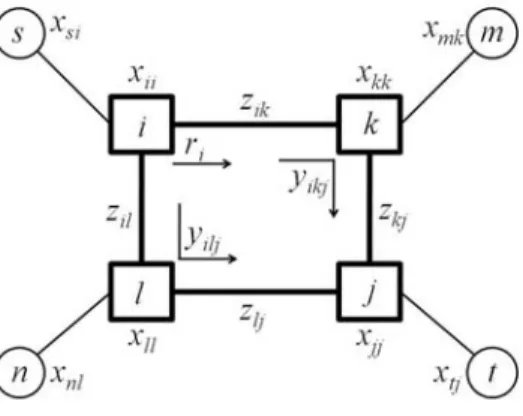
zij = 1 if a hub link is established between hubs i and j ; 0 otherwise yikj = 1 if hub k is used when travelling from hub i to hub j ; 0 otherwise
Figure 3.1 Decision variables of the mathematical model.
An integer programming formulation of the problem (3-stop-0) defined above is as follows: Minimize FH FL (3.1) subject to 1 (2.3) , (2.6) 2 , : (3.2) 1 : : : , , : (3.3) 2 , , : , , (3.4)
1 , : (3.5) , , (3.6) t , (3.7) t , , (3.8) Max , t t , , (3.9) 0,1 , (2.5) 0,1 , : (3.10) 0,1 , , (3.11)
The objective function (3.1) minimizes the total cost of establishing the hub network. The total cost term includes the fixed cost of locating hubs and establishing hub links.
Constraint (3.2) links x variables to z variables and ensures that a hub link can only be opened between two established hubs. We force the model via Constraint (3.3) so that if a direct link does not exist between two hub nodes, these two hubs must be reachable via stopping at a hub node in between. Thus, every two demand centers can receive service via at most three hubs on a route. Note that for given i and j, the summations ∑ : and
∑ : on the left hand side of the Constraint (3.3) both take on the value 0 if i and j are both hub nodes; i.e., if xii = 1 and xjj = 1. Thus, the left-hand side of the Constraint (3.3) takes on the value 1, if a direct hub link is not established between two established hubs and forces the y variable to take on the value 1 for some hub k. Constraints (3.4) and (3.5) are logical constraints linking y and z variables. The in-between hub can only be used if a direct hub link exists from both of the hubs (Constraint (3.4)). We do not
need to use an in-between hub, if a direct hub link connection between two hubs exists, and exactly one hub must be used in travel between two hubs (Constraint (3.5)).
The case for an in-between hub is illustrated in Figure 3.1. Because zij = 0 for xii = 1 and xjj = 1, the left hand side of Constraint (3.3) takes on the value 1 forcing the model to use another hub in between hubs i and j. By Constraints (3.4) and (3.5) yikj must be equal to 1 for some k such that xkk = 1, zik = 1, and zkj = 1. Then in the figure either yikj or yilj must be equal to one. Note that by Constraint (3.5) only one of yikj or yilj can take on the value 1.
We establish an undirected hub network so that if a hub link is opened in one direction it should also be opened in the other direction (Constraint (3.6)). Constraint (3.7) ensures that the ready time of the cargo at a hub is greater than the time needed to travel from all the demand points allocated to that hub. Remember that in cargo applications, a hub waits for all the cargo coming from demand centers that is allocated to that hub before sending the cargo to another hub or demand center. The left hand side of Constraint (3.8) calculates the maximum travel time between demand centers allocated to two different hubs, when a direct hub link is established between these two hubs whereas, the maximum travel time between demand centers allocated to two different hubs when a direct hub link is not established in between is calculated in Constraint (3.9). Recall that if there is not a direct hub link between two hubs, there is a known hub to be visited in between, which is obtained by y variables. Note that the ready time of the cargo at the in-between hub may be greater than the time required to travel from the origin to the in-between hub. Thus, we need the maximum operator on the left hand
side of Constraint (3.9). Constraints (2.5), (3.10) and (3.11) are the constraints that define binary variables.
This mathematical model is a nonlinear binary programming model due to Constraints (3.8) and (3.9). If we let ǀNǀ = n and ǀHǀ = h the model has (h3 + h2 + nh) binary variables and (2h3 + 5h2 + 2nh + n) constraints.
3.3 Linearizations
We propose Constraint (3.8a) below for the linearization of Constraint (3.8).
t , (3.8a)
Let us refer to the new formulation by replacing Constraint (3.8) with (3.8a) as (3-stop-1).
Theorem 3.1 Any feasible solution to stop-0) is a feasible solution to
(3-stop-1) and vice versa.
Proof Let , , , be a feasible solution to (3-stop-0). Let us show that
, , , is also feasible to (3-stop-1). As all constraints other than Constraint (3.8) are common to both, it suffices to show that , , , is feasible to (3.8a). Consider the equation (3.8a) associated with nodes i and j. There are two cases depending on the value of zij.
• Case 1: zij = 1. Then, Constraints (3.8) and (3.8a) yield the same left hand side.
• Case 2: zij = 0. The left hand side of the Constraint (3.8) yields 0; however, the left hand side of the Constraint (3.8a) yields rj + ri. It suffices to show that rj + ri is less than or equal to β. Note that when i = j,
Constraint (3.8a) yields 2 because tii = 0 and zii = 0. Thus, we have both and . By summing these two, we obtain . Thus, Constraint (3.8a) is satisfied.
To prove the converse, observe that the left hand side of (3.8) is always less than or equal to the left hand side of (3.8a); that is,
t t , .
Therefore, any feasible solution to (3-stop-1) is also feasible to (3-stop-0). □
For the linearization of Constraint (3.9), we provide two sets of constraints below:
t , , (3.9a)
(t t , , (3.9b)
Let us refer to the new formulation by replacing Constraint (3.9) with (3.9a) and (3.9b) in (3-stop-1) as (3-stop-2).
Theorem 3.2 Any feasible solution to stop-1) is a feasible solution to
(3-stop-2) and vice versa.
Proof Let , , , be a feasible solution to (3-stop-1). Let us show that
, , , is also feasible to (3-stop-2). Because all constraints other than Constraint (3.9) are common to both models, it suffices to show that
, , , is feasible to (3.9a) and (3.9b). Consider the equation (3.9a) and (3.9b) associated with nodes i, j, and k. There are three cases, depending on the values of ri, rk, and yikj.
• Case 1: yikj = 1
o Case 1a: t . Then, Constraints (3.9) and (3.9a) yield the same left hand side. However, the left hand side of Constraint
(3.9b) yields (t t . But as t
t t , Constraint (3.9b) is also satisfied. o Case 1b: t . Then, Constraints (3.9) and (3.9b) yield
the same left hand side. The left hand side of Constraint (3.9a)
yields t . But as, t
t t , the Constraint (3.9a) is also satisfied.
• Case 2: yikj = 0. The left hand side of the Constraint (3.9) yields 0; however, the left hand side of the Constraint (3.9a) yields rj + rk, and the left hand side of the Constraint (3.9b) yields rj + ri. It suffices to show that both rj + rk and rj + ri are less than or equal to β. From Constraint (3.8a) and the argument in the proof of Theorem 3.1, we know that
, , and . By summing these constraints, we obtain and . Thus, both Constraints (3.9a) and (3.9b) are satisfied.
Thus, we conclude that , , , is also feasible to (3-stop-2).
To prove the converse, observe that the left hand side of (3.9) is either equal to the left hand side of (3.9a) or (3.9b) or less than both of them. So any feasible solution to (3-stop-2) is also feasible to (3-stop-1). □
Now, let us state the linearized mathematical model (3-stop): Minimize (3.1)
subject to
Corollary 1 Any feasible solution to stop-0) is a feasible solution to
(3-stop) and vice versa.
Corollary 2 An optimum solution to (3-stop) is also an optimum solution to
(3-stop-0) and vice versa.
(3-stop) is a strong linearization of (3-stop-0) in three ways: (1) it uses precisely the same set of variables as in (3-stop-0), that is, there is no change in the dimension of the space; (2) the feasible sets are exactly the same; and (3) the optimal sets are the same.
For our applications we added Constraint (3.12):
1 , , (3.12)
to the model (3-stop) in order to have tighter LP relaxations.
3.4 Computational
Results
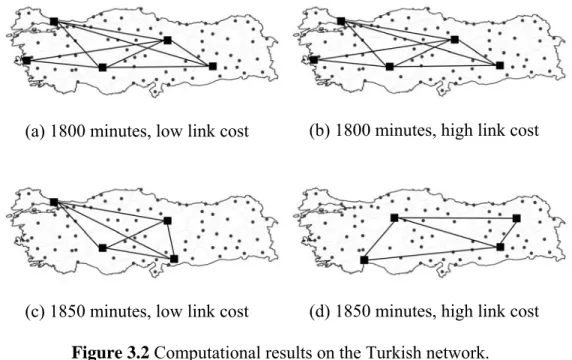
The model is first applied on the Turkish network. On this network, 81 cities are considered as demand centers. We took 16 candidate sites for hub locations among these demand centers: the most populated and industrialized cities in Turkey suitable for hub location (Yaman et al., 2007). Figure A.2 in Appendix A shows the geographical locations of the demand centers and candidate hub locations on a map of Turkey and presents the names of the candidate hub locations.
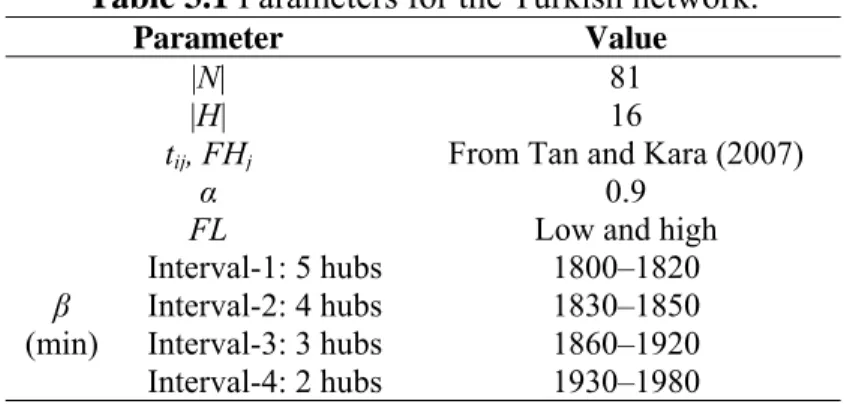
Our problem parameters for this Turkish network are summarized in Table 3.1. The travel times (tij) between all nodes on the network can be obtained from Beasley (1990). The fixed costs for locating hub facilities (FHj) are
taken from a previous study by Tan and Kara (2007). Various factors, such as the industrialization level, the in and out cargo intensity, land price, and the highway intensity of different cities have been considered in determining these fixed costs.
In addition to the fixed cost of opening hubs, the total cost term in the objective function includes the costs for establishing hub links (FLij). In order to propose a general model, we allowed for the costs of establishing hub links to differentiate each link in the model. However, through our interviews with cargo firms we observed that the costs for using inter-hub links are actually fixed, are the same for all links, and are not proportional to distances, i.e., that for all and . Thus, we take the link costs to be fixed in our computations. In order to observe the changes on the hub network with respect to these cost values, we took two different fixed cost values for hub links: low link cost and high link cost. The low link cost value is a fixed value that is taken as relatively lower than the average fixed hub costs, and the high link cost value is taken as approximately the average of fixed hub cost values.
Through our interviews with cargo firms, the hub-to-hub transportation time discount factor (α) was found to be 0.9 on ground transportation in Turkey. Thus, we took α to be 0.9 in all of our computations.
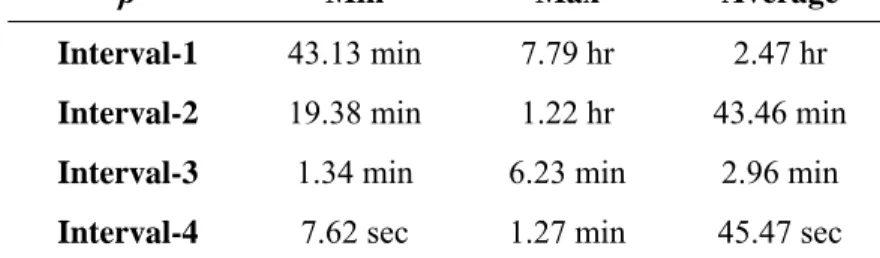
In this Turkish network, with a 0.9 discount factor, the tightest possible service time value between two demand centers is about 30 hours, i.e., 1800 minutes. We varied the service time values (β) between 30 and 33 hours (1800 to 1980 minutes) with ten-minute time intervals. In order to comment on the computational times more realistically, we divided the β values into