A S Y M P T O T IC
THEOI^y O r CHAi*!ACTSr!S Dr T
SYMMETRIC QROUPS
A iru irQ iC
SUSMiTTED TO THE OEPATTMEHT OF !^ATHEMATIC$
A^,m TH?:
SHO!NEET:NO AMD SCIEMCES
I |]vЦv^f'C©CJfry
■■'
l?,|
FULr
#■,·.. ^ *0·«-·'· ^ ^ :;, ^ 'i ■. A » l^·· i ·. j Lta A t·^., : ii *■ i-.i 5i s v*t··ji» n«' )| *rr fA• *.^· ·.■
i ii 2 ■; *1«.
**», 'w-i j
w i
)!?· « iS. .'**«. “‘«r .·■.·*·· j ^ A ^ A ■. .·. i«\ ·*· ■ ! -'*“ ·"·■ ■ ■?*“ '*• -1'. ; * '·*' A ■ : ■'.“ ' • W » ·■ ·« *< «/'isrfVO 4 »* H V4*- -Imp i i f l i '
c it V X ^ •^<1S >i ^ ^Tt T
\ V*M· I ft'T; ri ii ; o·'?«V i C.C^^ ·<' ‘ -«iJ 1...i L _/' ti Nk» ’W' ■•4'A S Y M P T O T IC TH EO RY OF CH ARACTERS OF THE
SYM M ETRIC GROUPS
A THESIS
SUBMITTED TO THE DEPARTMENT OF MATHEMATICS
AND THE INSTITUTE OF ENGINEERING AND SCIENCES
OF BILKENT UNIVERSITY
IN PARTIAL FULFILLMENT OF THE REQUIREA/IENTS
FOR THE DEGREE OF
MASTER OF SCIENCE
By
Elif Kurtaran
August, 1996
Q A
3 S 3
I certify that I have read this thesis and that in my opinion it is fully adequate, in scope and in quality, as a thesis for the degree of Master of Science.
____________ ____________________________
Prof.Dr. Alexander Klyachko(Principal Advisor)
I certify that I have read this thesis and that in my opinion it is fully adequate, in scope and in quality, as a thesis for the degree of Master of Science.
/'>,
Prof.Dr. Ismail Güloğlu
I certify that I have read this thesis and that in my opinion it is fully adequate, in scope and in quality, as a thesis for the degree of Master of Science.
Assoc. Prof. Dr. Mahmut Kuzucuoglu
Approved for the Institute of Engineering and Sciences:
Prof. Dr. Mehrnet Ba<
A B S T R A C T
A S Y M P T O T IC TH E O R Y OF CH A RACTERS OF THE
SYM M ETRIC GROUPS
Elif Kurtaran
M.S. in Mathematics
Advisor: Prof.Dr. Alexander Klyachko
August, 1996
In this work, we studied the connection between ramified coverings of Rie- mann surfaces tt : X V o i degree n and characters of symmetric group Sn- We considered asymptotics of characters of as n —> oo and normalized characters of Sn under some restrictions.
KeyxDords : Coverings, Riemann surfaces, triangulations, symmetric group, characters.
Ö ZE T
s i m e t r i k
GRUPLARIN KARAKTERLERİNİN
ASİMTOTİK TEORİSİ
Elif Kurtaran
Matematik Bölümü Yüksek Lisans
Danışman: Prof.Dr. Alexander Klyachko
Ağustos, 1996
Bu çalışmada Riemann yüzeyleri arasındaki n.dereceden tt : A —> T dallanmış
örtüleri ile Sn simetrik grubu arasındaki bağıntıyı inceledik. Ayrıca, n son suza giderken Sn simetrik grubunun karakterlerinin asimtotikleri ile normalize edilmiş karakterleri bazı kısıtlamalar altında ele aldık.
Anahtar Kelimeler : Örtüler, Riemann yüzeyleri, üçgenleştirme, simetrik grup, karakterler.
ACKN OW LEDGM EN TS
I am greatful to Prof. Alexander Klyachko who expertly and patiently guided my research up to this point and without whom this thesis wouldn’t exist.
I would like to thank my family for their unfailing support and influence in my life.
Finally, I would like to thank to my friends for all they have done for me, and especially to Özgül for her patience and support on my sleepless nights and to Ferruh for his helps.
TABLE OF C O N TE N TS
1 Introduction
1
1.1 Review of known r e s u l t s ...
1
1.2
Triangulations and ramified coverings...2
1.3 Connection with characters 3
1.4 Main r e s u lts ... 5
1.4.1 Explicit fo r m u la e ... 5
1.4.2 Asymptotic fo r m u la e ... 10
2 P re lim in a rie s 15
2.1
Covering Transformations and Galois Correspondance For Coverings 18
3 C o n n e c tio n b etw een coverings and characters 21
3.1 Hurwitz interpretation of solutions 21
3.2 Burnside’s interpretation of solution s... 23
3.3 Main th e o r e m ... 24
4 Explicit Formulae
26
4.2 Description of coverings in terms of triangulations... 27 4.3 Parabolic c a s e ... 34
4.3.1 Description of connected coverings 35
4.3.2 Disconnected coverings... 40 4.3.3 Estimation of coefficients... 42
5 A s y m p t o t ic F orm u lae 45
5.1 Frobenius form u la... 45 5.2 Reduction to contour in t e g r a l... 46
5.3 Asymptotic analysis of contour integral 46
5.4 Asymptotic fo r m u la e ... 47
6
V an ish in g o f n o rm a lized characters 586.1
Vanishing of normalized characters for exterior powers 586.1.1 Character formula for exterior p o w e r s ... 59
6.2
Vanishing of normalized characters for two row representations 636.2.1 Character formula for two row representations... 63
6.3
Vanishing of normalized characters for general representations . 65Chapter 1
Introduction
1.1
Review of known results
In this thesis we will consider the asmyptotic behaviour of characters of sym metric group Sn as n tends to oo. There are at least two reasons of interest of this problem.
i) The first one, which is not our interest of study, is its connection with representations of the infinite symmetric group Soo- Soo is a nontrivial experi mental model in the theory of locally finite groups and has been studied by Za- lesskii [
1
], Vershik and Kerov[2
]. In the theory of representations of symmetric group, each irreducible representation of Sn with character x\ corresponds to a Young diagram A. Vershik and Kerov[3], in their paper studied the limit form of Young diagrams with respect to the Plancherel measure, given as for an irreducible representation A. They obtained that, with respect to Placherel measure almost all diagrams have the same shape, given by the function^ I f \^\ ^
1
^
1^1
f o r |Y| >1
In the same paper, two sided bounds of the largest dimension (w.r.t Plancherel measure)of irreducible representations of ¿'n as n —> oo is found.
xx(g)
x a(i)
Thoma, in his paper [4], considered the problem of finding limit for the ratio as n —>· oo (called the norm alized character o f representation A)
for geSn C 5'oo, n is fixed and |A| —> oo. He gave an explicit formula for all normalized characters of Soo as
m > 2 i=\ i=\ where Oifç — IzTTtji— — IxTilfi— h W ► OO 5 n 9ki><) •■oo ) n fk{\) = rnax{i : {i,k ) G A} - A; + ( - ) , gk{\) = m ax{i\ {k ,i) ^ X] - k + .(^ ), (
1
.1
) (1.2)«1
>«2
· · · ^0
, >/?2
> · ·. >0
, Y^cki + < I and pm is the number of cycles of length m in the permutation a.ii) The second reason of interest of the problem is its connection with tri angulations of surfaces. We will focus our attention to this case ( section 1.2)
1.2
'IViangulations and ramified coverings
Our approach to the problem is motivated by its connection with triangulations of Riemann surfaces and ramified coverings. As to give an idea, observe the following.
Let X) be a triangulation of compact Riemann surface X , and Y be its barycentric subdivision. Let
/,■ : barycenters of triangles, : centers of edges,
Vi : vertices of Y (see fig.
1
.1
).The triangulation Y ' gives us a ramified covering tt : X —> P' : Rie
mann sphere, tt maps black triangles onto upper hemisphere, white triangles onto lower hemisphere, and barycenters to
0,1
and oo respectively.Figure
1
.1
:Hence, we get a ramified covering with the following properties: i) deg
7
T = 3 ^ {tria n g les in J2) = 2 ^ [ed ges inii) Barycenters of triangles have ramification index 3, iii) Centers of edges have ramification index
2
.It is easy to see that we have a one-to-one correspondance between triangula tions and coverings of sphere ramified only over
0
,1
,oo with ramification indices2
over0
, 3 over 1,arbitrary indices over oo.
It is worth to mention the special attractiveness of triangulations of a Rie- mann surface X for physicists since they are used as a model for random metric on X (see papers 5,6).
1.3
Connection with characters
As we have seen in previous item, the problem of counting the triangulations is particular case of counting ramified coverings of given degree and prescribed ramification indices. It turns out that the last problem is closely related with characters of symmetric group. This connection follows from two classical re sults.
i) The first is Hurwitz theorem which gives a one-to-one correspondance between ramified coverings tt : X —>· of given degree and ramification indices,
and solutions of the equation
9x92 ■ · ■ 9k — f 9i ^ C Sn (1.3)
up to conjugacy, where cycle lengths of gi is equal to ramification indices of points in fibers.
If instead oi we consider an arbitrary surface Y of genus g, then the number of coverings is equal to the number of solutions of the equation below, up to conjugacy.
9x92 ■ ■ ■
9
k [fx ,h i]. . . hg] = 1 ; fi, hi e Sn , 9i ^Ci C (1.4) where [ /, g] = fg f~ ^5
' M s a commutator.ii) The second is Burnside theorem which gives the number of solutions of the equations ( 1.3) and ( 1 . 4 ) for an arbitrary group G in terms of the char acters.
=
1
:9
, € C ¡ € G } = ^ X p O x t e ) g)|G|
X ( l ) ‘\GY~
2
g X{lY+'^3-‘where the summation is over all irreducible characters y of G, i',· G M are elements from fixed conjugacy classes (7,·.
The theorems of Hurwitz and Burnside leads to the following formula for the number of coverings, which is the starting point of our approach. Before, let us remark that the number —--- - is called as “Eisenstein number of coverings” .
T h e o r e m 1 .1 The Eisenstein number o f ramified coverings tt : X Y o f degree n with given ramification indices, o f the surface Y o f genus g y , ramified over k points j / i , . . . , in Y is given by
E
n:X^Y
\ C ,\ \ C ,\ ...\ C k \ j^ x{g,)x{9 2 )...x{9 k)
(n!)^~^i'v (;^(l))/=-(2-25y) (1.7) where gi G Ci are elements from fixed conjugacy classes Ci, cycle lenghts o f gi are ramification indices in fiber x’~^{yi), and the summation is over all irre ducible characters x o f
C o ro lla r y
1.1
Under the hypothesis o f theorem (1
.1
) with Y replaced by P* we have^
_ |(^i||C2| · · ·
\Gk\ x { g \ ) x { g 2 ) ■■ ·
x {gk)(1.8)
Hence, using the argument in section
1
.2
, we can write the following for mula:The Eisenstein number of triangulations on X is equal to _______ x(^
2
) x(<^3
) x {g )( f ) ! 2 f ( t ) ! 3 f ^ x ( l )
where geSn, C(g) denotes its conjugacy class,
62
consists of2
cycles and63
consists of 3 cycles. By (1.24) with gy = 0 ,k = 3 ,di =
2
d2
= 372
1
1
=
1
+ —( - — ^ ) , d:mean.value of cycle lengths of g.1.4
Main results
Theorem (1.1) can be used in both directions, i.e. information on coverings may be transferred in information on characters and vice versa. When the structure of the covering is known, it is easier to carry information on coverings to characters. Let us begin from coverings.
1.4.1
Explicit formulae
There exists several cases in which the number of coverings can be evaluated explicitly. In each of these cases, ramification indices in the fibers are the same.
Let
7
T : X —>■ be a ramified covering of degree n ramified over k points2
/1
,2
/2
) · · · ) î/fc with ramification indices rrii, equal in each fiber. In the case1
1
1
^ «I---b · ■. 4
---^ k — 2mi m
2
mk (1.9)all coverings may be explicitely described in terms of finite groups of Möbius transformations or plane Coxeter groups. Since we know the structure of these groups, we can get explicit formulae for (
1
.8
).1. Elliptic Case
If
1
1
1
1
,— + — + — + . . . + — > k
- 2
(1
.10
) mi mi m2
mkthe possible solutions are
ai) Cyclic case : k
=2
, mi = m2
= m,aii) Dihedral case : k = 3 ,mi = m
2
= 2 , m3
= m, bi) Tetrahedral case : mi =2
, m2
= m3
=3
, bii) Cubic case : mi =2
, m2
— 4 , m3
=3
, biii) Icosahedral case : mi =2
, m2
=3
, m3
=5
.In this case, all coverings may be described using finite groups of Möbius transformations.
F in ite grou ps o f M ö b iu s tra n sfo rm a tio n s: The transformations
T (z ) = — a ,b ,c ,d E C : ad — b c ^ O
cz + d
(
1
.
11
)
are known as Möbius transformations and they form a group under composi tion. Finite groups of Möbius transformations are:
ai) Cyclic group of rotations of order m by multiples of
aii) Dihedral group of symmetries of order 2m of a regular m-gon.
bi) Tetrahedral group of 12 rotations carrying a regular tetrahedron to itself.
bii) The group of rotations of cube of order 24.
biii) The icosahedral group of 60 rotations of a regular icosahedron.
Extended complex plane C|J{oo} and sphere may be identified via steo- graphic projection. Under this corresonpondance, finite groups of Möbius transformations correspond to finite group of rotations of sphere. They are in fact subgroups of finite Coxeter groups, as will be seen in chapter 4.
It turns out that when G is a finite group of Möbius transformations the map 7T : ^ ^ ramified covering with equal ramification indices in each fiber, say mi, mi's satisfying (1.10). We get the following formula for Eisenstein number of coverings.
T h e o r e m
1.2
The Eisenstein number o f ramified coverings tt : X —> P*0
/ degree n, ramified over k points y i,. ■ ■ ,yk> with equal ramification indices rriiin each fiber tt ^{yi), m i’s satisfying (LIO), is given by
E
^ (jg;)! |(3|ft
(
1.
1 2)
where G is finite group o f Möbius transformations corresponding to solution o f
(
1
.
10
).
Combining the above theorem with theorem (1.1) , we get the following .
T h e o r e m 1 .3 The following equalities holds
= {—y-rn^
m (1.1.3)E
x ( i ) n! (2
m ) » ( ¿ - ) ! (1.14)E
x(<^3Y x M
x(l)
. ( t ) ' ^ ’ . n! (12
) S ( I ) · 2"if-Jl (1.15)E
x M x(<^3)x(^.) _ ( f ) ! 2 ? ( f ) ! 3 ? ( ; ) ! 4 ?X ( l ) n! (24)57 ( i ) ! (1.16)E
X M x M x ( < 7 ,) _X ( l ) (1 )! 2 f ( | ) ! 3 t ( f ) ! 5 ?(60)“ (a)!
(1.17) X /vv-/ ·“· V--/ veo.*where the summations are taken over all irreducible characters x o f Sn and denotes the permutation consisting o f — cycles o f length m.
2
.P a ra b o lic C ase If1
1
1
---1
--- l· · ■ · H— mi m2
ruk= k - 2
(1.18)the possible solutions are
a) mi = m
2
= m3
—1714
=2
, bi) mi = 2 , m2
= m3
= 4, bii) mi = 2 , m2
= 3 , m3
=6
,biii) mi = m
2
= m3
= 3.In this case, all coverings can be explicitely described in terms of affine Coxeter groups.
A fR n e C o x e te r grou ps Affine Coxeter group G is generated by reflec tions in sides of a k-gon A C More generally, any k-gon with angles ^ ^ ■
1
satisfyingZ)
= k —2
, can be repeated by successive re flections in sides to cover the Euclidean plane. For m¿’s satisfying (1.18), the corresponding affine Coxeter groups are as follows:a) Group generated by reflections in sides of quadrangle (see figure (
1
.2
)). bi) Group generated by reflections in sides of triangle with angles f > f > f (see figure (1.3)).bii) Group generated by reflections in sides of triangle with angles f j f > f (see figure (1.4).
biii) Group generated by reflections in sides of equilateral triangle (see figure (1.5).
Similar to elliptic case, we can evaluate Eisenstein number of coverings using affine Coxeter groups.
T h e o r e m 1 .4 The Eisenstein number o f ramified coverings tt : X ^ o f degree
nfi,
ramified over k -points y i , . . . ,yk, with equal ramification indices mi in each fiber Tr~^{yi), rrn’s satisfying (1.18), is given byE
,1
. = coefficient at [JJ(1
~9
*^)]7T I k=l
(1.19)
where p eN depends on the affine Coxeter group corresponding to the solution o f (1.18) more explicitely, fo r m i’s satisfying the case
a) p, =
2
, bi) p = A, bii) p =6
, biii) p = S.Unexpected!}’·, we see that right side of the equality (1.19) contains a func tion close to Dedekind tj function.
D e d e k in d y fu n ctio n
Figure
1
.2
:Figure
1
.3
:Figure 1.4:
7){z) = e(cz + d ) ^ ; y M e S L
2
{1
) cz + d \ c d Jwhere e{a ,b ,c,d ) is a 24’th root of unity, is a modular form of weight R e la tio n w ith p (n )
The number p(n) of partitions of n is an important object in number theory.
function.
ri[z)
being holomorphic everywhere and verifying the relationIn 1917, Hardy and Ramanujan developed a method which yields an asymp totic formula for p(n). After some modification of Hardy and Ramanujan’s method, Rademacher obtained the exact formula for p(n). Proof of this exact formula is based essentially on the modular properties of the function
FI.Rademacher and H.Zuckerman, in their paper[
8
], have found the Fourier coefficients of the modular form Using these, we get the next theorem.T h e o r e m 1.5 The following asymptotic formulae holds.
x M
E
X^S2n
x(l)=
7T i n ~ ---3
- w* expTTW —22
31
(1
.20
)E
XcSin
x((^2)x{(^4y
x(l)
7T Ji nexpTTW-2i6 3i6
(
1.
2 1)
Y - X ((^ 2)xM x{(r6) 7T ^ 7T /-^ --- w n--- exp--^-^:
X.Sen 23312
d(
1.
2 2)
7T1
^ / ^ \ /X— no e x p ( —) v2
n22 3?
(1.23)1.4.2
Asym ptotic formulae
In the previous item, we deduced results on characters using theorem (1-1) and known structure of ramified coverings. Now, let us consider the other direction, i.e. getting information on coverings from that of characters.
The problem of estimating the number of coverings with given ramification indices in some extend can be reduced to estimation of the ratio
^^^^1
, wherex(l)^
d is mean value of cycle lengths oi g e
6
'„.To see this let us write Riemann- Hurwitz formula in the following form.Let
7
T : X T be a ramified covering of degree n, of surface Y of genus gy by surface X with genus g x , ramified over k points y i , . y k in Y. Riemann-Hurwitz formula connecting genus of X and Y may be written in the form:‘¿gx —
2
= n ‘2
gy —2
+ k — — i(1.24)
where di = g.) is mean value of cycle lengths of gi, for
5
r,:monodromy permutation with cycle lengths equal to ramification indices of points in fiber 7T- 1 iVi)·Hence, using equality (1.7) and Riemann-Hurwitz formula we get
1
x {g i) x{gk)1
...
(x(l))^ x ( l ) ^
(n!)2 — 2gy
(x(l))'
(1.25)
Since x ( l ) < V X , 1 > --- sViT-^' ^ Ziy -i for some constant c. x(i) "
Hence, decreases polynomially for gx > 0. On the other hand, grows exponentially, as will be seen in corollary (1.3). So, estimation of right side in above equality is mainly reduced to that of the ratio
x(i)''
D e sc rip tio n o f p ro b le m In our study, we considered the asymptotics of characters xg of Sn corresponding to Young diagrams ^ under the following conditions.
Let diagram jd be given by >
62
^ · · · -> ¿m and the cycle structure of g given by l “i2
“^ . . . n“" . Suppose thati) Diagram (d has fixed number of rows and g has fixed number of cycles. ii) Number of cells in each row increases as n ^
00
with fixed frequency, i.e. ^ = yd,· , /di is fixed as n —+00
.iii) Lengths of all cyles in g € Sn are coprime.
iv) Multiplicity of cycles in g E Sn increases as n
— 00
with fixed frequency, i.e ^ = cxfc , Qifc is fixed as n —+00
.the solution of the following system of non-linear algebraic equation. .k 3 X? æf + . . . + ÆÎ = ] i =
1
, . . . ,m
( l .2
(i) where ft = - , n o-k oik =— .
n
We prove the followings;
T h e o r e m
1.6
The system (1.26) has, up to proportionality , unique positive solution X = ( x i , . . . , Xm) , X\ > X'l > ■ ■ ■ > Xm >^-This theorem is crucial in proving the following asymptotic formulae.
T h e o r e m 1 .7 Let us consider a sequence o f diagrams (3 such that
6
i >62
> . . . > bjn, ¡3i = ^ fixed, and a sequence o f permutations g E Sn with cycle structure . . . n“” such that ^ is fixed. If lengths o f all cycles involved in gcSn coprime, and ^ , i zfi j ^ asymptotics fo r Xp{g) as n00
is given as:XÁ9)
^nw(x)
n
(1
- - ) ^( 2 in )“ p
Xi
, Hi,
where Xi’s are positive roots o f the system (1.26).
(1.27)
w (x) = ak log(xi + . . . + x l ) - ^ fii log k
X i i-=l
(1.28)
and Hu is the principal minor o f order m — I o f the quadratic form in variable dti
Hess{w) =
y~^
gfc
' E ” , i f * ? , E £ , i f *k=\
E , x f
- E mi=l
^kr ■
(1-29)
Taking a¿ following.
C o ro lla r y
1.2
The asymptotics fo r the dimension o f the irreducible represen tation corresponding to diagram ¡3 with different lengths o f rows isn.<,(l - |)
(27Tn)" ‘ ffß iß
2
. . . ß ^ where H{ ß ) = —J2i ßilog{ßi) is the entropy function.(l.ilO)
We observe that the above asymptotic is no more valid if x¿ = Xj for some i,j. When diagram is rectangular, xi = Xj V In this case, we evaluated the asymptotic for Xis{g) using Selberg integral.
T h e o r e m
1.8
Under the assumptions o f theorem (1
.7
), if lengths o f cycles involved in g are coprime and the diagram /3 is rectangular , i.e. all rows are o f the same length, thenx M ~ „ .
7
" - ( " > ) " ' i i i !(
27
t) 2 [n d)m
—1
(1.31)
where = \ , ^^^k
=d-From theorem (1.7), it follows that main term in asymptotic is the expres sion hence it is essential to estimate w{x).
T h e o r e m 1 .9 Let x be the unique positive root o f (1.26), w(x) as in theorem (1.28) and ß be diagram described as in theorem (1.7). Then
w{x) > ^ //(ß)
The equality is only if all cycles are o f the same length or diagram is rectangu lar.
C o ro lla r y 1 .3 If the diagram ¡3 is not rectangular and if all cycles involved in g are o f different length, then exponentially increases to oo as n ^ oo.
XßW
In addition to these, in this thesis we proved the following theorem, which solve the problem proposed by Zalesskii.
T h e o r e m
1.10
Ifi) Qn is any sequence o f elements o f Sn with fixed number o f cycles,
a) X\(n) is sequence o f faithful characters o f Sn labelled by partitions A(n), then
XA(n)(*7n) X A ( n ) ( l )
Chapter 2
Preliminaries
This chapter contains basic definitions and theorems needed for the rest of chapters.
An important part of the theory of functions of a complex variable is de voted to the study of algebraic functions. An analytic function w = io{z) is called an algebraic function if it satisfies a functional equation
A( z , w ) = ao{z)w'^ + ai{z)w'^ + an{z) = 0,ao(z) 0 (2.1)
in which the ai{z) are polynomials in z with complex numbers as coefficients. From this algebraic equation in w , we note that each value of z determines several values of w, so that w is a multiple-valued function of z.
Starting from a single function element of an algebraic function w{z) ,we could use analytic continuation to piece together the whole function and study in this way its multiple-valuedness. Riemann’s approach to this situation is to look for a new surface(instead of the z-plane) on which to consider the algebraic function defined, and on which it is an ordinary single-valued function. This surface is called a Riemann surface.
It can be shown that the Riemann surface for any algebraic function is topologically a sphere with g handles and the algebraic function is a single valued function on this surface(For interested , refer [
2
]).This number g is called as genus of the surface. The genus can be calculated by using polygonal subdivision.
set o f points o f S, called vertices, and a finite set o f simple points on S, called edges, such that
i) every edge has two end-points ,these points being vertices, a) edges can only intersect at their end-points,
in) the union o f edges is connected,
iv) the components o f the complement S \ M are homeomorphic to open discs. These components are called faces.
It can be shown that every compact, connected surface S has a polygonal subdivision. This was first proved (for Riemann surfaces) by T.Rado in 1925.
The Euler characteristic of a surface S is x { S) = x { M ) = V - E-{- F where is a polygonal subdivision of S with V vertices, E edges and F faces. Homeomorpic surfaces have the same Euler characteristic. [17]
T h e o r e m
2.1
The Euler characteristic o f a compact, connected, orientable surface S o f genus g is given byX{S) = 2 - 2 g .
Now , we can introduce covering surfaces of Riemann surfaces.
D e fin itio n
2.2
A continuous surjection p ;5
'—> S ,where S and S о-те Riemann surfaces, is a ramified covering map o f S if each stS has an open neighborhood U and a homeomorphism ф : U D (open unit disc) such that fo r each connected component V o f p~^{U) there is a homeomorphism ф : V D satisfying фор = тГпоф fo r some integer n > 1 (тгп : D D ,z z^).We have n = I iff p is a homeomorphism V ^ U, in this case p is called an unramified covering map.
I f n > l fo r some V then we say that the unique element s o f V
a branch point o f order n — I (Since p is like тг„, locally n-to-one near s). The points o f S over which there exists branch points are called ramified points and the integer n is called ramification index o f the ramified point.
ГЧ-/
In case when S is simply connected, p is called a universal covering map.
rsj
T h e o r e m
2.2
(R ie m a n n -H u r w it z ) Let p :S ^ S be a ramified covering o f degree n. The following formula is validwhere the summation is taken over all ramified points x in S with ramification index rrix.
We can classify Riemann surfaces according to their universal coverings.
T h e o r e m 2 .3 Every compact Riemann surface has a universal covering. In case o f genus 0 it is its own universal covering.
In case o f genus
1
, its universal covering is the complex plane C .In case o f higher genus its universal covering is the upper halfplane (Lobachevsky plane).
For any surface R, we can select a point z on R and consider the class C{ z) of all closed curves from z. Identifying curves in C{ z ) which are homotopic to each other and introducing a product on the homotopy classes, we can construct a group which, for the moment we denote by Tri{R,z). It is easy to see that any two such groups 'ir\{R,z) and tti{ R ,w) are isomorphic for R path connected. Hence we can refer to both as the fundamental group iri[R) of R. For a simply connected R, the group 'n’i{R ) is the trivial group since any closed curve from z is automatically homotopic to the point curve z.
D e fin itio n 2 .3 The degree o f a covering space o f X is the cardinal o f a fiber. If the degree is m, one also says that ( X ,
7
t) is an m-sheeted covering o f X, or an m-fold covering (It can be proved that all fibers in a covering space have the same cardinal) .T h e o r e m 2 .4 Let ( X, Xo) be a pointed space, let ( X ,
7
t) be a covering space o f X, and let Y = ir~^(xo). Let the ordering o f the points in the fiber over the base point Xq be : tt~^{xo) = Zi,Z2
...Zn. Path lifting defines a homomorphism (called the characteristic homomorphism fo r ir ) :x(7t) : 7Ti(X) Sn
o f the fundamental group
7
Ti( X ) into the symmetric group o f n elements. Image r\Jo f
x
{
tt
)
is called monodromy group o f ( X ,7
t).Main idea in this theorem is as follows: Given a loop I : [ 0 ,
1
] X in X based a.t Xq e X , i.e. /(0) = /(1) = a;,, , there exists unique lifting of I to a pathr\/
h '■ [0,1] -^ X in X with /¿(0) = Zi V z =
1
, ..n (So the fundamental group acts transitively on fibers). Since /, (1
) is again a point in the fibre7
r“ *(xo) , these liftings define a permutation re6
'„ such that /¿(1
) = z^(i). r depends only on the homotopy class of the loop I, and the assignement of r to the homotopy class of I , defines a homomorphism x(7
t). If we change the base point or change the ordering in the fibre over the base point, this will change x(7
t) by a conjugation inSn-Now , let us define what is meant by equivalent( or isomorphic ) coverings. rsj rsj
D e fin itio n 2 .4 Two covering spaces ( Y, q ) and { X, p) o f a space X are equiv alent if there is a homeomorphism -Y -^ X such that q = (pp.
T h e o r e m 2 .5 Two n-fold coverings are equivalent iff their characteristic ho- momorphisms are conjugate homomorphisms.
2.1
Covering Transformations and Galois Correspon
dance For Coverings
D e fin itio n 2 .5 If [ X^tt] is a covering space o f X, then a covering transfor-r\J rsj
mation is a homeomorphism h :X - ^ X with irh — tt. Define Aut{'K) as the set o f all covering transformations o f X . Under composition o f functions , Autipïï) form s a group.
By theorem (2.4), a covering tv : X ^ X of degree n, gives an action of the fundamental group of X , on the set of n elements, i.e. on the general fibre TT~\xo), XotX- The stabilizer tt, of a point ye'K~^{xo) is a subgroup of
7
Ti(.Y) and corresponding to another point y' in the fibre , a conjugate subgroup of tt* appears.W e have the following theorem about subgroups of 'ïïi{ X) and coverings of X [for proofs, see [10]].
T h e o r e m
2.6
The following correspondances hold1
)3
a one-to-one correspondance between conjugacy classes o f subgroups H o f G — 7Ti(X) and equivalence classes o f coverings tt o f X , where degir = [G :H],
2
) Connected coverings corresponds to normal subgroups o f Tr\(X).3) 3 a one-to-one correspondance between coverings o f X , o f degree n, and the actions o f tti{ X ) on n element set Y, where conjugate actions correponds to equivalent coverings by theorem (
2
.4
)· In case when the covering is connected, this action is transitive.4) Autir = A u ta Y = {a : Y Y' : ag — ga \/ g e G } where G is the fundamental group o f X. Otherwise stated
Aut-K = where {g\,..,gk] is the set o f generators o f wi i X) , and ^ {
31
,—,3
k} denotes its centralizer inSn-We can summarize the Galois Correspondance considered in this theorem as below: ( ^ denotes one-to-one correspondance )
TT : X —* X covering of degree n up to isomorphism <-)· Subgroups H of
7
Ti(A^)up to conjugacy Actions of t^\{X) on an n-element set.
R e m a r k
2.1
These notions are valid fo r non-ramified coverings but since re moving ramified points leads to non-ramified coverings , we can use them in our study dealing with ramified coverings o f sphere.D is c o n n e c te d C o v erin g s Now, let us consider the case when w : X ^ X is
/Ni/
non-connected covering, i.e. X is union of connected components X {, X = U,· Xi , where the restriction tt\x^ = iTi gives connected covering of X . By collecting the
/Ny
isomorphic components, we can write X = \JjmjXj , where X f s are pairwise non-isomorphic components and
^--- v;---^ rrij times
Symmetric group Sm acts on the isomorphic components m X j in the fol lowing way : Labelling m isomorphic components Xj by X\, X
2
, .., Xm for creSm , c r { Xi l } - - \J^ m) = X ’<r(i) U · ·· U ^cr(m) · In this way , group of permuta tions of isomorphic components, namely H becomes a subgroup of Autir. Moreover it can be shown that:i) Ht· AutiTi is a normal subgroup of Autir. ü)YliAut7Ti n rT‘5'mj =
1
·of isomorphic components. And
|Auit7r| = \Aut%i\ PJ ruj (2.3)
1=1
i=l
where k is the number of connected components, mj is the number of isomor phic components, rrij — k.
Chapter 3
Connection between coverings and characters
In this chapter we will prove the following theorem which gives the connection between coverings and characters of
Sn-T h e o r e m 3 .1 The Eisenstein number o f ramified coverings tt : X —> P* o / degree n ramified over k points y i , . . . ,yk in with given ramification indices is given by
E
r-.x-^F 11
\Autx\ \ C , \ \ C f i . . . \ C , ^ ^ x { g , ) x { g , ) . . . x { g , )(x(i))
k-2 (3.1)where the summation is over all irreducible characters x o f Sn, gi G Ci C Sn are elements from fixed conjugacy classes C{ and cycle lenghts o f gi are ramification indices in fiber Tr~^{yi).
This connection is due to two classical results of Hurwitz and Burnside.
3.1
Hurwitz interpretation of solutions
For a better understanding of Hurwitz interpretation of solutions, let us first consider what is really meant by the fundamental group of a surface R of genus g , by giving some examples.
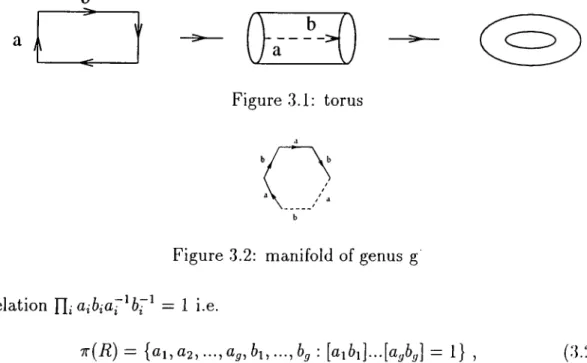
The torus, and manifold of genus g can be described as in figures (3.1) and (3.2). One can calculate the fundamental group from these polygons. The fundamental group 7t(jR) is generated by the loops
ai, ...,ag,b\, ..,bg
with thea A
b
a
Figure 3.1; torus
Figure 3.2: manifold of genus g
relation =
1
i.e.tt{R) = { a i , a
2
,...,ag,bi,...,bg : [ai6
i]...[a^6
J = 1} , (3.2) where == aibia~^b~^] is a commutator.The fundamental group of surface Y with the points
2
/ i ,1
/2
, ···,2
/A; removed is given by7ri(Y) Oigy b\^ .., bg^ j [^1 ^
1
] [^2
^2
] · · · — 1} · Where c^’s corresponds to loops aroud the removed points.If Y is P*; Riemann sphere with the points j/i, t/
2
, ···, Vk removed, its fundamen tal group is given by7Ti(Y) = {ci,..,cfc;ci...cfc =
1
} . (3.4) R e m a r k : When tt : Y ^ Y is a ramified covering map of degree n ramified over k points, lifting C{ leads to monodromy permutation Qi Ç. S-„,, lifting2
g non- contractible cycles Oi,61
, . . , a^,bg
leads to permutations/
1, h i ,
..,fg, hg €
Sn- W e can now state Hurwitz interpretation of solutions.T h e o r e m 3 .2 (H u r w itz ) 3 a one-to-one correspondance between the solu tions o f the equation
gi92 ■ ■ ■ 9k — I- · 9i Ci C Sn (3.5) up to conjugacy, and ramified coverings tt : Y ^ P* o f degree n up to isomor phism, ramified over k points y i , - - - , y k with prescribed ramification indices. Cycle lengths o f gi are ramification indices in fiber 'K~^{yi).
Let us outline the proof. P r o o f:
i) Let S = F^ \ { y i , . .. , yk} ,
7
t; X \7
r~^(i/i,. . . , ?/fc) S. Then, rriiS) ={ c i , C
2
, . . . , Cfc : C1
C2
. . . Cjt = 1}. It is easily seen that there exists a one-to-one correspondance between solutions of the equation9ig2---9k = 1 ■ 9 i ^ S n ( 3 .6 )
and action of 'K\{S) on an n-element set, where conjugate actions corresponds to conjugate solutions. Hence by theorem (2.6), 3 a one-to-one correspondance between coverings tt : X P* of degree n up to isomorphism and solutions of above equation up to conjugacy.
ii) The set . . . ,gk are monodromy permutations due to liftings of loops gen erating 7Ti(5'). By definition, at each branch point in X of ramification index m, ramified covering tt looks locally like \ z ^ . Hence, monodromy cyclically permutes zm to e m Z ^ , Therefore, cycle lengths of gi are ramifica tion indices in fiber 'K~^[yi).
Combining i and ii proves the theorem.
The following theorem may be proved in much the same way as theorem(3.2).
T h e o r e m
3.3
(G e n e ra liz e d H u r w itz th e o r e m ) 3 a one-to-one correspon dance between the solutions o f the equation9
î92
· · · gki f l i /2
] ■ ■-[fg·) = 1 · S'» € Ci € Sn, fii9i € (3-7) up to conjugacy and coverings tt \ X Y up to isomorphism, where tt is asdescribed in above theorem, with replaced by an arbitrary surface Y o f genus
3.2
Burnside’s interpretation of solutions
Burnside theorem gives the number of solutions of the equations (3.5) and (3.7) for an arbitrary group G in terms of characters as follows [9].
|Ci||C'
2
|...|C'fc| ^ x ( s i ) x ( S2
) - - - x ( S A . l . o)---^ { 91 92 · · · 9k[fl ? ^ 1 ] · · · [fg") — Í 9i ^ hgy f g G Sn } —
|g.||g
2
l... |C*| „ xi!n)x{g
2) ... x(gt)
(3.9)
|G|'-
2
ä1
j^’+2
£f—2
where the summation is over all irreducible characters x of G, Qi G are elements from fixed conjugacy classes C,·.
3.3
M ain theorem
Combining Hurwitz’s and Burnside’s results, we get the following theorem, which is the starting point of our approach.
T h e o r e m 3 .4 The Eisenstein number o f ramified coverings ir : X ^ o f degree n ramified over k points y i , . . . ,yk in with given ramification indices is given by
1
E
\Au í'k\|C^il|C'2|.-.|C')^| ^
(n!)^ x{9
x)
x{92)
. . . x{9k)
(x(i))^
- 2 (3,10)where the summation is over all irreducible characters x o f Sn, 9i G Ci are elements from fixed conjugacy classes Ci and cycle lenghts o f gi are ramification indices in fiber-K~^{yi).
P r o o f:
i) It suffices first to show
éÍ 9 \9 2- - -9 k = I ■9i^ Ci c S n ) = n\
7t: X -
,1
\AutTr\ ’(3.11)
where the summation is taken over ramified coverings tt : X ^ described as in the statement of theorem. By Hurwitz theorem, 3 a one-to-one corre spondance between solutions of gig
2
■ ■ - gk = 1: i/i G Ci up to conjugacy and ramified coverings tt : X —)■ P^ with given degree and ramification indices. Let [91
^92
-, ■■■■,9k] be a solution of g^g2
. . .9
k = T· 9i ^ Ci. We have#(solutions conjugate to <
72
, ■■■,9
k] = [-S'il : C'ti, ,52
,...,<?*}] > (3-^2) where C'{ÿi,52
,...,3
fc} is the centralizer of the set {91
,92
, ■■■ ■,9
k ] ■By theorem (2.6)
and the result follows.
ii) Since by Hurwitz interpretation of solutions y ,’s are monodromy permu tations in fiber 7r“ ^(i/i), cycle lengths of gi is equal to ramification indices of points in fiber. Combining (3.11) with equation (
3
.8
) in Burnside theorem for G — Sn·, implies the desired result.Using similar ideas, the folowing theorem may be proved.
T h e o r e m 3 .5 The Eisenstein number o f ramified coverings tt : X ^ Y o f degree n with given ramification indices, o f the surface Y o f genus g y , ramified over k points y i , . .. ,yk in Y is given by
E
\AuU\ \ C \ W C 2 \ . . . \ Ck\(n !)x(n^
x { g \ ) x { g 2 ) ■ ■ ■ x{gk)(;^(1 ))^-X(K) (3.14)where x ( F ) = 2 — 2gy is the Euler characteristic o f the surface Y, g¡ G Ci, cycle lenghts o f gi are ramification indices in fiber (yi), and the summation is over all irreducible characters o f
Sn-Chapter 4
Explicit Formulae
In this chapter we will give a detailed exposition of carrying information on coverings to that of characters of symmetric group and give our results. C la ssific a tio n o f ra m ified coverin gs w ith th e sa m e ra m ific a tio n in d ices.
Given a ramified covering ir : X Y with the same ramification indices in each fiber, we will determine the type of components of X using ramification indices.
We will use the following Riemann-Hurwitz formula.
Let TT \ X Y he & ramified connected covering of degree n, of the surface Y of genus gy by surface X of genus g x . Then
—
1
) = ‘^ri{gY — i) + x€Xwhere the summation is over all x G Y with ramification indices m,..
(4,1)
In the case of Y = and of equal ramification indices m,· in each fiber
7
T~^(?/i), the Riemann-Hurwitz formula can be written in the following form:X ( Y ) = n E — - ( < : -
1
2
) U=l m(4.2)
for
7
T : Y —»■ P \ ramified over k points y i , · ..,yk-So, if all ramification indices in a fiber are equal, the above equality gives us a tool for determining the components of X . Namely, we have three cases, i) Elliptic Case: If ^ —
2
, then all components of X are Riemannsphere.
ii) Parabolic Case : If ^ ^ —
2
, then all components of X are torus. iii) Hyperbolic Case : If ~ < k — 2, then all components of X have genus greater than1
.In cases i) and ii), we will get an explicit formulae for the number of such cover ings. There exists no explicit formulae in hyperbolic case. Asymptotics of the number of coverings in hyperbolic case is closely connected with asymptotics of characters of symmetric group, and will be studied in the next chapter.
Let us first concentrate on elliptic case.
4.1
Elliptic case
In elliptic case we will deal with ramified coverings tt : X —+ ramified over k points with equal ramification indices, say rrii, in each fiber and m i’s satisfying
k
E
î=l
1
TUi > k - 2 . (4.3)
There exists finitely many solutions for m^’s, these are ai) Cyclic case : k = 2 , rrii = m
2
— m ,aii) Dihedral case : k = 3 ,mi = m
2
= 2 , m3
= m , bi) Tetrahedral case : mi = 2 , m2
= m3
= 3, bii) Cubic case : mi = 2 , m2
= 4 , m3
= 3, biii) Icosahedral case : mi = 2 , m2
= 3 , m3
= 54.2
Description of coverings in terms of triangulations
W e will explicitely describe ramified coverings tt : P^ —>· PM n terms of trian gulations of P ^
Definition
4.1 A bicolored triangulation on a surface is the decomposition o fthe surface into triangles such that each edge has a neighborhood colored black and white.
Remark 4.1
Since each edge has a neighbourhood colored black and white, justBicolored triangulation of a surface X defines a ramified covering of
E x a m p le
1
: Let ^ be a bicolored triangulation on X , with vertices of triangles labelled by a, b and c. Let tt : X" —> sendingi) black triangles to north hemisphere, ii) white triangles to south hemisphere,
iii) vertices a,b, and c to
0,1
and oo respectively.Then,
7
T is a ramified covering map ramified over0,1
and oo. Ramification points in X are the vertices of triangles in with ramification index at a vertex equal to | ^ of triangles meeting at the vertex).P r o p o s itio n 4 .1 Let
7
T : X" —)· P^ be a ramified covering o f degree n, ramified over three points a,b,c € P*. Then ttinduces a bicolored triangulation on X.It has the following properties: i) fi^(triangles in)J2 — 2degTr,
a ) ( t r i a n g l e s meeting at a vertex j) — 2mj, mj : ramification index o f j .
P r o o f: Joining the points a,b and c partition P* consisting of two triangles, triangle abc(colored black) and its complement (colored white). Topologically, it can be assumed that a,b,c are on the equator of P^ hence dividing the sphere into two hemispheres north (colored black) and south (colored white) hemispheres, tt is continous, hence
7
T“ ^(a6
c) is simply connected. Labelling preimages of vertices a,b,c by the same letters, a bicolored triangulation of X is obtained.i) Let Zo € P^ : unramified point inside triangle abc. deg tt — n implies
7
t“ ^(zo) lies in n triangles in X colored black. Similarly, for zi € P^ unramified point in the complement of abc lies in n black triangles. Hence giving2
n triangles in X , n of them are inverse images of north, n of them of south hemisphere.ii) Follows from the fact that at a point with ramification index m j, tt looks locally like tTj :
2
^ z'^T Combining the above example and above proposition we get the following theorem.T h e o r e m
4.1
There exists a one-to-one correspondance between bicolored tri angulations on surface X and ramified coverings tt : X" — P^ with given degree and ramification indices, ramified over 3 points, such thati) (triangles in)J2 —
2
degiv ,As we will see, in elliptic case all coverings can be explicitely described using finite groups of Möbius transformations.
F in ite g ro u p s o f M ö b iu s tr a n s fo rm a tio n s : As explained in chapter
1
, fi nite groups of Möbius transformations are:ai) Cyclic group of rotations of order m by multiples of
aii) Group of rotations of regular m-gon (dihedral group) of order
2
rn. bi) Tetrahedral group of12
rotations carrying a regular tetrahedron to itself.bii) The group of rotations of cube of order 24.
biii) The icosahedral group of 60 rotations of a regular icosahedron,
and they correspond to finite groups of rotations of sphere [for details,see
7
]. In fact, these are highly related with finite Coxeter groups.Finite Coxeter groups are generated by reflections in planes A G all passing through the origin. Finite groups of Möbius transformations corre spond to subgroups of finite Coxeter group of index
2
. More explicitely, each group listed above is the subgroup ofai) Finite Coxeter group of order
2
m generated by reflections in planes of sym metry of a regular m-gon.aii) Finite Coxeter group of order 4m generated by reflections in planes of sym metry of dihedron.
bi) Finite Coxeter group of order 24 generated by reflections in planes of sym metry of regular tetrahedron.
bii) Finite Coxeter group of order 48 generated by reflections in planes of sym metry of cube.
biii) Finite Coxeter group of order 120 generated by reflections in planes of symmetry of regular icosahedron.
R e g u la r p o ly to p e s Polytopes are geometrical figures bounded by portions of lines, planes or hyperplanes. In two dimensional geometry, they are known as polygones and comprise figures as triangles, squares e.t.c. In three dimen sional geometry, they are known as polyhedra and include figures as tetrahedra, cubes e.t.c.
R e m a r k A plane p-gon is said to be regular if it is both equilateral and equian gular, and denoted by [p], A polyhedron is said to be regular if its faces are regular and equal, while its vertices are all surrounded alike. If its faces are { p } ’s, q surrounding each vertex, the polyhedron is denoted by { p , q } .
There are 5 regular polyhedra:
1 ) { 3 ,3 } Tetrahedron, 2 ) { 3 ,4 ) Octahedron, 3 ) { 4 ,3 } Cube,
4 ) { 3 ,5 } Icosahedron, 5 ) { 5 ,3 } Dodecahedron.
R o t a t io n g ro u p s o f reg u la r p o ly h e d r a Two reciprocal polyhedra (p, g) and { ç ,p } have the same rotation group. The center of {p, q] is joined to ver tices, mid-edge points and centers of faces and rotations of polyhedron consists of rotations through angles tt, about these respective lines [For de tails, see 18].
The following example is crucial for describing ramified coverings tt : P* —^ using finite groups of Möbius transformations.
E x a m p le
2
: Let G be a finite group of Möbius transformations. Consider the orbit space /G and the natural projection tt : P^ P ^ G . tt is given by7
t(z) = [z] where [z] denotes the G-orbit of z. In fact, the quotient space has genus0
and hence is just Riemann sphere due to Riemann-Hurwitz formula. Hence,7
T is a covering of sphere by sphere, with the following properties i) deg7
T = |G|,ii) z € P^ is ramified iff |[z]| < |G| iff Cz = (p € G : gz = z ] ^ 1. Hence, ramification index of z is equal to | G z | .
iii) If G is one of rotation groups of regular polyhedra, ramification points are f: center of faces, e: mid-edge points and v: vertices, tt is ramified over three
points a,b,c , in P^, 7T“ ^(a) = / , 7t“ ^(6) = e,7r“ ^(c) = u, with equal ramifi cation indices m i, m
2
, m3
in each fiber. mi = |G/ace|)” ^2
= \Cvertex\-,'^^ = IG edgeI.Using rotation groups of regular polyhedra, we can give the following table.
G IG'I
1
C face1
Cvertex \Cedge |tetrahedral
12
3 32
cube 24 3 4
2
icosahedral 60 5 3
2
iv) If G is cyclic group of rotations by angle ^ about a line, tt is ramified over two points with equal ramification indices mi = m