İNGİLİZ DİLİ VE EDEBİYATI ANABİLİMDALI İNGİLİZ DİLİ VE EDEBİYATI BİLİMDALI
THE ROLE OF MASS MEDIA TOOLS ON EFL SPEAKING SKILLS
Yüksek Lisans Tezi
MUHSİN YANAR
Danışman: Prof. Dr. Birsen TÜTÜNİŞ
ÖZET………..ii
ACKNOWLEDGEMENTS...iii
TABLE OF CONTENTS ...iv
LIST OF TABLES ………...v
LIST OF ABBREVIATION………vi
INTRODUCTION TO THE STUDY... 1
CHAPTER 1. AN OVERVIEW OF THE LITERATURE...5
1.1 Mass Media...7
1.2 The role of Mass Media ………....…..….8
1.3 Approaching Mass Media Technologies...……….……….………...9
1.4 The Role of Mass Media in Teaching ……….…………...9
1.5 Television’s Role in Teaching……….………..…..10
1.6 Radio and Television Comparison ………..…....11
1.7 Teaching and Learning of Languages ………...…12
1.8 Language in Mass Media ………..…..15
1.9 The Language of Media………..…...…..16
1.10 Authentic Materials ………...17
1.11 Authentic Materials vs. Textbook-based Materials………...…....18
CHAPTER 2.RESEARCH METHODS………... 21
2.1 Introduction……….21
2.2 The Hypothesis……….………...21
2.3 The Venue……….…………..……22
2.4 Subjects of Study……….22
2.5 Research Method Procedure……….…...……23
2.6 Tools of Research……….………..……….25 2.6. a. Questionnaire ………..……….…...25 2.6. b.Interview……..………...25 2.6. c.Observation………...…...26 2.6. d.Content Analysis…...……….…..………26 2.6. e.Data Collection……….……….……..…….…26 2.7 Pilot Study ……….……..………....26 2.8 Questionnaire 1………..…………..27 2.9 Questionnaire 2………..……….….27 2.10 Test / Examinations ……….……..………27 2.11 Conclusion………..………...…....28
3.1. Introduction………...…….29
3.2. Pilot Study Analysis ……….……….29
3.3 Questionnaire1Analysis………..………….30
3.4 Training Session ……….……….32
3.5Analysis of Tests /Examination ………...32
3.6 Analysis of Oral Tests ……….35
3.7 Questionnaire 2 ………...…37
3.7 Interpretations of Results ………40
CHAPTER 4. CONCLUSION………41
4.1 Introduction………...41
4.2 Overview of the Study………...41
4.3 Findings and Discussions………...42
4.4 Suggestions for Further Research………....….…..44
4.7 Conclusion……….……..44
REFERENCES……….…...46
APPENDICES……….…49
Appendix 1 – Pilot Study……….….49
Appendix 2 – The Checklist for Measuring Communicative Abilities ………...50
Appendix 3 –Daily Common Expressions Training……….52
Appendix 4 – Daily Common Expressions Listening Tests ………53
Appendix 5 – Daily Common Expressions Oral Interview………..56
LIST OF TABLES ………...v
Table 1-Pilot Study……….………...31
Table 2- The pre-checklist for communicative abilities....………....……...32
Table 3- The post-checklist for communicative abilities....………...………...34
Table 4- The pre-checklist for communicative abilities....………....………....35
Table 5- The post-checklist for communicative abilities………...…………35
Table 6- The usage of useful expressions to help fluency/ pre-training……….…...36
Table 7 - The usage of useful expressions to help fluency/ post-training………...37
Table 8- The usage of useful expressions to help fluency/ pre-training……….…...38
Table 9- The usage of useful expressions to help fluency/ post-training……….…….38
Table 10 -Experimental group usage of daily expressions……….…...40
Table 11 -Control group usage of daily expressions ……….…...41
LIST OF ABBREVIATION EFL English as a Foreign Language ELT English Language Teaching FL Foreign Language
LI The student’s native (primary or first acquired) language L2 The language being learned or studied
i
This study investigates the effect of mass media authentic materials on EFL students’ success in listening and speaking accurately and fluently. Two elementary level classes of the English Preparatory School were chosen randomly as the subjects of this study. There were 40 students grouped into two, one as experimental and the other as control. The subjects in the experimental group studied mass media authentic materials designed for them only. The subjects in the control group studied the standard curriculum. Besides, to get to know the students better and observe their common perspectives towards listening and speaking, an attitude questionnaire was given to both groups at the beginning and a similar one was given to the experimental group at the end of the study to determine whether the students have developed a positive attitude or not. The Hypothesis put forward for this study was; ‘if I use authentic mass media tools such as television, radio, films, videos, songs, and teach the expressions used in daily life, my students will pick up the colloquial language and will be able to use them’.
Data was gathered from two examination results and tests. As a result of data analysis, a statistically significant difference has been found between the scores of the first and the second examinations and tests. When the scores were analyzed, the findings indicated that mass media authentic materials were effective in foreign language listening and especially speaking skills development and these techniques raised awareness on how to speak accurately and fluently in a foreign language.
ii
Bu çalışma, kitle iletişim araçlarının, İngilizce öğrencilerinin dinleme ve konuşma derslerinde göstermiş oldukları doğruluk ve akıcılıktaki başarı etkisini araştırır. Katılımcılar, İngilizce hazırlık sınıflarından rastgele seçilen başlangıç seviyesi öğrencileridir. Biri deney grubu diğeri kontrol grubu olmak üzere 40 kişiden oluşan iki grup oluşturulmuştur. Deney grubundaki öğrenciler kendileri için düzenlenmiş kitle iletişim araçlarından oluşan program ile, kontrol grubu ise, standard programla çalışmıştır. Ayrıca, öğrencileri daha iyi tanımak ve dinleme ve konuşma derslerine olan bakış açılarını anlamak için, çalışmanın başında tutum anketi uygulanmıştır. Öğrencilerin olumlu bir tutum geliştirip geliştirmediklerini saptamak amacıyla, deney grubuna çalışmanın sonunda benzer bir diğer tutum anketi daha uygulanmıştır. Çalışma, televizyon, radyo, filmler, videolar, şarkılar gibi kitle iletişim araçları kullanılır ve günlük ifadeler öğretilirse, öğrenciler günlük dili anlar ve kullanır, hipotezinden yola çıkar.
Veriler, iki sınav sonucundan ve testlerden elde edilmiştir. Sınav sonuçları doğrultusunda, birinci ve ikinci sınav ve test sonuçlarında ciddi fark gözlenmiştir. Sonuçlar incelendiğinde, kitle iletişim araçlarının, yabancı dilde dinleme ve özellikle konuşma becerileri gelişiminde ve daha doğru ve akıcı konuşma farkındalığı kazandırılması üzerinde etkili olduğu gözlenmiştir.
iii
I personally would like to put my strong gratitude to my thesis supervisor Prof.Dr. Birsen Tütüniş, for her priceless, professional assistance, contribution and encouragement. This study has been realized with her unique guidance and deep understanding.
I would like to add my special thanks to Selin Küçükali for her encouragement, her sharing and for her support, and those who nurtured me intellectually.
Finally, I wish to express my sincere thanks to my family for their support for their spiritual togetherness with me all through my life up to now.
1 INTRODUCTION TO THE STUDY
Language has been the most important tool and vital invention for progress of humanity. The language of a particular group is the core carrier of that group’s tradition, traditional beliefs, customs history, and its background. As Benjamin Whorf says: The words
and structures of a person’s languages control his way of thinking and ultimately the whole
culture to which it belongs. (C.P. Verghese, 1990. p.9)
The importance of language for humans is unquestionable. It is the medium through which customs and traditions of society pass on to future generations. With language, people are trying to put their ideas across to others which are the basic form of communication. In fact, communication is the basic function of language. Saussure and Delacroix and Laguna (20th century) also argued that language developed more for the need of communication. English language is spoken not nationally but also internationally. All types of schools and universities are trying to teach English all over the world to enable their students to catch up with the developments and improvement in social areas and to create the necessary communication.
This is the reason why communicative teaching method emerged. The students in EFL classes are encouraged to do oral and written communication during their studies.
With the developments of technology and mass media tools, teaching English language has become easier, faster and effective. These tools enable the students to pick up
2
the essentials of real communication. In this study, the students were provided with comprehensible input via audio-visual materials taken from mass media tools such as television, radio and internet. Such authentic materials are believed to enable the learners to pick up the colloquial language and make use of it easier than the textbooks followed.
Learning happens both inside and outside the classroom. The mass quantity of the information in varied subjects is provided by press, magazines, films, TV, radio and authentic texts. As the mass media have penetrated so deeply into our lives, it is important to analyze the types and nature of the influence of the mass media exercises on students’ language learning. The course book as a teaching tool is wearing out and technology is cracked the walls of the classroom. Although the teachers get suspicious of their roles as a teacher seem to agree that mass media adds new perspectives to the lives and understandings of the people and the students and English classes get more interesting.
As the mass media and the communication are interconnected, it is not unreasonable to make use of mass media tools such as TV and radio programs, news, films, songs and internet in EFL.
The role of the language and media is needed to be analyzed in a good perspective in terms of its utility, intelligibility, currency, feasibility of learning. Therefore, there is an urgent need to construct a relation between language and the media.
The language teaching situation in terms of the students’ speaking competence is not successful in schools. There is an urgent need for a solution. The mass media tools could be considered as a remedy as these materials have potential to attract the students by being
3
flexible, entertaining and interactive. It will be easier, faster and more effective in improving students’ listening and speaking skills.
Television with its authentic audiovisual materials, radio with its authentic audio materials, news with its authentic everyday language and the internet facilities which has all sorts of materials will be an effective way of learning and using the language. The use of these mass media teaching aids can add zest, interest and vitality to any teaching learning situation. In addition to that, using authentic mass media teaching forces the students will be encouraged to be interactive, to learn faster and to remember. Mass media is materials, devices and symbols make a subject more comprehensible and interesting. They provide learners with realistic experiences which capture their attention and help in understanding of the mechanics of the language.
This study is conducted with the aim of finding out the impact of spoken discourse of mass media on second language speaking skills development. In this study, a small scale action research was conducted. It is a research technique that can be employed by teachers to improve on the educational environment in the classroom. Usually, action research is done by teachers to analyze behavior and various classroom situations to better the classroom environment. For the study in question, it was hypnotized students cannot use daily expressions unless they are taught explicitly and a solution was searched. Some students were given a questionnaire which was analyzed as a pilot study to see such study will be useful for the students. Then questionnaire, interview, test techniques were used to collect the data.
The use of authentic mass media tools such as television, radio, films, videos, songs, and teach the expressions used in daily life is seen as a solution.
4
The study was conducted at Piri Reis University with 40 (20 experimental group and 20 control group) students. The following research questions are put forward for the study:
1. Can I make the EFL students use daily expressions if I expose them to oral media? 2. What is the role of mass media tools such as television, radio, films, videos, songs,
and internet (social media) on the development of speaking skills in EFL?
In the first chapter, the literary review done for this study is summarized. In the second chapter, the research methods and techniques are given in detail. In the third chapter, the data analysis and the results are given. In the fourth chapter, the detailed discussion of the issue in question is given and suggestions for further study are made. The researcher hopes to bring light upon the problem of EFL learners’ use of language of colloquial English.
5 CHAPTER I
1. AN OVERVIEW OF THE LITERATURE
The increasing need for good communication skills in English language has made a great demand for English teaching around the globe. Millions of people want to improve their English or to be sure that their children achieve to communicate via English. This global demand for English has produced a demand for quality language teaching and language teaching materials and resources. Students at schools want to have a high level of communication in English. The demand for suitable teaching methodology is therefore as crucial as ever.
Communicative language teaching has many advantages on teaching speaking as communicative language teaching makes use of real-life situations that necessitate communication. The teacher sets up a situation that students are likely to encounter in real life. The communicative approach can leave students in uncertainty as to the result of a class exercise, which will vary according to their reactions and responses. The real-life simulations change from day to day. Students' motivation to learn comes from their desire to communicate in meaningful ways about meaningful topics. According to Margie S. Berns (1984), language is interaction; it is interpersonal activity and has a clear relationship with society. In this light, language study has to look at the use (function) of language in context, both its linguistic context and its social, or situational, context (who is speaking, what their social roles are, why they have come together to speak).
6
Prior to the Communicative Language Teaching (CLT) approach, traditional approaches that focus on structure and form were preferred at schools by teachers; however, because of its failure to develop learners' communicative skills in the target language, language teachers have gradually admitted the strength of the CLT approach. Traditional approaches concern with the analysis of formal written language and ignore the study of everyday spoken communication (Lyons, 1981). The rationale of the CLT approach is that the teacher should act as a facilitator to create a student centered classroom and engage learners in authentic-like and meaningful communications with the aim to increase comprehensible language input for learners and expect them to generate more output.
According to Lightbown and Spada (1999), in CLT, language is used for communication and we use language to express what we mean Bachman (1990), Hymes (1972) and Kaspers (1997) believe that language is more than a tool for communication; it also represents social and cultural background. Learning merely the target linguistic knowledge cannot successfully help learners on real-life communications in the target culture; they also need to acquire the target pragmatic competence, which is the capacity to integrate cultural knowledge into language use and choose appropriate language in different socio-cultural contexts.
The other purpose of the CLT approach that involves learners into meaningful communication is to create more comprehensible input (Krashen, 1982) which states that there is no learning without input. In other words, the language used by the teacher affects the language produced by the learners. Learning can only happen by means of a learner’s access to comprehensible input. Plus, learning will take place when unknown subjects/matters are just beyond the learner’s level. It is explained in detail ‘i+1’ structure. ‘i’ stands for the
7
learners’ current linguistic competence, and ‘1’ stands for the subjects/matters the learners intend to learn. The Input Theory also has two corollaries (Krashen, 1985).
Corollary 1: Speaking is a result of acquisition, not its cause: it comes out as result of forming competence via comprehensible input.
Corollary 2: If input is understood, the necessary grammar is automatically provided. The teacher does not have to teach the structure in the class.
It can be easily understood that comprehensible and right quantity input is the core which enables the learners to learn language. At this point, teacher talk should be comprehensible in different forms and in right quantities. But any teacher talk does not provide the necessary input can be made available to the learner through one-way or two-way interaction, listening to a lecture, watching television and taking place in conversations.
1.1 Mass Media
Mass media refers to various means of communication. The media of communication are means of vehicle capable of assuming forms that have characteristics of messages. Gould and Kolb (1964) have defined mass media as all the impersonal means of communication by which a visual or auditory messages or both are transmitted directly towards the audience. Included among the mass media are the television, films, radio, newspaper, magazines, books etc. Klapper (1949) has defined the mass media of communication as a process by which a mechanism of impersonal reproduction interviews between speaker and the audience.
8
The different definitions of mass media have been summed up by Rokeach and Cantor as: “a system that is constituted by the configuration of organizations and institutions producing and distributing cultural products that are theoretically available to entire populations in given societies at proximately the same time. A system that is embedded in the rest of the society in such a way, that if both effects and is affected by the political, economic and all other social systems that constitute a society. The mass media system, with its special information and communication resources, is embedded virtually in every corner of societal life, whether it be conflict, change, control, or social integration.” (1986. p.11)
1.2 The Role of Mass Media:
Mass media plays an important role in the lives of the people. For example people learn, and their attitude change. The media studied in different societies shows that their structure, contexts and audience differ according to their culture, legal, and economic features. Cultural realities such as tradition, values and roles cannot be divorced from the media context. The media plays its role according to the norms and requirements of its society or country. It could be any institution; family, political, religion, education, economic, law, and military or any other institutions of daily life related to these issues.
Advances in technology have changed the distribution of mass media in twentieth century radically. It is now embedded in virtually every corner of social life, whether it is conflict, change, control, or social integration. The power of media has always influenced opinions and behavior of people. At present audiences fully rely on mass communication. The downpour of information and knowledge is so quick and fast that there is no escape from it.
Television, newspaper, radio greatly influence public opinion and views. Generally it is the national language which is the medium of communication between a media person and
9
the audience. It determines the presentation and interpretation of ideas and events however; today English is the dominating language of media. It is playing a role of unifying people across the countries and cultures, leading to better understanding and tolerance.
1.3 Approaching Mass Media Technologies
The mass media enhances instruction. The enhancement may come from interesting presentation of material such as dramatization of instructed events or from a function in the instructional process or the drill and practice on a computer or the pacing provided by a broad cast television series. Plus, the mass media expand the audience. They can reach larger numbers of individuals than classroom instruction. The large numbers usually result from the appeal of the mass media, increased ease of access and wide publicity.
The mass media also reach students who could or would not participate in classroom instruction. These can include students who are distant from campus, individuals who are working and unable to coordinate their schedules with class times, or those occupied with the care of similar children, the handicapped and senior citizens.
1.4 The Role of Mass Media in Teaching
Heinich (1990) says mass media can serve many roles in teaching. The teaching maybe dependent upon the presence of a teacher, referred to as in instructor based.
10
There are certain objectives of mass media as mentioned by Singh (2005). Mass media supplies the spoken word which means that mass media deals with the words which go beyond the experience of the students. The teacher must take the help of mass media aids to supply and explain the spoken word. In addition, mass media the subject real and life like. It develops and improves attitude and interest. Plus, it makes learning permanent as mass media pushes the students to attend, to learn faster, remember longer and gain more accurate information with the audio-visual authentic materials provided as text books are not authentic enough and are not from the real life. (2005)
1.5 Television’s Role in Education
Tiffen and Combes, (1980, p.129) “Television has the potential to revolutionize education to resolve logistical problems and link learning more closely to real life”. Corry (1980) supporting the statement says that television has the vitality to provide surrogate experience and believes that anyone who feels education is worthwhile and liberating cannot help but love television. Television can attract and motivate large audience and so address national, universal, problems as no other medium can. Only television has the scope, the visual impact and the potential for persuasion and behavior change to move masses. The issue is not television but how television is used. The claims for Educational Instructional Television are controversial and universal; Corry reviews the arguments for and against: he says that television is expensive. (General Learning Cooperation, 1968; Jamison and Klees, 1973). Television requires strong support from the top. (Schramm, 1975). Television demands high levels of competence and many skills. Research shows television is no more effective than other media (Schramm, 1977). This may be true but research methods are inadequate to
11
evaluate important aspects of learning and to evaluate learning from thousands of information loaded visual images.
According to Schramm, television can command education reforms. Continuing education is not served well by traditional education. Television is the most preferred medium. Television can reduce the cost of education, especially in eliminating new construction. Television can instruct the illiterate and those with low reading and verbal skills. Television can store knowledge and visual experiences until they are needed for single delivery or repetition.
Massive problems and massive audiences need massive media. Despite its positive and negative qualities, television is the most powerful medium of communication. It has revolutionized many lives of the people in the world and has potentialities to remarkably affect our lives too. Its expansion has been more than dramatic than that of radio or the automobile. It has become an important part of way of life so much so that is difficult to say that whether it is a luxury or a necessity.
1.6 Radio and TV Comparison
Radio and television were the most powerful media in the past and at present. Looking at the strength and weaknesses of each medium Mohanty (1989) says radio is good on the one hand and bad in the other as TV is satisfying in broadcasting one kind of programs and maybe unsatisfactory in another. Radio transmission can cover a vast area with natural barriers; one can listen to radio programs very well while he is engaged in physical or intellectual work. The radio transmission is not expensive like that of TV transmissions. The
12
radio programs give ample scope for audience, imagination; freedom and experience with are not allowed in TV. Television has of course its own unique original contributions to make in broadcasting particularly in respect to motions, skills, and artistic dexterity. On the whole both media are potential for mass communication and should be utilized as mutually supporting and supplementing agencies. Both should aim at the universal well being and education, unprejudiced information and entertainment.
1.7 Teaching and Learning of languages
Today, it is also an ‘Age of Communication’ and mass media is playing a vital role in dissemination of information. The rapid development in communication and information has reached the status of an industry. This industry is potentially capable of influencing global opinion and it is a powerful tool to converge according to its needs. Now the wars are fought and won on the T.V screens rather than in the battle fields. Various civilizations are attempting to impose their thoughts and culture through media.
In the early 20th century the audio lingual and audio visual revolution did little to change the difficult situation between acquisition of knowledge and skills. The communicative competence in a target language was weak which lead social scientists to explore new means and sources to achieve communicative competence. Against this background, Brian Hill (1981) wrote an article in 1981 about the surveys on the potential of using media technology for teaching and learning of languages. He was surprised to find that it was inevitably to play an increasingly significant role through the last quarter of the 20th century.
13
In this article he attempted to show how media technology could contribute towards meeting the challenges of the new emphasis on communicative competence more effectively. However he laid emphasis on the right selection among the wide range of equipment available and the multiplicity of teaching and learning situations in which that equipment is employed made general claims difficult to substantiate. Although he mentioned some real problems of using technological aids, but the analysis put forward by him was based on more successful innovations in the belief with Schramm (1964) that the activities of those involved in media technology were then sufficiently substantial to combine into a legitimate field of study.
To achieve the proficiency in a language it was realized that there was a need to focus more on listening skills and on the development of oral proficiency which pointed to the vital role which radio and television, sound and video tape had to play. Kontakte (1974), Ensemble
(1975) Follow Me (1979), were among the generators of multimedia courses which have been
outstanding in turning the theory of communicative syllabuses into practice. One reason for its success was found to be the steady increase in understanding of media as language learning tools mentioned by Hill. Since 1960, when the impact of educational television began to be seriously considered (Schramm1982) several commentators analyzed the essential potential of the media in different ways and debated on it.
Class- based learning and learning at home are two different aspects of learning; the first is controlled and reinforced and the second depends on personal desire. These personal factors are much more difficult to counter than course based reasons, but considerable amount of work was undertaken into the support systems needed by home learners as
14
reinforcement of broadcasts. Many of the techniques developed for the Open University (Brown 1999; Bates, 1979) were adapted to the learning of languages.
In Thailand, large groups of second- and third-grade pupils, and sixth- and seventh- grade pupils, were tested with and without enrichment broadcasts in music and in English language, respectively. The students of English who were assisted by the broadcasts scored significantly well in aural tests as, and better in tests of reading and writing than, those who did not have the broadcasts. (Schramm, 1964)
In Turkey, the students who were learning English at English preparatory school were also tested by the researcher with and without enrichment broadcasts in videos from real life and in English language, respectively. The students of English who were assisted by the broadcasts scored significantly well in speaking tests / oral examinations.
In New Delhi, over 30,000 students are receiving enrichment lessons in language and science by the use of about 500 television sets placed in the school. Reports are encouraging. Both teachers and administrators are quoted as saying that the television lessons, and in particular the lessons in Hindi, provide as much learning for the teachers as for the students.
In Morocco radio broadcasted lessons in Arabic and French three times a day, for teachers. The Director of the Services reports: some broadcast, for example how to teach languages orally. They have contributed notably to the success of reforms in the teaching of French. You see, many teachers have had to change their methods, completely. They were accustomed to teaching in literary language. Now they have to teach utilitarian one, where the part played by oral exercises, has become much more important. Moreover, these model
15
lessons in French have enabled them to improve their pronunciation, while at the same time showing them how to conduct language courses properly and efficiently.
The students of Hawaiian schools who had pronunciation problems were taught remedial speech by either television or by their own teacher. The student’s performances were recorded through tape recorder before and after the remedial program. Students taught by television had an average gain score of 9, 8 as compared to the slight average loss of 0.4 for students taught by their own teachers. (Siraj, 2001)
In developed countries mass media and research are synonymous. Research has become a barometer to check the impact of every action and reaction of media and under its light and results, media is made more useful and meaningful. The power of media is harnessed through research and thus its objectives are achieved however media has its merits and demerits.
The reach of the media is determined by language rather than the nationality. Today English is the most widely used language of communication; Science, technology, business, industry, transport in all finds its use is essential in order to assure the highest common factor of mutual understanding. Therefore the question what role English language is playing in media setting of the country is of paramount importance.
1.8 Language in Mass Media
The fundamental function of language is communication. Having said that, it is an important aspect of culture, a marker of identity, a dominant feature in determining
16
nationality, a powerful tool to influence thought and perception to rule, to liberate, to enslave, to negotiate, to persuade so on. However, it is a skillful use of language which makes successful communication. Highlighting the importance of language Bobe ( 1998) says “we routinely use language while listening to radio and watching T.V. This multimedia potentiality of words – their capacity to operate as speech and writing sound and sight in a variety of live and recorded modes – is of fundamental significance. It means that words are an extraordinarily versatile and volatile communicative resource.
Human beings communicate in two fundamental ways: words and physical behavior. Human communication consists of visual signs, sounds, scents and movements, by which people exchange information. However words are symbols and abstractions therefore, cannot completely correspond to reality, moreover words have meanings according to the context thus words mean different things in different situations. S.I Hayakawa (1978) the most famous Semanticist is of the opinion that; the word is not the thing; the map is not the territory it stands for.
1.9 The Language of Media
The emergence of English as international language has changed the face of the globe geographically, politically and economically. English which was an unknown language in the 15th century outside Britain, has now crossed all the boundaries to become a truly global language?
America’s technological power and English language is dominating all the aspects of global communication particularly mass media in different parts of the world. The dominance
17
of American products is evident in global markets of international mass communication. American videos, music news, news, magazines, T.V programs etc are exported throughout the world. The dominance of media products provides the United States with the power to promote and facilitate globalization, export and spread English language. Presently the world is saturated in electronic media. The world’s leading western news agencies (AP) Associated Press (UPI) United Press International, (AFP)Agence France Presseand and British Reuters, are at the heart of the world’s news system supplying information to national media around the world in English. CNN and BBC is the world’s gigantic networks. English is spreading ominously around the world because of these global channels.
The linguist Edward Sapir (1996) was deeply impressed by the power of language over man’s mind. He writes: Language has tyrannical hold upon our orientation to the world. The tyrannical hold is quite visible especially on the nations which happen to be the colonies of English speaking countries. Their development of economic, political, media and educational activities are directly related to the English language.
1.10 Authentic Materials
Morrow (1977) defines authentic text as the language produced by a real speaker or writer for a real audience which is expected to express a real message. Rogers & Medley (1988) move further and look at the terms authenticity and authentic as used for describing oral and written language samples that are the reflection of language forms which are used naturally and appropriately based on the cultural and situational context. Nunan (1989) and Jordan (1997) concentrate on the issue of purpose and state that authentic is any material which has not been specifically produced for the purpose of language teaching. For Harmer
18
(1991) also authentic materials are the texts designed for the native speakers which are real and not initially designed for language learners. Lee (1995) considers authenticity in texts which are not produced for teaching purposes but for a real communicative purpose. By this he means that the writer of a text intends to convey a message to the reader. However, throughout the history of English language teaching, according to Tatsuki (2006) “authenticity is taken as being synonymous with genuineness, realness, truthfulness, validity, reliability, undisputed credibility, and legitimacy of materials or practices”. MacDonald et al. (2006) contend, if there is a correspondence between the texts used in the classroom and types of texts used outside the classroom then it is possible to call such texts authentic.
1.11 Authentic materials vs. textbook-based materials
According to Velazquez (2007) foreign language teachers normally apply two kinds of texts for instruction; either authentic or simplified. To Velazquez both kinds of texts are valuable. He values simplified texts compared to authentic texts because he considers them as easy-to-comprehend language which is tailored to students’ language ability at a specific level. He further argues that simplified texts can reinforce vocabulary and grammar and prepare learners for reading authentic texts.
Tomilson (2001) believes that since the contrived materials focus on the target form or structure they can be more helpful to learners although he further claims that if meaningful exposure to language is aimed authentic materials better prepare learners. Authentic materials are valuable because they contain cultural aspects and show the students the real samples of language as used by native speakers. Constructed materials are advantageous because they use more familiar structures and words. These are more appropriate when a new grammatical
19
structure is to be introduced or reinforced. However there are disadvantages seen for constructed materials such as being less interesting and not introducing real world reading to learners (Horwitz, 2008). She further states that when there is an aim of intensive reading both authentic and constructed materials are advised to be used while for extensive reading authentic materials are preferred. With the concern of textbook materials, unlike Tomilson and Velazquez who favor contrived materials in textbooks, Shrum and Glisan (1994) highlight that: Unfortunately, many language textbooks contain poorly motivated and illogically sequenced texts and dialogues that do not reflect real-world language or situations, although they usually contain multiple examples of the grammar being presented.
(Hwang. 2005)
Berardo (2006) refers to some of the characteristics pertaining to non-authentic materials as having an “artificial and unvaried” language, concentrating on the point that is to be taught, and including “false-text indicators” such as sentences which are formed perfectly, questions which are formed by grammatical structures and followed by a full answer, and structures which are repeated. These make the texts seem very unlike what the learners may face in the real world as the real language use reflection. He further claims that these texts cannot be used as a means of improving reading skills because they “read unnaturally” but still he is in the belief that they can be used when the teaching of language structures are concerned. Comparing authentic materials with written EFL materials, Hwang (2005) points out those authentic materials are interactive, whereas, EFL textbooks are instrumental. She also insists that if a learner wishes to get to near-native proficiency, relying on carefully written materials for English teaching is not enough.
20
Bell (2005) comparing simplified and contrived texts with authentic materials insists that although the burden that students have with simplified texts is less in understanding, authentic texts are advantageous since students face the real language written for and used by the native speakers. Besides, simplification may sometimes be detrimental to understanding because of “grouping”. To define grouping Joiner (1984) brings an insightful example which shows how important may authenticity be in understanding the target language for students. Joiner explains a situation in which a teacher adapts a menu for the classroom instruction and she decides to delete some of the words like Coca-Cola which she assumes there is no need to expose the learners to that word because they already know it. As Joiner argues, unlike the assumption made by the teacher, the word may be very useful in understanding the menu because for example a traveler may make an intelligent guess as to what the other words coming in the same grouping as Coca-Cola may mean and then the traveler may recognize the words come in the same grouping as drinks. (Bell, 2005).
21 CHAPTER II RESEARCH METHODS
2.1. Introduction
This chapter reflects an insight to the study itself. It gives details about the method, design, procedure, participants, measuring tools and data that have been evaluated throughout the process. It is the total analysis of the speaking, pronunciation and fluency patterns, mass media tools such as television, radio and internet, used on teaching tools. It also displays the overcome of the study.
2.2 The Hypothesis
For this small-scale research, the hypothesis was put forwards as:
EFL students cannot use daily expressions, which make the speaking more fluent unless they are taught explicitly.
The research questions addressed by this study were:
1. Can I make the EFL students use daily expressions if I expose them to oral media as much as possible?
2. What is the role of mass media tools such as television, radio, films, videos, songs, and internet (social media) on speaking skills and speaking fluently?
To find the answers to the questions mentioned above, electronic media such as radio news broadcast and some audiovisuals program were used as classroom materials to teach EFL. Research questions have been framed in order to help to determine broad categories of information that is required.
22 2.3 The Venue
The English Preparatory School of Maritime University accommodates students who study English before they start their colleges. The participants were given 5 skills courses: Structure, Reading and Writing, Listening and Speaking skills. The same curriculum was used for all the students who studied an intensive English language program at preparatory school.
EFL students are expected to pass the proficiency exam at the end of the year. During the year, students had quizzes and examinations prepared by the English Preparatory School. The aim of the quizzes is to test the content of the course. Quizzes are marked by the class instructors and after the administration, papers are returned to the students. In each quarter, there are two mid-terms. The aim of the midterms is to show students the areas that need to be studied further. Through the midterms, the course content and language skills are tested. Apart from the tests, there is listening and speaking class for 8 hours each week. In these classes, the students are exposed to a lot of social media materials and authentic audio. With this, the aim is to evaluate the students listening and speaking skills.
The students are given listening quizzes and tests and oral exams. All the students are expected to have a passing rate of 60 out of 100 in order to take the proficiency examination at the end of the year.
2.4 Subjects of Study
This study was done with 2 randomly chosen groups of EFL students. 20 students were in the experimental group and 20 students were in the control group. They were aged between 18-21 Participants were studying at a Maritime University English preparatory class
23
with diverse educational background. All students had a very limited English background. The two groups were treated differently in their listening speaking classes. For example, the control group was studying actual Q-Skills Listening and Speaking Course book, while the experimental group was supposed to study both the regular curriculum and many extra authentic social media materials such as movies, news, interviews and songs.
2.5 Research Methods Procedure
In this study action research was chosen as a model for a small scale classroom research. Action research involves inquiring into one's own practice through a process of self- monitoring that includes planning, acting, observing and reflecting on an issue or problem in order to improve practice. Wallace (1991) emphasizes the importance of reflection in a teacher’s classroom practices and he points out the change in teacher’s beliefs and practices due to reflection. The researcher of this study decided to do action research to reflect upon his own teaching and to change some of the application
Within second language education, action research has usually been associated with the study of classroom actions rather than addressing social problems associated with language teaching. Bailey (2001) maintains that action research for language teachers is 'an approach to collection and interpreting data which involves a clear, repeated cycle of procedures'. Action research is conducted by practicing language teachers because they themselves are valuable sources of knowledge regarding their own classroom situations and as a result change can be implemented more credibly because practicing teachers will find the results more credible and valid for their needs. However, action research is different from usual research conducted by academics, and while academic research is valuable in its own terms, it often has little practical application for practicing teachers.
24
Examples of actual action research abound in the English language teaching literature in recent times and teachers who have carried out action research often report significant changes to their understanding of teaching. Curtis (2001) reported that the teachers learned 'a great deal about themselves, their students and their teaching and learning environments through action research. Stewart (2001) carried out action research to explore how Japanese university students use questions in formal debates and concluded that action research for language teachers is not only a way to solve problems but it is found in the very act of entering into the cycle of investigation. Stewart (2001) maintains that action research forces teachers to think about what they are doing in the classroom in a systematic way through a lens focused on one particular area of their practice.
Action research involves collecting information about classroom events through observation or through collecting information in other ways, such as through interviews, questionnaires or recordings of lessons. Teachers, rather than the research community own the results. It is done to develop research skills useful for classroom inquiry, to bring about changes in classroom teaching and learning, to develop a deeper understanding of teaching and learning processes, to empower teachers by giving them the tools, which they can use to further impact changes within the profession in which they work.
Action research serves the needs of the reflective professional well because it combines the mastery of the professional knowledge a teacher has built up over the years with the wisdom of everyday practice. Although there is no one universally accepted set of processes that constitute conducting action research, it is generally agreed that it focuses on researching an issue of interest to the teacher and usually takes place inside the classroom to
25
determine what is currently occurring. Action research involves the teacher systematically collecting information about this issue and then acting on the information to make improvements to the issue. In order to help teachers collect information related to their action research project, they can use such reflective tools such as teaching journals, classroom observations, narrative analysis and group discussions. Through a process, then, that includes planning, observing, analyzing, acting and reviewing, language teachers can learn a great deal about the nature of classroom teaching and learning as well as acquire useful classroom investigation skills. In this study, the research also gained using action research.
2.6 Tools of Research
The researcher has used primary and secondary sources for data collection. The primary source was mass media tools such as television, radio, and online videos and from daily life. The secondary source was the course books.
a. Questionnaire
Two surveys were designed by using of questionnaires. The researcher opted to use both open ended and closed ended questionnaires in two respective surveys.
b. Interview
Secondly, interviews were conducted for evaluating the effect of social media on speaking accurately and fluently.
26 c. Observation
The subjects were observed in two ways; on a guide for the study in class, on data and on how they speak. In-class experience and observations provided a holistic view to the research problem.
d. Content Analysis
English TV programs, news, radio programs, videos and movies with/out English subtitle and songs with lyrics were analyzed and a syllabus was designed for classroom use. The syllabus designed was conducted in the experimental group’s class whereas the other control group was taught with the syllabus of the school.
2.7 Data Collection
Several data were used to draw conclusion based on their information. All data were collected in the first term of 2011 – 2012 academic years. To get a holistic view of Listening and Speaking class, we had data relied on classroom observations including classroom studies, questionnaires, statistic knowledge obtained from the written and oral tests of students.
2.8 Pilot study
A pilot study was conducted to get the students’ general idea of the advantages of mass media tools such as videos, movies and TV on speaking accurately and fluently, and plus, whether these tools would be effective and improve the students’ speaking skills and get the colloquial language. To get the results, six questions were asked to the students. (see Appendix 1)
27 2.9 Questionnaire 1
Questionnaire 1 was given to the students to understand the common perspective of them about Listening and Speaking. It was the first week of the term and the English level of students was low and found it hard to understand. The teacher asked some basic questions about Listening and speaking to reveal students’ perception about the course. Through oral social media feedback, the first questionnaire was based on some basic oral questions and listening media materials. (see Appendix 2). The students were wanted to catch and use the daily expressions from oral social media feedback/materials. (see Appendix 2)
2.10 Questionnaire 2
The research hypnotizes that the development awareness and raising interest of students towards the Listening and Speaking by using materials from social and mass media tools such as news, videos, authentic speaking sources will result in better listening, accuracy and fluency. Therefore, in order to check whether the study was fruitful or not, students’ interest towards the subject needed to be researched. (see Appendix 3)
2.11 Tests / Examinations
Tests and examinations prepared according to the course book and authentic media sources were given regularly to assess the outcomes of the materials used. The authentic materials from media tools and materials from the book chosen were used to evaluate the students’ listening comprehension. Before using the media materials in the class, the researcher taught some common daily expressions such as ‘actually, well, I think, for me, you know, personally, personally I think’ and so on. Afterwards, the students tried to grasp these expressions while watching the videos. The main purpose of these activities is to teach how
28
to speak or how to sound naturally and more sensibly. Furthermore, the students need to use them while speaking the second language if they would like to speak naturally.
(see Appendix 4 -5).
2.12 Conclusion
This chapter has presented the research question, setting, introduced the participants, used instruments and the data collection period. In the following chapter, the data analysis procedure and the results will be discussed.
29 CHAPTER III
DATA ANALYSIS AND RESULTS
3. Introduction
This chapter reveals the analyzed data and the interpretations of the results. In order to get a better understanding of the oral accuracy and fluency developments, three types of data were analyzed. The first one was the questionnaire to compare the pre and post of students towards speaking accurately and fluently. The second element was the collecting of the exam results to see the success and, the third one was the interviews that were done to get the necessary outcomes of the research. The study examines the analysis of studies of 20 and Speaking students. The students were engaged in social media and media materials, which focused on the development of oral accuracy and fluency. This chapter aims to analyze the whole process of students’ perceptions of speaking accurately and fluently in higher education.
3.1 Pilot Study Analysis
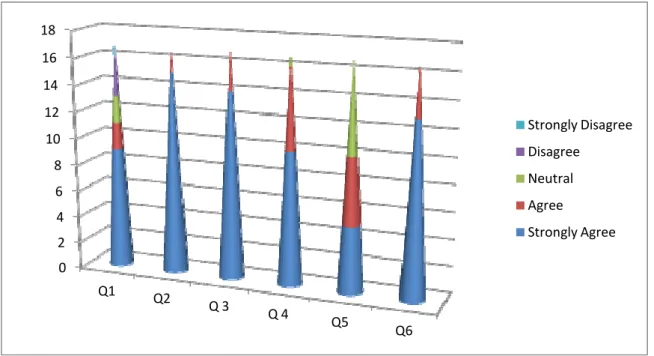
The pilot study was conducted and six questions were asked. As the students did not understand the questions, they were translated into Turkish to help them understand.
30 0 2 4 6 8 10 12 14 16 18 Q1 Q2 Q 3 Q 4 Q5 Q6 Strongly Disagree Disagree Neutral Agree Strongly Agree
Table 1. Pilot Study
From the pilot study, it can be understood clearly that most of the students chose the answer ‘ strongly agree’ which means that the students had the general idea that films, movies, television, chatting with native speakers and English songs would be a productive and an effective way of learning daily/ colloquial language and using it accurately and fluently. (see Appendix 1)
3.2 Questionnaire 1 Analysis
The research question, ‘Can I make the EFL students use daily expressions if I expose them to oral media as much as possible? What is the role of mass media tools such as television, radio, films, videos, songs, and internet ( social media) on speaking skills and speaking fluently?, an attitude questionnaire was given to students at the beginning of the term. The questionnaire had 6 questions and each question had 5 options. The questions were designed to reveal students’ opinions regarding their attitudes towards Listening and Speaking. The results were analyzed question by question. The students found the questions
31
and their options hard to understand, and therefore the whole questionnaire was translated into Turkish and given in Turkish. (see Appendix 2). It was understood that the students could not catch and use the daily expressions, which are the crucial part of fluent speaking. Here is the result of students’ attitude questionnaire;
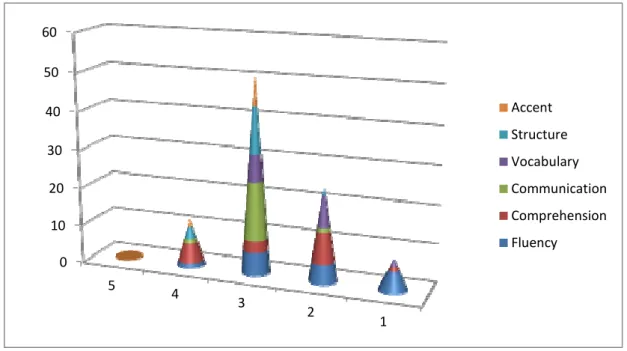
In this questionnaire, the students were tested according to some criteria such as fluency, comprehension, communication, vocabulary, structure and accent. The first question is about fluency, the second one is comprehension, the third one is communication, the fourth one is vocabulary, the fifth one is structure and the last one is accent. Each of these has five options. The students choose one option that matches with their level of fluency, comprehension, communication, vocabulary, structure and accent. ( see Appendix 2)
0 10 20 30 40 50 60 5 4 3 2 1 Accent Structure Vocabulary Communication Comprehension Fluency
Table 2: The pre- checklist for measuring communicative abilities.
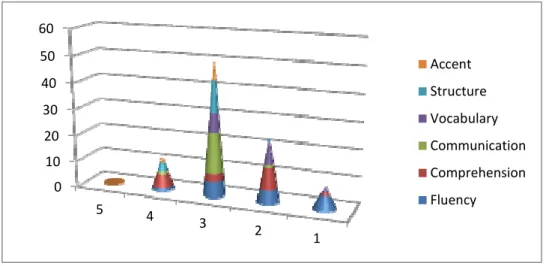
As it can be clearly understood from the Table 2 that in the first questionnaire, the students have the idea that they mostly speak hesitantly and slowly because of simply
32
paraphrasing and searching for words and speak in short patterns (1, 4). In addition to that they can understand simple sentences (2, 2) and they are almost unable to communicate (3,1), only able to communicate for personal and survival needs (3,2). Furthermore, the table shows that they use limited vocabulary (4, 2) or some basic words and use predominantly present verb tenses (5, 2) and make severe errors (6, 2). Lastly, the students have pronunciation problems, which are almost unintelligible.
3.3 Training Session
After the 1st questionnaire observations, students were trained about how /when to use these daily expressions list which has ‘Giving opinions, Agreeing, Disagreeing, Asking for opinions, Interrupting, Making things clear, Making a point/ stating a fact, Saying that you’re not sure, Trying to remember, Checking that you’ve understood’ and fillers. (see Appendix 3). After training, the students watched many authentic social media tools such as movies, news, interviews, lecture and songs. These online materials (www.ted.com), (www.realenglish.com, www.elllo.org), (www.youtube.com), were chosen according to the spoken language in the context. It was thought that if the students were exposed to these materials a lot, they would produce more common daily expressions. At the end of this training session and its applications, the students were given while listening test.
3.4 Analysis of Tests / Examinations
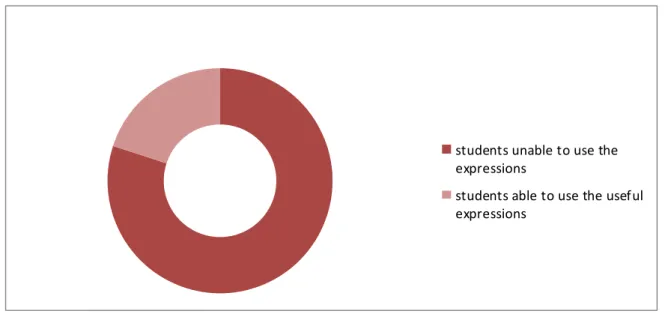
When the first written fill in the blank with the daily expressions test was given, they were not very successful; 14 out 20 students could not fill in the gaps, but only 4 out of 20 students could fill in the gaps with the correct alternatives of useful expressions that help them to sound naturally and fluently. Therefore, the researcher decided to give the
33
expressions on giving opinions, agreeing/ disagreeing, asking for opinions, making a point and so on.
students unable to use the expressions
students able to use the useful expressions
Table 6. The usage of useful expressions pre- training.
However, after the study sessions about the daily expressions and being exposed to variety of social media tools such as news, videos, interviews, songs and lectures, the students understood the key point, which is the usage of daily expressions while speaking the language. It is observed that they began to use these expressions whenever they were given a speaking subject. 0 5 10 15 20
The usage of useful expressions to help
the fluency
minority of the students used the useful expressions majority of the students used the useful expressions34 Table 7. The usage of useful expressions post- training.
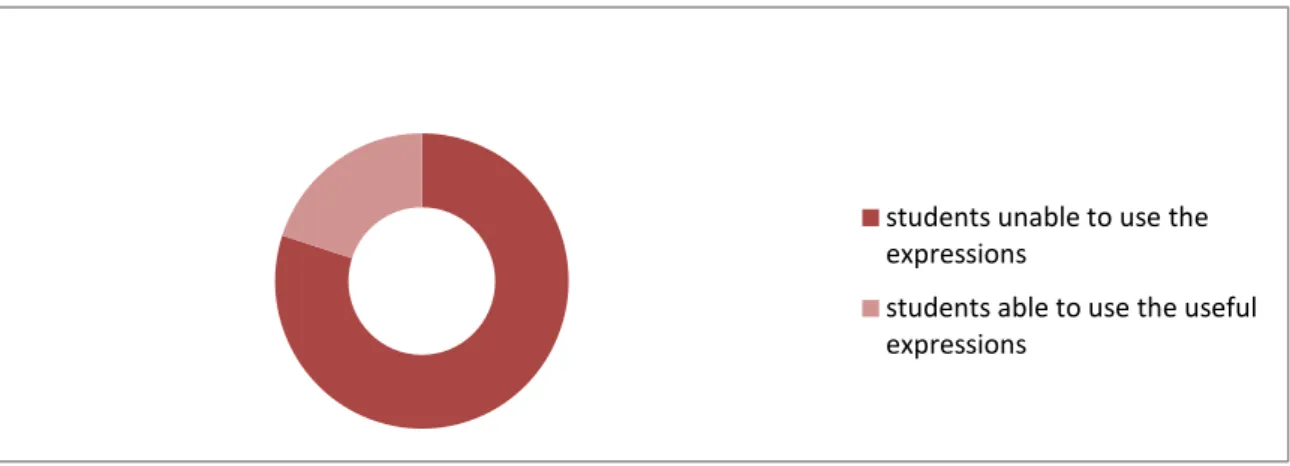
The students watched videos, short soap operas, speeches, lectures and songs with lyrics, weather forecasts, news and other supplementary audio-visual authentic materials. They were told to catch the phrases and expressions that they were trained about. Afterwards, they were tested by the researcher to see the outcomes of the training. 16 out of 20 students could fill in the gaps with correct alternatives of daily expressions while 4 out of 20 students could not do it efficiently enough.
students unable to use the expressions
students able to use the useful expressions
Table 8. The usage of useful expressions– pre- training.
0 10 20
The usage of useful expressions to help the
fluency
minority of the students used the useful expressions majority of the students used the useful expressions35
When before training and after training session compared, it can obviously seen that mass media authentic materials are more effective and motivating than the course books studied in the class as these audio-visual authentic materials are producing or capable of producing an intended result or having a striking effect on picking up the daily expressions.
In this test, the students were asked to fill in the blanks with the daily expressions that they heard. ( see Appendix 4). This was done several times and the students understood that the daily expressions are the key elements/points for speaking the language fluently. Afterwards, it was obviously seen that they are able to use these daily expressions whenever their opinions/ideas were wanted about any speaking subject.
3.5 Analysis of oral tests
Oral test was conducted to formally evaluate whether the students used the daily expressions well enough. There were two groups; experimental and control group. Experimental group did not have any training sessions on usage of daily expressions while speaking. However, control group had training session on usage of daily expressions to make their speaking more fluent and accurate. There were five students in each group and each student was asked six questions ranging from education, social life, health and so forth. Each student was asked to pick a card from an envelope and in each card, there were six questions. (see Appendix). Picking a card was not important for me, rather, using daily expressions while speaking was my key point.
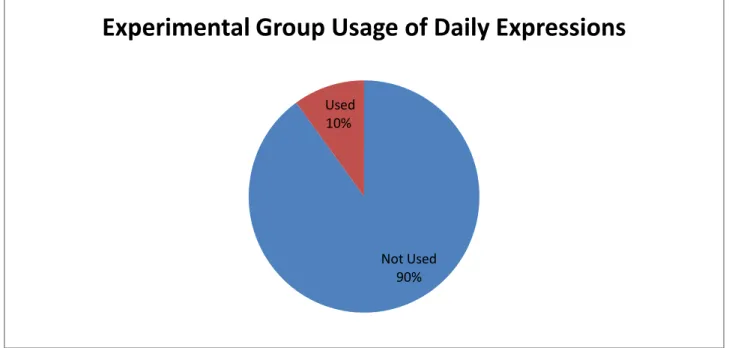
Each experimental group student chose a card from the envelope and began to speak on various subjects. However, it was seemed that their way of speaking was accurate but not fluent. 90 % of the students did not use daily expressions. Their way of speaking about given
36
subjects sounded like reading sentences from a book and dull. However, 10 % of the students spoke using daily expressions which sounded like more natural, accurate and fluent.
Not Used 90% Used
10%
Experimental Group Usage of Daily Expressions
Table 10. Experimental group usage of daily expressions.
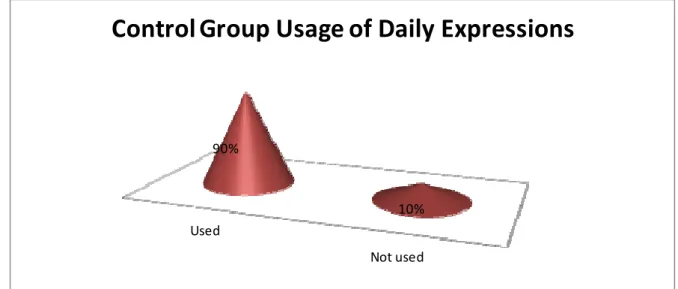
However, each student in control group picked a card from the same envelope and spoke about almost the same topics. 90 % of the control group students spoke using daily expressions such as ‘ Actually, I think, You know, Well, I think, For me, In my opinion, ans so forth which sounded more natural, accurate and most importantly fluent. Only 10 % of the students did not used these daily expressions.
37 Used Not used 90% 10%
Control Group Usage of Daily Expressions
Table 11. Control group usage of daily expressions.
At this point, it is seemed that using authentic mass media materials in class is effective on using common daily expressions while speaking. When both experimental and control group oral interview / tests into consideration, it is also understood that these authentic mass media materials can be used in the class to destroy the barrier between real life speaking language and classroom language.
3.6 Questionnaire 2 Analysis
After, the students watched authentic videos, short online lectures online authentic language teaching materials and some other materials such as news, weather forecast, soap operas which are short and with/ out English subtitle, and also some other course book listening materials to understand which one(s) is/are more helpful and motivating to make them speak naturally and fluently. The students have figured out that authentic audio-visual materials are more helpful and effective to make them speak fluently and sound naturally.
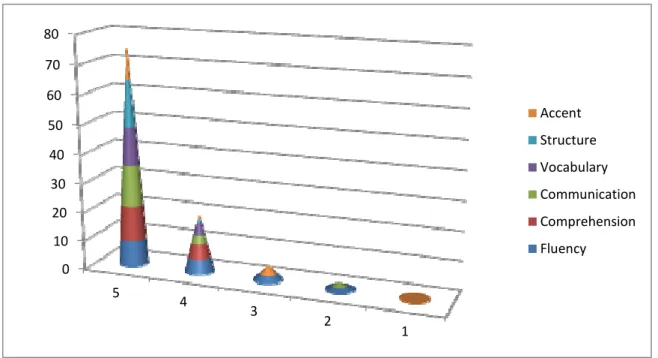
38 0 10 20 30 40 50 60 70 80 5 4 3 2 1 Accent Structure Vocabulary Communication Comprehension Fluency
Table 3. The post- checklist for measuring communicative abilities.
From the Table 3, it is seen that when the students exposed to audio-visual authentic media materials they speak with less hesitations (1, 4), and understand most spoken language (2, 4), initiate and sustain conversations (3, 3), and it is also observed that they can form/ produce some academic and colloquial vocabulary and expressions (4, 4), use some complex sentences (5, 3) and speak with few phonemic errors (6, 4), but more intelligible pronunciation. In summary, their fluency, comprehension, communication, vocabulary, structure and accent showed better progress.
39 0 10 20 30 40 50 60 5 4 3 2 1 Accent Structure Vocabulary Communication Comprehension Fluency
Table 4. The pre- checklist for measuring communicative abilities.
0 10 20 30 40 50 60 70 80 5 4 3 2 1 Accent Structure Vocabulary Communication Comprehension Fluency
Table 5. The post- checklist for measuring communicative abilities.
When compared to the first table, it is clear that the students are more familiar with English in many ways. For example, the students became more fluent, and it was easier for them to understand a native speaker. In addition, they could use the common daily phrases as they figured out that the people on videos, movies and TV used these while speaking. After exposed to these online and media tools, they could understand the accents and plus, they did try to have an accent while speaking. In short, it is seen that this study was productive, efficient and problem solving for the students.
40 3.7 Interpretations of the Results/ Results
The study was conducted to judge the effectiveness of mass media authentic materials on picking up the colloquial language in speaking English. The selected Preparatory School listening and speaking courses are devoted to this study of mass media authentic materials were carried out during the learning process. The results of the study presented the effectiveness of teaching these authentic materials in foreign language speaking skills development. The analysis of the data collected from the EFL students’ speaking on one hand and the effectiveness of mass media authentic materials on the other. The results, considerably high success with a score of percentage 80, and the questionnaires showed significant evidences of the study conducted throughout the year. Students developed positive attitude towards mass media authentic materials rather than non-authentic course book materials. The rate of speaking a foreign language accurately and fluently in the class increased compared to the beginning of the year. In addition, the results of the study revealed that authentic mass media materials used in the class are much more effective and efficient than those ones in the course books.
41 CHAPTER IV CONCLUSION
4.1. Introduction
This chapter presents the summary and draws a conclusion of the study presents the analysis of student achievement and their impact on students’ speaking skills within a year.
4.2. Overview of the Study
The aim of the study was to find the appropriate teaching technique for listening and speaking classes in which students benefit and produce more by means of authentic mass media materials. In this classroom- based research, the issue was to see whether authentic mass media materials could improve the ability of second language listening and speaking skills. In the design of the study, authentic mass media materials were used with the experimental group consists of 20 students. The control group however followed the standard curriculum. Two groups of students were tested to see their progress respectively. Then, the listening and speaking growth of the control and the experimental group was compared. The listening and speaking growth was measured through particular steps. The indicators were questionnaires and examinations. Throughout the research, videos, movies, short lectures, news, and so on were studied on to realize the errors and to find out how to speak/ sound naturally, accurately and fluently. During the study, students were also engaged in peer interactions spontaneously. All these created a discussion scene within the class. More freedom was offered to students, focus was on daily expressions that help the fluency. The support and feedback were on the correctness. The participants perceived that they can have
42
more expressions and can watch more or can be exposed more and can speak accurately, fluently and naturally. They had the chance of seeing and experimenting numerous speaking skills, strategies, and styles and that reflected a statistically significant difference in speaking improvement of the control group. Students could perform better speaking styles and ways. Furthermore, the attitudes of the participants towards speaking changed in a positive way. To sum up, the study revealed the benefits of authentic mass media materials in listening and more in speaking naturally.
4.3 Findings and Discussions
Speaking not only in foreign both language listening and speaking courses but also mostly in our daily lives is crucial for the students and teachers. In addition, today, not only students but also EFL teachers in Turkey and in the world have a chance of using authentic mass media materials not just in the classroom but also in their daily lives. Once used by both of these groups, it gives those opportunities to improve themselves not only academically but also personally. As a class, students could discuss a topic and share their views in a debate, which is a required skill, in higher education. The ones, who joined the study willingly, showed a satisfactory performance, and their English level was better than the experimental group. To concentrate on the content created by the ideas of students was important. With a system like focusing on the correctness encouraged the students, they realized their own speaking ability. Their language development was observed day after day, as they tried to talk about a topic / subject. They started with the vocabulary and in everyday English.
They become eager to talk naturally and comment on any kinds of topics as their speaking skills were evaluated according to their using common/ daily expressions rather than to their language learning problems. During the study, students with higher motivation