Dergi web sayfası:
www.agri.ankara.edu.tr/dergi www.agri.ankara.edu.tr/journalJournal homepage:
TARIM BİLİMLERİ DERGİSİ
—
JOURNAL OF AGRICUL
TURAL SCIENCES
19 (2013) 170-177
Comparative Study of Farm Yard Manure and Humic Acid in Integration
with Inorganic-N on Wheat (Triticum aestivum L.) Growth and Yield
Ihsanullah DAURa
a King Abdulaziz University, Faculty of Meteorology, Environment & Arid Land Agriculture, Department of Arid Land Agriculture, P.O. Box
80208, Jeddah, 21589, SAUDI ARABIA
ARTICLE INFO
Research Article ― Crop Production
Corresponding Author: Ihsanullah DAUR, E-mail: [email protected], Tel: +966-594133232 Received: 07 November 2012, Received in Revised Form: 04 August 2013, Accepted: 31 August 2013
ABSTRACT
Farmyard manure (FYM) is bulky and humic acid (HA) is compact organic source of plant nutrition. The objective of this study was to investigate the notion that 1 Mg FYM is equal to that of 1 kg HA and to develop an optimized integrated fertilization program. The study was conducted at the research station of Agricultural University Peshawar in Khyber Pakhtoonkwa, Pakistan, in a randomized complete block design with split plot arrangements. FYM (18 Mg ha-1) and HA
(18 kg ha-1) were in the main plots, whereas different nitrogen (N) levels (0, 50, 75, 100, 125, and 150 kg ha-1) were in
sub-plots. The results indicated a better performance of FYM than HA with significant (p < 0.05) differences in many parameters including plant height, leaf area index, chlorophyll content, biological yield, grain yield, and N content of grains. Of the different N levels, the best performance was observed for 100 kg N ha-1. Our present results show that 18
Mg FYM with 100 kg N ha-1 may be recommended as good sources for wheat fertilization. However, more research is
needed to evaluate the effectiveness of HA as an organic fertilizer and to compare higher HA rates with FYM. Keywords: Wheat; Fertilization; Farmyard manure; Humic acid; Nitrogen
İnorganik Asit ile Birleştirilmiş Çiftlik Gübresi ve Humik Asidin
Buğdayın (Triticum aestivum L.) Büyüme ve Verimine Olan Etkisinin
Karşılaştırılması
ESER BİLGİSİ
Araştırma Makalesi ― Bitkisel Üretim
Sorumlu Yazar: Ihsanullah DAUR, E-posta: [email protected], Tel: +966-594133232 Geliş Tarihi: 07 Kasım 2012, Düzeltmelerin Gelişi: 04 Ağustos 2013, Kabul: 31 Ağustos 2013
ÖZET
Bitki beslemede çiftlik gübresi hacimli iken humik asit yoğun organik besin kaynağıdır. Bu çalışmanın amacı; 1 kg humik asidin 1Mg çiftlik gübresine eşit olduğu fikrini araştırmak ve optimum birleşik gübreleme yöntemi geliştirmektir.
1. Introduction
Farmyard manure (FYM) and humic acid (HA) are important sources of organic fertilizers, and 1 kg HA are considered to be substituted for 1 metric ton of manure (Tahir et al 2011; Hammad et al 2011; Humintech 2012). Worldwide there are concerns regarding nitrogen (N) loss and ecological contamination from the use of high amounts of N fertilizers (Iqbal et al 2012; Tafteh and Sepaskhah, 2012), whereas low N application is reportedly unsatisfactory because it reduces crop yield (Dadnia et al 2010; Daur et al 2011). With these considerations, the present study was conducted to compare FYM and HA and determine an optimum N level for wheat cultivation under semi-arid climate conditions.
Integration of inorganic N with organic fertilizers has received relatively little attention in the past but has recently been gaining popularity possibly because of the limited amount of N present in organic fertilizers (Delfine et al 2005; Amujoyegbe et al 2007; Abedi et al 2010). There are limited field researches regarding the optimization of nitrogenous chemical fertilizers with organic fertilizers. Abedi (2010) evaluated the effects of different levels of
inorganic N (0, 80, 160, and 240 kg ha-1) and organic
(0, 30, and 60 Mg municipal solid waste compost
ha-1) and reported that the highest wheat grain yield
was achieved when the plants were fertilized with
160 kg N ha-1 and 30 Mg of compost ha-1. However,
many studies such as those of Delfine et al (2005), Yaduvanshi and Sharma (2008), Mandal et al
(2009), Dadnia et al (2010). Hammad et al (2011), Tahir et al (2011), Aliasghar and Behzad (2012), Fuertes-Mendizabal et al (2012), and Madani et al (2012) have demonstrated the individual effects of FYM, HA, and N application on wheat, but not their combined effects, this aprroach generated idea for the present study.
The present study compared the effect of 2 important organic fertilizers-FYM and powdered HA-in combination with different inorganic N levels to develop an environmentally and economically feasible fertilization program for wheat. The research findings are based on some important parameters of wheat growth and yield that may provide basis to study effect of these fertilizers at the biochemical level.
2. Material and Methods
Field experiments were conducted on wheat at the Experimental Farm of Agricultural University Peshawar in Khyber Pakhtoonkwa, Pakistan, in 2008–2009 and 2009–2010. To avoid a residual effect, different field was used every year, and composite soil samples were collected from the experimental areas from 0–30 cm depths before sowing to test the soil properties. Soil samples were oven-dried and crushed to pass through a 2 mm sieve. Sand, silt, and clay proportions of the soil were determined using the hydrometer method (Arshad et al 1996). Soil pH was determined using a soil saturation extract, as described by Thomas (1996). Cation exchange capacity (CEC) was Çalışma Pakistan Khyber Pakhtoonkwa Peşaver Tarım Üniversitesi araştırma istasyonunda tesadüf bloklarında bölünmüş parsel deneme deseninde yürütülmüştür. Ana parsellere 18 Mg ha-1 çiftlik gübresi ve 18 kg ha-1 humik asit
uygulanırken alt parsellere 0, 50, 75, 100, 125 ve 150 kg ha-1 azot uygulaması yapıldı. Sonuçlar; danelerin azot içeriği,
ürün verimi, biyolojik verim, klorofil içeriği, yaprak alan indeksi, bitki yüksekliği dahil olmak üzere en iyi performansın humik asitten ziyade çiftlik gübresinde elde edildiğini göstermiştir (P<0.05). Farklı azot seviyelerinde en iyi performans değerleri 100 kg N ha-1 oranında elde edilmiştir. Mevcut sonuçlar, buğday gübrelemesinde 100 kg N ha-1 ile birlikte 18
Mg ha-1 çiftlik gübresi önerilebileceğini göstermiştir. Bununla birlikte humik asidin organik gübre olarak etkinliğinin
değerlendirilmesine ve daha yüksek oranlardaki humik asit değerlerinin çiftlik gübresi değerleriyle karşılaştırılmasına ilişkin daha fazla araştırmaya ihtiyaç vardır.
Anahtar Kelimeler: Buğday; Gübreleme; Çiftlik gübresi; Hümik asit; Azot
measured following method of Page et al (1982). Lime (CaCO3) content was determined by the
Scheibler calcimeter method (Allison and Moodie, 1965). Organic matter was determined using the Walkley-Black method (Nelson and Sommers, 1996). Nitrogen content was determined using the Kjeldahl method (Bremner, 1996). Phosphorus (P), potassium (K), copper (Cu), zinc (Zn), iron (Fe), and manganese (Mn) were extracted using Mehlich 1 extracting solution (0.05 M hydrochloric acid [HCl] + 0.0125 M sulfuric acid [H2SO4]). Phosphorus
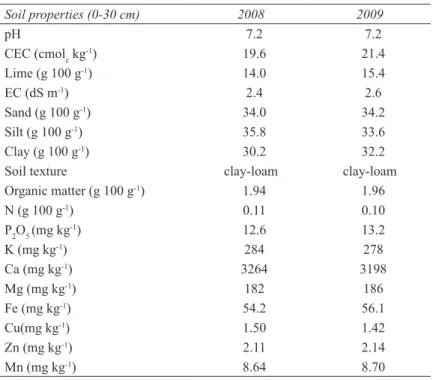
(P2O5) was determined colorimetrically (Murphy and Riley 1962), and K, Cu, Zn, Fe, and Mn were determined by atomic absorption spectroscopy using Hitachi atomic absorption spectrometer (Model Z-8000). Calcium (Ca) and magnesium (Mg) were extracted using 1 M potassium chloride (KCl). The soil analysis methods used in this study were described by Ryan et al (2001). The results of the selected soil properties are listed in Table 1.
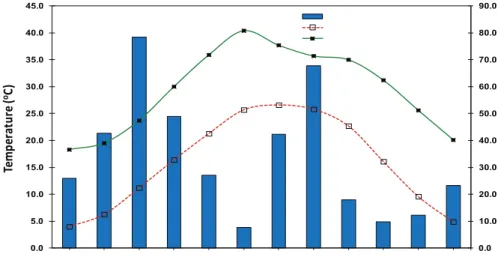
The climate of the experimental site was typically subtropical (Figure 1).
In these experiments, 2 organic fertilizers, FYM
(18 Mg ha-1) and powdered HA (18 kg ha-1), and 6
N levels (0, 50, 75, 100, 125, and 150 kg N ha-1)
from a urea source were evaluated. The fields were planted with a locally manufactured manual running seed drill on October 13, 2008 and October 12, 2009 in 10-row plots, each 5 m long with 30 cm between rows, by using a randomized complete block design with split plot arrangements replicated 4 times. Plots were kept weed-free thereafter by manual weeding. Phosphorus was deficient according to Horneck et al (2007) while following the same researchers’
guideline; 40 kg P2O5 ha-1 from the diammonium
phosphate (DAP) was desirable to accomplish crop growth in addition to the organic fertilizer addition. Other cultural practices were consistent with local agronomic practices.
Table 1- Soil properties (0-30 cm) of the experimental site
Çizelge 1- Denemenin yapıldığı alanın 0-30 cm’ deki toprak özellikleri Soil properties (0-30 cm) 2008 2009 pH 7.2 7.2 CEC (cmolc kg-1) 19.6 21.4 Lime (g 100 g-1) 14.0 15.4 EC (dS m-1) 2.4 2.6 Sand (g 100 g-1) 34.0 34.2 Silt (g 100 g-1) 35.8 33.6 Clay (g 100 g-1) 30.2 32.2
Soil texture clay-loam clay-loam
Organic matter (g 100 g-1) 1.94 1.96 N (g 100 g-1) 0.11 0.10 P2O5 (mg kg-1) 12.6 13.2 K (mg kg-1) 284 278 Ca (mg kg-1) 3264 3198 Mg (mg kg-1) 182 186 Fe (mg kg-1) 54.2 56.1 Cu(mg kg-1) 1.50 1.42 Zn (mg kg-1) 2.11 2.14 Mn (mg kg-1) 8.64 8.70
2.1. Procedures for data recording
Plant height (from the soil surface to the tip of the spike) was recorded from an average of 10 individual, randomly selected plants at time of anthesis in each subplot. Leaf area index (LAI) was determined using a SunScan canopy analysis system (Delta-T Devices Ltd., Cambridge, UK). Three measurements were taken randomly between different rows in each plot, and the average was then calculated. Leaf chlorophyll content was measured using SPAD-502 (Minolta Co. Ltd., Osaka, Japan). A total of 15 intact and fully expanded leaves were randomly selected in each subplot, and the SPAD reading of each was taken from the leaf center. The average of the 15 individual SPAD measurements was calculated. Grain yield was recorded in 6 central rows of each subplot and then converted into kg ha-1. Biological yield data were obtained
for 6 central rows of each subplot at maturity and then converted into kg ha-1. Nitrogen content in the
grains was determined using the Kjeldahl method (Bremner, 1996). Data were analyzed statistically by using MSTATC software for analysis of variance,
and means were compared using the least significant differences (LSD) test (Russell, 1986).
3. Results and Discussion
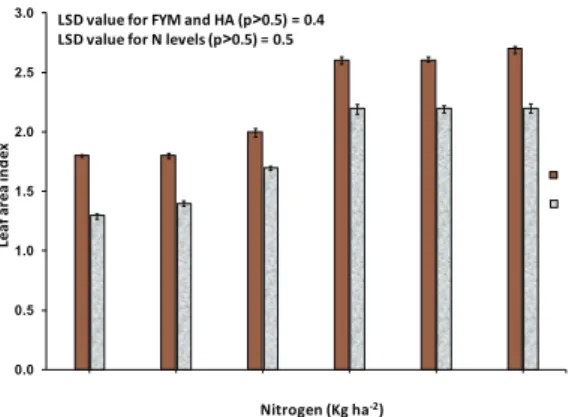
3.1. Plant growth and developmentPlant height and LAI were significantly (p < 0.05) affected by the organic fertilizers FYM and HA as well as N levels (Figure 2 and Figure 3). The interaction between the organic fertilizers and N levels was non-significant for these parameters. Our results showed that integration of FYM with 150 kg N ha-1 resulted in the production of tall plants (120 cm);
this finding was statistically similar to that obtained by integration of FYM with 100 and 125 kg N ha-1
treatments. The maximum LAI of 2.7 was obtained for plants that received FYM integrated with 150 kg N ha-1; this was statistically in accordance with the
LAI obtained for FYM integrated with 100 kg N ha-1
and 125 kg N ha-1. Similar results were reported by
Amujoyegbe et al (2007) and Iqbal et al (2012), who observed that increasing N fertilizer up to a certain level considerably influenced plant height and leaf
0.0 10.0 20.0 30.0 40.0 50.0 60.0 70.0 80.0 90.0 0.0 5.0 10.0 15.0 20.0 25.0 30.0 35.0 40.0 45.0
Jan Feb Mar Apr May Jun Jul Aug Sep Oct Nov Dec
Average rainfall (mm) Average minimum temperature Average maximum temperature
Tem per at ur e ( oC)
Fig.1. Climatic condition of the research site, average temperatures and rainfall throughout the year
Months
Figure 1- Climatic conditions of the research site, average temperatures (left ordinat) and rainfall throughtout the year (right ordinat)
area. The probable reason for this is that a higher N supply or the optimum fertilizers played an essential role in enhanced vegetative growth, as reported by Fuertes-Mendizabal (2012), Madani et al (2012), and Montazar and Behzad (2012).
Nitrogen (Kg ha-2) Pl an t h ei gh t ( cm ) 0 20 40 60 80 100 120 140 0 50 75 100 125 150 FYM HA
LSD value for FYM and HA (p>0.5) = 0.4 LSD value for N levels (p>0.5) = 0.5
Figure 2- Plant height of wheat as affected by organic fertilizers (FYM and HA) and nitrogen levels. Data series represent the two years mean ±S.D.(error bars)
Şekil 2- Organik gübreler (çiftlik gübresi ve hümik asit) ve azot seviyelerinden etkilenen buğday bitki yüksekliği. Veriler 2 yılın ortalamasıdır Nitrogen (Kg ha-2) Lea f a rea in dex 0.0 0.5 1.0 1.5 2.0 2.5 3.0 0 50 75 100 125 150 FYM HA
LSD value for FYM and HA (p>0.5) = 0.4 LSD value for N levels (p>0.5) = 0.5
Figure 3- Leaf Area Index of wheat as affected by organic fertilizers (FYM and HA) and nitrogen levels. Data series represent the two years mean ±S.D.(error bars)
Şekil 3- Organik gübreler (çiftlik gübresi ve hümik asit) ve azot seviyelerinden etkilenen buğday bitki yaprak alan indeksi. Veriler 2 yılın ortalamasıdır
The SPAD chlorophyll reading was significantly (p > 0.05) affected by N levels but was non-significantly affected by FYM and HA (Figure 4). There was no interaction between organic fertilizers and N levels for the SPAD chlorophyll reading. The SPAD chlorophyll measurement was maximal
for 100 kg N ha-1, which was similar to the SPAD
chlorophyll measurement for 125 kg N ha-1 and
higher levels of N. Our chlorophyll content result is in accordance to that obtained by Amujoyegbe et al (2007) and Islam et al (2009), who reported that the lowest chlorophyll content occurred in the control plot and it increased with the N level. Delfine et al (2005) support our results as with them no effect of organic fertilizers was observed on chlorophyll and photosynthesis. 0.0 5.0 10.0 15.0 20.0 25.0 30.0 35.0 40.0 45.0 0 50 75 100 125 150 FYM HA Nitrogen (Kg ha-2) SP AD ch lo ro ph yl l
LSD value for N levels (p>0.5) = 3.6
Figure 4- SPAD chlorophyll of wheat as affected by organic fertilizers (FYM and HA) and nitrogen levels. Data series represent the two years mean ±S.D.(error bars)
Şekil 4- Organik gübreler (çiftlik gübresi ve hümik asit) ve azot seviyelerinden etkilenen buğday bitki SPAD klorofil değerleri. Veriler 2 yılın ortalamasıdır.
3.2. Yield and yield components
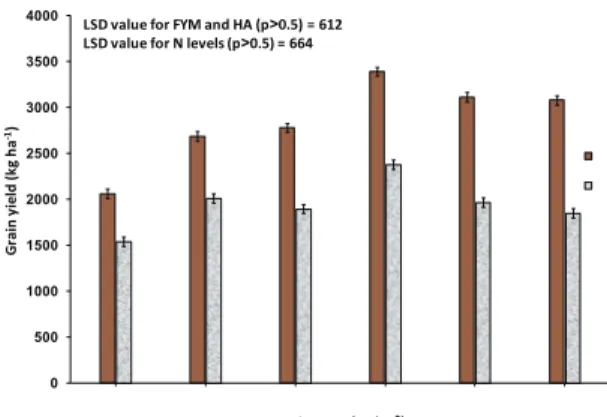
Significant (p < 0.05) differences between the organic fertilizers, FYM and HA, and various N levels were observed with respect to biological yield (Figure 5), grain yield (Figure 6), and N content of grains (Figure 7); however, no interaction was observed between the source organic fertilizers, and
N levels (Figures 5, 6 and 7). Biological yield (9867 kg ha-1) was maximal for FYM with 150 kg N ha-1
treatment but this was statistically parallel to FYM with 100 kg N ha-1 and 125 kg N ha-1. Grain yield
which is the economic yield of wheat was highest (3392 kg ha-1) for FYM with 100 kg N ha-1. Despite
grain N content (2.6%) was highest for FYM and 150 kg N ha-1 combination, this was statistically
similar to FYM with 100 kg N ha-1 and 125 kg N ha-1
treatments. Our results are supported by Yaduvanshi et al (2008), Islam et al (2009), Mandal et al (2009), Abedi et al (2010), Dadnia et al (2010), Hammad et al (2011), Iqbal et al (2012), and Madani et al (2012) who have observed similar increases in biological yield, grain yield, and N content of crops after the addition of N or a combination of N with manure. Furthermore, the results achieved with HA are parallel to those of Delfine et al (2005), who reported that HA is a limited source of plant nutritions for plant growth, grain yield, and quality, but contrasting to Tahir et al (2011), who have reported significant increase in growth (plant height and shoot weight) and N uptake of wheat with HA.
0 1000 2000 3000 4000 5000 6000 7000 8000 9000 10000 11000 12000 0 50 75 100 125 150 FYM HA Nitrogen (Kg ha-2) Bio lo gic al y ie ld (k g ha -1)
LSD value for FYM and HA (p>0.5) = 988 LSD value for N levels (p>0.5) = 995
Figure 5- Biological yield of wheat as affected by organic fertilizers (FYM and HA) and nitrogen levels. Data series represent the two years mean ±S.D.(error bars)
Şekil 5- Organik gübreler (çiftlik gübresi ve hümik asit) ve azot seviyelerinden etkilenen buğday biyolojik verimi. Veriler 2 yılın ortalamasıdır 0 500 1000 1500 2000 2500 3000 3500 4000 0 50 75 100 125 150 FYM HA Nitrogen (Kg ha-2) Gr ai n yi el d ( kg h a -1)
LSD value for FYM and HA (p>0.5) = 612 LSD value for N levels (p>0.5) = 664
Figure 6- Grain yield of wheat as affected by organic fertilizers (FYM and HA) and nitrogen levels. Data series represent the two years mean ±S.D.(error bars) Şekil 6- Organik gübreler (çiftlik gübresi ve hümik asit) ve azot seviyelerinden etkilenen buğday dane verimi. Veriler 2 yılın ortalamasıdır 0.0 0.5 1.0 1.5 2.0 2.5 3.0 0 50 75 100 125 150 FYM HA Nitrogen (Kg ha-2) Gr ai n N (% )
LSD value for FYM and HA (p>0.5) = 0.2 LSD value for N levels (p>0.5) = 0.2
Figure 7- Grain nitrogen content of wheat as affected by organic fertilizers (FYM and HA) and nitrogen levels. Data series represent the two years mean ±S.D.(error bars)
Şekil 7- Organik gübreler (çiftlik gübresi ve hümik asit) ve azot seviyelerinden etkilenen buğday bitki azot oranı. Veriler 2 yılın ortalamasıdır
4. Conclusions
The results of this study indicated that 18 kg of HA not increased wheat growth and yield as 18 Mg of FYM did. However, comparisons of higher levels of HA are suggested for evaluation in future research to further explore this idea. Moreover, on the basis of various parameters especially grain yield that is the economic part of wheat, 100 kg N ha-1 combined
with either FYM or HA was found to be optimal chemical N fertilization rate. Consequently, we recommend an application of 100 kg N ha-1 with 18
Mg FYM for wheat production with similar yield and in similar environmental conditions.
References
Abedi T A, Alemzadeh & Kazemeini S A (2010). Effect of organic and inorganic fertilizers on grain yield and protein banding pattern of wheat. Australian Journal of Crop Science 4(6): 384-389
Allison L E, and Moodie C D (1965). Carbonate. In: Methods of soil analysis, (Ed: C A Black), American Society of Agronomy, Wisconsin, pp. 1379-1396 Amujoyegbe B J, Opabode J T & Olayinka A (2007).
Effect of organic and inorganic fertilizer on yield and chlorophyll content of maize (Zea mays L.) and sorghum Sorghum bicolour (L.) Moench). African
Journal Biotechnol 6(16): 1869 – 1873
Arshad M A, Lowery B & Grossman B (1996). Physical tests for monitoring soil quality. In: Methods for Assessing Soil Quality, (Eds: J W Doran & A J Jones), Madison, WI: Soil Science Society of America, pp. 123–141
Bremner J M (1996). Nitrogen–total. In: Methods of Soil Analysis. (Ed: D L Sparks), Madison, Part 3, WI: American Society of Agronomy, pp. 1085–1121 Dadnia M R, Asgharzadeh A & Shaabani R (2010). Effect
of liquid nitrogen fertilizer and nitrogen levels on wheat (Triticum aestivum L.). Research on Crops
11(3): 628-631
Daur I, Sepetoglu H & Sindel B (2011). Dynamics of faba bean growth and nutrient uptake and their correlation with grain yield. Journal of Plant Nutrition 34: 1360-1371
Delfine S, Tognetti R, Desiderio E & Alvino A (2005). Effect of foliar application of N and humic acids
on growth and yield of durum wheat. Agronomy for
Sustainable Development 25(2): 183-191
Fuertes-Mendizabal T, Murua C, Gonzalez-Moro M B & Estavillo J M (2012). Late nitrogen fertilization affects nitrogen remobilization in wheat.
Journal of Plant Nutrition and Soil Science 175(1):
115-124
Hammad H M, Khaliq A, Ahmad A, Aslam M, Malik A H, Farhad W & Laghari K Q (2011). Influence of different organic manures on wheat productivity.
International Journal of Agriculture and Biology 13(1): 137-140
Horneck, D.A., J.W. Ellsworth, B.G. Hopkins, D.M. Sullivan, and R.G. Stevens. 2007. Managing Salt-affected Soils for Crop Production. PNW 601. Corvallis, OR: Oregon State University Extension Service
Humintech (2012). Is it possible to replace Humus with organic manure? Available: http://www.humintech. com/001/industry/information/faq.html#top (Accessed 02 Feb, 2012)
Iqbal M, Khan A G, Anwar-Ul-Hassan & Amjad M (2012). Soil physical health indices, soil organic carbon, nitrate contents and wheat growth as influenced by irrigation and nitrogen rates. International Journal of
Agriculture and Biology 14(1): 1-10
Islam MS, Hasanuzzaman M, Rokonuzzaman M & Nahar K (2009). Effect of split application of nitrogen fertilizer on morphophysiological parameters of rice genotypes. International Journal of Plant Production
1: 51-61
Madani A, Makarem A H, Vazin F, Joudi M (2012). The impact of post-anthesis nitrogen and water availability on yield formation of winter wheat. Plant Soil and
Environment 58(1): 9-14
Mandal A, Patra A K, Singh D, Swarup A, Purakayastha T J & Masto R E (2009). Effects of long-term organic and chemical fertilization on N and P in wheat plants and in soil during crop growth. Agrochimica 53(2): 79-91
Montazar A & Azadegan B (2012). Effects of seasonal water use and applied N fertilizer on wheat water productivity indices. Journal of Irrigation and
Drainage Engineering 61(1): 52-59
Nelson D W & Sommers L E (1996). Total carbon, organic carbon, and organic matter. In: Methods of Soil Analysis, Part 2, 2nd ed., (Ed: A.L. Page), Madison, WI: American Society of Agronomy, pp. 961–1010
Page AL, Miller RH, Keeney DR (1982). Methods of Soil Analysis, Part 2. Chemical and Microbiological Properties (Agronomy), 2nd ed. Soil Science Society of America, Madison, Wisconsin, USA
Russell D F (1986). MSTAT-C Package Programme. Crop and Soil Science Department, Michigan State University, USA
Ryan J, Estefan G, Rashid A (2001). Soil and Plant Analysis Laboratory Manual, 2nd ed. Aleppo, Syria: International Center for Agricultural Research in the Dry Areas and the National Agricultural Research Center
Tafteh A, Sepaskhah AR (2012). Yield and nitrogen leaching in maize field under different nitrogen
rates and partial root drying irrigation. International
Journal of Plant Production 6(1): 93-113
Tahir MM, Khurshid M, Khan M Z, Abbasi M K, Kazmi M H (2011). Lignite-derived humic acid effect on growth of wheat plants in different soils. Pedosphere
21(1): 124-131
Thomas G W (1996). Soil pH and soil acidity. In: Methods of Soil Analysis. Part 3, (Ed D. L. Sparks), Madison, WI: American Society of Agronomy, pp. 475–490 Yaduvanshi N P S, Sharma D R (2008). Tillage and residual
organic manures/chemical amendment effects on soil organic matter and yield of wheat under sodic water irrigation. Soil & Tillage Research 98(1): 11-16