T.C.
SELÇUK ÜNİVERSİTESİ SOSYAL BİLİMLER ENSTİTÜSÜ
YABANCI DİLLER EĞİTİMİ ANA BİLİM DALI İNGİLİZCE ÖĞRETMENLİĞİ BİLİM DALI
A COMPARATIVE STUDY OF OVERCOMING THE DIFFICULTIES
OF READING THROUGH MULTIPLE INTELLIGENCE THEORY IN
ENGLISH PREPARATORY CLASSES AT SCHOOL OF FOREIGN
LANGUAGES AT SELCUK UNIVERSITY
YÜKSEK LİSANS TEZİ
DANIŞMAN
Yrd. Doç. Dr. A.Hamit ÇAKIR
Hazırlayan Sevim SARAR
KONYA -2008-
ACKNOWLEDGEMENTS
I am really grateful to my thesis supervisor Assist. Prof. Dr. A. Hamit Çakır who has been gracious in guiding me and commenting on my thesis.
Thanks go to Assist. Prof. Dr. Eyüp Yarar, an instructor at Niğde University, for his statistical assistance.
I would also like to thank my family members especially to my husband, Doğan Sarar, for his endurance and to my son, Mehmet Batuhan Sarar for his priceless existence in every phase of the study.
ABSTRACT
This study aims to investigate how to overcome the difficulties of reading and vocabulary teaching through M.I. (Multiple Intelligences) theory. This study also aims to show the contribution of M.I. theory to reading lessons and students’ motivation. The data have been collected through the implementation of pre and post reading tests to 40 students at prep classes at Selcuk University, School of Foreign Languages.
In the first chapter, the background to the study, statements of the problems, goal and scope of the study, method of the study and limitations are presented.
The second chapter includes review of the literature. This part focuses on the
definition of “Multiple Intelligences theory and Intelligences and the definition of reading and M.I.’s importance in teaching reading in prep classes.
In the third chapter, the methodology and the information about experimental and control group are given. Data analysis and interpretation of the tests and experimental study take place in the next chapter. Also, the results of the study are given through the
interpretation of tables.
In “conclusion” part, the summary and findings of the study and suggestions are presented.
ÖZET
Bu çalışma çoklu zeka teorisinin İngilizce okuma derslerine katkısını ve öğrencilerin ilgi ve bölüm çeşitliliğini dikkate alarak onların motivasyonlarını arttırmadaki etkisini içermektedir. Bu çalışmadaki veriler Selçuk Üniversitesi, Yabancı Diller Yüksekokulu’nda İngilizce öğretilen hazırlık sınıflarında çeşitli bölümlerde eğitimine devam edecek olan toplam 40 öğrenci üzerinde ön ve son test içeren uygulamalar yapılarak toplanmıştır. Ve bu testlerde Independent t-testi kullanılmıştır.
Birinci bölümde, çalışmanın tarihçesi, problemin açıklanması, çalışmanın amacı ve içeriği, çalışmanın metodu ve sınırlılıkları sunulmuştur.
İkinci bölüm, literatür taramasını içerir. Çoklu zeka teorisi ve bu zeka tiplerinin tanımı, okuma teknikleri ve genel olarak eğitim ve bu teori arasındaki bağıntıyı içermektedir.
Üçüncü bölüm ise, metodoloji ve deney ve kontrol grubu ile ilgili bilgileri içermektedir. Veri analizi ve deneysel çalışmanın yorumlanması bir sonraki bölümde yer almaktadır. Çalışma sonuçları tablolar halinde de verilmektedir.
Sonuç bölümünde ise, çalışmanın özeti bulguları ve öneriler sunulmaktadır. Tezin arka tarafında ise çalışma ile ilgili bazı ekler yer almaktadır.
TABLE OF CONTENTS ACKNOWLEDGEMENTS . . . I ABSTRACT . . . II ÖZET . . . III CONTENTS . . . IV CHAPTER I . . . 1 INTRODUCTION . . . 1
1.1. General Background Of The Study . . . .. 1
1.2 Aim of the Study . . . 4
1.3. Scope of the Study . . . 5
1.3.1. The Problem . . . 5
1.3.2. The Research Question and Hypotheses . . . 6
1.4. The Significance . . . 6
1.5. The Limitations of the Study . . . 6
1.6. Organization of Chapters . . . 7
CHAPTER II . . . 8
REVIEW OF LITERATURE . . . . . . . . . . . . 8
2.1. An Overview of Intelligence . . . . . . 8
2.2. Gardner’s Theory of Multiple Intelligence . . . 10
2.3. Multiple Intelligences and the Strategies . . . 14
2.3.1. Verbal-Linguistic Intelligence . . . 15
2.3.2. Logical-Mathematical Intelligence . . . 19
2.3.3. Bodily- Kinesthetic Intelligence . . . 22
2.3.4. Visual- Spatial Intelligence . . . 25
2.3.5. Musical Intelligence . . . 29
2.3.6. Interpersonal Intelligence . . . 32
2.3.7. Intrapersonal Intelligence . . . 35
2.3.8. Naturalistic Intelligence . . . 38
2.3.9. Existential Intelligence . . . 39
2.4. Learning Styles and Multiple İntelligences . . . 40
2.5. Language Teaching and MI Theory . . . . . . 43
2.7. Using MI in the Classroom . . . . . . . 48
2.8. Reading . . . 52
2.8.1. The Role of Reading in Foreign Language Learning . . . 52
2.8.2. The Reading Process . . . 53
2.8.3. Models of the Reading Process . . . 54
2.8.3.1. The Bottom-Up Model . . . 55
2.8.3.2. The Top-Down Model . . . 55
2.8.3.3. The Interactive Model . . . 56
2.9. Definition of Reading Strategies . . . 58
2.10. Classification of Reading Strategies . . . 59
2.10.1. Metacognitive Reading Strategies . . . . . . 60
2.10.2. Cognitive Reading Strategies . . . . . . 60
2.11. Role of Think-Aloud Protocols in Assessing Strategy Use . . . 65
CHAPTER III . . . 67 METHODOLOGY . . . 67 3.1. Selection of Subjects . . . 67 3.1.1. Students . . . 67 3.2. Research Design . . . 68 3.3. Materials . . . . . . 71 3.3.1.Reading Texts . . . 71
3.3.2. Pre-test and Post-test . . . . . . . . . . . . . . . . . . . 71
3.3.3. Intelligence Inventory . . . 71
3.4. Data Collection Procedures . . . 72
3.4.1. Before the Instruction . . . 72
3.4.2. During the Istruction . . . . . . . 73
3.4.3. After the Instruction . . . . . . 75
3.5. Data Analysis . . . 75
CHAPTER 4 . . . 77
RESULTS AND ANALYSIS . . . 77
4.1. Restatement of the Purpose . . . 77
4.1.1. Analysis of the Pre-test Scores . . . 77
4.1.2. Analysis of the Post-test Scores . . . 80
4.1.2.1. Interpretations and Discussions of the Post-test Results . . . 81
CHAPTER 5 . . . 82
CONCLUSIONS AND FURTHER IMPLICATIONS . . . 82
5.1. Presentation . . . . . . 82
5.2. Summary of the Study . . . 82
5.3. Implications for Practice in the Field of ELT and Wider Context . . . 83
5.4. Implications for Further Research . . . 84
Bibliography . . . 85
APPENDICES . . . 88
Appendix A Reliability Analysis . . . 88
Appendix B Sample Activities Regarding MI Theory . . . . . . 88
Appendix C The Rearding Texts . . . . . . 90
Appendix D Pre – Test And Post – Test Questions . . . 99
Appendix E Target Vocabularies . . . 105
Appendix F Multiple Intelligence Inventory For English Language Teachers . . . 107
Appendix G An MI Inventory For Adults . . . 113
Appendix H Figure 3: The Teacher’s Intelligences Profile . . . 120
Appendix I Figure 4: Experimental Group’s Students’ Most Dominant Intelligence Areas . . . 121
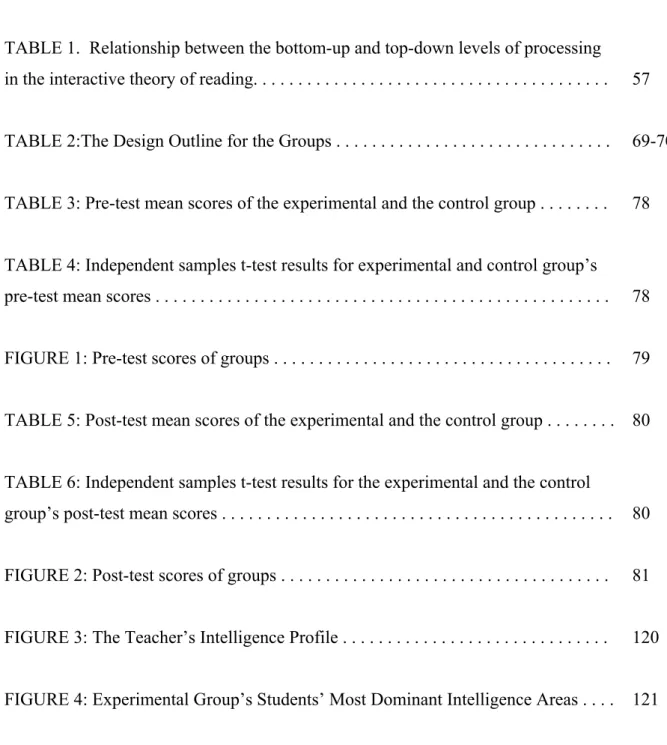
LIST OF TABLES
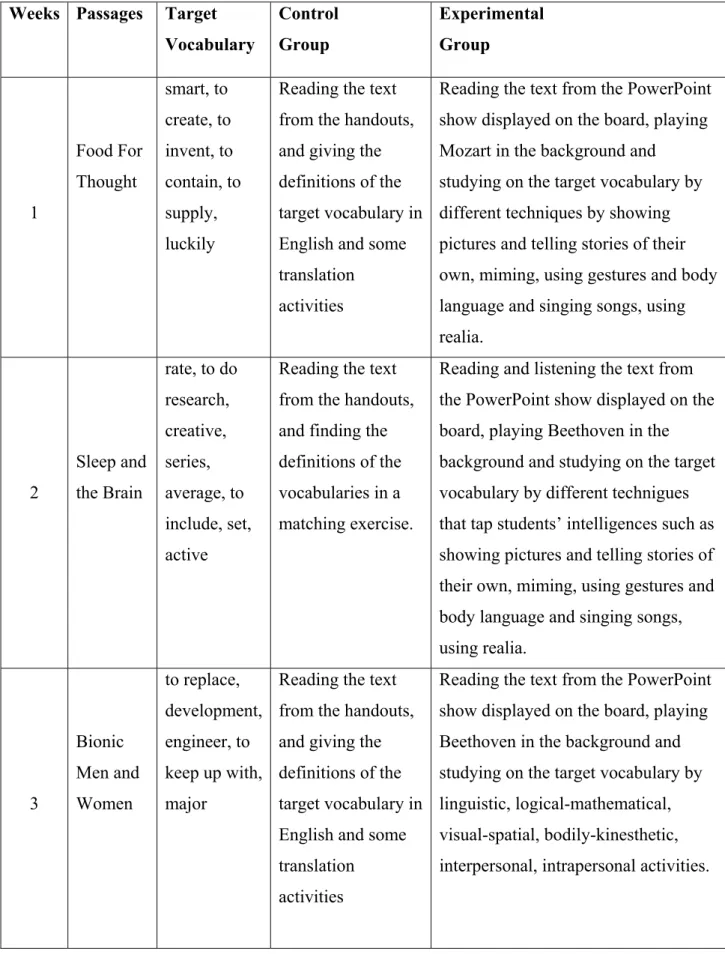
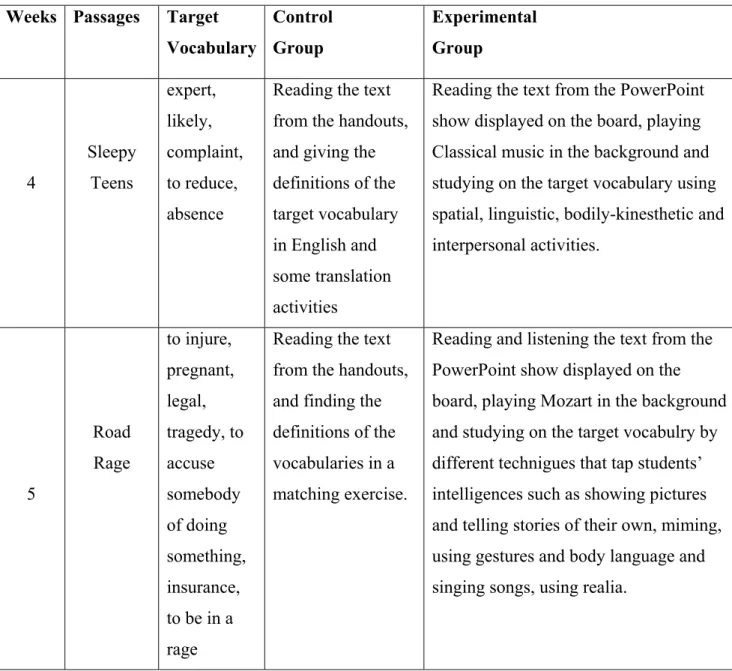
TABLE 1. Relationship between the bottom-up and top-down levels of processing in the interactive theory of reading. . . 57 TABLE 2:The Design Outline for the Groups . . .
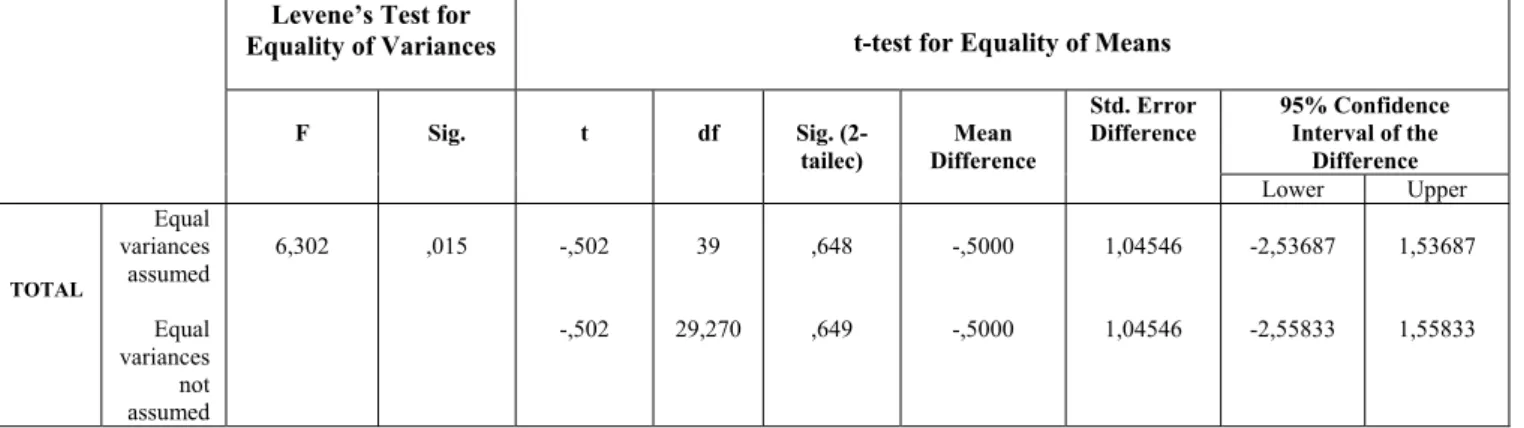
69-70 TABLE 3: Pre-test mean scores of the experimental and the control group . . . 78 TABLE 4: Independent samples t-test results for experimental and control group’s
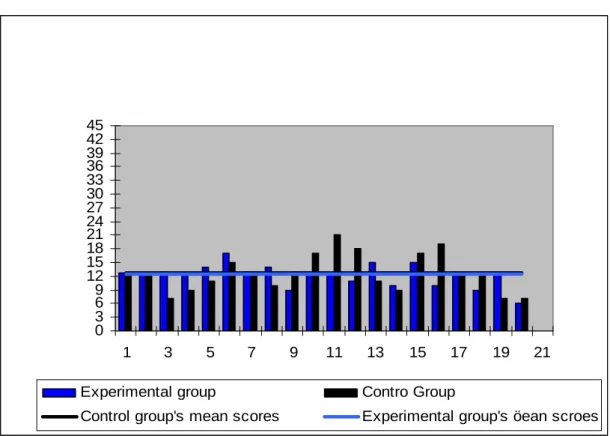
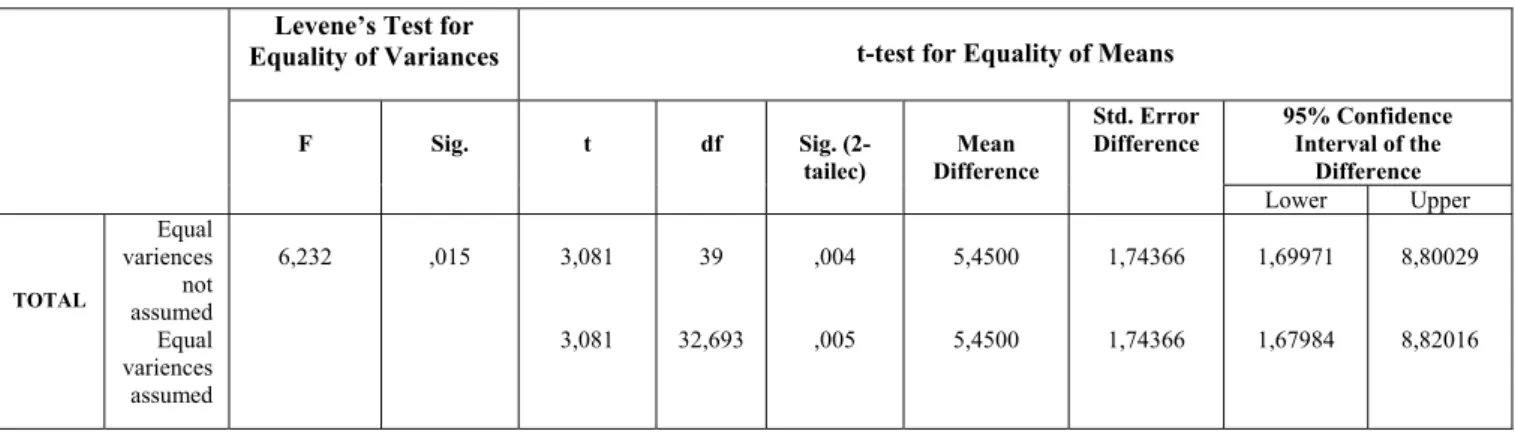
pre-test mean scores . . . 78 FIGURE 1: Pre-test scores of groups . . . 79 TABLE 5: Post-test mean scores of the experimental and the control group . . . 80 TABLE 6: Independent samples t-test results for the experimental and the control
group’s post-test mean scores . . .
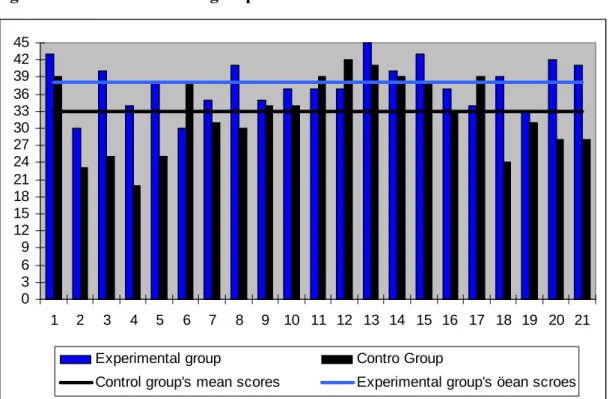
80 FIGURE 2: Post-test scores of groups . . . 81 FIGURE 3: The Teacher’s Intelligence Profile . . . 120 FIGURE 4: Experimental Group’s Students’ Most Dominant Intelligence Areas . . . . 121
CHAPTER 1 INTRODUCTION Presentation
This chapter begins with background of the study. Then, it goes on with the aim and scope of the study. The problem statement and the hypotheses follow these parts. The next part is the significance. Limitations of the study follow the significance. The final part is devoted to the organization of chapters.
1.1. General Background Of The Study
Since language teaching and learning is a significant, life-long and tiring process, people have given more and more importance to the teaching of foreign languages. Trere are many reasons why learning a foreıgn language is inevitable and so important. First of all, learning a foreign language has a positive effect on intellectual growth. It enriches and enhances a student’s mental development. It also leaves students with more flexibility in thinking, greater sensitivity to language and a better ear for listening. It also improves a student’s understanding of his / her native language. It gives a student the ability to communicate with people she would otherwise not have the chance to know. It opens the door to other cultures and helps a student understand and appreciate people from other countries. It increases job opportunities in many careers where knowing another language is a real asset.
Along with the various interpretatıons, visible changes have taken place in the area of education that can handle the problems of language teaching. Traditıonally, the human intelligence was objectively measured and reduced to a single number or “IQ” score. This states that in this tradıtıonal view of thinking people were categorized into 2 groups : (1) people who are intelligent and (2) people who are not. This traditional view of “intelligence” suggests that intelligence can be measured by short – answer tests:
Stanford – Binet Intelligent quotient
Wechsler Intelligence Scale for Children (WISCIV) Woodcock Johnson test of Cognitive Ability
People are born with a fixed amount of Intelligence. Intelligence level does not change over a life time. Intelligence consists of ability in logic and language. In traditional practice, teachers teach the same material to everyone. Teachers teach a topic or “subject”. However, the theory of multiple intelligences (MI), proposed by Howard Gardner, brought new dimensions to the concept of intelligence and challenged this commonly held belief. In 1983, Howard Gardner introduced his theory of multiple intelligences in a seminal book, Frames of Mind. Based on his work as professor in the Harvard Graduate School of Education, his work as a psychologist researching brain injuries and his long interest and involvement in the arts, he suggested that intelligence is not a single attribute that can be measured and given number. He pointed out that IQ tests measure primarily verbal, logical, mathematical, and some spatial intelligence. Believing that there are many other kinds of intelligence that are important aspects of human capabilities, he proposed that they also include visual/spatial, bodily/kinesthetic, musical, interpersonal and intrapersonal intelligences. More recently he added naturalist intelligence to the list and suggested that there may be other possibilities including spiritual and existential. In other words, Gardner’s”multiple intelligences”. Theory states that assesment of an individual’s multiple intelligences can foster learning and problem-solving styles. Short tests are not used because they don’t measure disciplinary mastery or deep understanding. They only measure rote memorization skills and one’s ability to do well on short tests. Some states have developed tests that value process over the final answer, such as PAM (Performance Assesment in Math )and PAL(Performance Assesment in Language). Human beings have all of the intelligences, but each person has a unique combination, or profile. We can all improve each of the intelligences, though some people will improve more readily in one intelligence area than in others. There are many more types of intelligence which reflect different ways of interacting with the world. M.I. pedagogy implies that teachers teach and assess differently based on individual intellectual strengths and weaknesses. Teachers structure learning activities around an issue or question and connect subjects. Teachers develop strategies that allow for students to demonstrate multiple ways of understanding and value their uniqueness.
Up to the present, Gardner (1995) has proposed a schema of seven intelligences in Frames of Mind (1983) and added the last two in Intelligence Reframed (1999). He suggests that there are probably many others that we have not yet been able to test.
A summary of Gardner’s nine intelligences is given as follows:
1 . Verbal-Linguistic Intelligence is the ability to use language effectively and creatively both orally and in writing. It means well – developed verbal skills and sensitivity to the sounds, meanings and rhytms of words. This intelligence can be seen in such people as poets, playwrights, storytellers, novelists, public speakers and comedians.
2 . Mathematical – Logical intelligence is the ability to think conceptually and abstractly, capacity, to use numbers effectively and ability to discern logical or numerical patterns. This intelligence can be seen in such people as scientists, computer programmers, accountants, lawyers, bankers and mathematicions.
3 . Musical intelligence involves the ability to produce and appreciate rhythm pitch and melody to recognize tonal patterns. This intelligence can be seen in performance musicians, rock musicians, dance bands and composers.
4 . Visual – Spatial intelligence is the ability to think in images and pictures, to sense form, space, line and shape and to visualize accurately and abstractly. This intelligence can be found in such people as architects, graphic artists, industrial design draftsperson, painters and sculptors.
5 . Bodily – Kinesthetic intelligence is the ability to use one’s body to express oneself and solve problems and handle objects skillfully. This intelligence can be seen in such people as actors, athletes, mimes, dancers, and inventors.
6 . Interpersonal intelligence involves the capacity to detect and respond appropriately to people’s moods, feelings, motivations and intentions and desire of others. It includes the ability to work cooperatively with others in a group and to communicate, verbally and nonverbally, with other people. This form of intelligence is well developed in such people as counselors, teachers, therapists, politicians, and religions leaders.
7 . Intrapersonal intelligence involves the ability to understand the internal aspects of the self and in tune with inner feelings, values, beliefs and thinking processes. This intelligence can
be seen in such people as philosophers, psychiatrists, spiritual counselors, and cognitive pattern researchers.
8 . Naturalist intelligence is the ability to recognize and categorize plants, animals and other objects in nature. Naturalistic intelligence deals with sensing patterns in and making connections to elements in nature. Using the same intelligence, people possessing enhanced levels of this intelligence may also be very interested in other species, or in the environment and the earth. Children possessing this type of intelligence may have a strong affinity to the outside world or to animals, and this interest often begins at an early age. People possessing nature smarts are keenly aware of their surroundings and changes in their environment, even if these changes are at minute or subtle levels. This intelligence can be seen in such people as farmers, hunters, zookeepers, gardeners, cooks, veterinarians, nature guide and forest rangers. 9 . Existential intelligence is the sensitivity and capacity to tackle deep questions about human existence, such as the meaning of life, why do we die, and how did we get here. This intelligence can be seen highly developed in philosophers.
Gardner’s Multiple Intelligences (MI ) Theory opened a new age in education throughout the world. Educators realized that learners have all of the intelligences, but each student has a unique combination, or profile. There are many more types of intelligence which reflect different ways of interacting with the world. Educators also started to regard the diversity of the learners in their learning styles, learning potentials and appreciate the development of learning on the part of the learners.
Taking into consideration the field of English Language Teaching, the multiple intelligences theory is of great importance for second language teaching. Since reading is a crucial part in language teaching by which students are able to understand the texts and have a good vocabulary size to speak fluently and write effectively, reading is chosen as the area where the study will be carried out.
1.2 Aim of the Study
The aim of the study is to develop reading performance and vocabulary learning ability of Seljuk University preparatory school students via creating a classroom environment where all
the intelligences are regarded. In other words, this study observed that not all of the intelligences are included in ELT. Instead traditional way of teaching is used in reading and in other skills of English. In this study the relationship between MI theory and ELT is examined in more details, and ways to help teachers use different types of intelligences in ELT especially in reading texts and learning vocabulary are tried to be shown.
In order to realize the aim stated above two classes from prepatory classes at Seljuk University will be chosen.
1.3 Scope of the Study
This study is carried out in preparatory classes at Selcuk University, School of Foreign Languages(SOFL). Selçuk University, located in Konya, is one of the most crowded universities in Turkey. The preparatory classes at SOFL are obligatory for some of the departments mainly for Faculty of Economics and Administrative Sciences, Faculty of Engineering, Faculty of Medicine and Vocational School of Social Sciences and optional for some of the departments such as faculty of Communication and Faculty of Technical Education.Therefore, the students of these departments have to take the Proficiency exam prepared by SOFL at the beginning of the term.The students who get under 60 in this exam, have to attend the preparatory programme fort he following two semesters.The students at SOFL receive 25 hours of instruction a week. 9 hours of instruction is for the main course lesson, which gives basic grammar of english, 8 hours of instruction is for listening and speaking, and the rest is for reading and writing.
1.3.1 The Problem
Teachers in some of English Language classes might not be employing methods of teaching based on the theory of Multiple Intelligences. (Gardner,1999) states that at any time in a teaching and learning experience, only about seventy percent of the students are responding to the methods employed. According to Christison (1997) in English as a second Language course, instructors have a tendency to focus upon visual and linguistic clues to teach language, which may reach the students who do not respond to develop their teaching methods and broaden their educational approach to help the students learn English and use it successfully.
The teachers need to reach all of the students by implementing methods, techniques, and strategies that stimulate the students’ strengths, abilities and intelligence areas.
The method of teaching reading skills at SOFL disregards MI theory. The MI theory regards and gives value to the students’ strengths and potentials so regarding MI theory in teaching reading strategies is of crucial importance. The traditional way of teaching reading skills ignores the students’ strength. In conclusion, the instruction regarding MI theory should be integrated into teaching reading and vocabulary.
1.3.2. The Research Question and Hypotheses The following hypotheses are tested:
1 . Activities and methods that activate Multiple Intelligence of students have a positive effect on understanding the reading passages.
2 . There is no effect of activities and methods that stimulate Multiple Intelligence on developing students’ ability of reading passages and learning vocabulary.
1.4 The Significance
The above given aim of the study appears to prove the thesis, the study may have a contribution toward the reading course offered at SOFL and it may lead to research on other skills that are used in main course, listening and speaking courses. The instructional goals may be achieved more easily by making use of the theory of MI in the program of SOFL. 1.5 The Limitations of the Study
1. The first limitation of the study was the number of the students in both experimental and the control groups. Because the number of the students in each classes was restricted to 20, the number of subjects involved in the study was 40. The data obtained from a larger group of students would have more reliable results.
2. The second limitation was time factor. As each particular passage may meet for only four to six hours per week, teachers were hesitant to offer valuable class time for the study as they had a syllabus to follow.
3. The next limitation was the educational background of the groups. Although the students were from the same faculties, that is to say, they were the students of the Faculty of Economics and Administrative Sciences, Faculty of Engineering and Faculty of Technical Education, and their proficiency averages more or less the same, there were some inequalities in their educational backgrounds concerning the courses they had in high school.
4. This study was limited to the instruction by a single instructor in both groups. This may create some problems at the point of objectivity.
5. Only reading skills of students were examined. Other skills were left out. 1.6 Organization of Chapters
Chapter 2 contains the review of literature and research related to MI theory, reading and vocabulary teaching and education. The chapter starts with a general overview of intelligence, defining historical and contemporary views on intelligence. Then, Gardner’s MI theory is explained. It is presented with a detailed description of eight intelligences. The adaptations and uses of MI theory and Gardner’s ideas in educational and language area are presented.
Chapter 3 introduces the methodology. Chapter 4 introduces results and analysis.
CHAPTER 2
REVIEW OF LITERATURE 2.1 An Overview of Intelligence
What is intelligence? The Webster’s Dictionary (1996) defines ıt as “capacity for learning, understanding, and similar forms of mental activity; aptitude in grasping truths, relationships, facts, meanings, etc,”.
Every society has its own ways of considering an ideal human being, such as the ancient Greeks who valued “physical ability, rational judgment, and virtuous behavior”(Gardner, 1999) while the Romans valued courage. In China, skills in music, drawing and archery were valued. In many western societies, “the intelligent person” has been valued for centuries(Gardner, 1999). The adjective intelligent has a strong impact on people, so those who are labeled “intelligent” are expected to be able to succeed not only in academic life but also in tasks or situations those people face in life. This is usually the general sense of intelligence. However, in western societies the word “intelligent” can also refer to high score results in IQ tests.
However, according to psychologists, definitions and measurement of intelligence vary: They define intelligence as:
1. the capacity to think abstractly, 2. to learn, or
3. to integrate new experiences and adapt to new situations. (Mehrens & Lehmann, 1980). One of these psychologists was Francis Galton who believed that intelligence was inherited. (Gardner, 1999) and he believed he could measure intelligence, so he developed formal IQ tests in the late nineteenth century. He was the first to institute a laboratory for the purpose of collecting evidence of people’s intellectual differences. In 1906 the French psychologist Alfred Binet developed the most well-known IQ test in the world. Binet wanted to test French children in order to predict their academic potential and identify children with learning disabilities. This way, those children could be helped in order to succeed in school.
The IQ test was modified to best suit American society in the 1920’s and 1930’s. (Gardner, 1999) and it became known as the Stanford-Binet IQ test. The IQ test is administered especially in primary school to predict success in academic studies. Since the IQ tests were being largely used in the USA for several purposes, some restrictions were made to the use of IQ tests in schools. American school psychologists only administer the IQ tests when there is need to identify either If a child has some disability in learning or If he / she is gifted (Gardner,1999). In a handout for parents distributed by the American National Association of School Psychologists (1998), psychological tests such as intelligence tests are described as diagnostic tools used by psychologists to predict academic success. The tests are composed of “verbal” and “performance” tasks, some tasks are “puzzles and copying patterns”. Some of the tests are the Wechler Intelligence Scale For Children, Kaufman Assesment Battery For Children, Stanford-Binet and Woodcock-Johnson Psycho-educational Battery.
Other tests were created in order to measure human capabilities. Tests such as Scholistic Assesment Test (SAT) are also similar to IQ tests. Even achievement tests resemble IQ tests (Gardner, 1999).
Many psychologists claim that IQ tests are valid for predicting achievement, as they were primarily created: however, they can not determine what intelligence is or how intelligent a person is. Gardner states:
So long as these tests continued to do what they were supposed to do –that is, yield reasonable predictions about people’s success in school- it did not seem necessary or prudent to probe too deeply into their meanings or to explore alternative views of what intelligence is or how it might be assessed.
Since the IQ tests predict academic success, they heve been used for several purposes. For instance, IQ tests have been used to make decisions about jobs and educational opportunities.(Gardner,1999). They have also influenced teaching practises and the way learners are tested in traditional schools.
Although the IQ tests have been administered for about a century, many psychologists have questioned their validity. The concept of intelligence as a singular, static and inherited
characteristic is subject to criticism and the IQ test is being criticized. As Snider (2001) states “Gradually, the instrument that once seemed miraculous was beginning to be vulnerable to scruting”. Gardner (1993) adds “dissatisfaction with the concept of IQ and with unitary views of intelligence is fairly widespread.”
2.2 Gardner’s Theory of Multiple Intelligence
As mentioned before, Howard Gardner proposed a revolutıonary and new concept of intelligence with the publication of his book Frames of Mind in 1983. His theory of multiple intelligences began to question the traditional view of intelligence and has totally changed the way intelligence is perceived. The essence of Gardner’s theory centered on the premise that there is no singular human intelligence.
The drive for investigating multiple intelligences stemmed from his experience as a teacher. He noticed that while an individual may be highly proficient in one skill or ability similar competence in another skill may be greatly lacking. A talented musician, for instance, might encounter difficulty in learning the lexicon or mastering even the rudiments of sentence structure in a foreign language, though it had been thought that the abilities to create music and to write both emerged from the same hemisphere of the brain.(Gardner, 1983).
According to Gardner, his theory is supported by numerous case studies of individuals whose mental capacities have been diminished through brain injury or disease, and who have subsequently lost one or more brain functions while retaining others. He suggests the phenomenon of idiot savants, who are mentally impaired individuals possessing strong ability in certain domains of intellect, such as the ability to hear a song and then replay it in various keys. Then, his theory asks how to account for sufferers of autism, who are sometimes capable of remembering staggeringly long series of numbers, dates and other data. The results of his investigations of such populations challenged the traditional view of intelligence as a singular construct, quantifiable by an IQ number. Rather than this, Gardner argues that intelligences must be plural, and the faculties developed by human beings originate from different cognitive processes.
According to Gardner (1983), intelligence is;
The ability to create an effective product or offer a service that is valued in a culture; A set of skills that make it possible for a person to solve problems in life; the potential for finding or creating solutions for problems, which involues gathering new knowledge.
Gardner changed the view of intelligence that the human beings have single intelligence. Intelligence has traditionally been defined in terms of intelligence quotient (IQ), which measures a narrow range of verbal\liguistic and logical\mathematical abilities. Howard Gardner (1993) argues that humans have a number of different intelligences that manifest themselves in different skills and abilities. All human beings apply these intelligences to solve problems, create processes and things. Intelligence, according to MI theory, means being able to apply one or more of the intelligences in ways that are valued by a community or culture. The current MI model outlines eight intelligences, although Gardner (1999) continues to explore additional possibilities.
Linguistic Intelligence: The ability to use language effectively both orally and in writing.
Logical-Mathematical Intelligence: The ability to use numbers effectively and reason well.
Spatial Intelligence: The ability to recognize form, space, color, line, and shape and to graphically represent visual and spatial ideas.
Bodily-Kinesthetic Intelligence: The ability to use the body to express ideas and feelings and to solve problems.
Musical Intelligence: The ability to recognize rhythm, pitch, and melody.
Naturalist Intelligence: The ability to recognize and classify plants, minerals, and animals.
Interpersonal Intelligence: The ability to understand another person’s feelings, motivations, and intentions and to respond effectively.
Intrapersonal Intelligence: The ability to know about and understand oneself and recognize one’s similarities to and differences from others.
Gardner developed the theory of multiple intelligences based on his study of many different people. He interviewed with and made brain research on hundreds of people, including “stroke victims, prodigies, autistic individuals, and so-called idiot savants”.
According to Gardner,
9 All human beings possess all the intelligences in varying amounts. 9 Each person has a different intellectual composition.
9 We can improve education by addressing the multiple intelligences of our students.
9 These intelligences are located in different areas of the brain and can work either independently or together.
9 These intelligences may define the human species.
In Bümen’s (2002) words according to MI theory, all the intelligences are of the same importance and one or more are not more impotant than the rest. Everyone has different intelligence types and feautures and benefit from these differently in getting knowledge, understanding the environment, solving problems and creating products.
The theoritical keys of Gardner’s MI theory are;
9 Each person possesses all the intelligences. MI theory is not a type of theory for deciding the one intelligence that fits. It is a theory of cognitive functioning, and it proposes that each person has capacities in all of the intelligences.
9 Most people can develop each intelligence to an adequate level of competency. Gardner suggests that everyone has the capacity to develop all the intelligences to a reasonably high level of performance if given the suitable encouragement, enrichment, and instruction.
Drawing upon findings from evolutionary biology, anthropology, developmental and cognitive psychology, neuropsychology, and psychometrics. Gardner (1983) uses eight different criteria to judge whether an ability can be counted as an intelligence.
9 Potential isolation by brain damage
The intellectual capacity shows potential isolation by brain damage. It must be relatively autonomous from other human faculties and localized in the brain, then, could impede it, while not affecting other intelligences.
9 The existence of idiot savants, prodigies, and other exceptional individuals. The capacity must be evidenced in idiot savants, prodigies, and other exceptional individuals. Gardner further argues that the extent that these conditions can be linked to genetic factors as to specific areas in the brain, the capacity is more persuasively an intelligence.
9 An identifiable operation or set of operations.
An intelligence must possess an operation or a set of operations integral to it, in other words, a basic information-processing mechanism that can deal with specific types of input. A human intelligence could be viewed as a “nevral mechanism or computational system which is genetically programmed to be activated or “triggered” by certain kinds of internally or externally presented information”.
9 A distinctive developmental history along with a definable set of “end-state” performances.
An intelligence must progress along a developmental history that results in a definable set of end-states. It begins with a patterning ability in the first year of life; next, it is encountered through a symbol system. Later, intelligences, along with their symbol system are represented in notational systems. Finally, during adolescence and adulthood, the intelligences show themselves in occupational or avocational pursuits.
9 An evolutionary history and evolutionary plausibility.
An intelligence must also show evolutionary antecedents and plausibility, including capacities shared with other organism(for example, social organization). Gardner emphasized the elusiveness of firm facts, however, in regard to this criterion.
9 Support from experimental psychological tasks:
Experimental psychology must support the existence of an intelligence. Such support might take the form of a study of linguistic or spatial processing, or one that focuses on the relative autonomy of an intelligence.
9 Support from psychometric findings.
An intelligence must receive psychometric support. Gardner is highly critical of standardized pencil and paper tests and though interpreting psychometric findings is not always simple, they can be used to enhance his theory’s credibility. For example, positive correlation between tasks that claim to assess one intelligence and less correlation with those that assess another intelligence can be considered support.
9 Susceptibility to encoding a symbolic system.
It must be possible to encode the operations of an intelligence in a symbols system. Symbol systems, as language, numbers and musical notation, contribute to the usefulness of an intelligence and might well be a primary characteristic of intelligence in humans.
An intelligence had to meet all, or nearly all, of the criteria in order to qualify with Gardner’s list. That is, intelligence was biologically oriented, but it was also influenced by the environment.
2.3. MULTIPLE INTELLIGENCES AND THE STRATEGIES
Howard Gardner provided a means of mapping the broad range of abilities that human possess by grouping their capabilities into eight comprehensive categories or “intelligences” (Armstrong, 2000).
2.3.1. VERBAL-LINGUISTIC INTELLIGENCE
Verbal-Linguistic Intelligence involves the development and the use of both the linguistic and the communicative competence. It includes verbal skills and sounds, meanings and rhythms of words (Armstrong, 1994). It is the capacity that makes people use lexical and grammatical items effectively and express themselves both in speech and writing as well as understanding what they hear and see (Gardner, 1993). It involves all language skills; ‘speaking, writing, reading, listening and understanding’ (Lazear, 2000). It allows people to understand the meanings of the words and the syntactic structures of sentences and to apply ‘metalinguistic’ skills to reflect on the use of the language. This ability is most shared competence and seen in ‘poets, novelists, journalists, and effective public speakers’ (Campbell, 1990).
Gardner (1983) does not consider linguistic intelligence as an auditory-oral form or intelligence as he claims that deaf people develop a gestural system for communication. By linguistic intelligence, he means the linguistic competence that can be manifested in different forms which enable human beings to communicate. He expresses his claim as follows:
...yet I have taken care not to term this capacity as an auditory-oral form of intelligence. There are two reasons. First of all, the fact that
deaf individuals can acquire natural language-and can also devise or master gestural systems-serves as decisive proof that linguistic intelligence is not simply a form of auditory intelligence. Second, there is another form of intelligence, with a history of equal longevity, and autonomy of equal persuasiveness, which is also tied to the auditoryoral tract .
Yavuz and Aydınoğlu (2004) summarize the linguistic intelligence considering its place in ELT as follows:
Linguistic intelligence relates to the ability to use language effectively; it involves the selection of lexical items, the production of well-formed sentences and their arrangement in discourse for the expression of ideas and feelings. This ability also helps to acquire various languages easily. It is believed that linguistic intelligence is high in lawyers, editors, authors, poets, interpreters and orators. A
learner with strong linguistic intelligence, who is good at memorizing language items, learns best by hearing, saying, reading and writing language expressions.
Elaborating what is meant by the linguistic intelligence, Lazear (2000) describes an inventory of the core capacities comprising the following:
1-The capacity to understand the order and meaning of words is the very complex process of grasping word meanings in a given context and knowing how to shift both meaning and context by rearranging words.
2-Explaining, teaching, and learning mean being able to give accurate verbal or written instructions to another and being able to follow such instructions given to you. This capacity involves not thoroughly understanding what you are trying to explain or teach, but also understanding what another will hear and understand in your instructions.
3-Linguistically based humor deals with such things as plays on words (puns) and the plays with words (the story with the surprise ending, riddles, jokes that usually involve various ‘twists’ of the language or misunderstood words and phrases, limericks, doublemeanings, and so on). Also involved is understanding of the setting in which something is funny. The socio-cultural context of humor is important to understand; something that is funny in one situation may be an insult another.
4-It involves the development of great sensitivity to the subtle meanings of the language and the sounds and rhythms of speech, as well as an understanding of the linguistic context of the listener. It involves an understanding of emphasis in speaking to underscore the most important parts of your communication. It is the ability to use the spoken and written word to influence and motivate people.
5-The capacity of memory and recall is the ability to access verbally stored information from the brain’s short-term and long-term memory, which involves a wide variety of techniques specific to an individual.
6-Possibly one of the most interesting and profound aspects of this intelligence is its capacity to engage ‘metalinguistic’ analysis. This unique ability is the use of language to investigate language.
As can be inferred from the afore mentioned quotation, linguistic intelligence involves the ability to acquire language by learning the speech sounds, storing and retrieving lexical items, learning to apply the (Universal Grammar) principles and parameters to the language being acquired, building up macro-language skills such as listening, speaking, reading, writing and to use language as a means of communication and interaction by developing communicative competence.
This intelligence is the easiest to develop as great attention has been given to it in schools (Armstrong, 1994). Education requires the use of this intelligence and as a result, learners have more chance to develop linguistic competence.
There have been several attempts to apply the MI theory to the foreign language teaching. As a result of these attempts, a foreign language teaching method based on the principles of MI has been designed. Berman (2003), who is concerned with the use of MI in language teaching, proposes general activities for linguistic students in ELT classes. These activities can be applied at any level or can be capitalized on for the development of additional activities by the ELT teachers. They can also be adapted for use in class to meet the needs of the language learners. The sample activities proposed by Berman (2003) are listed below: 9 Group discussions 9 Completing worksheets 9 Giving presentations 9 Listening to lectures 9 Reading 9 Wordbuilding games 9 Storytelling
Berman (2003) assumes that storytelling is the ideal means of providing the students with the chance to develop this intelligence, since storytelling is an oral tradition and has contributed to the creation of the great epics, chants, songs, poems, fables, myths, and fairy and folk tales that have been passed on from one generation to the next.
Armstrong (1994) also gives emphasis to storytelling and states that it has been in cultures all over the world for thousands of years and seen as an entertainment during some special times in the classrooms. It should be used as a vital tool and important strategy in education. He also suggests ‘Brainstorming, Tape Recordings, Journal Writing, and Publishing’ strategies which allow students to share and show their thoughts, feelings, comments, and ideas with writing or speaking activities.
Among all the above activities, storytelling, which has been used to pass information from one generation to the next, is given special emphasis as it is considered to be the ideal means of providing the learners with the chance to improve this intelligence.
For the development of this intelligence, diverse strategies and classroom activities have been suggested. It is worth mentioning Campbell’s (1996) ten linguistic strategies for use in education:
1. For five minutes, students do "quick writes" reacting to lesson information.
2. Students tell stories of how they apply ideas from any discipline to their lives outside of school.
3. To practice accuracy in communication, pairs of students listen to each other giving directions for an assignment.
4. To learn vocabulary for any topic, students create crossword puzzles. 5. Students debate diverse perspectives of any issue.
6. Student describe in writing the" most meaningful content they have studied.
7. In small groups, students give impromptu, “one minute presentations to each "other on topics of the teacher's choice drawn from
current lessons.
8. When reading classroom material, students review each page by creating keywords or phrases for the content of that page.
9. Student’s create mini-talk show programs where they pose as junior experts on classroom topics.
10. Using a word that represents a major concept, such as interdependence, students write a phrase with each letter of the word to explain its meaning.
2.3.2. LOGICAL-MATHEMATICAL INTELLIGENCE
Logical-Mathematical Intelligence is the intelligence to use numbers effectively (Gardner, 1993). It is the ability that makes people calculate measure, use logic, and solve math and science problems and affect the social sciences and humanities. It is seen in ‘scientists, mathematicians, accountants, and detectives’ in general (Campbell, 1990). It includes sensitivity to logic patterns and relationships, statements and prepositions, functions. ‘Categorization, classification, inference, generalization, calculation, and hypothesis’ testing are the process of logical - mathematical intelligence (Armstrong, 1994). This intelligence allows people to develop the capacity to recognize familiar objects in pictures and to pick them out of pictures containing many other objects that are unfamiliar and visualize and imagine these objects when they are not actually physically present. When people acquire the language, they also obtain abstract verbal symbols that stand for concepts developed as a result of one’s experience with the real world. The development of these symbols serves to improve logical- mathematical intelligence (Lazear, 2000).
Yavuz and Aydınoğlu (2004) summarize the logical- mathematical intelligences in ELT as follows:
Logical-mathematical intelligence relates to the ability to use numbers and logic effectively. It helps to measure and calculate, to find solutions to problems, to understand ‘cause and effect’ relationships to make predictions. Mathematicians, scientists, doctors, programmers, engineers and detectives score higher in this intelligence. A learner with strong logical-mathematical intelligence is good at inductive and deductive reasoning. S/he learns best by classifying, working out relationships, and problem solving, etc.
To clarify the characteristics of this intelligence, it is beneficial to have a look at the inventory of the core capacities that comprise the logical intelligence suggested by Lazear (2000).
1-Abstract pattern recognition is the capacity to discern patterns in the environment around you.
2-The capacity of inductive is the logical thought process that moves from the part to an understanding of the whole.
3-The capacity of deductive reasoning is the logical thought process that moves from the whole to an understanding of the parts.
4-Developing your capacities to discern relationships and connections will help you sort through and make sense out of the increasingly complex data that bombard you everyday.
5-The capacity performing complex calculations is the area most of us have traditionally and probably associated exclusively with logical-mathematical intelligence.
6-Scientific reasoning is a capacity that is no way limited to pure scientific pursuits! The basic scientific method is the process of observing, judging, weighing up, deciding, and acting.
It was the concern of applied linguists to adapt the MI activities to the foreign language education. To exemplify this, the following activities for use in ELT classes are given (Berman, 2003):
9 Logic puzzles
9 Logical-sequential presentations 9 Problem solving
9 Guided discovery
Armstrong (1994) mentions that ‘Calculations and Quantifications, Classifications and Categorizations, Socratic Questioning, Heuristics, Science Thinking’ strategies make students think and talk about subjects both inside and outside the math and science areas. Their perspectives and critical thinking skills are enriched with these activities.
Diverse strategies and classroom activities can be capitalized on for the development of this intelligence. Campbell (1990) lists ten logical-mathematical strategies as follows:
1. When given a problem, students plan strategies for ways to solve the problem before attempting its resolution.
2. Students are asked to discern patterns or relationships in lesson contents.
3. When offering solutions to any problem, students must provide logical rationale to support their answers.
5. To extend classroom learning, students conduct surveys and analyze data on topics that they or the teacher have selected.
6. Working in pairs, students make up story problems involving lesson content.
7. Students engage in discussions which include higher level thinking skills, such as comparing and contrasting, providing cause and effect answers, analyzing, hypothesizing, and synthesizing information.
8. As an independent or small group project, students employ the scientific method to answer a question they have about a classroom topic.
9. Students study units focused on math and science themes such as probability, symmetry, randomness, and chaos.
10. Students use a variety of organizers to enhance logical thinking, such as outline charts, Venn Diagrams, flow charts, and mindmaps.
2.3.3. BODILY- KINESTHETIC INTELLIGENCE
Bodily- Kinesthetic Intelligence is the intelligence to use body to express ideas and feelings with great skill (Gardner, 1993). It is the ability that makes people produce and transform things by means of their hands, this intelligence includes specific physical skills; ‘coordination, balance, dexterity, strength, flexibility, and speed’ (Armstrong, 1994). People with the bodily-kinesthetic intelligence use physical skills to express themselves. It is generally used by ‘dancers, athletes, surgeons, jugglers, and craftspeople’ (Campbell,1990). This intelligence takes place in most parts and situations of the life. It enables people to act in their lives; learning to operate within the language system, dialing a number with their hands, crossing streets with their feet etc. Bodily- Kinesthetic Intelligence related to physical movement involves such things as ‘drama, mime, dance, gesture, facial expressions, role- play, body language, posture, physical exercise, and physical games’ (Lazear, 2000).
Yavuz and Aydınoğlu (2004) summarize this intelligence and its implications for ELT as follows:
Bodily-kinesthetic intelligence relates to the ability to use the body effectively. People with the dominance of this intelligence are also characterized by their dexterous use of their hands and fingers. Craftspeople, sportspeople, surgeons and dancers are said to have this type of intelligence. A learner with strong bodily-kinesthetic intelligence, who is good at physical activities, learners best if s/he is provided with opportunities for physical challenges. The Total Physical Response techniques can be catered for this type of intelligence.
Lazear (2000) describes an inventory of the core capacities that comprise the bodily-kinesthetic intelligence as follows:
1-Remember when you were a kid and you would practice rubbing your stomach and patting your head at the same time, then switch to rubbing your head and patting your stomach? This skill is sometimes called multitracking and is the capacity to learn to control voluntary body movements.
2-Some of our body movements were at one time carefully and methodically learned and practiced but are today second nature to us, such as walking, riding a bike, driving a car, and so on. Learning to control these pre-programmed body movements is one of the capacities of strengthening your bodily-kinesthetic intelligence.
3- Expanding awareness through the body is the capacity of learning to listen to and trust the body. In many ways the body is like a complex radar station that gives us invaluable feedback about what is happening in the external world; for example.
4-This capacity is establishing a strong mind-body connection.
5-Such people as Marcel Marsceau and Red Skelton perfected this capacity, called mimetic abilities, which includes capacity to mime, to role-play, and to act dramatically.
6-The final bodily-kinesthetic capacity is improved body functioning. With bodily-kinesthetic intelligence, almost more than any of the other intelligences, practice makes perfect (or at least improvement).
Campbell (1990) states strategies for bodily-kinesthetic intelligence as follows: 1. Students role play any process such as photosynthesis, making a bill into a law, solving a quadratic equation, or the earths orbit around the sun.
2. Working together, with small blocks, toothpicks, legos, or popsicle sticks, students build models of molecular chains, famous bridges, or towns in history or literature.
3. Teachers can provide quick exercise breaks with simple calisthenics, Tai Chi or yoga stretches, an active game of Simon Says, or even a jog around the playground. . .
4. In small groups, students can create large floor games that cover important concepts, being studied.
5. Student can enact simulations, such as groups representing countries with different resources to trade, or pioneers addressing the challenges of the frontier.
6. Teachers can create "scavenger hunts" as one way for students to gather information on particular topics.
7. Regardless of the content, teachers may provide manipulatives for students to use to solve math problems, create patterns for art work, build replicas of cells or systems, or make storyboards for language and writing experiences.
8. To extend classroom learning into the community, students go on field trips.
9. Students learn physical skills like juggling, dancing, balancing, rope jumping, climbing, hula-hooping, bowling, throwing, catching, or working with tools of various kinds.
10. Students pantomime what they have learned from a day’s lesson.
Berman (2003) points out that the activities are the ideal way of getting students out of their seats. When the students move around the classroom, they provide effective ways of practicing and using the target language. The repetition of movements is also. Thought to be useful, since kinesthetic students learn through movements. He identifies four activities which are designed for those students who learn through kinesthetic ways. It is easy to apply these kinesthetic activities in ELT classes.
9 Circle dancing 9 Brain gym
9 Relaxation exercises 9 Craftwork
Armstrong (1994) describes some strategies such as ‘Body Answers, the Teacher Theatre, Kinesthetic Concepts, Hands-on Thinking, Body Maps’ carried out for those students who have bodily- kinesthetic intelligence. These strategies can be varied in many activities which make students respond to instruction by using their bodies, and bring out the performer in students and translate their knowledge from linguistic or logical systems into pure body language.
2.3.4. VISUAL- SPATIAL INTELLIGENCE
Visual- Spatial Intelligence is discovering the visual-spatial world accurately and learning to speak with visual symbols. People, who have highly visual-spatial intelligence
think in pictures, see and create images or designs with shape, color, and size (Gardner, 1993). It is the ability to perform transformations in visual view or symbols. This intelligence involves ‘sensitivity to color, line, shape, form’, and the ‘relations that exist between these elements’ and includes the capacity ‘to visualize, to graphically represent visual or spatial ideas, and to orient oneself’ appropriately in a spatial situation (Armstrong, 1994). It enriches students’ ‘mental imagery, spatial reasoning, images manipulation, graphic and artistic skills, and an active imagery. Painters, architects, sculptures, sailors, and pilots mostly use this intelligence in their lives (Campbell, 1996). The visual-spatial intelligence is the first intelligence which the brain uses, since it naturally thinks in images and pictures before attaching the words (Lazear, 2000).
Yavuz and Aydınoğlu (2004) summarize the visual-spatial intelligence in ELT as follows:
Visual-spatial intelligence relates to the ability to perceive and create forms, shapes, designs and colors. This heightens the ability to form mental images. Painters, sculptures, architects, decorators, sailors and pilots possess high visual-spatial intelligence. A learner with strong spatial intelligence learns best by visualizing concepts, using the mind’s eye, and working with pictures and diagrams.
To exemplify this ability, Lazear (2000) describes an inventory of the core capacities that comprise the visual-spatial intelligence as follows:
1- Remember when you were a kid and you would lie on you back and look up at the clouds and find animals, faces, objects, and different scenes. This capacity is called active imagination.
2- Forming mental images are the capacity to picture things inside your head. You use this capacity when you are trying to remember where you parked your car, where you last used your glasses when you can't find them, or when you are reading a novel and you create mental images of what is on the written page.
3- How good are you at following directions for getting from one place to another? Some people are never lost! Others are never found! The capacity for finding your way in space is one of the spatial skills of visual-spatial intelligence.
4- Graphic representation is the capacity to create visual illustrations to enhance communication of an idea, concept, emotion, process, or intuition. This capacity includes such things as photography, sculpture, drawing, painting, videos, and collages.
5- Another spatial capacity is recognizing relationships between objects in space. How good are you at parallel parking a car? Can you "sink" a basketball into the hoop more times than not? When playing chess or checkers, can you see the whole board and plan your next move in light of this?
6- When you are looking at an ‘optical illusion’ such as the classic two faces that are also a vase, or the old woman who is also a beautiful socialite, can you mentally make these images shift back and forth? This capacity is called mental manipulation of images.
7- The capacity of accurate perception from various angles is the very complex, often taken-for-granted, ability to recognize similarities and differences between objects from very different vantage points.
Berman (2003) compiles five activities for use in ELT classes for those students who use their spatial intelligence.
9 Charts 9 Minds maps 9 Visualizations 9 Diagrams
9 Videos
Armstrong (1994) maintains five strategies designed to activate the spatial intelligence. ‘Visualization, Color Cues, Picture Metaphors, Idea Sketching and Graphic Symbols’ require students to create graphic symbols that represent the concepts to be learned and to transform their knowledge or thoughts in images and pictures. These kinds of strategies enhance students’ visual thinking.
The following are the strategies (Campbell, 1990) that can be exploited in order to enhance visual-spatial intelligence:
1. Students might experiment with imagery to mentally rehearse performing well on a test, speaking in front of the class, or successfully resolving a conflict.
2. Students create a pictorial representation of what they have learned from a unit of study such as a chart, drawing, or mindmap.
3. Working independently or with a partner, students create a visual collage to display facts, concepts, and questions they have about a recent unit of study.
4. With access to computer graphics and page-layout programs, students illustrate their lessons.
5. Students diagram the structures of interconnecting systems such as body systems, economic systems, political systems, school systems, or food chains.
6. To communicate their understanding of a topic, students create flow charts, bar graphs, or pie charts.
7. Working in small groups, students create videotape or photograph projects.
8. To work with three-dimensional activities, students design costumes or sets for literature or social studies, tools or experiments for science, and manipulatives or new classroom or building designs for math.
9. Students create mobiles or design bulletin boards.
10. To demonstrate their understanding of a topic, students use color, shape, or rebus-type images in their papers.
2.3.5. MUSICAL INTELLIGENCE
Musical Intelligence is the ability which provides people expressing and transforming their feelings, thoughts, and knowledge in musical forms (Gardner, 1993). It enables students to “recognize, create, reproduce, and reflect” on music. “Composers, conductors, musicians, vocalists, and sensitive listeners” exhibit musical intelligence (Campbell, 1996). Musical intelligence consists of “sensitivity to rhythm pitch or melody, and timbre or tone color of a musical piece” (Armstrong, 1994). Lazear (2000) uses the term “auditory-vibrational intelligence”to illustrate the musical intelligence. He believes that it is really dealing with the whole areas of sound, vibration, tones, and beats, and so on. He claims that from the neurological perspective, it is the first intelligence to develop.
Yavuz and Aydınoğlu (2004) explain how to make use of the musical intelligence in ELT as follows:
Musical intelligence relates to the ability to hear and produce pitch, rhythm, tone and melody. People with musical intelligence distinguish themselves as musicians, composers and singers. A learner with strong musical intelligence is good at picking up sounds, noticing stressed syllables and identifying diverse intonation patterns. S/he can learn a language more easily in an environment where there is music and where songs are utilized. Lazear (2000) explains the characteristics of the musical intelligence as follows:
1- The evocative power of music and rhythm is very profound. Certain kinds of music and rhythm can calm us, energize us, and make us feel anxious, and so on. Developing an appreciation for the structure of music mail rhythm and its affective qualities is one of the ways to strengthen your musical-rhythmic intelligence.
2-We have certain schemas or frames for hearing music in our minds. We make conscious and unconscious connections with various kinds of music and rhythm.
3-Sensitivity to sounds deals with "turning up" our hearing capacities and learning to process the wide variety of auditory stimuli that have an impact on us every day of our lives.
4-Recognition, creation, and reproduction of melody, rhythm, and sound comprise the capacity to repeat accurately or mimic a tonal or rhythmic pattern produced by another person.
5-The capacity for utilizing various characteristic qualities of tones and rhythm as a way to enhance and deepen communication is a powerful aspect of this intelligence.
The following are three examples of the MI activities designed to develop the musical intelligence for use in an ELT class (Berman, 2003)
9 Songs 9 Jazz Chants
9 Background music
Campbell (1994) suggests the following ten strategies that can be made use of for the development of musical intelligence.
1. Teachers play background music to relax students or to focus their attention at various times during the day.
2. To review information, students compose curriculum songs: replacing the words to well-known songs with content information.
3. Students make their own rhythm instruments to use with curriculum songs or recitations of arithmetic facts, spelling words, or sets of roles or facts.
4. Students select a song and explain how its lyrics relate to a lesson’s content.
5. For students with access to musical software, rhythmic accompaniment can be added to multimedia reports and presentations.
6. Students select appropriate background music for book reports or other oral presentations.
7. To demonstrate patterns in mathematics, nature, and the visual arts, students use musical selections that are patterned and repetitive.
8. To become knowledgeable in any subject area, students listen to and analyze pre-recorded songs about the content areas.
9. Students analyze music to understand concepts such as relationships of parts to wholes, fractions, repeating patterns, timing, and harmony.
10. Students use musical vocabulary as metaphors such as crescendo for the climax of a short story; two-pan harmony for interpersonal relations; or cadence for physical exercise.
2.3.6. INTERPERSONAL INTELLIGENCE
Interpersonal Intelligence is the capacity to detect and respond appropriately to the moods, motivations and desires of others (Gardner, 1993). This intelligence includes “sensitivity to facial expressions, voice, and gestures”. It is the “capacity for discriminating among many different kinds of interpersonal cues, and the ability to respond effectively those cues in some pragmatic way” (Armstrong, 1994). There is nothing wrong with competition or individualism if they are thought in a wise and reasonable situation however, the interpersonal capacities are completely different from them (Lazear, 2000). Students with highly interpersonal intelligence enjoy working with others and enter into their inner world and understand their viewpoints (Lazear, 2000). Teachers, social workers, actors, and politicians mostly use this intelligence (Campbell, 1996).
Yavuz and Aydınoğlu (2004) summarize the interpersonal intelligence in ELT as follows:
Interpersonal intelligence relates to the ability to interact and cooperate with other people effectively. It sharpens the sense to understand how the others feel, what they intend to do. Leaders, politicians, teachers, and actors exhibit a high level of interpersonal intelligence. A learner with strong interpersonal intelligence learns best in an environment where pair work and group work activities are capitalized on and where language is used for real exchanges.
Lazear (2000) describes the characteristics of interpersonal intelligence as follows: 1-The capacity of effective verbal and nonverbal communication with others goes way beyond the simple meanings of the words we use. Think about times when someone's body language or the tone and rhythm of voice were out of synch with what they were saying.
2- The capacity to accurately read others' moods, temperaments, motivations, and feelings is a key to effective and meaningful interpersonal encounters.
3- The capacity of working cooperatively in a group deals with learning how to do your part and allowing others to do theirs for the sake of the group goal.
4- In everyday communication, we often miss what another is saying because our own internal mind chatter gets in the way. Listening to another's perspective is the capacity to listen fully and deeply to another, and to shut off temporarily the inner mental commentary, planning our comments or rebuttal, or thinking about a witty response to what is being said.
5-Passing into the life of another is the capacity to empathize with another's perspective, feelings, values, and beliefs, especially when they are somewhat foreign to our own. This capacity does not necessarily mean agreeing with the other's perspective. But it does mean understanding and appreciating the other perspective.
6- Recall times when you were part of a group effort and the final product was greater than the mere sum of the individual contributions of the various members of the group. This is called synergy (from the Greek syn and ergos), which means a "spontaneous working together." The capacity to create and maintain synergy in a group is one of the capacities of interpersonal intelligence.
Berman (2003) gives four sample activities based on the interpersonal intelligence to be used in an ELT class (Berman, 2003):
9 Group Work 9 Brainstorming 9 Pairwork 9 Peer Teaching
Berman (2003) claims that pair and group work provide opportunities for communication and co-operation. On the other hand, teachers should not force students to work in pairs or groups because their aptitudes and opinions are important in these kinds of activities.