Journal of Physics: Condensed Matter
Non-linear thermoelectricity and cooling effects in
metallic constrictions
To cite this article: I O Kulik 1994 J. Phys.: Condens. Matter 6 9737
View the article online for updates and enhancements.
Related content
Ballistic charge-carrier kinetics and phonon drag in semiconducting point contacts
E N Bogachek, I O Kulik and A G Shkorbatov
-Point-contact spectroscopy in metals A G M Jansen, A P van Gelder and P Wyder
-Point-contact spectroscopy A M Duif, A G M Jansen and P Wyder
-Recent citations
Heat current through an artificial Kondo impurity beyond linear response Miguel A. Sierra and David Sánchez
-Nonlinear heat transport in ferromagnetic-quantum dot-superconducting systems Sun-Yong Hwang and David Sánchez
-Nonlinear phenomena in quantum thermoelectrics and heat David Sánchez and Rosa López
Non-linear thermoelectricity and
cooling
effects in metallic
constrictions
I O Kulikt
Depanment of Physics, Bilkent University. 06533 Bilkent, Ankara, Turkey Received 23 May 1994
Abstract. Linea as well as non-linear contributions to the Zeebeck and Peltier coefficients of
a m r d l i c film in contact with the equilibrium metal are calculated within a simple model. The non-linear p m of the thermoelectric response survives down to a vezy low temperature which in
principle permits thermoelectric cooling ai these conditions. Thermal equilibrium in a metallic constriction between dissimilar metals IS evaluated in the non-linw current-canying regime.
1. Introduction
Small metallic and semiconducting specimens develop a number of specific low-temperature phenomena including flux quantization and persistent currents in normal-metal loops [I], charge discreteness effects in tiny metallic granules [Z, 31. non-equilibrium electron-phonon states in metallic microconstrictions (point contacts [4,
SI),
etc. Mostly these phenomena, which are promising for novel microelectronic applications, are displayed at quite a low temperature. In these conditions, the electron and phonon systems-ofa
metal can be easily driven out of equilibrium, which changes the state of the kinetic processes. Some questions which have been the subject of controversy for years can be subjected to theoretical investigation and experimental tests, for example why the resistivity is non-zero when phonons are dragged after electrons (the Peierls problem), or how the Joule heating takes place when scattering of electrons is purely elastic.^ (The Drude formula gives a finite resistivity at Zi = 00.)We shall partly answer the last question by considering the limit of large but finite inelastic electron mean free path Zi. The conductivity is not much affected by inelastic scattering processes whereas thermoelectric coefficients are, provided that the current is not small. In the non-linear regime, thermoelectric coefficients are strongly enhanced at large
Zi. The possibility of using this effect for thermoelectric cooling at very low temperatures will be discussed in section 4.
2. Formulation of the model
We consider a degenerate electron gas interacting elastically with impurities (or other defects -of the crystalline lattice) and inelastically with phonons, electrons, etc. Inelastic relaxation
t On leave of absence from the B I Verkin Institute for Low Temperature Physics and Engineering, Academy of
Sciences of the Ukraine. 47 Lenin Avenue. 310164 Kharkkov, Ukraine.
9738
IO
Kulikprovided by electron-phonon interaction becomes ineffective at low temperatures and low excitation energies with the corresponding scattering rate
si-'
N(T3
(1)where
OD
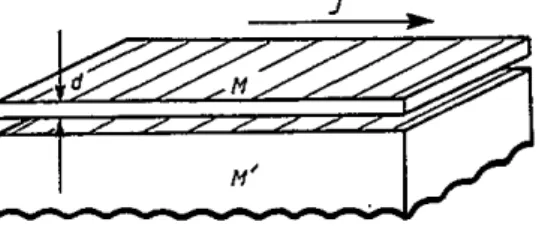
is the Debye temperature and E the energy of electron relative to the Fermi energy.We suppose that electrons in a metal film M (figure 1) can tunnel to a bulk metal
M',
the latter being consideredas
a thermostatfor
M.
The interaction betweenM
andM'
is described by a tunnelling HamiltonianHT
= W z ( u : b q+
bqfup)P.4
where u:(u,) creates (annihilates) an electron in M whereas bqf(bq) does the same in
M'.
J L
Figure 1. Schematic diagram of a tunnelling junction between B m w 1 film and a bulk metd J is the current passing through the film.
Calculating perturbatively the occupation fp =
(upp)
change due to ( 2 ) , one obtainsIf we assume that electrons in metal
M'
relax to their equilibrium by some inelastic mechanism different from ( 2 ) and stronger than the latter, such that we may considerf,
to be the equilibrium distribution, then (3) becomes the collision integral1 exp(e,/T)
+
1fi
= f p = E p-
/L.T is the equilibrium temperature of M'. The inelastic relaxation time zi can be related
to
the tunnelling resistance betweenM
andM'
according towhere N ( 0 ) is the density of electronic states at the Fermi energy, and
S
and d are the surface area and the thickness of a film, respectively.Elastic scattering can be written as (e.g. see [6])
where Wpp, is the electron-impurity scattering amplitude.
The purpose of this term is to redistribute electrons over the Fermi surface once they are driven out of equilibrium by the electric field. We shall simplify equation (8) to the form
f p
-
f-p 2re le =-
thus providing for the scattering p
+
- p only. This is enough to establish the time- independent electron distribution in the current-cawing state. We do not think that selection of the simplified electron-impurity scattering may change qualitatively the conclusions concerning the non-equilibrium current-carrying state to be discussed in the next section.The kinetic equation for the electronic distribution function is
Inelastic scattering ( 4 ) does not ensure automatically charge neutrality (as for example the electron-phonon scattering does) in the continuity equation following from (IO):
an 1
-
+
d i v j+
-
z(fp
-fi)
= 0.a t Ti
This can be improved if we suppose that, instead of (4),
where p‘ is the renormalized chemical potential derived self-consistently from the charge neutrality condition
The shift in appears because of the voltage between
M
and M’. In the homogeneous time-independent state, equation (13) is always satisfied with the unperturbed chemical potential p owing to the condition (11).Conventional scattering theory [6] based on the linear-response expansion
f p
=
f,”
+
f;
(14)with
fi
-
E has a puzzling feature that the current j remains finite at I; = 0. However, if we try to take into account the next terms in (14) proportional toE’,
E’, etc, we find9740
IO
Kulikthat non-linear corrections are divergent. Therefore, the non-perturbative solution of the Boltzmann equation is required. This can be achieved within the model adapted
A similar model has been considered by Saker et al [7] who introduced, in the elastic collision term, an unknown (isotropic) distribution function to be determined self- consistently. These workers, in their study of the non-linear conduction regime, have not considered thermoelectric effects.
Choose
f,
in the formfp
=f i
+
Fp+
GP (17)where
Fp
is an even and G, an odd function of p, and calculate the electric current density j and the heat current density q according to[SI
j = 2 e
s
dr,vG, q = 2s
ds,v$,G, (18)where the factor 2 is due to spin degeneracy and dr, = dp/(27r)?. Solution of the kinetic equation at
T
= 0 givesand
where T is the relaxation time given by
y 1 = re -I
+ &
I ' (21)Simple calculation gives j = ( n e 2 r / m ) E , whereas for the electron distribution function we obtain
and
Therefore, the Drude formula is exact at ri
+
00 whereas the distribution of electronsNote that Fp is not small at
e,
= 0 even at si+
CO. The electron distribution isis strongly different from the conventional linear-response drift state.
narrowed in the energy interval
~~
S E z e E f i 1 = u p (24)
which can be considered as an effective electronic temperature
T"
of the current-carrying state.3. Non-linear transport coefficients
Suppose that an electric field E and a temperature gradient V T exist in a metal. Transport equations for the even and odd parts of the distribution function (17) read, according to
( 1 5 ~
and
If
E,
andV
T
are space and time independent, G, is determined from the second-order differential equationThe solution to equation (27) is achieved through the Fourier transformation
G(R)
=J
d7, G, exp(ip.
R)
(28) which gives 1+
ssie2(E. T ) *1
dr,, ( F V T-
eEJ
exp(ip. r ) (29) G,=r d r andSubstituting equation (29) into equation (18) and performing an integration over the momentum p ,
one
obtainsand
11
af; a
1 a 2 exp(-ip. T)q =
-2
/”
d7, ( $ V T-
.E) .U-at,
-
ar[
(--
2m ar2+
p)(
1+
77ieZ(E. T ) ~ r=Om
(32) The non-linear term does not appear in equation (31) after taking the limit r
+
0, and we obtain for j9142
IO
KulikTherefore, the conductivity is expressed by the conventional Drude formula, at least for the simplified collision integral in the form of equations (4) and (9). The second point is that the weak inelastic scattering does not change the current density and the conductivity of a metal appreciably.
However, the heat conductivity is strongly affected by inelastic scattering and acquires non-linear contributions in
E
and V T . Evaluation of equation (32) results innZnt T Z E
-
- T V T+
q' r z n e 5 q=-P:'
3m (34) whereThe linear part of the kinetic coefficients satisfies the Onsager reciprocity relation According to the above expression, the Peltier coefficient
n
is determined asT a j / a ( v T ) = -aq/aE [61.
Comparing this with equation (24) we see that the second contribution resembles a contribution due to an effective temperature T* proportional to the electric field: T' ci
eE&. At low ambient temperatures, this contribution becomes dominant.
4. Is non-linear thermoelectric cooling possible?
The main reason for failure of thermoelectric cooling at low temperatures is the fast disappearance of the linear Peltier coefficient il as T + 0. The phonon drag increase in il
[9]
does not help much as it also disappears at low temperatures. (However, in small resistors, electron-phonon interaction may result in the important phonon-drag contribution [IO].) The question arises naturally of whether the non-linear temperature-independent part ofn
(equation (36)) may help. As we increase E , the Joule heating increases, thus reducing the effect of thernioelectric cooling. Let us estimate whether this is always the case.Consider a thermoelectric circuit between two metallic films with different inelastic mean free times si and equal elastic mean free times
re.
(We assume that 9>
re;
therefore the total relaxation time 5 is thesame
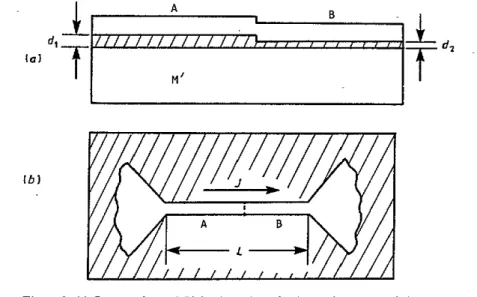
in both films.) This can be done by changing the thickness of a tunnelling barrier between a film and the bulk metal slightly, thus providing for the corresponding change in q. Parts of the film with different barrier transmissivities can be considered as different metals A and B in the thermoelectric circuit in figure 2,resulting in a heat release (or absorption, depending on the direction of the current) at the point of connection according to
1
Figure 2. (a) Cross section and (b) in-plane view of n thermoelectnc constriction.
This heat is released within the characteristic length of the order of
a.
The .Joule heat at the same region will beAn estimate of the ratio Q p e ~ t i e J Q ~ o u ~ e on the assumption that
In,
-
l7,l N l7 givesaccording to (36)
This may in principle be larger than unity at very strong electric fields. If we assume that the constriction length
L
in figure 2 is larger than the energy relaxation length A =a,
then this means practically that the bias at the microconstriction should be greater than theFermi energy. This corresponds to an electron drift velocity of the order of
Ud
-
Lp(1/li)’’Z (40)which is still much smaller than the Fermi velocity.
Let us make some numerical estimates. For a tunnelling junction of size 1 mm x 1 mm and film thickness d N cm, one obtains, according to
(7),
tiN s a tR N
N S2.With the realistic assumption 1 N cm. Therefore, very-high-
transmissivity junctions are required to obtain reasonable values of A, and therefore of the contact length. The possibility of thermoelectric cooling in a device of the type shown in figure 2 appears to be questionable; however, it is not completely ruled out.
If the constriction size is smaller than
A,
the right-hand side of (40) will acquire an extra factor L / A because the Joule heatis
then released mainly at the banks of the constriction where it produces a negligible effect. However, our formula (36) does not apply directly to this ‘diffusive’ regime of the constriction current-canying state (according to the definition in 141). For small drift velocities U < ~ p ( l / l i ) l ’ ~ h / L , the thermoelectric effect will manifestitself in the asymmetry of the current-voltage characteristic of the contact [lo]. cm, this gives A _Y
9144
IO
KulikThe experimental situation in studying non-linear transport in metals is not clear. Electron heating in the strong-current regime has been observed in metal films [ I ] , 121 and metallic microbridges [13]. However, thermoelectric effects have not been detected. In very narrow metallic constrictions (point contacts), the thermoelectricity shows up in the dependence of resistance on the direction of the current [14-16].
Acknowledgment
I am grateful to Professor A
S
Shumovsky for helpful discussions.References
[ I ] Washbum S 1991 Meroscrrpic Plzerx”a in Solid.7 ed B L Akhuler. P A Lee and R A Webb (Amsterdam: [2] Likhorev K K 1988 IBM 1. Re* De”. 32 144
[3] Devoret M H and Gmben H 1992 Single Ckurge Tunneling and Coulomb Blockade Phenomena in [4] Kulik I O 1992 Fiz Nirk Temp, 18 450 (Engl. trmsl. 1992 Sov. J. Low 2 m p . Phyr. 18 302)
[SI Van Krmpen H 1990 Scanning Tunnelini: Micmrcopy lid Reluied Me1lzrrd.s ed R J Behm. N Garcia and H [6] Ziman 1 M 1972 Principles in 1ke Theory ofSolids (Cambridge: Cambridge Univenity Press)
171 Sarkcr S K. Hu Y K, Stanton C I and Wilkins J W 1987 Pky$Y. Rev. B 37 9229
[SI Modelung 0 198 I Inimdur1im r o Solid-Snite Titeory (Springer Series in Solid-Sruic Science 2 ) (Berlin:
[9] Huebener R P 1972 Solid Stale Pkpic.s vol 27. ed H Ehrmreich. F Sqitz and D Turnbull (New York [IO] Bogachek E N, Kulik I O and Sh!wihatov A G 1991 J. Pkyr.: CmdmLv. Muller 3 8877
[ I 11 Roukes M L. Freeman M R, Germain R S, Richardson R C and Ketchen M B 1985 Pky.r. Rev. Leu 55 422 [I21 Wellstood F C. Urbino C and Clarke J 1994 P k y . Rev. B 49 5942
[I31 Chun K and Birgc N 0 1994 Pky.r. Rev. B 49 2959
[I41 Naydyuk Yu G. Gribov N N. Shklyarevskii 0 I and Yanson I K 1985 Fiz. Nirk. Temp. 11 1053 (Engl. transl. [IS] Shklymvskii 0 1. Jonsen A G M, H e r ” J G H and Wyder P 1986 Phyr. Rev. Lell. 57 1374
[I61 Trrcinski R, Gmelin E and Queisser H 1 1987 P k j r Rev. B 35 6373 Elsevier) p 3
Nunt,rtruciures ed H Graben and M H Devont (New York Plenum)
Rohrer (Devenrer: Kluwer) p 241
Springer) Academic) p 64