International Periodical for the Languages, Literature and History of Turkish or Turkic Volume 11/2 Winter 2016, p. 29-56
DOI Number: http://dx.doi.org/10.7827/TurkishStudies.9014 ISSN: 1308-2140, ANKARA-TURKEY
Article Info/Makale Bilgisi
Received/Geliş: 04.12.2015 Accepted/Kabul: 01.02.2016 Referees/Hakemler: Prof. Dr. Mehmet Dursun ERDEM –
Doç. Dr. Aslı YAZICI
This article was checked by iThenticate.
THE TURKS IN SWEDEN IN THE TRIANGLE OF ACCULTURATION, INTEGRATION AND HOMELAND
Mehmet ANIK** - Kamil ŞAHİN***
ABSTRACT
In this field study, social, cultural, political identity and sense of belonging to Turks in Sweden, to which degree they are integrated into the country they live in, their perception about their homeland, and whether there is a difference between the generations about this subject were assessed in line with the data obtained in the research. The data obtained in the field study carried out in Stockholm, Göteborg and Malmö cities, the most densely inhabited cities by Turks, and the analysis of the data was made using SPSS 18 programme. When the data obtained are analysed, it is revealed that Turks in Sweden care for the identity formation representing their homeland and its continuation in socio-cultural terms, and they generally tend to be conservative in this sense. Nevertheless, it is also understood that the contact of Turks in Sweden with Turkish culture and Turkey is gradually decreasing (when it compared to the past). This also reveals the differences between the generations. When that 3rd generation young Turks born in Sweden came to Turkey, they generally do not feel like in their homeland, but in a foreign country or a country they visit as guests, and this also related to this kind of change. While negativities occur at the point of active participation of the Turks in Sweden in the political system in this country, that they are generally in a positive level at the point of corporate integration is another result arising out of the data obtained in the field study.
STRUCTURED ABSTRACT
The mass labour migration from Turkey to Sweden occurred in the mid-1960s. In historical terms, it is possible to say that the relationship between Sweden and Turks has a rooted past dating back to the 16th
century, i.e. to the Ottoman Empire. That Turks went to Sweden as a result of this historical relationship dates back to an early date, the beginning of the 18th century. On the other hand, the date that is determinative for labour migration at a mass level is 1963 and after. The employment of Turkish workers in Sweden gained a legal regulation with Turkey-Sweden Labour Force Agreement signed in Stockholm on 10 March 1967 between Turkey and Sweden. Kulu district of Konya stands out in migrations from Turkey to Sweden. The most important reason for this is that the first people to migrate in the migration movement that started in 1963 were from Kulu, and the migration movement following this was mostly in the form of chain migration. Most of the immigrants of Turkish origin living in Sweden have bonds with Kulu district of Konya somehow. It would not be wrong to say that people of Kulu origin living in Sweden more than the actual population of Kulu in Turkey.
The main city that Turks in Sweden live is the capital city Stockholm, and this is followed by Göteborg and Malmö. In the 1960s when the mass migration to Sweden from Turkey occurred, the common feature of these three major cities was that they were industrial cities. When compared to other European countries that Turkish immigrants emigrated, the number of scientific studies on Turks in Sweden is at a more limited level. It is observed that the limited number of the studies on Turks in Sweden is generally carried out focusing on Stockholm or one or several districts of Stockholm. The sample group of this study includes not only Turks in Stockholm, but also in Göteborg and Malmö.
This research was carried out on first, second and third generation immigrant Turks living in Sweden. The number of the people living in Sweden whose homeland is Turkey, and who have ancestors who previously migrated to Sweden from Turkey even if they themselves migrated from Turkey, and were born in Sweden, is approximately 100,000. On the other hand, this universe is quite a dispersed universe. Choosing the sample within the universe led to major difficulties as the universe is dispersed, and it is impossible to obtain their exact addresses. In this context, the primary aim was to reach the number of the samples that can principally represent the universe. Thus, more than 500 questionnaire forms in total were prepared and filled in total. 429 valid forms among these were taken into consideration. Thus, the research was carried out within 95% confidence interval and with an error margin of 4.72%. The cluster sampling technique among the sampling techniques primarily based on the possibility was used as the sampling technique. The reason for this is that the universe is large and dispersed. On the other hand, the snowball sampling technique was used first in order to discover the universe and the cluster sampling technique was preferred in the continuing process in order to maintain the research on the basis of a possibility-based method.
When the results obtained in the research are generally examined, it is revealed that a great majority of the Turks in Sweden attach importance to their religious and cultural identities, and exhibit a conservative attitude in this context. Considering that they are a group of immigrants, such elements of identity both as intra-group collective identity elements and as part of belonging to the homeland are considered important by the Turks in Sweden in terms of ensuring cultural
sustainability. Undoubtedly, the perception in this sense is closely related to the socio-cultural integration into the country where one lives. While such a perception keeps the intra-group integration alive, it will keep the interaction with the local people of Sweden and other ethnical elements at a limited level. Considering the data obtained from the research, Turks in Sweden are also aware that this kind of socio-cultural barriers limits their interaction with the local people. This obviously should not be explained only over intra-group elements. It should be taken into consideration that quite a great majority of the Turks in Sweden complain about negative prejudices against Muslims and think that the immigrants are generally accused of negative situations are also effective in the formation of such socio-cultural borders. That a great majority (71,8%) think that they are regarded as foreigners by local Swedish people although they are Swedish citizens and also the discrimination against people of foreign origin gradually increases in recent years should also be taken into consideration in this sense. Especially that a great majority of the young generation who are born in Sweden and regard themselves as locals of this country express that the Swedish consider them as foreigners are significant in this sense. Again, that they think that they are exposed to negative discrimination as a result of the Muslim identities or cultural identities, especially in terms of employment in the labour market, should also be taken into consideration in this context.
When generally considered in terms of corporate integration, it is important that the Turks in Sweden state that they generally rely on the institutions in this country. Although the thoughts about the sufficiency of corporate or legal regulations are generally positive, it is seen that the participants state that there are negative differences at the level of discrimination against immigrants. Although negativities on certain institution such as health, politics, education and judgement are expressed by the participants, it is understood that there is a generally positive tendency at the point of integration of the Turks in Sweden into the country they live in. The approaches of the Turks in Sweden regarding the political system contain certain paradoxes from certain aspects. Although a general tendency that the political system in Sweden is open for the participation of the immigrant, it is striking that an overall negative tendency is observed at the point of active political participation. Although the Turks in Sweden state that the representation of the Turks in the political area is not at a sufficient level, that they act reluctantly or step back at the point of their active political participation in order to eliminate this deficiency is defined as a paradox.
Considering the findings obtained in the research, a great majority of the participants expresses that they attach importance to transferring the Turkish language and Turkish culture to the next generations in terms of protecting Turkish identity, it is revealed that the Turks in Sweden state that the daily use of Turkish has gradually decreased when compared to the past, and their relations with the Turkish culture and Turkey have also gradually weakened. Although the use of the mother tongue is cared for in terms of cultural sustainability and the continuation of the relations with the homeland, it is observed that the active and fluent use of Turkish seen among the first and second
generation Turks has decreased when compared to the third generation Turks and Swedish is in the position of active language of communication both within and outside the group. While there is a strong sense of belonging to the homeland among the first and second generation Turks, it is striking that the third generation young people who are born in Sweden declare that they generally feel like foreigners or guests when they go to Turkey. While such a perception can be considered positively in terms of the sense of belonging and integration into Sweden, it will definitely affect the relationship with Turkish culture and identity more negatively, and increase the formation of bicultural identities with the increase of acculturation. Despite this tendency observed in the cultural identity, it is revealed that there is more resistance in religious identity, and the conservative tendency is higher in this sense. Although a great majority of the Turks in Sweden generally put forth an anti-acculturation tendency by taking a conservative attitude in the subjects of homeland culture, mother tongue and religion, they accept that a process of acculturation is experienced with the increasing cultural interaction, especially among the young generations raised in Sweden.
Keywords: international migration, Turkish immigrants,
acculturation, sense of belonging, identity perception.
AKÜLTÜRASYON, ENTEGRASYON VE ANAVATAN ÜÇGENİNDE İSVEÇ’TEKİ TÜRKLER
ÖZET
Bu alan çalışmasında, İsveç’teki Türklerin sosyal, kültürel, siyasal kimlik ve aidiyet algıları ile içinde yaşadıkları ülkeye kurumsal bağlamda hangi düzeylerde entegre oldukları, anavatanlarıyla ilgili algılarının ne yönde olduğu, bu konuda nesiller arasında farklılıklar olup-olmadığı, elde edilen bulgular doğrultusunda değerlendirilmiştir. Bu bulgular, İsveç’teki Türklerin en yoğun yaşadığı iller olan Stockholm, Göteborg ve Malmö şehirlerinde yürütülen alan çalışmasında elde edilmiş ve verilerin analizi SPSS 18 programı aracılığıyla yapılmıştır. Elde edilen veriler
analiz edildiğinde, sosyo-kültürel açıdan İsveç’teki Türklerin
anavatanlarını temsil eden kimlik oluşumunu ve devamını önemsedikleri ve bu açıdan bakıldığında genelde muhafazakâr bir eğilim taşıdıkları ortaya çıkmaktadır. Buna karşın İsveç’teki Türklerin Türk kültürüyle ve Türkiye’yle olan irtibatlarının geçmişe nazaran giderek azaldığı yönünde bir sonuç da ortaya çıkmaktadır. Bu durum nesiller arası farklılıkları da ortaya koymaktadır. İsveç doğumlu 3. kuşaktaki genç Türklerin, Türkiye’ye geldiklerinde kendilerini genelde anavatanlarında değil de yabancı ya da misafir olarak bulundukları bir yerde hissetmeleri de bu yöndeki değişimle ilgilidir. İsveç’teki Türklerin bu ülkedeki siyasal sisteme aktif katılımları noktasında olumsuzluklar ortaya çıkmakla birlikte, kurumsal entegrasyon noktasında genelde olumlu bir noktada oldukları da alan çalışmasında elde edilen verilerden ortaya çıkan bir diğer sonuçtur.
Anahtar Kelimeler: uluslararası göç, İsveç, göçmen Türkler,
Introduction
When considered with the transnational dimension in terms of the sociology of immigration, the second half of the 20th century stands out as a period when international labor migration is
observed intensively towards the Western countries, which were economically developed or economically entered into an active developmental process. At the beginning of the 20th century,
almost all the mentioned states adopted a restrictive immigrant policy and feelings developed against immigrants in these countries due to the Great Depression, which had a deep influence and caused unemployment in 1930s. Western European Countries, which came out of the Second World War with immense destruction in many aspects, began to go through a great economic transformation after the Nazism was defeated and the immigrant policies of these countries were closely affected by this situation. When the aforementioned countries, where substantial decreases appeared in the populations due to two world wars focusing on continental geography, couldn’t meet their labor force needs for restructuring and economic development attempts from the domestic market, they preferred to import labor force from other countries. During this process, European countries with a colonist past (like United Kingdom, France and the Netherlands) fostered the migration from their former colonies and paved the way for migration to employ workers also from other countries because of the high deficit in the labor market during the post-war restructuring period. With respect to the international labor migration related to the Continental Europe, countries on the coast of the Mediterranean Sea and (former) Yugoslavia attract attention as the main countries that went through immigration or exported labor except for the migrations from former colonies. This foreign labor migration continued in the following periods as certain fluctuations. Such that the total number of the foreigners and non-nationals in 15 EU member countries with a population (immigrants) of 375 million people as of 1 January 1998 was around 19,1 million.1
In the process of international labour migration, Turkey was one of the Mediterranean countries immigrating to Europe was Turkey, and it participated in this process at the beginning of the 1960s with some delay. Mass labour migration from Turkey to Western Europe started after the worker placement agreement signed with Federal Germany on 30 October 1961, and thus, Germany affected the migration from Turkey to other European countries in many aspects as the principal country in labour migration.2 As a result of this principal role of Turkey, Turks migrating to countries
other than Germany were also called “Almancı” (meaning Turks in Germany). In this migration process, when non-qualified people rather than qualified workers migrated, Sweden is one of the European countries that Turkey sent workers. It was foreseen that those who went to Germany, Sweden and other Western countries would return to their homeland after staying in these countries for some time, but the immigrants became permanent after first being guest workers by taking along their families in Turkey in the next process.
The mass labour migration from Turkey to Sweden occurred in the mid-1960s. In historical terms, it is possible to say that the relationship between Sweden in Scandinavia and Turks has a rooted past dating back to the 16th century, i.e. to the Ottoman Empire. That Turks went to Sweden as a result of this historical relationship dates back to an early date, the beginning of the 18th century.3
On the other hand, the date that is determinative for labour migration at a mass level is 1963 and after. The employment of Turkish workers in Sweden gained a legal regulation with Turkey-Sweden Labour Force Agreement signed in Stockholm on 10 March 1967 between Turkey and Sweden. As an extension of Sweden’s policy of encouraging permanence rather than guest workers in contrast to
1 For more information on this subject, see Spellman (2008: 22-23); Meyers (2004: 1), Toksöz (2006), Castles&Miller
(2009).
2 For more information on this subject, see Abadan-Unat (2011), Aydın (2014), and Bartram (2005: 32-33).
other European countries allowing immigrants, the immigrants going to Turkey from Sweden started to take their families in Turkey to Sweden as of the beginning of the 1970s.
Kulu district of Konya stands out in migrations from Turkey to Sweden. The most important reason for this is that the first people to migrate in the migration movement that started in 1963 were from Kulu and the migration movement following this was mostly in the form of chain migration. Most of the immigrants of Turkish origin living in Sweden have bonds with Kulu district of Konya somehow.4 As a result of this condition of Kulu, it is frequently witnessed that Swedish officials
coming to Turkey generally visit Kulu and talk addressing to the citizens there and call attention to the importance of the bonds with Kulu and Sweden in these speeches. It is remarkable that a ballot box was set up in Kulu district of Konya in order to increase the participation in the last general election in Sweden (September 2014). It would not be wrong to say that people of Kulu origin living in Sweden more than the actual population of Kulu in Turkey.
There is no definite figure for the number of the immigrants of Turkish origin living in Sweden. That a long time has passed after the first migration, a regular and detailed record was not kept about the immigrants, the number of people born in Sweden (including their mothers and fathers) is gradually increasing, problems encountered in keeping records about these, and eventual illegal migrations can be regarded as the main reasons for the inability to declare a definite figure in this respect. According to 31 December 2006 data of the Republic of Turkey Ministry of Labour and Social Security, 63.580 Turkish citizens live in Sweden. This number includes those who ethnically define themselves as Kurdish, Syriac, Assyrian or Chaldean. It is also possible to talk about a number around 100,000 for today in a way that it includes these differences ethnically. Indeed, the Presidency for Turks Abroad and Related Communities indicates that approximately 100,000 people, 70,000 of whom are dual citizens live in Sweden.5 The main city that Turks in Sweden live is the capital city
Stockholm and this is followed by Göteborg and Malmö. In the 1960s when the mass migration to Sweden from Turkey occurred, the common feature of these three major cities was that they were industrial cities.
When compared to other European countries that Turkish immigrants emigrated, the number of scientific studies on Turks in Sweden is at a more limited level. It is observed that the limited number of the studies on Turks in Sweden is generally carried out focusing on Stockholm.6 The
sample group of this study includes not only Turks in Stockholm, but also in Göteborg and Malmö. In the light of the data obtained in this study, certain analyses will be carried out regarding the sense of belonging and identity of Turks in Sweden in cultural, social and political contexts, certain general perceptions of Sweden and Turkey, the acculturation perception and integration into Sweden in socio-political and socio-economical terms.
Analysis of the Field Research Data of the Turks in Sweden in the Triangle of Acculturation, Integration And Homeland
This research was carried out on first, second and third generation immigrant Turks living in Sweden. As is indicated above, the number of the people living in Sweden whose homeland is Turkey, and who have ancestors who previously migrated to Sweden from Turkey even if they themselves migrated from Turkey and were born in Sweden, is approximately 100,000. On the other hand, this universe is quite a dispersed universe. Choosing the sample within the universe led to major difficulties as the universe is dispersed, and it is impossible to obtain their exact addresses. In this context, the primary aim was to reach the number of the samples that can principally represent
4 For a study carried out about Kulu regarding the Turks in Sweden, see Lundberg&Svanberg (1994). 5 For more information on this subject, see http://www.yvdk.gov.tr/ulke-6-isvec.html
the universe. Thus, more than 500 questionnaire forms in total were prepared and filled in total. 429 valid forms among these were taken into consideration. Thus, the research was carried out within 95% confidence interval and with an error margin of 4.72%. The cluster sampling technique among the sampling techniques primarily based on the possibility was used as the sampling technique. The reason for this is that the universe is large and dispersed. On the other hand, the snowball sampling technique was used first in order to discover the universe and the cluster sampling technique was preferred in the continuing process in order to maintain the research on the basis of a possibility-based method.
An aspect that must be primarily expressed is that the questionnaire form that we use as a data collection tool has quite a comprehensive content. Our questionnaire form consists of two main parts. In the first part of the questionnaire, there are questions about the reasons for being in Sweden alongside with demographical information, whether there were any relatives there before, and questions on determining social, economical, political and cultural lives in Sweden and the degree of their feeling of belonging to Sweden, alongside with questions in determining their interest in and bonds with Turkey. The second part of the questionnaire form consists of three main scales. The first scale is the “Political Identity and Sense of Belonging Scale”. This scale consists of 11 propositions. The validity and reliability analyses of the scale were determined using the pilot application. The factor load values of the propositions making up the scale were found to be between .51 and .78, and these values obtained show that the scale is structurally valid. As a result of the factor analysis carried out, four factors explaining 66.4% of the total variance were obtained. The declared variance value is at a sufficient level in terms of the validity of the scale. Cronbach’s Alpha coefficient was found as .71 in the reliability analysis of the scale, and this rate shows a sufficient level of reliability for social sciences.
The second scale is the “Socio-Cultural Identity and Sense of Belonging Scale”. The scale consists of 15 propositions in total. The factor load values of the propositions making up the scale were found between .47 and .84, and these values obtained show that the scale is structurally valid. As a result of the factor analysis, four factors explaining 62.5% of the total variance were found. The expressed variance value is at a sufficient level in terms of the validity of the scale. Cronbach’s Alpha coefficient was found as .78 in the reliability analysis. This rate shows a sufficient level of reliability. The third scale is the “Corporate Integration Scale”. As a result of the validity analysis of the scale consisting of 13 propositions, the factor load values of the propositions making up the scale were found between .64 and .84, and these values showed that the scale is structurally valid. Again, four factors explaining 63.5% of the total variance were obtained as a result of the factor analysis made. The explained variance shows that the scale is at a sufficient level in terms of the validity of the scale. Cronbach’s Alpha coefficient found as .74 in the reliability analysis. This rate shows that it is a reliable scale at a rate of 74%, and this is a sufficient level of reliability for social sciences. In terms of reliability, issues such as subject reliability, observer (evaluator) reliability, situational reliability, instrument reliability and processing reliability were taken into consideration. As for validity, issues such as propositional validity, instrument validity, sampling validity, observer (evaluator) validity, subject validity, administration validity and analysis validity were taken into consideration.7
As this study is a paper, it is naturally impossible to present all of the details of the data obtained in the field study. Thus, we will try to reveal the sense of belonging and identity of the Turks in Sweden in the light of certain data that we chose in general tables.
7 For the theoretical information about the main criteria for reliability and validity, see Cobetta (2003: 81-84 and 173),
Demographic Features of the Sample Group
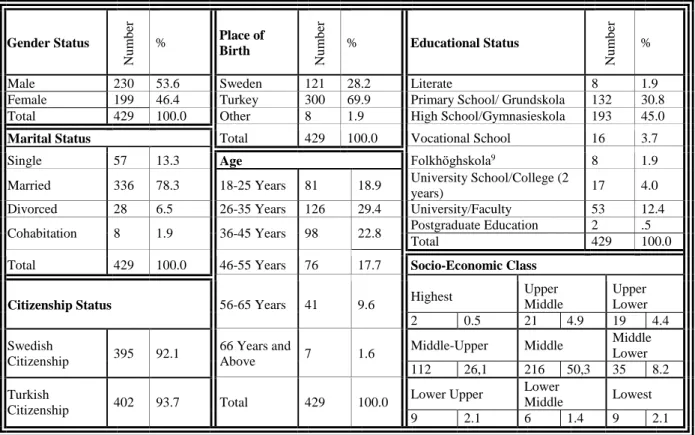
53,6% of the participants making up the sample group consists of men and 46,4% consists of women. Achieving equality especially in the number of women and men is harder in such type of researches. The questionnaires were generally fulfilled in the offices, associations and collective events rather than the participants’ homes. Considering that the participation of the immigrant women into non-domestic is lower than men, it is observed that the level of women participation in our research is high. Concerning the birth places of the participants, it is seen that 69,9% of them were born in Turkey. Most of the participants consist of first and second generation Turks (300 people). Third generation Turks born and raised in Sweden (121 people) also participated to the study. Other eight people of the participants whose homeland is Turkey consist of Turks born in other European countries such as Norway, Denmark and Germany and later migrated to Sweden with their parents. When participants were assessed by their educational status, it was understood that 30,8% of the participants were primary school graduates while 45% of them were high school graduates. On the other hand, that 12,4% of the participants are university graduates is a remarkable findings. While this rate is around 11% in Turkey, it is at a higher level in EU countries.8 Thus, we can say
that Turks living in Sweden has an average rate for Turkey in the context of being a university graduate. However it is quite below the EU average.
Table 1. Demographic Features of the Sample Group
When the marital status of the participants were examined, it is observed that 78,3% of the participants are married, and 13,3% are single while the rate of the divorced is 6,5%. According to 2013 data of TURKSTAT (Turkish Statistical Institute), there are 58.384.240 people above the age
8 Turkstat, 2013 Address-based census data. Available at: http://www.turkstat.gov.tr/Start.do 9 A kind of high school where people of different age groups continue.
Gender Status Nu m b er % Place of Birth Nu m b er % Educational Status Nu m b er %
Male 230 53.6 Sweden 121 28.2 Literate 8 1.9
Female 199 46.4 Turkey 300 69.9 Primary School/ Grundskola 132 30.8
Total 429 100.0 Other 8 1.9 High School/Gymnasieskola 193 45.0
Marital Status Total 429 100.0 Vocational School 16 3.7
Single 57 13.3 Age Folkhöghskola9 8 1.9
Married 336 78.3 18-25 Years 81 18.9 University School/College (2
years) 17 4.0
Divorced 28 6.5 26-35 Years 126 29.4 University/Faculty 53 12.4
Cohabitation 8 1.9 36-45 Years 98 22.8 Postgraduate Education 2 .5
Total 429 100.0
Total 429 100.0 46-55 Years 76 17.7 Socio-Economic Class
Citizenship Status 56-65 Years 41 9.6 Highest
Upper Middle Upper Lower 2 0.5 21 4.9 19 4.4 Swedish Citizenship 395 92.1 66 Years and Above 7 1.6
Middle-Upper Middle Middle
Lower
112 26,1 216 50,3 35 8.2
Turkish
Citizenship 402 93.7 Total 429 100.0
Lower Upper Lower
Middle Lowest
of 15 in Turkey, and 1.979.260 of them divorced after marriage.10 According to the figures, 3,39%
of the Turkish population above the age of 15 consists of divorced couples, while 63,76% consists of married couples and 9,34% consists of single people. What stands out is that the divorce rate of the people of Turkish origin living in Sweden is almost twice compared to that in Turkey.
When we investigated the age distribution of the sample group, it was observed that 18,9% of them are between the age of 18 and 25, 29,4% of them are between 26 and 35, 22,8% are between 36 and 45, 17,7% between 46 and 55, and 11,2% are above 56 years. Age distributions were appeared in accordance with general population density pyramid. When the sample group was asked in which social class they consider themselves in the country they live in socio-economical terms demographically, 50,3% of the participants indicated that they consider that they are in the middle of the middle class at social class plane that we divide into nine levels. On the other hand, the rate of those who consider themselves in the highest and lowest levels are quite low. As a result of our research, we found that 92,1% of the population constituting the sample group have Swedish citizenship, and 93,7% of them have Turkish citizenship. Hence, we understand that the concept of dual citizenship is quite high. On the other hand, it was determined that those who do not have Swedish citizenship are generally people who wait for their citizenship right or those who stay there for a definite period, not permanently. We can indicate that the concept of citizenship, which is a basic corporate factor for the individuals to feel themselves belonging to the country where they stay, is provided for the Turks in Sweden.
Political Identity and The Sense of Belonging
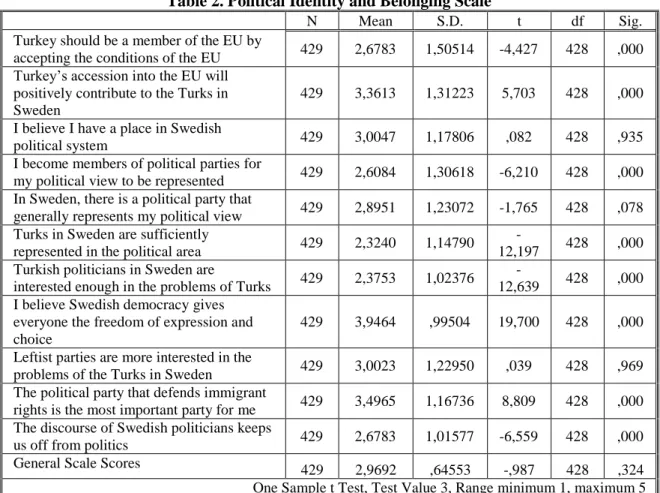
In order to determine the political identity and observe its formation in an individual, determination of her/his level of participation in the political events in her/his society and attitudes and thoughts about domestic politics is of principal importance. The scale developed in order to determine the political identity formation of the Turks in Sweden and their participation in Swedish politics in general and locally consists of 11 propositions. First, the views of the participants on the accession of Turkey into the EU, which includes Sweden where they live as well, were examined. The participants did not give a high consent in the context of the participation level into the proposition “Turkey should be a member of the EU by accepting the conditions of the EU”. The sample group exhibits a significant differentiation by the level of the distance to the middle point (3) between the endpoints of totally agreeing (5) and not agreeing at all (1) [t(429)=-4,427 p<0,05]. On
the other hand, a scoring favouring the accession was obtained for the proposition that “Turkey’s accession into the EU will make a positive contribution to Turks in Sweden ( :3,3613). This shows that the participants have certain concerns about the acceptation of Turkey of all the conditions of the EU. However the sample population clearly thinks that their accession to the EU will be something positive for them.
Table 2. Political Identity and Belonging Scale
N Mean S.D. t df Sig.
Turkey should be a member of the EU by
accepting the conditions of the EU 429 2,6783 1,50514 -4,427 428 ,000
Turkey’s accession into the EU will positively contribute to the Turks in Sweden
429 3,3613 1,31223 5,703 428 ,000
I believe I have a place in Swedish
political system 429 3,0047 1,17806 ,082 428 ,935
I become members of political parties for
my political view to be represented 429 2,6084 1,30618 -6,210 428 ,000
In Sweden, there is a political party that
generally represents my political view 429 2,8951 1,23072 -1,765 428 ,078
Turks in Sweden are sufficiently
represented in the political area 429 2,3240 1,14790
-12,197 428 ,000
Turkish politicians in Sweden are
interested enough in the problems of Turks 429 2,3753 1,02376
-12,639 428 ,000
I believe Swedish democracy gives everyone the freedom of expression and choice
429 3,9464 ,99504 19,700 428 ,000
Leftist parties are more interested in the
problems of the Turks in Sweden 429 3,0023 1,22950 ,039 428 ,969
The political party that defends immigrant
rights is the most important party for me 429 3,4965 1,16736 8,809 428 ,000
The discourse of Swedish politicians keeps
us off from politics 429 2,6783 1,01577 -6,559 428 ,000
General Scale Scores 429 2,9692 ,64553 -,987 428 ,324
One Sample t Test, Test Value 3, Range minimum 1, maximum 5 The Turks living in Sweden agreed with the proposition “I believe I have a place in Swedish political system” with a mean score of :3,0047. This mean score is neither towards accession nor towards non-accession. Hence, they actually do not have any opinion about whether they have a place in the Swedish political system in the strict sense. Moreover, this stands out as a real double bind situation. That the participants gave a score below the intermediate level to the proposition “I become members of political parties for the representation of my political view ( :2,6084) shows that the participants prefer to exclude themselves from the political system at the point of the representation or defence of their political views. On the other hand, a score of :2,8951 was given to the proposition “In Sweden, there is a political party that generally represents my political view”, and this shows that a significant portion of the participants think that there is no political party in Swedish political system that fully represents their opinions. While the scores given to the propositions “Turks in Sweden are sufficiently represented in the political area” ( :2,3240) and “Turkish politicians in Sweden are interested enough in the problems of Turks” ( :2,3755) and the mean values obtained principally show that the representation in political area is not sufficient, they also show that the sample population thinks that Turkish politicians in the political system also do not care enough for the problems of the Turks. They will definitely affect the sense of belonging to the society or the state negatively.
Studies on Turks in Sweden of previous periods show that the political integration of the Turks in this country is weak. In his field study completed in 1980 about the political participation of Turks living in Stockholm city, Şahin Alpay (1980: 236) indicates that the knowledge of Turks in Sweden about Swedish politics is quite low when compared to other immigrant groups. Alpay states
that almost half of the participants during field study do not watch the news on Swedish press, radio and television, and Turkish radios are the most important source of news for this immigrant group. Findings obtained by Alpay also show that Turks differ from other immigrant groups quite distinctively in terms of being interested in Swedish politics. Turks are the group that is least interested in Swedish politics among immigrant groups. Another result of the study is that Turks are the only immigrant group who are more interested in the politics of the country where they come from. Although Swedish media is more closely followed now as the 3rd generation people who were born in this country and talk Swedish like their mother tongue emerged and Swedish is learnt among the first and especially the second generation at a more advanced level during the period between the year when the field study in question was carried out up to now, not much change has occurred in terms of the trends in interest in politics in Sweden.
The agreement with the proposition “I believe Swedish democracy gives everyone the freedom of expression and choice” in the context of the freedom of expression and choice theoretically in the corporate sense ( :3,9464) shows a high agreement when compared to other propositions. The thought that in Sweden, which has a well-established and functioning democracy, everyone is given the freedom of expression and choice, is agreed by most of the participants. On the other hand, while the thoughts of the participants that the rights of the Turks in Sweden are more supported in leftist parties are not quite for certain, the research data show that political parties that support immigrant rights are more important for the immigrants11 and they stated that the discourse
of the politicians did not affect their political participation much. When we look at the general scale scores, the average score of :2,9692 is just below the intermediate level when compared to the
levels of not agreeing at all (1) and totally agreeing (5), and this is at unstable-intermediate level. The average score shows that people of Turkish origin living in Sweden do not feel like they belong to Sweden in terms of political identity and the sense of belonging, in other words, they do not consider themselves completely as a part of the Swedish political system and are not fully integrated into the political system.
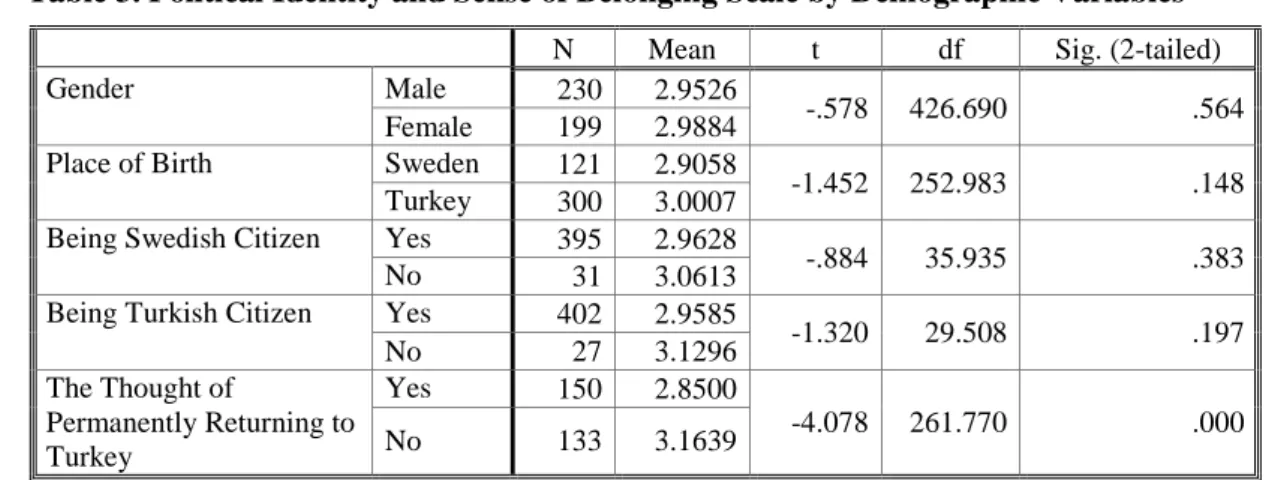
Whether the general data of the political identity and belonging scale vary by certain demographical features of the sample group was also tested. First, it was examined whether there is a significant difference according to the gender of the interviewees, and it was found that there was no significant differentiation by gender [t(426.690)= -,578 p>0,05]. Thus, the gender does not affect
one’s considering herself/himself a part of the Swedish political system.
11 The Turks in Sweden mainly support the Swedish Social Democratic Party (Sveriges Social demokratiska Arbetare parti
–SAP), which is the center-left party, and the Green Party (Miljöpartiet de Gröna-MP), which is the green-left party among the political parties. One of the common features of both parties is that they generally support immigrant rights.
Table 3. Political Identity and Sense of Belonging Scale by Demographic Variables
In the sample population, there are a few more countries as the place of birth other than Sweden and Turkey. The total percentage of these countries makes up 1.9 of the sample, and our sample consists of 429 people and only 8 of this sample expressed that they were born in countries other than Turkey and Sweden. Thus, we did not have the chance to evaluate statistically. When the scale is assessed according to whether the place of birth of the participants is Sweden or Turkey, there is still no significant difference between the groups in terms of political identity and sense of belonging [t(252,983)= -1,452 p>0,05]. Both the people born in Sweden and Turkey exhibit a very close
tendency.
When the scores given by the sample group to the political identity and sense of belonging scale according to the state of being Swedish citizen and Turkish citizen, there is still not a significant difference between the populations in accordance with the t-test results. Consequently, those who are Swedish citizens and those who are not indicated their level of agreement with the propositions constituting the scale with a very close average score. The same applies to the state of being a Turkish citizen. However, the difference between the average scores of those who are not a Turkish citizen and the Turkish citizens is a bit higher. Lastly, the difference between the scores of the political identity and sense of belonging of the people who are willing to return to Turkey permanently and the scores of those who do not consider to return to Turkey permanently was found to be statistically significant [t(261,770)= -4,078 p<0,05]. The level of the agreement with the political identity and sense
of belonging scale of those who do not consider returning to Turkey permanently is higher than those who consider returning to Turkey permanently. In this framework, the scale average of those who consider returning to Turkey is 2,85; while the scale average of those who do not consider returning to Turkey is at the level of 3,16. Both rates correspond to the unstable-intermediate level in five-point Likert-type scales. The idea of returning to the homeland survives among a considerable number of the Turks in Sweden, and that affects their political integration into Sweden negatively.
Socio-Cultural Identity and Sense of Belonging Scale
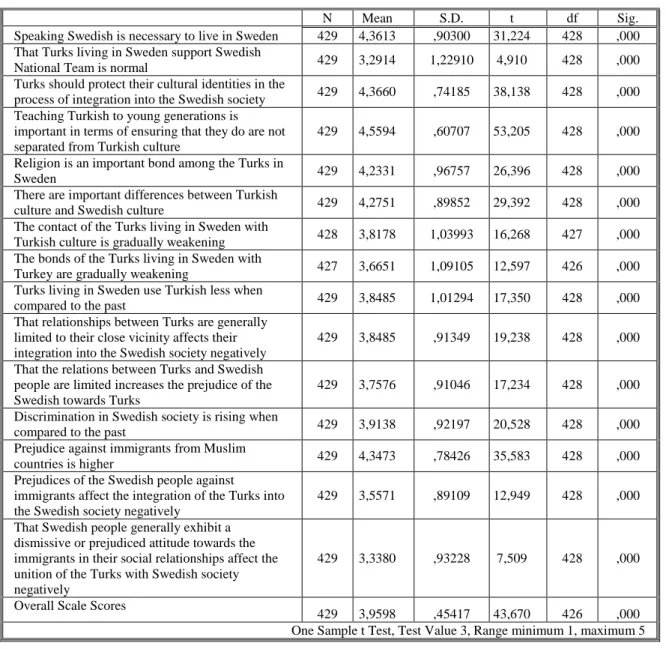
This scale shows the level of the sensitivity of the Turks living in Sweden towards their own culture, the attitudes of the local people towards this cultural identity, and how these attitudes affect the sense of belonging and identity states of the Turks of immigrant origin. 15 propositions were proposed in order to obtain these data, and the level of agreement with the propositions of the sample group was determined. First, the participants scored the proposition “Speaking Swedish is necessary to live in Sweden” at the completely agreeing level ( :4,3615). That the agreement with this proposition is high shows that the participants have a discrete and realistic manner. In the context of
N Mean t df Sig. (2-tailed)
Gender Male 230 2.9526
-.578 426.690 .564
Female 199 2.9884
Place of Birth Sweden 121 2.9058
-1.452 252.983 .148
Turkey 300 3.0007
Being Swedish Citizen Yes 395 2.9628
-.884 35.935 .383
No 31 3.0613
Being Turkish Citizen Yes 402 2.9585
-1.320 29.508 .197 No 27 3.1296 The Thought of Permanently Returning to Turkey Yes 150 2.8500 -4.078 261.770 .000 No 133 3.1639
adopting the symbolic values of the society one lives in as an indicator of belonging, the rate of agreement with the proposition “that Turks living in Sweden support Swedish National Team is normal” is at the level of 3,2914, and this level is the unstable-intermediate level. The scoring obtained shows us that the consciousness of being Swedish, i. e. the sense of possessing the symbolic values of the society one lives in, is not much effective on Turkish immigrants. For the level of agreement with the propositions shows that there is a conscious or non-conscious resistance against change in the cultural sense.
The rate of agreement of the participants with the proposition “Turks should protect their cultural identities in the process of integration into Swedish society” was found to be at the level of completely agreeing ( :4,3660). Thus, Turks in Sweden show that they clearly exhibit an anti-acculturation.12 In this framework, it is also observed that there is a high agreement with the
proposition “Teaching Turkish to young generations is important in terms of ensuring that they do not separate from Turkish culture” ( :4,5594). Turkish immigrants living in Sweden show that they care for the function of the mother tongue in ensuring the cultural sustainability with this scoring. On the other hand, certain differences between the generations can be mentioned at this point. In the research process, it was observed that a fluent Turkish is used as the language of communication between the first and second generation Turks, while third generation Turks, born in Sweden and studied at the schools in Sweden use Swedish most as the language of communication. While Swedish is generally the off-group language of communication between first and second generation Turks, Swedish is both off-group and intra-group basic language of communication between the third generation Turks, and Turkish they generally use with the first and second generation is not fluent.
Another important issue in protecting the cultural identity in addition to the language is a religion. The agreement with the proposition “Religion is an important cultural bond between the Turks in Sweden” was found to be at the level of :4,2331. This rate obtained is defined as complete agreement level. This level of the agreement shows that Turkish immigrants living in Sweden do care about religion as a common element of identity. Islamophobia is one of the most important problems that Muslim immigrants in the Western countries have experienced in their daily lives. The Islamophobic approach mainly contains negative prejudices against Muslims. At this point, it is observed that Turks in Sweden who express that they consider religion as an important element of cultural identity complains about such prejudices. Indeed, the agreement level of the participants with the proposition “There are many prejudices against the immigrants coming from Muslim countries” is at complete agreement level as a negative attitude of the local people towards Islam ( :4,3473). The prejudice that immigrant Turks face as a result of their religious belief both affect their social and cultural communication with the local people negatively and also lead to a tendency towards conservatism with the thought of protecting their religious identities. Immigrants of Turkish origin constituting the sample population express that there are significant differences between Swedish culture and Turkish culture. Although these differences are accepted, the rate of agreement of the Turks in Sweden with the proposition that their bonds with both Turkish culture and Turkey are gradually weakening has been quite high. On the other hand, it is observed that the use of Turkish as a language of communication has decreased gradually when compared to the past. This can be assessed as an indispensable reflection of a change in time despite the resistance shown. A process of acculturation is experienced with the concept of increasing cultural integration into the local culture in the society one lives in, which is, especially observed among the generations, raised in Sweden with the transition to permanent citizenship from immigration, and this is expressed as a sociological phenomenon by the participants in the research group.
Table 4. Socio-Cultural Identity and Sense of Belonging Scale
The sample group gave an average score of 3,8485 to the proposition “That the relationships between Turks are generally limited to their close vicinity affects their integration into the Swedish society negatively”. This level of scoring is at the level of agreement and differs significantly from level 3, which is the intermediate level [t(429)= 19,287 p<0,05]. That social relations mostly occur
within the group affects the socio-cultural integration into the Swedish society negatively, and this is a phenomenon accepted by the participants. On the other hand, the score given to the proposition “That the relations between Turks and Swedish people increases the prejudice of the Swedish against Turks” ( :3,7576) partially affirm the proposition. That the relationships are maintained within a closed group causes the development of certain prejudices of the people outside the group towards the group. People of Turkish origin living in Sweden prefer to maintain their social relations more among themselves, prefer less to establish social relations with the Swedish, and this causes the
N Mean S.D. t df Sig.
Speaking Swedish is necessary to live in Sweden 429 4,3613 ,90300 31,224 428 ,000
That Turks living in Sweden support Swedish
National Team is normal 429 3,2914 1,22910 4,910 428 ,000
Turks should protect their cultural identities in the
process of integration into the Swedish society 429 4,3660 ,74185 38,138 428 ,000
Teaching Turkish to young generations is important in terms of ensuring that they do are not separated from Turkish culture
429 4,5594 ,60707 53,205 428 ,000
Religion is an important bond among the Turks in
Sweden 429 4,2331 ,96757 26,396 428 ,000
There are important differences between Turkish
culture and Swedish culture 429 4,2751 ,89852 29,392 428 ,000
The contact of the Turks living in Sweden with
Turkish culture is gradually weakening 428 3,8178 1,03993 16,268 427 ,000
The bonds of the Turks living in Sweden with
Turkey are gradually weakening 427 3,6651 1,09105 12,597 426 ,000
Turks living in Sweden use Turkish less when
compared to the past 429 3,8485 1,01294 17,350 428 ,000
That relationships between Turks are generally limited to their close vicinity affects their integration into the Swedish society negatively
429 3,8485 ,91349 19,238 428 ,000
That the relations between Turks and Swedish people are limited increases the prejudice of the Swedish towards Turks
429 3,7576 ,91046 17,234 428 ,000
Discrimination in Swedish society is rising when
compared to the past 429 3,9138 ,92197 20,528 428 ,000
Prejudice against immigrants from Muslim
countries is higher 429 4,3473 ,78426 35,583 428 ,000
Prejudices of the Swedish people against immigrants affect the integration of the Turks into the Swedish society negatively
429 3,5571 ,89109 12,949 428 ,000
That Swedish people generally exhibit a dismissive or prejudiced attitude towards the immigrants in their social relationships affect the unition of the Turks with Swedish society negatively
429 3,3380 ,93228 7,509 428 ,000
Overall Scale Scores
429 3,9598 ,45417 43,670 426 ,000
formation of certain prejudices in the Swedish towards immigrants. Furthermore, the levels of agreement with the propositions show that this is also realized by Turkish immigrants. This is confirmed with the score of agreement given to the proposition “Prejudices of the Swedish people against immigrants affect the integration of the Turks into the Swedish society negatively.” The existence of a vicious cycle is also seen here. While the prejudice of the Swedish prevents the integration of the Turks into Swedish society, the reason for such prejudice is that Turks communicate with the Swedish at a minimum level. Thus, it is possible to mention mutual cultural barriers and prejudices resulting from this. On the other hand, the prejudice of the Swedish cannot be explained with a single reason. These reasons can be diversified as cultural, religious and political. Furthermore, the immigrants in Sweden do not only consist of the Turks. The attitudes and behaviours of the immigrants from different countries may have caused prejudice against the immigrants in general. The level of agreement of the proposition “That Swedish people generally exhibit a dismissive or prejudiced attitude towards the immigrants in their social relationships affect the unition of the Turks with Swedish society negatively” varied significantly from the intermediate point (3) between not agreeing at all (1) and completely agreeing (5) towards agreement [t(429)= 7,509
p<0,05]. As is indicated, that the Swedish exhibit negative attitudes and behaviours towards the immigrants as a result of the prejudice affect the integration of the immigrants into Sweden negatively.
The sample group indicated that the discrimination in the society, especially in recent years in Sweden, increased when compared to the past. It is seen that the level of agreement with the proposition in question is high. Moreover, this shows that discriminative tendencies show a negative effect in the context of socio-cultural integration. When the scale generally evaluated, it is observed that Turks living in Sweden act with the reflex of protecting their own cultural identity, and they tend to protect their cultural structure rather than feeling that the belong to Sweden in the sense of belonging and socio-cultural identity as the Swedish consider them as different from themselves and their tendency to accept them as they are is low.
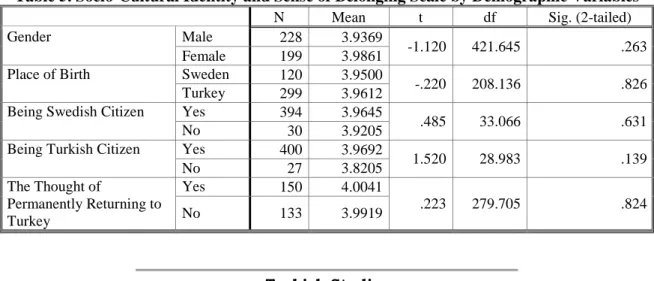
Examining whether there is an effect on socio-cultural identity and sense of belonging by demographic variables, it was firstly observed that being female or male does not constitute a significant difference in the scoring of the scale [t(421,645)= -1,120 p>0,05]. The difference of the place
of birth was a variable that was expected to have a significant difference. However, the analysis made showed that whether the participants are born in Sweden or Turkey does not lead to a significant difference in terms of socio-cultural identity and sense of belonging tendencies [t(208,136)= -,220
p>0,05]. This can show us that the effect of intra-family cultural transfer still continues intensively.
Table 5. Socio-Cultural Identity and Sense of Belonging Scale by Demographic Variables
N Mean t df Sig. (2-tailed)
Gender Male 228 3.9369
-1.120 421.645 .263
Female 199 3.9861
Place of Birth Sweden 120 3.9500
-.220 208.136 .826
Turkey 299 3.9612
Being Swedish Citizen Yes 394 3.9645
.485 33.066 .631
No 30 3.9205
Being Turkish Citizen Yes 400 3.9692
1.520 28.983 .139 No 27 3.8205 The Thought of Permanently Returning to Turkey Yes 150 4.0041 .223 279.705 .824 No 133 3.9919
When the scale is evaluated on the basis of citizenship, whether being a Swedish citizen or not does not affect the scoring of socio-cultural identity and sense of belonging scale. Similarly, being a Turkish citizen or not did not affect the differentiation of the scoring of socio-cultural identity and sense of belonging scale. Citizenship is assessed at a corporate quality rather than being a cultural state. Again, the thought of returning to Turkey permanently or not does not have a determinative effect in the tendencies in the context of socio-cultural identity and sense of belonging.
Corporate Integration Scale
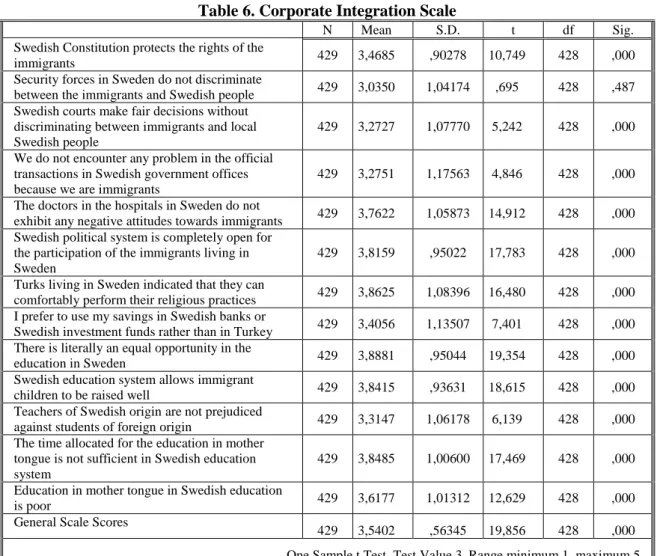
This scale shows the degree that the Turks living in Sweden adapt to Swedish corporate structure and their attitudes toward this corporate structure. 13 propositions were determined for the analysis of the situation and the corporate integration levels of the sample groups were tried to be established by assessing their attitudes towards these propositions. First of all, the sample group gave a score at the level of agreement ( :3,4685) to the proposition “The Swedish Constitution protects the rights of the immigrants.” The participants do not foresee a significant problem in terms of protecting immigrant rights in the context of Constitution. How the reflection of these norms on practice is also important in addition to normative regulations foreseeing natural equality. Indeed, the level of agreement of the participants with the proposition “the security forces in Sweden do not discriminate between people of immigrant origin and the Swedish” shows us the difference of the situation in practice. The scoring made for the proposition in question did not significantly differ from the intermediate point (3) of the scoring [t(428)= ,695 p>0,05]. Thus, it cannot be clearly said
that the security forces in Sweden do not discriminate between the immigrants and the local Swedish people. It is possible to encounter different studies on the sensitive problem in this subject regarding the immigrants and people of foreign origin. In his book titled Sveriges Likas Lag (2004), an ex-police officer Michael Lundh expresses that he observed that his colleagues had prejudices against foreigners when he was working in Normallmpolis team, and they frequently reflect this on the foreigners.
When the subject is discussed in the context of judgement, the level of agreement ( :3,2727) with the proposition “Swedish courts make fair decisions without discriminating between the immigrants and local Swedish people” is at the level ( :3,2727) of indecisive-intermediate. There is a significant difference from the intermediate point (3) here. The trust in courts is higher within the group when compared to the attitudes of the security forces toward immigrants. In the scientific study based on investigation and conviction files titled Likhet In för Lagen published in 2005, corporate discrimination in the Swedish justice system was examined and led to discussions in this sense. The study in question included the fact that elements such as gender, ethnicity and regional differences are effective in the process of judgement although the Swedish Constitution includes the principle “equal penalty for equal crime”, and immigrants are exposed to negative discrimination in judgement in this context (Diesen et al., 2005). The report published by Swedish National Council for Crime Prevention in 2008 shows that people of foreign origin and different ethnical and religious minorities are exposed to a discriminative treatment in police investigation, during the process of criminal investigation and in judgement system (Brottsförebyggande Rådet, 2008). On the other hand, the increase in the number of the participants expressing positive opinions among the Turks in Sweden, as an immigrant group, is remarkable. It is also evaluated this situation that a decrease occurred in the corporate discrimination problem encountered in practice in the judgement system in Sweden in the elapsed time. Turks in Sweden expressed that they generally do not experience many difficulties for being immigrants in their official jobs in Swedish government offices. However, the average score ( :3,2751) given to the proposition in question is not at the level of agreement either.
The level of scoring made by the Turks in Sweden to the proposition “Doctors in Swedish hospitals do not exhibit negative attitudes towards immigrants” is at the level of agreement ( :3,7622). It can be expressed that immigrants do not face any negative attitudes, especially in health issues, has a positive effect in the context of corporate integration. The scores of the sample group for the proposition “The Swedish political system is completely open for the political participation of the immigrants living in Sweden” is at the level of agreement ( :3,8159). That immigrants think that the political system is completely open for them gives rise to the thought that they can express themselves in Swedish political system and corporate structure, and this thought can create affiliation or integration towards Sweden, so that the right of political representation or choice can partially prevent the immigrants to see themselves as others. That individuals feel themselves free, especially in performing their religious practices, is an extremely important criterion. Turks living in Sweden indicated that they could comfortably perform their religious practices with an average score of 3,8625.
The immigrants constituting the sample group tended to agree with the proposition “I prefer to use my savings in Swedish banks or Swedish investment funds rather than in Turkey”. The tendencies differ significantly from the intermediate point (3) [t(428)= 7,401 p<0,05]. The thing to
consider at the point of using one’s savings is the duration and purpose of the immigrants to go to Sweden and stay there. The psychological state that is defined as expatriate includes the possibility to return and make the investment that will sustain one’s life when he/she returns in the homeland. Thus, that all investments cannot be used in Sweden can be regarded as a natural situation. In this sense, the score given to the proposition can be regarded as a high level.
Table 6. Corporate Integration Scale
N Mean S.D. t df Sig.
Swedish Constitution protects the rights of the
immigrants 429 3,4685 ,90278 10,749 428 ,000
Security forces in Sweden do not discriminate
between the immigrants and Swedish people 429 3,0350 1,04174 ,695 428 ,487
Swedish courts make fair decisions without discriminating between immigrants and local Swedish people
429 3,2727 1,07770 5,242 428 ,000
We do not encounter any problem in the official transactions in Swedish government offices because we are immigrants
429 3,2751 1,17563 4,846 428 ,000
The doctors in the hospitals in Sweden do not
exhibit any negative attitudes towards immigrants 429 3,7622 1,05873 14,912 428 ,000 Swedish political system is completely open for
the participation of the immigrants living in Sweden
429 3,8159 ,95022 17,783 428 ,000
Turks living in Sweden indicated that they can
comfortably perform their religious practices 429 3,8625 1,08396 16,480 428 ,000
I prefer to use my savings in Swedish banks or
Swedish investment funds rather than in Turkey 429 3,4056 1,13507 7,401 428 ,000
There is literally an equal opportunity in the
education in Sweden 429 3,8881 ,95044 19,354 428 ,000
Swedish education system allows immigrant
children to be raised well 429 3,8415 ,93631 18,615 428 ,000
Teachers of Swedish origin are not prejudiced
against students of foreign origin 429 3,3147 1,06178 6,139 428 ,000
The time allocated for the education in mother tongue is not sufficient in Swedish education system
429 3,8485 1,00600 17,469 428 ,000
Education in mother tongue in Swedish education
is poor 429 3,6177 1,01312 12,629 428 ,000
General Scale Scores
429 3,5402 ,56345 19,856 428 ,000
One Sample t Test, Test Value 3, Range minimum 1, maximum 5
The last part of the corporate integration scale was shaped in the context of education. The sample group gave a score at the level of agreement to the proposition “There is a complete equal opportunity in education in Sweden” ( :3,8881). The level of education obtained shows the confidence in the education system. That immigrants rely on the corporate functioning, especially in terms of education with regard to the future of their children, will affect their integration into Sweden positively. Again, the scoring made for the proposition “Swedish education system allows the children of the immigrants are raised well” ( :3,8415). This proposition also consolidates the score given to the previous proposition and the inference made. On the other hand, thinking that local Swedish teachers are not prejudiced against students of foreign origin in a general sense ( :3,3147) is also an important issue. While the rate here is not at the level of agreement, it has significantly differentiated from the intermediate point (3) towards the agreement level [t(428)= 6,139 p<0,05]. This
differentiation will have a positive effect on the integration.
Another issue deliberated in the scale is an education in mother tongue. It is observed that the sample group is not in a satisfactory attitude in the context of education in mother tongue. This is closely related to the fact that the corporate importance attached to the education in mother tongue in Sweden decreased during the period when the labour migration was intensive (Anık, 2012: 187).
When this is assessed in the context of corporate integration, education in mother tongue that is insufficient will definitely have a negative effect on integration. However, being aware of the content of the education system as a corporate structure, the sensitivity and interest show that Turks are not in a problematic situation in terms of integration in a corporate sense. Again, the general assessment of the scale shows us that there isn’t a big problem in terms of corporate integration.
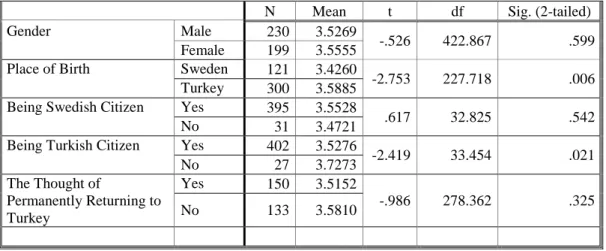
When corporate integration levels are investigated by demographic variables, the most important issue that stands out is there is a significant difference in the context of corporate integration between being born in Sweden and being born in Turkey [t(227,718)= -2,753 p<0,05]. What
is the interesting point here is that people born in Turkey have more corporate integration than those who are born in Sweden. This is remarkable in terms of showing the corporate integration success of the first and second-generation Turkish immigrants. When compared to other European countries, it is found that Sweden is more successful in terms of ensuring corporate integration. That there is a widespread governmental organization network in Sweden, the state encourages non-governmental organizations and supports them materially have been effective in obtaining this success. That immigrants established their own associations and federations especially in periods when the labour migration outside the country was intensive, and that these institutions act as a bridge between the state and the immigrants and carry out activities for the integration of the immigrants into the society they come to, are remarkable in this sense.13
There is a significant difference between those who are not Turkish citizens and those who are Turkish citizens in terms of the scoring made to the corporate integration scale in the sample group [t(33,454)= -2,419 p<0,05]. It is seen that those who are not Turkish citizens make a higher
scoring for corporate integration scale when compared to Turkish citizens, thus it is understood that being only Swedish citizen has a positive effect on corporate integration.
Table 7. Corporate Integration Scale by Demographic Variables
As for the gender, we see that gender does not affect integration in corporate terms. Similarly, being a Swedish citizen or not also does not affect corporate integration. Lastly, we see that the thought of returning to Turkey permanently or not does not lead to a significant difference in the scoring made for corporate integration scale.
13 For a study carried out in this subject regarding the Turkish Associations in Stockholm, see Lundberg&Svanberg (1991).
N Mean t df Sig. (2-tailed)
Gender Male 230 3.5269
-.526 422.867 .599
Female 199 3.5555
Place of Birth Sweden 121 3.4260
-2.753 227.718 .006
Turkey 300 3.5885
Being Swedish Citizen Yes 395 3.5528
.617 32.825 .542
No 31 3.4721
Being Turkish Citizen Yes 402 3.5276
-2.419 33.454 .021 No 27 3.7273 The Thought of Permanently Returning to Turkey Yes 150 3.5152 -.986 278.362 .325 No 133 3.5810
Single-Factor Variance Analyses of The Scales for Certain Variables
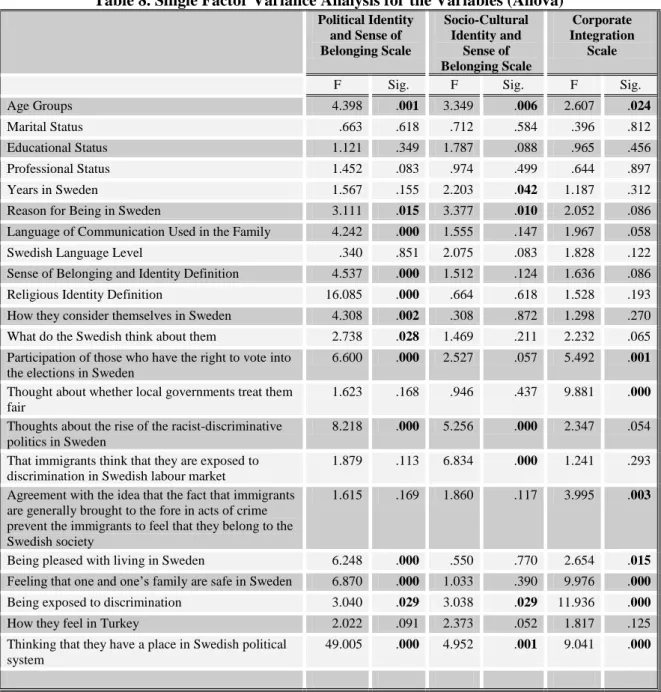
In the assessment of the scales, whether there is a significant difference between more than two groups in a variable is revealed by F test. Whether there is a significant difference between at least two of the variables that have more than one groups in “Political Identity and Sense of Belonging”, “Socio-Cultural Identity and Sense of Belonging” and “Corporate Integration” in the context of agreement was tested. First of all, the age group variables were examined. The age group variable was assessed in six groups in total being 18-25 Years, 26-35 Years, 36-45 Years, 46-55 Years, 56-65 Years, and 66 Years and above. In this sense, we observe that there is a significant difference between at least two of the groups of the variables for each scale when we conduct the F test. That the sample is within a particular age group affects the scoring made using scales. Thus, the age is important both in terms of the political identity, socio-cultural identity and corporate integration.
The variable marital status consists of four groups being married, single, divorced and co-habitation. In terms of the average score given by the groups for each group, it is observed that no significant difference occurs in view of the f value and P<0,05 significance level. All groups gave similar scores. Thus, the difference in marital status does not have a negative or positive effect on the integration.
The educational status of the interviewees is quite different from each other. The educational status variable is divided into eight groups from being illiterate to having master’s degree. There is no significant difference in terms of the scoring made to the scales between eight groups that make up the variable. As a result, we can say that the difference in the educational status does not have a negative or positive effect on the sense of belonging and integration to Sweden.
Professional status is the variable that contains the most groups. The participants specified approximately 24 professions. Among these are different professions ranging from doctors to hair-dressers. Although there are this many professions, there is no statistically significant difference between the professions in the context of the scoring made for the scales. Whether the profession is at a top or low level, it does not have a statistically positive or negative effect.
We gathered the participants in seven groups in terms of simplifying the assessment of the years that they live in Sweden. These groups were determined as 1-5 years, 6-10 years, 11-15 years, 16-20 years, 21-30 years, 31-40 years and 41 years and above. Among these groups that are determined, the only scale that there is a difference in terms on scoring made between at least two of them is the socio-cultural identity and sense of belonging scale. The difference of the duration of the years in Sweden affects socio-cultural identity and sense of belonging positively or negatively. On the other hand, the years spent in Sweden do not have a significant effect in the context of political identity and sense of belonging and corporate integration.
The variable of the reason for being in Sweden consists of work, family reunion, having one’s family in Sweden, Political asylum, being born in Sweden and the Education groups. There are significant differences in the scoring made by at least two of the groups making up the variable in the scoring they made for the political and socio-cultural identity and sense of belonging scales. Thus, we can say that the reason for being in Sweden does not affect the corporate integration level significantly but it affects the political and socio-cultural identity and sense of belonging.
The Swedish language level consists of five groups. These groups were defined as very good, good, medium, low and none at all. The distribution of the sample into groups concentrates on the levels of very good, good and intermediate. The percentage of those who have no knowledge in the sample is just 0,2%. In the F test carried out, it is observed that there is no significant difference