1
THE REPUBLIC OF TURKEY
BAHCESEHIR UNIVERSITY
THE ATTITUDES OF CONSUMERS’ TOWARD
COUNTERFEITS OF LUXURY GOODS
Master’s Thesis
ELİF BÖREKÇİ
3
THE REPUBLIC OF TURKEY
BAHCESEHIR UNIVERSITY
GRADUATE SCHOOL OF SOCIAL SCIENCES
MARKETING
THE ATTITUDES of CONSUMERS’ TOWARD
COUNTERFEITS of LUXURY GOODS
Master’s Thesis ELİF BÖREKÇİ
Supervisor:
PROF. DR. NIMET URAY /
Co-Supervisor:
YRD.DOÇ.DR. GÜLBERK GÜLTEKİN SALMAN
4
ACKNOWLEGDEMENTS
It is a great honour to present you my thesis. This thesis would not have been complete without a group of people whom I truly grateful for having in my life.
My first and deepest thank you goes to my supervisors Prof. Nimet Uray and Assoc. Prof. Gülberk Gültekin Salman for keeping their door always open and answering all my endless questions, their guidance, comments, feedbacks and their encouragements, without them it would be impossible to complete this thesis.
My very special thank you goes to my dearest friends İrem Güre , Duygu Akatay Ezgi Tekin and Deniz Özteoman for keeping me motivated, helping and supporting me in every way from the very beginning of this period.
I would like to thank to my family for their unconditional and valuable presence in my life, without them I could not have come to this stage.
There is also one special thanks left which should not be forgotten because without her I would not be studying marketing and I would not have chance to meet with my valuable supervisors. Thank you Prof. Selime Sezgin.
Last but not least I would like to thank all the respondents who took their time and fill out the questionnaire, without them this thesis would not be complete.
iv ÖZET
TÜKETİCİLERİN ORİJİNAL ÜRÜNLERİN SAHTELERİNI ALMA TUTUMLARI
Elif Börekçi Pazarlama
Tez Danışmanı: Prof. Dr. Nimet Uray, Yrd.Doç.Dr. Gülberk Gültekin Salman
Haziran, 2013, 112
Bu çalışmanın amacı Türkiyedeki tüketicilerin lüks marka ürünlerin çok benzer kopyalarını alma davranışlarında sosyal ve demografik özelliklerinin etkisini ve satın alma tutumunun satın alma eğilimi üzerindeki etkisini araştırmaktır. Tezde önerilen kavramsal model ve ilgili hipotezler De Matos et al. (2007) ve Phau and Teah (2009)’ın çalışmalarından yola çıkılarak oluşturulmuştur. Geliştirilen hipotezleri test etmek için internet ortamında bir anket hazırlanmış ve uygulanmıştır. Çalışmanın sonuçları, anketin yapıldığı grup üzerinde değer bilinci değişkenin pozitif bir etkisi olduğunu ortaya koymaktadır.. Aynı zamanda tutarlılık, tutarlı olma, dürüstlük gibi değerlerörneklemi oluşturan tüketiciler için önem taşımakta ve sahte ürün alma davranışını olumsuz etkilemektedir. Ancak bunun dışında seçilen diğer değişkenlerin tüketicilerin alım davranışı üzerinde bir etkisi bulunmadığı görülmüştür.
v ABSTRACT
ATTITUDES OF CONSUMERS TOWARDS COUNTERFEITS OF LUXURY PRODUCTS
Elif Börekçi
Marketing
Thesis Supervisor: Prof. Nimet Uray , Assoc. Prof Gülberk Gültekin Salman
June, 2013, 112 pages
The study aims to investigate which of the social and personality factors affects the attitude of the consumers towards counterfeit products in Turkey and the relationship of consumers’ attitude towards counterfeit product with purchase intentions.
A conceptual model is proposed by following the studies of De Matos et al. (2007) and Phau and Teah (2009). A survey of 180 respondents was conducted in online environment to test the hypotheses postulated. The results showed that from the selected variables, value consciousness has a positive impact on attitude whereas integrity has a negative effect on attitude. Other variables have no effect on attitude. Theoretical contribution of this study is an extension of knowledge of consumers’ attitude with regards to counterfeit products in Turkey.
vi CONTENTS TABLES ... ix FIGURES ... x ABBREVIATIONS ... xi 1.INTRODUCTION... 1 2. LITERATURE REVIEW ... 3
2.1 CONSUMER DECISION MAKING ... 3
2.2 COUNTERFEITING ... 5
2.2.1Defining Counterfeiting ... 5
2.2.2 Forms of Counterfeiting ... 6
2.2.3 Previous studies on Attitudes and Behaviours of Counterfeit Products ... 6
2.2.4 Factors affecting the attitude towards counterfeits of luxury brands ... 10
2.2.5 Attitudes towards counterfeiting ... 12
2.2.6 Purchase Intentions ... 13
2.3 LUXURY BRANDS ... 15
vii
2.4 SELF CONCEPT THEORY ... 17
3. STUDY ON CONSUMER ATTITUDES TOWARDS COUNTERFEITS ... 18
3.1.COUNTERFEITING IN TURKEY ... 18
3.2 RESERACH METDOLOGY: Research Design and Sampling ... 19
3.2.1 Sampling and Survey Design ... 19
3.2.2 Model and Theoretical Background... 20
3.2.3Normative Susceptibility ... 22 3.2.4 Informative Susceptibility ... 22 3.2.5 Value Consciousness ... 22 3.2.6 Personal Gratification ... 23 3.2.7 Status Consumption ... 24 3.2.8 Materialism ... 24 3.2.9 Integrity ... 25
3.2.10 Price Quality Inference... 26
3.2.11 Attitudes towards Counterfeits ... 28
3.2.12 Purchase Intentions ... 28
4. RESULTS and FINDINGS ... 28
4.1 SAMPLE CHARACTERISTICS ... 28
4.2 FINDINGS AND RESULTS ... 32
viii
6. CONCLUSION ... 47
LIMITATIONS OF THE STUDY ... 49
MANAGERIAL IMPLICATIONS ... 51
REFERENCES ... 53
APPENDICES ... 62
APPENDIX 1.: SURVEY SAMPLE ... 62
ix TABLES
Table 2. 1: Previous Studies about demand side of counterfeiting ... 74
Table 3.1: Measurement scale items and sources ... 19
Table 3.2 Normative Susceptibility Question ... 22
Table 3.3 Informational susceptibility questions ... 22
Table 3.4 Value Consciousness Questions ... 23
Table 3.5 personal gratification questions ... 24
Table 3.6 Status Consumption Questions ... 24
Table 3.7 Materialism Questions ... 25
Table 3.8 Integrity Questions ... 26
Table 3.9 Price Quality Inference Questions. ... 27
Table 3.9. Attitude Questions ... 28
Table 3.10 Purchase intention questions ... 29
Table 4.1 List of Eliminated Questions ... 33
Table 4.2. Factor Loadings ... 34
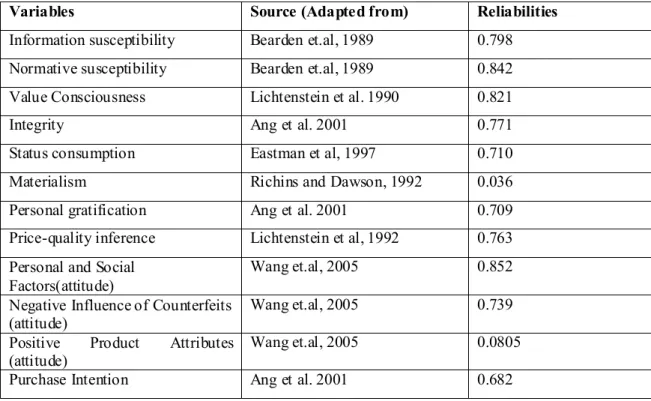
Table 4.3 Reliabilities of Factors ... 38
Table 4.4 Correlation Results ... 39
Table4.5 : Regression Analysis of positive product attribute based on independent variables ... 40
x
Table 4.6 Regression Analysis of negative impact of counterfeits based independent variables
... 41
Table 4.7: Regression Analysis between personal social factors and independent variables... 42
Table 4. 8 Regression Analysis between consumer attitudes and purchase intention ... 43
Table 4.9 : Original Product Buying Frequency ... 43.
Table 4.10 Counterfeit Product Buying Frequency ... 44
xi FIGURES
Figure 2.1: Consumer Decision Making Process...2
Figure 2.2: Theory of Reasoned Action model...14
Figure 3.1: Conceptual model...21
Figure 4.1 Gender Distribution of respondents……….29
Figure 4.2 age distribution of the respondents. ……….29
Figure 4.3 Education Level of the Respondents………30
Figure 4. 4 Monthly family income of the respondents……….31
Figure 4.5 Working Status of the respondents………..31
xii
ABBREVIATIONS ATO- Ankara Chamber of Commerce
IACC- International Anti-Counterfeiting Chamber IS-Information Susceptibility
MAT-Materialism
NIC- Negative Influence of Counterfeits on Industry NS- Normative Susceptibility
OECD- Organization for Economic Cooperation and Development PG-Personal Gratification
PI- Purchase Intention
PPA- Positive Product Attributes PSF- Personal and Social Factors PQI- Price Quality Inference SCT-Self Concept Theory SC Status Consumption
TRA- Theory of Reasoned Action VC- Value Consciousness
1 1. INTRODUCTION
The epidemic growth of counterfeiting can be attributed to the increase in world trade and emerging new markets, fast developments in technology, and also the increase in goods that are worth counterfeiting (Wee et al., 1995; Bloch et al., 1993).
Luxury brands are easily counterfeited as it is easy to sell and incur low manufacturing costs (Shultz and Soporito, 1996; Gentry et al., 2006). Past researches have revealed that about one-third of consumers would knowingly purchase counterfeit goods (Tom et al., 1998; Phau et al., 2001). Since demand is always the key driver of a market, a number of researchers have argued that consumer demand for counterfeits is one of the leading causes of the existence and rise in growth of the counterfeiting phenomenon (Gentry et al., 2001; Ang et al., 2001). As a result of these arguments, a good deal of research has focused on identifying important factors that influence consumers’ attitude towards counterfeit products.
The aim of this research is to understand the factors, namely as social and psychological factors that affect Turkish consumers’ attitudes towards counterfeits of luxury brand which is believed that it leads to purchase intention.
In the second chapter, literature review of the related topics is presented. The chapter begins with the decision making process and counterfeiting buying behavior, the motivations and antecedents of this behavior and the case of Turkey and continues with previous studies which are done in understanding the factors affecting purchasing counterfeits of luxury brands specifically focusing on the demand side of the issue and finally factors affecting the counterfeit buying behavior are mentioned.
Following to that, the Turkish case is explained briefly, then the research methodology is explained by mentioning about the questionnaire which has been designed and delivered to the respondents to get data for the analysis part.
2
Fourth chapter is about the analysis of the data collected. In detail, the analysis results such as factor analysis and regressions are explained. Besides brief information about the sample characteristics is given. In the last chapter, limitations about the study and future research recommendations for marketers and future researchers are given to conclude the research.
3
2. LITERATURE REVIEW
2.1 CONSUMER DECISION MAKING
Consumer behaviour studies deal with acquisitions, use and disposal of products, ideas and practices consumers go through in their daily lives and the social and psychological effects on behaviour. (Bagozzi et al, 2002) Besides, it analyzes what they buy, why they buy, when and where they buy, how often they buy and use it, how they evaluate it after purchase and finally what is the impact of the evaluations on future purchases. (Schiffman and Kanuk, 2010).
Consumers’ decision making process is one of the major areas of consumer behaviour that is researched in detail and theorized by marketing scholars. The consumer decision making model which is suggested by Engel et al. describes how consumers address consumption discrepancies that move them between actual and desired states. (Robinson and Doss, 2011). This model also provides a framework for the identification and interaction of factors that influence the consumer decision-making process (Robinson and Doss, 2011). According to this model, consumers typically go through five stages as problem recognition, information search, evaluation of alternatives, purchase and post purchase behaviour.(Kotler&Keller, 2012).
Figure 2.1 Consumer Decision Making Process
Source: Peter, J.P. and Olson, J.C., (2010) Consumer Behavior and Marketing Strategy 9th edition, McGraw Hill Education, Asia, p.163
Problem Recognition
Search for Alternative Solutions Evaluation of
Alternatives Purchase
Postpurchase Use and Reevaluation of Chosen Alternative
4
The buying process starts with problem recognition as it can be seen from the figure above. This is the first step in which consumer recognizes a problem or an unfulfilled need triggered by either internal or external stimuli such as hunger or thirst or buying a television or luxury fashion product which he/she sees on a friend and admired. According to Schiffman and Kanuk (2010, 485), there are two different problem recognition styles. First one is the actual state type in which consumers recognize that their products’ performance is low. On the other hand, in desired state type consumers are inclined to try a new product which will prompt the decision making process. Once the consumer recognized the need and decided that the need must be satisfied, the pre-purchase search begins. According to Schiffman and Kanuk (2010, 485) consumers may use their past experiences in making their current decision. But if they have no prior experience or inadequate information about a certain product or brand, then they start to search for more information from external sources. There are several sources that consumer can obtain information from such as friends or family members, advertisements, websites, mass media etc. (Kotler&Armstrong, 2012). As more information is obtained, consumer’s awareness and knowledge about the brand increase, they may learn about several availabilities, also may drop some of the options from considerations. The third step is evaluation of alternatives in which consumers arrive at brand choices, although the evaluation process is not simple and there may not be a single evaluation process. The evaluating of alternatives process depends on individual consumers and the buying environment. In some cases consumers make careful calculations, in some, they rely on intuition.
When the search for information is complete, consumers list their alternatives and begin to evaluate them. To evaluate the alternatives, consumers rely on two types of information. First one is the use of an evoked set that stands for a list of alternatives which will be the base for the selection and the second is the evaluation criteria that consumers consider (Schiffman& Kanuk, 2010, 488).
The last stages of decision making model are purchase and post-purchase activities which are related with the consumers’ satisfaction with the purchase. According to Schiffman and Kanuk (2010, 497), there are three types of purchases that the consumers make; trial purchase, repeat
5
purchase and long-term commitment purchase. If a consumer purchases a new product, this can be an example of trial purchase because consumers tend to buy less in quantity compared to familiar products. If they are satisfied with the trial purchase, they are most likely to repeat their purchases and even make long-term commitments to the product or the brand.
After the purchase stage is completed, consumers begin to use and assess the performance of it to see whether the product fulfil their expectations. The results can be neutral if there is a match between expectation and performance; satisfactory when the performance is better than the expectations, or the opposite if the expectations are not met. (Schiffman &Kanuk, 2010, 498). There are several ways of explaining consumer decision making in different situations or under different circumstances. One of the ways is the purchasing fashion products and their counterfeits which have been studied by several scholars throughout the time. (Tom et al, 1998, Cordell et al 1996, Penz and Stöttinger, 2005)
From the previous studies, it is possible to say that counterfeit purchasing behaviour takes place in the evaluation of alternatives step in which consumers compare the brands and narrow down their choices because of some reasons such as price, availability or personality traits (value consciousness, novelty seeking, status seeking, price consciousness, etc.) and if they think that counterfeit product will satisfy their needs, they purchase the product. But the process does not end with purchasing because some studies proved that, if consumers are satisfied with the counterfeit products and gratify themselves; sometimes they might consider buying the original one for next purchases or may consider buying the counterfeit products again. However, in some cases, consumers may fall into ethical dilemmas and might not consider buying again.
2.2 COUNTERFEITING 2.2.1 Defining Counterfeiting
Generally the brand of an enterprise is its most valuable asset. But the success of a brand may cause counterfeiting. (Maldonado and Hume,2005) Counterfeiting which is not a new practice is, has exploded in the recent years. Due to global economy and advancements in technology, today
6
it is possible to counterfeit almost everything, from pharmaceuticals and automobile parts to music CDs and books. Counterfeiting is a serious problem which is affecting not only the products whose brand name is synonymous with its quality but also products which require high level of research and development, and marketing. (Wee et al, 1995). According to International Anti Counterfeit Coalition, counterfeiting costs U.S. businesses $200 billion to $250 billion annually and causes for the loss of more than 750,000 American jobs.(http://www.iacc.org). From this, it can also be said that, counterfeiting does not only affect the brands, at the same time it directly affects the economies of the national countries.
In the literature several definitions of counterfeits or counterfeited products are also available. Kay (1990) defined counterfeit products as the reproduced goods that are identical to the legitimate articles in packaging, trademarks, and labelling. Similarly, Wilcox et al. (2009) defined counterfeits as ‘genuine fakes’ that are copies of original products which have high brand value in the market and are made to deceive consumers in the market. Wee et al, (1995) defined counterfeiting as the production of copies that are identically packaged, including trademarks and labelling, copied so as to seem to a consumer the genuine article. This means that the counterfeiters copied or imitated the products that have patents and trademarks without taking any permission from the manufacturers of the original products and selling them at lower prices than the original ones. Apart from the definitions, there are several terms used to represent product counterfeiting, such as piracy, imitation brand and a large “grey” area (Lai and Zaichkowksy, 1999) which has similar meanings, same essence with the term counterfeits and most of the times these words are used interchangeable. For example Lai and Zaichkowksy (1999) stated that counterfeiting and piracy are in the same essence since they both are reproduction of identical copies of authentic products but piracy is mainly related to software and fixed medium contents such as films and music recordings.(Cheung and Prendergast, 2006). According to Şahin and Atılgan’s study “Analyzing Factors that drive consumers to purchase counterfeits of luxury branded products” the main reason why a market for counterfeit brands is emerged is the desire of consumers to obtain luxury-branded products. So the reason why people purchase luxury branded products can be a significant indicator in understanding the reasons why they purchase counterfeit branded products. (Atılgan&Şahin, 2012).
7 2.2.2. Forms of Counterfeiting
The literature suggests that from the consumer point of view, there are two forms of counterfeiting; deceptive and non-deceptive counterfeiting. This classification can be done according to the level of awareness of the consumers because in deceptive counterfeiting, consumers are not aware of the fact that the products they are purchasing are counterfeits. It is possible to say that, they are victims in a way. On the other hand, in some other cases, consumers are fully aware that the product they are buying is counterfeit in which the situation can be defined as non-deceptive counterfeiting. (Grossman and Shapiro, 1988).
There are two sides of counterfeiting which are studied in the literature as supply and demand side of counterfeiting. The supply side of counterfeiting, although by being not much studied, (Staake et al., 2009), deals with understanding the way the illicit markets are operating, how companies in the emerging markets are using those copy products in their development processes and how the manufacturers of original, legal brands can fight with illegal producers. On the contrary the demand side of the counterfeiting has been studied more by scholars and researchers. Demand side of counterfeiting deals with the attitudes of consumers, the motivations and factors positively or negatively affecting their buying intentions.
2.2.3 Previous studies on Attitudes and Behaviours of Counterfeit Products
The past studies have proven that, from the demand side of counterfeit products, the most common reason to buy them is the low and affordable price (Eisend & Guler, 2006). However, the studies show that consumers with high incomes also buy counterfeit products (Eisend & Guler, 2006) which means that price is not the only reason in explaining counterfeit purchasing. Majority of the past studies analyzes the factors influencing the attitudes towards counterfeit products. For example, Wee, Tan and Cheok(1995) studied non-price determinants of intention to purchase counterfeit goods by doing surveys on 516 Southeast Asian college students and they found out that there is a highly significant relationship between the intent to purchase counterfeit purses/wallets and the function of personal appearance and snob appeal. Ang et al. (2001) studied the effects of social influences, demographic factors and personality characteristics on
8
counterfeiting buying behaviour and their results suggest that value consciousness has positive influence on attitude towards piracy, normative susceptibility, integrity and personal income has negative influence on attitude towards piracy and lastly, they found that males have more positive attitude towards piracy when it is compared to women. Moreover, Cordell et al (1996), analyzed attitude toward lawfulness, expected performance of the product, branding for low investment at-risk products, retailer prestige for high investment-at risk products, and price concession for low investment-at-risk products. The results of the study suggest that attitude towards lawfulness negatively related to willingness to purchase a known counterfeit only for knit shirts; expected performance positive related to willingness to purchase a known counterfeit for both products; branding and price concession positive related to willingness to purchase a known counterfeit for low investment-at-risk and finally retailer prestige positively related to willingness to purchase a known counterfeit for high investment-at-risk. Albers-Miller (1999) investigated the decision to purchase illicit goods by using four measures such as product type, buying situation, perceived criminal risk and price. The results of the study suggests that the interaction between risk and product type and also the interaction between price and product type were significant predictors of willingness of purchase(Albers-Miller, 1999). Besides, the results showed that peer pressure has a strong effect in illicit buying behaviour; the entire respondents who are questioned in the study mentioned that they most likely engage in illicit behaviour if there was peer pressure to do so. After 2000s, this issue became more popular and analyzed by researchers more. Among these studies, Gentry et al. (2001) analyzed the volitional choice for counterfeits and they found that counterfeits are purchased because of the brands and if the trial of the lower version is successful, people they interviewed mentioned that they would buy the authentic versions. According to their results, counterfeits are acceptable compromises and offer lesser value for lesser costs. The main reasons why counterfeits are purchased are because they represent a brand, provide novelty and symbolize person’s travel experiences. Penz and Stöttinger(2005) made a survey with 1040 Austrian consumers and they found that attitude towards counterfeiting and self identity have a positive effect on purchase intentions, particularly at low price levels; normative pressure and perceived behavioural control have a positive impact on purchase intentions at low and high levels of price, personality traits(readiness to take risk,
9
fashion involvement and ethical predisposition) influence attitude towards counterfeiting and subjective norm. In 2005, Wang et al made a survey on 314 Chinese students to analyze the effect of attitude towards piracy which is influenced by social influences, personality characteristics, and demographics on attitude towards piracy and purchase intentions. According to their findings, attitude towards piracy, value consciousness, and novelty seeking and value consciousness has positive influence on purchase intention and negative influence on normative susceptibility. There are studies which analyzed the effect of perceived risk, integrity and past buying behaviour of consumers on the attitudes of consumers and their buying intention. First of these studies is done de Matos et al. (2007). In order to analyze the main predictors of consumers’ attitude and behavioural intentions towards counterfeits the researchers made a survey and found out that perceived risk is the most important variable to predict consumer attitude toward counterfeits. According to their results, consumers who valued honesty and responsibility generally show negative attitudes toward counterfeits, on the other hand consumers who considered price as an indication of quality has more favourable attitude towards counterfeits. Yoo and Hee Lee (2009) proved that the past buying of the counterfeit products would have the positive influence towards the buying of the counterfeit products.
Kim and Karpova (2009) made a study to identify the motivations influencing attitudes towards buying fashion counterfeits by using Theory of Planned Behaviour. Their results indicate that product appearance, past purchase behaviour and value consciousness affect attitude toward purchasing fashion counterfeits positively, on the other hand, normative susceptibility has a negative effect on attitude. (Kim and Karpova, 2009). Phau and Teah (2009) analyzed the reasons behind the attitudes of consumers towards counterfeits of luxury brands and the outcomes of the attitudes in Chinese society by making surveys to 270 consumers. They analyzed the effect of normative and information susceptibility, collectivism, value consciousness, integrity and status consumption on the attitude and purchase intentions of consumers towards counterfeits of luxury brands and they proved that information and normative susceptibility have an effect on the attitude but their study showed that people who rely on expert opinion of others while purchasing products would be less tend to buy counterfeits of luxury brands. (Phau and Teah, 2009). Interestingly, collectivism does not have an effect on attitude
10
whereas value consciousness and status consumption influence purchase intention. Value conscious consumers would be more likely to buy counterfeits but on the other hand status consumption influences purchase intention negatively because according to their study the consequences of being caught while consuming counterfeits would be humiliation and embarrassment and these feelings would keep the Chinese consumers away from purchasing counterfeits of luxury brands.( Phau and Teah,2009).
In contrast to China and Brazil, Turkey is not of the countries in which counterfeiting and the attitude of consumers towards this issue is studied much. One of the studies dealing with this subject is Argın(2010)’s study which investigated the rapid increase in the sales of counterfeit brands in Turkey and attempted to identify the major factors motivating consumers’ purchase intentions of counterfeits of luxury brands. According to the results, an overwhelming majority of consumers purchase counterfeit brands regularly. Besides, there is a significant relationship between income level and counterfeit brand purchase, gender doesn’t influence counterfeit purchases and finally the study suggests that there is a significant relationship between age and counterfeit purchases.
As consumers’ demand to counterfeit brand increases, it becomes important to understand how consumers are motivated and have favourable attitudes toward the purchase of counterfeit brands and what is the reason behind this. The focus of this study is to investigate factors(social and personality) lying behind the purchase of counterfeit brands in the framework of Theory of Reasoned Action (TRA) and Self Concept Theory(SCT) and the bandwagon effect of consumer demand. .
The table in the appendix 2 present the studies which analyze the attitudes towards counterfeiting, the main motivations, reasons lying behind, and the relationship between attitudes and purchase intentions.
11
2.2.4 Factors affecting the attitude towards counterfeits of luxury brands
Attitude is a learned predisposition to behave in a consistently favourable or unfavourable way with respect to a given object(Schiffman&Kanuk, 2010, p.246). Since attitudes are learned, it is possible to say that, the attitude relevant to a purchase behaviour are forms of either direct experiences or mass media, Internet or other sources. (Schiffman&Kanuk, 2010). There are several factors affecting the attitude towards objects. In the view of Turkish consumers, the attitude towards counterfeits of luxury brands can be influenced by several factors which are listed in study as social factors and psychological factors.
• Social factors
Individual’s behaviours are affected by social influence and according to Bearden et al(1989) susceptibility to interpersonal influence is a general trait that differs from person to person. Ang et al. (2001) suggested that informational susceptibility and normative susceptibility influences attitudes towards counterfeit luxury brand purchasing.
Normative susceptibility: can be defined as the tendency to conform to the expectations of others. (Bearden et al., 1989). From this, it can be concluded that, if a person think that the fashion apparel he/she purchases may not like or may not impress others, or he/she might not get the approval from his/her social environment, he/she will likely develop negative attitudes towards counterfeits.(Kim and Karpova,2009).
Informational susceptibility refers to the tendency to learn about products or brands by seeking information from knowledgeable others, or making inferences based on observing people’s behaviours. (Bearden et al., 1989). For example, a consumer may observe other people and may think that people have luxury fashion items and they appear to be popular. By taking this thought, he/she might come to a conclusion of purchasing counterfeits as an alternative. According to Ang et al.(2001) study, there is a negative relationship between normative susceptibility and attitude towards counterfeits.
12 • Personality factors
Value consciousness: Luxury brands are purchased because of the image, the value and prestige benefits that the brand carries but if consumers are not willing to pay high prices for it, counterfeits are good alternatives that can be considered value for money. (Lichtenstein et al, 1990, Bloch et al, 1993). Value consciousness can be defined as a concern for paying low prices, subject to some quality restraint. Since counterfeits provide the same functional benefits as the original ones but at lesser price, consumers perceive counterfeits favourably. For consumers who are value conscious, attitudes towards counterfeit product would be positive.
Integrity: represents the level of consumers’ ethical standards and obedience to the law.(Wang et al.,2005). The level of integrity a consumer possesses defines the way he/she feels about counterfeiting. If integrity is important to a consumer, most probably he/she will develop a negative attitude towards counterfeit luxury brands. Kohlberg(1976) suggests that consumer’s behaviours are affected by their personal sense of justice and the influence of values like integrity will affect their behaviours to be involved in an unethical activity.(Phau &Teah, 2009). Personal gratification refers to the need for a sense of accomplishment, social recognition and the desire to enjoy the finer things in life.(Ang et al, 2001,Phau &Teah, 2009). If a consumer likes to enjoy finer things in life and puts a higher value on social recognition, he/she will most probably value the original brands and will not prefer counterfeits because of the inferior quality of the counterfeit brands.
Status consumption: According to Eastman (1997) status is a form of power that consists of respect, consideration and envy from others and represents the goals of the culture. According to Phau& Teah (2009), status consumption has long been defined as the purchase, use, display and consumption of goods and services as a means of gaining status (Eastman et al., 1997, Phau &Teah, 2009). Status consumption is for consumers who are seeking self satisfaction as well as to display their prestige and status to surrounding others usually through visible evidences (Phau &Teah, 2009). This means that, if a consumer wishes to show their prestige, and wishes to feel social respect, recognition from a group, most probably he/she will use original products because
13
original products will provide more accomplishment and respect to the consumer than counterfeits and most probably he/she will not have favourable attitudes towards counterfeit products.
Materialism: Materialism is the importance an individual attaches to worldly possessions (Belk, 1984). Richins and Dawson (1992) identified three materialistic traits: acquisition centrality, acquisition as the pursuit of happiness, and possession-defined success. Acquisition centrality means that materialists view possessions and acquisitions as the core value of their lives. Acquisition as the pursuit of happiness means that materialists consider possessions or acquisitions as requisite to satisfaction and happiness. Possession-defined success refers to the tendency to judge people’s achievements by their possessions. From these three traits, it can be said that counterfeits can be an alternative of satisfying the materialistic needs of consumers, if counterfeits can be perceived as way of satisfaction. (Albers-Miller, 1999; Bloch et al., 1993, Kim and Karpova, 2009).
Price- quality inference: In predicting consumer behaviour, the belief in price-quality inference, is very important. For some consumers price might be perceived as a cue in determining the quality of a product. (Schiffman and Kanuk, 2010). Lichtenstein, Ridgway, and Netemeyer (1993) define price-qualityschema as “the generalized belief across product categories that the level of price is related positively to the quality level of the product”. So, if the price of a product is higher, it would be more likely that consumers perceived that it is quality product
2.2.5. Consumer Attitude toward Counterfeits
Attitude is a learned predisposition to behave in a consistently favourable or unfavourable way with respect to a given object.(Schiffman and Kanuk,2010, 246). According to Bagozzi et al. (2002) attitude is psychological tendency that is expressed by evaluating a particular entity with some degree of favour or disfavour. The study which is done by de Celso Augusto de Matos et al (2007)., suggests that attitudes are highly correlated with one’s intentions, which in turn is a reasonable predictor of behaviour. So, if one has favourable attitude towards an object or a
14
product, it is highly acceptable that a person would likely to purchase the product. Therefore, in order to understand why consumers buy counterfeits of luxury brands, it is important to understand the relationship between consumers’ attitudes towards counterfeits and their intentions to purchase counterfeits of luxury brands.
There are several factors affecting consumers’ behaviours and ethical dilemmas they are faced with such as purchasing counterfeits products or not is one of the factors. In these kinds of situations, moral reasoning comes into play. (Phau et al., 2009). According to Kohlberg (1976), there are three stages that consumers encounter when they are faced with ethical dilemmas. At the pre-conventional level (Stages 1 and 2) an individual’s reasoning is based on expected personal consequences such as reward and punishment. Stages 3 and 4 focus on maintaining and adhering to the expectations of reference groups and societal values and at the post-conventional level (Stages 5 and 6),there is a clear effort to define moral principles and values, whilst still maintaining and adhering to the values of one’s reference group and society (Phau et al., 2009). From this theory which is called theory of moral competence, it can said that, consumers attitudes towards purchasing counterfeits of luxury brands are shaped after the third stage in which consumers started to try meeting with his/her social group’s expectations because it is possible to say that, consumers purchase counterfeit brands to be able to gain respect and acceptance from their social group without paying big amounts of money. Also the theory suggests that consumers’ personal behaviours are predicted by a subjective sense of justice and purchasing counterfeit products can be explained by the attitudes. (Phau et al., 2009).
2.2.6 Purchase Intention
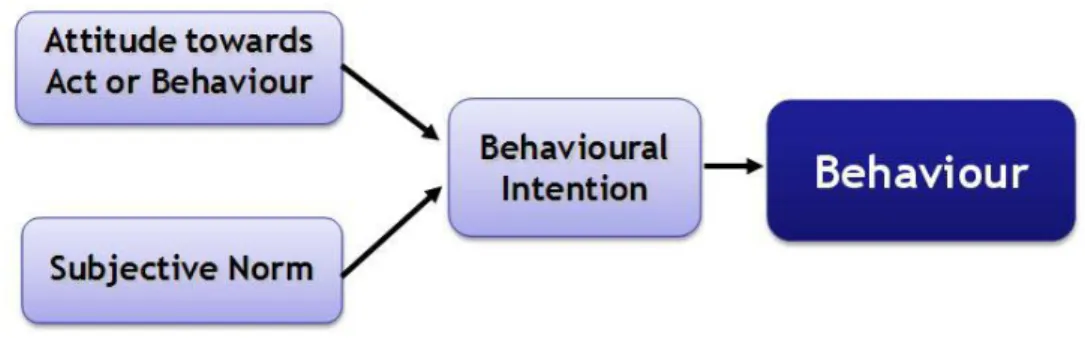
The past literature indicates that individuals’ attitudes toward counterfeit brands influence their intentions to purchase these brands (Kim & Karpova, 2009)Intentions are a psychological construct distinct from attitude which represents the person’s motivation in the sense of his or her conscious plan to exert effort to carry out behaviour. (Fitzmaurice, 2005). According to Fishbein and Ajzen theory of reasoned action(1975), behaviour is determined directly by one’s intention to perform the behaviour; intention in turn, is influenced by the behaviour. (Bagozzi et al., 1992). According to the model which is presented below as Figure 2, one’s intention to act is
15
a function of; attitude towards the behaviour and subjective norm.(Bagozzi et al., 1992). The model suggests that, attitude is a function of beliefs that performing the behaviour will lead to specific outcomes combine with evaluations of the outcomes. The other element in the function; subjective norm is defined as the beliefs that specific individuals expect one to perform or not to perform the behaviour combine with one’s motivation to comply with these specific individuals. (Bagozzi et al., 1992).
Figure 2.2: Theory of Reasoned Action model
Source: Ajzen and Fishbein, 1975, (retrieved from http://www.fidis.net)
From the socio-psychological perspective, TRA is based on the assumption that “human beings are usually quite rational and make systematic use of the information available to them and that they consider the implications of their actions before they decide to engage or not engage in a given behaviour” (Ajzen & Fishbein, 1980) So, it can be concluded that TRA posits that an individual’s behavioural attitude influences intention.
The theory assumes that consumers behave in a way that their behaviours are total under their own volitional control, people believe they can and will do, whatever they intend or try to do so. (Bagozzi et al., 1992). Taking what the theory assumes into account, it can be said that, consumers’ intention to purchase counterfeits of luxury goods is totally under their own control and they do it because they believe they can do it, without paying attention to other preventive factors.
16 2.3 LUXURY BRANDS
Luxury brands can be defined as goods for which the simple use or display of a particular branded product brings esteem for the owner; luxury goods enable consumers to satisfy psychological and functional needs. Above all these psychological benefits can be regarded as the main factor distinguishing luxury from non-luxury products or counterfeits. (Wiedmann et al., 2007). Phau et al.(2009) stated that consumers develop luxury meanings for brands based upon social interactions, object properties and hedonic values such as sensory beauty. Luxury goods can be defined as goods which are particularly used for display of certain brands which reflects prestige of the owner or the social status of the owner apart from its functional utility. (Phau et al., 2009). From this definition, it can be said that, luxury goods have a degree of exclusivity because of their name and higher price.
The other way to define luxury brands is that luxury brands are those whose price and quality ratios are the highest of the market and even though the ratio of the functionality to price might be low with regard to certain luxury goods, the ratio of intangible and situational utility to price is comparatively high.(Wiedmann et al., 2007). From all these definitions, it is possible to conclude that, luxury brands are brands with high prices in the market and they provide big esteem, self satisfaction, self-gratification to the owner. Functionality of the brands may not be really important but satisfying psychological needs of the owner is more important. According to Wiedmann et al.(2007), the term luxury and the consumption of luxury goods involves purchasing a product that represents value to both, to the individual and their reference group. From this quotation, it can be said that, consuming luxury goods serves a very basic human desire; impressing others, as well as satisfying their own needs because of the fact that, these products are consumed publicly and used for signaling status and wealth. According to Bearden and Etzel (1982), publicly consumed products were more likely to be conspicuous products than privately consumed luxury products. So, it can be said that, luxury brands are generally used for displaying wealth and power and visible luxury brands dominates this conspicuous segment. (Phau et al., 2009). This conspicuous segments issue is brought by Veblen who suggests that consumers use conspicuous consumption to signal wealth and to reach power and status.
17
According to Veblen, conspicuous exhibition of material goods and wealth is essential in the quest for prestige and elevates personal status. (Jugessur and Cohen, 2009).
2.3.1 Conspicuous Consumption
Veblen’s theory of conspicuous consumption is based on the premise that those who put wealth “in evidence” are rewarded with preferential treatment by social contacts. (Bagwell and Bernheim, 1996). From this definition, it can be concluded that, wealth is essential element in searching for prestige, it elevates personal status and whoever makes his/her wealth visible by others, this person gets reward by getting the expected treatment from his/her social environment. Since, buying and consuming in a public context is an important issue in conspicuous consumption and has an impact on shaping consumer behavior and consumers’ brand preferences (Bagwell and Bernheim, 1996) , there should be another issue which should be mentioned; the bandwagon effect which is identified by Leibenstein (1950). Bandwagon effect is one of the symbolic aspects of fashion taxonomy which is identified by Leibenstein. According to Leibenstein, there are three kinds of symbolic aspects; bandwagon effect, snob effect and Veblen effect. Snob effect refers to the fact that the demand for a commodity decreases because everybody else also wishes to consume the same commodity. Consumers falling under this category wishes exclusivity, they want to be differentiated from the crowd. (Leibenstein, 1950). These people are like trendsetters, opinion leaders. Second effect is the Veblen effect which refers to the phenomenon of conspicuous consumption, the fact that the demand for a consumers’ good is increased because of its higher price. (Leibenstein, 1950). For these consumers, price of a product is important because as it is mentioned above, consumers falling under this category put much emphasis on wealth, for these consumers, wealth is an important tool for signaling status. The final aspect is bandwagon effect which will be used for this paper. According to Leibenstein bandwagon effect refers to the extent to which the demand for a commodity is increased due to the fact that others also consuming the same commodity. (Leibenstein, 1950). It represents the desire of people to purchase a commodity in order to conform to the people they wish to be associated with; to be fashionable or stylish; or in order to appear to be “one of the boys”. (Leibenstein, 1950) This effect can be applied to counterfeits of luxury brands as well
18
because, bandwagon effect suggest that, consumers of bandwagon effect are like followers, they try to fit in with the desired social environment, they usually tend to follow the opinion leaders, trendsetters. (Jugessur and Cohen, 2009) and similar to consumers of high fashion brands, it can be assumed that consumers may use counterfeits of high fashion brands to be able to keep up with the trendsetters, to be a part of the environment they wish to be in, to gain social acceptance from their groups.
2.4 SELF CONCEPT THEORY
Luxury brands are used for public display and as a form of expression and they are the integral parts of the social fabric life. (Hoe et al., 2003) and they are important in understanding the self concept. The self is what one is aware of, one’s attitudes, feelings, perceptions and evaluations of oneself as an object.(Grubb and Gruthwohl, 1967) Self concept theory refers to totality of the individual’s thoughts and feelings having reference to himself as an object. (Sirgy, 1982). The theory has 4 components as actual self image, ideal self image, social self image and ideal social self image. Actual self and ideal self images are images of oneself as one would like to be. (Sirgy, 1982) Social self concept can be defined as the image that one believes others hold and ideal self concept refers to the image than one would like others to hold. From these concepts, social self concept which is also known as public-self; (Bushmann, 1993) will be mentioned in this study because according to the article Do counterfeits devalue the ownership of luxury brands presented by Nia and Zaichkowksy (2000), luxury products are commonly purchased by
consumers who are especially concerned with their impression on others, who put more emphasis on their physical appearance and care about gaining social approval from others. Consumers are motivated by a desire to impress others with their ability to pay particularly high prices (Phau et al., 2009); but when consumers have the desire to impress others but cannot afford paying such high prices, they tend to purchase counterfeits because according to Gino et al.(2010) counterfeits provides them this opportunity by signaling an aspiration to be something one is not; for example wearing counterfeits of luxury clothes or having counterfeit purses makes the wearer feel like he/she is one of the group that he/she desired to be.
19
3. FIELD STUDY ON CONSUMER ATTITUDES TOWARDS COUNTERFEITS OF LUXURY PRODUCTS: TURKISH CASE
3.1 COUNTERFEITING IN TURKEY
The International Anti-Counterfeiting Coalition (IACC) has estimated that counterfeiting causes for at least 200 billion dollars of job losses in a year. (Phau et al.,2009) According
to Turkey’s Registered Brands Associations’ findings, Turkey is the second largest country in counterfeiting after China (http://tescillimarkalar.org.tr). Similarly, Counterfeit Economy Report of the Ankara Chamber of Commerce (ATO) suggests that Turkey is the second-largest counterfeit product market in the world, with $3 billion of turnover after China.(Ozdogan&Baklaci, 2010)
The report shows that the counterfeit product market has become a new and powerful sector that threatens the economy. One of the reasons of why counterfeiting becomes so powerful is because there is a wide availability of counterfeit brands in the country, as the report suggested Turkey is the second country after China in terms production and sales of counterfeits.(Argın,2010). It is possible to find counterfeits of luxury brands even in street vendors. (.(Ozdogan&Baklaci, 2010).Besides, the new advancements in technology created opportunities for manufacturers of counterfeits to make products almost the same with the original ones and because counterfeits are sold in almost one third of price of originals(Ozdogan&Baklaci, 2010), although in Turkey, there are penal sanctions are applied to companies producing and distributing counterfeit branded products within the scope of Law on Protection of Brands.(Şahin&Atılgan, 2011).
3.2 FIELD STUDY ON CONSUMER ATTITUDES TOWARDS COUNTERFEITS 3.2.1 Research Methodology: Research Design and Sampling
Several attempts have been made to define counterfeiting and understand the factors affecting buying counterfeits of luxury brands. Particularly, the study tries to examine the social and personality factors such as value consciousness, price-quality inference and consumer
20
susceptibility in Turkey. The affect of selected demographics was also analyzed. Thus this study is based on descriptive research design through internet survey.
The original questionnaire was developed in English and translated into Turkish by the researcher and checked by the thesis advisor. The scale measures were taken from previous studies which are shown on the table 3.1 below. The questionnaire designed in an electronic environment with the help of an established survey site (qualtrics.com). The answers of respondents were saved in the database immediately when they fill out the questionnaire. The method of distribution for the questionnaire was through online social networks and mail groups. Table 3.1: Measurement scale items and sources
Variables Scale/Measurement Source (Adapted from)
Information susceptibility 5 point Likert Scale Bearden et.al, 1989 Normative susceptibility 5 point Likert Scale Bearden et.al, 1989 Value Consciousness 5point Likert Scale Lichtenstein et al. 1990
Integrity 5 point Likert Scale Ang et al. 2001
Status consumption 5point Likert Scale Eastman et al, 1997
Materialism 5 point Likert Scale Richins and Dawson, 1992
personal gratification 5 point Likert scale Ang et al. 2001
Price-quality inference 5 point Likert scale Lichtenstein et al, 1992 Attitudes towards counterfeiting luxury
brands
5 point Likert Scale Wang et.al, 2005 Purchase Intention 5 point Likert Scale Ang et al. 2001 In this study, a convenience sampling method was used.
3.2.2 Conceptual Model and Theoretical Background
The hypotheses constructed for this study are shown below. The original hypotheses and conceptual model are adopted from the study of Phau and Teah (2009) and the construct “materialism” is added. In addition to the study of Phau and Teah(2009), the effect of selected demographic variables are also analyzed as a mediating variable.
21
H1: Normative and information susceptibility have a negative influence on consumer attitudes towards counterfeits of luxury brands.
H2: information susceptibility have a positive influence on consumer attitudes towards counterfeits of luxury brands.
H3 : Value consciousness has a positive influence on consumer attitudes towards counterfeits of luxury brands.
H4.Integrity has a negative influence on consumer attitudes towards counterfeits of luxury brands.
H5. Personal gratification has a negative influence on consumer attitudes towards counterfeits of luxury brands.
H6. Status consumption has a negative influence on consumer attitudes towards counterfeits of luxury brands.
H7: Materialism has a positive influence on consumer attitudes towards counterfeits of luxury brands.
H8: Price-quality inference has a negative influence on consumer attitudes towards counterfeits of luxury brands.
H9: There is a significant relationship between attitude and purchase intention towards counterfeits of luxury brands.
22
Figure 3.1: Conceptual model
Source: Phau and Teah, 2009
3.2.3 Normative susceptibility
As previously mentioned, individual’s behaviours are affected by social influence and according to Bearden et al(1989) susceptibility to interpersonal influence is a general trait that differs from person to person. Ang et al. (2001) suggested that informational susceptibility and normative susceptibility influences attitudes towards counterfeit luxury brand purchasing. Normative susceptibility is the tendency to conform to the expectations of others. (Bearden et al., 1989). If consumers think that the fashion apparel which is purchased may not like or may not impress others, or the consumer not get the approval from his/her social environment, he/she will likely develop negative attitudes towards counterfeits.(Kim and Karpova,2009). In the second part of the survey the respondents were asked to choose the best answer from four statements which are listed below.
H1. Normative susceptibility has a negative influence on consumer attitudes towards counterfeits of luxury brands.
23 Table 3.2 Normative Susceptibility Questions
It is important that others like the products and brands I buy.
If other people can see me using a product, I often purchase the brand they expect me to buy.
I like to know what brands and products make good impression on others. If I want to be like someone, I often try to buy the same brands that they buy. .
3.2.4 Informational susceptibility
As it is previously mentioned, informational susceptibility refers to the tendency to learn about products or brands by seeking information from knowledgeable others, or making inferences based on observing people’s behaviours. (Bearden et al., 1989). For example, a consumer may observe other people and may think that people have luxury fashion items and they appear to be popular. By taking this thought, he/she might come to a conclusion of purchasing counterfeits as an alternative. So it is possible to conclude that study, there is a positive relationship between
informational susceptibility and attitude towards counterfeits.( Ang et al., 2001)
H2.Informational susceptibility has positive influence on consumer attitudes towards counterfeits of luxury brands
Table 3.3 Informational susceptibility questions
If I have a little experience with a product, I often ask my friends about the product
I often consult other people to help choose the best alternative available from a product class. I frequently gather information from friends or family about a product before I buy.
24 3.2.5 Value consciousness
As it is stated before, value consciousness is the concern for paying lower prices, subject to some quality constraints. Since, counterfeits provide similar functions to original ones, it possible to conclude that, consumers would have chose counterfeits as an option.
H3 : Value consciousness has a positive influence on consumer attitudes towards counterfeits of luxury brands.
The questions asked in the survey are listed below and measured with 5 point Likert Scale. Table 3.4 Value Consciousness Questions
I am concerned about the price and quality of the product. I compare prices for the best value of money.
I like to be sure that I get my money worth. I try to maximize the quality for the money spend
.
3.2.6 Personal Gratification
As it is previously mentioned, personal gratification is the need of sense of accomplishment, social recognition and to enjoy the finer things in life.(Ang et al., 2001). Consumers who purchase counterfeit products are willing to sacrifice the quality and functionality that original products provide to consumers. On the other hand consumers who purchase original products value those properties and they value social recognition and catching by others while using counterfeits would probably damages their social recognition , therefore it can be said that those consumers will have not a favorable attitude towards counterfeits of luxury products.
H5. Personal gratification has a negative influence on consumer attitudes towards counterfeits of luxury brands.
The questions that are asked in the questionnaire are measured by 5 point Likert Scale and are listed in Table 3.5
25 Table 3.5 personal gratification questions
A sense of accomplishment is important to me. I value pleasure.
I value social recognition.
3.2.7 Status Consumption
As it is mentioned before, status consumption can be defined as the purchase use, display and consumption of goods and services as a means of gaining status. (Phau et al., 2009). Besides, it involves social ranking and recognition from a group in which a person wishes to be part of as an award. (Phau et al., 2009).
H6. Status consumption has a negative influence on consumer attitudes towards counterfeits of luxury brands.
The questions asked in the survey were listed below. Table 3.6 Status Consumption Questions
I am interested in new products with status
While buying a product, I don’t put emphasis on the status that product represents. I would pay more for a product if it had status
The status of a product is irrelevant to me.
3.2.8 Materialism
As it is mentioned before, materialism is the importance an individual attaches to worldly possessions (Belk, 1984). There are three materialistic traits as acquisition centrality, acquisition as the pursuit of happiness, and possession-defined success. Based on these three it can be said that counterfeits can be an alternative of satisfying the materialistic needs of consumers, if
26
counterfeits can be perceived as way of satisfaction.(Kim and Karpova, 2009). Therefore, it is possible to say that, people with higher materialistic values will have favourable attitude towards counterfeits of luxury brands.
H7: Materialism has a positive influence on consumer attitudes towards counterfeits of luxury brands.
The questions that are asked in the questionnaire are measured by 5 point Likert Scale and are listed in Table 3.7
Table 3.7 Materialism Questions
It sometimes bothers me that I can’t afford to buy all the things I would like to buy.
Some of the most important achievements in life including acquiring material possessions.
I don’t place much emphasis on the amount of material objects people own as a sign of success.
I usually buy only the things I need. Buying things gives me a lot of pleasure
I put less emphasis on material things than people I know.
3.2.9 Integrity
Integrity represents the level of consumers’ ethical standards and obedience to the law.(Wang et al.,2005). The level of integrity a consumer possesses defines the way he/she feels about counterfeiting. Researches show that consumers who are more lawful-minded are less willing to buy counterfeits (Ang et al, 2001). Therefore it can possibly be observed that consumers who give value to integrity will have negative attitude towards counterfeit luxury brands.
27
H4.Integrity has a negative influence on consumer attitudes towards counterfeits of luxury brands.
The questions that are asked in the questionnaire are measured by 5 point Likert Scale and are listed in Table 3.8
Table 3.8 Integrity Questions
I value honesty.
I value responsible people.
I value people who have self control.
3.2.10 Price Quality Inference
As it is mentioned above, price can be used as a predictor of the quality of the product. Lichtenstein, Ridgway, and Netemeyer (1993) define price-qualityschema as “the generalized belief across product categories that the level of price is related positively to the quality level of the product”. So, if the price of a product is higher, it would be more likely that consumers perceived that it is quality product therefore, for consumers who believe in price quality inference, counterfeits may be perceived as inferior quality and they will have unfavorable attitude towards counterfeit products. The table 3.9 below presents the questions which are asked in the survey.
Table 3.9 Price Quality Inference Questions
I believe that the higher the price of a product, the higher the quality. I think that the price of a product is a good indicator of its quality I think if you want the best, you want to pay a little more.
28
3.2.11 Consumer Attitudes towards Counterfeit Luxury Goods
As it is mentioned before, attitude is psychological tendency that is expressed by evaluating a particular entity with some degree of favour or disfavour (Bagozzi et al. 2002). From this definition, it can be concluded that, if one has favourable attitude towards an object or a product, it is highly acceptable that a person would likely to purchase the product. In the first part, respondents are asked to choose original and counterfeit products that are purchased from a matrix table. There are ten choices and respondents are allowed to choose more than one answer to this part. In the second part, they asked to choose the best answer from 8 statements. Attitudes of respondents towards counterfeits are measured on a five-point Likert scale and the questions that are asked in the questionnaire are listed in Table 3.9
Table 3.10 Attitude Questions
Counterfeit production damages the rights and interests of the original manufacturers. Counterfeit production damages the luxury goods industry.
Counterfeits are as reliable as the original versions.
Counterfeits provide similar functions to the original versions. Counterfeits have the similar quality as the original versions.
There is a little chance of being caught while purchasing counterfeit luxury goods. I buy counterfeit products because everybody else does so.
I never even think of buying counterfeit products.
3.2.12 Purchase Intentions
Fishbein and Ajzen’s (1975) Theory of Reasoned Action suggests that, behaviors are caused by attitudes of consumers and some psychological processes. Moreover, an individual’s intention is related with their behaviors but this theory mainly focuses on the volitional behaviors which are done consciously. Since, most of the cases, counterfeit purchasing are done under full control of
29
the consumers, it is possible to say that, intentions lead to behaviors and there is strong relationship.
H9: There is a strong relationship between attitude and purchase intention towards counterfeits of luxury brands
In the same part, respondents are asked about considering themselves in the future and to choose the best answer from 4 statements accordingly. The questions about purchasing intentions are measured by 5 point Likert scale and listed in the table 3.9 below.
Table 3.10 Purchase intention questions
I would consider buying counterfeits as an option.
I would buy very identical sisters of luxury brands from peddlers.
30 4. FINDINGS AND RESULTS
4.1 SAMPLE CHARACTERISTICS
The graphs below contain information about the characteristics of the sample of 180 respondents. The numbers of female and male respondents are 129 and 51 respectively. The figure 4.1 below indicates the distribution of gender among respondents and the blue part of the chart represents male respondents distribution, green part represents female respondents’ distribution.
Figure 4.1 Gender Distribution of respondents
There are respondents from almost every age group from 20- 60 and the majority of respondents are 20-25 years old, specifically most of the respondents belonged to that group were 23 years old. Interestingly, it is followed by the age group 59-62. Figure 4.2 below shows the age distribution of the respondents.
71.7%
31
Figure 4.2 age distribution of the respondents.
Approximately 49,4 percent of the respondents are university graduates and 38, 3 percent of respondents have masters degree or higher. So it can be said that the education levels of the respondents is high. The table below presents the education levels of the respondents.
32
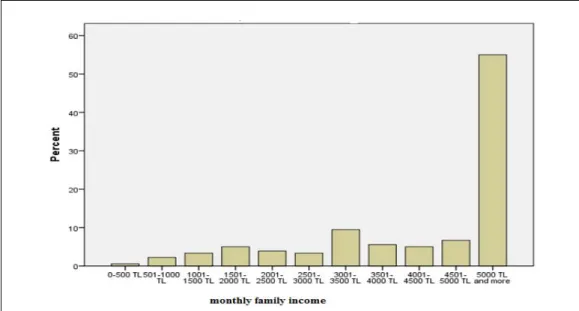
Majority of the respondents are working and their monthly family income is 5000TL and above. The tables below show monthly family incomes of the respondents and show whether the respondents are working or not. The results showed that almost all of the consumers have monthly family income levels are 5000TL and above. Besides almost all of the respondents are working and they stated their profession as other.
Figure 4. 4 Monthly family incomes of the respondents.
33
The table above shows the working status of the respondents. Majority of the respondents are working respondents and they selected the answer other.
4.2 FINDINGS AND RESULTS
There were 348 respondents who filled out the survey distributed online. At the beginning of the analysis, missing value analysis has been made to the questions. There were fifty one questions in total; three to test Purchase Intentions, four to test Status Consumption, four to test Value Consciousness, three to test Information Susceptibility, five to test Normative Susceptibility, three to test Price-Quality Inference, three for Personal Gratification, three for test Integrity, six questions for Materialism and finally eight questions to test Attitudes. The survey tool which is used enabled the researcher to make answering all the questions compulsory, therefore there were not any missing data. However there were 168 surveys which were incomplete, so these were excluded from the analysis.
To test scale dimensionality and validation of the eight constructs both exploratory and confirmatory factor analysis were performed. Kaiser-Meyer-Olkin Measure of Sampling Adequacy of the factor test was 0,776 and the Bartlett's Test of Sphericity significance was 0,000. These results proved that sample size is satisfactory to perform factor analysis. The communalities of almost all items are higher than 0, 50 and the ones that were less than 0.50 were excluded and factor analysis was performed again. After these tests, Rotated Component Matrix has been performed. According to the results, several items are eliminated at the data reduction process; the items can be seen at Table 4.2. The reason behind the eliminations is that they were not matching with any or the factors.
34
Table 4.1 List of Eliminated Questions
Value Consciousness
I am concerned about the quality of the product.
Price-Quality Inference
I think if you want the best, you want to pay a little more.
Personal Gratification
A sense of accomplishment is important to me.
Materialism
I don’t place much emphasis on the amount of material objects people own as a sign of success.
Some of the most important achievements in life include acquiring material possessions. I put less emphasis on material things than people I know.
Information Susceptibility
I often consult other people to help choose the best alternative available from a product class.
After the elimination of these ten items, factor analysis has been performed again. The factors emerged from the analysis slightly differed from the proposed thesis model. The Attitude factor has been divided into three groups namely as Positive Product Attributes (functionality, quality and reliability), negative influence of counterfeits on industry and manufacturers(damaging the industry and damaging the rights of manufacturers) and personal and social factors (I do it because everybody else do, and never thought of buying counterfeits). There were not any constructs has been excluded but with the elimination of the items some scales are changed accordingly.
35
Table 4.2 Factor Loadings
Purchase Intentions
I would think of buying counterfeits as an option.
I would buy counterfeits of original luxury brands from peddlers .
If my friend wishes I would think of purchasing counterfeits of luxury brands original brands for him/her
Product Attributes
Counterfeits of luxury brands have the similar quality of as the original Counterfeits of luxury brands provide the similar functions to the original Counterfeits of luxury brands are as reliable as the original versions.
Personal Ethics
I buy counterfeit products because everybody else does so. I never even think of buying counterfeit products.
Industrial
Counterfeit production damages the rights and interests of the original manufacturers. Counterfeit production damages the luxury brands industry
Status Consumption
I am interested in new products with status I would buy a product just because it has status. The status of a product is irrelevant to me
I would not pay attention to status of a product when buying.
Value Consciousness
I compare prices for the best value of money I like to be sure that I get my money worth. I try to maximize the quality for the money spends.
Price-Quality Inference
I believe that the higher the price of a product, the higher the quality I think that the price of a product is a good indicator of its quality
Personal Gratification I value pleasure Factor Loading 0,853 0,718 0,804 0,838 0,788 0,814 0,606 0,856 0,844 0,885 0.773 0,762 0,796 0.834 0,829 0.905 0.835 0,878 0,881 0,740