PROJECT
■ТИЕ PEO-GISS- .OP T Ü R K I ¥ ii ζΤ ·4·*ііим , й и а і Ц і Г Г Щ : Г О Τ Η κ г ’£ ? А й Т і й £ ? | Т ч О ! = ; і № Щ A N D THE IK S TS TU Tí ОЕ= B U S lîit S S A 0 .Ví:?í :S 7 ¿ -.? !0 M ‘ ■ ■ ’ '■ . · ' : . ■ · ■ ■ , ■ ' r e * ' ûft·'· г ^ ■ J« ·?·■ Ä*i*.iW. ІПИЧИ' ' '5і-'-;й P£ · Γ ί U Τ’ ·'*:,- ■, ,Ца»И*;‘**ц ; ?’· "Ш · У "».· ··'* · л _ t , .: й Й1, .i ■· »«iTafc »«b *»2f*·* Л í ■ ψ»·έ: .* :іі:'..шт d:'s·: ¡L ..Íí t Í * ' · ' ; / ·' '»У“ ' !*ΐΞ*·'0 -íS#» ' ‘· T-*u.; ^ -.. ГЗ«*^ Ц“ § йѴ И*і2сі.?Ы 2· I Ж V' ' *1^·^ ïH^.î-is . ч1.· .Лч-д» ,—-?η·.'ί .с ; ii. ir,,-yr . Ş:;-^-;2w : -:y*·· « * Η·~ Ä :*:;.«.■/Jr*:^··*>· •': ·· ^ i i ЛІ I» ïî^ k lS Λ* I U - >«. ЧУц v \ ’ Uh* ·5 'U -it .>...' w .i* · '. »· л; » ‘лл* . í Λ» І a l '-ч ц -iU .t»*a. -·4 . '·ν ,Μ *. . ^·„ ,-ρ ■Μ. -Uti«?*:..'.,ί. J ;WÍ-J;·.·ί?|·;·Ϊ4. if*:·;*«. ·ί- α'ν^ . Іій·! íil“Síí?l ·
^•ö
• > У 2 . < Гy s s /
“ ■.♦ ·Φ -ηίι^'*■.·,.,*-W.’ii! ■.>·AN OVERVIEW OF THE PROJECT EVALUATION CONCEPT: THE PROCESS OF THE DEVELOPMENT BANK OF TURKEY
A THESIS
SUBMITTED TO THE DEPARTMENT OF MANAGEMENT AND THE INSTITUTE OF BUSINESS ADMINISTRATION
OF BILKENT UNIVERSITY
IN PARTIAL FULFILLMENT OF THE REQUIREMENTS FOR THE DEGREE OF
¡MASTER OF BUSINESS ADMINISTRATION
^ X £ ^ ¿ L ·..ÍA J U
-BY TANER SAN FEBRmRY, 19S1
н ъ Ц Я . ц
I certify that I have read this thesis and in my opinion it is fully adequate, in scope and quality, as a thesis for the degree of Master of Business Administrât ion.
Vj
-Assoc. Prof. Kursat Aydogan
I certify that I have read this thesis and in my opinion it is fully adequate, in scope and quality, as a thesis for the degree of Master of Business Administrât ion.
Assoc. Prof. Gökhan Capoglu
I certify that I have read this thesis and in my opinion it is fully adequate, in scope and quality, as a thesis for the degree of Master of Business Administration.
Assoc. Prof. Limit Erol
Approved for the Graduate School of Business Admini^rat ion.
lA L '
I would like to thank Associate Professor Kursad Aydogan ■for his valuable guidance and patience, without which this study could not be accomplished. I like to thank Associate Professors Limit Erol and Gökhan Capoglu for
their valuable time. I also would like to thank
Professor Erdal Turktan, Hacettepe University, for his sincere suggestions. Senior Experts Attilia Catak and Erdal Ekincioglu at the Development Bank of Turkey deserve special thanks for their support and helpful cooperation throughout my thesis. Simru Sonar and Evren Ors have given me valuable help to write this study.
lACKNOWLEDGEMENTS
The purpose o i this thesis study is to analyze project evaluation concept in detail and to give an exairiple of a project appraisal process from Turkey. The process adopted by the Development Bank of Turkey, which is one of the few project formulators and
evaluators in Turkey, is selected to analyze and to crtisize for this study. A financial evaluation of Refined Cotton Oil
Plant Project within the South Anatolia Project is also
demostrated according to principals of project appraisal report format of the b an k.
ABSTRACT
ÖZET
Bu tez çalışmasının amacı, proje değerlendirme kavramını detaylı olarak incelemek ve Türkiye'de uygulanan proje değerlendirme sürecini bir örnek çalışma ile ortaya
koymaktır. Türkiye’de proje değerlendirme işlevi olan nadir kuruluşlardan, Türkiye Kalkınma Bankası proje değerlendirme süreci analiz ve eleştiri için seçilmiştir. Bu çalışmada GAP projesi içinde uygulanması düşünülen Rafine Pamuk Yaşı
Projesi'nin finansal değerlendirmesi Türkiye Kalkınma Bankası proje değe rlenci i Tine esaslarına göre g'erçekleş t i r i İmiş t i r .
TABLE OF CONTENTS ACKNOWLEDGEMENTS... i i ABSTRACT... i i i TABLE OF CONTENTS... LIST OF TABLES... LIST OF FIGURES..,... 1. INTRODUCTION... ... 1
e, PROJECT APPRAISAL CONCEPT AND ITS RELATIONSHIP WITH THE NATIONAL PLANNING ... l-2.1. PROJECT DEFINITION... ... 2
2.2. PROJECT APPRAISAL... 3
2.2.1. STAGES OF PROJECT APPRAISAL... 3
2.2.2. PROJECT EVALUATION CONCEPT... 5
2.2.3. REASONS FOR PROJECT EVALUATION... 3
2.3. WHO EVALUATES PROJECTS... ... 2.4, RELATION BETWEEN PROJECT APPRAISAL AND NATIONAL PLANNING OF SOCIETY... ... 3. PROJECT APPRAISAL PROCESS IN DEVELOPMENT BANK OF TURKEY.... 16
3.1. RATIONALE BEHIND DEVELOPMENT BANKING... . 3.2. DEVELOPMENT BANK OF TURKEY... 3.3. PROJECT APPRAISAL PROCEDURE... · 3.3.1. TECHNICAL EVALUATION... 21
3.3.2. ECONOMICAL EVALUATION .... -... 23
3.3.3. FINANCIAL EVALUATION...32
4. FINANCIAL EVALUATION: AN EXAMPLE...37 5. SUMMARY AND CONCLUSION... ...
LIST OF TABLES
7. 1. INVESTMENT AMOUNT AND DISTRIBUTION OVER YEARS 40 7. 2. ANNUAL OPERATING EXPENSES AT FULL CAPACITY 41 7. 3. ANNUAL OPERATING INCOMES AT FULL CAPACITY 41 7. 4. DISTRIBUTION OF OPERATING EXPENSES AND PROJECT EXPENSES 42 7. 5. DISTRIBUTION OF OPERATING INCOMES AND PROJECT INCOMES 42 7. 6. CALCULATION OF WORKING CAPITAL AT FULL CAPACITY 43 7. 7, DISTIRUBUTION OF WORKING CAPITAL OVER YEARS 43
7„ S. DEPRECIATION 44
7. 9. PPF INVESTMENT CREDIT PLAN (1ST SLICE) 4в 7.10. PPF INVESTMENT CREDIT PLAN (2ND SLICE) 47
7.11. TOTAL CREDIT PAYMENTS BY YEARS 43
7.12. PPF INVESTMENT CREDIT PLAN (1ST SLICE) 49 7.13. PPF INVESTMENT CREDIT PLAN (2ND SLICE) 50
7.14. TOTAL CREDIT PAYMENTS BY YEARS 51
7.15. PROFORMA INCOME STATEMENT 55
7.16. CASH FLOW TABLE 56
7.17. PRICE INDEX 57
7.13. PROFORMA INCOME STATEMENT 53
7.19. CASH FLOW TABLE 59
7.20. FINANCIAL REQUIREMENTS AND RESOURCES 60
7.21. FINANCIAL REQUIREMENTS AND RESOURCES 61
7.22. CALCULATION OF NPV AND IRR 64
Fig 3.i. DECIDING MODULE.... ... 7 Fig 5.1. INSTITUTIONAL FRAMEWORK... 13 Fig 6.1, APRAISAL PROCESS OF DEVELOPMENT BANK OF TURKEY... IS LIST OF FIGURES
1. INTRODUCTION
In developing countries financial resources for investment is very limited, therefore optimum allocation of funds to right
investments is crucial for the future of the country. The best investment alternative should be found for the development of country. Each project should be analysed and evaluated before implementation. By using project evaluation techniques, benefits and costs should be compared being aware of the risks in the environment »
Proje?ct evaluation processes in development banks serve as decision modules for chosing best investment alternative which suits the goals of national planning. From this point of view, development banks carry the responsibility of efficient and
effective use of resources. Therefore the project evaluation methods in these banks should be designed to make the best dec i si on »
For these reasons, in this study, project appraisal concept in general and project ¿appraisal process in the Development Bank of
Turkey are presented.
In the presentation, project appraisal concept and its importance will be stressed. The project appraisal process of Development Bank of Turkey will be introduced and this process will be discussed. The results of finacial evaluation demostration are put forward .
E. PROJECT APPRAISAL CONCEPT AND ITS RELATIONSHIP WITH NATIONAL PLANNING
In this chapter de-finition o-f project and project appraisal are given and reasons for project evaluation and relationship with national planning are presented,
e.l. PROJECT DEFINITION
A project is an investment proposal which defines how and where the limited resources might be used to serve a new market
profitably, to introduce a newly invented technology or to satisfy a social need (1) .
A project aims to reserve some of the resources to create benefits in future. In other V'^ords it is a study of directing limited
resources to the most profitable and/or beneficial investment ideas.
According to another approach " a project is the use of national values to produce value" (E).
Investment project , which is a very important tool for economic and social development, has a broader definition. All prior
studies to supply products or services to satisfy certain segment of the existing or future demand by applying technology on
raw materials, capital stocks and manpower with minimum cost for the benefit of entrepreneur and/or society are called "investment project studies". An investment project is the formulation of these studies to be the best alternative (1).
1. Kargul , Dogan,"Yatirim Projelerinde Kullanilan Temel Teknikler", Dunya, Nov. IS 1939, p 4.
S. Packard , C. PhiIp , "Project Appraisal For Development
Administration", Publications of Institute of Social Studies, Paris, 1974, p.l7.
2.2, PROJECT APPRAISAL
The laanAgers of a business must recognise that generating
Investment projects is an essential tool for success. A management team must not neglect the responsibility to develop tomorrow's business, therefore all available resources of the company must be
allocated to the task. For this reason, searching for new
profitable investment ideas should be a part of management
functions. This is also a study to create continuous wealth which is the main objective of business. After all, project evaluation becomes crucial as selecting best alternative is vital for the
future of a company. On the other hand, none of the sophisticated evaluation processes is useful for a company unless there is a set of projects which are based on detailed experience of the markets and technology involved. Original and profitable investment ideas can be generated by a creative team in a company <3).
2.2.1. STAGES OF PROJECT APPRAISAL
Projects should be evaluated under solid methodologies in which the projects are analysed and appraised in detail, from various points of views compared to a set of evaluative criteria.
King (1975) has proposed six-stage process for project appraisal.
3, King, P.,"l3 the Emphasis of Capital Budgeting Theory Misplaced?·. Journal of Business Finance and Accounting,1975, Vol 12, No 1. pp 63-82.
1 Search? investment project begins with finding out opportunity In a market or for serving a social need. The creative team of the company has to find projects that are profitable and/or soclaly beneficial, and has good fits with the talents and resources of
the business.
2, Screening; At this stage feasibility of the project is
reviewed. The strategic fit of the project to the organisation may be considered in this stage as well.
3. Definition; A detailed description of the project has to be given. The project subject is identified in this stage. Cost and revenues, inputs and output of the project are part of this
process.
King <1975) inserts technical and economic analysis of the project Into this stage. The research of suitable personnel,
office/factory space to be found, technology to be used, market to be served and all other investigations are the part of definition.
4. Evaluation? There are various types of techniques and methodologies for this purpose. The objective of the project evaluation is to put forward a full package of information about
the project, both numerical and descriptive that will assist the final decision (4). Evaluation rarely ends with a single
number.
4. Hirst, R.C. Ian, "Business Investment Decisions", Philip Allan Publisher Lmt., London, 1999, pp. 4-5.
5, Decision: The package of information produced at the evaluation
stage and strategic considérât ions are use?d in making final
decision. Decision is given among a set of a 1ternatives,
6. Post Acceptance Analysis: This analysis is essential for
learning from experience?. Lessons can be learned ¿ibout bias:; over- optimism in forecasting benefits and undare?stimating costs- These
lessons ¿are useful if they can be fed back into the appraisal system. The re^\l performance is compared with the proje?cted
technical, economical and financial performance to find out major error sources in estim-ations to guide necessary rearranqemen ts in the s y s t e m ,
Though King (197b) has proposed an¿?ly5İs to be part of definition stage, in many applications analysis is an independent stage of the project appraisal where all ¿available information is
exhibited
-2.2.2. PROJECT EVALUATION CONCEPT
In this study, the emphasis is on evaluation stage- Evaluation is. the process of Ê?xamining and judging the worth., quality,
s iqnif i ca n c e , ^amoun ts , degree or cond 11ion of something . I n genera 1 , p ro.j ec t ev¿\ 1 l\a tion con c e p t c ¿ï<n be e p 1 airied as
a process for determining and comparing costs and benefits of an i.n V e s t li)0n t ( b ) . D r i rig t li i.s p r o c e i»> t h c? p r i o r i t y o f the p r o j e c t
investment. During tliis process the priority of the project against other investment opportunities and probable costs and benefits in case of alternative use of allocated resources in other projects are determined and evaluated.
Another description says " Project evaluation is search of
whether a project is consistent and valid according to technical, economic and financial aspects" (6>. The main point of the process
13 to answer the question " is the project right alternative to
allocate the resources ? "
2.2.3. REASONS FOR PROJECT EVALUATION
Within the content of these general definitions, there may be several reasons for project evaluation;
* There may be need to judge the importance of a foreseen project to those for whom the project is intended.
There may be also need for estimating the cost and/or eventual success of a project in relation to the cost of alternative
projec ts.
* Even when the project is under implementation or
experimentation, there may be need for assessing the successful
implementation of various components of the project.
* After the project is put into operation there may be need to appraise the degree of success, viewing it in relation to the initial goals of the project; this is in fact within the content of King's sixth stage, post acceptance analysis. This topic will be emphasised in the following pages.
* In addition to all these factors, there may also be a need to find out the relevance of the project as well as any
side-effects which the project might have caused.
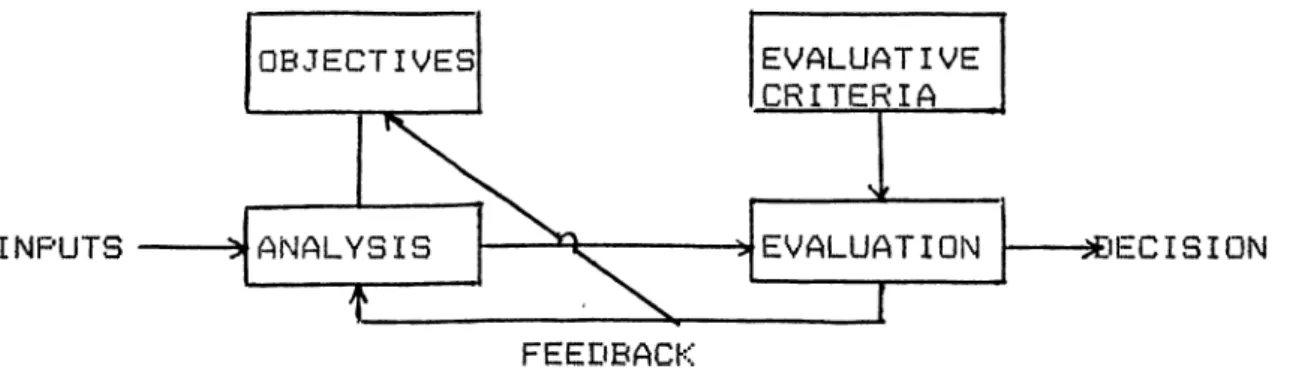
Evaluation is one of the basic components of classical deciding module (Fig 3.1.). Deciding module is formed by objectives, analysis, evaluative criteria and evaluation.
INPUTS
Fig 3.1. Deciding Module Source :
Soumelis, Constantin G., Project Evaluation Methodologies and Techniques , F’aris, United Nations Educational, Scientific and Cultural Organisat ion, 1977, p. IS
There is a straight analogy between a project evaluation process and classical deciding module. As mentioned earlier, goal of a
project 13 either to serve a market profitably or to provide a social benefit, or both. There are two types of goals by
definition; quantitative and qualitative goals. Quantitative goals are usually planned before, and there is no associated problem in
Interpreting the goals as they are usually stated numerically. On the other hand, qualitative goals are associated with the nature of the output and usually much less precise than quantitative goals. They reflect purpose of the project and are subject to various interpretations as they are viewed by various evaluators at particular time period.
Evaluative criteria are set according to the objectives. They bring limits which the project has to perform within these borders
l.e. shortages should be avoided in work flow (a technical
criterion), the product should capture a certain market share ian economic criterion), future cash flows should have positive net present value (a financial criterion), the project should create a number of employment per unit capital (a social criterion).
Certainly there are various types of criteria used in project
appraisals, these examples are given to express evaluative cr 1 ter la notion.
Though It IS not present in Eig 3,i,. there is always a link
between analysis and evaluative criteria. Analysis stage is built so that It can produce data for evaluation stage to compare the results with evaluative criteria.
Analysis wl tilín pr .'j-'t’t appr.iisal consists of three parts;
technical, economic anù financial. Technical anT economic parts are independent, wnereas financial analysis is performed according
to the data processed in technical and economic parts.
Feedbacks to objectives and analysis parts nay cause readJustments of the system's internal arrangements iiMplied in its original
go a 1 s so tri.a t t he fir ai ■au 1 rl ch ange goals or set new ones.
Inputs to project ev.i.luation process are generally technology, innovation, resources available and kind of the product or service (7> .
7, Goumells, Constantin G.,"Project Evaluation Methodologies and Techniques", Paris. United Nations Educational, Scientific
and Cultural Organisation, 1977, p, 13
2.3. WHO EVALUATES THE PROJECTS 7
In literature two types of evaluator can be observed; insiders and outsiders. Social researchers, consulting and financial firas are usually accepted as outsiders and project managers of the firms are called insiders. In case of both type of evaluation, there are pros and cons according to specific situations.
An inside evaluator has detailed information about the project that will be implemented by the firm, but inside evaluation reveals the psychological factors involved in the project
evaluation. The project manager will be willing to defend his/her
project against the projects of other departments because of
Internal competition within the company. The policy makers of the firm will prefer outsiders to ensure the objectivity of
evaluation, while lower level project manager will insist on inside evaluation to control the results of evaluation.
Outsiders Will have their own goals, therefore the methodologies used will serve their goals rather than the evaluation of the
benefits of the project for the company. As an example a financial
firm will evaluate the project giving major importance on ability to pay its debts. In addition, outsiders will perceive the project in a different way, and it will take time to understand goals. On the other hand an experienced outside evaluator in the field of project will not only shorten time but also guarantee the success
of the evaluation process <8).
Another approach is to establish evaluation units within the company which will work independently from action units, but because of the cost factor, action units are usually used as evaluation units.
There is not a unique answer to the question of " who evaluates the projects?". The decision must be given according to the kind and importance of the project. In case of routine matters, there
IS a general tendency to use insiders.
8. soumelis (1977). pp, 25
2-4. RELATIONSHIP BETWEEN PROJECT APPRAISAL AND NATIONAL PLANNING OF SOCIETY
A private commercrial entrepreneur selects the project which
satiiifies his· objectives best. For a national pliinner this process is rather coiTiple:·:, The choice must be subject to a set of general objectives of national policy and have consequences for
employment, output, consumption, savings, foreign exchange
earning, income distribution and other things relevant to
national paramesters. For example, when a soap rnanuf aic turer sets a
price, he only thinks about his commercial benefits, on the other hand a n a t i o r ia 1 planner h a s t o c o n s i d e r t li e? r b 1 a t i o n b e t w b e n price and the soap usage habits of society (9). These objectives may severely conflict with each other, since nartion is a collection of d i f f eren t in teres t s ,
Projects in the concern of national planning are analyzed under social benefit-cost appr'oach by the national planners. The social benefit-cost approach must cope with multiple objectives- This approach is aimed -at systematizing the complex problems of project planning from the point of view of the
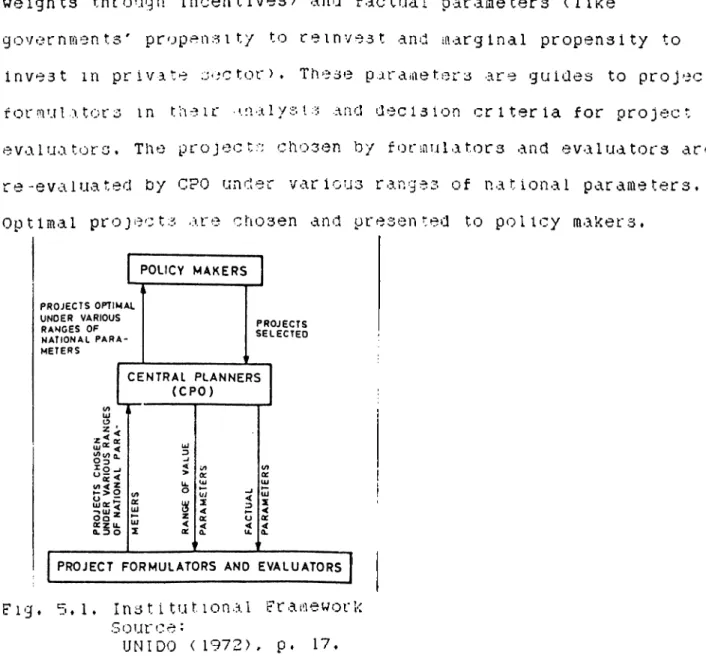
society-Ins ti tutiona 1 framework (Fig 5. ) of project selection in macro
phase is rather complex. The policy makers of the; country select project subjects according to economic conjoncture of the world
and the country. In thiis framework central planning offices (CPO,
9. U N I D O , "Guid 1 ines for Project E'/aluation " , United Nations
state Planning office in Turkey> has a significant role in i-iip leraen tvi t ion of the policy. CPO determines range value
parameters (like social rate of discount, regional distribution weights through incentives) and factual parameters (like
governments' propensity to reinvest and marginal propensity to invest in private sector). These paraiaeters are guides to project formulators in their '.nalysts and decision criteria for project evaluators. The projects chosen by formulators and evaluators are re-evaluated by CPO under various ranges of national parameters. Optimal projects .are chosen and presented to policy makers.
Fig. 5.1. Institutional Framework ■Source:
UNIDO (1972), p. 17,
In this frame, social bouief i t-cos t analysis is the most important part of project appraisal. Social benefit is measured as value added to the national economy. Value added of,a project is the function of following items (10);
10. Türkan. Erdal, Interview (Prof, in Hacettepe University)
- Profit generated by the project. - Interest payments of the project.
- Wages and salaries paid to the employee within the project, - Foreign exchange earning.
- Rent expenses of the project, etc..
In developing countries and totalitarian systems, the social cost benefit analysis depends on engineering feasibility studies with fairly narrow and simple techniques. Since late 1970's
environmental impact assessment (EIA) have begun to play an
Important role in project evaluation process in representative and pluralistic democracies. U.s. National Environmental Policy Act <NEPA) stated the requirements for an environmental impact
analysis as follows (ll)l
- the environmental impact of proposed project,
- the residual effect that could not be mitigated by good planning.
- alternative of proposed project (including an assessment of doing nothing at all).
- the relationship between short-term economic gains and the longer term advantages of maintaining a productive system,
- a statement of any irreversible or irretrievable environmental or social consequences of implementing proposed project.
2IA is mainly applied in the U. s . and to some extent in the U. K.
U . O'Riordan, Timothy. Swell. DerricK."From Project Appraisal
to Policy Review" ed. Timothy <5.· Derrick, John Willey & Sons Ltd.,
B-Angiore. 1981, p. 15.
14-in mak14-ing f14-inal decision. In Japan, Australia, most West European countries and Canada, EIA is used mainly as descriptive criteria not as means for determining final project design. EIA becomes essential in pluralistic democracy where high interest group activity and high political influence exist. The properties of
this medium are (IE);
- policy centered decision structures, - freedom of information,
- early publicity of project decisions,
- various mechanisms for administrative legal review, - participatory with negotiation.
Under these conditions, before designing a project, interest group lobying, changing political mood, hearings, personal ities of
related parties must be analysed. EIA must assess all possibilities for environmental damage or social cost.
In developing countries reactions to the projects related to natural environment has risen significantly in the last decade. Time has come for the project designers and CPO's to take care of environmental impact of related projects to both nature and public mood. This will also be a good introduction to wide environmental
impact assessment
-12. O'Riordan (1981), p. 20.
In this chapter the pro]ect evaluation process used In Development Bank of Turkey is. introduced. During the presentation of the
process alternative methods and some criticism will be put forward.
3.1. RATIONALE BEHIND DEVELOPMENT BANKING
Development banks try to generate investment capital in developing countries where resources are limited. They supply technical
assistance and additional resources to entrepreneurs to accelerate industrial development of the country. The rationales behind the development banks are as follows (13).
- In developing countries the propensity to save is low, therefore resources for investment are not enough, in addition the available resources are not directed to the development of the country,
- There are not enough number of entrepreneurs,
- There is not a mechanism which will transfer savings to Industrial firms and allocate funds on project basis (unlike commercial banks),
- The need for independent institutions for supporting, orienting and evaluating investment projects.
3. ^1. DEVELOPMENT BANK OF TURKEY
The formation, transactions and activities of State Industry and Laborer Invest.iient Bank, which was established in 1975 under
13. Ekinciogiu, Erdal, "Kalk inma Bankac 11 ığ( in m Kuruluş Nedenleri"
TKB, Ankara. 1939, pp. 4-5.
3. PROJECT APPRAISAL PROCESS IN DEVELOPMENT BANK OF TURKEY
statutory Dacr-ie no 13, have been arriinged in 19888 through the Stattı tory Decreva no. 32?, and from July 15th 1988 on, the bank's title has been altered as Development Bank of Turkey (14).
Development Bank of Turkey, [nc. and Tourism E'ank of Turkey., which are development and investment banks in the sectors of
manu f ac tur ing and tourism respectively, were me;rged in January
1939. As of Jal!^.ıar''/ 2nd 1990, the bank's capital was increased to TL. one trillion.
The ma i.n activities of the bank £^re; - Project Appraisal
■“ f-inane ing
„ Cre?d i t Ac t i V i t i es
. P a r t i c i p a t i o n A c t i v i t i e s
, Financial Leasing Activities -- Eianking -■ Research ■·- Securitives -·· R e t) a b i 1 i t a t i on “ Training ·“ r e tr i In i c a 1 A s s i s t a n c e
- Publicity and Market Support
3.3. PROJECT APPRAISAL PROCEDURE
Actual'/ the project appraisal process begins outside of
Development Bank of Turkey as the bank grants medium and long
14. Development E<ank of T u r k e y , "Annual Report 1988", Ankar,a , 1989.
term credits to the projects which owns incentive certificate given by S P O .
The investment projects that have at least T L . S50 Million in regions that has development priority and T L . 5 Billion fixed
investment amount in normal regions are candidates for taking incentive certificate from 3P0 (15).
Companies apply SPO with technical feasibility report of their project and a formal request. Project is evaluated under
macroeconomic policy and an incentive certificate is arranged according to the subject and location of the project if it
satisfies the criteria The projects that do not have competitive power in international markets, do not bring advanced and suitable
technology , and do not reach specified production capacities in the sector, do not qualify for an incentive certificate (16).
The prospective project must be a;
- in a region where the investment is incited,
- within the content of incited investment subjects; the project must not be listed in Decree S6/1345S which defines the subjects
that are not incited.
The possible incentives which also affects financial evaluation of the project are as follows;
15. Trkiye Kalkinma Bankasi," Teşvik Mevzuati", Ankara, 1990. 16. Tuğrul, Seyhan,"Tesvik Belgesi ve Yatirimlari Teşvik Tedbirlerinin Uygulanmasi", TKB VI. Proje Hazirlama ve Değerlendirme Semineri, Ankara, 19S9, p. 5.
- Customs Exemption
- Investment Tax Credit (Investment Discount) - Medium and Long Term Domestic and Foreign Loan - Source Usage Support Premium
- Tax, Duty and Fee Exemptions - Foreign Currency Allocation
- Building, Civil Works Fee Exemption - Free Withdrawals From Financing Fund - Working Capital Credit
- Value Added Tax Postponement
Conditions of all above items change due to the location and subject. The conditions and equity debt ratio limits are
determined by 5P0 according to regulations and decrees published in Official Newspaper. An incentive certificate is shown in
Appendix 1.
The appraisal procedure in Development Bank of Turkey is shown schematically in Fig 6.1, The procedure begins with the
application of company to the General Directorate for financial support either in form of middle and long term investment and/or
equity participator and/or working capital. The applications are
transferred to the Directorate of Loans and the applicants are · requested to fill out the "Application Form" prepared by the bank and some additional documents to be presented to the bank within 30 days. The companies which do not present the documents within specified period are automatically taken out of the procedure. The applications sent Co the bank are subjected to a preliminary
t
1
î î t hri ·; c: a 1 ft pi/· a i ç. a '¡ Eccriü-ric ftpp/-:-ı5i-.5İ
i
1
Гігіагіоіаі ftppr-àiîsl
ѳ
φ
_L
Prepar at i СП of the Appraisal Peport
Preseritation of Report to the loans aná ? artı с i pat i on I> i reoto rate
Г/агагт'ііnation of the J 1T e f i r s a n ô. v о n d i t i о n s о f
iLoans and the (Guaranties T"
Sub'···!.!ssion to the General Directorate
e V a 1 LI a t i o n :· > / l r · I o a r i d e p r i: i ri »a n t . T 1" » e a o o 1 i c:; a I: .1 o n w h .1 c h d o n o t
o b y B l; c» i *J I 1 a r »:;:i o f L r i ·:···? i i i. v 0 i:: e r h i f i ·;: a 1 0 a r e r e j a c t cl a n d a 10 L 10 1*··' e i i p 1 a i r j t r j a 1 1' ^ 0 y0 c> n r · · > o f r · 0 f u s a 1 i s ?=> e n I: t o t 0 c o m p a n y ,
T i"Io00 w h i 0 i"j 5a t i. ;;;> T y ti I")0 c i··' i 1:0 r i a a r 0 t r a n 0 f 0 r r“0 d to t h e F·'r o .j 0 t
A p p r a l s a 1 v:^nrl F o 1 1 o w ..U p O.i. r *01·; t o r a t o s ( F“'AF ) ,
A tiaani w h i c b i. : »consposed f an e c o n o m i c tj, a f i n a n c i a l a n a l y s t ,^nd
a t e c h n i c a l e y p o r ' t o x a n i i n ^ t h a Porm a n d d o c u m e n t s i n h a n d , d a i n a n d
a d d i t i o i v a l d a t a i f n e e d e d a n d c o l l e c t f u r t h e r i n f o r m a t i o n b y
■y i. 1 t i. a q c >: :> 1 i i qa n y a ri d p r o j e c; t s i t e , i f t t i e i:) ro j e c: t i s f o l\ n d t •::'i o e
un s a t L s f c t o r y u)"i ij >>r' t |···í0 s 0 i r'l f o i···I)ia t i o r i , a l e t t e r o f r e f i..is a l I s
s e n t t o t-10 c u m p a n y o t h e r w i s e e v a l u a t i o i j ac: t i v i t i e s a r e
c a n t i . n u e d . E v a 1 u a t i o n r'0 p o r* t s o f 0 a c h 0 i i p e r t a r e g a t h 0 r"ed u n d e r
pi"‘o j 0 c: t a p p r < a i s a 1 f o r i n a t o f t h e b a n k « T’r).i.s r ej::)or t i s p r - e s e n t ':i t o
1110 D i r 0 c t o r a t e o f 1.. o a n s a n d t ia i s d i r 0 c: t o r a t e p r 0 s 0 n t i t t o t h ?
G e n e r a ! . D L r e c t o r a t e a f t e r d e t e r i f f i n i n g t e r m s a n d c o n d i t L o n s o f t h e
1 G a n v> a ! i d q li a r · a n t e e s .. T li i s r e po i * t i n c: 1 lid e s 10 c hn i c a 1 , e c o n o\r. i c 1
a n d f .1. n a n c i a 1 e v a 1 u a t i or) w h i c h w i 1 .1 b e p r e s (· * n t e d i n d 0 t a i 1. i n
S e c t i o n s :> . 3 . 1 . ; , 3 3 . 2 . a n d 3 3 . 3 . r e s p e c F i v e .1 y .
■ r h0 a p p r a i. sa 1 r e p a r t .i. ;·:> p r ·e s e n t e d tcj t h e Boart:l c· f Di. rec: t (.:)r t o r *
t i- i ^ j .1' j:) |:.) ■ o V a i. o ? U1 e G 0 n 0 r" a 1 D i r- e c t o r a t e . . I f 11"! 0 G 0 n 0 r“ a I D j. r e c t r a 10 d o e s n o I' a p p r· o v e 11 i 0 p r o J e c: t , l e t t e r o f r" 0 f u s a l i s s e n t t ‘:) t h o c o 1 n p a n y . F" o .1. .1. o w i. n g t h e f i. 11 a 1 d e c i s i o r i o f t h e B o a r d o f D i r o c t o r · s t h e I n a nd / o 0 q 1..1.1 1y p ar tic*: i p a t i o n t)0 ct;··in0 s a v a 11 t) 1. e , I n ca s 0 o f l o a n , a f t e r s L.i p p 1 y .i. n g n e c e <:?> s a r * y d o c lim 0 n t s a r) d a f t e r q e 1 1 i. r i q r“ e q u i. r c? cJ
q L\ a r a г rl: a 0 ■ iS, ·: n ; ·' t: г ■ э p r n ·.·:· '..t r · a i. - j ia a 1 о a n a с\ r 0 e jtí n t w i t h t n a
D i ra:i(;:; t a r a v0 r L o a r i B » A r a r t a i n ariiO Lint o f l o a n .1. a p a i d i.n - > d / ; ^ n c e
a n d t h e r ' e a t -i' l ov r a d t o bo »..i t i. I i ;:ed f a . l l o o . i . n q t h e p r e s e n t a t i o n
o f t h e e x p e n S;- d o e a m e n t s b y t h e e o í H p a n / a n d i n a r c o r d a n c e w i t h f i n a Г“! c: i I. p .!. a n í:; e i : i: i. о r ' l ■ :J i r. ·: i : -a о г * i.;) J e c:: t a p p r · a i iii a İ r " a p (j r t - I n c: a s e D f e q a i t y oa· · t i.i.oi.pa t i o n n ti le D i r a c t o r ' a t e o f P a r t i c i p a t i o n s r e a !. 1. c e s e · :i a l t у * л ·,: i c i. о ·!': i cj n a f t e r · · ;·; a r r у i n q о и t t !" j e i" j e c: e s s a г"· p г" (.■> ■■;: e d ı..: г ■ s Г i ı v;^ ! ;·:/ n к a ı «: 1 r îs i‘" -v· p ;·■· e -s e г'j t a t i v e t o b v:? t h В o a r d î;::« f D i r- o· r: t o r s a г ı d В; j a r · d г.■ f A' д d i. t o r s cj f ' \ ! 1 e г: o n> p a n у . T h e cDı npai ! i . e s of: ı.ctı t h e b a n k h a s f f n a n c e d a r e t h e n f o l l o w e d а р г e g а 1 -д i“ I. у u у t ti e О i 1· · > - к о t · а t ú? s о f г' и г а п d f о I I с:) и - а р г е р п г t s г · е p r e p a ı - ' e d .. I n t h i s s t u d y o u r c o n c e r n i s p r o j e c t e v a l u a t i o n p a r t o f t h i s p r о e dl ir a . [ n t h0 f o i l о v*·inq 1 i n 0 s t e h r - i i c a 1 , ec:о n о f i c a n d f i n a n c i a l a n a l y s i s a n d e v a l u a t i o n p r o c e s s o f t h e b a n k w . l l l b e e >; p 1 a i. n e с;1 a j-i d c r i t i. 1 c e d , 3-3.1. TECHNICAL EVALUATION i n e r ' j e r t o d e t e r í í u . n e t h e t e c h n l e a l f e a s i b i l i t y o f t t i e p r o j e c t^ t e c h n i c a l e v a l u a t i o n i s ii^ade b y t h e t e c h n i c a l e x p e r t s i n F“‘AF’ - T h e m a j o r s u b j e c t s c o v e r e d i n t h i s e v a l u a t i o n a r e b r i . e f l y e x p í a (.ned b e 1DW ·[
1 _Li;;ic_a t i pri i Г!"!e s e J. ec: t i r.·d о f t h0 1 о a t j. c;·n mu s t t»e t 0 r e ·->u .1 t о f
a ri 0 X 10 П is i v e <д n a. ). у s .1 , T’ h e r" 0 a r 0 n \ \ m e r о i..i s f a c: t о r s t ti a t d 0 t v;? r ■: ?. :l г ¡
с·.-t h e l o c a с·.-t i o n ; , b u t i t i s n e a r l y j . i n p o s s i b l e t o s a t i s f y t h e s e
сгиеп:!.. Tile Developiaen t Bank of T^irkey usually aetertaines tne location accocding to subject. Experloncos showed that finding qualified personnel for the process is one of the major problem in
location selection, many fact<5ries are forced to work at very low capacity utilisation ratios because of this reason. The costs of
erroc-j h a v e been always very expensive. The distance to the
cultural centers, developed health centers, schools are importint
fa(;i;ors for keeping i.iualified psrsonnel. Wood, leather, ceramic industries are some of the examples that suffer for this reason ( 17) ,
Political factors have always played an important role in
selecting location both In general and in decisions of the о.л.пк.
The s 1 te . locat ion choices are not determined by classical factors
In case projects that has importance for national security. Another fact in Turkey is the tendency among medium and small
investors to invest in their hometown.
Some of the classical factors for '.le ter m in ing the location of the site are as follows;
- Possibility of easy transportation - Availability of 'jualified personnel
- Availability of raw, auxiliary and operating material - A p p r о p r 1a. t e oil m a t e
- Lоc■?. 11 оn of t ar gо t mar кe t f оr c>u tpu t - Employment late in the region
17, Çatak, Atilla. Interview (Senior Supervisor in Development Bank of Turkey.
2. Products: Màln and waste products, and by-products are
spec 1f led.
3, Production Сарае I-,y and Technical Capacity Utilisation: The production cApacity of the plant is specified according to ¡aarket condition;!, oconoiines of scale and technical aspects. In this stage established capa:ity and technical capacity have to be
distinguished. 2s V'.'o l i sh id capac i ty is the naximum capacity of
itiachine layout or systea. On the other hand to determine technical capacity nseds expertise in the field of project. In technical evaluation the technic.al capacity ¡lust be 'letermlned under the
following factors (13);
- Availability of gualified personnel who c:m perfor.a the
process at higiier capacity utilisation ratio (CUR), - Condition of machine, fatigue,
- The quality of raw aiaterials,
- Иагтопу between the capacities of machines in the lay-out,
- Repair tn .1 maintenance duration of machines.
In t h i s s t a g e harmony between machi nes or u n i t s has to be e mp h a s i s e d . In e v e r y i ns l us t r y t h e r e a r e some machi nes which
d e t e r mi n e the o v e r a l l c a p a c i t y of the p l a n t , f o r exa mpl e ovens in cer ani i c i n d u s t r y , in л p r o j e c t s t u d y in t h i s f i e l d , the c a p a c i t i e s о f a l l :ii a c h 1 n e j n 11 s t j e l: о m p a 11 b 1 e wi t h о v e n о t h e r w i s e
o v e r c a p a c i t i e s wi l l i n c r e a s e the c o s t o f or od ;.;c t i o n , and u n d e r c a p a c i t ie:s wi l l c a u s e a c c u mu l a t i o n o f work-l i i p r o c e s s in
production line, Thougn it seems to be very simple procedure, there are examples of this error in project studies < 19>.
4. Raw and Auxiliary ^^aterialз; The properties and prices of raw and auxiliary materials are given In detail. The bargaining power of suppliers has to be analysed carefully to avoid possible
material shortages. The price fluctuations must be observed. Fluctuating costs Cleans fluctuating prices which is a quite
important obstacle to hold a stable market share. During technical studies an effective ijuallty control system has to be designed for raw and auxiliary material acceptance.
5. Production Methods; This stage is known to be the most important part of the technical evaluation. Flow diagrams and balance sheet of inputs and outputs are m a m concerns of this stage. The material balance directly affects cost accounting
within the project, therefore very detailed analysis is essential for realistic estimation of costs. As these calculations will be the basis for operating expenses estimation, they will directly affect working capital need forecasts.
6. Organisation; The number of necessary personnel is determined la accordance with implementation plan of project. In general three parts are considered in studies? management, administrative units, and technical units. The connections between administrative and technical units on cost accounting and market demands should
19. ç a t a k .
14-oe empliaslaed. The design of organisation should be always compatible with the process applied In the proposed plant.
7. Economic Life: Expert should determine economic life of the project considering his expertise in the field of project,
availability of qualified personnel who will execute the project and specifications of machines, in practice generally economic
llfes are taxen from accounting regulations published in the Official Newspaper.
0. Technical Assistance, Patent and Know-How: The cost of these services are calculated in detail. Advanced and suitable
technology should be aliied in all project studies. Know-how
applications should be specially analysed and necessary guarantees should be asked in agreements. The content of guarantees for the success of the project can be listed as follows <20)?
- The agreement should not end before the plant reaches a
specified CUR or at least six months are passed after start-up. - The agreement should Include training of personnel.
- All types raw and auxiliary materials and their proportions should be listed in detail.
- The process should be described without hiding any detail. - Special agreements for supplying spare parts of machines and operating laa ter lals should be held.
9. Implementation Plan? The implementation plan specifying the
20. Ç a t a k .
possible dates for the completion of investment and start-up dates is determined by technical expert. A successful implementation plan can not be designed unless fund flows are strictly specified. After credits are allocated, the start up date should be
determined. If the implementation plan and fund flow are not compatible, the shortages in both working capital and payments will be possible,
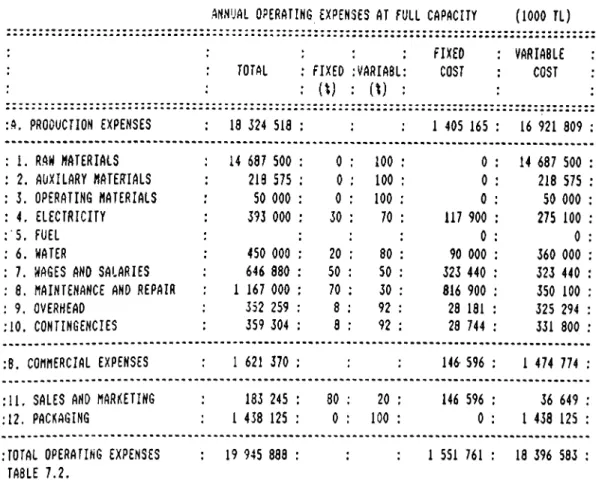
10.Operating Expenses; Operating expenses are determined according to the planned process. Technical expert decides on the variable and fixed ratios of the expenses. The main operating expenses, used in evaluation, are as follows (21):
1. Raw Materials
2. Auxiliary Materials
3. Factory Supplies (Operating Materials) 4. Utilities
5. Wages and Salaries 6. Maintenance and Repair 7. General expenses
8. Contingencies
9. Sales and Administrative Expenses 10. Transaction Taxes
11. Total Investment Cost; Total Investment cost is the sum of
fixed investment cost end working capital requirement.
21, Türkiye Kalkınma B a n k a s i Y a p i l a b11 ir 1 Ik Etüdü Hazırlama
Esasları", Ankara, 19G9, p,53.
The cost of fixed investment items are determined by using the information on written contracts, orders, proforma invoices, realised expenses, and by making comparisons with the costs of similar investments. Then the basic items and their costs are summarised in an table.
Determination of the amount of working capital amount is a joint study of technical, economic and financial project analysts. Working capital need is the function of raw, auxiliary and operating materials, work in process, finished good inventory, cash in hand and receivables in a project study. A separate
intention on receivable management should be given in project studies as it is one of the major sources of working capital shortage. In project studies realistic collection periods should be estimated according to economic situation and the sector rather
than taking number from previous studies.
The important items of total investment cost are listed below (22)
I. Land
II. Fixed Investment
1. Project and Feasibility Studies
2. Technical Assistance, Patent. Know-How 3. Construction
4. Machinery and Equipment
4.1. M a m Machinery and Equipiaent
4.2. Auxiliary Machinery and Equipment
21. Türkiye Kalkınma Bankasi,"Yapilabi1 ir Iik Etüdü Hazırlama Esasları", Ankara. 1939, p.90.
4.3. Transportation and Insurance 4.4, Taxes. Tariffs. Duties. Fees 5. Vehicles. Fixtures
6. Erection. Installation 7. General Expenses
3. Expeiises for Trial Expenses
9. Con 11ngencies
III. Wor k 1 n g Cap 11 a 1 Requ I r e n .mi t
Decause of inflationary effects, pre-lnvestigations and delays in project appraisal process, serious conflicts arise in determining fixed investment cost (23). During the feasibility study total investment amount is calculated and credits are demanded according to this calculation. In general project evaluation process begins at least 30 days after application, the price increases within
this period generate variances in investment cost forcing the limits of resources. In many cases generating new funds is
inevitable, both owners' equity and loans have to be increased for
this reason. iJnfor tunately, this starts another evaluation
process and a series of bureauc ratio operations for increasing capital which will invite additional inflationary effects. Capital
increases are confirmed by the Ministry of industry after for the firms having less than hundred pertners and by Capital Market
Board (SPK) for the firms having hundred or more partners after
the approval of board of directors.
23. Ç a t a k .
The problem can be solved by giving more responsibility and
authority to senior experts like applications In West Europe (24). In similar situations senior expert should have authority to
d'-^teraiine a credit limit for the project and to allocate extra funds for Inflationary variances and contingencies not to cause unnecessary bureaucratic operations.
3.3.2. ECONOMICAL EVALUATION
The purpose of the economic appraisal is to analyse the
characteristics and composition of the actual and potential demand and supply conditions, of the products that are going to be
produced <or being produced) by the execution of the project. This study aims to detect the marketability of the product. This
appraisal is performed within a format in Development Bank of Turkey. In the following lines the Important parts of the format will be analysed.
1. Market Definition: The sector and subsector of the market which the products or services belong to, is defined according to the definitions of GPO. Incentives that are being distributed in this are listed.
In project appraisal studies this definition is sector definition rather than the description of market, the segments of the market. Which the project will serve, are rarely explained.
2. Product Definition? The kind of the product (consumer product or intermediate product), brand names, standards, and
specifications of the goods are given. The existing substitutes and complementary goods are also exhibited in this part.
3. Supply Conditions; The total production capacity of the firms which are already producing the product and its substitutes is determined. Statistics concerning total production, inventory, exports and imports are gathered for past 10 - 15 years.
4. Dornsn-:) Analysis? For mak i ng cons I s ten t and s ign i f lean t
forecasts, the data belonging to consumption levels and export volumes in addition to production capacity, sales, inventory stocks and imports are collected. If the product is export
oriented, the foreign market is also analysed. Government import and export regimes, attitudes and probable changes in policy. p r i c e :1 a > t i c 11 y f t>r the p r od uc t s ho u I '.i b e an a. 1 y 2ad .
Trend analysis and regression on available data are most common te'.:h.niques in appraisal studies. Extensive market research can not be performed because of cost and lack of necessary personnel,
5. Comi-·!■:!risen of Supply and Dem.and: Co;n0ar i 11a aggregate supply and
dtjuiam.! both globally (whole Turkey) and regionally, the economic capacity utilization ratio (CUR) is determined in the sector. This CUR IS also used for the project as economic CUR throughout the study without evaluating the quality of marketing efforts of the
firm.
6. Product Prices: The price is determined according to market conditions and technical characteristics of the product. The price of existing brands, substitutes, major complements, the quality and image of product, and prices of inputs determine the price.
7. Sales and Competition: A simple environmental analysis is
performed for the project. The main competitors in the market are introduced, supply of inputs is explained. The strengths and
weaknesses of the company should also be analysed, very detailed environmental analysis including the changes in econoraic
conditions and policies should be implemented for the future of the project.
8. Production Capacity: According to sales forecasts and
production plan estimates the economist together with a technical expert determines the capacity.
Capacity selection t-s closely related to the size of market
(demand) and costs of production. In deciding about the capacity project formulators should do their best for reaching economies of scale. The advantages of working at economies of scale were proved by South Korea who established an export oriented industry at
economies of scale with very low unit costs increasing her competitiveness in international trade (25).
25. Ertek.Tumay," Economies of Scale and Capacity Selection", Project Evaluation International Training Workshop, Altmyunus,
1989, pp. 2,23.
The aain objective of an economic appraisal should be very detailed market research. In today's highly competitive
environment the purpose of a project should be to produce what can be marketed. Especially Introduction of new products and services
is quite risky and costly. Companies should perform marketing
research to identify new market needs and opportunities and to
respond them with appropriate product or service offerings <26). on the other hand the Bank should find out the realistic demand
for the projected product by means of market researchs and evaluate the marketing capacity of the company to guarantee
repayment of loans and their interests or/and return on investment in case of participation.
3.3.3. FINANCIAL EVALUATION
After the project is evaluated both technically and economically, V.
the financial analyst prepares a report covering:
1. The evaluation of the present situation of the company. 2, Tiie evaluation of the project.
Necessary information are provided from the documents of the company, balance sheets, income statements which are analysed during the site visit, All other data necessary for financial evaluation are the results of technical and economic evaluation. In the following lines the financial evaluation procedure will be
ana I yseil under i mpor tan r h.ead ings.
26. Bodur. Ntisaf fer. ■■ Marketing Research for New and Existing
Product Development", Project Evaluation international Training Workshop, Altinyunus. 1989, p. 1,
1..1 QJf!.—jLbig__Pr0 s e n t S i t u a t i o n o f t h e Co m p a n y : __!r:.§.9.iH!L 1_^ jt a t Li s s, T h e s t a t u 3 , 3 li b j e c t o w n e s h i p 3 1 r n c t u r e , e q u i t y c a p . í t ¿ ^ l are e x a m l r i e c J b y u s i n g t h e m a i n c h a r t c e r a n d o t h e r l e g a l d o c u m e n t s o f t h e comp<LUiy „ b..:^_!IAΓ^·■lD.L·.;k:ií:A_T^be f i n a n c i a l s t a t u s o f t h e c o m p a n y i s a n a l y z e d f r o m r e c e n t t r i a l b a l a r t c e s ^ b a l a n c e s h e e t s a n d i n c o m e s t a t e m e n t s . C u r r e n t a s s e t s ^ f i >; e d a s s e t s . , s h o r t a n d l o n g t e r m I i ui i:;) j. 1 -i. L i. 0 s a n d o w n e r ' e q ix i t y o f t ti e c: o rn p a n y a r' e d e t e r m 1 n e d .
C a i s · ' ^ te..·.. b b e r"(e 1 a t i a n s Cf f t h e c o i n p a n y v*ji t h o t i·!er
p a r t i. 0 s a r·e i. r ■ ·/ r;·/ -s t i. c'l a t e d .. T‘ h e p r e s 1 1 q e o f c c:)in pari y i n i t s
e n v i r ' o n m e n t a n d a n y e ; - i l 3 t l n q p r o b l e m s w i t h c u s t o m e r s a n d s u p p l i e r s a r e e/i a;n i . n e d ™ <:K_f b e m a n a g e m e n t t e a m o f t h e c o m p a n y ; , m e m b e r s o f b o a r d o f d i r e c t o r s a n d m a i n s t a f f a r e e v a l u a t e d a n a l y z i n g t h e i r b a c k g f - Q u n d a n d p r e s e n t s i t u a t i o n s . I f t h e y a r e i n s u f f i c i e i i t t o e x e c u t e t h e p r q . j e c t a n a d y i s o r y t e a m i s a s s i g n e d . 2. . T t) 0 F i n a n c i a 1 A p p r a i s a 1 __o f t h e F r a . j e c t : T h e f i n a n c i a 1 n e e d a n d s o u r c e s
o f 11")e p r o j ec: t , r e q u i r e d t o c om p 1 e t e t h e i n v e s tin e n t a n d t o s t a r“ t -
u p t h e o p e r a t i o n a s f o r e c a s t e d a n d s t a t e d i n t h e t e c h n i c a l
e V a 1 u a t i o n a n d m a r k o t s t l\ (J i e s .
b . _P.Gi?.para ti^^^ __t h e P r o f o r m a C a s h F l o w a n d I n c o m e S t a t e m e n t s
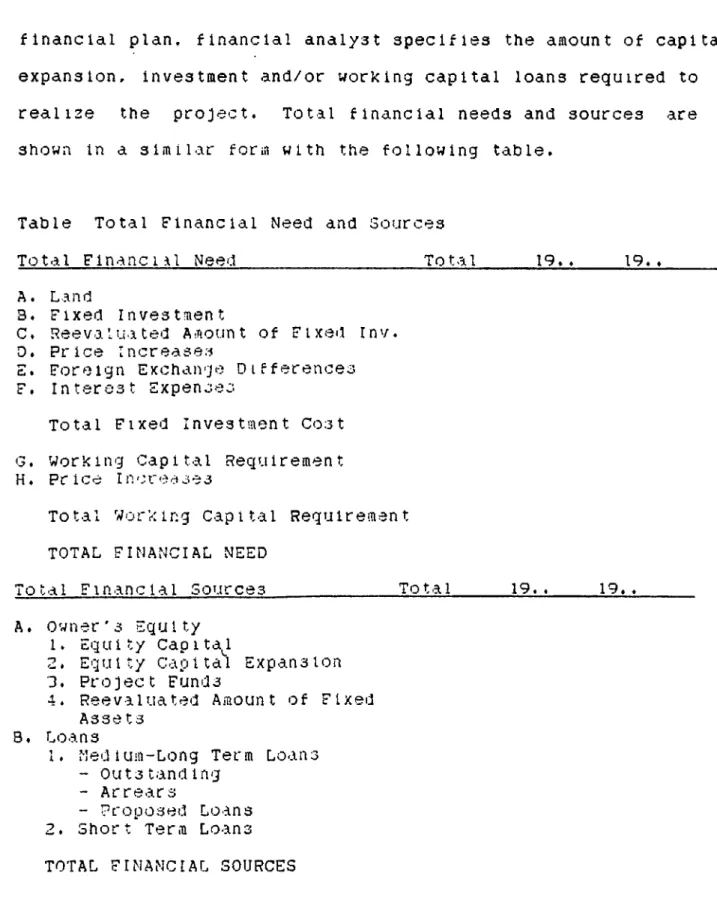
i . T o t a 1 F i. r) a n c i ¿vi 1 N e e d s a n d S t:ji l.ir c e s s A f t e r t l"i e f o r m i\ 1 a t i o n o f
financial plan, financial analyst specifies the amount of capital expansion. Investment and/or working capital loans required to
realise the project. Total financial needs and sources are
shown In a similar form with the following table.
Table Total Financial Need and Sources
Total Financial Need_________________Tota 1 19. . 19. ,
A. Land
3. Fixed Investment
C, Reevaluated Amount of Fixed Inv. 0. Price Increases
E. Foreign Exchange Differences F. Interest Expenses
Total Fixed Investment Cost G. Working Capital Requirement H. Price In.'^reases
Total Working Capital Requirement TOTAL FINANCIAL NEED
To ta 1 Financ 1 a l Sources____________ Total 19. . 19. .
A. Owner's Equity 1. Equity CapitaJ
2 . Equ1ty Capi tal Expansion 3. Project Funds
4. Reevaluated Amount of Fixed Assets
B. Loans
1. Medium-Long Term Loans - Outstanding
- Arrears
- Proposed Loans 2. Short Term Loans TOTAL FINANCIAL SOURCES
When preparing this table the allowable limits of debt to total capitalisation ratio according to regions is considered.
ll> Annual Sales Revenue: The annual revenue of the project at full capacity la calculated, regarding the minimuia of CURs given by technical and economic experts. Inventories, sales amounts, tax discounts are also considered in finding out the net annual sales revenues.
iii. Annual Operating Expenses; The annual operating expenses are calculated according to CUR and inventory stock levels. Cost of goods sold and unit costs including depreciation and interest are calcula ted.
iv. Proforma Income Statement; This table illustrates the profit and loss of the project on annual basis comparing revenues and costs. After deduction of all payables and applicable taxes, the net incoine after tax is obtained from which the dividends payable is calculated.
V. Proforma Cash Flow gtateiiient; In this statement the annual
cash inflows and outflows are compared. Cash inflows are the result of sales and outflows are operating expenses, investment expenditures (renewals, additional working capital requirements)
taxes, and dividends, loan interest payments and installments.
The difference between the cash inflows and outflows determines the annual cash surplus or deficit.
Vi. Determination of Debt coverage Ratio? The annua1 debt coverage ratios are calculated by the following formula.
D e b t C o v e r a g e " Ra t i.o C a s h / G p e r a t i n q I n v e e t n e n c T a x e s a n d \ I n f 1 (") v\i - \ E Vi p .. +· E X p . · 1“ D i v i d e r'f d s / I t e r" e 1 IE p , + l.„ o a n R e p a y :ti e n t s T h e l a r g e r t h i s r a t i o , t h e b e t t e r t h e a b i l i t y o f t h e f i r m t o s e r v i c e t s d e b t -y I i j . _.C.dJlzE-yV.;·D____ GD..dl..Zrii..d..i. ^ ^ ^ ^ c a p a c i t y u t i 1 i c a t i o n ra t i.o v-fh i. c ti 1 1 ·)e p r o j e c t c an ma k e p r o f i t , i d e t e r lii i ri e d b y b r e a k e v en a n ::'A 1 ·/ ;:!> 1 'r.· «
T h e oi..! 1 1 i .r!e o f the f i n a n c i a 1 e v a ]. i.·a t ion p r o c e s s v^ias q i v e i n l a s t
t h r e e p a n e s , r i ’ie ' l e i n o n s t r a t i o n o f t h i s p r o c e s s i s i l l u s t r a t e d i n
t h e f o l l o w i n g c h a p t e r . T h i s c h a p t e r a l s o i n c l u d e s t h e a 1 t e i ' n a t i v e
me 11)o d s f o s c i r n i : ? p a r t s and cJ i f f ere n t pain t s o f v i e i s e v i ! a i b i t e d
a b o u t t i“’! i s p r o c e s s .