KÜTÜPHANESİ
Ankara Üniversitesi
Dil ve Tarih-Coğrafya
Fakültesi Dergisi
Cilt XII, Sayı: 1, 2. Mart - Haziran 1954
A STUDY OF THE REMAINS OF SAMOTHERIUM
FOUND AT TAŞKINPAŞA
M U Z A F F E R S Ü L E Y M A N Ş E N Y Ü R E K , Ph. D.
Professor of Anthropology and Chairman of the Division of Palaeoanthropology University of Ankara
During the course of the field work and excavations I carried out in 1952 and 1953 in the fossiliferous deposits of tuff in the vicinity of the village of Taşkınpaşa, which is about 16 kilometers south-southeast of the town of Ü r g ü p in central Anatolia, 1 I found two astragali, a skull and the lower teeth belonging to genus Samotherium of the family Giraffidae. T h e fauna from Taşkınpaşa includes Hipparion gracile K a u p , Sus
erym-anthius Roth and Wagner, Tragocerus amaltheus Roth and Wagner,
Trag-ocerus sp., Gazellinae and Rhinocerotidae, 2 in addition to the remains
of Samotherium 3 described in this report. From these it is evident that this
1 1 wish to extend my thanks to the office of the Dean, the Professors' Council and to the Eastern and Central Anatolian Research Stations of the Faculty of Language, History and Geography of the University of Ankara for extending me the necessary grant which made this field work and excavations possible.
On these trips I was accompanied by Dr. Enver Bostancı, assistant of Palaeoan-thropology in the University of Ankara and also by Mr. Cemal Ünal from the village of Taşkınpaşa (For the field work and discoveries made in this region see Şenyürek,
1958b, pp. 172-174). 2 The remains of Gazellinae and a few limb-bones belonging to Rhinocerotidae.
have not yet been determined.
3 During the field work at Taşkınpaşa, in addition to the remains of Samotherium, six limb-bones (a metacarpus, two fragments of metatarsus, one astragalus, a centro-tarsal bone and a phalanx)of a heavier member of Giraffidae were discovered in the guUy of kızıl-asma,"which is beside; the village of Taşkınpaşa, being slightly southwest of it, and at a place called Paşabağı which is located about 1 .5 kilometers east-southeast of the village of Cemil in this neighborhood and about 2.5 kilometers north-Tnortheast of Taşkınpaşa (see
fauna from Taşkınpaşa belongs to the Pontian Age, that is to the Lower Pliocene. 4
A representative Pontian mammalian fauna, including one genus of Giraffidae, had been found earlier by E. Chaput, H. N. Pamir and S. Erk in a deposit of tuff at Karain, which is about 12 kilometers north-northeast of Taşkınpaşa. Chaput states, regarding this fauna from K a r a i n :
"A l'altitude de 1.225 metres, dans un banc de tuf â grain fin, nous avons recueilli de nombreuses dents d'Hipparion gracile Kaup et quelques dents brise'es de Mach-airodus; mes compagnons Hamit Nafiz Pamir et Suat Erk ont exrait en outre une mâchoire inferieure de Giraffide determine par M. Piveteau comme Alcicep-halus Neumayri Roodler et Weithoffer, identigue â des echantillons provenant du Pontien de Maragha. L'ensemble de la faune indiaue que les tufs dacitiaues de Kara In datent du Pontien (s.l. ). Ces tufs s'elevent jusqu'â 1.450 metres; une corniche de laves de 50 metres de hauteur les domine, jusgu'au bord du plateau situe
ici â une altitude de 1.500 metres."5 However, as the genus Alcicephalus, first
described by Rodler and Weithofer in their study of the Pontian fauna from Maragha, 6 is now included in genus Samotherium7, first described by Forsyth Major from Samos,8 the name of the species Alcicephalus neumayri Rodler and Weithofer, reported from Karain by Chaput, 9 is now written as Samotherium (Alcicephalus ) neumayri.10
Şenyürek, 1953b, P. 173). Of these bones five were found at Kızılasma and one (a frag-ment of a metatarsus) at Paşabağı. These remains, belonging to the same form, have not yet beeri completely determined.
4 Zittel (1925, p. 300), Lewis (1937, p. 194), Romer (1946, Table 4), Thenius (1949), Papp and Thenius (1949, Table VI) and,Şenyürek (1951, p. 70, 1952, p. 474; 1953a, P. 2; 1953b, p. 174 and 1953c, p.460) have attributed the Pontian Age to the lower Plio cene period.
5 Chaput, 1936 p. 113.
6 Rodler and Weithofer, 1890, p. 754.
7 Şee Major, 1891b, p. 319; Bohlin, 1926, pp. 47 and 93; Simpson, 1950, p. 156. 8 Major, 1888 (cited by Major, 1891b, p. 317, 1891c, p. 95 and Bohlin, 1926, P. 175).
9 Chaput, after Piveteau, See Chaput, 1936, p. 113. 10 Bohlin, 1926, p. 93.
FAMILY GIRAFFIDAE GRAY, 1821 1 1
SUBFAMILY PALAEOTRAGINAE PILGRIM 1911, l 2
GENUS SAMOTHERIUM MAJOR, 1 8 8 8 1 3
SAMOTHERIUM MAJORI BOHLIN, I 9 2 61 4
1926. Samotherium boissieri var. major Bohlin. Die Familie Giraffidae, Palaeontologia Sinica, Series C, Vol. IV, Fascicle 1, p. 87.
Samotherium majori Bohlin, which had been described by Bohlin as
Samotherium boissieri var. major from Samos 15 is represented by a skull
and the right lower cheek-teeth found during the excavation, in 1953, at Bayramkalesi, which is just above the western edge of the village of Taş-kınpaşa.1 6 The lower teeth were found directly below the skull, which was lying in the ground with the palate facing upward. The two astragali, described in this report, were found during the sounding made at the same place in 1952, near the spot where later the skull was discovered.
In the skull are preserved the frontal bones, the largest part of the nasal bones and the maxillae. In norma lateralis, the preserved part of the brain-case is relatively shallow, while the face is vertically deepened (see figs. 1 and 2). This skull, which is devoid of horns, probably belongs to a female animal. 17 The top of the orbits are, relatively speaking, thin. The upper profile of the skull, in mid-sagittal section, is straight from the anterior tip of the preserved portion of the nasal bones to a place between the distal half of the orbits. Between the distal portions of the orbits is seen a slight swelling, on the mid-sagittal plane, behind which the upper profile of the skull inclines gently downward and backward to the coronal suture. The upper surfaces of the orbits are considerably higher than the mid-sagittal part of the upper surface of the skull between them, which thus appears sunken. When the distal parts of the upper surfaces of the right and left orbits are connected with a line, it is observed that the top of the slight swelling on the mid-sagittal plane, already referred to, remains 10 mm. below this line. In having upper surfaces of the orbits at a higher level than the mid-sagittal part of the skull between them the specimen from Taşkınpaşa resembles Samotherium boissieri Major from Samos 18 and also other members of the subfamily Palaeotraginae. 19
1 1 Simpson, 1950, p. 156. 1 2 Ibid., p. 156.
1 3 Ibid., p. 156 a n d Major, 1888. 1 4 Bohlin, 1926, p. 87.
1 6 Ibid., p. 87.
1 8 For the texture of the deposit of tuff at this and at other fossiliferous localities in
this region a n d for their geological age see: Şenyürek, 1953b, p p . 172-174.
1 7 F o r sex differences in horns of Samotherium a n d Palaeotraginae see: Major, 1891b,
p. 317; Pilgrim, 1911, p. 27; Bohlin, 1926, p. 98.
1 8 Major, 1891b, p. 318. 1 9 Bohlin, 1926, p. 98.
The orbits are of oval shape and the lowest point of the inferior mar-gin of the orbit, on the right side, is about 80 mm. higher than the alve-olar margin. According to Bohlin, the corresponding measurement is about 70 mm. in Samotherium cfr. neumayri (Rodler and Weithofer) from the Kansu Province of China,2 0 and about 100 mm. in Samotherium sinense (Schlosser). 21 When a line perpendicular to the alveolar process is drawn from the most forward point of the orbit, it is observed that in the skull from Taşkınpaşa the anteriormost point of the right orbit is 45 mm. behind the distal face of the right third upper molar. In this feature the skull from Taşkınpaşa differs from that of Helladotherium duvernoyi Gaudry and Lartet from Pi-kermi, in which, as can be seen from the drawing published by Gaudry 22 the anteriormost point of the orbit is above the distal portion of the third upper molar, that is, it is more antenorly placed than in the Anatolian skull. In having posteriorly placed orbits the skull from Taşkınpaşa also conspicuously differs from those of Samotherium neumayri (Rodler and Weit-hofer) from Maragha, 23 Samotherium cfr. neumayri (Rodler and Weithofer) from China 24 and Samotherium boissieri Major from Samos, 25 in all of which the orbits are more anterior in position than in the Anatolian speci men. In this feature Samotherium majori Bohlin from Samos, described by Bohlin as Samotherium boissieri var. major, 26 comes closer to the Anatolian specimen. According to the figures given by Bohlin, in 3 specimens (Nos. 5,9 and 11) of Samotherium majori Bohlin from Samos the anteriormost point of the orbit is from 1 to 3 cm. behind the third upper molar. 27 Bohlin describes the position of the orbits in one specimen (No. 10) of Samotherium
majori as behind (hinter) and in another as being far behind (weit hinter)
the upper third molar. 28 In this feature Samotherium sinense (Schlosser) from China approaches Samotherium majori Bohlin from Samos and Taşkınpaşa.
20 Bohlin, 1926, p. 47. 2 1 İbid., p. 51.
22 Gaudry, 1862, pl. XLI, fig. 1.
23 As can be seen from the picture published by Rodler and Weithofer (1890, pl. 1, fig. 1) in the specimen of Samotherium (Alcicephalus ) neumayri (Rodler and Weithofer) from Maragha a perpendicular line dropped from the anteriormost point of the left orbit passes through the anterior part of the third upper molar.
24 According to Bohlin (1926, p. 48) in Samotherium cfr. neumayri (Rodler and Weit-hofer) from China the anteriormost point of the orbit is above the second upper molar.
25 According to Bohlin in Samotherium boissieri Major from Samos, the anteriormost point of the orbit may either be above the third upper molar or may extend as far as the second upper molar (See Bohlin, 1926, p. 89). As can be seen from the drawing pub lished by Major (1891b, fig. 1), in the male skull of Samotherium boissieri Major the anteriormost point of the right orbit is above the middle of the third upper molar.
26 Bohlin, 1926, p. 87. 27 ibid., p. 89. 28 ibid., p. 89.
Regarding the position of the orbits in this species from China Bohlin states: "Die Vorderkante der Orbitae liegt i his 2 Zentimeter hinter M3." 29
In the skull from Taşkınpaşa the tip of the preserved portion of the nasal bones is slightly in advance of P2 (see figs. ı and 2). As a considerable portion of the anterior part of the nasal bones is broken, it is evident that the tip of ossa nasalia was considerably ahead of P2. In this feature the skull from Taşkınpaşa resembles Samotherium boissieri Major from Samos in which, as can be seen from the drawing published by Major, 30 the tip of the nasal bones is also far ahead of P2. According to Bohlin, the tip of the nasal bones is also ahead of P2 in Samotherium cfr. neumayri (Rodler
and Weithofer) and Samotherium sinense (Schlosser) from China. 31
The form of the preserved part of the skull, in norma verticalis, is nearly triangular (fig. 3). The surface of the maxilla is somewhat depressed below and along the nasal bones on each side. Behind the orbits the skull narrows rapidly to the coronal suture. Thus while the width of the skull above the distal end of the orbits is 253 mm., its width is reduced to about
110 mm. at the level of the coronal suture.
In norma basilaris, the tooth rows converge gently toward the anterior part of the palate (fig. 4). The choanae have a maximum width of 42.00 mm., and their anteriormost point stops between the second and third upper molars. As can be seen from the pictures published by Rodler and Weithofer and Bohlin, the anterior margin of the choanae is consider ably more antetiorly placed in the skull from Taşkınpaşa than in those of Samotherium neumayri (Rodler and Weithofer) from Maragha, 32 Samo
therium cfr, neumayri (Rodler and Weithofer) from China 33 and Samotherium
sinense (Schlosser).34 The choanae of Samotherium sinense (Schlosser) from
China also differ from those of the Anatolian specimen in being very narrow. 35 As can be seen from the photograph published by Bohlin 36 in Samotherium majori Bohlin from Samos the anterior margin of the cho anae stops between the second and third upper molars. Furthermore, in this skull from Samos the choanae are also wide, as is the case in the Anat olian specimen. Thus, in this feature the skull from Taşkınpaşa resembles closely that of Samotherium majori Bohlin from Samos.
The measurements of the skull from Taşkınpaşa are listed in Table 1 and they are contrasted with those of Samotherium majori Bohlin from
29 Ibid., p. 51.
30 Major, 1891b, fig. 1. 31 Bohlin, 1926, pp. 48 and 52.
32 Rodler and Weithofer, 1890, pl. II, fig. 2. 33 Bohlin, 1926, pl. V, fig. 2.
34 Ibid., pl. VI. fig. a. 35 Ibid., pl. VI, fig. 2. 36 Ibid., pl. IX, fig. 8.
Samos and other species of the same genus in Table 2. As can be seen from Table 2, the width of the skull of the Anatolian specimen, measured over the orbits, is smaller than that of Samotherium boissieri Major and is in the range of Samotherium majori Bohlin. Indeed, in this dimension the Anatolian specimen comes close to the average of Samotherium majori Bohlin from Samos. In the length measurement of the orbit the Anatolian specimen exceeds Samotherium boissieri Major from Samos and also Samotherium cfr.
neumayri (Rodler and Weithofer) from China. Although, the orbit length
of Samotherium majori Bohlin from Samos is considerably shorter than that of the skull from Taşkınpaşa, stili in this measurement the Samos form of Samotherium majori Bohlin comes closer to the Anatolian specimen than do Samotherium boissieri Major and Samotherium cfr. neumayri (Rodler and Weithofer). The height of the orbit in the skull from Taşkın paşa is considerably smaller than that of Samotherium cfr. neumayri (Rodler and Weithofer) from China. As far as can be judged from the photograph of one skull published by Bohlin, 37 the orbit of the Anatolian specimen, in addition to being longer, also appears to be relatively lower than that of Samotherium majori Bohlin from Samos. Although the tip portions of the nasal bones are broken in the Anatolian specimen, its nasal bones appear to be somewhat longer than those of Samotherium majori Bohlin from Samos, 38 which in turn exceed those of Samotherium boissieri Major from the same island. In short, although there are some differences, in the measurements available for comparison, the skull from Taşkınpaşa comes closer to that of Samotherium majori Bohlin from Samos than to Samotherium boissieri Major from the same island.
In the skull from Taşkınpaşa all the right upper premolars and molars are preserved in situ. On the left side of the upper jaw M2- M3 and parts of the crowns of M1 and P4 are retained. Of the left upper P2 and P3 only the roots have been preserved. All the preserved upper teeth are worn, the degree of attrition being the greatest in M1.
The enamel of all the teeth displays fine striations or rugosities, which are also characteristic of other members of Giraffidae. 39 When the three upper premolars are examined in occlusal view (figs. 4 and 5), it is seen that on their external surfaces the anterior, middle and posterior folds are
well-3 7 Ibid., pl. I X , fig. 10.
3 8 T h e length of the nasal bones of the Anatolian specimen listed in Tables 1 a n d
2 has been measured from nasion, that is the middle of the naso-frontal suture. On the other h a n d , the nasal lengths given by Bohlin are measured along the naso-maxillary suture. Bohlin (Bohlin, 1926, p. 89) describes this measurement as follows: "Vom
Hinterende-Vorderende der Sutur gegen das Maxillare." Although the tip portions of the nasal bones are
broken in the Anatolian specimen, the nasal length measured along the naso-maxillary suture is 190 m m .
developed. In this skull P3 and P4 are in general of similar form. In this feature Samotherium majori Bohlin from Anatolia differs from Helladotherium
duvernoyi Gaudry and Lartet in which these two teeth to some extent differ
in occlusal view, 40 and resembles Samotherium (Alcicephalus ) neumayri (Rodler and and Weithofer) from Maragha. 41 At the base of the internal surface of P3 is observed a slightly thickened band, which represents a remnant of cingulum.
In the second and third upper molars which are not so badly worn as the first molar, it is seen that the anterior and middle folds are well-developed. The posterior fold is also well-developed and is as large as the middle fold in the third upper molar, while it is, although stili distinet, smaller than the middle fold in the second upper molar. In both the second and third upper molars the external surface of the anterior lobe displays a well-formed rib, which is much less distinct in the external surfaces of the posterior lobes of these teeth (figs. 4 and 5). At the basal part of the mesial surface of the posterior lobe of the third upper molar a small basal pillar is observed (figs. 4 - 5 ) . In the first upper molar this formation is represented by only a small scale-like thickening at the same spot, while there is no basal pillar in the second upper molar.
The postero-external corner of the third upper molar is prolonged backward, so that in occlusal view the posterior margin of the chewing surface slopes forward and imvard, that is, it converges toward the anterior margin on the inner side. Furthermore, in this third upper molar the width of the posterior lobe is considerably less than that of the anterior lobe. In these features, the third upper molar of the Anatolian specimen differs from the correspondirig tooth of Samotherium (Alcicephalus ) neumayri (Rod ler and Weithofer) from Maragha, in which, as can be seen from the drawing published by Rodler and Weithofer, 42 the posterior margm of this tooth is almost parallel to its anterior margin and also there is not much difference between the widths of anterior and posterior lobes. On the other hand, in these two features the third upper molar of Samotherium
majori Bohlin from Samos, as far as can be judged from Bohlin's photograph, 43
seems to approach that of the Anatolian specimen.
The measurements of the upper teeth of the Anatolian specimen are listed in Table 3 and they are compared with those of other forms of
Samotherium in Tables 5 and 6. In absolute P2-M3, P2-P4 and M1- M3 lengths
the skull from Anatolia exceeds Samotherium boissieri Major from Samos,
Samotherium (Alcicephalus ) neumayri (Rodler and Weithofer) from Maragha,
40 De Mecquenem, 1924, p. 158 and Gaudry, 1862, pl. XLI, fig. 2.
41 Rodler and Weithofer, 1890, pl. II, fig. 2 and De Mecquenem, 1924, p. 158. 42 Rodler and Weithofer, 1890, pl. II, fig. 2.
Samotherium cfr. neumayri (Rodler and Weithofer) and Samothenum sineme
(Schlosser) from China and falls within the range of Samotherium majori Bohlin from Samos (Table 5). In the index expressing P2-P4 length as a percentage of M1- M3 length, the Anatolian specimen falls within the range of Samotherium boissieri Major from Samos and Samotherium sinense (Sch losser) from China (Table 5). In this index the Anatolian specimen is sur-passed by Samotherium cfr. neumayri (Rodler and Weithofer) from China, but greatly exceeds Samotherium (Alcicephalus ) neumayri (Rodler and Weit-hofer) from Iran which appears to have the smallest upper premolars, relative to the upper molars, in the genus Samotherium. The specimens of
Samotherium majori Bohlin from Samos slightly exceed the Anatolain
specimen in this index, that is they have, relatively speaking, slightly larger upper premolars.
As can be seen from Table 6, in the size of the individual teeth, expressed by the robustness value, Samotherium majori Bohlin from Anatolia exceeds Samotherium boissieri Major from Samos and Samotherium cfr. neumayri (Rodler and Weithofer) from China in all the upper teeth. The upper teeth of the skull from Taşkınpaşa have bigger robustness values and great-er lengths than, those of Samothgreat-erium (Alcicephalus ) neumayri (Rodlgreat-er and Weithofer) from Maragha and Samotherium sinense (Schlosser) from China, with the only exception of M1 which is strongly worn and thus reduced in size in the AnatoHan specimen.
Bohlin has published the measurements of the individual upper teeth of only one specimen (No. 11) of Samotherium majori Bohlin from Samos. 44 The teeth of this one specimen from Samos happen to be smaller than those of the Anatolian specimen, again with the only exception of M1 which is extremely worn in the skull from Anatolia. But stili it is note-vrorthy that in size, the teeth of this specimen of Samotherium majori Bohlin from Samos come closer to those of the Anatolian specimen than those of
Samotherium boissieri Major, Samotherium (Alcicephalus) neumayri (Rodler
and Weithofer) from Maragha and Samotherium cfr. neumayri (Rodler and Weithofer) from China. It may also be said that in the size of most of the teeth this specimen of Samotherium majori Bohlin from Samos comes closer to those of the Anatolian skull than those of Samotherium sinense from China. However, the AnatoHan specimen differs from the single example of
Samotherium majori Bohlin from Samos in having much lower crown indices
in P2, P3, M2 and M3, In crown indices of P4 and M1 the Anatolian and Samos forms are almost equal, there being a very imperceptible difference in favor of the Anatolian specimen.
In summary, it can be stated that in absolute P2-M3, P2-P4 and M1- M3 lengths and in the sizes of the individual upper teeth the skull
from Taşkınpaşa comes closer to Samotherium majori Bohlin from Samos than to other species of the genus Samotherium. The Anatolian specimen differs from the Samos form of Samotherium majori Bohlin in having, relative to M1- M3 length, a slightly shorter P2-P4 length. The skull from Anatolia also differs from one specimen of Samotherium majori Bohlin from Samos in having lower crown indices in most of its upper teeth, but as we have only one specimen of each form for this index it is difficult to say with certainty whether this represents an individual variation or an important difference between the two forms.
The right lower premolars and molars shown in fig. 6 were found isolated but in a row below the skull. Of the corpus mandibulae only a part under M3 is preserved, its remainder having disintegrated. I have set these lower premolars and molars, which belong to the same individual, in Plaster of Paris. All the lower teeth are worn to various extents. Of these P3, P4 and M1 are extremely worn, while P2, M2 and M3 are worn to a lesser extent, although they stili exhibit an advanced stage of attrition. Like the upper teeth, these lower teeth also show the striations or rugos-ities characteristic of Giraffidae.45
P2 of this specimen shows a relatively well-developed metaconid, or inner cusp. In this feature the specimen from Taşkınpaşa differs conspi-cuously from P2 of Samotherium (Alcicephalus ) neumayri (Rodler and Weit-hofer) from Maragha. Regarding P2 of this Maragha species Rodler and Weithofer state: "Beim votdersten Pramolaren —Pr3—fehlt der Innenhöcker meist
vollstandig oder ist nur schwach angedeutet." 46 In P2 of the specimen of
Samo-therium (Alcicephalus ) neumayri (Rodler and Weithofer) from Maragha,
depicted by Rodler and Weithofer, 4 7 the inner cusp is rudimentary and is much smaller than that of Samotherium majori Bohlin from Anatolia. In P2 of the specimen of Samotherium (Alcicephalus ) neumayri (Rodler and Weithofer), published by De Mecquenem, 4 8 as far as can be judged from the photograph, the metaconid is absent or at the most extremely rudi mentary. P2 of Samotherium majori Bohlin from Taşkınpaşa also differs from the corresponding teeth of Samotherium sinense (Schlosser) 49 and Samo
therium sp. II. Bohlin5 0 from China, in having a much better developed
metaconid.
On the antero-internal corners of the anterior lobes of M2 and M3 is seen, in occlusal view, a noticeable anterior fold, which extends to the vicinity of the base of the crown on the internal surface of the tooth. In ,this 45 At the same place were found two isolated lower incisors and a lower canine belonging to a member of Giraffidae, very probably to genus Samotherium.
46 Rodler and Weithofer, 1890, p. 759. 47 Ibid., pl. III, fig. 4.
48 De Mecquenem, 1924, pl. II, fig. 2. 49 See Schlosser, 1903, pl. IX, fig. 10. 50 See Bohlin, 1926, pl. V, fig. 11.
feature the Anatolian specimen approaches Samotheriunı (Alcicephalus )
neumayri (Rodler and Weithofer) from Maragha. Regarding the anterior
fold of the lower molars of Samotherium (Alcicephalus ) neumayri (Rodler and Weithofer) De Mecquenem states: "les arriere-molaires inferieures de l'Alci
cephalus Neumayri (pl. II. fig. 2 ) presentent chez l'adulte un pli anterieur tres
fort de la muraille interne qui ne se retrouve pas chez le Samotherium."51 However,
it is evident that this statement of De Mecquenem does not apply to Samo
therium majori Bohlin, or at least to the Anatolian form of this species. 52
But stili as the teeth of the Anatolian specimen are badly worn, while those of the Maragha species depicted by Rodler and "Weithofer53 and De Mec-quenem 54 are much fresher, it is difficult to say with certainty whether the anterior fold in the lower molars of the Anatolian form reached the same size as that of Samotherium (Alcicephalus ) neumayri (Rodler and Weit hofer) or not.
The last lower molar of the Anatolian specimen possesses a well devel-oped third or posterior lobe of oval shape (fig.6). Regarding the third lobe of the third lower molar of Samotherium (Alcicephalus ) neumayri (Rodler and Weithofer) from Maragha, De Mecquenem states: "le talon de la deniere
molaire inferieure est moins important que celui du Samotherium, que cem de
l'Hella-dotherium Duvernoyi et de l'Alcicephalus sinensis Schlosser." 55 In this feature
the third lower molar of the Anatolian specimen conspicuously differs from that of Samotherium (Alcicephalus ) neumayri (Rodler and Weithofer) in which, as can be seen from the pictures published by Rodler and Weit hofer 56 and De Mecquenem,5 7 the third lobe of the last lower molar is much smaller than that of Samotherium majori Bohlin from Anatolia. The relative size of the third lobe of M3 in Samotherium majori Bohlin from Taşkınpaşa is about the same as that of Samotherium sinense (Schlosser) from China, depicted by Schlosser58. But the third lobe of M3 of the Ghinese species differs from that of the Anatolian specimen in that it is joined to the second lobe by a broad isthmus, whereas in the Anatolian species the place of junction of the second and third lobes is much narrower because of a deep but very narrow slit between the second and third lobes on the inner side. As can be seen from the picture published by Schlos ser,59 this extra slit is lacking in Samotherium sinense. As can clearly be seen
51 De Mecquenem, 1924, p. 157.
52 As the teeth of Samotherium boissieri Major and Samotherium majori Bohlin from Samos have not yet been fully described, it is not possible for me to say whether the anterior fold also occurs in the lower molars of Samos form of Samotherium majori Bohlin or not.
53 Rodler and "Weithofer, 1890, pl. III, fig. 4. 54 De Mecquenem, 1924, pl. II, fig. 2. 55 Ibid., pp. 157-158.
56 Rodler and Weithofer, 1890, pl. III, fig 2. 57 De Mecquenem, 1924, pl. II, fig. 2. 58 Schlosser, 1903, pl. IX, fig. 7. 59 Ibid.
from the drawing published by Rodler and Weithofer,60a similar slit between the second and third lobes, on the inner side, is also found in Samotherium
(Alcicephalus ) neumayri (Rodler and Weithofer) from Maragha, in which
the Maragha species appraoches Samotherium majori Bohlin.
There are no median basal pillars, on the external side between the first and second lobes in second and third lowef molars. 61 At the base of the inner surface of the second lobe of the third lower molar is observed a swelling. Similarly the basal par t of the inner, posterior and external surfaces of the third lobe of the last lower molar is surrounded by a con-tinuous swollen band, which forms a distinct ridge on the inner side. This swollen band on the third lobe and the swelling on the basal part of the external surface of the second lobe of M3 represent remnants of a cingul-um. At the basal part of the external surface of the third lobe of M3 is seen a tiny tubercle or pillar, which probably is a derivative of the cingulum surrounding the base of this lobe.
The measurements of the lower teeth of Samotherium majori Bohlin from Taşkınpaşa are listed in Table 4 and are contrasted with those of other forms of the genus Samotherium in Tables 7 and 8. As can be seen from Table 7, in P2- M3 length the Anatolian specimen exceeds those of Samotherium
boissieri Major from Samos, Samotherium (Alcicephalus ) neumayri (Rodler
and Weithofer) from Maragha, Samotherium cfr. neumayri (Rodler and Weithofer) and Samotherim sineme (Schlosser) from China and falls in the range of Samotherium majori Bohlin from Samos. The P2-P4 length of the Anatolian specimen is larger than those of Samotherium boissieri Major and
Samotherium (Alcicephalus ) neumayri (Rodler and Weithofer) and is near
those of Samotherium cfr. neumayri (Rodler and Weithofer) and Samotherium
sineme (Schlosser) from China. In this measurement, also, the Anatolian
specimen is within the range of Samotherium majori Bohlin from Samos. In M1-M3 length the specimen from Taşkınpaşa surpasses Samotherium boissieri Major, Samotherium (Alcicephalus ) neumayri (Rodler and Weithofer), Samo
therium cfr. neumayri (Rodler and Weithofer), Samotherium sineme (Schlosser)
and also Samotherium majori Bohlin from Samos. However, if one specimen of Samotherium from Samos with a P2- M3 length of 250 mm., listed by Bohlin,62 belongs to Samotherium majori Bohlin, then it would not at all be unreasonable to suppose that in this measurement, too, the Anatolian specimen may fall within the range of Samotherium majori Bohlin from Samos.
In the index expressing P2-P4 length as a percentage of M1-M3 length, the specimen from Taşkınpaşa is within the range of Samotherium majori Bohlin from Samos. On the other hand, Samotherium boissieri Major from
60 Rodler and Weithofer, 1890, pl. III, fig. 1.
61 As in M1 the enamel margin between the first and second lobes is completely worn away, it is not possible to say whether this tooth had a median basal pillar or not.
Samos, Samotherium (Alcicephalus ) neumayri (Rodler and Weithofer) from Maragha, Samotherium cfr. neumayri (Rodler and Weithofer) and Samo
therium sinense (Schlosser) from China exceed the Anatolian specimen in this
index. It appears that in genus Samotherium this index is highest in Samo
therium sinense (Schlosser) and tends to be the smallest in Samotherium majori
Bohlin. It is also interesting to observe that Samotherium majori Bohlin, both from Samos and Anatolia, differ from Samotherium boissieri Major in having a relatively larger upper and a smaller lower premolar row.
As for the measurements of the individual teeth (Table 8), P2 of
Samotherium majori Bohlin from Anatolia is longer than that of Samotherium (Alcicephalus) neumayri (Rodler and Weithofer), and is near to that of Samotherium sinense (Schlosser) in both length and width, being very slightly
larger. The P3 of the Anatolian specimen, which is a strongly worn tooth, stili slightly exceeds in length the maximum of Samotherium (Alcicephalus )
neumayri (Rodler and Weithofer) from Maragha. The P3 of the Anatolian
specimen is shorter than that of Samotherium sinense (Schlosser), and is near to that of this Chinese form in width, being very slightly wider. The robust-ness value of P3 in Samotherium majori Bohlin from Taşkınpaşa is slightly smaller than that ot Samotherium sinense (Schlosser). The length of the badly worn P4 of the Anatolian specimen is within the range of Samotherium
(Alcicephalus ) neumayri (Rodler and Weithofer) and is shorter than that
of Samotherium sinense (Schlosser). In both width and robustness value P4 of the Chinese species also exceeds that of the Anatolian specimen.
M1 of the Anatolian specimen, which is again badly worn, is within the range of Samotherium (Alcicephalus ) neumayri (Rodler and "Weithofer) in length, but in spite of the heavy attrition it has suffered it exceeds that of Samotherium sinense (Schlosser) in both length and width. M2 and M3 of the Anatolian specimen surpass those of Samotherium (Alcicephalus )
neumayri (Rodler and Weithofer) in length and those of Samotherium sinense (Schlosser) in both length and width measurements.
Regarding the lower teeth of Samotherium from Samos Bohlin states:
"An den Unterkieferzahnreichen ist der Grössenunterschied nicht so offenbar wie an den Oberkieferzahnreichen. Ausser den in die Tabelle aufgenommenen
exist-ieren drei Kleinere Kiefer in München (M3 46,50 und 50+ ; an den beiden ersten
in der Tabelle enthaltenen Kiefern des Senkenbergischen Museums misst M3 56,
bzw. 58 mm. )" 6 3 Thus the maximum length of the third lower molar of
the larger form of Samotherium from Samos, viz., Samotherium majori Bohlin, comes quite close to that of the Anatolian specimen.
To summarize the account of the lower teeth, it can be stated that in size of the teeth and in the relative length of its lower premolar series the Anatolian specimen comes close to Samotherium majori Bohlin from
Ibid., p. 92.
Samos. Samotherium majori Bohlin differs from Samotherium boissieri Major from Samos in having longer lower teeth and, relatively, a somewhat shorter lower premolar row. Samotherium majori Bohlin is distinguished from
Samotherium (Alcicephalus) neumayri (Rodler and Weithofer), which is
another Pontian species in the Near East, in having a better developed metaconid in its P2, a larger third lobe, or talonid, in its third lower molar, larger lower teeth and a relatively shorter lower premolar series.
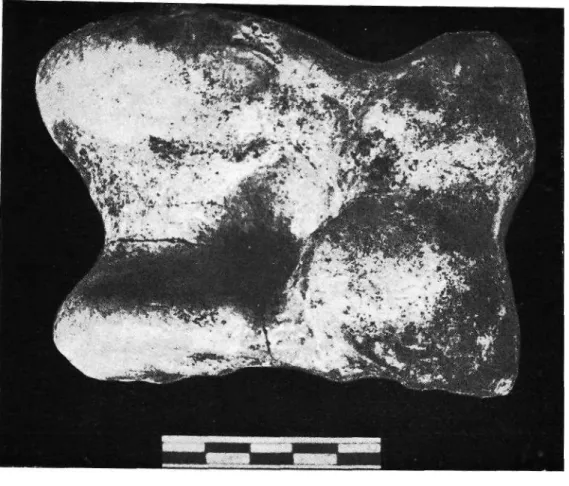
The right and the left astragali were found at Bayramkalesi near each other and probably belong to the same individual. Of these two astragali the left one (figs. 7, 8, 9 and 10) is preserved intact, while the right one is considerably corroded. The left astragalus, which is better for descriptive-purposes, agrees with that of Samotherium64 in having a thicker internal side (Table 9), and a depression in the distal part of the plantar surface, slightly internal to the lateral margin, with a small process below and internal to it. Furthermore, in this astragalus the articular area for os centrotarsale (scapho-cuboid), on the distal part of the dorsal or anterior surface, is quite extensive which is again a characteristic of Samotherium. 65
The measurements of the astragali from Taşkınpaşa (see Table 9) are within the range of those of Samotherium sineme (Schlosser) from China, the range of measurements of which, given by Bohlin, are as follows: External length 103-120 mm., internal length 93-105 mm., distal width 66-77 mm. and internal thickness 56-67 m m .6 6 In length, proximal width and distal width the Anatolian specimens exceed those of.four astragali of Samotherium (Alçicephalus ) neumayri (Rodler and Weithofer) from Maragha, measured by Rodler and Weithofer (length 94-102 mm., proximal width 60-69 mm. and distal vvidth 59-68 mm.).6 7 Rodler and Weithofer have attributed to Samotherium (Alcicephalus ) neumayri a fifth and larger astragalus with a length of 120 and a proximal width of 79 m m .6 8 If this large astragalus belongs to Samotherium (Alcicephalus ) neumayri, then the astragali from Taşkınpaşa would fall in the range of this species from Maragha. But in my opinion the attribution by Rodler and Weithofer 69 of this large astragalus to Samotherium (Alcicephalus ) neumayri is extremely doubtful.
Schlosser, in his study of 1921, has given the measurements of the astragali of a "small" (length 92, proximal width 62, distal width 62 mm.) and a "large" form of Samotherium from Samos (length 100, proximal width 72, distal width 72 mm.). 70 It is evident that the astragali of even the
64 Ibid., p. 69. 6 5 Ibid., p. 69. 66 Ibid., p. 69.
67 Rodler and Weithofer, 1890, p. 765. 68 Ibid., p. 765.
69 Ibid., p. 765.
70 Schlosser, 1921, p. 34. Bohlin (1926, p. 87) lists Schlosser's (Schlosser, 1904, p. 114 and 1921, p. 34) "large" form as a synonym ot Samotherium boissieri var. major.
large form of Samotherium measured by Schlosser 71 are smaller than the specimens from Taşkınpaşa. 7 2
The post-cranial skeleton of Samotherium majori Bohlin from Samos is not well-known. Regarding the skeleton of this Samos form Bohlin makes only the following statements: "In den Masstabellen für Samotherium
sinense habe ich auch Masse für einige Skeletteile von S. boissieri aufgenommen, die bedeutend grösser sind als die auf S. 84-87 behandelten, weshalb ich sie zu der
Vari-etât major stelle. Das skelett deutet auf ein Tier von der Grösse des S. sinense. . " . 73
The radius, metacarpus, tibia and metatarsus of this Samotherium, preserv-ed at Münster and measurpreserv-ed by Bohlin, 74 are bigger than those of the
large form measured by Schlosser. 75 Judging by the size of these bones,
it is only reasonable to suppose that the astragalus of this form may also have been bigger than that of Samotherium described as "large" by Schlosser 7 6 and may have been near the Anatolian specimens in size. If Bohlin's attribution of the bones at Münster to Samotherium boissieri var.
major is correct, then it would be reasonable to attribute the bones of the
so-called "large" form of Schlosser 77 to Samotherium boissieri proper.
In summary it can be stated that the astragali from Taşkınpaşa belong to genus Samotherium. Furthermore, it is possible, but by no means certain, that they may appertain to Samotherium majori Bohlin, described as a variety of Samotherium boissieri Major by Bohlin. 78 The question as to whether these two astragali definitely belong to Samotherium majori Bohlin or not will only be settled when additional specimens are found in association with the skull.
From the account given above it is clear that the skull and the lower teeth found at Taşkınpaşa come closer to a form of Samotherium from Samos, described as Samotherium boissieri var. major by Bohlin, 79 than to other species of the genus Samotherium.Taking into consideration the material described by Bohlin 8 0 and the remains from Taşkınpaşa, this form described as a variety of Samotherium boissieri by Bohlin differs from
Samotherium boissieri proper in the following features :
71 Schlosser, 1921, p. 34.
72 The astragali of Samotherium boissieri Major from Taraklia, measured by Kho-menko (max. length 94-99 mm., width 62-68 mm.), are also smaller than those of the Anatolian specimens (see Khomenko, 1913, p. 118). According to Khomenko (1913,
p-118) the length of the Münich specimen of Samotherium boissieri Major is 100. 8 mm. and its width 76 mm. 73 Bohlin, 1926, p. 93. 74 Ibid., pp. 61, 65-66, 67 and 72. 75 Schlosser, 1921, p. 34. 76 Ibid., p. 34. 77 Ibid., p. 34. 78 Bohlin, 1926, p. 87. 79 Ibid., p. 87. 80 Ibid., pp. 87-93.
Samotherium boissieri Major S. boissieri var. major (according to
Bohlin, 1926)
S. majori Bohlin (according to
Şenyürek)
Witdh of the skull measured above Width of the skull measured above the orbits is larger. the orbits is smalleı.
Orbits are more anteriorly placed. Orbits are much more posteriorly placed.
Length of orbits is smaller. Length of orbits is larger. Nasal bones are shorter. Nasal bones are longer. Teeth are smaller. Teeth are larger.
Post-cranial skeleton is probably Post-cranial skeleton is probably smaller. larger. Although the Samotherium material from Samos is unfortunately not yet fully described, 81 from the above list it is seen t h a t the form described as Samotherium boissieri var. major by Bohlin 82 is distinct from Samotherium
boissieri Major. For this reason I have elevated the new variety created by
Bohlin to the rank of a species, viz., Samotherium majori Bohlin.
The skull from Taşkınpaşa differs from the Samos form of Samotherium
majori Bohlin in having a longer and probably relatively lower orbit,
somewhat longer nasal bones and relative to M1- M3 length a slightly shorter P2-P4 length. But whether these are merely individual variations or are indicative of different varieties of the same species is difficult to determine at the present time as the material from Taşkınpaşa is stili limited. This question will be settled only when additional and more complete material is found in Anatolia.
Among the Pontian localities of Turkey, 83 the members of the genus
Samotherium have so far been found at two places, viz., Karain and Taşkın
paşa, which are near eaeh other. The species reported from Karain 81 The skull of Samotherium boissieri Major from Samos has been too briefly and sketchily described by Major (see Major 1888 and 1891a,b,c). Khomenko (1913) has described two teeth and has given the measurements of some post-cranial bones. Schlos-ser (1921) has also listed the measurements of some post-cranial bones of Samotherium from Samos. Bohlin (1926), in his extensive treatise on the family Giraffidae, has given a short account of the skull and post-cranial skeleton of Samotherium boissieri and of the skull of Samotherium boissieri var. major, with only a brief reference to the post-cranial skeleton of the latter.
It is greatly hoped that our colleagues in Europe will restudy and describe in detail the Samotherium material from Samos preserved in several European museums.
82 Bohlin, 1926, p. 87.
83 For these Pontian localities see: Chaput (1936), Malik and Nafiz (1933), İzbırak and Yalçınlar (1951), Ozansoy (1951), Şenyürek (1951, 1952, 1953a and c), Thenius (1949) and Yalçınlar (1946, 1947 and 1952).
is Samotherium (Alcicephalus ) neumayri (Rodler and Weithofer), 84 which had been found earlier at Maragha in Iran, 8 5 and that from Taşkınpaşa is Samotherium majori Bohlin which until now was known only from Samos. 86 As Maragha and Samos are, respectively, just to the east and west of Anatolia, it is thus not surprising to find these two species in central Anatolia.
S U M M A R Y AND C O N C L U S I O N
The skull and the lower teeth found at Taşkınpaşa belong to a form of Samotherium, originally described by Bohlin as Samotherium boissieri var.
major from Samos. 87 However, as this form is distinct from Samotherium
boissieri Major proper, I have elevated this new variety created by
Bohlin 88 to the rank of a species, viz., Samotherium majori Bohlin. L I T E R A T U R E C I T E D
BOHLIN, B. 1926. Die Familie Giraffidae. Mit besonderer Berücksichtigung der
fossilen Formen aus China. Palaeontologia Sinica, Series C, Vol. IV,
Fascicle 1, Peking.
CHAPUT, E. 1936. Voyages d'etudes geologiques et geomorphogenigues en Turauie. Memoires de I'lnstitut Français d'Archeologie de Stamboul, I I , Paris. D E MECQUENEM, R. 1924-1925. Contributions al' etude des fossiles de Maragha. Annales de Paleontologie, Vol. X I I I , 1925, pp. 133-160 and Vol. XIV, 1925, pp. 1-36.
FURON, R. 1953. Introduction â la Geologie et a'l Hydrologie de la Turauie. Memoires du Museum National d'Histoire Naturelle. Nouvelle serie, Serie C, Sciences de la Terre, Vol. I I I , Fascicule I, Paris.
GAUDRY, A. 1862. Animaux fossiles et Geologie de l' Attigue. D'apres les recherches faites en 1855-1856 et en 1860, sous les auspices de l'Academie des Sciences, Paris.
ÎZBIRAK, R. and YALÇINLAR, İ. 1951. Kayseri'nin kuzeyinde üst Miosene ait
omurgalılar. Les vertebres du Miodne superieur au Nord de Kayseri ( Turguie ).
Türkiye Jeoloji Kurumu Bülteni (Bulletin of the Geological Society of Turkey), Vol. I I I , No. 1, pp. 153-154 and 155-157.
KHOMENKO, J . 1913. La faune meotiçue du village Taraklia du district de
Ben-dery. I. Les ancetres des Cervinae contemporains et fossiles. II. Giraffinae et Cavicornia. Annuaire Geologique et Mineralogique de la Russie, Vol.
XV, livr. 4-6, pp. 107-143. 84 Chaput, 1936, p. 113.
85 Rodler and Weithofer, 1890, pp. 754 and 758. 86 Bohlin, 1926, p. 87.
87 Ibid., p. 87. 88 Ibid., p. 87.
LEUGHS, K. 1949. Zur Pikermifauna von Ilhan bei Ankara (Anatolien). Sitzungsberichten der Österr. Akademie der Wissenschaften. Mathem.-naturw. KI., Abt. I, 158. Bd., 9.U.10. Heft, pp. 655-656.
LEWIS, G. E. 1937. A nem Siwalik correlation. American Journal of Science, Vol. X X X I I I , pp. 191-204.
MAJOR, C..J. F. 1888. Sur un gisement d'ossements fossiles dans l'ile de Samos,
contemporains de l'âge de Pikermi. Comptes rendus de l'Academie des
Sciences, Vol. 107, seance du 31 decembre, Paris (Cited by Major, 1891b, p. 317, 1891c, p. 95 and Bohlin, 1926, p. 175).
MAJOR, C. J .F. 1891[a]. Considerations nouvelles sur la faune des vertebres du
miocene superieur dans l'ile de Samos. Comptes Rendus des Seances de
l'Academie des Sciences, Vol. C X I I I , No. 18, pp. 608-610.
MAJOR, C. J . F. 1891[b]. On the fossil remains of the species of the family
Giraffidae. Proceedings of the General Meetings for Scientific Business
of the Zoological Society of London, pp. 315-326.
MAJOR, C. J . F. 1891[c]. Le Gisement ossifere de Mitylini. In Carlo de Stefani, C. J. F. Major and W. Barbey: Samos. Etude geologique, paleon-tologique et botanique. Lausanne, pp. 85-99.
MALİK, A. and NAFIZ, H. 1933. Küçükçekmece fosil fıkralı hayvanlar mecmuası.
Vertebres fossiles de Küçükçekmece. İstanbul Darülfünunu Geologie Ens
titüsü neşriyatından, No. 8 (Publication de l'Institut de Geologie de l'Universite de Istanbul, No. 8), İstanbul.
OZANSOY, F. 1951. Preliminary report on a Pontian mammalian fauna from
Muğla. Türkiye Jeoloji Kurumu Bülteni (Bulletin of the Geological
Society of Turkey), Vol. I I I , No. 1, pp. 147-151.
PAPP, A. and THENIUS, E. 1949. Über die Grundlagen der Gliederung des
Jung-tertiârs und Quartârs in Niederösterreich, unter besonderer Berücksichtigung der Mio-Pliozdn-und Tertiar-Ouartâr-Grenze. Sitzungsberichten der Österr.
Akademie der Wissenschaften, Mathem.-naturw. KI., Abt. I, 158. Bd., 9.U.10. Heft, pp. 763-787.
PILGRIM, G. E. 1911. The fossil Giraffidae of India. Palaeontologia Indica, New Series, Vol. IV, Memoir No. 1, Calcutta, pp. 1-29.
RODLER, A. and WEITHOFER, K. A. 1890. Die Wiederkduer der Fauna von
Maragha. Denkschriften der Kaiserlichen Akademie der Wissenschaften.
Mathematisch-Naturwissenschaftliche Classe. Siebenundfünfzigster Band, Wien, pp. 753-771.
ROMER, A. S. 1946. Vertebrate Paleontology. Chicago.
SCHLOSSER, M. 1903. Die fossilen Saugetiere Chinas nebst einer Odontographie
der rezenten Antilopen. Abhandlungen der K. Bayer. Akad. Wiss., X I I .
Band, pp. 1-221.
SCHLOSSER, M. 1904. Die fossilen Cavicornia von Samos. Beitrage zur Palae-ontologie und Geologie Oesterreich-Ungarns und des Orients, Bd. X V I I .
SCHLOSSER, M. 1921. Die Hipparionenjauna von Veles in Mazedonien. Abhand-A. Ü. D. T. C. Fakültesi Dergisi F. 2
lüngen der Bayerischen Akademie der Wissenschaften. Mathematisch-physikalische Klasse, X X I X . Band, 4. Abhandlung, pp. 1-55. ŞENYÜREK, M . S. 1951. Gökdere (Elmadağı ) fauna'sına dair bir not. A note
on Gökdere (Elmadağı ) fauna. Ankara Üniversitesi Dil ve
Tarih-Coğ-rafya Fakültesi Dergisi. (Revue de la Faculte de Langue, d'Histoire et de Geographie, Üniversite d'Ankara), Vol. IX, Nos. 1-2, pp. 63-67 and 68-73.
ŞENYÜREK, M. S. 1952. A study of the Pontian fauna of Gökdere (Elmadağı ) ,
south-east of Ankara. Belleten, Vol. XVI, No. 64, pp. 449-492.
ŞENYÜREK, M. S. 1953[a]. A note on a new species of Gazella from the
Pontian of Küçükyozgat. Ankara Üniversitesi Dil ve Tarih-Coğrafya Fa
kültesi Dergisi (Revue de la Faculte de Langue, d'Histoire et de Geographie, Üniversite d'Ankara), Vol. XI, No. 1, pp. 1-14. ŞENYÜREK, M. S. 1953[b]- List of localities of mammalian fossils of Pontian
Age in the Vilâyet of Kayseri. Ankara Üniversitesi Dil ve Tarih-Coğrafya
Fakültesi Dergisi (Revue de la Faculte de Langue, d'Histoire et de Geographie, Üniversite d'Ankara), Vol. XI, Nos. 2-4, pp. 171-175. ŞENYÜREK, M. S. 1953[c]). Horn-cores of Oioceros from the Pontian of Küçük
yozgat- Belleten, Vol. XVII, No. 68, pp. 459-473.
SIMPSON, G. G. 1950. The principles of classification and a classification of
mammals. Bulletin of the American Museum of Natural History, Vol.
85, New York.
TEILHARD DE CHARDIN, P. a n d TRASSAERT, M. 1937. The Plicoene Camelidae,
Giraffidae and Cervidae of South Eastern Shansi. Palaeontologia Sinica,
New Series C, N o . ' ı , Whole Series No. 102, Nanking.
THENIUS, E. 1949. Über die Sâugetierfauna aus dem Unterpliozdn von Ilhan bei
Ankara (Türkei ). Sitzungsberichten der Österr. Akademie der
Wissenschaften. Mathem.-naturvv. KI., Abt., I, 158. Bd., 9.U.10. Heft, pp. 656-661.
YALÇINLAR, I. 1946. Eşme civarında Miosen'e ait bir omurgalılar fauna'sı. Une
faune de vertebres miocenes aux environs d'Esme. İstanbul Üniversitesi Fen
Fakültesi Mecmuası (Revue de la Faculte des Sciences de l'Univer-site d'Istanbul), Series B, Vol. XI, Fascicle 2, pp. 124-130.
YALÇINLAR, İ. 1947- Yukarı-Gediz vadisinde Miosen'e ait vertebre fosilleri. Les
vertebres fossiles du Miocene dans la vallee du Gediz-supe'rieur. Türkiye
Jeoloji K u r u m u Bülteni (Bulletin of the (Geological Society of Turkey), Vol. ı, No. i, pp. 164-170 and pp. 171-177.
YALÇINLAR, İ. 1952. Note preliminaire sur le gisement de Şarkışla et les autres
gisements de vertebres miocenes de la Turauie centrale. Bulletin Mensuel de
la Societe Linneenne de Lyon, No. 6, pp. 146-149.
ZITTEL, VON K. A. (Revised by A. S. Woodward). 1925.Text-book of
(The scale is in centimeters)
Fig. 1. T h e skull of Samotherium from Taşkınpaşa, seen from the right side. Fig. 2. T h e skull of Samotherium from Taşkınpaşa, seen from the left side. Fig. 3. T h e skull of Samotherium from Taşkınpaşa, seen from above. Fig. 4. T h e skull of Samotherium from Taşkınpaşa, seen from below.
Fig. 5. T h e occlusal view of the right upper teeth of Samotherium from Taşkınpaşa. Fig. 6. T h e occlusal view of the right lower teeth of Samotherium from Taşkınpaşa. Fig. 7. T h e left astragalus of Samotherium from Taşkınpaşa. T h e posterior side. Fig. 8. T h e left astragalus of Samotherium from Taşkınpaşa. T h e anterior side. Fig. 9. T h e left astragalus of Samotherium from Taşkınpaşa. T h e medial side. Fig. 10. T h e left astragalus of Samotherium from Taşkınpaşa. T h e lateral side.
TABLE ı
Measurements of the Skull of Samotherium majori Bohlin from Taşkınpaşa 1
Length (antero-posterior diameter) of the frontal bone Width of the skull measured above the orbits (at the middle) W i d t h of the skull measured above the orbits (at the back) Length (antero-posterior diameter) of the orbits
Height (vertical diameter) of the orbits Interorbital width
Vertical distance of the lowest point of the orbit above the alveolar process
Horizontal distance of the anteriormost point of the orbit behind the distal face of M3
Length measurement of nasal bones
Width of palate (at the level of the middle of the lingual surfaces of right and left M3)
Width of palate (at the level of the middle of the lingual surfaces of right and left P2)
ı g o . o o 2 2 2 . 0 0 253.00 82.00 (Left) 51.00 (Right) 2 0 0 . 0 0 80.00 (Right) 45.00 (Right) 2 1 9 . 0 0 + 94.00 65.00
1 In this study all measurements of the skull, teeth and limb-bones are given in
Measurements of the Skull in Genus Samotherium Major
Samotherium majori Bohlin from Taşkınpaşa Samotherium majori Bohlin (Samotherium
boissieri var. major Bohlin) from Samos.
Bohlin, 1926
Samotherium boissieri Major from Samos.
Bohlin, 1926
Samotherium cfr. neumayri (Rodler and
Weithofer) from China. Bohlin, 1926
Samotherium sinense (Schlosser) from China.
Bohlin, 1926 Length (Ant.-Post. Diameter) of Frontal Bone 190.00 ' — — — 175.00 5 Width of Skull Mea-sured above Orbits 253.00 254.601 (240-265) 266.00 — 2 4 0 . 0 0 + Length (Ant.-Post. Diameter), of Orbits 82.00 76.502 (76-77) 67.00 .65.00 — Height (Vertical Diameter) of Orbits 51.00 — — 62.00 ' — Length Measure-ment of Nasal Bones 219.00 + 177.503 (170-185) 157-504 (154-161) — 300.00? Width of Palate (at level of M3) 94.00 "— — 90.00 — Width of Palate (at level of P2) 65.00 — — 53.00 —
1 Average of 5 specimens calculated from Bohlin, 1926, p. 89. 2 Average of 2 specimens calculated from Bohlin, 1926, p. 89. 3 Average of 2 specimens calculated from Bohlin, 1926, p. 89.
4 Average of 2 specimens calculated from Bohlin, 1926, p. 89. ;
5 By subtracting the distance from crista occipitalis to the coronal suture (133 mm.) from the distance of crista occipitalis to the nasofronal suture (308 mm.), given by Bohlin (1926, p. 53).
T A B L E 3
Measurements of the U p p e r T e e t h of Samotherium majori Bohlin from Taşkınpaşa
p2.M3 P2-R4 Ml- M3 P2 P3 P4 M1 M2 M3 Length 1 205.00 36.00 126.50 28.60 29.10 29.10 35-20 (33-70) 46.50 (44.00) 49.20 (43 . 70) Max. Width 2 — — — 28.00 31.00 33.50 40.00 44.50 39.50 Widths First (Anterior-most) Lobe 2 — — — — — — 37.40 44.50 39.50 Second Lobe 2 — — — — — — 40.00 43-50 36.00
1 P 2 - M3, P2- P4 a n d M1- M3 lengths a n d the lengths of the individual teeth are the
m a x i m u m measurements taken on the external side of the teeth. In case of the individual upper molars, the length measurements shown in parentheses are the mesio-distal diameters measured along the middle of the occlusal surfaces.
2 Width measurements are the m a x i m u m bucco-lingual diameters measured at the
TABLE 4
Measurements of the Lower Teeth of Samotherium majori Bohlin from Taşkınpaşa
P2-M3 P2 P4 M1-M3 P2 P3 P4 M1 M2 M3 Length l 213.00 76.00 137.00 23.60 25.60 27.80 36.40 43.40 59-20 Max. Width 2 — — — 14.20 17.20 20.40 27.30 29-50 28.60 Widths First (Anterior-most) Lobe 2 — — — — — — 24.60 29.20 28.60 Second Lobe 2 — — — — — — 27.30 29-50 26.40 Third Lobe 2 — — — — — — — — 14.50 1 P2-M3, P2-P4, M1-M3 lengths and the lengths of the individual teeth are measured along the middle of the occlusal surface.
2 Width measurements are the maximum bucco-lingual dimensions taken at the basal part of the crown.
T A B L E 5
U p p e r P2- M3, P2- P4 and M4- M3 Lengths in Genus Samotherium Major 1
Samotherium majori Bohlin from
Taşkınpaşa
Samotherium majori Bohlin (S.boissieri
var. major Bohlin) from Samos. Average (calculated from Bohlin,
1926)
Samotherium boissieri Major from
Samos. Average (calculated from Bohlin, 1926)
Samotherium (Alcicephalus) neumayri
(Rodler and Weithofer) from M a r a g h a . De Mecquenem, 1924
Samotherium cfr. neumayri (Rodler
and Weithofer) from China. Bohlin, 1926
Samotherium sineme (Schlosser) from
China (Alcicephalus sinensis Schlos ser, 1903). Schlosser, 1903
Samotherium sineme ( Schlosser )
from China. Bohlin, 1926
P2- M3 (Length) 2 0 5 . 0 0 2 0 0 . 6 0 2 (195-208) 174-75 6 (168-180) 2 0 0 . 0 0 1 8 0 . 0 0 ca. 190-200 1 8 7 - 1 9 0 . 0 0 p2_p4 (Length) 8 6 . 0 0 8 5 . 0 0 3 (84-86) 7 3 . 0 0 ' (70-78) 7 5 . 0 0 7 8 . 0 0 ca. 8 0 . 0 0 7 9 . 0 0 M4- M3 (Length) 1 2 6 . 5 0 1 2 2 . 8 0 4 (118-128) 1 0 9 . 2 5 8 (104-118) 1 2 5 . 0 0 1 1 0 . 0 0 ca. 1 2 0 . 0 0 1 1 6 . 0 0 P2- P4X 100 M4- M3 67.98 7 0 . 6 55 (69.42-72.88) 67.64 9 (61.73-70.47) 6 0 . 0 0 7 0 . 9 0 66.66 6 8 . 1 0
1 Indices and averages of the material taken from the literatüre have been calculated
by me. Figures in parantheses show the range.
2 Average of 5 specimens measured by Bohlin, 1926, p. 90. 3 Average of 3 specimens measured by Bohlin, 1926, p. 90. 4 Average of 5 specimens measured by Bohlin, 1926, p. 90.
5 Average of 3 specimens calculated from the figures given by Bohlin, 1926, p. 90. 6 Average of 8 specimens measured by Bohlin, 1926, p. 90.
7 Average of 7 specimens measured by Bohlin, 1926, p. 90. 8 Average of 8 specimens measured by Bohlin, 1926, p. 90.
TABLE 6
Measurements of the Permanent Upper Teeth in Genus Samotherium Major 1
P2
P3
Samotherium majori Bohlin from
Taşkınpaşa
Samotherium majori Bohlin (Samotherium boissieri var. major
Bohlin) from Samos. No. 11. Bohlin, 1926
Samotherium boissieri Major
from Samos. N o . f. Bohlin, 1926
Samotherium (Alcicephalus ) neumayri (Rodler a n d
Weit-hofer) from M a r a g h a . Rodler and Weithofer, 1890
Samotherium cfr. neumayri
(Rodler a n d Weithofer) from China. Bohlin, 1926
Samotherium sinense (Schlosser)
from China. Schlosser, 1903
Samotherium sinense (Schlosser)
from China. Bohlin, 1926
Samotherium majori Bohlin from
Taşkınpaşa
Samotherium majori Bohlin (S. boissieri var. major Bohlin)
from Samos. N o . 11. Bohlin, 1926
Samotherium boissieri Major from
Samos. No. f. Bohlin, 1926
Length 28.60 25.00 24.00 24. 004 (23-26) 26.00 26.00 24.00 29.10 27.00 25.00 W i d t h 28.00 29.00 25.00 24.00 27.00 22.00 31.00 31.00 29.00 Robustness V a l u e2 800.80 725.00 600.00 624.00 702.00 528.00 902.10 837.00 725.00 Crown Index 3 97-90 116.00 104.16 92-30 103.84 9 1 . 6 6 106.52 114.81 116.00
1 Indices and averages of the material taken from the literature have been
calculated by me. Figures in parentheses show the range.
2 Robustness value=Length xWitdh. 3 Crown index=Widthx 100
Length
4 Average of 4 specimens (skull and Nos. a, d, and e), mcasured by Rodler and
TABLE 6 (Continued)
Measurements of the Permanent Upper Teeth in Genus Samotheriurn Major
P3
P4
Samotheriurn (Alcicephalus ) neumayri (Rodler and
Weit-hofer) from M a r a g h a . Rodler a n d Weithofer, 1890
Samotheriurn cfr. neumayri
(Rodler a n d Weithofer) from China. Bohlin, 1926
Samotheriurn sinense (Schlosser)
from China. Schlosser, 1903
Samotheriurn sinense (Schlosser)
from China. Bohlin, 1926
Samotheriurn majori Bohlin
from Taşkınpaşa
Samotheriurn majori Bohlin (S. boissieri var. major Bohlin)
from Samos. N o . 11. Bohlin, 1926
Samotheriurn boissieri Major
from Samos. No. f. Bohlin, 1926
Samotheriurn (Alcicephalus) neumayri (Rodler a n d
Weit-hofer) from M a r a g h a . Rodler a n d Weithofer, 1890
Samotheriurn cfr. neumayri
(Rodler a n d Weithofer) from China. Bohlin, 1926
Samotheriurn sinense (Schlosser)
from China. Schlosser, 1903
Samotheriurn sinense (Schlosser)
from China. Bohlin, 1926
Length 2 5 - 5 05 (24-27) 26.00 29.00 27.00 29.10 27.00 -25.00 26.70 6 (24.5-28) 26.00 27.00 25.00 Width 26.00 2 8 . 5 0 ' 29.00 33.50 31.00 3 1 . 0 0 29.37 7 (28-31.5) 32.00 31.00 34.00 Robustness Value 676.00 826.50 783.00 974.85 8 3 7 . 0 0 775.00 7 7 5 . 6 2 ' (686-850.5) 832.00 837.00 850.00 Crovvn Index 100.00 9 8 . 2 7 107.40 115.12 114.81 124.00 III.51 7 (103.57. 116.66) 123.07 114.81 136.00
5 Average of 4 specimens (skull and Nos. a, d and e), measured by Rodler and
Weithofer, 1890.
6 Average of 5 specimens (skull and Nos. a, b, d and e), measured by Rodler and
Weithofer, 1890.
7 Average of 4 specimens (skull and Nos. a, d and e), measured by Rodler and
TABLE 6 (Continued)
Measurements of the Permanent Upper Teeth in Genus Samotherium Major
Ml
M2
Samotherium majori Bohlin from
Taşkınpaşa
Samotherium majori Bohlin (S. boissieri var. major Bohlin)
from Samos. No. 11. Bohlin, 1926
Samotherium boissieri Major
from Samos. N o . f. Bohlin, 1926
Samotherium (Alcicephalus ) neumayri (Rodler a n d
Weit-hofer) from M a r a g h a . Rodler a n d Weithofer, 1890
Samotherium cfr. neumayri
(Rodler a n d Weithofer) from China. Bohlin, 1926
Samotherium sinense (Schlosser)
from China. Schlosser, 1903
Samotherium sinense (Schlosser)
from China. Bohlin, 1926
Samotherium majori Bohlin
from Taşkınpaşa
Samotherium majori Bohlin
(S. boissieri var. major Bohlin)
from Samos. N o . 11. Bohlin, 1926
Samotherium boissieri Major from
Samos. N o . f. Bohlin, 1926
Samotherium (Alcicephalus ) neumayri (Rodler a n d Weithofer)
from M a r a g h a . Rodler a n d Weithofer, 1890 Length 35.20 38.00 34.00 3 8 . 4 08 (35-42) 34.00 37.00 39.00 4 6 . 5 0 4 4 . 0 0 41.00 44.00 9 (42-46) W i d t h 40.00 42 .00 36.00 38.00 34.00 4 3 . 0 0 4 4 . 5 0 4 5 . 0 0 39.00 4 1 . 6 61 0 (40-44) Robustness Value 1408.00 1596.00 1224.00 • 1292.00 1258.00 1677.00 2069.25 1980.00 I599-00 1844.66 1 0 (1800-1886) Crown I n d e x 110.79 110.52 105.88 -111.76 91.89 110.25 9 5 . 6 9 102.27 95.11 94.25 1 0 (88.88-104.76)
8 Average of 5 specimens (skull and Nos. a, b, c and d), measured by Rodler and
Weithofer, 1890.
9 Average of 4 specimens (skull and Nos. a, b and c), measured by Rodler and
Weithofer, 1890.
10 Average of 3 specimens (skull and Nos. a and b), measured by Rodler and
TABLE 6 (Continued)
Measurements of the Permanent Upper Teeth in Genus Samotherium Major
M2
M3
Samotherium cfr. neumayri
(Rodler a n d Weithofer) from China. Bohlin, 1926
Samotherium sinense (Schlosser)
from China. Schlosser, 1903
Samotherium sinense (Schlosser)
from China. Bohlin, 1926
Samotherium majori Bohlin from
Taşkınpaşa
Samotherium majori Bohlin (S. boissieri var. major Bohlin)
from Samos. No. 11. Bohlin, 1926
Samotherium boissieri Major
from Samos. N o . f. Bohlin, 1926
Samotherium (Alcicephalus ) neumayri (Rodler a n d Weithofer)
from M a r a g h a . Rodler a n d Weithofer, 1890
Samotherium cfr. neumayri
(Rodler a n d Weithöfer) from China. Bohlin, 1926
Samotherium sinense (Schlosser)
from China. Schlosser, 1903
Samotherium sinense (Schlosser)
from China. Bohlin, 1926
Length 4 0 . 0 0 42 .00 40.00 4 9 . 2 0 4 6 . 0 0 4 0 . 0 0 4 2 . 6 6 1 1 (41-44) 38.00 45.00 39.00 W i d t h 42.00 4 0 . 0 0 46.00 39.50 4 1 . 0 0 3 8 . 0 0 35.00 42.00 40.00 Robustness V a l u e 1680.00 1680.00 1840.00 1943.4.0 1886.00 1520.00 1330.00 1890.00 1560.00 Crown Index 105.00 9 5 . 2 3 115.00 8 0 . 2 8 89-13 95.00 92.10 93-33 102.56
11 Average of 3 specimens (skull and Nos. b and c), measured by Rodler and
TABLE 7
Lower P2-M3, P2-P 4and M1-M3 Lengths in Genus Samotherium Major 1
Samotherium majori Bohlin from
Taşkınpaşa
Samotherium majori Bohlin (S. boissieri
var. major Bohlin) from Samos. Average (calculated from Bohlin,
1926)
Samotherium boissieri Major.
De M e c q u e n e m , 1924
Samotherium boissieri Major (?) from
Samos. Average of 2 specimens 4
(Calculated from Bohlin, 1926)
Samotherium (Alcicephalus ) neumayri
(Rodler a n d Weithofer) from M a r a g h a . De Mecquenem, 1924
Samotherium cfr. neumayri (Rodler
a n d Weithofer) from China. Bohlin, 1926
Samotherium sinense (Schlosser)
from China (Alcicephalus sinensis Schlosser, 1903). Schlosser, 1903
Samotherium sinense (Schlosser)
from China. Bohlin, 1926
P2- M3 (Length) 213.00 213.66 2 (198-250) 181.00 198.00 (195-201) 195.00 209.00 190.00 198.00 P2 P4 (Length) 76.00 8 0 . 7 53 (71-84) 70.00 74.00 74.00 77.00 ca. 78.00 7 6 . 0 0 ? Ml-M3 (Length) 137.00 131.00 3 (129-133) 118.00 127.00 (124-130) 125.00 131.00 ca. 115-120 122.00 P2-P4X 100 M1- M3 55.47 5 7 . 8 03 (53-78-63-15) 59.32 58.29 (56.92-59-67) 59-20 58.77 65.00-67.825 62.29
1 Indices and averages of the material taken from the literature have been
calculated by me. Figures in parentheses show the range.
2 Averages of 6 specimens [M 2439, Shadel, Kiefer, MGML 13 (s), WNSS and
MHMW], given by Bohlin, 1926, p. 91.
3 Averages of 4 specimens [M 2439, Shadel, MGML 13 (s) and WNSS], given by
Bohlin, 1926, p. 91.
4 The specimens BM M3868 and MHNP, given by Bohlin, 1926, p. 91. 5 Obtained from the two M1-M3 lengths, given by Schlosser, 1903, p. 107.
T A B L E 8
Measurements of the Permanent Lower T e e t h in Genus Samotherium Major 1
p2
P3
P4
Samotherium majori Bohlin from
Taşkınpaşa
Samotherium (Alcicephalus ) neu-mayri (Rodler a n d Weithofer)
from M a r a g h a . Average [Calculated from Rodler and Weithofer, 1890]
Samotherium sinense (Schlosser)
from China [ Alcicephalus
sinensis Schlosser, 1903].
Schlosser, 1903
Samotherium majori Bohlin from
Taşkınpaşa
Samotherium (Alcicephalus) neu-mayri (Rodler and Weithofer)
from M a r a g h a . Average [Calculated from Rodler and Weithofer, 1890]
Samotherium sinense (Schlosser)
from China [ Alcicephalus
sinensis Schlosser, 1903].
Schlosser, 1903
Samotherium majori Bohlin from
Taşkınpaşa
Samotherium (Alcicephalus ) neu-mayri (Rodler a n d Weithofer)
from M a r a g h a . Average [Calculated from Rodler and Weithofer, 1890]
Samotherium sinense (Schlosser)
from China [ Alcicephalus
sinensis Schlosser, 1903]. Schlosser, 1903 Length 23.60 1 7 . 5 02 (15-20) 23-50 25.60 22.50 2 (20-25) 27.00 27.80 27.70 3 (21 .5-31) 32 .00 Width 14.20 __ 14.00 17.20 — 17.00 20.40 — 21.00 Robustness Value .335. 12 — 329.00 440.32 — 469.00 567.12 — 672.00 Crown I n d e x 60.16 — 59.57 67.18 — 62.96 73.45 — 65.62
1 Indices a n d averages of the material taken from the literature have been
calculated by me. Figures in parentheses show the range.
2 Average of 2 specimens (e and g), given by Rodler a n d Weithofer, 1890.
TABLE 8 (Continued)
Measurements of the Permanent Lower Teeth in Genus Samothenum Major
M1
M2
M3
Samothenum majori Bohlin from
Taşkınpaşa
Samothenum (Alcicephalus ) neu-mayri (Rodler and Weithofer)
from M a r a g h a . Average [Calculated from Rodler and Weithofer, 1890]
Samothenum sinense (Schlosser)
from China [ Alcicephalus
sfhensis Schlosser,
1903]-Schlosser, 1903
Samotherium majori Bohlin from
Taşkınpaşa
Samotherium (Alcicephalus) neu-mayri (Rodler a n d Weithofer)
from M a r a g h a . Average [Calculated from Rodler a n d Weithofer, 1890]
Samotherium sinense (Schlosser)
from China [ Alcicephalus
sinensis Schlosser, 1903].
Schlosser, 1903
Samotherium majori Bohlin from
Taşkınpaşa
Samotherium (Alcicephalus ) neu-mayri (Rodler a n d Weithofer)
from M a r a g h a . Average [Calculated from Rodler a n d Weithofer, 1890]
Samotherium sinense (Schlosser)
from China [Alcicephalus
sinensis Schlosser, 1903] Schlosser, 1903 Length 36.40 3 4 . 1 64 (24-38) 33 .00 4 3 . 4 0 39.00 4 (28-42) 38.00 59.20 52.33 4 (45-57) 51.00 W i d t h 27.30 — 22 .00 29.50 — 26.00 28.60 — 27.00 Robustness Value 993.72 726.00 1280.30 — 988.00 1693.12 • — 1377.00 Crown I n d e x 75.00 — 66.66 67.97 — 68.42 48.31 — 52.94