Ankara University
Institute of Nuclear Sciences
Owner on behalf of Institute of Nuclear Sciences,
Ankara University,
Director
Niyazi MERİÇ, Ph.D.
http://jns.ankara.edu.tr
Editor-in-Chief
Haluk YÜCEL, Ph.D.
Assistant Editor-in-Chief
George S. POLYMERIS, Ph.D.
Editorial Board
Birol ENGİN, Ph.D.
Erkan İBİŞ, M.D.
Gaye Ö. ÇAKAL, Ph.D.
Güneş TANIR, Ph.D.
Hamit HANCI, M.D.
Ioannis LIRITZIS, Ph.D.
İsmail BOZTOSUN, Ph.D.
M.Salem BADAWI, Ph.D.
Mustafa KARADAĞ, Ph.D.
Niyazi MERİÇ, Ph.D.
Osman YILMAZ, Ph.D.
Özlem BİRGÜL, Ph.D.
Özlem KÜÇÜK, M.D.
Slobodan JOVANOVIC, Ph.D.
Turan OLĞAR, Ph.D.
Volume 2, No. 1 January 2015 ISSN: 2148-3981
Journal of Nuclear Sciences
Not for reproduction, distribution or commercial use.
Provided for non-commercial research and education use.
* Corresponding author. Tel.: +8801714697208
E-mail address: [email protected] (QMR Nizam).
Journal of Nuclear Sciences, Vol. 2, No. 1, Jan. 2015, 1-6 Copyright © 2014, Ankara University, Institute of Nuclear
Hosted by Ankara University
Journal of Nuclear Sciences
ISSN: 2148-3981
J o ur na l h om e page: h t tp :/ / j n s . a n k a r a . e d u . t r /
DOI: 10.1501/nuclear_0000000007
Assessment of occupational exposure in non-medical facilities of
Bangladesh
QMR Nizam
1*, S Shill
2and M Haider
21Department of Physics, University of Chittagong, Chittagong-4331, Bangladesh
2Bangladesh Atomic Energy Regulatory Authority, E-12/A, Agargaon, Sher-E-Bangla Nagar, Dhaka-1207
Received 19.09.2014; received in revised form 16.10.2014; accepted 16.11.2014
ABSTRACT
The concern about occupational exposure is being increased by the worker and regulatory body day by day in Bangladesh. After establishment of Bangladesh Atomic Energy Regulatory Authority (BAERA) this type of study has been carried out extensively for creating database about the safety of occupational worker in different facilities. The present research work has been performed on major medical radiological facilities including non-destructive testing (NDT), nucleonic gauge and irradiation facilities. Among these facilities, the workers of Engineer Inspection Services, Bangladesh (EISB) received high radiation doses. The outcome of the present study also shows that the radiation workers of NDT facilities are exposed to more radiation than any other facilities. This is because they used to work with high activity radiation source at offsite area. Every NDT facility should be more equipped with radiation shielding and personal protective equipment. These data can be utilized by BAERA in future for further strengthening of radiation safety infrastructure for the concerned workers.
Keywords: Occupational Exposure, Radiation Dose, TLD, Non Destructive Testing, Irradiator, BAERA.
1. Introduction
The most important source of radiation exposure to worldwide population lies in the enormous application of ionizing radiation in different sectors [1]. Radioisotopes and radiation emitting equipment are used in Bangladesh for medicine, industry, oil and gas exploration, education, research and development etc., for a long time, bringing immense benefits to the national economy. On the other hand, cancer induction by radiation exposure is a stochastic effect without a dose threshold, however, risk of developing secondary cancers may increase with the dose received. Uncontrolled and misuse of the radiation practice may also lead to an emergency that may cause deterministic harms e.g. burns, injuries, deaths and may contaminate environment [2]. The occupational workers involved in the above mentioned radiological facilities might be exposed to high radiation dose because of lack of concern about radiation safety, shielding materials, radiation measuring equipment, regulatory requirements and
great dependence on refurbished equipment. There is significant variance between the set factors and the actual output of these refurbished units. This is mainly due to irregular quality control practices, poor equipment maintenance and non-compliance to radiation protection rules and regulations. So it is very important to measure the occupational exposure dose. Occupational exposure is the result of radiation exposure at work and personal dosimetry is an important tool to ensure compliance with regulatory or generally accepted dose limits [3,4]. Analysis of the received occupational doses is an important component of institutional radiation protection Technologists performing interventional procedures programs are expected to have a higher dose investigation level than those merely involved in general radiography [5]. So this work aimed at checking out the radiation safety status and occupational dose limit for the workers of different industrial, irradiator and non-destructive testing (NDT) facilities in Bangladesh.
Nizam et.al/Journal of Nuclear Sciences Vol 2 (1) (2015) 1-6
2 2. Materials and Methods
In order to measure the radiation dose level for each individual, various types of dosimeters can be used. In the current study, thermoluminescent dosimetry (TLD) badge has been introduced for the measurement of radiation dose. The advantages of a TLD over other personnel monitors are its linearity
of response to dose, its relative energy
independence, and its sensitivity to low doses. It is also reusable, which is an advantage over film badges. However, no permanent record or re-readability is provided and an immediate, on the job readout is not possible.
TLD Badge:
The structure of a TLD badge generally consists of a phosphor, such as lithium fluoride (LiF) or calcium fluoride (CaF), in a solid crystal form. When a TLD is exposed to ionizing radiation at ambient temperatures, the radiation interacts with the phosphor crystal and deposits all or part of the incident energy in that material. Some of the atoms in the material that absorb that energy become ionized, producing free electrons and areas lacking one or more electrons, called holes. Imperfections in the crystal lattice structure act as sites where free electrons can become trapped and locked into place. Heating the crystal causes the crystal lattice to vibrate, releasing the trapped electrons in the process. Released electrons return to the original ground state, releasing the captured energy from
ionization as light, hence the name
thermoluminescence. Released light is counted using photomultiplier tubes and the number of photons counted is proportional to the quantity of radiation striking the phosphor [6]. The amount of light released versus the heating of the individual pieces of thermoluminescent material is measured. The "glow curve" produced by this process is then related to the radiation exposure. The process can be repeated many times.
In TLD badges used by the occupational worker in Bangladesh, two LiF chips are embedded in a card as shown in the Fig. 1.
These cards are loaded in black color holder. The dimensions of the crystals are 3.2 mm × 3.2 mm × 0.89 mm. The chips are covered by a Teflon foil with
a thickness of about 13 mg/cm2. Filter materials of
the holder are 1000 mg/cm2 ABS plastic and Teflon
for deep dose estimation [7].
TLD Reader:
Harshaw 4500 Manual TLD reader provides versatile readout of TLD dosimeters. It incorporates both hot gas and planchet heating to read TLD cards, chipstrates, ringlets and unmounted dosimeters.
Dual photomultiplier tubes and associated
electronics enable it to read cards in two positions simultaneously. A start button and four indicator lights control and monitor the operation. The Model 4500 (Fig. 2) connects via a serial interface to an external PC, as illustrated, which provides control over the setup, time-temperature profiles (TTPs), analysis, data recording and storage [8].
Experimental Radiological facilities:
The assessment of occupational exposure was carried out on industrial facilities which include non-destructive testing (NDT), nucleonic gauge in
different industry and irradiation facilities.
Irradiation and NDT facilities use high activity
sources (60Co, 192Ir) and nucleonic gauge assembled
with low activity sources (241Am, 85Kr etc). There is
potentially assumed to have high radiation exposure risk for occupational workers during working particularly in the industrial radiography (NDT) and
60Co irradiation facilities. Additionally, 60Co
irradiation are classified in category 1 and industrial radiography in category 2 and the radiation sources of nucleonic gauges are in category4 according to IAEA TECDOC- 344 and IAEA Safety Guide No.RS-G-1.9 [9,10]. Therefore, in order to ensure radiation safety of the concern, people require thorough investigation of their occupational exposure level of these facilities and hence, the
Fig.2. Harshaw 4500 TLD Reader system
.
3 present study is carried out by including these facilities.
For staff in interested facilities, a single TLD badge is issued for a worker and if protective lead apron is used, the badge is worn outside the apron at collar level. Then this TLD card is read out in every three
months. The evaluated Hp(10) dose equivalent value
can be used for estimation of the effective dose and hence it is entered as the dose of record without any corrections, as a matter of policy. This has resulted to different practices among institutions in the country. The effective dose is then estimated from the readings of these two dosimeters using the Webster formula [11]. Pregnant workers are issued a supplementary badge, worn inside the apron at waist level, to monitor the dose to the fetus.
The dose recording level is set to 0.05 mSv; calculated doses below this are entered as “M” (minimal). For calculation purposes, “M” takes the value of zero. In this study, annual dose records of the exposed workers for each of the previously mentioned facilities are presented; as well as the dose distribution, annual collective dose and the mean annual dose.
3. Results and Discussion
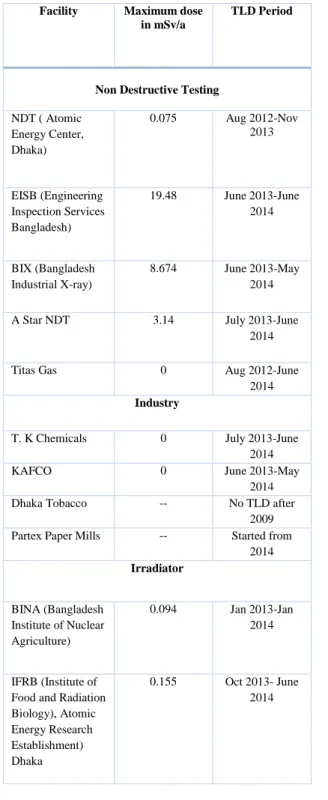
In this study we worked on total eleven facilities among which five were NDT, four were industries which use nucleonic gauge and two were irradiator facilities. The study was carried out by using the TLD data of three occupational worker/staff who works frequently in those facilities. Table 1 shows the facility name and the maximum occupational dose with dose measurement period.
Dose distributions of the workers from those NDT facilities are shown in Fig. 3. From the figure 3, there can be seen that among five NDT facilities the workers from three facilities EISB, BIX and A Star NDT are exposed much more than two other facility NDT, AEC and Titas Gas. Additionally, it has been
found that the workers of Titas Gas Company have zero value (i.e, 0.05 mSv/y) of dose. Within the mentioned period the radiation workers of Titas Gas Company, it is reported that they did not perform any repair and maintenance or other operation by using NDT techniques.
Table 1. Information on the facilities used for this
investigation
Fig.3. Occupational dose distribution in various facilities
Facility Maximum dose
in mSv/a
TLD Period
Non Destructive Testing
NDT ( Atomic Energy Center, Dhaka) 0.075 Aug 2012-Nov 2013 EISB (Engineering Inspection Services Bangladesh) 19.48 June 2013-June 2014 BIX (Bangladesh Industrial X-ray) 8.674 June 2013-May 2014
A Star NDT 3.14 July 2013-June
2014
Titas Gas 0 Aug 2012-June
2014
Industry
T. K Chemicals 0 July 2013-June
2014
KAFCO 0 June 2013-May
2014
Dhaka Tobacco -- No TLD after
2009
Partex Paper Mills -- Started from
2014 Irradiator BINA (Bangladesh Institute of Nuclear Agriculture) 0.094 Jan 2013-Jan 2014 IFRB (Institute of Food and Radiation Biology), Atomic Energy Research Establishment) Dhaka 0.155 Oct 2013- June 2014
Nizam et.al/Journal of Nuclear Sciences Vol 2 (1) (2015) 1-6
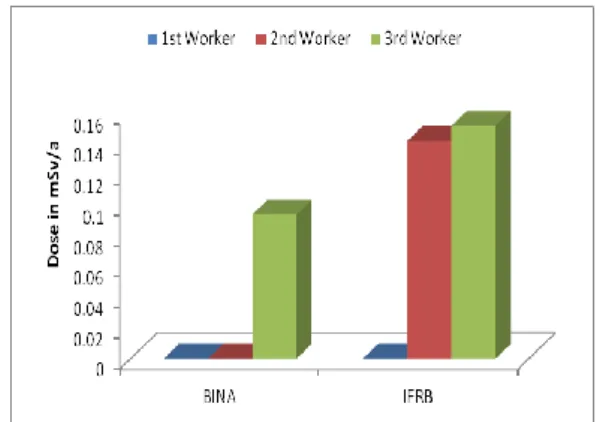
4 It is found that the workers from industrial facility have also zero doses. The occupational exposures from these sorts of industrial facilities remains at lower level compared to other facilities like NDT, Well logging etc. [12]. In nucleonic gauge facility the radiation source is usually kept in the well shielded system. Besides the low strength sources are utilized in nucleonic gauge. Therefore, the likelihood of having high exposure from these facilities is very low. But in case of irradiation facility we observe small amount of doses for the workers. The comparative dose distribution of the workers from two irradiation facility are shown in Fig. 4.
Since the received dose is dependent on personal protective equipment, it is necessary to present that equipment used by the above facilities in this regard. Table 2 shows the comparative presentation of personal protective equipment in the investigated
facilities
.
4. Conclusion
The annual received dose rate of the worker is high in the EISB, which is an NDT facility. This is due to the frequency of work by this facility is more than other facilities. Besides the personal protective equipment used by the worker in this facility is not sufficient. BIX and A Star NDT also have the frequent job in this field. That’s why the workers of these facilities have received more dose than other facility. These dose are also varying depending on the use of personal protective equipment. From Table 2 we see that BIX has the more effective shielding equipment compared to others.
Table 2. Protective equipment used by the
investigated facilities NDT Facility Protective Equipment used Industrial Facility Protective Equipment used NDT, AEC, Dhaka Emergency tongue ( Short) T. K Chemicals Emergency Tongue
Lead gloves Lead
gloves
Lead apron Lead apron
Lead Goggles Lead
Goggles Tungsten Collimator KAFCO Lead gloves
Lead Collimator Lead apron
Lead Sheet Lead
Goggles
EISB
Lead Apron Lead apron
Lead gloves Lead
Goggles Lead goggles Partex Paper Mills Lead gloves
Lead container Lead apron
Isotope Handling tongue Lead Goggles Collimator Irradiator BIX Emergency tongue (Long and Short)
BINA
Emergency Tongue
Lead gloves Lead
gloves
Lead apron Lead apron
Lead Goggles Lead
Goggles Tungsten
Collimator IFRB, AERE,
Dhaka
Lead apron
Lead Collimator Lead
Goggles Lead Sheet Beacon/Bleeper A Star NDT Lead Apron Lead gloves Lead goggles Isotope Handling tongue Collimator Titas Gas Emergency tongue (Long and Short) Lead gloves Lead apron Lead Goggles Lead hood Lead Collimator
Fig.4. Dose distribution for radiation workers worked in irradiation facilities
Fig.3. Occupational dose distribution in various facilities
On the other hand the industrial facility which use nucleonic gauge used low strength radioisotope and the worker in these facilities does not work too closely with the source. That’s why the worker from these facilities is safer than other facilities. In case of irradiation facility we see that IFRB staffs are exposed more dose than BINA. The comparative dose rate for the worker in NDT and Industrial (nucleonic gauge and irradiator) facility is shown in Fig. 5.
If we compare the occupational exposures among three kinds of facilities (NDT, Nucleonic Gauge and Irradiator), the occupational workers receive much more doses who work in NDT facilities compared to other two kinds of facilities which is shown in Fig. 5. This is because high strength sources are utilized in NDT operation. Apart from these, NDT operations are carried out at offsite, the radiation worker sometimes does not utilize personal protective devices which could contribute more radiation doses to the worker. Similar outcome have been emerged from the other research work [13]. From this study it is clear that no worker exceeds the limit of occupational exposure which is 20 mSv/a set by the IAEA [12] and BAERA (NSRC Rules-1997). But according to ALARA (As Low As Reasonably Achievable) principle workers who get higher doses compared to others should try to lower their dose level. Lowering dose level will help the workers to avoid deterministic effect and decrease the probability of stochastic effect [14].
So from the above study it is clear that authority of NDT facilities should take more care for their radiation worker or staff and the staff that are already highly exposed should be removed from the radiation related work. All the facility should maintain proper radiation safety rules. BAERA can take into account this study for further step in this regard. This work can also be used as baseline data for future monitoring in this field by the BAERA.
Acknowledgement
Authors are grateful to Bangladesh Atomic Energy Regulatory Authority and Health Physics Division, Atomic Energy Centre, Dhaka for helping with proper data of the interested facility. Authors are also
grateful to Nazia Hoque Chowdhury for
improvement of the manuscript. 5. References
[1] World Health Organisation. “Ionising Radiation in our Environment
http://www.who.int/ ionizing_radiation/env/en/. (Accessible on: 08.06.2010)
[2] ICRP Publication 103. “The Recommendations of the International Commission on Radiological Protection”. Annals of the ICRP; 37 (2-4). Oxford: Pergamon Elsevier; 2007.
[3] Covens P, Berus D, Buls N, Clerinx P, Vanhavere F. “Personal Dose Monitoring in Hospitals: Global Assessment, Critical Applications and Future Needs”. Radiat. Prot. Dosim. 124(3). 250–259 (2007).
[4] International Commission on Radiological Protection. “General Principle for the Protection of Workers”. ICRP Publication 75, Pergamon Press, Oxford (1997).
[5] A.N. Al-Haj, C.S. Lagarde, “Statistical analysis of historical occupational dose records at a large medical center”. Health Phys. 83. 854-860 (2002). [6] Faiz M. Khan. "The Physics of Radiation Therapy". Lippincott Williams & Wilkins (2003). [7] “User’s Instruction Guide Individual Monitoring Service by TLD”. Health Physics Division Atomic Energy Centre, Dhaka; 4 Kazi Nazrul Islam Avenue, Ramna, Dhaka-1000 Bangladesh Atomic Energy Commission; May 2012
(http://www.baec.org.bd/baec/aecd/IMS_TLD.pdf) [8] Product Specifications;
https://jrtassociates.com/pdfs/tld_4500.pdf
[9] IAEA-TECDOC-1344. “Categorization of radioactive sources; Revision of IAEA-TECDOC-1191, Categorization of radiation sources”. International Atomic Energy Agency; July 2003. [10] Safety Guide No. RS-G-1.9. “Categorization of Radioactive Sources”. International Atomic Energy Agency. VIENNA, 2005.
Fig.5. Occupational dose rates in different facilities
Nizam et.al/Journal of Nuclear Sciences Vol 2 (1) (2015) 1-6
6 [11] Webster, E.W. “EDE for exposure with protective aprons”.Health Phys., 56:568-569, (1989).
[12] Sanaye SS, Baburajan S, Pawar SG, Nalawade SK, SapraBK.”Occupational exposures in industrial application of radiation during 1999-2008”. RadiatProt Environ., 35:17-21 (2012).
[13] Noriah Mod Ali. “Evolution of radiation protection trends-the Malaysian Perspective”. Progress in nuclear science and technology, 1: 14-19 (2011).
[14] SAFETY SERIES No. 115. “International Basic Safety Standards for Protection against Ionizing Radiation and for the Safety of radiation Sources”. International Atomic Energy Agency; VIENNA, 1996.