
199
AUJES Adiyaman University Journal of Educational Sciences
ISSN:2149-2727
DOI: http://dx.doi.org/10.17984/adyuebd.413369
Altıncı Sınıf Öğrencilerinin Hücre Konusundaki Bilgi Farkındalıkları
İle Kavram Yanılgılarının Dört Aşamalı Test İle Belirlenmesi
Hüseyin Cihan BOZDAĞ1*, Gökçe OK2
1 Milli Eğitim Bakanlığı, Gazi Ortaokulu, Buca, İzmir
2 Dokuz Eylül Üniversitesi, Buca Eğitim Fakültesi, Biyoloji Eğitimi Anabilim Dalı, İzmir
MAKALE BİLGİ ÖZET Makale Tarihçesi: Alındı 06.04.2018 Düzeltilmiş hali 08.01.2019 Kabul edildi 22.02.2019 Çavrimiçi yayınlandı 30.06.2019 Makale Türü: Araştırma Makalesi
Bu araştırmada altıncı sınıf öğrencilerinin hücre bölünmeleri konusundaki bilgi farkındalıkları ile sahip oldukları kavram yanılgılarının belirlemesi amaçlanmıştır. Araştırma, İzmir şehir merkezindeki bir devlet okulunda öğrenim gören 388 (184’ü kız, 204’ü erkek) ortaokul öğrencisi ile yürütülmüştür. Öğrencilerin hücre konusundaki bilgi farkındalıkları ile kavram yanılgılarının tespitinde Hücre Kavramsal Ölçme Aracı (HKÖA) kullanılmıştır. Verilerin analizinde ise betimsel istatistik tekniklerinden yararlanılmıştır. Elde edilen bulgular, öğrencilerin hücre konusunda düşük kavramsal bilgi düzeyine sahip olduklarını göstermiştir. Diğer yandan öğrenci yanıtlarının güven düzeylerine dayalı analizi neticesinde öğrencilerin bilimsel gerçeklerle uyuşmayan kavramlara kendilerinden emin şekilde yanıt verdiği belirlenmiştir. Bu bağlamda dördü güçlü düzeyli, altısı orta düzeyli olmak üzere on kavram yanılgısı tespit edilmiştir. Sonuç olarak, belirlenen kavram yanılgıları içerisinde yer alan güçlü düzeyli yanılgıların varlığı öğrencilerin bilişsel yapısına daha sıkı tutunan kavram yanılgılarının bulunduğuna işaret etmektedir.
© 2019AUJES. Tüm hakları saklıdır Anahtar Kelimeler: Altıncı Sınıf, Bilgi Farkındalığı, Dört Aşamalı Test, Hücre, Kavram Yanılgısı
Geniş Özet Amaç
Bireysel yaşantılar yoluyla bilişsel yapıya tutunarak yeni bilgi ve becerilerin edinilmesine engel olan, bilimsel görüşler ile uyuşmayan bilgiler kavram yanılgısı olarak nitelendirilmektedir (Baki, 1999; Hasan, Bagayoko ve Kelley, 1999; Wessel, 1999). Temel kavramlarının birçoğunun soyut içeriğe sahip olması nedeniyle Fen Bilimleri kavram yanılgılarının gözlendiği alanların başında gelmektedir. Kavram öğretiminde öğretmenlerin en çok zorlandığı ve kavram yanılgılarının sıklıkla gözlendiği fen konularından birisi de “hücre” konusudur (Ecevit ve Şimşek, 2017; Güneş ve diğer., 2010). Fen dersinin temel konularından biri olan hücre konusu farklı eğitim kademelerinde öğrenciler için soyut ve anlaşılması zor kavramlardan birisi olarak kabul edilmektedir (Dreyfus ve Jungwirth, 1988;
*Sorumlu yazarın adresi: Milli Eğitim Bakanlığı, Gazi Ortaokulu, Buca, İzmir
Flores, Tovar ve Gallegos, 2003; Kawalkar ve Vijapurkar, 2009; Köse, 2014). Kavram yanılgılarının teşhisinde mülakat, kavram haritaları sözcük ilişkilendirme testleri, çizim, kavram karikatürleri kullanılsa da sıklıkla çoktan seçmeli testler tercih edilmektedir (Peşman ve Eryılmaz, 2010; Tan ve diğer., 2002; Taşlıdere, 2016; Uğur, 2010). Çoktan seçmeli testler zaman içinde gerekçe ve güven aşamalarının eklenmesiyle iki, üç ve dört aşamalı olarak geliştirilmiştir. Ancak hücre konusundaki kavram yanılgılarının teşhisinde çoğunlukla çoktan seçmeli ve açık uçlu testler ile mülakatlar (Gençer, 2006; Kawalkar ve Vijapurkar, 2009; Tambo, Mukaro ve Mahaso, 2003) tercih edilmektedir. Diğer yandan hücre konusunda dört aşamalı testlerin kullanımına ilişkin bir çalışmaya ise rastlanılmadığından yürütülecek çalışmanın bu alandaki boşluğu dolduracağı düşünülmektedir. Bu bağlamda, yürütülen çalışmanın temel amacı, altıncı sınıf öğrencilerinin hücre bölünmeleri konusundaki bilgi farkındalıkları ile sahip oldukları kavram yanılgılarının belirlemektir.
Yöntem
Araştırmada altıncı sınıf öğrencilerinin hücre konusundaki bilgi farkındalıkları ile sahip oldukları kavram yanılgıları incelendiğinden tarama modeli benimsenmiştir. Araştırmanın çalışma grubunu, 2017-2018 eğitim- öğretim yılında İzmir şehir merkezindeki bir devlet ortaokulunun altıncı sınıfında öğrenim gören 184’ü kız (%47.4) ve 204’ü erkek (%52.6) olmak üzere rastgele seçilen toplam 388 öğrenci oluşturmaktadır. Veri toplama aracı olarak onaltı sorudan oluşan Dört Aşamalı Hücre Kavramsal Ölçme Aracı (HKÖA) kullanılmıştır. Testin tamamına yönelik analiz sonuçlarına göre ortalama güçlük indeksi .39 ve ayırt edicilik indeksi .72 olarak hesaplanmıştır. Cronbach alpha güvenilirlik katsayısı ise bir aşama, iki aşama, üç aşama ve dört aşama için sırasıyla .72, .86, .89 ve .90 olarak belirlenmiştir. Bunun yanı sıra ölçme aracının yapı geçerliği yönünden cevap ve gerekçe aşamalarında verilen yanıtlardan ne derece emin olunduğunun belirlenmesi gerekmektedir (Caleon ve Subramaniam, 2010b; Kaltakçı, 2012). Bu doğrultuda cevap ve gerekçe aşamalarından alınan puanlar ile güven aşamalarından alınan puanlar arasındaki ilişki Pearson momentler çarpımı korelasyon katsayısı ile araştırılmış olup değişkenler arasında pozitif, orta düzeyli ve anlamlı bir ilişki olduğu belirlenmiştir.
Bulgular
Çalışma sonucu elde edilen veriler incelendiğinde, öğrencilerin kavramsal anlama düzeylerinin aşama sayısı arttıkça belirgin şekilde azaldığı (bir aşama: %52, iki aşama: %40, üç aşama: %36 ve dört aşama: %33) belirlenmiştir. Öğrencilerin yalnız %33’lük kısmının teste doğru yanıt vermesi hücre konusunda düşük kavramsal anlama düzeylerinin bulunduğuna göstermektedir. Buna ek olarak testin genelinde öğrencilerin %60’ı verdikleri yanıtlardan emin olmasına karşın yalnızca %33’ünün doğru yanıt vermesi, yanlış
201
yanıtlarından da emin olan öğrencilerin varlığına diğer bir değişle kavram yanılgılarına işaret etmektedir. Diğer yandan dört aşamalı testin cevap ve gerekçe aşamaları farklı bilgi düzeyini ölçebileceğinden ayrı birer soru olarak algılanabilmektedir (Caleon ve Subramaniam, 2010b; Griffard ve Wandersee, 2001; Tsai ve Chou, 2002). Bu nedenle güven düzeylerine yönelik biribiri ile ilişkili Güven Ortalaması (GO), Doğru Cevap Güven Ortalaması (DGO), Yanlış Cevap Güven Ortalaması (YGO) ve Güven Ayrım Oranı (GAO) değişkenlerine yönelik hesaplamalar yapılmıştır. Güven aşamalarına verilen yanıtlar “1”-“6” arasında puanlandırıldığından güven düzeyinin (GD) net belirlenebilmesi için eşik değer “3.5” olarak kabul edilerek puanlama yapılmıştır. Buna göre “GD<3.5” halinde düşük güven düzeyi, “GD>3.5” halinde ise yüksek güven düzeyi şeklinde değerlendirme yapılmıştır. Elde edilen sonuçlar öğrencilerin yüksek güven düzeyi eşliğinde sorulara yanıt verdiğini göstermektedir. GAO değişkeni öğrencilerin bildikleri ile bilmediklerini ayırt edip edemediklerini ifade eden bir göstergedir. Pozitif GAO; doğru yanıt veren ve yanıtlarına yönelik yüksek güven düzeyine sahip öğrencilerin varlığını, negatif GAO ise yanlış yanıt veren ancak verdikleri yanıtların doğruluğuna yönelik yüksek güven düzeyine sahip öğrencilerin varlığını ifade etmektedir. Buna göre testin genelinden elde edilen sonuçlar, 4, 7, 10 ve 13.sorularda yanlış yanıt veren ve yanıtlarının doğruluğundan emin olan öğrencilerin daha fazla olduğuna işaret etmektedir.
Kavram yanılgılarının teşhisi aşamasında HKÖA’ndaki her bir sorudaki çeldiriciler ayrı ayrı değerlendirilmiştir. Bunun yanı sıra kavram yanılgılarını güven düzeyi ortalamalarını da dikkate alarak; GO değeri üç buçuk üzerinde olanlar (GO>3.5) “Gerçek Yanılgı” ve GO değeri üç buçuk ve altında olanlar (GO≤3.5) “Suni Yanılgı” şeklinde iki grupta incelenmiştir. Ayrıca gerçek yanılgılarda kendi içinde “Güçlü Yanılgılar” (GO≥4.0) ve “Orta Düzeyli
Yanılgılar” (3.5<GO<4.0) olmak üzere iki alt gruba ayrılmaktadır. Sonuç olarak elde edilen
bulgular ışığında on farklı kavram yanılgısı teşhis edilmiştir. Buna göre; “Bitki hücresi yuvarlak,hayvan hücresi köşeli yapıdadır.(KY1; %15)”, “Hücre duvarı hücre zarı ile birlikte esnek yapılıdır. (KY5; %10)”, “Hücrede sindirim, solunum, boşaltım gibi yaşamsal olaylar çekirdekte gerçekleşir. (KY6; %10)” ve “Mitokondri büyük moleküllü besinleri parçalama görevi yürütür. (KY9; %11)” kavram yanılgıları Güçlü Yanılgı kategorisinde, “Çekirdek içermeyen gelişmiş canlılarda hücre iki kısımdan oluşur.(KY2; %16)”, “Bitki hücrelerinde hücre zarı varken hayvan hücrelerinde bulunmaz. (KY3; %10)”, “Hücrede enerji üretiminden endoplazmik retikulum sorumludur. (KY4; %10)”, “Hücre zarı ve hücre duvarı seçici geçirgendir. (KY7; %11)”, “Hücre zarı ve hücre duvarı koruyucu özellikleri nedeniyle sert yapılıdır. (KY8; %11)” ve “İlkel ya da gelişmiş tüm hücreler çekirdek içerir. (KY10; %19)” kavram yanılgıları ise Orta Düzeyli Yanılgı kategorisinde değerlendirilmiştir.
Tartışma ve Sonuç
Çalışmadan elde edilen veriler değerlendirildiğinde, öğrencilerin hücre konusunda düşük kavramsal anlama düzeyine sahip oldukları ile konu hakkında doğru ve yanlış bilgiyi net olarak ayırt edemedikleri sonucuna ulaşılmıştır. Öğrencilerin verdikleri yanıtlarına ilişkin güven düzeyleri doğru ve yanlış bilginin doğruluğuna olan bağlılıklarını, dolayısıyla bilgi farkındalıklarını ifade etmektedir. Doğru bilgiyi yanlış bilgiden ayırt edebilen öğrenciler bilimsel bilgiye sahip oldukları yönünde değerlendirilmiştir. Bunun aksine öğrenciler arasında doğru bilgiye olduğa kadar yanlış bilginin de doğruluğundan oldukça emin olan öğrencilerin varlığı ise kavram yanılgılarına işaret etmektedir. Araştırma sonucunda ulaşılan veriler de öğrenciler arasında belirgin kavram yanılgılarının bulunduğunu göstermiştir. Verilen yanıtlar, bu yanıtlara dayalı güven düzeylerine yönelik elde edilen veriler ile birlikte değerlendirildiğinde dördü güçlü düzeyli, altısı orta düzeyli olmak üzere on kavram yanılgısı belirlenmiştir. Dolayısıyla belirlenen kavram yanılgıları içerisinde yer alan güçlü düzeyli yanılgıların varlığı öğrencilerin bilişsel yapısına daha sıkı tutunan kavram yanılgılarının bulunduğu sonucunu beraberinde getirmiştir. Bu durum, kavram yanılgılarının öğretim aşamalarında dikkate alınması gerektiği yönünde değerlendirilebilir. Bu bağlamda çalışma sonucunda ulaşılan sonuçlar uyarınca şu önerilere yer verilebilir.
Çok aşamalı çoktan seçmeli testlerin kavram yanılgılarının teşhisinde kullanımının yaygınlaştırılması ile elde edilen tüm verilerin birlikte değerlendirilmesi daha net sonuçlara ulaşılmasını mümkün kılabilir.
HKÖA ilköğretim ve ortaöğretim düzeyinde hücre konusundaki kavram yanılgıları, bilgi farkındalıkları ve kavramsal anlama düzeyini belirlemede kullanılabilir.
Çalışma kapsamında hücre konusundaki kavram yanılgıları belirlenmiş olup; bundan sonraki çalışmalarda, bu çalışmada ve alanyazındaki diğer çalışmalarda belirlenen kavram yanılgılarının nedenlerinin belirlenmesine ve/ve ya giderilmesine çalışılabilir.
Hücre gibi soyut içeriğe sahip konularla ilgili alanyazında belirlenen kavram yanılgılarının takip edilmesi, kavram yanılgılarının önlenmesine yönelik yöntem, teknik ve stratejilerin belirlenmesinde yol gösterici olacaktır.
Kavram yanılgılarının öğretim basamaklarındaki kilit rolü düşünüldüğünde öğretim faaliyetlerini yürütenlerin bilinçlendirilmesi önem arz etmektedir.
Gerek üniversite düzeyinde ders içeriklerine kavram yanılgılarının dahil edilmesi, gerekse öğretmenlerin bu konuda bilgilendirilmesi amacıyla hizmet içi eğitimlerin düzenlenmesi gerekmektedir.
203
ADYÜEBD Adıyaman Üniversitesi Eğitim Bilimleri Dergisi
ISSN:2149-2727
DOI: http://dx.doi.org/10.17984/adyuebd.413369
Determination of the Knowledge Awareness and Misconceptions of
Sixth Grade Students about the Cell With Four Tier Test
Hüseyin Cihan BOZDAĞ1*, Gökçe OK2
1Ministry of Educaton, Gazi Middle School, Buca, İzmir
2Dokuz Eylul University,Buca Faculty of Education, Department of Biology Education, Izmir
AR T I C L E I N F O A B ST R A C T Article History: Received 06.04.2018 Received in revised form 08.01.2019 Accepted 22.02.2019 Available online 30.06.2019 Article Type: Research Article
In this study, the purpose is to determine the misconceptions and knowledge awareness of sixth grade students about the cell by using four tier Cell Conceptual Measuring Tool (CCMT). The study was conducted with 388 (184 female and 204 male) students studying at a state middle school in Izmir city center. In the analysis of the data, descriptive statistical techniques were used. According to the results obtained, it was determined that the students had low conceptual understanding rates about the cell. In the other hand, it has been determined that students respond confidently to concepts that are incompatible with scientific facts as a result of analysis of student responses based on confidence levels. In this context, ten different misconceptions have been identified, four of them are strong-level and six are intermediate-level. As a result, the presence of strong-level misconceptions within the identified misconceptions indicates that there are misconceptions which are more tightly adhered to the cognitive structure of the students.
© 2019AUJES. All rights reserved Keywords:Four Tier Test, Knowledge Awareness, Misconception, Sixth Grade, The Cell
Introduction
Individuals, since the first years of life, to make sense of the world around them, construct many concepts by creating cognitive models (Allen, 2014). But sometimes they prefer to construct related concepts meaningfully in their own way. Some of these (preliminary) information structured prior to formal education often does not correspond to scientific facts. Therefore, individuals come to school with these preliminary information (Allen, 2014; Duit and Treagust, 2003; Treagust, 1988; Wessel, 1999). In the literature; for these preliminary information, different terms such as naive knowledge (Klopfer, Champagne and Gunstone, 1983), pre-concept (Hashweh, 1988), alternative structure (Pfundt and Duit, 1991), alternative concept (Driver and Easley, 1978; Trowbridge and Mintzes, 1985), children's science (Osborne and Freyberg, 1985), alternative framework (Watts, 1981; 1983), alternative view (Stewart and Dale, 1990) and misconception (Helm, 1980) are used.
*Corresponding author’s address: Ministry of Education, Gazi Middle School, Buca, İzmir
In the literature, the term of “misconception” is the most preferred term among these terms. Misconceptions are considered as information that prevents the acquisition of new knowledge and skills by clinging to the cognitive structure through individual experiences and as information incompatible with scientific opinions (Baki, 1999; Hasan, Bagayoko and Kelley, 1999; Wessel, 1999).
One of the objectives of the science course is to make students make sense of the concepts fully and correctly. Since basic science concepts form the basis of advanced concepts, it is extremely important to learn these concepts in a meaningful way for an adequate science education (Çepni, Ürey and Çil, 2009). However, most of the basic science concepts have abstract content. In this respect, science is one of the areas where misconceptions are frequently encountered. One of the science subjects in which the teachers have the most difficulty and misconceptions are frequently observed in concept teaching is the subject of “cell” (Ecevit and Şimşek, 2017; Güneş et al., 2010). The subject of cell, which is one of the basic subjects of science course, is considered as one of the abstract and difficult concepts to understand for students at different educational levels (Dreyfus and Jungwirth, 1988; Flores, Tovar and Gallegos, 2003; Kawalkar and Vijapurkar, 2009; Köse, 2014). Therefore, diagnosing the knowledge levels and misconceptions of the students regarding the cell are important. Many studies conducted in recent years in the field of cell may be classified as determination of misconceptions in different teaching levels (Cavas and Kesercioglu, 2010; Kawalkar and Vijapurkar, 2009; Dreyfus and Jungwirth, 1988; Hailegebriel, 2014; Tambo, Mukaro and Mahaso, 2003; Gençer 2006), determination of conceptual knowledge level (Yüce, Önel and Bekis, 2016; Taştan Kırık and Kaya, 2014; Önel, Yüce and Yeşilyurt, 2015a; 2015b), analysis of effective teaching method techniques on learning (Köse, 2014; Çepni, Ürey and Çil, 2009; Ormancı and Balim, 2016; Kaynar, 2007; Yakisan, 2008; Guler, 2011; Furkan, 2016) to develop tools for the diagnosis of misconceptions (Tsai and Chou, 2002; Gençer, 2006).
Due to the fact that its microscopic structure is difficult to revive in the mind, the cell subject is considered as a difficult concept to be understood by the students in different grade levels (Taştan Kırık and Kaya, 2014; Önel et al., 2015a). Therefore, many misconceptions have been identified in different class levels related to cell subject in the literature. The most common misconceptions in the cell have been observed in the concepts regarding the differences in plant and animal cells. For example, it is the most common misconception that animal cells contain a cell wall (Cavas and Kesercioğlu, 2010; Hailegebriel, 2014; Taştan Kırık and Kaya, 2014; Önel et al., 2015a, 2015b; Yüce, Önel and Bekis, 2016). Besides, misconceptions such as that plant cells contain centrosome (Gençer, 2006; Taştan Kırık and Kaya, 2014; Köse, 2014) or animal cells contain chloroplasts (Gençer, 2006; Taştan Kırık ve Kaya, 2014; Köse, 2014; Köse, 2014; Önel et al., 2015a, 2015b) have also been identified. As a matter of fact, the findings of the study suggesting that the presentation of the cell subject in the form of plant and animal cells will cause learning obstacles (Clément, 2007) indicate that it is possible to determine misconceptions in this way. On the other hand, the structures where vital events such
205 as respiration, digestion and excretion occur in the cytoplasm in the cell are called organelles. The structure, function and cell type of each organelle may be similar or different. However, as seen in many studies, it has been identified that the students have views incompatible with the scientific information; such as that all the cells contain the same organelles (Hailegebriel, 2014), mitochondria are found only in a plant or only in an animal cell (Gençer, 2006; Köse, 2014), mitochondria, centrosomes or chloroplast organelles are responsible for protein synthesis (Köse, 2014). As it is known, the smallest unit of the living creature that shows vitality is defined as cell. On the other hand, while misconceptions in the definition tier of the cell are encountered among the students (Gençer, 2006; Kawalkar and Vijapurkar, 2009), misconceptions in the drawing tier of the basic cell form (Hasiloglu and Eminoglu, 2017; Kawalkar and Vijapurkar, 2009; Tambo, Mukaro and Mahaso, 2003) have also been observed. In addition, misconceptions such as that the cell is the smallest structure unit of only plant or only human (Gençer, 2006), the cells just fill the inside of living creature instead of creating the body of it (Dreyfus and Jungwirth, 1988; Kawalkar and Vijapurkar, 2009) or the cells are made up of tissues (Cavas and Kesercioglu, 2010) have also been observed.
Misconceptions are likened to the short-circuiting wires since they disrupt the meaning unity between the concepts (Bahar, 2003). From this respect, they are seen as barriers that prevent meaningful and permanent learning (Allen, 2014; Davis, 1997). Therefore, it is important to determine the misconceptions as soon as possible because they put up resistance against the acquisition of new information (Hasan, Bagayoko & Kelley, 1999; Hermita et al., 2017). Even though interviews, concept maps, word association tests, drawing, concept cartoons are frequently used in the identification of misconceptions, multiple choice tests are preferred frequently (Peşman and Eryılmaz, 2010; Tan et al., 2002; Taşlıdere, 2016; Uğur, 2010). However, multiple-choice tests are inadequate to distinguish between the students giving the correct answer consciously and the ones giving the correct answer by luck. Eventually, this deficiency has been tried to be remedied by adding the reasoning tier in which the reason for the answer has been questioned (Treagust, 1985). As for two-tier tests designed in this way, the fact that the wrong answerers to both two-tiers are evaluated in terms of misconception leads to ambiguity. This ambiguity has been tried to be eliminated by adding a third tier (confidence tier) regarding to what extent the answerers feel confident about the answers given (Caleon and Subramaniam, 2010a; Hasan, Bagayoko and Kelley, 1999). However, the study findings that the participants could evaluate the tiers of question and reason as separate questions and that the level of confidence could therefore be different for each tier have required the addition of a second tier of confidence to the three-tier tests (Caleon and Subramaniam, 2010b; Griffard and Wandersee, 2001; Hermita et al., 2017; Kaltakci, 2012). Therefore, in four-tier tests that have replaced the three-tier tests, which have often been preferred in recent years, there are separate tier of confidence for both question and reason tiers. Therefore, the increase in the number of tiers in multiple-choice tests has brought more detailed analysis results as well (Kaltakçı, 2012).
Although the use of four-tier tests in the identification of misconceptions in science education has increased in recent years (Hermita et al., 2017; Kaltakçı, 2012; Kaltakçı Gürel, Eryilmaz and McDermott, 2015; 2017; Sreenivasulua and Subramaniam, 2013; Taşlıdere, 2016), in the identification of misconceptions about cell; multiple-choice tests, open-ended tests and interviews (Gençer, 2006; Kawalkar and Vijapurkar, 2009; Tambo, Mukaro and Mahaso, 2003) are preferred mostly. Besides, there is no study on the use of four-tier tests on the cell. In addition; the fact that the study findings, where misconceptions that have been identified based on the multiple-choice test answers and the level of confidence analyses on the basis of tiers have been evaluated together, are limited has formed the other starting point of the study. Therefore, in order to determine the knowledge awareness and misconceptions of the sixth grade students about cell, the four-tier “Cell Conceptual Measurement Tool (CCMT)” has been used. In this context, the main aim of the study is to determine the knowledge awareness and misconceptions of the sixth grade students about the cell.
Method Research Model
In the research, the screening model has been adopted since the sixth grade students' cell knowledge awareness and misconceptions are examined. Screening models are arrangements made in a universe composed of many elements on a whole universe or a group to be taken from it in order to make a general judgement about the universe (Karasar, 2009).
Study Group
The study group consisted of 388 students randomly selected as 184 girls (47.4%) and 204 boys (52.6%) in the sixth grade of a state secondary school in İzmir city centre in 2017-2018 school year. In the study, for the choice of sampling to represent the universe, random choice was used among the students with similar characteristics in terms of socio-economic characteristics. The most important feature of this sampling method is that all units in the universe have an equal and independent chance to be selected for the sample (Büyüköztürk et al., 2014).
Data Collection Tool
In order to determine the cell knowledge awareness and misconceptions of the sixth grade students, the four-tier CCMT has been used in accordance with the achievements in the science curriculum (Ministry of Education, 2013). In the preparation of the measuring tool; studies in literature, textbooks, interviews with course teachers, students' opinions in class and their answers in written exams were taken into consideration. The conceptual measuring tool consists of four tiers of multiple choice sixteen questions. The first tier consists of three multiple choice options with the correct answer with distractors, including possible misconceptions. The second tier is the tier of confidence regarding to what extent the students are confident about their answers they gave in the first tier. The third tier consists of three-choice multiple choice options where the students provide reasoning for their
207 answers given at the first tier. In addition to these, in case the students cannot find the appropriate reasoning for them, there is a blank space in which they can express their reasons. The fourth tier is the second tier of confidence regarding to what extent the students are confident about their answer they have given in the third tier. There are six options which are rated between “1”and “6” in the confidence tier respectively, “Just guess”, “I'm not too sure”, “I'm not sure”, “I’m sure”, “I'm pretty sure” and “I'm absolutely sure”. In the preparation of the questions, achievements regarding cell subject in the curriculum of science course, the textbook, the questions prepared for determination the misconceptions in the literature, the suggestions of the course teachers and experts and the opinions of the students and the answers given in the written exams have also been used. By determining the data set of lower and upper groups 27% concerning the measuring tool, item difficulty of the first tier has been identified as ranging between .41-.71, discrimination of it between .32-.70; item difficulty of the two tiers between .31-.60, discrimination of it between .40-.81; item difficulty of three tiers between .24-.55, discrimination of it between .45-.88; ; item difficulty of four tiers between .23-.51, discrimination of it between .38-.95. It is recommended that the difficulty index of a test item be in the range of .20-.80 and the index of discrimination be greater than .30 (Alıcı et al., 2011). Therefore, it has been determined that it is appropriate according to the data obtained from the CCMT in terms of item difficulty and discrimination.
On the other hand, the Cronbach's alpha coefficient should be greater than .70 in order to be considered a reliable measuring tool (Büyüköztürk et al., 2014). The Cronbach alpha reliability of the conceptual measuring tool with sixteen questions has been determined as .72, .86, .89 and .90 for one tier, two tiers, three tiers and four tiers, respectively. According to these results, we can say that the four-tier CCMT has an assessment reliability. In addition to this, it is necessary to determine to what extent the students are confident about the answers given in the answer and reasoning tiers in terms of the construct validity of the measuring tool (Caleon and Subramaniam, 2010b; Kaltakçı, 2012). In this respect, the relationship between the points obtained from the answer and reasoning tiers and the points obtained from the confidence tiers has been researched with Pearson product-moment correlation coefficient. According to this; it has been identified that there have been positive, moderate and meaningful relationships between the answer tier and the confidence tier as r= .53; between reasoning tier and confidence tier as r= .55, between both answer and reasoning tiers and both two confidence tiers as r= .59. (p <0.01).
In addition, the point-biserial correlation coefficient has been calculated to indicate the relationship between the correct answers given to each test item in four tiers and the total points obtained from the test. Values greater than .20 are acceptable in point-biserial correlation; and the higher the value acquired is, the better the test item makes discrimination between the students with low points and the ones with high points (Wuttiprom et al., 2009). Also in the literature studies (Kirbulut and Geban, 2010; Peşman and Eryılmaz, 2010), there are study findings based on the data obtained in this direction. Consequently, the results of the analysis
indicate that all items of the measuring tool have values that are greater than .20 and acceptable (Table 1).
Table 1. Descriptive Statistics and Item Analysis Results for Four Tiers
Difficulty Index Discrimination
Index Point Biserial Correlation Mean .39 .72 .63 Number of Question (.20-.29) 3 Number of Question (.30-.39) 5 1 1 Number of Question (.40-.49) 7 1 1 Number of Question (.50-.59) 1 1 2 Number of Question (.60-.69) 3 8 Number of Question (.70-.79) 5 4 Number of Question (.80-.89) 3 Number of Question (.90-.99) 2
Number of Question = 16; N=388; Sd=4.67; Mean=5.35; α=.90
Collection And Analysis Of Data
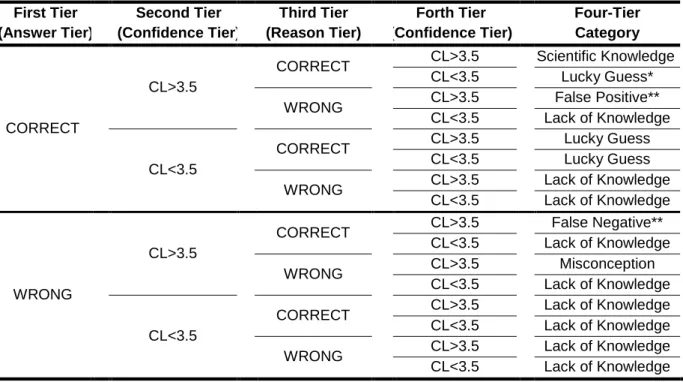
The responses obtained from the measurement tool were evaluated with descriptive statistical techniques and data analysis was performed with SPSS 22.0 and MS Office Excel programs. For the four-tier measurement tool, the categories to be used in scoring and evaluation are arranged by taking into consideration the criteria determined by Kaltakçı (2012). According to this, six categories are defined as Scientific Knowledge, Misconceptions, Lucky Guess, False Positive, False Negative, Lack Of Knowledge (Table 2).
Table 2. Scoring Categories First Tier (Answer Tier) Second Tier (Confidence Tier) Third Tier (Reason Tier) Forth Tier (Confidence Tier) Four-Tier Category CORRECT CL>3.5
CORRECT CL>3.5 Scientific Knowledge CL<3.5 Lucky Guess*
WRONG CL>3.5 False Positive**
CL<3.5 Lack of Knowledge
CL<3.5
CORRECT CL>3.5 Lucky Guess
CL<3.5 Lucky Guess
WRONG CL>3.5 Lack of Knowledge
CL<3.5 Lack of Knowledge
WRONG
CL>3.5
CORRECT CL>3.5 False Negative**
CL<3.5 Lack of Knowledge
WRONG CL>3.5 Misconception
CL<3.5 Lack of Knowledge
CL<3.5
CORRECT CL>3.5 Lack of Knowledge
CL<3.5 Lack of Knowledge
WRONG CL>3.5 Lack of Knowledge
CL<3.5 Lack of Knowledge
CL<3.5: “Just Guess”, “Not Too Sure”, “Not Sure” CL>3.5 ; “Sure”, “Pretty Sure”, “Absolutely Sure” * Evaluation is made in the "Lack of Knowledge" category in the literature.
209 In addition to this, the scoring to be used in data analysis in four-tier measurement tool is carried out by evaluating the correct-wrong answers and the responses to the confidence tiers together. In the scoring stage, the correct answers are encoded as “1” and the wrong answers as “0”. However, since responses to confidence tiers were scored between “1”and“6”, the threshold value was considered as “3.5” in order to determine the level of confidence (CL). Accordingly, it was evaluated as low confidence level in “CL<3.5” and high confidence level in “CL>3.5”. In the analysis phase, the low confidence level was encoded with 0 and the high confidence level with 1. The scoring categories determined in this direction can be summarized as follows:
Scientific Knowledge: It is the category determined as a result of four-tier
evaluation of the students' correct answers. When scoring through the correct answers, the correct answers in question and reason items in each question are coded as “1” and the wrong answers are coded as “0”. In this respect, if each of the question, reason and confidence tiers is coded with “1”, evaluation is made as scientific knowledge.
Misconception: It is the category determined for the students' wrong answers
in the question and reason tiers. When evaluating misconceptions, the wrong answers in question and reason items in each question item are coded as “1” and the correct answers are coded as “0”. In the analysis for the wrong answers, if each of the question, reason and confidence tiers is coded with “1”, evaluation is made as misconception.
Lucky Guess: Students can show a low level of confidence in the confidence
tiers, even if they respond correctly to the answer and reason tiers. In this respect, if each of the answer and reason tiers coded “1” and at least one confidence tier coded “0”, evaluation is made as lucky guess. Although this category is evaluated as lack of knowledge in the literature, it is thought that students should be evaluated in terms of reaching the correct answers in both tiers. In this direction, an assessment can be made in terms of they have reached the correct answer by chance.
False Positive: Accompanied by high leve of confidence, Students’ correct
responds for the answer tier and the wrong responds for the reason tier were coded as “1” and the others as “0”.
False Negative: Accompanied by high leve of confidence, Students’ wrong
responds for the answer tier and the correct responds for the reason tier were coded as “1” and the others as “0”.
Lack Of Knowledge: İf students responds low level confidence in the
alternative answers of the above-mentioned categories or if they had different levels of confidence (low-high, high-low) in the confidence tiers, assessment was made in the category of lack of knowledge.
Results
In this section, according to the data obtained from the measurement tool, sixth grade students' conceptual understanding rates, true / false knowledge awareness, misconceptions, false positive and false negative, lack of knowledge and lucky guess rates are given.
The conceptual level of understanding determined based on the correct answers of the students was calculated from one stage to four stages respectively. In addition, the level of confidence for each tier was calculated separately and together, as the levels of confidence could vary depending on the students' evaluation of the question and reason tiers as separate questions (Table 3).
Table 3. Conceptual Understanding And Confidence Level Analysis Results For Cell
Topic
According to the results of the analysis based on the correct answers of the students; as the number of tiers increases, there is a significant decrease in the level of conceptual understanding about the cell. According to this, the average level of conceptual understanding is 52% in one stage (one tier), while this ratio is 40%, 36% and 33%, respectively, in two, three and four stages. As the number of stages increases, this decrease is thought to be due to lack of knowledge, lucky guess or misconceptions. On the other hand, in the assessment of conceptual understanding level, 75% and above satisfactory, 50-74% range is sufficient, 25-49% range is low, and values below 25% point to low conceptual understanding level (Gilbert, 1977). Therefore, determination of the percentage of students who responded correctly to the test as 33%, indicating that there is a low level of understanding of the cell. On the other hand, while 52% of the students have reached the correct answer, it is observed that 66% of this students are sure about their answers. In addition, while the average of four-tier correct answers is 33%, the average of both confidence tiers is 60%. This indicates that 60% of the students are sure of all given answers throughout the test. In addition, the relationship between the correct answers in the
1 Tier 2 Tier 3 Tier 4 Tier CLP (%) CF CFC CFW CDQ CLP (%) CF CFC CFW CDQ CLP (%) CF CFC CFQ CDQ
1 60 51 45 43 73 4,28 2,91 1,37 0,91 76 4,37 2,89 1,48 0,84 68 4,32 2,58 1,11 0,94 2 54 40 36 34 64 3,96 2,39 1,57 0,49 65 3,96 2,31 1,66 0,38 58 3,96 2,16 1,42 0,48 3 62 50 42 39 75 4,34 2,85 1,49 0,84 71 4,19 2,71 1,48 0,73 69 4,27 2,40 1,12 0,85 4 52 39 29 24 69 4,08 2,22 1,86 0,23 60 3,81 1,74 2,07 -0,20 59 3,94 1,60 1,64 -0,03 5 73 64 58 54 78 4,62 3,66 0,96 1,66 77 4,59 3,41 1,18 1,39 74 4,60 3,29 0,85 1,61 6 55 40 37 33 66 4,02 2,35 1,67 0,40 60 3,87 2,34 1,54 0,45 59 3,94 2,12 1,38 0,45 7 37 25 23 22 51 3,59 1,59 2,00 -0,23 51 3,59 1,79 1,81 -0,01 47 3,59 1,47 1,67 -0,12 8 52 40 36 34 69 4,16 2,30 1,85 0,27 66 4,08 2,25 1,83 0,25 64 4,12 2,02 1,58 0,28 9 49 38 36 34 65 4,03 2,26 1,77 0,28 62 3,98 2,28 1,71 0,33 61 4,01 2,05 1,52 0,31 10 42 27 23 23 61 3,84 1,72 2,12 -0,23 57 3,73 1,87 1,87 0,00 55 3,79 1,51 1,72 -0,13 11 57 46 44 40 70 4,21 2,73 1,48 0,73 66 4,11 2,68 1,43 0,71 64 4,16 2,53 1,28 0,75 12 48 39 35 34 66 4,10 2,35 1,75 0,35 64 4,04 2,36 1,69 0,37 62 4,07 2,11 1,50 0,37 13 40 24 21 20 57 3,70 1,53 2,17 -0,38 61 3,78 1,74 2,05 -0,19 55 3,74 1,34 1,84 -0,32 14 49 38 36 34 57 3,80 2,21 1,59 0,36 54 3,66 2,29 1,37 0,52 51 3,73 2,04 1,27 0,46 15 48 36 32 29 59 3,86 2,16 1,70 0,26 54 3,65 2,09 1,56 0,29 52 3,76 1,87 1,36 0,30 16 57 44 39 37 68 4,19 2,69 1,49 0,69 63 4,07 2,65 1,42 0,68 62 4,13 2,36 1,19 0,69 MEAN 52 40 36 33 66 4,05 2,37 1,68 0,41 63 3,97 2,34 1,63 0,41 60 4,01 2,09 1,40 0,43
CLP(%) Confidence Level Percentage CF :Confidence Mean CFC: Correct Answer Confidence Mean CFW: Wrong Answer Confidence Mean CDQ: Confidence Discrimination Quotient (CFC-CFW/standard deviation of confidence)
211 four-tier test and the general confidence level in both confidence tiers is compared with the 2-D dot Plot graph (Graph 1).
Graph 1. Overall Confidence Level Comparison With Four-Tier Points
As the answer and reason tiers of a four-tier test can measure different levels of knowledge, it can be perceived as a separate question. In this case, confidence levels in answers and reason tiers may vary (Caleon ve Subramaniam, 2010b; Griffard ve Wandersee, 2001; Tsai ve Chou, 2002). For this reason, the confidence tiers were evaluated separately and together. In addition to this assessment, some related variables were calculated for confidence levels. These variables specified by Caleon and Subramaniam (2010b) can be summarized as follows:
Confidence Mean (CF): This express the confidence levels of the students. Correct Answer Confidence Mean (CFC): This Express the confidence
levels of students when they gave correct answers.
Wrong Answer Confidence Mean (CFW): This Express the confidence levels
of students when they gave wrong answers. Although the students in this group mark the wrong option, they are evaluating that they are responding correct to the questions in a cognitive level.
Confidence Discrimination Quotient (CDQ): The CDQ indicates whether the
students can discriminate between what they know and what they do not know (Caleon ve Subramaniam, 2010b). CDQ formulated as CFC-CFW/standard deviation of confidence (Sd). CDQ can receive positive or negative values. According to this, positive CDQ express the presence of students who respond correctly and have high levels of confidence in their responses and negative CDQ express the presence of students who respond wrongly and have high levels of confidence in their responses. Therefore, positive CDQ shows that students can distinguish the correct information about the concept, have knowledge awareness, and negative CDQ shows that they can not distinguish the correct information and the wrong information.
Variables related to confidence level were calculated for the overall test due to the four-tier structure of the CCMT (Table 3). According to this test, CF variable was determined as 4.01 on average. The threshold value was considered as “3.5” in order to determine the level of confidence (CL). Accordingly, it was evaluated as low
confidence level in “CL<3.5” and high confidence level in “CL>3.5”. Therefore, it can be said that students have a high level of confidence because the CF variable expresses a value higher than 3.5 on average and on each question basis. On the other hand, CFC and CFW values of the variables related to the knowledge awareness of the students were analyzed. According to this, the mean of the CFC variable was 2.09 and the mean of the CFW variable was 1.40. This result points to the fact that the students are more confident of the accuracy of their knowledge about the concepts of the cell, so that most students can distinguish the correct information. This result indicates that students are more confident about the accuracy of their knowledge about cell concepts, and that most students are able to distinguish the correct information. As a matter of fact, the CDQ variable, which is the indicator of this situation, has taken a positive value of 0.43 in the average throughout the test. Positive CDQ states that students can generally distinguish between the correct information and the wrong information. On the other hand, in terms of CDQ variables higher values were obtained in the 1.3.5,11 and 16.questions compared to other questions. In particular the highest CDQ value (1.61) was calculated in the 5th question. According to this, in the fifth question, in which the evaluation of the organization in a multicellular organism is requested, the majority of the students reached the correct answer and were very confident in their answers. In addition, when the data in Table 3 are examined, it is observed that the conceptual understanding and confidence rates of the fifth question have the highest value among all the questions in the overall test. Similarly, in the first question 0.94, in the third question 0.85, in the eleventh question 0.75 and in the sixteenth question 0.69, positive and conceptual understanding levels are high values were obtained. This can be considered as a result of the fact that the data obtained from the CDQ variable enables the determination of the conceptual understanding level.
On the other hand, the results obtained from the general test cannot be evaluated in the same way for each question. The most obvious indicator of this is that CDQ has taken negative values in 4th, 7th, 10th and 13th question. In these questions, the CFQ variable has taken values greater than the CFC variable. This suggests that students who respond incorrectly and are confident that their answers are correct. Therefore, it can be said that there is no awareness between the correct information and the wrong information in the related concepts. In addition, students ' confidence in the wrong answers indicates that they are holding on to the wrong concepts on the subject. These wrong concepts which are considered to be contrary to scientific facts are considered as misconception. Therefore, the identification of misconceptions that are considered to be present among students is important.
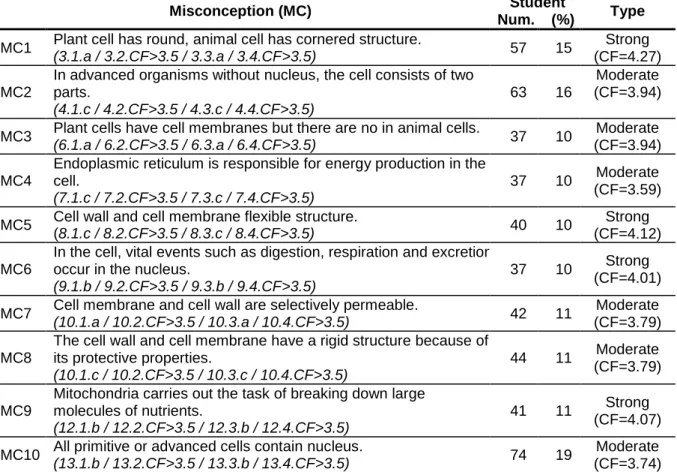
The distractors in each question in the CCMT were evaluated separately during the diagnosis of misconceptions. For example; The correct answer to the first question is ”A“ because the right answer in the answer and reasoning tiers is listed in the same option. In this case, the combination of four-tier correct answers consisting of answers-confidence-reason-confidence phases is “A”-“CL>3.5”-“a” - “CL>3.5”. Therefore, each of the combinations of “B”-“CL>3.5”-“B”-“CL>3.5” and “C”-“CL>3.5”-“C”-“CL>3.5” for incorrect answers represents misconceptions. It is stated that in the
213 diagnosis of misconceptions in the literature, misconceptions with 10% or more ratio will be accepted as meaningful (Caleon ve Subramaniam, 2010a; Tan ve diğer., 2002). In this case, ten misconceptions are identified (Table 4).
Table 4. Misconceptions and Types
Misconception (MC) Student
Num. (%) Type
MC1 Plant cell has round, animal cell has cornered structure.
(3.1.a / 3.2.CF>3.5 / 3.3.a / 3.4.CF>3.5) 57 15
Strong (CF=4.27) MC2
In advanced organisms without nucleus, the cell consists of two parts.
(4.1.c / 4.2.CF>3.5 / 4.3.c / 4.4.CF>3.5)
63 16
Moderate (CF=3.94)
MC3 Plant cells have cell membranes but there are no in animal cells.
(6.1.a / 6.2.CF>3.5 / 6.3.a / 6.4.CF>3.5) 37 10
Moderate (CF=3.94) MC4
Endoplasmic reticulum is responsible for energy production in the cell.
(7.1.c / 7.2.CF>3.5 / 7.3.c / 7.4.CF>3.5)
37 10 Moderate (CF=3.59) MC5 Cell wall and cell membrane flexible structure.
(8.1.c / 8.2.CF>3.5 / 8.3.c / 8.4.CF>3.5) 40 10
Strong (CF=4.12) MC6
In the cell, vital events such as digestion, respiration and excretion occur in the nucleus.
(9.1.b / 9.2.CF>3.5 / 9.3.b / 9.4.CF>3.5)
37 10 Strong (CF=4.01) MC7 Cell membrane and cell wall are selectively permeable.
(10.1.a / 10.2.CF>3.5 / 10.3.a / 10.4.CF>3.5) 42 11
Moderate (CF=3.79) MC8
The cell wall and cell membrane have a rigid structure because of its protective properties.
(10.1.c / 10.2.CF>3.5 / 10.3.c / 10.4.CF>3.5)
44 11 Moderate (CF=3.79)
MC9
Mitochondria carries out the task of breaking down large molecules of nutrients.
(12.1.b / 12.2.CF>3.5 / 12.3.b / 12.4.CF>3.5)
41 11 Strong (CF=4.07) MC10 All primitive or advanced cells contain nucleus.
(13.1.b / 13.2.CF>3.5 / 13.3.b / 13.4.CF>3.5) 74 19
Moderate (CF=3.74)
In addition, in Caleon and Subramaniam (2010b) studies, they divided misconceptions into two groups, taking into account confidence level averages. Accordingly, those with a CF value more than three and a half (CF> 3.5) for each misconception were evaluated as Genuine Misconception and those with a CF value less than three and a half (CF<3.5) were considered as Spurious Misconception. In addition, Genuine Misconceptions are divided into two subgroups, “Strong Misconceptions” (CF≥4.0) and “Moderate Misconceptions” (3.5<go<4.0). Therefore, misconceptions were grouped by evaluating them in terms of CF value (Table 4).
It is possible to collect misconceptions diagnosed in the cell in three sub-headings; comparison of plant and animal cells (MC1-MC3-MC5-MC7-MC8), basic parts of the cell (MC2-MC10) and cellular organelles (MC4-MC6-MC9). According to the results of analysis, the misconception rates are 10%-19%. In addition, four of the ten misconceptions (MC1-MC5-MC6-MC9) were evaluated in the group of strong misconceptions and others were evaluated in the group of moderate misconceptions according to the assessment made for CF variable. Therefore, it canbe said that there are misconceptions which are more tightly adhered to the cognitive structure of the students. In addition, as a result of the evaluation made in terms of the CFQ
variable, data were obtained on the 4th, 7th, 10th and 13th questions that the students could not distinguish the correct information from the wrong information. When the data obtained from the diagnosis of misconceptions and the data obtained from the CFQ variable were compared, in the same questions were found to be misconceptions. This situation can be considered that CFQ indicates the existence of misconceptions.
In addition, the misconceptions have been examined in the tiers of the four-tier structure of the CCMT (Graph 2).
Graph 2. Evaluation of misconceptions in four tiers
When graph 2 is examined, it is observed that the misconception rates were decreases significantly as the number of tiers increased. According to this, from one tier to four tiers, the mean of misconception is decreasing to 32%, 18%, 14% and 12%. This is indicate that the data obtained with the four-stage CCMT give clearer results. The most obvious of the misconceptions that have been diagnosed is the moderate misconceptions group (MC2-MC10) that are related to the basic parts of the cell. According to this, while the misconception “All primitive or advanced cells contain nucleus (MC10)” has a ratio of 19%, “In advanced organisms without nucleus, the cell consists of two parts (MC2)” has a ratio of 16%. Considering the correct answers to the thirteenth question (Table 3) in which the MC10 was diagnosed, it was observed that 55% of the students were confident in the overall test response, but only 20% of them reached the correct response. These results indicate the presence of a students group that is sure of the wrong answers in the 55% group. As a matter of fact, 19% of the students in this question were considered to have misconceptions. Similarly, in the fourth question where MC2 was diagnosed, 59% of the students were sure of the response, while 24% were evaluated at the level of scientific knowledge. The rest is evaluated in the category of misconceptions, lack of knowledge or lucky guess. As a matter of fact, the 16% of the group, who is sure of the wrong answer, was determined in the misconception group.
Another misconception group is a group of strong and moderate misconceptions about the comparison of plant and animal cells. In this group, the strong misconception which is consisting 15% of students is strong misconception
MC1 MC2 MC3 MC4 MC5 MC6 MC7 MC8 MC9 MC10 Mean 1 Tier 33 37 27 36 24 30 29 29 31 42 32 2 Tier 22 23 15 16 15 17 18 16 15 25 18 3 Tier 16 20 12 11 11 12 12 12 11 21 14 4 Tier 15 16 10 10 10 10 11 11 11 19 12 0 5 10 15 20 25 30 35 40 45 % P er ce nta g e
215 that "plant cell has round, animal cell has cornered structure (MC1)” is the most obvious misconception. On the other hand, 10% of the students have the opinion that “When cell membrane is present in plant cells, it is not found in animal cells (MC3)” (Figure 1). Besides, While, MC5 has a ratio of 10%, which indicates that the cell membrane and cell wall properties are greatly mixed, MC7and MC8 have a ratio of 11%. According to this, some of the students have the opinion that “Cell wall and cell membrane flexible structure (MC5)”,while some of them have the opinion that “The cell wall and cell membrane have a rigid structure because of its protective properties (MC8)”. On the other hand, a group of students has a misconception that ”Cell membrane and cell wall are selectively permeable (MC7).
Figure 1. Sample Question Items (MC1 [Question 3] and MC3 [Question 6])
Besides, misconceptions about cellular organelles have also been identified among students. According to this, 10% of the students have a moderate misconception in the form of “Endoplasmic reticulum is responsible for energy production in the cell (MC4)”. On the other hand, 11% of students have a strong misconception in the form of “In the cell, vital events such as digestion, respiration and excretion occur in the nucleus (MC6)”. Similarly another 11% of students have a strong misconception in the form of “Mitochondria carries out the task of breaking down large molecules of nutrients (MC9)”.
On the other hand, based on the data obtained by the CCMT, calculations were made on the categories of Lucky Guess, False Negative, False Positive and Lack of Knowledge (Table 5). In order for a test to be considered clear, understandable and valid, false positive and false negative rates should be less than 10% (Halloun ve Hestenes, 1995). Obtained values indicate the validity of the test. It is also possible to determine whether participants have achieved the correct answer by chance. The data obtained in this context indicate that 11% of the students achieved the correct answer by chance. On the other hand, about one third of the students have a lack of knowledge about the cell. The following are the questions in which the most lack of knowledge is observed among the students: 7. Question (49%), 14 questions (40%) and 9 questions (37%) regarding the functions of cellular organelles, 15. Question about the similarities and differences of plant and animal cells (39%), 16. Question about the structure of the plant cell (39%).
Table 5. Rates of False Positive, False Negative, Lack of Knowledge and Lucky Guess S1 S2 S3 S4 S5 S6 S7 S8 S9 S10 S11 S12 S13 S14 S15 S16 Mean False Positive 4 2 5 6 4 2 1 3 2 2 2 3 2 1 4 4 3 False Negative 4 2 4 1 2 3 3 3 3 4 2 2 4 3 2 4 3 Lack of Knowledge 28 35 24 34 21 31 49 32 37 37 29 33 36 40 39 29 33 Lucky Guess 8 12 12 14 10 15 10 9 9 12 12 9 13 12 11 12 11 Discussion
In this study, conceptual understanding rates, knowledge awareness and misconceptions of the sixth grade students regarding the cell have been examined. For this purpose, four-tier CCMT has been developed. The data obtained from the CCMT has showed that the students have had a low conceptual level of knowledge. According to this, the correct answer average is ranked as 52%, 40%, 36% and 33% from one tier to four tier at digressive rate. In addition to this, confidence level calculations have been made about the confidence level of the students in their answer and reasoning tiers. The obtained data shows that 66% of the students in the answer tier, 63% in the reasoning tier and 60% in the overall test are confident about their answers. Although 60% of the students in the test are confident about their answers, only 33% of them are evaluated at the scientific knowledge level, indicating the existence of students who are confident about their wrong answers. Students in this group are evaluated in the misconception category.
In addition to this, calculations regarding the related variables such as CF, CFC, CFW, CDQ based on confidence level have been performed. In the confidence level assessment, ”CL> 3.5” has been evaluated as high confidence level. The CF has been calculated as 4.01 in the overall test; this situation shows that the students have answered the questions with high confidence level. The CDQ variable, which is based on the related variables, states whether the students can distinguish between what they know and what they do not know (Caleon and Subramaniam, 2010b). Positive CDQ values indicate that students are able to discriminate the right information and the wrong information in the relevant questions, while negative CDQ values indicate that the views that are contrary to the scientific facts about the related concept are adopted. According to this; CDQ has been calculated averagely as 0.43 in the overall test. In addition, the data obtained from the CCMT with sixteen questions has showed that the CDQ variable had positive values in the questions 1,2,3,5,6,8,9,11,12,14,15 and 16. This situation can be evaluated that the students can find the correct answer about the related concepts confidently and thus distinguish between the correct information and the wrong information in the overall test. In addition, similarities between the data obtained from the conceptual understanding level based on correct answers and the data obtained from CDQ variables are noteworthy. For example, the highest conceptual understanding rate among students has been obtained in the 5th question with 54%. In addition, the students have answered the 5th question confidently, the rate of which is 74%, the highest rate in overall test. Accordingly, in the evaluation made for the CDQ variable, the highest value has been obtained as 1.61 in the 5th question again. Also in other
217 questions where positive CDQ values have been obtained in a similar way, conceptual understanding rates which are proportional to CDQ variable value have been obtained. In the light of these results, it is thought that the data obtained in terms of CDQ variable can enable to determine the conceptual understanding levels and knowledge awareness.
On the other hand, the CDQ value, which is positively observed throughout the test, varies on each question. As a matter of fact, CDQ has received negative values in questions 4, 7, 10 and 13. The negative CDQ value indicates that students have answered incorrectly and are confident about their accuracy. Therefore, students in this group accept information that is contrary to scientific facts as correct in their cognitive structures. Students use the wrong concepts instead of scientific facts. They cannot distinguish scientific correct information from wrong information. The fact that students have answered confidently the concepts that do not comply with scientific facts points to the existence of misconceptions about the subject. In this context, analysis of statistical data for the identification of students' misconceptions about the cell has been carried out.
When the data obtained with the four-tier CCMT has been evaluated in order to determine the misconceptions of the students about cell, average misconceptions rates of 32%, 18%, 14% and 12% have been identified from one tier to four tiers, respectively. The fact that 10% or more misconceptions identified are considered significant in the literature (Caleon and Subramaniam, 2010a; Tan and et al., 2002), a total of ten misconceptions have been determined. On the other hand, Caleon and Subramaniam (2010b) have divided their misconceptions into two groups as Genuine Misconception (CF> 3.5) and Spurious Misconception (CF <3.5) by taking their confidence level average (CF) into consideration. In addition, the real misconceptions have been divided into two sub-groups as “Strong Misconceptions” (CF≥4.0) and “Moderate Misconceptions” (3.5 <CF <4.0). Ten misconceptions determined in this direction have been evaluated with CF variable. The four of the misconceptions (MC1-MC5-MC6-MC9) determined according to this have been evaluated in the group of strong misconceptions and the others in the moderate misconceptions group. The existence of strong misconceptions among the misconceptions determined shows the existence of alternative views with quite confidence regarding its accuracy due to the fact that they (strong misconceptions) hang on to the cognitive structure more tightly.
The smallest unit of the living creature where basic vitality events are observed is cell. In the curriculum about cell subject; the aim of the course is to enable the students to comprehend the basic building unit of the living creature and its relationship with other structures, to distinguish between plant and animal cells and to gain knowledge and skills about the cellular organization (Ministry of Education, 2013). In this direction, the teaching activities are based on the differences between the basic structure of the cell and plant and animal cells. Therefore, it is expected that the students will have the knowledge regarding that the developed cells are composed of three basic parts; cytoplasm, nucleus and cell membrane, whereas simple (primitive) cells (such as bacteria) do not contain
nucleus. On the other hand, according to the data obtained in the 13th question of the test where common basic parts of all primitive or advanced cells are questioned, even though 55% of the students have been confident about their answers, only 20% of them has found the correct answer. This result constitutes evidence that there are wrong answers where they are confident about its accuracy. As a matter of fact, 19% of students think that “all the primitive or advanced cells contain the nucleus (MC10).” Similarly, according to the data obtained from the 4th question of the test where the basic concept about the structure of cell have been questioned, 59% of the students have been confident in their answers, and 16% of these students have adopted the idea that “In advanced organisms without nucleus, the cell consists of two parts (MC2).” The basic image regarding the basic parts of the cell is based on the images visualised by microscope and repeated during the teaching (intracellular epithelial cell/onion membrane cell sample). Therefore, students who do not have the chance of observing a primitive cell may not be able to distinguish between simple or advanced cell on their conceptual pattern presented to them and they have built according to the visual image on the microscope. This situation may manifest itself in the form of misconceptions that there is nucleus in all cells or that there is no nucleus in the advanced cells.
Plant and animal cells have similar structures in terms of the basic parts as well as having certain differences. The major difference is their shape. According to this, the plant cells are cornered, and the animal cells have a round structure. The majority of misconceptions identified in respect of cell have been observed at the point of comparison of plant and animal cells. According to the data obtained from the 3rd question of the test where the basic differences in terms of shape of the cells are examined, 69% of the students have been confident about the answers they have given and 39% of them were assessed at the level of scientific knowledge. On the other hand, it has been observed that 15% of the students in the group of 69% who have been confident about the accuracy in their answers have had a misconception that “Plant cell is round, animal cell is cornered structure (MC1)”. It is clear that the students in this group experience confusion in terms of shape of the plant and animal cells. The result of this confusion has ensured that the related concept is established in contradiction with the scientific facts. Another indication regarding the confusion of similarities or differences between plant and animal cells is the misconception which is adopted by 10% of the students that “Plant cells have cell membranes but there are no in animal cells (MC3)”. Advanced-structured plant and animal cells have similarities in terms of basic cell parts (nucleus, cell membrane and cytoplasm). However, there are cell walls surrounding the cell membrane in plant cells unlike animal cells. At this stage, it has been evaluated that the students have alternative opinions since they confuse the cell membrane with the cell wall. As a matter of fact, 10% of the students have opinion that “Cell wall and cell membrane flexible structure (MC5)”, and 11% of the students have the opinion that “Cell membrane and cell wall are selectively permeable (MC7)” and 11% of the students have the opinion that “The cell wall and cell membrane have a rigid structure because of its protective properties (MC8)”. The fact that the identified
219 misconceptions of the cell membrane and cell wall are extensively related to each other is an indicator of the confusion encountered during the learning of these concepts among students. As a matter of fact, simple differences such as flexibility, rigidity and semi permeability have been used interchangeably towards cell membrane and cell wall concepts. The increase in students' beliefs about the accuracy of their opinions has led to the fact that the related conceptions are mistakenly established in the cognitive structure and led to the misconceptions. The findings obtained support the findings of the study that there is complexity in the cell membrane and cell wall in the literature (Cavas and Kesercioglu, 2010; Hailegebriel, 2014; Taştan Kırık and Kaya, 2014; Köse, 2014; Önel et al., 2015a; 2015b; Tambo, Mukaro and Mahaso, 2003; Yüce, Önel and Bekis, 2016).
As is known, the structures in which the vital events such as respiration, digestion, excretion, and energy production in cytoplasm in the cell occur are called organelles. Following the basic parts of the cell, the specific features and tasks of each organelle are presented in the teaching steps. However, the successive chain of concepts can provide a basis for the students to use the concepts or tasks interchangeably. Therefore, this situation shows itself as a misconception. As a matter of fact, the views such as that “Endoplasmic reticulum is responsible for energy production in the cell (MC4)” adopted by 10% of the students, “In the cell, vital events such as digestion, respiration and excretion occur in the nucleus (MC6)” adopted by the 10% of the students, and “Mitochondria carries out the task of breaking down large molecules of nutrients (MC9)” in which 11% of the students feel confident about its accuracy support the aforementioned circumstance. In a similar manner, as a result of the studies carried out by Gençer (2006) and Köse (2014), it is possible to evaluate that the tasks of the organelles are used interchangeably in the way that the concepts such as mitochondria, centrosomes and chloroplasts are used in respect of organelle that carry out protein synthesis in a similar way. This circumstance supports the research findings obtained that different organelles and tasks are used interchangeably among students.
Conclusion and Recommendations
It is important to diagnose misconceptions before or during the teaching steps due to its preventing structure in the acquisition of new knowledge or the transfer of existing knowledge. Within this context, in the literature it is preferred to determine the misconceptions through the measuring tools in which multiple-choice tests are particularly included. In recent years, the use of multiple-choice tests has gathered momentum. Nonetheless, in the studies which are carried out with the measuring tools that include multi-tier multiple-choice tests, it is favoured to make identification towards the confidence level based on student answers or based on answers given. Therefore; the answers together with the data regarding the confidence level based on the answers constitute the focus of the study.
As a conclusion; when the data obtained from the study have been evaluated, it has been concluded that students have low conceptual understanding level about the subject of cell and cannot clearly distinguish between correct and wrong
information about the subject. The confidence levels of the students' answers indicate their commitment to the accuracy of correct and wrong information, and thus indicate their knowledge awareness. The students who can distinguish the right information from the wrong information have been evaluated as having scientific knowledge. On the other hand, the existence of students who are quite confident about the accuracy of wrong information as much as the students who are confident about the accuracy of correct information indicates the misconceptions. The data obtained from the research has also demonstrated that there have been apparent misconceptions among the students. When the answers have been assessed together with the data obtained concerning the confidence levels based on these answers, ten misconceptions, four of which are on strong-level and six of which are on moderate-level, have been determined. Hence, the existence of strong-level misconceptions in the determined misconceptions has resulted in the fact that there are misconceptions that hang on to students' cognitive structure tightly. This situation can be considered in a manner that the misconceptions should be taken into consideration in the teaching tiers. Within this context, following suggestions can be included in accordance with the results reached as a conclusion of the study.
With extending the use of multi-stage multiple-choice tests to diagnose misconceptions, more accurate results can be achieved by evaluating all the obtained data together.
The CCMT can be used to determine the misconceptions, knowledge awareness and conceptual understanding level regarding the subject of cell at primary and secondary school level.
Misconceptions about the subject of cell have been identified within the scope of the study; and in future studies, it can be endeavoured to determine the causes of the misconceptions identified in this study and in the other studies in the literature and/or to eliminate them.
Follow-up of misconceptions about abstract content such as cells, will guide the identification of methods, techniques and strategies for the prevention of misconceptions.
Considering the key role of the misconceptions in the teaching steps, it is important to raise awareness of those who carry out instructional activities. It is necessary to organize in-service trainings both in order to include the
misconceptions into the course content at the university level and to inform the teachers about this issue.
References
Alıcı, D., Başol, G., Çakan, M., Kan, A., Karaca, E., Özbek, Ö.Y. & Yaşar, M. (2011)
Eğitimde ölçme ve değerlendirme. Ankara: Pegem Akademi Yayınları.
Allen, M. (2014). Misconceptions in primary science. McGraw-Hill Education (UK). Bahar, M. (2003). Biyoloji eğitiminde kavram yanılgıları ve kavram değişim stratejileri.
![Figure 1. Sample Question Items (MC1 [Question 3] and MC3 [Question 6]) Besides, misconceptions about cellular organelles have also been identified among students](https://thumb-eu.123doks.com/thumbv2/9libnet/4477552.78307/17.892.105.786.352.587/question-question-question-misconceptions-cellular-organelles-identified-students.webp)

