i . '4 О^ІЛ СЛ"
г O il i-ıK
'Χ·'Μ
^ ■
/ *' V
'·■
’" Г‘ Л
ѵ
и■-· р
■ /■ А ^ Р Г с г, С'·- ,г^ ; ,сЭиВ'ѵ^І'ТТЕВ' "'^'О
τ;;;-22-·.
γ_Ι·',Τ-/?5’ΗΤ Ol? С^-0^
і»
і!0ОТ?2'
Y^'í іО оЗ'0:О ч
■'■'-·. à ' ? ? · ' ^ · · . Ό *,. f » · ^ /■ ■ ·.> ■ ■ ■ 'Cli' « . i í u ^ V ■ ['γτ*'^ ' ' -' .V ■ ·\.<^ . Ч -·*. ' (Λ ' ■. ■ ^' 'SSOli
" > ' í 7 T O P T "ÎY
o ¿i-•t:, / ■ Oj¿ ' - i '■ ·'' ¿ "■· .'T '^ · - r - · ¡Щ.Г- ,~ , .1-.. T ^ ‘ ч ' ч ' - ■ ^ O O — - 1 , ' ' ^ w - - - - . w " 'DY
£ ■ ■ ' ' ·■ ‘W ; ■ · .'I' * Гі, ίΤ'^ ·“ . i t ,..V ,;o .■ M '·. ·' Ί · β ; 9 * Ь ЗAN OBJECT MEMORY FOR AN
OBJECT-ORIENTED DATABASE
MANAGEMENT SYSTEM
A THESIS
SUBMITTED TO THE DEPARTMENT OF COMPUTER ENGINEERING AND
INFORMATION SCIENCES
AND THE INSTITUTE OF ENGINEERING AND SCIENCES OF BILKENT UNIVERSITY
IN PARTIAL FULFILLMENT OF THE REQUIREMENTS FOR THE DEGREE OF
MASTER OF SCIENCE
By
F. Nihan Kesim
July 1988
I certify that I have read this thesis and that in my opinion it is fully adequate, in scope and in quality, as a thesis for the degree of Master of Science
Arkun(Principal Advisor)
I certify that I have read this thesis and that in my opinion it is fully adequate, in scope and in quality, as a thesis for the degree of Master of Science.
&
i U
Assoc. Prof. Bülent Özgüç
I certify that I have read this thesis and that in my opinion it is fully adequate, in scope and in quality, as a thesis for the degree of Master of Science.
Assoc. Prof. Murat Tamk
Approved for the Institute of Engineering and Sciences:
:ay. Director of kijai
ABSTRACT
AN OBJECT M EM ORY FOR AN OBJECT-ORIENTED
DATABASE M A N A G E M E N T SYSTEM
F. Nihan Kesim
M.S. in Computer Engineering and
Information Sciences
Supervisor: Prof. Dr. Erol Arkun
July 1988
Object-oriented paradigm is an approach that can be applied in various areas of computing. In this approach, each entity is represented by an object which captures the state and the behaviour of the entity. In this thesis, a focused survey of object-oriented paradigm in general and object-oriented database management systems in particular has been carried out and an object memory module is designed and implemented for an object-oriented database management system prototype. The object memory module handles the representation, access and manipulation of objects in the system and provides the primitive functions that are necessary in the development of the prototype.
Keywords : object-oriented database management system, object, class, method, message, data abstraction, encapsulation, inheritance, class hierar chy, object memory, message passing.
ÖZET
NESNESEL BİR VERİ TABANI SİSTEMİNDE NESNE
BELLEĞİ
F. Nihan Kesim
Bilgisayar Mühendisliği ve Enformatik Bilimleri Yüksek Lisans
Tez Yöneticisi: Prof. Dr. Erol Arkun
Temmuz 1988
Çeşitli bilgisayar kullanım alanlarında uygulanabilen nesnesel yaklaşımda her bir varlık, kendi durumunu ve işlevlerini kapsayan bir nesne olarak mo-' dellenir. Bu tezde nesnesel yaklaşım kavramı ve nesnesel veri tabanı işletim sistemleri üzerinde araştırma yapılmış ve bir nesnesel veri tabam sistemi pro totipi için nesne belleği tasarlanıp gerçekleştirilmiştir. Nesne belleği, nes nelerin gösterimini, erişimini, kullanımını ve bütün prototip sistemin gelişti rilmesi için gereken temel fonksiyonları sağlar.
Anahtar kelimeler : nesnesel veri tabanı sistemleri, nesne, sınıf, metod, mesaj, aktarım, veri soyutlaması, sınıf hiyerarşisi, nesne belleği, mesaj yol lama.
ACKNOWLEDGEMENT
I wish to express my considerable gratitude to my supervisor Prof. Dr. Erol Arkun who has given me guidance and encouragement throughout the development of this thesis. I would also like to thank Dr. Nierstrasz for his valuable remarks during his visit at Bilkent University. I am especially grateful to my friends Sibel Ozelçi and Murat Karaorman for their comments and collaboration on this work. My sincere thanks are due to Oğuz Gülseren for his kindly helps in bringing the thesis to its final form and to İmren Kiziler for her typing part o f the thesis. I owe a great debt of thanks to my family who have stood by me and supported me well beyond the call of duty. Finally, I would like to thank all the research assistants of the Engineering and Science Faculty of Bilkent University for their morale support during this study.
TABLE OF CONTENTS
1
IN T R O D U C T IO N
1
2 G E N E R A L P R O P E R T IE S OF O B JE C T -O R IE N T A T IO N
4
2.1 Basic C o n c e p ts ... 4 2.2 Characteristics of Object-Oriented A p p r o a c h ... 7 2.3 Application Areas ... 93 O B J E C T -O R IE N T E D A P P R O A C H I N P R O G R A M M IN G
L A N G U A G E S
11
3.1 General Properties of Object-Oriented
Program m ing... 11
3.1.1 Object Identity in Programming L anguages... 14 3.1.2 Advantages of Object-Oriented P rogram m ing... 15
3.1.3 Disadvantages of Object-Oriented Programming . . . 16 3.2 Some Examples of Object-Oriented Programming Languages 16
3.2.1 S m a llta lk ... 17
3.2.2 S m a llw o rld ... IS
4
O B J E C T -O R IE N T E D A P P R O A C H IN D A T A B A S E SY S
T E M S
20
4.1 Importance of a Data M od el... 20
4.2 Limitations of Existing Data M o d e ls ... 22
4.3 Object-Oriented Database Management S y s t e m s ... 24
4.3.1 Properties of Object-Oriented Database Systems . . . 24
4.3.2 Problem Areas in Object-Oriented Database Systems 25 4.4 Some Examples of Object-Oriented Database Management Sys tems ... 27
4.4.1 The GemStone Database S y s te m ... 28
4.4.2 The ORION Database System ... 31
4.4.3 The Iris Database Management S y s t e m ... 34
5 T H E O B J E C T -O R IE N T E D D B M S P R O T O T Y P E
38
5.1 The Object Memory Module ... 405.1.1 Representations of the Objects Supported by the System 44 5.1.2 Protocols For All System-Defined C la s s e s ... 58
5.1.3 Schema Evolution M eth odology... 68
5.2 Message Passing M o d u le ... 71
5.3 Secondary Storage Management Module ... 74
5.4 The User Interface Module ... 76
5.5 Current State of The Implementation 76
SY ST E M S
78
7 C O N C L U S IO N S
80
LIST OF FIGURES
3.1 Shallow copy and deep copy 15
4.1 Correspondence between 0 - 0 and conventional database sys
tems ... 26
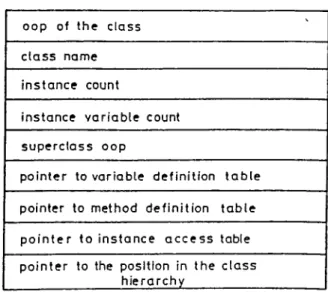
5.1 The architecture of the prototype system ... 39
5.2 The format of an object table entry ... 41
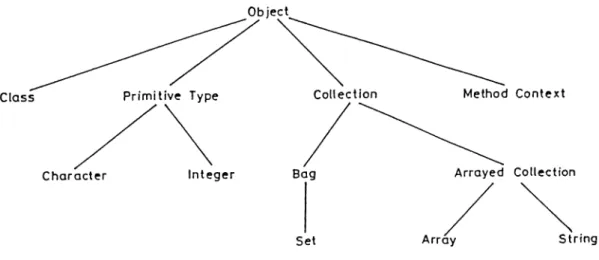
5.3 The hierarchy of system-defined classes 42 5.4 The format of a node in the class h ie r a r c h y ... 43
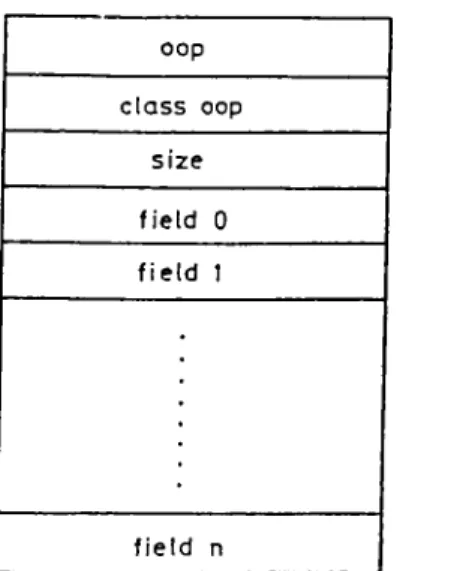
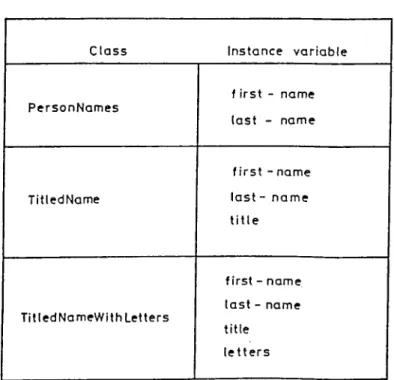
5.5 The format of an allocated object 45 5.6 Instance variable inheritance example ... 47
5.7 Allocated chunks for an object ... 47
5.8 The format of a class defining object 49 5.9 An entry of the IVDT of a class ... 50
5.10 The instance access table e n t r y ... 52
5.11 An Array O b j e c t ... 54
5.12 A String Object ... 54
5.13 A Bag (Set) instance ... 55
ix
1. INTRODUCTION
With the increasing efficiency of computer systems, the sophistication and demand of the users have been increasing. There have been some impor tant changes in both general-purpose programming and database languages. In general purpose programming, the improvement started with assemblers and went to high-level languages and more recently to logic and functional languages. In database languages, from navigational models more declarative relational models have been reached. Especially, in newer data-intensive ap plications such as computer aided design and manufacturing (C A D /C A M ), document retrieval, expert systems and decision support systems, the need to introduce more powerful data modeling concepts in both programming languages and database models became obvious. This resulted in the de velopment of object-oriented programming environments and this approach was extended to other fields. Although there is no clear definition of what object-orientation is, the basic characteristic of this approach is that instead of passing data to procedures as in the traditional data processing meth ods, the objects which represent real world entities are requested to perform operations on themselves.
Informally, an object-oriented database management system can be de fined as follows. It is a system which is based on a data model that allows to represent an application entity, whatever its complexity and structure, by exactly one object of the database. Thus no artificial decomposition into simpler concepts is necessary. As entities might be composed of subentities which are entities themselves, an object-oriented data model has to allow recursively composed objects.
Object-orientation is very suitable for database applications. Conven tional record-oriented database systems reduce application development time and improve data sharing among applications. However they are subject to the limitations of a finite set of data types and the need to normalize data. Furthermore, there is a semantic gap between the application semantics and its database representation. In contrast, object-oriented systems offer flex ible abstract data-typing facilities and the ability to encapsulate data and operations with the message metaphor. In addition, they reduce applica tion development efforts. Also, one can easily represent models which can not be represented using normalized relations, thus keeping the semantic gap as small as possible and representing most of the problem semantics in the database itself. Another point is that, object-oriented systems aim at solving the impedance mismatch problem [41] seen in conventional database systems in which there are separate data definition and data manipulation languages by providing a single language.
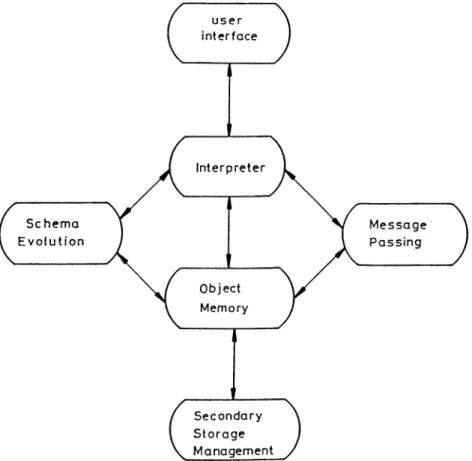
In this thesis, a focused survey on object-oriented paradigm and object- oriented database management systems has been carried out and a single- user memory-based object-oriented database management system prototype has been designed and implemented. The designed and implemented object- oriented database management system prototype consists of four major mod ules which are object memory and schema evolution; message passing; sec ondary storage management, indexing and the user interface [30] [16]. The implementation of the system has been carried out on Sun workstations run ning Berkeley Unix^ 4.2 and using the C programming language [38] [6] [17] [18]. The goal of this study was to understand the fundamental concepts of object-orientation, realize the possible dilRculties in the implementation of such systems and discover the open problems for future research.
The first part of the thesis presents the results o f the survey. The basic concepts, characteristics and application areas of object-oriented approach are introduced. Then the application of this approach in programming lan guages and in database systems is explained by giving examples of the existing systems.
In the second part, the designed object-oriented 'database management system prototype is presented. The object memory module is explained in detail and the functions of the other modules are summarized. Finally, the current research issues in the object-oriented database systems are stated.
2. GENERAL PROPERTIES OF
OBJECT-ORIENTATION
There is much confusion about the term object-oriented. It appears that the concept can be applied to anything from an operating system to an interface for a text editor. There is no clear way of telling whether a system is ’’ really” object-oriented or not. In fact, object-orientation is an approach that can be applied in various areas of computing [27].
The basic principles of the object-oriented approach are encapsulation and
inheritance. Encapsulation means that, an object packages an entity and the
operations that apply to it and inheritance enables specialization of existing objects. In object-oriented systems, all conceptual entities are modeled as objects. An integer, a string or more complex entities such as an employee or an aircraft is an object.
2.1
Basic Concepts
An object consists of a private memory and a public interface part defined by a set of messages. The private memory is made up of the values for a collection of instance variables. The value of an instance variable is itself an object and therefore has its own private memory. A simple object, such as an integer or a character, has no instance variables. A simple object has a value which itself is an object.
A message is a request for an object to access, modify or return a portion of its private memory [4]. A message specifies which operation is desired, but not how that operation should be carried out. They invoke methods which describe how to carry out the operations that apply to the object. Methods are not visible from outside of the object. An important property of an object is that, its private memory can be manipulated only by its own methods, and the messages are the only way to invoke an object’s methods. Therefore, the set of messages to which an object can respond constitutes its interface.
A typical application may create and reference a large number of objects. If every object is to carry its own instance variables and its own methods, the amount of information to be specified and stored can become unmanageably large. For this reason and also for conceptual simplicity, similar objects are grouped together into a class [4]. All objects belonging to the same class are described by the same instance variables and the same methods. They all respond to the same messages. Objects that belong to a class are called
instances of that class. A class describes the instance variables of its instances
and the methods that are applicable to its instances. Thus when a message is sent to an instance, the method which implements that message is found in the definition of the class. Classes are not only collections of objects, but also templates for the creation of objects. A class provides the create and destroy operations for its instances. Since classes are also objects, a message is sent to a class when a new instance of that class is created.
The class concept provides modularization and conceptual simplicity as well as reducing duplication, since all messages, methods and instance vari ables shared by the instances only appear in the corresponding class defini tion. Another such tool is inheritance [4] [24] : Classes are organized in a
hierarchy. A class hierarchy is a hierarchy of classes in which an edge between
a node and a child node represents the IS-A relationship; that is the child node is a specialization of the parent node and conversely, the parent node is a generalization o f the child node. The parent node is called the superclass of the child, and the child node is called the subclass of the parent. Objects at any level of this hierarchy inherit all instance variables and methods of higher
level objects. A class needs to inherit properties only from its immediate su perclass. So by induction, a class inherits properties from every class in its superclass chain. A subclass may modify the definitions and implementations it inherits from its superclasses or may add new ones.
There are two types of inheritance : simple inheritance and multiple in heritance. In simple inheritance a class may have a single superclass [4]. Thus the class hierarchy is restricted to being a tree. In multiple inheritance a class may have more than one superclass, and the class hierarchy becomes a directed acyclic graph (or a lattice structure) [4] [37] [13]. In multiple in heritance, a class inherits the union of variables and methods from all its superclasses. Multiple inheritance increases sharing by making it possible to combine definitions from several classes. It also simplifies data modeling and often requires fewer classes than are required with simple inheritance.
In both types of inheritance, there is the name conflict problem. Name conflicts occur when two or more classes have instance variables or methods with the same name. Two types of inheritance conflicts may arise. One is the conflict between a class and its superclass. The other is between the superclasses of a class and occurs only in multiple inheritance. The name conflict between a class and its superclass is solved by giving precedence to the definitions of the instance variables or methods of the class. In this way the definitions local to the class overrides the definitions in its superclass. The name conflict between the superclasses can be solved in two ways. Either all instance variable or method names in the superclasses must be distinct or a priority order is accepted on the superclasses. The priority order is specified by starting with the first superclass in the superclass specification and proceeding depth-first up to joins.
In all object-oriented systems, each object is associated with an identi fier, which is unique and is never reused for another object [19] [5]. Identity concept makes it possible for objects to be distinguished from one another regardless of their content. One powerful technique for supporting identity is through surrogates. Surrogates are system generated globally unique identi fiers, completely independent of any physical location or object values [19].
2.2
Characteristics of Object-Oriented Approach
To fully support object-oriented approach, a system must show the fol lowing five characteristics [27]:
1. Data Abstraction 2. Independence
3. Message passing paradigm 4. Inheritance
5. Homogeneity
D a ta A b stra ctio n
The most important concept in the object-oriented approach is data ab straction. That is, the behaviour of an object rather than its implementation is of interest. Every object has a clearly defined interface which is independent of the object’s internal representation. The interface provides the commu nication to other objects. This representation independence makes it easier to experiment with different implementations of an object and increases the portability of software. The class concept provides the data abstraction.
In d ep en d en ce
Independence states that objects have control over their own state and existence. The state of an object can only be changed by its own methods. Once an object is created, it will continue to exist, unless it is detected that the object neither refers to nor is accessible from another object. Another form of independence is the ability to add new object types at run-time. When new types are created dynamically, the new type objects and the old objects must be able to communicate with each other.
M essage p assin g paradigm
Message passing is a model for object communication. Independence of objects is supported by the message passing paradigm. In this pmadigm an object can interact with other objects only by sending and receiving messages. When an object sends a message to another object, one of the methods of that object is invoked. In fact the receiver object is free in the interpretation of the message. It may delay responding or it may refuse to handle the request or it may perform the method and return the result. Returning something is again accomplished by message passing. When there is no concurrency, message passing is implemented just as procedure calls.
In the case of a concurrent environment, message passing may be syn chronous or asynchronous. In asynchronous message passing the message is put in a queue, and the sender can switch to another task. In synchronous message passing, the sender blocks until the response to the message is re ceived.
In h eritan ce
One of the most important characteristics of the object-oriented approach is inheritance. Inheritance provides the ability to specialize object classes. A specialized class inherits properties (i.e., the instance variables and the methods) of its superclass, and also may add more properties. An instance of a subclass responds to all messages that its superclass understands but the reverse of this is not true. The superclass cannot respond to the messages corresponding to the new methods that the subclass adds.
Inheritance can be considered in four categories [13]:
• Type theory inheritance : It is related to the similarity of structure be tween a subclass and a superclass. Here a subclass contains all instance variables of the superclass. In addition, it can have more instance vari ables.
• External interface inheritance : Here a subclass provides all the meth ods of the superclass and can also provide additional methods.
• Code sharing and reusability : Here a subclass can use the methods provided by its superclass as if they were defined in the subclass itself. Hence multiple copies of the same code are eliminated. Thus more complex programs can be built out of simpler ones.
• Polymorphism : It is related to operator overloading and allows a con crete operation to inherit its definition and properties from a generic operation.
Conventional object-oriented systems combine some or all of these kinds of inheritance into one structure.
H o m ogen eity
In a fully ’’ object-oriented” system, everything is an object. That is, a class or a method or an instance is an object. This notion provides a very consistent view of the system. But there are some points that must be considered. How far the principle of homogeneity is carried must be decided. For example, if the messages are objects also, then to manipulate them, another message should be sent. Another example is thinking of instance ' variables as objects. This provides constructing complex objects whose parts are also objects. Again the circularity must be considered. Because, it is not efficient to treat ’’ parts” of an integer as objects. To break such kinds of circularity certain basic objects may be accepted and then all other objects can be built up from them.
2.3
Application Areas
The object-oriented approach first appeared in programming languages and then applied in other areas. The major application areas of the object- oriented approach are programming languages, database management sys tems, knowledge representation, C A D /C A M systems and office information systems [41].
Knowledge representation and C A D /C A M systems require unifying the treatment of data and metadata. They require versions and multiple design transaction support.
Object-oriented approach can easily support menu and icon interfaces and multimedia document management. Therefore it is appropriate for office information systems.
In the following sections, the application of the approach in programming languages and database systems will be explained.
3. OBJECT-ORIENTED APPROACH IN
PROGRAMMING LANGUAGES
In recent years object-oriented programming has gained a great popular ity in the design and implementation of emerging data-intensive application systems. These include artificial intelligence (AI), computer-aided design and manufacturing (C A D /C A M ) and office information systems (OIS) with multimedia documents. Object-oriented programming offers a number of im portant advantages for these applications over traditional control-oriented programming, which are discussed in this chapter.
3.1
General
Properties
P r ogr amming
of
Object-Oriented
Most programming languages support the ” data-procedure” paradigm. That is, active procedures act on passive data that are passed to them as parameters. For example, a square root function takes a number as its input parameter and returns the square root of that number. Data type is also im portant. In the above example, if a strongly typed language is used, then for each data type of the input parameter, a different version of the square root function would be implemented. On the other hand a late-binding language such as LISP detects the data type of the number at run time and performs the appropriate operations for that data type. Object-oriented languages use
a data (object) centered approach. Here, data are not passed to procedures, but they axe asked to perform operations on themselves. For example, to take the square root of a number, the number is asked to perform the operation on itself. So the number is the receiver of the message ’’ square root” .
In object-oriented languages, objects combine the properties of procedures and data since they perform computations and save local state. All of the action in object-oriented programming comes from sending messages between objects. Message sending is a form of indirect procedure call. Objects re spond to messages using their own procedures. Message sending supports data abstraction. The principle is that calling programs should not make assumptions about the internal representations o f data types they use. A data type is implemented by choosing a representation for values and writing a procedure for each operation. A language supports data abstraction when it has a mechanism for collecting together all of the procedures for a data type. Thus class concept represents the data types [32].
Another feature of object-oriented programming is operator overloading. Operator overloading is the use of the same operator symbol to denote distinct operations on different data types (e. g. it may be possible to use the minus sign to denote both integer difference and set difference). The meaning of the operator can be resolved only by the data types of its operands. Operator overloading provides the usage of the same message for different methods in different classes. When the message is sent to an object, it is first bound to the class of that object and then the method for that class is executed. When operators have two or more operands, one operand (usually the first one) must be selected as the message receiver that controls the overloading and the others are treated as message arguments. However there is an unfairness if the computation is based only on the type of the first argument. For example.
and
Multiply (x: real, y: real) Multiply (x: real, y: vector)
should be understood as real number multiplication and scalar-vector multi plication, respectively. Such a distinction can be done only if all argument
types are considered as characterizing the function td be applied [41].
The advantages of overloading may be more apparent with the following example. For instance, an application requires the printing of different ob jects, each with their own format. The object-oriented approach gives the responsibility onto the objects themselves. Each object is sent exactly the same message, print, so that it will print itself in the proper way. The ad dition of new types only requires writing new procedures for the common operations. So, new objects with their own print method, can simply be added and no further program modification will be required.
Inheritance concept enables programmers to create new classes of objects by specifying the differences between a new class and an existing class, instead of starting from scratch each time. A large amount of code can be reused by this way. During execution, the search for an attribute begins at some level of the class hierarchy and proceeds to the top, taking the first instance of the attribute that is found. The mechanism to add new behaviour to an existing class is language dependent. In most object-oriented languages, such as Smalltalk, this is accomplished by embedding a message-send to the pseu- dovaxiable super in the new definition of a method. Syntactically pseudovari
ables are treated the same as normal variables. However, their semantics are different. They cannot be assigned a new value. There are two important pseudovariables self and super. Both of them refer to the object that receives
the message currently being processed. The difference between the two lies in the way that the message lookup is performed. When self is sent a mes
sage, the message lookup is performed as when the message is sent externally, starting in the object’s direct class. When super is sent a message, the lookup
is performed starting in the superclass of the class in which the method is currently being executed. The superclass where the method is found, is not necessarily the superclass of the object’s class. This pseudovariable mecha nism gives objects a controlled way of accessing superclass methods.
3.1.1
Object Identity in Programming Languages
Most programming languages employ user-defined names (i.e. variable names) to represent identity. The actual binding of an object to its name can be dynamic or static. This approach mixes addressability and identity, although the concepts are quite different. Addressability is external to an object within a particular environment and is therefore environment depen dent. On the other hand, identity is internal to an object. Its purpose is to provide a way to represent the individuality of an object independently of how it is accessed. Object-oriented languages provide separate mechanisms for these concepts, so that neither is compromised [19].
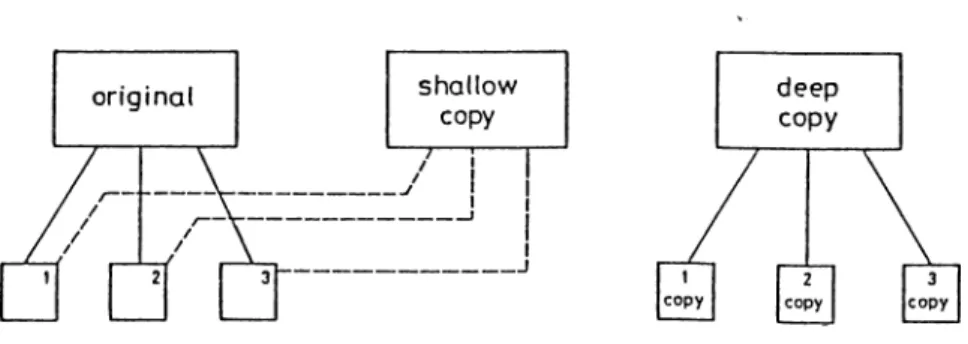
A single object may be accessed in different ways and bound to different variables. There must be some way to find out if these variables refer to the same object. For example an employee object may be accessed as the manager of some department and bound to variable x. The same employee object may be accessed as an employee with a specified status, and bound to another variable y. Object-oriented languages provide both identity test operators and equality test operators. Also different copy operators are supported. There are two ways to make copies of an object. These are shallow copy and deep copy. The distinction is whether or not the values of the object’s variables are copied. In shallow copy the values are not copied but they are shared. When the copy is changed another object with the new value is created and the value of the original object remains the same. In deep copy the values are copied, they are not shared. As an example, a shallow copy of an array refers to the same elements as in the original array, but the copy is a different object. Replacing an element in the copy does not change the original. A deep copy of the array, is a new array with its own identity whose elements are also new objects with their own identity but which have the same values as those of the original array. Figure 3.1 shows the relationship between shallow and deep copying.
Figure 3.1: Shallow copy and deep copy
3.1.2
Advantages of Object-Oriented Programming
Object-oriented languages have many advantages over traditional procedure- oriented languages. Data abstraction and information hiding, that is the hid ing of internal representation and implementation of an object, increase reli ability and modifiability of softwcire systems by reducing interdependencies. In addition, since the internal state variables and methods axe not directly accessed, a carefully designed interface may permit the internal data struc tures and procedures to be changed without affecting the implementation of other modules.
Also dynamic binding and operator overloading increases fiexibility by permitting the addition of new classes of objects (data types) without having to modify existing code. Inheritance and dynamic binding together permits code to be reused. This has the advantage of reducing overall code and increasing programmer productivity.
Object-orientation provides a natural way to translate the real world prob lem into a program. Because working with objects seems more natural than working with constructs found in standard languages. Dividing a problem into objects and defining actions for those objects simplifies programs. Also the object-message paradigm provides promotion to a more modular system.
Therefore object-oriented programming provides major advantages in the production and maintenance of software. It requires shorter development times and provides a high degree of code sharing. These advantages make object-oriented programming an important technology for building complex software systems now and in future [32].
3.1.3
Disadvantages of Object-Oriented Programming
Object-oriented languages have some characteristics that are considered disadvantages by some. The one most often debated is the run-time cost of the dynamic binding mechanism. A message-send takes more time than a straight procedure call [32].
Another disadvantage is that implementation of object-oriented languages is more complex than procedure-oriented languages, since the semantic gap between these languages and typical hardware machines is greater.
Another potential problem is that a programmer must learn a large class library before becoming proficient in an object-oriented language. As a result· object-oriented languages are more dependent on good documentation and development tools.
3.2
Some Examples of Object-Oriented Programming
Languages
Many of the ideas behind the object-oriented programming have roots going back to SIMULA [13] [37], which is an Algol-based simulation lan guage. The first substantial interactive, display-based implementation was the Smalltalk language [12]. The object-oriented style has often been sup ported for simulation programs, systems programming, graphics and artificial
intelligence programming. There are probably fifty or more object-oriented programming languages now in use, mostly with very limited distribution [37]. Below, only three object-oriented languages will be summarized. These are Smalltalk, Smallworld and Hybrid.
3.2.1
Smalltalk
Smalltalk is probably the best-known object-oriented language [7] [10] [12]. In Smalltalk, there are two basic unitsrobjects and classes. Classes contain function definitions (methods) and data declarations. Every object is an instance of some class. The top-level superclass is class Object. All classes are refinements of the superclass Object. They add new or different methods or allow more variables in their instances. Classes themselves are objects and are instances of classes, called metaclasses. Metaclasses are instances of the class MetaClass. Because a class is an object, it cannot contain its own specialized methods. These special methods are kept in the metaclass of the class. In other words, a superclass is a more general version of a class, while a metaclass specifies the operations that can be performed on a class.
Smalltalk objects interact by exchanging messages. In addition to message passing, different objects of a class can share variables, called class variables. Class variables are defined in the metaclass of the class and are accessible to any method defined in the class.
Smalltalk supports simple inheritance. That is each class has a unique superclass. In Smalltalk, control structures are also objects. That is, a block expression is an object that can be executed by sending it the message value.
Smalltalk’s object-method paradigm is used for menu-based interfaces. For example, the user specifies an object by pointing its icon with a mouse, and then selects the operation from a small menu.
Smalltalk is interpreted, rather than compiled. This obviously degrades performance.
3.2.2
Smallworld
Smallworld is a shell language that uses the object-oriented approach [21]. Smallworld is not intended to be a programming language. Rather, it is a system for organizing files, programs and system commands. The object model is different from that of Smalltalk. A Smallworld object is an independent entity, not an instance of some class. An object is a collection of properties. Each property has a name and a value. Smallworld methods are merely properties with the suffix .method. Objects are grouped into classes,
as defined by the class property of each object. Classes are used only for organizational purposes. The member objects of a class need not have the same or even similar structures.
A Smallworld object can define its own properties and methods. If an object does not have a requested property p or method m, it then asks its class for property inherited:p or method inherUed:m. If not found, the request follows the superclass chain until it reaches the top-level class. Universe. Smallworld classes are normal objects. As a result, they can customize their own methods, eliminating the need for metaclasses. Furthermore, classes can provide inherited properties, and this permits default values to be inherited from a class. Smallworld also supports simple inheritance.
3.2.3
Hybrid
Hybrid is an object-oriented programming language in which objects are active entities [29]. Active objects are persistent and concurrent. Thus they unify the concept of an object with those of processes and files. Hybrid is an attempt to provide a fully object-oriented language that is strongly-typed and concurrent. The goal is to design a programming language based on a small number of concepts that support reusable code, reliability through well-defined interfaces, and concurrency.
In Hybrid, objects are structured, and may contain other objects. A small set of constructors is available for structuring objects and defining object ’’ types” . A unit of concurrency is called a domain and is comparable to a process. Each domain contains a single top-level ’’ root” object and any number of subobjects. Independent objects, in different domains may execute concurrently. An activity is defined as a thread of control, which may pass between domains when independent objects communicate. Activities may be scheduled by objects through the use of delay queues. Objects may switch between several activities by delegating calls to other objects. The notion of
subactivities manages sets of related activities. Longer term mutual exclusion
4. OBJECT-ORIENTED APPROACH IN
DATABASE SYSTEMS
Merging of the object-oriented programming language and data model ideas has given rise to the idea of applying the object-oriented approach to the database field. Object-oriented languages offer flexible abstract data typing facilities and the ability to encapsulate data and operations via the message paradigm. Combining object-oriented language capabilities with the storage management functions of a traditional data management system would re sult in a system that reduces application development efforts and increases modeling power.
4.1
Importance of a Data M odel
Every database is a model of some real world system. At all times, the contents of a database axe supposed to represent the semantics of an ap plication environment as completely and accurately as possible. Also, each change to the database should reflect an event occurring in that environment. Therefore it is expected that the structure of a database reflects the structure of the system that it models.
The data model supported by a database management system defines a framework of concepts that can be used to express the application seman tics. The primary purpose of any data model, is to provide a formal means
of information representation and a formal means of manipulating such a representation. A data model consists of three components [9] :
• a collection of object types • a collection of operators
• a collection of general integrity rules.
The object types are the basic building blocks of the data model. For example in the relational model the objects are relations and domains. The
operators provide a means for manipulating a database that is composed of
valid instances of the object types. The relational operators are those of the relational algebra. The integrity rules constrain the set of valid states of the database that conform to the model. In relational model for example, there are two integrity rules : entity integrity rule and referential integrity rule.
For a particular model to be useful for a particular application, there must exist some simple correspondence between the components of that model and the elements of that application. In other words the process of mapping ele ments of the application into constructs of the model must be straightforward. One of the objectives of data models is to keep the gap between the semantics of the application itself and the semantics of the application as represented in the database as small as possible.
Today’s database systems are mostly based upon one of the classical data models : hierarchical, network or relational. The data structures provided by these data models have significantly limited capabilities to express the mean ing of a database and to relate a database to its corresponding application environment. In these data models, one conceptual entity has to be repre sented by a number of database objects (e.g. records, tuples). Since classical business/ administrative database applications usually deal with rather sim ple entities, traditional data models may be adequate for them. But this is not true for applications like VLSI-design, image processing and office automa tion. In these areas, entities usually show very complex internal structures and may consist of a larger number of properties [41].
In response to the inadequacies of the traditional data models, several semantic data models [1] [2] [14] have been proposed. The basis of all these studies is to use data models that provide the representation of a large portion of the meaning of the data in the database [20] [26]. The basic rule of semantic modeling is that the model represents data about objects and relationships between them in a direct manner. Such object-based modeling has given rise to the object-oriented data modeling and hence object-oriented database systems. The basic object-oriented concepts form the basis of an object- oriented data model. Hence, it is a data model that allows to represent one application entity whatever its complexity and structure, by exactly one object of the database. Thus no artificial decomposition into simpler concepts is necessary.
Before discussing the characteristics of an object-oriented database sys tem, it will be better to specify the shortcomings of the database systems that are based on the traditional data models.
4.2
Limitations of Existing Data Models
Although record-based data models have been successfully applied to a variety of data processing problems, they have also serious limitations. A fundamental problem of these models is that they provide a finite set of data types and need to normalize data. Thus they cannot easily handle the semantic connections present in most real world data. They support a fixed set o f simple types, such as integer, real and character string. However, they do not have support for defining new types and for adding operations to these types. The constructors for abstract types are limited. The relational model supports ’’ tuple” and ’’ relation” ; the hierarchical model supports ’’ segment” and ’’ tree of segments” ; the network model supports ’’ record” and ’’ owned list of records” . A given field of a record cannot be a structured data item. The operations are similar in the three models: access or set a field, traverse a relation, tree or list in some order; select a record according to a Boolean
condition. In addition the relational model supports operations on entire relations, such as project and join. However the set of operators cannot be extended.
Another problem is that such models typically rely on symbolic identifiers to represent data objects and force users to think in terms of the resulting indirection. In the relational model the properties of an entity must be suf ficient to distinguish it from all other entities. Thus, user-defined identifier keys represent the identity of an object. An identifier key is some subset of the attributes of an object which is unique for all objects in the relation. For example to identify department tuples, department names can be used as the distinguishing property. But when a department’s name changes, update anomalies occur. Making up unique department numbers to distinguish de partments, introduces artifacts into the database scheme that are not in the world being modeled.
Another problem with current systems is that update commands are ma chine oriented. Update commands insert, delete or modify records. Such updates do not correspond to the real world changes. Changes in the real world require updates to several database items. For example, adding a stu dent into a database may require insertions into several relations. These limitations make integrity checking difficult and therefore may cause incon sistencies in the database.
Another problem is that commercial database systems separate data def inition and data manipulation languages. This problem of having two lan guages is called impedance mismatch problem [41]. One mismatch is concep tual, that is the data definition and the data manipulation languages might support widely different programming paradigms. One is a declarative lan guage, the other is a procedural language. The other mismatch is structural. The languages do not support the same data types. For example, a relational database can be accessed using SQL [8] from COBOL , but when some com putation is necessary, COBOL can operate only at the tuple level. Thus the relational structure is lost.
they are too slow at fetching and storing fields. Most data processing trans actions require getting a few tuples from a relation and updating them or selecting tuples from two or more relations which is performed by taking joins. Each fetch or store costs the same as a procedure call from the ap plication program to the database. This becomes a great overhead when accessing a single tuple. Also normalization and other design considerations increase the levels of indirection between an entity and its subcomponent.
4.3
Object-Oriented Database Management Systems
Object-Oriented Database systems have appeared with a goal to overcome these limitations of the existing database systems. They employ an object data model and use object-oriented programming language facilities.
4.3.1
Properties of Object-Oriented Database Systems
The object-oriented approach can be contrasted to the value-based paradigm supported by the original relational approach to databases. While in rela tional databases tuples can only be distinguished on the basis of their values, in object-oriented systems there is a hidden permanent unique identifier as signed to each entity (or object). Thus an entity referring to another entity can be implemented using the latter’s unique identifier. This policy provides a simple way to support relationships between entities. This built-in identity approach has the advantage that no joins axe required for entity relationships. Also it eliminates the disadvantages of the need for unique attribute names.
In the object-oriented approach a single entity is modeled as a single object not as multiple tuples in multiple relations. Properties of entities need not be simple data values but can be other entities of arbitrary complexity. For example the course taken by a student need not be just a string. It can
be another object which itself having properties such'as course name, credit and the room where it meets, and also its own behaviour.
A data object retains its identity through all changes in its own state. Entities with information in common can be modeled as two objects with a shared subobject containing the common information. For example, two employee objects that work in the same department will point to the depart ment object by using its built in identity. Such sharing reduces the ’’ update anomalies” that exist in the relational database systems and helps to solve the
referential integrity problem. Referential integrity is automatically satisfied
in object-oriented databases. Because one object refers directly to another object, not to a name or a property for that object. The reference cannot be created if the other object does not exist. Any change in an entity value is automatically seen by all entities which refer to it. This is not the case with relational systems. In relational systems, a change in the key value of an entity must be propagated to other tuples sharing that value.
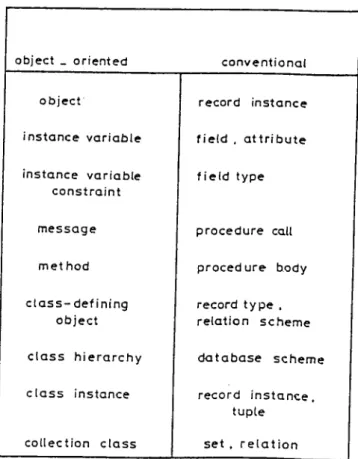
In [25] a correspondence between object-oriented and conventional database systems is established. The three principal concepts, object, message and class, roughly correspond respectively to record, procedure call and record , type in conventional systems. Class definitions are the analogue to schemes in database systems. But classes also package operations with the structure to encapsulate behaviour. Other correspondences are shown in figure 4.1.
4.3.2
Problem Areas in Object-Oriented Database Sys
tems
Object-oriented database systems must store both large numbers of ob jects and objects that axe large in size. This necessity requires new storage techniques. Searching a long collection by a sequential scan will give unac ceptable performance. Searching for elements should be at most logarithmic in the size of the collection, rather than linear. Storing complex objects on disk presents some difficult problems. In order to illustrate the problems,
object _ oriented conventional
object record instance
instance v a ria b le fie ld . a t t r i b u t e
instance v a riable co nstrain t
f i e l d type
message pro cedure call
met hod p ro c e d u re body
c l a s s - defining o bject record ty p e , relation scheme c la s s h ie r a r c h y d a t a b a s e scheme c la s s instance record in s ta n c e , tuple collection c la s s set . r e l a t i o n
Figure 4.1: Correspondence between 0 - 0 and conventional database systems consider Employee objects with fields social security number, name, depart ment and salary, where name and department fields are themselves compound objects. Employee objects can be stored basically in two ways [41]. One is to decompose them into their fields and represent each field as a binary relation. That is, binary relations of the form Employee-salary, Employee-department, etc. The other way is to group all the fields of one object together on disk. Binary relation representation is better for associative access, since few blocks need be read for the scan. On the other hand, they are not very good if all fields of an employee object are required to be fetched, since those fields are dispersed through many disk blocks. In the other storage scheme, only one block is read to get all the fields of a single employee object. However, for as sociative access, performance is not so good. For example, to find employees with salaries over some given value, many disk blocks must be read, because salary fields are separated by all the other fields.
Since both representations have some problems, a hybrid organization is reported in [7]. In this organization binary relations are used on disk to speed
up associative access and object-based representation is used in main memory to speed manipulation of single objects.
The capability of processing predicate based queries against a large database is an important requirement in a database environment. Object-oriented sys tems should support associative access on elements o f large collections. They should supply storage structures to support locating an element by its inter nal state. For example, an application may want to find all employee objects whose salary is more than 100000. Such queries will require searching of all the instances of a class, and cause poor performance. To avoid searching, indexing on instance variables must be supported. The instance variables can be nested several levels deep in an object to be indexed (e. g. the man ager variable of the department object which is the value of an Employee’s Worksin variable ).
Another problem in developing database applications is the impedance mismatch between the programming language used to process data and the data manipulation language used to access the database. This problem is attacked in [7] by proposing an integration of databases and programming languages using objects. Their goal is to create an object-oriented database system with a single language for data manipulation and application pro gramming.
4.4
Some Examples of Object-Oriented Database Man
agement Systems
There are several object-oriented database system prototypes. None of them, except the GemStone Database System, has become commercial yet. The following sections give the summaries of three example object-oriented database systems.
4.4.1
The GemStone Database System
The GemStone database system is a result of a development project at Servio Logic Corporation [24] [25]. It has become commercial recently. It supports a model of objects similar to that of Smalltalk-80. GemStone pro vides an object-oriented database language called OPAL, which is used for data definition, data manipulation and general computation.
The major pieces of the GemStone system. Stone and Gem, correspond to the object memory and the virtual machine of the standard Smalltalk implementation. Stone provides secondary storage management, concur rency control, authorization, transactions and recovery. Stone also manages workspaces for active sessions. Stone uses unique surrogates called object- oriented pointers (OOPs) to refer to objects, and an object table to map an OOP to a physical location. This indirection means that objects can easily be moved in secondary memory. Object table can potentially have 2^^ en tries. Stone is built upon the underlying VMS file system. The data model that Stone provides is somewhat simpler than the full GemStone model, and only provides operators for structural update and access. An object may be stored separately from the objects it references, but the OOPs for the values of an object’s instance variables are grouped together.
Stone supports five basic storage formats for objects, self identifying (e.g. small integer, character, boolean), byte (e.g. string, date, float), named, indexed and nonsequenceable collections. The byte format is used for classes whose instances may be considered atomic. The named format supports access to the components of an object by unique identifiers, instance variable names. The indexed format supports access to the components of an object by number, as in instances of class Array. This format supports insertions o f components into the middle of an object and can grow to accommodate more components. The non-sequenceable collection (NSC) format is used for collection classes in which instance variables are anonymous. Members of such collections are not identified by name or by index, but a collection can be
queried for membership, and have members added, removed or enumerated. Both the indexed and NSC format support dynamic growth of objects, and are bound in size only by the total number of objects in the system and the physical limits of secondary storage. When objects in these formats grow large, their representation changes from a contiguous one to a B-tree which maintains the members by OOP for NSCs and by offset for indexed objects. The byte format also supports dynamic growth in a manner similar to that for the indexed format. Stone groups objects into logical segments, which are the unit of conflict in concurrency control, and the unit of ownership for authorization.
Gem sits atop Stone, and elaborates Stone’s storage model into the full GemStone model. Gem also adds the capabilities of compiling OPAL meth ods into bytecodes and executing that code, user authentication, and session control. The Gem layer contains the virtual image, that is the collection of OPAL classes, methods and objects that are supplied with every GemStone system. OPAL is a computationally complete language and can express var ious associative searches on a collection.
Class hierarchy in the current GemStone virtual image is similar to that of Smalltalk’s. Comparing it to the Smalltalk hierarchy, classes for file access, communication, screen manipulation and the programming environment have been removed. The file classes are unnecessary as all GemStone objects are persistent. Computation for screen manipulation needs fast bytecode execu tion. GemStone is optimized toward maintaining large number of persistent objects, rather than fast bytecode execution. The programming environment classes are replaced by a browser application that runs on top of GemStone. Besides removing these classes, new classes and methods have been added to make the data management functions of transaction control, accounting, ownership, authorization, replication, user profiles and index creation con trollable from within OPAL.
GemStone’s database features can be summarized as follows [34]:
database requires the concept of transaction. GemStone uses an op timistic concurrency control policy.
• Sharing of objects : A dictionary is a collection of key-value pairs and supports the naming of objects. GemStone provides each user with a distinct list of dictionaries. Although this list is private to the user, the dictionaries that it contains, can be shared by other users. This allows the sharing of objects in the shared dictionary.
• Security : GemStone secures the object database by first authenticating each user through a user name and password. Also groups of objects may be explicitly marked as either read only, read/write, or no privi leges for selected users.
• Centralized server : GemStone is a centralized server for database ob jects. Currently it does not allow a database to be distributed among several servers.
• Primary and secondary storage management : GemStone hides from application designers the paging of objects between secondary and pri mary memory, and supports objects larger than the size of the server’s primary memory.
• Method execution : GemStone supports a Smalltalk-like execution model. • Resilience to common failure modes : If the reliability of the disk drives
is insufficient then the users can selectively replicate the stored objects on line ensuring that the database survives single-point failures.
• Uniform language : GemStone presents one language, OPAL, to its users. Through OPAL the user manipulates the information in the database, defines new classes, writes portions of application programs, and controls the GemStone server. Thus it is a uniform language that can be used as either a data management or a data definition or a general computation or a system command language.
• Fast associative access : Database systems are traditionally efficient at finding all members of a set meeting a selection criteria. GemStone
allows users to dynamically add or remove ass6ciative access structures to accelerate such tests.
4.4.2
The O R IO N Database System
ORION is a prototype object-oriented database system under implemen tation in the Database Program at Microelectronics and Computer Tech nology Corporation (MCC) as a research vehicle for developing a database technology for object-oriented applications from the C A D /C A M , AI and OIS domains [4]. It is implemented in Common LISP. The intended applications for ORION impose two types of requirements : advanced functionality and high performance. The ORION architecture has been designed to satisfy these requirements.
ORION provides a number of advanced features that conventional database systems do not, including version control, storage and presentation of unstruc tured multimedia data and dynamic changes to the database schema.
ORION supports a number of major concepts found in many object- oriented systems such as objects, classes, class lattice, methods and inher itance and also two features to further reduce redundant storage and specifi cation of objects: shared-value and default-value instance variables. For such variables, a value must be specified. For a shared-value variable of a class, all instances of the class take on the specified value. For a default-value variable, those instances of a class whose value for the instance variable is not specified take on the specified default value.
In ORION, as in most object-oriented systems, both classes and instances are viewed as objects. This is necessary mainly for uniformity in the han dling of messages. To create an instance of a class, a message is sent to the corresponding class. There are also many other situations in which it is nec essary to send messages to class objects, such as inquiry of the definition of the class, changing the definition of the class.
In ORION, a class can have more than one superclass. Thus the class structure is generalized to a lattice. The approach used in ORION to re solve name conflicts among superclasses of a given class is as follows. If an instance variable or a method with the same name appears in more than one superclass, the one chosen by default is that of the first superclass in the list of immediate superclasses for that class. Unlike most other systems, ORION allows the user to explicitly change the permutation of the superclasses. Fur ther, the user may explicitly inherit one instance variable or method from among several conflicting ones.
Each class object belongs to a class, the system defined class Class. All class objects are instances of this class. To create a new class, a message needs to be sent to the class Class. For each user-defined class, ORION defines a corresponding class, a Set-Of class, as a subclass of the class Set. These Set- Of classes form a lattice parallel to the lattice of user-defined classes. One special instance o f the Set-Of class of some user-defined class is the set of all instances of that class. Another special instance o f the Set-Of class of a user-defined class is the set of all instances of that class and its subclasses. Predicate-based queries are messages to these set objects and return subsets of these sets.
ORION applications require flexibility in dynamically defining and mod ifying the class lattice. Changes to the class lattice can be categorized as follows: Changes to the contents of a node, changes to an edge and changes to a node. Changing the contents of a node implies adding or dropping in stance variables or methods, or changing the properties of them. Changes to an edge imply the alteration of inheritance structure, such as changing the order o f superclasses or removing one of the superclasses of a class. Adding or dropping a class, or changing the name of a class are the examples of changes to a node.
One of the enhancement goals of ORION is to support composite objects. A composite object is a complex object formed of a set of subobjects that are treated as units of storage, retrieval and integrity checking. For example, a vehicle is an object that contains a body object, which has a set of door