HUNGARY AT CROSSROADS: WAR, PEACE, AND OCCUPATION
POLITICS (1918-1946)
The Graduate School of Economics and Social Sciences
of
İhsan Doğramacı Bilkent University
by
IŞIL TİPİOĞLU
In Partial Fulfillment of the Requirements for the Degree of
MASTER OF ARTS
THE DEPARTMENT OF
INTERNATIONAL RELATIONS
İHSAN DOĞRAMACI BİLKENT UNIVERSITY
ANKARA
iii ABSTRACT
HUNGARY AT CROSSROADS: WAR, PEACE, AND OCCUPATION POLITICS (1918-1946)
Tipioğlu, Işıl
M.A., Department of International Relations Supervisor: Assoc. Prof. Dr. Hakan Kırımlı
July, 2019
This thesis traces the steps of the Hungarian foreign policy from 1918 to 1946, and analyzes the impact of revisionism after the Treaty of Trianon on Hungarian foreign policy decisions and calculations after the First World War. Placing the Hungarian revisionism at its center, this thesis shows the different situation Hungary had as a South European power as an ally of Germany throughout the Second World War and subsequently under the Soviet occupation. It also argues that it was the interlinked Hungarian foreign policy steps well before 1941, the official Hungarian participation in the war, which made Hungary a belligerent country. Also, based largely on the American archival documents, this study places Hungary into a retrospective framework of the immediate post-war era in Europe, where the strong adherence to Nazi Germany and the Hungarian revisionism shaped the future of the country.
Key Words: European Politics, Hungary, Revisionism, the Second World War, Twentieth Century
iv ÖZET
YOL AYRIMINDA MACARİSTAN: SAVAŞ, BARIŞ VE İŞGAL POLİTİKALARI (1918-1946)
Tipioğlu, Işıl
Yüksek Lisans, Uluslararası İlişkiler Bölümü Tez Danışmanı: Doç. Dr. Hakan Kırımlı
Temmuz, 2019
Bu tez, 1918’den 1946’ya kadar olan Macar dış politikası adımlarını takip ederek Trianon Antlaşması’ndan sonra ortaya çıkan Macar revizyonizminin, Macar dış politika kararlarında ve hesaplamalarındaki etkisini analiz etmektedir. Merkezinde Macar revizyonizmini ele alan bu tez, Macaristan’ın İkinci Dünya Savaşı boyunca bir Alman müttefiki olarak ve takiben sonraki Sovyet işgali altında bir Güney Avrupa gücü olarak farklı konumunu göstermektedir. Aynı zamanda bu tez, 1941 yılında Macaristan’ın fiili olarak savaşa katılmasından çok önce, birbiriyle bağlantılı Macar dış politika adımlarının Macaristan’ı savaşa taraf yapmış olduğunu ortaya sürmektedir. Büyük ölçüde Amerikan arşivlerine dayanılarak yapılan bu çalışma Macaristan'ı, Nazi Almanyası ve Macar revizyonizminin güçlü bir şekilde ülkenin geleceğini şekillendirdiği Avrupa'daki savaş sonrası dönemde retrospektif bir çerçeveye yerleştirmektedir.
Anahtar Kelimeler: Avrupa Politikası, İkinci Dünya Savaşı, Macaristan, Revizyonizm, Yirminci Yüzyıl,
v
ACKNOWLEDGEMENTS
First and foremost, I would like to express my indebtedness and gratitude for my supervisor Assoc. Prof. Hakan Kırımlı, who has been an invaluable mentor. His passion for history and research, and his advices along the way encouraged me and motivated me for the past two years in my M.A. program. I am also thankful for the fact that he let me work on something I really wanted. I would like to thank the examining committee members, Asst. Prof. Dr. Onur İşçi and Assoc. Prof. Dr. Fatih Yeşil for their
constructive criticism and significant suggestions. I am very thankful to Dr. Emre Saral for his recommendations. I would also like to thank Gülay Başkaya, whose smile and support turned my every visit to the Bilkent Library into a boost of morale.
I would especially like to extend my gratitude to my friends, to Cansu Kartal for her support and friendship of almost fifteen years; to Taylan Paksoy, and Monika Manişak-Paksoy for their continuous encouragement, intelligent conversations, and the joy they brought, which brought me back to reality at much needed intervals throughout my thesis ; to F. Burhan Ayaz for the support he provided just a phone call away; and to Arie Serota for his invaluable and almost daily support for me across the Atlantic.
Lastly, I would like to thank my family; if it were not for their presence, love, patience, and encouragement, I would not have been able to come thus far in my pursuits. And I owe very special thanks to Göksel Baş, for his endless love and patience, his believing in me as a colleague that kept me going, and his precious presence in my life.
vi
TABLE OF CONTENTS
ABSTRACT ……….. iii ÖZET ………. iv ACKNOWLEDGMENTS ………. v TABLE OF CONTENTS ……….. viLIST OF TABLES ………viii
LIST OF FIGURES ………... ix
CHAPTER I: INTRODUCTION ………. 1
1.1. The Objective and Scope of the Thesis ………1
1.2. Archival Sources and Literature ………4
CHAPTER II: HUNGARY BETWEEN THE WARS (1919-1939) ………. 9
2.1. Hungary in Transition ……… 9
2.2. The Signing of ‘Trianon’ ……….. 15
2.3. Hungary and the Axis Camp ………. 19
CHAPTER III: HUNGARY AND THE BREAK UP OF THE SECOND WORLD WAR ………. 29
3.1. Armed Neutrality ………. 29
3.2. The German Impact on the Hungarian Foreign Policy ……… 33
CHAPTER IV: HUNGARIAN COMBAT ACTIVITIES IN THE WAR (1941-1944) ……….36
vii
4.2. The Bombing of Kassa ……… 41
4.3. The Massacre of Novi Sad ……… 45
4.4. Defeat on the Don ……….48
4.5. Hungarian Doubts and Allied Contacts ………... 53
CHAPTER V: UNGARN FEINDESLAND: THE GERMAN AND RUSSIAN OCCUPATIONS OF HUNGARY (MARCH 1944 – FEBRUARY 1945) …57 5.1. Hungary under German Control ……… 58
5.2. Negotiations with the Soviets and German Invasion of Hungary..64
5.3. Russian Advance on Hungary ……… 69
5.4. Assessment ………81
CHAPTER VI: STUNDE NULL: THE SOVIET INFLUENCE ON HUNGARY IN THE IMMEDIATE POST-WAR PERIOD (1945 – 1946) ……… 84
6.1. The Political Situation in Hungary at the End of the War …… 86
6.2. ‘Bellum in Pace’ ………91
6.3. The Extent of the American Influence in Hungary ……… 96
6.4. The ‘Peace’ Terms for Hungary ……… 100
CHAPTER VII: CONCLUSION ………. 104
REFERENCES ……… 108
viii
LIST OF TABLES
Table I: Hungarian territorial and populational losses as a result of the Treaty of Trianon (per 1910 data)……….. 17
ix
LIST OF FIGURES
Figure 1: The ‘Trianon’ Hungary……… 116
Figure 2: “Nem, nem, soha!” ………..117
Figure 3: Hitler and Horthy……….118
Figure 4: Hungarian territorial gains between 1938-1941………..….119
Figure 5: Count Pál Teleki……….. 120
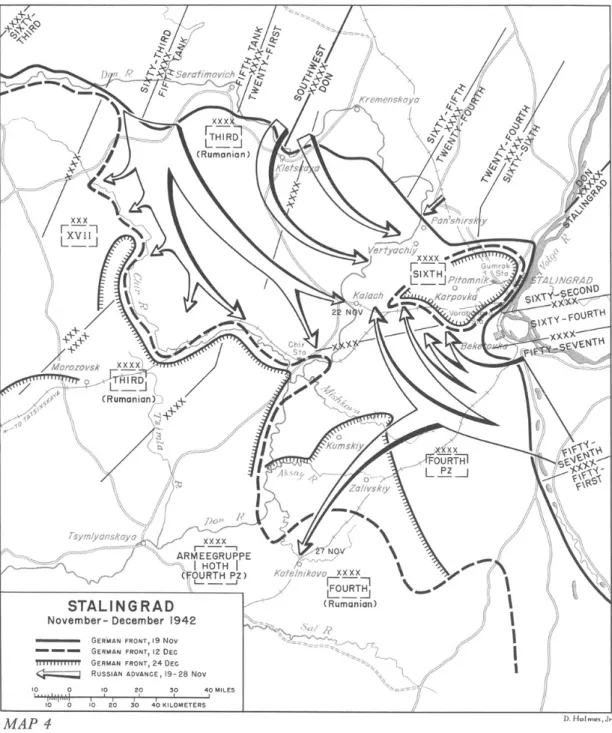
Figure 6: Disaster at Stalingrad………121
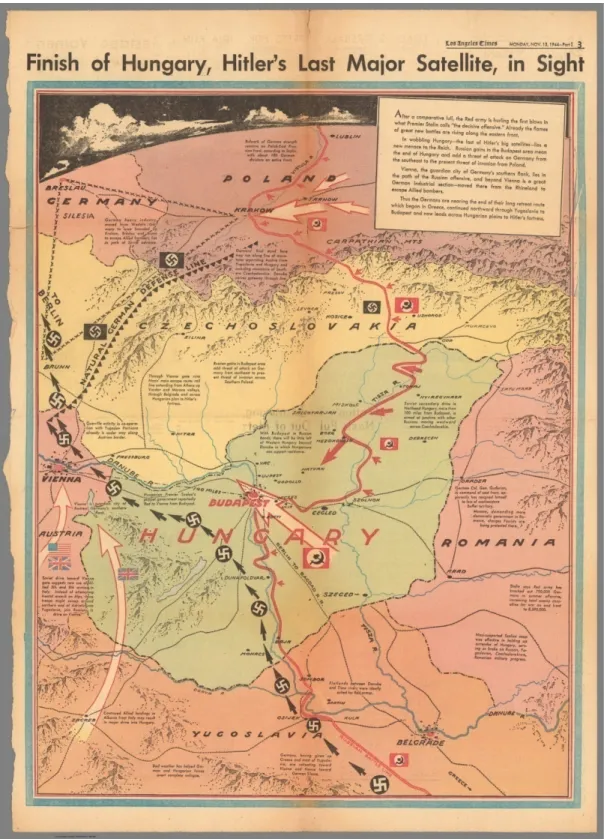
Figure 7: The Soviet Advance on Hungary –Hitler’s Last Satellite ……...122
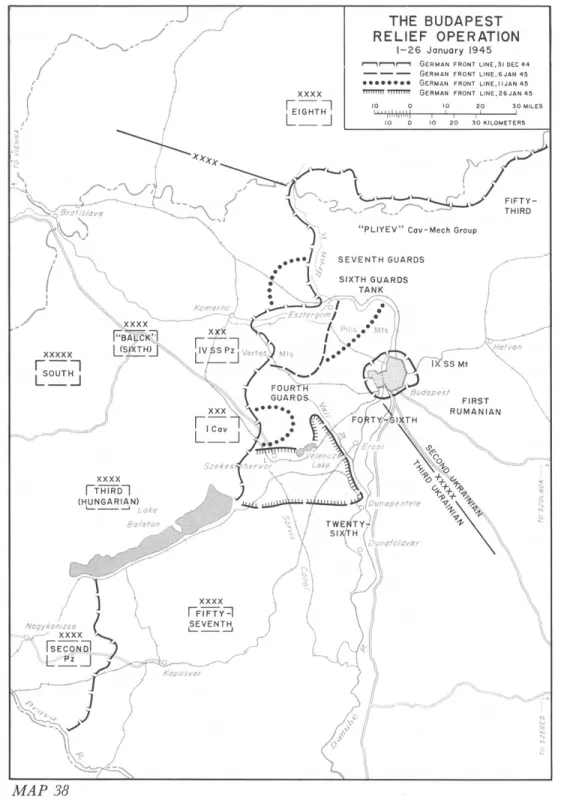
Figure 8: Budapest Relief Operation ………...123
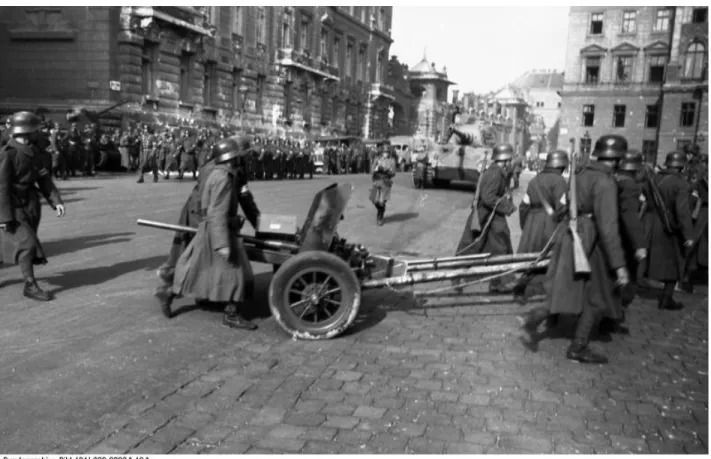
Figure 9: German troops in Budapest, October 1944 ……….124
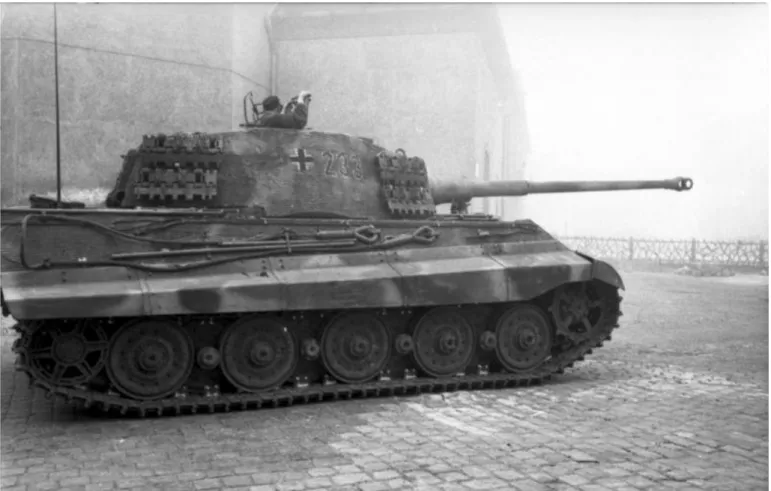
Figure 10: German Panzer, Tiger II, Budapest ………...125
1
CHAPTER I
INTRODUCTION
1.1. The Objective and Scope of the Thesis
The objective of this thesis is to analyze the impacts of Hungarian revisionism on its foreign policy calculations and to place Hungary and its strong adherence to the Nazi Germany even when the defeat was imminent, into a historical perspective and within the framework of the post-war Europe. This framework predominantly includes the diplomatic policies of the Great Powers –the United States, Soviet Union, and Great Britain. In addition to the Hungarian diplomacy in the light of revisionism, a breakdown of the military situation with the armistice negotiations in the background during the German, and later, Soviet occupations of Hungary is necessary to see the downfall of the Hungarian adherence to revisionism. What followed was a Soviet military dominance that gave way to the controlled but not thorough Soviet political control. The focus will be on the period from the beginning of the Regency of Miklós Horthy to the Soviet occupation of Hungary and the immediate post-war era. The presence of the Red Army
2
once set foot upon Hungary, set the tone for the political developments in Hungary as well as the camp it would be on in the Cold War.
The Treaty of Trianon, which Hungary signed on June 14, 1920, marked both the offset and a date of rebound for Hungarian foreign policy between the wars, and its revision became the primary tenet. The Treaty gave Slovakia and upper and western parts of Hungary as well as the Hungarian coronation city of Pozsony (Pressburg) to the Czechs; allotting the major portion of the partition with the entire Transylvania and its
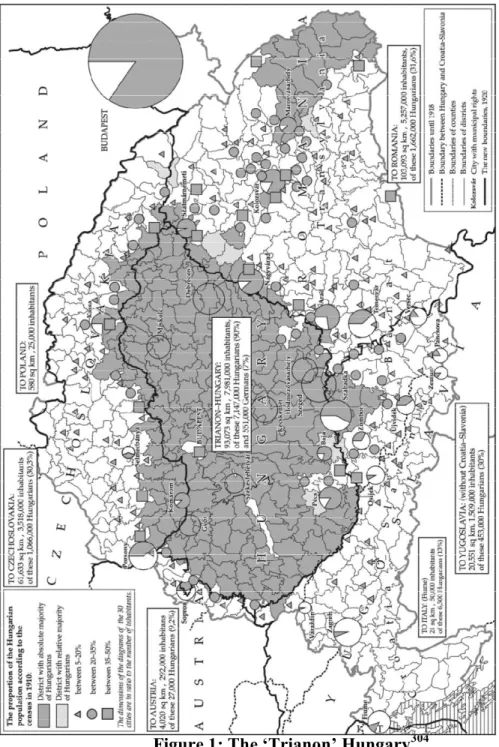
surrounding territories, part of Banat and Temesvár. Serbia took the remaining parts of Banat and Bácska; these territories taken from Hungary were merged with Croatia-Slovania, Dalmatia, Bosnia, Slovenia, Herzegovina, Montenegro and the Kingdom of Serbia itself to establish the new state of Yugoslavia. Moreover, Trianon gave Austria- which had no territorial claims against Hungary –the Burgenland. Poland was also given some 1000 km2, and Italy received the Hungarian harbor city of Fiume.1 Thus, with the treaty, Hungary turned into the smallest Eastern-European country in terms of territory, population, economic resources, and military might (See Figure 1). From then on, the Hungarian foreign policy had a single focus; the revision of the Treaty of Trianon. The fact that the secession of territories of ‘historical Hungary’ did not happen overtime but with just a stroke of a pen by the dominant policies of the Great Powers, strengthened the Hungarian belief that a reversal of the Treaty must be exacted.
We could place Hungary’s role in the Second World War into the rest of the Axis
countries; but in many ways its position was incomparable. What differentiated Hungary can only be grasped in retrospect, although a chronological look into its foreign policy
3
and diplomatic fixation on territorial revision seems that the country was inevitable to follow that path. However, the claim of inevitability in history is nothing but obsolete. True, the domestic policy of a country is inseparable from its foreign policy as we see in the case of Hungary where all the other political goals had been subordinated to the Hungarian irredentism. This study asserts that Hungary had long forgotten the
distinction between the unjust territory ‘grabs’ that disregarded the ethnic principle and the territorial secessions, which were a necessity from the perspective of historical course, just as the empires of Europe crumbled and gave way to nation-states. This Hungarian indifference and total adherence to revisionism automatically made a country like Nazi Germany the ideal ally regardless of other German political and military objectives. Hungary was both a German ally and an enemy country –occupied by Germany. Among all the Axis countries –Italy, Croatia, Slovakia, Bulgaria, Romania, and Finland –Hungary’s role and course was similar to that of Romania. The oil sources of both countries, the Romanian leading the way, were indispensable for Germany to keep up its war machine; both countries extended diplomatic and military support to Germany in its invasion of the Soviet Union. But Germany never occupied Romania. What we can ascertain from the events up until Hungary’s active participation in the Second World War is that its fanatical revisionism paved the way for its indissoluble bond with Hitler’s Germany. This was first marked with the First Vienna ‘Award’ of 1938.
The main argument of this study concerning the interwar Hungary is that it was well before 1941 that Hungary turned into a co-belligerent. The First Vienna ‘Award’ was the first step, which was seemingly a victory for Hungarian revisionism but as a matter of
4
fact, a bond with Germany. As reflected in the German-Hungarian diplomatic meetings, it was highly probable that if Hungary did not pursue pro-German policies from 1938 on, Hitler might as well use the ‘Award’ as blackmail for the integrity of Hungarian territories. We cannot offer an ‘alternative’ for the Hungarian foreign policy for the interwar and war years, nor does it rest within the objectives of the historiography. This thesis will attempt to bring the focus back on the revisionism that started and ended the Hungarian dreams of the restoration of ‘greater Hungary.’
1.2. Archival Sources and Literature
This study has made extensive use of the archives of the Foreign Relations of the United States. They particularly came in use on the years 1944-1946 when the American
interest in the European peace came to the forefront. Other archival sources include the translated German Documents on Foreign Policy (GDFP) as well as the
Kriegstagebücher des Oberkommandos der Wehrmacht. The GDFP documents that I could access covered the years between 1937 and 1941, pertaining to Series D. This series enlighten us as to the inner German foreign policy calculations; however, the papers on Hungary are very limited in scope. An unexpected but very useful source was from the Republic Archives of the Prime Ministry of Turkey (BCA) for the impact of the Anschluss on Hungarian and Italian foreign policy in a report by the Turkish Minister in Pest. For the Budapest Operation of the Soviet Union, the English-translated narratives of the Soviet General Military Staff came to my aid. Although it contains Soviet
5
propaganda in its explanation of military objectives, the minute details of the Budapest Operation in English have been very valuable.
I have approached Horthy’s memoirs with due criticism. In his memoirs, Horthy argues that Hungary was a necessary geopolitical entity for Hitler’s war machine. Unable to provide military support, which was not demanded at the beginning anyway, Hungary would contribute the raw materials and military transportation, which were exactly what Germany needed of Hungary. The argument goes that even if these former two were discarded, Germany wanted to keep a country like Hungary on its side for Hitler feared it seeing it on the Allied side as was seen in the cases of Denmark, Belgium, and Holland.2 Horthy also finds the idea that Hungary could have resisted Germany both politically and militarily to be “nonsense.”3 It is a flawed argument because Horthy presupposes the place of Hungary on the Axis side, disregarding the possibility even of a neutral stance during war. If we treat the neutrality as an unworkable policy objective, Hungary had completed all the steps to place itself on the Axis side; the signing of the Anti-Comintern Pact, which led to the break- up of diplomatic relations with the Soviet Union, the Hungarian recognition of Japan’s invasion and claim on Mainland China (1931), and leaving the League of Nations, to name a few. Moreover, the Hungarian revisionist ambitions steered the course of Hungarian policy actions regarding Germany, which seemed happy to oblige in return of greater military favors from Hungary.
However, Horthy stretches the period of ‘neutrality’ for Hungary well into the late 1930s and marks the suicide of Pál Teleki as the end of Hungarian non-belligerency.4 This is,
2 Horthy, Memoirs, 172. 3 Ibid., 173.
6
to say the least, an almost-naïve and apologetic statement that impresses upon the modern reader that the tug of war swept over Hungary as fitting of the Zeitgeist of Hitler’s Europe.
In the secondary literature on Hungary during the Second World War, a number of scholars, who have analyzed the domestic and foreign policies of Hungary during this period, are worth mentioning. Although it was written in the 1950s, Carlile Aylmer Macartney’s two-volume work titled October Fifteenth: A History of Modern Hungary, 1929-19455 is monumental and used in almost every study on Hungary that deals with the same period. The impact of the Hungarian revisionism on its international relations was best reflected in Joseph Rotschild and Nancy M. Wingfield’s Return to Diversity: A Political History of East Central Europe Since World War II6, which examines the political transition of European States in the Danubian basin with a retrospective look into their war-time politics. Rotschild’s study on East Central Europe between the Two World Wars7 has also been very useful to derive a general picture of South Eastern Europe between the 1920s to the 1940s. However, these two works focus on all the countries in this part of Europe with a general framework.
For the Hungarian military participation in Operation Barbarossa, Mario D. Fenyö’s article, Allied Axis Armies at Stalingrad, and his book, Hitler, Horthy, and Hungary:
5 Carlile Aylmer Macartney, October Fifteenth: A History of Modern Hungary 1929-1945 Volume I and
II (Edinburgh: Edinburgh University Press, 1956).
6 Joseph Rotschild and Nancy M. Wingfield, Return to Diversity: A Political History of East Central
Europe Since World War II (New York: Oxford University Press, 2000).
7 Joseph Rotschild, East Central Europe between the Two World Wars (Seattle: University of Washington
7
German-Hungarian Relations, 1941-19448 combine the German impact on Hungary with Hungary’s military steps. These two works have guided me to blend the political decisions taken in the background with the realities of the war raging in the foreground. In writing the battle on the Don, the German and consequent Soviet operations in Hungary, in addition to the Soviet General Staff material I have made use of several works that especially focus on Hungary such as Hungary in World War II: Caught in the Cauldron9 by Deborah S. Cornelius, who traces the Hungarian history from Béla Kun to its Soviet occupation; and another recent work by Krisztián Ungváry titled Battle for Budapest,10 which also gives minute details of the battle between the German forces and the Red Army. How the fight for control of the Budapest took place was analyzed in part by Anthony Beevor,11 and Glantz and House.12 For the Soviet and Anglo-American aims regarding Hungary, Michael Dobbs’s book Six Months in 194513 clearly sets forth the Allied motives and plans for entire Europe at Yalta. Dobbs avoids the cliché that Stalin had the spread of Communist ideology in his plans for Europe. The fact was, as Dobbs elaborates, the realpolitik in Stalin’s post-war aims played a greater role and the reach of the Red Army determined the reach of the Soviet political influence over Europe.
8 Mario D. Fenyö, “The Allied Axis Armies at Stalingrad,” Military Affairs 59, no. 2 (Summer
1965):57-72. Hitler, Horthy, and Hungary: German-Hungarian Relations, 1941-1944 (New Haven: Yale University Press, 1972).
9 Deborah S. Cornelius, Hungary in World War II: Caught in the Cauldron (New York: Fordham
University Press, 2011).
10 Krisztián Ungváry, Battle for Budapest: One Hundred Days in World War II ( London: I.B. Tauris,
2003).
11 Anthony Beevor, The Second World War (New York: Little, Brown and Company, 2012)
12 David M. Glantz and Jonathan M. House, When Titans Clashed: How the Red Army Stopped Hitler
(Lawrence: University Press of Kansas, 1995).
13 Michael Dobbs, Six Months in 1945: FDR, Stalin, Churchill, and Truman –From World War to Cold
8
As for the military terms, in order to avoid confusion I have used the shortened Arabic numbers to refer to the Soviet armies (i.e. fronts), divisions, and corps such as the 2nd Ukrainian Front. The full spelling is used to denote its German, Hungarian, Italian, and Romanian equivalents, such as the Sixth Army. A number of differences in reference to Russian and German military formations is that Soviet armored units use ‘tank’
divisions, corps etc. in contrast to the German use of ‘panzer’ for the very same units. The other is the Soviet’s ‘rifle’ units were German ‘infantry’ units.
9
CHAPTER II
HUNGARY BETWEEN THE WARS (1919-1939)
“The Hungarians are not our friends but our enemies.” – Clemenceau, 191914
2.1. Hungary in Transition
Before the Treaty of Trianon and the declaration of the Hungarian kingdom, Hungary had undergone a few transitional periods that left an imprint both on the Hungarian mind and Hungarian foreign policy considerations in years to come. The first of those was the ineffective Károlyi regime. The symbol of the Aster Revolution (Öszirózsás
forradalom), Count Mihály Karolyi ascended to power in October 1918, the last year of the Great War. Károlyi took on the role of representative of the workers in Parliament during the worker strikes in June. And later, he became the head of the newly-formed revolutionary National Council.
Károlyi sought to make better diplomatic ties with France as an alternative to the crumbling Germany and to cut its ties with Austria. Two months after taking office,
10
Károlyi declared Hungary a republic. Within the same month of November, Romania entered Cluj, the capital of Transylvania, not advancing further. The new Hungarian government also granted autonomy to the Ruthenians, Swabians, and Slovaks, living in the Hungarian territories.15 Károlyi was publicly known to be a follower of Wilson’s Fourteen Points. Here, granting autonomy to the national minorities was not the central part; it was the restoration of the lost Hungarian territories that seemed to be attainable for Hungary in the Wilsonian policies.16 Therefore, a Hungarian military resistance to the Romanian occupation would have undermined the friendly relations Károlyi was trying to sustain with the victor powers. Yet, the Károlyi regime did not find extensive support by the Great Powers, who, by now, committed themselves to the Czechs, Slovaks, and other Southern Slavic peoples, who demanded total separation from Hungary. The only western power that was sympathetic to the Hungarian cause was Italy and its objective was to turn Hungary into an ally for the Italian demands on Yugoslavia.
On November 7, Károlyi sent a delegation to Belgrade for Hungary to be included in the negotiations for an armistice with French General Louis Franchet d’Esperey, the Allied commander of the Balkan armies.17 The Hungarian diplomatic protests against the territories lost to the Czechs and Romanians were met with indifference. The final blow was on March 20 when Ferdinand Vix, the head of the French military mission in
15 Joseph Rotschild, East Central Europe between the Two World Wars (Seattle: University of
Washington Press, 1992), 140. In Paris, Edvard Beneš, the Czechoslovak minister of foreign affairs, demanded that Hungary evacuate Slovakia, which was complete by January 20, 1919. Tibor Hajdú and Zsuzsa L. Nagy, “Revolution, Counterrevolution, Consolidation,” in A History of Hungary, ed.Peter F. Sugar et al. (Bloomington: Indiana University Press, 1990), 299.
16 Macmillan, Paris 1919, 259.
17 Deborah S. Cornelius, Hungary in World War II: Caught in the Cauldron (New York: Fordham
11
Budapest, transmitted the French Supreme Council Decision of Hungary’s evacuation of the zone between the Tisza River and the eastern parts of the Hungarian plains as an ultimatum.18 The area that was asked of Hungary was to push Hungary approximately a hundred kilometers to the west. Moreover, accepting this ultimatum meant that
practically nothing would stop Romania going deeper into Hungary. A Hungarian acceptance, Károlyi anticipated –and rightly so –would result in his fall and a subsequent revolution.19
The Hungarian reaction to the Vix Ultimatum was enormous; the public belief was that the Károlyi government was mistaken in its attempts to cooperate with the Entente. The government rejected the ultimatum, resigned, and handed down the power to the Social Democrats and Communists who formed an alliance. On March 21, 1919, the
Revolutionary Governing Council proclaimed the Hungarian Soviet Republic.20 Real power now rested in the hands of Béla Kun. The Hungarian Communist experiment lasted for four months. The state intervention in economy as well as on religion quickly turned into state terror. The hundreds of property owners faced arrests by the
government, which became known as the “Red Terror.” At the same time, outside Hungary, an opposition front was in the works. In Vienna and later in Széged, counter-revolutionary committees were set up. Those committees were under the leadership of Hungarian aristocrats, including the future prime ministers Pál Teleki, István Bethlen,
18 Ibid., 17.
19 Macmillan, Paris 1919, 262.
20 Istvan Deak, “Budapest and the Hungarian Revolutions of 1918-1919,” the Slavonic and East European
12
Captain Gyula Gömbös among the members of the Széged committee calling for raising a national army.21
As the ‘Terror’ continued, on the border with Romania, there was a whole new different picture; by the end of April, Romanian and Czechoslovak armies had moved into Hungary and were in the vicinity of Budapest. The Romanian forces had already taken Nagyvárad, Arad, and Debrecen. The industrial area around Miskolc, and Salgótarján, which was twenty-five kilometers away from Budapest, were in the hands of the Czechoslovak Army.22 Relief was expected of the Ukrainian Red Army, which indeed checked the Romanian advance at the Tisza. The Hungarian forces were made up of the workers and supported by miners. They launched a counter-attack against the Czechs. This quickly turned into a steady Hungarian advance into Slovakia, which halted around the middle of June. By lack of military supplies and the French pressure, the Hungarian Red Army retreated from Slovakia.
By that time the Hungarian political leadership lost its political leverage; the fact that Béla Kun and his Communist circle were Jewish also fueled anti-Semitism in the country. The Romanian Army was pressing deeper into Hungary and all the Hungarian counter-attacks were met with more resistance. The military situation was desperate. On August 1, the Hungarian Governing Council with Kun at its head presented its
resignation and escaped to Vienna. Two days later, the Romanian Army was in
Budapest.23 Meanwhile, the Yugoslavs and Czechoslovaks drove deeper into Hungary.
21 Bela Bodo, “Hungarian Aristocray and the White Terror,” Journal of Contemporary History 45, no. 4
(October 2010), 709.
22 Hajdú and Nagy, “Revolution, Counterrevolution, Consolidation,” 306. 23 Macmillan, Paris 1919, 267.
13
In the countryside, there was resistance both to Budapest and its failed policies, the National Army under the command of Horthy, arrived at Siófok in Transdanubia, which was not under Romanian occupation. The National Army was an independent body with no ties to the government in Budapest. The Army did not come into direct military contact with the Romanians, but it was with orders to execute those supported by the Soviet Republic.24 The paramilitary detachments carried out pogroms aimed directly at Jews and Communists which came to be called the ‘White Terror.’
The Romanian troops looted Budapest and the surrounding areas; they stayed until the middle of November after the Romanians, Miklós Horthy entered the capital with his National Széged Army and made an agreement with a British diplomat, Sir George Russell Clerk, who was sent by the Paris peace-makers, to form an alliance. A
counterrevolutionary government with István Friedrich as its prime minister and Horthy as the commander-in-chief of the army ruled three months until a new government that also had Socialist representatives replaced it in November.25 Immediately after, the general elections followed, in which the Communist and Socialist parties were not able to participate.
The newly-established Hungarian assembly passed a law, declaring Hungary to be a kingdom. But instead of electing a monarch, it followed a medieval precedent and appointed a regent until a monarch could replace him.26 On March 1, 1920, the last Commander-in-Chief of the Austro-Hungarian Navy and the aide-de-camp of the
24Bodo, “Hungaritan Aristocracy”, 716. 25 Rotschild, East Central Europe, 152.
26 As Miklós Horthy notes this practice dates back to 1446 when Hunyadi János acted as Regent until
1452 with the title “Föméltoságu,” –High Dignitary. Nicholas Horthy. Memoirs (Westport: Greenwood Press, 1978), 111.
14
Austro-Hungarian emperor Francis Joseph, Miklós Horthy was elected as regent. Horthy had played an active and audacious role at the Battle of Otranto, the greatest sea
engagement in the Adriatic, directing his forces while he was wounded on a stretcher on a ship for hours. As regent, Horthy was able to exercise as much power as a monarch. He could choose the prime minister, convene, prorogue, and dissolve Parliament. Officers pledged allegiance to him as they had done to the emperor of Austro-Hungary. Democracy was embraced only partially. The adherents of the old regime were content with pluralistic but restricted ‘democracy’ so long as they were able to work it out to their advantage. The fear of Bolshevism produced toleration to democracy that could withstand direct manipulation. However, this manipulation came in the form of populist nationalism and irredentism.
Although the position of regent was considered to be temporary, Horthy would rule Hungary even into the Second World War, for more than twenty years. The Horthy regime would come to be identified with Hungary between the wars. Besides
nationalism and conservatism, fervent anti-Communism and a political adherence to the aristocracy as the pre-eminent social class defined the Horthy era.27 Horthy aligned the course of the Hungarian politics with that of Germany and was aware early on that although Hungary would follow Germany into a European war, if they did not win,
27 Steven B. Vardy, “The Impact of Trianon Upon Hungary and the Hungarian Mind: the Nature of
15
Hungary would not exist on the map anymore.28 Two weeks after Horthy’s election, a new coalition government went to Paris to sign the new peace treaty.
2.2. The Signing of ‘Trianon’
The Treaty of Trianon, which Hungary signed on June 14, 1920, marked both the offset and date of rebound for Hungarian foreign policy between the wars, and its revision, the primary tenet. Interwar Hungary had many political, economic, and social fluctuations, but these were shadowed by the “Trianon Syndrome,” which set the course for Hungary after the Great War.29 The Hungarian reaction to Trianon was excessively emotional and politically all-consuming. The peaceful revision of the treaty had never been an option, for Hungary aligned itself with the other countries such as Italy, and later, Germany – countries that were not content with the conclusion of peace after the First World War, either. To make sense of the Hungarian policy decisions and fluctuations during the Second World War, as well as what that war cost to the country, we need to look deeper into Hungary between the wars and the diplomatic commitments and diplomatic
renunciations it had formed.
28 “Ein verlonerer Krieg würde Ungarn von der Landkarte verschwinden machen,” noted Horthy before he
met the Führer in 1936. Pál Pritz, “Hungarian Foreign Policy between Revisionism and Vassalage,” Foreign Policy Review (2011):104.
29 After the end of the war, the Hungarian borders were back as the treaty dictated. Thus, the syndrome did
16
The Treaty of Trianon took two-thirds of Hungary’s territories, three-fifths of its population (See Table 1). Before the Great War, the Hungarian population was close to 20 million; now Hungary had only 7,615,117 people. The Hungarians had become the second biggest Diaspora in the world, and the biggest ethnic minority in Europe (with Transylvanian Hungarians in Romania).30 The territories Romania had absorbed from Hungary were bigger than the newly-created Hungary. The military, on the other hand, was reduced to 35,000 officers and men only to maintain order and for the security of frontiers. Mobilization and creation of general staff were forbidden as well as an air force and armored units. The economic structure also went under a major change; Hungary now had only 16 percent of its forests, and 11 percent of its oil production.31 The country’s dependence on foreign trade rose up. At the beginning of the 1920s, Czechoslovakia, Romania, and Yugoslavia allied –the Little Entente – allied to deter any possible Hungarian effort to revise the treaty.32 The Entente, empowered by the French, was to make sure that Hungary would only have reduced territories under the Treaty.
30 Tibor Frank, “Treaty Revision and doublespeak: Hungarian neutrality 1939-1941,” in European
Neutrals and Non-Belligerents During the Second World War, ed. Neville Wylie (Edinburgh: Cambridge University Press, 2002), 151.
31 Hajdú and Nagy, “Revolution, Counterrevolution, Consolidation,” 314. 32 Cornelius, Hungary in World War II, 33.
17 TABLE I:
Hungarian territorial and populational losses as a result of the Treaty of Trianon (per 1910 data)33
Area (square km) Population (in total)
Magyars(linguistics)
‘Historic’ Hungary (without
Croatia-Slovenia)34 282,870 18,264,533 9,944,627 Lost to: Austria 4,020 291,618 26,153 Czechoslovakia 61,633 3,517,568 1,066,685 Poland 589 23,662 230 Romania 103,093 5,257,467 1,661,805 Yugoslavia 20,551 1,509,295 452,265 Italy 21 49,806 6,493 Total Losses 189,907 10,649,416 3,213,631 Truncated Hungary 92,963 7,615,117 6,730,996
Thus, Trianon was a turning point as well as a traumatic event for Hungary; it set the Hungarian foreign policy moves both for the interwar period and even well into the Second World War. The Hungarian revisionism had become a national ambition, a rallying point for people from all political spectrums. With the revision as the central focus, the Hungarian foreign policy also consolidated on two other priorities; making Hungary a bulwark against Bolshevism in Central Europe, and building and maintaining
33 All the statistics are taken from Rotschild, East Central Europe, 155.
34 If we are not to consider these territories part of ‘historic Hungary’ as Crotia-Slovenia had become part
of Hungarian territories in 1102 when the Croation crown was passed into Árpad dynasty. Pál Engel, The Realm of St. Stephen: A History of Medieval Hungary, 895-1526 (New York: I.B: Tauris, 2001), 35.
18
friendly relations with great European powers –Germany, Italy, and Great Britain, in particular.35 The Hungarian answer for the Trianon was one: “Nem, nem, soha!”(“No, no, never!”) (See Figure 2).
The ruling class was largely estate owners, and the middle class, who wished to see Hungary retain its old traditions in economy, politics, and society. They gravitated toward the parliamentary government as the ideal form, which they thought, managed to balance the right and left spectrums in Hungary. The counts István Bethlen and Pál Teleki were the pioneers of this concept. In July 1920, Count Pál Teleki formed a new government. His government aimed to reduce the influence of the rightist extremists in Hungarian politics. The Hungarian Communist Party was also banned in 1921. The political upheaval continued with a debate over whether the monarchy should be restored in full. The legitimists had no support from the extreme right, which had militarization as one of its aims. Under the monarchy, they believed, it would be unattainable to do so. The Great Powers also opposed the resumption of the Hungarian monarchy.36 The crisis over the monarchy drove the Teleki government out of office.
To put the post-Trianon political objectives into action, in the immediate post-First World War period, Count István Bethlen, Hungary’s longest-lasting prime minister in office (1921-1931) of Transylvanian origin, sought to place Hungary into the newly-built political and economic machine of Europe. This integration and seeking new
35 Horthy especially gravitated toward Britain, which helped Horthy ascend to the Regency. Added to this
gravitation was the French supported the Little Entente and the United States simply did not take any interest in Hungarian affairs. Frank, “Treaty revision and doublespeak,” 154.
36 In 1921, Charles IV, who resided in Switzerland, went to Hungary with the backing of the legitimists
and Teleki government. Horthy had the support of France as well as the rejection by Hungary’s neighbors that feared the resurrection of the Dual Monarchy. Thereupon, Charles IV was forced to leave Hungary. Hajdú and Nagy, “Revolution, Counterrevolution, Consolidation,” 318. Charles IV made a second attempt to take the Hungarian throne in October, which also failed.
19
reliable partners for a country with hostile neighbors shaped Bethlen’s policies. Bethlen opened negotiations with the Entente countries to settle the question of the Burgenland and the territorial dispute with Yugoslavia over the regions around Pécs. The latter dispute was solved when Yugoslavia abided by the Paris settlements and evacuated the regions it occupied. As for the Burgenland, Italy acted as a mediator between Austria and Hungary, and except for Sopron, Austria took Burgenland.37
In 1922, Hungary gained membership in the League of Nations and acquired loans from the League.38 To find support for its revisionism, Hungary turned to Great Britain. However, Bethlen was aware that the British would not directly support them especially in observance of the Treaty of Trianon. What best describes the British stance on these Hungarian claims is the British Foreign Secretary (1919-1924), Lord Curzon’s statement that Hungary could gain prosperity only through the “abandonment of such dreams as Hungarian political parties seem freely to indulge in of recovering the position that Hungary formerly held in Central Europe.”39
2.3. Hungary and the Axis Camp
In the years between 1921 and 1926, Bethlen tried to find a common political ground with Hungary’s neighbors as well as with the Central Powers. France was on the camp of the Little Entente, and Great Britain had its influence down to a minimum in Central
37 In Sopron, the two parties agreed to a plebiscite, whose outcome gave the region to Hungary. Mária
Ormos, “The Early Interwar Years, 1921-1938,” in A History of Hungary , ed. Peter F. Sugar et al. (Bloomington: Indiana University Press, 1990), 320.
38 Frank, “Treaty revision and doublespeak,” 155.
39 Thomas Sakmyster, “István Bethlen and Hungarian Foreign Policy, 1921-1931,” Canadian-American
20
Europe. Italy came forward as the ideal partner. In 1927, Hungary signed a treaty of friendship with Italy. What united these two countries was the case of Yugoslavia; Italy wished to see Yugoslavia isolated, and an East-European ally to counter the French influence in the Danube region. Hungary also had lost territories to Yugoslavia, thus, with a strong European ally; Hungary would be a hectoring power in the region, at least, diplomatically. Until the German-Hungarian relations developed and steered the course and fate of Hungary with the rise of Hitler, Italy was the greatest ally that supported the Hungarian irredentist claims; and the Treaty of 1927 would remain the only bilateral agreement Hungary made with a Great Power until joining in the Anti-Comintern Pact of 1939.40
The Bethlen era called for territorial expansion and revision of the lost Hungarian territories, Bánát, Slovakia, Carpatho-Ukraine, and parts of Romania, moderate revisionism, limiting the Hungarian claims only to the areas where the Hungarian populations were dominant.41 His establishment of closer ties with both Italy and
Germany set the course of the rest of the Hungarian foreign policy on the Axis side. Yet, Bethlen seemed to have left room to maneuver toward the other Western countries, when he stepped down in 1931. After the Bethlen government, Horthy had appointed Count Gyula Károlyi as prime minister. His administration was short-lived; the foreign policy aimed at a return into the orbit of Western Europe so as to bring order to the
40 Sakmyster, “István Bethlen,” 9. 41 Ibid., 13
21
Hungarian economy. Károlyi resigned on September 21, 1932. In his stead, Horthy asked Gömbös to form a new government.42
General Gyula Gömbös pushed Hungary into the radical right.43 A new era in Hungarian politics had begun. Horthy and his circle had all been born and grown up during the Austro-Hungarian Monarchy; its values and culture had been embedded in them. The higher officers had started in the Habsburg army and participated in the Great War. The former prime ministers –Bethlen, Teleki, and Károlyi –were all counts; the political leaders were mostly the great landowners and finance magnates. Gömbös, on the other hand, was the son of a Lutheran teacher of German ancestry. He represented a new middle class as his generation grew up in the nationalist spirit of truncated Hungary.
His appointment as prime minister in October 1932 coincided with the electoral victory of the National Socialist Party in Germany. On January 30, 1933, Hitler came to power. And in June 1933, Gömbös became the first European leader to meet with Hitler. But his political designs and a possible common ground for Hungary and Germany met with indifference by the German leader. Hungary’s revisionism was not on Hitler’s political agenda. His support was stronger only in the issue of destroying Czechoslovakia.44 Gömbös’ primary goal was a German-Hungarian-Italian partnership; this carried the country further into the Axis camp and to an increase of the pro-German elements both in the government and the army.45 Gömbös expected that Hungary would be able to
42 Mária Ormos, “The Early Interwar Years, 1921-1938,” 331.
43 Gömbös was instrumental in organizing the National Army at Széged, was a popular candidate. In the
early 1920s he advocated the idea of Hungary as a one-party state and was the leader of an anti-Semitic group within the army. But through the late 1920s he had more moderate political views. In 1929 he became minister of defense.
44 Cornelius, Hungary in World War II, 53.
22
press on its revisionist demands with a power balance and support by Germany and Italy in Europe.
On March 17, 1934, Hungary, Italy, and Austria signed the Rome Protocols,
guaranteeing consultation in case of an external threat to any of these three parties.46 This was a retaliatory pact against the newly concluded Balkan Pact that renounced the existing revisionist territorial claims in the Balkans. But Gömbös also secured a
guarantee of support by the Italians, who did not consolidate their bond with the Germans and disfavored strong German influence over the Danubian countries such as Hungary and Austria. In the fall of 1935, Italy invaded Ethiopia. A year later, the League of Nations denounced the Italian invasion and placed an economic embargo against Italy.47 This news worried Hungary enormously for Italy’s tie-down in Africa would leave no other Central European power to defend the Hungarian interests in the region; however, the embargo compelled Mussolini to have closer ties with Germany. In the meantime, Germany was distancing itself from Hungary and endeavoring for better relations with Romania.48 The next year, Germany and Austria signed an agreement that tied the Austrian foreign policy to that of Germany, although Germany had recognized the independence of Austria. This agreement caused Italy to take on a more cautious policy toward Germany. Thus, not leaning on either side, Gömbös’ balance between Berlin and Rome continued. The interpretation of such an agreement was that now Hungary would have a more free hand in handling its foreign policy without fear of
46 Winston S. Churchill, The Gathering Storm (Boston: Houghton Mifflin Company, 1985), 85.
47 Peter Pastor, “Hungarian-Soviet Diplomatic Relations 1935-1941: A Failed Rapprochement,”
Europe-Asia Studies 56, no. 5 (July 2004):733.
23
diplomatic repercussions from Germany.49 Moreover, the Hungarian Foreign Ministry was well aware that their country was incapable of giving military guarantees to Austria in case of a German attack.50
Simultaneously, Hungary maintained its diplomatic contacts with Moscow. Budapest’s request was the Soviet support of Hungarian revisionist claims that was born out of Trianon, as well as support for Hungary’s right to rearm like its neighbors in Central Europe. However, the Soviet Union would ask for Hungary acting as a barrier against the growing German expansion toward Eastern Europe.51 This was not a commitment Hungary would be willing to make as its previous policies concerning Germany proved, although Germany did not support all the Hungarian territorial claims except that on Czechoslovakia. Coupled with an inconsistent foreign policy, Gömbös’ control over the domestic affairs was not faring well, either. As a result, the government lost the majority in Parliament. By that time, Gömbös was seriously ill; he died in 1936.
Horthy wanted a candidate that would be able to balance the foreign policy and save the country from a complete commitment to the pro-Axis policy. For that, Kálman Darányi appeared to be the ideal candidate. Darányi had conservative political leanings, which aligned him with the camp of aristocrats and financial bosses in the Government Party.52 By appointing Darányi, Horthy hoped to keep Hungary’s foreign policy options as wide
49 Başbakanlık Cumhuriyet Arşivi [=BCA], 1936: 30 10 / 231-557-10.
50 The Hungarian administration also found Anschluss a crisis of the decision of the Great Powers that
split Europe into small states. Betty Jo Winchester, “Hungary and the ‘Third Europe’ in 1938,” Slavic Review 32, no.4 (December 1973):744.
51 Pastor, “Hungarian-Soviet Diplomatic Relations,” 734.
52 Betty Jo Winchester, “Hungary and the Austrian Anschluss,” East European Quarterly X, no. 4 (1976),
24
as possible to benefit from the ever-changing and critical events in Central Europe for the sake of the Hungarian revisionism.
In spring 1938, with a Hungarian delegation, Darányi visited Berlin where Hungary’s way of seeking a separate agreement with the Little Entente was criticized as a sign of the Hungarian deviation from the Hungarian-German cooperation. The German government gave the Hungarian delegation an overview of the German plans for the Danubian Region, especially the fate of Czechoslovakia. The German support for the Hungarian revision would be directed toward the Czechoslovak question. On other territorial claims, Germany made no definitive promises for the time being.53 After the visit to Berlin, Darányi oriented the Hungarian policy more toward Germany and caused the talks with the Little Entente to be stalled.54 However, Germany did not openly support the Hungarian claims in Slovakia and Ruthenia –the territories of Felvidék. The only assurance given was that Germany did not have any claims over this region. On March 12, 1938, the last year of the European peace, Hitler incorporated Austria into the German Reich with the Anschluss; now Hungary became contiguous with Germany. This development meant, above all, that Germany became even greater direct influence over Hungary. The Hungarian government was the first to congratulate Germany on the acquisition. Following the Anschluss, the extreme right, including the Arrow-Cross Party, gained popular support and interest.55 Darányi gave approval of these rising
53 Gyula Juhász, Hungarian Foreign Policy 1919-1945 (Budapest: Akadémiai Kiadó, 1979), 132. 54 Magda Ádám, “The Munich crisis and Hungary: the fall of the Versailles settlement in central Europe,”
Diplomacy & Statecraft 10, no. 3, n.d., 86.
55 The Arrow-Cross Party had been founded in the 1930s as some right-wing parties merged. Its political
vision consisted of enmity toward the short-lived Communist influence in Hungary in 1919,
anti-Semitism, and fostering of feudal structures, and it was an ardent follower of Nazism in Hungary. Its roots went back to Ferenc Szálasi’s Party of the National Will in 1935. Ian Kershaw, To Hell and Back: Europe 1914-1949 (London: Penguin Books, 2016), 244.
25
rightist leanings by introducing the first anti-Jewish Bill as well as closing down leftist papers.
In order to put Hungary back into a West-oriented path, Horthy appointed Bela Imrédy as prime minister due to his pro-Western, especially pro-British ties. Meanwhile, as Hitler’s intentions toward Czechoslovakia were shaped, Imrédy’s cautious policy that Hungary would not act to integrate any part of Czechoslovakia unless the country was in disintegration, found support by the Regent Horthy as well. Such a move, the Regent was well aware, would drag Great Britain into the war.56 A certain political pattern emerged with the closer relations with Germany, which directly gave rise to the far-right in Hungary. Whenever the newly-appointed government would cross the line Horthy and his circle would deem inappropriate or overly pro-German, another seemingly moderate candidate would take its place that went even beyond the accepted limits of Axis friendship.57 However one thing that did not alter is the belief that it would be Germany only who could realize the Hungarian hopes of revisionism.
Between Germany and Italy, Hungary sought to find a balance with the Little Entente. The reason for Hungary’s non-adherence to any of these three political camps was that his revisionism did not find full support in any of them. Choosing a side meant an irrevocable commitment that did not guarantee the realization of Hungarian irredentism. Thus, regardless of their political orientation, the Hungarian prime minister, all endorsed by Horthy, would seek to pursue this sole goal, currying favor with every power that had
56 This fear of Western military interference in the Czechoslovak affair slowed down the Hungarian pace
with regard to its full support for Germany in a military crisis. Thomas Sakmyster, “Hungary and the Munich Crisis: The Revisionist Dilemma,” Slavic Review 32, no. 4 (December 1973), 734.
26
a say in the region. In light of this, the negotiations with the Little Entente encompassed renunciation of war and the protection of the Hungarian minorities in Czechoslovakia, Yugoslavia, and Romania. The agreement that also included Hungary’s right to rearm, was signed in Bled, Yugoslavia, on August 23, 1938.58 The Bled Agreement was a sign that Hungary was not solely dependent on Berlin to navigate its foreign policy in South-eastern Europe.
The Munich Agreement in 1938 has always been acknowledged as Germany’s violation of Czechoslovak territorial integrity. At the same time, the later dissolution of
Czechoslovakia was also an opportunity, and Hungary was quick to grab it in its northern neighbor. As much as a German affair, Hitler made sure to turn the
Czechoslovak disintegration into a European affair, a revision of the unjust treaties after the Great War. The Germans and the Hungarians referred to Czechoslovakia as a
Saisonstaat, a country that was born out of favorable circumstances at the end of the Great War, thus, it was liable to dissolution if the climate changed to the detriment of its existence.59 For the invasion, German had asked nothing of Hungary and Hungary was content that Germany did not give any ultimatums for participation in the invasion.60
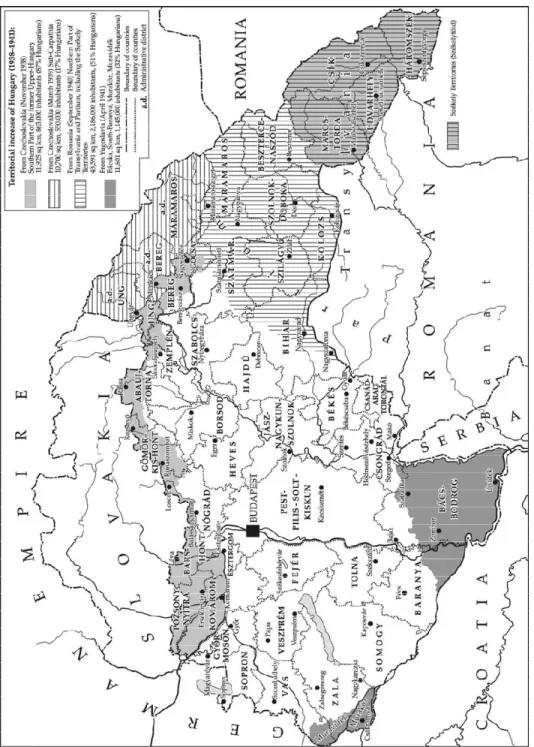
So, when Germany, together with Italy, ‘awarded’ Kassa (Kosice), Munkács, and Ungvár to Hungary at an arbitrational summit in Vienna. With the ‘Award,’ Hitler managed to decentralize the affair away from Germany. The First Vienna ‘Award,’ dated November 2, 1938, gave territories from the former Hungarian Uplands in
58 Winchester, “Hungary and the ‘Third Europe’,” 746.
59 Stephen Borsody, the Triumph of Tyranny: the Nazi and Soviet Conquest of Central Europe (Great
Britain: Macmillan Company, 1960), 81.
60 Documents on German Foreign Policy [=DGFP], Minute by the State Secretary (Weizsäcker) for the
27
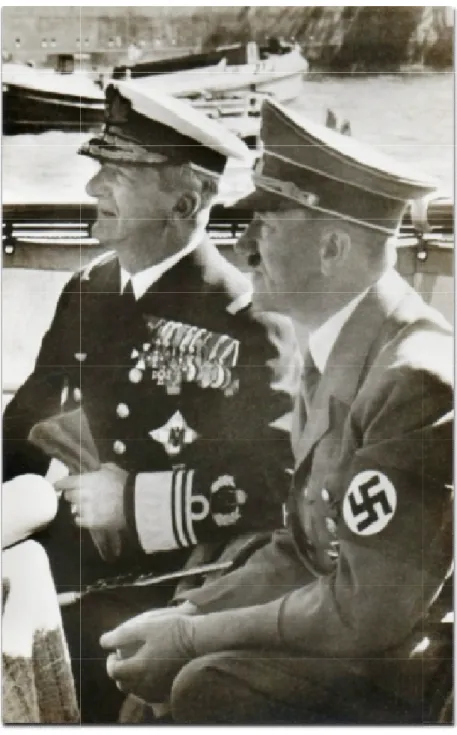
Slovakia and southern Carpathian Ruthenia, 11,927 km2 with its 869,299 population, 86.5 percent of whom were Hungarians.61 The arbitrary decision was carried under the supervision of German Foreign Minister Joachim Ribbentrop, and Italian Foreign Minister Count Galeazzo Ciano, and was part of the partitioning of Czechoslovakia.
The Hungarian justification was that as a member of the Little Entente, Czechoslovakia did not abide by the agreements they signed, which included the protection of minorities, as well as the claim that on the Hungarian-Czechoslovak border, clashes were
constant.62 Of all the five cities Hungary wanted to have, only three were returned to Hungary.63 Before the First Vienna Award, Hitler had had the bridgehead in Pressburg64 and the neighboring territories. Hungary resented this German grab as they considered this area part of Hungary. As for eastern Slovakia, Hungarian claim was merely a “frontier rectification,” as they explained to the Germans.65 Additionally, the Hungarian government was keeping tabs on the German-Romanian relations. A recently-concluded economic treaty between the Romanian and German governments raised the question whether there were any political concessions attached to it, which the German Foreign Ministry was quick to deny.66
In January 1939, Imrédy tried to pursue a foreign policy that would put Hungary under even heavier German influence. He replaced the Foreign Minister Kálmán Kánya with Count István Csáky. Germany did not like Kánya as he promoted and signed the Bled Agreement. Count Csáky made Hungary join the Anti-Comintern Pact and leave the
61 Frank, “Treaty Revision,” 156. 62 Horthy, Memoirs, 167.
63 Pastor, “Hungarian-Soviet Diplomatic Relations,” 737. 64 Also known as Pozsony and Bratislava.
65 DGFP, Minute by an Official of the Foreign Minister’s Secretariat, March 23, 1939, 2313/484508. 66 DGFP, Memorandum by the State Secretary, March 25, 1939. 169/82515,
28
League of Nations.67 This first policy move severed the Hungarian-Soviet relations.68 The Imrédy government complied completely with the German foreign policy. The Hungarian demand for the annexation of Carpatho-Ukraine (or Ruthenia)69 drove a wedge between Berlin and Budapest. The Hungarian demand arose from a political calculation that would give Hungary room to maneuver in the region. A common border with Poland would vitiate the Little Entente as well as Germany, which now increased its political pressure on Hungary because of the Anschluss. Germany did not give its consent for the Hungarian annexation exactly for the same reasons Hungary wanted to take it. An independent revisionist move by Hungary would render German help useless and the Hungarian state less reliant. There was no hope of support from Rome, either. The German and Italian governments referred to the ‘Vienna Award,’ as binding for the Hungarian-Czechoslovak frontiers. Yet, Budapest pressed on with their demands, this time appealing to their common cause of defense against Bolshevist influence.70
67 This public wish was materialized during the prime ministry of Teleki when Hungary did indeed leave
the League on April 11, 1939. Juhász, Hungarian Foreign Policy, 150.
68 Loránd Tilkovszky, “The Late Interwar Years and World War II,” in A History of Hungary, ed. Peter F.
Sugar et al. (Bloomington: Indiana University Press, 1990), 340.
69 Hungary had controlled the region for hundreds of years but after the Great War, the Great Powers had
given the region to Czechoslovakia in 1919 on the condition of making it autonomous when the Hungarian demands for it lost its effect under the Communist Kun regime. Stalin would retain Carpatho-Ukraine in 1944. Rotschild, East Central Europe, 83-84.
29
CHAPTER III
HUNGARY AND THE BREAK UP OF THE SECOND WORLD
WAR
3.1. Armed Neutrality
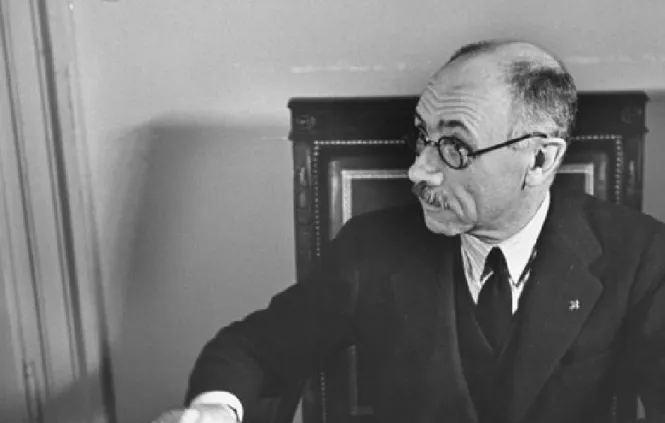
The Prime minister after February 16, 1939, was Count Pál Teleki. He sought to
maintain friendly relations with both Italy and Germany but was unwilling to participate on the side of Germany in a war.71 His foreign policy was essentially ‘armed neutrality’. However, the Hungarian occupation of the rest of Ruthenia in March 1939 was a step outside this ‘neutral’ stance. The Hungarian grab of Carpatho-Ukraine was the extension of the thorough liquidation of Czechoslovakia and took place with the approval of Germany.72 A neutral stance could not hold fast in the face of ambitious revisionist goals. Teleki re-introduced the Hungarian claim on Carpatho-Ukraine in the form of geopolitical needs as he could hardly base it off ethnic lines. The prime objective on the Hungarian foreign policy agenda remained to be the annexation of Carpatho-Ukraine. A
71 This distrust seemed to be shared by Count Ciano, who noted that “any kind of alliance with them [the
Germans] becomes a bad alliance in a little.”Galeazzo Ciano, August 27, 1939, 130.
72 Bohemia and Ruthenia had been incorporated into Germany and Slovakia remained independent but as
30
month later, on March 10, Slovakia declared its cessation from Czechoslovakia and made appeals to Germany for to be placed under their protection. Teleki acted promptly: he convened the ministers and issued a statement that Hungary would occupy Carpatho-Ukraine if Germany invaded Czechoslovakia.73 Hitler ‘relented’ to the Hungarian decision at the cost of several binding conditions for Hungary: the recognition of
previous German treaties with the autonomous Carpatho-Ukraine government, respect of the rights of the German minority in the region, and political immunity to the politicians of the regime there. With a free hand authorized by Hitler, Hungary advanced into Carpatho-Ukraine on March 14. In the public eye, the invasion appeared as an independent Hungarian action that proved the Honvéd’s might. But the invasion of Carpatho-Ukraine was part of the end of Czechoslovak dissolution and Hungary, blinded by its revisionist ambitions warily contributed to the consolidation of Nazi dominance in the Danubian basin.
Teleki avoided any involvement in the invasion of Poland, which would be the beginning of German distrust toward Hungary later in the war. Shortly before the German invasion of Poland, the Hungarian Foreign Minister, Count Istvan Csáky, visited Berchtesgaden where he was told that the Hungarian refusal to join in military operations against Poland out of moral reasons74 was unacceptable as Germany
supported Hungarian revisionism in the past two years with tangible results.75 After this unofficial berating, Hungary decided not to declare its neutrality. The revisionist claims
73 Juhász, Hungarian Foreign Policy, 153.
74 In an enclosed letter to Hitler, Teleki also raised the Hungarian moral concern. See DGFP,
Memorandum by the State Secretary, July 24, 1939, 73/5194045, Vol VI.
75 DGFP, Memorandum by an Official of the Foreign Minister’s Personal Staff, April 29, 1939
F13/400-10. Also, Germany did not ask for any active participation from Hungary in the invasion of Poland but demanded that they use the Hungarian railways for troop transportation. Also see Frank, “Treaty Revision and doublespeak,” 160-162.
31
were, in a way, raison d’être of the Hungarian state; the Hungarian government did not wish to make any contrary moves that would risk the loss of the newly-acquired territories. However, as a cautionary step, Hungary consulted Italy on the issue of granting Germany passage through Hungary to Poland.76 The armed neutrality consisted of currying favor with Germany on the territorial issues and adopting its policy
according to that of the Axis.77 From the Italian perspective, Hungary was intransigent and tended to accept favors from Italy as long as it first solicited.78 In fact, this was part of Teleki’s political agenda; he sought the Italian support as a counter-balance to the growing German economic and political influence. All the while, Hungary sustained its revisionism, this time directed toward Transylvania. The issue of a possible Romanian aggression on the Hungarian border also dominated the talks at Berchtesgaden. The Foreign Minister Csáky referred to the Romanian attack on Austro-Hungary and consequent invasion of Transylvania in 1916 when the Empire faced the Brusilov offensive in Lutsk.79 Now Hungary awaited a similar opportunity, a moment of weakness on the Hungarian part, to arise for Romania to invade Hungarian territories. The Trianon ‘Syndrome’ brought along a fear of a military clash with Romania that never materialized but Hungary always used it as a pretext for avoiding complete commitment to the foreign policy of the Third Reich.
After September 1, 1939, when Germany invaded Poland, the question of granting Germany droit de passage to Poland became the epicenter of Hungarian foreign policy.
76 Mussolini advised the Hungarian delegates to “turn down the German demand as courteously as they
can.” Ciano, September 9, 1939, 141. Two days later, Ciano commented that the Hungarian refusal of passage to the Germans would have a pay-off afterwards.
77 Ciano, April 20, 1939, 148. 78 Ciano, April 30, 1939, 74.
32
The Hungarian calculation expounded that their resistance to the German demand of free passage to Poland would win the favor of the British, thus accordingly, all the public explanations abode by this calculation, asserting that Hungary would not get involved in a war with Poland in any way. Hungary based this logic on the history they shared with Poland, too.80 Although Germany offered the oil wells of the Sambor region in return, Hungary opted to resort to the Italian opinion, which advised Hungary to avoid any political or military involvement without provoking Germany.81 The Hungarian neutrality through the invasion of Poland persisted while Germany did not turn its requests into demands from Hungary. Furthermore, Hungary even opened its border to some 140,000 Polish refugees, who were mostly soldiers;82 this and its neutrality would later to be held against it by the Germans. Through the middle of September, the Soviet Union invaded eastern Poland, which was guaranteed under the secret clauses of the Ribbentrop-Molotov Pact. Now the Soviet Union was at the door of Hungary and the threshold was about 150 kilometers long. The fear of a revival of the Communist upsurge as it was in 1919 intensified the fears of the Hungarian ruling circles.83 The re-establishment of friendly relations with the Soviet Union after the invasion of Poland was a move to curb that possible influence. In November 1939, the idea of forming a neutral bloc in Central Europe against the Balkan Pact became a current issue, first raised by Italy and found disapproval from Germany. Romania later endorsed such a
80 These two peoples, the Hungarians and the Poles, possessed a “centuries old friendship” after all.
Stephen Báthory, the Prince of Transylvania ruled Poland, well before the Habsburgs, the Jagiello dynasty had the Hungarians under their rule. And moreover, Hungary and Poland had never been at war with each other. Horthy, Memoirs, 155.
81 Macartney, October Fifteenth: A History of Modern Hungary 1929-1945 Volume I (Edinburgh:
Edinburgh University Press, 1956), 366.
82 Ibid., 368.
33
bloc whose main provision would be a declaration of neutrality among the participating states.84
3.2. The German Impact on the Hungarian Foreign Policy
The year 1940 altered the convictions of the Hungarian ruling classes as Germany advanced into the heart of Europe with the Blitzkrieg into France. Germany now seemed invincible. Thus, for the question of a re-settlement of the question of Transylvanian territories, Hungary turned to Germany. Arbitrating on behalf of both Romania and Hungary and giving a guarantee of clearing those two Central East European countries of potential disturbances in the near future, Hitler gave Hungary northern Transylvania and the Székelyföld (easternmost Transylvania). On August 30, 1940, Germany and Italy as arbiters assigned the “Second Vienna Award” at the Belvedere Palace in Vienna. The “Award” gave Hungary approximately 43,000 km2 of northern Transylvania.85 The disputed territory was virtually cut in half to appeal to Romania and Hungary.86 Again, Hungary was able to revise the map of Europe. But this time neither side was content
84 Juhász, Hungarian Foreign Policy, 168.
85 The towns of Mármarossziget, Szatmárnemeti, Nagyvárad, Koloszvár, and Marosvársárhely were given
to Hungary with 2.5 million inhabitants in total. Romania got to keep Brasso, Nagyszeben, Segesvár, Arad, and Temesvár. Horthy, Memoirs, 180.
86 Transylvania had been home to the Hungarians ever since they conquered the Carpathian basin in the 9th
century. From the late 16th to the late 17th centuries, the Ottomans and the Habsburgs tried to dominate the
region. In the 1690s, the Ottoman influence over Transylvania dissipated, giving way for the Habsburgs to rule over the entire Hungary. The Hungarians gained autonomy to a certain degree in the Revolution of 1848; but more effectively in Ausgleich of 1867 with the Habsburg Empire. From then to the end of the Great War, Transylvania was under the direct Hungarian rule. After the war, Romania occupied Transylvania in 1919, and later officially acquired Transylvania with the signing of the Treaty of Trianon through the influence of the Great Powers. See Nándor F. Dreisziger, “Transylvania in International Power Politics during World War II,” Hungarian Studies Review XXXVI, no. 1-2 (2009): 86-87.
34
with the outcome of this arbitration. When both parties saw the revised borders on the map, the Romanian Foreign Minister, Mihail, Manoilescu, fainted.87 With the Second ‘Award’, Hungary re-annexed two-fifths of its Trianon losses but Romania was able to retain the economically vital parts of Transylvania. Hitler figured that for the invasion of the Soviet Union, which was just taking shape as a plan, he needed the Hungarian lines of transportation. So, in order to utilize them in the near future, Germany should satisfy the Hungarian revisionism with one step further. At the same time, he still needed the military and economic aid in the coming campaign. Germany resolved the territorial dispute in such a way to ensure that both sides would carry out German wishes. The ‘Award’ gave Hungary enough territory to make the country indebted to Germany, and did not strip Romania of all the vital territories. The German arbitration tied Hungary to Germany; three months after the territorial settlement of Transylvania, Hungary adhered to the Tripartite Pact.88 Along with Hungary, the signatories included Slovakia and Romania. The underlying reason for joining the Pact both for Hungary and Romania was to take a share in the future territorial gains the Axis powers were to achieve. Yet again, Hungary was lured in by its passionate revisionism. Hungary also granted the German troops in disguise free passage to Romania for Hitler to either attack Greece or the approaching but the furtive invasion of the Soviet Union.89 Moreover the price of the ‘Award’ came in the handing over of the Hungarian Germans to the Volksbund.90
87 Ciano, August 30, 1940, 289.
88Eva S. Balogh, “Peaceful Revision: the Diplomatic Road to War,” Hungarian Studies Review X, no. 1
(Spring 1983):50. The Tripartite Pact was a defensive military agreement of alliance, initially signed by Germany, Italy, and Japan on September 27, 1940.
89Elisabeth Barker, British Policy in South-East Europe in the Second World War (London: Macmillan
Press, 1976), 67.
90 The Volksbund der deutschen Ungarn was a representative body of the German minority in Hungary,
35
In 1940, Teleki also tried to establish a Hungarian government-in-exile in the US and already sent five million dollars to Janos Pelenyi, the Hungarian minister in
Washington.91 The reason for such a move was the fear of a German invasion of Hungary; in such an event, Hungarian political figures wanted to deprive Germany of any legitimate representative in Hungary, transferring all the representation to the previously-founded government in the US. Another measure was the placement of a prominent Hungarian political figure that would be permanently stationed in the West if the Hungarian government could not flee at the moment of invasion. Tibor Eckhardt, a former leader of the Smallholders’ Party was chosen for this task.92 The relatively peaceful German policies toward Hungary caused the Hungarian government to abandon these plans. The year 1940, therefore, drove Hungary to completely abandon the dual and balanced policies it pursued between Germany and Italy. Germany dominated the Hungarian politics and revisionist dreams.
and grant special rights to the German minority both in Hungary and northern Transylvania. Cornelius, Hungary in World War II, 132.
91 In the end, the amount was sent back to Budapest. Frank, “Treaty revision and doublespeak,” 164-165. 92 What is lesser known is the idea to form a government-in-exile in Canada. The reasoning behind such a
consideration was that the country would be ideal since Canada never had had any diplomatic relations with Hungary unlike the US. For a thorough explanation of this Canadian affair with new documents see Nándor F. Dreisziger et al., “Mission Impossible: Secret Plans for a Hungarian Government-in-Exile in Canada during World War II,” Canadian Slavonic Papers 30, no. 2 (June 1988).