FINITE ELEMENT METHOD BASED
SIMULATIONS OF LOW FREQUENCY
MAGNETIC FIELD IN SEAWATER
A THESIS
SUBMITTED TO THE DEPARTMENT OF ELECTRICAL AND ELECTRONICS ENGINEERING
AND THE GRADUATE SCHOOL OF ENGINEERING AND SCIENCE OF BILKENT UNIVERSITY
IN PARTIAL FULFILLMENT OF THE REQUIREMENTS FOR THE DEGREE OF
MASTER OF SCIENCE
By
Fatih Emre Şimşek
August, 2013
ii
I certify that I have read this thesis and that in my opinion it is fully adequate, in scope and in quality, as a thesis for the degree of Master of Science.
_____________________________ Prof. Dr. Yusuf Ziya İder (Advisor)
I certify that I have read this thesis and that in my opinion it is fully adequate, in scope and in quality, as a thesis for the degree of Master of Science.
____________________________ Prof. Dr. Hayrettin Köymen
I certify that I have read this thesis and that in my opinion it is fully adequate, in scope and in quality, as a thesis for the degree of Master of Science.
____________________________ Assist. Prof. Dr. Satılmış Topçu
Approved for the Graduate School of Engineering and Science:
____________________________ Prof. Dr. Levent Onural Director of the Graduate School
iii
ABSTRACT
FINITE ELEMENT METHOD BASED SIMULATIONS
OF LOW FREQUENCY MAGNETIC FIELD IN
SEAWATER
Fatih Emre Şimşek
M.S in Electrical and Electronics Engineering Supervisor: Prof. Dr. Yusuf Ziya İder
August, 2013
Propagation properties of the electromagnetic waves in seawater are different than in air (vacuum) due to electrical conductivity (σ) and high relative permittivity (εr) of the seawater. Numerically it is hard to solve the
electromagnetic waves in seawater for the complex geometries. With the help of the advances in the Finite Element Method (FEM) tools as well as the personal computers, we have chance to analyze magnetic field of the complicated and complex geometries of physical systems in seawater. In this thesis; an air-cored multilayer transmitting coil is designed. Then the low frequency magnetic flux density of this coil in different studies in seawater in COMSOL Multiphysics is solved. In the first study; the magnetic flux density of the coil in air and in seawater for different frequencies on different observation points is solved. In the second study; the shielding effect of the material of the case of the coil as well as the thickness of the case is analyzed. Specific materials as well as thickness for the case are proposed. In the third study; the perturbation of the magnetic flux density of the coil due to a metal plate is analyzed. The material of the metal plate is taken iron and copper. Iron has high relative permeability (
r) and high electrical conductivity (σ). Copper has unity permeability (0) and
high electrical conductivity (σ). Effect of the high electrical conductivity on the perturbation of the magnetic flux density on the observation point is analyzed.
iv
Effect of high relative permeability on the phase shift of the field on the observation point is observed. A detection region for the plate and coil geometries according to the attenuation of the secondary fields caused by the eddy currents on the metal plate is proposed. In the last study; perturbation of ambient Earth magnetic field due to a submarine is solved and how this perturbation can be imitated by an underwater system, which tows a DC current carrying wire is analyzed. These underwater systems are used to test detection performance of magnetic anomaly detector (MAD) equipped aircrafts.
Keywords: Finite Element Method, COMSOL Multiphysics, Air-cored
v
ÖZET
DÜŞÜK FREKANSTA MANYETİK ALANIN DENİZ
SUYUNDA SONLU ELEMANLAR YÖNTEMİNE
DAYALI BENZETİMLERİ
Fatih Emre Şimşek
Elektrik ve Elektronik Mühendisliği, Yüksek Lisans Tez Yöneticisi: Prof. Dr. Yusuf Ziya İder
Ağustos, 2013
Elektromanyetik dalgaların su içindeki yayılma özellikleri havadakinden (vakum) suyun elektrik iletkenliği (σ) ve yüksek bağıl yalıtkanlık sabiti (εr)
yüzünden farklıdır. Karmaşık geometriler için elektromanyetik dalgaları deniz suyu içinde nümerik olarak çözmek zordur. Sonlu Elemanlar Yöntemi (SEY) araçlarındaki ve kişisel bilgiayarlardaki gelişmeler sayesinde deniz suyu içinde karmaşık fiziksel sistemleri analiz etme şansımız vardır. Tezde; hava çekirdekli çok katmanlı bir göndermeç sarımı tasarlanmıştır. Daha sonra bu sarımın manyetik akı yoğunluğu deniz suyunda farklı durumlarda COMSOL Çoklufizik'de incelenmiştir. İlk çalışmada; sarımın manyetik akı yoğunluğu havada ve suda farklı frekanslarda ve farklı gözlem noktalarında çözülmüştür. İkinci çalışmada; bobinin içinde bulunduğu gövdenin malzemesinin ve gövde kalınlığının ekranlama analizi yapılmıştır. Gövde için belirli malzeme ve kalınlık önerisinde bulunulmuştur. Üçüncü çalışmada; sarımın manyetik akı yoğunluğunun metal bir plaka yüzünden bozulmasının analizi yapılmıştır. Metal plakanın malzemesi demir ve bakır alınmıştır. Demir yüksek bir bağıl manyetik geçirgenlik (r) ve elektriksel iletkenliğe (σ) sahip olup; bakır ise birim
manyetik geçirgenlik (0) ve yüksek elektriksel iletkenliğe (σ) sahiptir. Yüksek
elektriksel iletkenliğin gözlem noktasındaki manyetik akı yoğunlunda yaptığı etki analiz edilmiştir. Yüksek bağıl manyetik geçirgenliğin gözlem noktasındaki
vi
manyetik alanın fazındaki kaymaya etkisi analiz edilmiştir. Plaka ve sarım geometleri için metal plaka üzerinde oluşan eddy akımlar tarafından yaratılmış ikincil alanların sönümlenmesine göre bir saptama bölgesi önerilmiştir. Son çalışmada ise; dünyanın manyetik alanının bir deniz altı tarafından bozulması çözülmüş ve bu bozulma nasıl DC akım taşıyan bir teli çeken sualtı sistemi tarafından taklit edilebilir analiz edilmiştir. Bu sualtı sistemleri manyetik anomali detektörü (MAD) ile donatılmış hava taşıtlarının saptama performanslarını test etmek için kullanılır.
Anahtar sözcükler: Sonlu Elemanlar Yöntemi, COMSOL Çoklufizik, Hava
çekirdekli çok katmanlı bobin, suda metal saptaması, Manyetik anomali saptaması.
vii To My Family
viii
Acknowledgements
I would like to express my gratitude to my supervisor Prof. Dr. Yusuf Ziya İder for his instructive comments, invaluable guidance and continuing support in the supervision of the thesis.
I would like to express my special thanks and gratitude to Prof. Dr. Hayrettin Köymen and Dr. Satılmış Topçu for showing keen interest to the subject matter and accepting to read and review the thesis.
My parents Cihan and Birgül Şimşek, and my brother Oğuz Şimşek deserve special mention for their support and encouragement. I also would like to thank my friends Taha Ufuk Taşcı, Ali Alp Akyol, Güneş Bayır, Durmuş Ali Taşdemir, Fatih Süleyman Hafalır, Necip Gürler and especially Merve Nur Çenesiz for their support and friendship.
ix
Contents
1 INTRODUCTION 1
1.1 Metal Detectors...2
1.1.1 Metal Detector Technologies...4
1.1.2 Coil Orientations of Metal Detectors...5
1.2 Fluxgate Magnetometer...7
1.3 DC Magnetic Anomaly Detector...8
1.4 Scope of the Thesis...9
1.5 Outline of the Thesis...10
2 THEORY AND NUMERICAL METHODS FOR LOW FREQUENCY MAGNETIC FIELD IN SEAWATER 12
2.1 Introduction...12
2.2 Formulation...12
3 DESIGN OF AN AIR-CORED MULTILAYER COIL 16
4 CASE STUDIES 19
4.1 Magnetic Field of a Coil...19
4.2 Magnetic Field of a Shielded Coil...32
4.3 Perturbation of the Magnetic Field Due to a Metal Plate...43
4.3.1 Iron Plate...55
4.3.2 Copper Plate...62
4.4 Magnetic Field Due to Current in Straight Wire...73
x
List of Figures
Figure 1.1: Coil configuration no. 1. ... 6
Figure 1.2: Coil configuration no. 2. ... 6
Figure 1.3: Coil configuration no. 3. ... 7
Figure 1.4: Coil configuration no. 4. ... 7
Figure 3.1: Geometry of an air- cored multilayer coil. ... 16
Figure 4.1: The coil in the solution medium. ... 20
Figure 4.2: Coil, case and the solution domain in 2D view. ... 21
Figure 4.3: Generated mesh of the coil, case and the medium. ... 22
Figure 4.4: Observation arch: one meter from the center of the coil from 00 to 900. ... 23
Figure 4.5: All three frequencies on the same plot (in air). ... 24
Figure 4.6: All three frequencies on the same plot (in seawater). ... 24
Figure 4.7: Frequency 500 Hz in air and seawater. ... 25
Figure 4.8: Frequency 1 kHz in air and seawater. ... 25
Figure 4.9: Frequency 10 kHz in air (green) and seawater (blue). ... 26
Figure 4.10: Observation line: Red line from the origin of the coil to 80m @ 00 (r=0, z=0 to r=0, z=80m). ... 27
Figure 4.11: All three frequencies (500 Hz, 1 kHz and 10 kHz) in air and seawater. ... 28
Figure 4.12: Frequency 500 Hz in air (blue) and seawater (green). ... 29
Figure 4.13: Frequency 1 kHz in air (blue) and seawater (green). ... 30
Figure 4.14: Frequency 10 kHz in air (blue) and seawater (green). ... 31
Figure 4.15: Coil, case and the solution medium. ... 33
Figure 4.16: Generated mesh of the coil, case and the solution medium. ... 34
Figure 4.17: Observations points (r=0, z=1 and r=1, z=0). ... 35
Figure 4.18: Magnetic Flux Density norm (T) vs Conductivity(S/m), f = 500Hz. ... 37
xi
Figure 4.19 : Magnetic Flux Density norm (T) vs Conductivity(S/m), f =
10000Hz. ... 38
Figure 4.20: Magnetic Flux Density Norm (T) vs Conductivity(S/m), f = 500Hz. ... 40
Figure 4.21: Magnetic Flux Density Norm (T) vs Conductivity(S/m), f = 10000Hz. ... 41
Figure 4.22: Effect of thickness @ 00 (r=0, z=1)... 41
Figure 4.23: Effect of thickness @ 900 (r=1, z=0). ... 42
Figure 4.24: Solution medium. ... 44
Figure 4.25: Coil and the metal plate. ... 45
Figure 4.26: Generated mesh of the plate coil and the solution medium. ... 46
Figure 4.27: Generated mesh of the plate. ... 47
Figure 4.28: Generated mesh of the coil. ... 47
Figure 4.29: Plate, coil and observation point. ... 48
Figure 4.30: X component on the observation line (x=[4.95:5.05],y=0,z=0). ... 50
Figure 4.31: Y component on the observation line (x=[4.95:5.05],y=0,z=0). ... 50
Figure 4.32: Z component on the observation line (x=[4.95:5.05],y=0,z=0). .... 50
Figure 4.33: X component on the observation line (x=0,y=[-0.05:0.05],z=0). .. 51
Figure 4.34: Y component on the observation line (x=0,y=[-0.05:0.05],z=0). .. 51
Figure 4.35: Z component on the observation line (x=0,y=[-0.05:0.05],z=0). .. 51
Figure 4.36: X component on the observation line (x=0,y=0,z=[-0.05:0.05]). .. 52
Figure 4.37: Y component on the observation line (x=0,y=0,z=[-0.05:0.05]). .. 52
Figure 4.38: Z component on the observation line (x=0,y=0,z=[-0.05:0.05]). .. 52
Figure 4.39: Plate detection range. ... 54
Figure 4.40: Element size 32cm (green) and 16cm (blue). ... 56
Figure 4.41: Eddy currents and surface current density on the bottom surface of the iron plate when phase angle: 00. ... 58
Figure 4.42: Eddy currents and surface current density on the bottom surface of the iron plate when phase angle: 750. ... 58
Figure 4.43: Perturbation of the field on the observation point due to iron plate through the path (x, y=0, z=0). ... 60
xii
Figure 4.44: Perturbation of the field on the observation point due to iron plate
through the path(x, y=0, z=-3.5). ... 61
Figure 4.45: Element size 10cm (green) and 8cm (blue). ... 63
Figure 4.46: Generated mesh of the copper plate. ... 63
Figure 4.47: Eddy currents and surface current density on the bottom surface of the copper plate when phase angle of the current: 00. ... 65
Figure 4.48: Eddy currents and surface current density on the bottom surface of the copper plate when phase angle of the current: 750. ... 65
Figure 4.49: Perturbation of the field on the observation point due to copper plate, path(x, y=0, z=0). ... 67
Figure 4.50: Perturbation of the field on the observation point due to copper plate, path(x, y=0, z=-3.5). ... 68
Figure 4.51: Perturbation of the field on the observation point (x component), iron vs. copper through the path(x, y=0, z=0). ... 69
Figure 4.52: Perturbation of the field on the observation point (z component), iron vs. copper through the path(x, y=0, z=0). ... 70
Figure 4.53: Perturbation of the field on the observation point (x component), iron vs. copper through the path(x, y=0, z=-3.5). ... 71
Figure 4.54: Perturbation of the field on the observation point (z component), iron vs. copper through the path(x, y=0, z=-3.5). ... 71
Figure 4.55: Model of submarine. ... 74
Figure 4.56: Submarine in the solution medium. ... 74
Figure 4.57: Generated meshes of the submarine and the solution medium. ... 76
Figure 4.58: Generated mesh of the submarine. ... 76
Figure 4.59: Observation line (x=0, y=0, z=-40 to z=40). ... 78
Figure 4.60: Perturbation on the line of (x=0, y=0, z=-40 to z=40). ... 78
Figure 4.61: Observation line (x=0, y=-25 to y=25, z=13). ... 79
Figure 4.62: Perturbation on the line of (x=0, y=-25 to y=25, z=13 ). 10m above the submarine. ... 79
Figure 4.63: Perturbation on the line of (x=0, y=-25 to y=25, z=18 ). 15m above the submarine. ... 80
xiii
Figure 4.64: Perturbation on the line of (x=0, y=-25 to y=25, z=28 ). 25m above
the submarine. ... 80
Figure 4.65: Current carrying wire system. ... 81
Figure 4.66: Wire and solution domain. ... 82
Figure 4.67: Generated meshes of the wire and the solution domain. ... 83
Figure 4.68: Observation line (x=0, y=0, z=-40 to z=40). ... 84
Figure 4.69: Magnetic Flux Density norm on the line of (x=0, y=0, z=-40 to z=40). ... 84
Figure 4.70: Observation line (x=0, y=-25 to y=25, z=10). ... 85
Figure 4.71: Magnetic Flux Density norm on the line of (x=0, y=-25 to y=25, z=10). ... 85
Figure 4.72: Magnetic Flux Density norm on the line of (x=0, y=-25 to y=25, z=15). ... 86
Figure 4.73: Magnetic Flux Density norm on the line of (x=0, y=-25 to y=25, z=25). ... 86
xiv
List of Tables
Table 2.1: Electromagnetic properties of air and seawater for the frequency 1
kHz. ... 15
Table 3.1: Dimensions of the coil. ... 17
Table 3.2: New dimensions of the coil. ... 18
Table 3.3: Number of winding and impedance values of the coil. ... 18
Table 4.1: Properties of the computer used for the simulations. ... 19
Table 4.2: Magnetic Flux Density norm of the coil for 2mm thickness for different materials. ... 35
Table 4.3: Magnetic Flux Density norm of the coil for 2mm thickness for different conductivities of the material of the case. ... 37
Table 4.4: Magnetic Flux Density norm for 1mm thickness for different materials. ... 38
Table 4.5: Magnetic Flux Density norm of the coil for 1mm thickness for different conductivities of the material of the case. ... 40
Table 4.6: Magnetic Flux Density of the coil on the observation point in seawater. ... 53
Table 4.7: Perturbation of the field on the observation point due to iron plate. . 60
Table 4.8: Perturbation of the field on the observation point due to copper plate. ... 67
Table 4.9: Effect of relative permeability and electrical conductivity on the phase angle. ... 72
Table 4.10: Perturbation of ambient Earth magnetic field due to submarine. .... 81
1
Chapter 1
INTRODUCTION
Due to the recent developments in electronics as well as increase of the human activity on the sea, underwater systems have become popular. With the ease of new technological developments, many new applications have been designed; old fashioned methods have been re-evaluated. Underwater telemetry and control systems have been used for different applications. These applications are related to communication, monitoring of wildlife, sensing, navigation, control and monitoring of Autonomous Underwater Vehicles (AUV).
There are three different techniques that have been used in underwater environment. These techniques are based upon acoustic [1,2,3,4,5], optic [6,7,8,9] and electromagnetic [10,11,12] principles. As listed in [1], these techniques have advantages and disadvantages compared to each other. Acoustic based technology has these advantages; long range up to 20km, energy efficient, precision navigation, low size and cost; in the meantime acoustic based technology has these disadvantages; unable to transit water air boundary, poor in shallow water, adversely affected by water aeration, ambient noise and unpredictable propagation, latency, limited bandwidth detectable and impact on marine life [1,2,3,4,5]. Optical based technology has advantages which are ultra-high bandwidth and low cost; but also has disadvantages as well. These are susceptible to turbidity and particles, marine fouling on lens faces, needs tight alignment, very short range and difficult to cross water/air boundary [6,7,8,9]. Lastly; electromagnetic based technology has both advantages and disadvantages; signal passes through ice, water/air and water/seabed boundary, unaffected by water depth, unaffected by turbidity and bubbles, good non-line-of-sight performance, immune to acoustic noise, immune to marine fouling, up
2
to 100 Mbps data rates, frequency agile capability, unaffected by multi-path, no known effects on marine animals are the advantages, being sensitive to electromagnetic interferences and limited range through water are the disadvantages [10,11,12].
Electromagnetic based technology has many applications that exploit the advantages of electromagnetic waves in seawater. The followings are some applications of the electromagnetic based technology: real-time control of Unmanned Underwater Vehicles (UUV) from shore, submarines and surface vessels, wireless through-hull transfer of power and data, high-speed transfer of data between UUVs and surface vessels, real-time transfer of sensor data from UUVs when submerged, communications between UUVs and subsea sensors, UUV distributed navigation systems for shallow harbors and ports, UUV docking systems, subsea navigation beacons; asset location, asset protection, subsea networks, data transmission from underwater sensors to surface or shore without surface repeaters, harvest data from submerged sensors via Unmanned Airborne Vehicles, communications; UUV to UUV, submarine to UUV, UUV to Unmanned Surface Vehicle, UUV to Unmanned Airborne Vehicles, diver communications (speech and texting), underwater navigation, underwater sensing [13].
1.1 Metal Detectors
One of the most popular applications of electromagnetic based technology is metal detectors in seawater [14,15,16,17,18]. One of the motivations of metal detectors is to search treasures located deep below the oceans. Ships have been transporting the riches of the world from port to port in their travels around the world. Some ships ran into dangerous situations and sink with valuable items under seawater during their journey. Trying to detect the location of such shipwrecks is interest of some adventurers. They try to find caches of gold, silver or anything else rumored to have been hidden somewhere in the
3
shipwreck [15].When searching such shipwrecks, boat towed metal detectors or magnetometers are used [16]. Metal detectors can be used to detect all types of metals for reasonable depth [17]. Magnetometers can be used to locate iron and steel at greater depth. If the adventurer can narrow the searching zone, a hand held metal detector can be used. Hand held metal detectors feature either Pulse or Broad Band Spectrum circuit to eliminate the effect of the minerals in the seawater [18]. One another motivation of the metal detectors is to detect underwater cables. Such cables are power and communication cables of submarines. These cables which are installed in shallow waters have been buried under the seabed. If these cables need to be repaired or relocated, they need to be detected and tracked via metal detectors [19].
Magnetic field strength is measured via various different technologies. Each technique has its own unique properties that make it more suitable for particular applications. Devices which measure low fields (< 1 mT) are called magnetometers and high fields (> 1 mT) are called gaussmeters [20]. Magnetometers are separated into vector component and scalar magnitude types. Vector component type magnetometers are search coil, fluxgate, SQUID (superconducting quantum interference device), magnetoresistive and fiber-optic. Scalar type magnetometers are proton precession and optically pumped. Sorts of gaussmeters are Hall Effect, magnetoresistive, magnetodiode and magnetotransistor [21].
Metal detectors can be sorted according to the technology they use or according to transmitting and receiving coil orientations. Each technology can have its transmitting and receiving coil orientations and each orientation can have its own technology [22,23]. Metal detectors use one of three technologies: very low frequency (VLF), pulse induction (PI ) and beat-frequency oscillation (BFO).
4
1.1.1 Metal Detector Technologies
In very low frequency (VLF) technology there are two distinct coils. The outer coil loop is the transmitter coil. It is a coil of wire. Electricity is sent along this wire. The current moving through the transmitter coil creates an electromagnetic field. The polarity of the magnetic field is perpendicular to the coil of wire. As the current changes direction, the polarity of the magnetic field changes. If the coil of wire is parallel to the ground, the magnetic field is constantly pushing down into the ground and then pulling back out of it. As the magnetic field goes back and forth into the ground, it interacts with any conductive objects it encounters, causing them to generate weak magnetic fields of their own. The polarity of the object’s magnetic field is directly opposite the transmitter coil’s magnetic field. If the transmitter coil’s field is pulsing downward, the object’s field is pulsing upward. The inner coil loop is the receiver coil which is another coil of wire. It acts as an antenna to collect and amplify frequencies coming from the target objects in the ground. When the receiver coil passes over an object giving off a magnetic field, a small electric current goes through the coil. This current oscillates at the same frequency as the object’s magnetic field. The coil amplifies the signal and sends it to the control box of the metal detector [24,25].
PI systems may use a single coil. This coil can be both transmitter and receiver. The system also may have two or even three coils working together. This technology sends powerful, short bursts (pulses) of current through a coil of wire. Each pulse generates a brief magnetic field. When the pulse ends, the magnetic field reverses polarity and collapses very suddenly, causing a very sharp electrical spike. This spike lasts a few microseconds and results in another current to run through the coil. This current is named the reflected pulse and is extremely short, lasting only about 30 microseconds. Another pulse is then sent and the process repeats. In a PI metal detector, the magnetic fields from target objects add their “echo” to the reflected pulse, making it last a fraction longer
5
than it would without them. A sampling circuit in the metal detector is set to monitor the length of the reflected pulse. By comparing it to the expected length, the circuit can determine if another magnetic field has caused the reflected pulse to take longer to decay. If the decay of the reflected pulse takes more than a few microseconds longer than normal, there is probably a metal object interfering with it [26,27].
In a beat-frequency oscillator (BFO) system there are two coils of wire. One large coil is in the search head and a small coil is located inside the control box. Each coil is connected to an oscillator that generates thousands of pulses of current per second. The frequency of these pulses is slightly offset between the two coils. When the pulses travel through each coil, the coil generates radio waves. A small receiver within the control box collects the radio waves and creates an audible series of tones (beats) based on the difference between the frequencies. If the coil in the search head passes over a metal object, the magnetic field caused by the current flowing through the coil creates a magnetic field around an object. The object’s magnetic field interferes with the frequency of the radio waves generated by the search-head coil. As the frequency deviates from the frequency of the coil in the control box, the audible beats change in duration and tone [22,28].
1.1.2 Coil Orientations of Metal Detectors
In the view of the orientation of the transmitting and receiving coil there are different types of coil configurations in the metal detectors. Each of them has its own advantages with respect to the techniques they are driven. The followings are some common configurations of the transmitting and receiving coils.
6
Coil configuration no. 1 is called the GEM-3 configuration. There are three concentric coils; two are transmitting and one is receiving (US Patent No. 5,557,206) in this configuration. Transmitter coil 1 is connected in an opposite polarity to a small inner transmitter coil which creates a magnetic cavity at the center where the receiver coil is placed. The two transmitting coils work together to cancel (or buck) the source field at the receiver coil. This source cancellation (or bucking) method provides a great increase in sensor dynamic range and gives a resolution of parts-per-million level [29].
Coil configuration no. 2 is called GEM-5 configuration (US Patent No. 6,204,667). There are three concentric coils; one is transmitter at the center and two are receiver on either side of and at equal distance from the transmitter. The outputs from the two receiver coils are subtracted to cancel the primary signal from the transmitter, providing a dynamic range and resolution similar to the GEM-3 configuration [30]. Transmitter coil 1 Transmitter coil 2 Receiver coil
Figure 1.1: Coil configuration no. 1.
Receiver coil 2 Receiver coil 1 Transmitter coil
7
There are two coils in the coil configuration no 3. One is the transmitter coil at the origin (0, 0, 0). The other is the receiver coil perpendicular to the plane of the transmitter coil. The receiver coil is at the point (0, y0, 0). Due to the
reciprocity, transmitter and receiver coils can be interchangeable, that is transmitter coil can be receiver coil and receiver coil can be transmitter coil [19].
There are three coils in the configuration no. 4. One is the transmitter coil at the origin and other two receiver coils are symmetrically away from the transmitter coil. The plane of the transmitter coil is perpendicular to the receiving coils’. The advantage of this configuration compared to the configuration 3 is that the position of the detected material can be discriminated according to the detector carrying device [31].
1.2 Fluxgate Magnetometer
The fluxgate magnetometer is a magnetic field sensor for vector magnetic field. It can measure earth's field and resolve below one 10,000th of that. It has been used for navigation, compass work, metal detection and prospecting. It is easy to
z
X
y 0
y0
Figure 1.3: Coil configuration no. 3.
Figure 1.4: Coil configuration no. 4.
x
z
y 0
8
construct. There are two style of design of it: designed with rod cores and designed with ring cores. These cores are highly permeable cores which serve to concentrate the magnetic field to be measured. The core is magnetically saturated alternatively in opposing directions along any suitable axis, normally by means of an excitation coil driven by a sine or cosine signal. Prior to saturation the ambient field is guided through the core producing a high flux due to its high permeability. When the core saturates, the core permeability falls away to that of vacuum causing the flux to collapse. In the next half cycle of the excitation waveform the core recovers from saturation and the flux because of the ambient field is once again at a high level until the core saturates in the reverse direction; the cycle then repeats. Although the magnetisation reversals due to excitation, the flux from the ambient field operates in the same direction throughout. A sense coil placed around the core will collect these flux changes, the sign of the induced voltage indicating flux collapse or recovery [32].
1.3 DC Magnetic Anomaly Detector
Conventional detection of submarines has involved both acoustic and non-acoustic techniques. Acoustic technique is the utilization of active and passive hydrophones. These sound methods promise great range in the detection of the submarines, [33]. Alternative techniques to detect submarines by hydrophones were being studied in years 1917. One alternative was the use of magnetism. Magnetic anomaly detection (MAD) is a passive method used to detect visually obscured ferromagnetic objects by revealing the anomalies in the ambient Earth magnetic field, [34]. The U.S experimentally tried a ship towed magnetic detection device in 1918. This device had too limited a detection range and also suffered from the presence of the magnetic signature of the towing ship. With the outbreak of WW II, renewed interest occured in alternative detection systems for anti-submarine warfare. There was a pressing need to devise a means for them to be able to detect a submerged submarine for aircraft. One of
9
the devices that received renewed attention was the use of magnetic anomaly detection. As early as 1941 magnetic detection devices (which measure changes in the Earth's magnetic field) were developed in both Britain and the U.S. The first use of these devices was in U.S K type blimps. This was followed by much wider installation of MAD devices in ASW patrol aircraft. Most ASW aircraft were equipped with MAD by 1943. Initially, the U.S. thought that MAD would be a primary means of detecting submerged submarines. In use MAD was found to be a system of limited usefulness. This was due to its very limited range and, its inability to distinguish between sources of magnetic variance. Frequently, wrecks or local magnetic disturbances were classified as submarines. This was particulary true earlier in the war before experience with the system had discovered its limitations. MAD in combination with sonobuoys proved more useful by late war. In combination, MAD let an aircraft to localize a contact made with sonobuoys and, the sonobuoys provided confirmation that the contact was, indeed, a submarine. In this combination MAD became the secondary system to the sonobuoy, the reverse of what was originally expected [35].
In order to test the detection performance of a magnetic anomaly detector equipped aircraft, a submerged submarine is needed and practicaly it is hard to have a submerged submarine any time it is necessary. Instead of having a submerged submarine, a submerged system can be used to test the detection of a magnetic anomaly detector equipped aircraft. In order to imitate the anomalies on the ambient Earth magnetic field caused by the submarine, the submersed system which tows DC current carrying wire can be utilized. Anomaly created by this system can be tried to be detected by MAD equipped aircrafts. Utilization of such systems cost less money and time than floating a submarine.
1.4 Scope of the Thesis
The Finite Element Method (FEM) has been developed and many commercial FEM tools has been started to be utilized. One of the FEM tools is COMSOL
10
Multiphysics software. This is a general purpose-software platform, based on advanced numerical methods, for modeling and simulating physics-based problems [36]. In the thesis, we make use of this software. Not only FEM tools have been developed but also physical memory and computation power of the personal computers have been increased. With the help of the advances in the FEM tools as well as the personal computers, we can analyze the complicated and complex geometries of physical systems. In the thesis; we solve the low frequency magnetic flux density of an air-cored multilayer coil in different cases in seawater. In the first study the magnetic flux density of the coil in air and in seawater for different frequencies on different observation points is solved. In the second study; the shielding effect of the material of the case of the coil as well as the thickness of the case is analyzed. Specific materials for the case as well as thickness for the case are proposed. In the third study; the perturbation of the magnetic flux density of the coil due to a metal plate which is firstly iron then copper are analyzed. Iron has high relative permeability (r) and high
electrical conductivity (σ). Copper has unity permeability (0) and high
electrical conductivity (σ). Effect of the high relative permeability and electrical conductivity on the perturbation of the magnetic flux density of the coil is observed. A detection region for the plate and coil geometries according to the strength of the perturbation of the magnetic field is proposed. In the last study; perturbation of ambient Earth magnetic field due to a submarine is solved and how this perturbation can be imitated by a current carrying wire system so as to test magnetic anomaly detector (MAD) equipped aircrafts is analyzed.
1.5 Outline of the Thesis
The outline of the thesis as follows. The second chapter discusses the theory and numerical methods for low frequency magnetic field in seawater. In the third chapter design of an air-cored multilayer coil is presented. Case studies of low frequency magnetic field of the air-cored multilayer coil in seawater are
11
illustrated in the forth chapter. In addition, the perturbation of ambient Earth magnetic field due to a submarine and how this perturbation can be imitated by current carrying wire system is studied in the forth chapter. Finally, discussions and conclusions are in the fifth chapter.
12
Chapter 2
Theory and Numerical Methods for
Low Frequency Magnetic Field in
Seawater
2.1 Introduction
Electromagnetic properties of seawater and air as well as governing equations of propagation of electromagnetic waves in seawater are presented in this chapter. Propagation properties of the electromagnetic waves in seawater are different than in air (vacuum). The reason of this difference is that seawater has electrical conductivity (σ) and high relative permittivity (εr). Electrical conductivity of
seawater varies from 1 to 8 (S/m). If the salinity of the sea is low the conductivity is close to 1and if it is high, the conductivity is close to 8.
2.1 Formulation
In order to understand the behavior of the electromagnetic waves in seawater, the governing equations must be known. Maxwell's equations predict the propagation of electromagnetic (EM) waves travelling in seawater. To derive the partial differential equation (PDE) system to be solved in the Magnetic Fields interface under the branch of AC/DC for the physics section of the model in the COMSOL Multiphysics, we start with Ampere's law:
e D D H J E v B J t t . (2.1)
13
Now assume time-harmonic fields and use the definitions of the potentials:
B A, (2.2) A E V t , (2.3)
Constitutive relationships between electrical and magnetic fields are the followings: 0 r B H, (2.4) 0 r D E, (2.5)
where 0, 0 are the permittivity and permeability of vacuum, with numerical values: 7 0 4 10 (henry/m), (2.6) 12 0 8.854 10 (farad/m). (2.7)
In frequency domain, Ampere's law and electrical field are the followings:
e
H E J j D
, (2.8)
E j A . (2.9)
Electric displacement field (D) can be re-written according to the equations (2.5) and (2.9) as following:
0
r
D j A. (2.10)
Magnetic field strength (H) can be re-written according to the equation (2.4) as the following:
1 1
0
r
14
Finally, when we put the equations (2.10) and (2.11) into the equation (2.8) and re-arrange it, we find the PDA solved in COMSOL Multiphysics:
2
1 1
o r o r
j A B Je. (2.12) A linearly polarized plane EM wave propagating in the z direction can be described in terms of the electric field strength Ex and magnetic field strength Hy
with [37],
0exp( ),
Ex E j t z (2.13)
0
HyH exp(j t z). (2.14)
The propagation constant ( ) can be written in terms of permittivity ( ), permeability (), and electrical conductivity ( ) by
j j j ,
(2.15)
where is the attenuation factor,
is the phase factor, and
2 f
is the angular frequency. For a fixed frequency and conductivity, absorption coefficient and wavelength in seawater can be written as the followings:
1/2
3 17.3 10 f dB / m , (2.16)
1/2
3 3.16 10 / f m . (2.17)When α and λ are multiplied, how much electromagnetic energy in one wavelength to be absorbed is found:
15 54.6(dB)
(2.18)
The attenuation of 54.6 dB in one wavelength is a high value. This absorption prevents the magnetic waves to penetrate long distances in seawater.
The speed of the electromagnetic wave in seawater is dependent upon the frequency and electrical conductivity:
1/23
c 3.12 x 10 f / (m/s). (2.19)
For example, the speed of the electromagnetic wave is 50x103 m/s and the wavelength is 50m if the frequency is 1 kHz and the conductance of the seawater is 4 (S/m). The speed of the electromagnetic wave in air is 3x10⁸ m/s and the wavelength is 300x103 m if the frequency is 1 kHz. The following table summarizes this example.
Medium Air (vacuum) Seawater
Speed of electromagnetic wave (c) (m/s) 3x10⁸ 50x103 Wavelength (λ) (m) 300x103 50 Conductivity (σ) (S/m) 0 4 Permeability (µ) (H.m-1) 1 1 Permittivity ( r) (F/m) 1 80
Table 2.1: Electromagnetic properties of air and seawater for the frequency 1 kHz.
16
Chapter 3
DESIGN OF AN AIR-CORED
MULTILAYER COIL
In this chapter; we design an air-cored multilayer coil in order to solve the magnetic field of it in different case studies in seawater. We need the an air-cored solenoid coil which is able to be steered with plausible current and power. Since power consumption is an important criterion for an underwater system. We steer the coil with 1 Ampere current through the studies. In order to be able to steer the coil with 1 Ampere current, the coil has to have plausible impedance value at low frequencies. We need to calculate the inductance of the coil so as to calculate the impedance of it. The geometry and dimensions of an air-cored multilayer coil is illustrated on the Figure 3.1.
Figure 3.1: Geometry of an air- cored multilayer coil.
O M I C B W
17
We designate the coil with the dimensions on Table 3.1. We calculate the inductance of an air-cored multilayer coil via Wheeler's formula, [38].
Dimensions Value (mm)
C (radial thickness) 125 mm B(width or length) 100
W (diameter of the copper wire) To be determined I (inner diameter) 250
M (mean diameter) 375 O (outer diameter) 500
Table 3.1: Dimensions of the coil.
According to Wheeler's formula, the design starts with the determination of the inductance of the coil. Then the number of the windings is calculated and the American Wire Gauge (AWG) number of the copper wire is decided. DC resistance (R) of the wire is calculated either. P is linear packing density (the wire diameter divided with the centre-to-centre wire spacing). P is taken as 0.8. We decide 50 milliHenry for the inductance value of the coil. The necessary design values are calculated by using the following equations:
2 2 7.87 3 9 10 N M L M B C (3.1) 2 W N B C P (3.2) 2 14250 N M R W (3.3)
When we solve the equation (3.1) for N, we have 384 numbers of windings. When we solve the equation (3.2) with this N for W, we have 4.56mm diameter of the wire. We choose AWG 5 wire whose diameter is 4.621mm which is close to the calculated one. We re-calculate C (radial thickness) with this new W via the equation (3.2). We re-calculate the inductance of the coil with this new C (radial thickness), and M (mean diameter) and we find 50.034 millihenry which is closely 50 millihenry. We calculate the DC resistance (R) of the copper wire
18
via the equation (3.3) and find 0.47Ω. Then, we calculate the impedance of the coil at 600 Hz asZ w L 2
f L 2
600 0.05 188 . The power required to drive the coil isP V I I2 R 12 188 188 W. This power consumption is plausible for an underwater system. In the thesis we make use of this coil through the simulations.Dimensions Value (mm)
C (radial thickness) 128 B (width or length) 100 W (diameter of the copper wire, AWG5) 4.621 I (inner diameter) 250 M (mean diameter) 378 O (outer diameter) 506
Table 3.2: New dimensions of the coil.
N (number of winding) 384 turns
L (inductance) 50 mH
Z (impedance @ 600Hz) 188 Ω R (DC resistance ) 0.47Ω
19
Chapter 4
CASE STUDIES
In this chapter, detailed analyses of magnetic field of the air cored multilayer coil using 2D axial symmetric and 3D simulation of FEM models developed in COMSOL Multiphysics are presented. In addition, analyses of perturbation of ambient Earth magnetic field due to a submarine as well as analysis of magnetic field of DC current carrying wire are presented. In each section these models are described with respect to all aspects of FEM: geometry, physics, boundary condition and mesh. The computer used for the FEM simulations needs to be powerful in terms of central processing unit (CPU) and needs to have big random access memory (RAM) to be able generate finer meshes and solve larger matrices. The properties of the computer we used is illustrated on the Table 4.1.
Manufacturer: Hewlett-Packard Company
Model: HP Z800 Workstation
Processor:
Intel(R) Xeon(R) CPU X5675
@3.07GHZ 3.06GHZ (2 processors)
Installed memory (RAM): 64GB
System type: 64-bit Operating System Table 4.1: Properties of the computer used for the simulations.
4.1 Magnetic Field of a Coil
In this section, low frequency magnetic field of the air-cored multilayer coil in seawater and in air for three different frequencies of 500Hz, 1 kHz and 10 kHz are studied in COMSOL Multiphysics. We observe the variations of the magnetic flux density of the coil with respect to the three different frequencies
20
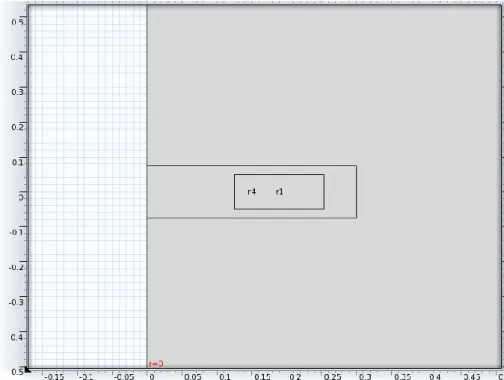
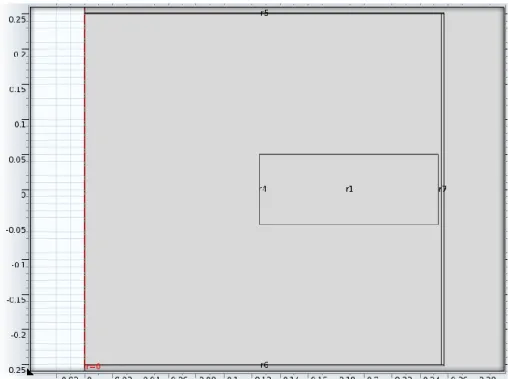
and seawater. The applied current to the coil is 1 Ampere. We take a cylinder as a solution domain as illustrated on the Figure 4.1. The diameter and the height of the cylinder is 50m. We put the coil in the solution domain as seen on the Figure 4.1 to have 2D axial symmetry. The coil is z-directed and at the origin of the cylinder. The symmetry provides the problem to be solved with less physical memory and processing power of the personal computer. This is an advantage over 3D asymmetric geometries. In the model we put the coil into a case (cylinder). This cylinder has 30cm radius and 15cm height and inside of it is air. The case has no thickness. The coil, case and the medium can be seen in 2D axial symmetry on the Figure 4.2.
Figure 4.1: The coil in the solution medium. 160m
160m
x y z
21
Figure 4.2: Coil, case and the solution domain in 2D view.
After modeling the geometry of the coil, Magnetic Fields interface is added under the AC/DC branch for the physics selection of the model. This interface solves the equation (2.12).
After adding physics for the model, we assign boundary conditions to the coil, case and outer boundary of the solution domain enclosing the coil geometry. Ampere’s Law is assigned to the coil and the case. In this condition, r is taken
1; σ is taken zero and εr is taken 1 since these domains are air. For the solution
domain enclosing the coil geometry we assign Ampere’s Law, too. If the solution medium is air, r is taken 1; σ is taken zero and εr is taken 1. If the
solution medium is seawater, r is taken 1, σ is taken 4 (S/m) and εr is taken 80.
Boundary condition assigned to the edges of the solution medium is magnetic insulation. The equation solved on this boundary isn A 0. We set the tangential component of vector magnetic potential of these boundaries to zero. In order to excite the coil, external current density is assigned to the coil domain. The coil is excited in phi direction with respect to 2D axial symmetry.
22
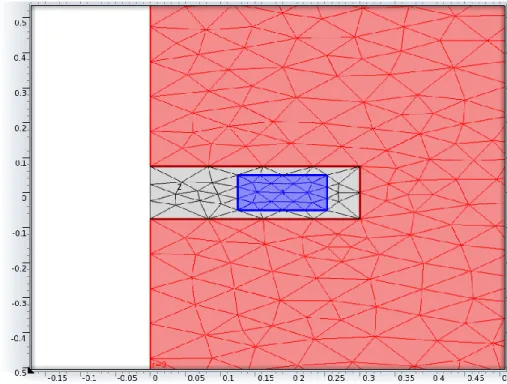
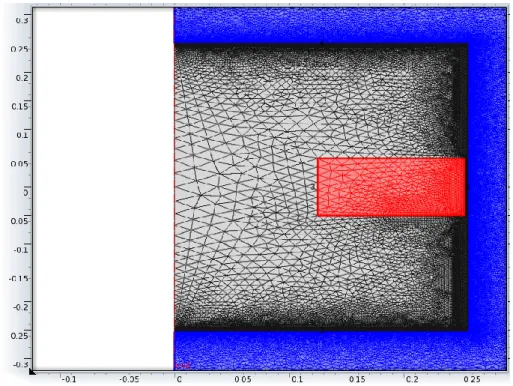
After adding physics and boundary condition, we generate a mesh for the model in order to discretize the complex geometry of the coil into triangular elements. In order to get accurate results, in any wave problems, it is vital that wavelength must be taken into account while generating meshes. According to [39], maximum element size of the mesh elements must be at least one fifth of the wavelength at the operating frequency. The meshing of coil, case and the medium is on the Figure 4.3.
Figure 4.3: Generated mesh of the coil, case and the medium.
As the last step, we add frequency domain as study step and solver sequence for the model so as to compute the solution.
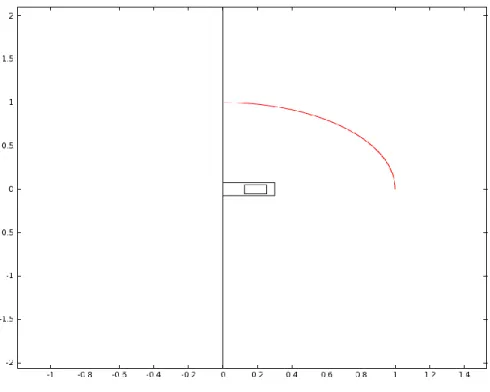
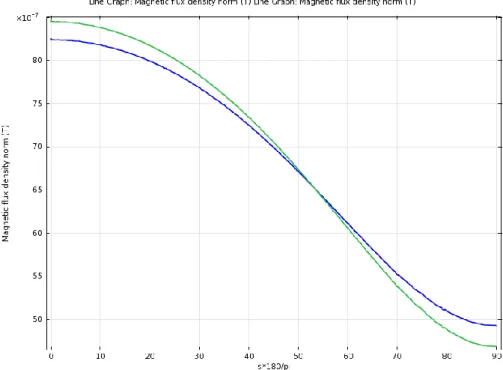
We start post-processing of the magnetic flux density of the coil. Firstly we observe the magnetic flux density of the coil on an arch. As can be seen on the Figure 4.4, the observation arch is 1 meter away from the center of the coil from 00 to 900. The following plots show the change of the magnetic flux density norm of the coil on the arc when the frequencies are 500 Hz, 1 kHz, 10 kHz and the medium is air and seawater.
23
Figure 4.4: Observation arch: one meter from the center of the coil from 00 to 900.
24
Figure 4.5: All three frequencies on the same plot (in air).
25
Figure 4.7: Frequency 500 Hz in air and seawater.
26
Figure 4.9: Frequency 10 kHz in air (green) and seawater (blue).
Comparisons of the magnetic flux density of the coil for three frequencies in air and in seawater are illustrated on the preceding plots. We observe on the plots that the magnetic flux density norm is maximum at 00 (r =0, z= 1) and minimum at 900 (r =1, z= 0) in one meter distance. Magnetic flux density norm at 00 (r =0, z= 1) is almost two fold of magnetic flux density norm at 900 (r =1, z= 0). As seen on the Figure 4.5, in air for three frequency (500 Hz, 1 kHz and 10 kHz) curves coincide, on the other hand as seen on the Figure 4.6, in seawater 500 Hz and 1 kHz are close to each other and 10 kHz differs from them. Blue curve is 500Hz, the frequency of green curve is 1 kHz and the frequency of red curve is 10 kHz. As the frequency increases, ratio of the magnetic flux density at 00 to 900 decreases. As seen on the Figure 4.7 and Figure 4.8, in air and seawater for 500 Hz and 1 kHz respectively, magnetic flux densities of the coil on the arc coincide. As illustrated on the Figure 4.9, in air and seawater magnetic flux density of the coil differ from each other.
27
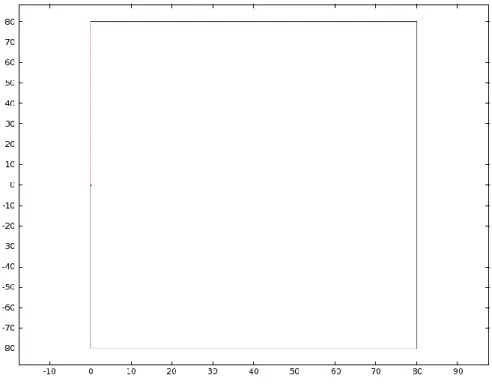
Secondly; we observe the magnetic flux density of the coil on an observation line which is from the center of the coil to 80m at 00 (r=0, z=0 to r=0, z=80m). This observation line is illustrated on the Figure 4.10. Wavelength () of electromagnetic wave in seawater is 70m when the frequency is 500 Hz, 50m when the frequency is 1 kHz and 16m when the frequency is 10 kHz. In the following plots, we observe the attenuation of magnetic flux density of the coil in air and seawater for each frequency.
Figure 4.10: Observation line: Red line from the origin of the coil to 80m @ 00 (r=0, z=0 to r=0, z=80m).
28
When we plot the magnetic flux density of the coil through this observation line for three frequencies (500 Hz, 1 kHz and 10 kHz) in air and seawater, we see that all of the plots coincide; it is not possible to discriminate them from each other. This plot is illustrated on the Figure 4.11. In order to be able to discriminate the plots, we plot them for three different frequencies and two mediums in the following figures.
Figure 4.11: All three frequencies (500 Hz, 1 kHz and 10 kHz) in air and seawater.
29
When the frequency is 500 Hz, wavelength () of electromagnetic wave in seawater is 70m. Comparison of the magnetic flux density of the coil in air and seawater through the line (r=0, z=[69:71]) is illustrated on the Figure 4.12. Magnetic flux density in seawater is 5.0639 10 13 (T) and in air is
11
1.1729 10 (T) at the point (r=0, z=70m). In one wavelength, the magnetic flux density of the coil attenuates 62.8dB in seawater with respect to in air.
30
When the frequency is 1 kHz, wavelength () of electromagnetic wave in seawater is 50m. Comparison of the magnetic flux density of the coil in air and seawater through the line (r=0, z=[49:51]) is illustrated on the Figure 4.13. Magnetic flux density in seawater is 1.2856 10 12 (T) and in air is
11
5.8812 10 (T) at the point (r=0, z=50m). In one wavelength, the magnetic flux density of the coil attenuates 76.4dB in seawater with respect to in air.
31
When the frequency is 10 kHz, wavelength () of electromagnetic wave in seawater is 16m. Comparison of the magnetic flux density of the coil in air and seawater through the line (r=0, z=[15:17]) is illustrated on the Figure 4.14. Magnetic flux density in seawater is 3.6698 10 11 (T) and in air is
9
2.1699 10 (T) at the point (r=0, z=16m). In one wavelength, the magnetic flux density of the coil attenuates 81.5dB in seawater with respect to in air.
32
4.2 Magnetic Field of a Shielded Coil
Detectors, sensors and electronic circuitries of underwater systems are isolated from seawater via water proof cases due to the fact that submerging the system into seawater without isolating it from seawater damages the components of the electronic systems. There are different decision criterions in the selection of the material of the case of the underwater systems. The material of case has to be water proof, hard, durable and rustproof. Selection of the material of the case is also a vital decision step when the concerns of electromagnetic interference are taken into account. The material of the case can affect the magnetic field of the coil according to its electrical properties. Due to the electrical properties of the case that are electrical conductivity ( ) and relative permeability (r), the
strength of the magnetic field can be attenuated. The attenuation of the magnetic field of the coil is not only due to the permeability of the material of the case but also eddy currents that are created on the surface of case. This effect is called the shielding effect of the case on the magnetic field strength of the coil. In this section, the effect of the electrical conductivity of the material of the case and different thicknesses of the case on the magnetic flux density of the coil is studied. We disregard permeability of the material of the case and other electromagnetic interference sources. The studied materials are copper (Cu), aluminum (Al), stainless steel and carbon mixed composite. These materials have relative permeability (r) 1 and relative permittivity (r) 1 but they have
different electrical conductivity values.
We begin the analysis with the designation of the geometry of the models in COMSOL Multiphysics. We take a solution domain as a cylinder whose height is 50m, radius is 25m. We take the case whose inner length is 50cm and inner radius is 25.5cm. We take a gap distance of 2mm between the outer radius of the coil and the inner radius of the case. Two dimensional axial symmetric views of the case, coil and the solution medium are on the Figure 4.15.
33
Figure 4.15: Coil, case and the solution medium.
After modeling the geometry of the coil and the case, Magnetic Fields interface is added under the AC/DC branch for the physics selection of the model. The equation solved in this interface is the equation (2.12).
After adding physics for the model, we have to assign boundary conditions to the coil, the case and the solution domain enclosing the coil and the case geometries. For the solution domain enclosing the coil and the case geometries we assign Ampere’s Law. The solution medium is seawater, r is taken 1, σ is
taken 4 (S/m) and εr is taken 80 in this domain. The coil domain and inner of the
case domain are taken air, r is taken 1, σ is taken zero and εr is taken 1 in these
domains. Thickness domain of the case is the interested material. We assign Ampere’s Law in this domain too. In this domain, r is taken 1, and εr is taken
1. Electrical conductance (σ) varies according to the material chosen. Boundary condition of the edges of the solution medium is magnetic insulation. The equation solved on these edges isn A 0. We set the tangential component of vector magnetic potential of these boundaries to zero. In order to excite the coil,
34
external current density is assigned to the coil domain. The coil is excited in phi direction with respect to 2D axial symmetry.
After adding physics and boundary condition, we generate a mesh for the model in order to discretize the complex geometry of the coil into triangular elements.
Figure 4.16: Generated mesh of the coil, case and the solution medium. As the last step, we add frequency domain as study step and solver sequence for the model so as to compute the solution.
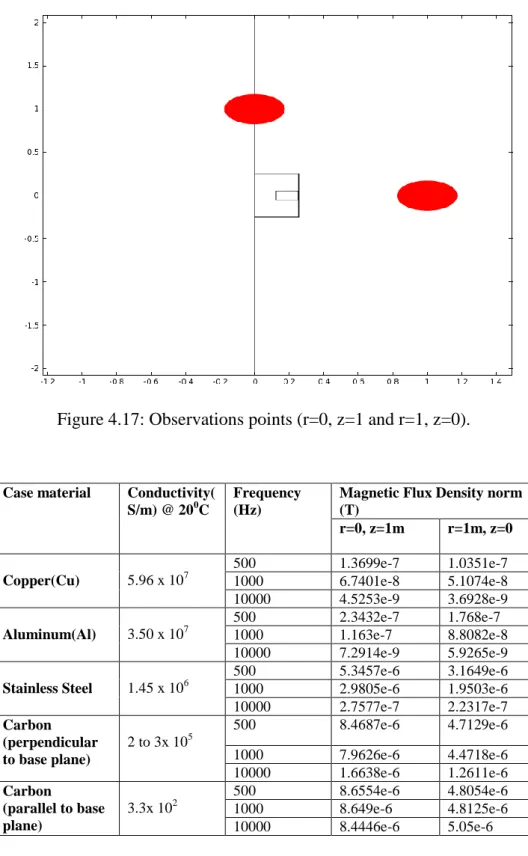
We study the shielding effect of thicknesses for 2mm and 1mm of the case for three frequencies of 500Hz, 1 kHz and 10 kHz. Observation points of shielding effect are on the Figure 4.17. Firstly, we observe the effect of the 2mm thickness of the case for different materials, different electrical conductance values and frequencies on the magnetic flux density norm at two points: (r=0, z=1) and (r=1, z=0). Secondly, we observe the magnetic flux density of the coil for 1mm thickness of the case.
35
Figure 4.17: Observations points (r=0, z=1 and r=1, z=0).
Case material Conductivity(
S/m) @ 200C
Frequency (Hz)
Magnetic Flux Density norm (T) r=0, z=1m r=1m, z=0 Copper(Cu) 5.96 x 10⁷ 500 1.3699e-7 1.0351e-7 1000 6.7401e-8 5.1074e-8 10000 4.5253e-9 3.6928e-9 Aluminum(Al) 3.50 x 10⁷ 500 2.3432e-7 1.768e-7 1000 1.163e-7 8.8082e-8 10000 7.2914e-9 5.9265e-9 Stainless Steel 1.45 x 10⁶ 500 5.3457e-6 3.1649e-6 1000 2.9805e-6 1.9503e-6 10000 2.7577e-7 2.2317e-7 Carbon (perpendicular to base plane) 2 to 3x 10⁵ 500 8.4687e-6 4.7129e-6 1000 7.9626e-6 4.4718e-6 10000 1.6638e-6 1.2611e-6 Carbon (parallel to base plane) 3.3x 10² 500 8.6554e-6 4.8054e-6 1000 8.649e-6 4.8125e-6 10000 8.4446e-6 5.05e-6
Table 4.2: Magnetic Flux Density norm of the coil for 2mm thickness for different materials.
36
Conductivity(S/m) Frequency (Hz) Magnetic Flux Density norm (T)
r=0, z=1m r=1m, z=0 0.01 500 8.6554e-6 4.8054e-6 1000 8.649e-6 4.8125e-6 10000 8.4449e-6 5.0502e-6 0.1 500 8.6554e-6 4.8054e-6 1000 8.649e-6 4.8125e-6 10000 8.4449e-6 5.0502e-6 1 500 8.6554e-6 4.8054e-6 1000 8.649e-6 4.8125e-6 10000 8.4449e-6 5.0502e-6 10 500 8.6554e-6 4.8054e-6 1000 8.649e-6 4.8125e-6 10000 8.4448e-6 5.0502e-6 1e2 500 8.6554e-6 4.8054e-6 1000 8.649e-6 4.8125e-6 10000 8.4448e-6 5.0501e-6 1e3 500 8.6554e-6 4.8054e-6 1000 8.649e-6 4.8125e-6 10000 8.4433e-6 5.0493e-6 1e4 500 8.6551e-6 4.8053e-6 1000 8.6477e-6 4.8119e-6 10000 8.3244e-6 4.9853e-6 1e5 500 8.6247e-6 4.7903e-6 1000 8.5282e-6 4.7525e-6 10000 4.1056e-6 2.7165e-6 5e5 500 7.9686e-6 4.4652e-6 1000 6.5538e-6 3.773e-6 10000 8.1019e-7 6.4479e-7 1e6 500 6.5582e-6 3.7673e-6 1000 4.1944e-6 2.5897e-6 10000 4.0108e-7 3.2365e-7 2e6 500 4.1966e-6 2.5854e-6 1000 2.1473e-6 1.4779e-6 10000 1.9945e-7 1.6164e-7 3.5e6 500 2.4668e-6 1.6604e-6 1000 1.1967e-6 8.7419e-7 10000 1.133e-7 9.1938e-8 5e6 500 1.7007e-6 1.2025e-6 1000 8.297e-7 6.1685e-7 10000 7.8715e-8 6.3905e-8 8e6 500 1.0433e-6 7.6666e-7 1000 5.1516e-7 3.8711e-7 10000 4.8156e-8 3.911e-8 1e7 500 8.3024e-7 6.1596e-7 1000 4.1132e-7 3.099e-7 10000 3.7798e-8 3.0702e-8 1.5e7 500 5.5026e-7 4.1221e-7 1000 2.7344e-7 2.0661e-7 10000 2.367e-8 1.923e-8 2e7 500 4.1162e-7 3.0947e-7 1000 2.0468e-7 1.5483e-7
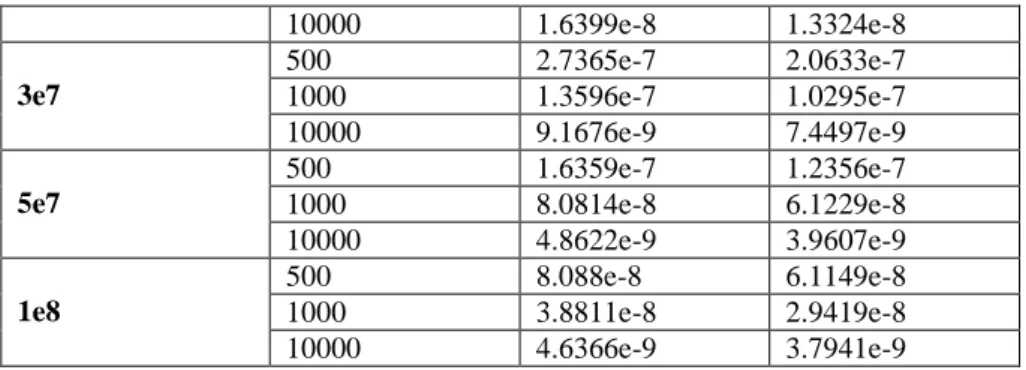
37 10000 1.6399e-8 1.3324e-8 3e7 500 2.7365e-7 2.0633e-7 1000 1.3596e-7 1.0295e-7 10000 9.1676e-9 7.4497e-9 5e7 500 1.6359e-7 1.2356e-7 1000 8.0814e-8 6.1229e-8 10000 4.8622e-9 3.9607e-9 1e8 500 8.088e-8 6.1149e-8 1000 3.8811e-8 2.9419e-8 10000 4.6366e-9 3.7941e-9
Table 4.3: Magnetic Flux Density norm of the coil for 2mm thickness for different conductivities of the material of the case.
Figure 4.18: Magnetic Flux Density norm (T) vs Conductivity(S/m), f = 500Hz.
10-2 10-1 100 101 102 103 104 105 106 107 108 0 1 2 3 4 5 6 7 8 9x 10
-6 Magnetic Flux Density norm (T) vs Conductivity(S/m), @ 0 degree (r=0, z=1) and 90 degree (r=1, z=0), thickness 2mm, f = 500Hz
Conductivity(S/m) M a g n e ti c F lu x D e n s it y n o rm ( T ) r=0, z=1 r=1, z=0
38
Figure 4.19 : Magnetic Flux Density norm (T) vs Conductivity(S/m), f = 10000Hz.
Secondly, we repeat the calculations for 1mm thickness of the case.
Case material Conductivity(
S/m) @ 200C
Frequency (Hz)
Magnetic Flux Density norm (T) r=0, z=1m r=1m, z=0 Copper(Cu) 5.96 x 10⁷ 500 2.7633e-7 2.0751e-7 1000 1.3768e-7 1.0383e-7 10000 1.1955e-8 9.6731e-9 Aluminum (Al) 3.50 x 10⁷ 500 4.7204e-7 3.5299e-7 1000 2.3493e-7 1.7692e-7 10000 2.1909e-8 1.7725e-8 Stainless Steel 1.45 x 10⁶ 500 7.3653e-6 4.1575e-6 1000 5.3462e-6 3.1647e-6 10000 5.564e-7 4.4532e-7 Carbon (perpendicular to base plane) 2 to 3x 10⁵ 500 8.6117e-6 4.7734e-6 1000 8.4663e-6 4.7116e-6 10000 3.3707e-6 2.2997e-6 Carbon (parallel to base plane) 3.3x 10² 500 8.6594e-6 4.797e-6 1000 8.653e-6 4.8041e-6 10000 8.4488e-6 5.0417e-6
Table 4.4: Magnetic Flux Density norm for 1mm thickness for different materials. 10-2 10-1 100 101 102 103 104 105 106 107 108 0 1 2 3 4 5 6 7 8 9x 10 -6 Conductivity(S/m) M a g n e ti c F lu x D e n s it y n o rm ( T )
Magnetic Flux Density norm (T) vs Conductivity(S/m), @ 0 degree (r=0, z=1) and 90 degree (r=1, z=0), thickness 2mm, f = 10000Hz r=0, z=1 r=1, z=0
39
Conductivity(S/m) Frequency (Hz) Magnetic Flux Density norm (T)
r=0, z=1m r=1m, z=0 0.01 500 8.6594e-6 4.797e-6 1000 8.653e-6 4.8041e-6 10000 8.4488e-6 5.0418e-6 0.1 500 8.6594e-6 4.797e-6 1000 8.653e-6 4.8041e-6 10000 8.4488e-6 5.0418e-6 1 500 8.6594e-6 4.797e-6 1000 8.653e-6 4.8041e-6 10000 8.4488e-6 5.0418e-6 10 500 8.6594e-6 4.797e-6 1000 8.653e-6 4.8041e-6 10000 8.4488e-6 5.0418e-6 1e2 500 8.6594e-6 4.797e-6 1000 8.653e-6 4.8041e-6 10000 8.4488e-6 5.0418e-6 1e3 500 8.6594e-6 4.797e-6 1000 8.653e-6 4.8041e-6 10000 8.4484e-6 5.0415e-6 1e4 500 8.6593e-6 4.797e-6 1000 8.6527e-6 4.8039e-6 10000 8.4175e-6 5.0248e-6 1e5 500 8.6517e-6 4.7932e-6 1000 8.6223e-6 4.7889e-6 10000 6.405e-6 3.95e-6 5e5 500 8.4727e-6 4.7047e-6 1000 7.9667e-6 4.4641e-6 10000 1.6664e-6 1.2588e-6 1e6 500 7.9727e-6 4.4575e-6 1000 6.5578e-6 3.7667e-6 10000 8.1181e-7 6.4367e-7 2e6 500 6.5622e-6 3.7609e-6 1000 4.1979e-6 2.5852e-6 10000 4.0207e-7 3.2319e-7 3.5e6 500 4.6763e-6 2.8225e-6 1000 2.4687e-6 1.6601e-6 10000 2.2895e-7 1.8472e-7 5e6 500 3.4433e-6 2.1888e-6 1000 1.7025e-6 1.2022e-6 10000 1.6001e-7 1.2925e-7 8e6 500 2.1512e-6 1.4727e-6 1000 1.0446e-6 7.6636e-7 10000 9.9781e-8 8.0663e-8 1e7 500 1.7034e-6 1.2003e-6 1000 8.3136e-7 6.1573e-7 10000 7.9703e-8 6.4447e-8 1.5e7 500 1.1171e-6 8.1485e-7 1000 5.5109e-7 4.1209e-7 10000 5.2889e-8 4.2777e-8 2e7 500 8.319e-7 6.1483e-7 1000 4.1232e-7 3.0943e-7
40 10000 3.9423e-8 3.189e-8 3e7 500 5.5148e-7 4.1151e-7 1000 2.7426e-7 2.064e-7 10000 2.5839e-8 2.0904e-8 5e7 500 3.2966e-7 2.4731e-7 1000 1.6423e-7 1.238e-7 10000 1.4719e-8 1.1909e-8 1e8 500 1.6436e-7 1.2364e-7 1000 8.1828e-8 6.1742e-8 10000 6.0143e-9 4.8667e-9
Table 4.5: Magnetic Flux Density norm of the coil for 1mm thickness for different conductivities of the material of the case.
Figure 4.20: Magnetic Flux Density Norm (T) vs Conductivity(S/m), f = 500Hz.
10-2 10-1 100 101 102 103 104 105 106 107 108 0 1 2 3 4 5 6 7 8 9x 10
-6Magnetic Flux Density norm (T) vs Conductivity(S/m), @ 0 degree (r=0, z=1) and 90 degree (r=1, z=0), thickness 1mm, f = 500Hz
Conductivity(S/m) M a g n e ti c F lu x D e n s it y n o rm ( T ) r=0, z=1 r=1, z=0
41
Figure 4.21: Magnetic Flux Density Norm (T) vs Conductivity(S/m), f = 10000Hz.
Figure 4.22: Effect of thickness @ 00 (r=0, z=1). 10-2 10-1 100 101 102 103 104 105 106 107 108 0 1 2 3 4 5 6 7 8 9x 10 -6 Conductivity(S/m) M a g n e ti c F lu x D e n s it y n o rm ( T )
Magnetic Flux Density norm (T) vs Conductivity(S/m), @ 0 degree (r=0, z=1) and 90 degree (r=1, z=0), thickness 1mm, f = 10000Hz r=0, z=1 r=1, z=0 10-2 10-1 100 101 102 103 104 105 106 107 108 0 1 2 3 4 5 6 7 8 9x 10
-6 Magnetic Flux Density norm (T) vs Conductivity(S/m), @ 0 degree (r=0, z=1), f = 500Hz
Conductivity(S/m) M a g n e ti c F lu x D e n s it y n o rm ( T ) 2mm thickness 1mm thickness
42
Figure 4.23: Effect of thickness @ 900 (r=1, z=0).
We observe the effect of the electrical conductivity of the material of the case and the effect of the thickness of the case on the magnetic flux density norm of the coil on the two observation points for two frequencies on the preceding figures. We observe on the Figure 4.18 to the Figure 4.23 that as the conductivity of the material of the case increases, magnetic flux density norm of the coil is unaffected until a certain value of the electrical conductivity in any two frequencies. After a certain electrical conductivity value, shielding effect of the case starts and the field attenuates rapidly. This critical value depends upon the thickness of the case and the frequency. As can be observed on the Figure 4.18, magnetic flux density norm of the coil decreases drastically after the conductivity exceeds 106 (S/m) when the frequency is 500Hz and the thickness of the case is 2mm. On the other hand, as it is illustrated on the Figure 4.19 drastic attenuation of the magnetic flux density norm starts when the conductivity of the material of the coil exceeds 104 (S/m) if the frequency is 10kHz. It can be concluded that as the frequency increases, attenuation starts for
10-2 10-1 100 101 102 103 104 105 106 107 108 0 0.5 1 1.5 2 2.5 3 3.5 4 4.5 5x 10
-6 Magnetic Flux Density norm (T) vs Conductivity(S/m), @ 90 degree (r=1, z=0), f = 500Hz
Conductivity(S/m) M a g n e ti c F lu x D e n s it y n o rm ( T ) 2mm thickness 1mm thickness