T.C.
ISTANBUL AYDIN UNIVERSITY INSTITUTE OF SOCIAL SCIENCES
THE IMPACT OF TURKISH-ISRAELI RELATIONS ON TURKEY’S RELATIONS WITH ARAB STATES
MASTER THESIS Natig SAMADOV
Department of Political Science and International Relations Political Science and International Relations Program
Thesis Supervisor: Assist. Prof. Dr. Gokhan DUMAN
T.C.
ISTANBUL AYDIN UNIVERSITY INSTITUTE OF SOCIAL SCIENCES
THE IMPACT OF TURKISH-ISRAELI RELATIONS ON TURKEY’S RELATIONS WITH ARAB STATES
MASTER THESIS Natig SAMADOV
(Y1412.110013)
Department of Political Science and International Relations Political Science and International Relations Program
Thesis Supervisor: Assist. Prof. Dr. Gokhan DUMAN
DECLARATION
I hereby declare that all information in this document has been obtained and presented in accordance with academic rules and ethical conduct. I also declare that, as required by these rules and conduct, I have fully cited and referenced all material and results that are not original to this work.
i
FOREWORD
The aim of the thesis is to analyze how a non-Arab Muslim country, Turkey, which has historical roots, borders and normal political and economic relations with Arabs and Arab countries in the region, cooperate with single non-Muslim Jewish Israel in the region which has religious and political conflicts with Arabs and Muslims. The dissertation mainly analyses how the relations of Turkey – Israel impact to the relations of Turkey with Arab states in the Middle East. Also in the dissertation I will find answers to the questions that how Arab States reacted to the Turkish – Israeli’s political, economical and strategic partnerships and what were the benefits of Turkey from getting cooperate with Israel despite of Arabs.
I would like to express my deepest gratitude to my supervisor Assist.Prof. Dr. Gokhan Duman, for his excellent teaching skills and indulgent comments. I would like to thank to my advisor Assist. Prof. Dr Ozum Sezin Uzun for overall unforgettable support throughout my enrollment in the program of M.A in Political Science and International Relations at Istanbul Aydin University. I also would like to thank to all other instructors and professors who taught me at the Institute of Social Sciences at Istanbul Aydin University.
Finally, I am very appreciative for the eventual support I got from my family.
ii
TABLE OF CONTENT Page FOREWORD ... I TABLE OF CONTENT ... II ABBREVIATIONS ... IV LIST OF TABLES ... V LIST OF FIGURE ... VI ABSTRACT ... VI ÖZET ... VII 1. INTRODUCTION ... 1
2. HISTORICAL PERSPECTIVE: TURKISH – ISRAELI RELATIONS AND REACTIONS OF ARAB STATES IN COLD WAR YEARS ... 6
2.1 Background ... 6
2.2 Relations from 1948 until 1964 ... 7
2.3 Multi-Dimensional Foreign Policy; Turkey’s tilt towards the Arab states and economic relations during 1980s ... 11
2.4 Balance Of Power in the Middle East ... 19
3. RELATIONS IN THE POST-COLD WAR ERA ... 25
3.1 The Contours of Turkish Foreign Policy in the 1990s ... 25
3.2 Common security concerns with Israel and reactions of Arabs ... 27
3.3 Effects of political developments to the economic relations of Turkey and Middle East states ... 31
4. RELATIONS DURING THE JUSTICE AND DEVELOPMENT PARTY ERA ... 34
4.1 Major Tenets of Justice and Development Party’s (AKP) Foreign Policy towards the Middle East ... 34
4.2 War on Iraq ... 43
4.3 Lebanon Crisis ... 51
4.4 Arab Spring and reactions of Turkey and Israel ... 57
5. CONCLUSION ... 66
REFFERENCES ... 71
iv
ABBREVIATIONS
PKK : The Kurdistan Workers Party (Kurdish: Partîya Karkerên Kurdistan) ISIS : Islamic State of Iraq and Syria
JDP : Justice and Development Party
CHP : Republic People Party (Cumhuriyet Halk Partisi) MIG : Mikoyan-Gurevich
ASALA : The Armenian Secret Army for the Liberation of Armenia
MOSSAD : Ha-Mossad le-modi'in u-le-tafkidim meyuhadim meaning "Institute for Intelligence and Special Operations"
CENTO : The Central Treaty Organization ADL : Anti-Defamation League
CBQ : Commercial Bank of Qatar CIA : The Central Intelligence Agency UNSC : United Nations Security Council MDW : Mass Destruction Weapon
GNAT : Grand National Assembly of Turkey AQAP : Al-Qaeda in Arabian Peninsula
v
LIST OF TABLES
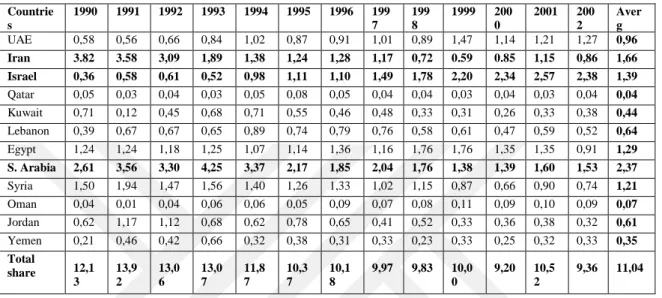
Page Table 3.1: Export Shares of Middle East Countries in Turkey's Total Export (%) between 1990 and 2002 ... 32 Table 3.2: Import Shares of Middle East Countries in Turkey's Total Import (%) between 1990-2002 ... 32 Table 4.1: Amount of Foreign Trade between Turkey and Arab Gulf States (.000 USD) ... 41
vi
LIST OF FIGURE
Page Figure 2.1: The Geographical and Political Balance Mechanism of the Middle East
... 22
Figure 4.1: The Trade Results between Turkey and Israel from 2007 till 2014 ... 39
Figure 4.2: Invasion Map of Iraq ... 44
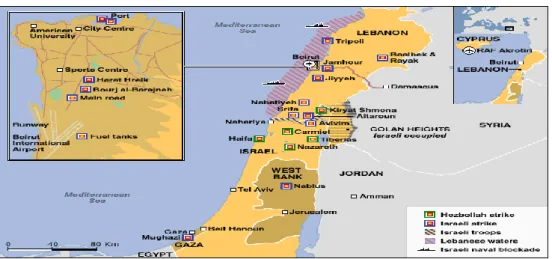
Figure 4.3: Lebanon Crisis Map ... 56
vi
THE IMPACT OF TURKISH-ISRAELI RELATIONS ON TURKEY’S RELATIONS WITH ARAB STATES
ABSTRACT
The dissertation analysis the historical aspects of Turkish – Israeli relations and how the Turkish – Israeli relations affected to Turkey’s relations with Arab states. The main important point is that how these two of non-Arab states of the Middle East region build strategic relations despite of Arab States. Using comparative historical approach, I will analyze in detail the ideological and political problems of contemporary bilateral relations, as well as to consider the impact of Turkish-Israeli relations to the Turkish-Arab relations. Turkey and Israel have tried filling lack of balance of power in the Middle East which emerged after Cold War era as becoming regional powers amongst Arabs. In the thesis it has been analyzed how these rival states need strong strategic partnership with each other despite of Arabs in the region.
Keywords: Turkey, Israel, Turkish-Israeli relations, Turkish-Arab relations, Middle East
vii
TÜRK – İSRAİL İLİŞKİSİNİN TÜRKİYENİN ARAP DEVLETLERİ İLE İLİŞKİSİNE ETKİSİ
ÖZET
Tez, tarihi görünüm ve günümüz Türk – İsrail ilişkisinin Arap devletleri üzerinde nasıl etki ettiğini incelemektedir. Önemli nokta, Ortadoğu bölgesinin iki Arap olmayan devletinin bölgedeki Arap devletlere rağmen nasıl strateji ilişki kurduğudur. Kıyaslamalı tarihsel yaklaşamı kullanarak, detaylı şekilde ikili ilişkilerdeki ideolojik ve siyasi sorunların Türk – İsrail ilişkisinin Türk – Arap ilişkilerine etkisi açısından analiz edeceğiz. Türkiye ve İsrail Soğuk Savaş sonrası dönemde Ortadoğu bölgesinde boşalan güc dengesini Arapların arasında bölgesel güc olarak doldurmaya çalıştılar. Bu tezde bu iki hasım devletlerin Araplara rağmen neden bir-birleri ile güclü strateji ortaklığa ihtiyac duydukları da analiz edildi.
Anathar Kelimeler: Türkiye, İsrail, Türkiye – İsrail ilişkisi, Türkiye – Arap ilişkisi,Ortadoğu
1
1. INTRODUCTION
Here is Middle East. If you do not know the history of these lands, you will be a “useful idiot” (Yalcin, 2014). Energy sources, shorter and low-price transportations for transports of goods and services have increased the importance of the Middle East. Additionally, the region has hosted to homelands of three main religions (Christianity, Islam and Judaism) and also diversified nations, colorful cultures, ancient historic backgrounds of states, strategic states, having direct borderline with Asia, Europe and Africa and etc. factors are specifying significance of the region. Majority in the region is Arabs and Arab States. Turks, Persians, Kurds and Jewish people are four non-Arab nations and Turkey, Iran and Israel is three non-Arab states in the region. Correlation between Arabs and non-Arabs are playing key role for regional states. Iran, despite of being Muslim state, is accepted as an enemy by Arab states and Israel is a Jewish country and identified as an enemy by Muslims and Turkey is a Muslim country, has rooted connections with Arabs but not identified as an enemy by Israel. That’s why the relations between Turkey and Israel are crucial for Arab States. After First World War, with the collapse of Ottoman Empire, several Arab states occurred but possible relations between Turkey and Arabs were impossible because of British and French’s colonial attitudes toward Arab region. After Second World War with the end of decolonization policy of the Great Britain and France, Arab states got independence in the Middle East and the region would be changed to be like a boiler in following years.
The main purpose of the thesis is to analyze how the regional developments have affected the relations between Turkey and Israel and how the Arab States have been affected from this Turkish-Israeli relation. After the Cold War, regional instability forced Turkey to get closer relation with Israel. However, the relations between Turkey and Israel was not temporary, it has been based on the national interests for both states. This strategic partnership between Turkey and Israel has played one of the most important roles in Turkey’s foreign policy toward the Middle East. I have
2
tried to analyze how a non-Arab Muslim country, Turkey, which has historical roots, borders and normal political and economic relations with Arabs and Arab States (Gulf States, Egypt, Libya, Syria and Iraq) in the region, cooperate with single non-Muslim Jewish Israel in the region which has religious and political conflicts with Arabs and Muslims. The dissertation mainly analyses how the relations of Turkey – Israel impact to the relations of Turkey with Arabs States (Gulf States, Egypt, Libya, Syria and Iraq) in the Middle East. In the dissertation I try to answers to the questions that how Arabs reacted to the Turkish – Israeli’s political, economic and strategic partnerships and what were the benefits of Turkey from getting cooperated with Israel despite of Arabs. One of the most important issue that what I have tried to analyzed, the developments in the region affected only to the relations between Turkey and Israel or the relations between Turkey and Arab States (Gulf States, Egypt, Libya, Syria and Iraq) also have been also affected at the same time. This topic is important because it deals with religious, governmental and ethnical situations that cause serious regional conflicts; the topic studies how the governments of countries balance their relations with each other despite of other regional powers, shows how the ethnical situation and religion play important role in the Middle East and answers the question of why non-Arab powers of the regions need each other despite of Arabs.
The subject of this dissertation is the relations of Turkey and Israel, Turkey – Arab States relations during the years 1945-2016. The subject deals with economic, political and military relations of Turkey and Israel in the Middle East and effects of these relations to Arab states (Gulf States, Egypt, Libya, Syria and Iraq). The content features how Muslim but non-Arab country, Turkey, and Jewish Israel conduct bilateral relations despite of Arabs in Middle East. Chronologically speaking, the content is divided into three periods, first period starts from 1948 (the year of Israel’s establishment) until 1990 (Cold War Years), second begins from 1990 till 2002 and last chapter contains 2002 till 2016.
The dissertation limited the years between 1948 (the year of establishment of Israel State) and 2016. First chapter starts with establishment of Israeli State and relations with Turkey during the Cold War as a state and contains 1948 – 1990 years. At the end of 1940s and beginning of 1950s, the establishment of Israel state in Arab lands, being first Muslim country of Turkey which recognized Israel as a state (28 March
3
1949), Turkey’s pro-western attitude during Suez Crisis, creation of Baghdad Pact and at the end of 1950s ascending of crisis with Syria brought Turkey face-to-face with Arab world and resulted break of relations among Arabs and Turkey. As a result, Arabs saw Turkey as a strategic partner of imperialist west during these years (Vurmay, 2009). In 1960s new government in Turkey led by Prime Minister Suat Hayri Urguplu who supported that Turkey would not only abide by west, also would evolve relations with Arabs and Soviet Union (Karpat, 1975). Prime Minister Urguplu had taken more attention to Palestine issue to gain political and economic support from Arabs. At that term the next war between Arabs and Israel was emerged and Turkey had supported Arabs clearly during the war. Turkey also closed its US bases, cause of these bases had been using for logistic support to Israel. Al-Nasser, leader of Egypt, had lost out and new guidance for Arabs had passed to Saudi Arabia. During Cyprus conflict, in 1974, Turkey requested backing from Arab states and demanded to recognize Northern Cyprus as a state, but as an answer to Turkey, Arabs postulated from Turkey to interrupt all connections with Israel (Sleiman, 2002:40). The relations were based on intelligence and security issues between Turkey and Israel in 1960 and 1970s. Jerusalem was declared as permanent capital by Israel government on 30th July 1980. The decision was condemned by Turkey and requested for cancellation. Turkish consulate was closed in Jerusalem. The coup d’état was realized by Chief of General Staff General Kenan Evren in Turkey on 12nd September 1980. The relations were dropped off to the lowest level almost broken totally. At the beginning of 1980s Turkey returned to balancing relations between Arabs and Israel (Sleiman, 2002:45-67).
Second chapter talks the strategic partnership relations’ between Turkey and Israel. After Cold War, strategic partnership was started with Israel. Military issues were the most important tools in foreign policy of both countries with each other. Palestine issue was getting more effective in relations. Changes in governments in both Turkey and Israel defined the arguments of relations. Yitzhak Rabin, Simon Peres and Ehud Olmert terms in Israel, Suleyman Demirel, Tansu Ciller, Necmeddin Erbakan, Mesut Yilmaz and Bulent Ecevit terms in Turkey changed main concepts of relations between Israel – Arab – Turkey relations in the region. Gulf War, Oslo Agreements, Common Sham Battle and important military agreements was followed during these
4
terms. During the strategic partnership period, military relations were improved, mutual military trainings were organized.
The last chapter contains the relations during Justice and Development Party period. It’s so critical terms for both parts. It has been an important period in terms of either improving the relations or occurring new conflicts. The new era was started with Justice and Development Party period for the relations Turkey and Israel. The main issue in the relations with Israel was intelligence and military issues. The braches of relations were spread to the other civil sectors in the second period of JDP. The Arab Spring, new defined policies, energy issues, territory conflicts, terror issues, importance of strategic situation of the region and new governments are getting key factor for regional and global powers. The main crisis between the states was occurred in 2008 with the occupation of Gaza Strip. Low chair crisis in Tel Aviv, Mavi Marmara tragedy in international waters in 2010, “one minute” crisis in Davos were crisis headlines in relations. Civil deaths in Gaza till the end of 2010 exceed thousand and Israel’s all policies against Palestine were condemned by Turkish political leaders in domestic and international arenas.
Turkey and Israel assimilated importance of strategic side of the relations. In terms of Israel, main purpose of the foreign policy is “surroundings strategy”. The goal of Israel, to surround Arabs with non-Arab community by follows this strategy/policy (Melman, 1990:29). Israel needs faithful non-Arab but Muslim partners in the region against Arabs. Before 1979, Islamic Revolution, Iran had been one of the most important partner for Israel in the region. However, with the revolution Iran was pushed out and isolated. That’s why Turkey’s importance for strategic partnership came to the agenda. Improve relations with non Arabic countries are called as Frog Policy by Israel (Sozcu, 16.07.2014). Israel develops connections with non-Arab societies in the region and Israel’s target is to recovery from Arabs’ surroundings by the Frog policy. Israel has aimed to be accomplished with non-Arab States by jumping over Arabs’ surroundings like a frog (Eshed, 1988). In terms of Turkey, Turkey’s relations with Arab States are not as well as the period before Arab Spring. The relations with Syria, Egypt and Iraq got into dangerous impasse. The crisis in Syria, coup in Egypt and arresting Mursi and his supporters by General Sisi, supports of Arabs to Sisi, ISIS’s capture of Mosul and crisis with Iraq government, spread of ISIS terrorist attacks to the frontier of Turkey, are obligated Turkey to think deeply
5
about its policy towards Middle East. One of the most crucial points for Turkey’s foreign policy is to achieve to the target of being greatest regional power. It is known well that it would not be easy without Israel’s support. The most important tool of Israel is power of Jewish lobby in the United States legislative and executive branches. It is clear that Jewish lobby plays important role in the voting process in the House of Representative and Senate of the US. In the terms of Turkey, any negative bill or regulations might be obstructed by vetoes of Jewish representatives of the Senate and House of Representatives. Each year in April, so called Armenian Genocide bill has not accepted in the Senate cause of Jewish lobbies’ vetoes.
Methodologies conducted in this thesis are of qualitative nature. Content analysis of both primary sources and secondary sources will be conducted. The primary recourses of the thesis are officially statements, multimedia products and agreements. For the secondary resources, books, journal articles and newspaper articles have been used.
Within the context of first part of the thesis, the works of Behcet Kemal Yesilbursa’s The Formation of RCD; Regional Cooperation for Development, Daniel Wagner’s and Giorgio Cofiero’s Is the Turkish – Israeli Rapprochement for Real?, Daniel Raviv’s and Yossi Melman’s Every Spy a Prince; the Complete History of Israel’s Intelligence Community, Ahmet Davudoglu’s Strategic Depth, Edward Sheenan’s The Real Sadat and Demythologized Nasser, Fahir Armaoglu’s Palestine Issue and Arab – Israel Wars 1948-1988, Javid Ali’s Chemical Weapons and the Iran – Iraq War: A Case Study in Noncompliance, Kemal Karpat’s Turkey’s Foreign Policy in Transition: 1950-1974, Mustafa Albayrak’s Turkey’s Middle East Policy from Baghdad Pact until Iraq Revolution (1954-1958) were used. Within the context of the second part of the thesis, the works of Ali Balci’s Turkish Foreign Policy and Israel; Compare the Years of 1990s and 2000s, Dore Gold’s The End of the Post-Gulf War Era, Lewis Bernard’s The Shaping of Modern Middle East, Meliha Benli Altunisik’s Worldview and Turkish Foreign Policyin the Middle East, Miral Vurmay’s From Past to Today Arab – Turkish Relations, Ahmet Davudoglu’s Strategic Depth were used and within the context of the third part of the thesis, the works of Kemal Kirisci’s The Rise and Fall of Turkey as a Model for Arab World, The Future of Turkey’s Middle East Policy, Lewis Bernard’s The End of Modern History in the Middle East, Martin Kalb’s and Carol Saivetz’s The Israeli – Hezbollah War of
6
2006; The Media as a Weapon in Asymmetrical Conflict, Matt J. Martin’s Predator: The Remote – Control Air War over Iraq and Afghanistan: A Pilot’s Story, Oguz Celikkol’s From One Minute to Mavi Marmara; Conflict of Israel and Turkey were used.
2. HISTORICAL PERSPECTIVE: TURKISH – ISRAELI RELATIONS AND REACTIONS OF ARAB STATES IN COLD WAR YEARS
2.1 Background
In 2006 Palestinian legislative council elections resulted with the victory of Islamic Palestinian organization Hamas, lead by Khalid Mashal. After victory, Khalid Mashal visited to Turkey and met with Turkish Prime minister Recep Tayyip Erdogan and Turkish Minister of Foreign Affairs Abdullah Gul. During meetings Abdullah Gul used an important sentence in his speech; “The title deed register of Israel, Palestine and Jerusalem belong to me so I have to take care about Palestine” (Sabah, 20.02.2006).
Almost all Middle East, included lands where Israel was established, was under rule of Ottoman Empire from XVI century till the First World War. During the First World War on 16th May 1916, the secret Sykes-Picot Agreement or officially named as Asian Minor Agreement was signed between Great Britain and France (Encyclopedia Britannica) and assented by Russian Empire. The agreement was due to defeat of Ottoman Empire and share out of its lands in Middle East by Triple Entente. The policy on region and present-day conflicts carry steps of this agreement (Guardian, 30.12.2015). According to the agreement, Great Britain would take the control of Jordon, River of Jordon, Southern Iraq, and the coastal strip between the Mediterranean Sea, France would dominate southern Turkey, Northern Iraq, Syria and Lebanon, and Russia would take Armenia, Istanbul and Turkish Straits (Barr,
7
2011:18-33) but there was not shown in any article of the agreement for domination over Palestine lands. After First World War Great Britain made more effort for Palestine. As result, in San Remo Conference in April 1920, the question over Palestine was solved and Sykes – Picot was changed; France would dominate Syria and Lebanon, Great Britain would control Palestine, Jordon and Iraq. One of most important document for Palestine in 1917 was Balfour declaration. It was a letter from Great Britain foreign secretary Arthur Balfour to Walter Rothschild, leader of the Great Britain Jewish Society. In the letter was offered a national home for Jewish people in Palestine (Martin, 2010:65-87). From the declaration numbers of Jewish immigrants to Palestine increased under the control of British Mandate; from 1919 till 1923 35,000-40,000 Jews came to Palestine, from 1924 till 1932 75,000-80,000 Jews family moved, from 1933 till 1936 200,000 – 250,000 Jews came to Palestine (Peel Commission Reports, 1947). Increasing of Jews minority caused many conflicts between Arabs and Jews people in Palestine. In 1936 Arab leaders created High Arab Commission and organized revolt to protest Jewish immigration policy. British government created a commission, led by Lord Robert Peel, to solve the conflict (Peel Commission Reports, 1947). On July 1937, Peel published its report on conflict as White Paper. According to Peel Commission Report, the root of conflict was coming from deep so Arabs and Jews people could not live within a state. The report was foreseeing the division of Palestine into three parts: Arab Region, Jews region and Mandate Governance on Tel-Aviv, Jaffa, Jerusalem and Bethlehem. Either Jews or Arabs were opposite to this report. For Arabs, they never accept Jews society neighborhood and for Jews, they never accept a state less area than Arabs and without Jerusalem. Jews claimed that pledges of “national home” were included with all Palestine and Jordon, so White Paper betrayed ‘national home” (Peel Commission Reports, 1947). League of Nations also was opposite to this report and British government created new commission, led by Sir John Woodhead, for a new research for solution of the conflict but with the beginning of Second World War the quests for the conflict was stopped.
2.2 Relations from 1948 until 1964
After Second World War, United Kingdom and France decided for withdraw from the Middle East. This withdrawal caused to establishments of independent Arab
8
States in the Middle East. The withdrawal from Palestine had been started by UK in May 1948. The establishment of Israel was declared by Jewish National Council at the date of 14th May 1948 in Tel Aviv. Voting day in the United Nations on establishment of Israel state, according to the result the state of Israel was officially established; 33 countries with lead of the USA (72% of voting) voted for in favor, 13 countries mainly Arabs and Turkey voted for against (28% of voting) and 10 countries with lead of the UK were the abstentions (Friedman, 2006:34). The first declaration of recognition had come from the USA at the same day and Israel was recognized by Union of Soviet Socialist Republics at the next day. Few hours later of announcement of Israel’s establishment, the declaration of war on Israel had come by Arab nations (Lebanon, Syria, Iraq, Egypt and Jordon). After declaration of war by Arab States on Israel, the Palestine Commission was created by UN General Assembly to define the future of Palestine. As normally Arabs were opposite to the newly created commission. The constituent members of the commission were the US, France and Turkey. The first crisis between Turkey and Arabs was occurred with the creation of the commission. On 28th March 1949, Israel was recognized by Turkey and Turkey had been the first Muslim state with the recognition of Israel. After that the connection between Turkey and Arabs were strained.
The first step in the relations at the political level between Turkey and Israel was begun in March 1950. At that period The Republican People’s Party lead by Ismet Inonu was in power in Turkey and the relations were improved during Democrat Party led by Adnan Menderes. The first relations were based on intelligence issues (Korucu, 2005). In 1950, the single party system in Turkey was ended with the Democrat Party, led by Adnan Menderes, victory in the elections and Menderes became Prime Minister of Republic of Turkey. On September 1951, Turkey and Greece were invited the Ottawa Summit of the North Atlantic Treaty Organization for negotiation for full membership to NATO. In 16th February 1952, Turkey was officially invited to NATO and on 25th February Turkey became NATO member in Lisbon Summit of NATO (Yesilbursa, 2010:43-49). After a year, in October 1953, Turkey was elected to United Nation Security Council (Yesilbursa, 2010:43-49). This election was the second biggest victory for Turkey’s foreign affairs during Democrat Party term. In following years, trade and air transport agreements were signed with Israel. All relations with West were going well but with Arabs it was worse because Arabs thought that Turkey had done something behind their back
9
(Yesilbursa, 2010:43-49). In 1955-1956 years, two happenings were reason to begin cold era between Turkey and Israel. First was Baghdad Pact, second was Suez Crisis. In 1955 Baghdad Pact was formed by Iraq, Iran, Pakistan, UK and Turkey. Turkey expected that Arabs would not be against to the Baghdad Pact because joining of Arabs to this Pact would make easier economic aids from west to Arab world but Arabs would support Pan-Arabism (Sonmez, 2009:84). For Israel, Turkey would encourage Arab world against Israel (Kurkcuoglu, 1972:66-68). Israel mentioned this discomfort via ultimatum (Erhan, 2016:73-75). Response of Israel to Turkey’s Baghdad Pact membership was not delay: decreased export from Turkey and demanded immediately five million credit loans from Turkey. (Erhan, 2016:73-75) Iraq wanted to become regional leader with creation of Baghdad Pact and support of west. Great powers aimed different expectations with creation of Baghdad Pact. For Turkey Baghdad Pact meant to prevent communism spread in Middle East, for Britain to cling in Middle East (Sanjian, 1997:97-112). Iraq and Britain took more effort to attract Jordan and Lebanon because Britain thought that if Jordan become a member of Pact, other Arab states would follow her, but it would never happened (Sanjian, 1997:97-112). Jordan and Lebanon followed “wait and see” policy. Government of Jordan sympathized to west but public was against it. In Jordan people reacted sharp to Baghdad Pact and Egypt media supported all these protests so King Hussein gave up the decision for joining the Pact (Sanjian, 1997:97-112). Turkey aimed more western aids to the region and remove Soviet influence from the region with creation of the Pact. Egypt led by Nasser, tried to rescue Egypt being addicted to the west, Menderes tried making strong relations with the west by supporting pro-western policies in the region (Cakmak, 2008:434-551). Turkey never expected Arabs negative reactions against the Pact. Turkish Prime Minister Menderes visited Jordan and Lebanon to convince Arabs but was welcomed with protests (Sanjian, 1997:97-112). All despite of Iraq, Britain and Turkey’s struggles, none of Arab states joined to Baghdad Pact.
In 1954 Egypt demanded British troops to withdraw from Suez Canal. Egypt’s troops also were busy in intermitted battles with Israel along the border of Egypt and Israel. For building Aswan Dam on the Nile River, Egypt leader Jamal Abdel Nasser declared nationalization of Suez Canal (Armaoglu, 1989:64-75). This was the victory of Arab nationalism over western imperialism in Arab world and Nasser became a leader of Arab world. The Arab League supported Nasser. Turkey saw the situation
10
in the atmosphere created by Baghdad Pact (Sanjian, 1997:97-112). Iraq thought that it was an opportunity for tilt over of Nasser. In 1956 Suez Crisis was happened. First Israel attacked to Egypt on 26th October 1956. Turkey condemned Israel for this attack (Artuc, 2008:210-215). After 2 days Britain’s and France’s joined to the war. The duty of France and Britain troops were to took the control the around of Suez Canal during the war (Armaoglu, 1989:64-75). The USA was unannounced from all these military activities. That’s why the US was opposite to the war as the Soviets. Turkey had never used any policies which the US was opposite. That’s reason which Turkey was also against to the military activities of Israel in Egypt over Suez. Turkey’s ambassador in Tel Aviv, Sevkati Istinyeli was called back to Turkey. The US warned Britain, France and Israel with applying economic sanctions if they continued the war. As a result, France and Britain withdrew from Egypt in December and Israel followed them by March 1957. When the Baghdad Pact established, Iraq was the biggest nominee for leadership of Arab world but, nevertheless Nasser lost, Egypt became the leader of Arab world after Suez war. As a result of Suez pro-western regional powers included Turkey lost their prestige in Arab world.
1958 Iraq revolution by General Abd al-Karim Qasim, Soviet influence in Syria and close economic and military relations of Egypt led by Nasser with USSR and others developments were enforced non – Arab regional powers (Iran-Israel-Turkey) to built strong links among each other. Israel perceived threatening with the revolution in Iraq like Turkey because pro-western government was fallen by pan – Arabism supporter (Albayrak, 2013). The coup d’état was supported by Nasser and the USSR. During the putsch King Second Faisal and his Prime Minister Nuri al-Said were killed by Qasim’s supporters (Albayrak, 2013). Israel decided to get close strategic cooperation with Arab regional states and signed security agreement with non-Arab Iran and Ethiopia (Troen, 2002:130). Founder and first Prime Minister of Israel David Ben Gurion wanted Turkey to join this security partnership because in his mind, Israel would balance the hostility of regional Arabs with friendship of Turkey (Koni, 1994). For ensuring participation of Turkey to phantom pact, Ben Gurion, with his foreign affairs minister Golda Meir, organized hidden voyage to Turkey and this voyage was announced compulsory landing for trouble of the airplane (Zohar, 1979:76). Ben Gurion met with Prime Minister Adnan Menderes and Foreign Affairs Minister Fatih Rustu Zorlu and agreed on participation of Turkey to Israel’s security
11
pact with Iran and Ethiopia. Main part of phantom pact was sharing of intelligence information among members (Tavlas, 1994:30).
During 1950s, rising Arab nationalism in Arab world, Ottoman heritage, Turkey’s pro-western policy and Turkey’s close relations with Israel caused Turkey’s exclusion from Middle East. There was a wrath among Arab nations to West for its mandate policy toward Arab states and in addition to this, western support on establishment of Israel on Palestine territories. This fact also increased Arabs’ fury against west. For that reason, none of Arab states except Iraq, joined Baghdad Pact. Capturing governance first in Egypt then in Syria by Arab nationalists, Syria’s claim over Hatay and close relations of Arab states with Soviet Union caused stretched relations between Arab states and Turkey. After Iraq revolution by Arab nationalists, Turkey was deprived of active policy toward Middle East.
2.3 Multi-Dimensional Foreign Policy; Turkey’s tilt towards the Arab states and economic relations during 1980s
In 1960s, Turkey’s interest of foreign policy was different with the west and Israel. Especially during Cyprus conflict, there was lack of Western partners’ support to Turkey. Also a letter was written by US president Lyndon Johnson to Turkish Prime Minister Ismet Inonu on 5th June 1964; it was written that the US was against Turkish military intervention in Cyprus, and if any military conflict with Soviet Union happened, NATO allies would not go help for Turkey (Michael, 2009:65-72). Due to west’s attitude about Cyprus issue, Turkey decided to apply multi-dimensional policy for its foreign policy and Turkey had not been stick only to the west, but also the relations with Soviets and Arabs would be developed (Karpat, 1975:18). In 1965, Justice Party in Turkey came to the power with led by Suleyman Demirel (Demirci, 2016:54). His most important duty for foreign affairs was to review the relations with West and Arabs. Turkish Prime Minister Demirel had taken more attention to Arab neighbors because before 1960s Turkey had followed pro-western policy, that’s why Turkey was forced to leave alone in the Middle East by Arab States. After switching to multi-party system in Turkey, religious factors, therefore, Islamic values came into prominence (Kurkcuoglu, 2010:66-68). During Demirel’s visit to Moscow in 1967, he gave a speech to press; “West never wanted industrialization of Turkey or it had seen as impossible. They advised us agricultural
12
and light industry. Heavy industry never looked with favor on us. We cooperated with Soviets and started to build these issues. West worried by this. Before coming here, US ambassador came to the Prime Ministry building and visited me, opened my room door, before sitting he asked that “Are you changing axis?”. They did not like our relations with Soviets and Middle East.”(Neziroglu, 2003) The Middle East and Islamic regions were changed to one of the most important target of Turkey’s foreign policy. Turkey’s diversify foreign policy was seen itself in the relations with Israel during Six Days War in 1967. On May 1967, the balance of power in the Middle East was in favor of Arabs. The most important partner of Israel, the USA, was busy in Vietnam. Also arms support from Britain and France was difficult when international conditions were considered (Kurkcuoglu, 2010:66-68). Israel was in danger as geopolitically any possible attack by Arabs from east over West Bank by Jordan, from north over Golan Heights by Syria, from west over Gaza and from south over Najaf desert by Egypt. The Soviet Union had been stayed beside of Arabs since 1955. From the beginning of 1967, the relations between Israel and Syria were stretched. Israel claimed that Palestinian guerrillas pass over from Syria to Israel. Israel informed UN that he could not stand idle with hands tied and the tension changed to a war on 7th April 1967 (Olgun, 2015).
During 1966 one third of Egyptian troops were in Yemen to support Arab Nationalists in civil war. Egyptian air defense system was so weak; “a Jewish peace activist with his single motor airplane entered to Egypt airspace, landed to Fayed airport and wanted to meet with President Nasser (Al Jazzeera, 02.07.2017). It was a big question that how this activist departed from Israel with his primitive airplane crossed over Sinai Peninsula and landed an airport near to the Suez Canal without any notice. On 16th August 1966, an Iraqi pilot escaped from army with Soviet produced MIG 21 and landed to Israel. Israeli army took an opportunity for exploration of advantage and disadvantage sides of Arabs’ Air Forces’ aircrafts with dissect of MIG 21. Dany Shabira who was the head teats pilot of Israeli Air Forces flied with MIG 21 and ascertained all Achilles heel of MIG 21 in enemy’s hand (Ginor, Remez, 2007:133-152). Israel used all information of MIG 21 during the real war. Israel did shoot down 6 Egyptian MIGs on frontier between Syria and Israel by aerial attack in 7th April, 1967. On 30th May, Jordon and Egypt signed a defense pact and 4th June Iraq joined it (Ginor, Remez, 2007:133-152).. Israel aircrafts bombed Egypt, Syria and Jordan airports and Egypt lost its 320 aircrafts, it was 80
13
percent of Egypt’s aircrafts and all bombard planes in the first day of the war in 5th June 1967 (Armaoglu, 1989:46). Within three days, Israel occupied half of Sinai Peninsula, Gaza, West Bank, Golan Heights and Jerusalem. In sixth day of the war Israel had won. As a result of the war; Israel expanded its lands as 6 times with occupied territories and map of Middle East changed, refugee problem was raised in occupied lands by Israel, Egypt lost its leadership in Arab world and leadership passed to Saudi Arabia, Soviet Union, which supported Arabs during the war, began to lost its influence in Arab world after the war (Duran, 2013). During the struggle the bases in Turkey was closed to the US military operations. The reason was shown as the logistic supports from the US to Israel had been realized over Turkey via these bases. Turkish Prime Minister declared when the war began that Turkey would be at the side of Arabs and would be help them for victory (Kurkcuoglu, 2010:66-68). It was clear that Turkey would support Arabs despite of the west.
In 1967, Egypt made a military alliance with Syria and Jordan against Israel. On June, Israel destroyed air forces of Egypt, Syria and Jordan, and occupied Sinai Peninsula, East Jerusalem, West Bank and Golan Heights. The USA supported Israel; the USSR broke the relations with Israel. The confidence of Arabs for the USSR arms was shattered with the war. The US played in active role in the peace processes with the victory of Israel and stated the conditions of the war. According to the conditions; recognition of the sovereignty rights of all states in the region would, equitable treat for Arab refugees, allow for peace passing from Suez Canal, limitation of armament and guarantee for territorial integrity of each states. Almost all condition would serve for existence of Israel in the region. Arabs demanded for withdrawal of Israel from occupied territories. The conflict would continue till 1973. At that term Soviets would make amends to Arabs for excuses of 1967 and increased economic and military aids to the Arabs.
At the beginning of 1970s almost all states in Middle East nationalized oil companies in their countries. During the nationalization process, Iraq faced overreaction by oil companies and Turkey supported Iraq for nationalization process. (Tiryakioglu, 1979:101).
In 1973 another war occurred in the Middle East. It was the last war which Arab states jointly attacked Israel. As shortly 1973 was a year that Arabs despaired of front
14
line war against Israel. Arabs named the war as Ramadan war, for Jews Yom Kippur war and for west it was October war. It was different from previous ones. Israel had been taken unawares by Arabs for first time. It was Ramadan month in Islamic world and first day of Yom Kippur, the holiest day in Judaism. On 6 October Israel found itself at the war with Egypt and Syria. Israel was in advance. It had confidence that the victory of 1967 brought. At the end of the war, Israel took the control of Golan Heights and used as shield against Syria in north, West Bank territory was conquered and used as shield against Jordan in east and Sinai was occupied in south and used as shield against Egypt and also there was the US factor behind of Israel. Arabs lost at behind of table since 1967 war because with discussions none of lands taken back which occupied by Israel during 1967 war. However, Arabs patience was exhausted. Arabs preferred war and joint against common enemy. Egypt forces passed Suez Canal and Syria troops took control back on Golan Heights and attacked from east at the same day. Israel counter-attacked over Golan Heights against Syria but Egypt to relieve Syria began new attack toward inside of Israel at the third day of the war. The US had looked the region from the Cold War prism and the way to keep Soviet away from the Middle East was to strengthen Israel (Caglayan, 2004:56). Israel was not only an ally, but also strategic partner of the US. For that reason, the US bat for Israel with the Operation Nickel Grass by dispatching weapons and munitions starting on 13rd October 1973. (Shlaim, 1995:32-41) After two days, on 15th October 1973, the balance of the war changed. Israel forces, with the US air forces support repelled Syria troops from Golan Heights and broke the connection between Egypt 2nd and 3rd armies. (Shlaim, 1995:32-41). The Arab States applied oil embargos on the states which supported Israel during the war on 16th October. The US was top of the embargo list. Oil embargos whacked the US up to terminate the war. Foreign Minister of the US Henry Kissinger flied to Moscow on 21st October. The USSR was one of the most important supporters of Arabs during the war. The Soviets dispatched weapons for Arabs but not as much as the US for Israel.(Griffith, 2008:53-56) Israel was not fight against only Egypt and Syria, also nine Arab states (Iraq, Algeria, Jordan, Kuwait, Libya, Morocco, Saudi Arabia, Sudan and Tunis) sent 50,000 troops to Syria and Egypt, 30,000 of 50,000 was from only Iraq. (Griffith, 2008:53-56) Negotiation in Moscow gave its result immediately; with the No:338 decision of UN security council ceasefire was declared in the Middle East. All three
15
states (Egypt, Syria and Israel) declared “victory”; Anwar al Sadat was called “hero of Suez” and Hafez al-Assad was called as “Lion of October”. (Ezzat, 2012)
After the war of 1973, Arabs said to the West especially to the US; “You love our oil, but we don’t love your friend Israel. Furthermore our oil is not so much. You adjusted our oil prices as you want for a long time, from today we will do price adjustment” (Yanki, 1980). During the war of 1973, Arabs used the oils as a weapon against the West and aimed the US argue out of supporting Israel and it resulted rising the price of oil as 320% within 3 months (Abir, 2006:62-66).
In 1970s, Turkey was forced to apply Middle East initiative because of economic crisis. Export quotas which applied by European Economic Community and standstill in world economic markets in second half of 1970s were limited export possibility to European markets. For that reason is the most efficient market was Middle East. (Dagi, 2002:16). Other political triggers for Turkey’s shift to Middle East were negative decision of UN on Cyprus issue and President Johnson’s letter on Turkey military operation in Cyprus and also coldness relations between Israel and Turkey was advantage for getting close relations with Arabs in 1970s. Starting of 1970s, Turkey started multi-dimensional policy on economically predominant (Irbec, 1990:115) and avoided relationship with Israel. On 23rd November 1970, in Grand National Assembly of Turkey, during the discussion of issues on agenda, member of Turkish Parliament, Necmettin Erbakan stated that Turkey needed Common Market with Muslim countries in the Middle East (Kocer, 2003:86). Economic relations between Middle East and Turkey were improved and caused for increasing rates of trade between the region and Turkey with the rising of oil prices and occurring rich-oil based products (Acar, 1993). In 1970, Turkey’s export to Middle East increased as 38% with comparing previous year (Irbec, 1990:115-117). During 1960s, Turkey owned half of coal and oil transportation sector but in 1971, Turkey supplied 40 percent of oil needs by native resources and 60 percent was imported from the Middle East (Ozturk, 2006:94-97). In 1973, total export rate to Arabs states was 3.3 percent but it was increased by 12.8 percent (Irbec, 1990:115-117). Arabs share rates in Turkey’s import products was only 6.1 percent in 1973 but was increased by 16.8 percent in 1974 (Simsek, 2005:89). On 27th August 1973, Turkey signed Crude Oil Pipelines Agreement with Iraq in Ankara. Two pipelines which passed over Turkey were important for Turkey. Turkey needed oil and the cheapest way to provide oil
16
was from Iraq. Oil transport from Iraq to Europe over Turkey would bring in income to Turkish economy.
The years, between 1950 and 1970, were the hottest years of Cold War. Communism as a regime was getting more threat for the world which had ruled by capitalist regimes. Turkey as location formed a border line between the socialist regimes and capitalist regimes. Turkey had had straight borderlines socialist regimes from eastern border, capitalist regimes from the western border. For the both regimes Turkey’s importance was the highest. Turkey was the single state between the both regimes and Middle East. Turkish governments had preferred applying pro-western policies by achieving aids from Truman Doctrine, Marshal Plan and being a member of NATO and all these were targeted to protect Turkey against Soviets threats (Ozer, 2014:34). Turkey was aimed to use a protection shield against Soviets. Turkish governments had sympathized to the west block which had protected by the US and built close connections with Israel which had supported by the West. At the same time, Pan-Arabism was dominated in Middle East and Turkey was isolated from Middle East by Arabs because of its pro-western policy as a Muslim country. For that reason, it succeed to got relations only with single Arab state Iraq. After revolution in Iraq, non-Arab states of Middle East, (Iran-Israel-Turkey) got close with each-other. After defeating of pan-Arabism in Middle East, oil crisis in the world and economic crisis in Turkey changed Turkey’s face to Middle East during 1970s. Turkey’s foreign policy was based on political factors between 1950 and 1970 but after 1970s the predominant tools were economic factors. After applying multi-dimensional policy, Israel’s regional policy was condemned and Arabs supported by Turkey but with Ozal term, Turkey started balanced policy between Arabs and the West. Turgut Ozal played active role among Arabs. At the same time cared not breaking relations with Israel between till the end of Cold War.
In 1970s the world and Middle East were entered new eras with changes in governments and agreements. The SALT I was signed between the US and the USSR. In the Middle East, King Hussein of Jordan excluded Palestinian guerrillas from Jordan, Anwar Sadat took the power in Egypt after death of Nasser and Ba’ath supported Hafez Assad was on the head of Syria. On 6th October 1973, in the holly day for Jewish; Yom Kippur, Egypt and Syria bombed Suez canal and Golan Heights which were in the control of Israel at that days. At the beginning Arabs were near to
17
victory but later Israel could take the control in her hands. Anwar Sadat was agreed on peace and declared ceasefire. After the war, Arabs agreed with Iraq’s offer on applying oil embargos on pro-Israel countries and five percents in price would be raised for each month. Libya, Saudi Arabia and Iraq applied full embargos on the US. Oil prices rose from 5,4 dollars to 22,6 dollars. Greatest oil markets, Japan, the US and Europe, faced with some difficulties. A year later the embargo would be removed. Egypt and Syria built new diplomatic relations with Washington. Egypt closed military base of the USSR and it showed the loose of political prestige of Moscow in Arabs eye. On 19th November 1977, Anwar Sadat visited Israel and at the same year Israel Prime Minister Menachem Begin visited Egypt. On 5-7 September 1978, Camp David Agreement was signed between these leaders. According to the Agreement; Israel would give self-determination for Palestinians in Gaza Strip and West Bank, then Israel would withdraw from Sinai Peninsula within 3 months. On 18th September Israel withdrawn from Sinai Peninsula and Egypt recognized Israel. Arabs were opposite to the agreement and Egypt was got out from membership of Arab League. The centre of the organization was moved from Cairo to Tunis. Egypt’s new strategy was welcomed with economical aids from the US and faced some conflicts inside of the country. Assassination of Anwar Sadat was a result of this conflict in 1981. After death of Sadat, pro-Western Hosni Mubarak came to the power in Egypt.
The determinative parameters for next 10 years were; Islamic Revolution in Iran, Soviets invasion of Afghanistan and Iran-Iraq war. In 1979 Khomeini created Iran Islamic Republic with the Revolution. During the term of Revolution, the price in oil rose from 13 dollars to 34 dollars and this arisen caused an oil crisis in the US for a little time period. Iran Islamic Republic left CENTO and applied embargo on Israel. In 1979 Iranian students crowd the US embassy in Tehran and hostage crisis was happened between Iran and the US. In 1979 Saddam Hussein regime was in Iraq. From this year the several conflicts between Iran – Iraq was emerged and these conflicts were changed to a war in 1980. On 22nd September Iraq attacked Iran. There was no any victor at the end of 8 years. The US supported Iraq during the war. The war made heavy blow for Iran. Iran lost more than 20 times of all oil produced incomes in war expenses during the war. The situation for Iraq was not different
18
from Iran’s; between 1982-1985 years Iraq bought arms from the US and the UK as 42,8 billion dollars (Eye, 2012).
In 1981, Israel’s share rate on Turkey’s total export was not 0.4 percent, but share of Middle East countries was reached to 40.3 percent (Irbec, 1990:115-117). In that period Libya, Iraq, Iran and Saudi Arabia were the most important economic partner of Turkey. In 1979, it was allowed for open a representation of Palestine Liberation Organization in Ankara. Turkey also supported and voted in favor of Palestine in UN General Assembly. After the coup d’état, Turkey did not change its political axis in 1980 and banned participation of Israel in Izmir Industry Fair in 1981.
During 1980s, Middle East was so complicated; Soviet Union occupation of Afghanistan, Iran Islamic Revolution, Iran – Iraq War, declaration of Jerusalem as capital city by Israel, Israel invention of Lebanon, coup d’état in Turkey but first three were most important factor that increased Turkey’s interest on Middle East. All these three run upside down all policy in the Middle East. Soviet occupation meant that Soviet influence in Middle East, especially in oil-rich region Persian Gulf was increased and opened the way for expanding of Soviet towards South-Eastern Asia. The relations between Israel and Turkey kept up its coldness as 1970s but Israel’s activities in the region were so salient in those years. Israel began to tighten up the region and declared Jerusalem as capital city on 30th July 1980. Turkey and Arabs condemned Israel for this reason. The Chief of General Staff Kenan Evren realized coup d’état in Turkey on 12nd September 1980. The relations between Israel and Turkey had been decreased to lower level and only common activity with Israel was Israel’s Lebanon operation. Lebanon was invaded by Israeli military forces with the excuses of detecting terror camps of ASALA, an Armenian militant organization, (The Armenian Secret Army for the Liberation of Armenia), and destroying them, so Israel proposed for cooperation for the operation. Turkey went to elections and Motherland Party led by Turgut Ozal came to the power in 1983. During Ozal’s term, Turkey’s intent was keep close relations with Arabs because of economic reasons. For that reason Turkey stayed as neutral during Iran – Iraq war which started on 22nd September 1980. Turkey’s most export share to Middle East was shared between Iran and Iraq. Iraq and Turkey got an agreement on increasing capacity of Kirkuk – Ceyhan Oil Pipeline and trade amount with Iran reached to 2 billion dollars (Turkmen, 2010:55). Turkish Republic of Northern Cyprus declared its independence
19
in 1983 and Turkey demanded Arab States to recognize the independence but no react had been come by Arab States. Ozal observed Arabs’ political view on these issues and preferred mainly pro-western policy, even though in 1988, Turkey became the first country that recognized Palestine as an independence state (Kurkcuoglu, 2006:99).
In 1989, with assassination of Lebanon president a civil war occurred in Lebanon. The conflicts were increased in south part of Lebanon which was under control of Israel. Israel intelligence service kidnapped religious leader of Lebanon Sheikh Abdulkarim Ubeyd, in answer to this, American hostage was hanged. So the US interfered to the Lebanon crisis and tried to solve the conflicts with diplomatic ways. As a result military government in east Beirut, led by Michel Aoun, was dissolved by the US. At the same time, the political activities of Palestinian Liberation Organization were increased and first Intifada was begun for freedom of Arab lands, which was under occupation of Israel, and Gaza.
2.4 Balance Of Power in the Middle East
After the Second World War, British and French colonies got their independence and these newly independent countries created geopolitics, economics and geo-cultural discrepancies. Doubtless, the main reason of these discrepancies was creation of Israel State. By establishment of Israel State, anti-Semitism1 thought had
moved from Europe to the Middle East. More interesting fact, in the region, which had been influenced by both two Super Powers, the US and the USSR, contradictory structures was emerged as politically. Socialist-nationalist Nasser and Baas administrations had exhibited anti-Israeli approaches. The US had effort to transform the present revolutionary powers to traditional Arab regimes (Sandikli, Dagci, 2006:105-107). However, the US had always strived to protect Israel when applying policy to toward the Middle East (Sandikli, Dagci, 2006:105-107). Balances inside of the region and effects of outside powers to inside balances were the result of Middle East’s own sixty seven percent proven oil reserves of the world (Sen, 2003:102). For the west, the most important issues are delivery of gulf oils to the world markets as
1 Discrimination against Jews. Before establishment of Israel, discrimination against Jews in Europe
was its highest point. Hitler’s policies against Jewish society was the best example for this Anti-Semitism.
20
unconfined and continuously and ensuring the security of Persian Gulf by Israel. The USSR pursued the conflict with the US in the region over Egypt Yemen and Syria. On 20th October 1955, Syria and Egypt signed Mutual Defense Pact, in answer to the pact Israel signed security pact with the US for reason Egypt’s buying arms from USSR over Czechoslovakia (Uslu, 2003: 124-126). On 30th October 1955, Israel demanded from the USSR to stop selling of arms to Egypt, in answer, ambassadors of seven Arab countries warned the foreign affairs minister of the US about disadvantages of relations with Israel (Sandikli, Dagci, 2006:105-107).
Jamal Abdul-Nasser in Egypt followed the policies which aimed to defend the Pan-Arabism and to eliminate of Israel. Suez Canal which was built by support of France and England in 1869, was nationalized by Nasser. Suez Canal was taken advantages in transportation of Oils from Persian Gulf to Europe. Transportation from around of Africa results 20,900 km for 24 day, but via Suez Canal the shortcut reduces the distance by 43 percent, 12,000 km for 14 days (Lesseps, 2011:271-275). For this reason, the US tried to solve the problem with notification, but France and Britain which directly affected from the nationalization, got together for resort to force and to occupy the Suez Canal got an agreement with Israel. After occupation of Suez Canal, the USSR protested France and Britain with sending diplomatic correspondence. Saudi Arabia and the US applied embargos on France, but during oil crisis the decision about embargo was suspended. On 25th January 1957, Eisenhower Doctrine was declared. According to the Doctrine; the US would be stand against all communist activities in the Middle East. On 7th March 1957, Israel withdrew from Egypt with demand of the US. Egypt and Syria were against the Doctrine, Iraq, Iran and Turkey accepted, Lebanon and Libya reluctantly accepted (Dedeoglu, 2002:53). On 13rd April 1957, Syria attacked Jordan and the US sent military help to Jordan. Egypt and Syria read this situation as involvement of the US in Arabs’ domestic affairs. Upon this Jordan and Iraq declared creation of Arab Federation, in answer to the federation, Egypt and Syria joint and declared United Arab Republic (Sandikli, Dagci, 2006:105-107). The US lost its prestige in eyes of Arabs with its policy towards the Middle East. On 14th July 1958, there was coup-d’état in Iraq and King Regime was got down. It was reason for collapse of Baghdad Pact.
The year of 1959 was a complicated year for the Middle East. The US, Turkey, Iran and Pakistan signed Defense Pact. Nasser faced some disagreements with the USSR and Syria accused Iraq as a communist spy (Ro`i, 1974:26-39). The US got an
21
agreement with Britain, Italy and Turkey for place medium-range missiles in these countries with under control of the US. In Turkey the base was built in Izmir (Sisav, 1992:147). During the term of Kennedy, the US tried warm relations with Syria, Egypt and Saudi Arabia. Nevertheless, Egypt and Syria were close to the USSR. The USSR had more reputation than the US in eyes of Arabs which united against existence of Israel. In 1960, Iraq declared that it created “Palestine Republic Amy” and would fight against Israel. Nevertheless, Iran recognized Israel. So Egypt applied economic embargo on Iran. Saudi Arabia declared that it would not extend the agreement on Air Base with the US because its support to Israel.
On 19th July 1961, Britain gave the independence to Kuwait. Iraq objected to the decision and claimed that this land was belonging to Iraq. Few days later, the US demanded to appoint ambassador from Kuwait, for this Iraq recalled its ambassador from the US and stated to freeze of relations with the US (Alazemi, 2013:87-94). Nasser supported Kuwait against Iraq and Britain sent troops to Persian Gulf for response of threat by Iraq. In 1963 Nasser supporter colonel Abdul Salam Arif came to the power by coup d’état in Iraq. The government was on the control of Ba’ath Party in Syria. On February 1965, Israel bought arms from German Federal Republic, comparable to this, Egypt recognized East Germany. Government of East Germany visited Egypt and signed with Egypt hundred million economic aid packs with the efforts of the USSR (Chicago Tribune Newspaper, 22.02.1965).
The most basic geographical and political balance mechanism of the Middle East geopolitics should be seen on the sensitive balance of Egypt – Turkey – Iran (Davutoglu, 2012:353-360). This regional balancing factor has formed central triangle which intersects of water ways of the main world continent with basic sea joined ways.
22
Figure 2.1: The Geographical and Political Balance Mechanism of the Middle East
(http://politikaakademisi.org/2014/04/26/egypt-turkey-and-iran-exchanging-roles-in-a-tumultuous-middle-east/)
This is one of the basic strategic triangles which international actors have had to take attention when they making policy toward the region. If the developments are followed inside of the triangle, it might be kept pulse of the new regulations about the region.
In 1950s years, when Nasser had been excluded with Suez Canal crisis, Turkey and Iran got closer within the Baghdad Pact and made strategic relations (Davutoglu, 2012:353-360). The result of this relation has might be take course about the today’s regional balancing system of the Middle East. Till 1970s years, Turkey – Iran partnerships (Pakistan and Iraq for a little time) against Egypt of Nasser, which made threats for interests of the systematic powers, was very important in terms of balance of regional powers and international determinative actors of this balancing. After revolution in Iran, the relations between Egypt and Turkey was cold but kept a good lookout for each other (Davutoglu, 2012:353-360). This balance system shows that in the terms of outside of regional powers, exclusion two of these three countries would be incubus for the region. It seems as great threat for any formed ally of any two of these three countries in out of the system. For that reason, if one these countries excluded to outside of the system, other two would be forced to closer with each other inside of the system (Davutoglu, 2012:353-360). In the both exclusion (Egypt during Suez Crisis, Iran after Revolution), Turkey had tried to make balanced policy between excluded power from the system and the power inside. The most important
23
thing was in both exclusions, excluded powers were defined as threat for Israel2.
According to Ahmed Davudoglu’s Strategic Depth, Middle East contains three main triangle balancing system.
The greatest triangle has related with smaller triangle in relations. The smallest triangle is also important because these countries have had direct borders with Israel and two of them (Palestine and Lebanon) are in hot conflict with Israel. In general, in the balancing among triangles, greatest triangle never allows to all members of smaller triangles in making ally with each other in the opposite side. At this situation, 2+1 balances with 1+2 (Davudoglu 2012:356). In Baghdad Pact, two members of greatest triangle Iran and Turkey made an ally with a member of smaller triangle Iraq against other member greatest triangle Egypt with other two members of smaller triangle Syria and Saudi Arabia. After military coup in Iraq, Turkey, Iran and Saudi Arabia made an ally against Egypt, Syria and Iraq. During civil war in Yemen, Egypt, Syria and Iraq built a partnership against Iran, Saudi Arabia and Jordan. After 1980s, the ally of Iran and Syria was against to Egypt, Iraq and Saudi Arabia. During first Gulf War, Iran and Jordan were against to Egypt, Saudi Arabia and Syria. At the middle of 1990s, Turkey, Egypt and Israel were an ally against Iran, Iraq and Syria (Davudoglu, 2012:356-360).
After the Second World War, there were two main affected factors for Middle East; The US attempts for fill the lack of balance of power in the Middle East with the withdrawal of Germany, UK and France from the region and establishment of Israel. In January 1979, Khomeini came to the power in Iran with revolution and in June Saddam was in office in Iraq. A year later, Iran – Iraq war was started and ended after 8 years. Before the war, in April 1969, Iran wanted to occupy Shatt al-Arab River but never succeed. Sunni Saddam always worried about Iran’s influence on Iraqi Shiite majority. Iraq attempted to take the control of Khuzestan. During the war, the US had sold arms to both sides; Iran and Iraq (Los Angeles Times, 20.01.1988). Israel also had sold arms to Iran as over a billion dollars (Shahdadi, 1990:237-238). Till the revolution in Iran, the balances were building on Iran. The Middle East had been taken shape on Iran. However, with the revolution the system
2 In Suez Crisis Egypt was declared as an enemy for Israel and after Revolution Iran was seen as an
24
was broken. The First War was happened for four years, Second was for 5 years but Iran – Iraq war resulted in eight years. At the final there was no looser or victor. Both countries’ economies were based on oil. Iraq bombed Iranian oil tankers, as answer Iran bombed Iraqi oil plants. Both countries fell down as economically. The aim of West was to supply Iranian oil without monopoly of Iran itself. The US, UK and Japan had supported Iraq but Iraq was supported by France, Russia and Israel. The US saw clearly that who had had what they have and which kind of arms were used. In 1986, UN General Assembly had decided that Iraq was using Mass Destructive Weapons against Iran (Hughes, 2002:436). But the decision was vetoed by the US and UK in UN Security Council. Israel supported Iran to crush Arabs and used the theory of “the enemy of my enemy is my friend”. Arabs, except Syria, supported Iraq during the war. Turkey was neutral. Iraq could not pay its debts which had borrowed during the war and this caused to the attack of Iraq to Kuwait in 1990. The main aim of the US was to change the regime in Iran and to drive Iranian oil to the world market without monopoly of Iran itself. At the war, the US observed strong and weak sides of the parts and how the neighbors and other regional powers reacted.
25
3. RELATIONS IN THE POST-COLD WAR ERA 3.1 The Contours of Turkish Foreign Policy in the 1990s
After the Cold War, the international system changed from bipolarity3 to uni-polarity4 led by the USA. Uncertainty, instability and multifaceted threats was brought with unipolar system itself and the US’s expansionist policy toward the Middle East caused recharge of balancing power in the region during the Post-Cold War period. After Cold War situation was so permitting that the USA may spread western liberal democratic values to the world. Collapse of USSR weakened Turkey’s strategic importance for security of the West because there was no any threat from the east (Bal, 2006:19). Fearing of possible isolated from the West, Turkey aimed to build strategic partnership with the USA and its allies. Gulf War is the most important war for forming of new Middle East and balancing the power in Middle East after the Cold war and Turkey supported the Western coalition with Arab states in the war (Gozen, 1998:24). Gulf War started with Kuwait occupation by Iraq and resulted separation of Iraq into three parts; northern no-fly zone (to protect Kurds in north part of Iraq), southern no-fly zone (to protect Shiite Muslims in south part of Iraq) and centre with capital of Baghdad. The war was also strengthening the US’ link with the region. Gulf War was the most important war for forming of new Middle East and balancing the power on Middle East after the Cold War. The US actually interfered to crisis first time in the Middle East with the war. The developments after the Cold War, forced Turkey to draw new foreign policy toward Middle East. The war affected to Turkey’s policy toward Middle East with the end of Cold War. Supporting of Turkey to the Gulf War did not get expected results for Turkey. After the war economic sanctions enforced on Iraq in a reaction Iraq closed down the Kirkuk – Ceyhan Oil pipeline and Turkey-Iraq economic
3 Bipolarity is a world order system in which predominance of global military, cultural and economic
influence is shared between 2 states.
4 Unipolarity is a world order system in which predominance of global military, cultural and