FORMS OF SUPPORT FOR AND CHALLENGES TO FOSTERING INTERNATIONAL-MINDEDNESS: PERSPECTIVES ABOUT THE INTERNATIONAL BACCALAUREATE DIPLOMA PROGRAM FROM
DIFFERENT SCHOOL CONTEXTS
A DOCTORAL DISSERTATION BY
AKIN METLİ
THE PROGRAM OF CURRICULUM AND INSTRUCTION İHSAN DOĞRAMACI BİLKENT UNIVERSITY
ANKARA JUNE 2018 AKIN M E T L İ 2018
COM
P
COM
P
This dissertation is dedicated to my beloved wife, Dr. Derya Zengin Metli, for her constant support and unconditional love as well as my lovely daughter, Arya, for being the joy and tranquility of my life. I am grateful to both of them as they have patiently waited for me to complete my doctoral research. I love you both dearly.
FORMS OF SUPPORT FOR AND CHALLENGES TO FOSTERING INTERNATIONAL-MINDEDNESS: PERSPECTIVES ABOUT THE INTERNATIONAL BACCALAUREATE DIPLOMA PROGRAM FROM
DIFFERENT SCHOOL CONTEXTS
The Graduate School of Education of
İhsan Doğramacı Bilkent University by
Akın Metli
In Partial Fulfilment of the Requirements for the Degree of Doctor of Philosophy in the Program of Curriculum and Instruction
İhsan Doğramacı Bilkent University Ankara
İHSAN DOĞRAMACI BİLKENT UNIVERSITY GRADUATE SCHOOL OF EDUCATION
FORMS OF SUPPORT FOR AND CHALLENGES TO FOSTERING INTERNATIONAL-MINDEDNESS: PERSPECTIVES ABOUT THE INTERNATIONAL BACCALAUREATE DIPLOMA PROGRAM FROM
DIFFERENT SCHOOL CONTEXTS Akın Metli
June 2018
I certify that I have read this doctoral dissertation and have found that it is fully adequate, in scope and in quality, as a dissertation for the degree of Doctor of Philosophy in Curriculum and Instruction.
---
Asst. Prof. Dr. Jennie Farber Lane (Supervisor)
I certify that I have read this doctoral dissertation and have found that it is fully adequate, in scope and in quality, as a dissertation for the degree of Doctor of Philosophy in Curriculum and Instruction.
---
Asst. Prof. Dr. Armağan Ateşkan (Examining Committee Member)
I certify that I have read this doctoral dissertation and have found that it is fully adequate, in scope and in quality, as a dissertation for the degree of Doctor of Philosophy in Curriculum and Instruction.
---
Asst. Prof. Dr. Jale Onur, Maltepe University (Examining Committee Member)
I certify that I have read this doctoral dissertation and have found that it is fully adequate, in scope and in quality, as a dissertation for the degree of Doctor of Philosophy in Curriculum and Instruction.
---
Prof. Dr. Michael Evans, University of Cambridge (Examining Committee Member) I certify that I have read this doctoral dissertation and have found that it is fully adequate, in scope and in quality, as a dissertation for the degree of Doctor of Philosophy in Curriculum and Instruction.
---
Prof. Dr. Cengiz Alacacı, Istanbul Medeniyet University (Examining Committee Member)
Approval of the Graduate School of Education ---
ABSTRACT
Forms of Support for and Challenges to Fostering International-Mindedness: Perspectives about the International Baccalaureate Diploma Program from Different
School Contexts Akın Metli
Ph.D. in Curriculum and Instruction Supervisor: Asst. Prof. Dr. Jennie Farber Lane
June, 2018
This study investigates students’, teachers’ and the International Baccalaureate Diploma Program coordinators’ perceptions of forms of support for and challenges to international-mindedness. It specifically investigates how the International
Baccalaureate Diploma Program core components: Creativity, Activity, Service, Theory of Knowledge, and Extended Essay foster the pillars of international-mindedness (multilingualism, intercultural understanding and global engagement). The research used mixed methods to explore perceptions of international-mindedness within three schools in Istanbul, Turkey. The qualitative phase used semi-structured interviews, focus groups, lesson observations, and document review. The quantitative phase applied a pre and post-test design to measure intercultural understanding and the global engagement. The quantitative portion of the study compared data from schools with a Turkish (national) student body to a school that had more international staff and students and found no significant difference between and among students’ pre and post levels of intercultural understanding and global engagement in terms of improvement after one year of International Baccalaureate Diploma Program
education. The study identified ways intercultural understanding and global engagement are fostered as well as various factors that undermined the implementation of international-mindedness. Regarding the three pillars of international-mindedness, the study revealed examples of the core components (especially about global knowledge, intercultural issues and community service) work to foster intercultural understanding and global engagement. The role of multilingualism and its relation to the other pillars was less clear, resulting in a reinterpretation of the international-mindedness conceptual framework used to guide the study. The revised framework illustrates that intercultural competence and global engagement should be the main components, supported by knowledge, skills,
dispositions, and agency related to international-mindedness. Other researchers and educators can use this framework and associated methods to examine how
international mindedness is implemented in different schools and to develop strategies to support global citizenship pedagogy in other regions of the world.
Key words: Global engagement, International Baccalaureate, intercultural
ÖZET
Uluslararası Fikirliliğin Gelişmesindeki Destekler ve Zorluklar: Uluslararası Bakalorya Diploma Programı hakkında Farklı Okul Bağlamlarından Perspektifler
Akın Metli
Doktora, Eğitim Programları ve Öğretim Tez Danışmanı: Dr. Öğr. Üyesi Jennie Farber Lane
Haziran, 2018
Bu çalışma, öğrencilerin, öğretmenlerin ve Uluslararası Bakalorya Diploma
Programı koordinatörlerin uluslararası fikirliliğin destekleri ve zorlukları hakkındaki algılarını inceler. Çalışma, özellikle Uluslararası Bakalorya Diploma Programında Yaratıcılık, Etkinlik ve Toplumsal Hizmet; Bilgi Kuramı; Bitirme Tezinden oluşan ana öğelerinin uluslararası fikirliliğin temel unsurlarını (çokdillilik, kültürlerarası anlayış ve küresel sorumluluk) nasıl geliştirdiğini araştırır. Bu çalışma, İstanbul’da bulunan üç farklı okulda uluslararası fikirlilik algılarını araştırmak üzere karma metod kullanılmıştır. Nitel aşamada, yarı yapılandırılmış bireysel mülakatlar, odak grup mülakatları, ders gözlemleri, doküman analiz metotları kullanılmıştır. Nicel aşama, kültürlerarası anlayışı ve küresel sorumluluğu ölçmek üzere ön-ardıl tasarım içermektedir. Çalışmanın nicel kısmında veriler Türk (ulusal) öğrenci grubunun bulunduğu okullarla uluslarararası akademik kadro ve öğrencinin olduğu başka bir okulla karşılaştırılmıştır. Nicel kısım bir yıl Uluslararası Bakalorya Diploma Programı eğitimi sonrası gruplar arasında ve içinde istatistiki olarak kültürlerarası anlayış ve küresel sorumluluk gelişimi açısından anlamlı bir fark olmadığını göstermiştir. Çalışma, kültürlerarası anlayış ve küresel sorumluluğun gelişim
yollarını ve uluslararası fikirliliğin uygulanmasını olumsuz etkileyen faktörleri tespit etmiştir. Uluslararası fikirliliğin üç temel unsuru ile ilgili olarak, çalışma ana öğelerin kültürlerarası anlayış ve küresel sorumluluğu nasıl geliştirdiğine dair örnekler
(özellikle küresel bilgi, kültürlerarası konular ve toplumsal hizmet hakkında) sunmuştur. Çokdilliliğin rolü ve diğer temel unsurlarla olan ilginin daha az açık olması nedeniyle bu çalışmayı yönlendirmede kullanılan uluslararası fikirlilik kavramsal çerçevesi yeniden yorumlanmıştır. Revize edilmiş olan kavramsal çerçevede, uluslararası fikirlilik ile ilgili bilgi, beceri, tutumlar ve eylemlilikle desteklenen kültürlerarası yetkinlik ve küresel sorumluluğun temel unsurlar olması gerektiği açığa çıkmıştır. Diğer araştırmacılar ve eğitimciler uluslararası fikirliliğin dünyanın farklı bölgelerindeki farklı okullarda nasıl uygulandığını araştırmak ve ayrıca küresel vatandaşlık pedagojisi ile ilgili stratejiler geliştirmek üzere bu revize edilmiş kavramsal çerçeveyi ve ilgili metodları kullanabilirler.
Anahtar kelimeler: Çokdillilik, kültürlerarası anlayış, küresel sorumluluk, Uluslararası Bakalorya, uluslararası fikirlilik, uluslararası eğitim
ACKNOWLEDGEMENTS
Undertaking this PhD has been a truly awe-inspiring and life-changing experience for me and it would not have been possible to do without the support and guidance I received from many people.
I have been very lucky to have a committee of dedicated, supportive, and accomplished scholars. Firstly, I would like to express my sincere gratitude to my former advisor Dr. Robin Ann Martin who worked with me closely for two years for the continuous support of my PhD study and related research, for her tremendous patience and immense knowledge as well invaluable feedback and support, especially on peer-coding, analysis, and reporting. Her guidance helped me in all the time of research and writing of this dissertation, our co-authored article in Compare: A Journal of Comparative and International Education, and the IB Jeff Thompson Research Award report.
I would like to thank my current thesis supervisor, Asst. Prof. Dr. Jennie Farber Lane for her insightful comments, encouragement and continued support, but also for the hard questions which encouraged me to widen my research from various perspectives. I would like to also thank my former thesis supervising committee: Assoc. Prof. Dr. Sencer Çorlu and Prof. Dr. Julie M. Aydınlı and my current thesis supervising committee: Asst. Prof. Dr. Armağan Ateşkan and Asst. Prof. Dr. Jale Onur for their continued support and guidance on this research.
My deep appreciation goes out to İhsan Doğramacı Bilkent University for presenting this life time opportunity to complete my BA, MA in English Teacher Education and pursue my PhD in Curriculum and Instruction at such a prestigious university on full scholarship. I am very grateful to the Doğramacı family for their passion of excellence in education. In particular, a special thanks to Prof. Dr. Ali Doğramacı for gift of the opportunity to serve as a visiting scholar at the University of Cambridge and special thanks to Prof. Dr. Margaret Sands and Prof. Dr. Alipaşa Ayas for their mentorship and support to help me visit the University of Cambridge. Prof. Dr. Margaret Sands and Prof. Dr. Alipaşa Ayas, to whom I am also deeply indebted, have been an unceasing advocate through all stages of my doctoral program. Lastly, I would like to take this opportunity to thank Prof. Dr. Michael Evans who warmly welcomed me to the University of Cambridge as a visiting scholar. I am grateful for all support provided for my research.
My sincere thanks also goes to the General Director of Bilkent Erzurum Laboratory School, Mr. James Swetz for allowing me to take time off from school to do my data collection, Dr. Oğuzhan Özcan for his guidance on statistical analysis, Yiğit L. Doğancı for his technical support, the DP coordinators, school principals and heads of the participating case study schools for permitting me to administer my surveys, interviews and focus groups. Without their precious support, it would not have been possible to conduct this research.
I am also appreciative of financial support for this research study provided generously by the International Baccalaureate through their Professor Dr. Jeff Thompson Research Award. Last but not least; I would like to thank my family,
friends and all other colleagues for supporting me spiritually throughout writing this thesis and my life in general.
TABLE OF CONTENTS
CHAPTER 1: INTRODUCTION ... 1
Introduction ... 1
Background to the study ... 2
Statement of problem ... 7
Purpose ... 8
Research questions ... 9
Significance ... 9
Definition of terms ... 10
Outline of the dissertation ... 14
CHAPTER 2: REVIEW OF RELATED LITERATURE ... 16
Conflicts over definitions of international-mindedness ... 16
Conceptual framework of international-mindedness... 19
Recommendations for implementing international-mindedness ... 23
Review of research related to international-mindedness ... 26
CHAPTER 3: METHODOLOGY ... 31
Research design ... 31
Context ... 34
Contextual information about the National School ... 34
Contextual information about the International School ... 36
Contextual information about the Additional School ... 37
Maintaining ethical standards ... 38
Sampling ... 39
Instrumentation ... 43
Qualitative instruments ... 43
Quantitative instruments ... 47
Reliability, validity and generalizability ... 53
Data collection ... 56
Data collection at the school visits ... 57
Qualitative analysis ... 60
Quantitative analysis ... 62
Summary ... 63
CHAPTER 4: RESULTS ... 64
Introduction ... 64
Demographic information survey results ... 64
IM related student characteristics at the National School ... 64
IM related student characteristics at the International School ... 65
IM related student characteristics at the Additional School ... 67
Qualitative findings: general perceptions about the forms of support for and challenges to international-mindedness ... 68
Forms of support for international-mindedness ... 69
Perceived challenges to the development of international-mindedness ... 83
Support for and challenges to the pillars of IM (multilingualism, intercultural understanding and global engagement) ... 92
Forms of support for multilingualism ... 93
Challenges to multilingualism ... 95
Forms of support for intercultural understanding ... 98
Challenges to intercultural understanding ... 102
Forms of support for global engagement ... 106
Challenges to global engagement ... 107
Practices of multilingualism, intercultural understanding and global engagement in the DP core components (CAS, TOK, EE) ... 109
Practices of multilingualism in Creativity, Activity and Service (CAS) ... 110
Practices of multilingualism in Theory of Knowledge (TOK) ... 112
Practices of multilingualism in Extended Essay (EE) ... 114
Practices of intercultural understanding in Creativity, Activity and Service (CAS) ... 116
Practices of intercultural understanding in Theory of Knowledge (TOK) ... 119
Practices of intercultural understanding in Extended Essay (EE) ... 123
Practices of global engagement in Creativity, Activity and Service (CAS) ... 128
Practices of global engagement in Theory of Knowledge (TOK) ... 132
Practices of global engagement in Extended Essay (EE) ... 136
Quantitative findings about intercultural understanding ... 139
Quantitative findings about global engagement ... 144
CHAPTER 5: DISCUSSION ... 149
Introduction ... 149
Overview of the study ... 149
Major findings, conclusions and recommendations ... 151
Findings related to the first research question ... 151
Findings related to the second research question ... 166
Findings related to the third research question ... 185
Implications for practice ... 191
Relationship among Multilingualism, Intercultural Understanding and Global Engagement ... 192
A revised conceptual framework of IM ... 194
Implications for further research ... 203
Limitations ... 208
Conclusion ... 211
Reflections of the researcher... 215
REFERENCES ... 216
APPENDICES ... 229
Appendix A: Parent Permission/Assent Form (English Version) ... 229
Appendix B: Parent Permission/Assent Form (Turkish Version) ... 230
Appendix C: Student Consent Form ... 231
Appendix D: Teacher / Coordinator / Administrator Consent Form ... 232
Appendix E: Demographic Information Survey for DP Students ... 233
Appendix F: Demographic Information Survey for Core Component Teachers . 235 Appendix G: General Demographic Survey Permission ... 238
Appendix H: Interview Protocol for School Administrators ... 239
Appendix I: Interview Protocol for CAS Coordinator ... 241
Appendix J: Interview Protocol for TOK Coordinator... 243
Appendix K: Interview Protocol for EE Coordinator... 245
Appendix L: Focus Group Protocol with CAS Advisors ... 247
Appendix M: Focus Group Protocol with TOK Teachers ... 249
Appendix N: Focus Group Protocol with EE Supervisors ... 251
Appendix P: Focus Group Protocol with DP TOK Students ... 255
Appendix Q: Focus Group Protocol with DP EE Students ... 257
Appendix R: Observation Protocol for TOK Classes ... 259
Appendix S: School Audit Form ... 261
Appendix T: School Documents Requested for Analysis ... 263
Appendix U: Document Analysis Rubric ... 264
Appendix V: NVIVO Node Structure Summary ... 268
Appendix W: Global Citizenship Scale (Adapted Version) ... 271
Appendix X: Global Citizenship Survey Reverse Coded Items ... 274
Appendix Y: Global Citizenship Scale (Original Version) ... 275
Appendix Z: Global Citizenship Survey Permission ... 278
Appendix AA: Intercultural Development Inventory (IDI) ... 279
Appendix AB: Node Structure Conceptual Overlaps & Notes on Coding ... 280
Appendix AC: School Profile Template ... 289
LIST OF TABLES
Table Page
1 Information about the schools and sampling number ... 40
2 Characteristics of participants in interviews in each school ... 40
3 Characteristics of participants in focus groups in each school ... 41
4 The number of participants who took the IDI pre/post tests from each school ... 42
5 The number of participants who took the GCS pre/post tests from each school .... 42
6 Reliability coefficients of subscales of Global Citizenship Scale (GCS) ... 55
7 Data collection plan for the school visits ... 56
8 Key themes on school environment support ... 69
9 Key themes learned on pedagogical strategies/policies support ... 76
10 Key themes learned on professional development support ... 81
11 Key themes learned on challenges to IM ... 83
12 Key themes learned on support for multilingualism ... 93
13 Key themes learned on challenges to multilingualism ... 95
14 Key themes learned on support for intercultural understanding ... 98
15 Key themes learned on challenges to intercultural understanding ... 102
16 Key themes learned on support for global engagement ... 106
17 Key themes learned on challenges to global engagement ... 107
18 Key themes learned on practices of multilingualism in CAS ... 110
19 Key themes learned on practices of multilingualism in TOK ... 112
20 Key themes learned on practices of multilingualism in EE ... 114
21 Key themes learned on practices of intercultural understanding in CAS ... 116
23 Key themes learned on practices of intercultural understanding in EE ... 123
24 Examples of EEs in Humanities from three schools fostering intercultural understanding ... 124
25 Key themes learned on practices of global engagement in CAS ... 128
26 Examples of community service projects for global engagement ... 129
27 Key themes learned on practices of global engagement in TOK ... 132
28 Key themes learned on practices of global engagement in EE ... 136
29 Descriptive statistics of the IDI at the National School ... 140
30 Wilcoxon signed-ranks test results of the IDI at the National School ... 140
31 Descriptive statistics of the IDI at the International School ... 141
32 Paired samples t-test results of the IDI at the International School ... 141
33 Descriptive statistics of the IDI at the Additional School ... 142
34 Paired samples t-test results of the IDI at the Additional School ... 142
35 One way ANOVA with repeated measures results of the IDI ... 143
36 Descriptive statistics of the GCS at the National School ... 144
37 Wilcoxon signed-ranks test results of the GCS at the National School ... 144
38 Descriptive statistics of the GCS at the International School ... 145
39 Paired samples t-test results of the GCS at the International School ... 145
40 Descriptive statistics of the GCS at the Additional School... 146
41 Paired sample t-test results of the GCS at the Additional School ... 146
LIST OF FIGURES
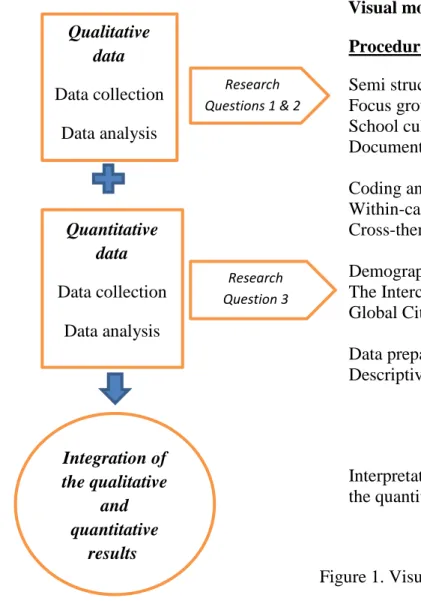
Figure Page 1 Visual model of research design ... 33 2 Revised relationship among multilingualism, intercultural understanding and global Engagement ... 192 3 Revised IM conceptual framework model ... 194
1
CHAPTER 1: INTRODUCTION Introduction
Global. International. Intercultural. Cosmopolitan. The world we inhabit is all of these. In many ways it has always been. Humans have never lived in isolation from one another, as hundreds of years of global exchange attest. Nevertheless, the reach of these
dynamics is more profound for those of us living in the twenty-first century than ever before. Our ability to respond appropriately to, and to thrive in, this context requires a paradigm shift in how we think about the world around us (Richardson, 2016, p.1).
The world we live is becoming increasingly interconnected, globalized and
multicultural; subsequently, world citizens are expected to develop certain lifelong learning skills to engage in communication with people who have different cultures and traditions. The world we live in also goes through many difficulties such as terror threats, degradation of environment, racially biased perspectives and actions, poverty and so forth. As we live on the same planet, our actions leading to these challenges not only impact our small, local community, but also the world at large. Consequently, world citizens are also expected to develop global perspectives and humanistic values to handle the global issues. Thus, international education to promote international-mindedness has become an important necessity as it ensures advocacy for achieving unity and harmony for peace.
This research study aims to help increase our understanding of the development of international-mindedness by exploring how its related constructs such as
multilingualism, intercultural understanding and global engagement are implemented through international education at three different school contexts.
2
This chapter introduces the study with six sections: a) background to the study, b) statement of problem, c) purpose, d) research questions, e) significance, and g) definition of terms. It concludes with an outline of the chapters of this dissertation.
Background to the study
International education is a multilingual, multicultural learning environment where students study globally focused curriculum such as one developed by International General Certificate of Secondary Education (IGCSE), International Baccalaureate (IB) Programs, Advanced Placement (AP) and so on. The objectives of an
international education are to celebrate diversity as desirable for improving the human condition, to promote understanding and respect for one’s own and for other cultures, to encourage a knowledge of issues of global concern, to recognize the benefits of a humanist education to share with others an understanding of the human condition (Walker, 2002). International education can be provided both at a national and international school context through “values education for peace, conflict resolution skills, respect for cultural heritage and the environment and intercultural understanding” (Hill, 2012b, p. 342).
Turkish national schools use the national curriculum along with optional international curriculum to provide international education. So, international education can be provided not only at an international school but also at a national school, as well. International school uses international education curriculum for students from a wide range of countries. It does not follow the national curriculum of the country of residence. The vast majority of students in international schools were expatriates in the past, but this is not the case any longer. The reason is that at many
3
international schools, the host country nationals want their children to learn another language and be exposed to an international education (Mark, 2011). Furthermore, international schools have shown a dramatic growth around the world to meet the demands of families who want their children to study at international schools to be able to return to their home country or travel to another country for required occupational reasons (Hayden & Thompson, 2013; Mark, 2011).
Stakeholders at both the national and international school settings implement an international curriculum to teach students the art of negotiation, diplomacy and conflict resolution. They provide students with an understanding of other nations’ priorities, promote an understanding of differing national characteristics and behaviors, study issues that cross national frontiers such as environmental issues, health and safety, economics and politics. Such international education is expected to show real awareness of the interdependence and appreciation of other cultures in a global perspective. Thus, the product of a successful international education is international-mindedness (Hill, 2012a).
International-mindedness is considered as a foundational principle and a key concept of the International Baccalaureate’s (IB) educational philosophy. Represented in 144 countries all over the world (IBO, 2016), the IB is a multilingual and multicultural organization which encompasses a wide range of languages spoken and a wide array of national, cultural, ethnic and social groups. According to the philosophy of the IB, the aim of IB programs is “to develop internationally-minded people who,
recognizing their common humanity and shared guardianship of the planet, help to create a better and more peaceful world” (IB learner profile booklet, p.5). Within the
4
IB programs, both the academic subjects and the core components are used as a tool to help develop the ideals and values outlined in the IB mission statement (Lineham, 2013). However, the term “internationally-minded” is not specifically used in the IB mission statement, but the key words pertaining to the concept are used such as “inquiring, knowledgeable, young caring people…for a better peaceful
world…through intercultural understanding and respect.”
As an approach to represent the values of the IB educational philosophy, the IB encourages schools to integrate an internationally-minded approach in their
educational practices. Students in the IB schools are educated to be the global leaders of the future who have an insight into cultures across the world and concerns for the well-being of the world community. “IB schools show evidence of a spirit of
internationalism and promote interculturalism” (Schweisfurth, 2006, p.49). IB Schools shape their school ethos, educational philosophies, educational goals and outcomes according to their approach toward international-mindedness and educate students toward international-mindedness through reducing ethnocentrism,
increasing intercultural understanding and promoting global awareness for taking actions.
However, as an overarching concept, international-mindedness does not have a curricular framework or assessment tool to evaluate the effectiveness of the distinct school practices. The core challenge with assessing international-mindedness is that there is a lack of agreement on how to define it. Since there is no universal definition or agreement on a single definition (Hayden & Thompson, 2013), schools may find international-mindedness difficult to interpret. Also, Marshall (2007) points out that
5
teachers and global educationalists encounter similar terms regarding global
citizenship education terminology, which makes it also difficult to conceptualize and assess international-mindedness.
The International Baccalaureate (IB) “attempts to define international-mindedness in increasingly clear terms, and the struggle to move closer to that ideal in practice” (Towards a continuum of international education, p.3). Studies Castro, Lundgren, Woodin, (2013); Bailey, K. & Harwood, (2013); Harwood, & Bailey, (2012); Singh & Qi, (2013); Sriprakash, Singh, & Qi, (2014) conducted on the conceptualization, articulation, development, implementation and assessment of
international-mindedness play a significant role in shaping the curricular and extracurricular practices of international-mindedness at the IB World Schools. As Castro, Lundgren, & Woodin (2013) suggest international-mindedness can be defined as an openness to and curiosity about the world and people of other cultures and a striving toward a profound level of understanding of the complexity and diversity of human
interactions. Even though the term international-mindedness is not widely encountered outside the IB, the underlying concepts such as multilingualism, intercultural understanding and global engagement could define the conceptual framework for what international-mindedness means (Castro, Lundgren, Woodin, 2013).
Furthermore, the attributes of the IB Learner Profile express the values inherent to the IB continuum of international education. The IB Learner Profile aims at developing a sense of continuum between the three programs: Primary Years Program (PYP), Middle Years Program (MYP) and Diploma Program (DP) and
6
considered as a map to pursue international-mindedness (Wells, 2011). It indicates the features that an internationally-minded person should ideally possess and therefore provides a framework for fostering international-mindedness. The IB Learner Profile identifies international-mindedness as the “continuum of
international education, so teachers, students and parents can draw confidently on a recognizable common educational framework, a consistent structure of aims and values and an overarching concept of how to develop international-mindedness” (IBO, 2014, p. 1).
However, there is no mechanism to monitor the successful promotion of the IB Learner Profile, which is a path to international-mindedness and for fulfilling the mission statement (Wells, 2011). Furthermore, although the concept of international-mindedness may have common features across the IB World Schools, the construct of international-mindedness is contextual since it is “set in a national, social, economic and political context” (Castro, Lundgren, & Woodin, 2013, p.8). This indicates that the interpretations, reflections and practices of international-mindedness may vary based on the specific cultural contexts such as the
geographical location, school type, student-teacher-parent profile, curricular and instructional practices and so forth.
Thus, the conceptual framework for defining international-mindedness needs further inquiry to examine how international-mindedness is defined, supported and practiced to ensure its rigor and integrity at different school contexts. Therefore, the practices of international-mindedness should be investigated further to find out about the forms of support for, practices of and challenges to the development of
international-7
mindedness through curricular and non-curricular implementations in different school contexts.
Statement of problem
In reviewing the literature in the field of international education, it is clear that the development and implementation of international-mindedness through curricular or non-curricular practices in different school contexts has not undergone detailed investigation. There have been mainly conceptualizations and reflective
interpretations on international-mindedness. Previous research studies conducted by researchers Bailey and Harwood (2013); Castro, Lundgren, Woodin, (2013);
Harwood and Bailey (2012); Singh and Qi (2013); Sriprakash, Singh and Qi, (2014) have identified a range of literature in the field with the underlying aim of
conceptualization and assessment of international-mindedness.
While much research continues on easier-to-measure academic outcomes, little has yet been done about what schools are doing in practice that support the IB mission in terms of its academic or non-academic outcomes toward the development of
international-mindedness. The concept of international-mindedness may not be well understood by only analyzing written documents or from interview data that seeks only to define concepts of school stakeholders. Another reason why investigations into international-mindedness (IM) have been limited could be because different schools in different settings may have different ways to implement international-mindedness. Hence, understanding real world practices from different school contexts will help researchers and educators appreciate how IM is and is not implemented in schools.
8 Purpose
If the IB has an implied mission to develop global citizens, there needs to be a further inquiry into how the program fosters international-mindedness. Specifically, IB Diploma Programme core components: Creativity, Activity and Service (CAS), Theory of Knowledge (TOK), Extended Essay (EE) are said to be responsible for nurturing and fostering international-mindedness in the DP (Mannix, 2012), with the ultimate goal of developing responsible global citizens. Therefore, this mixed-methods case study research specifically examined what it calls “core components” of the DP:
Theory of Knowledge (TOK: an interdisciplinary course which is designed to provide coherence by exploring the nature and problem of knowledge across disciplines),
Creativity, Activity and Service (CAS: an experiential learning program in which students are involved in artistic pursuits, sports and community service work)
Extended Essay (EE: an in-depth study of a focused independent research on a topic)
and their influence on the development of international-mindedness in terms of multilingualism, intercultural understanding and global engagement.
The study sought specifically to:
1. Explore forms of support for and challenges to developing international-mindedness in different school contexts
2. Explore how the implementation of the pillars of IM within the core components of DP are perceived by students and teachers
9
3. Analyze how students’ levels of IM changed after one full year of DP and compare the patterns of improvement among schools
Research questions 1. How do DP students and staff:
a. Perceive how the development of international-mindedness has been supported by their school culture?
b. Identify challenges to developing students’ international-mindedness? 2. How do DP staff and students perceive how:
a. multilingualism, intercultural understanding and global engagement are supported and challenged?
b. TOK, CAS, EE core components are practiced to foster
multilingualism, intercultural understanding and global engagement? 3. Do students improve their levels of intercultural understanding and global
engagement after one year in the DP? Also, is there any difference among schools in terms of patterns of improvement in intercultural understanding and global engagement?
Significance
Promoting international-mindedness has become a significant responsibility of schools to advocate for “a better and more peaceful world” (IB mission statement). Yet, enacting international-mindedness through internationalized curriculum does not have straightforward procedures, policies or strategies for support to practicing and assessing international-mindedness. Through this in-depth case study about the development, implementation and assessment of international-mindedness in different school contexts, there will be a greater clarification of concepts,
10
applications and practices regarding international-mindedness. This would surely help the IB to develop further its own understanding of, international-mindedness for clarity on its conceptualization and practice.
There are many DP schools around the world. Even though the individual school cultures may be different from the current study, there will likely be similar challenges that are faced when implementing strategies and policies to support international-mindedness, particularly in national schools whose educational systems tend toward more traditional approaches of teaching and learning. As all IB national and international schools use the same core components as prescribed by the
organization, data from this research can be relevant to any DP school around the world.
Both the national and international schools in other regions in Turkey and also in the other countries can utilize the research findings for their own reflection and self-evaluation on the development of international-mindedness in their own unique setting. In addition, any IB national and international school can utilize the findings with regards to the practices and strategies for improving instructional techniques that support international-mindedness.
Definition of terms
Creativity, Activity, Service (CAS) is an experiential learning program in which students are involved in artistic pursuits, sports and community service work, thus fostering their awareness and appreciation of life outside the academic arena CAS
11
includes reflection and documentation on seven predetermined outcomes (IBO, 2016).
Core Components: Extended Essay, Theory of Knowledge and Creativity, Activity and Service in the IB Diploma Program.
Diploma Program (DP) was established in 1968 and was the first program offered by the IB. It is an assessed program for students aged 16 to 19. The DP was established to provide students with a balanced education, to facilitate geographic and cultural mobility and to promote international understanding. The DP curriculum is made up of six subject groups and the DP core components, comprising Theory of Knowledge (TOK), Creativity, Activity, Service (CAS) and the Extended Essay (Towards a continuum of IB education, p. 10, 11).
Extended Essay (EE) is an in-depth compulsory study of a focused independent research or investigation on a topic chosen by the student in cooperation with a supervisor in the school. It is an approximately 40 hours of work by the student, with an externally assessment and a prescribed limit of 4,000 words (IBO, 2016).
Global engagement represents a commitment to address humanity’s greatest challenges in the classroom and beyond. Students and teachers are encouraged to explore global and local issues, including developmentally appropriate aspects of the environment, development, conflicts, rights and cooperation and governance.
12
they hold the earth and its resources in trust for future generations (Castro, Lundgren, Woodin, 2013)
IB Continuum School: It is a school which implements the full IB programs (Primary Years Program, Middle Years Program, Diploma Program).
IB Learner Profile is the IB mission statement translated into a set of learning outcomes for the 21st century. The IB learner profile describes the attributes and outcomes of education for international-mindedness (Towards a continuum of IB education, p. 4).
International Baccalaureate (IB) aims to develop inquiring, knowledgeable and caring young people who are motivated to succeed. Unlike a strictly national curriculum, IB programs reflect the best practices of a range of different educational frameworks and curricula. It encourages students to be internationally-minded and to think beyond their immediate environment (Towards a continuum of IB education, p. 3).
International-mindedness (IM) can be defined as an openness to and curiosity about the world and people of other cultures and a striving toward a profound level of understanding of the complexity and diversity of human interactions. It could be defined in aspects such as multilingualism, intercultural understanding and global engagement (Castro, Lundgren, & Woodin, 2013).
13
Intercultural understanding involves recognizing and reflecting on one’s own perspective, as well as the perspectives of others. The goal is to explore human commonality, diversity and interconnection (Castro, Lundgren, Woodin, 2013).
International school is a school that uses international education curriculum and with students from wide range of countries. It does not follow the national curriculum of the country of residence.
Middle Years Program (MYP) was introduced in 1994 and is for students aged 11-16. The MYP is a challenging curriculum framework that encourages students to make practical connections between their studies and the real world. The MYP comprises eight subject groups, providing a broad and balanced education for early adolescents (Towards a continuum of IB education, p. 9-10).
Multilingualism: It means speaking more than two languages. It is connected with the idea that the languages help individuals develop an appreciation of intercultural perspectives through connecting with people’s histories and experiences (Castro, Lundgren, Woodin, 2013).
National School is a school which uses compulsory national curriculum along with optional international curriculum. In this study, a national school refers to one that is for mainly Turkish students.
Primary Years Program (PYP) was introduced in 1997. The PYP is taught to students aged 3-12. The PYP prepares students to become active, caring, inquiring, lifelong
14
learners who demonstrate respect for themselves and others and have the capacity to participate in the world around them (Towards a continuum of IB education, p. 8).
Theory of Knowledge (TOK): It is an interdisciplinary course which is designed to provide coherence by exploring the nature of knowledge across disciplines,
encouraging an appreciation of other cultural perspectives. It has both external assessment (essay on a prescribed title with 1,600 words maximum) and internal assessment (presentation of approximately 10 minutes per student) (IBO, 2016).
Outline of the dissertation
This introductory chapter provided background to the study, established the research problem, described the purpose of study, identified the research questions,
determined the significance, and defined key terms.
Chapter two, which reviews the literature related to the study, consists of four sections: a) conflicts over definitions of international-mindedness, b) conceptual framework of international-mindedness, c) recommendations for implementing mindedness and d) review of research related to international-mindedness.
Chapter three describes the methodology of the study and consists of seven sections: a) research design, b) context, c) sampling, d) instrumentation, e) reliability, validity and generalizability, f) data collection and g) data analysis.
Chapter four provides the results of the study, and consists of five parts: a)
15
for and challenges to international-mindedness, d) qualitative findings related to forms of support for and challenges to fostering the pillars of IM in the DP core components (CAS, TOK, EE), and e) quantitative findings related to the
improvements in the pillars of IM (intercultural understanding and global engagement).
The conclusions of the study are discussed in Chapter five. It consists of five parts: a) overview of the study, b) major findings and conclusions, c) implications for
practice, d) implications for further research, e) limitations and f) concluding remarks.
16
CHAPTER 2: REVIEW OF RELATED LITERATURE
This chapter outlines the related review of literature. It begins by introducing the conflicts over definitions and emergence of international-mindedness. Next, the conceptual framework of international-mindedness are expanded, followed by recommendations for implementing international-mindedness. Finally, review of research related to international-mindedness is discussed. The purpose of this chapter is to provide background information related with the research questions on the key areas of investigation such as conceptualizations, theoretical framework, assessing and implementing international-mindedness.
Conflicts over definitions of international-mindedness
When we look at how the concept of international-mindedness has emerged through time, we can go back to the period of Ottoman Empire. The Ottoman Palace School of Enderun is historically significant as it lays a foundation for international
schooling. This school was established to provide a unique, high quality, education to gifted students from different backgrounds and ethnicity. The motive behind why this school was created is that it was the first institutionalized education system that could educate these well-rounded individuals with high academic achievement to serve the empire in the ruling class. This school system not only aimed to educate multicultural, multilingual and academically challenging students, but also to help them discover their own talents and embrace universal human values. Many worldly figures emerged from this educational system, including Matraki who was a
17
musketeer, knight, calligrapher and engineer” (Corlu, et al., 2010, p. 24). Such exceptional students were trained to be the leaders of the Empire.
Similar to Endurun in the nineteenth century, the IB today also defines international education based on developing citizens of the world in relation to culture, language and learning to live together, fostering the development of universal values, building and reinforcing students’ sense of identity and cultural awareness, fostering
discovery and enjoyment of learning and so forth. The IB puts special emphasis on “international-mindedness” and equipping students with the necessary personal attributes and life skills to play an active role in the construction of a better future life by means of fostering a peace-making mindset.
While international-mindedness seems to be a recent connotation in response to globalization in the IB world, it has likely existed in many conceptions (i.e., awareness of global issues, international cooperation and conflict resolutions, international communication, intercultural understanding, recognition and interdependence of global issue, etc.) for hundreds of years (Hill, 2012b; Hill & Ellwood, 2013). The developments of global environmental and economic issues have also played a role in the evolution of international-mindedness. It has emerged along the same lines as concepts related to intercultural awareness and sensitivity about cultural, and social and religious differences.
Conceptual disagreements may arise because similar terms and terminology are used to refer to international-mindedness without being aware of any possible differences. Furthermore, the assumptions and perceptions of stakeholders in international
18
schools may be different. Thus, the IB schools may find international-mindedness difficult to interpret (Hayden & Thompson, 2013) because it may be interpreted in different ways based on their particular contexts. Marshall (2007) also points out that teachers and global educationalists encounter similar terms regarding global
citizenship terminology. Terms such as world-mindedness education, global citizenship education, international education, education with a global or
international dimension, world studies education for international understanding look like similar terms. However, their distinctness and relationships are not clearly known.
Even though there are different terms for the concept of international-mindedness, the common terms and specific uses overlap, so there can be a mutual understanding for a shared understanding (Harwood & Bailey, 2012). Therefore, a school must define and understand what internationally-minded students and teachers need to represent this understanding within the context of the school’s programs and curricula (Fannon, 2013).
Terms such as intercultural understanding and taking actions to global problems are common in the definitions of international-mindedness. To exemplify, as defined by Harwood and Bailey (2012), international-mindedness is “a person’s capacity to transcend the limits of a worldview informed by a single experience of nationality, creed, culture or philosophy and recognize in the richness of diversity in the
multiplicity of the ways of engaging with the world” (p. 3). They further explain that international-minded people have the necessary understanding and actions for both national and international citizenship. Ranger (2013) asserts that
internationally-19
minded individuals’ values can be observed through their actions since they show more than an understanding of internationalism. They are open-minded about the common humanity and respect each other’s cultures and beliefs. They also take action through discussion and collaboration to help build better and peaceful world. Another definition of international-mindedness with the common understanding is that international-mindedness refers to an openness to and curiosity about the world and people of other cultures and a striving toward a profound level of understanding of the complexity and diversity of human interactions (Castro, Lundgren, & Woodin, 2013).
Conceptual framework of international-mindedness
The IB is credited with bringing international-mindedness into the forefront of international education and their first emphasis was intercultural understanding. The promotion of international-mindedness emerged explicitly when it was first
introduced by the IB through the DP (Hill, 2012b). The IB definition of international-mindedness has changed and become more mature through time, as well. When international-mindedness was first introduced by the DP during the 1960s (Hill, 2012b), the IB focused on “intercultural understanding, awareness of global issues, critical thinking skills, education for the whole person and the provision of a university entrance qualification with worldwide currency” (Hill, 2012b, p. 251).
The IB definition of international-mindedness has developed. The definition of international-mindedness, largely associated with global/intercultural understanding, was considered as an open attitude for curiosity to gain an understanding of the different cultures and interactions, as the IB mission statement emphasizes
20
core values that need to be developed for “a better and more peaceful world”, the IB’s conceptual framework for defining IM has now incorporated two more dimensions, namely global engagement and multilingualism. “Intercultural
understanding is central to the IB understanding of IM, while global engagement and multilingualism are considered as contributing to students’ development of IM” (Singh and Qi, 2013, p. viii).
In 2013, the IB commissioned a study on the conceptualization of IM and identification of existing instruments for assessing it. This report, developed by Singh and Qi (2013), makes an attempt to clarify and define the concept of IM. Based on a systematic analysis of official IB documents about international- mindedness, a comprehensive literature review on international-mindedness and other related constructs in the field, this report indicates that in the IB documents international-mindedness is explicitly manifested in the three pillars of IM: multilingualism, intercultural understanding and global engagement. These pillars are embedded in the IB Learner Profile.
An internationally-minded learner is a competent communicator, open-minded and knowledgeable. However, these qualities cannot be achieved without the remaining seven attributes, which fall into the two categories of cognitive competence (inquirers, thinkers and reflective practitioners), and dispositions (principled, caring, risk-takers, and balanced) (Singh and Qi, 2013, p. viii).
According to Singh and Qi (2013), critical language awareness can enhance intercultural awareness. Intercultural understanding is necessary for international understanding and cooperation, which leads to responsibility for taking actions to be globally engaged in addressing the humanity’s greatest challenges, thus
21
Building on this conceptual framework for what international-mindedness is, Castro, Lundgren & Woodin’s exploratory study in 2013 documented and reflected from a critical perspective on related pillars of international-mindedness (multilingualism, intercultural understanding and global engagement) and the conceptualization of these constructs through a document analysis and literature review. This report indicates that “although the term international-mindedness is not widely used outside the IB and its related publications, the three components as underlying concepts cover a vast range of literature” (Castro, Lundgren, & Woodin, 2013, p. 4). It was reinforced that international-mindedness could be defined in aspects such as multilingualism, intercultural understanding and global engagement. Thus, this conceptual framework of international-mindedness with its pillars was used to guide the investigation in this study.
As for what these pillars of international-mindedness are, multilingualism is described as a term:
whose definition can range from the description of someone who can speak more than two languages at its most
straightforward, to one which recognizes that the speaker, subject, context and place are all closely connected to language and, most importantly, that language cannot be separated as an entity from those who are using it, the context within which they are using it, and the purposes for which they are using it (Castro, Lundgren & Woodin, 2013, p.23).
As an alternative term for multilingualism, “plurilingualism” is defined by the Common European Framework of Reference for Languages as “the ability to use languages for the purposes of communication and to take part in intercultural interaction, where a person, viewed as a social agent, has proficiency of varying
22
degrees, in several languages, and experience of several cultures” (Council of Europe, 2001, p.168).
Intercultural understanding is “recognized as closely linked to language learning, and there is a strong emphasis on developing knowledge of other cultural groups,
appreciation of different ways of being and behaving, and developing positive attitudes to others” (Castro, Lundgren, & Woodin, 2013, p.6). In other words, intercultural understanding refers to “the ability to understand the perceptions concerning one’s own culture and the perceptions of the people who belong to another culture, and the capacity to negotiate between the two” (Samovar, et al., 2010, p. 52). Intercultural understanding requires individuals to appreciate their own cultural values and beliefs and appreciation of others’ nature of culture to be able to cultivate a mutual respect among diverse cultures by means of showing respect and understanding on the similarities and differences of cultural practices, customs and traditions. This is a significant aspect since it enables schools to equip students with personal attributes and life skills that are necessary to play an active part for the construction of their future life.
Global engagement is “undertaking activity outside of schools, in the local community and/or other foreign communities. Global engagement is not closely linked to multilingualism, and there is some reference to intercultural understanding leading to global citizenship” (Castro, Lundgren, & Woodin, 2013, p.6). Students have an understanding of the importance of social problems through global engagement. They are encouraged to show empathy with the problems facing humanity and our planet. In this way, schools can help students to address issues
23
such as earthquakes, floods, drought, pollution, hunger, global warming, political wars and so on in a more sensitive way as well as demonstrate their critical and problem solving skills while approaching global problems.
Recommendations for implementing international-mindedness Bates (2012, p. 262) asks, “Is global citizenship possible, and can international schools provide it?” He discusses that “while in strict legal terms global citizenship is not possible, in metaphorical terms a number of different possible definitions and categories of global citizenship and global citizenship education [are possible]” (p. 272). Davies (2006) argues that the idea of “global citizenship” is simply a metaphor because people cannot be citizens of the world in the way that they are citizens of a country. Thus, “is global citizenship a fiction, a seeming paradox or oxymoron?” (Davies, 2012, p. 5) As “there is a reasonable consensus on the importance of global citizenship, and on knowledge, skills, and behaviors” (Davies, 2006, p. 22), actually, schools have an important role in developing a curricular and extracurricular
program contributing to the development of global citizenship education.
Thus, schools, which aim at embracing a global approach to education, can include international-mindedness in their ethos which is directly linked to the school’s mission, vision and philosophy (Ranger, 2013; Swetz, and Swetz, 2014).
International-mindedness can be promoted effectively when it is interwoven in the standards, curriculum, ethos and commitment of the school (Skelton, Wigford, Harper & Reeves, 2002). This commitment will help schools to develop
internationally-minded students who have tolerance for peace and enthusiasm for global cooperation through school activities to act on the global issues (Skelton,
24
Wigford, Harper & Reeves, 2002). When students study other cultures and their practices, they gain a better understanding and increased awareness of their own culture’s beliefs and characteristics. Cause (2009) discusses that with regards to the development of international-mindedness in schools, its development cannot be taken for granted.
Hence, teachers need to understand that developing international-mindedness will not happen by putting children of different nationalities in the same classroom (Cause, 2009). To exemplify, the MA research study by Küllü-Sülü (2014) investigated the role of Native English Speaking Teachers (NESTs) in promoting intercultural sensitivity (IS), student ideas about the role of NESTs and Non-native English Speaking Teachers (NNESTs) in terms of promoting IS and teaching target culture. The findings indicated that there is not a statistically significant difference between total IS scores of students educated by NESTs and NNESTs (Küllü-Sülü, 2014). This indicates that foreign language teachers who come from different countries than the students did not really have a major impact on students’ intercultural sensitivity. Although the study was conducted in a mono-cultural environment rather than a multi-cultural environment, it still gives an implication that having native speakers of English in an English learning environment will not naturally provide intercultural sensitivity.
Recommended by the experts in the field, there are strategies that support the
development of international-mindedness. As educators become more internationally attentive, schools around the world communicate similar objectives with regards to the global perspectives and international education (Hansen, 2011). For example, if
25
students have an opportunity to study cultures and countries which are different from their own, they can demonstrate an increased awareness of others as well as to develop greater understanding and appreciation of their own culture (Fannon, 2013). As long as national schools demonstrate international-mindedness within their curricular and extracurricular practices, national schools can also instill in an international worldview in spite of having only one single experience of nationality in a national school context. Therefore, international-mindedness should be an integral part of the school’s climate, standards, curriculum, extra-curriculum, instruction, and assessment in order to prepare students for an interdependent world (Skelton, et al., 2002). Furthermore, students should be guided through building classroom cultures, along with the wider school community that fosters moral and inclusive intercultural relations (Cause, 2009).
The attitude towards international-mindedness can also be fostered through the curriculum, including learning and teaching practices which are enhanced with international and intercultural experiences (Bailey & Harwood, 2013). The
curriculum can provide a balance between local and global perspectives for human dignity and diversity. The development of an international outlook on a problem studied as part of the curriculum requires students to develop the skill to look at an issue from multiple perspectives (Lineham, 2013). However, on its own, the
curriculum may not even be sufficient to achieve an education toward international-mindedness. Therefore, it is the responsibility of the schools to raise students’
awareness of global perspectives and develop an appreciation of other points of view if they will educate a new generation of global citizens (Hansen, 2011). In this way, students develop global consciousness and become understanding, caring,
open-26
minded and tolerant individuals as they learn to respect cultural perspectives and understand the interconnectedness of the world.
Lastly, there may be a need to assess the effectiveness of the implementation of international-mindedness. For example, self-reflective journal or portfolio can be included in assessment (Harwood & Bailey, 2012). However, the assessment of a curriculum that promotes international-mindedness may not be measured simply by means of an examination. In fact, too much focus on examination results alone can affect the teaching styles and cause schools to move from a constructivist or social-constructivist approach to a more behaviorist methodology (Lineham, 2013). This can have a negative effect on student learning and the ability of a curriculum to promote the aims of international education. Furthermore, the development of international-mindedness does not happen by focusing on instructing students on the ten attributes of the IB Learner Profile. There is a need for clearer instructions about how to assess, or even describe, the extent to which students appreciate and embrace the values promoted in the IB Learner Profile (Wells, 2011).
Review of research related to international-mindedness
Upon reviewing the related literature, there are only a few empirical studies on the development and implementation of practicing international-mindedness. The research studies conducted so far focus more on the documentation, reflection on related constructs (Bailey and Harwood 2012, 2013; Castro, Lundgren, and Woodin 2013; Singh and Qi 2013; Sriprakash, Singh, and Qi, 2014).
The exploratory study by Castro, Lundgren, and Woodin (2013) based on IB document analysis and related literature review on the aspects of
international-27
mindedness aimed to conceptualize, document, reflect on and assess international-mindedness. The study focuses on multilingualism, intercultural understanding and global engagement and how the constructs related to international-mindedness are defined and theorized in the research field of international and intercultural
education. In addition, it also investigates what skills and competences are being assessed and what models and instruments are being used for assessing the intercultural dimension in different educational settings.
Another research study was conducted by Sriprakash, Singh, and Qi (2014). It is a cross-cultural qualitative comparative study of international-mindedness. Through interviews with parents, teachers and students at each of the six schools, the study offers comparative insights about the concept of international-mindedness across cultures. The aim of the research was to provide a resource for the IB community of empirically based concepts and practices of international-mindedness that have emerged from the experiences and perspectives of students, parents and teachers in IB schools. As part of a multi-site approach, 196 parents, teachers, and students were interviewed in six IB schools in Australia, China and India. According to the
findings, international-mindedness has varied implications. It was seen as a tool for global mobility, a form of western cultural capital and a strategy for academic advancement. IB schools are the places where the conceptualization and
implementation of international-mindedness is facilitated through national historical, social and political contexts. The practices of international-mindedness varied across the six school contexts and were dependent on school cultures, level of commitment from teachers and leadership teams, and level of integration and promotion across school activities. Successful school practices of international-mindedness include
28
embodying international-mindedness into their long-term strategies, active leadership to drive the school planning and practice of international-mindedness, explicitly linking school events to ideas relating to international-mindedness, engaging the critical and creative capacity of students to plan and organize events for
international-mindedness.
A more recent study by Hacking, et al., (2017) investigated the promising practices of the development and assessment of international-mindedness. This study revealed supporting findings on how schools can nurture IM through their standards,
curriculum and commitment. This study examined how IB Schools conceptualize, implement and assess international-mindedness and understand related challenges. Researchers investigated promising practices in developing and assessing
international-mindedness at two pilot schools and nine case study schools with different programs and contextual locations to gain various perspectives at each school. The interview data and focus group findings suggest that intentionality is the means of promising practice on IM since the case study schools were actively
working to develop students’ IM. Therefore, school communities were recommended to discuss, define, develop, assess and evaluate IM according to their particular contexts and profiles.
The research study by Singh and Qi (2013), which is the basis of the conceptual framework of international-mindedness for this study, provides an account of the conceptualization of international-mindedness and existing instruments for assessing it. It aims at the development of a conception of international-mindedness, an
29
issues and tools in the field and the identification of instruments for assessing it. Alternative techniques and strategies of these methods, their validity and impacts in different educational contexts were also reviewed in the literature, but they found out that the assessment of international-mindedness is an under-researched area and the instruments used to assess international-mindedness are very limited. Singh and Qi were able to identify a variety instruments that have been used related to assessing IM, including the following:
The Global-Mindedness Scale (GMS) measures levels of global mindedness in students studying in countries other than their home countries. The GMS identifies attitudes, beliefs, and behaviors related with global mindedness. It has five domains: responsibility, cultural pluralism, efficacy, global centrism, and interconnectedness (Hansen, 2010, p. 22-23, as cited by Singh and Qi, 2013).
The Global Perspective Inventory (GPI) measures an individual’s global perspective comprehensively (Merrill, Braskamp & Braskamp, p. 356, as cited by Singh and Qi, 2013). The instrument includes six scales—both development and acquisition scales within each of the three domains— Cognitive, Intrapersonal, and Interpersonal.
The Global Competence Aptitude Assessment (GCAA) instrument measures knowledge, skills, and attitudes necessary to become globally competent. It assesses both Internal Readiness (personal traits and aptitude) and External Readiness (knowledge, skills and experiences) (Global Leadership
Excellence, n.d., p. 2, as cited by Singh and Qi, 2013).
The Global Citizenship Scale (GCS) measures social responsibility, global competence, global civic engagement, and their sub-dimensions. Based on
30
the validity tests, global competence and global civic engagement are strong dimensions of global citizenship. However, social responsibility proved to be an unclear dimension. Yet, the scale is theoretically grounded and empirically validated (Morais & Ogden, 2010, as cited by Singh & Qi, 2013).
The Intercultural Development Inventory (IDI) measures orientations towards cultural differences, based on the Developmental Model of Intercultural Sensitivity (DMIS) by Bennett (1986). The DMIS consists of five stages on an intercultural development continuum. Denial, Defense and Minimization are the ethnocentric mindset and Acceptance, Adaptation are the intercultural mindsets.
Singh and Qi (2013) concluded that there is a need for a combination of instruments to account for multiple competencies inherent in international-mindedness and for the optimal measurement of international-mindedness. The current study combined with the Intercultural Development Inventory (IDI) with the Global Citizenship Scale (GCS). The IDI focuses more on intercultural competence; whereas, GCS focuses on global competence in terms of not only having intercultural communication
competence, but at the same time how much we are engaged in global problems. Thus, the IDI and the GCS were used to analyze any improvements in students’ levels of intercultural understanding and global engagement respectively.