Full Terms & Conditions of access and use can be found at
https://www.tandfonline.com/action/journalInformation?journalCode=recs20
ISSN: 1514-0326 (Print) 1667-6726 (Online) Journal homepage: https://www.tandfonline.com/loi/recs20
How Can Recessions Be Brought to an End? Effects
of Macroeconomic Policy Actions on Durations of
Recessions
Bedri Kamil Onur Taş & Hüseyin Ekrem Cunedioğlu
To cite this article: Bedri Kamil Onur Taş & Hüseyin Ekrem Cunedioğlu (2014) How Can Recessions Be Brought to an End? Effects of Macroeconomic Policy Actions on Durations of Recessions, Journal of Applied Economics, 17:1, 179-198, DOI: 10.1016/S1514-0326(14)60008-8
To link to this article: https://doi.org/10.1016/S1514-0326(14)60008-8
© 2014 Taylor and Francis Group, LLC
Published online: 22 Jan 2019.
Submit your article to this journal
Article views: 6
* Bedri Kamil Onur Taş (corresponding author): TOBB University of Economics and Technology, Sogutozu Cad. 43 Sogutozu, Ankara, Turkey; email: [email protected]. Huseyin Ekrem Cunedioglu: Economic Policy Research Foundation of Turkey, Özyeğin University Graduate School of Business, Nişantepe District, Orman Street, 34794 Çekmeköy, İstanbul, Turkey; email: ekrem.cunedioglu@ozu. edu.tr. We are indebted to Fatih Özatay and Süreyya Serdengeçti for helpful discussions. We also would like thank Jorge M. Streb (the Editor), an anonymous referee and participants at the TEK International Conference on Economics for many valuable comments.
HOW CAN RECESSIONS BE BROUGHT TO AN END?
EFFECTS OF MACROECONOMIC POLICY ACTIONS ON
DURATIONS OF RECESSIONS
B
edriK
amilO
nurT
aş*TOBB University of Economics and Technology
H
üseyine
KremC
unediOğluEconomic Policy Research Foundation of Turkey
Submitted July 2011; accepted July 2013
This paper analyzes how effective macroeconomic policy actions are in ending recessions. We also investigate which structural factors help the country to experience shorter recessions. We implement survival regression analysis and conclude that expansionary monetary policy significantly decreases durations of recessions whereas fixing the exchange rate does not have an effect on the durations of recessions. Expansionary fiscal policy has undesired effects and decreases the probability that recession will end, thus increasing the durations of recessions. The analysis of country specific factors indicates that emerging countries experience shorter recessions. Recessions in countries with higher trade openness last significantly longer. Financial openness and institutional quality do not have significant effects of recession durations. The empirical analysis takes into account alternative probability distributions and endogeneity of policy actions.
JEL classification codes: E32, E52, E62
“... economists seem strangely unsure about what to tell policy-makers to do to end recessions.”
Romer and Romer (1994: 1)
I. Introduction
There is an ongoing debate about optimal macroeconomic policy during recessions. Policy reactions aim to end recessions as quickly as possible, decreasing their durations. Although there are many studies which investigate the factors that start recessions, or affect the probability of being in a recession, the analysis of macroeconomic policy and factors that end recessions, or decrease their duration, is limited.
In this paper, we take the statement of “ending the recession” literally and analyze the factors and policy actions that affect the probability that the recession will end by looking at hazard rates of recessions. We implement survival-time analysis to investigate the following questions. First, does the structure of the country at the start of recession have an effect on the durations of recessions? Second, how do macroeconomic policy actions affect durations of recessions? The first question leads to examine the effect of structural factors (trade openness, financial openness, institutional quality, and being an emerging country) on recession duration, to see which countries are more resistant to recessions and shake the recessions off more quickly. The second question focuses on the comment by Romer and Romer (1994) and leads to investigate the effectiveness of macroeconomic policy actions to end recessions. The effect of monetary expansion, fiscal expansion and change in the exchange rate regime on the probability that the recession will end (the hazard rate of recession) is examined.
A large body of research analyzes the causes and effects of recessions. For instance, Claessens et al. (2011) analyze recessions in 23 emerging and 21 OECD countries. They find that recessions in emerging markets are deeper compared to developed countries when the amplitudes of recessions are considered. They identify that the recessions associated with financial crisis in emerging markets last longer and cause larger decreases in output. Among papers that investigate the implication of recessions in emerging markets, Chang et al. (2009) and Kose et al. (2006) analyze the linkages between long-term growth and short-term business cycle volatility using panel data sets, while Neumeyer and Perri (2005) analyze the effects of various shocks on business cycles in emerging markets using stochastic dynamic models.
Reinhart and Rogoff (2008) analyze the aftermath of banking crisis in advanced economies and emerging markets. They conclude that banking crisis have similar effects on housing and equity prices, unemployment, government revenues and debt in both advanced and emerging economies. Reinhart and Rogoff (2009) examine the aftermath of severe financial crisis in developed countries. They show that unemployment increases and housing price declines as a response to financial crises last five to six years. On average the duration of output declines is two years. Claessens et al. (2009) analyzes the linkages between macroeconomic and financial variables during recessions for 21 OECD countries. They identify 122 recessions1 and find evidence that recessions associated with credit crunches and
house price busts tend to be deeper and longer than other recessions. Although they report the behavior of interest rates and government consumption during recessions, they do not analyze the effect of macroeconomic policy actions on the duration of recessions and the role of those policy actions in ending recessions. Their focus is more on the fundamental factors that start recessions than factors and policy actions that shorten duration of recessions. Jorda et al. (2012) examine the role of credit in business cycles. They examine 200 recession episodes in 14 advanced countries and conclude that decrease in output is significantly higher in financial-crisis recessions and recoveries are slower after recessions preceded by credit-intensive expansions.
Regarding fiscal behavior during recessions, Blanchard and Perotti (2002) examine the effects of shocks in government spending and taxes on U.S. output. They conclude that positive government spending shocks have a positive effect on output and positive tax shocks have a negative effect. Kaminsky et. al (2004) find that fiscal policy in OECD countries is countercyclical or acyclical whereas fiscal policy in developing countries is procyclical. Erbil (2011) examines fiscal policy in oil producing countries and concludes that fiscal policy is highly procyclical in the middle income groups and procyclical in high income countries. Similar to our study, Claessens et al. (2009) measure fiscal policy as changes in government consumption and analyze 21 OECD countries. They conclude that fiscal policy is countercyclical. Vegh and Vuletin (2012) analyze how governments change tax
1 They also identify 112 credit contraction episodes, 114 episodes of house price declines, 234 episodes
rates over the business cycle. They conclude that tax policy is acyclical in industrial countries but procyclical in developing countries. Besides the empirical analysis mentioned above, several papers provide theoretical investigations of the effect of fiscal policy on recessions. Eggertsson and Krugman (2012) investigate the effect of fiscal policy on debt-driven recessions. They construct a model in which debt overhang depresses demand and causes a recession. They provide supportive evidence for fiscal expansion by arguing that expansionary fiscal policy limits the output loss and the size of the shock.
Many empirical studies in the literature focus on the factors that help predict recessions. Estrella and Mishkin (1999) investigate the probability of US recessions and show that stock prices are useful with one-to-three-quarter horizons and the spread, which represents the term structure of interest rates, is a reliable predictor of US recessions beyond one-quarter. Birchenhall et al. (1999) build a logistic model that successfully predicts US business cycles. Crucini (2008) et al. implement a multi-country approach and examine the factors that drive G-7 business cycles. They find that productivity and fiscal policy are the main factors that cause variance of output.2
Business cycle duration dependence is examined by some of the studies that implement the methodology used in this paper. The main research question is whether periods of expansion or contraction in economic activity are more likely to end as they become older. This is also known as positive duration dependence. Sichel (1991) and Zuehlke (2003) implement the Weibull duration model to analyze duration dependence of US business cycles. They find empirical evidence of positive duration dependence for US expansions and contractions. Diebold et al. (1993) confirm the results of Sichel (1991) using an exponential-quadratic hazard model. Finally, Castro (2010) examine duration dependence of business cycles in 13 industrial countries. He finds evidence of positive duration dependence for both expansions and contractions for the analyzed industrial countries.
Although there is a vast literature that investigates how recessions start, fewer studies examine how to end them. Romer and Romer (1994) analyze monetary and fiscal policy in the postwar US recessions. Their simulations conclude that
2Productivity shocks constitutes 54% and fiscal policy shocks cause 20 percent of the variance of output respectively.
compared to fiscal policy, monetary policy is more effective in ending recessions. Bordo and London-Lane (2010) investigate the behavior of the Fed at the end of recessions. They conclude that since 1960 the Fed is late to tighten money supply after recessions which caused higher levels of inflation.
Our study makes the following contributions to the literature. First of all, we conduct a duration analysis by implementing parametric hazard models to examine the effectiveness of macroeconomic policy actions in ending recessions. Compared to the methods conducted in previous studies, this study tests for the presence of duration dependence and the effect of economic and political variables in ending recessions. Second, the effect of monetary and fiscal policy actions and changes in exchange rate regime on recession duration has not been studied in the literature. The analysis conducted in this paper presents novel results about the effectiveness of these policy reactions in ending recessions. We take on the criticism of Romer and Romer (1994) and provide empirical evidence that can be used by economists to advise policy-makers on “what to do to end recessions”. Third, we investigate recessions in a multi-country setting of 22 countries which includes both industrial and developing countries. This data set allows us to differentiate the policy responses of industrial and developing countries to recessions. We also analyze whether the effectiveness of policy actions differs among industrial and developing countries. Finally, we contribute to the business cycle duration dependence literature by analyzing duration dependence for 22 industrial and developing countries. Previous studies focus on the US and a limited number of industrial countries.
The paper proceeds as follows. Section II explains the methodology and the data. Section III presents the summary statistics of recessions and policy actions during recessions. Section IV conducts the survival regression analysis and presents the results. Section V argues the policy implications of the empirical results and concludes.
II. Data and methodology
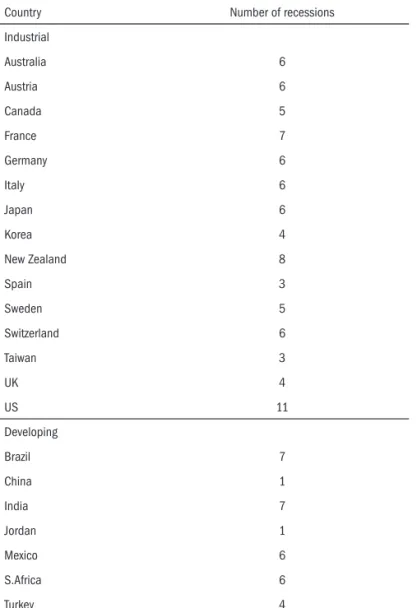
We analyze recessions in 22 different countries: Australia, Austria, Brazil, Canada, China, France, Germany, India, Italy, Japan, Jordan, Korea, Mexico, New Zealand, South Africa, Spain, Sweden, Switzerland, Taiwan, Turkey, UK and US. Table A1 in the Appendix presents the number of recessions identified for each country. The recession dates of Turkey are from the Central Bank of Turkey and for the
remaining 21 countries we used the recessions identified by the Economic Cycle Research Institute (ECRI).3 The ECRI data set identifies recessions between 1948
and 2009. The ECRI identification is preferred because ECRI has established reference cycle chronologies for 21 economies based on the same methodology used to establish the official business cycle dates for the United States by the NBER.4,5 Quarterly durations of recessions are used as the duration variable in our
analysis. The hazard ratio of recession duration, in other words the probability that the recession ends, is used as the dependent variable.
Trade openness, financial openness and institutional quality are used to represent the economic structure of the economy. Trade openness is calculated using the standard ratio of imports and exports to GDP. The financial openness index is from Chinn and Ito (2008), which is based on the binary dummy variables that codify the tabulation of restrictions on cross-border financial transactions reported in the IMF’s Annual Report on Exchange Arrangements and Exchange Restrictions.6 We use the constraint on the executive variable in Polity IV as a
measure of institutional quality as in Acemoglu and Johnson (2005).
A. Indicators of policy
To analyze the effect of policy actions in ending recessions it is necessary to determine the indicators of monetary and fiscal policy, and of exchange rate regime.
We use the change in the money market rate as suggested by Romer and Romer (1994).7 We calculate the change in levels of the interest rates as in Claessens et
3 The dataset is available at http://www.businesscycle.com/resources/cycles
4 The detailed description of the procedure is available at http://www.nber.org/cycles/july2003/
recessions.html.
5An alternative methodology would be the BBQ methodology as in Claessens et al. 2009. This methodology identifies the peaks and throughs using a 5 quarter window. A complete cycle is defined as the period from one peak to the next twophases, the contraction phase and the expansion phase. It is reported by the Euro Area Business Cycle Committee that the BBQ methodology gives different results on business cycles compared to NBER results. Thus, we do not implement the BBQ methodology and prefer the recessions identified by the ECRI which coincides with the NBER methodology
6Explanation and dataset is available at http://www.ssc.wisc.edu/~mchinn/research.html.
7 Bernanke and Blinder (1992) also argue that “interest rate on Federal funds is extremely informative
about future movements of real macroeconomic variables, more so than monetary aggregates or other interest rates.”
al. (2009) as a measure of monetary policy actions during recessions. We follow Kaminsky et al. (2004) and Claessens et al. (2009) and use the percent change in government expenditure to gauge fiscal policy actions as a response to recessions. Money market rate and government expenditure data is from the International Financial Statistics database of the IMF. Finally, exchange rate regimes are identified using the classification of Levy-Yeyati and Sturzenegger (2005). They classify exchange rate regimes as float (1), interm (2) and fixed (3) by analyzing the volatility of exchange rates and international reserves. Their dataset is available for the 1974-2004 time period.8
B. Methodology
We implement survival-time (duration) analysis methodology to investigate the factors that affect durations of recessions. In survival analysis, the survivor function is used as the dependent variable. The survivor function presents the probability of surviving past a certain time. The hazard function of the survival analysis provides the probability of leaving the initial state in the given time interval. In this study, the durations of recessions are calculated in quarterly terms and the econometric model is developed in quarterly hazard rates.
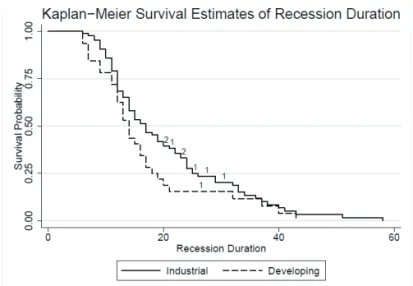
The Weibull probability distribution is used to model survival probabilities. The Weibull distribution is suitable for modeling data with monotone hazard rates that either increase or decrease exponentially with time. As stated by Castro (2010), the Weibull distribution is the most popular model in the analysis of the duration of expansions and recessions. Studies like Diebold et al. (1993), Sichel (1991), Zuehlke (2003) and Castro (2010) implement the Weibull model to investigate duration dependence of business cycles. Figure 1 shows that the Weibull distribution is suitable for the analysis of recession durations by displaying the decrease in hazard rates with time. The survivor rate function can be presented as follows:
,
(1)where , are the covariates, and is an ancillary parameter to be estimated from the data.
The hazard function can be derived using the survivor rate function. The hazard function for recession i (the probability that the recession will end) can be written as
.
(2)The factors that affect the hazard function can be estimated using the following regression equation:
,
(3)where is a vector of explanatory variables, and is a vector of regression coefficients. The coefficients are estimated using maximum likelihood. The significance of indicates that the variable has an effect on the hazard rate of recession duration and a positive coefficient indicates that the hazard rate gets higher as that variable increases and the recession is more likely to end.
The distribution function of the hazard function is an incremental part of the survival regression analysis. We use the Weibull distribution which is the appropriate distribution function for modeling hazard rates that decrease with time. To be able to obtain robust empirical results we also use the Cox proportional hazards model which does not require prior determination of the distribution function. Using the Cox model, one could estimate the relationship between the hazard rate and explanatory variables without making assumptions about the shape of the hazard function. In the Cox proportional hazards model (Cox 1972), the hazard is assumed to be
.
(4)The Cox model allows us to calculate the coefficients of the duration regression without specifying a distribution function.
C. Endogeneity
Econometric analysis of the effect of policy actions on duration of recessions is nontrivial because of the potential endogeneity problem. There might exist contemporaneous interactions between changes in the interest rate and government expenditure and duration of recessions. Romer and Romer (1994) state that monetary policy might be endogenous. Similarly, Blanchard and Perotti (2002) argue that fiscal policy can be adjusted in response to unexpected changes in GDP within a year. The mean duration of recessions in our data set is 19 quarters. Thus, policymakers and legislatures might conduct fiscal policy actions as a reaction to the increase on recession durations. Consequently, fiscal policy reaction might be a function of duration of recessions especially when recessions last more than one year.9
Several studies that examine the effects of monetary and fiscal policy shocks on GDP show that both shocks might be endogenous. Thus, the maximum likelihood estimates might understate the effects of shocks to monetary and fiscal policy. To take into account the potential bias, we implement 2SLS instrumental variables estimation methodology where the changes in the money market and government expenditure are treated as endogenous. We use first and second lags of CPI Inflation and treasury bill rates at the start of recessions as instruments. The Hausman (1978) overidentification tests verify that these variables are valid instrumental variables.
We begin our analysis by presenting a descriptive analysis of duration of recessions, macroeconomic structure and policy variables.
III. Summary of recessions and macroeconomic variables
We first examine the summary statistics of durations of recessions. The mean of recessions experienced in the 22 countries is 18.67.10
9Blanchard and Perotti (2002) state that “Direct evidence on the conduct of fiscal policy suggests that it takes policymakers and legislatures more than a quarter to learn about a GDP shock, decide what fiscal measures, if any, to take in response, pass these measures through the legislature, and actually implement them. The same would not be true if we used annual data.
10Although one interesting indication of Table 1 is that the mean of recession duration is higher in industrial countries than developing countries, we cannot reject the the null hypothesis of equality of means.
Table 1. Summary statistics of duration of recessions
Number of observations Mean Standard deviation Min Max
Full sample 118 18.67 10.1 6 58
Industrial countries 86 19.55 10.26 6 58
Developing countries 32 16.31 9.43 6 43
Figure 1 presents the survival probability of recessions where 9 observations are right censored.
Figure 1. Survival probability of recessşons calculated using Kaplan-Meier methodology. Small numbers show the observations lost due to right-censoring.
The maximum duration of recessions is 58 months which happened in New Zealand between September 1986 and June 1991.11 The longest recession in
developing countries happened in South Africa between February 1989 and August 1992. The equality of survivor functions tests accept the null hypothesis that survivor functions of industrial and developing countries are equal at 5 percent but reject the null at 10 percent significance level.12
11 The ECRI also identifies the recession that started in November 1995 and still continues (170 months
between 1995-2009) in Jordan. This recession is excluded from the dataset because it significantly distorts the summary statistics.
A. Economic conditions of countries at the beginning of recessions
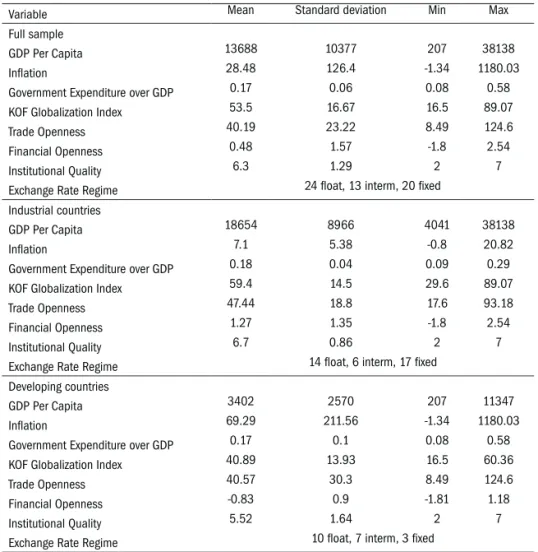
Table 2 summarizes the macroeconomic and structural variables. The industrial countries are more integrated to the global economy with higher scores of trade openness, financial openness and globalization index. Industrial countries had fixed exchange rate regimes at the start of 17 recessions out of 37.13
Table 2. Macroeconomic conditions of countries at the start of recessions
Variable Mean Standard deviation Min Max
Full sample
GDP Per Capita 13688 10377 207 38138
Inflation 28.48 126.4 -1.34 1180.03
Government Expenditure over GDP 0.17 0.06 0.08 0.58
KOF Globalization Index 53.5 16.67 16.5 89.07
Trade Openness 40.19 23.22 8.49 124.6
Financial Openness 0.48 1.57 -1.8 2.54
Institutional Quality 6.3 1.29 2 7
Exchange Rate Regime 24 float, 13 interm, 20 fixed
Industrial countries
GDP Per Capita 18654 8966 4041 38138
Inflation 7.1 5.38 -0.8 20.82
Government Expenditure over GDP 0.18 0.04 0.09 0.29
KOF Globalization Index 59.4 14.5 29.6 89.07
Trade Openness 47.44 18.8 17.6 93.18
Financial Openness 1.27 1.35 -1.8 2.54
Institutional Quality 6.7 0.86 2 7
Exchange Rate Regime 14 float, 6 interm, 17 fixed
Developing countries
GDP Per Capita 3402 2570 207 11347
Inflation 69.29 211.56 -1.34 1180.03
Government Expenditure over GDP 0.17 0.1 0.08 0.58
KOF Globalization Index 40.89 13.93 16.5 60.36
Trade Openness 40.57 30.3 8.49 124.6
Financial Openness -0.83 0.9 -1.81 1.18
Institutional Quality 5.52 1.64 2 7
Exchange Rate Regime 10 float, 7 interm, 3 fixed
B. Macroeconomic policy changes during recessions
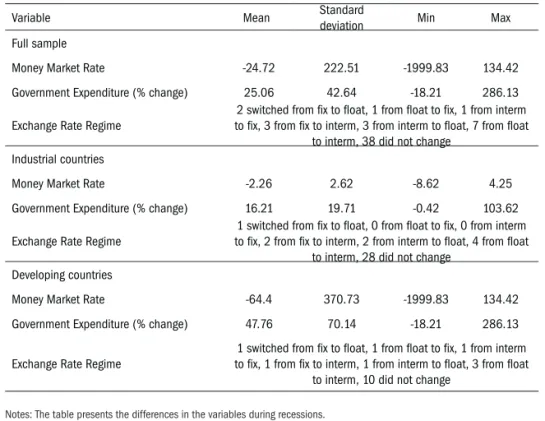
Table 3 shows the policy response of countries to recessions. The changes in variables during recessions are used as policy response variables. Table 3 shows that money market rate decreased substantially during recessions. Also, fiscal expansion is used as a policy tool during recessions since the percentage change in government expenditure is positive. These findings are in line with the results of Claessens et al. (2009).
Table 3. Changes in policy variables during recessions
Variable Mean Standard deviation Min Max
Full sample
Money Market Rate -24.72 222.51 -1999.83 134.42
Government Expenditure (% change) 25.06 42.64 -18.21 286.13
Exchange Rate Regime to fix, 3 from fix to interm, 3 from interm to float, 7 from float 2 switched from fix to float, 1 from float to fix, 1 from interm to interm, 38 did not change
Industrial countries
Money Market Rate -2.26 2.62 -8.62 4.25
Government Expenditure (% change) 16.21 19.71 -0.42 103.62
Exchange Rate Regime
1 switched from fix to float, 0 from float to fix, 0 from interm to fix, 2 from fix to interm, 2 from interm to float, 4 from float
to interm, 28 did not change Developing countries
Money Market Rate -64.4 370.73 -1999.83 134.42
Government Expenditure (% change) 47.76 70.14 -18.21 286.13
Exchange Rate Regime to fix, 1 from fix to interm, 1 from interm to float, 3 from float 1 switched from fix to float, 1 from float to fix, 1 from interm to interm, 10 did not change
Notes: The table presents the differences in the variables during recessions.
The money market rate decreased after the start of the recession in 44 out of 53 recessions in industrial countries and in 13 out of 30 recessions in developing
countries.14 Although the mean of change in the money market rate is negative
only in 13 recessions in the emerging markets, the central bank lowered the interest rate as a reaction to recessions. In 57 of 59 recessions government expenditure increased in industrial countries and in 20 of 23 recessions government expenditure increased in developing countries.15 These results show that fiscal policy is used
more widely during recessions compared to monetary policy (lower interest rates). The change in the exchange rate regime is displayed in the table.
IV. Survival regression analysis
In this section, we estimate the coefficients of equation 3 and 4 to analyze the effect of macroeconomic variables and policy actions on the durations of recessions.
A. Which countries experience lower recession durations?
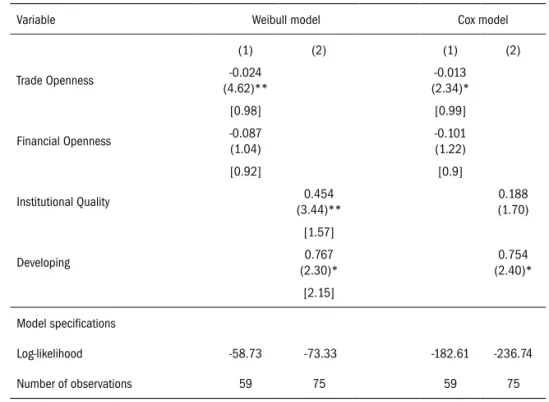
Table 4 presents the regression specifications where the explanatory variables are variables that show the structure of the economy. The log-relative hazard form is estimated indicating that the coefficients gauge the effect of the variable on the hazard rate of recessions, probability that the recession will end.
First two columns show the regression specifications for the survival model with Weibull distribution and the last two columns present the results of Cox model. In both regression specifications the coefficient of trade openness is significant and negative. The negative coefficient indicates that the hazard rate is lower and the recession tends to be longer when the trade openness of the country is higher. The second and fourth columns investigate the effect of institutional quality and being an developing country on the probability that the regression will end. The coefficients of both institutional quality and developing country dummy are positive and significant for the Weibull model. This result indicates that developing countries and countries with higher institutional qualities experience shorter recessions.
14 The money market rate is available for 83 recessions.
Table 4. Regression results of duration on structure of the country at the start of recessions
Variable Weibull model Cox model
(1) (2) (1) (2) Trade Openness (4.62)**-0.024 (2.34)*-0.013 [0.98] [0.99] Financial Openness -0.087 (1.04) -0.101 (1.22) [0.92] [0.9] Institutional Quality (3.44)**0.454 0.188 (1.70) [1.57] Developing 0.767 (2.30)* 0.754 (2.40)* [2.15] Model specifications Log-likelihood -58.73 -73.33 -182.61 -236.74 Number of observations 59 75 59 75
Notes: Hazard ratios are presented in square brackets. Absolute values of z statistics in parentheses. * significant at 5%; ** significant at 1%.
B. Which macroeconomic policy is more effective in decreasing duration of recessions?
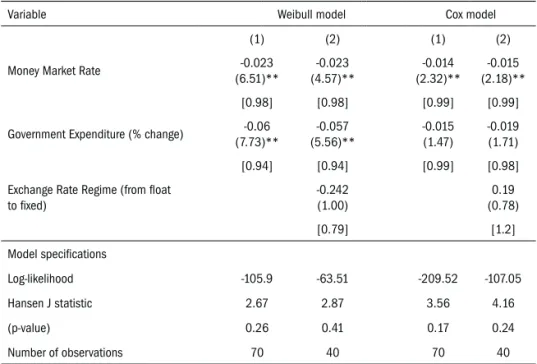
We now turn to the effects of macroeconomic policy actions on durations of recessions. We examine the effects of monetary policy measured by changes in the money market rate, fiscal policy measured by percent change in government expenditure and changes in the exchange rate regime as a response to recessions. Table 5 presents the 2SLS instrumental survival regression results of equations 3 and 4 where the explanatory variables are changes in macroeconomic policy variables.
Table 5. Effects of macroeconomic policy on duration of recessions, 2SLS IV regression results
Variable Weibull model Cox model
(1) (2) (1) (2)
Money Market Rate (6.51)**-0.023 (4.57)**-0.023 (2.32)**-0.014 (2.18)**-0.015
[0.98] [0.98] [0.99] [0.99]
Government Expenditure (% change) (7.73)**-0.06 (5.56)**-0.057 -0.015 (1.47) -0.019 (1.71)
[0.94] [0.94] [0.99] [0.98]
Exchange Rate Regime (from float
to fixed) -0.242 (1.00) (0.78)0.19 [0.79] [1.2] Model specifications Log-likelihood -105.9 -63.51 -209.52 -107.05 Hansen J statistic 2.67 2.87 3.56 4.16 (p-value) 0.26 0.41 0.17 0.24 Number of observations 70 40 70 40
Notes: Hazard ratios are presented in square brackets. Absolute values of z statistics in parentheses. * significant at 5%; ** significant at 1%. First and second lags of CPI Inflation and treasury bill rates at the start of recessions are used as instrumental variables. Constant term is displayed.
Table 5 shows that monetary policy and fiscal policy have negative and significant coefficients. The negative coefficient of the change in the money market rate indicates that when the interest rate gets lower the hazard rate of durations increases. This means that expansionary monetary policy increases the probability that the recession will end. Thus, expansionary monetary policy significantly decreases recession durations. The negative coefficient of the fiscal expansion variable is somewhat surprising since it indicates that when the government expenditure increases as a response to recessions the hazard rate gets lower. In
other words, recessions last longer when government expenditure increases.16
These results are in line with Mishkin (2009) who claims that “... monetary policy is more potent during financial crises because aggressive monetary policy easing can make adverse feedback loops less likely.” Finally, the change in the exchange rate regime from float to a more rigid regime does not have an effect on the hazard rate.17
The adverse effect of fiscal expansion on recession duration presented in the Weibull model of Table 5 is contrary to theoretical arguments. Both the neoclassical and Keynesian theories support the idea that fiscal policy should smooth the volatility of output. As presented in Claessens et al. (2009) we find that the reaction of government policy is in line with these theoretical arguments. Table 3 shows that government expenditure increases in percentage terms during recessions. But Table 5 concludes that these expansionary reactions are ineffective and have unfavorable effects by increasing recession durations.18
To sum up, Table 5 gauges the effectiveness of different policy actions in ending recessions. Policy recommendations can be driven from these empirical results. The survival regressions indicate that expansionary monetary policy significantly increases the probability that the recession will end but expansionary fiscal policy might have undesired results and increase the duration of recessions.
16 Some of the examined countries are eurozone countries. We conducted additional analysis to examine
whether the results of Table 5 differ for eurozone countries. We added eurozone dummy variable and interaction variables in to the 2SLS regression as explanatory variables. We conclude that the results presented in Table 5 do not differ for eurozone countries.
17 A positive value of the difference in the exchange rate variable indicates that the country switched
from a float (1) to fixed (3) exchange rate regime.
18 A possible explanation for this result can be provided by the literature which investigates the
dynamics behind the procyclical behavior of fiscal policy. As presented by Erbil (2011) two arguments are proposed in the literature: 1) constraints to financing, and 2) structure of the economy. These two arguments can be used to explain adverse effects of fiscal expansion on recession duration. Tax revenues are significantly lower during recessions, so expansionary fiscal policy should be financed by borrowing at higher interest rates, since a recession also limits lending capacity. This borrowing would distort the future budget balance, which will make it harder for countries to shake off recessions. In other words, excessive borrowing during recessions to conduct countercyclical fiscal policy would have negative effects on the economy through higher interest rates and higher budget deficits in the future.
V. Conclusion and policy implications
The discussion about optimal macroeconomic policy response to recessions intensified as the global recession that started in 2007 still persists. Since August 2007, the Federal Reserve has eased monetary policy aggressively as a response to the financial crisis started in the United States (Mishkin, 2009). Many economists like Krugman (2008) argue that monetary policy has not been effective. As stated by Mishkin (2009) the view that the Federal Reserve lost its ability to promote the economy by cutting the interest rates is shared by some participants in the FOMC. The minutes from the October 28-29, 2008, meeting indicate that “Some members were concerned that the effectiveness of cuts in the target federal funds rate may have been diminished by the financial dislocations ...”
As presented above there is an ongoing debate about the effectiveness of macroeconomic policies among both policy makers and academicians. Our empirical results contribute to this discussion by showing that monetary policy is effective in ending recessions whereas expansionary fiscal policy have undesired effects and increase duration of recessions. These results are in line with Mishkin (2009) who claims that “... monetary policy is more potent during financial crises because aggressive monetary policy easing can make adverse feedback loops less likely.” A third policy alternative of changing the exchange rate regime from flexible to fixed does not have an effect on ending recessions. Consequently, the empirical results indicate that aggressive monetary policy should be implemented to decrease the duration of recessions.
Structural factors also significantly affect the durations of recessions. Whereas survival regression analysis indicates that countries that are more integrated to the global economy, especially countries with high trade openness, have high recession durations, developing countries and countries with higher institutional quality experience shorter recessions.
Appendix
Table A1. Recessions experienced by each country between 1950-2009
Country Number of recessions
Industrial Australia 6 Austria 6 Canada 5 France 7 Germany 6 Italy 6 Japan 6 Korea 4 New Zealand 8 Spain 3 Sweden 5 Switzerland 6 Taiwan 3 UK 4 US 11 Developing Brazil 7 China 1 India 7 Jordan 1 Mexico 6 S.Africa 6 Turkey 4
References
Acemoglu, Daron ,and Simon Johnson (2005). Unbundling institutions. Journal
of Political Economy 113:949-995.
Baxter, Marianne and Robert G. King (1999). Measuring business cycles: Approximate band-pass filters for economic time series. The Review of
Economics and Statistics 81:575-59.
Bernanke, Ben S., and Alan S. Blinder (1992) The federal funds rate and the channels of monetary transmission. American Economic Review 82:901-21. Birchenhall, Chris R., Hans Jessen, Denise R. Osborn, and Paul Simpson (1999).
Predicting U.S. business-cycle regimes. Journal of Business & Economic
Statistics 17:313-323.
Blanchard, Olivier and Roberto Perotti (2002). An empirical characterization of the dynamic effects of changes in government spending and taxes on output.
The Quarterly Journal of Economics 117:1329 - 1368.
Castro, Vitor (2010). The duration of economic expansions and recessions: More than duration dependence. Journal of Macroeconomics 32:347-365.
Chang, Roberto, Linda Kaltani, and Norman V. Loayza (2009). Openness can be good for growth: The role of policy complementarities. Journal of Development
Economics 90: 33-49.
Chinn, Menzie, and Hiro Ito (2008). A new measure of financial openness.
Journal of Comparative Policy Analysis 10: 307-320.
Claessens, Stijn , M. Ayhan Kose and Marco E. Terrones (2009). What happens during recessions, crunches and busts? Working Paper 08/274, IMF.
Claessens, Stijn , M. Ayhan Kose and Marco E. Terrones (2011). Recessions and financial disruptions in emerging markets: A bird’s eye view. In L. F. Cespedes, R. Chang and D. Saravia, editors, Monetary policy under financial turbulence. Santiago, Chile, Central Bank of Chile.
Cox, D. R. (1972). Regression models and life-tables (with discussion). Journal of
the Royal Statistical Society Series B 34: 187–220.
Crucini, Mario J., M. Ayhan Kose and Christopher Otrok (2008). What are the driving forces of international business cycles? Working Paper 14380, National Bureau of Economic Research.
Diebold, F., G. Rudebusch and D. Sichel (1993). Further evidence on business cycle duration dependence. In J. H. Stock and M. W. Watson, editors, Business
Eggertsson, Gauti B., and Paul Krugman (2012). Debt, deleveraging, and the liquidity trap: A Fisher-Minsky-Koo approach. Quarterly Journal of
Economics 127: 1469-1513.
Erbil, Neşe (2011). Cyclicality of fiscal behavior in developing oil-producing countries: An empirical review. Economic Research Forum 17th Conference Papers.
Estrella, Arturo, and Frederic S. Mishkin (1999). Predicting U.S. recessions: Financial variables as leading indicators. Review of Economics and Statistics 80: 45-61.
Hausman, Jerry A. (1978). Specification tests in econometrics. Econometrica 46: 1251–1271.
Jordà, Òscar, Moritz H.P. Schularick and Alan M. Taylor (2012). When credit bites back: Leverage, business cycles, and crises. Working Paper 17621, NBER. Kaminsky, Graciela L., Carmen M. Reinhart, and Carlos A. Vegh (2004). When it
rains it pours: Procyclical capital flows and macroeconomic policies. Working Papers 10780, NBER.
Kose, Ayhan M., Eswar S. Prasad and Marco E. Terrones (2006). How do trade and financial integration affect the relationship between growth and volatility?
Journal of International Economics 69:176-202.
Levy-Yeyati, Eduardo, and Federico Sturzenegger (2005). Classifying exchange rate regimes: Deeds vs. words. European Economic Review 49:1603-1635. Mishkin, Frederic S. (2009). Is monetary policy effective during financial crises?
American Economic Review 99:573-77.
Neumeyer, Pablo A., and Fabrizio Perri (2005). Business cycles in emerging economies: The role of interest rates. Journal of Monetary Economics 52:345– 380.
Reinhart, Carmen M. and Kenneth Rogoff (2008). Banking crises: An equal opportunity menace. Working Paper 14587, NBER.
Reinhart, Carmen M. and Kenneth Rogoff (2009). The aftermath of financial crises. American Economic Review 99: 466-472.
Romer, Christina D. and David H. Romer (1994). What ends recessions? NBER
Macroeconomics Annual 9: 13-57.
Sichel, Daniel E. (1991). Business cycle duration dependence: A parametric approach. The Review of Economics and Statistics 74: 254-260.
Vegh, Carlos A. and Guillermo Vuletin (2012). How is tax policy conducted over the business cycle. Working Paper 17753, NBER.
Zuehlke, Thomas W. (2003. Business cycle duration reconsidered. Journal of