• .«.■ -M î» ·.{ a 18 jîg‘ ” ' , ν 'Π! ■' 1Μ Γ » w y> .· « vr »WM- ^ « л * » к * * .·· Mí >·*'·
A NEGOTIATION PLATFORM FOR COOPERATING
MULTI-AGENT SYSTEMS
A DISSERTATION SUBMITTED TO
THE DEPARTM ENT OF COM PU TER ENGINEERING AND
INFORMATION SCIENCE
AND THE INSTITUTE OF ENGINEERING AND SCIENCE
OF BILKENT UNIVERSITY
IN PARTIAL FULFILLMENT OF THE REQUIREMENTS
FOR THE DEGREE OF
D O CTO R OF PHILOSOPHY
by
Faruk Polat
1993
Q
1 2 ^ • P 4 f
I certify that I have read this thesis and that in my opinion it is fully adequate, in scope and in quality, as a dissertation for the degree of Doctor of Philosophy.
Assist.Prof.Dr. H .A l^ ^ Güvenir (Principal Advisor)
I certify that I have read this thesis and that in my opinion it is fully adequate, in scope and in quality, as a dissertation for the degree of Doctor of Philosophy.
a
/
Prof.Dr. TNeşe Yalabık
I certify that I have read this thesis and that in my opinion it is fully adequate, in scope and in quality, as a dissertation for the degree of Doctor of Philosophy.
I certify that I have read this thesis and that in my opinion it is fully adequate, in scope and in quality, as a dissertation for the degree of Doctor of Philosophy.
Assist.Prof.Dr. Kemal Oflazer
I certify that I have read this thesis and that in my opinion it is fully adequate, in scope and in quality, as a dissertation for the degree of Doctor of Philosophy.
Assist.Prof.Dr. Ilyas Çiçekli
Approved by the Institute of Engineering and Science:
Prof.Dr. MehmetCoaray,
Abstract
A NEGOTIATION PLATFORM FOR COOPERATING
MULTI-AGENT SYSTEMS
Faruk Polat
Ph. D. in Computer Engineering and Information Science
Supervisor: Assist.Prof.Dr. H.Altay Güvenir
1993
Research in Distributed Artificial Intelligence attempts to integrate and coor dinate the activities of multiple, intelligent problem solvers that interact to solve complex tasks in domains such as design, medical diagnosis, business manage ment, and so on. Due to the different goals, knowledge and viewpoints of the agents, conflicts might arise at any phase of the problem-solving process. Man aging diverse knowledge requires well-organized models of conflict resolution. In this thesis, a computational model for cooperating intelligent agents which openly supports multi-agent conflict detection and resolution is described. The model is based on the insights that each agent has its own conflict management knowl edge which is separated from its domain level knowledge. Each agent has its own conflict management knowledge which is not accessible or visible to others. Fur thermore, there are no globally known conflict resolution strategies. Each agent involved in a conflict chooses a resolution scheme according to its self-interest. The problem-solving environment allows a new problem solver to be added or an
existing one to be removed, without requiring any modification of the rest of the model, and therefore achieves open information system semantics.
K e y w o r d s : Distributed Artificial Intelligence, Conflict Detection, Conflict Resolution, Conflict Management Knowledge, Open Informa tion System
ö zet
Y A R D IM LA ŞA N AKILLI SİSTEMLER İÇİN BİR M ODEL
Faruk Polat
Bilgisayar ve Enformatik Mühendisliği
Doktora
Tez Yöneticisi: Assist.Prof.Dr. H.Altay Güvenir
1993
Dağıtık yapay us alanındaki araştırmalar, tasarım, tıp, iş yönetimi gibi karmaşık alan problemlerini çözmek için bir araya gelen birden fazla akıllı problem çözücünün çalışmalarının birleştirilmesini ve koordine edilmesini amaçlar. Problem çözücülerin değişik amaç, bilgi ve bakış açılarına sahip olmaları, problem çözümü aşamalarında çelişkilerin ortaya çıkmasına sebep olur. Dağıtık bilgi yönetimi çok iyi orga nize edilmiş çelişki yönetimi modellerini gerektirir. Bu tez çalışmasında, çoklu çelişki bulumu ve çözümüne dayalı bir yardımlaşan akıllı sistemler modeli an latılmaktadır. Bu modelde her problem çözücü alan bilgisinden ayrı olarak çelişki yönetimi bilgisine sahip olup bu bilgi diğer problem çözücüler tarafından bilin memekte ve erişilememektedir. Böylece tüm problem çözücüler tarafından bili nen bir çelişki yönetimi bilgisi bulunmamaktadır. Her problem çözücü, çelişkinin giderilmesine kendi çelişki yönetim bilgisine dayanarak katkıda bulunur. Geliştirilen model, yeni bir problem çözücünün sisteme entegre olması veya sistemden ayrılmasına olanak verirken, modelin hiç bir şekilde değiştirilmesini gerektirmez. Böylece model açık bilgi sistemleri mantığına erişir.
A n a h ta r
s ö z cü k le r : Dağıtık Yapay Us, Çelişki Bulumu, Çelişki Çözümü, Çelişki Yönetimi Bilgisi, Açık Bilgi Sistemleri.
Acknowledgement
The author wishes to express his deepest gratitude to Assist.Prof.Dr. H. Altay Güvenir for the valuable guidance, patience and support throughout all steps of the development of the thesis work. Dr.Güvenir’s invaluable emphasis on various aspects of the thesis have enriched the author’s appreciation, understanding and knowledge of the field of Artificial Intelligence and Computer Science. The author expresses his gratitude to the members of the Ph.D. committee for their beneficial comments and remarks.
The author is also deeply appreciative of the beneficial discussions and con tributions received from Assist.Prof.Dr. Shashi Shekhar during his stay as a visiting NATO scholar at the Department of Computer Science of University of Minnesota, Minneapolis in 1992-93 academic year. In addition, sincere appreci ation is extended to Assoc.Prof.Drs. Maria Gini and Jaideep Srivastava in the same department for their valuable advices on identifying the characteristics of the computational model developed. Thanks to Assoc.Prof.Dr. Varol Akman of Bilkent University for his valuable discussions and comments on AI based design- problem solving. The author would like to thank Drs. Shashi Shekhar, Suzan Lander and Mark Klein for their valuable comments that greatly contributed to the formation of the thesis proposal.
The author is grateful to his colleagues, Ahmet Coşar, Reda Alhajj, Uğur Güdükbay, and Veysi İşler, for their continuous encouragements in all stages of this study.
Thanks to my parents, Sait and Hakime Polat, brother. Fazıl, and sister, Naşide, for their continued encouragements and moral support that greatly helped to get this work completed.
Contents
1 Introduction 1
1.1 Our A p p ro a ch ... 4
1.2 Organization of the T h e s is ... 5
2 Distributed Problem Solving 7 2.1 Cooperation in DPS 9 2.2 Goals of C o o p e r a tio n ... 10
2.3 Approaches to D P S ... 11
3 Cooperating Expert Systems 14 3.1 Previous Work ... 15
3.1.1 Blackboard Architectures and G B B ... 15
3.1.2 H earsay-II... 17
3.1.3 The Contract Net P r o to c o l... 18
3.1.4 The Distributed Vehicle Monitoring T e s t b e d ... 20
3.1.5 Other F r a m e w o r k s ... 22
4 Conflict Management 24 4.1 Models of Human Conflict R esolu tion ... 25
4.1.1 Aspects of N e g o tia tio n ... 25
4.1.2 Integrative Agreement Between Two P a r t ie s ... 27
4.1.3 Third-Party Intervention... 29
List of Tables
7.1 Evaluation 7.2 Evaluation 7.3 Evaluation 82 84 Vll5 The Computational Model 37
5.1 W hy Cooperative D e s ig n ... 38
5.2 Architecture of the M o d e l ... 38
5.2.1 Representation of Problem and K n o w le d g e ... 39
5.2.2 Shared M e d iu m ... 45
5.2.3 Agent Model ... 48
5.2.4 Conflict Resolution Knowledge... 51
5.3 Problem-Solving Phases ... 54
6 Multi-Agent Conflict Management 58 6.1 Multi-Agent Conflict D e t e c t i o n ... 60
6.1.1 Computation of Degree of S a t is fa c t io n ... 60
6.1.2 Conflict Detection Algorithm ... 63
6.2 Multi-Agent Conflict R e so lu tio n ... 65
7 Examples of Cooperating Experts Problems 71 7.1 Office Design ... 71
7.2 Configuring A Personal C om p u ter... 85
8 Conclusions and Future Work 92
References 96
Appendix
A A Sample Run 108
List of Figures
1.1 Classification of D A I ... 2
3.1 An Example GBB Blackboard S t r u c t u r e ... 16
3.2 Task Announcement, Bid and Award Message E x a m p le s ... 19
3.3 The D V M T Problem-Solving A r c h ite c tu r e ... 21
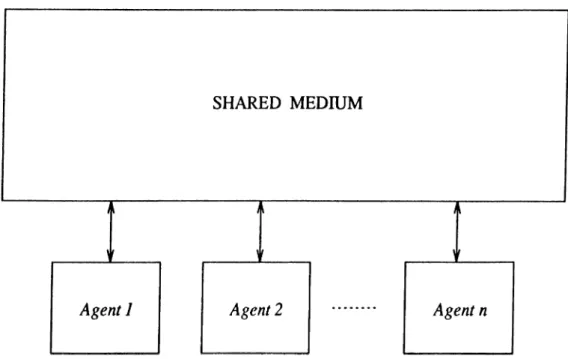
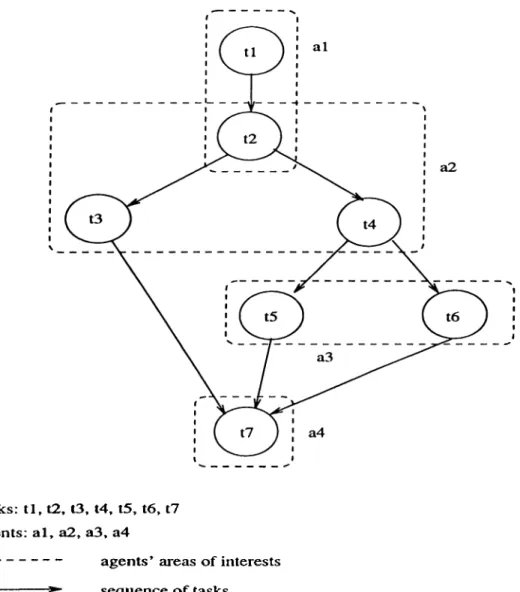
5.1 The Architecture of the Proposed Cooperative Design Environment 39 5.2 Example o f a task sequence to be performed by a set o f agents. . . 43
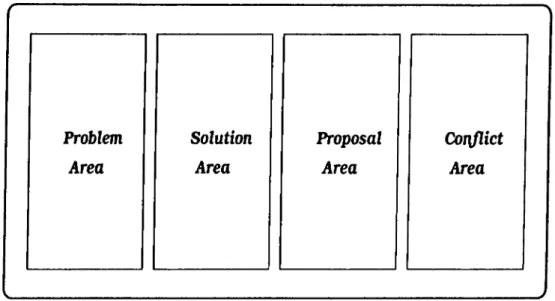
5.3 The Shared B lackboard... 46
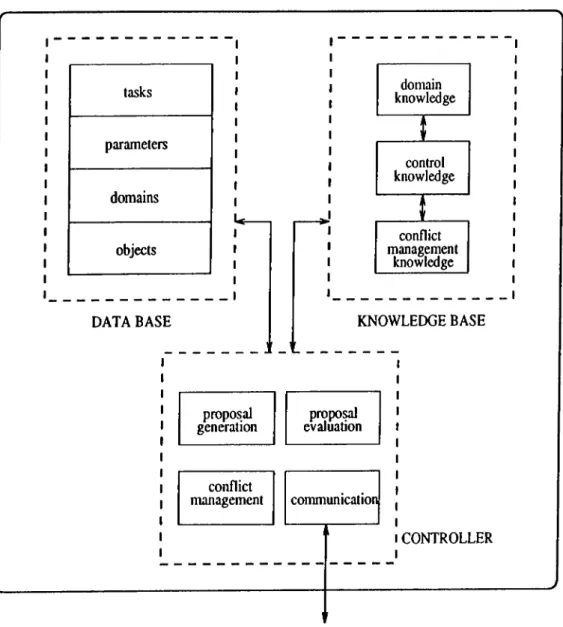
5.4 Internal Structure of a Design Agent in the M o d e l... 50
5.5 Problem Solving Steps within Agent a,·... 56
6.1 Proposal Evaluation and Conflict Detection within Agent a, . . . 64
6.2 Conflict Resolution Steps within Agent a,· 66
6.3 Conflict Resolution Steps for Agent a,· in Constraining Search Space. 67 6.4 Conflict Resolution Steps for Agent a,· in Counter-Proposing Al ternatives... 68
6.5 Conflict Resolution Steps for Agent a,· in Selecting an Alternative. 70 7.1 Global Layout of the O ffice... 75
7.2 Layout of the Office After proposal.O ... 76
7.3 Layout of the Office After Resolution Alternative p r o p o s a l-l 78 7.4 Layout of the Office After Resolution Alternative proposal_2 . . 78
Chapter 1
Introduction
Distributed Artificial Intelligence (DAI) is a subfield of artificial intelligence which is concerned with solving problems by using both AI techniques and distributed processing capabilities. A DAI system must include at least two agents and requires that these agents have some degree of information and/or control auton omy, and that some nonempty subset of the agents display sophistication in an artificial intelligence sense (capable of reasoning, planning, etc). DAI is different from distributed processing in that it does not only distribute data, as in the case of distributed processing, but also control. In addition, DAI involves extensive cooperation among problem solvers.
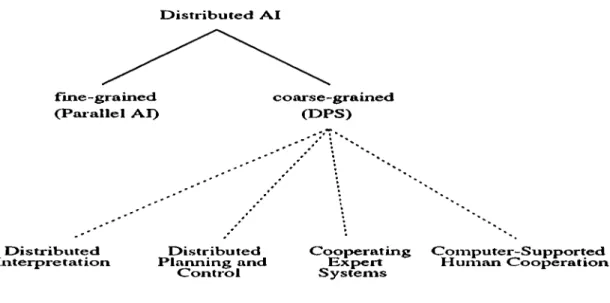
Distributed processing systems address the problem of coordinating a network of computing systems to carry out a set of disparate and mostly independent tasks. There is much less interdependence between tasks in distributed process ing than in DAI. This often leads to a concern with issues such as access control and protection, and results in viewing cooperation as a form of compromise be tween potentially conflicting views and desires at the level of system design and configuration. DAI, on the other hand, aims at combining approaches existing in many disciplines such as negotiation, interaction, contracts, agreement, orga nization, cohesion, etc [8, 14, 15, 16, 24, 34, 48, 53, 83]. Generally speaking, in terms of level interaction between processes, there are two approaches in AI to distributing data and control for achieving cooperation (Fig. 1.1) :
CHAPTER 1. INTRODUCTION D istr ib u te d A.I firte-g ra in e d CPai'allel A.I) c o a rse -g ra in e d CDPS) D is tr ib u te d
In.terx>re tat io n P la n n in g and D istrib u ted C o n tr o l
C o o p e r a tin g C o m p u te r -S u p p o r te d Exp^ert M unian C o o p e r a tio n S y s t e m s
dassificcifion wntfi respect to data artel control distrihution dassification w>itli respect to application domain
Figure 1.1: Classification of DAI
• Fine-grained (Parallel AI)
• Coarse-grained (DPS)
Parallel AI is concerned with developing parallel computer architectures, lan guages and algorithms for AI, whereas DPS considers how the task of solving a particular problem can be divided among a number of problem-solving agents which cooperate at the level of dividing and sharing knowledge about the prob lem and about the developing situation. DPS aims at conceptual advances in understanding the nature of reasoning and intelligent behavior among multiple agents. On the other hand. Parallel AI deals with solving performance problems o f AI systems. Although Parallel AI is considered as a sub-discipline separate from DAI, it is important to note that developments in concurrent programming languages and architectures may have profound impacts on DAI system architec tures, reliability, knowledge representation and so on.
One of the application domains of DPS (Fig. 1.1) is cooperating expert sys tems. Cooperating expert system approeich is concerned with solving complex
CHAPTER 1. INTRODUCTION
tasks that require diverse expertise to generate comprehensive solutions. When human specialists cooperate, they bring together multiple disciplines or multiple viewpoints on a single problem. Bringing together diverse knowledge is a source of robustness and balance which is extremely important in many real-world situ ations: a civil engineer and an architect work together to design and build a safe and attractive building, or a pediatrician and a cardiac specialist consult to help an infant with a heart problem. The team can solve problems that are beyond the scope of any of the individual experts and the solutions are generated from a rich and varied body of knowledge, providing the potential for creativity and innovation.
Although diversity is beneficial in some respects, there are also difficulties in handling the conflicts that arise from trying to merge multiple perspectives for a common good. Managing diverse expertise is difficult because one has to take into account the problems which will arise in working out solutions in the face of conflicting goals, constraints, viewpoints, and knowledge of heterogeneous experts. Consider a team of human experts who are cooperating in choosing a computer system for a company. The team consists of a computer specialist and a manager. They have the shared goal of selecting an appropriate computer sys tem for their company, but each expert wants to insure that his own perspectives should be reflected in the final solution appropriately. The computer specialist recommends a UNIX-bcised workstation, a computer system known with its qual ity in networking and graphical capabilities. The manager recommends a classical DOS-based personal computer because of its lower cost and his and other middle manager’s acquaintance with DOS. In this conflicting situation, it is necessary for the two agents to reconcile their difference to reach a globally agreed solution.
Resolution of conflicts usually is accomplished through exchange of informa tion among participants. How to exchange, what to exchange, when to exchange, and who to exchange it with, are questions that have to be considered in devel oping computational models for conflict resolution. Applications of cooperating expert systems can be seen in human problem-solving tasks such as design, med ical diagnosis, research, business management, and human relations. Computer
CHAPTER 1. INTRODUCTION
models of conflict resolution borrows many ideas from these natural application domains.
1.1
Our Approach
In this dissertation, we present a formal computational model, caWed AfEVTUAfS^, in which a set of knowledge-based agents cooperate for solving design problems. Throughout this thesis, we use the terms agent, expert and problem-solver inter changeably to refer to the autonomous knowledge-based systems. The model is based on resolution of conflicting solutions generated by experts having differ ent goals, priorities, and evaluation criteria. Many of the existing approaches to conflict management [1, 43, 46, 99] rely on coordinated resolution strategies which require resolution of a conflict based on a globally agreed strategy. In these systems, conflict resolution knowledge is maintained centrally. In any case, one of the disputants is given the power to take control of the conflicting situation and apply a resolution scheme known to everybody. A mediator or a single agent from the team would not have enough detailed knowledge about the problem to be able to make good decision outside of its own expertise.
The novel approach in AfEVTUM S, however, allows agents to freely choose the most appropriate action, given their understanding of the global and local situations and their own capabilities. They maintain their own set of conflict management knowledge which is not globally known. Using their own conflict knowledge, the participants may come to an agreement on a revised solution. Agents know the reasons behind their decisions and are able to anticipate the impact of various revisions. AiEVTUAfE allows conflicts to be resolved through negotiating agents that act based on their local perspectives of the global situa tion. AiEVTUAfE is designed for solving problems in the domain of design and is based on the insights that, each agent has its own conflict knowledge separate from its domain-level knowledge, and that this knowledge can be instantiated in
^ M C V T U M S stands for NEgotiaton PlaTform for cooperating mlllti-ageNt intelligent
the context of particular conflicts into specific resolutions. Each agent’s conflict knowledge centers around the domain issues through which that agent is con tributing to the global solution. Agents are able to evaluate partial solutions to tasks through different issue-perspectives and negotiate over conflicting solutions cooperatively. This is similar to the resolution of conflicts that occur among human beings when solving a problem.
There are several reasons why conflicts need to be resolved by using agents’ private conflict resolution knowledge instead o f global knowledge about conflict resolution. First of all, this task is very similar to the resolution of conflicts that occur among human beings in solving complex problem tasks in domains like design, diagnosis, business management, etc. When a conflict is detected, it is not resolved by a central authority using global conflict resolution knowledge, but rather by specialists who are involved in the conflict and negotiate a revised solution that will be acceptable to all of them, using their own conflict resolution knowledge and perspectives. Second, global conflict resolution requires consistent merging of the conflict resolution knowledge obtained by each agent. This makes the maintenance of global knowledge difficult. Because when a new agent is added to, or removed from the system, or the conflict resolution knowledge of an agent is revised, the global conflict resolution knowledge must be rebuilt accordingly. Lastly, distribution of knowledge leads to increased reliability and fault-tolerance to agent failures.
1.2
Organization of the Thesis
CHAPTER 1. INTRODUCTION
5
In the next chapter, an overview of DPS is presented by emphasizing the im portance of coherent cooperation and coordination. Existing approaches to the coordination of cooperating agents and application domains in DPS are outlined.
In Chapter 3, cooperating experts approach is described and some typical systems supporting this approach are introduced.
CHAPTER 1. INTRODUCTION
and summarizes the existing approaches. First, models of human conflict reso lution are introduced, and then the existing computational models for conflict resolution, development-time and run-time models, are described.
Chapter 5 explains the new model, AfEVTU AfS, for cooperating experts, and how the problem-solving proceeds within it. The architecture of AiEVTUAfS^ representation of knowledge, the agent model, and the main problem-solving steps are presented in details.
Chapter 6 describes how conflict resolution takes place in AfEVTUAfE. The methodology used for jointly detecting and resolving conflicts is presented, along with the relevant algorithms.
Chapter 7 includes two examples from the domain of design to illustrate how problem-solving proceeds in AfEVTUAfE. The examples are chosen from the domains of oflSce design and computer hardware configuration.
Chapter 8, the last chapter, summarizes the novel approach presented in the dissertation and states its contribution to the area o f computational models of conflict resolution, and also suggests future work.
Chapter 2
Distributed Problem Solving
In DPS, a group of individual agents come together to solve a difficult global problem. There are four phases in solving a problem cooperatively by several agents. In the first phase, the original problem is decomposed into simpler ones. In the second phase, these subproblems are distributed to the most capable and relevant agents. In the third pheise, subproblems are solved cooperatively. The last phase requires the synthesis of the subproblem solutions to obtain a global solution for the original problem which is acceptable to all agents [16, 25, 28, 41, 54, 82].
Advances in hardware technology for processor construction and interproces sor communication make it possible to connect together large numbers of sophis ticated processing units that execute asynchronously. Various connection struc tures are possible, from a very tight coupling of processors through shared or distributed memory, to a looser coupling o f processors through a local communi cation network or to a very loose coupling of geographically distributed processors through a communication network.
Besides the rapid development in processor and communication technology, among the several other reasons that motivate researchers to explore new ideas about problem-solving which requires multiple agents are:
CHAPTER 2. DISTRIBUTED PROBLEM SOLVING
spatially distributed, such as interpreting and integrating data from spa tially distributed sensors or controlling a set of robots that work together on a factory floor. It is also possible to have the applications being/unciion- ally distributed, such as bringing together a number o f specialized medical- diagnosis systems on a particularly difficult case. Finally, the applications might be temporally distributed, as in a factory where the production line consists of several work areas, each having an expert system responsible for scheduling orders.
• Sometimes problems are simply too large or complex to be solved by a single problem solver. Such problems could only be solved via the cooperation of several independent systems {synergy effect, emergent functionality). For instance, multiple expert systems with different, but possibly overlapping expertise, could cooperate to deal with problems that are outside the scope o f a particular expert system.
• A DAI system supports the principles of modular design and implemen tation. The ability to structure a complex problem into relatively self- contained processing modules leads to systems that are easier to build, debug and maintain. For example, the general field of medical diagnosis is complicated and extensive. To manage the field, medical experts divide it into many specialties. In order to build a general medical diagnosis system, someone could exploit the modularity of the field, building a knowledge- based system for each specialty in parallel and with minimum interaction between the systems.
• The environment in which both control and data are distributed should result in reliable computation and graceful degradation. That is, the failure o f one agent, for example, should not crash the whole system down. •
• One o f the goals of AI is to develop systems which are essential for our daily life. These systems should interact with humans intelligently. To achieve this, these systems they must have the ability to intelligently cooperate and
coordinate with each other and with humans with more flexibility. DAI is the first step towards this long-term goal.
However, many AI problems cannot be decomposed into independent subprob lems. Furthermore, it is often impossible to solve the subproblems in isolation. Even if they were, merging the independently formed .solutions would be difficult. Therefore, problem-solving agents should cooperate at every phase of problem solving. It is also necessary to develop ajjpropriate control regimes that allow the coordination of activities of cooperating problem solvers.
CHAPTER 2. DISTRIBUTED PROBLEM SOLVING
9
2.1
Cooperation in DPS
Cooperation where no single agent has sufficient expertise, resources and infor mation to solve a problem independently is an important area of research in the field of DPS [7, 11, 14, 21, 22, 52, 72, 73, 78, 79, 100]. Different agents might have the expertise necessary for solving different parts of the problem. For ex ample, consider the problem of designing a steam condenser. One agent might have expertise on the motor, another on the heat exchanger, yet another on the pump components of the steam condenser, etc.
The agents in a DPS network might utilize different resources. Some might be very fast as far as computation is concerned, a third party might have connec tions that speed up the communication, while others might have excess memory. Finally, different agents might have different information or viewpoints regarding a certain problem. For example, consider a distributed sensing network where geographically separated agents are monitoring aircraft movements. In this case, different agents will have different perceptions because their sensors will pick up different signals. It is possible to form an overall picture of aircraft movement only when agents combine the information about their views.
The amount o f cooperation between agents is an important aspect of DPS. It may range from fully cooperative to antagonistic. In fully cooperative sys tems, there is a high price due to the heavy communication between agents. In antagonistic systems, on the other hand, there is no communication cost since
CHAPTER 2. DISTRIBUTED PROBLEM SOLVING
10
agents may not cooperate at all. The extent to which agents should cooperate in solving a problem is dependent upon the application domain and is currently an attractive research area.
2.2
Goals of Cooperation
Agents cooperate to improve their own self-interests by sharing subproblem so lutions. Cooperation thus requires intelligent local decisions so that each agent performs tasks that generate useful subproblem solutions. There are several goals to be achieved by the agents which are cooperating:
• Improved performance through parallelism (several agents solve different parts of the whole problem concurrently),
• Increase in the confidence of a subsolution by letting agents verify each other’s results (in order to get consistent results, agents use their own ex pertise to interpret the shared data),
• Exchange of tasks among agents by allowing a task to be performed by the most capable agent (fair utilization of agents’ computational resources),
• Assigning of important tasks to multiple agents to guarantee a solution even in the presence of agent failures (reliability), and •
• Improving the use of individual agent expertise through the exchange of goals, constraints, partial solutions, and knowledge.
Problem solvers cannot achieve all of these goals simultaneously. While con centrating on the achievement of one goal, usually it is not possible to achieve some of the other goals. For example, in a problem where a solution is to be generated cis fast as possible, it is necessary to avoid actions causing inter-agent communication. In this case, although we achieve an improved performance through parallelism, we may not improve the use of individual agent’s expertise through exchange of partial results and knowledge.
CHAPTER 2. DISTRIBUTED PROBLEM SOLVING
11
2.3
Approaches to DPS
Coordination of activities in a multi-agent environment is a very important is sue in DPS. There are several approaches to improve the coordination among cooperating agents in a distributed problem-solving environment [62, 16]. These are
• Negotiation,
• Function ally-accurate cooperation,
• Multi-agent planning, and
• Organizational structuring.
In the negotiation approach [10, 44, 83, 84], a problem task is decomposed into a set of subtasks which are assigned to the agents based on a bidding protocol. Since different agents may have different capabilities, the bidding protocol will offer the opportunity for a task to be assigned to the most appropriate agent. The negotiation approach allows effective use of computing resources and exper tise through the exchange of tasks. It also facilitates the generation of reliable solutions through assignment of the same tasks to several agents having different expertise and problem-solving capabilities.
In functionally-accurate cooperative systems [49], agents cooperate by gen erating and exchanging tentative, partial solutions based on their limited local views of the network problem. By iteratively exchanging their potentially in complete, inaccurate, and inconsistent partial solutions, the agents eventually converge on an overall network solution. This apjjroach allows the agents to generate solutions without being overly influenced by each other.
In multi-agent planning [8, 27, 28, 36, 42, 47, 80, 81], agents form a multi agent plan which specifies all of their future actions and interactions. Multi-agent plans can be generated in a centralized or distributed way. In centralized multi agent planning, agents agree on an agent to solve their planning problems and all pertinent information is sent to that particular agent. On the other hand, in
CHAPTER 2. DISTRIBUTED PROBLEM SOLVING
12
distributed multi-agent planning, agents cooperatively generate the plan. This is necessary, especially, in an environment where no single agent has a global view of the problem and the environment.
In organizational structuring [17, 21], common knowledge about general problem solving roles and communication patterns are used to guide agents about how to cooperate. An organizational structure is the pattern of information and control relationships that exist among agents, and the distribution of problem-solving capabilities among agents. Imposing a high level organization on DPS environ ment gives agents knowledge that improves the way they coordinate, while still allowing them to pursue alternative solution paths that are not dictated by the network.
To achieve coherent cooperation, agents must predict each others’ actions during any phase of the problem-solving process. Multi-agent planning requires accurate predictions in order to form acceptable plans. However, negotiation and functionally-accurate cooperation can perform without adequate predictions. Negotiation takes a top-down view of problem-solving while functionally-accurate cooperation takes a bottom-up view. Organizational structuring lies between the strongly top-down view of contracting and bottom-up view o f functionally- accurate cooperation.
There are several clcisses of application domains where DPS is applicable. Some of them are
• Distributed Interpretation: These applications require the integration and analysis of distributed data to generate a potentially distributed semantic model of data. Application domains include distributed sensor networks [50, 51] and communication network fault diagnosis [10, 11, 93, 97, 98]. •
• Distributed Planning and Control: These applications involve developing and coordinating the actions of distributed effector agents to perform de sired tasks. Application domains include distributed air traffic control [20], cooperating robots, remotely piloted vehicles [87], and distributed process control in manufacturing [59].
CHAPTER 2. DISTRIBUTED PROBLEM SOLVING
13
• Cooperating Expert Systems: In these applications, several expert systems work together to solve a common problem. The heterogeneous character of cooperating experts allows different problem-solving approaches to be used in solving the problem under consideration. Application arecis include medical diagnosis [9] and engineering design [40, 43, 45, 46].
• Computer-Supported Human Cooperation: Intelligent systems with coor dination knowledge assist humans in decision making, through filtering information and focusing attention on relevant information. Application domains include intelligent command and control systems, and multi-user project coordination [13, 58, 74].
There are several technology platforms built for implementing various DPS sys tems. These include testbeds such as the Contract Net Framework [83], DVM T [50], MACE [26], integrative systems such as ABE [18], blackboard systems such as GBB [12], BBl [35], object-based tools such as ORIENT84/K [94], belief-based systems such as AgentO [76, 77, 100].
Chapter 3
Cooperating Expert Systems
In the cooperating experts approach, several specialized agents work together to solve a global problem. Examples of the integration of expertise through cooperation can be seen in human problem-solving tasks such as design, diagnosis, business management, and human relations. As a subfield of DPS, cooperating experts approach has the following distinguishing characteristics:
• agents are heterogeneous in their problem-solving capabilities and knowl edge,
• the knowledge of each agent is potentially inconsistent or incompatible with that of others, •
• agents are logically independent and negotiate with each other around in teracting subproblems, and
• local goals, constraints, priorities, and evaluation criteria may be conflicting among agents.
CHAPTER 3. COOPERATING EXPERT SYSTEMS
15
3.1
Previous Work
111 the following sections, we briefly describe blackboard architectures and GBB (Generic BlackBoard), Hearsay-II, the Contract Net Protocol, Distributed Vehi cle Monitoring Testbed, and some other frameworks which are typical examples reflecting the cooperating experts approach.
3.1.1 Blackboard Architectures and GBB
The blackboard architecture [19, 35, 56, 57] is one of the architectures that can be used to implement a cooperating experts system application. The blackboard problem-solving approach offers superior flexibility in structuring complex AI applications. Blackboard systems perform problem-solving by using three bcisic components:
• a blackboard^ which is a global database containing input data, partial so lutions, and other data that are used in various problem-solving phases,
• knowledge sources (KSs), which are independent modules that contain the knowledge needed to solve the problem, and that can be widely diverse in representation and in inference techniques. KS modularity facilitates application development and simplifies maintenance and enhancement, and
• a control mechanism, which is separate from the individual KSs and makes dynamic decisions about which KS is to be executed next.
GBB [12, 23] is a flexible, high-level tool for building efficient blackboard sys tems. GBB provides the following facilities that developers need in constructing high-performance blackboard applications:
• a blackboard database compiler and runtime library, which support pattern- based, multidimensional range-searching algorithms for efficient retrieval of blackboard objects, •
CHAPTER 3. COOPERATING EXPERT SYSTEMS
16
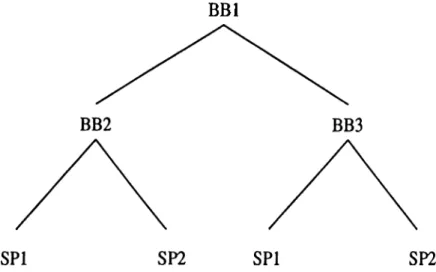
BBl
Figure 3.1: An Example GBB Blackboard Structure
• generic control shells and agenda-management utilities, and
• interactive graphics for monitoring and examining blackboard and control components.
GBB views the blackboard eis a hierarchical forest of nested blackboards. Blackboards are the containers for holding spaces and other blackboards. Black board objects reside in spaces, which are the leaves of this hierarchy. Each space can be defined as a highly structured, n-dimensional volume, with blackboard objects occupying some extent within the space. Spaces can be viewed as the “containers” that hold blackboard objects (called units). Units contain slots which hold data values and links which are special purpose slots that contain link pointers between units. The space on which a unit is to be stored can be specified by the sequence of nodes traversed from a root blackboard node through all inter mediate blackboard nodes to the leaf space node. For example, if the blackboard B B l had the blackboards BB2 and BB3 as components, and BB2 and BB3 had spaces SPl and SP2 as components as shown in Figure 3.1, the two paths (BBl BB2 S P l) and (B B l BB3 S P l) specify different instances of the space SPl.
CHAPTER 3. COOPERATING EXPERT SYSTEMS
17
Efficient insertion and retrieval of blackboard objects is achieved using a lan guage specifying the dimensional structure of each space and a separate specifica tion o f how that space is to be implemented. Any change to a blackboard object or to the state of the blackboard database is called an event in GBB terminology. For example, creation or deletion of a unit, access or modification of a slot, and access or modification of a link are typical examjjles of events. When an event occurs, event triggering mechanism of GBB instantiates those knowledge sources that declared their interest in this particular kind o f event. They are scheduled and executed in a priority-based manner. Activation of a K.S is managed by a centralized scheduler.
There are several problems in developing distributed knowledge-based system applications on GBB. The autonomous behavior of agents in a typical application must be simulated by using knowledge sources of the GBB. However, event triger- ring mechanism of GBB does not allow real autonomy since knowledge sources are specific modules that are executed upon particular events on the blackboard.
3.1.2
Hearsay-II
Hearsay-II [19] is a continuous speech understanding system developed at Carnegie Mellon University. It can be considered eis the first system using the cooperat ing experts approach. It consists of a set of knowledge sources, a blackboard, a priority based task scheduler, and a focusing mechanism for meta-level control. The original Hearsay-II did not have a distributed architecture. Later on Lesser and Erman developed a distributed Hearsay-II architecture which consisted of a set o f functionally-accurate complete Hearsay-II systems, each one with its own blackboard, sampling one time-continuous segment o f the speech signal.
Since speech processing is time localized except for the highest semantic lev els, these systems need only to exchange high level intermediate results consisting o f phrase hypotheses. They could converge on complete interpretations despite the loss of some messages. This kind of communication is nearly ideal, but dis tributing a generic Hearsay-II architecture in this way would not necessarily work
CHAPTER 3. COOPERATING EXPERT SYSTEMS
18
for other applications. This work highlights a beisic trade off between communi cation and computation in DPS networks. The more communication takes place the more reduced the inconsistency is because agents will have more common information. Less communication leads to more inconsistency and causes agents to spend more effort to resolve inconsistencies.
Cooperation among specialized knowledge sources occurs implicitly through the incremental extension of globally available hypothesis. Knowledge Sources containing expertise are instantiated in response to a particular pattern on the blackboard. They cannot be suspended or reinstantiated once execution has terminated. They also do not keep the history of their actions.
3.1.3
The Contract Net Protocol
The Contract Net Protocol developed by Smith and Davis [83] provides a general paradigm to design cooperating expert systems in a distributed environment. It models transfer of control in a distributed system with the metaphor of negoti ation among autonomous intelligent agents. The Contract Net consists o f a set of nodes (agents) that achieve the desired goal of coordinating their activities through contracts. There are three classes of nodes in the net: manager^ bidder, and contractor. The manager is the node that identifies a teisk to be done, and assigns it to other nodes for execution. The bidders are the nodes that make offer to perform the task announced by the manager. The contractor is a successful bidder, the one whose bid has been accepted by the manager.
Contracting occurs through exchange of information between interested par ties followed by a final agreement by mutual selection depending on the available information. It differs from voting in that parties are free to exit the process rather than being bound by the decision of the majority. At the beginning, the manager receives a large task and decomposes it into smaller subtasks in a pre defined way. It announces the task to the idle nodes. Nodes that have enough resources, expertise, and information to perform the announced task send their bids to the manager. Later, the manager evaluates the bids and awards the task
CHAPTER 3. COOPERATING EXPERT SYSTEMS
19
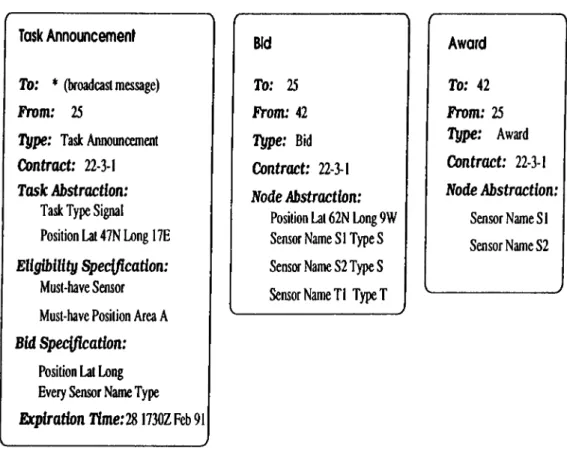
Task Announcement
To:
* (broadcast message)From: 25
туре:
Task AnnouncementContract:
22-3-1Task Abstraction:
Task Type Signal Position Lat47N Long 17E
Eligibility ^ecification:
Must-have Sensor Must-have Position Area A
Bid Specification:
Position Lat Long Every Sensor Name Type
Expiration Time:2S
1730Z Feb 91/■- - - ' ---.
Bid Award
IV); 25 T o; 42
From:
42From:
25Type:
BidType:
AwardContract:
22-3-1Contract:
22-3-1Node Abstraction:
Node Abstraction:
Position Lat 62N Long 9W Sensor Name SI Sensor Name SI Types Sensor Name S2 Sensor Name S2 Types
Sensor Name Tl TypeT ^_ _ _ _ _ _ _ _ _ _ _ _ _ _ _ _ _ _ _ _ /
Figure 3.2: Task Announcement, Bid and Award Message Examples
to the most capable node. Afterwards, the manager sends the task information to the contractor who reports back the progress and eventually the final result o f the tasks. The manager may choose to award the task to several nodes if it wants to increase reliability.
Smith and Davis investigated a distributed interpretation application in the Contract Net Framework, where the network should track vehicles over a wide geographical area. The network contains two types of nodes. Sensor nodes extract signal features from the data they sense, manager nodes process signals obtained from different sensors to construct a map of vehicle movement. A manager node tries to form contracts with sensor nodes through exchange of messages. Every message includes information about its source, destination, type, and contract identifier. Fig. 3.2 shows the use of three messages (task announcement, bid, and award) for the distributed sensor net applications.
CHAPTER 3. COOPERATING EXPERT SYSTEMS 2 0
Task announcement message contains abstract information about the task, expected capabilities for potential contractors, information that a bid should contain and a deadline for the bids to be received. In vehicle monitoring, task abstraction indicates the task type and manager’s location. The expected ca pabilities specify the sensory capabilities, and location of a potential contractor, and bid specification includes the sensor’s location and sensory abilities. A task bid message includes the information requested in the task announcement’s bid specification. In this application, bid information consists of the position and sensory capabilities of the sensor node. After evaluating bids, manager issues a task award message for each node that is awarded the task. In this application, the message specifies which of a sensor’s sensory capabilities are to be utilized.
The Contract Net Framework is concerned with the allocation of tasks to sev eral problem solvers through a bidding protocol. It requires a top-down decom position of large tasks and the allocation o f the subtasks to appropriate agents. It is well-suited for applications with well-defined task hierarchies, and for cases in which tasks are initially presented to a few nodes in the network.
3.1.4
The Distributed Vehicle Monitoring Testbed
Distributed Vehicle Monitoring Testbed (D V M T) simulates a network o f coop erating expert systems, called nodes, to track vehicle movement using sounds recorded by acoustic sensors [50]. The spatially distributed nodes detect the sounds of vehicles, and each applies the knowledge o f vehicle sounds and move ments to track a vehicle over its spatial area. Nodes exchange information about vehicles they have tracked to build a map of vehicle movements through the en tire area. There is a need for organizational structuring to guide their processing and communication decisions, otherwise nodes may overwhelm each other with tentative partial results.
For the specification of organization in DVM T, each node is associated with a set of interest areas which defines what, when and to whom information should be transmitted. It also indicates how much priority should be given to processing
CHAPTER 3. COOPERATING EXPERT SYSTEMS 2 1
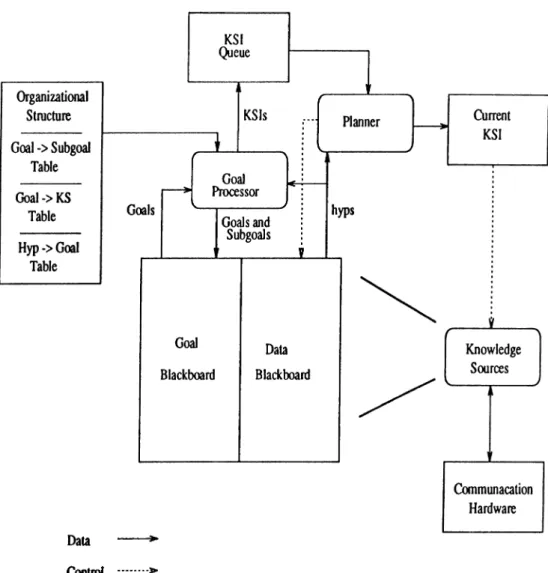
Data Gxitrol
CHAPTER 3. COOPERATING EXPERT SYSTEMS 2 2
externally received goals versus internally generated goals. Each node in DVM T is represented as a blackboard-based problem solver, with levels of abstraction and knowledge sources appropriate for vehicle monitoring (Fig. 3.3). A knowl edge source performs the basic problem-solving tasks of extending and refining hypotheses. Each hypothesis tentatively indicates where a certain type of vehicle was at different discrete sensed time points. In this model, the basic Hearsay-II architecture has been augmented to include more sophisticated local control and the capability o f communicating hypotheses and goals among nodes. In particu lar, a goal processing module and communication knowledge sources have been added.
3.1.5
Other Prameworks
Georgeff [27] has developed a framework in which agents cooperate without ex plicit communication. It requires that each agent must have complete knowledge of others’ abilities and payoffs. This is, however, too restrictive for the majority of real-world problems. One o f the motivations for developing a multi-agent en vironment is to allow agents to negotiate solutions when they do not have good models o f each other’s abilities and payoffs.
Shekhar [75] developed a shell for cooperating expert systems, called Coop. It supports cooperation models to characterize three essential decisions in the cooperation process. These reason about the need for cooperation, understanding global knowledge to locate relevant expert systems and selecting appropriate cooperation plans. Coop environment enables experts to autonomously resolve the three fundamental decisions at run-time. Each agent in Coop uses a common representation which combines a theory of fuzzy sets with a theory of evidence and logic programming. After performing fuzzy set computations, an expert decides whether it can achieve a given goal independently, or needs help from others.
Chandrasekeran [9, 33], in the M DX approach, proposes a “cooperating com munity of specialists” where each specialist contains its own knowledge-base and
CHAPTER 3. COOPERATING EXPERT SYSTEMS
23
inference mechanism for solving disease diagnosis problems. MDX is based on a hierarchy of specialists with those at top being more general than those at lower levels. Task distribution is done according to the hierarchical structure of the system. For diagnosticians, this hierarchy serves the function of organizing their troubleshooting knowledge. The concrete details for each disease are encoded in the production rules attached to the appropriate concepts.
Chapter 4
Conflict Management
In the cooperating experts approach, several specialized agents combine to solve a common problem. During any phase of the problem-solving, conflicts might appear as a result o f incorrect and incomplete local knowledge, different goals, priorities, and solution evaluation criteria. When there are several conflicting proposed solutions for a (sub)problem, the agents involved in a conflict must either agree to choose one proposal, cooperatively revise one, or search for a new solution that will be acceptable to everyone.
A conflict may be either direct or indirect. A direct conflict occurs when two or more agents have beliefs that are explicitly inconsistent. This type of inconsistency is due to the uncertainty inherent in the domain. For example, when several agents are designing an office, an agent might prefer a round desk while another insists on a rectangular one. An indirect conflict occurs when agents have constraints that do independently contain a shared object. For example, in designing an office the functionality expert wants to place the PC desk in front of a window, while the electricity expert says that the PC desk must be within 2 meter of the electrical plug, because the PC comes with a 2m long main power cable. This is a problem if the only window in the office is 4 meter away from the electrical line. The inconsistency is not inherent in the knowledge, rather it is due to a particular configuration of objects. Detection of conflicts in cooperating experts is a difficult task and is actually dependent on the problem domain.
CHAPTER 4. CONFLICT MANAGEMENT
25
There are several methods that have been used to resolve conflicts. Existing research related to conflict resolution in cooperative problem solving can be di vided into two categories: models of human conflict resolution and computational models.
4.1
Models of Human Conflict Resolution
There are considerable amount of work concerning the resolution of conflicts that occur between individuals or groups of individuals in domains such as business, international relations and so on [71]. However, most of these techniques cannot be directly applied to computational models because much of the work addresses issues specific to the psychology of human participants that are not present in machine agents and that greatly influences the process. Human motivation is more complex than the state of our current understanding; for example, some times the disputants involved in a conflict do not know what they really want. As a result, the level of description of conflict resolution expertise is more abstract than appropriate for machine based agents.
4.1.1 Aspects of Negotiation
It is possible to make important observations in the human model of negotiation behavior that are worth considering for computational models. Initially, Pruitt [71] described levels of demand and rates of concession for parties involved in negotiation. Later, he described how the demand levels and concession rates can affect the motivation and expectations behind the proposal process. Each party’s expectations can be described in terms of issue tracking, position and image loss as well as limit and level of aspiration. Each party uses a model of itself and its opponents to evaluate and generate proposals. Finally, the behavior of parties during negotiation can be influenced by the perceived power that one party maintains over the issues. We describe each of the aspects of negotiation in detail in the following subsections.
CHAPTER 4. CONFLICT MANAGEMENT
26
Demand Level and Concession RateA party’s perceived benefit that it gains from any proposal it makes during ne gotiation describes a demand level. The other party’s behavior can be somewhat determined by the demand level of the proposal of the first party. Research among human subjects showed that bargainers that make low initial demands tend not to agree or cause negotiation take longer [6]. The party responding to the initial weak demand expects further large concessions from the perceived weak party. This prevents the responding weak party from making large concessions of its own. The opposite behavior is seen when more aggressive proposals are made. In this case, aggressive proj)osals tend to require aggressive counter-proposals caus ing parties to quickly overshoot their final point of agreement in the negotiation. Therefore, it is recommended that good negotiations must avoid the hazard of moving too slowly or too quickly towards the agreement. A party’s demand level can be measured in terms of the position the party takes on its issues. The con cept of demand level is not so clearly defined in many computational models of negotiation.
Tracking, Position and Image Loss
The response of one party to another party’s original proposal is based on a phenomenon called tracking. One party tracks the other party in order to estimate that party’s ultimate demand level. Tracking a party’s demand level is very useful when there is no other information available to help make this determination (such as facial expression, body language, etc.). A party’s perceived position and image loss will affect the other parties’ response behavior. The position of a party is described as its desired benefit it gains given its level of alternatives. Image loss is the impression the other party makes o f the first party. If the first party abandons its position, the impression gained by the second party will be that the former lacks firmness in position. This can cause the second party to have a higher demand level.
CHAPTER 4. CONFLICT MANAGEMENT
27
Limit and Level of Aspiration
A negotiation limit is the absolute lowest value that a party will agree upon for its issues. This is the bottom boundary in a party’s negotiation position. The top most negotiation boundary is determined by the parties’ level o f aspiration. A party’s aspiration is its perceived value that seems attainable at any time during the negotiation [71]. Also, the level of aspiration will always be greater than or equal to the bargainers’ limits. There are also interesting relationships between limit and level of aspiration:
• limit tends to remain constant over time, whereas aspiration declines to wards the limit,
• limit and aspiration are positively correlated, and
• the strength o f the correlation increases over time.
4.1.2
Integrative Agreement Between Two Parties
When parties want to develop an agreement which includes some aspects of each party’s issues into the final solution, they can enter into a form of coordinated behavior which is called integrative agreement. In the literature, there are four types of integrative agreement: cost cutting, compensation, log-rolling and bridg ing. These four types can be classified into two groups. The first group represents behaviors which improve the other party’s position without reducing the first party’s position (cost cutting and compensation). The second group represents behaviors which change the position of both parties (log-rolling and bridging).
Cost Cutting
The first party makes a proposal that is intended to benefit the second party by reducing some cost of the second i)arty. During this action, the first party maintains the same level o f aspiration while attempting to entice the other to make some form of a concession. Cost cutting can also be done by a third party
CHAPTER 4. CONFLICT MANAGEMENT
28
such cis an arbitrator. During cost cutting, parties need to exchange relevant information about their priorities. Cost cutting allows the parties to maintain their positions in addition to providing some form of negotiation for the other party’s future concerns about an agreement.
Compensation
There are three types of compensation behaviors: specific compensation, homol ogous compensation and substitute compensation. Specific compensation can be interpreted as a type of cost cutting behavior. It provides the first party with some means of reducing tensions for the second party. Parties inform the others of their “worries.” Through specific compensation, one party specifically compen sates the other’s issues by some secondary means. In homologous compensation, the first party concedes the same aspects for a similar concession made by the second party. The idea is for the first party to provide some type of benefit for the second party. This is achieved indirectly by demonstrating to the second party that the first party is losing an amount o f benefits which is equal to what it is gaining.
In substitute compensation, parties propose substitutes for the other’s re quested issues. The first party can use a stereotype of the second a s well as the extend of the second party’s issue costs so a s to produce an adequate com pensation response. In general, this type of behavior requires a different realm of reality and therefore is not a s useful in computational models of negotiation where mechanical parties do not respond emotionally to proposals a s humans would.
Log-rolling
The first party exchanges or swaps a set of its issues with a set of issues from the second party. In this form o f integrative agreement, each party changes current bargaining position, but in the most minimum fashion possible. For log-rolling to occur, parties have to know the priority ranking among the other party’s issues.
CHAPTER 4. CONFLICT MANAGEMENT
29
Bridging
During bridging a new proposal is generated that benefits both parties in terms of their most important issues. Thus both parties change their negotiation positions, but for their common benefit. The new proposal can come in several forms. First, both parties agree to accept one party’s issues this time if the other party’s issues could be met during the next encounter. Bridging can also result from the resource shortage. In this case, parties must either schedule the resource themselves or rely on a third party for help.
4.1.3
Third-Party Intervention
Sometimes intervention by a third party-during negotiation is useful when the parties cannot develop any alternatives themselves. It has been shown that nego tiators concede much faster when a suggested alternative is made by a third-party as opposed to conceding to alternatives made by the other party [30]. One idea for this behavior is that negotiating parties use a third party to legitimize their own interests in their proposals. In general there are three types of third-party intervention:
• mediation,
• fact finding, and
• arbitration.
Third-Party Mediation
A major area of research in human negotiation has been in the area of third-party mediation. Third-party mediation is a form of intervention which attempts to coordinate behavior in a cooperative fashion between disputing parties. Medi ation may come about in several ways. First, each party can make a request for mediation if it predicts that other party is powerful and firm in its position. A time limit could also cause the disputing parties to request mediation which
CHAPTER 4. CONFLICT MANAGEMENT
30
would lead to a quick and equable solution. Mediation can also occur through third-party observation o f the negotiation process. The third-party could then intercede and make suggestions.
Mediators can help in several ways. First, they can set the “right” envi ronment just by being present during negotiations. This type of negotiation is described as process mediation. Second, they can take a more active role and get involved in learning about the issues under discussion, which is named as content mediation.
Third-Party Fact Finding
A second form o f third-party intervention is fact finding. During fact finding, the third party listens to both sides of the conflict and produces a set of non-binding recommendations. It is up to the parties to elect to follow the suggestion as a solution or to throw it out. Not much research has been performed in this area of human negotiation.
Third-Party Arbitration
The final form o f third-party intervention is arbitration. During arbitration, the third-party performs services similar to the fact finding in order to learn about the parties issues. This allows the arbitrator to make recommendations based on these issues. Unlike fact finding, recommendations based on arbitration are binding. Arbitration can be either requested by the parties, or it can be forced upon them by a prior decision, such as a court order. There are three forms of arbitration: conventional, final offer and mediation-arbitration combination.
In conventional arbitration, the arbitrator has the option of making a deci sion that seems the best for all parties involved. In final offer arbitration, the arbitrator uses what the parties have currently proposed without any improvi sions. Finally, mediation-arbitration combination provides the arbitrator with the greatest amount o f flexibility. In this method, the arbitrator initially performs mediation to get the two sides to agree. If that fails, the arbitrator then renders
CHAPTER 4. CONFLICT MANAGEMENT 31 a binding decision. This form of arbitration allows the arbitrator to reason with the participants before throwing this weight around.
4.2
Computational Models
A common practice in building knowledge-based systems is to avoid potential conflict situations through analysis and consistency checking of the knowledge base at development time [31, 55, 60, 61, 6 6, 70, 89]. Traditional knowledge-ba^ed systems rely on all of the potential conflict between different perspectives being re solved at hiowledge-base development time. This is done by checking knowledge bases for consistency and completeness. Consistency checking includes detecting conflicts, redundancies and subsumptions. Completeness checking includes test ing whether the system answers all reasonable situations within its domain of expertise. This approach, although effective, is very costly as the amount and diversity of knowledge increases. Also, it may be impossible to foresee all possible conflicts which may arise in a given domain. Resolving all conflicts, no matter how unlikely, at development time can be prohibitively time-consuming. More over, dividing the domain knowledge into smaller internally consistent collections is difflcult.
Problems encountered when resolving conflicts at development time can be avoided by allowing conflicts to occur and be resolved at run-time. In other words, participating agents are allowed to generate conflicting solutions to the subproblems at run-time. In the case of a conflict, a set of strategies could be used to resolve the conflict. An agent’s proposed solution can either be acceptable or unacceptable to another agent depending on how the proj)osed solution benefits the latter agent. When proposals are unacceptable, agents are in conflict. These conflicts may involve single or multiple perspectives and must be resolved by some form of iterative negotiation if the agents are to agree on a solution. To prevent the overall performance degradation of a system, the negotiation mechanism must allow agents to quickly converge on a solution. The fundamental advantage of