Analysis of Cylindrically Conformal Antennas Using
Closed-Form Green’s Function Representations
Mert Kalfa
1,2, Şakir Karan
2, Vakur B. Ertürk
11Department of Electrical and Electronics Engineering, Bilkent University, Ankara, Turkey 2Radar and Electronic Warfare Systems Vice Presidency, Aselsan Inc., Ankara, Turkey
Abstract—Probe-fed microstrip patch antennas and slotted
sectoral waveguide array antennas embedded in cylindrically stratified media are analyzed with a hybrid Method of Moments/Green’s function technique, where closed-form Green’s function representations for electric and magnetic current sources are used as the kernel of the associated integral equations. Various patch and slot antennas are analyzed using the proposed method. Numerical results in the form of input impedance, S-parameters, and radiation patterns are presented and compared to the results obtained from CST Microwave StudioTM and HFSSTM.
Index Terms—conformal antennas, closed-form Green’s
functions, method of moments, generalized pencil of function method.
I. INTRODUCTION
A wide range of military and commercial applications require microstrip or slot antennas and arrays that conform to the host platform due to aerodynamic constraints, reduced radar cross section compared to that of planar platforms, wider scan range, and aesthetic reasons. As a result, rigorous analysis of such structures is of great interest. However, as the number of layers deposited on the host platform increases, rigorous investigation of these structures becomes quite challenging.
Several integral equation (IE) based design/analysis tools that use closed-form Green’s function (CFGF) representations as the kernel of an IE have been developed for the design and rigorous analysis of printed circuit elements and/or printed antennas/arrays in planar multilayered media [1]. However, when similar printed structures are considered on multilayered cylinders (with a perfect electric conductor (PEC) forming the innermost region), most of the available IE based tools suffer from memory and efficiency requirements. In particular, the long matrix fill times for the matrix entries related to the cylindrically stratified media constitute the main bottleneck. Besides, deficiencies regarding the available CFGF representations for cylindrically stratified media have also prohibited the development of the cylindrical counterpart of the already established planar procedures. Therefore, several studies on CFGF expressions for cylindrically stratified media have been reported with the purpose of being used in conjunction with Method of Moments (MoM) to design and analyze cylindrically conformal antennas (probe-fed microstrip antennas and various slot antennas) and arrays by our group [2]-[7].
In this study, analysis of probe-fed microstrip and slot antennas embedded in cylindrically stratified media is presented with an emphasis on slotted waveguide array antennas that has not been available in the literature, where a hybrid MoM/Green’s function technique in the space domain is used. Accurate and efficient CFGF representations for electric and magnetic sources form the kernels of the associated IEs. First, a brief review of the proposed analysis method for the probe-fed microstrip antennas together with input impedance and mutual coupling type numerical results will be presented. Then, numerical results in the form of input impedance, S-parameters and radiation patterns will be provided for slot antennas in cylindrically stratified media (with comparison to available results in the literature as well as results obtained from HFSSTM) during the presentation.
II. ANALYSIS OF CONFORMAL MICROSTRIP ANTENNAS/ARRAYS
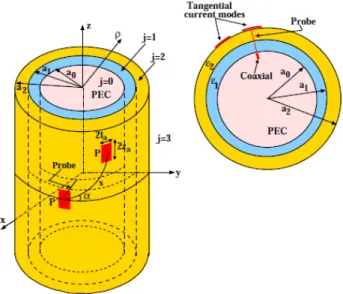
The geometry of two probe-fed patches on an infinitely long (the z-axis) cylindrically stratified medium with a perfectly conducting (PEC) cylindrical ground is shown in Fig. 1. The material layers surround the PEC ground coaxially, and air forms the outermost region. Antennas can be located at air-dielectric or dielectric-dielectric interfaces. This work is supported by The Scientific and Technological Research
Council of TURKEY (TÜBİTAK) under the project EEEAG-113E628.
Fig. 1. Geometry of two probe-fed microstrip patch antennas on cylindrically stratified media together with its cross-sectional view from the top.
The analysis procedure for the antennas depicted in Fig. 1 starts by setting up an electric field integral equation (EFIE), where the CFGF representations due to electric sources, presented in [2] and in particularly in [3], form its kernel. Main steps of the development of these CFGF representations can be summarized as follows: First, the spectral domain Green’s function representations are rewritten in such a way that all special cylindrical functions (i.e., Hankel and Bessel functions) are expressed in the form of ratios. Besides, their Debye representations (due to possible large arguments and orders) are used when necessary so that electrically large cylinders can be handled. Then, as explained in [2] and [3], performing an envelope extraction with respect to cylindrical eigenmodes (n), the summation over n is calculated efficiently. Then, performing another envelope extraction with respect to Fourier variable 𝑘𝑧 to the resultant expression,
well-behaved representations in the spectral domain are obtained. Finally, corresponding closed-form expressions (i.e., the CFGF representations) are obtained with the aid of generalized pencil of function (GPOF) method [8]. It should be noted that in order to make sure that the developed CFGF representations are valid everywhere, all singularities are treated analytically [3]. These singularities are simply the spectral domain singularity, which manifests itself along the axial line of the cylinder (i.e., ρ = ρ’ and φ = φ’), and the space domain singularity, which manifests itself when the source and observations points are on the top of each other. Then, the EFIE (with the aforementioned CFGF representations forming its kernel) is converted to a matrix equation via a Galerkin MoM procedure where piecewise sinusoidal (PWS) basis functions [9] are used to expand the electrical currents on the conducting patches. Moreover, an attachment mode is introduced to model the feeding accurately by ensuring the continuity of the current from the probe to the patch.
III. ANALYSIS OF CONFORMAL SLOT ANTENNAS/ARRAYS The geometry of a slotted sectoral waveguide array antenna, embedded in a cylindrically stratified medium, is illustrated in Fig. 2. Similar to Fig. 1, the geometry is assumed
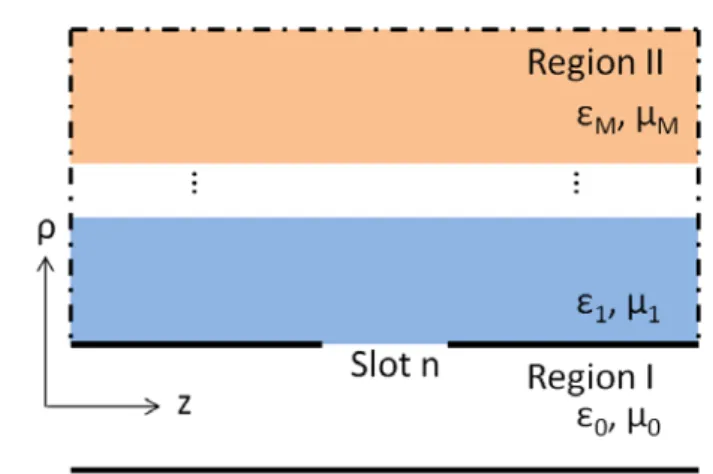
to be infinitely long along the z-direction. The geometry, shown in Fig. 2 is in fact composed of two regions. These regions are illustrated in Fig. 3, where a cross-sectional view of the geometry is shown. Region 1 corresponds to the sectoral waveguide, where array of thin longitudinal slots and are introduced on its broad wall. Region 2 is formed from the material layers (and air as the outermost layer) that surround the sectoral waveguide coaxially. These material layers may represent monolithic or sandwich radomes.
The analysis procedure for the geometry depicted in Fig. 2 starts by first representing the slots with fictitious magnetic current sources as a consequence of the equivalence theorem. Then, a magnetic field integral equation (MFIE) is set up by enforcing the continuity of the tangential magnetic fields across the slots. As the next step, the MFIE is converted to a matrix equation by using a Galerkin MoM procedure, where PWS basis functions are used to expand the fictitious magnetic currents assumed to exist on the slots. The resulting matrix equation and expressions for the entries of the mutual admittance matrix are given below.
1 1 ( )I ( )II ij ij N N I Y Y I α α + =
(1) ( ) ( ) o , , same waveguide 0, therwise i j HM I zz i j i j I S S ij G K K SdS K K Y d ′ ∈ = ∫∫ ∫∫
(2) ( ) ( ) i j II HM II ij zz i j S S Y =∫∫ ∫∫
G KK SdS′d (3)In (1), αn is the unknown voltage coefficient of the nth PWS
basis function, whereas In is the excitation coefficient that can
be found as the inner product of the incident field and the nth PWS basis function. In (2) and (3), K
n is defined as the nth PWS basis or testing function.
As seen in (2)-(3), two special Green’s function representations are used as the kernel of the MFIE Fig. 3 Cross-sectional view of the slotted sectoral waveguide, showing the two solution regions
Fig. 2 A slotted sectoral waveguide array embedded in a cylindrically stratified medium
given in (1). Regarding the first region, the appropriate Green’s function representation of a sectoral waveguide is developed in [5] (expressions are similar to the ones presented in [10]) and its zz component �𝐺𝑧𝑧𝐻𝑀(𝐼)� is used in the kernel of
the MFIE based on the fact that the slots are very narrow in the transverse direction. Regarding the second region, a complementary study to [2] and [3] is performed in such a way that, CFGF representations for magnetic current sources (that can be used to represent the scattered fields from slots as a consequence of the equivalence theorem) are developed and again only its zz component �𝐺𝑧𝑧𝐻𝑀(𝐼𝐼)� is used in the kernel of
the MFIE [4]-[7]. Similar to the electrical source case, the CFGF representations for magnetic sources are developed to be valid in all regions due to the analytical treatment of the aforementioned singularities.
Finally, regarding the excitation of the waveguide(s), the fundamental mode (TE11) is assumed. It should also be noted that the corresponding entries of the admittance matrix related to Region 1 are evaluated analytically resulting a significant acceleration in the solution process.
The equivalent currents that are obtained as the output of the MoM solution cannot be used to directly assess the antenna performance by themselves. Hence, post-processing parameters such as the Y/Z/S-parameters and far-zone co-polarized radiation patterns (and hence, the realized gain) for the analyzed antennas are also computed using the Green’s function representations for the waveguide interior and the cylindrically stratified media, respectively.
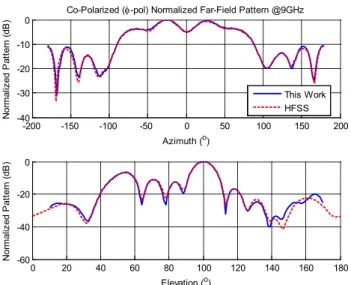
To illustrate the accuracy and the efficiency of the proposed analysis method, a generic slotted sectoral waveguide array antenna with 2mm thick Teflon® coating (εr = 2.2) is simulated. The problem geometry is given in Fig. 4, and the computed co-polarized far-zone electric field patterns are given in Fig. 5. In Fig. 4-5, azimuth plane is defined as the θ=90°, while the elevation plane is defined as φ=0°, where (θ, φ) are spherical coordinates.
The HFSS simulations were performed in a high performance cluster (HPC), with 512-cores and 4TBs of RAM. They required 50GBs of RAM and took 20 minutes to solve a single frequency. On the other hand, the proposed method was implemented in a desktop computer using MATLAB and only required 0.7GBs of RAM and took 2 minutes to solve a single frequency, which showcases the efficiency of our proposed method.
IV. CONCLUSION
In this study, CFGF representations for magnetic and electric current sources are developed which can be used in conjunction with a hybrid MoM/Green’s function technique to analyze probe-fed microstrip patch antennas and slotted sectoral waveguide array antennas embedded in cylindrically stratified media. To assess the performance of the developed expressions, various probe-fed microstrip patch antennas and slotted sectoral waveguide arrays in the presence of layered radomes (monolithic or sandwich) are analyzed using the proposed method. Numerical results in the form of input impedance of various probe-fed microstrip patch antennas and the mutual coupling between two patch antennas will be presented showing good agreement when compared to the available published results as well as the results obtained from CST Microwave StudioTM. Numerical results for various generic slotted sectoral waveguide arrays will also be presented, and will be compared to the results obtained from HFSSTM.
The proposed analysis method can be easily extended to investigate slotted substrate-integrated waveguides, slotted cavity antennas, and aperture-coupled patch antennas embedded in cylindrically stratified media.
REFERENCES
[1] A. Alparslan, M.I. Aksun, K.A. Michalski, “Closed-form Green’s functions in planar layered media for all ranges and materials,” Microwave Theory and Techniques, IEEE Transactions on, vol. 58, no.3, pp.602-613, Mar. 2010.
[2] Ş. Karan, V.B. Ertürk, A. Altıntaş, “Closed-form Green’s function representations in cylindrically stratified media for method of moments applications,” Antennas and Propagaion, IEEE Transactions on, vol. 57, no.4, pp. 1158-1168, Apr. 2009.
[3] Ş.Karan, V.B. Ertürk, “Analysis of input impedance and mutual coupling of microstrip antennas on multilayer circular cylinders using closed-form Green’s function representations,” Antennas and Propagation, IEEE Transactions on, in press.
-200 -150 -100 -50 0 50 100 150 200 -40 -30 -20 -10 0 Azimuth (o) N or m al iz ed P at ter n ( dB
) Co-Polarized (φ-pol) Normalized Far-Field Pattern @9GHz
This Work HFSS 0 20 40 60 80 100 120 140 160 180 -60 -40 -20 0 Elevation (o) N or m al iz ed P at ter n ( dB )
Fig. 5 Normalized co-polarized farfield patterns in azimuth and elevation planes
Fig. 4 A generic slotted sectoral waveguide array antenna with 2mm thick Teflon coating
[4] M.S. Akyüz, V.B. Ertürk, M. Kalfa, “Closed-form Green’s function representations for mutual coupling calculations between apertures on a perfect electric conductor circular cylinder covered with dielectric layers,” Antennas and Propagation, IEEE Transactions on, vol. 59, no.8, pp.3094-3098, Aug. 2011.
[5] M. Kalfa, V.B. Ertürk, “Derivation of Green’s function representations for the analysis of sectoral waveguides embedded in cylindrically stratified media,” IEEE International Symposium on Antennas and Propagation and USNC/URSI National Radio Science Meeting, pp.172, Orlando, FL, USA, 7-13 Jul. 2013.
[6] M. Kalfa, V.B. Ertürk, “Analysis of slotted sectoral waveguides embedded in cylindrically stratified media using closed-form Green’s function representations,” IEEE International Symposium on Antennas and Propagation and USNC/URSI National Radio Science Meeting, pp.157, Orlando, FL, USA, 7-13 Jul. 2013.
[7] M. Kalfa, V.B. Ertürk, “Design and analysis of slotted sectoral waveguide array antennas embedded in cylindrically stratified media,” IEEE International Symposium on Antennas and Propagation and USNC/URSI National Radio Science Meeting, Memphis, TN, USA, 6-11 Jul. 2014.
[8] V.K. Jain, T.K. Sarkar, D.D. Weiner, “Rational modeling by pencil-of-function method,” Acoustic Speech, Signal Processing, IEEE Transactions on, vol. ASSP-31, pp. 564-573, 1983.
[9] M. Marin, P. H. Pathak, “Calculation of the surface fields created by a current distribution on a coated circular cylinder,” Tech. Rep. 721565-1, Apr. 1989.
[10] G.-X. Fan, J.-M. Jin, “Scattering from a cylindrically conformal slotted waveguide array antenna,” Antennas and Propagation, IEEE Transactions on, vol. 45, no. 7, pp. 1150-1159, 1997.