Procedia - Social and Behavioral Sciences 174 ( 2015 ) 1758 – 1763
1877-0428 © 2015 Published by Elsevier Ltd. This is an open access article under the CC BY-NC-ND license (http://creativecommons.org/licenses/by-nc-nd/4.0/).
Peer-review under responsibility of the Sakarya University doi: 10.1016/j.sbspro.2015.01.834
ScienceDirect
INTE 2014
A Study on instructional methods used in CAD courses in interior
architecture education
Özge Gül
a*
aDoğuşUniversity, Faculty of Fine Arts and Design, Department of Interior Architecture, İstanbul, Turkey
Abstract
Computer Aided Design (CAD) today plays an increasingly important role for interior architecture. 25 years ago, almost all interior architecture presentations are drawn on a paper with a pencil. Today CAD radically changes all these traditional drawing habits and it becomes an economical and technological requirement for interior architecture profession.
In this study, the instructional methods used in CAD courses are analyzed according to “CIDA 2014 Student Learning Expectations” through student surveys. At the end of the study, it is evaluated which instructional methods are more beneficial to teach “Computer Aided Presentation and Image Manipulation Techniques” in Interior Architecture Education.
© 2014 The Authors. Published by Elsevier Ltd.
Peer-review under responsibility of the Sakarya University.
Keywords: computer aided design, CAD, education, instructional methods, interior architecture
1. Introduction
In order to meet the growing computer aided design talent demands, universities open expedient CAD courses for students to make them adapt to the rapid development and popularization of computer-aided design technology. CAD software turn out to be the key tool for professions such as architecture, interior architecture, industrial product design, graphic design, engineering etc. These software packages provide support to designers at gathering knowledge, sketch, 2D design, 3D design, prototyping and visualization stages of design process (Dönmez, 2013).
* Corresponding author. Tel.: +090-216-444-7997-1921
E-mail address: [email protected]
© 2015 Published by Elsevier Ltd. This is an open access article under the CC BY-NC-ND license (http://creativecommons.org/licenses/by-nc-nd/4.0/).
Interior architecture encompasses the examination of interior spaces in terms of practical, esthetical, symbolical and functional aspects and design of interior spaces according to user’s physiological and psychological needs and activities (Gökhan & Atasoy, 2005). Interior architecture is a multi-faceted profession that applies technical and creative solutions in order to design interior spaces (Duralp, 2006). It specializes in interior space’s detailed design requirements such as colour, material, texture, lighting, heating, acoustics, furniture and all details of human use (Coles and House, 2007).
In the interior architecture education field, CAD knowledge becomes an economical and technological requirement for students and professionals in order to express the design decisions effectually. In traditional architectural design process, two-three dimensional drawings and models which gradually become more concrete are used. With the use of computers in design process, although traditional expression tools are not left aside, digital technologies are used as additional tools in visualization of design (Yıldırım and Yavuz, 2012).
Piotrowski (2004) states that interior architect should integrate the interior architecture knowledge with presentation tools and instruments. After he/she improves interior design decisions, he/she should manage to present these design decisions through appropriate instruments such as computer aided drawings, sketches etc…
2. Curriculum Analyses of Interior Architecture from the Viewpoint of CAD Education
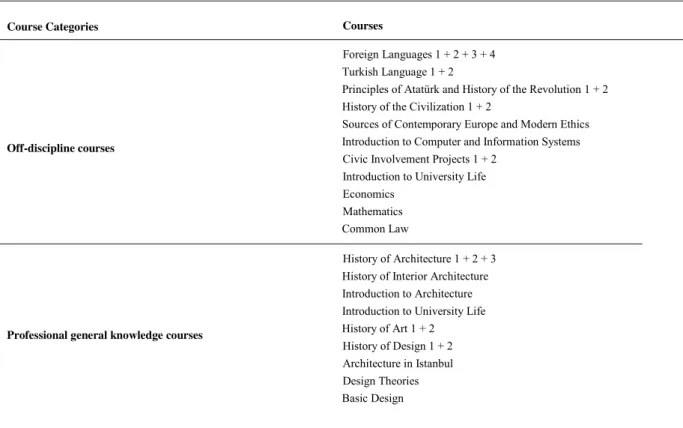
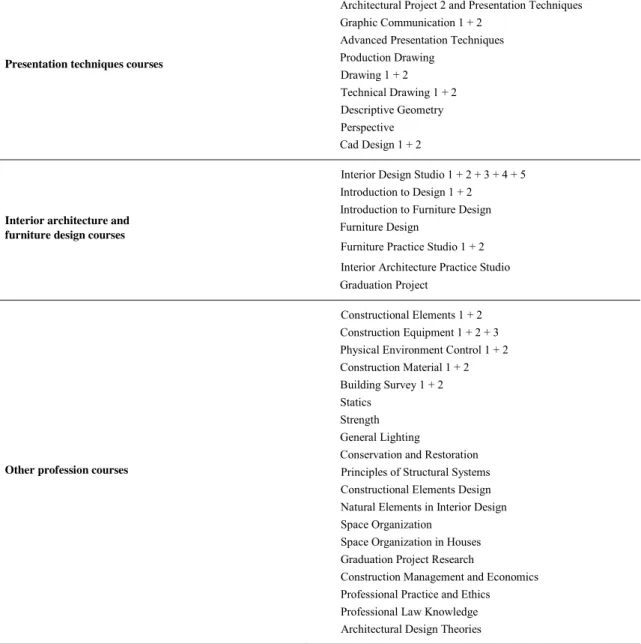
The cumulative course list of Interior Architecture Bachelor’s degree programs in Turkey obtained from author’s previous study (Erkan, 2013) is demonstrated in Table 1.
Bahçeşehir University, Doğuş University, İstanbul Technical University and Mimar Sinan Fine Arts University are taken as a reference for the curriculum analyses. The diversities in student selection methods and university types are considered during the determination of these universities. Compulsory courses are considered and these courses categorized as five main groups during the curriculum analyses.
Table 1. Cumulative course list of Interior Architecture Bachelor’s degree programs in Turkey
Course Categories Courses
Off-discipline courses
Foreign Languages 1 + 2 + 3 + 4 Turkish Language 1 + 2
Principles of Atatürk and History of the Revolution 1 + 2 History of the Civilization 1 + 2
Sources of Contemporary Europe and Modern Ethics Introduction to Computer and Information Systems Civic Involvement Projects 1 + 2
Introduction to University Life Economics
Mathematics Common Law
Professional general knowledge courses
History of Architecture 1 + 2 + 3 History of Interior Architecture Introduction to Architecture Introduction to University Life History of Art 1 + 2
History of Design 1 + 2 Architecture in Istanbul Design Theories Basic Design
Presentation techniques courses
Architectural Project 1 and Presentation Techniques Architectural Project 2 and Presentation Techniques Graphic Communication 1 + 2
Advanced Presentation Techniques Production Drawing Drawing 1 + 2 Technical Drawing 1 + 2 Descriptive Geometry Perspective Cad Design 1 + 2
Interior architecture and furniture design courses
Interior Design Studio 1 + 2 + 3 + 4 + 5 Introduction to Design 1 + 2
Introduction to Furniture Design Furniture Design
Furniture Practice Studio 1 + 2 Interior Architecture Practice Studio Graduation Project
Other profession courses
Constructional Elements 1 + 2 Construction Equipment 1 + 2 + 3 Physical Environment Control 1 + 2 Construction Material 1 + 2 Building Survey 1 + 2 Statics
Strength General Lighting
Conservation and Restoration Principles of Structural Systems Constructional Elements Design Natural Elements in Interior Design Space Organization
Space Organization in Houses Graduation Project Research
Construction Management and Economics Professional Practice and Ethics Professional Law Knowledge Architectural Design Theories
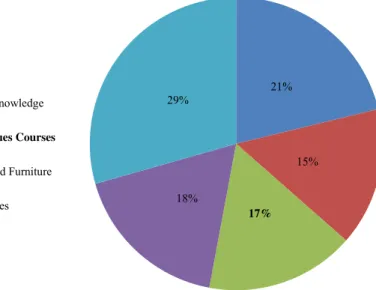
The result of the cumulative course analyses points out that there are 18 Off-discipline Courses, 13 Professional General Knowledge Courses, 15 Interior Architecture and Furniture Design Courses, 25 Other Profession Courses and 14 Presentation Techniques Courses in Interior Architecture Bachelor’s Degree Programs in Turkey.
Table 2. The scatter chart of courses in Interior Architecture Bachelor’s degree programs in Turkey
Table 2 shows that the allocation of the presentation techniques courses is 17 percentage of the cumulative course list. These curriculum analyzes shows the importance of presentation techniques courses in the interior architecture education field.
3. Instructional Methods Used in CAD Courses
The computer aided design (CAD) courses in Interior Architecture education can be classified as: x 2D and 3D Drawing Courses
x Computer Aided Presentation and Image Manipulation Courses
According to the surveys and Expert Choice criteria assessment that put forward by Dönmez (2013), software packages Rhinoceros, 3ds Max, Photoshop, Autocad, Solid Works, Corel Draw were chosen as the first six software for the design education. Five of these software packages are take part in the first category ( 2D and 3D Drawing) and “Photoshop” takes part in the second category (Computer Aided Presentation and Image Manipulation Courses).
The instructional methods used in CAD courses can be classified as:
x Theory Based Instruction Method: This is a traditional “Teacher Centered” method. In this instructional method teacher transfers knowledge to the student verbally. He/she also can give written documents to enhance knowledge.
x Invention Based Instruction Method: This method can be called as “Learning Game”. After teacher transfers knowledge about specific design and drawing tool, he/she puts forward a design problem. Students need to use learned tools to solve the design problem.
x Searches and Analyzes Based Instruction Method: The instrument of this method is homework. Teacher gives homework to the student and student search and analyzes possible solutions. Teacher shows some tools such as videos, tutorials to the student to help them to find the solution.
x Collaborative Learning Based Instruction Method: This method emphasizes practice in the classroom. In this method teacher shows the solution of the problem first and then solve this problem again synchronously with the students (URL 1). 21% 15% 17% 18% 29% Off-discipline Courses
Professional General Knowledge Courses
Presentation Techniques Courses
Interior Architecture and Furniture Design Courses
4. Survey Study
In this study, by taking into consideration the results of Dönmez’s study (2013), Photoshop is determined as the essential “Computer Aided Presentation and Image Manipulation Course” for design students. Interior Architecture Bachelor’s Degree Programs in Turkey aim to be accredited in line with the CIDA (Council for Interior Design Accreditation) Standards. Accordingly the instructional methods used in Photoshop courses are analyzed through CIDA 2014 “Design Process” Standards. The survey study was carried out between 40 participants (students) of “İÇM 210: Computer Aided Design” course in the 2013-2014 Spring Semester. This is a compulsory course that takes part in Interior Architecture Bachelor’s Degree Program for the 4th semester students in Doğuş University.
During the semester, each instructional method applied deliberatively as follows:
x Theory Based Instruction Method is applied in the first three week of the course. Main purposes and fundamentals of Photoshop for interior architects are explained. General knowledge about Photoshop menus and tools are transferred to the student both verbally and documentarily.
x Invention Based Instruction Method is applied in the midterm and final exam. After transferring the needed knowledge about Photoshop Tools, students are expected to design a Movie Poster in the midterm exam and Architectural Plan Visualization in the final exam by using gathered knowledge and skills.
x Searches and Analyzes Based Instruction Method is applied as weekly homework.
x Collaborative Learning Based Instruction Method is applied in the architectural plan visualization practices. These practices in the classroom were preliminary preparation to final exam.
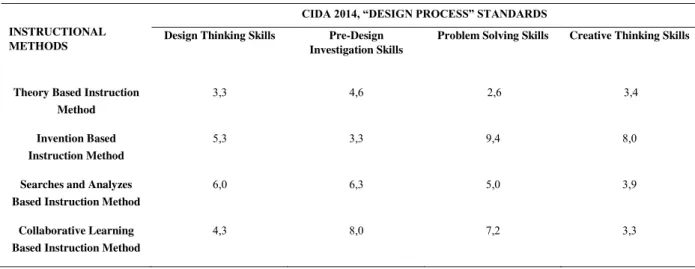
The survey takes part after the final exam. In this survey, the participants (students) were expected to state their level of achievement of skills determined in CIDA Professional Design Process Standards 2014, as result of each instructional method. They give points from 1 to 10 to each category.
After the survey implemented, the data collected from each student’s questionnaire and the mean values for each instructional method used in “Computer Aided Presentation and Image Manipulation Course” calculated according to CIDA 2014 Design Process Standards.
Table 3 shows the mean values obtained from survey study.
Table 3. Survey Study: The analyze of instructional methods used in Photoshop Courses according to CIDA 2014 Design Process Standards
INSTRUCTIONAL METHODS
CIDA 2014, “DESIGN PROCESS” STANDARDS Design Thinking Skills Pre-Design
Investigation Skills
Problem Solving Skills Creative Thinking Skills
Theory Based Instruction Method
3,3 4,6 2,6 3,4
Invention Based Instruction Method
5,3 3,3 9,4 8,0
Searches and Analyzes Based Instruction Method
6,0 6,3 5,0 3,9
Collaborative Learning Based Instruction Method
5. Conclusion
As a result of survey, Invention Based Instruction Method was chosen as the best instructional method for Problem Solving and Creative Thinking Skills. Searches and Analyzes Based Instruction Method was chosen as the most beneficial instructional method for Design Thinking Skills. Collaborative Learning Based Instruction Method was chosen as the most beneficial instructional method for Pre-Design Investigation Skills. The result of the study shows that Theory Based Instruction Method is not preferred method among the students for CAD education.
The result of survey points out that application-oriented instruction methods are preferred by Interior Architecture students for Computer Aided Presentation and Image Manipulation Courses. The prominence of Invention Based Instruction Method proves that the students find the “Learning Games” beneficial for improving their skills in CAD courses.
This study was performed to examine the instructional methods used in CAD courses at Interior Architecture Bachelor’s Degree Programs in Turkey. Advanced study can be made with the CAD lecturers to obtain their opinions and suggestions.
References
Dönmez, S., (2013). Computer Aided Industrial Design Software Selection in Industrial Product Design Education at Turkey Using Expert Choice Program, Procedia - Social and Behavioral Sciences 106, 682-89
Duralp, M., (2006), An Approach to Integrate Lighting Concepts into Interior Design Studios: A Constructivist Educational Framework, PHD Thesis, Bilkent University, The Institude of Fine Arts, The Department of Interior Architecture and Environmental Design, 6-8
Erkan, Ö., (2013). Interdisciplinary Collaboration between Interior Architecture and Industrial Product Design Programs in Turkey, Procedia - Social and Behavioral Sciences 106, 1540-47
Gökhan, Ç.B., Atasoy, A., (2005), İç Mimarlık Eğitim Programı Tasarımı ve Geliştirme Modeli Önerisi, İtü Dergisi/a: Mimarlık, Planlama, Tasarım, Cilt:4, Sayı:2, 25-39
House, N.,Coles, J.,(2007), The Fundamentals of Interior Architecture, AVA Publishing, Switzerland, 8-10 Piotrowski, M.C., (2004), Becoming an Interior Designer: A Guide to Careers in Design, John Wiley&Sons, London
Yavuz, A.Ö., Yıldırım, M. T., (2012). Study on Defining Utilization Steps of Tradiational Tools in Architectural Design Education, Procedia - Social and Behavioral Sciences 51, 239-43
URL1. http://tll.ibu.edu.ba/assets/userfiles/tll/EDU-439-%C3%96%C4%9ERET%C4%B0M-STRATEJ%C4%B0LER%C4%B0- Y%C3%96NTEMLER%C4%B0-VE-TEKN%C4%B0KLER%C4%B0.pdf