Low-cost, large-scale, ordered ZnO nanopillar arrays for light extraction efficiency enhancement in quantum dot light-emitting diodes
Xuyong Yang,1 Kapil Dev,1 Jianxiong Wang,1 Evren Mutlugun,1 Cuong Dang,1 Yongbiao
Zhao,1 Swee Tiam Tan,1 Xiao Wei Sun1* and Hilmi Volkan Demir1,2* 1
LUMINOUS! Center of Excellence for Semiconductor Lighting and Displays, School of Electrical and Electronic Engineering, Nanyang Technological University, Nanyang Avenue, 639798 (Singapore) 2 Department of Electrical and Electronics Engineering, Department of Physics, UNAM – Institute of Materials Science and Nanotechnology, Bilkent University, Bilkent, Ankara, 06800 (Turkey)
E-mail: [email protected] and [email protected]
Abstract: We report a QLED with enhanced light outcoupling efficiency by applying a layer of periodic ZnO nanopillar arrays. The resulting QLED reaches the record external quantum efficiency (EQE) of 9.34% in green-emitting QLEDs with a similar device structure.
Keywords: quantum dots; ZnO; nanopillar; QLED; light-emitting diodes
Quantum dot (QD) lighting-emitting diodes (QLEDs) with advantages in colour quality, tunable emission spectrum, stability and cost-effectiveness have been intensively investigated as candidates for next-generation lighting and displays.1-2 However, even though a 90% internal quantum efficiency (IQE) has been realized by using highly efficient QD emitters,3 the external quantum efficiency (EQE) of QLEDs is encountering a bottleneck due to the low light extraction efficiency (LEE). For conventional organic LEDs (OLEDs) in a planar waveguide-like structure, most of the generated light (~80%) is lost because of being trapped in substrate, waveguided modes, or coupled to surface plasmon modes associated with metallic electrodes, and finally only around 20% of internally generated photons can be extracted into air.4 Given the structural similarity between QLEDs and OLEDs, it can be expected that the light out-coupling efficiency of QLEDs is quite low as well.In addition, the QLED architecture also has its own speciality. For example, the critical angle for total internal reflection (TIR) would decrease because of the increasing refractive indices when changing from organics (n ~1.75) in OLEDs to inorganc materials (QDs and inorganic charge transport materials) in QLEDs. Therefore, in-depth studies on the light extraction from QLEDs would be in great demand for improving device performances.
Here, we report a QLED with enhanced light out-coupling efficiency by applying a layer of large-scale, periodic zinc oxide (ZnO) nanopillar arrays. The uniform ZnO nanopillar arrays were obtained by a simple and efficient pattern replication in non-wetting templates (PRINT) technique. The resulting QLEDs with the ordered ZnO nanostructure as light out-coupling medium exhibit superior performance compared to that of the flat QLED (reference device), with the maximum luminance, current efficiency (CE) and EQE values of 54, 200 cd/m2, 26.6 cd A−1 and 9.34%, respectively. To our knowledge, the EQE of 9.34% is the highest reported EQE value for green QLEDs with a similar device structure.
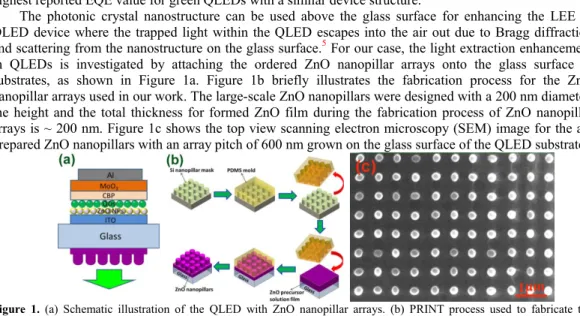
The photonic crystal nanostructure can be used above the glass surface for enhancing the LEE of OLED device where the trapped light within the QLED escapes into the air out due toBragg diffraction and scattering from the nanostructure on the glass surface.5 For our case, the light extraction enhancement in QLEDs is investigated by attaching the ordered ZnO nanopillar arrays onto the glass surface of substrates, as shown in Figure 1a. Figure 1b briefly illustrates the fabrication process for the ZnO nanopillar arrays used in our work. The large-scale ZnO nanopillars were designed with a 200 nm diameter, the height and the total thickness for formed ZnO film during the fabrication process of ZnO nanopillar arrays is ~ 200 nm. Figure 1c shows the top view scanning electron microscopy (SEM) image for the as-prepared ZnO nanopillars with an array pitch of 600 nm grown on the glass surface of the QLED substrate.
Figure 1. (a) Schematic illustration of the QLED with ZnO nanopillar arrays. (b) PRINT process used to fabricate the ordered ZnO nanopillar arrays on the glass surface of ITO-glass substrate. (c) The top view SEM image of the resulting ZnO nanopillars with an array pitch of 600 nm.
534
WH2.2 (Contributed) 10:45 AM - 11:00 AM
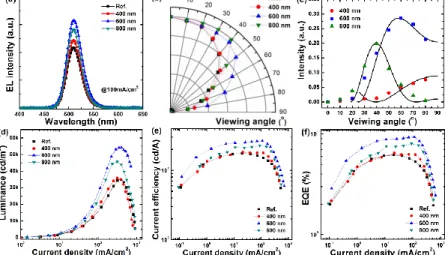
Figure 2a shows the EL spectra for the reference device without ZnO nanopillar arrays and devices with ZnO nanopillar arrays measured using an integrating optical sphere at a current density of 100 mA/cm2. Comparisons of these integral EL spectra show no significant difference in the EL peak positions (at ~510 nm) for these devices. However, EL intensities obtained from the QLEDs with ZnO nanopillars were obviously enhanced, especially for the device with a ZnO nanopillar array pitch of 600 nm. Figure 2b presents the normalized angular emission intensity for these devices. The reference device and device with ZnO pillar array pitch of 400 nm show similar angular distribution characteristics with an approaching Lambertian emission pattern, which implies that the diffraction effect for the device with 400 nm pitch ZnO pillars is not very significant. The QLEDs with the ZnO pillar array pitches of 600 nm and 800 nm, however, show quite different angular emission behaviours that present non-Lambertian emission distributions. The emission intensity decreasing for the device with 600 nm pitch ZnO pillars is much slower and the device with 800 nm pitch ZnO pillars show its maximum emission intensity at a viewing angle of 30°.The non-Lambertian emission behaviours for the two QLEDs could be explained by the diffraction effect of the ordered ZnO nanostructure.
The electroluminescence (EL) intensity of the diffracted light emitted from the QLEDs with different ZnO array pitches as a function of the emission angle6 is shown in Figure 2c. The diffracted light by ZnO array is obtained by subtracting the total angular emission of the reference device from that of the corresponding QLEDs. The amplitude of light extracted by the ZnO nanopillars, estimated by fitting experiment data with diffraction model, is 0.09, 0.286, and 0.2 for QLEDs with a ZnO pillar array pitch of 400 nm, 600 nm, and 800 nm, respectively. The extraction amplitude for 600 nm pitch ZnO pillars is the highest, indicating the strongest diffraction grating effect and showing consistency to the highest performance of the corresponding device. The enhanced device performance for these QLEDs with ZnO nanopillar arrays is shown in Figures 2d-2f. In Figure 2d, the QLED with 600 nm pitch ZnO pillars exhibits the highest brightness and its luminance reaches 54,200 cd/m2, 1.5 folds higher than that of the reference device. Figures 2e and 2f present the EQE-J and CE-J curves of device. With the incorporation of ZnO nanopillars, the device with the ZnO nanopillar array pitch of 600 nm made a high CE of 26.6 cd/A. This corresponds to an EQE level of 9.34%, significantly higher than that of the reference device (6.17%).
Figure 2. (a) EL spectra of QLEDs acquired from an integrating optical sphere. (b) Angular dependencies of the reference device and devices with different ZnO array pitches. (c) Fitting of the angular distribution for QLEDs with different ZnO array pitches. (d) Luminance, (e) current efficiency, and (f) EQE versus current density.
In conclusion, our results indicate that the cost-effective ZnO nanopillars are promising light outcoupling layer for improving QLED performance and our approach may have important implications for understanding and designing high-performance QLEDs by enhancing light extraction efficiency.
This work is supported by the National Research Foundation of Singapore under Grant Nos. NRF-RF-2009-09, NRF-CRP-6-2010-02, and NRF-CRP-11-2012-01 and the Singapore Agency for Science, Technology and Research (A*STAR) SERC under Grant Nos. 092 101 0057 and 112 120 2009. HVD also acknowledges EURYI and TUBA.
References
[1] Y. Shirasaki et al., Nature Photon. 2013, 7, 13. [2] X. Yang et al., Adv. Mater. 2012, 24, 4180. [3] B. S. Mashford et al., Nature Photon. 2013, 7, 407. [4] R. Meerheim et al., Appl. Phys. Lett. 2010, 97, 253305. [5] W. H. Koo et al., Nature Photon. 2010, 4, 222. [6] S. W. Liu et al., Appl. Phys. Lett. 2013, 102, 053305.
535