Cite this article as: Kilic FS, Kaygisiz B, Aydin S, Yildirim C, Karimkhani H, Oner S. Pregabalin attenuates carrageenan-induced acute inflammation in rats by inhibiting proinflammatory cytokine levels. Eurasian J Med 2018; 50(3): 156-159.
ORCID IDs of the authors: F.S.K.: 0000-0002-5356-696X B.K.: 0000-0001-5910-9914 S.A.: 0000-0003-2498-8378 C.Y.: 0000-0002-1565-9217 H.K.: 0000-0002-4966-1745 S.O.: 0000-0002-4759-4913
1Department of Pharmacology, Eskişehir
Osmangazi University School of Medicine, Eskişehir, Turkey
2Department of Biochemistry, İstanbul Medipol
University School of Medicine, İstanbul, Turkey
3Department of Biostatistics, Eskişehir
Osmangazi University School of Medicine, Eskişehir, Turkey
Received: November 7, 2017 Accepted: April 5, 2018
Correspondence to: Fatma Sultan Kilic E-mail: [email protected]
DOI 10.5152/eurasianjmed.2018.17261 ©Copyright 2018 by the Atatürk University School of Medicine - Available online at www.eurasianjmed.com
ABSTRACT
Objective: Pregabalin (PGB) is a compound used in the treatment of epilepsy, anxiety, and neuropathic pain. Experimental data also indicate that PGB can reduce inflammatory pain. We aimed to investigate the anti-inflammatory effects of PGB on carrageenan (CAR)-induced paw edema and its effects on tumor necrosis factor-α (TNF-α) and interleukine-1β (IL-1β) acting as acute phase cytokines in inflammation, and anti-inflammatory cytokine IL-10, in rats.
Materials and Methods: Single doses of PGB 30, 50, and 100 mg/kg and indomethacin (INDO) 5 mg/kg in the treatment groups and saline in the control group were injected once intraperitoneally prior to adminis-tration of 100 µl of 1% CAR into the right hind paw of the rats. The paw thickness was measured using gauge calipers (Vernier calipers) before (0 hour) and every hour afterwards for 6 hours following the inflammation induction. The cytokine levels in the blood serum obtained intracardiacally were determined after 6 hours using the enzyme-linked immunosorbent assay method. p<0.05 was considered statistically significant. Results: There was no significant difference between the 0 and 6th hour considering the paw thickness in
all groups, except in the CAR group. CAR significantly increased the paw thickness at 6 hours compared to the 0 hour. All doses of PGB and INDO significantly reduced the paw thickness after 6 hours compared to the CAR group. The TNF-α and IL-1β levels in the PGB and INDO groups were comparable to the control group, whereas in the CAR group, these levels were increased. The IL-10 level was enhanced in the PGB 50 mg/kg and INDO groups.
Conclusion: It was observed that all doses of PGB exerted anti-inflammatory-like effects comparable to INDO, supported by their effects on the levels of cytokines.
Keywords: Pregabalin, inflammation, anti-inflammatory effect, cytokines, rat
Introduction
Pregabalin (PGB) S(+)-3-isobutyl-gamma-aminobutyric acid (GABA), a gabapentin derivative, is an anticonvulsant used in the treatment of epilepsy [1]. It is also used for neuropathic pain treatment [2, 3], and it exerts its effects by acting on the GABAergic neurotransmission, voltage-dependent potassium channels, and calcium channels [4].
Inflammation is a complex process that occurs in response to injuries and tissue damage, and it in-cludes neutrophil migration to the inflamed area induced by inflammatory mediators, such as tumor necrosis factor-α (TNF-α), interleukine-1β (IL-1β), and the secretion of chemical mediators, such as histamine, serotonin, bradykinin, and prostaglandin [5]. If the inflammatory process is not terminated, it may harm the body systems and may cause some diseases, such as rheumatoid arthritis [6]. The PGB is reported to have an antinociceptive effect in neuropathic pain as well as tory pain [3, 7]. It is also suggested that the PGB exerted an antinociceptive effect in inflamma-tory pain via inhibiting the release of neuropeptides on sensory neurons. Furthermore, it was reported that gabapentin, which has structural and functional similarities to PGB, showed anti-inflammatory effects in rats [8].
Our goal was to investigate the anti-inflammatory effect of PGB at different doses in carrageenan (CAR)-induced paw edema as well as its effects on serum pro- and anti-inflammatory cytokine levels in rats.
Pregabalin Attenuates Carrageenan-Induced Acute Inflammation in
Rats by Inhibiting Proinflammatory Cytokine Levels
Materials and Methods
Animals
Adult female Wistar albino rats (250–300 g) were used in this study (a total of 42 rats were obtained from the Medical and Surgical Research Center [TİCAM] and divided into 6 groups containing 7 rats each). Rats were housed under the standard conditions at room temperature (23±2°C) and lighting (12/12 h light/dark cycle), and food and water were available ad libitum. All experiments were approved by the Local Ethical Committee of Experimental Animal Research (430/2015).
Drugs
The PGB (Lyrica; Pfizer, İstanbul, Turkey), car-rageenan iota type, powder, J60603 (Alfa-Aesar, Karlsruhe, Germany), and indomethacin (INDO) (Fluka, BioChemika, Bucharest, Ro-mania) were dissolved in saline. The PGB and INDO were administered intraperitoneally (i.p.),
and CAR was intradermally (i.d.) (subplantar) administered.
Experimental Design
An acute anti-inflammatory effect of PGB was assessed in CAR-induced paw edema. In ad-dition, proinflammatory cytokines IL-1β, and TNF-α, and anti-inflammatory cytokine IL-10 levels were determined in sera of rats. INDO, a nonsteroidal anti-inflammatory drug (NSAID), was used as a reference drug [9].
Animals were divided into six groups (n=7 per group):
1) Control group: 100 µl saline i.d.+saline i.p. 2) CAR group: 100 µl CAR i.d.+saline i.p. 3) PGB 30 mg/kg group: 100 µl CAR i.d.+30 mg/ kg PGB i.p.
4) PGB 50 mg/kg group: 100 µl CAR i.d.+50 mg/ kg PGB i.p.
5) PGB 100 mg/kg group: 100 µl CAR i.d.+100 mg/kg PGB i.p.
6) INDO 5 mg/kg group: 100 µl CAR i.d.+5 mg/ kg INDO i.p.
Carrageenan-induced Paw Edema
The PGB at doses of 30, 50, and 100 mg/kg, INDO 5 mg/kg, or saline were injected i.p. to rats 30 minutes before the i.d. (subplantar) administration of 100µl of 1% CAR into the right hind paw of the rats. The paw thickness was measured just before the CAR injection (0 hour) and in every hour for 6 hours after the CAR injection using Vernier calipers [10, 11].
Determination of the IL-1beta, TNF-alfa, and IL-10 Levels
Intracardiac blood samples were obtained after 6 hours for the determination of cytokines and were kept at −80 °C until analysis. The IL-1β, TNF-α, and IL-10 levels in sera were analyzed using the enzyme-linked immunosorbent assay kits (eBiosci-ence, Vienna, Austria) according to the manual.
Statistical Analysis
Statistical analysis was performed using the Sta-tistical Package for the Social Sciences (SPSS Inc.; Chicago, IL, USA) version 15.0 statistical pack software. The data were normally distributed when analyzed using the Shapiro–Wilks test. The data of the anti-inflammatory response were analyzed statistically with one- and two-way analysis of variance (ANOVA); the statistical analysis of cytokine levels was conducted with one-way ANOVA. The Tukey post-hoc test was used according to the Levene homogeneity test. p<0.05 was considered statistically significant.
Results
The Effects of Pregabalin on CAR-Induced Paw Edema
Carrageenan significantly increased the paw thickness compared to control group (p<0.05). (As known carrageenan is an inflammatory agent. So it leads to inflammation. Thus, this data is an expected result.) There was no significant differ-ence between the groups in terms of paw thick-ness at all time points, except in the CAR group (Figure 1). CAR significantly increased the paw thickness at all hours compared to other groups. All doses of PGB significantly decreased the paw thickness dose-independently at 4th–6th hour, and this effect was similar to INDO (Figure 1).
The Effects of Pregabalin on the Serum Cyto-kine Levels
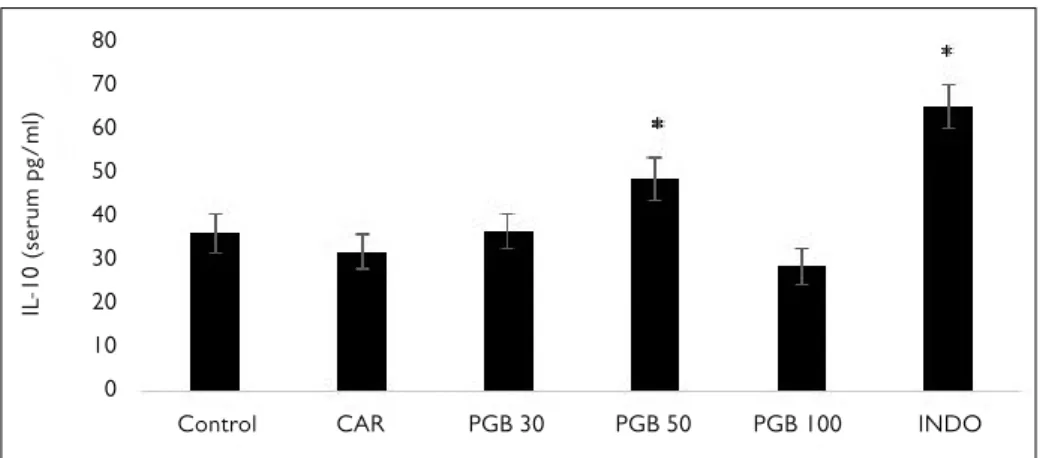
The PGB 50 mg/kg increased the IL-10 lev-els compared to the control and CAR groups (p<0.05)
Eurasian J Med 2018; 50(3): 156-159 Kilic et al. Pregabalin in Inflammation
• 157
Figure 1. The anti-inflammatory effects of PGB on the CAR-induced paw edema
Results are given as the mean±SEM.
CAR: carrageenan; PGB: pregabalin; INDO: indomethacin. *p<0.05 compared to control; +p<0.05 compared to the CAR group.
0,8 0,7 0,6 0,5 0,4 0,3 0,2 0,1 0 Pa w E dema (c m) 0th 1th 2th 3th 4th 5th 6th
Control CAR PGB 30 PGB 50 PGB 100 INDO
Figure 2. The effects of PGB on serum IL-10 levels
Results are given as mean±SEM.
CAR: carrageenan; PGB: pregabalin; INDO: indomethacin. *p<0.05 compared to control. +p<0.05 compared to CAR group.
80 70 60 50 40 30 20 10 0 IL -10 (serum pg/ml)
This effect was less prominent than in the INDO group; however, there was no statistical signifi-cance between the PGB 50 mg/kg and INDO groups (Figure 2).
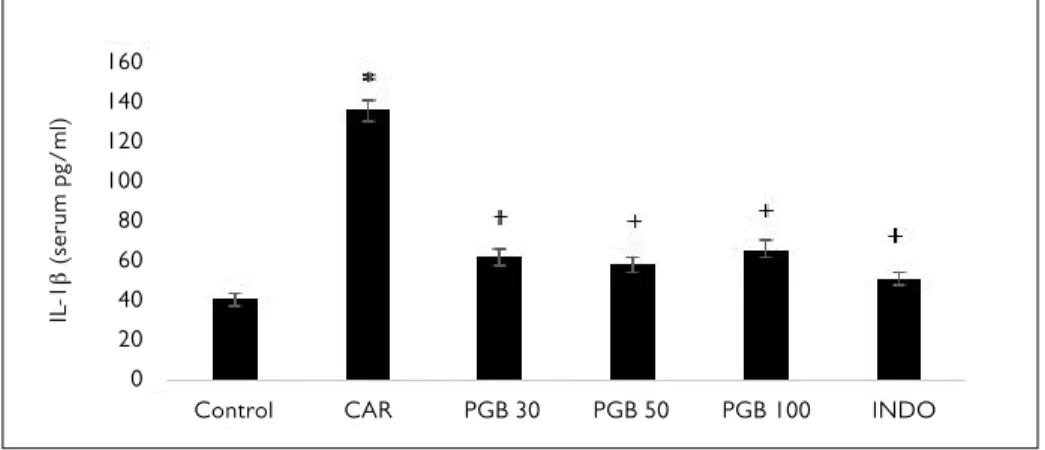
Carrageenan significantly increased the IL-1β and TNF-α levels compared to the control and PGB groups (p<0.05). The PGB significantly decreased the IL-1β and TNF-α levels dose-independently compared to the CAR group (p<0.05). These effects of PGB were similar to INDO; however, there was no statistical sig-nificance between the PGB and INDO groups (Figure 3, 4).
Discussion
In this study, we investigated the anti-inflamma-tory effects of PGB on the CAR-induced paw edema and its effects on the serum cytokine lev-els in rats. We observed that CAR increased the paw thickness compared to control (p<0.05). The paw thickness was found to be increased at the 3rd and 4th hour and reduced to the 0-hour
values at the 6th hour in the treatment groups
(p>0.05) (Figure 1), whereas paw thickness
in-creased with time in the CAR group (p<0.05). We observed that the PGB decreased the paw edema dose independently, and this effect was similar to INDO, the reference anti-inflamma-tory drug (Figure 1). This result was consistent with the finding that gabapentin reduced the paw thickness in an arthritis model in rats in-duced with Freund’s complete adjuvant admin-istration [12]. Although we used the PGB and CAR-induced inflammation model, we may sug-gest that our results are in accordance consider-ing the similarity between the PGB and gabapen-tin in the mechanism of action with gabapengabapen-tin. The PGB, similar to gabapentin, acts by binding to the α2δ-1 subunit of voltage-gated calcium channels. It also affects GABAergic neurotrans-mission. The PGB exerts antiepileptic, analgesic, and anxiolytic effects. In addition, antiepileptics can sometimes be used for the relief of posther-petic neuralgia as an adjunctive treatment to antidepressants [13]. In the United Kingdom, gabapentin and pregabalin are indicated for the treatment of neuropathic pain. The PGB, as an antiepileptic, shows less efficacy against the focal
seizures and may worsen generalized myoclonic and absence seizures. The PGB is also used for diabetic peripheral neuropathy, postherpetic neuralgia, and fibromyalgia [7]. Antiepileptic drugs are particularly preferred for neuropathic pain conditions, for example, painful diabetic neuropathy and postherpetic neuralgia, and they are not favored for nociceptive pain, such as arthritis. On the other hand, their use in acute pain conditions has been studied. In gen-eral, acute pain is treated ineffectively as chronic pain [4]. The α2δ-1 subunit of voltage-gated cal-cium channels is reported to be upregulated in inflammatory models in rats [14]. Furthermore, ligands of the α2δ-1 subunit as well as pregaba-lin were shown to be effective in inflammatory pain models, and this effect was associated with binding to the α2δ-1 subunit rather than affect-ing the GABAergic transmission [15].
Inflammation is a defense mechanism that pro-tects the body from the damage caused by endogenous or exogenous stimuli [6]. Inflam-mation is essential to maintain physiological pro-cesses; however, if the underlying pathology that triggers inflammation remains untreated, inflam-matory diseases, such as rheumatoid arthritis and atherosclerosis, may occur [6].
In our study, we induced inflammation by CAR, which is an acute inflammation model [10, 11]. There are several hypotheses trying to clarify the acute inflammation processes. Recently, it was reported that the cytotoxicity emerging in the acute phase of the inflammation may result from the damaging effects of reactive oxygen species induced by the release of proinflamma-tory cytokines [16, 17]. In addition, enzymatic pathways, such as COX-2, which is an inducible COX enzyme, are suggested to play role in the inflammatory response [18]. Considering this, nonsteroidal anti-inflammatory drugs (NSAIDs) are used for their analgesic, antipyretic, and anti-inflammation properties. In addition, PGB was reported to show analgesic effect on inflamma-tory pain by inhibiting neuropeptides on sensory neurons [19].
In our previous study, the PGB (30 and 100 mg/ kg) exerted a central spinal but not central su-praspinal antinociceptive effect, and the PGB 100 mg/kg presented a peripheral antinocicep-tive effect. We suggested the involvement of the opioidergic pathway in the central spinal antino-ciceptive effect of PGB, whereas the nitrergic and serotonergic pathways are not involved [3]. Therefore, we aimed to investigate the effect of PGB on inflammation considering its use in the treatment of acute and chronic neuropathic pain.
Figure 3. The effects of pregabalin on serum IL-1β levels
Results are given as mean±SEM.
CAR: carrageenan; PGB: pregabalin; INDO: indomethacin. *p<0.05 compared to control; +p<0.05 compared to the CAR group.
160 140 120 100 80 60 40 20 0 IL -1 β (serum pg/ml)
Control CAR PGB 30 PGB 50 PGB 100 INDO
Figure 4. The effects of pregabalin on serum TNF-α levels
Results are given as mean±SEM.
CAR: carrageenan; PGB: pregabalin; INDO: indomethacin.
300 250 200 150 100 50 0 TNF-α (Serum pg/ml)
Inflammatory responses are often mediated by the production of proinflammatory molecules and cytokines [20]. The first 6 hours of the in-flammation are regarded to be significant in the inflammation process because the release of cytokines, also known as acute phase reactants, reach maximum levels in this period. Inflamma-tory mediators, such as TNF-α and IL-1β, play a significant role in the inflammatory processes [5]. On the other hand, IL-10 serves as an anti-inflammatory cytokine that inhibits the release of TNF-α, IL-1, IL-6, IL-8, and IL-12 from mac-rophages [18]. Blood concentrations of several cytokines, such as TNF-α, IL-6, and IL-1β, are widely used as biomarkers of inflammation. TNF-α was the first cytokine to be considered a common linking factor in the inflammatory response, whereas IL-6 is an acute phase reac-tant and is involved in the progression of acute inflammation to chronic inflammation [21]. IL-1β plays an essential role in the inflammatory process; however, its prolonged high levels have been associated with inflammatory diseases, such as irritable bowel syndrome and rheuma-toid arthritis [20, 22]. In our study, we observed that PGB at all doses decreased the levels of proinflammatory cytokines TNF-α and IL-1β, which increased with the CAR injection in the sera of rats. Furthermore, this effect was com-parable to INDO. In addition, the PGB increased the levels of IL-10. However, this effect was less prominent than INDO (Figure 2–4).
This study offers PGB as an alternative anti-inflammatory agent comparing its anti-inflam-matory effect to those of NSAIDs. Accordingly, gastric side effects of PGB, if there are any, should be stated to make a more appropriate comparison. In this study, we did not assess the gastric side effects of PGB; however, we planned to investigate the effects of pregabalin on gastric ulcer formation in further studies.
As a conclusion, we suggest that PGB possesses anti-inflammatory effect at all doses. However, this effect was similar to INDO, a NSAID, which is in used in clinical practice. We suggest that PGB 30 and 50 mg/kg may be used as an anti-inflammatory agent.
Ethics Committee Approval: Ethics committee ap-proval was received for this study from the Local Ethical Committee of Experimental Animal Research (430/2015).
Informed Consent: N/A
Peer-review: Externally peer-reviewed.
Author Contributions: Concept – F.S.K.; Design –F.S.K., B.K.; Supervision - F.S.K., B.K.; Resources – F.S.K., B.K.; Materials – F.S.K., S.A., B.K., H.K., C.Y.; Data Col-lection and/or Processing - F.S.K., S.A., B.K., H.K., C.Y.; Analysis and/or Interpretation – F.S.K., S.O.; Literature Search – F.S.K., B.K.; Writing Manuscript – F.S.K., B.K.; Critical Review – F.S.K., B.K.
Acknowledgements: This study was supported by Scientific Research Commission of Eskişehir Osmangazi University (Project numbers: 2015-946).
Conflict of Interest: Authors have no conflicts of in-terest to declare.
Financial Disclosure: The authors declare that this study has received no financial support.
References
1. Eutamene H, Coelho AM, Theodorou V, et al. Antinociceptive effect of pregabalin in septic shock-induced rectal hypersensitivity in rats. J Pharmacol Exp Ther 2000; 295: 162-67. 2. Ceyhan M, Tan E. A New Anticonvulsant
pre-gabalin: Preclinical data. Turk J Neurol 2008; 14: 161-71.
3. Kaygisiz B, Kilic FS, Senguleroglu N, Baydemir C, Erol K. The antinociceptive effect and mecha-nisms of action of pregabalin in mice. Pharmacol Rep 2015; 67: 129-33. [CrossRef]
4. Moore RA, Straube S, Wiffen PJ, Derry S, Mc-Quay HJ. Pregabalin for acute and chronic pain in adults. Cochrane Database Syst Rev 2009; 3: CD007076. [CrossRef]
5. Dias JM, de Brito TV, de Aguiar Magalhães D, et al. Gabapentin, a synthetic analogue of gamma aminobutyric acid, reverses systemic acute in-flammation and oxidative stress in mice. Inflam-mation 2014; 37: 1826-36. [CrossRef]
6. Moreira Lda R, Brum Eda S, da Silva AR, et al. Antinociceptive and anti-inflammatory effect of the Scutia buxifolia Reissek stem barks extract. Phytomedicine 2016; 23: 1021-28. [CrossRef]
7. Abou-Khalil BW. Antiepileptic drugs. Continuum (Minneap Minn) 2016; 22: 132-56. [CrossRef]
8. Sarıtaş TB, Korkmaz M, Sevimli A, Sarıtaş ZK. Comparison of the effects of gabapentin and pregabalin on wound healing in rats. Int Wound J 13:748-53. [CrossRef]
9. Abd-Allah AAM, El-Deen NAMN, Mohamed WAM, Naguib FM. Mast cells and pro-inflamma-tory cytokines roles in assessment of grape seeds extract anti-inflammatory activity in rat model of
carrageenan-induced paw edema. Iran J Basic Med Sci 2018; 21: 97-107
10. 10-Amdekar S, Roy P, Singh V, Kumar A, Singh R, Sharma P. Anti-inflammatory activity of lactobacillus on carrageenan-induced paw edema in male wistar rats. Int J Inflam 2012; 752015: 1-6. [CrossRef]
11. 11- Caiazzo E, Maione F, Morello S, et al. Ad-enosine signalling mediates the antiinflammatory effects of the COX-2 inhibitor nimesulide. Bio-chem Pharmacol 2016; 112: 72-81. [CrossRef]
12. Sun D, Yang J, Wang D, et al. Gabapentin regulates expression of FGF2 and FGFR1 in dorsal root gan-glia via microRNA-15a in the arthritis rat model. J Orthop Sci 2017; 22: 1112-1119. [CrossRef]
13. onks R. Psychotropic drugs. Wall PD, Melzack RA, editors. Textbook of Pain. 3rd ed. Edin-burgh: Churchill Livingstone; 1994.p.963-89. 14. Meleine M, Boudieu L, Gelot A, et al.
Compara-tive effects of α2δ-1 ligands in mouse models of colonic hypersensitivity. World J Gastroenterol 2016; 22: 7111-23. [CrossRef]
15. Rahman W, Bauer CS, Bannister K, Vonsy JL, Dolphin AC, Dickenson AH. Descending seroto-nergic facilitation and the antinociceptive effects of pregabalin in a rat model of osteoarthritic pain. Mol Pain 2009; 5: 45. [CrossRef]
16. Bernardi A, Zilberstein A, Jäger E, Campos MM, Morrone FB, et al. Effects of indomethacin-loaded nanocapsules in experimental models of inflammation in rats. Br J Pharmacol 2009; 158: 1104-11 [CrossRef]
17. Pandey A, Bani S, Kumar S N, Gupta B D, Suri K A. Anti-arthritic activity of agnuside mediated through the down-regulation of inflammatory mediators and cytokines. Inflamm Res 2012; 61: 293-304 [CrossRef]
18. Shitany NA, Bastawissy EA, desoky K. El-lagic acid protects against carrageenan-induced acute inflammation through inhibition of nuclear factor kappa B, inducible cyclooxygenase and proinflammatory cytokines and enhancement of interleukin-10 via an antioxidant mechanism. Int Immunopharmacol 2014; 19: 290-99. [CrossRef]
19. Cooper TE, Heathcote LC, Anderson B, Gré-goire MC, Ljungman G, Eccleston C. Nonste-roidal anti-inflammatory drugs (NSAIDs) for cancer-related pain in children and adoles-cents. Cochrane Database Syst Rev 2017; 7: CD012563.
20. Joseph SV, Edirisinghe I, Burton-Freeman BM. Fruit Polyphenols: A review of antiinflammatory effects in humans. Crit Rev Food Sci Nutr 2016; 56: 419-44. [CrossRef]
21. Gabay C. Interleukin-6 and chronic inflammation. Arthritis Res Ther 2006; 8 Suppl 2: 3. [CrossRef]
22. Kornman KS. Interleukin 1 genetics, inflamma-tory mechanisms, and nutrigenetic opportunities to modulate diseases of aging. Am J Clin Nutr 2006; 83: 475-483. [CrossRef]