REPUBLIC OF TURKEY
BAHCESEHIR UNIVERSITY
FACTORS EFFECTING TURKISH
CUSTOMERS’ MOBILE MARKETING
SERVICES ADOPTION
Master’s Thesis
AYŞEGÜL DEMİR
REPUBLIC OF TURKEY
BAHCESEHIR UNIVERSITY
GRADUATE SCHOOL OF SOCIAL SCIENCES
MARKETING (EN)
FACTORS EFFECTING TURKISH CUSTOMERS’
MOBILE MARKETING SERVICES ADOPTION
Master’s Thesis
AYŞEGÜL DEMİR
Thesis Supervisor: Doç. Dr. KEMAL SUHER
TURKISH REPUBLIC
BAHCESEHIR UNIVERSITY
GRADUATE SCHOOL OF SOCIAL SCIENCES MARKETING (EN)
Name of the thesis: FACTORS EFFECTING TURKISH CUSTOMERS’ MOBILE MARKETING SERVICES ADOPTION
Name/Last Name of the Student: AYŞEGÜL DEMİR Date of the Defense of Thesis: 12.06.2013
The thesis has been approved by the Graduate School of Social Science.
Yrd. Doç. Dr. Burak Küntay Graduate School Director
Signature
I certify that this thesis meets all the requirements as a thesis for the degree of Master of Arts.
Dr. Selçuk Tuzcuoğlu Program Coordinator
Signature
This is to certify that we have read this thesis and we find it fully adequate in scope, quality and content, as a thesis for the degree of Master of Arts.
Examining Comittee Members Signature____
Thesis Supervisor --- Doç. Dr. Kemal SUHER
Member ---
Doç. Dr. İdil Karademirlidağ SUHER
Member ---
iii
ABSTRACT
FACTORS EFFECTING TURKISH CUSTOMERS’ MOBILE MARKETING SERVICES ADOPTION
Ayşegül Demir Marketing
Thesis Supervisor: Doç Dr. Kemal Suher
June 2013, 110 Pages
Rapid developments on mobile technology in the last decades and high rates of consumer’s adaptations have remarkably changed the doing of business and offered marketers many new opportunities to reach and serve customers. The purpose of this thesis study is to examine critical determinants of Turkish consumers’ intention to accept mobile marketing services and to provide insights for marketers in order to offer mobile marketing tools that meet consumers’ expectations. This study also aims combining a literature review with the results from the qualitative survey leads to a conceptual model of factors effecting mobile marketing services adoption. Facilitating conditions, perceived value (refers also performance expectancy), social influence factors derived from the Unified Theory of Acceptance and use of Technology (UTAUT) and privacy concern factors are evaluated to question the critical determinants of Turkish consumers’ intentions to participate in mobile marketing services. Both face to face and online questionnaire were conducted and 232 valid responses are collected. Relationships between the selected values and intention to participate in mobile marketing were analyzed through factor and regression analysis formulated in the Statistical Package for the Social Sciences (SPSS) program. Facilitating conditions, perceived value and social influence found support in our findings as indicators of mobile marketing services adoption, while the privacy concern factor did not. Additionally, the effect of demographic values (age, gender, occupation, education etc.) on intention to participate in mobile marketing services is also examined as a research question with ANOVA analyses and meaningful effect of education and income level on mobile marketing services adoption was seen.
Key Words: Mobile marketing, Mobile marketing services, Smartphones, Mobile technology, Technology adoption, Consumer behavior, Unified Theory of Acceptance and use of Technology
ÖZET
TÜRKİYE’DEKİ TÜKETİCİNİN MOBİL PAZARLAMA SERVİS ADAPTASYONUNU ETKİLEYEN FAKTÖRLER
Ayşegül Demir Pazarlama (EN)
Tez Danışmanı: Doç Dr. Kemal Suher
Haziran 2013, 110 Sayfa
Son yıllarda mobil teknolojilerde yaşanan hızlı gelişmeler ve tüketicilerin teknolojiye yüksek orandaki adaptasyonu, iş dünyasında önemli değişikliklere yol açmakta ve müşterilerine ulaşan ve hizmet eden pazarlamacılara yeni fırsatlar sunmaktadır. Bu tez çalışmanın amacı, mobil pazarlama servislerine adaptasyonu ve bu adaptasyonu etkileyen kritik faktörleri analiz ederek, tüketicilerin beklentileri ile uyumlu mobil pazarlama servislerinin sunulmasına katkı için pazarlamacılara çıktı sağlamaktır. Niteliksel anket sonuçları ile literatür taraması sentezlenerek mobil pazarlama servislerinin adaptasyonunu etkileyen faktörler için kavramsal bir model oluşturulması hedeflenmiştir. Birleştirilmiş Teknoloji kabulü ve kullanımı teorisine ait kolaylaştırıcı koşullar, algılanan değer/fayda,, sosyal etki faktörlerinin yanısıra gizlilik endişesi faktörleri Türkiye'de tüketicilerin mobil pazarlama servisleri kullanma niyetlerini etkileyen kritik belirleyiciler olarak analiz edilmiştir. Yüz yüze ve internet üzerinden yayınlanan anket çalışması ile 232 tane geçerli yanıt alınmıştır. Seçilen kritik faktörler ile mobil pazarlama adaptasyonunun arasındaki ilişkiyi açıklamak için istatistik paket programı olan SPSS kullanılarak factor ve regresyon analizleri yapılmıştır. Gizlilik endişesi dışındaki, Birleştirilmiş Teknoloji kabulü ve kullanımı teorisine ait kolaylaştırıcı koşullar, algılanan değer/fayda ve sosyal etki faktörleri mobil pazarlama adaprasyonu ile ilişkili bulunmuştur. Ayrıca, demografik özelliklerin (yaş, cinsiyet, eğitim, deneyim vb.) mobil pazarlama servislerini kullanımına etkisi araştırma sorusu olarak ANOVA analizleri ile irdelenmiş, eğitim ve gelir seviyesinin mobil pazarlama servisleri adaptasyonunu etkilediği gözlemlenmiştir.
Anahtar Kelimeler: Mobil pazarlama, Mobil pazarlama servisleri, Akıllı telefonlar, Mobil teknoloji, Teknoloji adaptasyonu, Tüketici davranışı, Birleştirilmiş teknoloji kabulü ve kullanımı teorisi
v CONTENTS
LIST OF TABLES ... vii
FIGURE(S) ... x ABBREVIATION(S) ... xi 1. INTRODUCTION ... 1 2. LITERATURE REVIEW ... 3 2.1.MARKETING ... 3 2.2.MOBILE TECHNOLOGY ... 5
2.2.1.Early History of Mobile Technology ... 6
2.2.2.Mobility Figures ... 9
2.3.MOBILE MARKETING ... 14
2.4.MOBILE MARKETING SERVICES ... 16
2.5.THEORIES BEHIND MOBILE MARKETING ACCEPTANCE .. 20
2.5.1.Fishbein’s Multi-Attribute Model ... 20
2.5.2.Theory of Reasoned Action (TRA) ... 21
2.5.3.Theory of planned Behavior (TPB) ... 22
2.5.4.Technology Acceptance Model (TAM) ... 24
2.5.5.Innovation Diffusion Theory (IDT) ... 25
2.5.6. . Unified Theory of Acceptance and use of Technology (UTAUT) ... 26
2.7.CONSUMER ATTITUDES AGAINST MOBILE MARKETING .. 28
2.7.1.Cross Cultural Psychology Impact on Consumer Behavior ... 28
2.7.2.Cross Cultural Studies About Mobile Marketing Acceptance .. 30
3. CONCEPTUAL FRAMEWORK AND HYPOTHESES ... 39
4. RESEARCH METHODOLOGY ... 43
4.1.QUESTIONNAIRE ... 43
4.2.SAMPLE AND DATA COLLECTION ... 44
4.3.DATA ANALYSIS APPROACH ... 45
5. ANALYSES AND FINDINGS ... 46
5.1.DEMOGRAPHIC PROFILE OF THE RESPONDENTS ... 46
5.2.MOBILE PHONE AND MOBILE INTERNET USAGE OF THE RESPONDENTS ... 48
5.4.FACTOR ANALYSIS AND SCALE RELABILITIES ... 56
5.5.CORRELATION ANALYSIS ... 63
5.6.REGRESSION ANALYSIS ... 64
5.7.INTERPRETATION OF THE HYPOTHESIS ... 71
5.8.ANSWER OF THE RESEARCH QUESTION ... 74
6. DISCUSSION AND CONCLUSION ... 88
7. IMPLICATIONS ... 91
8. LIMITATIONS ... 93
REFERENCES ... 94
APPENDICES ... 101
APPENDIX 1: QUESTIONNAIRE (ENGLISH) ... 102
APPENDIX 2: QUESTIONNAIRE (TURKISH) ... 106
vii
LIST OF TABLES
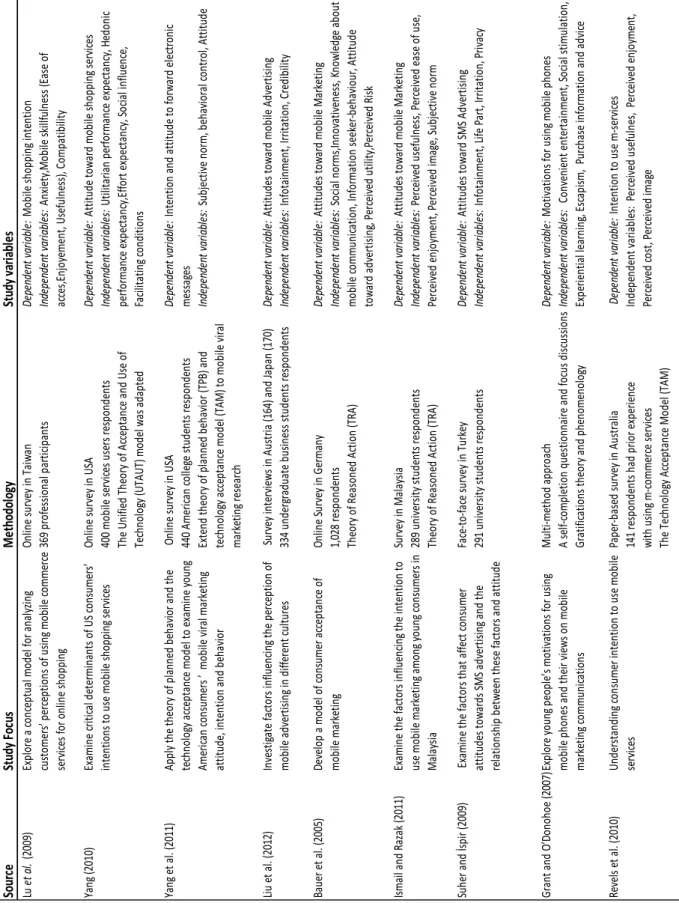
Table 2.1: Review of literature on mobile marketing adoption...29
Table 3.1: Summary of the questionnaire items………..………...…43
Table 5.1: Age………..……..……..…..46
Table 5.2: Gender………..…..….…..…46
Table 5.3: Marital status……….…...…..47
Table 5.4: Education………..…...47
Table 5.5: Occupation………..………48
Table 5.6: Monthly personal income……….….….48
Table 5.7: Mobile phone usage year………...48
Table 5.8: Mobile phone quantity………49
Table 5.9: Mobile phone types and brands………..49
Table 5.10: Mobile content download……….…………50
Table 5.11: Mobile content download……….………50
Table 5.12: Types of most frequently downloaded mobile contents………..….51
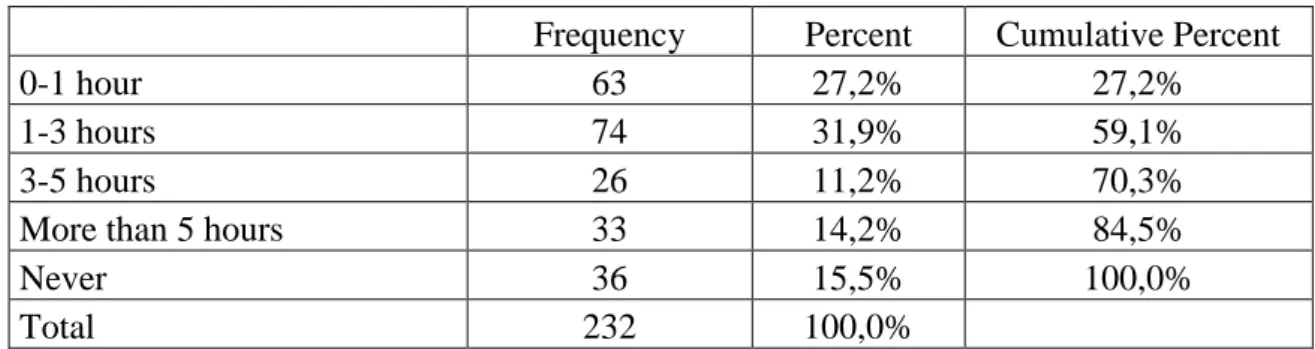
Table 5.13: Mobile contents download frequency………...…………51
Table 5.14: Top uses of mobile phone……….52
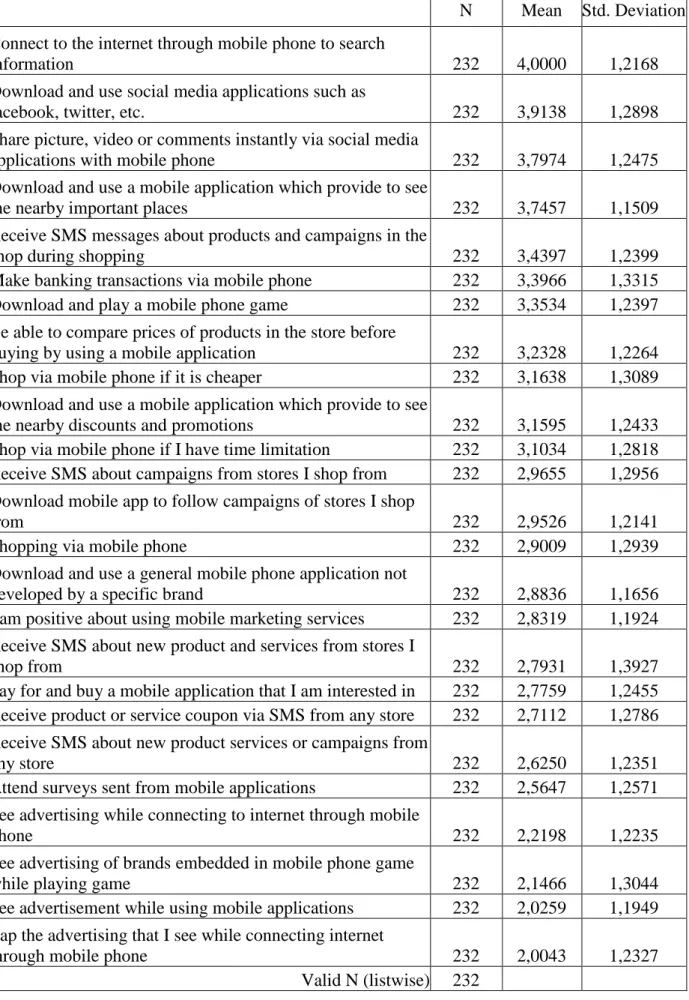
Table 5.15: Intention to participate in mobile marketing services………...……53
Table 5.16: Attitude towards the characteristics of mobile marketing services….….55 Table 5.17: KMO and Bartlett's Test (intention to participate in mobile marketing services) ………..………..………...……...…57
Table 5.18: Factor Analysis: Total variance explained (intention to participate in mobile marketing services).……….………….57
Table 5.19: Factor Analysis: Rotated component matrix (intention to participate in mobile marketing services)………..…....58
Table 5.20: Reliability Test (intention to participate in mobile marketing services factors)………..…59
Table 5.21: KMO and Bartlett's Test (independent variables)……….60
Table 5.22: Factor Analysis: Total variance explained (independent variables)…….60
Table 5.23: Factor Analysis: Rotated component matrix (independent variables)………..61
Table 5.25: Reliability Test (independent variables)………..….63
Table 5.26: Correlations………..63
Table 5.27: Regression analysis: Model Summary……….…….………65
Table 5.28: Regression analysis: ANOVA table of intention to participate in mobile advertising………...….66
Table 5.29: Regression coefficients of dependent variable intention to participate in mobile advertising……….…..….66
Table 5.30: Regression analysis: Model Summary……….……...67
Table 5.31: Regression analysis: ANOVA table of intention to participate in SMS..67
Table 5.32: Regression coefficients of dependent variable intention to participate in SMS………..68
Table 5.33: Regression analysis: Model Summary………..………68
Table 5.34: Regression analysis: ANOVA table of intention to participate in mobile shopping and banking……….……..68
Table 5.35: Regression coefficients of dependent variable intention to participate in mobile shopping and banking………..…....69
Table 5.36: Regression analysis: Model Summary………....……..69
Table 5.37: Regression analysis: ANOVA table of intention to participate in social media and entertaining services………...…69
Table 5.38: Regression coefficients of dependent variable intention to participate in social media and entertaining services……….…....70
Table 5.39: Regression analysis: Model Summary……….……….70
Table 5.40: Regression analysis: ANOVA table of intention to participate in location based services……….…..71
Table 5.41: Regression coefficients of dependent variable intention to participate in social media and entertaining services………..71
Table 5.42: Summary of the Regression Analyses ………..…72
Table 5.43: T-test for gender relation……….………..………74
Table 5.44: T-test for marital status relation………...…….75
Table 5.45: T-test for mobile phone type relation……….…..….76
Table 5.46: ANOVA analysis for Age: Test of Homogeneity of Variances…..…..…76
ix
Table 5.48: ANOVA analysis for Age: Post-hoc (Scheffe) tests………...…77 Table 5.49: ANOVA analysis for Education: Test of Homogeneity of Variances....78 Table 5.50: ANOVA analysis for Education: ANOVA……….…79 Table 5.51: ANOVA analysis for Education: Post-hoc (Scheffe) tests………..80 Table 5.52: ANOVA analysis for Income: Test of Homogeneity of Variances…….81 Table 5.53: ANOVA analysis for Income: ANOVA………..81 Table 5.54: ANOVA analysis for Income: Post-hoc (Scheffe) tests……….….82 Table 5.55: ANOVA analysis for mobile Internet: Test of Homogeneity of
Variances………..83 Table 5.56: ANOVA analysis for mobile Internet: ANOVA………..….84 Table 5.57: ANOVA analysis for mobile Internet: Post-hoc (Scheffe) tests……..….84 Table 5.58: ANOVA analysis for mobile Occupation: Test of Homogeneity of
Variances………..85 Table 5.59: ANOVA analysis for mobile Internet: ANOVA………..……....86 Table 5.60: ANOVA analysis for mobile Occupation: Post-hoc (Scheffe) test…..…86 Table 5.61: Summary of T-test and ANOVA Analyses Results………..87
FIGURE(S)
Figure 2.1: Mobile Network………..…..………..6
Figure 2.2: Evolution of Mobile Cellular Networks……….………..….….…….7
Figure 2.3: Fixed and mobile subscriptions 2009-2018………..…..……9
Figure 2.4: Mobile subscriptions and mobile traffic values………..……..…10
Figure 2.5: Global ICT developments 2006-2011…….………..…..…………..11
Figure 2.6: Intercontinental Broadband subscriptions...……….. …………..12
Figure 2.7: Theory of Reasoned Action…….……….22
Figure 2.8: Theory of planned behavior…….……….23
Figure 2.9: Technology Acceptance Model…….………...………24
Figure 2.10: Drivers of adoption of innovations.………..…. …………25
Figure 2.11: The Unified Theory Acceptance and Use of Technology (UTAUT) …...27
Figure 3.1: Theoretical Model……….………42
xi
ABBREVIATION(S)
SMS : Short Messaging Service MMS : Multimedia Messaging Service
GSM : Global System for Mobile Communications GPS : Global Positioning System
LBS : Location Based (Mobile) Services
IP : Internet Protocol
ICT : Information and communication Technology ITU : International Telecommunication Union
1G : First Generation
2G : Second Generation
3G : Third Generation
4G : Fourth Generation
LTE : Long Term Evolution
WAP : Wireless Application Protocol
UMTS : Universal Mobile Telecommunications System EDGE : Enhanced Data rates for GSM Evolution AMA : American Marketing Association
TAM : Technology Acceptance Model TRA : Theory of Reasoned Action TPB : Theory of Planned Behavior IDT : Innovation Diffusion Theory
UTAUT : Unified Theory of Acceptance and use of Technology RFID : Radio Frequency Identification Tags
1. INTRODUCTION
Mobile technologies have profoundly transformed the ways of doing businesses and marketing. Customers use mobile devices for communication, entertainment, business and also information purposes. Mobile marketing (m-marketing) offers direct communication with consumers anytime and anyplace and gains more popularity as the number of mobile device users are on the increase. The latest developments allow continuous Internet access via mobile devices such as mobile phones or tablets and these advances bring up new challenges for marketers and marketing researchers (Liu et al. 2011).
Mobile phone is the most ubiquitous personal item in the world and ubiquity is the main feature of mobile commerce. This involves the delivery of services in the physical world and allows the mobile user to benefit from these services and carry out transactions in real time in anywhere (Sallam and Udgata 2011). There is more to do on the mobile handset than just talking or text messaging and over the years, the mobile phone has become an increasingly attractive product with added features (Jayawardhena et al. 2008). Mobile phones have attracted the attention of marketing practitioners and scholars not only because of the enhanced mobility and immediacy of the medium but also because of the personal nature of mobile phones (Im and Ha 2012). The mobile phone has become a portable entertainment player, a new marketing tool for retailers and manufacturers, a multi- channel shopping device, a navigation tool, a new type of ticket and money, and a new mobile Intranet device (Barutçu 2008) and at the same time, the mobile phone has also become an interesting channel for transmitting advertising messages to consumers (Liu et al. 2011). Through the introduction of data services, mobile phone has rapidly become a viable commercial marketing channel. Especially, mobile internet and smart devices has created a new channel for marketers to reach consumers by using mobile marketing services such as Short Messaging Service (SMS), Multimedia Messaging Service (MMS), E-mail, location based services (LBS), mobile applications including value added services such as news, city guide, weather and traffic information, navigation tracking etc., mobile browsing/shopping, social media communication, mobile games and many more.
2
The usage of mobile marketing services has been growing and become an important economic factor (Broeckelmann 2010). The use of the term mobile marketing in this study refers to any form of marketing activity; advertising or sales promotion activity aimed at consumers, and is conducted over a mobile channel. As the number of smartphone users increases, mobile marketing campaigns are receiving more attention than ever before from the marketers and unique characteristics of mobile phones make them an effective business communication tool to reach consumers (Im and Ha 2012). Therefore, it is important for marketers to improve consumer response rates and acceptance of mobile marketing via smartphones. Even though companies are investing seriously in mobile commerce and mobile marketing, the nature and implications of this channel have yet to be fully understood and studies need to be performed to gain an insight into how to benefit it best (Barutçu 2008).
This study focuses on examining the factors influencing consumers' intentions to accept mobile marketing services. The main objective is to engage Global System for Mobile Communications (GSM) operators’ and companies’ attention to new opportunities in mobile commerce and mobile marketing. Besides the factors of the Unified Theory of Acceptance and use of Technology (UTAUT) Technology Acceptance such as facilitating conditions, perceived value (refers also performance expectancy), demographic factors, social influence (age, gender, income, experience etc.), additionally privacy concern factor will be evaluated to question the critical determinants of Turkish consumers’ intentions to use mobile marketing services.
After this introduction part, literature review including sub sections respectively; marketing, mobile technology, mobile marketing, theories behind mobile marketing services acceptance and cross cultural studies about mobile marketing acceptance provide detail information and studies conducted previous academic researches. The following research methodology, analysis, findings parts contain the study explanations, details and results based on online and face to face survey. The data is analyzed through factor, regression, ANOVA analysis and also T-test. In final section, conclusion is formed according to the literature review and the research results.
2. LITERATURE REVIEW
2.1. MARKETING
Marketing is not just an economic activity. Sales or advertising is just the tip of the marketing iceberg. Marketing drives the consumer society and the culture of consumption. Nowadays everything and anything is marketed; religion, politics, science, history, celebrities, careers, sport, art, fiction, fact and marketing affects everybody since, consumers cannot escape the market even they try to live the simple life (Saren 2007). According to the American Marketing Association (AMA) Board of Directors1, “Marketing is the activity, set of institutions, and processes for creating, communicating, delivering, and exchanging offerings that have value for customers, clients, partners, and society at large”. Kotler and Armstrong (2005) propose that marketing is the process by which organizations create value for customers and build strong customer relationships to have value from customers in return.
The importance of building long-term relationships has been recognized in various areas of marketing management. Most of the empirical studies had relied on the traditional view of marketing for their conceptual, analytical framework and their conclusions are drawn from data that have been generated and examined in the context of the marketing mix model where the variables of product, price, promotion, and distribution are managed in order to attract customers and generate transactions (Coviello and Brodie 2001). However, recent and ongoing changes in the business environment, most notably escalating competition, increasing globalization of markets and more demanding customers, are making it difficult to compete effectively on the basis of traditional marketing mix variables alone (Parasuraman 1998). A new paradigm of thought has emerged; it is argued that it is more important to focus on the development and management of relationships and such relationships may extend beyond final customers to include suppliers, channel intermediaries, and a variety of other market contacts (Coviello and Brodie 2001). Marketing approaches such as organizational buying behavior, industrial marketing,
1
Mobile Marketing Association (MMA), Academic Review: Mobile Marketing: Convergence of Media & Mobile, September 2008, http://www.mmaglobal.com/node/2521 [accessed 14 October 2012].
4
business network research, relationship marketing, services marketing, logistics and one-to-one marketing (Ojasalo 2001) have all strongly focused on customer relationships. In order to build strong relations, communication tools have become more important.
Two major factors are changing the face of today’s marketing communications. First, as mass markets have fragmented, marketers are shifting away from mass marketing and they have mostly developed focused marketing programs in order to build closer relationships with customers in more narrowly defined micro markets. Second, vast improvements in information technology are speeding the movement toward segmented marketing. Today’s information technology helps marketers to keep closer track of customer needs and also more information about consumers at the individual and household levels is available than ever before. The shift from mass marketing to segmented marketing has provided the shift from mass marketing to one-to-one marketing and many companies have adopted direct marketing, as complementally to other marketing approaches (Kotler and Armstrong 2005). Direct marketing has a much longer history, originating from organizations selling their products directly using a catalogue and mail-order. Such companies offered the convenience of shopping from home, receiving one’s purchases through the mail and these credit facilities have engaged customer’s interest (Harridge 2008). From these rather modest inceptions, direct marketing has evolved into a complex science that involves collecting data on customers, storing transactional and behavioral information in a database, analyzing the performance of various tactics and manipulating data to maximize the return on investment (Harridge 2008).
Direct marketing became a powerful tool at the time when the cost of communication was falling rapidly (Palmer and Lewis 2009). The digitization of information enables sellers to customize the products and services they are selling and also allows marketers to customize the promotional messages directed at many customers (Schiffman et al. 2010, p. 33). Continuous developments in information, mobile technologies and low cost internet access have opened up opportunities for companies to deal directly with thousands or millions of individual customers in a way that was previously unimaginable, and only manageable through the use of intermediaries (Palmer and Lewis 2009). However, it is crucial to send the right information to the right customer, since most of the consumers felt “constantly bombarded” by radio and TV advertisements, billboards, pop-up ads, telemarketing calls,
junk mail, spam, et al. and more than two-thirds say all of this has little or nothing in common with them (Thomas 2007). It is a challenge for firms to evaluate the effectiveness of this diffusion of new channels. A more significant challenge is the lack of control over communication. Consumers are increasingly able to communicate among themselves, and it is much more difficult for marketer to attract consumer attention within this chaos environment. In this respect, interactivity and two-way communication has gained more importance. Mobile marketing is one of the most effective forms of direct and interactive marketing and this study aims to find out the factors effecting customers mobile marketing acceptance in order to provide insights for marketers. Before reviewing the literature of mobile marketing and previous studies about mobile marketing acceptance factors, it is essential to know about the mobile technology developments and trends throughout the years.
2.2. MOBILE TECHNOLOGY
Mobile technology is directly what the name implies; technology that is portable.2 This technology exists with the devices and also improved mobile networks which provide both mobile voice and data services. Some examples of mobile devices can be tablet PCs, personal digital assistants, mobile phones, PDAs, global positioning system (GPS) devices or smartphones, but it is incontestable that mostly used devices that serve the mobile technology are mobile phones and smartphones. The technology arena has also moved on from voice to wireless information which is enabled by mobile internet. Mobile internet distinguishes itself from other fixed or portable internet access systems by including the option to use the web anywhere even while traveling at high speed (e.g. in trains) (Gerpott,2010). Developments in mobile network technologies have allowed higher data transfers with higher transmission speeds and create the foundation for a wide range of mobile non-voice communication, information, entertainment, and commercial transaction services with value added data applications such as web browsing, e-mail, video streaming, gaming, shopping etc. In order to understand mobile technology more clearly, first, a brief history of mobile technology and then the mobility figures will be reviewed.
2
Naismith, L., Lonsdale, P., Vavoula, G and Jenkings, M. S., 2004. Literature Review in Mobile Technologies and Learning, Futurelab Series, [online] 2004, 11 , http://www2.futurelab.org.uk/resources/documents/lit_reviews/Mobile_Review.pdf [accessed 05 May 2013]
6 2.2.1. Early History of Mobile Technology
Cellular telephony derives its name from the partition of a geographic area into small “cells” and each cell is covered by a local radio transmitter and receiver powerful enough to enable connectivity with cellular phones, referred to also as mobile terminals, within its area. Voice and data exchanged between a mobile terminal and regular phone networks, or the internet, are transmitted via the mobile network which consists of the cellular operator’s radio access network and core network.3 Below figure shows the simplest structure of the mobile network.
Figure 2.1: Mobile Network
Source: Encyclopedia of Life Support System (EOLSS)
Mobile network has been evolved for many years. Although the cellular revolution is less than 20 years old, the entire history of “mobile radio” is barely 100 years old. In 1857, Scottishtheoretical physicist Clark Maxwell derived a theory of electromagnetic radiation, which Italian inventor Guglielmo Marconi used as a basis for the invention of radio
3
Pashtan, A., Wireless Terrestrial Communications: Cellular Telephony, EOLSS [online], 1, http://www.eolss.net/Sample-Chapters/C05/ [Accessed 5 May 2013].
transmission in 1901.4 This was a great achievement; however, it was unable to achieve reasonable data transmission rates for over a half century.
Cellular Network evolution has been categorized in to ‘generations’ as shown in figure 2.2 Figure 2.2: Evolution of Mobile Cellular Networks
Source: Kumar et al. 2010
In the 1970s, the First Generation, or 1G, mobile networks were introduced in AT&T’s Bell Labs. Cell phone signals were based on analog system transmissions, and 1G devices were comparatively less heavy and expensive than prior devices.5 The first commercial cellular network was the Nordic mobile telephone (NMT) network deployed in the Scandinavian countries in 1981 and the advanced mobile phone service (AMPS) cellular system was deployed in the United States in 1983 and was followed by other analog deployments across the world.6 Also digital packet data (CDPD) developed in the early 1990s with maximum data speed 19,2Kbps. The global mobile phone market grew from 30 to 50 percent annually with the appearance of the 1G network, and the number of subscribers worldwide reached approximately 20 million by 1990.7
4Nubarrón J., 2011. Evolution Of Mobile Technology: A Brief History of 1G, 2G, 3G and 4G Mobile Phones, Brighthub [online],
http://www.brighthub.com/mobile/emerging-platforms/articles/30965.aspx# [accessed 5 May 2013].
5
Nubarrón J., 2011. Evolution Of Mobile Technology: A Brief History of 1G, 2G, 3G and 4G Mobile Phones, Brighthub [online], http://www.brighthub.com/mobile/emerging-platforms/articles/30965.aspx# [accessed 5 May 2013].
6
Pashtan, A., Wireless Terrestrial Communications: Cellular Telephony, EOLSS [online], 1, http://www.eolss.net/Sample-Chapters/C05/ [Accessed 5 May 2013].
7
Nubarrón J., 2011. Evolution Of Mobile Technology: A Brief History of 1G, 2G, 3G and 4G Mobile Phones, Brighthub [online], http://www.brighthub.com/mobile/emerging-platforms/articles/30965.aspx# [accessed 5 May 2013].
8
Second-generation (2G) mobile systems were introduced in the end of 1980s. Low bit rate data services were supported as well as the traditional speech service. Compared to first-generation systems, higher spectrum efficiency, better data services, and more advanced roaming were offered by 2G systems (Kumar et al. 2010). The 2G carriers also began to offer additional services, such as paging, faxes, text messages and voicemail. An intermediary phase, 2.5G was introduced in the late 1990s and it uses the General Packet Radio Service (GPRS) standard, which delivers packet switched data capabilities to existing GSM networks and allows users to send graphics rich data as packets.8 GPRS supports flexible data transmission rates as well as continuous connection to the network and is the most significant step towards 3G (Kumar et al. 2010). The importance for packet switching increased with the rise of the Internet and the Internet Protocol (IP). The Enhanced Data rates (EDGE) network which offers three times higher throughput on air interface in comparison with simple GSM/GPRS is an also example of 2.5G mobile technology (Zalud 2002).
At the start of the 21st century third generation (3G) systems are deployed (Zalud 2002). 3G networks enable network operators to offer users a wider range of more advanced services with greater network capacity and services include wide-area wireless voice telephony, video calls, and broadband wireless data, all in a mobile environment. Additional features also include High Speed Packet Access (HSPA) data transmission capabilities able to deliver speeds up to 14.4 Mbps (Kumar et al. 2010). 3G cellular services, also known as universal mobile telecommunications systems (UMTS) handled by the Third Generation Partnership Project (3GPP) established in 1998, sustain higher data rates and open the way to Internet style applications.9
The current generation of mobile telephony fourth generation 4G, which has not been deployed in Turkey yet, and also called Long term evolution (LTE) has been developed with the aim of providing much higher transmission rates. In contrast to 3G, the new 4G framework to be established will try to accomplish new levels of user experience and multi-service capacity by also integrating all the mobile technologies that exist (Kumar et al. 2010). 4G systems will be fully Internet Protocol (IP) based wireless Internet which will
8
Nubarrón J., 2011. Evolution Of Mobile Technology: A Brief History of 1G, 2G, 3G and 4G Mobile Phones, Brighthub [online], http://www.brighthub.com/mobile/emerging-platforms/articles/30965.aspx# [accessed 5 May 2013].
9
Pashtan, A., Wireless Terrestrial Communications: Cellular Telephony, EOLSS [online], 1, http://www.eolss.net/Sample-Chapters/C05/ [Accessed 5 May 2013].
provide access to wide range of telecommunication services, including advanced mobile services, supported by mobile and fixed networks. 10
2.2.2. Mobility Figures
As a result of developments in mobile technologies, everything is going mobile. It has changed how people behave and how they prefer mobility to communicate and to improve their daily lives, through new and existing services. The penetration of mobile network connections and cell phones markets in developed countries is enormously high and furthermore, in developing countries, penetration is still growing quickly (Broeckelmann 2010). Below figures 2.3 and 2.4 from November 2012 Ericsson mobility report shows that by the end of 2012, total mobile subscriptions reached around 6,6 billion worldwide and are expected to reach around 9,3 billion by the end of 2018; global mobile broadband subscriptions will be around 1.5 billion in 2012, and are predicted to reach 6.5 billion in 2018.
Figure 2.3: Fixed and mobile subscriptions 2009-2018
10Nubarrón J., 2011. Evolution Of Mobile Technology: A Brief History of 1G, 2G, 3G and 4G Mobile Phones, Brighthub [online],
10
Note: ‘Mobile broadband subscriptions’ is a sub-segment of ‘Mobile subscriptions’. ‘Mobile PCs/tablets’ is a sub-segment of ‘Mobile broadband subscriptions’
Source: Ericsson Mobility Report, November 2012.
Figure 2.4: Mobile subscriptions and mobile traffic values
Source: Ericsson Mobility Report, November 2012.
Likewise, according to the International Telecommunication Union (ITU) data release11 and below figure 2.5; total mobile cellular subscriptions reached almost 6 billion by end 2011, corresponding to a global penetration of 86 percent and by end 2011, there were more than 1 billion mobile broadband subscriptions worldwide. Mobile broadband has become the single most dynamic Information and Mobile broadband subscriptions have grown 45 percent annually over the last four years and today there are twice as many mobile-broadband as fixed mobile-broadband subscriptions.12 These outputs apparently point out that mobile cellular subscriptions and mobile internet usage increase day by day.
11
International Telecommunication Union (ITU), Key statistical highlights: ITU data release, June 2012, http://www.itu.int/ITU- D/ict/statistics/material/pdf/ 2011%20Statistical%20highlights_June_2012.pdf [accessed 13 October 2012].
12
International Telecommunication Union (ITU), ICT Facts and Figures, 2011, http://www.itu.int/en/ITU-D/Statistics/Documents/facts/ICTFactsFigures2011.pdf [accessed 13 October 2012].
Figure 2.5: Global ICT developments 2006-2011
Source: ITU World Telecommunication, 2011.
From the intercontinental perspective, Europe leads in broadband connectivity, with fixed- and mobile-broadband penetration reaching 26 percent and 54 percent, respectively as shown below figure 2.6 (Turkey is located in Europe region). The world’s top broadband economies are from Europe and Asia and the Pacific. In the Republic of Korea mobile broadband penetration exceeds 90 percent that is followed by Japan with 87,8 percent, Sweden with 84 percent, Australia with 82,7 percent and Finland with 78,1 percent.13 More broadband penetrations doubtless require more investments on mobile networks. Current figures about the percentage of the population covered by a 2G mobile cellular network is twice as high as the population covered by a 3G network and 3G population coverage reached 45 percent in 2011.14 Since 4G deployments are new, there is no certain value for the coverage ratio.
13
International Telecommunication Union (ITU), ICT Facts and Figures, 2011, http://www.itu.int/en/ITU-D/Statistics/Documents/facts/ICTFactsFigures2011.pdf [accessed 13 October 2012].
14
International Telecommunication Union (ITU), ICT Facts and Figures, 2011, http://www.itu.int/en/ITU-D/Statistics/Documents/facts/ICTFactsFigures2011.pdf [accessed 13 October 2012].
12
Figure 2.6: Intercontinental Broadband subscriptions
Source: ITU World Telecommunication, 2011.
On the other hand, figure 2.4 exhibits that as of today; only a part of mobile consumers can use mobile data services and innovative applications effectively with their advanced devices such as PDAs or smartphones because of the low level of smartphone penetration. Thus, most mobile phone owners have only restricted experiences with mobile services due to the mobile phone features that they have. First mobile phone was launched 40 years before in 3th April of 1973 by Martin Cooper who was an engineer in Motorola. This mobile phone was in 22 cm length, more than one kilogram weight, had 30 circuit board in it, needed 10 hours for battery loading and this battery only supported 20 minutes talk15. Mobile phones have been evolved tremendously within 40 years and today, especially mobile phones called smartphones do not only supports voice calls but also enable us to use internet, listen music, take photos, videos, e-mailing, chatting, shopping etc. and much more with their small size and average 100 gram weight. There is also regular mobile phones support limited services, however the developments in mobile technology and mobile marketing services push producers to focus on creating smartphones with new features. “The iPhone really changed the mobile phone from being a communication device to being a multimedia device.” says Maria Mandel, Senior Partner, Executive Director Digital Innovation at Ogilvy, and North America Board Chair of the Mobile Marketing Association, “That
15
opened the floodgates and since then we’ve seen an overwhelming number of consumers start demanding those types of devices.”16
Likewise, Süreyya Ciliv, CEO of the leader mobile operator in Turkey Turkcell, mentioned the new smartphone operations started by Turkcell in 2012 third quarter result meeting and noted that smartphone user subscriber rate is only 17 percent for Turkcell and there is still big way to go ahead. This ratio can be considered within the average level, since, according to the Ericsson mobility report17, only around 15-20 percent of the worldwide installed base of mobile phone subscriptions uses smartphones, which means that there is considerable room for further uptake.
Many observers agree that one of the next important evolutions in the information technology area is mobility (Chtourou and Souiden, 2010) and marketers have begun to spend more serious amounts of money on mobile technology and mobile media. For instance, in order to invest this area, in Mobile World Congress18 Turkcell has announced that, smartphone named Gebze and designed by Turkcell Technology, will be produced locally. This improvement will not only increase penetration of smartphones and mobile marketing activities, but also there is an expectation of half billion Turkish Liras decrease in Turkey’s current account deficit by selling a billion devices. Many new mobile applications and services come out within last decade and upward trend of data consumption seems to continue. However, smartphones are not network smart devices; due to their huge demand of data downloading, mobile operators are required to provide proper solutions and services. Growths in wireless data services have placed higher demands on mobile wireless networks, and in response wireless carriers are upgrading their networks to offer faster data rates. More recently, wireless carriers have begun to deploy new fourth generation (4G) cellular networks that can deliver even higher data rates instead of existing third generation (3G) cellular networks (Yang 2012). Usage effectiveness and experience of mobile applications is better with the availability of high data rates delivery by mobile networks. Although, Turkey has not met with 4G technology yet, there are huge investments on 3G network and data speed rates converges current 4G networks. Briefly, usage of mobile
16
American Marketing Association, Transformers, 2010,
http://www.marketingpower.com/ResourceLibrary/Documents/Content%20Partner%20Documents/COLLOQUY/2010/transformers.pdf [accessed 4 April 2012].
17
Ericsson, Ericsson Mobility Report, June 2012, http://www.ericsson.com/ [accessed 13 October 2012]. 18
Milliyet, Turkcell'den akıllı telefon müjdesi:Gebze, January 2013, http://ekonomi.milliyet.com.tr/turkcell-den-akilli-telefon-mujdesi-gebze/ekonomi/ekonomidetay/26.02.2013/1673751/default.htm [accessed 4 April 2012].
14
applications triggers network investments and networks with high data rates triggers creation of new mobile services or applications that aim to arouse transactions in the market by simplifying our daily lives.
2.3. MOBILE MARKETING
Nowadays, mobile and wireless communication devices and systems are common place in our everyday life and marketing activities supported by mobile devices offer great opportunities for direct communication with consumers without the barriers of time, place, location and other. Mobile marketing is used to support all other marketing tools and tactics such as viral marketing (with the culture of online sharing), customer relationship management (by staying in touch with customers), corporate social responsibility (by publicizing social marketing campaigns), online advertising (in forms of content sponsorship and banners), and guerilla marketing (making use of low cost or free media to influence the target audience). The evolution of mobile marketing has resulted in new and fashionable ways of marketing the businesses, cost reductions, increased profitability, and hi-tech image (Tunsakul 2011). Mobile marketing also can be considered as a brand new system that hits the target by leading the customer’s actions and directly presenting innovations by covering individualism, not mass. Mobile marketing has now become remarkable with its interesting practices in sales, payment, advertising, control and marketing management.
A diverse range of definitions for the broad concept of mobile marketing exist and literature is full of suggested definitions of mobile marketing (Roach 2009). Sullivan and Drennan (2002) propose the definition of m-marketing as “the application of marketing to the mobile environment of smart phones, mobile phones, personal digital assistants (PDA), and telematics”. Bauer et al. (2005) identify m-marketing as “using the mobile phone as a means of conveying commercial content to customers”. According to Carroll et al. (2006 p.110) mobile marketing is “Using interactive wireless media to provide customers with time and location sensitive, personalized information that promotes goods, services and ideas, thereby generating value for all stakeholders”. Barutçu (2008) describes mobile marketing as “marketing activities and programs performed via mobile phone in mobile commerce”. Shankar and Balasubramanian (2009) define mobile marketing as “two- or
multi-way communication and promotion of an offer between a firm and its customers using a mobile medium, device, or technology”. From the marketing communication aspect, the Mobile Marketing Association (MMA)19 defines mobile marketing as “Mobile Marketing is a set of practices that enables organizations to communicate and engage with their audience in an interactive and relevant manner through any mobile device or network.” On the other hand, Tähtinen (2006) reviews Academics’ use of mobile marketing and his literature review yielded 5 distinct definitions of m-marketing and, when comparing the AMA’s definition of marketing to the picture of mobile marketing provided through the five studies, there is a clear difference. Mobile marketing seems to be used to describe only one part of the marketing definition, namely the communication of value (Tähtinen, 2006). This conclusion receives support from two of the studies (Bauer et al. 2005; Heinonen and Strandvik 2006) that both use also the term ‘mobile marketing communication’ when describing the phenomenon. Similarly, Pousttchi and Wiedemann (2010, p.1) define mobile marketing as “form of marketing communication using mobile communication techniques to promote goods, services and ideas.” Mobile marketing can be considered as the realization of marketing activities that are required to be realized directly with the individual via mobile instruments. Mobile marketing is a method of marketing that benefits from mobile technology in order to activate the target mass through personal messages (Yamamoto 2010, p.54).
Mobile is one of the many communication channels and the use of mobile phones and other mobile devices to market a brand or message called mobile marketing. Therefore, based on the above definitions, it can be concluded that the focus of mobile marketing is communication. Mobile marketing communication channels offer limitless possibilities and opportunities that cannot be gotten from any other medium (Nasir 2010, p.420). Mobile devices are always with us and unlike other advertising media; the mobile phone belongs to only one person. Mobile communication allows a company to target consumers with anytime, anywhere marketing. Other form of customer communication or commerce interaction cannot offer the ability to reach consumers at any time or at any place. Because of the ubiquitous nature of mobile devices, it is the most personalized and customized communication channel (Yang 2010). The demand for mobile devices, which are
19
Mobile Marketing Association (MMA), MMA Updates Definition of Mobile Marketing, November 2009, http://www.mmaglobal.com/news [accessed 13 October 2012], p.8.
16
equipment such as smartphones, PDAs, and digital music players that are typically used on an anytime, anywhere basis without being connected by wires, and services that use these mobile devices is growing rapidly worldwide (Shankar and Balasubramanian, 2009). Mobile phone and mobile devices present the opportunity to interact directly with the consumers and get responses from the consumers. Also, marketing through mobile devices allows for innovative forms of customer relationships and is expected to lead to the development of numerous mobile commerce based services (Liu et al. 2011). Mobile communication establishes a direct dialogue between the marketer and the potential consumers; so that it is also an interactive media. Briefly, the personal and ubiquitous nature of the mobile device, the interactivity of the media, and its context sensitivity make the mobile marketing communication distinctive from other communication channels.
2.4. MOBILE MARKETING SERVICES
The literature to date is mostly based on mobile marketing practices using the classic mobile phone, with its very limited capability, compared to today’s smartphones, which have almost unlimited potential with the mobile internet availabilities. As Barutçu (2008) noted that by using new browsers and other mobile applications, the new range of mobile technology offers the Internet “in user pocket” for which the users possibilities are endless, including banking, reaching all web pages via mobile phone without computer, booking or buying tickets, shopping and real time news. Moreover, with the introduction of new technologies such as radio frequency identification tags (RFID) and e-wallets that easily integrate with smartphones enable to get price comparisons, customer reviews, discounts, coupons, and other information by entering the bar code of a product and provide quick shopping experience across multiple channels (such as physical store, web-based, and mobile etc.) with substantially greater level of convenience, flexibility, efficiency, and personalization (Persaud and Azhar 2012). The advanced mobile internet technologies make the phone a portable entertainment player, a new marketing tool for retailers and manufacturers, a multi-channel shopping device, a navigation tool, a new type of ticket and money, and a new mobile intranet device (Barutçu 2008).
Developments in mobile technology have leaded variety of mobile data services. In general, mobile data services can be classified into four categories: communications services,
information content services, entertainment services, and commercial transaction services (Hong et al. 2008). Mobile communications services, which are currently the most widely used form of mobile data services, include SMS, MMS, e-mails, and mobile chatting. On the other hand, entertainment services are rapidly becoming popular among consumers. Examples of mobile entertainment services include ring-tones, digital characters, horoscope, mobile gaming, mobile video, mobile music, etc. (Barutçu 2007). Information content services deliver information content, such as news headlines, weather news, sports news, maps, location based information, traffic information, etc. Finally, commercial transaction services enable consumers to purchase movie/concert tickets, conduct financial transactions (e.g., buying and selling stocks, transferring funds between bank accounts, paying bills), and shop for goods and services (Hong et al. 2008).
Mobile advertising, location based mobile services (LBS), mobile sales promotion and discounts, mobile internet, advergame, mobile applications, mobile shopping stand out as the critical mobile marketing tools. Commonly, the objective of mobile marketing campaigns is to increase brand awareness and revenue, improve customer loyalty, generate opt-in databases and boost attendance at specific events (Salo et al. 2008). However, increasing technology and mobile alerts also has the potential to be intrusive and annoying. Hence, privacy concern which is apparently well understood in the sense that most people using the term believe that others share their particular definition (Suher and İspir 2009) and also permission for mobile marketing factors should be taken into consideration by marketers.
Mobile service providers are increasingly seeing the cell phone’s screen as an opportunity to secure advertising revenue, much the same as broadcast TV station and movie theaters see their screens as an opportunity for advertisers to get their message to the viewing consumer. Mobile advertising has typically been categorized into push and pull models (Bamba and Barnes 2007). In the pull-model campaign, the marketer sends the information requested by the consumer; whereas in the push-model campaign, the marketer takes the initiative to send messages to the consumer such as sending SMS (Short Message Services) and MMS (Multimedia Message Service) advertisements to the potential customers. By using MMS, marketers can benefit from the use of photos, music, logos and animation and videos. SMS and MMS advertisements are expected to achieve higher response rates than
18
that of e-mail or television because all advertisements can be sent personally (Barutçu 2007). It is also noted that when advertisers provide funny and entertaining SMS advertising messages, which are informative and relevant to the target group, customers are likely to increase their purchasing intentions regarding the advertised products (Liu et al. 2011). All types of mobile phones support to receive SMS and SMS is still one of the most frequently used channels of mobile marketing today. However, as usage of smartphones like iPhone, Android and Blackberry, increase and people start to access Internet via through their mobile phones, mobile search is predicted to dominate mobile marketing and marketers can develop a wider range of pull-based services and employ a larger set of marketing techniques (Persaud and Azhar 2012).
Location based mobile services (LBS) play also an important role in mobile marketing. LBSs are the services in which the location of a person or an object is used to shape the application or service. ‘What is near me? ’ or ‘ where is the nearest restaurant?’ questions can be answered with these location based mobile services (Barutçu 2007). Technologies like the GPS enable operators to find the user’s location and be able to make contextual advertising or adapt the marketing impulse to customer’s current position (Suher and İspir 2009). According to some researchers, location-based advertising is even more effective in the pull scenario, as in a push scenario, consumers can feel controlled and refuse outright to give permission for using their positioning data (Pousttchi and Wiedemann 2010, p.3) while some others supported that LBSs will become the killer application of mobile commerce (Bauer et al, 2005). Location based services have become popular after the introduction of Google Maps and GPS on mobile phones. Nowadays, location based applications like Foursquare is widely used by internet phone users. People can easily share their locations on the social networks such as Facebook and Twitter. Many companies, stores and restaurants have used location based channel to publicize their information, sales promotion and discounts. Sales promotion is one of the promotional mix including coupons, discounts, rebates, free samples, gifts and incentive items in order to observe an immediate effect on sales. Mobile coupons in sales promotion play an important role, and marketers can predict a higher usage of mobile compared to their paper-based equivalents (Barutçu 2008) For example, some restaurant offers a promotional campaign in which a customer who checks in at its place for 3 times will receive a special discount. Each check-in means a great deal of brand awareness if friends of the person who checks in are of great number. It can be
also seen that Google Maps are widely used to enable most businesses to make themselves known to the public.
On the other hand, some consumers may use mobile data services for communication activities, while others focus on fun activities, such as games, ring-tones and music downloads. More specifically, mobile operators are actively contracting for entertainment content providers to develop games, contests, and TV-like soap opera stories that engage consumers to act like an audience, and provide an opportunity to secure revenue from advertisers that are increasingly interested in reaching mobile consumers via their cell phone or PDAs (Schiffman et al. 2010, p. 34). Two more recent additions to mobile entertainment services are advergaming, the combination of advertising and gaming, and value-added applications, in which it is possible to access new functionalities during use that go beyond the traditional pay-per-download to incorporate billing within the application itself for additional content and services (Feijooa et al. 2012). Advergaming is the use of interactive gaming technology to deliver embedded advertising messages to consumers and incorporates branding directly into the gaming environment (Çeltek 2010). Companies suborn the consumer into interact with their brand with an advergame, so they can find out on their own that they appreciate and value companies brand ideas (Çeltek 2010).
In the last few years, applications for mobile devices have become a matured market. An app is a piece of software that a consumer downloads onto their phone from a specific location or store created by their cell carrier, the device manufacturer or third party app store. Simple apps exist for standard feature phones, but today’s mobile apps are typically associated with smartphones where their functionality is enhanced by rich graphics, animations, video and the ability to trigger phone functionality such as the GPS or the camera. Apps are specific to a phone platform and must be developed for them: iPhone, Android, BlackBerry and Windows are the current major platforms20. All GSM operators offer mobile internet applications in Turkey. When using the mobile internet, mobile phone users can have access to all web pages via mobile phone without computer (Barutçu 2008). There are three main types of apps that marketers can be concerned with: first type Branded
20
Mobile Marketing Association (MMA), A Brand Marketer’s Guide to the Mobile Web and Mobile Apps: Not an Either/or Proposition, 2011, http://www.mmaglobal.com/bestpractice [accessed 2 April 2013].
20
Apps are specifically developed to enhance some aspect of the company’s product and while not typically used to sell that product, they encourage use of it such as Coke’s Spin the Bottle (play the iconic game with a Coke bottle), the Weber’s On the Grill (get recipes and grilling advice) or KRAFT’s iFoodAssistant (menu planning with grocery list functionality), second type Mobile Media Related App are often extensions of well-known media properties that have functionality unique to the apps such as CNN Mobile or the weather Channel Mobile and third type Mobile Shopping/Commerce Related Apps refers retailers such as Macy’s and Amazon are taking the lead with their customers and trying to establish a continuous on phone presence on mobile devices through their apps, which offer easy mobile commerce and price comparison by scanning a barcode.21
In addition to all mobile marketing services mentioned in this part, it is also very important that mobile marketing services should not be evaluated as separate medium. They need to take place in general marketing strategy of companies as a complementary member of marketing mix. However, considering the mobile technologies rapid development and increasing dominance, finding out factors affects customer mobile marketing services adoption in Turkey would be an important output for the marketers while drawing their marketing strategies and deeply understanding of related theories about acceptance of mobile marketing is required before determining these factors.
2.5. THEORIES BEHIND MOBILE MARKETING ACCEPTANCE
Many theories have been used to explain the acceptance of, intention for and attitudes towards the mobile marketing, mobile advertising or mobile phone marketing. To understand the various studies about mobile marketing, it is necessary to know the key points and particular details of related major theories.
2.5.1. Fishbein’s Multi-Attribute Model
One of the most important and extensively researched models in the literature is Fishbein’s behavioral model (Wu 2003). The Fishbein multi-attribute model (Ajzen and Fishbein 1980) is a complex and influential conceptualization of the relationships among consumer’s
21Mobile Marketing Association (MMA), A Brand Marketer’s Guide to the Mobile Web and Mobile Apps: Not an Either/or Proposition,
belief, attitudes, intentions and behavior. This model recommends that people form attitudes toward any object (e.g. product, service, or cause or an issue) on the basis of their beliefs (perceptions and knowledge) about the object and the evaluation of the object (Schiffman et al. 2010, p. 251). In this model, a person’s overall attitude toward some object could be derived from his beliefs and feelings about various attitudes about the object. Thus it can be used as a multi-attribute measurement model. Fishbein’s attitude model can be expressed in equation form as (Wu 2003);
where;
Ao= the person’s overall attitude toward the object o.
bi = the strength of his belief that the object is related to attribute i(belief component, such as the strength of the belief that mobile shopping is convenience).
ei= evaluation or intensity of feelings toward attribute I (evaluation component) n= the number of relevant beliefs for that person.
Based on this model, attitude towards a service (such as a mobile marketing service) can change when either evaluative aspect or strength of belief related with an attribute changes, or when attributes are added or removed. The Fishbein model provides a convincing approach to understand how an overall evaluation of a service is derived from a consumer’s beliefs. Different consumer’s beliefs about the same service may be dissimilar. The Fishbein model allows for differences among consumers in strength of beliefs and can readily explain these differences in service evaluation, also it suggests that the most positive overall evaluation should result from the integration of many strongly held positive beliefs about the service (Vatanparast 2010, p.257). Fishbein’s model is extremely helpful to mobile marketers because it provides reasons for consumer preferences, identifies unfulfilled needs, and provides suggestions for new products.
2.5.2. Theory of Reasoned Action (TRA)
Theory of Reasoned Action (Fishbein and Ajzen, 1975) is a tool used to achieve deeper insights into how attitudes and beliefs are related with individual intentions to perform. The TRA model represents a comprehensive integration of attitude components into a model
22
that is designed to lead to both better explanation and better predictions of behavior. TRA is a refinement of Fishbein’s multi-attribute model that clarifies the relationship between attitudes and behavior. In accordance with this expanded model, to understand intention it is also needed to measure the subjective norms that influence an individual’s intention to act (Schiffman et al. 2010, p. 253). Subjective norm can be described as an individual’s perception of the social pressure to perform the target behavior (Ajzen and Fishbein 1980). In other words, subjective norm is composed of the user’s perception of how others thought about user’s behavior, and the user’s motivation to comply with the expectations of these referents (Fishbein and Ajzen 1975). The components of TRA are three general constructs: behavioral intention, attitude, and subjective norm. TRA proposes that the most significant determinant of a consumer’s actual behavior is the intention to perform a behavior which is a function of attitude towards behavior and subjective norms (Vatanparast 2010, p. 258). The two functions are new contributions to Fisbein’s previous model as below;
Figure 2.7: Theory of Reasoned Action
Source: Vatanparast, 2010, p. 258.
2.5.3. Theory of planned Behavior (TPB)
The theory of planned behavior is an extension of the theory of reasoned action (Ajzen and Fishbein 1980, Fishbein and Ajzen 1975) and includes an additional factor leading to “intention”; the construct of perceived behavioral control which is a consumer’s perception of whether the behavior is or is not within consumer’s control (Ajzen 1991). Perceived
behavioral control plays an important part in the theory of planned behavior. Perceived behavioral control denotes a subjective degree of control over the performance of a behavior and should be read as perceived control over the performance of a behavior (Yang and Zhou, 2011). Ajzen (1991) defines perceived behavioral control as “the perceived ease or difficulty of performing the behavior”. In the context of system usage, perceived behavioral control relates to the degree to which an individual believes that consumer has control over personal or external factors that may facilitate or constrain system use (Vatanparast 2010, p. 258). For mobile services, attitude towards behavior can then be described as an individual’s favorable or unfavorable evaluation of using a specific service while subjective norm can be seen as the perceived social pressure to use or not to use pointed service. Ajzen (1991) shows that perceived behavioral control, attitudes and subjective norms are all positively related to the intentions about the behavior which predicts the actual behavior of a consumer.
Figure 2.8: Theory of planned behavior
Source: Ajzen 1991.
The TPB model has not been tested sufficiently in empirical studies because of some limitations such as the ambiguity that surrounds the definition of perceived behavioral control and lack of consideration of unconscious motives as TPB is grounded on the belief that people think rationally and make logical decisions (Vatanparast 2010, p. 259).
24 2.5.4. Technology Acceptance Model (TAM)
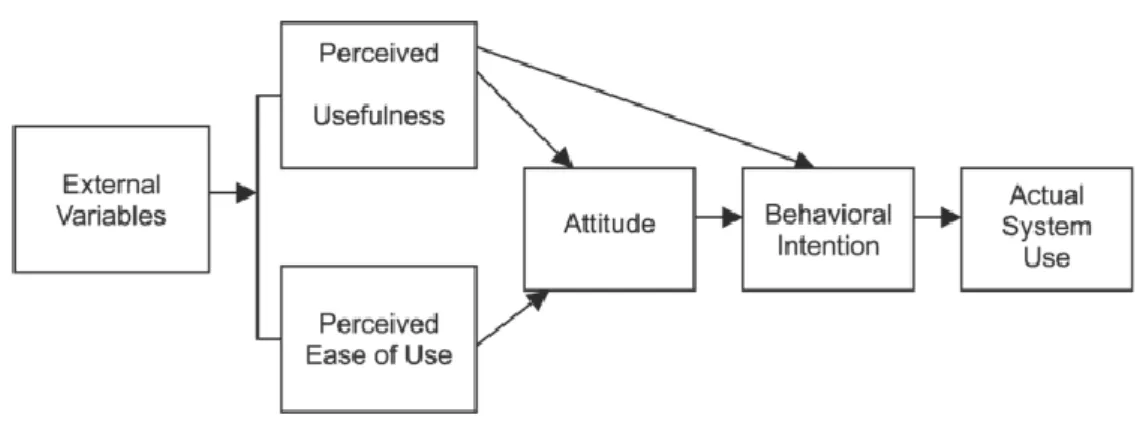
TAM is grounded in the Theory of Reasoned Action (Fishbein and Ajzen 1975) and Theory of Planned Behavior (Ajzen 1991) and based on two key determinants of perceived usefulness: “the degree to which a person believes that using a particular system would enhance his or her job performance” and perceived ease-of-use “the degree to which a person believes that using a particular system would be free of effort” (Davis 1989). Although models related to TAM are typically applied to technology adoption within the organization (Davis 1989), it has been applied as well to more general contexts relating to consumers’ adoption and usage of technology. Useful and easy-to-use technologies have a positive influence on a user’s future attitude and intention towards using the technology. Basically, people are more likely to use a system that is believed to help them perform better. However, even if a system is useful, if it is too difficult to use, the effort required to use it prevails the potential of enhanced performance benefits to be derived from the system. Based on TAM model, the system can be more useful when it is easier to use, thus, technology acceptance via perceived usefulness is directly influenced by ease-of-use (Davis 1989). Many empirical studies have tested the TAM model and confirmed that these factors do correlate with the usage of target system, thus, if the technology is useful and easy to use by the consumers, the acceptance of the technology is likely to be positive as well (Lu et al. 2003). Also, in the mobile domain, consumers who find mobile technology useful and easy to use are consumers who have more positive attitudes towards mobile marketing (Gao et al. 2012).
Figure 2.9: Technology Acceptance Model
2.5.5. Innovation Diffusion Theory (IDT)
The diffusion of new goods or standards is an object of interest in innovation as well as diffusion theory. Innovation Diffusion Theory is another theory that clarifies acceptance and intention to use technology. Rogers (1983) defines innovation diffusion theory as “the process by which innovation is communicated through certain channels over time among the members of a social system.” The diffusion process is considered to pass sequentially through knowledge, persuasion, decision, implementation and confirmation of the innovation (Chaudhuri 1994). In this regard, Rogers (1983) claims that the following five attributes of innovation influence the adoption of innovations; relative advantage, compatibility, complexity, trialability and observability.
Figure 2.10: Drivers of adoption of innovations
Source: Rogers,1983.
These five attributes are conceptually distinct but empirically interrelated with each other. Rogers (1983) defines relative advantage as “the degree to which innovation is perceived as being better than the idea it supersedes” such as economic profitability or in status giving. Relative advantage is one of the best predictors of an innovation’s rate of adoption as