C om mun.Fac.Sci.U niv.A nk.Series A 1 Volum e 66, N umb er 2, Pages 62–70 (2017) D O I: 10.1501/C om mua1_ 0000000801 ISSN 1303–5991
http://com munications.science.ankara.edu.tr/index.php?series= A 1
ON THE INVARIANTS OF RULED SURFACES GENERATED BY THE DUAL INVOLUTE FRENET TRIHEDRON
MUSTAFA B·IL·IC·I
Abstract. The purpose of this paper is to describe ruled surfaces generated by a Frenet trihedron of closed dual involute for a given dual curve. We identify relations between the pitch, the angle of the pitch, and the drall of these surfaces. Some new results related to the developability of these surfaces are also obtained. Finally, we illustrate these surfaces by presenting one example.
1. Introduction
Dual numbers were originally conceived by Cli¤ord in 1873 [13] as a tool for his geometrical investigations. However, their …rst application to mechanics was con-ceived by Study in 1901 [4]: Study used dual numbers and vectors in his research on the geometry of lines and kinematics. Since that time, there has been consid-erable research on dual numbers [2; 5; 8]: In recent years, dual numbers have been used to study the motion of a line in space. The pitches and the angle of pitches of closed ruled surfaces are very important in studying the geometry of lines. In the literature, the integral invariants of closed ruled surfaces corresponding to the parameter of dual spherical curves and oriented lines have been studied by several authors [1; 3; 6; 7; 9 12; 14]:
In this paper, we investigate the ruled surfaces generated by a Frenet trihedron of closed dual involute for a given dual curve by a …rmly connected dual angle between the dual binormal vector and dual Darboux vector of this dual base curve. We then identify the relations between the pitch, the angle of the pitch, and the drall of these surfaces. Some new results related to the developability of these surfaces are also obtained.
2. PRELIMINARIES
A dual number has the form a+"a , where a and a are real numbers and "2= 0. The set of all dual numbers, denoted by ID, is an associative ring with the unit
Received by the editors: June 20, 2016; Accepted: October 12, 2016.
2010 Mathematics Subject Classi…cation. Primary 47L50, 53A17; Secondary 53A25.
Key words and phrases. Ruled surface, dual involute-evolute, dual Frenet frame, dual numbers. c 2 0 1 7 A n ka ra U n ive rsity C o m m u n ic a tio n s d e la Fa c u lté d e s S c ie n c e s d e l’U n ive rs ité d ’A n ka ra . S é rie s A 1 . M a th e m a t ic s a n d S t a tis t ic s .
element 1. A dual vector is a triple of dual numbers. Hence, if!A is a dual vector, we may write!A = !a + "~a , where ~a and ~a 2 E3and " is the dual unit introduced
above. The set of all dual vectors is called the dual space, and is denoted by ID3.
The set ID3is a ID module over the ring ID.
The inner product of two dual vectors!A and!B is de…ned as D! A ;!B E = D !a ;!bE+ " D!a ;!b E+D!a ;!bE . (2.1) The cross-product of two dual vectors!A ;!B 2 ID3 is given by
!
A ^!B = !a ^!b + " (a ^ b + a ^ b) : (2.2) For!A 6= (0; a ) 2 ID module, the norm !A of!A is de…ned by
!A =rD!A ;!AE
= k!a k + " D
!a ;!a E
k!a k : (2.3)
Let be the dual angle between the unit dual vectors!A and!B . Then,
D!A ;!BE= cos = cos ' "' cos '; (2.4) where = ' + "' , 0 ' , and ' 2 R is a dual number. Here, the real numbers ' and ' are the angle and the minimal distance, respectively, between the two oriented lines !A and !B . The geometric region satisfying the equality
!A = (1; 0), where!
A 6= (0; a ), is called a dual unit sphere in the ID module. Study [4] established a theorem that states “there is a one-to-one mapping be-tween the dual points of a dual unit sphere and the oriented lines in R3”. According
to this theorem, the unit dual vector!A = !a + "!a corresponds to only one oriented line in R3, where the real part !a shows the direction of this line and the dual part
!
a shows the vectorial moment of the unit vector !a with respect to the origin. A di¤erentiable curve on the dual unit sphere represents a di¤erentiable family of straight lines in R3, which is called the ruled surface. This correspondence allows
us to study the properties of ruled surfaces within the geometry of dual spherical curves on a dual unit sphere. A di¤erentiable closed curve on the dual unit sphere represents a closed ruled surface in R3. Thus, in this paper, all of the curves we discuss are closed.
Now, suppose that V : I R ! ID3, s ! V (s) = V1(s) is a di¤erentiable unit
speed curve in the dual unit sphere. We denote the closed ruled surfaces generated by this curve as [V1]. Let fV1; V2; V3g be the moving dual Frenet frame of the curve
V = V1, with
V1= V; V2=
V0
Now, take V (s) as a closed curve with curvature (s) = k1+ "k1 and torsion
(s) = k2+ "k2. Then, the dual Frenet formulas may be expressed as [12] :
2 4 V 0 1(s) V20(s) V30(s) 3 5 = 2 4 0(s) (s)0 0(s) 0 (s) 0 3 5 2 4 VV12(s)(s) V3(s) 3 5 : (2.5)
In the unit dual spherical motion K=K0, the dual Frenet frame fV1; V2; V3g
per-forms a dual rotational motion around the instantaneous dual Pfa¤ vector. This vector is determined with the equation
= V1+ V3: (2.6)
De…nition 1. Let = + " be the dual rotation vector (instantaneous dual Pfa¤ vector) of the dual spherical motion. The vector
D = d + "d = I
(2.7) is called the dual Steiner vector of this dual spherical motion [6]:
Theorem 1. The dual angle of a closed ruled surface constructed by the dual unit vector V1 is given by [10] :
V1 = hD; V1i : (2.8)
Theorem 2. The dual angle of the pitch of a closed ruled surface can be given by:
V1= V1 "LV1; (2.9)
where LV1 and V1 are the pitch and the angle, respectively, of a closed ruled surface
[10]:
3. DUAL INVOLUTE FRENET TRIHEDRON
De…nition 2. Let ^ : I ! ID3 and ^ : I ! ID3 be dual unit speed curves. If the
tangent lines of the dual curve ^ are orthogonal to the tangent lines of the dual curve ^, then the dual curve ^ is said to be involute of the dual curve ^; equivalently, the dual curve ^ is said to be evolute of the dual curve ^. According to this de…nition,
hV1; R1i = 0; (3.1)
where V1is the tangent of the dual curve ^ and R1 is the tangent of the dual curve
^.
Theorem 3. Let ^, ^ be two dual curves. If ^ is involute of ^, we can write ^ (s) = ^ (s) + [(c s) + "d] V1(s) ; c; d 2 R.
Corollary 1. The distance between corresponding dual points of the dual curves ^ and ^ is = jc sj + "d.
Theorem 4. Let ^, ^ be two dual curves. If ^ is involute of ^, then the relationship between the dual Frenet vectors of the dual curves ^ and ^ can be given by
2 4 RR12 R3 3 5 = 2 4 cos0 10 sin0 sin 0 cos 3 5 2 4 VV12 V3 3 5 : (3.2)
The real and dual parts of R1, R2, R3 are
8 > > > > > > < > > > > > > : r1= v2 r2= cos'v1+ sin'v3 r3= sin'v1+ cos'v3 r1 = v2
r2 = cos'v1+ sin'v3+ ' (sin'v1+ cos'v3)
r3 = sin'v1+ cos'v3+ ' (cos'v1 sin'v3)
; (3.3)
where = ' + "' ; "2= 0 is the dual angle between the dual rotation vector
and dual binormal vector V3. Then, the following relations hold between the
vectors R1, R2, R3 and R01, R02, R03:
R01 = P R2 (3.4)
R02 = P R1+ QR3 ,
R03 = QR2
where P = p + "p and Q = q + "q are the curvature and torsion of the involute curve ^. If we separate these relations into dual and real parts, we get
8 > > > > > > < > > > > > > : r0 1= pr2 r0 2= pr1+ qr3 r0 3= qr2 r 0 1 = p r2+ pr2 r 0 2 = p r1+ pr1+ q r3+ qr3 r3 = q r2 qr2 : (3.5) Since P = k^ 0 ^^00k k^0 k3 , we have that P = p 2 + 2
. Using the formula Q = det(^
0
;^00;^000) k^0
^^00k2 ,
we …nd Q = 0. Separating P and Q into real and dual parts, we get 8 > > > > > < > > > > > : p = p k2 1+k22 k1 p = k2(k1k2 k1k2) k2 1 p k2 1+k22 q = 'k0 1 q = k1'0 k1'0 k2 1 . (3.6)
4. ON THE INVARIANTS OF RULED SURFACES GENERATED BY A DUAL INVOLUTE FRENET TRIHEDRON
In this section, we calculate the integral invariants of the closed ruled surfaces [R1], [R2], and [R3] that are kinematically generated by dual Frenet vectors of the
dual involute curve ^ given in Eq. (3.2).
In dual unit spherical motion, the dual orthonormal system fR1; R2; R3g
per-forms a dual rotational motion around the instantaneous dual Pfa¤ vector for all t 2 R. The dual rotation vector of this motion is determined by:
= QR1+ P R3: (4.1)
The dual Steiner vector relevant to the dual Frenet frame of the dual involute curve is D = R1 I Qds + R3 I P ds: (4.2)
If we separate (4.2) into its real and dual parts, we can write 8 > < > : d = r1 I qds + r3 I pds d = r1 I q ds + r1 I qds + r3 I p ds + r3 I pds : (4.3)
We now calculate the integral invariants of the closed ruled surfaces. The dual angle of the pitch of the closed ruled surface [R1] is given by
R1 = D; R1 :
Using Eq. (4.1), we have
R1 = I Qds; (4.4) R1 = I qds " I q ds: (4.5)
Substituting the values of q and q in (3.6) into Eq. (4.5), we obtain
R1 = I '0 k1 ds " I k1' 0 k1'0 k2 1 ds: (4.6)
Corollary 2. The angle of pitch and the pitch of the closed ruled surface [R1] are R1= I '0 k1ds and LR1 = I k1'0 k1'0 k2 1 ds, respectively. The drall of the closed ruled surface [R1] is
R1=
hdr1; dr1i
hdr1; dr1i
; which, using the values of dr1and dr1 in Eq. (3.5), gives
R1 =
p
Corollary 3. The closed ruled surface [R1] generated by R1 is developable if and
only if p = 0 (i.e. the dual curvature is a pure real number).
Using the values of p and p in (3.6) into the last equation, we get
R1=
k2(k1k2 k1k2)
k1(k12+ k22)
: (4.8)
Theorem 5. The closed ruled surface [R1] which generated by R1 is developable if
and only if k2= 0 or kk2
1 =
k2
k1.
The dual angle of the pitch of the closed ruled surface [R2] is R2= D; R2 :
Thus, using Eq. (4.1), we get
R2= 0: (4.9)
Corollary 4. The angle of pitch and the pitch of the closed ruled surface [R2] are R2= 0 and LR1 = 0, respectively.
The drall of the closed ruled surface [R2] is R2=
hdr2; dr2i
hdr2; dr2i
:
Using the values of dr2and dr2 given by Eq. (3.5), we have R2 =
pp + qq
p2+ q2 : (4.10)
Corollary 5. The closed ruled surface [R2] generated by R2 is developable if and
only if qp = pq.
Substituting the values of p, p , q, and q in (3.6) into the previous equation, we get
R2 =
k2(k1k2 k1k2) + '0(k1' 0 k1'0)
k1 k12+ k22+ '0
2 : (4.11)
Theorem 6. The closed ruled surface [R2] generated by R2 is developable if and
only if k2(k1k2 k1k2) + '0(k1' 0 k1'0) = 0:
The dual angle of the pitch of the closed ruled surface [R3] is R3= D; R3 :
Using Eq. (4.1), we get
R3 =
I
R3=
I
pds " I
p ds: (4.13)
Substituting the values of p and p in (3.6) into Eq. (4.13), we have
R3 = I p k2 1+ k22 k1 ds " I k2(k1k2 k1k2) k2 1 p k2 1+ k22 ds: (4.14)
Corollary 6. The angle of pitch and the pitch of the closed ruled surface [R3] are R3= I p k2 1+k22 k1 ds and LR1 = I k2(k1k2 k1k2) k2 1 p k2 1+k22 ds, respectively. The drall of the closed ruled surface [R3] is
R3=
hdr3; dr3i
hdr3; dr3i
; which, using the values of dr3and dr3 in Eq. (3.5), gives
R3=
q
q : (4.15)
Corollary 7. The closed ruled surface [R3] generated by R3 is developable if and
only if q = 0 (i.e. the dual torsion is a pure real number).
Substituting the values of q and q in Eq. (3.6) into the previous equation, we obtain
R3=
k1' 0 k1'0
k1'0
: (4.16)
The closed ruled surface [R3] generated by R3is developable if and only if kk11 =d'd'.
Example 1. Let us consider the dual space curveb (s) = (0; 0; 1)+" (sins; cos s; 0) and its tangent
V1(s) = (0; 0; 1) + " (sins; cos s; 0) :
From the Theorem 3, we have
b (s) = (0; 0; 1 + (c s)) + " (sins + (c s) sin s; cos s (c s) cos s; d) ; c; d R as an involute of b with tangent vector
R1(s) = (0; 0; 1 + c s) + " (sins + (c s) sin s; cos s (c s) cos s; d) ;
the corresponding ruled surface has the following parametrization
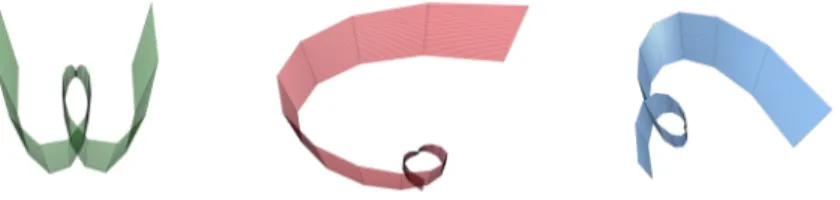
[R1] = (1 + c s) (cos s + (c s) cos s; sin s + (c s) sin s; 0) + v (0; 0; 1 + c s)
Figure 1. Some ruled surfaces generated byR1from left the right for
c = 1; 0; 1:
5. CONCLUSIONS
Closed curves and ruled surfaces are important and e¤ective tools for studying spatial kinematics. In this study, we have characterized the closed ruled surfaces [R1], [R2], and [R3] that are kinematically generated by the dual involute Frenet
trihedron. We have found the integral invariants of these closed ruled surfaces in terms of the curvatures of an involute curve, evolute curve, and dual Darboux angle . Furthermore, we stated some interesting results related to the developability of these surfaces. It is hoped that this study will provide the impetus for new studies and contribute to the study of spatial mechanisms.
References
[1] Kücük, A. Gürsoy, O., On the invariants of Bertrand trajectory surface o¤sets, App. Math. and Comp. 151 (2004), 763–773.
[2] Yang, A. T. and Freudenstein,F., Application of dual-number quaternion algebra to the analysis of spatial mechanisms. J. Appl. Mech. 31 (1964),300–308.
[3] Özyilmaz, E. and Yayli, Y., On the integral invariants of a time-like ruled surface, Math. Comput. Appl. 6 (2001), 137–145.
[4] Study, E., Geometrie der Dynamen. Verlag Teubner, Leipzig, 1903.
[5] Veldkamp, G. R., On the use of dual numbers, vectors, and matrices in instantaneous, spatial kinematics. Mech. and Mach. Theory. 11 (1976), 141–156.
[6] Hac¬saliho¼glu, H.H., On the pitch of a closed ruled surfaces. Mech. and Mach. Theory. 7 (1972), 291–305 .
[7] Hac¬saliho¼glu, H.H., MovingGeometry and Quaternion Theory. Publishings of Science and Art Faculty of Gazi University, Ankara-Turkey, 1983.
[8] Müller, H. R., Über geschlossene bewegungs vorgange, Monatsh. Math. 55 (1951), 206–214. [9] Gürsoy, O., On the integral invariants of a closed ruled surface, J. of Geom. 39 (1990), 89–91. [10] Gürsoy, O., The dual angle of pitch of a closed ruled surface, Mech. and Mach. Theory. 25
(1990), 131–140.
[11] Köse, Ö., Contribution to the theory of integral invariants of a closed ruled surface, Mech. and Mach. Theory. 32 (1997), 261–277.
[12] Köse, Ö., Nizamo¼glu, ¸S. and Sezer, M. An explicit characterization of dual spherical curves, Do¼ga Turkish J. Math. 12 (1988), 105–113.
[13] Cli¤ord, W. K. Preliminary sketch of biquaternions. Proc. London Math. Soc. 4 (1873), 381– 395.
[14] Yayl¬, Y. and Saraço¼glu, S. Ruled surfaces and dual spherical curves, Acta Univ. Apulensis. 30 (2012), 337–354.
Current address : Ondokuz May¬s University, Educational Faculty, Department of Mathematics 55200 Atakum, Samsun, TURKEY.