Yayınlayan: Ankara Üniversitesi KASAUM
Adres: Kadın Sorunları Araştırma ve Uygulama Merkezi, Cebeci 06590 Ankara
Fe Dergi: Feminist Eleştiri 10, Sayı 1
Erişim bilgileri, makale sunumu ve ayrıntılar için: http://cins.ankara.edu.tr/
Female Genital Mutilation in Tanzania: Re-examining Women’s Position in Society
Josephine Shabani, Gemma Todd
Çevrimiçi yayına bsaşlama tarihi: 1 Haziran 2018
Bu makaleyi alıntılamak için: Gemma Todd, Josephine Shabani “Female Genital Mutilation in Tanzania: Re-examining Women’s Position in Society,” Fe Dergi 10, no. 1 (2018), 120-138.
URL: http://cins.ankara.edu.tr/19_11.pdf
Bu eser akademik faaliyetlerde ve referans verilerek kullanılabilir. Hiçbir şekilde izin alınmaksızın çoğaltılamaz.
Josephine Shabani*Gemma Todd*
Much discussion has been raised worldwide on Female Genital Mutilation and/or Cutting (FGM/C), however, there is a need to understand the impact of FGM/C for girls and women. This paper focuses on the practice, and experiences, of FGM/C in Tanzania. This paper uses Tanzania’s 2016 Demographic and Health Survey to analyse two key objectives: 1) who is at risk of FGM and potentially why; and 2) what are the future outcomes if one conducts FGM: what relationships do they enter into and what socio-economic status is obtained? The results show 10.48% of women interviewed had experienced FGM/C. The majority of these cases are conducted at a young age (51% below eight years old); and by traditional circumcisers (65%). Secondly, the experience of FGM was highest for women residing in rural areas; with no education; from the poorest socio-economic group; and from the Central-Northern regions including Manyara, Arusha, Singida, Dodoma and Mara. A key contribution made by this paper is identifying the associations to future life outcomes: FGM/C experience was associated to particular relationships later in life, and with particular partners. The findings raise the need for engagement of practitioners, policy makers and community members, of different levels to engage in the movement to stopping FGM.
Keywords: Female genital mutilation, Tanzania Demographic Health Survey, Life-course approach, women, girls, violence
Tanzanya'da Kadın Sünneti: Kadınların Toplumdaki Konumunun Yeniden Değerlendirilmesi Kadın Sünneti hakkında birçok küresel tartışma yapılmıştır; ancak, kadın sünnetinin kadınlar ve kızlar üzerindeki etkilerine bakmak gereklidir. Bu makale, Tanzanya’da kadın sünneti pratiğine ve deneyimlerine odaklanır. Makale, Tanzanya’nın 2016 Demografi ve Sağlık Anketi’ni iki amaç çerçevesinde analiz etmektedir: 1) Kimler kadın sünneti açısından risk altındadır ve neden?; ve 2) kadın sünneti pratiği sonrasında gelecek sonuçlar nelerdir?: Bu kadınlar ne gibi ilişkilere girerler ve ne gibi sosyo-ekonomik statüler kazanırlar? Sonuçlar, görüşülen kadınlardan %10,48’nin kadın sünneti deneyimine sahip olduğunu göstermiştir. Bu vakaların çoğunluğu genç yaşta gerçekleşmiş (%51’i sekiz yaşın altında); ve geleneksel sünnetçiler tarafında yapılmıştır (%65). İkinci olarak, kadın sünneti deneyimi kırsal bölgelerde yaşayan kadınlarda ve Manyara, Arusha, Singida, Dodoma ve Mara’yı da kapsayan, Orta ve Kuzey bölgelerinde en yüksektir. Bu makalenin Temel katkılarından birisi, kadın sünnetinin gelecek hayat açısından sonuçlarının belirlenmesi hususundadır: kadın sünneti deneyimi sünnetten sonraki hayatta vuku bulan belirli ilişkiler, özellikle de belirli partnerlerle olan ilişkiler ile bağdaştırılmaktadır. Sonuçlar, uzmanların, politika yapıcıların ve farklı düzeylerdeki toplum üyelerinin kadın sünnettini engelemek için hareket etmeleri gerekliliğini işaret etmektedir.
Anahtar Kelimeler: Kadın sünneti, Tanzanya Demografi ve Sağlık Anketi, yaşam seyri yaklaşımı, kadın, kızlar, şiddet
Introduction
“Female Genital Mutilation (FGM) comprises all procedures involving partial or total removal of the external female genitalia or other injury to the female genital organs for non-medical reasons” (WHO, UNICEF, UNFPA, 1997). Four types of FGM have since been classified (see WHO, 2017). Much discussion has been raised worldwide on FGM and/or Cutting (FGM/C), discussing the foundations of the practices’ emergence and legality. However, there is a need to understand in greater depth the impact of FGM/C for girls and women. International figures show in 2015 around 125 million girls and women, across 29 countries across Africa
*İfakara Health İnstitute, Dar es Salaam IHI
919,000 reported in countries such as Uganda and Togo. Tanzania was reported to have about 15% of women and girls (equivalent to 7.9 million) to have undergone the procedure. It was also reported that women aged between 45-49 were more likely to have been cut than girls aged 15-19 years of age, suggesting a decline in practice (ibid). However, mixed results are emerging. Tanzania’s Demographic and Health Survey (TDHS) of 1996 reported a prevalence of 18% which dropped to 15% in 2004 (TDHS, 2004). The data showcases the prevalence of the practice; but how more investigation is required into the numbers and experiences.
This paper focuses on the practice, and long-lasting experiences. Utilising Tanzania’s most recent TDHS (2015/16) analysis is drawn with two key objectives. Firstly, what is the prevalence of FGM/C; and who is most at risk? Secondly, what is the impact of FGM/C; with impact being evaluated across ones’ life-course, the relationships they end up in and decision-making behaviours? Much of the focus on FGM focuses on the prevalence and reasons for its continued practice, however, limited analysis has been conducted on the impact on future life courses.
In Tanzania, the historical roots of FGM/C are unclear, however, a resurgence was noted in the 1980s linked to the belief the practice would enhance social status and marriage prospects for young girls at a time when there was a declining economic value, and social status, attached to education (Nypan, 1991). FGM/C became illegal in 1998, when an amendment to the Tanzanian Sexual Offences (Special Provision Act) penal code, prohibited the practice. FGM is thus criminalised and punishable by law; however, as Yusuf and Fessha (2013) show Tanzania’s Constitution foundations fails to offer full protection to women: the right to health and probation of harmful practices is not stated. Furthermore, the Law of the Child (2009), legalizes, within Tanzania’s national legal framework, the obligation to protect children and sets standards for children to be able to live healthy, free and safe lives. The Law identifies who are vulnerable children and when to intervene . The Law has four key principles for ensuring this: 1) ensuring the ‘best’ interests of the child; 2) ensuring children participate in decision-making; 3) ensuring no discrimination; and 4) ensuring children have a right to privacy.
Alongside the legal barriers presented, Tanzania has ratified a number of international conventions rejecting the practice, such includes: Convention on the Elimination of All Forms of Discrimination against Women (CEDAW); the UN Convention on the Rights of the Child (CRC) (1991); the African Charter on the Rights and Welfare of the Child (1993); Maputo Protocol on the Rights of Women in Africa; Protocol of the African Charter on Human and People’s Rights. Tanzania has also been identified as a ‘Pathfinder country’, a key partner country that will introduce, lead, design and implement, strategies to ensure children live in a context free of violence by 2030. The pathfinder countries will be “champions” for children (SDG, 2015); and children’s wellbeing has been set on the political agenda (see Global Partnership to End Violence against Children, 2017). Complying with international guidelines, Tanzania follows the obligation of ensuring all children have the right to be protected, to survive, develop and be treated with dignity. However, contradictions continue to emerge in Tanzania’s approach to child development and protection. McAlpine (2008) shows contradictions are found in how Tanzania defines the ‘child’ and therefore what protection is granted to children, particularly articulated in employment, family care, sexual exploitation and constitutional rights. Violence against children remains prevalent across Tanzania; perpetuated by a limited understanding of child rights, socio-cultural practices, and a lack of governmental capacity to effectively deal with cases of child abuse (TCRF, 2013). The practice of FGM, for example, remains common. Additionally, reports from NGOs suggest that the practice is now being conducted at a later date: post-18 years of age, where the practice is not ‘illegal’ (GIZ, 2011). The contradictions of law, and dichotomy between local cultural traditions and legal practice, is well recognised (see Boyle et al, 2001).
From this context, a number of concerns can be raised as to why the practice continues in Tanzania; what can help in stopping it; and how can children and women get accountability for the lack of rights? Such inquiries go beyond the scope of this paper; however, the paper raises key findings to understand the social-side of the practice. The practice is linked to social and power dynamics, placing it in this context, we can begin to understand more about who is at risk and what the future implications are. This paper shows that FGM is practiced to 1) mark socio-economic class and limit female mobility (the mobility refers to accessing education and tools of empowerment); 2) mark cultural norms, at the household level; and 3) mark the transition into marriage and/or union. The types of unions is explored and defined. The paper is divided into five sections. This introduction is followed by a methodological section; presentation of results; and discussion, concluding on the need for a new gender lens in tackling FGM/C
Methodology
This study uses Tanzania Demographic and Health Survey (TDHS) data which is collected every five years, incorporating a large sample size of women and men aged 15-49 years; and concerning a range of issues from maternal mortality, alcohol consumption, migration, circumcision, to health-related behaviours (see DHS, 2015/16). Stata (SE v14) and Geographic Information Systems (ARC GIS v12) were used to answer the stated objectives. Logistic regression models were also used to find the risks associated with FGM/C by various socio-demographic characteristics using Stata.
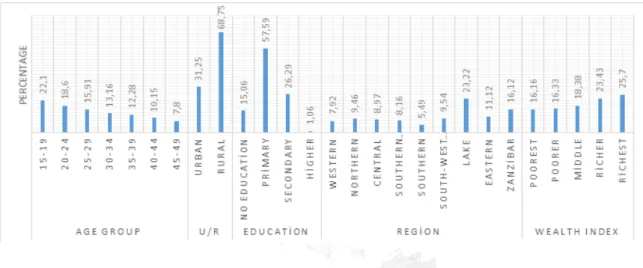
In 2015/16 special surveys were conducted on FGM/C. Figure 1-2 shows the geographic locations of where they were conducted; Figure 3 shows the demographic profiles of respondents who took part.
Figure 1 and 2: Maps showing GPS location Tanzania DHS survey 2015/16 (by region and residence).
Source: Authors Own, based on GPS data from TDHS (2015/16).
This paper focuses on the prevalence of FGM and the root causes; and questions about the long-term outcomes. The research questions includes:
1)Is there a relationship between respondent circumcision and individual or household characteristics at the time of interview? Characteristics include region, type of residence (urban/rural), highest education level, sex of household head, age of household head, and wealth index. The question here concerns the background of females being circumcised.
Is there a relationship between circumcision and future life outcomes and/or behaviors? Future life-outcomes and behaviors include actions conducted following circumcision, such as: family planning choices, marriage status and structure, children and reproduction, sexual lifestyles, health-related behaviors and the husband or partners character. The question here is linked to gender empowerment literature questioning, what happens next? By going through circumcision are the women more likely to go into abusive relationships or develop ‘negative’ lifestyle behaviors?
Results
During the 2015/16 TDHS, 13634 interviews were conducted with women of reproductive age across Tanzania. Demographic profiles of participants is shown in Figure 3. Overall, a majority of respondents were from rural residences (68.37% Vs 31.63% urban residence), and a higher proportion aged 35-39 years. More than half of the people interviewed had primary education (56.57%) while only 1% had higher education. A fairly equally wealth quintile distribution is found with participants ranging from 16.16% poorest to 25.70% richest wealth quintile. Apparently, Lake Zone had majority of respondents (23.22%) one of the reasons is Lake Zone represents more regions compared to other zones.
Figure 3: Demographic characteristics of 2015/16 DHS (Percentage of total interviews, 2dp).
Source: TDHS (2015/16). N.B. The Wealth Index is based on the DHS household data collected, including ownership of assets, household construction material, and the type of water access and sanitation facilities. The Index is a composite measure of a household’s cumulative living standard. See DHS (2017) and Rutsein and Johnson (2004) for further details on the Wealth Index construction.
FGM/C practices in Tanzania
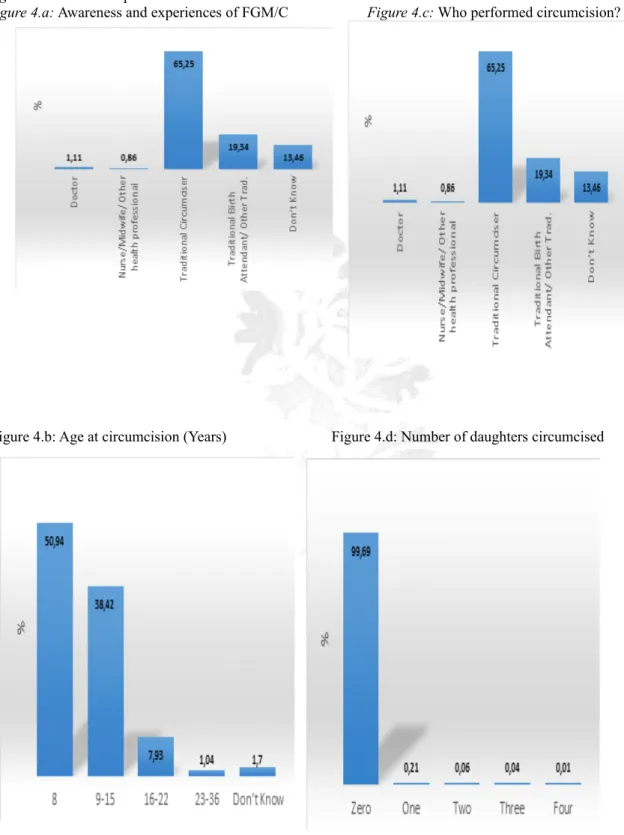
The results from TDHS 2015/16 shows that about 80% of women had heard of female circumcision (FC), while only 21.81% had heard about genital cutting (GC); but only 10.48% having (declared) to experience it. The analysis shows that, out of the 10.48% of women who had experienced FGM/C had undergone different types of FGM/C with the most common type being the ‘removal of flesh from the genital area’ (87.39%)-Figure 4.a. FGM/C is conducted during younger ages, particularly among girls in infancy stages categorically aged 0-8 years (50.94%)- Figure 4b;violating the Law of the Child (2009) and Tanzania’s status as a ‘pathfinder’ country for combating child violence. The main actor conducting the procedures are ‘Traditional Circumcisers’ (Figure 4c). However, a majority of respondents (99.7%) stated they had not had their daughter circumcised, with 95% believing the practice should be stopped (Figure 4d; 4e). This may be due to legal changes, declaring FGM to be illegal practice under the Sexual Offences Special Provision Act of 1998 (URT, 1998), or identify changing perceptions of the practice. Respondents were not asked if they had the intention to circumcise their own daughters in the future.
Figure 4a-4e: FGM/C practices in Tanzania
Figure 4.a: Awareness and experiences of FGM/C Figure 4.c: Who performed circumcision?
Figure: 4.e: Should FGM be stopped or continue?
Source: TDHS (2015/16). FGM/C risks in Tanzania
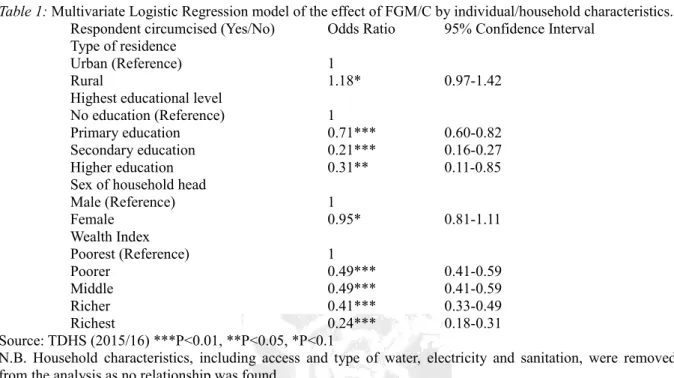
Part one of the analysis identified the proportion of women who experienced FGM, their demographic profiles; the age at which it is conducted, and means of conduction. This section of the analysis focuses on assessing the effect of FGM/C on various factors like individual, economic, household, future life outcomes and behaviours using logistic regression models as presented in Table 2.
Regarding type of residence, the results shows that the odds of being circumcised is 18% higher if you are staying in rural than being in urban (OR=1.18). Non-educated women are the most likely to be circumcised: risk reduced by 29% for primary education holders; 79% for secondary education holders; and 69% for higher education holders, comparing to non-educated woman. This may be due to mobility of girls during the school period.
In addition to type of residence and educational level, odds-ratios vary based on the sex of household head and wealth index. The chances of FGM/C is reduced by 5% if you are staying in the house that is headed by a female compared to a male headed-household. There is also an increased risk in circumcision for the ‘poorest’ wealth index group. A female was 51% less likely to be circumcised if she is from poorer or middle-income household; 59% less likely being from a richer household; and 76% less likely if the woman is from the richest family/household, compared to the poorest household (Table 2). Such suggest the prevalence FGM/C in Tanzania is a matter of economic class, social status and education, and cultures within households. Household and individual factors influence risk. With risk highest among male headed-households, rural residence, and the poorest wealth quintiles, we can interpret how household factors and cultures associated with location and poverty, limit a woman’s mobility to escape FGM/C. Secondly, with woman of no education at highest risk, we can interpret the gender power dynamics at play – limited access to education minimises resistance to the practice and the value placed on what the woman can achieve.
Table 1: Multivariate Logistic Regression model of the effect of FGM/C by individual/household characteristics. Respondent circumcised (Yes/No) Odds Ratio 95% Confidence Interval
Type of residence
Urban (Reference) 1
Rural 1.18* 0.97-1.42
Highest educational level
No education (Reference) 1
Primary education 0.71*** 0.60-0.82
Secondary education 0.21*** 0.16-0.27
Higher education 0.31** 0.11-0.85
Sex of household head
Male (Reference) 1 Female 0.95* 0.81-1.11 Wealth Index Poorest (Reference) 1 Poorer 0.49*** 0.41-0.59 Middle 0.49*** 0.41-0.59 Richer 0.41*** 0.33-0.49 Richest 0.24*** 0.18-0.31 Source: TDHS (2015/16) ***P<0.01, **P<0.05, *P<0.1
N.B. Household characteristics, including access and type of water, electricity and sanitation, were removed from the analysis as no relationship was found.
Geographical variations in FGM/C
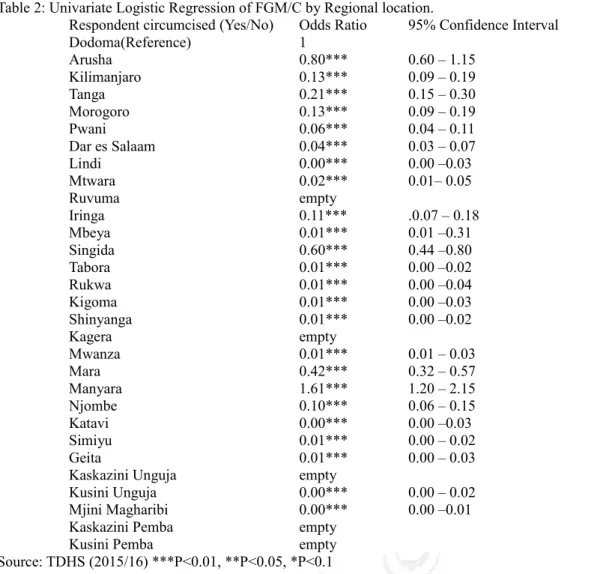
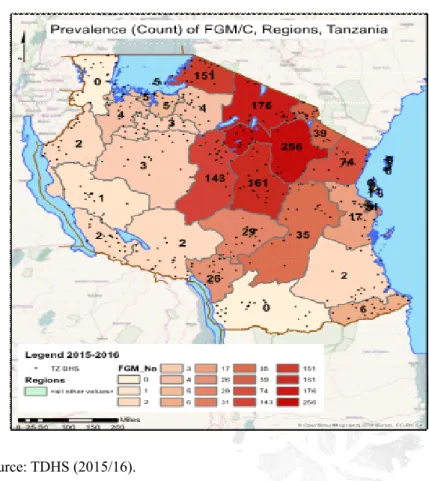
A geographical imbalance is also prevalent in FGM/C (Table 2). With Dodoma being a reference category, there was a higher likelihood of a woman being circumcised if from Manyara region compared to women staying in Dodoma region. However, compared to Dodoma, risk of FGM/C reduces by 20% for females from Arusha; 40% for Singida, and 58% for Mara. Figure 5 maps the regional variations in FGM/C. A previous DHS report states that the residential and regional variations in FGM reflect ethnic differences1 and the spread of advocacy
campaigns (DHS, 2004). Although ethnicity is not recorded in the TDHS, taking the six regions with the highest FGM/C prevalence (Table 3 and Figure 5: Manyara, Dodoma, Arusha, Singida, Mara and Tanga), some of the main ethnic groups within these regions with a higher prevalence of FGM include the Rangi and Sandawi (Dodoma region); the Waarusha (Arusha region), Hazabe (Manyara region) and the Simbiti, Rieny, Ugu, Bakabwa, Kine, Natta, Zanaki, Kiroba and Tatiro (Mara region). Greater knowledge of FGM is found amongst women from the Northern Zones (i.e. Maasai and Chagga), Eastern (i.e. Dar es Salaam) and Central Zones (i.e. Gogo), compared to Southern regions (ibid; and Winterbottom et al, 2009). This is also where a number of advocacy campaigns have been based, with NGOs and civil-society mainly based in urban areas and targeting areas with Masaai, due to FGM being common practice and symbolic of the rite of passage to womanhood (Winterbottom et al, 2009; Msuya et al, 2002). However, such raises a question as to whether women in these areas are more likely to confirm they have experienced FGM, due to their education on the practice?
Table 2: Univariate Logistic Regression of FGM/C by Regional location.
Respondent circumcised (Yes/No) Odds Ratio 95% Confidence Interval
Dodoma(Reference) 1 Arusha 0.80*** 0.60 – 1.15 Kilimanjaro 0.13*** 0.09 – 0.19 Tanga 0.21*** 0.15 – 0.30 Morogoro 0.13*** 0.09 – 0.19 Pwani 0.06*** 0.04 – 0.11 Dar es Salaam 0.04*** 0.03 – 0.07 Lindi 0.00*** 0.00 –0.03 Mtwara 0.02*** 0.01– 0.05 Ruvuma empty Iringa 0.11*** .0.07 – 0.18 Mbeya 0.01*** 0.01 –0.31 Singida 0.60*** 0.44 –0.80 Tabora 0.01*** 0.00 –0.02 Rukwa 0.01*** 0.00 –0.04 Kigoma 0.01*** 0.00 –0.03 Shinyanga 0.01*** 0.00 –0.02 Kagera empty Mwanza 0.01*** 0.01 – 0.03 Mara 0.42*** 0.32 – 0.57 Manyara 1.61*** 1.20 – 2.15 Njombe 0.10*** 0.06 – 0.15 Katavi 0.00*** 0.00 –0.03 Simiyu 0.01*** 0.00 – 0.02 Geita 0.01*** 0.00 – 0.03
Kaskazini Unguja empty
Kusini Unguja 0.00*** 0.00 – 0.02
Mjini Magharibi 0.00*** 0.00 –0.01
Kaskazini Pemba empty
Kusini Pemba empty
Source: TDHS (2015/16) ***P<0.01, **P<0.05, *P<0.1 Figure 5: Prevalence of FGC/M by Region, Tanzania, 2015/16.
Source: TDHS (2015/16).
Relationship between FGM/C and other demographic and socio-economic factors
Table 3 shows regression results between women who have been circumcised and the type of relationship they enter. With respect to marital status and marriage structure, women who are living with partners are less likely to be circumcised compared to women who have never been in a union. Women categorised as: ‘married’, ‘widowed’, ‘divorced’ and ‘no longer living together/separated’, were dropped in the analysis as there was no risk of circumcision when in these marital status’. Unmarried women (never been in a union) were more likely to be circumcised. However, this could be a factor of age – with a number of the women being too young to have married; or alternatively, it could provide a reflection on the type of women who are circumcised. With cultural reasons such as ‘making you more eligible for marriage’ being stated as a reason to undergo FGM, why have a higher portion of circumcised women not been in a union?
In addition, the results show that a woman whose husband/partner is staying elsewhere have a 32% higher risk of being circumcised, compared to the woman that are currently living with their husbands/partner. Such results need to be seen with reference to the number of wives a male partner/husband has; and the decision-making process of circumcision: FGM/C may reflect a family, or broader household, decision. More so, questions could be raised on why the husband/partner is living elsewhere – work, education, polygamy? Women who were involved in a polygamous relationship, including at least three other wives show an increase in likelihood of FGM/C. The likelihood of circumcision rises and peaks at having three wives (Table 3).
Table 3: Multivariate Logistic Regression Model on the effect of FGM/C by marital status/ marriage structure.
Respondent circumcised (Yes/No) Odds Ratio 95% Confidence Interval
Current marital status
Never in union (Reference) 1.00
Living with partner 0.61*** 0.50-0.73
Currently residing with husband /partner
Living with her (Reference) 1.00
Staying elsewhere 1.32** 1.03-1.70
Number of other wives
No other wives (Reference) 1.00
1 1.21** 1.00-1.46 2 2.10*** 1.47-2.99 3 5.10*** 2.64-9.86 4 1.47 0.42-5.20 6 empty 9 empty Don’t know 0.63 0.25-1.58 Source: TDHS (2015/16) ***P<0.01, **P<0.05, *P<0.1
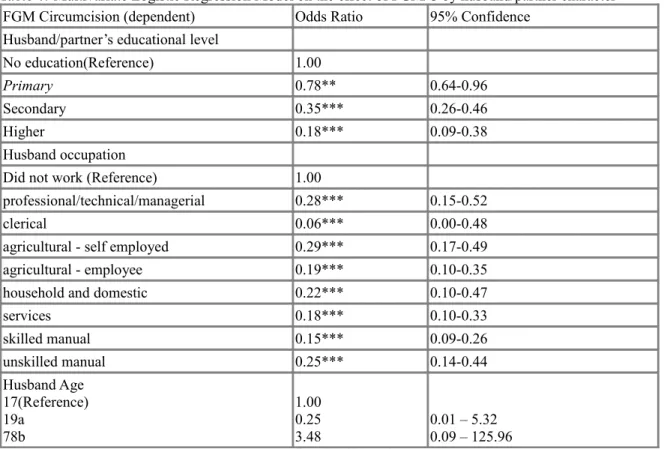
Building on this, Table 4 showcase results on what kind of background the men (partners and husbands) come from decision-making in the household and justification of beating. With respect to the husband or partner character or background (Table 4), the results show that the respondents who have partners with no education (reference group) FGM/C is higher compared to partners with primary education (22% less likely to be circumcised) and higher education (82% less likely). Husbands with no work (reference group) had the highest odds ratio of circumcision; with FGM/C comparatively reduced when the respondent is having a husband who is working somewhere. Although there is not much variation in the risk across the occupation groups (Table 4), except for if a husband is working in a clerical job whereby the women is 94% less likely to be circumcised compared to when the woman is not circumcised. However, such results need to recognise the distribution of partners across these occupation groups (Figure 6).
Table 4: Multivariate Logistic Regression Model on the effect of FGM/C by husband/partner character
FGM Circumcision (dependent) Odds Ratio 95% Confidence
Husband/partner’s educational level
No education(Reference) 1.00
Primary 0.78** 0.64-0.96
Secondary 0.35*** 0.26-0.46
Higher 0.18*** 0.09-0.38
Husband occupation
Did not work (Reference) 1.00
professional/technical/managerial 0.28*** 0.15-0.52
clerical 0.06*** 0.00-0.48
agricultural - self employed 0.29*** 0.17-0.49
agricultural - employee 0.19*** 0.10-0.35
household and domestic 0.22*** 0.10-0.47
services 0.18*** 0.10-0.33 skilled manual 0.15*** 0.09-0.26 unskilled manual 0.25*** 0.14-0.44 Husband Age 17(Reference) 19a 78b 1.00 0.25 3.48 0.01 – 5.32 0.09 – 125.96 Source: TDHS (2015/16) ***P<0.01, **P<0.05, *P<0.1
Highest odds ratio significance =a (n.b. excludes ‘Don’t Know’ response or ‘Other’) Lowest odds ratio significance = b (n.b. excludes ‘Don’t Know’ response or ‘Other’) Figure 6: Bar Graph showing Husband/Partner Occupation, (Grouped) 2015/16.
Source: TDHS (2015/16).
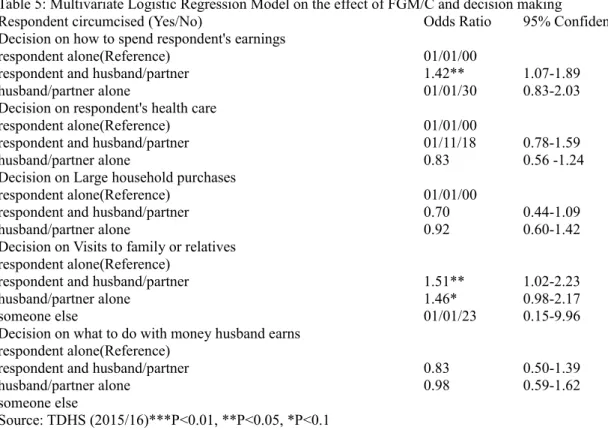
The results in Table 5 show no clear relationship between decision-making power and FGM/C. The results reveal that the likelihood of being circumcised is 42% higher if the decision on how to spend respondent's earnings is done by respondent and husband/partner compared to when this decision is done by the respondent
decision on visits to family or relatives, the results show that the likelihood of being circumcised is 51% higher for respondents whose decision on visits to family or relatives is done by respondent and husband/partner compared to when this decision is done by the respondent alone. Similarly, the likelihood of a woman being circumcised is 46% higher for respondents whose decision on visits to family or relatives is done by husband/partner alone compared to if the decision on visits to family or relatives is done by respondent alone. Although no clear patterns or trends are shown, the results in Table 6 shows circumcision is higher in scenarios where decision-making is done together (husband and respondent) or by the husband alone. This raises issue over the type of relationships women, who have experienced circumcision, enter: their empowerment, voice, and decision-making power within the relationship.
Table 5: Multivariate Logistic Regression Model on the effect of FGM/C and decision making
Respondent circumcised (Yes/No) Odds Ratio 95% Confidence
Decision on how to spend respondent's earnings
respondent alone(Reference) 01/01/00
respondent and husband/partner 1.42** 1.07-1.89
husband/partner alone 01/01/30 0.83-2.03
Decision on respondent's health care
respondent alone(Reference) 01/01/00
respondent and husband/partner 01/11/18 0.78-1.59
husband/partner alone 0.83 0.56 -1.24
Decision on Large household purchases
respondent alone(Reference) 01/01/00
respondent and husband/partner 0.70 0.44-1.09
husband/partner alone 0.92 0.60-1.42
Decision on Visits to family or relatives respondent alone(Reference)
respondent and husband/partner 1.51** 1.02-2.23
husband/partner alone 1.46* 0.98-2.17
someone else 01/01/23 0.15-9.96
Decision on what to do with money husband earns respondent alone(Reference)
respondent and husband/partner 0.83 0.50-1.39
husband/partner alone 0.98 0.59-1.62
someone else
Source: TDHS (2015/16)***P<0.01, **P<0.05, *P<0.1
In addition to decision-making in the relationship, the relationship concerning FGM/C and women’s empowerment, based on the type of relationships circumcised women enter, is shown in Table 6. As with all the TDHS results, the response is based on what the respondent declares. The likelihood for circumcision was higher in all domestic abuse justification scenarios. Firstly, the likelihood of the respondent being circumcised is 23% higher for women who justified the reasons for being beaten by their spouses being ‘the wife goes out without telling a partner/husband’; 19% higher for women who justified the reasons for being beaten by their spouses as ‘neglecting their children’; and 25% higher for women who justified the reasons for being beaten by their spouses as ‘arguing with husbands’, compared to the counters. The risk likelihood rises further for women who justified the reasons for being beaten by their spouses as the ‘wife refuses to have sex with husband’ (51%); or ‘burning the food’ (51%), compared to counters.
Table 6: Multivariate Logistic Regression Model on the effect of FGM/C and justification of beating
Respondent circumcised (Yes/No) Odds Ratio 95% Confidence
wife goes out without telling husband No(Reference)
Yes 1.23** 1.03-1.48
Wife neglects children No(Reference)
Yes 1.19* 0.98-1.43
Wife argues with husband No(Reference)
Yes 1.25** 1.04-1.51
wife refuses to have sex with husband No(Reference)
Yes 1.51*** 1.26-1.80
wife burns food No(Reference)
Yes 1.22** 1.03-1.44
Source: TDHS (2015/16) ***P<0.01, **P<0.05, *P<0.1
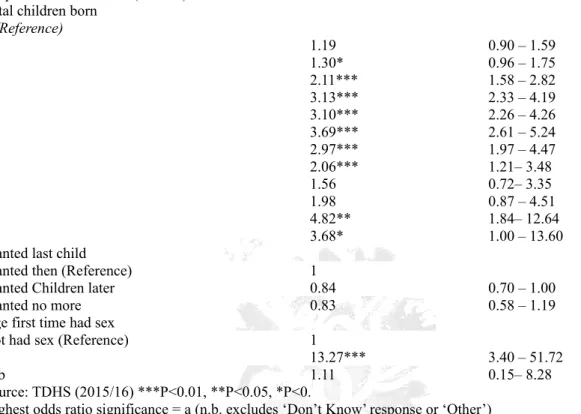
The final component is looking at the link between family planning, family size, and circumcision. Table 7 shows that the likelihood of being circumcised is higher for respondents’ with more than one child. For example, the odds of being circumcised is two times higher for respondents who have four children compared to respondents with one child; and 5 times higher for respondents who have twelve children compared to respondents with 1 child. Table 7 also shows that respondents who wanted children later are 16% less likely to be circumcised by compared to respondents who wanted children then. Finally, the odds of circumcision decreased with age at first sex. For example, the odds of being circumcised was highest for respondents who had sex for the first time at the age of nine. FGM risk was thirteen times higher for this group compared to respondents who had not started sex. The respondents who started first sex at twenty-seven years was lowest compared to other ages, but they had an 11% higher likelihood of being circumcised compared to the respondents who had not started sex. These results are useful to observe in light evidence showing low uptake and use of contraceptive methods: with nearly 70% of uncircumcised and circumcised women not using contraception (TDHS, 2016). Additionally, does FGM/C symbolises a women’s ability to navigate, and obtain, sexual relations?
Table 7: Multivariate Logistic Regression Model on the effect of FGM/C by children and age first time had sex.
Respondent circumcised (Yes/No) Odds Ratio 95% Confidence
Total children born 1(Reference) 2 1.19 0.90 – 1.59 3 1.30* 0.96 – 1.75 4 2.11*** 1.58 – 2.82 5 3.13*** 2.33 – 4.19 6 3.10*** 2.26 – 4.26 7 3.69*** 2.61 – 5.24 8 2.97*** 1.97 – 4.47 9 2.06*** 1.21– 3.48 10 1.56 0.72– 3.35 11 1.98 0.87 – 4.51 12 4.82** 1.84– 12.64 13 3.68* 1.00 – 13.60
Wanted last child
Wanted then (Reference) 1
Wanted Children later 0.84 0.70 – 1.00
Wanted no more 0.83 0.58 – 1.19
Age first time had sex
Not had sex (Reference) 1
9a 13.27*** 3.40 – 51.72
27b 1.11 0.15– 8.28
Source: TDHS (2015/16) ***P<0.01, **P<0.05, *P<0.
Highest odds ratio significance = a (n.b. excludes ‘Don’t Know’ response or ‘Other’) Lowest odds ratio significance = b (n.b. excludes ‘Don’t Know’ response or ‘Other’) Discussion: FGM/C risks and the Position of Women in Society
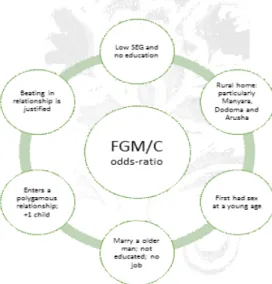
This paper provides an analysis into FGM across Tanzania using the TDHS data (2015/16). The results highlight the following, and are visualised in Figure 5. Firstly, 10.48% of the 23,666 women interviewed had experienced FGM. However, there was uncertainty as to the type of FGM experienced. The majority of these cases are conducted at a young age (51% below eight years old); and by traditional circumcisers (65%). Secondly, the experience of FGM was highest for women of certain groups and locations. The likelihood was highest for women residing in rural areas; with no education; from the poorest socio-economic group; and from specific regions, particularly Manyara, Dodoma and Arusha (respectively).
A key contribution made by this paper was looking at the impact of FGM on future life outcomes. Although documented in other regions and countries this has not been explored in Tanzania. A study in West London’s maternity care facilities show Somali refugees experienced unequal access to facilities but also poor management of FGM during pregnancy and labour (Bulman and McCourt, 2002); furthermore, FGM was a key risk factor for dysmenorrhea, obstructed labour and postpartum haemorrhage in Egypt (Ibrahim and Mahmoud, 2016). In Tanzania, associations emerge in the type of relationships the women who have been circumcised enter. Although the risk of circumcision was higher for women who had never been in a union, precaution is required in interpretation of this result due to how the ‘unions’ are defined. In cases where a woman is in a union/partnership, circumcision is higher if the partner/husband lives elsewhere, not living with the women. This is matched by the fact that the risk, or odds, of circumcision increases five-fold when a man has three wives. There was a higher risk of women going into polygamous relationships, with their husband living elsewhere, once circumcised. In addition, the likelihood of circumcision was highest for women with husbands who had no education; did not work; and were older (highest for age group 78 years).
Finally, the results raise concern over the position, and power, of a woman, who is circumcised, has in society. Circumcision likelihood was highest in all cases whereby domestic abuse was justified: whether being justified as the ‘wife refused to have sex’ or ‘burnt the food’. However, circumcision odds were also higher in
women are more likely to enter relationships whereby abuse is justified; however, they also stated joint decision-making was utilised. Additionally, circumcision was highest for respondents who had more than one child, and had sex at the age of nine (13 times higher than women who have not had sex). Circumcision odds can be shown to be strongly interlinked to the dominance of masculinity: circumcised women enter abusive relationships, polygamous relationship and have more than one child. Violence (in all forms: sexual, physical and mental) against girls can thus be identified as a key barrier in limiting young girls and women achieving their full potential. As shown in this paper, violence is justified within partnerships. Additionally, as other findings show violence remains common practice. Baseline results of publications from the MAISHA study show 75% of women in Mwanza region had experienced intimate partner violence in the past 12 months; and a strong association can be found between experiencing sexual abuse and mental health (Kapiga et al, 2017).
The results however, are not able to suggest causality, but showcase that risk groups can be identified, whereby the odds of circumcision are highest, across Tanzania, and women (or girls) who experience FGM are more likely to enter certain relationships – being in polygamous relationships, with an older partner, and whereby beating is justifiable. We are not able to interpret the degree of influence FGM has on one’s life course; however, by showing relationships to ‘risk factors’ and identifying ‘future relationships’ discussion can be raised over a women’s position in society and the impact of FGM.
Figure 7: Diagram showing the factors connected to higher odds-ratio of circumcision, and its influence over ones’ life course.
Source: Authors own.
What the findings reveal is the position of women in Tanzanian society. Firstly, practises of FGM remain very high – and variable across regions. Much has been discussed around the issue of FGM and women, or girls, empowerment. However, more reflection is required in how the position of disempowerment continues through one’s life-cycle and life course: is it creating a continuation of (dis-em)-powered relations and roles? Can links of inter-generational inequity be identified (see Onuzo et al, 2013)? How far we have come in terms of women’s empowerment is much discussed; but this paper shows that there is still some way to go in changing women’s position in society. There is a need to discuss how the cycle of disempowerment can be broken; to do so this discussion focuses on broader gender studies and women’s empowerment literature.
Intergenerational effects require synthesis. Studies on the relationship quality show there is a consistency in the relationship quality across generations: positive relationships reported with ones’ elders has been mirrored with more positive relationships with ones’ children (see Birditt et al, 2012). Positive intergenerational relationships can be mirrored by the experience of personal relationships. This is also the same for the transmission of ‘negative’ relationships (see Silverman et al, 2009; Rada, 2014). For example, Rada’s (2014) study on the prevalence of violence in Romanian families shows that violence was a common memory of the parents’ childhood: 35% had seen parental violence and 54% been a victim of family violence. The
violence against women being a way to enforce corrective behaviours; and c) verbal violence and humiliation remained culturally acceptable (ibid.). The negative behaviours, in this case, family and gender-based violence, would thus be justified and continued over generations. Additionally, emotional states of parents are key for a child’s development. Studies have shown parental depression and severe stress have adverse impacts on their children’s emotional wellbeing. Mother’s diagnosed with maternal depression, and stress, put their children at risk of personally continuing the experience of depression and acute/chronic stress up until the age of 20 (Hamen et al, 2011). Such findings show the type of relationships matter: positive and negative relationships are transmitted inter-generationally with-holding positive (and negative) life outcomes.
Secondly, having access to ‘empowerment’ tools can change a girls’ life trajectory. Social stratification is maintained (or changed) across generations based on socio-economic characteristics, particularly being able to access education (see Onuzo et al, 2013). A study by Mare and Maralani (2006) showed the educational status of Indonesian women had a positive effect on the educational status of the next generation. With this however, educated women were also seen to have fewer children and better marriages. Additionally, with specific reference to FGM, the impact of education is shown. A study by Mustafa (2009) on ‘women’s empowerment’ and the intention to continue FGM practice in Egypt, showed women of ‘high empowerment’, defined by their ability to make household decisions and education level, were eight times more likely to discontinue FGM for their daughters. Finally, on this note, having access to services and products that enable girls to determine the right to their own body, has a significant change in their life trajectory and reproductive outcomes. Su (2016) focuses on women’s empowerment in the context of being able to negotiate safe sex. The conclusion is made that women, particularly youths, from low-income backgrounds can be empowered in breaking the sexual disempowerment position they are placed in, and subsequently negative future outcomes for themselves and offspring, by having increased access to female contraception. Access to such sexual ‘empowerment’ tools are seen as necessary for the women to be able to have safe sex, without relying on the male’s willingness. Lacking this access was identified to result in less control over reproduction but also higher likelihoods their children will follow similar lifestyles.
The literature findings discussed show how relationships and accessing ‘empowerment tools’, whether contraception or education, are key. It also follows on the ‘life-course’ ideology, which identifies the ‘adolescence’ stage as a critical time for a girl can determine their life trajectory (see IHE, 2017). International discourses identify this stage as a period by which the girl should be educated and grow, in order to become an agent of change in her own life and contributor to her own, and society’s, development (see Bustreo, 2014).
Therefore, the questions raised is, how can the cycle of disempowerment be broken? Any interventions need to look beyond ‘just girls’ to strengthening health, education and power systems; encouraging a multi-sectorial response; and encouraging active social change. Various interventions are required within, and across, different social groups.
Conclusion
Movements to end FGM are now a global phenomenon (references; Dorkenoo, 1996; 28tooMany, 2017), with several local or national-based initiatives being led by agents of changed (for example: UNFPA, 2015; and Sanghani, 2015). Such initiatives all recognise the need to eliminate FGM for improvements in women and child health; gender equity; and improved life outcomes.
Discussions on intergenerational equity identify how poverty and wellbeing can be transmitted across generations and early childhood experiences are precursors for future life outcomes (see Onuzo et al, 2013). Early childhood development, and thus risk, matters for their future trajectory and wellbeing. Despite this evidence little has been written on this transmission in the Africa region. In addition, no research has been conducted on this with reference to specific experiences of violence amongst children. This paper focuses on the practice of FGM to explore two key objectives: 1) who is at risk of FGM and potentially why; and 2) what are the future outcomes if one conducts FGM: what relationships are entered into and socio-economic status is obtained?
This paper uses the TDHS 2015/16 to analyse these objectives. The findings showcase the following: FGM experiences are reported at 10.48%. However, a key limitation of the TDHS is its reliance on what information is given by the respondent. With FGM having been illegalised, and multiple variations or definitions
FGM was common at younger ages, being conducted mainly by traditional FGM circumcisers, and particularly prominent in certain regions: namely Manyara, Dodoma and Arusha. Such may be linked to specific socio-cultural norms within these areas, but the data does not allow a finer scale of analysis. With risk highest among male headed-households, rural residence, and the poorest wealth quintiles, we recognise household and cultural factors associated with location and poverty as limiting a woman’s mobility to escape FGM/C. Furthermore, with woman of no education at highest risk, recognise how limiting access to education minimises resistance to the practice and the value placed on what the woman can achieve. In addition to this the findings show a higher-odds ratio for experiencing FGM is also linked to future life-outcomes. The findings show if FGM was conducted the girl/women was more likely to be married at a younger age, and to a partner of a specific demographic and socio-economic profile: low education, without a job, and older. Additionally, having experienced FGM was connected to a higher risk of abusive relationships, polygamous relations and having more than one child.
The results of this paper focus on the 10.48% that stated they had experienced a form of FGM. The results raise concern and ways forward to policy makers and practitioners working in the field of FGM. Firstly, young women and girls (uneducated and poorest wealth quintiles, in rural residence) can be identified as being of higher risk to FGM/C practices. Programmes and policy interventions are required in these areas to not only understand more on the community perceptions of FGM but also find ways to effectively alleviate risk to such groups. Secondly, the findings show that women who experience FGM experience a certain life trajectory. Although no causality is suggested the risk of entering abusive relationships and relationships whereby more children are conceived is important to note. Life-courses literature shows that inter-generational poverty and wellbeing can be re-transmitted over time, thus creating a cycle whereby poor wellbeing and life outcomes can be maintained. Efforts are therefore required by policy makers to break this cycle. By identifying the factors associated to high-risk of FGM, and the cycle of girls/women getting into negative relationships, action is required by practitioners, policy-makers and community members, to ensure the cycle can be changed.
References
28tooMany, 2017. 28 Too Many, FGM… Let’s End it. Accessed [Online]: http://28toomany.org/
Child Reach International, 2016. FGM/C in Tanzania, Child Reach International FGM/C Policy Position, Online. Birditt, S, K., Tighe, A, L., Fingerman, L, K., and Zarit, H, S. 2012. ‘Intergenerational Relationship Quality Across
Three Generations’, Journal of Gerontology Series B: Psychological Sciences, Social Sciences, 67:5, pp 627-638.
Boyle, H, E., Songora, F., and Foss, G. 2001. ‘International Discourse and Local Politics: Anti-Female-Genital-Cutting Laws in Egypt, Tanzania and the United States’, Social Problems, 48:4, pp 524-544.
Bulman, H, K., and McCourt, C. 2002. ‘Somali Refugee Women’s Experiences of Maternity Care in West London: A Case Study’, Critical Public Health, 12:4, pp 365-380.
Bustreo, F. 2014. ‘Empowering Girls: Ending the Cycle of Violence’, WHO Media Centre, Commentary by Assistance Director-General of Family, Women’s and Children’s Health, 10th October 2014, Accessed [Online]: http://www.who.int/mediacentre/commentaries/empowering-girls/en/
Demographic and Health Survey (DHS), 2017. The Demographic and Health Survey Program: DHS Overview, USAID, Accessed [Online]: http://www.dhsprogram.com/What-We-Do/Survey-Types/DHS.cfm
DHS, 2017. ‘Wealth Index’, The Demographic and Health Survey Program: DHS Overview, USAID, Accessed [Online]: http://www.dhsprogram.com/topics/wealth-index/Index.cfm
Dorkenoo, E. 1996. ‘Combating Female Genital Mutilation: An Agenda for the Next Decade’, World Health Statistics Quarterly, 49:2, pp 142-147.
GIZ, 2011. ‘Country Fact Sheet: Ending Female Genital Mutilation in Tanzania’, in Country Department Africa – Western Africa, Angola and Pan-African Organisations and Programmes, September 2011, pp 1-2, Germany, Accessed [Online]: https://www.giz.de/fachexpertise/downloads/giz2011-en-fgm-tansania.pdf
Global Partnership to End Violence Against Children, 2017. Pathfinder Roadmap: Tanzania, Accessed [Online]: http://www.end-violence.org/tanzania.html
Hammen, C., Hazel, A, N., Brennan, A, P., and Najman, J. 2011. ‘Intergenerational Transmission and Continuity of Stress and Depression: Depressed Women and their Offspring in 20 years of Follow-up’, Psychological Medicine, 42:5, pp 931-942.
Ibrahim, M., and Mahmoud, H. 2016. ‘Effect of Female Genital Mutilation on Female Sexual Function, Alexandria, Egypt’, Alexandria Journal of Medicine, 52:1, pp 55-59.
Institute of Health Equity (IHE), 2017. Resource Page: Working towards Health Equity, Accessed [Online]: http://www.instituteofhealthequity.org/about-our-work/working-toward-heath-equity-
Kapiga, S., Harvey, S., Muhammed, K, A., Stockl, H., Mshana, G., Hashim, R., Hansen, C., Lees, S., and Watts, C. 2017. ‘Prevalence of Intimate Partner Violence and Abuse and Associated Factors among women enrolled into a Cluster Randomised Trial in North-western Tanzania’, BMC Public Health, 17:190.
Mare, D, R., and Maralani, V. 2006. ‘The Intergenerational effects of changes in Women’s Educational Attainments’, American Sociology Rev., 71:4, pp 5542-556.
Msuya, E, S., Mbizvo, E., Hussain, A., Sundby, J., Sam, E, N., and Stray-Pedersen, B. 2002. ‘Female Genital Cutting in Kilimanjaro, Tanzania: Changing Attitudes?’, Tropical Medicine and International Health, 7:2, pp 159-165. Mustafa, A. 2009. ‘Women’s Empowerment and the Intention to Continue the Practice of Female Genital Cutting in
Egypt’, Archives of Iranian Medicine (AIM), 12:2, pp 154-160.
Nypan, A. 1991. ‘Revival of Female Circumcision: A Case of Neo-Traditionalism’, in Stolen, K., A., and Mariken, V. (Eds.) Gender and Change in Developing Countries, Oslo: Norwegian University Press.
Science, London, UK., UNICEF, April 2013.
Rada, C. ‘Violence against women by male partners and against children within the family: Prevalence, associated factors and intergenerational transmission in Romania, a cross-sectional study’, BMC Public Health, 14:129 Rutsein, O, S., and Johnson, K. 2004. The DHS Wealth Index: DHS Comparative Reports, No. 6, Maryland, USA,
Accessed [Online],: http://www.dhsprogram.com/publications/publication-cr6-comparative-reports.cfm Sanghani, R. 2015. ‘Meet the Amazing Woman Running a Safe House for Girls Fleeing FGM’, The Telegraph,
Accessed [Online]: woman-saving-girls-in-Tanzania.html
Silvermann, C, R., and Lieberman, F, A. 2009. ‘Negative Maternal Attributions, Projective Identification and the Intergenerational Transmission of Violent Relational Patterns’, Psychoanalytic Dialogues: The International Journal of Relational Perspectives, 9:2, pp 161-186.
Sekhri, S., and Debnath, S. 2014. ‘Intergenerational Consequences of Early Age Marriages of Girls: Effect on Children’s Human Capital’, The Journal of Development Studies, 50:12, pp 1670-1686.
Su, C. 2016. ‘Breaking the Cycle: How Increasing Access to Female-Controlled Contraception Can Empower
Low-Income Adolescent Families’, Expose Magazine, Accessed [Online]:
https://projects.iq.harvard.edu/expose/book/breaking-cycle
Tanzania Demographic Health Surveillance (TDHS), (2004). Chapter 13: Female Genital Cutting, pp 247-256, Accessed [Online]: http://dhsprogram.com/pubs/pdf/FR173/13Chapter13.pdf
UNICEF, 2015 http://data.unicef.org/wp-content/uploads/2015/12/FGMC_Lo_res_Final_26.pdf
United Nations Population Fund (UNFPA), 2015. Empowering Women to Lead the Change: One Woman’s Fight Against FGM, Accessed [Online]: http://www.unfpa.org/news/empowering-women-lead-change-one-woman %E2%80%99s-fight-against-fgm
United Republic of Tanzania (URT), 1998. Sexual Offences Special Provisions Act, No 4 of 1998, Accessed [Online]: http://parliament.go.tz/polis/uploads/bills/acts/1457516075-ActNo-4-1998.pdf
URT, 2016. Tanzania Demographic Health Survey and Malaria Indicators (2015-2016): Final Report December 2016, Ministry of Health, Community Development, Gender, Elderly and Children, Ministry of Health Zanzibar, National Bureau of Statistics, Office of Chief Government Statistician Zanzibar, ICF; Dar es Salaam, Zanzibar, Maryland USA.
WHO, 2017. Sexual and Reproductive Health: Classification of Female Genital Mutilation, WHO, UNICEF, UNFPA, 1997, Accessed [Online]: http://www.who.int/reproductivehealth/topics/fgm/overview/en/
Winterbottom, A., Koomen, J., and Burford, G. 2009. ‘Female Genital Cutting: Cultural Rights and Rites of Defiance in Tanzania’, African Studies Review, 52:1, pp 47-71.
Yusuf, C., and Fessha, Y. 2013 ‘Female Genital Mutilation as a Human Rights issue: Examining the effectiveness of the Law against Female Genital Mutilation in Tanzania’, African Human Rights Law Journal, 13:2.