
863.1
Abstract
The Varestraint Test is applied to understand microcrack after GTA welding. However, The EB (Electron Beam) Varestraint Test is a new method, which tests sıitabilty of the source for EB Welding in aero engine and high temperature materials. In this study, Electron Beam Varestraint Test is introduced. In addition experimental studies were carried out for superalloy Rene 41 and results are presented.
1. Introduction
In actually, the mean of this method is "Varestraint Test for EB Weld". And it was developed especially to estimate hot cracking suscpectibilities and microfissures occurrence in HAZ (Heat Affected Zone) after EB (Electron Beam) welding of superalloy, titanium alloy and stainless steel. The term microfissures applied to small-scale microcracks that cannot be seen even by using NDT (Non Destructive Testing) method. The Varestraint Test was adapted to Electron Beam welding and it may be called as an Electron Beam Varestraint Test (EBVT). In this study, Electron Beam Varestraint Test is introduced. As known today, superalloys and titanium alloys are used at the high temperature area of the combustion of turbines and rockets (Fig.l). In spite of the Heat Affected Zone (HAZ) this alloys are almost perfect, depending on welding methods, spesifications of welding process and grain size of the material there exist microfissures after welding. The HAZ cracking suspectibility of superalloy and titanium alloy were evaluated using the
Varestraint (Weldabilty) Test [1].
Figure 1: J85 Turbojet Engine with Afterburner [2]
2. Varestraint Weldability Test
The Varestraint Weldability Test (VWT) is a state-of-the-art tool for materials weldability testing. (Fig. 2). The rapid development of new alloys has lead to a tremendous increase in materials performance. To be cost effective, conventional automated welding processes must readily join these new alloys. The Varestraint Weldability Test is the leading test for materials weldability. The VWT allows material developers and end users to evaluate a given alloy's weldability with a simple and well-accepted procedure.
The VWT consists of three main components: The enclosure at the left houses the welding and hydraulic power sources. A variety of welding power source capability options is available. In the middle is the welding torch manipulator and weld-specimen-bending ram. Precision linear slides with micro-stepping motors and high-resolution encoders control torch position and speed. Bending ram position and speed are controlled via a linear displacement transducer [3].
EB VARESTRAINT TEST METHOD AND AN APPLICATION
ICAS 2002
M. Cemal KUŞHAN1, Mümtaz ERDEM2, Tamer SARAÇYAKUPOĞLU3 1 Osmangazi University, Engineering & Architecture Faculty, Dept. of Mechanical Engineering, Eskişehir/TURKEY
2
TUSAŞ Engine Industries Inc., Eskişehir/TURKEY
3
863.2 Key Features:
• Servo-controlled hydraulic bending ram
• GTAW/PAW process capability
• 3-axis torch manipulator
• Programmable strain and strain-rate
• Spot, longitudinal and transverse welds
• Simultaneous/consecutive weld/bend
• Graphical User Interface
• Complete test data acquisition
• Tea-setup storage and retrieval
Figure 2 The varestraint test [3]
3. EB Varestraint Test
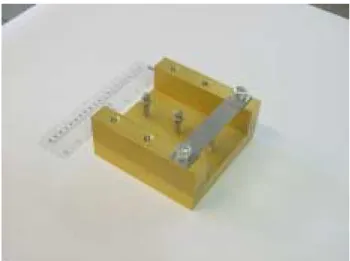
The varestraint test, which is described in the Section 2, can only be used with GTA welding. Because the volume of mechanism shown in Figure 2 can not be fitted into the cell of the EB welding machine and this mechanism can not be set up in the cell even if its dimensions are made smaller. Due to this limitation, it has been decided to change appropriately the EB welding of the test by making a constructive adaptation in the Varestraint test mechanism. For this purpose, the fixture shown schematically in the Figure 3 has been prepared.
The deformation (ε) is ensured by applying a (P) load from just middle of the press block with a press ram at the Figure 4 (r) end curvature radius, (ε) deformation is selected between 0.07 – 0.25 and (r) radius is calculated from the Equation I.
ε = t/2r (1) In this equation;
ε: deformation t: sample thickness r: press ram radius
Figure 3: EB Varestraint Test Fixture and (P) Loaded Specimen
Figure 4: EB Varestraint Test Sample (3-D) After the sample that was prepared for the experiment is placed in the fixture, the application of the (P) load is realized and the fixture is placed into the EB welding cell together with the sample that was exposed to the load. By doing so, the conditions of the Varestraint Test mechanism with GTA welding are applied to the EB welding. It is aimed with this test to increase the possibility of hot cracks (hardening cracks, from the opening by being liquefied) in the HAZ’s of the welded samples during EB welding.
863.3
4. Experimental Study
The superalloy Rene 41 used on the EB Varestraint experiment, has been supplied from the waste leaves of metal in thickness of 1.27 mm(0.050"), which were used at the TEI (TUSAŞ Engine Industries Inc.). This material is used as exhaust ejector material of the J85 engines of the T-38 Talon aircraft. New design exhaust ejector of the J85 engine, in which Rene 41 is used at a great extent [4] is shown in Figure 5.
Figure 5 J85 engine exhaust ejector [4].
4.1 Preparing the Samples
The materials to be used in the experiment have been prepared in 152x25x1.27 mm dimensions at the CNC workbench according to the measurements in Figure 4. Two holes have been drilled to each sample in the same workshop in 12.5 diameter and having 127 mm clearance between them.
The burr occurred at all samples after the production have been removed and lastly oil, dirt and marking paint which are not wanted during the welding have been cleaned in the ensolver bath.
To be able to perform the EB varestraint test 3 samples have been prepared and connected to the fixture shown in Figure 3.
4.2 EB Varestraint Test Application
Sciaky brand workbench has been used as EB welding workbench, which is present at the 1.HİBM (First Air Supply Maintenance Center) Jet Revision Department, shown in Figure 6. The same welding values have been applied to all samples. These values are shown in the Table 1.
Table 1: Welding variables used during the EB Varestraint test
Current 10 mA Tension 50 KV
Energy 0,3 kj/mm Welding medium 10-4 torr
Figure 6. Sciaky brand EB welding workbench
5. Results
1. The importance of the Varestraint on applications in sectors such as space and aviation industry where the constructions without micro-crack are very important can not be debated.
2. With this study, it is shown that, the Varestraint test, which is realized only for the samples with GTA welding due to its
863.4 mechanism, can also be applied for the EB
welding.
3. The Varestraint test, which is rarely seen in literature, is applied only for the stainless steel and Super-alloys. But this test can also be applied for other material groups. 4. New specifications (such as welding speed,
press ram curvature radius, P load etc) must be adopted for EB Varestraint tests in order to use the same test for other material groups.
References
[1] Kuşhan M.C., Investigation of microcraks at heat effected zone of electron beam welded Fe-Ni based superallo Inconel 718, OGU, Graduate School of Natural and Applied Sciences, unpublished PhD thesis (in Turkish), 1996
[2] www.aircraftenginedesign.com [3] www.weldwareinc.com
[4] Erdem M.S., Design Focused Projects In Aeroengine Industries, MMO Issue No;E/2001/265 1.Aeroneutical Symphosium (in Turkish) 2001 Eskisehir/Turkey
![Figure 5 J85 engine exhaust ejector [4].](https://thumb-eu.123doks.com/thumbv2/9libnet/3582694.19964/3.892.78.410.402.688/figure-j-engine-exhaust-ejector.webp)
