Reprinted with permission from International Conference on Image Processing, Vol. 3, pp. 125—128 (1995). ©1995 IEEE.
ADAPTIVE METHODS FOR DITHERING COLOR IMAGES
Lale Akarun
Bogazigi University
Dept. of Computer Eng.
Istanbul, TURKEY.
ABSTRACT
Most color image printing and display devices do not have the capability of reproducing true color images. A common remedy is the use of dithering techniques that exploit the lower sensitivity of the eye to spatial reso-lution and exchange higher color resoreso-lution with lower spatial resolution. In this paper an adaptive error dif-fusion method is presented. The error difdif-fusion filter coefficients are updated by a normalized LMS type al-gorithm to prevent textural contours, color impulses and color shifts which are among the the most com-mon side effects of the standard dithering algorithms.
1. INTRODUCTION
Most color image printing and displaying devices do not have the capability of reproducing true color images [1]. Consequently, the number of colors has to be reduced drastically. A common remedy is the use of dithering techniques that exploit the lower sensitivity of the eye to spatial resolution and exchange higher color resolu-tion with lower spatial resoluresolu-tion. The eye averages the colors in a neighborhood and creates the illusion of more colors. Error diffusion achieves this effect by dis-tributing the error encountered in quantizing a pixel to neighboring pixels, ensuring in effect, that the neigh— boring pixels are biased in the reverse direction. Some well-known error diffusion filters are Floyd—Steinberg,
Stucki, Jarvice, Judice and Ninke [2]-[5].
Common problems that are addressed by dithering are color shift and the appearance of false textural con-tours. When an image is quantized into a limited num-ber of colors that form a palette, the color of a region is classified into one of the colors in the palette, resulting in a shift which is visible to the eye. A worse-looking defect, however, is the formation of false edges in areas of the image where, there is originally a smooth transi-tion between two colors in the palette. Error diffusion
This study is supported by TUBITAK grant EEEAG 115
Yasemin Yardzmcz
Bogazici University,
Dept. of Electrical Eng.
Istanbul, TURKEY.
674
A. Ems Cetz'n
Bilkent University,
Dept. of Electrical Eng.
Ankara, TURKEY.
solves these two problems in most of the cases: By bail-ancing the quantization errors, it produces an average color shade which is closer to the original color of the region and breaks up the false edges. However, if the given color is close to the boundary of a color cluster and the filter coefficients are not adequately selected, the quantization errors accumulate and eventually, a palette color from a different cluster is produced. This manifests itself as a color impulse which is very dis-turbing. Another adverse effect of dithering manifests itself around edges: Colors from two sides of the edge are smeared to each other and sharp edges are con-verted to jagged edges.
In this paper a new adaptive error diffusion tech-nique is proposed to correct these adverse effects: The error diffusion filter coefficients are obtained by min-imizing the mean squared error between the average color of the original image and the dithered image. Considering the fact that there may be significant dif-ferences in the statistics of different regions in a typi-cal image an LMS type adaptive algorithm is used to solve the minimization problem. This adaptive tech-nique not only produces dithered images in which the average color shade is closest to the original and the occurance of color impulses is greatly reduced but false textural contours do not appear as well.
In Section 2 the adaptive error diffusion algorithm is described. In Section 3 effects of scaling the error diffusion filter coefficients is discussed, and in Section 4 simulation examples are presented.
2. ADAPTIVE ERROR DIFFUSION ALGORITHM
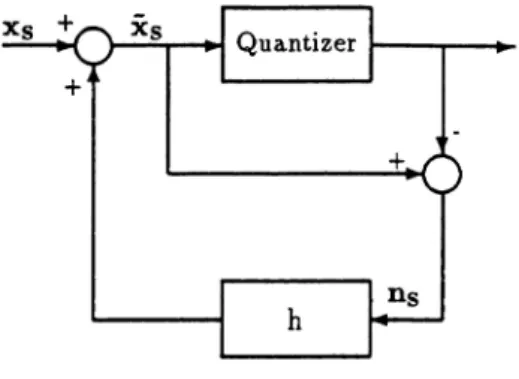
Figure 1 shows the block diagram of the error diffusion technique. A color image is represented by 3 x 1 vec-tors x, for s = 0,1,2, ..., (N1 x N2) - 1. To simplify the equations, double indices denoting the location of the pixels have been replaced by the single index s. For an image of size N1 x N2 the (n1,n2)-nd pixel corre sponds to the index 3 = n1 + n2N1.Given the image X:
+ .. W8 A Quantizer +4 +_ RS h .
Figure 1: Block diagram of the error diffusion method.
Figure 22’ Filter mask of the error diffusion method and
the Floyd-Steinberg
filter coefficients (N = 4).
and a quantizer Q, error diffusion works as follows: The quantization error 11, is diffused to neighboring pixels to create a dithered image i,. Then, the dithered im-age is quantized instead of the original imim-age:
is — x5 + Zhs—knk (1)
Ic<a
is - Q(i8) (2)
where k < 3 corresponds to a causal error diffusion mask and the filter coefficients h = (hl ...hN)T are scalars. In standard Floyd-Steinberg error diffusion method, the filter coefficients h are fixed and indepen-dent from the image to be dithered. Figure 2 shows the mask of the Floyd-Steinbergfilter. Usually the coeffi-cients are chosen as T723" 113, 1-53 and 1%. In our algorithm, the error diffusion filter coefficients h = (hl ...hN)T are obtained by minimizing the mean squared error be-tween the average color value of the original image and the dithered image. In order to obtain the optimum error diffusionfilter coefficients the quantity
EUIXs - Q(is)ll2}
(3)
is to be minimized with respect to h;. This is equivalent to minimizing:
Emns — Shawl?)
k<an:
(4)
with respect to the filter coefficients. Differentiating
Equation (4) with respect to h,- and setting the results
675
to zero, the following set of linear equations are ob-tained:
E{n;1‘n,_,-} = Z h,_,.E{n;fn,-.-}
(5)
k<s
where 2' = 1,2, ...,N, the n, is the quantization er-ror at location 3. By solving the system of Equa-tions in (5) the error diffusion filter coefficients h =
(hl ...hN)T can be obtained. The covariance
coeffi-cients E {nEn,-,-} are not available in practice but they can be estimated from the quantization error statistics of the original image. However this approach does not yield good results because a typical image can not be assumed to be a stationary randomfield.Considering the fact that there may be significant differences in the statistics of different regions of a typ-ical image we use an LMS type adaptive algorithm to determine the error diffusionfilter coefficients. The key step is to replace the ensemble average with the index average and compute the stochastic gradient vector. For each color component we minimize
63(8) = (nfi - Z hiknfi)?
k<s
(6)
where hf is the filter coefficient vector for the color component 3. At the index 3 thefilter coefficient vector is updated using the following equation
11‘(8 +1) = 11[(8) - #V€£(3)2
(7)
where p is the step size. The gradient is given by
Vefls) —2e£(s)zf
(8)
where the vector zfi contains the past quantization er-rors,
(9)
In our simulation studies we employed the so-called normalized LMS update equation [10]:
zfi : [11:4 . . . nfi_N]T
e¢(s)zf
HZ‘EIP
where the step size parameter ,u is chosen in the interval (0,2) as in the case of the normalized LMS algorithm, and 63(8) can be calculated as follows:
61(8) = (i. — war - Z hunt
k<sh‘(s) = h‘(s)+u
(10)
(11)
In the halftoning of monochrome images for display on bilevel devices, the quantization levels correspond-ing to the on/off states are at two opposite ends of a
scale, represented by zero and one. In the error
diffu-sion methods [2H5], the'filter coefficients are positive
numbers that are selected to add up to'one. This re-sults in adequate representation of all pixel intensities because the convex hull of the quantization levels con-tains all possible gray scales. In color error diffusion, this is no longer valid. More quantization levels are re-quired to represent all colors, and common algorithms attempt to place color quantization levels near the cen-ter of color cluscen-ters [6]. Consequently, some colors in the original image are outside the convex hull of the quantization levels. Error diffusion algorithms whose coefficients are selected as positive constants do not ad-equately address this problem. When a color outside the convex hull of quantization colors is encountered, this results in the accumulation and ultimate satura-tion of quantizasatura-tion errors. This manifests itself as a colored impulse. One method described in [6] attemts to avoid this incident by checking the magnitude of the error against a threshold that is proportional to the cluster size for the given color. Our method avoids the saturation of errors altogether: Inspection of
Equa-tion (10) reveals that the
filter coefficients hi can
be-come negative, allowing for recovery from saturation of errors. However, the sum of the magnitudes of the fil-ter coefficients obtained by Equation (10) may exceed one. In such cases we scale the coefficients down so that their sum is one. Effect of scaling the filter coefficients is discussed in Section 3.Recently, adaptive error diffusion was applied to
gray level images in [8] and [9]. Our adaptive
algo-rithm uses a different error measure from [8] and [9]
and the resulting filter update equation is simpler.
3. EFFECTS OF SCALING THE FILTER COEFFICIENTS
As outlined in Section 2, one of the major problems in the error diffusion of color images is the appearance of color impulses. In many standard algorithms, the error diffusion filter coefficients are defined to sum to one. That corresponds to diffusing all of the error en-countered in quantizing a pixel to neighboring pixels. If the coefficients are scaled by a figure that is greater than one, that results in positive feedback, and the re-sults are disastrous. However, if the scaling coefficient is smaller than one, the effect is a cross between er-ror diffusion dithering and doing no dithering at all: If the scaling coefficient is around 90 %, doing a little less dithering even improves the appearance in terms of color impulses. This suggests an adaptive algorithm for scaling the error diffusion filter coefficients: In re-gions where there is little activity, false countours are
676
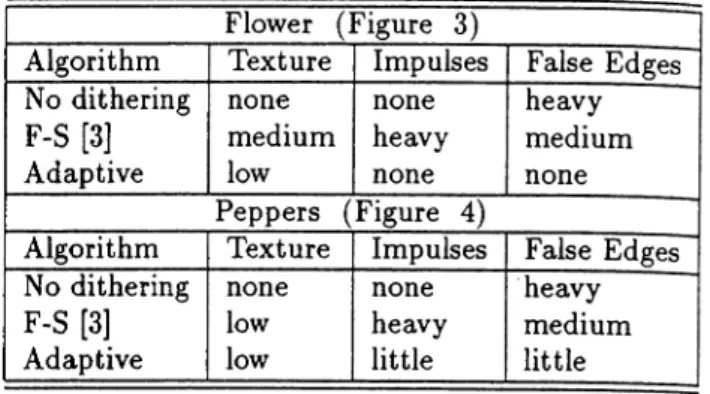
Table 1: Subjective Comparison of Dithering
Algo-rithms
‘Flower (Figure 3) W
Algorithm
Texture
Impulses
False Edg?
No dithering none none heavy *—
F-S [3]
medium
heavy
medium
Adaptive low none none
Peppers (Figure 4)
fl
Algorithm Texture Impulses False Edges No dithering none none heavyF-S [3]
low
heavy
medium
Adaptive low little littlenot likely to show up. On the other hand, color im-pulses are highly noticeable when they occur in those
constant regions. Therefore, relaxing error diffusion by
spreading only a portion of the error yields superior results in such regions. We adapt the scaling coeffi-cient based on a measure of activity and change the amount of error diffused. This simple algorithm yields satisfactory results: The appearance of color impulses is eliminated almost completely, and the compromise in terms of the slight increase in the appearance of false contours is outweighed by the overall improvement.4. SIMULATION RESULTS AND CONCLUSION
We compare the results of dithering with the filter mask of Equation (10) with that of the Floyd-Steinberg mask. The color images corresponding to the results are given in Figures 3 and 4. The input images have been quantized to 16 colors with the median-cut
algo-rithm [7]. It is observed that quantization to 16 colors
results in the appearance of false edges. Figures 3a and 4a are the results of error diffusion with the Floyd-Steinberg algorithm. It is observed that the application of the Floyd-Steinberg algorithm causes the creation of colored impulses and false textures while alleviating the appearance of false contours. Figures 3b and 4 b show the results of our adaptive algorithm. The appearance of disturbing colored impulses and false textures is min-imized, while the false contours are completely elimi-nated. Table 1 summarizes these subjective compar-isons.In this paper, we developed an adaptive error diffu-sion method for color images. The adaptation criterion is based on the quantization error statistics. In stan-dard error diffusion methods thefilter has a unity gain. We observed that this restriction can be relaxed and the diffusion filter may have a gain slightly less than
Figure 3: Dithering an image quantized to 16 colors
with the median-cut algorithm: (a) Error diffusion with
the Floyd-Steinberg
filter (b) Error diffusion with the
proposedfilterone. This leakage is especially useful to avoid impulses occuring in flat areas of the image.
5. REFERENCES
[1] Jan Allebach, “Digital Color Imaging: Bringing Color to the Desktop,” IEEE SP-Society Distin-guished Lecturer’s series: 3. Sinyal Isleme Ku-rultayi, Goreme, Turkey, May 1995.
[2] RA. Ulichney,“Dithering with blue noise,” Proc. IEEE, vol. 76, pp. 56-79, Jan. 1988.
[3] R.W. Floyd and L. Steinberg, “An adaptive
algo-rithm for spatial grayscale,” Proc. SID, vol. 17, no.2, pp. 75-77, 1976.
[4] J.F. Jarvis, C.N. Judice, and W.H. Ninke, “A survey of techniques for the display of continu-ous tone pictures on bilevel displays,” Comput. Graphics, Image Processing, vol. 5, pp. 13-40, 1976.
677
Figure 4: Dithering an image quantized to 16 colors with the median-cut algorithm: (a) Error diffusion with the Floyd-Steinberg filter (b) Error diffusion with the proposed filter
[5] R. Gentile, E. Walowit, Jan Allebach,
“Quantiza-tion and multilevel halftoning of color images for near-original quality,” J. Opt. Soc. Amer. A., vol.7, pp. 1019-1026, 1990.[6] M.T. Orchard and C.A. Bouman,“Color
quantiza-tion of images,” IEEE Trans. Signal Processing, vol. 39, pp. 2677-2690, Dec. 1991.[7] P. Heckbert, “Color image quantization for frame buffer display,” Computer Graph., vol. 16, no 3, pp. 297-307, July 1982.
[8] R. P. Mironov and R.K. Kunchev,“Adaptive
er-ror duffision for image quantisation,” Electronics Letters, pp. 2021-2022, vol. 29, November 1993. [9] P. W. Wong, “Error diffusion with dynamicallyad-justed kernel,” ICASSP’94, pp. V-113-116, 1994. [10] B. Widrow and SD. Stearns, Adaptive Signal