Procedia - Social and Behavioral Sciences 150 ( 2014 ) 890 – 898
1877-0428 © 2014 The Authors. Published by Elsevier Ltd. This is an open access article under the CC BY-NC-ND license (http://creativecommons.org/licenses/by-nc-nd/3.0/).
Peer-review under responsibility of the International Strategic Management Conference. doi: 10.1016/j.sbspro.2014.09.098
ScienceDirect
10
thInternational Strategic Management Conference
Participation to decision making: Does manager choose
opportunity rather than threat?
Ertan Gündüz
Gelişim University, İstanbul, 34310, Turkey*Abstract
Top managers of organizations tend to resolve only some of the strategic issues themselves. Especially differences in the way strategic issues are perceived are likely to affect the amount of top level executive participation in decision making process. The drives of perception might be sex, education, experience of the manager. On the other side the information sharing and participation climate within an organization might affect the managerial responses. This claim should cover empirical support. To answer the need the survey of this study is conducted on 612 middle and senior managers of 122 randomly chosen out of top 500 high performing firms operating in different industries in Turkey, between the years of 2012-2014. The obtained data from the questionnaires are analyzed through the SPSS statistical packaged software within a reliability level of 95%. Analyses results strongly supported the moderating effect of information sharing and wide participation either in strategic decisions for opportunities or strategic decisions for threats.
© 2014 Published by Elsevier Ltd. Selection and/or peer-review under responsibility of the 10th
International Strategic Management Conference
Keywords: Participation; information sharing; decision making.
1. Introduction
The purpose of this study is to determine empirically the relation between issue labels and managerial executive behavior of the organizations. The research included an examination of the degree to which participation in decision making varies when the challenging issue is viewed as a threat or as an
*
Corresponding author Tel. + 90-532-635-5279 Fax. +90-216-395-8501 E-mail: [email protected] © 2014 The Authors. Published by Elsevier Ltd. This is an open access article under the CC BY-NC-ND license
(http://creativecommons.org/licenses/by-nc-nd/3.0/).
opportunity. It is predicted that not only the sex, experience and education but normal, high and low participation climates through organizations affect top executives who seek information outside their own group when resolving issues. Finally, it is estimated if organization’s normal information processing and participation climate moderate organizational responses to opportunity or threat distinctions. Dyer and Singh (1998) identified four sources of competitive advantage, which are embedded in inter-firm relationships (Yousif Arsham, 2012).:
x Relation-specific assets, x Knowledge-sharing routines, x Complementary resources, and x Effective governance.
Only complementary resources of four items are indirectly related with issue identification and managerial participation. So it is safe to relate managerial attitude with competitive advantage. The closer World have come with cyber-industrial sabotage activities, such as hacking or boundary spanning usually relate to industrial secrets that have commercial value to competitors (Hafer and Gresham, 2012). Despite the ‘information sharing and participation in strategic issues towards the mission of an organization’ is considered amongst physiological needs of Abraham Maslow, a manager should be careful (Mears and Voehl, 1997).
2. Literature Review and Hypotheses
2.1. Strategic Issue Identification
A manager, who is able to read the signals of far threats using governance networks and understands how to harness the exigency brought on by the situation, can diminish the potential dangers and take full advantage of the resulting opportunities.
Since a crisis can be broken down into three unique phases, crisis lifecycles can be understood and utilized for the benefit of the organization (Prewitt et. al., 2011). In the first phase of the lifecycle, the organization finds itself mired in a static phase which equates to a comfort zone. In this first phase leaders struggle when they attempt to introduce change or learning due to the organizations preference to avoid conflict and maintain stasis. When a crisis engulfs an organization then the stasis that envelops the organization evaporates and gives rise to the second phase or the disaster phase. The disaster phase often threatens the very existence of the organization. When the organization successfully eliminates the immediate organizational threat, the organization is able to enter the adaptive phase of the crisis lifecycle. In this third phase, the leader has the undivided attention of the organization and the underlying urgency to solve the issues that led to the crisis in the first place. Regrettably, many leaders don’t take advantage of this golden opportunity and push the organization back toward the status-quo which ensures that the crisis will return in force. Crises brings challenges as well as opportunity for change, therefore with enhanced competence, explicit mission and establishment of strategic plans, the leadership can be remarkably improved in crisis (Junjie et. al. 2012). The key to turn crises into opportunity lies in how to identify and improve the pivotal competence, build a mission shared by all and implement strategies that fit specific environment. Previous research on the impact of acute stress, for example, indicates that people will revert to their dominant response instead of a recently learned behavior in those circumstances (Hadley et. al., 2011). This implies that simply knowing and practicing crisis response plans may be inadequate to ensure that leaders are ready to effectively assess information and make decisions in a
crisis. The way in which decision makers characterize or label organizational issues is believed to affect the resolution of these strategic issues. Dutton and Jackson (1987) hypothesized that a greater amount of involvement will occur in opportunities rather than threats. When situations are labelled as opportunities, participating in decision making process will be greater throughout the organization than when the issues are labelled as threats. In the light of the literature, it is possible to predict decision making process alter by the labels of issues and to propose the Hypothesis 1as following:
H1: When decision makers face strategic issues that have been labelled as opportunities, participation in decision making process will be more than when issues have been labelled as threats.
2.2. Moderating Effect of the Information Processing and Participation Climate on Response to Issue Labels
Organizational information processing theory suggests that organizational behavior can be understood by examining the information flows within organizations. While other variables such as strategy and structure are likely to affect the way issue identification alter organizational responses indirectly the effect of the degree of information sharing and participation climate within an organization should directly affect the treatment of issues (Thomas and McDaniel, 1990). When organizations generally place a high value on openness free exchange in order to solve problems, it seems likely that this value for openness would dominate even in the face of differing issue identification. This is because organizational culture and a predisposition towards openness could be considered a cultural characteristic. It is a powerful phenomenon that affects many organizational processes and behaviors. For example organizations with open flows of communication and generally wide employee access to day-to-day decision making will most likely maintain relatively participative approaches to resolving both threats and opportunity issues. The information sharing and participation climate of the organization likely moderates the differences in participation that occur as a result of the opportunity versus threat identification (see Figure 1). In light of the literature, it is possible to predict information processing and participation climate moderates decision making process and to propose the hypothesis 2 as following:
H2: When information processing and participation climate prevails in organization participation will be relatively high even in issues that have been labelled as threat.
Figure 1. Top Management Response to Strategic Issue Identification
Information Processing/ Participation Climate
Low – Moderate - High
Top Management Response Participation in Decision Making Strategic Issue Identification
3. Methodology
3.1. Research Goal
This survey aims to identify the moderating effect of information sharing and participation environment within an organization on managerial treatment of strategic issues labelled as opportunity or crisis. To test the propositions, a field survey using questionnaires was conducted.
3.2. Sample and Data Collection
The sample derived from main group which consist of top 500 firms throughout Turkey according to Stock Exchange Istanbul (BIST) 2013 List. 361 companies’ managers could be reached via electronic mails out of 500 commercial companies. The data compiled from the responses from top managers of 122 firms. The respondents are 105 Presidents, 136 Group General Managers, 96 Vice-Presidents of Engineering or Sales, 121 Chief Officers, 11 Vice-President of Planning and Programs and 42 Program Manager of research and development and 101 Project Chiefs in total of 612. Thus, respondents possess strongest positions of management in their respective organizations. Also, the mean of approximately five respondents per organization exceeds the acceptable average number of informants reported in other strategy making research (cf. Miller, 1988; Miller et. al., 1988; Milliken, 1990). The total sample of 612 informants can be characterized as follows: the executives worked in their respective company mostly between 3 - 9 years, and they have been working in the industry sector for 10 - 20 years (mean). Some 33% of the respondents are above 40 year old age group, 51% are in 30 - 40 age groups, and 16% are 22 - 29 year old age group. About 17 percent of the respondents had more than 20 years of industry experience and 12 percent work in their respective firms for more than 20 years. Some 54% of the respondents hold master and doctorate degrees, 44% hold graduate degrees, and 2% have undergraduate degrees.
A questionnaire mailed first in March 2012. The questionnaire was pretested and professionally produced and distributed, and two follow-up mailings were carried out. In case of need to motivate managers, by telephone and face to face interview techniques had also been used during one year period. Each participant was assured of confidentiality, and to be informed about results. The response rates were 34 percent considering the firm accessibility, and 61 percent for manager returns. A comparison of respondents and non-respondents suggested they did not differ in such observable characteristics as firm size and industry and company experience.
3.3. Analyses and Results
Following Likert type scale respondents were presented the descriptions of five decision-making modes, in which each mode represents a degree of participation. The decision modes were based on the forms of decision-making participation outlined in the Vroom-Yetton-Jago model of decision-making (Vroom and Jago, 1974). Informants were presented with a definition of strategic decisions and with definitions of decisions under threat and opportunity in questionary (Mintzberg et. al., 1976). Top level executives in organizations are assumed fairly comfortable with the distinction between threat and opportunities because these represents two schemas commonly used by strategic decision makers as they scrutinize their environments and determine appropriate actions (Jackson and Dutton, 1988). Informants
then asked which decision mode would typically be used when their firm dealt with crisis or opportunity decisions.
The following definitions of crisis and opportunity were given to the respondents:
Threat Decision: This is a strategic decision in which the organization faces intense pressure; manager feels a threat and a poor decision could have a substantial negative impact.
Opportunity Decision: This is a strategic decision which involves a voluntary action to improve an already secure situation.
The threat definition apparently does not include a temporal dimension as threats are taken to be ongoing issues. From the complex systems point of view threat divert the organization away from equilibrium necessitating a new type of adaptive reaction.
Information Processing and Participation Climate: Informants were asked to assess the information processing and participation climate of organization. Organizations that have a high degree of participation are expected normally to have highly shared information. Information processing and participation climate was measured with a scale in which informants asked questions about the degree to which the concept of participation fits into the overall strategy-making process in their organizations. The scale reported uses Likert-type responses in which 1 = strongly disagree, 2 = disagree, 3 = neutral, 4 = agree, 5 = strongly agree.
Heaping up Issues organization level scores were needed to test the hypotheses and these scores are achieved by cluster sums of individual responses.
Before aggregating the data, it was necessary to determine whether or not individual respondents from a given company essentially agreed on decision-making mode used for crises and opportunities. Modified percentage of agreement calculation estimates the agreement in terms of simple presence or absence (Suen and Ary, 1989). However in this case the scale only measures degrees of participation instead of presence or absence. Two raters who choose adjacent scale points (eg. 2 and 3) are not in absolute agreement, but they are relatively close. So modified percentage of agreement calculations are used to take “closeness” on the scale into account (Ashmos at. al., 2011). In each company every pair of participation scores for each of crisis and opportunity issues were examined. Informants exactly agreed 32% of time; were 1 scale point apart 56% of the time; and were 2 scale points apart 12% of the time. Because informants were in unanimity and 1 scale point apart 88% of the time it is concluded that they essentially agreed on participation modes. Table 1 represents participation scores for each company by reporting means.
Table 1 Mean participation score reported for different strategic issues at organizational level
Strategic Issue Identification Mean Participation* SD
Threat 2.17 1.161
Opportunity 3.88 1.166
n=122. Respondent scores were averaged to achieve an organization’s score. Difference: t= 22,939 Significance (2-tailed) = 0.000
Hypothesis 1 predicted that a strategic issue labelled as an opportunity will elicit more participation by strategic decision makers than one labelled as a crisis. Table 1 presents the mean participation score for the two types of strategic issues. Paired T-Tests indicate that the main participation scores are different as predicted in Hypothesis 1. Hypothesis 1 predicted greater participation in issues labelled as opportunities than in issues labelled as crises. The mean participation score for an opportunity is significantly greater than that for threat (3.88 vs. 2.17, t=22,939, p<.001).
Hypothesis 2 considers how an organization’s “normal” information processing and participation climate may influence how much it utilizes participation in “special” circumstances. Hypothesis 2 predicts when information processing and participation climate prevails in organization; participation will be relatively high even in issues that have been identified as threat. The processing of information and participation scale scores were arrayed and trichotomized, thus allowing the identification of
organizations which can be considered to be characterized as having low, moderate, or high degrees of information processing and participation in “normal” circumstances (Ashmos et. al., 2011). 37 firms low (average score: 2.28), 41 firms moderate (average score: 3.15) and 44 showed high (average score: 4.09) participation levels in normal mood.
Table 2. Mean participation score for different strategic issues for organizations whose participation climate can be characterized
as low, moderate and high
Low Participation Climate Organizations n=27, Average participation: 2.34 (2.22-2.71)
Strategic Issue Mean Participation* SD
Threat 2.18 .59
Opportunity 2.41 .78
Medium Participation Climate Organizations n=21, Average participation: 3.16 (3.08-3.21)
Strategic Issue Mean Participation* SD
Threat 3.89 .58
Opportunity 3.40 .43
High Participation Climate Organizations n=74, Average participation: 4.09 (3.96-4.19)
Strategic Issue Mean Participation* SD
Threat 2.29 .81
Opportunity 4.52 .61
* A higher number indicates more participation
These three groups average significantly different scores on participation scale (t=11.59, p<.05). The data showed by Table 2 reports that organizations generally use a more participative mode even when facing issue identified as threat dependent to the participation climate, which supports Hypothesis 2. T tests indicate significantly more participation for opportunities than crises for low participation organizations (t=15.58, p<.001) and high participation organizations (t=22.33 p<.01). The difference in participation scores for opportunities and crises for moderate participation organizations does not reach significance (t=-.394, p<.012). When considering the “normal” degree of participation as a factor, high participation organizations are significantly more participative than low participation organizations in response to a threat perception (mean score of 2.29 vs. 2.18, p<.05) and in response to an opportunity perception (mean score of 4.52 vs. 2.41, p<.01). The participation of organizations with high participation climate has highest scores in this study. That finding may gather a wider support by further research.
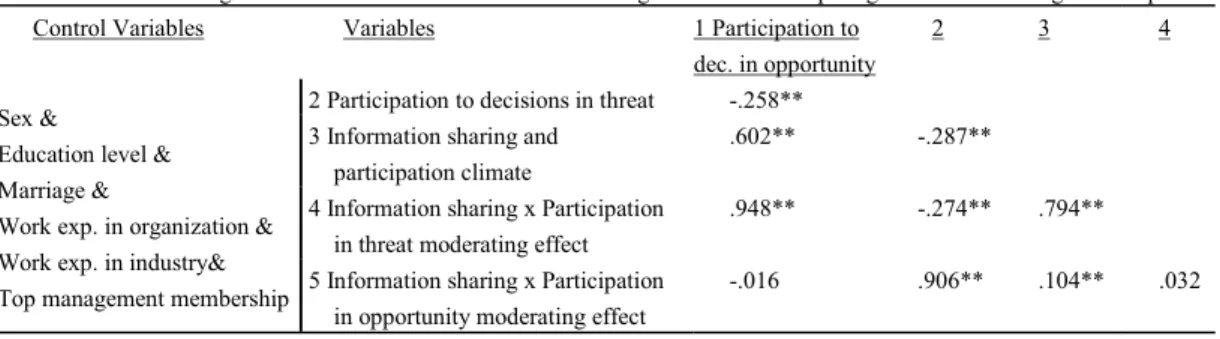
For correlations Table 3 and for regression analysis table 4 represent the case when considering the “normal” degree of participation as a moderator variable on managerial participation responses whether in crisis or opportunity strategic situations.
Table 3. Regression/ Correlation Results for Moderating Effects of Participating Climate on Managerial Responses
Control Variables Variables 1 Participation to
dec. in opportunity
2 3 4
Sex &
Education level & Marriage &
Work exp. in organization & Work exp. in industry& Top management membership
2 Participation to decisions in threat -.258** 3 Information sharing and
participation climate
.602** -.287**
4 Information sharing x Participation in threat moderating effect
.948** -.274** .794**
5 Information sharing x Participation in opportunity moderating effect
-.016 .906** .104** .032
*p< 0.05; **p< 0.01 one tailed t- tests for standardized betas.
When the characteristics of respondents are controlled for very significant correlations between the variables of the model prevails. Two interesting outputs are seen on moderating effects. While participation to decision making process increases in threat identification of issues under the high information sharing climate, moderating effect is negative in opportunity identification condition. The other negative relation is between information sharing/ participation climate and participation to decisions in issues identified as threat. For direction of relations Table 4 shows the linear regression analysis results.
Table 4. Regression results for moderating effects of participating climate on managerial participation to decision making process
Variables for Opportunity Control Variables
General Female Male Education Low Education High Exper. Low High Exper. Average participation climate .610** .631** .598** .646** .576** .682** .567** Information sharing x Participation in
opportunity moderating effect
-.081* -.118* -.064 -.086 -.076 -.198** -.010
Variables for Threat Control Variables
General Female Male Education Low Education High Exper. Low High Exper. Average participation climate .182** -.211 -.164* .183 -.176* .007 -.243** Information sharing x Participation in threat
moderating effect
.128 * -.207 -.093 .170 -.096 -.423** .007 *p< 0.05; **p< 0.01, two-tailed t- tests for standardized betas.
As seen in Table 4 whatever the control variables for respondent specifications are average participation climate has strong positive effect (p<.01) on top management intervention to decision making process for the issues labelled as opportunity. In contrast when the issue identified as threat average participation climate does not affect top management inclusion to decision making process for girls, low educated and less experienced managers. Moreover male, highly educated and experienced managers are negatively affected by participation climate in case of an issue identified as threat. As for moderating effect of average participation climate if the managers are low experienced there is strong
negative effect on top management intervention to decision making process for the issues labelled as threats. When the issue labelled as threat, average participation climate have strong positive effects on managerial participation in decision making process (p<.01) and normal positive moderating affect in the same dependent variable (p<.05). Not only regression results show that organizational climate of participation and strategic situations descriptive variables but, they also show lone correlation to dependent variable as generally expected from a moderating variable effect.
4. Conclusion
The results of this study indicate that top level executives participate in decision making groups if the identified issue contains more opportunity than threat. Our findings support Dutton and Jackson’s (1987) hypothesis that issue labelled as opportunities will result in greater involvement of organizational members than issues that are labelled as threats. Though the effect should be modified by information processing and participation climate in organizations it has no support by outputs of this study. However this study is also a response to the study of Ashmos at. al. (2011) which precluded sophisticated analysis and wider sample still has shortfalls. A future study would benefit from larger sample of firms with more participation.
Good decisions must be made quickly, despite the uncertainty, time pressure, and high stakes associated with such threats (Hannah et. al., 2010; Pearson and Clair, 1998). It is likely that a sense of severe time pressure which a threat may, but not necessarily, impart precipitates a need to constrict overall information processing and control by centralizing decisions, that is moving decisions up to the top management team. There may simply not be enough time to push decisions down through the hierarchy, regardless of the quality of information at the lower levels. On the other hand it is handy to have some responsible group to buffer threats from creative top managers and entrepreneurs.
Threats still require the processing of information that is of high quality, relevant and timely. High quality, relevant information is likely not possessed solely by Chief Executive Officer. There may be implication for managers derived from the results.
First implication of this study for managers is that the frame that a manager gives to an issue alters the way the manager as well as others process information related to making choices about that issue. It has an ultimate effect amongst organization members who organically creates solutions to problems. The language manager uses to present issues to others in the organization has been showed to have significant impact on how those issues will be decided. Frame a manager gives to an issue causes organization members to choose between the ways of processing information for resolution. For example an issue framed as opportunity the organizational “brain” expands in size reaching out to less familiar, less conventional response patterns with higher freedom comparing when labelled as threat. Because opportunity causes people to feel free to create provided there is little danger comparing the climate produced by threat-type issues. Thus, it seems to be important for manager to take advice from others before labeling an issue and create the potential for predictions about the strategic decisions.
It is possible that threat-type issues are distorting events which thrust firms away from the state of system equilibrium. If the firm aggressively unlearns old logic that no longer gives life to the organization, a new sense of order will happen. Then, survival of firms depend enabling systems to
self-organize, develop a new logic and patterns. It is clear by experience of firms a major way to life and vitality passes through participation of its members in decision making process. The second implication of this study given the strong effect of issue labels on subsequent organizational behavior is that the managers must work hard to create ways for participation, learning and shared meaning to occur.
The focus of this manuscript was on differences in participation due to the labels of threat and opportunity. Future research should extend this research to other labels, other differences in issue characteristics and other characteristics of top managers. Another focus of future study on the label of issues might be the whole effect throughout the organization when there are different participation levels and flat organization types.
The inclusion of organizational performance variables in future researches is crucial to answer the questions about issue labeling.
References
Dutton, J. E., and Jackson S.E. (1987), Categorizing strategic issues: Links to organizatonal action, Academy of Management Review, Vol.12, pp.76-90.
Hadley, C. N. (2011), Pittinsky, T. L., Sommer S. A., Zhu W., Measuring the efficacy of leaders to assess information and make decisions in a crisis: The C-LEAD scale, The Leadership Quarterly, No: 22, pp.633-648.
Hafer, J. C.,and Gresham G. (2012), Managers’ and Senior Executives’ Perceptions of Frequency and Type of Employee-Perpetrated Information Sabotage and Their Attitudes toward It - The Results of a Pilot Study, Institute of Behavioral and Applied Management, pp.151-167.
Hannah, S. T., Campbell, D. J., and Matthews, M. D. (2010). Advancing a research agenda for leadership in dangerous contexts. Military Psychology, 22(1), pp.157–189.
Jackson, S. E., and Dutton J. E. (1988), Discerning threats and opportunities, Administrative Sciences Quarterly, Vol.33, No:3, pp.370-387.
Junjie, W., Yongkang, L.,and Yang, B. (2012), Sectors to Turn Challenge into Opportunity, in Crisis Management in the Time of Changing World Atlantis Press, ICPM, pp.181-187.
Matthews, F. (2011), Paper presented in the European Consortium of Political research Conference, Reykjavik, 25-27 Aug, pp.1-23. Mears, P., and Voehl, F. (1997), Team building: A structural learning approach, New York, NY: CRC Press LLC.
Milliken, F. (1990), Perceivingand interprting environmental change: An exemination of college administrators’ interpretation of changing demographics, Academy of Management Journal, Vol.31, No: 2, pp.280-308.
Miller, D. (1988), relating Porter’s business strategies to environment and structure: Analysis and performance implications, Academy of Management Journal, Vol.31, No:2, pp.280-308.
Miller, D., Droge, C., and Toulouse, J. M. (1988), Strategic process and content as mediators between organizational context and structure, Academy of Management Journal, Vol.31, No:3, pp.544-569.
Mintzberg, H., Raisinghani, D., and Theoret, A. (1976), The structure of unstructured decision process, Administrative Science Quarterly, Vol.21, pp.246-274.
Pearson, C. M., and Clair, J. A. (1998). Reframing crisis management. Academy of Management Review, No:23(1), pp.59–76. Prewitt, J. E., Weil, R., and McClure A. Q. (2011), Crisis Leadership - An Organizational Opportunity, Australian Journal of
Business and Management Research, Vol.1 No.6, pp.60-74.
Thomas, J., and McDaniel, R. (1990), Interpreting strategic issues: Effects of strategy and the information processing structure of the top management team, Academy of Management Journal, Vol.33, pp.286-306.
Vroom, V., and Jago, A. (1974), Decision making as a social process: Normative and descriptive models of leader behavior, Decision Sciences, pp.743-769.
Yousif, A. (2012), Towards understanding the added value of social CRM, A systematic analysis and a customer value map, Innovation and Entrepreneurship, Twente Uni., pp.1-52.