Students’ Adoption of Distance Education
Environments: an Action Research of a Non-Thesis
Masters’ Program
Muhammet BERİGEL
1, Hasan KARAL
2ABSTRACT
The purpose of this research is to examine the factors in students‘ adoption of a distance education environment. An action research model was used for this study. The researcher was the system administrator of the learning management system. The action research methodology was used to profile student‘s adaption process. The findings are obtained from the researchers‘ observations and data collected from the learning management system. The study included 132 students enrolled in Educational Administration, Controlling, Planning, and Economics non-thesis Master‘s program. The results suggest that organizational structure and the technologies used are the main factors in assisting students to adopt distance education and reducing the adoption period.
KEYWORDS: Distance education, adoption to distance education, action research
INTRODUCTION
Many modern tertiary educational institutions are now faced with the challenge of a consistently growing demand for places in various academic programs. Increasingly, the challenges for access to these programs are from potential students with geographically distant and culturally diverse backgrounds. Many educational institutions have responded to the demand for increased access by adopting distance education as a mode of delivery and have created virtual universities (Ocak and Göktalay, 2006). These changes require students to adapt to new learning environments and students are therefore pressured to integrate new technologies into their learning activities.
Students within an online learning environment interact with the teacher learning environment and materials are different from traditional learning environments. Students with access to an e-learning system can now interact with instructional materials in various formats (text, pictures, sound, video on demand, and so on) anywhere and at any time, as long as they can log on to the internet. Furthermore, given the functionality of message boards, instant message exchanges and video conferencing, they can even interact with teachers
1Research Assistant, Karadeniz Technical University, Computer and Instructional Technologies
Education Department [email protected]
2
Assist. Prof. Dr., Karadeniz Technical University, Computer and Instructional Technologies Education Department [email protected]
and classmates, both individually and on a simultaneous basis (Trombley and Lee, 2002; Zhang and Zhou, 2003).
Many traditional educational institutions are slowly getting involved in online programs or have extended traditional programs, which Hanna (1998) defined as extended traditional universities. Such universities operate as the parent organization to a ‗virtual program‘ serving a non-traditional, geographically dispersed student body.
It is clearly of importance to gain an understanding of the factors contributing to students‘ successful adoption of online learning environments. Many previous studies have investigated student‘s adoption process of online learning environments (Venkatesh and Brown, 2001; Xia and Lee, 2000; Ali, Davis, Bagozzi and Warshaw, 1989; Hsu and Lu, 2004).
Student‘s adoption processes has generally been investigated using the technology acceptance model (TAM) developed by Davis (1989); this has been widely used over the past decade as a means of forecasting the extent to which new technologies will be adopted in the field of information systems (IS), with the findings of many studies being consistent with tam applications. In their various applications of the TAM, a number of studies have confirmed that user perceptions of usefulness and the ease-of-use of a system are two important antecedents of technology adoption, and have also suggested various ways of broadening the overall applicability of the TAM (Venkatesh and Brown, 2001; Xia and Lee, 2000; Ali, 2003; Davis, Bagozzi and Warshaw, 1989).
As the e-learning system promises a new way of delivering education, TAM could be useful in predicting students‘ acceptance of an e-learning system. However, there are some other factors within the adoption process that can not be observed using the TAM model, because it focuses on the individual; to determine all factors, it is also necessary to observe students within a social learning environment. To reveal these factors, the researcher must be part of the system that is being studied.
Factors Influencing Student’s Adoption
The aim of this study is to investigate students‘ adoption process of a distance education environment. Students enrolled in this program are teachers working at schools located in different cities in Turkey and have at least five years professional experience. The main factors influencing student‘s adoption process were categorized according to studies within the literature. Students‘ experiences, activities and behaviors were profiled to reveal factors affecting student‘s adoption process of an online learning environment
The literature on the adoption of information provides factors that are grouped in 3 main categories (Kettinger and Grover, 1997; Lewis, Levin and Grene, 1999;
Venkatesh, Morris and Ackerman, 2000). These factors are: Organizational characteristics; Organization and technology fit; Technology and external environment fit. Another important factor is the individual characteristics of students. The present study used 4 main categories to profile the students‘ adoption process.
Organizational Characteristics
The climate of an organization is very important for the adoption process. If students using an online learning system receive sufficient support and knowledge from the organization, their adoption process will be faster and easier (Attewell, 1992). Size should also be important in the present context, because larger institutions are more likely to have the technology infrastructure that is essential for providing an online distance-learning environment.
Organization and Technology Fit
Students using online learning environments are faced with using a learning management system or other technologies provided by the organization. An organization with a high propensity to innovate may still lag in adoption if the innovation does not fit its needs, strategies, resources, or capabilities. In higher education, public/private status can be a proxy for the fit between an organization and a technology (Özdemir and Abrayeva, 2007). If an organization uses technology in an appropriate way, students face fewer problems.
Technology and External Environment Fit
Technology characteristics, the external environment, and the fit between the two may also impact the adoption process. The effect of geographical location may influence the process of students‘ adoption of a learning environment (Özdemir and Abrayeva, 2007).
Individual Characteristics
Students‘ individual characteristics, technological literacy, attitudes, needs, and genders may influence their process of adopting online learning environments. A distance education program allows different students to study together. These differences may influence individual student‘s adoption of the online learning environment.
METHOD
Research Framework
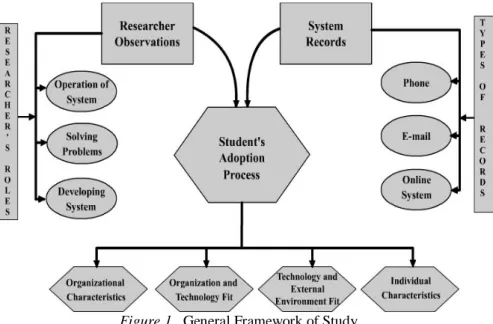
This study was first semester of Administration, Controlling, Planning, And Economy Non-Thesis Master‘s program at Karadeniz Technical University. The study lasted 14 weeks. The researcher was also the System Administrator of the online learning system. The researcher‘s responsibilities were general operation of systems, solving system problems, solving students‘ problems and also developing the systems. The researcher‘s role as System Administrator was to supply data for students‘ adoption process using experiences and observations and also to maintain system records providing information about the students‘ adoption process.
Figure 1. General Framework of Study
Figure 1 shows the general framework of study. Students‘ adoption process was investigated over 14 weeks using researcher observations and system records. Researcher observations focus on the researcher‘s role as system administrator. These roles are:
Operation of System: As the system administrator, the researcher is responsible for the operation of the system, organizations of courses, content, plans, exams and student relations. This role provides the opportunity to observe students‘ problems and experiences using the online learning system.
Solving Problems: As the system administrator, the researcher is responsible for solving problems encountered by students during the education process. Students may experience problems using the system, attending the live
courses, accessing and managing content, student affairs, master program and other technical issues. Students are able to contact the researcher to produce solutions to their problems
Developing System: As the system administrator, the researcher is also responsible for developing the systems. The researcher must be aware of problems using system records and must make changes and developments required to the systems. This reduces problems in using the online learning system. This role gives the opportunity to observe students‘ adoption following any system maintenance and development.
System records are another source for investigating students‘ adoption process. When students experience problems or require help, they contact the system administrator via phone, e-mail or the online system.
Phone: All phone calls are recorded at the distance education center. When students experience a problem or require help, they may contact system managers via telephone. These phone calls are recorded and students‘ problems are addressed. The records of these technical support calls were used to investigate students‘ adoption process
E-mail: Students may also receive support via e-mail, which also provides a record of their adoption process.
Online System: When students encounter problem or require help, they may contact the system managers using the online system. The online system has two functional components: live support during office hours- for one hour each week, the system administrators contact students with system information, to solve their problems and listen to students‘ demands; and an online contact form- live support during office hours and online contact form data are recorded by the system. The researcher used these records to investigate the students‘ adoption process.
Methodology
An action research methodology was used in this study to profile student‘s adaption process. Action research was introduced by Kurt Lewin in the 1940s to study social psychology and social changes at the University of Michigan‘s Research Center for Group Dynamics (Lewin, 1947). Lewin‘s work established the reputation of action research as a ―science of practice‖ that is best suited to studying complex social systems by introducing changes into practice and observing the effects of these changes (Argyris et al., 1985). The fundamental contention of action research is that complex social systems cannot be reduced for meaningful study. As a result, the goal of action research is to understand the complex process rather than prescribing a universal law (Bakerville, 1999).
Several sources outline three distinct types of action research. For example, Grundy (1988, p. 353) discusses three modes of action research: technical, practical, and emancipating. Holter and Schwartz-Barcott (1993, p. 301) discuss three types of action research—that of a technical collaborative approach, a mutual collaborative approach, and an enhancement approach. McKernan (1991, pp. 16-27) also lists three types of action research: the scientific-technical view of problem solving, the practical-deliberate action research mode, and a critical emancipating form of action research.
The present study used the technical collaborative form of action research, because the primary goal of this approach was to test a particular intervention based on a pre-specified theoretical framework. The relationship in this mode of action research was between the researcher and a practitioner. The communication flow within this type of research is primarily between the facilitator (practitioner) and the group, so that the researcher's ideas may be communicated to the group (Grundy, 1998). In other words, the researcher identifies a problem after collaborating with the practitioner, and then provides information to this practitioner who facilitates its implementation with the group.
The researcher acts as the system administrator of the online learning system. Role of researcher supplies observation for four dimensions of the adoption process (organizational characteristics, organization and technology fit, technology and external environment fit, and individual characteristics). The system administrator required the researcher to observe students, students‘ problems and system quality to increase the effectiveness of the system.
Participants
The study included 132 students enrolled in the educational administration, controlling, planning, and economy non-thesis master‘s program at Karadeniz Technical University.
Data Collection
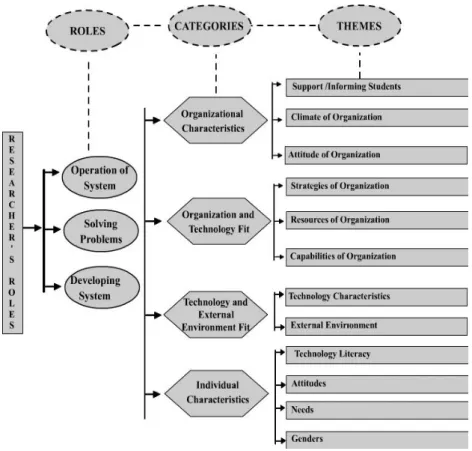
Data collected took place during the first semester of the non-thesis master program, in which students first start the distance education program. Data was collected from system records and researcher observations. Three of the system administrator roles were used for data collection. Data was collected using observation forms based on four categories influencing the student‘s adoption process: Organizational Characteristics, Organization and Technology Fit,
Technology and External Environment Fit and Individual Characteristics.
Figure 2 shows the categories and themes used for collecting data; the observation forms used 4 categories and 12 themes to collate data.
Figure 2. Observation Form Elements
The technical support records for the system were also used for data collection, consisting of phone calls, e-mails and online system data.
RESULTS and FINDINGS Organizational Characteristics
Distance Education Program is first distance education experiences of students at non-thesis program. Also this program is first master program of organizayiom at Karadeniz Technical University Distance Education Center. Due to limited experience of distance education, students require a significant level of assistance from the Distance Education Center. As a result, organizational characteristics are important for the success of the adoption process.
Table 1. Problems and Questions About Organizational Characteristics Rate Communication Type Phone E-mail Online System (Live Classes) Master Program 37 Students (27%) 20% 5% 75% Rules 57 Students (43%) 40% 0% 60% Student Affairs 86 Students (85%) 60% 10% 30%
Students‘ problems and questions about organizational characteristics are grouped in three categories. Thirty-seven students asked questions about the master program. Although students were informed that the university regulations were the same for both the distance learning and traditional classroom thesis programs, students want to confirm the rules of the thesis program. Fifty-seven students asked about of the regulations of the non-thesis program. Distance-learning students were from different regions of Turkey. They must complete tasks related to student affairs using the online system (adding courses, payments, attendance etc.). Students have first distance education experiences and therefore 65% of the distance-learning students faced some form of problems.
Supporting and informing students, the climate of the organization and the attitude of organization towards students were the main points that were focused on. Most of the problems and questions were solved by the Distance Education Center. Students were more comfortable when their problems were solved by the organization. Another important factor in the adoption process is obtaining sufficient information about the program, technologies and process. Sometimes students were not adequately informed by organizations, or some of the students‘ needs were paid insufficient attention. Students tended to panic at these situations and consult the distance support services to try to get information about these topics.
The attitude and climate of the organization are other important factors in the adoption process (Attewell, 1992). If an organization is well structured to conduct distance education programs, students feel more comfortable and have a greater sense of security.
Organization and Technology Fit
The distance education program is mainly conducted using a Learning Management System comprised of two parts, Synchronous and Asynchronous. The asynchronous part includes course content, weekly program, university
regulations, frequently asked questions, and individual information; the synchronous part includes live classes and communication platforms. To access the Learning Management System, students need internet connection and Flash Player software, which is installed on almost all computers. The technical background of the online system is very important. Although no problems have arisen related to the online system, some students experienced problems using system and consulted the help desk. It was found that these problems originated from their lack of computer and technological literacy and negative attitudes about distance education.
The strategies, resources and capabilities of an organization are of crucial importance for students‘ adoption process. Many technologies are used for distance education. An organization uses upper level technologies for distance education activities. Distance education technologies generally have two parts: organization and students. Within the organization part, students did not encounter many problems; however, on the student side, there were problems with students failing to meet their responsibilities to carry on distance education activities. The organization‘s capabilities, resources and strategies are the main factors in continuing successful distance education activities.
Technology and External Environment Fit
The technology used to maintain the online system is designed regarding students‘ opportunities. Using a high-speed internet connection, students would have no problem connecting to the online system. However, some students in the non-thesis master program used 3G technology to connect to internet, and therefore experienced some problems due to their lack of technical foundation. Also, some students working from rural areas experienced connectivity and electricity problems. Although all of the live classes are recorded on the system and students can review the content on-demand, this problem affected some students‘ adoption process of the distance education program.
Individual Characteristics
The study sample includes 132 teachers working in 58 different cities, who all have different experiences. Another important factor is that 47% of the sample is school managers and assistant managers. The main factors in students‘ adoption process were related to individual characteristics. Although the learning management system is easy to use, some students experienced problems using the system. Live classes were conducted during the evenings, but some students experienced problems joining the live classrooms due to a lack of time. All of the study participants originally graduated from university at least 5 years previously. After five years professional experience, most participants returned to postgraduate education highly motivated to succeed. Of the 132 participants, only 4 students left the program, stating that they did not feel they would successfully complete the course.
Students on the distance education program were firstly meet with live classes. They were required to sit in front of a computer and join the classrooms. The researcher conducted some interviews with students after the classroom sessions and asked their opinion of the live classrooms and the method of learning. At the beginning of the semester there were many complaints, but at the end of semester the participants did not complain about the method of learning.
CONCLUSION and RECOMMENDATIONS
This study investigated students‘ process of adopting a distance education program. Students‘ adoption is important for the success of a program. Success in online learning is defined as a multi-faceted construct that can be assessed along four dimensions: Organizational characteristics, organization and technology fit, technology and external environment fit, and individual characteristics. Organization is very important to prepare students for distance education. The results showed that, prior to starting this form of education, some factors must be considered to help students to adapt to distance education. These factors include choosing appropriate technologies, having sufficient resources, giving support and informing students, the climate and attitude of organizations, students‘ level of technological literacy, and students‘ needs.
The action research study presented in this paper reveals important factors affecting students‘ process of adapting to a distance education environment. The results suggest that organizational structure is the main factor in assisting students to adapt to distance education. Rogers (1995) describes adoption periods taking from a few months to several years. The results of this study also indicate methods to reduce the duration of student‘s adoption periods.
For effective technological adoption, students‘ different stages of concern should be acknowledged and appropriate support should be provided (Sehnaz and Mehmet, 2006).
The use of distance education is increasing in Turkey. This study will help staff, managers and instructors involved in distance education programs to facilitate students‘ adoption process.
REFERENCES
Ali, A. (2003). Faculty Adoption Of Technology: Training Comes First. Educational Technology, 43, 51-53.
Argyris, C., Putname, R., & Smith, D. (1985). Action Science: Concepts, Methods and Skills for Research and Intervention. (Pp.4). San Francisco, Ca: Joessey-Bass. Attewell P. (1992). Technology Diffusion And Organizational Learning: The Case Of
Davis, F.D., Bagozzi, R.P. & Warshaw, P.R. (1989). User Acceptance of Computer Technology: A Comparison of Two Theoretical Models, Management Science 35 (8), 982–1003.
Hanna, D. (1998). Higher Education In An Era Of Digital Competition: Emerging Organizational Models. Journal Of Asynchronous Learning Networks, 2(1), Pp. 66-95.
Hsu, C.L. & Lu, H.P. (2004). Why Do People Play Online Games? An Extended Tam With Social Influences And Flow Experience, Information And Management, Vol. 41, Pp. 853-68.
Kettinger, W.J. & Grover, V. (1997). The Use Of Computer-Mediated Communication In An Interorganizational Context, Decision Sciences 28 (3), 513–555.
Lewin, K. (1947). Frontiers İn Group Dynamics Iı. Human Relations, 1, 143-153. Lewis, L., Levin, D. & Greene, B. (1997). Distance Education At Postsecondary
Institution: 1997–1998. Retrieved November 02, 2010 from the World Wide Web: Http://Nces.Ed.Gov/Pubs2000/2000013.Pdf.
Ocak, M. A. & Goktalay Ş. B. (2006). Faculty Adoption of Online Technology in Higher Education, the Turkish Online Journal of Educational Technology, 5, 4, 5-37 Trombley, K. B. & Lee, D. (2002). Web-Based Learning In Corporations: Who Is Using
It and Why, Who Is Not And Why Not?, Journal Of Educational Media, Vol. 27 No. 3, Pp. 137-46.
Venkatesh, V. & Brown, S.A. (2001). A Longitudinal Investigation Of Personal Computers In Homes: Adoption Determinants And Emerging Challenges, Mis Quarterly, 25: 1, 71-102.
Venkatesh, V. Morris, M.G. &Ackerman, P.L. (2000). A Longitudinal Field Investigation of Gender Differences In Individual Technology Adoption Decision-Making Processes, Organizational Behavior and Human Decision Processes 83 (1), Pp. 33–60.
Xia, W. & Lee, G. (2000). The Influence of Persuasion, Training, and Experience on User Perceptions and Acceptance of It Innovation, Proceedings of Icis, 371-184.
Zafer, D., Ozdemir, A. & Jason Abrevaya, B. (2007). Adoption Of Technology-Mediated Distance Education: A Longitudinal Analysis, Information & Management 44 , 467–479
Grundy, S. (1988). Three modes of action research. In Kemmis, S. & McTaggert, R. (Eds.), The Action Research Reader (3rd ed.). Geelong, Australia: Deakin University Press.
Holter, I. M., & Schwartz-Barcott, D. (1993). Action research: What is it? How has it been used and how can it be used in nursing? Journal of Advanced Nursing 128, 298-304.
McKernan, J. (1991). Curriculum Action Research. A Handbook of Methods and Resources for the Reflective Practitioner. London: Kogan Publishers.
Grundy, S. (1987). Curriculum: Product or Praxis. London. England: The Falmer Press. Rogers, E. M. (1995). Diffusion of innovation. The Free Press, New York (1995). Sehnaz B,G & Mehmet A, O. (2006 ). Faculty Adoption Of Online Technology In Higher
Educatıon The Turkish Online Journal of Educational Technology . Vol:5-4 No: 5