The Graduate School of Education of
Bilkent University
by
Sevim Güneş
In Partial Fulfillment of the Requirements for the Degree of Master of Arts
in
The Program of
Teaching English as a Foreign Language Bilkent University
Ankara
MA THESIS EXAMINATION RESULT FORM
July 19, 2011
The examining comittee appointed by The Graduate School of Education fort he thesis examination of the MA TEFL student
Sevim Güneş
has read the thesis of the student.
The comittee has decided that the thesis of the student is satisfactory.
Thesis Title: The Background Factors That Influence Learners’ English Proficiency
Thesis Advisor: Asst. Prof. Dr. Philip Durrant
Bilkent University, MA TEFL Program
Comittee Members: Vis. Asst. Prof. Dr. JoDee Walters Bilkent University, MA TEFL Program
Asst. Prof. Dr. Gültekin Boran Gazi Univesity, Faculty of Education
ABSTRACT
THE BAKGROUND FACTORS THAT INFLUENCE LEARNERS’ ENGLISH PROFICIENCY
Sevim Güneş
The Program of Teaching English as a Foreign Language
Supervisor: Asst. Prof. Dr. Philip Durrant
July 2011
This study was conducted to explore the relationship between language achievement and starting age of learning English as a foreign language, type of high school, languages known by the learners and spoken in their home environment and learners’ attitudes towards language learning, and also to clarify other possible factors affecting language achievement. The participants of the study were the students of Medicine, Engineering and Law Faculties at Dicle University. To explore the effects of the mentioned factors on language achievement, a questionnaire was completed by 105 participants and the data to clarify the other possible factors affecting language achievement were obtained through interviews with twelve of the participants. The data derived from the questionnaires were analyzed with SPSS and the data obtained from the interviews were analyzed in a qualitative way.
The findings obtained from the quantitative analysis present the following results. The results showed that starting to learn English as a foreign language at an
early age does not have many advantages on learning. Type of high school is very important for English proficiency, because the students of Anatolian/Science High School have much higher proficiency in English. Knowing more than one language and being in a family environment where more than one language is spoken do not have a significant effect on English proficiency. There is not a correlation between attitudes towards language learning and language proficiency.
As the results of qualitative analysis, it was seen that practicing what is learnt in the classroom and having a connection with the foreign language out of the classroom (listening to English songs, watching English movies) are very important to gain a high proficiency in language. On the other hand, grammar-based
instruction, experiencing the same teaching styles during the whole learning process, lack of environment to practice foreign language and a high anxiety level cause problems in the learning process.
Key Words: Foreign language, starting age, attitudes, bilingualism, intensity of language education.
ÖZET
ÖĞRENCİLERİN İNGİLİZCE YETERLİLİĞİNİ ETKİLEYEN FAKTÖRLER
Sevim Güneş
Yabancı Dil Olarak İngilizce Öğretimi Programı
Tez Yöneticisi: Yrd. Doç. Dr. Philip Durrant
Temmuz 2011
Bu çalışma dil başarısı ile yabancı dil olarak İngilizce öğrenmeye başlama yaşı, lise türü, dil öğrenenler tarafından bilinen ve aile ortamlarında konuşulan diller ve dil öğrenimine yaklaşım arasındaki ilişkiyi araştırmak ve dil başarısı üzerinde etkili olabilecek diğer muhtemel faktörleri belirlemek amacıyla yapılmıştır. Bu çalışmanın katılımcıları, Dicle Üniversitesi Mühendislik, Tıp ve Hukuk Fakültesi öğrencileridir. Bahsedilen faktörler ve dil başarısı arasındaki ilişkiyi araştırmak için 105 katılımcıya anket uygulanmıştır; diğer muhtemel faktörlerin belirlenmesi için gerekli olan veri ise katılımcılardan 12’siyle yapılan görüşmeler sonucunda elde edilmiştir. Anketlerden elde edilen veriler SPSS ile görüşmelerden elde edilenler ise nitel olarak analiz edilmiştir.
SPSS analizinden çıkan bulgular, erken bir başlama yaşının yabancı dil olarak İngilizce öğreniminde çok etkili olmadığını, birden fazla dil bilmenin ya da aile ortamında birden fazla dil konuşulmasının İngilizce öğrenimi üzerinde büyük bir etkiye sahip olmadığını, dil öğrenmeye olan yaklaşım ile dil yeterliliği arasında bir korelasyon olmadığını, öte yandan lise türünün dil başarısı için son derece önemli
olduğunu ve Anadolu ve Fen Lisesi öğrencilerinin dil öğreniminde Düz Lise öğrencilerinden daha başarılı olduğunu ortaya koymuştur.
Görüşmeler sonucunda elde edilen verilerin nitel analizi ise sınıflarda
öğrenilen bilgilerin pratik edilmesinin ve yabancı dil ile olan bağlantıyı sınıf dışında da devam ettirmenin (okul dışında İngilizce müzik dinlemek ya da film izlemek gibi) dil başarısı üzerinde olumlu etkiye sahip olduğunu; fakat dil bilgisi temelli öğretimin, öğretim süresi boyunca aynı yöntemlerin kullanılmasının, yabancı dili kullanabilecek bir ortamın olmamasının ve yüksek kaygı düzeyinin dil öğrenimi üzerinde olumsuz etkiye sahip olduğunu ortaya koymuştur.
Bulunan sonuçların, Milli Eğitim Bakanlığı’nın yaptığı/yapacağı eğitim reformlarına yönelik katkı sağlaması ve yabancı dil eğitimi ile ilgilenen
akademisyenler ve İngilizce öğretmenlerine dil eğitiminde etkili olan faktörler açısından ışık tutması ümit edilmektedir.
Anahtar Kelimeler: Yabancı dil, başlama yaşı, yaklaşımlar, iki dillilik, dil eğitiminde yoğunluk.
ACKNOWLEDGEMENTS
There are many who I am deeply indebted to for providing me with their tremendous help, support and encouragement throughout MA TEFL Program.
First and foremost, I owe my deepest gratitude to my thesis advisor Asst. Prof. Dr. Philip Durrant. His wisdom and guidance, support, and navigation efforts have a big role on completing this thesis. I thank him particularly for the promptness of his thought-provoking feedback which I always received in the shortest time. I also thank him for his patience as he kept reading, editing my chapters.
A profound gratitude is also owed to my instructors; Asst. Prof. Dr. JoDee Walters, Asst. Prof. Dr. Julie Mathews Aydınlı and Asst. Prof. Dr. Maria Angelova. Their invaluable instructions, supports and understandings helped me to complete MA TEFL Program despite so many things. Moreover, I thank my classmates for their sense of friendship and help which were highly complementary.
I would express my sincere thanks to the administration of Dicle University; the manager of School of Foreign Languages, Assoc. Prof. Dr. İlhan Kaya; the head of ELT Department, Asst. Prof. Dr. Nilüfer Bekleyen and all my colleagues,
especially Şehmus Turan. They all supported and encouraged me in this difficult process. I cannot ignore the helps of my colleagues in data collection process and all the difficulties became easier with their invaluable help. I also thank to my dear friends, Havva Karakaya and Remziye Yılmaz for their helps on the last days of this long process. They are all the secret supporters of this study.
I also thank to the student of Medicine, Law and Engineering Faculties of Dicle University who completed the questionnaires seriously and attended to the interviews to share their valuable thoughts on the issues I explored.
I am grateful to my family, especially my parents. They have been behind every success that I achieved until now and I’m sure they will be. Although I was far away from them, I always felt their belief and confidence in my heart and this
strengthened me all the time.
The last but not the least, I owe special thanks to my beloved husband, Ahmet Nedim Güneş. If he were not, I would not be writing these lines. I cannot describe his patience and encouragement throughout these tiring months. His endless and
unconditional support made all impossibilities possible. I took each step with him and I owe this sense of achievement to him.
LIST OF CONTENTS ABSTRACT ... iv ÖZET ... vi ACKNOWLEDGEMENTS ... viii LIST OF CONTENTS ... x CHAPTER I: INTRODUCTION ... 1
Background of the Study ... 4
Introduction ... 4
Age ... 4
The Effect of the Intensity of Language Education on Foreign Language Acquisition (FLA) ... 6
Attitude ... 7
Languages Known by the Learners ... 8
Statement of the Problem ... 9
Research Questions ... 11
Significance of the Problem ... 11
Conclusion ... 12
CHAPTER II: LITERATURE REVIEW ... 13
Introduction ... 13
Age ... 13
What is the age issue about? ... 13
Research on Second Language Acquisition ... 15
Research on Foreign Language Acquisition and Effects of Intensity on FLA ... 18
The Effect of Attitude towards Learning English on Achievement ... 23
Languages Known by the Learners and Spoken in Their Home Environment ... 26
Conclusion ... 27
CHAPTER III: METHODOLOGY ... 28
Introduction ... 28 Setting ... 29 Participants ... 30 Instrument ... 31 Procedure ... 32 Conclusion ... 33
CHAPTER IV: DATA ANALYSIS ... 34
Introduction ... 34
Quantitative Analysis ... 35
1a) How is students’ English proficiency when they start university affected by the age they started learning English? ... 35
1b) How is students’ English proficiency when they start university affected by type of high school? ... 38
1c) How is students’ English proficiency when they start university affected by the languages they know and are spoken in their family, and by the other family members who know English? ... 39
1d) How is students’ English proficiency when they start university affected by their attitudes towards learning English? ... 42
Qualitative Analysis ... 42 Conclusion ... 44 CHAPTER V: CONCLUSION ... 45 Introduction ... 45 Discussion of Findings ... 46 Pedagogical Implications... 52 Limitations ... 55
Suggestions for Further Research ... 57
Conclusion ... 57
REFERENCES ... 59
APPENDIX A: ENGLISH QUESTIONNAIRE ... 64
APPENDIX B: TURKISH QUESTIONNAIRE ... 68
APPENDIX C: TURKISH SAMPLE INTERVIEW ... 72
APPENDIX D: ENGLISH SAMPLE INTERVIEW ... 74
LIST OF TABLES
Table 1- The profile of participants………. 31
Table 2- The variables which were not included in the study………. 36
Table 3- Participants’ starting time of learning English……….. 37
Table 4- The times and numbers of participants’ first effective education……. 38
Table 5- When learners started to have first effective education……… 39
Table 6- The number of participants and languages they know………. 41
CHAPTER I: INTRODUCTION
As English is a global language, we come across its importance in most of the fields all around the world. The importance of English increases every passing day, as do the importance of the factors affecting English proficiency. This is also true in Turkey. The students who graduate from high school face some problems with English when they start university. In some departments, such as Medicine, Law and Engineering, there is a high intensity of English classes and this has a strong effect on students’ ability to pass their classes. The students who do not have a good education in high school face many more problems than the ones who do. The
students of other departments are more likely to face these problems after graduation, because it is often necessary to have a high proficiency in English in order to get a good job. The importance and necessity of English proficiency keeps the eyes on the effective factors, and a number of background factors influencing proficiency have been researched.
A particularly commonly research factor is that of the starting age of learning English (Abello-Contesse, 2008; Abrahamsson & Hyltenstam, 2009; Abu-Rabia & Kehat, 2004; Bongaerts, 2005; Hyltenstam & Abrahamsson, 2003; Larson-Hall, 2008; Singleton, 2005). In Turkey, English was added to the primary school curriculum in 1997 by the Ministry of Education, suggesting that the Ministry believes that learners benefit from starting to learn at a younger age. However, there are contradictory views about this factor. Many researchers think that starting to learn a second language at a late age causes some problems in the learning process (Perani et al., 1996 ) whereas others think that the learners who start to learn a
second language in later periods of life can also be very successful (Bongaerts et al., 1997).
Another factor thought to affect English proficiency is the intensity of language education (Garcia Mayo & Garcia Lecumberri, 2003; Larson-hall, 2008; Lengyel & Singleton, 1995; Munoz, 2006). A number of studies have considered the mediating effect of intensity of language education on the starting age of foreign language acquisition ( Dörnyei, 2009; Garcia Mayo & Garcia Lecumberri, 2003; Larson-hall, 2008; Lengyel & Singleton, 1995; Munoz, 2006). In the Turkish
context, this factor is an important one because students who study in different types of high schools have different intensity of English classes. For example
Anatolian/Science high school students have 10 hours of English classes in a week in their 1st grade, but regular high school students have four hours of English classes weekly. If this is an effective factor in determining language proficiency, it may mean that some students are disadvantaged when they come university, because they are all exposed to the same university program regardless of their types of high school.
A third factor which is often thought to affect proficiency is that of learners’ attitudes towards learning a foreign language. Research studies related to this factor have been conducted from different perspectives. Some studies looked at whether learners have positive or negative attitudes towards learning a foreign language (Abu-Rabia, 2003); some other studies focused on the correlation between attitude and language proficiency level (Clément, Gardner, & Smythe, 1980; Gardner & Masgoret, 2002; İnal, Evin, & Saracoğlu, 2003).
A final factor that will be researched in this study is the effect of other languages known by the learners and spoken in their home environment. Kirkici (2004) reviewed various studies to explore the effect of bilingualism on English. Some of these studies concluded that being bilingual has positive effects on learning a foreign language (Balkan; Cummins & Gulutsan; Peal & Lambert; Scott- all cited in Kirkici, 2004) and some others concluded the opposite (Appel & Muysken; Carrow; Grosjean; Kelly; Macnamara- all cited in Kirkici, 2004). This variable may be particularly important in the context of Diyarbakir, where this study will be conducted. Diyarbakır is one of the cities where more than one language is spoken; most of the children grow up as bilingual or they start to learn a second language after they start primary school. This may have an effect on students when they start to learn English.
The purpose of this study is to investigate the relationship between English proficiency and students’ starting age of learning English, type of high school, languages known by the learners and spoken in their home environment, and attitude towards English. It will also explore other possible background factors that may affect foreign language acquisition.
Background of the Study Introduction
Language teaching involves difficult decisions regarding when teaching should start, what the curriculum should include and which methods should be used (Güngör Aytar & Öğretir, 2008). To answer these questions, the factors that affect language learning should be known first. Some research studies about the factors effecting language proficiency have been carried out; the factors that have been researched include starting age of acquiring a second language (Abello-Contesse, 2008; Abrahamsson & Hyltenstam, 2009; Abu-Rabia & Kehat, 2004; Catling & Johnston, 2006; Chiswick & Miller, 2008), intensity of language education (Larson-hall, 2008), attitude towards learning a foreign language (Abu-Rabia, 2003; Gardner & Masgoret, 2002; İnal, Evin, & Saracoğlu, 2003). In addition to the factors
mentioned, this study will also focus on the effect of languages known by the
learners and spoken in their home environment. The effects of being multilingual on foreign language learning are discussed in Kirkici’s review (2004), but to my
knowledge, there are not any studies exploring the slightly different point of the effect of languages spoken in learners’ home environment.
Age
Age is one of the issues on which various research studies have been done for years; it is believed by a lot of researchers that the earlier foreign language
teaching/learning starts, the more effective it will be (Abrahamsson & Hyltenstam, 2009; Perani et al., 1996). Penfield and Roberts (as cited in Harley, 1986) state that the brain of a child is more plastic than an adult’s. Before the age of nine to 12, s/he can learn two or three languages in an easy way, as s/he is an expert in learning to speak at these ages. However, after the age of 12, the brain becomes progressively
rigid in terms of language learning. Perani et al.'s study on brain processing (2006) found that some areas of the brain are shaped with early exposure to the language, but this shaping is not possible for learners who are exposed to a second language later in life. Similarly, Chomsky indicates that children learn the basic rules of a language before the age of five despite differences in language learning environment and intelligence (Güngör Aytar & Öğretir, 2008). It is stated that the first ten years of life are the most appropriate period for language learning. During this period, the child’s receiving and producing a language are accomplished by both the left and right hemispheres of the brain; but in puberty, the left hemisphere becomes much more dominant (Bulut, 2003).
As it is stated above, age is accepted as a very important factor in the
language learning process. Educators in many countries are aware of this fact and try to take it into account in designing their education systems. Sayınsoy (as cited in Bulut, 2003) indicates that in European Union countries, teaching English at early ages has been popular since 1985. In Turkey, students have started to learn English in 4th grade in primary schools since the 1997-1998 academic year, because starting to learn English after the age of 10 or 11 was seen as problematic. As the first step of designing new approaches for English, therefore, the authorities decided to teach English at a younger age.
To investigate the problems related to age, some research studies have been done in different countries, but most of these studies focus on specific areas of the language learning process such as the relationship between age and pronunciation (Theo Bongartes et al., 1997), or teaching vocabulary to children (Sun & Dong,
2004). This study will focus on the impact of starting age of learning English on the foreign language (FL) learning process as a whole.
In research studies, the age factor is considered in two different settings: EFL (English as a Foreign Language) and ESL (English as a Second Language). Studies conducted in second language contexts have generally found that younger children learn a language more easily (e.g. Abrahamsson & Hyteltenstam, 2009; Singleton & Lengyel, 1995), though some have also found that learners can have a high level of proficiency in L2 at any age (Abello-Contesse, 2008). From most of the studies conducted in EFL settings, on the other hand, it was concluded that an early start is not an advantage for foreign language learning (Garcia Mayo & Garcia Lecumberri, 2003; Larson-Hall, 2008; Munoz, 2006).
The Effect of the Intensity of Language Education on Foreign Language Acquisition (FLA)
I am not aware of any studies that researched the effect of intensity of language education directly. However, a number of studies have taken this factor into account as a variable modulating the effect of starting age of foreign language acquisition with the intensity of language education (Garcia Mayo & Garcia Lecumberri, 2003; Larson-Hall, 2008; Munoz, 2006; Oller, J. & Nagato, 1974).
The studies present similiar results on this issue. Oller and Nagato (1974) concluded that starting to acquire a foreign language at an early stage of life does not have a positive effect on learning in the condition of having only one to two hours of language classes a week. Garcia Mayo and Garcia Lecumberri (2003) present similar results; starting to learn a foreign language at a young age does not produce positive
effect on achievement. The researchers also conclude that as the learners’ exposure to the target language increases, the degree of achievement increases. In the study by Djigunovic and Vilke (as cited in Garcia Mayo & Garcia Lecumberri, 2003), it was seen that early beginners were better than later ones as long as some basic conditions such as an adequate intensity of and quality of exposure to the target language were met. Munoz (2006) suggests that starting age and the intensity of language education are not conclusive determinants of perception and production of FL sounds in a native-like way, but adds that this does not mean the length of exposure to foreign language is an irrelevant factor. Larson-Hall (2008) states that an early age is not a magical factor, but will be advantageous as long as the learners receive adequate language input. This is also the conclusion reached by Lightbown and Spada (2006) in their review of the field.
Attitude
Many different research studies have investigated the effect of attitude or motivation on second and foreign language acquisition over the years (Clement, Dörnyei, & Noels, 1994; Clément, Gardner, & Smythe, 1977, 1980; Ely, 1986; Gardner & Masgoret, 2002). Gardner (1985), Ellis (2003), and Shirbagi (2010) state that attitude and motivation are not synonyms. Attitude is defined as “a disposition to respond favorably or unfavorably to an object, person, institution, or event’’ (Ajzen, as cited in Shirbagi (2010).
Motivation, on the other hand, is explained in Dörnyei (2001) as concerning:
…the direction and magnitude of human behavior, that is: the choice of a particular action, the persistence with it, the effort expended on it. In other words, motivation is responsible for why people decide to do something, how long they are willing to sustain the activity and how hard they are going to pursue it, p. 8.
Many research studies conducted over the years have shown that attitude is an important factor for foreign language acquisition. As early as 1975, Gardner and Smythe indicated that attitude promotes motivation and motivation promotes second language achievement (as cited in Gardner & Masgoret, 2002). Similarly, Clément, Gardner and Smythe (1980) show that EFL learners who have a positive attitude towards learning a foreign language use the language more frequently and are more motivated to go on learning the language. A more recent study in the Turkish context, by Inal, Evin and Saracoglu, also shows that there is a positive correlation between attitude towards learning a foreign language and achievement (2003).
Languages Known by the Learners
Various studies about the effect of languages known by the learners reviewed in Kirikici’s study (2004) present different results for the effect of knowing more than one language on learning a foreign language. As Kirkici (2004) stated most of the studies on this issue before the 1960`s arrived at the conclusion that bilingualism has negative effects on child`s mental, social and psychological development. As stated in Kirikici’s study, Jesperson (1922) concluded that a bilingual child never reaches the perfectness of using two or more languages in the same level; Tireman (1954) expressed that only 54% of Spanish-English bilinguals can perform
appropriately in their reading tasks. On the other hand, more recent studies have started to focus on the positive effects of bilingualism. As is cited in Kirkici (2004), the studies of Murray and Kourtzin, Grosjean, Roseberry-McKibbin and Brice, Hawson, and Gonzales and Yawkey indicate that bilingualism provides great contributions to children`s language skills and mental skills.
Statement of the Problem
English learners in Turkey face a variety of problems in the process of learning English. In attempting to address deficiencies in the educational system, the Ministry of National Education decided to make education reforms and regulate the existing system in many ways in the 1997-1998 academic year. One of these reforms was about the curriculum of primary schools. With this new education system, English began to be taught in the 4th grade of primary school instead of the 6th grade (that is, at age 10, rather than at age 12). While this decision was based on a belief in the necessity of beginning English at early ages, clear evidence of the validity of this decision in the Turkish context has not been provided.
Another factor which is thought to have an important effect on English proficiency is ‘type of high school’. In Turkey, there are different types of high schools such as Anatolian High Schools, science high schools, private high schools and regular high schools; these have different intensities of language education. Ministry of National Education has recently focused on new reforms for the education system of these schools. The duration for a regular high school was
increased to four years from three years in 2005, and English started to be taught in a longer period of time in Anatolian/Science high schools. The students of these schools used to take 24 hours classes in their first year of high school, but they have 10 hours weekly in their first grade now. This study will provide evidence for the type of high schools, and clarify which type(s) of high schools present more effective language education.
Additionally, this study will look at the effect of attitude on language achievement. In many education institutions, the attitudes of the learners are not
taken into consideration in the learning process. This is also so at Dicle University. If a positive correlation is found between the attitude toward language learning and achievement, this evidence will guide the authorities to encourage the learners to develop positive attitudes which promote their motivation in the learning process.
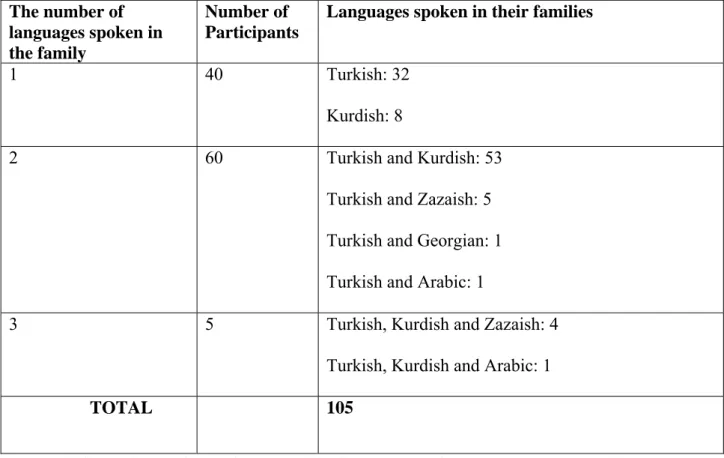
In addition to the factors mentioned above which are traditionally associated with proficiency, this study will also look at the effect of languages spoken in the learners’ home environment. In Diyarbakır, most of the people know more than one language; they acquire the second language by means of environment or they grow up bilingual. Most of the students, especially in suburbs, learn Kurdish in their home environment. After they start primary school, they start to learn Turkish, which is the language of education, and when they start 4th grade at primary school, they start to learn a foreign language, which is English. It is possible that the multilingual background of some students may represent either an advantage (because they have previously learned a second language) or a disadvantage (because they have had to cope with being educated in a second language) for learners.
Research Questions
1. How is students’ English proficiency when they start university affected by a) the age at which they started learning English?
b) the type of high school they attended?
c) the languages that are known and spoken in their family? d) their attitudes towards learning English?
2. What other background factor(s) influence students’ English proficiency?
Significance of the Problem
To know the factors that affect foreign language learning is one of the most important steps of effective teaching. This study aims to identify the effect of starting age of learning a foreign language, type of high school, the languages known by the learners and spoken in their home environment, and attitudes towards learning English on students’ language proficiency. Finding out the relationship between these factors and language proficiency will provide further evidence for the broader research and in particular for research on foreign language learning in Turkey. The results will provide empirical evidence either supporting or countering recent educational reforms for starting English education at an earlier age. This study will also look at the effect of ‘type of high school’ to clarify the effectiveness of high schools’ language education systems; the results of this will be helpful to see which types of high schools are more effective in foreign language teaching and this will provide guidance for Ministry of National Education in terms of new reforms.
As another factor, the effect of attitude towards language learning on foreign language proficiency will be also explored. If a positive correlation is found between attitude and foreign language proficiency, new ways of increasing positive attitudes
that promote motivation can be explored and presented to the learners at the beginning of the learning process; these can be different activities presented according to the major of the students. As the last factor, the effects of languages known by the learners and spoken in their home environment will be explored. The effect of bilingualism or multilingualism has been researched before (Kirkici, 2004), though I am not aware of any such study in the Diyarbakir context. Moreover, as the effect of languages spoken in learners’ home environment has not, to my knowledge, been explored before, this study will provide guidance for the studies conducted in multilingual societies and the education institutions of these societies.
The second research question, which explores other possible factors effecting foreign language proficiency, is also intended to guide authorities who are
responsible for the education system. This question aims to uncover specific effective factors other than the ones mentioned above. This will be helpful in terms of indicating both the factors that have a positive effect and those that have a negative effect on language proficiency. In this way, an evaluation of current language education system will be made and new ways of language education may be presented.
Conclusion
In the next chapter, further information about the research studies which have been conducted to clarify the effects of background factors such as starting age, intensity of language education, languages known by the learners and attitude towards FLA will be presented.
CHAPTER II: LITERATURE REVIEW Introduction
A number of different background factors are thought to affect students’ success in learning a foreign language. These include the age at which learning starts (Abello-Contesse, 2008; Abrahamsson & Hyltenstam, 2009)the interaction of
starting age with intensity of language education ( Dörnyei, 2009; Garcia Mayo & Garcia Lecumberri, 2003; Larson-Hall, 2008; Munoz, 2006) and students’ attitudes toward language learning (Clement, Dörnyei, & Noels, 1994; Gardner & Masgoret, 2002; Lambert, 2001). In this study, the correlation between the factors stated above and students’ English proficiency and other possible factors effecting students’ success will be studied. This review will discuss each factor in turn.
Age
What is the age issue about?
The effect of age on foreign/second language Acquisition is an issue on which a lot of empirical studies have been done over the years (Barry, Johnston & Wood, 2006; Chiswick & Miller, 2008; Dörnyei, 2009; Hyltenstam & Abrahamsson, 2003) . It is commonly believed that young learners can acquire a second language in a more natural and easier way while older learners have to struggle to attain even moderate fluency (Harley, 1986), but contradictory beliefs also exist (Abello-Contesse, 2008).
As Scovel (2000) notes, children are generally thought to be better second language learners than adults. That is, younger learners learn in a quicker way than adults and the outcomes are better (Abello-Contesse, 2008). However, as Dornyei (2009) has pointed out, it is also known by anybody who teaches a foreign language
to different age groups that a 15 or 30 (or even 60)- year-old learner is likely to make more progress in a school context than a 5-year-old child. It seems, therefore,
younger learners do better in natural environments in which the learner may have a lot of contacts with native speakers. On the other hand, in a formal language learning environment like a school, where analytic skills and formal learning strategies may be more important, teenagers seem to do better than young learners.
Different explanatory hypotheses have been suggested for the perceived advantage of children in a naturalistic learning environment (Dörnyei, 2009; Hyltenstam & Abrahamsson, 2003).
In terms of biological causes of the age factor, ‘myelination’ is believed to be important. As Hyltenstam and Abrahamsson (2003) indicate, myelin is a substance which exists in the glial cells and includes lipids and proteins. Cortical neurons myelinate in the brain; in this psychological-chemical process, the axons of the neurons are wrapped with myelin by glial cells. This process provides the neurons with nutrition and helps electrical signals conduct more rapidly, so transfer of information occurs at larger cerebral distances. By puberty, most areas of the brain have reached full myelination.
As cited in Hyltenstam & Abrahamsson (2003), Pulvermüller and Schuman (1994) describe the effects of myelination on language acquisition potential with reference to two systems of cortical connections between neurons. One of them uses apical dendrites and axons and it is far from the cell body and connects different cortical areas. The other one using basic dendrites is close to the cell body and local branches of the axons. These two systems were labeled the A-system and the
B-system by Braitenberg, 1978 (as cited in Hyltenstam & Abrahamsson, 2003). Neural connections form naturally and locally through the B-system before myelination of a certain area severs the connections between neighboring neurons. This, it is claimed, is why phonological and syntactic systems are acquired easier in an early period of life; that is, these aspects are acquired by means of connections within a limited cortical area (Hyltenstam & Abrahamsson, 2003).
Cognitive explanations are also given for the effect of age on SLA. Perhaps the most common such explanation is given in terms of the interference of general problem-solving mechanisms which are involved in older learners’ learning process. As Hyltenstam & Abrahamsson (2003) stated, this explanation has been termed the fundamental difference hypothesis by Bley-Vroman (1989). It indicates that adult learners do not have access to the inborn language acquisition device, but have to rely on general problem-solving procedures (as cited in Hyltenstam & Abrahamsson, 2003).
Explanations for the greater success of young learners are also given in terms of motivation. Bialystok and Hakuta (1999) conclude that the motivation of children for native-like levels of second language is higher than adults as the children develop positive attitudes toward acquiring the L2 and the culture of the language which is being learned. A further effect of motivation is that young learners have more input compared to adults.
Research on Second Language Acquisition
Some researchers claim that any learners can gain native-like proficiency no matter at which age they start to acquire their second language, but some other
researchers believe that native-like proficiency is impossible after a certain period (Abrahamsson & Hyltenstam, 2009).
Long (1990) claims that there is a critical age of 12 for achieving native-like pronunciation (as cited in Bongaerts, 2005). Flege, Munro and MacKay (1995) conducted a study to evaluate Long’s claim, the purpose of the study being to find out whether native-like pronunciation can be achieved after the critical age. The participants were 240 Italians who had immigrated to Canada. They had arrived in Canada at different ages (min=2, max=23). English sentences were read out by these participants and their pronunciation was evaluated by 10 native speakers. It was reported that 6% of immigrants who had arrived in Canada after the age of 12 had a native-like accent. In contrast, none of the participants who had arrived after the age of 16 had native-like accents. It was concluded that an early age of arrival (AOA) is advantageous to gaining a native-like performance in L2.
Contrasting results are presented by Bongaerts and his colleagues, who conducted similar studies with participants who were post-critical period second language learners (Bongaerts, 1999; Bongaerts et al., 1997, 2000). In the first study (Bongaerts et al., 1997), the participants were Dutch learners of English. Five participants were found to have a native-like performance on the given task, which was reading sentences. In the second study (Bongaerts, 1999), the participants were French learners of English and three performed like native speakers on the same task as the previous study. In the third study (Bongaerts et al., 2000), the participants of which were immigrants to the Netherlands with different L1 backgrounds, two performed in a native-like way. From all of these studies, it was concluded that the
learners who begin to learn a second language after a purported critical period can attain a native-like level in various linguistic domains (all cited in Bongaerts, 2005).
Abrahamsson and Hyltenstam (2009) also investigated whether late L2 learners can achieve a native-like level in L2. Their participants were 195 Swedish speakers who had begun their second language learning at various ages and who identified themselves as potentially native-like speakers of L2. One hundred and seven of these participants began to learn Swedish before the age of 12 and 88 began at 12 or later. They were selected with three advertisements in daily newspapers according to six different criteria: being Spanish native speakers, speaking Spanish fluently, being 19 years old or older, having lived in Sweden for ten years or more, having minimally a 12-year educational level (no less than senior high school), and having been exposed to Swedish spoken in the greater Stockholm area. The people who called for the advertisement had a 15-minute interview on the telephone; they were asked to speak about a certain subject for one minute. These speech samples were then used as stimuli in listening sessions, in which Swedish native speakers were asked to
determine whether the respondents had a foreign accent. After the listening sessions with a large sample (n = 195; Age of onset (AO) < 1-47 years) and broad and detailed linguistic analysis with a small number of participants (n = 41; AO = 1-19 years), the results were analyzed. Most of the early learners and only a few of the late learners were perceived as native speakers of Swedish. However, only a small
number of early learners and none of the late learners showed real linguistic
nativelikeness when their performance was evaluated linguistically. It was concluded that an early starting age is an advantage for second language acquisition.
Research on Foreign Language Acquisition and Effects of Intensity on FLA
As indicated before, this study looks at the effects of background factors on learning English as a foreign language. However, the research studies mentioned above are all about learning English as a second language. Some important
differences between learning language as a foreign language or a second language should be considered when studying the effect of starting age. The learners who learn English as a second language have many more opportunities to practice and improve the language as a result of their large amount of exposure to the target language. On the other hand, learners who learn English as a foreign language are exposed to the target language generally in a formal setting and in a limited amount. When looking at the effect of starting age in FLA settings, amount of exposure is an especially pertinent variable (Munoz, 2006). Singleton (1995) estimates that exposure to a FL in a formal setting for 18 years is nearly equal to one year of exposure in an L2 naturalistic setting (Singleton, 1995). This section is going to look at the research studies done to clarify the effect of age on learning English as a foreign language and its interaction with intensity of instruction.
In an early study, Oller and Nagato (1974) studied Japanese students who had started to learn English in primary school (one to two hours a week) or in junior high school. Those two groups were tested in the 7th, 9th and 11th grades by means of cloze tests. There were statistically significant differences between the two groups when they were in 7th and 9th grades, but not in the 11th grade. It was concluded that starting to learn a foreign language at an early age did not have a long-term advantage.
Perani et al. (1996) looked at the functions of the brain while learning a foreign language. Nine right-handed Italians who were born of Italian parents and had studied English for at least five years in a formal environment were the participants of the study. Their ages were between 21and 32 and they had not been exposed to English before the age of seven and had not spent more than one year in an English-speaking country. All had an advanced level of English and none had knowledge of Japanese language. The participants listened to short stories in Italian, English or Japanese and at the same time, an assessment of their cerebral blood flow (CBF) was done with positron emission tomography (PET). Two control conditions were also run. In the first condition, Japanese tapes were played backwards (backward condition) and the participants listened. In the second condition, the participants listened to Italian and English stories and were asked questions about the meaning of these stories (attentive rest). The participants had eight correct responses in Italian and 6.5 in English out of ten questions about the stories listened to during PET scanning. This indicated that their comprehension was slightly better in Italian than in English. The scan data showed that some brain areas distinguish spoken language from non-speech input no matter whether the person has the knowledge of language itself or not and this ability is protected during adulthood, but on the other hand, as a striking result, it was seen that no areas in the brain were significantly more active while listening to English stories than while listening to an unknown language, which was Japanese in this study.
As a result of these findings, it was concluded that some areas of brain are shaped with early exposure to the first language and are not activated by the exposure to a second language learned later in life.
Garcia Mayo and Garcia Lecumberri (2003) explored the effect of the length of exposure to a foreign language setting on target-like performance in a
grammaticality judgement task and whether earlier exposure would lead to more target-like performance in that type of task. The study was carried out in a foreign-language environment with two groups of participants (N= 60) who were from different age groups, were bilingual and were learning English as a third language. The participants were grouped in terms of number of hours of exposure and type of received instruction. They were also put into two groups according to their ages of first exposure to English (8-9 vs. 11-12). The participants were given a
grammaticality judgement task with 17 sentences and asked to decide which ones were ‘correct’, which ones were ‘incorrect’ and to say ‘do not know’ for the ones they were not sure about. In terms of length of exposure to FL, it was concluded that the longer the exposure to the foreign language, the better subjects’ performance was. Moreover, it was seen that older subjects who had been exposed to FL at the age of 11-12 were better than the younger subjects in the circumstances of controlled length of exposure. Thus, starting to learn a foreign language with formal instruction at an early age is not seen to produce significantly better results.
In a related study, Munoz (2006) attempted to determine the effect of
different starting age of FL and variable lengths of exposure to the target language on different age groups’ perception and production of English segments. The subjects were 281 students who were part of the BAF (The Barcelona Age Factor) Project, which is about changing the English instruction age from 11 years (Grade 6) to eight years (Grade 3) in both primary and secondary schools around Spain. They were Spanish and Catalan learners of English. The students were distributed in 11 groups
according to the starting age of learning the FL (8, 11, 14, 18+ or A, B, C, D) and the length of exposure to the TL in a formal setting (200, 416, 726 hours, or exposure Time 1, Time 2 and Time 3). None of the participants had been to an English-speaking country. All of them learnt English in a school setting. An auditory discrimination task and an imitation task were used. The former included 20 tape-recorded pairs of words in which the second word of each pair could be the same or different from the first one and the students were asked to say whether the pairs heard were the same or different. In the second task, which included 34 English words, the students were asked to repeat the word they heard. The results for age and exposure effects on the perception of FL sounds show that the older starters (11, 14, 18+) were better than the younger ones (8-year-old starters) in discriminating English vowels and consonants. This shows the advantage of a late starting age in an FL context. However, younger learners’ rate of discriminating vowels and consonants increases when the length of exposure to the TL increases.
In a recent study, Jenifer Larson-Hall (2008) looked at whether a young starting age is advantageous in a situation of minimal exposure to instructed foreign language. Over 200 Japanese native speakers who were students of a national university in Japan were the participants of this study. These students can be
accepted as the brightest students of Japan as it is very difficult to be accepted to the university that they were studying at. A grammaticality judgment test (GJT), a phonemic discrimination test and an aptitude test, and a background questionnaire about students’ early experiences with English were used as the instruments of the study. It was found that age differences in terms of foreign language acquisition were advantageous only as long as a significant amount of input is received by the
learners. In this study, the substantial amount of language exposure refers to 1600-2200 hours of input which means six to eight hours in a week, if this amount is calculated over six years and 44 weeks per year. It was also concluded that the advantages of an early starting age emerge when total input increases. The results of the study were summarized as showing that an early age is not a magical ability that helps to learn a foreign language in a quick and native-like way in a minimal input situation, but it is a non-negligible factor that has a big role in improving language learning as long as the learners receive adequate input. (Larson-Hall, 2008).
In his review of the literature, Dörnyei (2009) concludes that these research studies provide evidence of older learners being better than younger in most formal learning environments. Similarly, Lightbown and Spada (2006) summarise the findings as follows.
When the goal is basic communicative ability for all students in an
educational system, and when it is assumed that the child’s native language will remain the primary language, it may be more efficient to begin second or foreign language teaching later. When learners receive only a few hours of instruction per week, learners who start later (for example, at age 10, 11 or 12) often catch up with those who began earlier. Some second or foreign language programmes that begin with very young learners but offer only minimal contact with the language do not lead to much progress (p.74).
The Effect of Attitude towards Learning English on Achievement
Effects of attitude on learning English as a foreign language is another sub-question of the first research sub-question.
As stated in the background of the study, attitude is defined as “a disposition to respond favorably or unfavorably to an object, person, institution, or event’’ (Ajzen, as cited in Shirbagi (2010).
Motivation, on the other hand, is explained in Dörnyei (2001, p. 8) as concerning:
…the direction and magnitude of human behavior, that is: the choice of a particular action, the persistence with it, the effort expended on it. In other words, motivation is responsible for why people decide to do something, how long they are willing to sustain the activity and how hard they are going to pursue it.
The effect of attitude on achievement in second/foreign language acquisition has been much discussed by researchers (Ellis, 2003; Gardner, 1985; Shirbagi, 2010). As stated in Lightbown and Spada (2006), though there is much evidence of a
correlation between attitude and learning, it is not totally known whether success in language learning is produced by positive attitude or successful learning produces positive attitude, or other factors affect both.
In his motivation theory, Gardner (as cited in Dörnyei, 2001) indicates that motivation includes three components: motivational intensity, desire to learn the language and attitudes towards learning the language, and adds that a truly motivated individual displays all these components together and these help the learner to arouse adequate motivation to reach the goals of the learning process. Shirbagi (2010) says
that learning is not affected directly by attitudes, but that attitudes are in the position of instruments that develop motivation. Similarly, Ellis (2003) states that motivation involves attitude and other affective factors which influence the learners’ amount of effort they spend for L2 learning, so studies are generally done considering the connection between attitude and motivation. In this section, research studies about motivation and attitudes toward language learning will be presented.
Over the years, nearly all of the research studies in this area have concluded that positive attitude has a positive impact on language achievement. Clement, Gardner and Smythe (1977) conducted a study to assess the motivational characteristics of 304 francophone students who were in 10th and 11th grades in Montreal. It was found that favorable attitudes are effective on students’ motivation to learn L2.
Another study (Clément, Gardner, & Smythe, 1980) was conducted with the purpose of assessing the relationship between attitude, motivation, language aptitude, social factors and fluency in second language. The data were obtained from 223 subjects who were francophone 11th grade students from Montreal. It was found that an individual who has a positive attitude towards English tends to speak English frequently, is motivated to learn English and wants to continue to learn English.
As cited in Dörnyei (2001), the purpose of Dörnyei & Kormos’ empirical study was to explore the effects of a number of motivational and social variables on L2 learners’ engagement in an oral argumentative task. Forty six intermediate level Hungarian students studying English in Budapest were the participants of the study. Two self-report questionnaires, including questions about attitudinal/motivational
issues and a scale assessing the level of group cohesiveness in the students’ learner groups, the participants’ willingness to communicate and questions asking about the interrelationships among the learners, were used as the instruments of the study. The results concerning the motivational variables showed that they had a significant effect on learners’ task performance.
A more recent article by Gardner and Masgoret (2002) reviewed research conducted by Gardner and associates to estimate how well motivation and attitude contributed to achievement in language. The attitude/Motivation Test Battery and three achievement measures including self-ratings, objective tests and grades were used to collect data from 10,489 individuals. As a result, it was concluded that the effect of attitude toward the learning situation is not as high as the effect of motivation.
A more recent study (İnal, Evin, & Saracoğlu, 2003) was conducted in a Turkish context to clarify the relationship between the students’ achievement and their attitudes towards learning English as a foreign language. The participants were 421 students from different types of high schools (Anatolian, Regular or Vocational high schools). A language Attitude Scale (LAS) designed by Saracoglu (1992) was administered to all participants to collect data about their personal information and their attitude towards learning English and the relationship between attitude and different variables such as gender, type of high school, being abroad, and bilingualism. The data obtained from the questionnaires were analyzed in a
quantitative way. A high positive correlation was found between students’ attitudes and their achievements (r= 0. 42).
Languages Known by the Learners and Spoken in Their Home Environment I am not aware of any studies exploring the effect of languages spoken in learners’ home environment, so the literature about the effect of bilingualism will take place in this section.
Kirkici (2004) reviewed the studies conducted on this issue. He notes that different research studies have reached different results about this factor. Carrow (1957) conducted research on Spanish-English bilingual children in Texas primary schools and concluded that monolingual children performed better in the reading, spelling, hearing exams in proportion to bilingual students. On the other hand, the studies of Roseberry- McKibbin and Brice (2000) and Hawson (1997) which were also stated in Kirkici (2004) concluded that bilingualism has a lot of advantages for children’s language skills. By reviewing these studies, Kirkici (2004) stated that it is difficult to define the cognitive and (meta)linguistic effects of bilingualism, so more detailed and controlled research should be done to reach a more absolute conclusion.
The idea that bilingualism makes a positive contribution to children’s mental and language skills started to gain currency following Peal and Lambert`s survey in 1962, which revealed that if all the conditions of survey controlled equally,
bilinguals perform better in the respect of intelligence and communication abilities. In this study, the participants were a group of monolingual and a group of bilingual 10-year old students obtained from 6 Montreal French Schools. The participants were given verbal and non-verbal intelligence tests. It was seen that bilinguals performed much better than monolingual group in both tests.In the same study, Peal and Lambert also examined the underlying reason for the issue of bilinguals`
perspective of the rules of two languages, they can perform better skills than monolinguals.
Conclusion
As can be inferred from the studies reviewed above, an early age is an advantage in terms of second language acquisition, but the same cannot be said for foreign language learning, because older ages are seen to have an advantage in learning a foreign language, except in cases of intense input. The studies conducted for the effect of attitudes toward language learning show that attitude may have more impact on language learning when it promotes motivation. The research about the effect of languages known by the learners present mixed results; being bilingual may have either positive or negative effects on language achievement.
In the next part, the methodology of this study will be stated to show how the relationship between English proficiency and starting age of learning English, type of high school, languages known and spoken in the family and students’ attitudes towards learning English will be clarified.
CHAPTER III: METHODOLOGY Introduction
The purpose of this study is to investigate the relationship between students’ English proficiency when they enter university and the age at which they started learning a foreign language, the type of high school they attended, the other languages that they know and/or are spoken in their families and their attitudes towards English. It also aims to explore what other factors may affect level of proficiency by the time students have entered university. The following research questions are addressed:
1. How is students’ English proficiency when they start university affected by a) the age at which they started learning English?
b) the type of high school they attended?
c) the languages that are known and spoken in their family? d) their attitudes towards learning English?
2. What other background factor(s) influence students’ English proficiency?
This chapter will provide information about setting, participants, instruments, data collection procedures and data analysis.
Setting
This research was conducted at Dicle University, School of Foreign
Languages, Diyarbakır, Turkey. The School of Foreign Languages is responsible for teaching English to preparatory class students and the students of other departments as well as providing public English courses, which students are free to attend. This study will deal with students from the faculties of Engineering, Medicine, and Law only.
Students in these faculties have eight hours English per week in their first year; as this is not a preparatory class, they take other classes related to their own major at the same time. At the beginning of each academic year, the students entering these departments take a placement test. Students are arranged into groups on the basis of the results of this test. Those whose score is under 40 start from elementary level and those whose score is over 40 start from pre-intermediate level. Most of the students start from elementary level. There are no students at higher levels.
There are 75 elementary level students and 50 pre-intermediate level students in the Medicine Faculty, 162 elementary level students and 27 pre-intermediate level students in the Law Faculty, and 192 elementary level students in the Engineering Faculty at Dicle University.
The students of the Medicine and Law Faculties have a mid-term exam and five quizzes each term and they have a final exam at the end of the year. They are required to get at least 60 from the final exam and the average grade of all their exams has to be at least 60 in order to pass the class. If they cannot achieve this score, they have a make-up exam after the final. Unlike the Medicine and Law
Faculties, the students of the Engineering Faculty have a mid-term exam, a final exam and 5 quizzes at the end of each term. A make-up exam for the students who cannot get the required score from the final exam is also applied at the end of each term. The assignments and participation of the students are also taken into
consideration. After all these exams, if they are considered to be unsuccessful, they can go on to take their departments’ classes, but they have to pass the English exam before graduation. For that reason, they subsequently continue to take the exams with the first grade students until they pass.
Participants
One hundred and fifty first year students from the faculties of Medicine, Engineering and Law were included in this study, because those were the only students who were present while administering the questionnaires. Only 105 questionnaires could be used as 45 of them were not answered seriously (see Procedure, below). The profile of the 105 participants who were included in the main analysis is given below:
Gender Male- 65 Female- 40
Age Mean: 19.5, min:18, max: 24
Department Medicine- 25 Law- 44 Engineering- 36 Table 1- The profile of the respondents
The purpose of selecting students from the Medicine, Engineering and Law faculties is that the students studying in these departments all achieved high scores in the university entrance exam (ÖSS). They are aware of their responsibility and study hard. Most of these students graduated from Anatolian high schools though there are also students who graduated from regular high schools. Their ages of starting to learn
English varies and as they are from different parts of Turkey, they have some different features in terms of languages they know and spoken in their environment. Some of them started to learn English at the 4th grade in primary school (Age: 10) and some after 8th or 9th grade (Age: 14 or 15). These students had different intensity of English classes at high school. Anatolian, science or private high school students have more English classes than the ones who study in a regular high school. After starting university, these students have the same program for English classes.
Instrument
A semi-structured interview, a questionnaire and placement tests were used as the instruments of the study. The questionnaire was in two parts. In the first part, there are factual questions about students’ starting age of learning L2, the type of schools they attended before university, how many languages they know and are spoken in their families, and whether they had had any other opportunities to improve their English. The second part includes questions about students’ attitudes towards English. The questionnaire was not adapted from another one; I designed it according to the possible factors that may be effective on students’ English learning. Firstly, I wrote all of the questions that appeared in my mind about the effective factors and I eliminated them according to their degree of importance. The questionnaires administered to the participants were Turkish, because it might be difficult for some of the students to understand an English questionnaire (See Appendix A for the English version of full questionnaire and Appendix B for the Turkish version of the questionnaire). The questionnaires were administered to the participants in the classrooms by their instructors.
The interviews were done with 12 participants; 6 of these students were the ones who had a score below 20 out of 100 in the placement test and 6 of them were the ones who had a score above 40 out of 100. The interviews were done individually and a silent environment was chosen to have a high quality in recording. The
participants were asked one question which was indicated according to the group. The successful students were asked what they think about being successful in
English and the other group is asked about the reasons of having problems in English learning process. Other questions were asked according to students’ answers for the first question (see Appendix C for an example interview in Turkish and Appendix D for the one in English).
Students’ English proficiency (the main outcome variable) was measured on the basis of the placement test that had been done at the beginning of the academic year to arrange the classes according to the level of the students. The placement test including 80 questions was mostly grammar-based; there were also reading passages. You can see the whole placement test in Appendix E.
Procedure
Before starting the research, the necessary permissions were obtained from Dicle University, School of Foreign Languages. The instructor of each class asked his/her students their starting age of learning English. The aim was to indicate if there would be enough variation to apply the real questionnaire. After seeing that there was an adequate number of students who had started to learn English at different ages, the questionnaire was applied after explaining the purpose of the study. Before entering the data into SPSS, the questionnaires were manually
screened. Some questionnaires included contradictions in the answers. For example, the first question asks whether they had studied English before they came to
university or not, a student ticks ‘No’, and in the second question, they are asked when they started to learn English, and the student ticks the ‘Primary School’ option; it can be understood from his/her answers that the questions had been answered without reading; 45 questionnaires were excluded from consideration in this way.
After the data collection process, the data derived from questionnaires and the scores of the placement test were analyzed in a quantitative way with SPSS. After the data analysis process, interviews with 12 different students who have different levels of English were conducted to see what they think about their learning process. The interviews were done in Turkish, because it might be difficult for the students to express their opinions in English. They were recorded and transcribed. After the transcription, the data was analyzed read many times and repeated patterns were marked and then analyzed.
Conclusion
In this chapter the setting, participants, instruments and procedure of the study were presented. In the next chapter, the analysis of the data obtained from the questionnaires and the interviews will be described and the results of the data analysis will be presented.
CHAPTER IV: DATA ANALYSIS Introduction
This thesis addressed the following research questions:
1. How is students’ English proficiency when they start university affected by
a) the age at which they started learning English? b) the type of high school they attended?
c) the languages that are known and spoken in their family? d) their attitudes towards learning English?
2. What other background factor(s) influence students’ English proficiency?
For this study, a questionnaire and semi-structured interview were used to collect data. The questionnaire included questions about various factors to answer the first research question and semi-structured interviews were used to answer the
second research question.
Not all of the variables in the questionnaire will be included in the data analysis as there was not sufficient variation among students (see Table 2). Since almost all students were found to be in a single category for these questions, they can be assumed not to be widespread factors affecting the variation in Dicle students’ proficiency.
Did you attend prep class? Yes-15 No-89 Have you ever been abroad? Yes-5 No-98
Have you had private lessons or gone to a course for English
Yes-7 No-98
What was the type of primary school you attended?
Private-4 Public-101
Table 2- The variables which were not included in the study
Quantitative Analysis
In terms of my first research question, the questions about the relationship between proficiency and starting age, type of high school attended, languages the learners know and are spoken in the family, and attitude towards learning English were analyzed. I will describe the results for each factor in turn.
1a) How is students’ English proficiency when they start university affected by the age they started learning English?
Table 3 shows the stage of their education at which students started learning English. Since so few students were found in the pre-school, high school and
university groups, these categories were merged to compare the students who started learning English at primary school and earlier vs. middle school and later.
Starting time of learning English Frequency Pre-school (6) 1 Primary School (7) 68 Middle School (12) 30 High School (15) 5 University (19) 1 TOTAL 105
Table 3- Participants’ starting time of learning English (The numbers in brackets refer to starting age)
Students’ placement test scores were low overall (M=27.92, SD=13.72, min=0, max=75). It was found that the students who had started learning English at primary school or earlier (N= 69, M= 29.10, SD=14.29) had slightly higher scores than the ones who started at middle school or later (N= 36, M= 25.66, SD= 12.42), but the difference was not statistically significant (t (103) = 1. 22, p (one tailed)= .12). The age at which Dicle University students started learning English does not therefore seem to be an important factor affecting their proficiency.
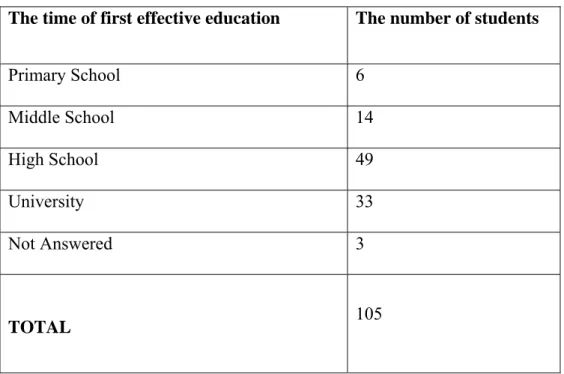
Since it was predicted that the majority of students would start learning English at about the same time, but that the quality of this education was likely to differ, the questionnaire also included a secondary question asking when they felt they had received their first effective English language education. As Table 4 shows, there were not many participants who had their first effective education in primary school or middle school, so I combined these two groups. Participants who did not
think that they had had an effective education at any period of their school lives were not included in the analysis.
The time of first effective education The number of students
Primary School 6 Middle School 14 High School 49 University 33 Not Answered 3 TOTAL 105
Table 4- The times and numbers of participants’ first effective education
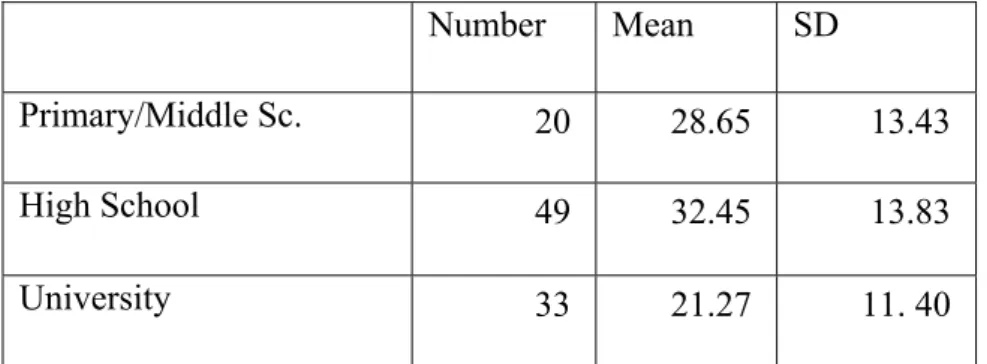
For the effect of age of first effective education, I compared the students who felt that they had received their first effective education at primary/middle school vs. High School vs. university. (Table 5 shows the mean proficiency scores for each period.) An independent samples ANOVA showed that the overall difference between groups is significant (F (2,99)= 7.29, p< .001). Planned contrasts showed that students who received their first effective education at university scored significantly lower than those who received their first effective education at
primary/middle or high school. There was a moderate effect size (t(99)=3.26, p(one-tailed)<.001, r=.31). However, there was no significant difference between those receiving their first effective education in primary/middle school and those receiving their first effective education in high school (t(99)=1.1, p=.27).