Development of Elementary School Students’ Argumentativeness In
Science Courses
Osman Nafiz KAYA
1Ziya KILIÇ
2Geliş Tarihi: 24.01.2008 Yayına Kabul Tarihi: 02.04.2008
ABSTRACT
The aim of this study was to investigate the effects of science courses founded on argumentative discourse activities on elementary school students’ tendencies to approach argumentative situations. A semester-long argumentative discourse integrated science courses were carried out with 7th Grade students (n=23), and 8th Grade students (n=24). To measure change in the students’ tendencies to approach argumentative situations, a 20-item Likert-type Argumentativeness Scale (AS) was administered to all the students as pretest and posttest, and 37 randomly selected students were individually interviewed at the end of the study. The results of statistical analysis of the AS indicated that both 7th and 8th Grade students’ argumentativeness significantly increased from prior to the end of this study. This significant increase was further supported by evidence from the qualitative data gathered through the interviews.
Keywords: Science education, argumentation, social-constructivist approach.
İlköğretim Öğrencilerinin Fen Derslerindeki Tartışmacı Eğilimlerinin
Gelişimi
ÖZET
Bu çalışmanın amacı, tartışmacı söylev etkinliklerine dayalı yürütülen fen derslerinin ilköğretim öğrencilerinin tartışmaya olan eğilimleri üzerine etkisini araştırmaktır. Tartışmacı söyleve dayalı yürütülen fen dersleri bir dönem boyunca 23 7. sınıf ve 24 8. sınıf öğrencisiyle gerçekleştirildi. Öğrencilerin tartışmacı eğilimlerindeki değişimi ölçmek için 20 maddelik Likert tip anket olan Tartışmacı Anketi tüm öğrencilere ön ve son test olarak uygulandı. Çalışmanın sonunda rasgele seçilen 37 öğrenciyle bireysel mülakatlar yürütüldü. Tartışmacı Anketinden elde edilen verilerin istatistiksel analiz sonuçları hem 7. sınıf hem de 8. sınıf öğrencilerinin tartışmaya olan eğilimlerinde anlamlı bir artışın meydana geldiğini gösterdi. Elde edilen bu istatistiksel olarak anlamlı gelişme mülakatlar vasıtasıyla elde edilen nitel veriler tarafından da desteklendi.
Anahtar Kelimeler: Fen eğitimi, tartışma, sosyal yapılandırıcı yaklaşım.
INTRODUCTION
Over the last few decades there have been studies undertaken that highlighted the significance of talk in enabling students to promote their conceptual understanding. Seminal work was undertaken by Barnes (1977) and Barnes and Todd (1977). Then Lemke (1990) and Sutton (1992) have presented a clear argument for the process of induction of students into the language of science. National Science Education Standards document has also specifically stated important changes in more emphases on science as argument and explanation (NRC, 1996). In line with these reform ideas, the conceptualization of science learning as argument has been recently proposed by Driver, et al. (2000), Erduran, et al. (2004), Jimenez-Aleixandre, et al. (2000), Martin and Hand (in press), Naylor et al. (2007) and von Aufschnaiter, et al. (2008). Driver et al. (2000) claimed that conceptual change is dependent on the opportunity to socially construct, and reconstruct, one’s own personal knowledge
1 Fırat Üniversitesi, Eğitim Fakültesi, İlköğretim Bölümü, Elazığ/ TÜRKİYE 2
through a process of dialogic argument. Reconceptualization the teaching of science as argumentation basically uses the social constructivism which has its origins with Vygotsky (1978). Social constructivism, an extension of constructivism, maintains that learning occurs from the interactions among people rather than limiting the process totally to within the individual. A number of researchers (e.g., Carlsen, 1991; Cobb & Yackel, 1996; Driver et al., 1994; Lemke, 1990) have adopted this version of constructivism by accommodating both personal and interpersonal construction of knowledge in science education. Driver et al. (2000) claimed that science as a social process of knowledge construction that involves argumentation. Therefore, students need to learn science through the same way (argumentation) that scientists constructed scientific knowledge. However, such occasion seldom occur in science classrooms and laboratories. For example, Newton et al. (1999) investigated the extent to which discussion, debate, or argumentation activities are used in regular science lessons in the UK. Their results based on an observation schedule to record student activities and the nature of student–teacher interactions showed that very little opportunity was given by teachers for students to discuss ideas in groups, or for whole class discussions about the interpretation of events, experiments, or social issues in 34 lessons that they observed. There were only two cases where the teacher set a group discussion task although these discussions continued less than 10min each. This unexpected result was explained using teachers’ responses to this finding. First, most of the science courses were teacher-centered with a heavy emphasis on teacher exposition and recitation forms of question and answer interaction. In other words, teachers’ pedagogical and practical knowledge were very limited to support argumentation in school science classrooms. Second, there were external pressures that imposed upon science teachers in England by the National Curriculum and its assessment system. They concluded that there is a need to carry out studies to promote argumentative discourse among students through appropriate pedagogical practices in science classrooms.
This paper focuses on the elementary school students’ tendencies to argue about controversial issues, or
argumentativeness. This is differentiated from arguing to derogate another person, or verbal aggressiveness.
Argumentativeness involves the use of reasoning to advocate and refute positions on controversial issues. According to Infante and Rancer (1982), in contrast to the low argumentative person, the highly argumentative person experiences favorable excitement and has a strong tendency to approach arguments, while feeling no inhibition to argue nor tendencies to avoid arguments. There may be two main reasons to develop the argumentativeness of young people in school. First, scientific discussions or arguments are seen to be at the heart of science and central to the discourse of scientists (Driver et al., 2000). Accordingly, it is not only important that students approach argumentative situations to understand the concepts or theories of science, it is also vital that they understand nature of science that refers to science epistemology (Lawson, 2003; Lederman, 1992). With respect to public understanding of science, second, young people should also develop their argumentativeness because students who are in school today will be active citizens for the next 30 to 40 years. During that time they will face important issues that combine economics, politics, technology, and science. The primary purpose of universal science education is to prepare students to act appropriately as citizens about many sosioscientific issues such as global warming and protecting the ozone layer. Many of these issues require argumentative people because the science underlying the issues may not be straightforward and often uncertain (Driver et al., 2000; Osborne et al., 2004).
Purpose of the Study
In the present study, it was aimed to investigate the development of elementary school students’ tendencies to approach argumentative situations during the science courses integrated with argumentative discourse activities. Thus, the following research question formed the basis of this study: Does the science
course specially designed with argumentative discourse activities significantly improve elementary school students’ argumentativeness?
METHOD
Sample
Forty-seven elementary students participated in this study. Twenty-three students (10 females and 13 males) were in 7th Grade, and twenty-four students (10 females and 14 males) were in 8th Grade from an elementary school in Ankara in Turkey. Their ages were 13 to 15. These two classes were randomly selected from all four classes in the school.
Data Collection
Argumentativeness Scale (AS). A 20-item Likert-type questionnaire developed by Infante and Rancer (1982) was used. In the AS, consisting of statements about arguing controversial issues, there are 10 items dealing with tendency to approach argumentative situations (e.g., I enjoy defending my point of view on an issue) and 10 items focusing on tendency to avoid argumentative situations (e.g., Arguing with a person creates more problems for me than it solves). A 5-point Likert scale response format with 'always', 'often', 'sometimes', 'rare' and 'never' was used. Scores of 5, 4, 3, 2 and 1, respectively, were assigned for the items of tendency to approach argumentative situations, and reverse scoring for the items of tendency to avoid argumentative situations. Cronbach’s alpha reliability for the AS was .73.
Individual Semi-structured Interviews. The Likert scales have many advantages (Oppenheim, 1992). However, the results of Likert scales may not present what students’ tendencies to approach argumentative situations are beyond the meaning of the items. Therefore, to clarify students’ responses to the Likert items in the AS, individual semi-structured interviews were carried out with 37 randomly selected students (n=18 for 7th Grade, n=19 for 8th Grade). Some interview questions were:
1. Did you like science course integrated argumentative discourse activities? Why or why not?
2. How did the experiences of argumentative discourse integrated science lessons affect your tendency to approach argumentative situations?
3. How did your participation in the argumentative situations change during the science course?
4. How did your desire to argue over controversial issues change during the science course? 5. How did your ability to create an argumentative situation change during the science course?
Each interview lasted about 20-25 minutes. All interviews were audio-recorded and transcribed verbatim.
Research Design and Procedure
This study, one group pretest-posttest design (Campbell & Stanley, 1963), was conducted during the 2004-2005 academic year. It was over an 8 week period for both 7th and 8th Grade students. The science classes were held four times each week according to the school timetable. The first author of this paper taught both 7th and 8th Grade classes. The science courses with argumentative discourse activities were carried out in a unit on
the particulate nature of matter in the 7th Grade class, and on a unit on change in matter and energy in the 8th Grade class. Some subtopics of the unit for 7th Grade, for example, included matter and properties of matter; compound, mixture and element; atom, atomic structure, chemical and physical changes, and extension of macroscopic properties to sub-microscopic ideas, and the limits of atomic models. The curriculum objectives of 7th and 8th Grade science courses were modified to improve student conceptions of the nature of science at the beginning of the study because the Turkish elementary school curriculum focused only on teaching the science concepts to the students rather than aspects of nature of science. However, many reform documents of science education (e.g., AAAS, 1993; NRC, 1996) specified that science teachers should not only teach the scientific concepts, but should purposively instruct students in specific aspects of the nature of science. In the beginning of the science courses, the AS was administrated to all of the students as a pretest. After the completion of the treatment, the AS was immediately re-administered to the students as a posttest and individual interviews were carried out with students.
Classroom Teaching
Argumentation theory embraces analytical, rhetorical, and dialectical schemes for the evaluation and communication of knowledge claims (van Eemeren et al., 1996). Dialectical argumentation involves dynamic interactive discourse among students and between students and teacher in the process of building scientific concepts. In this study, argumentative discourse activities were designed and carried out from the perspective of the “dialectical” or “multivoiced” interpretation of argument that is involved when different perspectives are being examined and the purpose is to reach agreement on acceptable claims or courses of action among two or more individuals (Driver et al., 2000). So, the students in both classrooms were first placed into small groups of four because the multivoiced nature of argument construction is much more obvious within a group.
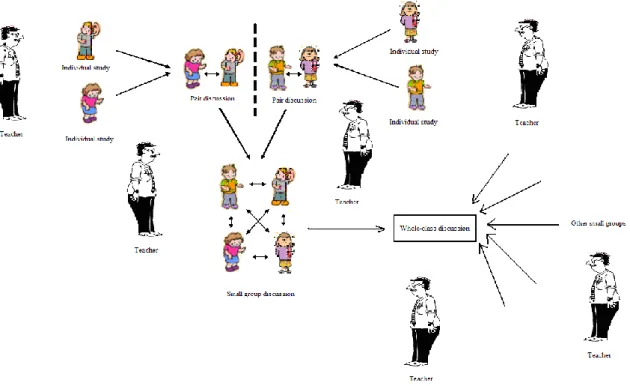
The first lesson in both classes was devoted to a warm-up activity named ―Which nanny is much better than others?‖ so that students can understand the importance of using appropriate evidence and connecting evidence to a claim, and claims with warrant and backing involving in an everyday life situation. Because the students’ difficulties in their knowledge and ability to generate and critique arguments have been documented in the literature (e.g., Bishop & Anderson, 1990; Kuhn, 1993). During this activity, it was also aimed that students become more familiar the general structure of argumentative discourse activities in the science courses. This general structure consisted of certain steps (see Figure 1). First, each student of small groups was asked to individually study on the given task or problem (2-3 minutes), then share and discuss his/her idea with his/her peer in the group (3-5 minutes) to make a conclusion by asking them to evaluate each other’s arguments including their evidence, claim, and reasons (pair discussion). Afterwards, these two students of the small group were asked to share and discuss their ideas with other two students in the same group (5-7 minutes) to make a conclusion as a group decision by using appropriate evidence and connecting evidence to a claim, and claims with appropriate reasons. During these small group discussions, when students agreed, they were encouraged to explain their reasons, or when they disagreed, they were encouraged to challenge with counterarguments. As the discussion proceeds, the students were asked to weigh the reasons and evidence offered, and decided on whether to maintain or change their original ideas or positions. These small group discussions, which students evaluating each other’s arguments, generally lasted about 10-15 minutes. The teacher did not intervene to students’ responses. At the end of these small-group discussions (see Figure 1), students sometimes compromised
solutions about the issues that they discussed. But they sometimes did not arrive at a conclusion about the topics that they discussed with each other. After small group discussions, each group shared their opinions with the rest of the class as a whole-class discussion. These whole-class discussions, which students of small groups evaluated each of other small groups’ arguments, generally lasted about 10 minutes.
Figure 1. The general structure of the argumentative discourse activities in science courses.
Major activities to promote argumentative discourse in the science classes were: table of statements; concept map of student ideas; role play, a report of a science experiment undertaken by students; competing theories with cartoons, story, ideas and evidence; classroom theater; drawing a science idea, constructing an argument; predicting, observing, and explaining; making models and designing an experiment. The science units of both 7th and 8th Grade classes were related to sub-microscopic world of chemistry. Therefore, many computer animations prepared by Macromedia Flash MX software were simultaneously used with almost all of the activities above to enable the students to discuss with each other on the non-observable world of chemistry such as atomic structure, chemical bonding, and chemical reactions.
Data Analysis
The dependent variable for this study was the students’ argumentativeness and independent variable was the format of instruction (argumentative discourse activities). A paired-sample t-test on the scores of the AS pre and post-tests were used to evaluate the impact of the treatment on the students’ argumentativeness. SPSS 14.0 (Statistical Package for Social Sciences) was used to carry out statistical analyses. All of the audio-recorded interviews were transcribed verbatim. Then, the interview transcripts for each student were separately read and interpreted by the first author. One external expert crosschecked the analyses of the interview data with the original transcripts of all students. There was 95.60% agreement between the expert and the researcher.
RESULTS
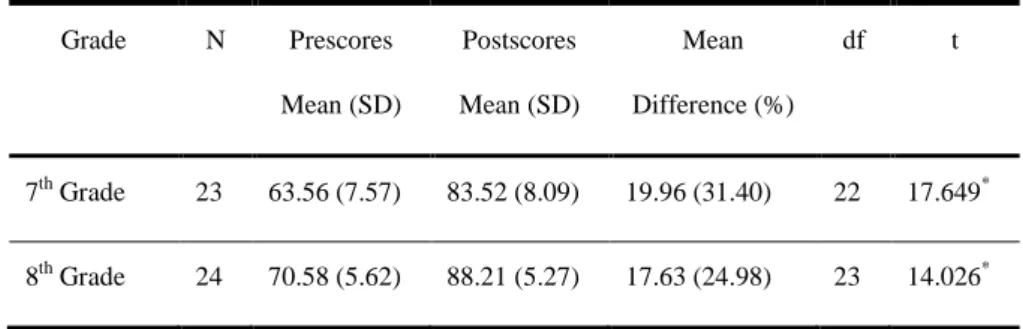
All results of the statistical analyses of the pre/post administration of the AS are tabulated in Table 1. Statistical analysis showed that there was a significant increase in both 7th and 8th Grade students’ AS scores from prior to after the treatment [t(22)=17.649, p < .0001 for 7th Grade; t(23)=14.026, p < .0001 for 8th Grade].
Table 1 summarizes the values of mean differences and percentage increases of the students’ AS scores. These increases of mean and related percentage values are 19.96 (31.40%) for the 7th Grade students, and 17.63 (24.98%) for the 8th Grade students. All of the values clearly indicate the students in both 7th and 8th Grades became more argumentative as the result of argumentative discourse integrated science courses.
The findings of individual interviews supported the quantitative results of this study. It was found that almost all of the students described their argumentative science courses were a fun way of learning. Thirty-two students expressed that their curiosity and interest toward arguing on controversial issues increased during the science course.
Table 1. Comparison of the students’ pre and post-test scores on the AS.
Grade N Prescores Mean (SD) Postscores Mean (SD) Mean Difference (%) df t 7th Grade 23 63.56 (7.57) 83.52 (8.09) 19.96 (31.40) 22 17.649* 8th Grade 24 70.58 (5.62) 88.21 (5.27) 17.63 (24.98) 23 14.026* *p < 0.0001
Twenty-nine students stated that trying to advocate their claims and refuting others’ claims made them excited. Some excerpts of the interview responses of the students include:
It was amazing that thinking about how I can support my idea with different reasons and how I can rebut others’ claims through counterarguments. This was first experience for me in my science class in which I could freely speak about my ideas…. (A 7th Grade student)
Now I am sure that listening to the teacher and taking the notes that he told us when we are sitting are not attractive and interesting. In contrast, it was very boring. Listening to our classmates’ ideas and making counter claims with rebuttals and reasons are very different, and this way of learning science is really fun for me…. (An 8th Grade student)
Twenty students reported that they worried about the relationships with their classmates because of arguing with them at the first 2-3 lessons, but, their anxiety toward arguing with their friends decreased in the course of time because they realized that argumentation is the way of learning science and to understand what others really think. Some excerpts taken from the interviews include:
When I first heard that we will discuss with each other in class, I was anxious because I did not want to make my friends upset. However, I was aware of argumentation is a good way of talking about science and learning it during time being. (A 7th Grade student)
Discussion was not compatible with my character since I am very quiet and shy person. On the other hand, I can tell my tendency to approach argumentation gradually improved because of the argumentative activities that I participated in this science class. (An 8th Grade student)
Thirty-four students stated that they did not have enough opportunity to discuss with their classmates in their previous science courses. Because their classroom teachers taught science—provides answers taken from textbooks and does not ask to give reasons. These students reiterate because teacher does not pay attention to reasoning, they do not force themselves to think of reasons. However, they came to the realization after the argumentative discourse activities that they need to know or search for logical reasons for their claims. Twenty-eight students expressed that they definitely avoided getting into an argumentative situation before this study. However, 25 of these 28 students reported that their experience with argumentative discourse activities in the science courses increased their self-confidence to participate into an argumentative situation, and generate and evaluate arguments. Some excerpts from the interviews carried out include:
My old science classes did not allow me to talk about science and consequently determine different ideas and create a discussion atmosphere. When you are learning science through reading the textbook that all students have, there is no need to conduct discussions. However, the activities that we participated in the science class showed that we need to find strong reasons to support our claims and rebut others’ ideas. (A 7th Grade student)
I have never thought that presenting our ideas with robust explanations is very important since you can find answers of almost all of the questions that our teacher ask us. On the other hand, I understood that if you learn science you have to think a lot… (An 8th
Grade student)
Twenty-seven students reported that argumentative discourse activities enabled them to realize that they should find a good rebuttal to refute others’ opinions. Twenty-four students stated that they became aware that they should support their claims with reasons and predict what their peers have in their mind even before they start talking. The following excerpt of the interview responses of the students include:
I think that the most exciting part of the class is predicting what my classmates think and what kinds of counterclaims to them can be made. I also had some argumentative situations that others predicted what I planned to present as rebuttals for their claims. This is a very different experience for me… (An 8th Grade Student)
In brief, the significant increase in students’ argumentativeness determined by the statistical analyses of the Likert scale data was further supported by evidence from the qualitative data gathered through analysis of the individual interviews carried out with students. Many students expressed that they started focusing on ―why‖ rather than ―what‖. They developed a new habit of mind—searching for reasons, because they were convinced that communicating with their peers and teachers and the use of logical and critical thinking are important to learn science.
Discussion
There is a general agreement among science educators that the major purpose of science education is promoting students’ scientific literacy. While some describe the scientifically and technologically literate person who can identify scientific issues underlying national and local decisions and express positions that are scientifically and technologically informed, others see scientific literacy as the capacity to read newspaper and
magazine articles about scientific and technological matters with a reasonable level of understanding (Hodson, 2003). To achieve this goal, teachers should be encouraged to pose tasks within an oppositional framework (e.g., arguments for or against in a discussion group) in science classrooms and laboratories because improvement of students’ argumentativeness is one of the most important component of any education that seeks to enhance scientific literacy (Driver et al., 2000, Simon & Johnson, 2008). However, the literature findings show that students are poor at presenting arguments ―for and against‖ or presenting different points of view on the same issue. Therefore, the results of this study made a significant contribution to our understanding of how elementary school students’ argumentativeness change during the argumentative discourse integrated science courses. To our knowledge, there is also no an empirical study focusing on this issue. So, we now have a better idea of how elementary school students respond to their experiences in an argumentative science course. The positive results obtained from this study on the students’ argumentativeness during the science courses are paramount because such tendencies toward being argumentative are pre-cursors for not only learning and achievement in science, but also becoming a good citizen in the future. In this pioneer study, the research method may be adequate although the subjects were limited to 47 students in both classrooms. It should be noted that mixed-research design, consisting of quantitative and qualitative methods, was used in this study. Further studies need to be conducted with larger class sizes to determine the factors that impact the development of students’ argumentativeness in science classrooms.
REFERENCES
American Association for the Advancement of Science. (1993). Benchmarks for science literacy. New York: Oxford University Press.
Barnes, D. (1977). Talking and writing in science lessons. Cambridge Journal of Education, 7, 138–147. Barnes, D., & Todd, F. (1977). Communication and learning in small groups. London: Routledge & Kegan Paul.
Bishop, B., & Anderson, C. W. (1990). Student conceptions of natural selection and its role in evolution. Journal of Research in Science Teaching, 27, 415-427.
Campbell, D. T., & Stanley, J. C. (1963). Experimental and quasi-experimental designs for research. Boston: Houghton Mifflin.
Carlsen, W.S. (1991). Questioning in classrooms: A sociolinguistic perspective. Review of Educational Research, 61, 157-178.
Cobb, P., & Yackel, E. (1996). Constructivist, emergent, and sociocultural perspectives in the context of development research. Educational Psychologist, 31, 175-190.
Driver, R., Asoko, H., Leach, J., Mortimer, E., & Scott, P. (1994). Constructing scientific knowledge in the classroom. Educational Researcher, 23, 5-12.
Driver, R., Newton, P., & Osborne, J. (2000). Establishing the norms of scientific argumentation in classrooms. Science Education, 84, 287-312.
Erduran, S., Simon, S., & Osborne, J. (2004). TAPping into argumentation: Developments in the use of Toulmin's Argument Pattern in studying science discourse. Science Education, 88, 915-933.
Hodson, D, (2003). Time for action: Science education for an alternative future. International Journal of Science Education, 25, 645-670.
Infante, D. A., & Rancer, A. S. (1982). A conceptualization and measure of argumentativeness. Journal of Personality Assessment, 46, 72-80.
Jim´enez-Aleixandre, M., Rodr´ıguez, A., & Duschl, R. (2000). ―Doing the lesson‖ or ―doing science‖: Argument in high school genetics. Science Education, 84, 757–792.
Kuhn, D. (1993). Science argument: Implications for teaching and learning scientific thinking. Science Education, 77, 319– 337.
Lawson, A.E. (2003). The nature and development of hypothetico-predictive argumentation with implications for science teaching. International Journal of Science Education, 25, 1387–1408.
Lederman, N. G. (1992). Students’ and teachers’ conceptions about the nature of science: A review of the research. Journal of Research in Science Teaching, 29, 331-359.
Lemke, J.L. (1990). Talking science: Language, learning and values. Norwood, NJ: Ablex.
Martin, A.M. & Hand, B. (in press). Factors Affecting the Implementation of Argument in the Elementary Science Classroom. A Longitudinal Case Study. Research in Science Education.
Naylor, S., Keogh, B., & Downing, B. (2007). Argumentation and primary science. Research in Science Education, 37, 17– 39
Newton, P., Driver, R., & Osborne, J. (1999). The place of argumentation in the pedagogy of school science. International Journal of Science Education, 21, 553–576.
National Research Council. (1996). National science education standards. Washington, DC: National Academy Press. Oppenheim, A. N. (1992). Questionnaire design, interviewing and attitude measurement. London, UK: Pinter Publishers. Osborne, J., Erduran, S., & Simon, S. (2004). Enhancing the quality of argumentation in school science. Journal of Research
in Science Teaching, 41, 994-1020.
Simon, S. & Johnson, S. (2008). Professional learning portfolios for argumentation in school science. International Journal of Science Education, 30, 669-688.
Sutton, C. (1992). Words, science and learning. Buckingham, UK: Open. University Press.
Van Eemeren, F.H., Grootendorst, R., Henkemans, F.S., Blair, J.A., Johnson, R.H., Krabbe, E.C.W., Plantin, C., Walton, D.N., Willard, C.A., Woods, J., & Zarefsky, D. (1996). Fundamentals of argumentation theory: a handbook of historical backgrounds and contemporary developments. Mahwah, NJ: Lawrence Erlbaum Associates.
von Aufschnaiter, C., Erduran, S., Osborne, J., & Simon, S. (2008). Arguing to learn and learning to argue: Case studies of how students’ argumentation relates to their scientific knowledge. Journal of Research in Science Teaching, 45, 101-131.
Vygotsky, L.S. (1978). Mind and society: The development of higher mental processes. Cambridge, MA: Harvard University Press.