Web-based educational systems are promising applications to enhance design education. Although the advantages of such systems have been discussed in the literature extensively, few studies in the field have used them for teaching interdisciplinary design collaboration. In order to alleviate this problem, a web-based interdisciplinary building design studio was designed and implemented. Considering the lack of systematic approaches in the use of Information and Communication Technologies (ICT) in studios, this paper offers a framework for analysing, understanding and exploiting web-based studios in terms of aim, content, method and management in the light of the case study.
INTRODUCTION
The effects of the Information and Communication Technologies (ICT) have been enormous in design fields in the recent decades. Rapidly developing technological infrastructure, broad-band Internet connections, and easy access to technology have all facilitated for capturing, storing, distributing, searching, and generating design information without the limitations of physical boundaries. Building design professionals are increasingly using new ICT applications for competitive advantage in the market (Cerovsek and Turk, 2004). On the other hand, the use of such tools in design education provides opportunities for broadening the horizons of the educational methods and preparing the students for their prospective practices (Agostinho et al., 2002, Karakaya and Şenyapılı, in press).
Among the several ICT applications in design education, web-based design studios have been attracting considerable attention (Rummel et al., 2005; Craig and Zimring 2000). The studio is the main medium for the acquisition of design knowledge in architectural education and it is widely assumed that it is the core and the other courses are complementary (Teymur, 1992). A web-based studio is a “networked studio, distributed across space and
A FRAMEWORK FOR WEB-BASED EDUCATION
SYSTEMS SUPPORTING INTERDISCIPLINARY DESIGN
COLLABORATION
Ahmet Fatih KARAKAYA and Şule TAŞLI PEKTAŞ
Received: 31.10.2007
Keywords: design collaboration; design education; education theory; interdisciplinary design; web-based education systems.
AHMET FATİH KARAKAYA and ŞULE TAŞLI PEKTAŞ 138 METU JFA 2007/2
time” (Broadfoot and Bennett, 2001); such that its participants may be in different locations handling design communications via computers. There has been a considerably large -and ever growing- body of work on web-based design studios (Simoff and Maher, 2000; Chiu, 2002; Elger and Russell, 2001). The advantages of such studios have also been well documented and include:
“• open design towards increasing the functionality of the environment;
• open design towards the incorporation of additional media types either in
plug-in or helper format, which enhances the expressiveness of design information representation.
• on-line archiving of design information and keeping track of past experiences to be accessible for other Web-based studios” (Simoff and Maher, 1997).
However, having reviewed the literature on web-based design studios (Karakaya, 2005), the authors of this paper identified two important deficiencies in the existing studies:
1. Despite the importance of interdisciplinary collaboration in design education, it has been neglected in web-based studios just like it is often underestimated in traditional design studios.
2. Existing studies on the subject tend to be mere descriptions of case studies and they are rarely discussed through robust means. Systematic methods are urgently needed to analyze, to understand, to explain and to exploit web-based studios.
It has been widely recognized that building design is a collaborative process (Fruchter, 1996; Lu and Cai, 1999; Bouchlaghem et al., 2005). Several parties with diverse disciplinary backgrounds are involved in building design and they are expected to produce an integrated product. Thus, collaboration among professionals was recognized as the most important factor effecting building design quality (Arditi and Günaydın, 1998). However, it was also observed that building design education institutions have been experiencing problems in teaching collaborative design. Throughout their education, the students usually do not have opportunities to learn about and to collaborate with members of related disciplines. Some educational approaches aimed to address this fragmentation and to propose ways to overcome it. For example, Wheeler (1998) claimed that architects and design engineers needed to be educated together so they could learn how to work better together. Pultar (1999) proposed that it might be useful to give a general design education to architects and structural engineering students for an initial period, after which, students should have the chance to choose their specialization fields. Moreover, there were several attempts to implement interdisciplinary courses for sensitizing the students to the issues, objectives, and concerns of the related disciplines. Although such courses provided students with variable insights into the value systems used by their peers (Chinowsky and Robinson, 1995; Jackson, 1997), the wide spread utilization of interdisciplinary building design courses has been hindered by practical limitations in terms of time, budget, place, human workforce, etc. Within this perspective, this paper proposes that well-documented advantages of web-based education such as being free
of limitations of physical boundaries and of strict time schedules as well as the attractiveness of the Internet for the new generations can facilitate for integrating collaborative work in design teaching through web-based interdisciplinary courses.
The need for systematic approaches to ICT applications in design education was acknowledged before (Pektaş and Erkip, 2006; Pektaş, 2007). In order to abate this problem, the present paper proposes utilization of Teymur’s system (1997; 2001) for studying architectural education. Teymur (2001) reiterates that architectural education had been approached as a “practice without theory”. In order to raise architectural education debates from the level of mere experience to that of systematic and critical analysis, he recommended “problematization of architectural education” (Teymur, 2001). When architectural education is defined as a “problem”, it inevitably demands theory. Teymur argued that such theories could not be directly borrowed from education discipline due to the peculiarities of architectural education. Aiming at a comprehensive structure for the discourse, he suggested that architectural education could be handled within the framework of four basic questions: objectives and motivations (why), contents (what), methodology and medium (how) and management and staff (who) (Teymur, 1997; 2001). The International Union of Architects (UIA) adopted Teymur’s system as a framework for discussing issues related to architectural education (UIA, 2002). It was also applied in implementation of web-based design studios (Sagun et al., 2001) and in discussing the current state of CAAD (Computer Aided Architectural Design) education (Pektaş, 2007).
In order to realize the proposals of this paper, an interdisciplinary web-based building design studio was designed and implemented for interior architecture and architecture students. In this paper, first, the setting of the case study was described and then its findings were analyzed according to Teymur’s system. It was attempted to represent the whole framework in a concise diagram to guide further studies and suggestions for further research were also made.
CASE STUDY
The case study aimed to rehearse collaboration between architects and interior architects through a web-based tool during design education. Two elective courses, one from Delft Technical University (TUDelft), Netherlands and another from Bilkent University, Turkey, were selected for this purpose. Twenty-one architecture students from the TUDelft course, (BK 6810 Audio Visual Production), and 16 interior architecture students from the Bilkent course (IAED 316 Computer Application) participated in the case study. Students formed groups consisting of two professions, and each group designed “A Turkish Store in the Netherlands” collaboratively. Groups were generally composed of 2 interior architecture students and 3 architecture students. There were 8 groups in total.
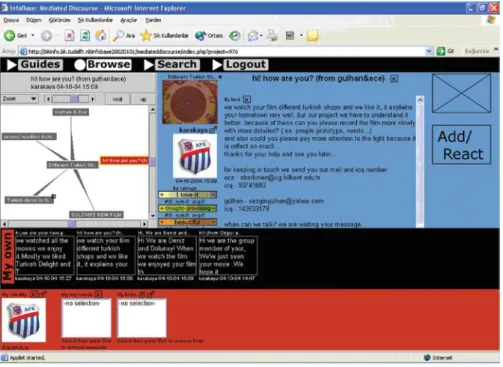
In order to facilitate the collaboration on the World Wide Web, a tool (InfoBase) developed by the TUDelft was utilized (Figure 1). InfoBase enabled the information collected and generated by the students to be stored, exchanged, and manipulated. The collaboration between the two universities took about 9 weeks.
The structure and the enclosure of the building, inside which the store would be located, was designed and uploaded by the architecture students. Interior architecture students downloaded the existing documents of the
AHMET FATİH KARAKAYA and ŞULE TAŞLI PEKTAŞ 140 METU JFA 2007/2
building in .dxf (drawing interchange format) and used software like AutoCAD and/or 3DS Max to develop, share and communicate their designs. During the collaboration process, architecture students were responsible for establishing a client profile, presenting the context of the built environment and the façade, and giving architectural decisions. Interior architecture students, on the other hand, were responsible for arranging the interior elements (such as partition walls, stairs, allocation of spaces, etc.), designing the lighting, acoustics, furniture, and establishing a circulation pattern.
After the case study, participating students filled a questionnaire. According to the results of the case study,
• Both groups felt that they were clearly expressing themselves to the other discipline,
• Both groups expressed that they would willingly collaborate with the other discipline in the future,
• Both disciplines agreed that collaboration with the other discipline is necessary in their education,
• Both camps also agreed that collaboration with the other discipline is necessary in their professional life,
• Both groups agreed that web-based design studio is useful for learning interdisciplinary design collaboration (Karakaya and Şenyapılı, in press).
FRAMEWORK
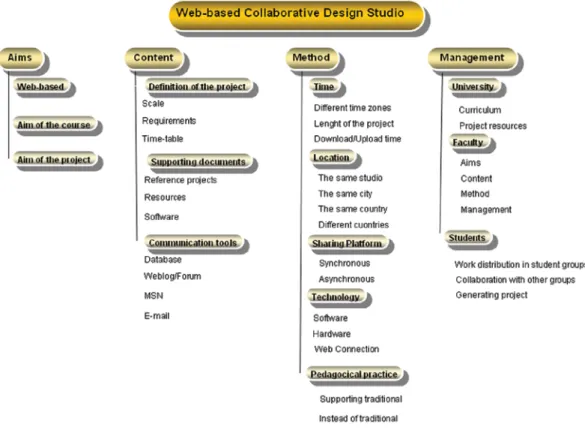
The case study described above, provided insights into many factors that should be considered in design and implementation of similar web-based interdisciplinary design courses. These factors were analyzed and discussed in the following section under four headings, namely, aims, content, method, and management, in line with Teymur’s system (Figure 2).
Aims
Before attempting to implement a based studio, aim(s) of using a web-based platform should be well defined. Advantages and disadvantages of such a platform should be considered while preparing course time-table and content. Since face-to-face communication, gestures and freehand drawings are important for design studio communication, projects and the schedule should be arranged accordingly. It is widely acknowledged that the pedagogy of traditional design studio is based on a kind of thinking by doing which Schön (1985) called reflection-in-action. In this method, a studio instructor plays the role of the master who demonstrates how to design in a place based setting. When the notion of place is lost in web-based studios, this may barrier effective information flow between the instructor and the students. In order to resolve this problem, hybrid web-based studios utilizing both traditional and online techniques should be designed.
As Şenyapılı and Karakaya (2006) stated, hybrid courses integrate face-to-face and online communication where a significant portion of the learning activities take place online. Hybrid courses reduce the time spent in the classroom, nevertheless in-class participation were not rendered totally useless. Such courses join the best features of face-to-face teaching with the best features of online learning. Main advantages of hybrid courses over the traditional face-to-face communication are accessibility to course content, effectiveness of large lecture instruction, and level of connectivity between students and instructor (Poltrock and Engelbeck, 1999; Cheng and Kvan, 2000; Johnson, 2002; Garnham and Kaleta, 2002). In recent years, design studio has emerged as one of the areas where such hybrid structure is utilized. Having considered these factors, the case study course was designed and implemented in a hybrid structure and the participants
Figure 2. A framework for web-based col-laborative design studio
AHMET FATİH KARAKAYA and ŞULE TAŞLI PEKTAŞ 142 METU JFA 2007/2
reported that they benefited from the combined use of online and offline techniques.
Furthermore, if two or more remotely located studios are integrated on a web-based platform, the aims of these courses should be compatible. In the case study, one graduate course from TUDelft and one undergraduate course from Bilkent were selected. Since both courses were elective courses, the structure of the courses could be tailored easily to meet compatibility requirements.
Finally, a Web-based interdisciplinary design course should adopt a generic view of design process rather than specific discipline-oriented courses so that they could accommodate collaborative work. In the case study, the adopted design process definition was thoroughly discussed and agreed upon at the very beginning of the project.
Content
When a web-based interdisciplinary design course is prepared, “what” should be taught is a basic concern. In parallel with the infinite content of design studios, web-based platforms may contain a great deal of information. However, when uncontrolled, this possibility may result in an unstructured and confusing information overload. The management of content is especially important for an interdisciplinary course. The content should consist of the crucial and overlapping aspects of both disciplines consonant with the levels of the students.
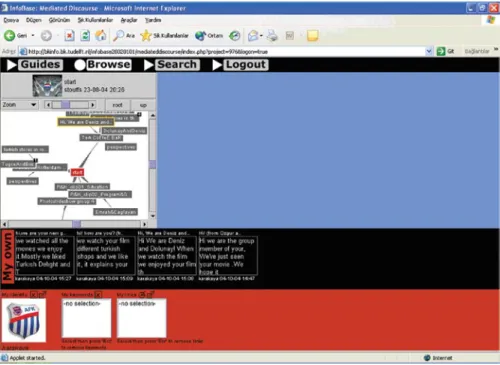
In our case study, knowledge management was handled by a database (Figure 3). Both student groups uploaded their projects into Infobase. By using search and browse links, students could follow contributions and critiques for their projects. A Java applet in the database demonstrates related projects and contributions of a project in a branched tree format. Scale and representational aspects of the design project are other important issues while deciding the content of the course. Each profession involved in building design has a peculiar viewpoint of buildings and their components. For example, architects are more interested in site planning,
Figure 3. InfoBase solution to knowledge management problem
mass studies and enclosures; while interior architects’ main considerations are elements forming interior atmosphere such as color, texture, lighting, etc. As a result, two disciplines are used to work with the same building in different scales. Therefore, the content of the project should respond to the varieties brought by collaborative work. In the case study, the project was small enough to be studied in different scales. In “A Turkish store in the Netherlands” project students worked on a two storey high building located on the corner, the building had 160 m2 floor area and a mezzanine floor. Architecture students worked in 1/100 scale and interior architecture students worked in 1/20 scale. Design terminology and different
viewpoints of the groups were not especially problematic in the case study, since the two groups were not much different in this respect. However, courses about the collaboration between architects/interior architects and engineers can be more difficult due to different jargon and terminology used.
Supplementary documents and the choice of software are also important in the representation of the project. Since the dream of a single design software addressing all building design professionals has not been realized yet, the applications used in an interdisciplinary web-based studio must be as comprehensive as possible and compatible as well. In the case study, AutoCAD was used to generate two dimensional drawings and exported in .dxf format; 3DSMax and Maya were used to generate three dimensional drawings, and animations. Interchangeable drawing formats of .dxf and .3ds provided compatibility of software used by different student groups. Method
The methodology of the course, “how” a web-based studio is conducted, should also be discussed when designing such a course. While
collaborating with students from other countries, different time zones should be considered; since, the schedule of the course might be effected. In order to solve time zone related problems, a proper mix of on-line and off-line communication tools may be integrated into sharing platform. In the case study, InfoBase and Weblog (Figure 4) provided offline communication, MSN Messenger provided online communication.
Length of the project should be tailored according to the prospected design process. A detailed design schedule should be prepared for different phases of design, i.e.,early design decisions, design development and presentation of the project. Download/upload times may differ due to connection speed and this may result in unexpected intervals (waiting time) in the process. For example, in the case study, the limited width of internet connection in Turkey caused some problems in uploading documents to InfoBase. Using up-to-date software and hardware may prevent many problems in this regard.
The location of a studio -being in the same studio, in the same university, in the same city, in the same country or in different countries- requires different approaches. The choice between synchronous and asynchronous communication is largely dependent on this parameter. Although
synchronous communication often demands more resources such as technical infrastructure, time and money; when the parties are remotely located it becomes crucial in certain phases of the process. In the case study, elective courses were not handled simultaneously. Bilkent course was on Monday afternoons and TUDelft course was on Tuesday and Thursday afternoons. Bilkent students could easily communicate with their
AHMET FATİH KARAKAYA and ŞULE TAŞLI PEKTAŞ 144 METU JFA 2007/2
group members in Bilkent, however group members from the Netherlands could join them at weekends or in evenings.
Management
Another important question regarding web-based interdisciplinary studios is “who” should be responsible for the management of the course. Since such studios involve many participants: universities, academic staff, and students (probably from different cultures), distribution of responsibility and workload should be agreed upon at an earlier phase of the course development. In the case study, course instructors from Bilkent and TUDelft got together to discuss aims, content, method and management of the collaborative process before the semester. After general agreement of these issues, the course instructors fulfilled their responsibilities.
Course instructor(s) is often the key person; s/he is responsible for budget management, time management, work load distribution in student groups, collaboration with other groups, and evaluation of end products. Due to the transparency of management process, students are generally more active in course management in a web-based studio compared to traditional studios. In the case study, students reported that they felt more control on their design process in the web-based studio, compared to traditional studios. Nevertheless, instructors still needed to devote time to discuss with students about the course and why their collaboration is important at the beginning. This gave students a sense of value and encouraged them.
CONCLUSION
This paper indicated the potential of virtual design studios as a medium where students of different disciplines and geographies establish, develop, share design ideas and rehearse for professional encounters of the market. It also demonstrated how a systematic approach can be utilized to structure the outcomes and insights gained in the process.
It seems that rapid development of technology caught design institutions unprepared for web-based practices. Thus, empirical web-based courses have not been integrated with theories of design curriculum yet. This study should be viewed as an effort toward such integration. The framework proposed in this paper is not all-exhaustive and it is hoped that it will be elaborated by further studies.
REFERENCES
AGOSTINHO, S., OLIVER, R., HARPER, B., HEDBERG, J., and WILLS, S. (2002)
A Tool to Evaluate the Potential for an ICT-Based Learning Design to Foster High-Quality Learning (http://elrond.scam.ecu.edu.au/ oliver/2002/ascilite.pdf) (retrieved: September 2007).
ARDITI, D. and GÜNAYDIN, H. M. (1998) Factors that Affect Process Quality in the Lifecycle of Building Projects, Journal of Construction Engineering and Management 124(3)194-203.
BOUCHLAGHEM, D., SHANG, H., WHYTE, J. and GANAH, A. (2005) Visualisation in Architecture, Engineering and Construction (AEC), Automation in Construction, 14(3) 287-95.
BROADFOOT, O., BENNETT, R. (2001) Design Studios: Online?
Comparing Traditional Face-to-face Design Studio Education with Modern Internet-based Design Studios, http://www.omnium.edu. au/assets/downloads/list/omnium_paper_rb_ob_2003_auc.pdf) (retrieved: February 2006).
CEROVSEK, T., TURK, Z. (2004) Working Together: ICT Infrastructures to Support Collaboration, In International Conference on Computing in Civil and Building Engineering , ICCCBE , 10 , Weimar , Germany, (http://e-pub.uni-weimar.de/volltexte/2004/212/pdf/icccbe-x_256. pdf) (retrieved: September 2007).
CHENG, N., KVAN, T. (2000) Design Collaboration Strategies, In SiGraDi 2000: 4th Iberoamerican Congress of Digital Graphics, Rio de Janeiro. CHINOWSKY, P. S., ROBINSON, J. (1995) Facilitating Interdisciplinary
Design Education through Case Histories. (http://fie.engrng.pitt. edu/fie95/4a3/4a32/4a32.htm) (retrieved: September 2007).
CHIU, M. L. (2002) An Organizational vView of Design Communication in Design Collaboration, Design Studies, 23 (2)187-210.
ELGER, D., RUSSELL, P. (2001) Net-based Architectural Design: The Difficult Path from the Presentation of Architectural Design in the World Wide Web to Teamwork in Virtual Planning Offices: A Field Report, Architectural Information Management, 19th eCAADe Conference Proceedings, Helsinki (Finland) 371-75.
FRUCHTER, R. (1996) Conceptual, Collaborative Building Design Through Shared Graphics, Expert IEEE 11(3) 33- 41.
GARNHAM, C., KALETA, R. (2002) Introduction to Hybrid Courses, Teaching with Technology Today (http://www.uwsa.edu/ttt/ articles/ garnham.htm) (retrieved: September 2007).
JACKSON, B. (1997) The Development of TOTAL Studio: A
Comprehensive Computer-Mediated Studio Environment for Architecture and Engineering, (http://www-ec.njit.edu/ec_info/
AHMET FATİH KARAKAYA and ŞULE TAŞLI PEKTAŞ 146 METU JFA 2007/2
image1/text_files/jax/papers/total_97.html) (retrieved: February 2007).
JOHNSON, J. J. (2002) Reflections on Teaching a Large Enrollment Course Using a Hybrid Format, Teaching with Technology Today (http:// www.uwsa.edu/ttt/articles/jjohnson.htm) (retrieved: September 2007).
KARAKAYA, A. F. (2005) A Study on the Encounter of the Architect and the Interior Architect through Web-based Collaborative Learning, unpublished master thesis submitted to Bilkent University, Ankara, Turkey.
KARAKAYA, A. F., ŞENYAPILI, B. (2008) Rehearsal of Professional
Practice: Impacts of Web-Based Collaborative Learning on the Future Encounter of Different Disciplines, International Journal of Technology and Design Education 18(1), 101-117.
PEKTAŞ, Ş. T. (2007) A Structured Analysis of CAAD Education, Open House International 32(2) 46-54.
PEKTAŞ, Ş. T., ERKİP, F. (2006) Attitudes of Design Students toward Computer Usage in Design, International Journal of Technology and Design Education 16(1) 79-95.
POLTROCK, S., ENGELBECK, G. (1999) Requirements for A Virtual Collocation Environment, Information and Software Technology (41) 331-39.
PULTAR, M.(1999) Building Education: From Fragmentation to Integration, in G. Sağlamer, A. Melezinek and S. İncecik, eds., Engineering
Education in the Third Millennium: Referate des 28. Internationalen Symposiums “Ingenieur Pedagogik ‘99, Leuchtturm Verlag, Alsbach; 373-79.
RAGOONADEN, K., BORDELEAU, P. (2000) Collaborative Learning via the Internet, Educational Technology and Society, 3 (3) 1-16.
SAGUN, A., DEMİRKAN, H., GÖKTEPE, M. (2001) A Framework for the Design Studio in Web-based Education, Journal of Art and Design Education 20(3) 332-42.
SCHÖN, D. (1985) The Design Studio: An Exploration of its Traditions and Potentials, RIBA, London.
SIMOFF, S. J., MAHER, M. L. (1997) Design Education Via Web-Based Virtual Environments, Fourth Congress of Computing in Civil Engineering, T. Adams, ed., Computing in Civil Engineering, 418-25. SIMOFF, S. J., MAHER, M. L. (2000) Analysing Participation in
Collaborative Design Environments, Design Studies (21)119-144. ŞENYAPILI, B., KARAKAYA, A.F. (2006) A Hybrid Framework for
Collaboration in Design Curricula, in The Joint International Conference on Construction Culture, Innovation and Management (CCIM) (www.buid.ac.ae/conf/html/CCIM2006%20Exec%20Summ aries.pdf) (retrieved: December 2007).
TEYMUR, N. (2001) 4x4 – Towards a Working Theory of Architectural Education, Presented at AEE 2001 Conference, (http://cebe.cf.ac. uk/aee/pdfs/teymur1.pdf) (retrieved: February 2007).
TEYMUR, N. (1997) Bir Mimarlık Kuramına Doğru (Towards a Theory of Architecture), Mimarlık Eğitimi Ve..., TMMOB, Ankara; 5-43.
TEYMUR, N. (1992) Architectural Education: Issues in Educational Practice and Policy, ?uestion (sic) Press, London.
UIA (The International Union of Architects) (2002) UIA and Architectural Education Reflections and Recommendations, Text adopted by the 2002 UIA Assembly, Berlin, (www.uia-architectes.org/image/PDF/ Reflex_eng.pdf) (retrieved: September 2007).
WHEELER, C. H. (1998) Architects and Engineers Need to be Educated Together so They can Learn How to Work Better Together, Architectural Record, 186 (8)183-4.
WEB TABANLI EĞİTİM SİSTEMLERİNİN TASARIMDA İŞBİRLİĞİNİ DESTEKLEMEK AMACIYLA KULLANILMASI İÇİN BİR ÇERÇEVE ÖNERİSİ
Hızla gelişen teknolojik altyapı ve geniş bantlı internet erişimi her alanda olduğu gibi yapı tasarımı alanında da değişimlere yol açmıştır. Fiziksel sınırları kısmen ortadan kaldıran iletişim teknolojileri ve bilgisayar destekli tasarım kavramı belli bir süredir hem donanım hem de yazılım olarak gelişme göstermiş, birçok disiplinin işbirliği içinde çalışması gereken yapı sektörü de bu hızlı değişime adapte olmaya çalışmıştır.
Sözü edilen gelişmelere paralel olarak, bilgisayar teknolojilerinin yapı eğitiminde kullanımı artmıştır. Bu konuyla ilgili çok sayıda deneysel uygulamanın yanı sıra pek çok akademik çalışma da mevcuttur. Fakat konuyla ilgili araştırmalar, şimdiye kadar yapılan çalışmaların birçoğunun bilgi ve iletişim teknolojilerini tasarım eğitimine (atölye/ stüdyo) sadece eklemeye çalıştığını ve bunun sonunda da bilgisayar destekli tasarım uygulamalarının eğitime katkılarının tam olarak gerçekleştirilemediğini göstermiştir. Ayrıca, yapılan çalışmaların çoğunda farklı disiplinlerle, farklı kültürlerle ve farklı ülkelerle beraber çalışmak mümkün olduğunda nelerle karşılaşılabileceği tam olarak vurgulanmamıştır.
Tasarım sürecinde işbirliği konusu günümüz yapı sektöründe çok önemli olmasına rağmen, üniversite eğitim müfredatları ilerde birlikte çalışması beklenen meslek gruplarının ilgi/yetki alanları ve bunların nasıl örtüştüğü hakkında öğrencilere yeterli bilgiyi sunmamaktadır. Tasarımda işbirliğini eğitimle bütünleştirmek için, ortak dersler yürütülmesi ya da yapı eğitiminin belli bir süre boyunca farklı meslek grupları için ortak konular içermesi gibi öneriler geliştirilmiş, fakat ne yazık ki uygulamadaki zorluklar yüzünden problemler tam olarak çözülememiştir. Bütün bunların sonucunda, disiplinler arası iletişim, yapı eğitiminin ve yapı sektörünün önemli bir problemi olmaya devam etmektedir.
Web tabanlı eğitim sistemleri bilgisayar destekli tasarım uygulamaları arasında tasarımda işbirliğini desteklemek açısından önemli bir yere sahiptir. Web tabanlı sistemlerin coğrafi kısıtlamaları kaldırması, daha hızlı ve ucuz olması gibi konular literatürde çok tartışıldığı halde, tasarımda farklı disiplinlerin işbirliği konusunda bu sistemlerin kullanımıyla ilgili çalışmalar yok denecek kadar azdır. Bu bağlamda, çalışmamızın amacı
Alındı: 31.10.2007
Anahtar Sözcükler: tasarımda işbirliği; tasarım eğitimi; eğitim teorileri; disiplinler arası tasarım; Web-tabanlı eğitim sistemleri.
AHMET FATİH KARAKAYA and ŞULE TAŞLI PEKTAŞ 148 METU JFA 2007/2
tasarım eğitiminde web tabanlı sistemleri farklı meslek gruplarının işbirliğini öğrencilere eğitim süreci içinde öğretmek için kullanmaktır. Bu amaçla, 2004 yılı güz akademik döneminde Bilkent Üniversitesi, Güzel Sanatlar Tasarım ve Mimarlık Fakültesi, İç Mimarlık Bölümü, IAED 316 Computer Applications (Bilgisayar uygulamaları) ve Hollanda Delft Teknik Üniversitesi, Mimarlık Bölümü, BK 6810 Audio-Visual Production (Görsel-işitsel üretim) dersleri öğrencileri arasında bir dönemlik ortak bir proje yürütülmüştür. Projede öğrencilerin yapı tasarımı sürecinde mimar-iç mimar ilişkisini prova etmeleri amaçlanmıştır. Ortak proje konusu olarak Hollanda’da bir Türk dükkanı tasarlanması istenmiştir. Proje mevcudu, 3 mimarlık ve 2 iç mimarlık öğrencisinden oluşan 8 gruba ayrılmıştır. Hollandalı öğrenciler projenin mimari kısmı (yer seçimi, binanın formu ve yapısı vb.), Türk öğrenciler ise iç mimari kısmı (tefriş, aydınlatma, renk, doku, dolaşım vb.) ile daha yoğun ilgilenmişlerdir. Proje süresince iki ülkedeki öğrenciler fiziksel bir ortamda buluşmadan tamamen web tabanlı sistemleri (InfoBase, Weblog, MSN vb.) kullanarak tasarım kararları almışlar ve dosya paylaşımı ile projelerini tamamlamışlardır. Bu çalışma, Web tabanlı eğitimin mevcut ders programlarına kaynaştırılmasıyla, tasarım öğrencilerinin geleceğin uluslararası ve çok disiplinli iş dünyasına daha iyi hazırlanmaları için bir araç olarak kullanılabileceğini göstermiştir. Bu makalede, tamamlanan alan çalışmasının bulgularından yola çıkılarak, yapı tasarımında işbirliğinin web tabanlı eğitim teknolojileriyle öğretilmesi için bir çerçeve sunulmaktadır. Bu çerçeve, uygulamadaki amaçlar, içerik, yöntem ve yönetim konularını farklı disiplinlerin birarada çalışması esasına göre ele almaktadır. Benzer uygulamaların hızla gelişen teknolojiye bağlı olarak yaygınlaşması öngörüldüğünden, sunulan çerçevenin konuyla ilgili gelecek çalışmalara yardımcı olması umulmaktadır.