The Role of the Organizational Communication on Employees’
Perception of Justice: A Sample of Public
Institution from Turkey
Mehmet İnceAssistant Professor, Faculty of Economics and Administrative Sciences Karamanoğlu Mehmetbey University, 70100, Karaman - Turkey
E-mail: [email protected] Tel: +90-338-2262000; Fax: +90-338-2262023
Hasan Gül
Assistant Professor, Faculty of Economics and Administrative Sciences Karamanoğlu Mehmetbey University, 70100, Karaman - Turkey
E-mail: [email protected].
Tel: +90-338-2262000; Fax: +90-338-2262023
Abstract
Organizational peace, communication and justice perception are very important factors in order to be successful. The objective of this study is to examine the relationships between the degree of organizational communication and organizational justice perception of employees. Besides, there is another objective which is identifying the relationships between employees’ demographic features and organizational communication. The research was done on 98 employees who are working for Provincial Directorate of Agriculture allied to Karaman governorship. Data derived from the survey method research is analyzed by using SPSS 16.0 software program. Descriptive statistics, t-test, one way variance analysis, correlation and regression analysis are used during the assessment of the data. At the end of the research, findings show that there is a significant relationship between communication and interactive justice. Further, findings state that there is a difference on employees’ organizational communication degree according to their education status.
Keywords: Organizational Communication, Organizational Justice, Distributive Justice, Procedural Justice, Interactive Justice, Justice Perception
1. Introduction
With globalization developments in political, social, economic and technological areas affect communal and organizational lives at an important manner. In parallel with these developments organization management are obliged to develop new management techniques to struggle even harder competition conditions. These modern management techniques to a large extent aim to raise employees’ performance by referring the power of communication (Eroğluer, 2011). Accordingly, for organization and human as a social being, communication has a vital importance. Communication whether has pros or cons are an inseparable piece of life and also it has an important role on all activities aimed at gaining organizational objectives (Ada et al., 2008).
Communication covers all activities that an individual does when he wants to make a transformation in someone else’s mind. This is a meaning bridge between an individual or individuals
and organization. Communication is a process that contains expressing, listening and understanding (Banerji and Dayal, 2005). Similarly, emphasizing social aspect of communication, Gerbner also defines communication as “social interaction formed by entries”. Communication that takes part on the base of social life and forms the content of organizational structure is a process which aims conducting good relationships between groups and organizations (Doğan, 2005). Multidimensional aspect of the notion of communication along with its analyses from different viewpoints affects its definition. Eroğluer (2011) propounds that communication concept has 4560 different usages. According to Oliver (1997) communication is the exchange of ideas, emotions and opinions through words, letters and symbols among two or more people. He states that this may be defined as a technical fact. Yet it is uncertain whether symbols are transfer truly or not, to what extent symbols meet the transmitted message and how effective transmitted fact on the receiver (Kalla, 2005; Baltaş and Baltaş, 2002).
The objective of this study is to determine the effect of organizational communication on employees’ perception of justice. While unlimited communication opportunities occurred as a result of technological developments in today’s world present the importance of quality and functionality of communication in organizations’ activities prominently, the significance of this study emerges. Considering studies about this issue, justice dimensions used in the study partly or totally are dependent to employees of organization who are in other words human as a social being. This shows that employees of organization can cause different results on organizational communication at different times and conditions. Therefore, examining the effects of employees’ demographics on organizational communication is also another objective of this study.
2. Organizational Communication and its Importance
Organizations are social units that congregate for production, formed by individuals who have different views and knowledge to reach a common goal. From a wider perspective, organizations are not only in the effort to provide intra-organizational cooperation and common sense for production. They are also trying to establish relationships with the external world and adapt dynamic, competitive and uncertain conditions by strategize the information they gained from their environment and transferred to information processing centres of the organization. Organizational and administrative activities for adapting in and out of organization and information exchange require an effective and functional communication system (www.donusumkonagi.net). In this context, communication is a vital point of organizations. Organizations that could not create effective communication would stagger like a ship without a steer. Effective communication helps organizations to strengthen the employees to reach organizational goals (Hindi et al., 2004). Groups and individuals are connected to an organization with communication phenomenon and organizational structure is constituted through communication (Mumby and Stohl, 1996). Shared reality is occurred between members of organization via communication. Communication at organizational degree helps to transfer organizational objectives and goals to employees and intra-organization groups. On the other hand, communication provides sharing organizational values and believes among employees (Demirel, 2009).
There are so many definitions of organizational communication. For example, while Bovee and Thill (2000) define organizational communication as “exchanging knowledge and opinions in the organization”, Argenti (2003) defines it as “creating a positive atmosphere for all employees of organization”. This definition makes organizational communication a wider dimensional concept rather than information traffic per se. Communication in the organization should be transferred from an executive person to another and from an employee to another. When the organizations become bigger and more complex, organizational communication becomes harder and the necessity of organizational communication quality increases (Kalla, 2005). According to Goldhaber, (1990) communication, a process in a given organization is about creating and exchanging information in a dependent relations network. Price defines organizational communication as “transmitting news about the work from organization to employees and through employees (Phattanacheewapul and Ussahawanitchakit, 2008;
Chen et al., 2005). So, regarding different definitions of organizational communication provided above, a general and comprehensive definition might be like as follows; organizational communication is a social process provides contact and information exchange between both departments and units of organization and organization’s environment for the purpose of operation of organization and accomplishment of the organization’s objective (Kocabaş, www.yordam.manas.kg). Stated process has combining function to create and hold together all types of relations among people, organizations and societies (Durğun, 2006). When communication process is done effectively, employees understand the roles and functions awaited from them and the objective of organization will be well understood. Thus, organizational communication enable to provide support in areas like making team work possible, supporting decision process and eliminating the barriers among departments (Ada, 2007).
In organizational communication, beyond the information exchange, it is important that sender has an attraction will for receiver (Kelly, 1999). According to organizing form in the organization, there are three formal communication kinds. These are; top-down communication that orders, decisions and rules are transmitted in pecking order, bottom-up communication that information and results are transmitted to seniors in pecking order and finally horizontal communication that allows coordination and information sharing among departments (Adler and Elmhorst, 1996).
Bell and Martin (2008) defined administrative communication which is an important dimension of organizational communication as “horizontal, vertical, below or above information exchange and meaning transfer through official and non-official channels to reach managers’ objectives”. Management academics and executives like Reinsch (2001), Yates and Orlikowski (1992) ve Fulk and Boyd (1991) consider communication as the core of organization’s life (Paulraj et al., 2008). Administrative communication is giving information to employees about organization’s institutional policies and procedures, financial results, group and employee successes, and customer feedback. Organization management can deliver the information about organization via channels such as control, group meetings, brochure and newsletters, mission declaration (Soupata, 2005; Argenti, 1998) and company’s web site (Ng et al., 2006).
The objective of organizational communication is to procure internalizing organization’s goal and policy from all employees, to give the idea that employees are considered as important by providing interactivity among employees working in several departments and in this respect to increase job satisfaction, to maintain operation of organization and to attain the objective of organization (www.iletisimblogu.blogcu.com). The efficiency of organization is dependent on effective communication as much as management (Demirtaş, 2010). Sincere and effective communication styles among organization members enable members to integrate the organization through internalization of the organization’s objectives and rules by the employees. Thus, commitment of the person who works in this atmosphere increases and as the rise of job satisfaction, employee contributes to the increase of organization’s success (Tosun, 2009).
Effective communication in organizations can simplify successful organization operation. Recent studies about communication show that communication has positive correlation with many organizational outputs like organizational commitment, performance, organizational citizenship behaviours, and job satisfaction. In contrast communication failure may cause functionless results like stress, job dissatisfaction, low trust, decrease in organizational commitment, severance intention, and absence (Miller, Ellis, Zook and Lyles 1990; Rodwell, Kienzle and Shadur 1998; Malmelin 2007; Bastien 1987) and this can affect organization’s efficiency negatively (Zhang and Agarwal, 2009). It is known that especially high stress which is triggered by modern life cause increase in antisocial communication examples like criticism, yelling, despotism, and clatter. Hostility statements and interpersonal aggression acts like starting rumours about someone and putting down phone calls gradually increase (Chory and Hubbell, 2008). These kinds of negations arise from unhealthy communication and it shows how communication is important for organizational success. Effective communication in organization is also a great contributor to perform organizations’ strategic plans.
Well organized, proactive and effective communication which is placed at strategic planning degree has an important role to reach organization’s objectives (Kuchi, 2006).
Lack of communication that occurs in higher degrees and spread to whole organization may cause misunderstanding of the employees. In addition to this communication barrier that interrupts organizational activities, some organizations have limited capacity to provide required information due to lack of money and time. Also, the scarcity of the formation of necessary relations between resource and receiver is another obstacle (Johnston and Joyner, 2005). Establishing effective communication system in organization can be provided by developing and establishing participative spirit among employees. Human resources management encourages bottom-up communication in organizations. This means participative management, in other words this is installing psychological partnership between employees and management (İbicioglu, 1992). Champoux (1996) states that regarding the development of degree of organizational communication, sharing a common culture of the receiver and sender is very important. Besides, in addition to organization members have verbal and written skills and they are giving feedbacks he emphasizes that it is important when the receiver understand the message sent by the resource. Message sent by resource should be short, clear, plain and understandable, noise should be reduced as much as possible during communication and technologic developments must be rejoiced in communication are other organizational communication recruitment suggestions of Champoux (Bolarinwa and Olorunfemi, 2009).
In today, communication is an important component of organizational activity. Because global market becomes widespread, the most of organizations to meet their needs with lower resource oblige to recruit communication and lower communication fails. Therefore, organizations should eliminate the barriers on communication and create efficient, participative and transparent communication medium. Constantly developing new technologies present the need of organizations should have open and correct communication (Hindi et al., 2004).
Degree of organizational communication shows existing information opportunity that a person can meet his demand about his job role and providing information about organization activities (Green, 1987). Studies in the last decade emphasize the relationship between organizational communication and employees’ justice perception. Employees’ sense of justice perceived about organizational operations and resource distribution to a large extent determined by communication degree. In as far as organizational communication degree is “individual satisfaction degree when employee make a successful relation or someone made a successful relation with him (Rube, 1984), communication degree definitely affect organizational justice perception whether direct or indirect. Former studies show that rise on information quantity what employee has had positive effects on employee satisfaction and justice perception. In this respect, organization’s publication and tools that create communication relation between employees and executives is not only a communication tool but they are also strong strategies that support job enthusiasm, job satisfaction and sense of justice (Putti and Aryee, 1990).
3. The Concept of Organizational Justice and its Importance
Recently, organizational justice becomes an important study field in industrial and organizational psychology (Eberlin and Tatum, 2008; Bolat, 2010). Organizational justice is a sophisticated field that has many distinctions and confusing definitions. Despite it has many not enough enlightened parts, organizational justice means individuals’ perceptions about moral and ethical procedure. Organizational justice is important because it has contacts with critical organizational processes like commitment, citizenship, job satisfaction and performance. Also in some studies in literature, it is propound that organizational justice has close relations with leadership style and decision making process (Eberlin and Tatum, 2005; Abu Elanain, 2010). Employees are becoming more important in decision making processes. Even though employees take more responsibility in configuration of organization’s decisions, it is examined that whether decision about employees are moral or not (Colquitt et al., 2001). In this respect, the concept of “organizational justice” which is referred to moral
distribution of acquisition generated from relations in organization gradually becomes more important (Özmen et al., 2007). Tatum and his friends (2003) state that justice is adopted as organizational justice for organizations (Eberlin and Tatum, 2008).
Justice notion includes employees’ perceptions about prizes, results, preparation of decision and participation to decision making process. Organizational justice is defined in different ways by different authors. Organizational justice as a notion is protection of accuracy and rightfulness in organization by authority (Pillai et al., 1999). Many researchers like Folger, Konovsky, and Greenberg define organizational justice as a positive value related to several organizational outputs (Eroğlu, 2009). According to Cropanzano and Greenberg, organizational justice is a perception and considerations about process and result convenience of organizational implementations. Another definition says that it is a structure that affects job patterns of employees and determines the quality of social interaction in organization with implementations that consists of employee’s distribution of work, wage, rewarding and resting conditions (Dinç and Ceylan, 2008).
It is stated that people’s right and truth perception about organization life is one of the definitions about organizational justice. In this context, justice principles in a society help to define rights and liabilities between social institutions and people. Hoy and Tarter (2004) state that general principles about organizational justice can be as follows:
• The equity principle: It suggests that contribution of individual revenue and other earnings gained from the organization should be proportional.
• The perception principle: It states that individual evaluations are effective on creating general justice perception.
• The voice principle: It supposes that the rise on employees’ participation degree would affect justice perception in positive way.
• Interpersonal justice principle: It grounds on that respectful, responsive and mature behaviour among people is needed to strengthen justice perception.
• The consistency principle: This principle is based on the opinion which is consistency in leader’s behaviours is needed to create a justice perception in lower degree employees. • The egalitarian principle: It highlights the need of making decisions not only for individual
acquisitions but also share an organizational mission during the decision making process. • The correction principle: It is about recruitment and correction of bad and wrong decision. • The representation principle: Decisions should be grounded on objective, rational, correct
and reliable information.
• Ethical principle: Moral and ethical standards should be taken into the consideration about monitoring employees and decisions.
Although there is an observable rise on studies about justice in last twenty years, most of the theoretical findings of the literature are based on Equity Theory which is developed by Adams in 1965 (Thurston Jr, and McNall, 2010; Karriker and Williams, 2009). Equity theory is based on employee’s effort-benefit comparison. Employee compares “the benefit” from effort he makes for his job, his skills, his education, and his job performance with “the result”. These benefits and results are rewards, which acquired when the job is done, like wage, promotion, appreciation, success and status etc.. As a result of comparison, person’s effort-benefit ratio may be higher, same and lower than other employees (Tutar, 2007). If the person thinks that he has same or higher results with his efforts, he satisfies and develops positive attitudes and behaviour for his organization. On the contrary, if he thinks that other employees gain more benefits from the results with lower effort, he has lower satisfaction and develops negative attitudes and behaviours. By the time, Adams’ Equity Theory evolves to the notion of distributive justice. As mentioned before, Adams base justice perception on comparison of person’s input and output and others’ input and output. Equity or distributive justice is occurred when an employee’s input-output ratio conceptually equal to other’s (Berneth et al., 2007).
Another theory which has similar model in to comparison highlighted in Equity Theory is Crosby’s (1976) Relative Deprivation Theory. Accordingly, an employee in lower degree always
compares the benefit he gets with higher degree employees’ benefits and this comparison between different classes cause deprivation for the employee (Cowherd and Levine, 2001). So, people’s justice perception has an important role in all theories about justice (Yeniçeri et al., 2009). In this context, the organizational justice perception can be a descriptive factor on increasing organizational success. Evaluation of organization in this sense is about working behaviour types resulting from the reaction whether being fair or not (Eskew, 1993). There are three organizational justice types in the existing literature. These are (McDowall and Fletcher, 2004; Erdoğan et al., 2006; Zhang et al., 2009; Klendauer and Deller, 2009):
Distributive Justice: Roots of distributive justice reach Equity theory developed by Adams and
the perception about employees’ results and acquisitions is called distributive justice (Yılmaz and Taşdan, 2009; Abu Elanain, 2010; Klendauer and Deller, 2009; FitzGerald, 2002). Whilst this justice type focuses on reward and punishment distribution degree of working performance (Nirmala and Akhilesh, 2006), it involves the perception of employee about organization’s distribution of resources and rewards (Blakely et al., 2005).
Distributive justice is a notion about share of all employee acquisitions such as task, good, service, opportunity, reward/punishment, role, status, wage, promotion and etc. both in social and organizational context. So, distributive justice is about honesty and accuracy about distribution of organizational resources. Because of this, it mainly emphasizes outputs like wage increase, performance evaluation, rewarding and punishment (Tutar, 2007). Positive distribution justice perception of employees is dependent on how organization able to act distribution role fairly. For this reason, employees’ emotion about distributive justice substantially is the output of organization (Cremer et al., 2004).
Procedural Justice: Studies in recent years state that when employees react against
organizational decision that they are affected by them, they are influenced by operations caused decisions as much as decision itself. In other words, employees are interested in procedural justice and try to understand procedures during the decision making. Procedural justice is based on perceptions of procedures, policies, tools to solve a complaint, time to overcome complaint (Gursoy et al., 2007). According to Folger and Konovsky (1989), procedural justice means to understand procedures which are being used for identifying decisions. In other words, it contains justice perceptions of decision making processes (Konovsky, 2000; Chory and Hubbell, 2008; Yılmaz and Taşdan, 2009).
According to Brett and Goldberg (1983) and Lind and Tyler (1988) this justice type is an important variable to provide employees’ participation to decision (Turunç, 2009). Effects of procedural justice are independent from distributive justice and this presents that employees are interested in procedures because of the reasons beyond results they get with procedures (Karabay, 2004). Procedural justice is defined as the degree of being fair on methods, procedures and policies which are the bases of identifying and measuring the elements like wage, promotion, financial potential, working conditions, and performance evaluation (Doğan, 2002). This kind of justice is mainly about trust on identifying distributive justice elements’ quantity and ratio process. According to Leventhal and his friends’ study in 1980, procedural justice includes (Berneth el al., 2007):
a) It requires being consistent among people and in time, b) It contains behaving unprejudiced,
c) It uses correct, objective, reliable and related information in decision making, d) It allows to make reformative activities when contractors have conflicts, e) It considers the opinion of contractor that affected by the result.
Procedural justice means to avoid distribution of wages unfair, to implement organizational operations like participation to decisions and information sharing fairly (Colquitt and Chertkoff, 2002).
Interactional justice: Justice type about perception of interpersonal communication (Karriker and Williams, 2009; Gefen et al., 2008) and developed by Bies and Moag (1968) is called interactional justice. Interactional justice has two aspects (Berneth et al., 2007): First is interpersonal interaction justice and second is briefing justice. Interpersonal justice is required to subordinates behave respectful
and kind to executives and other employees. Respect of decision maker is perceived as dignity and elegancy. in addition to executives give information to subordinates, briefing justice means giving information about social and employee personal rights to subordinates, explaining process in total, making reasonable explanations to orders, protection of interest, and respecting the right to information (Berneth et al., 2007; Tutar, 2007). According to Moorman (1991), interactional justice is the way what and how will be said to employees in decision making process or it is the interaction between the people who make the distribution and who affected by distribution. People are careful about how they are treated and whether enough briefing is made or not rather than what the procedures are during decision making and how trustfully these procedures are implemented. Perceptions about the quality of interpersonal behaviour during the implementation of procedures form interactional justice (Yılmaz, 2004).
4. The Relations between Organizational Communication and Organizational
Justice
In literature, there are many researches to discover the relations between communication and several organizational outputs. In this research, communication’s relations with job performance (Pincus, 1986), organizational commitment (Puttie et al., 1990; Varona, 1996), efficiency (Clampitt and Downs, 1993), and job satisfaction (Pettit et al., 1997; Pincus, 1986) are discussed in details (Johnston et al., 2007). Just like in social life, uncertainties and obscurities are always seen as a source of suspicion in organizational life. People develop some kind of stereotypes or negative behaviours about the things they do not know or are not informed (Doğan, www.eab.ege.edu.tr).
Information means trust and openness as much as it means power. Having open communication channels to reach every kind of information has formative effect on people’s perception and evaluation process about their job lives. Communication in this context is accepted as a/the tool that provides information to organizations for reaching organizations’ strategic targets (Waterhouse and Lewis, 2004). Implementing organizational communication open and honest leads employees feel themselves reinforced (Doğan, 2006). Berger and Calabrese – considering this fact – state that people are communicating in order to decrease ambiguity. Shapiro, Sheppard and Cheraskin (1992) think that regular communication develops trust among individuals. Schweiger and DeNisi (1991) state that two way communication – performed by weekly meetings, telephones, newsletters – between management and employees decreases ambiguity and increases job satisfaction, commitment, trust and honesty (Yamaguchi, 2009).
Mueller and Wynn (2000) state in their many conceptual and applied studies about justice for more than thirty years that individual has fictive and behavioural answers to perceived injustice. These studies have a common ground which is the assumption of “people are not unconcerned to justice notion” namely “they value justice” (Özmen et al., 2007). In this respect, there are close relations between justice and organizational atmosphere, and communication.
The key concept of communication with its relationship to justice is trust. Communication is a kind of glue that holding employees and organization together and bringing trust. When there is a lack of communication and trust between employees and organization, there is loss of productivity, quality, sale and income. People have the need of knowing what is going on in the organization, what is their place in it and if the right information reach them in right time or not. This process comes up as a function of effective and powerful communication (Rosen, 1998). Rhenman mentions conflicts happening from unsuccessful information exchange and he shows insufficient information and communication as reasons of these conflicts. If reaching and sharing information is easy in an organization, it is also easy to solve individual and organizational problems. In one way, communication is sharing information among people. People, who have information about his department, unit, job, applied technique, organizational objective, strategy, policies and intended change, would be more compatible and empathetic (Yeniçeri, 2006). People who are informed
constantly and whose opinions’ are considered important behave with drives that he is valuable and he is considered important. Source of self-commitment and powerful loyalty to executives and organization is mostly effective communication. In other words, effective communication is itself an important motivation tool to create fairness and justice perception that increase person’s self-commitment (Barutçugil, 2004).
Applied studies show that in the cases when justice perception is high, employees expose positive attitudes and behaviours increasingly. Nonetheless, organization in which low justice perception is intensive, employees’ performance and inter organizational communication profiles are low, they behave unwilling to adapt organization culture and they found insufficient to reach targets, to have loyalty and to naturalize organization policies (Yürür, 2008). Concordantly, speed and degree of freedom of communication process lead to evaluation of justice perception in a more free circumstance. Freedom of information flow affects employees’ justice perception positively and derives them to adapt job easily. Justice is in the centre of all humanistic relations. Organizational justice is form of employees’ behaviour, activities and tendencies in an organization. Organizational justice creates a base for strategic thinking and value management and besides it is a/the base of all organizational values and principles. Injustice is the fact that it threatens continuousness and growth which are the most important objectives of organizational life (Chegini, 2009).
In order to be effective in organizational communication, management should make employees believe that it interacts with all employees equally. Manager should interact with all employees equally, communicate with them voluntarily, listen to subordinates’ problems and suggestions and show that he is ready to solve problems (www.iletisimblogu.blogcu.com). Bad news like rejection of a suggestion or evaluation of a performance very low when it may not lead employees develops unfair justice perception and distrust to managers. Nonetheless, good communication may lighten or remove this kind of negative and reverse reactions. On the other side, if there is an emotion arising from perceived injustice or experiences or communication tactics about injustice, these communication tactics and trust may affect trust without having relations among each other. For this reason, communication tactics in a particular form or perceived procedural justice or both of them may create an effect on a particular form of trust (Yamaguchi, 2009). Communication in an organization consists of one of the most important parts of organizational processes. Effective communication not only causes successful implementation of exchanging and settlement processes, but also positive organizational perceptions among employees. Perception of distributive and procedural justice support more job satisfaction and performance recruitment (Gupta and Kumar, 2010). Researches interested in justice perception in working place (Folger and Bies, 1989; Skarlicki and Folger, 1997; Ambrose and Cropanzano, 2003) present direct and indirect roles of communication in configuration with justice perceptions.
One of the basic studies about relationships between organizational communication and procedural justice is Gopiath and Becker’s (2000) study. In their comprehensive research they state that there is a meaningful relation between communication and procedural justice perceptions. In another study from Moideenkutty and others (2006), a strong correlation is found between procedural justice and appreciation arising from communication with managers.
Yamaguchi (2005) says that different aspects of interpersonal communication describe 62 % of procedural justice. Researchers argue that procedural justice perception is arisen from resentment and satisfaction that employees bear for organizational managerial activities. Effective interpersonal communication affects employees’ procedural justice perceptions (Yamaguchi, 2005). Bringing procedural justice positive is an effective method of participation of the employees to decision making process and supporting them to give suggestions (Bies and Shapiro 1988; Salancik and Meindel 1984).
“The voice effect” –providing active participation of employees to decisions– is closely related to procedural justice (Wang and Nayir, 2010). High quality communication in organizations not only allows employees providing organizational input in decision making process, but also it enables employees to understand decision easily. Therefore, it is logical to expect a relationship between
communication and procedural justice. Although there are very few studies which present experimental results for connection between procedural justices a communication (Zhang and Agarwal, 2009). Just like there is a relation between organizational communication and procedural justice, there exist(s) a high correlation between distributive justice and communication. As mentioned before, communication plays an important role on configuration of employees’ justice perception. In meta-analysis studied by Shaw, Wild and Colquitt (2003) – to explain effects of justice – it is stated that explanation to employees is significantly effective on distributive justice (Gupta and Kumar, 2010).
Although there are several researches about relationships between organizational communication and distributive and procedural justice and several findings from these researches, there are not many studies about relations between communication and interactional justice. Certainly, this is because interactional justice is more recent than other justice types. Interactional justice type contains more social and humanistic features rather than distributive and procedural ones. Managers listen to employees, trying to empathize with them and explaining the decision to them are the examples of interpersonal behaviour and these kinds of behaviours cause interactional justice (Gupta and Kumar, 2010).
5. Research Method
5.1. The Objective and Scope of the Research
The fundamental objective of the research is to present the relationship between organizational communication degree and employees’ justice perceptions. To present effect of organizational communication on employees’ procedural, distributive and interactional justice perceptions, organizational communication is assumed as independent and organizational justice dimensions are assumed as dependent variables and relations among them are examined.
Also, impacts of demographic features like employees’ age, sex, etc. on organizational communication are evaluated. Population of the research is employees of Provincial Directorate of Agriculture allied to Karaman governorship. There are 162 employees working in this public institute. Comparative to employee number, 120 survey forms are delivered and only 103 of them returned. 5 of the survey forms are filled wrong or incomplete and that is why they are not accepted. So, research is examined on 98 survey forms. Sample ratio of the research is determined as n/µ: 98/162: 0,60.
5.2. Scope of the Research and Scales
To collect data, a survey form with three categories is utilized. In first part, there are questions to identify employees’ demographic – like age, sex and marital status – and individual features. Second and third categories involve statements about organizational communication and organizational justice types which are also dependent and independent variables of our research. Fivefold Likert scale is used and (1) correspond to “totally disagree” and (5) “totally agree”.
A Scale which is originally developed by Huseman and others (1980), summarized to 24 questions by Miles and others (1996) and then interpreted to Turkish and applied 109 employees working in a company in defence industry by Yüksel (2005) is used to measure organizational communication. To measure organizational justice, Justice Scale developed by Moorman is used. Moorman’s Justice Scale evaluates organizational justice in three dimensions which are procedural, distributive and interactional. These scales consist of 25 statements, 7 of them are developed to measure procedural justice, 10 of them are interactional justice and 8 of them are distributive justice.
5.3. Research Model and Hypothesises
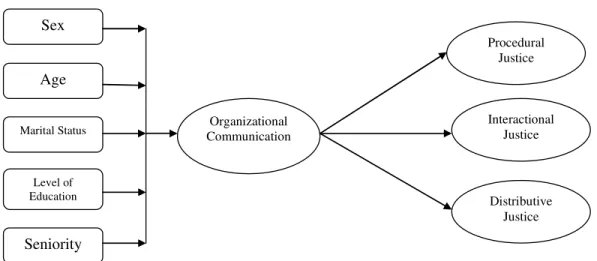
The model showed at Figure 1 is developed to evaluate organizational communication and organizational justice types.
Figure 1: Research Model Distributive Justice Procedural Justice Interactional Justice Organizational Communication Sex Age Marital Status Level of Education Seniority
Hypothesis will be tested in the research toward this model as follows:
H1: Degree of employees’ organizational communication differs from their sex. H2: Degree of employees’ organizational communication differs from their age
H3: Degree of employees’ organizational communication differs from their marital status.
H4: Degree of employees’ organizational communication differs from their level of education. H5: Degree of employees’ organizational communication differs from their seniority.
H6: There is a positive relation between degree of organizational communication and employees’ procedural justice perceptions.
H7: There is a positive relation between degree of organizational communication and
employees’ interactional justice perceptions.
H8: There is a positive relation between degree of organizational communication and
employees’ distributive justice perceptions.
6. Results of Hypothesis Testing
6.1. Demographic Profiles of Respondents
In addition to factor and reliability analysis, there is frequency analysis in the research. In Table 1, demographics of participators are seen. 85,7 % of participators is man and 14,3 % is woman. 2 % of participators is between 21-25 age, 6,1 % is between 26-30 age, 13,3 % is between 31-35 age and 78,6 % is in 36 and more age group. So, majority of the participators is middle age and older employees. 91,8 % of the participators is married, 6,1 % is single and 2 % is divorced. 14,3 % of the participators has high school degree, 35,7 % has associate degree and 41,8 % has bachelor degree and finally 8,2 % has master or doctorate degree. 14,3 of the participators has less than 1 year seniority, 11,2 % has between 1-5 years seniority, 12,2 % has 6-10 years seniority and finally 62,3 % has more than 11 years seniority.
Table 1: Demographic Information of Respondents
CONTROL VARIABLE (n:83) f %
SEX Male Female 84 14 85,7 14,3
AGE 21-25 2 2,0 26-30 6 6,1 31-35 13 13,3 36-40 34 34,7 41-45 20 20,4 46 and more 23 23,5
Table 1: Demographic Information of Respondents (Continued) MARITAL STATUS Single 6 6,1 Married 90 91,8 Divorced 2 2,0 LEVEL OF EDUCATION High School 14 14,3 Associate Deg. 35 35,7 Bachelor Deg. 41 41,8 Master Deg. + 8 2,0 SENIORITY
Less than 1 year 14 14,3
1-5 11 11,2 6-10 12 12,2 11-15 14 14,3 16-20 29 29,6 21 and more 18 18,4 6.2. Correlation Analysis
Directions and degrees of relations between values is tried to be calculated by using Pearson correlation coefficient. For correlation analysis, organizational communication’s and of organizational justice’s sub-scales’ correlation coefficients are calculated.
Table 2: Correlations between Organizational Communication and Organizational Justice
Mean S. D. 1 2 3 4 5 6 7 8 9 1. SEX 1,1429 ,35173 1 2. AGE 5,3571 1,26206 -,348** 1 3.MS 1,9796 ,37935 -,132 ,209* 1 4. LOE 3,4388 ,83809 -,075 -,237* -,199 1 5. SEN 3,8878 1,70435 -,111 ,671** -,020 -,182 1 6. PJ 2,9111 ,99705 -,031 -,014 -,180 -,203 -,132 1 7. IJ 3,0827 1,06025 ,095 -,174 -,244* -,073 -,208* ,840** 1 8. DJ 2,7194 1,19439 -,002 -,025 -,189 -,169 -,107 ,772** ,818** 1 9. OC 3,3698 ,79119 ,004 ,019 -,164 -,112 ,060 ,578** ,705** ,627** 1
**. Correlation is significant at the 0.01 level (2-tailed); *. Correlation is significant at the 0.05 level (2-tailed).
MS: Marital Status; LOE: Level of Education; SEN: Seniority; PJ: Procedural Justice; IJ: Interactional Justice; DJ: Distributive Justice; OC: Organizational Communication.
It is specified in correlation analysis that there are relations between employees’ organizational communication degree and perceptions of organizational justice types in several degrees. Organizational communication has positive and meaningful relation with procedural justice at (r: ,578) p<0.01 degree, interactional justice at (r: ,705) p<0.01 degree and distributive justice at (r: ,627) p<0.01 degree. So, it is seen that organizational communication is related to all three types of organizational justice.
Especially the relation with interactional justice perception is stronger than other two. Interactional justice that is about perception of interpersonal communication and has two sub-dimensions which are interpersonal communication and briefing (Karriker and Williams, 2009; Chory and Hubbell, 2008; Gefen et al., 2008; Berneth et al., 2007) is highly related to the degree of communication in the/a organization. When employees believe they are well informed about the job, organizational decisions, rules, activities and policies by their managers in the organization, their perceived interactional justice degree increases. In this situation, employees’ belief and trust about managers and colleagues are respectfully solid.
6.3. Findings about Comparison between Employees’ Organizational Communication Degree and Demographics
It is seen at the table below what the results of t-test are about comparison between employees’ organizational communication degrees and their sex. At Table 3, it is seen that male and female employees have similar values for organizational communication degrees and no significant difference (t= 1,191; p>0,05) is found between their organizational communication degrees. Therefore, Hypothesis 1 is rejected.
Table 3: T-test Results of Comparison between Employees’ Organizational Communication Degrees and Sex
Sub-Scales Sex n X S.D. t Sig (p)
ORGANIZATIONAL COMMUNICATION Male 84 3,3686 ,81940
1,191 ,278 Female 14 3,3771 ,61962
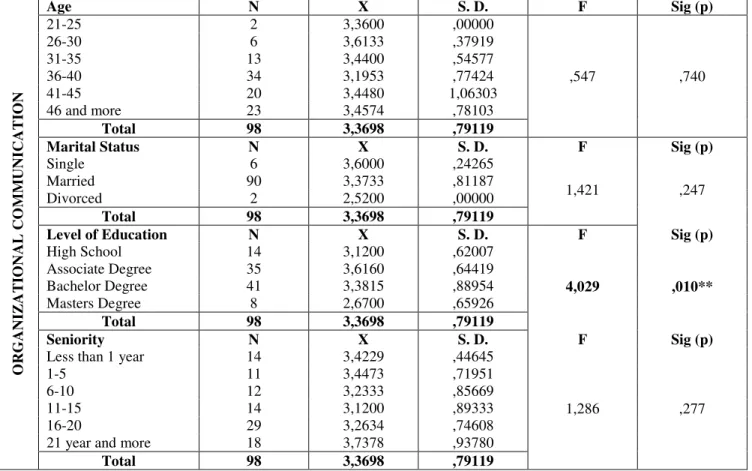
Anova test results regarding comparison of employees’ organizational communication degrees with their age, marital status, level of education and seniority are seen at the table below. When Table 4 is examined, there is no meaningful difference with age, marital status and seniority with regard to organizational communication. Only, employees’ level of education (F = 4,029; p:0,01) has significant difference with regard to organizational communication degree. Therefore, Hypothesis 2, Hypothesis 3, and Hypothesis 5 are rejected and Hypothesis 4 is accepted.
Table 4: Anova Test Results Regarding Comparison of Employees’ Organizational Communication Degrees with Their Age, Marital Status, Level of Education and Seniority
O R G A N IZ A T IO N A L C O M M U N IC A T IO N Age N X S. D. F Sig (p) 21-25 2 3,3600 ,00000 ,547 ,740 26-30 6 3,6133 ,37919 31-35 13 3,4400 ,54577 36-40 34 3,1953 ,77424 41-45 20 3,4480 1,06303 46 and more 23 3,4574 ,78103 Total 98 3,3698 ,79119
Marital Status N X S. D. F Sig (p)
Single 6 3,6000 ,24265
1,421 ,247
Married 90 3,3733 ,81187
Divorced 2 2,5200 ,00000
Total 98 3,3698 ,79119
Level of Education N X S. D. F Sig (p)
High School 14 3,1200 ,62007 4,029 ,010** Associate Degree 35 3,6160 ,64419 Bachelor Degree 41 3,3815 ,88954 Masters Degree 8 2,6700 ,65926 Total 98 3,3698 ,79119 Seniority N X S. D. F Sig (p)
Less than 1 year 14 3,4229 ,44645
1,286 ,277
1-5 11 3,4473 ,71951
6-10 12 3,2333 ,85669
11-15 14 3,1200 ,89333
16-20 29 3,2634 ,74608
21 year and more 18 3,7378 ,93780
6.4. Regression Analysis and Hypothesis Test
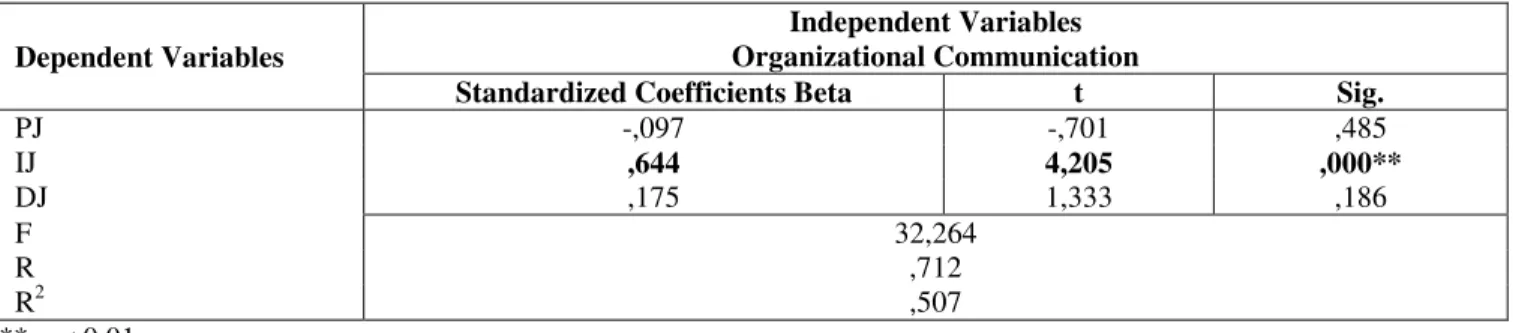
At Table 5, regression analysis’ results of effects of organizational communication degree on employees’ justice perceptions are given. In other words, number 6, 7 and 8 hypothesises are tested with this regression analysis. In the model, organizational communication is independent and organizational justice types are dependent variables.
Table 5: Regression Analysis on the Effect of Organizational Communication on the Organizational Justice
Dependent Variables
Independent Variables Organizational Communication
Standardized Coefficients Beta t Sig.
PJ -,097 -,701 ,485 IJ ,644 4,205 ,000** DJ ,175 1,333 ,186 F 32,264 R ,712 R2 ,507 ** p < 0,01
F value in regression model is the value that shows model’s significance and it 32,264. Therefore, the model that created to measure relations between organizational communication degree and justice types is significant. As it is seen on the table, there is a positive relationship between (p: ,000**) organizational communication degree and interactional justice. As mentioned at correlation analysis, organizational communication degree plays an important role on interactional justice which is about perception of interpersonal communication and has dimensions like briefing and interpersonal interaction. In addition to sincerity that managers presents during/throughout communication with employees, organizational operations, informing of subordinates about their social and personal rights, explanations processes purely, making reasonable explanations to suggestions, protecting their rights, respecting their right to information (Berneth et al., 2007; Tutar, 2007) cause interactional justice perceived in positive way. So, in the light of these findings, Hypothesis 7 propounded parallel to literature is accepted. But there are no findings to support Hypothesis 6 and 8. Yet, in regression analysis, no relationships are found between organizational communication and procedural and distributive justice types. There are some researches in literature Ambrose and Harland, 1995; Gopinath and Becker, 2000; Moideenkutty et al., 2001; Yamaguchi, 2005) about positive relationships between organizational communication and distributive and procedural justice. But as Zhang and Agarwal mentioned (2009), very few studies present empirical evidence for relationship between organizational communication and procedural and distributive justice. Also, it is not reached to experimental evidence to show relationship between organizational communication and those two justice types. This situation shows that – as Johnston and Joyner (2005) mentioned – there is not enough relationship between managers who are assumed as a resource and employees who are assumed as receiver in the public institution that the research done. Also, it shows that employees believe that distribution of rewards and punishments are not fair (Nirmala and Akhilesh, 2006; Blakely et al., 2005).
7. Summary and Concluding Remarks
Communication in organization management is one of the basic tools to perform management functions effectively and efficiently. To maintain all kinds of process in organizational activities and to perform objectives and goals, communication is used. Yet, realizing employees’ knowledge and skills is possible with communication. Accordingly, flow of information among people precisely and reliable is important for organizations to get sustainable competitive advantage in today’s world. Another fact
that is effective on organization’s success is employees’ justice perceptions. Organizational justice is employees’ perceptions about whether activities about distribution of organizational resources, degree of interpersonal relationships and operation organizational processes are being done fairly or not.
This study’s fundamental objective is to highlight the opinion of increasing degree of organizational communication would affect employees’ justice perception in the positive way, by examining the relationship between organizational communication and justice types. In this regard, survey study is done at Provincial Directorate of Agriculture allied to Karaman governorship. In the survey, study to measure employees’ communication degree, Organizational Communication Scale developed by Miles and his co-authors (1996) and translated to Turkish by Yüksel (2005) is used. Organizational justice is measured by Organizational Justice Scale which is developed by Moorman. In the research which is done with 98 participants, it is seen that employees’ perception on organizational communication is positive and moderate level ( : 3,3698), in other words organizations and executives communicate with their employees at middle level. There are no significant differences on employees’ communication degree with regard to employees’ demographics like sex, age, marital status and seniority (H1, H2, H3 and H5) and there is a significant difference on organizational communication with regard to their level of education (H4). So, we can say that managers and executives should take employees’ level of education consideration while they are communicating with them. This provides developing employees’ appropriation of their jobs, increasing employee morale, creating healthier communication medium.
In the research, one (H7) of three (H6, H7 and H8) hypothesises is accepted about identifying the relations between organizational communication and organizational justice types. A positive relationship is found between organizational communication and perception of interactional justice. As mentioned before, organizational communication plays important role on configuration of interactional justice. Behaviours like respect and kindness from managers to employees, sincere on communication, informing subordinates about organizational operations, social personal rights, objective and rational explanations to suggestions, looking after employees’ benefits lead interactional justice perceived positively. But, no relationship found between organizational communication between procedural and distributive justice perceptions. In spite of the general opinion in literature like organizational communication is related to both procedural and distributive justice (Ambrose and Harland, 1995; Moideenkutty et al., 2001; Yamaguchi, 2005), it is reached no findings to support hypothesises about relation between organizational communication and distributive and procedural justice.
When employees perceive organizational decisions and activities fair, it leads their trust to increase towards their manager. Concordantly, employees’ perceptions whether it is fair or not participating to decisions, performance evaluation, allocation of organizational resources and rewards like wage and promotions and procedures that play role on operation of these is very important for managers in communication with them. It is clear that process of procedural informing and effective and fair distribution of resources is needed to create a positive employee perception for organization and results of the research is supporting it. Creating positive employee perception like executive policies are fair is only possible with managing organizational communication and information flow effectively and in a healthy way. Managers’ fair decisions and applications generally are not enough for employees’ positive justice perceptions. It definitely should be supported by an effective communication and sharing process. In this context, organization managers have important responsibilities to create a structure that help to spread sharing of organizational information among employees.
As a consequence, organizational communication is effective to create positive justice perception at subjects as follows:
• To administer the participation of employees to decisions, • To give feedbacks on employees’ performances,
• To inform employees about organizational processes,
• To create reward/punishment system that evaluates employees’ performance fairly,
• To care to create a balanced language between being sincere or being diplomatic in organizational communication,
• To communicate with obeying respect and kindness rights in organizational relations, • To encourage knowledge sharing.
This research has some constraints as other studies have. The biggest constraint is that the research is applied in one public institution and done with only its employees. Hence, making generalization with research’s findings would not give healthy results. Besides, the reason the research is done in a public institution; it does not explain evaluation of differences between public and private sector employees. Another important constraint is the reason justice perception is a time manner attitude; it can change by time.
In the light of the constraints mentioned above, these suggestions are made for future studies: • To contribute both national and international literature, the scope of the research should
involve both public and private sector employees and it should be made comparative studies,
• It should be identified that whether justice perception is inconstant or not by doing researches on the same organizations and employees in different times,
• Organization culture should be added as a moderator variable to studies about examining relations between organizational communication and justice.
References
[1] Abu Elanain, H. M., 2010. “Testing the direct and indirect relationship between organizational justice and work outcomes in a non-Western context of the UAE”, Journal of Management Development 29(1), pp. 5-27.
[2] Ada, N., 2007. “Örgütsel İletişim ve Yeni Bilgi Teknolojileri; Örgütsel İletişim Ağları”, Ege Akademik Bakış / Ege Academic Review 7(2), pp. 543-551.
[3] Ada, N., Alver, İ. ve A. Fatma, 2008. “Örgütsel İletişimin Örgütsel Bağlılık Üzerine Etkisi: Manisa Organize Sanayi Bölgesinde Yer Alan ve İmalat Sektörü Çalışanları Üzerinde Yapılan Bir Araştırma”, Ege Akademik Bakış / Ege Academic Review 8(2), pp. 487-518.
[4] Adler, R. B. and J. M. Elmhorst, 1996. Communicating at Work, ISBN 0-07-114001-8 (5th ed). McGraw Hill. New York.
[5] Ambrose, M. L., and L. K. Harland, 1995. “Procedural justice and influence tactics: Fairness, frequency, and effectiveness”. in R. Cropanzano and M. Kacmar (Eds.), Organizational politics, justice and support: Managing the social climate of the workplace (pp. 97-130). Westport, CT: Quorum.
[6] Baltaş, Z., ve A. Baltaş, 2002. Bedenin Dili, Remzi Kitabevi, İstanbul.
[7] Banerji, A. and A. Dayal, 2005. “A Study of Communication in Emergency Situations in Hospitals”, Journal of Organizational Culture, Communications and Conflict 9(2), pp. 35-45. [8] Barutçugil, İ., 2004. Stratejik İnsan Kaynakları Yönetimi, Kariyer Yayıncılık, İstanbul.
[9] Bell, R. L., and J. Martin, 2008. “The Promise of Managerial Communication as a Field of Research”, International Journal of Business and Public Administration 5(2), pp. 125-142. [10] Berneth, J. B., Armenakis, A. A., Feild, H. S. and H. J. Walker, 2007. “Justice, Cynicism, and
Commitment: A Study of Important Organizational Changes Variables”, The Journal of Applied Behavioral Science 43(3), pp. 303-326.
[11] Blakely, G. L., Andrews, M. C. and R. H. Moorman, 2005. “The Moderating Effects of Sensitivity on The Relationship between Organizational Justice and Organizational Citizenship Behaviors”, Journal of Business and Psychlolgy 20(2), pp. 259‐273.
[12] Bolarinwa, J. A. and D. Y. Olorunfemi, 2009. “Organizational Communication for Organizational Climate and Service in Academic Libraries”, Library Philosophy and Practice, pp. 1-5.
[13] Bolat, O. İ., 2010. “The Relationships between Leader-Member Exchange and Organizational Justice in Hotels”, European Journal of Economics, Finance and Administrative Sciences 26, pp. 115-125.
[14] Chegini, M. G., 2009. “The Relationship between Organizational Justice and Organizational Citizenship Behavior”, American Journal of Economics and Business Administration 1(2), pp. 171-174.
[15] Chen, J. C., Silverthone, C. and J. Y. Hung, 2005. “Organizational Commmunication, Job Stress, Organizational Commitment, and Job Performance of Accounting Professionals in Twain and America”, Leaderships and Organization Development Journal 27(4), pp. 242-249. [16] Chory, R. M. and A. P. Hubbell, 2008. “Organizational Justice and Managerial Trust as
Predictors of Antisocial Employee Responses”, Communication Quarterly 56(4), pp. 357-375. [17] Cohen, R. L., 1987. “Distributive Justice: Theory and Research”, Social Justice Research 1, pp.
19–40.
[18] Colquitt, J. A. and J. M. Chertkoff, 2002. “Explaining Injustice: The Interactive Effect of Explanation and Outcome on Fairness Perceptions and Task Motivation”, Journal of Management 28(5), pp. 591–610.
[19] Colquitt, J. A., D. E. Conlod, M. J. Wesson., C. Porter and K. N. G. Yee, 2001. “Justice at the Millennium: A Meta Analytic Review of 25 Years of Organizational Justice Research”, Journal of Applied Psychology 86(3), pp. 425–445.
[20] Cowherd, D. M., I. D. Levine, 1992. “Product Quality and Pay Equity Between Lower-Level Employees and Top Management: An Investigation Of Distributive Justice Theory”, Administrative Science Quarterly 37(2), pp. 303-304.
[21] Cremer, D. D., Dijke, M. V. and A. Bos, 2004. “Distributive Justice Moderating the Effects of Self-sacrificial Leadership”, The Leadership & Organization Development Journal 25(5), pp. 466-475.
[22] Demirel, Y., 2009. “Örgütsel Bağlılık ve Üretkenlik Karşıtı Davranışlar Arasındaki İlişkiye Kavramsal Yaklaşım”, İstanbul Ticaret Üniversitesi Sosyal Bilimler Dergisi 8(15), pp. 115-132.
[23] Demirtaş, M., 2010. “Örgütsel İletişimin Verimlilik ve Etkinliğinde Yararlanılan İletişim Araçları ve Halkla İlişkiler Filmleri Örneği”, Marmara Üniversitesi İİBF Dergisi XXVIII(1), pp. 411-444.
[24] Dinç, A. ve A. Ceylan, 2008. “Kaçak Elektrik Kullanımıyla İlgili İdare Çalışanı Tutumunun Örgütsel Adalet ve İs Memnuniyeti ile İlişkisi, Çalışma Gruplarına Göre Farklılıklar”, Cumhuriyet Üniversitesi İİBF Dergisi 9(2), pp. 13-29.
[25] Doğan, H., 2002. “İşgörenlerin Adalet Algılamalarında Örgüt İçi İletişim ve Prosedürel Bilgilendirmenin Rolü”, Ege Akademik Bakış Dergisi 2(2), pp. 71‐78.
[26] Doğan, H., “İşgörenlerin Adalet Algılamalarında Örgüt İçi İletişim ve Prosedürel Bilgilendirmenin Rolü”, http://eab.ege.edu.tr/pdf/2_2/C2-S2-%20M7.pdf.
[27] Doğan, S., 2005. Çalışan İlişkileri Yönetimi, Kare Yayınları, İstanbul.
[28] Doğan, S., 2006. Personel Güçlendirme Rekabette Başarının Anahtarı, Kare Yayınları, İstanbul. [29] Durğun, S., 2006. “Örgüt Kültürü ve Örgütsel İletişim”, Yüzüncü Yıl Üniversitesi Eğitim
Fakültesi Dergisi III(II), pp. 112-132.
[30] Eberlin, R. J. and B. C. Tatum, 2005. “Organizational Justice and Decision Making, When good intentions are not enough”, Management Decision 43(7/8), pp. 1040-1048.
[31] Eberlin, R. J. and B. C. Tatum, 2008. “Making just decisions: organizational justice, decision making, and leadership”, Management Decision 46(2), pp. 310-329.
[32] Erdoğan, B., Liden, R. C. and M. L. Kraimer, 2006. “Justice and Leader-member Exchange: The Moderating Role of Organizational Culture”, Academy of Management Journal 49(2), pp. 395-406.
[33] Eroğlu, Ş. G., 2009. “Örgütsel Adalet Algılaması ve İş Tatmini Hakkında Bir Araştırma”, Pamukkale Üniversitesi Sosyal Bilimler Enstitüsü Yüksek Lisans Tezi, Denizli, pp. 1-223. [34] Eroğluer, K., 2011. “Örgütsel İletişim ile İş Tatmini Unsurları Arasındaki İlişkiler: Kuramsal
Bir İnceleme”, Ege Akademik Bakış / Ege Academic Review 11(1), pp. 1409-1424.
[35] Eskew, E. D., 1993. “The Role Of Organizational Citizenship Behavior”, Employee Responsibilities And Rights Journal 6(3).
[36] FitzGerald, M. R., 2002. “Organizational Cynicism: Its Relationship to Perceived Organizational Injustice and Explanatory Style”, University of Cincinnati, UMI Microfilmed 2002, pp. 1-70.
[37] Folger, R., 1987. “Distributive and Procedural Justice in the Workplace”, Social Justice Research 1(2), pp. 143–159.
[38] Gefen, D., Ragowsky, A. and C. Ridings, 2008. “Leadership and Justice: Increasing non Participating Users’ Assessment of an IT Through Passive Participation”, Information & Management 45, pp. 507‐512.
[39] Green, D., 1987. Business Guide to Communication Systems, Pitman Publishing, Great Britain, pp. 7-22.
[40] Greenberg, J., 1990. “Organizational Justice: Yesterday, Today, and Tomorrow”, Journal of Management 16(2), pp. 399–432.
[41] Gupta, M. A. and R. Kumar, 2010. “Look Who’s Talking! Impact of Communication Relationship Satisfaction on Justice Perceptions”, VIKALPA 35(3), pp. 55-65.
[42] Gursoy, D., Ekiz, E. H. and C. G. Chi, 2007. “Impacts of Organizational Responses on Complainants’ Justice Perceptions and Post-Purchase Behaviors”, Journal of Quality Assurance in Hospitality & Tourism 8(1), pp. 1-25.
[43] Hindi, N. M., Miller, D. S. and S. E. Catt, 2004. “Communication and Miscommunication in Corporate America: Evidence From Fortune 200 Firms”, Journal of Organizational Culture, Communications and Conflict 8(2), pp. 13-26.
[44] Hoy, W. K. and C. J. Tarter, 2004. “Organizational justice in schools: no justice without trust”, International Journal of Educational Management 18(4), pp. 250-259.
[45] http://iletisimblogu.blogcu.com/orgutsel-iletisim-nedir/5621454, AD: 03.01.2011.
[46] http://www.donusumkonagi.net/makale.asp?id=2909&baslik=orgutsel_iletisim, AD: 10.02.2011.
[47] İbicioğlu, H., 1999. “İşletmelerde İnsangücü Verimliliğinin Arttırılması”, Dumlupınar Üniversitesi Sosyal Bilimler Dergisi 1(2).
[48] Johnston, M. K. and B. E. Joyner, 2005. “Leadership And Communication: A Multiple-Perspective Study Of Best Practices”, Journal of Organizational Culture, Communications and Conflict 9(2), pp. 1-14.
[49] Johnston, M. K., Reed, K., Lawrence, K. and M. Onken, 2007. “The Link between Communication and Financial Performance in Simulated Organizational Teams”, Journal of Managerial Issues XIX(4), pp. 536-553.
[50] Kalla, H. K., 2005. “Integrated Internal Communications: A Multidisciplinary Perspective”, Corporate Communications: An international Journal 10(4), pp. 302-314.
[51] Karabay, E., 2004. “Kamuda ve Özel Sektörde Örgütsel Adalet Algısı İle Örgütsel Bağlılık Arasındaki İlişkiler”, Yüksek Lisans Tezi, Hacettepe Üniversitesi SBE, Ankara.
[52] Karriker, J. H. and M. L. Williams, 2009. “Organizational Justice and Organizational Citizenship Behavior: A Mediated Multifoci Model”, Journal of Management 35(1), pp. 112‐135.
[53] Kelly, D., 1999. “Using Vision to Improve Organizational Communication”, Leadership & Organization Development Journal 21(2), pp. 92-101.
[54] Klendauer, R. and J. Deller, 2009. “Organizational Justice and Managerial Commitment in Corporate Mergers”, Journal of Managerial Psychology 24(1), pp. 29-45.
[55] Kocabaş, F., “Değişime Uyum Sürecinde İç ve Dış Örgütsel İletişim Çabalarının Entegrasyonu Gerekliliği”, http://yordam.manas.kg/ekitap/pdf/Manasdergi/sbd/sbd13/sbd-13-22.pdf, AD: 12.01.2011.
[56] Konovsky, M. A., 2000. “Understanding Procedural Justice and Its Impact on Business Organizations”, Journal of Management 26(3), pp. 489‐511.
[57] Kuchi, T., 2006. “Constant Change and the Strategic Role of Human Communication. A Selective Annotated Bibliography”, Library Management 27(4/5), pp. 218-235.
[58] McDowall, A. and C. Fletcher, 2004. “Employee development: an Organizational Justice Perspective”, Personnel Review 33(1), pp. 8-29.
[59] Moorman, R. H., 1991. “Relationship between Organizational Justice and Organizational Citizenship Behaviors: Do Fairness Perceptions Influence Employee Citizenship?”, Journal of Applied Psychology 76, pp. 845–855.
[60] Mumby, D. K. and C. Stohl, 1996. “Diciplining Organizational Communication Studies”, Management Communication Quarterly 10, pp. 50-72.
[61] Ng, W. H. T., Butts, M. M., Vandenberg, R. J., DeJoy, D. M. and M. G. Wilson, 2006. “Effects of Management Communication, Opportunity for Learning, and Work Schedule Flexibility on Organizational Commitment”, Journal of Vocational Behavior 68, pp. 474–489.
[62] Nirmala, M. C. and K.B. Akhilesh, 2006. “An attempt to Redefine Organizational Justice: in the Rightsizing Environment”, Journal of Organizational Change Management 19(2), pp. 136-153.
[63] Özmen, Ö. N., Arbak, Y. T. ve P. S. Özer, 2007. “Adalete Verilen Değerin Adalet Algıları Üzerindeki Etkisinin Sorgulanmasına İlişkin Bir Araştırma”, Ege Akademik Bakış / Ege Academic Review 7(1), pp. 17–33.
[64] Paulraj, A., Lado, A. A. and J. J. Chen, 2008. “Inter-organizational Communication as a Relational Competency: Antecedents and Performance Outcomes in Collaborative buyer– supplier Relationships”, Journal of Operations Management 26, pp. 45–64.
[65] Phattanacheewapul, A. and P. Ussahawanitchakit, 2008. “Organizational Justice Versus Organizational Support: The Driven-factors of Employee Satisfactıon and Employee Commitment on Job Performance”, Journal of Academy of Business and Economics 8(2), pp. 114-123.
[66] Pillai, R., A. S. Chester and S. W. Eric, 1999. “Fairness Perceptions and Trust as Mediators for Transformational and Transactional Leadership: A Two‐Sample Study”, Journal of Management 25(6), pp. 897–933.
[67] Putti, J. M. and S. Aryee, 1990. “Communication in Organizations”, Group & Organization Management 15(1), pp. 44.
[68] Rosen, R. H., 1998. İnsan Yönetimi, MESS Yayınları, İstanbul.
[69] Ruben, B., 1984. Communication and Human Behavior, Macmilan Publishing Comp., New York, pp. 11-18.
[70] Taylor, J. R., 2001. “The ‘Rational’ Organization Reconsidered: An Exploration of some of the Organizational Implications of Self-Organizing”, Communication Theory 11, pp. 137-177. [71] Thurston Jr, P. W. and L. McNall, 2010. “Justice perceptions of performance appraisal
practices”, Journal of Managerial Psychology 25(3), pp. 201-228.
[72] Tosun, C., 2009. “Kamu İşletmelerindeki İletişim Biçimlerinin Verimliliğe Etkisi-1”, Anahtar, Milli Prodüktivite Merkezi Aylık Yayın Organı 21(242), pp. 20-23.
[73] Turunç, Ö., 2009. “İş Performansının Artırılmasında Adalet ve Motivasyonun Rolü: Bankacılık Sektöründe Bir Model Araştırması”, 17. Ulusal Yönetim ve Organizasyon Kongresi, 21-23 Mayıs 2009, Eskişehir Osmangazi Üniversitesi İşletme Bölümü, pp. 141-148.