Slow Surface Plasmons on Moiré Surfaces
S. S. Senlik1, A. Kocabas2, A. Aydinli11. Department of Physics, Bilkent University, 06800, Ankara, Turkey
2. FAS Center for System Biology, Northwest Building, Oxford Street Cambridge, MA 02138, USA
Controlling the group velocity (vg) of light is an important issue in order to understand light matter
interactions and enable new technological applications. Surface plasmon polaritons(SPP) offer new possibilities in this regard. SPPs with small group velocities in the vicinity of the band edges of periodic structures and in metallic nano particle chains have recently been studied [1, 2]. In this report, we present the design, fabrication and realization of coupled plasmonic cavities using metallic Moiré structures. The phase shifts at the nodes of Moiré pattern enable localization of SPPs resulting in a mini band in the band gap region. We find group velocities around vg=0.44c at the center of the mini band and approaches to zero at the edges of mini band.
We have fabricated Moiré patterns using conventional interference lithography. The Moiré surface include two different periods with periodicities of Λ1=295nm and Λ2=305 nm. These patterns include -phase shifts
located at the nodes. Moiré surface acts as a distributed Bragg reflector with a sinusoidal modulated amplitude for SPPs. These phase shifts are instrumental for the localization of propagating SPPs. A 50-nm thick Ag thin film is evaporated on the Moiré patterns to generate the metallic surface. Angle and wavelength dependent reflectivity was measured through using Kretschmann geometry.
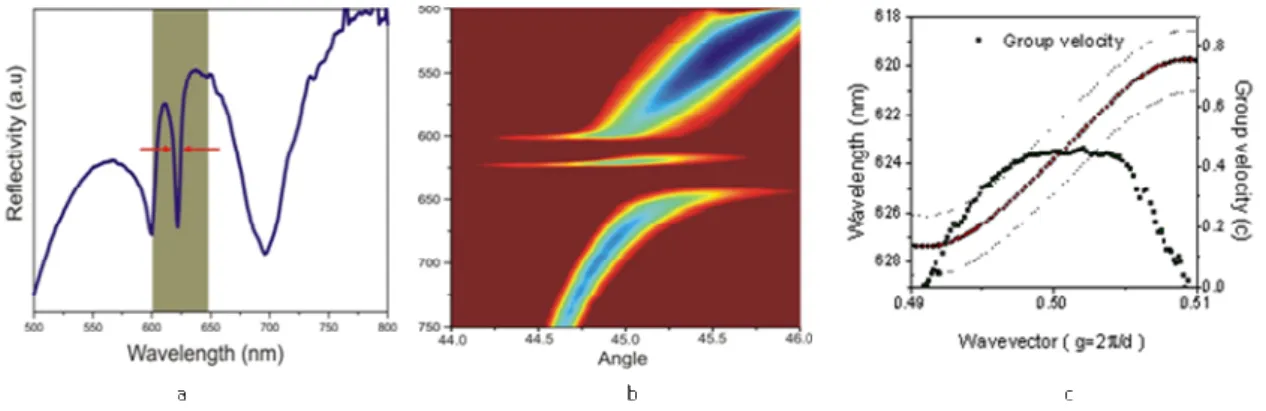
Fig. 1 a) The reflectivity of Moiré pattern in the Kretschmann geomety. b) Dispersion map of Moiré pattern in the
Kretschmann geomety c) Red dots show the experimental dispersion curve of wave-guiding mode on a Moiré surface green dots show the corresponding group velocities
In Fig. 1a, the grey shaded region indicates the plasmonic band gap. The absorption peaks located at the 600 nm and 700 nm correspond to the lower and upper branches of the plasmonic band gap. There is an additional resonance in the band gap region which does not appear in the uniform grating case. This additional absorption peak corresponds to the localization of SPPs at the nodes of Moiré surfaces. The linewidth of this excitation is 6 nm and the quality factor is 103. Fig. 1b is constructed from many reflectivity measurements at various angles to study group velocity of SPPs. A mini band in the plasmonic band gap is observed due to localization of SPPs. In Fig 1c, one can observe that dispersion band gets flattened at the edges of the mini band. The group velocity is approximately 0.44c at the center of the band and approaches to zero in the vicinity of the band edges.
References
[1] J. Gómez Rivas, M. Kuttge, P. Haring Bolivar, H. Kurz, J. A. Sánchez-Gil, "Propagation of Surface Plasmon Polaritons on semiconductor Gratings" Phys. Rev. Lett. 93, 256804 (2004).
[2] Stefan A. Maier , Pieter G. Kik, and Harry A. Atwater, "Optical pulse propagation in metal nanoparticle chain waveguides " Phys. Rev. Lett. 67, 205402 (2004).