Examining the Temperamental Effortful Control,
Extraversion, and Negative Affectivity as Predictors
of Children’s Social Competence
Ibrahim Hakkı ACAR
1Geliş Tarihi: 14.06.2016 Kabul Ediliş Tarihi: 05.12.2016 ABSTRACT
The current study examined the children’s temperament as predictor of their social competence, with a particular focus on children’s regulatory temperament (i.e., effortful control) as moderators of associations between extraversion and social competence, and negative affectivity and social competence. A total of 94 children (56 boys, 38 girls) with mean age of 7.05 years (SD= 0.88) enrolled in 24 classrooms from five elementary schools in Istanbul. Mothers reported on children's temperament and teachers reported on children’s social competence. Nested children within classrooms were tested by using hierarchical regression models via SAS PROC MIXED. Results showed that temperamental effortful control was positively associated with children’s social competence. Effortful control significantly moderated the association between temperamental extraversion and children’s social competence. Low levels of effortful control (1 SD below the mean) and lower extraversion was associated with less social competence. Limitations and future directions of the current study are discussed.
Keywords: Temperament, Social Competence, Effortful Control, Negative Affectivity,
Extraversion.
Özdenetim, Dışadönüklük ve Olumsuz Duygulanımın
Çocukların Sosyal Yeterliğine Etkisinin İncelenmesi
ÖZ
Bu çalışmada, çocukların mizacının onların sosyal yeterlikleri ile ilişkisi incelenmiştir. Özellikle de, düzenleyici mizacın (özdenetim) dışa dönüklük ve sosyal yeterlilik ayrıca da negatif duygulanım ve sosyal yeterlilik arasındaki ilişkilerini nasıl değiştirebileceği incelenmiştir. İstanbul'da beş ilköğretim okulunda bulunan yaş ortalaması 7.05 (SS = 0.88) olan 94 çocuk (56 erkek, 38 kız) çalışmaya katılmıştır. Çocuk mizaç formunu ebeveynler ve sosyal yeterlik formunu öğretmenler doldurdu. Çocukların sınıfların içersinde olması sebebiyle, toplanan veriler SAS PROC MIXED aracılığıyla hiyerarşik regresyon modelleri test edildi. Sonuçlar özdenetim ile sosyal yeterlik arasında olumlu ilişkili olduğunu göstermiştir. Mizaçsal özdenetim anlamlı bir şekilde dışa dönüklük ve sosyal yeterlik arsındaki ilişkiyi önemli ölçüdeyordamıştır.. Bu bağlamda, çocukların düşük seviyedeki özdenetim ve dışa dönüklüğe sahip olduklarında sosyal yeterlikleri düşük seviyede olduğu sonucuna ulaşılmıştır.. Sonuçlar kapsamında mevcut çalışmanın sınırlılıkları ve gelecek yönelimleri tartışılmıştır.
1 Dr., Department of Child Youth and Family Studies, University of Nebraska-Lincoln, 135 Mabel Hall Lincoln NE, The U.S.A 68588-0236 Phone: 001 402 802 8738 e-posta: [email protected]
Anahtar Kelimeler: Mizaç, Sosyal Yeterlik, Özdenetim, Olumsuz Duygulanım, Dışa
Dönüklük .
INTRODUCTION
Children’s social competence has been in a scope of the research in child development and education; therefore, a large body of research has focused on it by investigating a variety of factors influencing social competence in early and late childhood (Brophy-Herb, Lee, Nievar, & Stollak, 2007; Chen & French, 2008). Social competence defined as ability to integrate feelings, thinking, and express behaviors to achieve personal goals within a given context and culture (Kostelnik, Whiren, Soderman, & Gregory, 2005). In short, within peer interactions it is defined as “sustaining positive engagement with peers” and “effectiveness in interaction” (Rose-Krasnor & Denham, 2009; p.163). Researchers have found associations between social competence and, parenting, temperament, peer group influences, teacher interactions, and cognitive abilities (Anthony et al., 2005; Griggs, Gagnon, Huelsman, Kidder-Ashley, & Ballard, 2009).
Temperament has reactive and regulatory components; reactive temperament taps on individual characteristics such as surgency, fear, activity level, impulsivity, and anger. Regulatory temperament (i.e., effortful control) taps on individual characteristics such as attentional focusing, inhibitory control, and perceptual sensitivity (Putnam & Rothbart, 2006; Rothbart & Bates, 2006). Children’s regulatory temperament (i.e., effortful control) has been found to be related to higher levels of social competence (Valiente et al., 2003), in contrary, children’s activity level has been found to be related lower level of social competence (Gleason, Gower, Hohmann, & Gleason, 2005; Szewczyk-Sokolowski et al., 2005). From the perspectives of interplay of temperamental characteristics on child development (Rothbart & Bates, 2006), the current study was focused on examining the contributions of regulatory (i.e., effortful control) and reactive temperament (i.e., surgency) to children’s social competence. In particular, the current study was aimed at exploring interplay between effortful control and surgency on early elementary children’ social competence.
Children’s Social Competence
Children’s socialization in early childhood is one of the building blocks for concurrent and future development (Eisenberg, Fabes, & Spinrad, 2006; Hartup, 1996; Rogoff, 1990). The long-term goal of socialization is to help the individual become an active and engaged member of the community (Kagitcibasi, 2007). In the process of socialization, children learn values of the social environment in which they live and how to behave properly, according to social rules and norms (Rogoff, 1990). Children need social competence to understand what social response is required within a particular social context (Denham, Basett, & Wyatt, 2007; Ladd, 2005). Social competence is the ability to use appropriate social skills in a given social context to understand social cues and respond them accordingly (Ladd, 2005). Social competence is an important tool for children’s
social relationships and school success (Halberstadt, Denham, & Dunsmore, 2001; Rose-Krasnor & Denham, 2009).
During the peer interactions, children need a set of social skills that contribute to formation of positive peer interactions (Ladd, 2005). Even though social competence is somewhat compromised of social skills, there is a conceptual and hierarchical distinction between social skills and social competence (Gresham & Reschly, 1987; Greene & Burleson, 2003; McFall, 1982). Social skills are part of the broader construct that is social competence (Winner, 2008). In return, social competence is the broader picture encompassing the ability to interact successfully with peers and adults in a variety of social situations (Ladd, 2005; Winner, 2008). Social skills refer to the ability to perform a behavior to meet demands of a specific social situation and the personal goal of the child, such asking for help to get his/her shoes tied (McFall, 1982; Winner, 2008). According to McFall’s (1982) and Rose-Krasnor’s (1997) Prism Model of social competence, social skills are important foundations for social competence. For example, actions such as displaying aggressive behavior with peers predicts behavioral outcomes such as limited classroom engagement, peer rejection, and problems for the future development of teacher-child interactions, which are seen as behavioral indicators of social incompetence (Asher, Oden, & Gottman, 1977; Estell et al., 2008; Ladd & Burgess, 1999). In contrast, children who had positive interactions with peers in childcare had better social and communicative skills with peers in third grade, were less aggressive, and showed more cooperative skills with peers, which are seen as manifesting social competence (National Institute of Child Health and Human Development Early Child Care Research Network [NICHD ECCRN], 2008).
Social competence in early years is crucial for children’s concurrent and future development including social, academic, and cognitive skills (Denham et al., 2004; Halberstadt et al., 2001). For example, previous research has showed that children with higher levels of social competence in early years demonstrated higher levels of social relationships with peers and adults as well as academic competence in later years (Domitrovich, Cortes, & Greenberg, 2007). The next section will talk about temperamental effortful control and extraversion as antecedents of children’s social competence.
Children’s Temperament and Social Competence
Temperament in childhood is considered as a central characteristic that influences personality, emotionality, and social behaviors (see Berdan, Keane, & Calkins, 2008; David, 2007; Sterry, et al., 2010, for relevant review). Temperament is defined as individual differences in reactivity and self-regulation that has biological foundations and evolve through interactions with environmental characteristics (Rothbart, 2011; Rothbart & Bates, 2006). Temperament has two main dimensions: reactivity and regulation. Reactivity refers to an individual’s intensity of arousability or responsivity to the social context or situations (Rothbart, Derryberry, & Hershey, 2000). Regulatory dimension of temperament refers to mechanism such as attention, avoidance, and inhibition that individual regulate (Rothbart, 2011). Extraversion as
temperamental characteristic falls under reactive and effortful control falls under regulatory dimension of temperament (Rothbart, 2011).
Temperamental extraversion is a reactive component of temperament, refers to positive emotions, higher levels of activity in social interactions, and quick approach to given environmental rewards (Evans & Rothbart, 2007; Rothbart, 2011). Surgency as component of temperament is considered to be related to the extraversion personality factor (Rothbart, 2011). Factors analysis of Rothbart’s Child Behavior Questionnaire showed that surgency includes activity level, approach (positive anticipation), high-intensity pleasure, impulsivity, shyness (negative loading), and smiling and laughter (Putnam & Rothbart, 2006; Rothbart, 2011). Surgent children have excessive levels of excitement towards new objects, gifts and rewards particularly, and higher activity levels during social interactions with peers (Rothbart, 2011l; Szewczyk-Sokolowski et al., 2005). From this perspective, the current study used surgency as extraversion temperamental characteristic for children as relates to their social competence. Another reactive temperamental domain is negative affectivity that refers to a general disposition to experience negative emotions (Putnam & Rothbart, 2006; Rothbart, 2011). Negative affectivity includes anger/frustration, discomfort, falling reactivity and soothability (negative loading), fear, and sadness (Putnam & Rothbart, 2006; Rothbart, 2011). Fear and anger are the most researched dimensions of negative emotionality in child development (e.g., Rorthbart, Ahadi, & Evans 2000). Considering negative affectivity consists of emotions such as anger, frustration, and discomfort, research has shown that negative emotion is a predictor of concurrent and future problem behaviors such as antisocial behavior and over-reaction to environmental stimuli (Boyce & Ellis, 2005; Lengua & Long, 2002; Rothbart, 2011). For example, children (8-10 years old) with higher levels of negative emotionality perceived their parents’ divorce as more negative and stressful compared to children with lower levels of negative emotionality (Lengua & Long, 2002). The researchers concluded that children with higher levels of negative emotionality experienced higher levels of stress in the event of their parent’s divorce; this is likely indicative of their experiences with many stressful events.
The third temperamental dimension, effortful control, is regulatory component of temperament. Effortful control refers to voluntary inhibition of inappropriate response and replacement with an appropriate response (Rothbart, 2011). Effortful control includes attentional focusing, inhibitory control, low-intensity pleasure, and perceptual sensitivity (Putnam & Rothbart, 2006; Rothbart, 2011). In general, effortful control has been negatively related to externalizing behaviors and predictive of positive peer and teacher relations over time during the preschool years. For example, children with high effortful control are more likely to be prosocial, high in social competence, and relatively low in problematic behaviors (Eisenberg Fabes, Guthrie, & Reiser 2000; Rothbart & Bates, 2006; Rudasill & Konold, 2008; Valiente et al., 2003).
Theoretical conceptualizations and previous research have suggested that one temperamental characteristic can work with another temperamental characteristic as they influence social outcomes (Acar et al., 2015; Rothbart & Bates, 2006; Yoleri, 2014; Zentner & Bates, 2008). From this perspective, it expected that regulatory temperamental characteristics may eliminate the detrimental effects of reactive or difficult temperamental characteristics on children’s social outcomes (Eisenberg et al.,2000; Rothbart & Bates, 2006). For example, Rudasill and Konold (2008) found that shyer children had higher levels of self-control and cooperation as part of social competence when they had higher levels of inhibitory control and attentional focusing as part of their temperamental effortful control. Considering these previous findings, the current study attempted to examine how effortful control would moderate the associations between extraversion and social competence as well as between negative affectivity and social competence.
The Current Study
The contribution of temperament on children’s social competence has been widely examined in Western sample with different age groups (e.g., Gleason et al., 2005; Rudasill & Konold, 2008; Valiente et al., 2003). However, the research examined the associations between children’s temperamental characteristics and their social competence has been lacking in Turkish sample. Therefore, the current study aimed at exploring the association between temperament (effortful control and extraversion) and early elementary children’s social competence. In particular, the interplay of effortful control and extraversion on children’s social competence was warranted. Findings from the current study are expected to contribute the existing literature and provide guidelines for parents and teachers to support children’s social competence depending upon their temperamental characteristics.
The following research questions and hypotheses were addressed. First, to what extent are the temperamental extraversion, negative affectivity, and effortful control related to children’s social competence? It was hypothesized that temperamental extraversion and negative affectivity as reactive characteristics would be negatively related to children’s social competence (Hypothesis 1A) conversely, effortful control would have a positive association with children’s social competence (Hypothesis 1B). Second, to what extent does effortful control as regulatory temperament moderate the association between children’s extraversion and negative affectivity, and children’s social competence? It was hypothesized that effortful control would moderate the association between children’s negative affectivity and extraversion, and their social competence. Such that, effortful control as regulatory temperament would eliminate the detrimental effects of extraversion and negative affectivity as reactive temperaments on children’s social competence (Hypothesis 2).
METHOD Participants
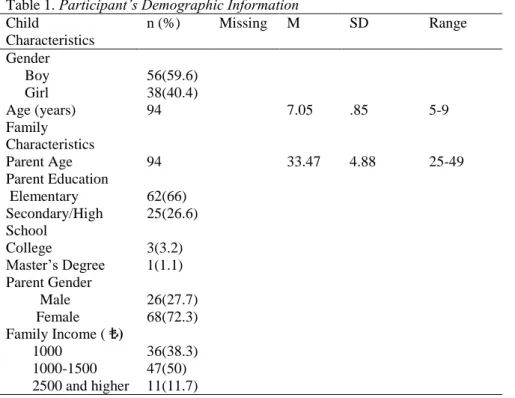
Ninety-four children (38 girls and 56 boys) children from 24 classrooms across three elementary schools were recruited for the current study. Each classroom had four to five children at average, to maximize generalizability of the sample. Children aged from 5 to 9 with the mean age of 7.05 (SD=.84=5 years). Most of the children were from low socioeconomic background living in suburbs in Istanbul. A total of 62 % of the parents completed elementary school, 26.6% of parents completed middle/high school, 3.2 % of parents completed college, and 1.1% earned their Master’s degree. See Table 1 for complete demographic information.
Table 1. Participant’s Demographic Information Child Characteristics n (%) Missing M SD Range Gender Boy 56(59.6) Girl 38(40.4) Age (years) 94 7.05 .85 5-9 Family Characteristics Parent Age 94 33.47 4.88 25-49 Parent Education Elementary 62(66) Secondary/High School 25(26.6) College 3(3.2) Master’s Degree 1(1.1) Parent Gender Male 26(27.7) Female 68(72.3) Family Income ( ) 1000 36(38.3) 1000-1500 47(50) 2500 and higher 11(11.7) Measures Demographic Information
Children’s demographic information such as gender and age as well parents’ age, level of education, and family income was reported by parents.
Child Temperament
Children’s Behavior Questionnaire –short form (CBQ; Putnam & Rothbart, 2006; Rothbart, Ahadi, &Hershey, 1994) was completed by parents. The Turkish version of the CBQ was translated and validated by Akin-Sari, Iseri, Yalcin, Akin-Aslan, and Sener (2012). The short form CBQ is composed of 94 items and
contains 15 subscales designed to measure the temperament of children. The CBQ is a 7-point scale (where 1 = “Extremely untrue of your child” and 7 = “Extremely true of your child”; Rothbart et al., 1994).
In the current study, three main dimensions of the CBQ were used. Three dimensions are Surgency-Extraversion, Negative Affectivity, and Effortful Control (Putnam & Rothbart, 2006). 25 items capturing surgency/extraversion dimension were used (example item; “Gets so worked up before an exciting event that s/he has trouble sitting still,”). 31 items capturing Negative Affectivity dimension were used (example item; “has temper tantrums when s/he doesn't get what s/he wants”). 24 items capturing Effortful Control dimension were used (example item “Can easily stop an activity when s/he is told ‘no.”). Similar approach was used in previous research (e.g., Putnam & Rothbart, 2006; Suurland et al., 2016). Internal consistency for Extraversion (Cronbach’s α= .77), Negative Affectivity (Cronbach’s α= .76), and Effortful Control (Cronbach’s α= .72) was acceptable for the current study.
Child Social Competence
Teachers reported on children’s social competence using The School Social Behavior Scale (SSBS; Merrell, 1993) which was adapted into Turkish by Yukay-Yuksel (2009). The Social Competence subscale of the SSBS is composed of 32 items (e.g., “Is skillful at initiating or joining conversations with peers”) and asks teachers to rate the social behaviors of children on a 5-point scale (1 = “Never” and 5 = “Frequently”). In the current study, the internal consistency of the social competence (Cronbach’s α = .97) was acceptable. Data Collection Procedures
School principals were contacted to grant permission for the study. Once principals agreed, teachers were asked to voluntarily complete the SSBC. Parents were contacted through teachers to ask for their permissions. Once parents agreed to participate, they were given demographic questionnaire and the CBQ to complete. Parents retuned the questionnaires to teachers and researchers picked up from teachers.
Statistical Analysis Approach
Before running conceptualized models, all study variables were tested for normality assumptions. It was found that variables did not violate the normality assumptions considering criteria of skewness < 3 and kurtosis < 8 (Kline, 2005). Therefore, no log transformation was applied to any variable.
As following, a series of hierarchical linear regression models were run to test each hypothesis. Given all children were nested in classrooms, random intercept models were run to account for non-independence observations of children in classrooms as a random effect at the classroom level within the statistical models (Raudenbush & Bryk, 2002). Intraclass correlation from unconditional model (i.e., empty model) was .09 for social competence. SAS PROC MIXED was used to run all analyses (SAS Institute Inc. 2011). Satterthwaite was used in PROC
MIXED as denominator degrees of freedom method to control unbalanced classroom size in analysis (West, Welch, & Galecki, 2015).
Children’s temperament (extraversion, negative affectivity, and effortful control) as independent variables were standardized (i.e., transforming to z-scores) to create interactions terms for moderation models (Aiken & West, 1991). To examine the significant interaction between temperamental characteristics (i.e., extraversion x effortful control and negative affectivity x effortful control), simple slope analysis was run at three levels of effortful control; high (1 SD above the mean), mean level, and low (1 SD below the mean) (Aiken & West, 1991). In all analysis, children’s age and gender were controlled based on previous literature; such that children’s age and gender are associated with social competence and temperamental characteristics (Rothbart, 2011; Rose-Krasnor, 1997).
RESULTS
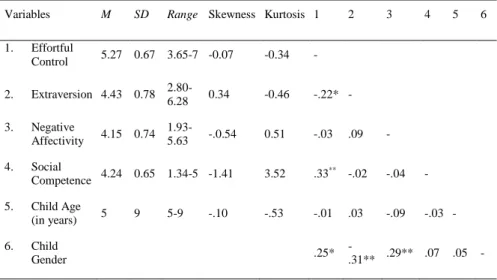
Table 2. Descriptive Statistics and Intercorrelations for All Variables
Variables M SD Range Skewness Kurtosis 1 2 3 4 5 6 1. Effortful Control 5.27 0.67 3.65-7 -0.07 -0.34 - 2. Extraversion 4.43 0.78 2.80-6.28 0.34 -0.46 -.22* - 3. Negative Affectivity 4.15 0.74 1.93-5.63 -.0.54 0.51 -.03 .09 - 4. Social Competence 4.24 0.65 1.34-5 -1.41 3.52 .33 ** -.02 -.04 - 5. Child Age (in years) 5 9 5-9 -.10 -.53 -.01 .03 -.09 -.03 - 6. Child Gender .25* -.31** .29** .07 .05 - Note. *p< .05, **p< .01
Mean, standard deviation, and inter-correlations for the study variables are presented at Table 2. Children’s negative affectivity was significantly associated with gender (r (93) = .29, p=.004), favoring girls. Temperamental extraversion was negatively associated with effortful control (r (93) = -.22, p=.02) and child gender (r (93) = -.31, p=.002), favoring boys. Children effortful control was positively associated with children’s social competence (r (93) = .33, p=.001) and child gender (r (93) = .25, p=.01), favoring girls.
Main Effects Models
The current study examined main effects of temperamental characteristics on social competence to warrant testing associations in between them as it was
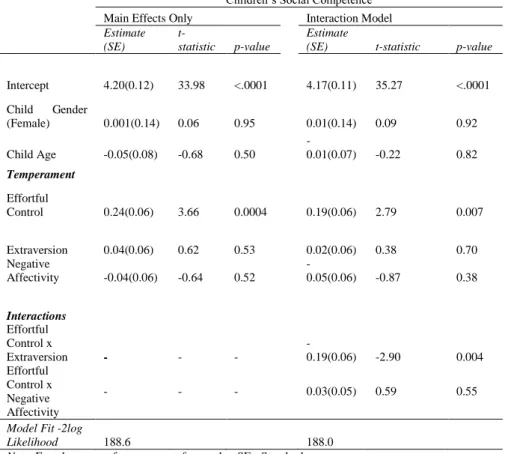
examined in Western samples. Therefore, to examine the first research question, the main effects of children’s temperamental effortful control, negative affectivity, and extraversion were regressed onto children’s social competence in main effect only model. In main effect only models, there was no interaction terms included. In main effects only model, effortful control was positively associated with children’s social competence, such that for every one-unit increase in effortful control, children’s social competence increased significantly by .245 (p = 0004). This finding is supported our Hypothesis 1B. None of the other main effects were significant. Therefore, there was no significant support for hypotheses 1A. See Table 3 for complete Main Effects Models.
Table 3. Final Model Parameters for Main and Moderation Effects for Effortful Control, Extraversion, and Negative Affectivity on Social Competence
Children’s Social Competence
Main Effects Only Interaction Model Estimate
(SE)
t-statistic p-value
Estimate
(SE) t-statistic p-value
Intercept 4.20(0.12) 33.98 <.0001 4.17(0.11) 35.27 <.0001 Child Gender (Female) 0.001(0.14) 0.06 0.95 0.01(0.14) 0.09 0.92 Child Age -0.05(0.08) -0.68 0.50 -0.01(0.07) -0.22 0.82 Temperament Effortful Control 0.24(0.06) 3.66 0.0004 0.19(0.06) 2.79 0.007 Extraversion 0.04(0.06) 0.62 0.53 0.02(0.06) 0.38 0.70 Negative Affectivity -0.04(0.06) -0.64 0.52 -0.05(0.06) -0.87 0.38 Interactions Effortful Control x Extraversion - - - -0.19(0.06) -2.90 0.004 Effortful Control x Negative Affectivity - - - 0.03(0.05) 0.59 0.55
Model Fit -2log
Likelihood 188.6 188.0
Note. Female was a reference group for gender. SE= Standard errors Interaction Models
To examine the second research question, the baseline model was specified as the main effects of child gender, child age, effortful control, negative affectivity, and extraversion. effortful control, negative affectivity, and extraversion were
0 1 2 3 4 5 -2,00 -1,50 -1,00 -0,50 0,00 0,50 1,00 1,50 2,00 So cial C o m p eten ce Low High Extraversion High Mean Low
included in the same interaction models (e.g., effortful control x negative affectivity and effortful control x extraversion) to test moderating effect of effortful control between temperamental extraversion and negative affectivity, and children’s social competence. Table 3 presents the final model parameters for the main effects models and the interaction models for social competence as an outcome.
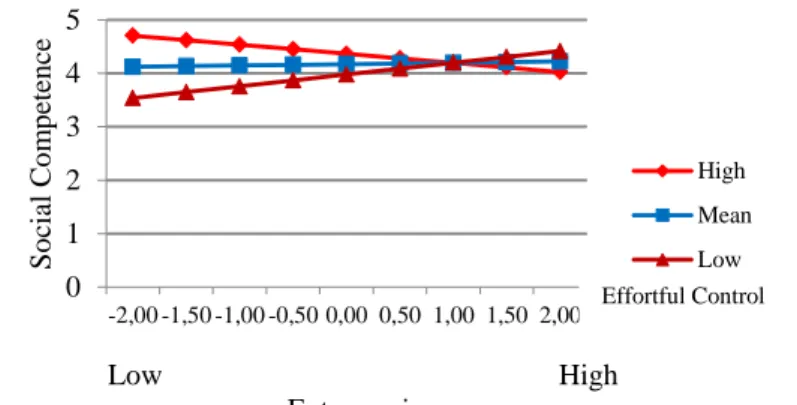
In interaction model, interaction terms were added to the main effects only model. Results from the interaction model showed that temperamental effortful control significantly moderated the association between extraversion and children’s social competence (β= -.19, t = -2.90, p =.004). Simple slope analysis showed that the slope for children’s extraversion on their social competence when effortful control was at mean and high levels was not significantly different from zero (t= -0.38, p=.70 and t= -1.74, p=.08, respectively). However, effortful control was low, the slope for children’s extraversion on their social competence was significantly different from zero (t= 2.44, p= .01). Thus, when effortful control is at mean or high levels, children’s temperamental extraversion is unrelated to their social competence. However, when effortful control is low, mean and low levels of extraversion is related to lower levels of social competence. See Figure 1 for interaction plot. This finding partially supported the Hypothesis 2. Surprisingly, effortful control did not moderate the association between negative affectivity and children’s social competence (t= 0.59, p= .55).
Figure 1. Temperamental Effortful Control and Extraversion Predicting Social Competence
DISCUSSION and CONCLUSION
The current study aimed at exploring the association between regulatory temperament (effortful control) and reactive temperament (extraversion and negative affectivity), and early elementary children’s social competence. Two main findings emerged from this study. First, temperamental effortful control was positively associated with children’s social competence. Second, effortful control significantly moderated the association between temperamental
extraversion and children’s social competence. These findings are discussed as followings.
First, parents’ ratings of temperamental effortful control (i.e., attentional focusing, inhibitory control, and perceptual sensitivity) contributed to teachers’ ratings of children’s social competence. Such that children with higher levels of effortful control were rated as higher levels of social competence. These results are congruent with the previous research conducted in both Western and Non-Western samples (Rudasill & Konold, 2008; Yagmurlu & Sanson, 2009), considering that effortful control refers to inhibiting inappropriate response and replace it with appropriate response to given environmental stimuli (Rothbart, 2011). Teachers may perceive children with higher levels of effortful control as cooperative and behaving in accordance with classroom rules, following their directions, and getting along with peers, which all are considered as part of the social competence in the classroom (Rudasill & Konold, 2008; Valiente et al., 2003). Children in elementary classroom are expected to attend classroom processes, listen to instructions, focus on classroom learning; therefore, temperamental effortful control appears to be an effective tool for children to succeed in classroom learning and behaviors (Blair, 2002).
Second, effortful control appeared to work together with extraversion as predictors for children’s social competence. Specifically, effortful control moderated the association between extraversion and social competence, such that at low levels of effortful control (1 SD below the mean) and lower extraversion was associated with less social competence. These finding is somewhat consistent with previous research (Eisenberg et al., 2000; NICHD ECCRN, 2008; Rudasill & Konold, 2008) showing that children’s inhibitory control and attentional focusing as part of the effortful control buffered against negative effects of shyness negative emotionality as part of the reactive temperament on their social outcomes. Such that, children with better effortful control (i.e., attentional focusing and inhibitory control) had higher levels of social outcomes (e.g., positive peer interactions and social competence) despite negative effects of reactive temperament (i.e., shyness, negative emotionality) (Acar et al., 2015; Rudasill & Konold, 2008).
Implications of the Current Study
The findings from the current study highlights the importance of recognizing children’s both reactive and regulatory temperamental characteristics as related to children’s social competence in early elementary school years. In school and classroom contexts, understanding and recognizing children’s temperamental characteristics can help teachers to support children’s social competence. Hence, the findings from the current study are informative for educational practice. The early elementary classroom contexts emphasize academic and social development of children (Hamre & Pianta, 2001). To scaffold children’s academic and social growth in early elementary school years, teachers can facilitate their learning and social context by accommodating chıldren’s needs
depending upon their temperamental characteristics. By doing so, children with reactive temperament can reduce detrimental effects of it so that they can easily involve classroom process or peer interactions (Acar et al., 2015); In addition, children regulatory temperament can also benefit from teachers’ facilitation by fostering their regulation so that they can sustain their focus on academic process or engage with the classroom material. The results can also inform parent to recognize their children’s temperamental characteristics and accommodate their needs by providing nurturing environment so that children can develop better social competence, which is crucially important for their future development and relationships.
REFERENCES
Acar, I. H. Rudasill, K. M., Molfese, V., Torquati, J. & Prokasky, A. (2015). Temperament and preschool children’s peer interactions, Early Education and Development, 26(4), 479-495, DOI: 10.1080/10409289.2015.1000718
Aiken, L. S., & West, S. G. (1991). Multiple Regression: Testing and interpreting interactions. Thousand Oaks: Sage.
Akin Sari, B., Iseri, E., Yalcin, O., Akin Aslan, A., & Sener, S. (2012). Çocuk davranış listesi kısa formunun Türkçe güvenilirlik çalışması ve geçerliliğine ilişkin ön çalışma. Klinik Psikiyatri, 15, 135–143.
Anthony, L.G., Anthony, B.J., Glanville, D.N., Naiman, D.Q., Waanders, C., & Shaffer, S. (2005). The relationships between parenting stress, parenting behaviour and preschoolers’ social competence and behaviour problems in the classroom. Infant and Child Development, 14, 133–154.
Asher, S., Oden, S., & Gottman, J., (1977). Children’s friendships in school settings. In L.G. Katz (Ed.), Current Topics in Early Childhood Education (Vol. 1), Hillsdale, NJ, McGraw Hill
Berdan, L. E., Keane, S. P., & Calkins, S. D. (2008). Temperament and externalizing behavior: Social prefence and perceived acceptance as protective factors. Developmental Psychology, 44(4), 957-968. doi:10.1037/002-649.44.4.957. Blair, C. (2002). School readiness: Integrating cognition and emotion in a
neurobiological conceptualization of children’s functioning at school entry. American Psychologist, 57(2), 111-117. doi: 10.1037//0003-066X.57.2.111 Boyce, W.T., & Ellis, B.J. (2005). Biological sensitivity to context: I. An
evolutionary-developmental theory of the origins and functions of stress reactivity. Development & Psychopathology, 17, 271–301
Brophy-Herb, H. E., Lee, R. E., Nievar, A., & Stollak, G. E. (2007). Preschoolers’ social competence: relations to family characteristics, teacher behaviors and classroom climate. Journal of Applied Developmental Psychology, 28, 134-148. Chen, X. & French, D (2008). Children’s social competence in cultural context. Annual
Review of Psychology 59, 591-616.
David, K. M. (2007). Interparental conflict and preschooler's peer relations: The moderating roles of temperament and gender. Social Development 16(1), 1-23 Denham S. A., Bassett H. H., & Wyatt T. (2007). The socialization of emotional
competence. In: J. Grusec & P. Hastings (Eds.). Handbook of socialization: Theory and research (pp.614-637). New York: Guilford Press.
Domitrovich, C. E., Cortes, R. C., & Greenberg, M. T. (2007). Improving young children’s social and emotional competence: A randomized trial of the Preschool PATHS Curriculum. Journal of Primary Prevention, 28, 67-91.
Eisenberg, N., Fabes, R. A., Guthrie, I. K., & Reiser, M. (2000). Dispositional emotionality and regulation: their role in predicting quality of social functioning. Journal of Personality & Social Psychology, 78(1), 136-157. doi:10.1037//0022-3514.78.1.136.
Eisenberg, N., Fabes, R. A., & Spinrad, T. L. (2006). Prosocial Development. In W. Damon, R. M. Lerner (Series Ed.), & N. Eisenberg (Vol. Ed.), Handbook of child psychology: Vol.3. Social, emotional, and personality development (pp. 6th ed., pp. 646-718). New York: Wiley.
Estell, D. V., Jones, M.H., Pearl, R., Van Acker, R., Farmer, T. W., & Rodkin, P.C. (2008). Peer groups, popularity, and social preference: Trajectories of social functioning among students with and without learning disabilities. Journal of Learning Disabilities, 41(1), 5-14.
Gleason, T. R., Gower, A. L., Hohmann, L. M., & Gleason, T. C. (2005). Temperament and friendship in preschool-aged children. International Journal of Behavioral Development, 29(4), 336-344. doi:10.1080/01650250544000116.
Gresham, F. M., & Reschly, D. J. (1987). Dimensions of social competence: Method factors in the assessment of adaptive behavior, social skills, and peer acceptance. Journal of School Psychology, 25(4), 367-381.
Greene, J. O., & Burleson, B. R. (Eds.). (2003). Handbook of communication and social interaction skills. Mahwah, NJ: Erlbaum.
Griggs M.S., Gagnon S.G., Huelsman T.J., Kidder-Ashley P., & Ballard M. (2009). Student-teacher relationship matter: Moderating influences between temperament and preschool social competence. Psychology in the schools, 46(6):553–567. doi: 10.1002/pits.20397.
Halberstadt, A.G., Denham, S.A., & Dunsmore, J.C. (2001). Affective social competence. Social Development, 10(1), 79-119.
Hartup, W. W. (1996). The company they keep: Friendships and their developmental
significance. Child Development, 67(1), 1-13.
doi:10.1111/14678624.ep9602271141.
Kagitcibasi, C. (2007). Family, self, and human development across cultures: Theory and applications. Mahwah, NJ: Lawrence Erlbaum.
Kostelnik, M. J., Whiren, A. P., Soderman, A. K., & Gregory, K. (2005). Guiding Children’s Social Development: Theory to Practice (5th
Edition). Clifton Park, NY: Thomson & Demler Learning.
Kline, R. B. (2005). Principles and Practice of Structural Equation Modeling (2nd ed.). New York: Guilford
Ladd, G. W. (2005). Children's Peer Relations and Social Competence: A Century of Progress. New Haven: CT: Yale University Press.
Ladd, G. W., & Burgess, K. B. (1999). Charting the relationship trajectories of aggressive, withdrawn, and aggressive/withdrawn children during early grade school. Child Development, 70, 910 –929.
Lengua, L.J., & Long, A.C. (2002). The role of emotionality and self-regulation in the appraisal–coping process: Tests of direct and moderating effects. Journal of Applied Developmental Psychology. 23, 471–493.
McFall, R. M. (1982). A review and reformulation of the concept of social skills. Behavioral Assessment, 41(1). 1-33.
National Institute of Child Health and Human Development Early Child Care Research Network (2008). Social competence with peers in third grade: Associations with earlier peer experiences in childcare. Social Development, 17(3), 419-453. doi:10.1111/j.1467-9507.2007. 00446.x
Putnam, S. P., & Rothbart, M. K. (2006). Development of short and very short forms of the Children’s Behavior Questionnaire. Journal of Personality Assessment, 87(1), 103–113. doi:10.1207/s15327752jpa8701_09.
Raudenbush, S. W., & Bryk, A. S. (2002). Hierarchical Linear Models: Applications and Data Analysis Methods (2nd Edition). Newbury Park, CA: Sage.
Rogoff, B. (1990). Apprenticeship in thinking: Cognitive development in social context. New York: Oxford University Press.
Rose-Krasnor, L. (1997), The Nature of Social Competence: A Theoretical Review. Social Development, 6ö 111–135. doi:10.1111/j.1467-9507.1997.tb00097.x Rose-Krasnor, L., & Denham, S. (2009). Social-emotional competence in early
childhood. In K. H. Rubin, W. M. Bukowski, & B. Laursen, Handbook of Peer Interactions, Relationships, and Groups (pp. 162-179). New York, NY: The Guildford Press.
Rothbart, M. K. (2011). Becoming who we are: temperament and personality in development. New York, NY: The Guilford Press.
Rothbart, M. K., Ahadi, S. A., & Hershey, K. L. (1994). Temperament and social behavior in childhood. Merrill-Palmer Quarterly, 40, 21-39.
Rothbart, M. K., & Bates, J. E. (2006). Temperament. In W. Damon, R. M. Lerner (Series Ed.), & N. Eisenberg (Vol. ed), Handbook of Child Psychology: Vol.3. (6th Ed.) Social, Emotional, and Personality Development (pp. 99-166). New York: John Wiley & Sons Inc.
Rothbart, M. K., Derryberry, D., & Hershey, K. (2000). Stability of temperament in childhood: Laboratory infant assessment to parent. In V. J. Molfese, & D. L. Molfese, Temperament and Personality Development Across the Life Span (pp. 85-119). NJ: Erlbaum.
Rudasill, K. M. & Konold, T. R. (2008). Contributions of children's temperament to teachers' judgments of social competence from kindergarten through second grade. Early education &Development, 19(4), 643-666.
Rudasill, K., Niehaus, K., Buhs, E., & White, J. M. (2013). Temperament in early childhood and peer interactions in third grade: The role of teacher–child relationships in early elementary grades. Journal of School Psychology, 51, 701–716. doi:10.1016/j.jsp.2013.08.002
Suurland, J., van der Heijden, K. B., Huijbregts, S. C. J., Smaling, H. J. A., de Sonneville, L. M. J., Van Goozen, S. H. M. and Swaab, H. (2016), Parental Perceptions of aggressive behavior in preschoolers: Inhibitory control moderates the association with negative emotionality. Child Development, 87, 256–269. doi: 10.1111/cdev.12455
Sterry, T. W., Reiter-Purtill, J., Gartstein, M. A., Gethardt, C. A., Vannatta, K., & Noll, R. B. (2010). Temperament and peer acceptance: The mediating role of social behavior. Merrill-Palmer Quarterly, 56(2), 189-219.
Szewczyk-Sokolowski, M., Bost, K. K., & Wainwright, A. B. (2005). Attachment, temperament, and preschool children’s peer acceptance. Social Development, 379-397.
Valiente, C., Eisenberg, N., Smith, C. L., Reiser, M., Fabes, R. A., Losoya, S., . . .Murphy, B. C. (2003). The relations of effortful control and reactive control to children’s externalizing problems: A longitudinal assessment. Journal of Personality, 71(6), 1171-1196.
West, B. T., Welch, K. B., Galecki, A. T., (2015). Linear Mixed Models: A Practical Guide Using Statistical Software (2nd Edition). USA: CRC Press
Winner, M. G. (2008). A politically incorrect look at evidence-based practices and teaching social skills: A literature review and discussion. San Jose, Ca: Think Social Publishing.
Yagmurlu, B., & Sanson, A. (2009). Parenting and temperament as predictors of prosocial behaviour in Australian and Turkish Australian children. Australian Journal of Psychology, 61(2), 77–88. doi:10.1080/00049530802001338 Yoleri, S. (2014). The role of Child’s Temperament Predictor on Preschool Social
Competence. Creative Education, 5, 1160-1169.
http://dx/doi/org/10.4236/ce.2014.513131
Yukay-Yuksel, M. (2009). A Turkish Version of the School Social Behavior Scales (SSBS). Kuram ve Uygulamada Eğitim Bilimleri / Educational Sciences: Theory & Practice, 9 (3), 1633-1650.
Zentner, M., & Bates, J. E. (2008). Child temperament: An integrative review of concepts, research programs, and measures. European Journal of Developmental Science, 2, 7–37.
Genişletilmiş Özet
Sosyal yeterlik çocuk gelişimi ve eğitimi araştırmalarnın ana kapsamı içersinde yer almaktadır. Bu nedenle, geniş bir araştırmacı kitlesi erken çocukluktaki sosyal yeterliği etkileyen çeşitli faktörler üzerindeki araştırmalara odaklanmıştır (Brophy-Herb, Lee, Nievar & Stollak, 2007). Sosyal yeterlik; belirli bir bağlam ve kültür içerisinde, önceden belirlenen kişisel hedeflere ulaşmak için duyguları bütünleştirme, düşünme ve davranışları ifade etme yeteneği olarak tanımlanır (Kostelnik, Whiren, Soderman & Gregory, 2005).Yapılan araştırmalarda, sosyal yeterlik ile ebeveynlik, mizaç, akran grubu etkileşimleri, öğretmen etkileşimleri ve bilişsel yetenekler arasında anlamlı ilişkiler bulunmuştur (Anthony ve ark., 2005; Griggs ve ark., 2009).
Erken çocukluk döneminde sosyalleşme, çocukların mevcut gelişim süreçlerinde ve gelecekteki gelişimi için önemli yapı taşlarından birisidir (Eisenberg, Fabes & Spinrad, 2006; Rogoff, 1990). Sosyalleşmenin uzun vadeli hedefi, bireyin aktif ve girişimci bir toplum üyesi olmasına yardımcı olmaktır (Kağıtçıbaşı, 2007). Sosyalleşme sürecinde, çocuklar yaşadıkları sosyal çevrenin değerlerini öğrenir ve sosyal kurallar ve normlar çerçevesinde nasıl davranmaları gerektiğini benimserler (Rogoff, 1990). Çocuklar belirli bir sosyal bağlam içinde nasıl bir sosyal tepkinin gerekli olduğunu anlamak için sosyal yeterliğe ihtiyaç duyarlar (Ladd 2005; Denham, Basett & Wyatt, 2007). Sosyal yeterlik,sosyal bir bağlam içerisinde verilen sosyal ipuçlarını anlamak ve bu ipuçlarına göre cevap verebilme olarak ifade edilmektedir (Ladd, 2005). Bu sosyal yeterlik çocukların sosyal ilişkileri ve okul başarısı için de önemli bir araçtır (Halberstadt, Denham, & Dunsmore, 2001; Rose-Krasnor & Denham, 2009).
Mizaç çocukluk çağında kişilik, duygusallık ve sosyal davranışlarını etkileyen bir merkezi karakter olarak kabul edilir (bkz. Berdan, Keane, & Calkins, 2008; Sterry, et al., 2010). Mizaç biyolojik temelleri olan ve çevresel faktörlerle etkileşime geçerek gelişen bireyin tepkisellik ve özdenetimindeki farklılıkları temsil eder (Rothbart ve Bates, 2006; Rothbart, 2011). Mizacın tepkisellik ve düzenleme olarak iki ana boyutu vardır; Tepkisellik bir sosyal bağlam ve durumda gösterilen uyarılma ve duyarlılık yoğunluğunu temsil eder (Rothbart, Derryberry, & Hershey, 2000). Mizacın düzenleme boyutu ise bireyin düzenlemiş olduğu engelleyici, dikkatle yoğunlaşma, kaçınma gibi mekanizmaya işaret eder (Rothbart, 2011). Dışa dönüklük mizacın tepkisellik alt boyutuna girerken özdenetim mizacın düzenleme boyutu altına girer (Rothbart, 2011). Dışa dönük ve özdenetimi az olan çocuklar yaşıtları ile sosyal etkileşimler sırasında yüksek seviyede aktiflik gösterip ve yeni nesneler, hediyeler ve ödüller ile karşılaştıklarında onlara karşı aşırı heyecan sergilerler (Rothbart, 2011; Szewczyk-Sokolowski ve diğ., 2005). Diğer bir tepkisel mizaç boyutu olan olumsuz duygulanımın da çocukların eşzamanlı ve gelecekti problem davranışlarının belirleyicisi olduğu gözlemlenmiştir (Boyce & Ellis, 2005; Lengua & Long, 2002; Rothbart, 2011). Öte yandan, özdenetime sahip çocukların akranları ile yüksek seviyede olumlu sosyal davranış, sosyal yeterlik
ve düşük seviyede problem davranışlar sergilediği tespit edilmiştir (Eisenberg ve arkç., 2000; Rothbart & Bates, 2006).
Mizaç ve sosyal yetkinlik arasındaki ilişki uluslararası alanyazında çok derinlemesine araştırılmasına rağmen, ülkemizde Türk kültüründe bu alanda yapılan çalışmalar nadirdir (örn. Yoleri, 2014) , bu sebeple bu çalışmanın amacı çocukların mizaç (özdenetim, dışadönüklük, ve olumsuz duygulanım) ve sosyal yeterlikleri arasındaki ilişkiyi incelemektir. Özellikle de çocukların özdenetiminin olumsuz duygulanım ve sosyal yeterlik ve de dışa dönüklük ve sosyal yeterlik arasındaki bağlantıyı nasıl yönlendirdiğini belirlemektir..
Bu çalışmada 5 ila 9 (ortalama yaş= 7,05) yaşları arasında toplam 94 çocuk (38 kız) yer almıştır. Örneklem İstanbul’un dış kısımlarında yaşayan düşük gelirli ailelerden oluşmaktadır.
Çocukların mizacı ebeveynleri tarafından doldurulan Çocuk Davranış Ölçeği -Kısa formu (CBQ; Putnam & Rothbart, 2006; Rothbart, Ahadi, ve Hershey, 1994) ile ölçülmüştür. Çocuk Davranış Ölçeği -Kısa formunun Türkçe versiyonunun geçerlik ve güvenirliği Akın-Sari, İşeri, Yalçın Akın-Aslan ve Şener (2012) tarafından yapılmıştır. Orijinal versiyonuna paralel olarak, bu çalışmada da iç tutarlık kat sayısı Dışadönüklük (Cronbach α = 0,77), Olumsuz Duygulanım (Cronbach α = 0,76), ve Özdenetim (Cronbach α = 0,72) olarak bulunmuştur. Çocukların sosyal yeterliği Yukay-Yüksel (2009) tarafından Türkçe’ye uyarlanan , Okul Sosyal Davranış Ölçeği (SSBS; Merrell, 1993) ile ölçülmüştür.. Mevcut çalışmada sosyal yeterliliğin iç tutarlılığı (Cronbach α = .97)’dir.
Çocukların sınıf içerisinde bulunmasını göz önünde bulundurarak hiyerarşik lineer regresyon modelleri SAS PROC MIXED kullanılarak yapılmıştır (Raudenbush & Bryk, 2002). Koşulsuz başlangıç modelinde sosyal yeterlik için sınıf içi korelasyon 0,09 olarak bulunmuştur. Mevcut düzensiz sınıf dağılımını kontrol için serbestlik derecesi olarak Satterthwaite tekniği kullanıldı (West, Welch, & Galecki, 2015). Anlamlı sonuç veren etkileşim sonuçları için moderatör için üç seviyede yüksek (ortalamanın 1SS ), ortalama düzeyi ve düşük (ortalamanın 1 SS altında) basit eğilim analizleri gerçekleştirildi (Aiken & West, 1991).
Çocukların olumsuz duygulanımının cinsiyet ile kızlar lehine anlamlı ilişkisi bulunmuştur (r (93) = 0,29, p = 0,004). Dışadönüklük ve özdenetim arasında olumsuz ilişki tespit edildi (r (93) = -.22, p = .02). Ayrıca, dışadönüklük ve cinsiyet arasında erkekler lehine (r (93) = -.31, p = .002) ilişkisi tespit edilmiştir. Çocukların özdenetimi ve sosyal yeterlik arasında olumlu (r (93) = 0,33, p = 0,001) ve kızlar lehine cinsiyet ile (r (93) = 0,25, p = 0,01) ilişkisi bulunmuştur. Ana etkiler modelinde, özdenetimin pozitif bir şekilde çocukların sosyal yeterliğini etkilediği gözlemlenirken; yani özdenetimdeki bir birim artış, çocukların sosyal yeterliliğinde 0,245 (p = 0.004) anlamlı bir artışa denk gelmektedir.
Etkileşim modelinden elde edilen sonuçlar mizaçsal özdemetimin anlamlı bir şekilde dışadönüklük ve çocukların sosyal yeterlik arasındaki ilişkiyi modere ettiği bulundu (β = -.19, t = -2,90, p = .004). Bu ilişkinin anlamlılığı için test edilen basit eğilim analizleri (simple slopes anaylsis) özdenetimin düşük olduğu durumlarda çocukların sosyal yeterlik üzerindeki dışadönüklük için test edilen eğilimin anlamlı bir şekilde sıfırdan farklı olduğu gözlemlendi (t = 2.44, p = 0,01). Yani, çocukların mizaçsal özdenetimi düşük olduğu zaman, ortalama ve düşük seviyedeki dışadönüklük düşük seviyedeki sosyal yeterlik ile anlamlı olarak ilişkilidir.
Bu çalışmada iki temel sonuca ulaşılmıştır; birincisi, mizaçsal özdenetimin pozitif bir şekilde çocukların sosyal yeterliğini etkilediği tespit edilmiştir. Bu sonuç önceki çalışmalar ile uyum sağlamaktadır ki çocuklar kendi olumsuz davranışlarını özdenetim olarak bastırdıklarında daha iyi sosyal beceri ve akran ilişkileri göstermektedir (Rudasill & Konold, 2008; Yagmurlu & Sanson, 2009). İkincisi, çocukların mizaçsal özdenetimi düşük olduğu zaman, ortalama ve düşük seviyedeki dışadönüklük ile düşük seviyedeki sosyal yeterlik anlamlı olarak ilişkili olduğu tespit edilmiştir. Eisenberg ve arkadaşları, veRudasill ve Konold (2008)’de aynı şekilde özdenetimin çocukların negatif etki gösteren diğer mizaçsal boyutlarının etkisini değiştirdiği ve çocukların daha iyi sosyal beceriler gösterdiğini sonucuna ulaşmıştır.
Sonuç olarak, çocukların ilköğretim yıllarında sahip oldukları mizaçsal özellikleri onların sosyal yeterliğini etkilemektedir. Öğretmenlerin çocukların mizaçsal özelliklerini tanıyarak onlara özgü ortamlar oluşturması çocukların daha iyi sosyal beceriler göstermesine katkı sağlayacaktır.