Journal of Physics: Conference Series
OPEN ACCESS
Stochastic Enhancement of High-order Harmonic
Generation
To cite this article: I Yavuz et al 2012 J. Phys.: Conf. Ser. 388 032023
View the article online for updates and enhancements.
Related content
Enhancement of high-order harmonic generation in the presence of noise
I Yavuz, Z Altun and T Topcu
-Dielectronic Recombination in He-like, Li-like and Be-Li-like Iodine and KLM Resonances
Erdi A Bleda, Aye Yumak, Ilhan Yavuz et al.
-Efficient extension and enhancement of high-order harmonics
Xue-shen Liu and Na-na Li
Stochastic Enhancement of High-order Harmonic Generation
I. Yavuz∗1, E. Bleda†, and Z. Altun∗
∗Department of Physics, University of Marmara, 34722, Ziverbey, Istanbul, TURKEY †Depertment of Mathematic and Computer Science, AREL University, Tepekent, Istanbul, TURKEY
Synopsis Here we demonstrate that from the combination of fundamental laser and noise it is possible to enhance harmonic intensities by 5 orders of magnitude with a modest noise-to-laser amplitude ratio.
Due to its rather low conversion efficiency, op-timal enhancement of high harmonic generation has attracted much attention over the last two decades. Different methods, based on multicolor driving fields or mixed gas targets, etc., have been introduced to improve the efficiency of high-harmonic generation for shorter-wavelengths.
We demonstrate the constructive role of noise addition for the generation high order harmon-ics from He+ ion. Ti:sapphire laser with a
peak intensity of 1015
W/cm2
, a full-width half-maximum pulse duration of 10 cycles, a cen-tral laser wavelength of 800nm with a commonly used sine squared pulse shape is used as the fun-damental driving field. The simulation of one-dimensional time dependent Schrodinger equa-tion has been performed for He+ion interacting
with the fundamental driving laser field with and without the addition of noise.
The form of the effective potential (Coulomb potential + laser potential) in the Hamilto-nian is set to be V (x, t) = −2/(|x|α+ β)1/α + xE0sin2(πt/τ ) sin(ω0t) [1]. One of the purposes
of this study has been the investigation of the stochastic effects as function of model potential. The simulations have been repeated for three dif-ferent values of α. The β values are chosen so that the initial state state of the system corre-sponds to the ground state of the He+ ion in
each case.
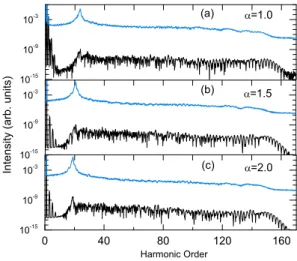
As it can be seen from Fig 1, regadless of the type of effective potential used in the sim-ulations, the overall profile of the power spec-tra with and without the stochastic effects in all cases look very similar. Small local differ-ences in the power spectra obtained from laser field alone are completely wiped out by the ad-dition of noise. In all cases the HHG yield is found to be 5 orders of magnitude larger than that of laser field alone. The 23rd harmonic for α = 1.0 shifted its harmonic order to lower val-ues as a function of model Coulomb potential
for simulations with the laser field alone. Same feature persisted in the simultaneous presence of the laser and the noise. We think the shifted harmonic corresponds to the ionization with the 1s→2p pre-excitation.
A net enhancement by a factor 50 in the power spectrum by an optimal combination of laser field and noise is achieved from our simu-lations with the model potential of α = 2. Such a net enhancement in the HHG yield may be at-tributed to the stochastic resonance induced by the noise. 10 -15 10 -9 10 -3 10 -15 10 -9 10 -3 0 40 80 120 160 10 -15 10 -9 10 -3 (c) (b) (a) =1.0 =1.5 In te n sity ( a r b . u n its) =2.0 Harmonic Order
Figure 1. High-order harmonic spectrum for He+ ion interacting with laser field (black lines) and combined laser and stochastic field (blue lines) for three different model potentials. (a) solid core (α= 1.0) (b) super-solid core (α= 1.5) and (c) soft core (α= 2.0). The noise-to-laser amplitude ratio is 0.097. The back-ground featureless curves are the averages over 50 different realizations for fixed noise-to-laser ratio.
References
[1] A. A. Silev, M. Yu. Ryabikin, and N. V. Vvdenskii Phys. Rev. A82, 033416 (2010)
1E-mail: [email protected]
XXVII International Conference on Photonic, Electronic and Atomic Collisions (ICPEAC 2011) IOP Publishing Journal of Physics: Conference Series 388 (2012) 032023 doi:10.1088/1742-6596/388/3/032023