' Ä i i t r | £
M I
p J J ,f-·*r
r ^ M T £ - 4 ^ ' T c ;Ä T H h S IS
m JB m iT T E D TO TM.£ D £FA «T M iE ^ T O F U m J ^ E M E H T
A N D
G R A D U A T E S C H O O L OF BU S IN E S S ADIf||^l!STRAT!ON
OF BILKEN T U N I V E R S I T Y
FOR THE DEGI«.EE O r
M A S T E R OF B U S IN E S S A D M I N I S T R A T I O N
A L I V E N E J L A DEM IRAQ
F E B R U A R Y 1-992
HF
5681
- L 3M 6
1331
c.
EVALUATION. OF FINANCIAL LEASING CONTRACTS
A THESIS
SUBMITTED TO THE DEPARTMENT OF MANAGEMENT AND
GRADUATE SCHOOL 0 F BUSINESS ADMINISTRATIOM OF BILKENT UNIVERSITY
FOR THE DEGREE OF
MASTER OF BUSINESS ADMINISTRATION
By
Aliye Nejla DEMIRAG FEBRUARY 1992
3
ο á И Р -b(oS;|■L·^
•г . 1 Ш •Ä-1 certify that I have' road this thesis and in my opinion it is fully adequate, in scope and quality, as a thesis for the degree of Master of Business Administration.
Assoc. P r o f . Guynur Muradocjlu Sengül
I certify that I have read this thesis and in my opinion it is fully adequatey, in scope and quality, as a thesis for the degree of Master of Business Administration.
Assoc.Prof . ''GöKWan Capoglu
I certify that I have read this thesis and in my opinion it is fully adequate, in scope and quality, as a thesis for the degree of Master of Business Administration.
U (
'
Assoc.irof. (5^n Simga
Approved for the Graduate School of Business Administration.
9
ABSTRACT
EVALUATION OF FI NANCIAL LEASING CONTRACTS
BY
DEMÎRAĞ, ALİYE NEJLA
SUPERVISOR; Assoc. Prof. Guinur M. ŞENGÜL February 1992
In this thesis, the financial leasing contract of company X that decided to acquire a machine, was evaluated. The main concern is whether to obtain the use of the machine by leasing or borrov;ing to buy. By comparing these two
alternatives, the economic attractiveness or profitability of the two alternatives is analysed. These evaluations
done by using three different borrowing rates and for two tax paying positions. The value of lease obtained for each case and three different discount rate are compared, the econonically
benefitable
alternative is analysed under Turkish legalframework.
Keywords; Financial leasing contract, evaluation, value of lease, benefitable alternative.
Ö Z E T
F İNANSAL KÎRALAFıA SÖZLESMESIN İN DEĞERLENDİRİLMESİ
DEHÎRAĞ, ALİYE NEJLA YÜKSEK LİSANS TEZİ
İSLETME ENSTİTÜSÜ
TEZ YÖNETİCİSİ: Ass.Prof. Gülnur M.SENGÜL Şubat 1992
Bu tez, bir firmanın Finansal Kiralama yoluyla sahip olnaya karar verdiği bir makinaya ait finansal kiralama söz leşmesinin değerlendirilmesini incelemektedir. Firıva açısın dan makinanın kiralama yoluyla mı yoksa borçlanarak satmalına yoluyla mı sağlanması seçeneklerinin irdelenmesi, bu tezin özünü oluşturmaktadır. Tezde, her iki alternatif karşılaştı rılarak, hangi alternatifin makinanın sağlanması için firma açısından kârlı olacağına karar vermesi ayrıntılı olarak o r taya konulmaktadır. Yapılan değerlendirmede; firmanın kirala ma süresi boyunca vergi ödeyeceği ya da vergi ödemeyeceği varsayımlarından hareket edilmiş ve ayrıca firmanın borç a l m a sıyla ilgili olarak üç değişik faiz oranı kullanılmıştır.
Anahtar kelimeler; finansial kiralama kontratı, değerlen-dirilm.esi, kiralamanın değeri, avantajlı s e ç e n e k .
ACKN0WLED6EHEMTS
I wish to express mir sincere gratitute to Ass. Prof Giilnur M. SEtlGtiL for her close supervision, guidance and
encouragement throughout this Study. I would like to also express my indebtness to her, because of the assistance and overall support that, she provided to me.
I would also like to express my thanks to the other members of the examining committee for their contribution.
I would like to thank Dr. Senan UYANIK for her suggestions and help.
I also thank to my family for their support during the preparation of this thesis.
C O N T E N T S
INTRODUCTION ... 1 CHAPTER 1 ... 1.1. D e f i n i t i o m l ... 4 1.2. Historical B a c k g r o u n d ... 5 1.2.1. History in Turkey ... 8 1.2.1.1. Cross-Border Leasing in T u r k e y ... H 1.2.1.2. Domestic Leasing... 13 1.3. Advantages of L e a s i n g ... 13 1.3.1. Advantages of Leasing-To a L e s s e e ... 131.3.2. Advantages of Leasing-To a Lessor ... 16
1.4. Types of Lease... 18
^lj4.1. Financial L e a s e ... 18
'll. 4.2. Operating L e a s e ... 20
1.4.3. Sale and L e a s e b a c k ... 22
1.4.4. The Full Payout Le a s e ... 22
1.4.5. The Leverage Lease ... 24
1.4.6. The Capital Lease ... 28
1.4.7. True L e a s e ... 29
1.4.7.1. True Lease for T u r k e y ... 29
1.4.8. Direct or Single Investor L e a s e ... 33
1.4.9. Domestic and International L e a s i n g ... 34
1.4.9.1. Domestic L e a s i n g ... 34
1.4.9.2. Cross-Border L e a s i n g ... 34
CHAPTER 2 2.1. Quantitative Models for Lease Evalution... 36
2.1.1. Capital Budgeting Approach ... 36
2.1.2. Financing Approach ... 36
2.1.3. Investment and Financing Decision ... 37
2.1.3.1. Schall Model ... 37
2.1.3.2. Myers, Dill and Bautista Model .. 38
2.2. Qualitative Determinants of the Lease Evaluation.. 52
2.2.1. User Characteristics Affecting the Leasing Decision ... 52
2.2.2. Lessor Characteristics Affecting the Leasing Decisions ... 56
2.2.3. The Inflation Effect in the Valuation of Leasing Contract ... 58
CHAPTER 3 3.1. Financial Leasing Law in T u r k e y ... 60
3.2. Regulation Regarding the Determination of Periods and Limits for Financial Leasing A c t i v i t i e s ... 66
3.3. Regulations Regarding the Procedures and Principles for Custom Taxes, Duties, Charges, and Value Added Taxes on Assets ... 68
CHAPTER 4 4.1. Valuation Application in T u r k e y ... 73
4.1.1. Case Study: Financial Leasing Contract Reauirements ... 74
Page
4.2. Net Benefit Computation of Leasing (NBL)... V7 C O N C L U S I O N ... 90 R E F E R E N C E S ... ... 9^
a p p e n d i x 1; Financial Leasing Companies in
T u r k e y ... APPENDIX 2; Block Diagram of Transaction of
Leasing Companies Operated in Turkey · · · · 95 APPENDIX 3: Block Diagram of Cross-Border Leasing
Transacticns Operated Abroad... ^
1 Leasing activities of financial leasing companies during 198 7-199 0 period... 9 2 Cross-Border Leasing Activities of Financial
Leasing Companies in 1986-1990 ... 9 3 Transactions of Leasing Companies Operated in
T u r k e y ... 10 4 Cross-Border Leasing Transactions of the
Companies Operated A b r o a d ... 12 5 Evaluation of Lease vs. Borrow to buy
Decision (The firm is in tax-paying position
every p e r i o d ) ... 82 6 Worksheet for Direct Cash Flow from Leasing,
Company X (end of six m o n t h s ) ... 83 6a. Worksheet for determining the value of lease (90 %)84. 6b. Worksheet for determining the value of lease
(151.185 % ) ... 85 6c. Worksheet for determining the value of lease (160%)86 7 Evaluation of Lease vs. Borrow to Buy Decision
(The firm is in a non-tax paying position every
period) ... 87 7a. Worksheet for determining the value of lease (90%) 88 7b. Worksheet for determining the value of lease
(124.2%)... 88 7c. Worksheet for determining the value of lease
(160 % ) ... 89
LIST OF TABLES
Table
Page
Table
Page
8 The Value of Lease for Three different Discount
R a t e ... 89
8a. The value of lease in tax paying position 89 8b. The value of lease in non-tax paying position,.. , 89
Figure Page
1 Financial Leasing Arrangement ... 19
2 Operational Leasing Arrangement... 21
3 Sale and Lease-back Arrangement... 23
4 Leveraged Lease Arrangement... 25
5 Two-party Leasing Relationship... 26
6 Three-party Leasing Relationship. ... 26
7 The Relationship Between Parties to a Leveraged Lease... 27
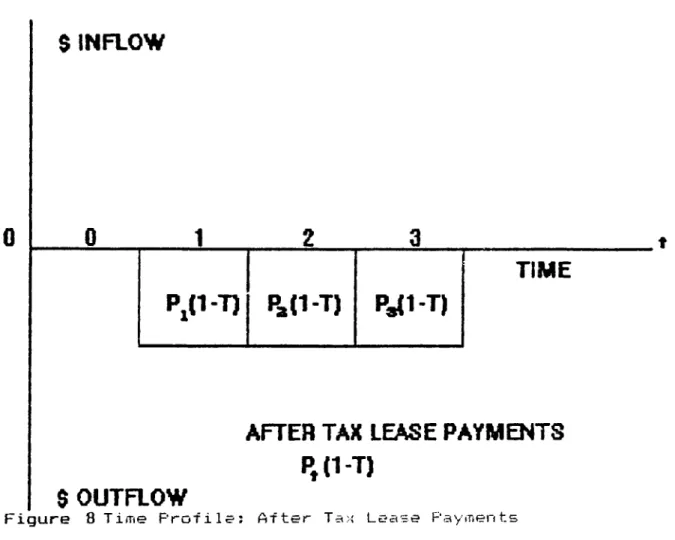
8 Time Profile: After Tax Lease Payments... 47
9 Time Profile: Cash Flows for P u r c h a s e... 48
10 Time Profile: Borrowing and Reyapment... 49
11 Time Profile: Purchase and Borrowing... 50
LIST OF FIGURES
INTRODUCTION
DEFINITION
Leasing can be defined as a contractual relationship in which the owner of the asset or property, the LESSOR grants to a firm or person; the LESSEE the use of the property's services for a specified period of time (16)
Leasing has become a very popular alternative to the outright purchase capital equipment, because it simultaneously, provides for the use of assets and their financing.
Firms lease as an alternative to buying a capital
equipment. Computers are often leased, so are trucks, railroadcars etc. The largest group of lessors is equipment manufacturer, and banks get the second importance.
One of the most important type of lease is a financial lease covers a major portion of the asset's useful life. It is long-term and can best be compared to a secured term loan. It is also the most appropriate type of lease for commercial banks.
A financial lease is actually the functional equivalent of a loan in that the lease payments are spread over the useful life of the asset. At the end of the lease, the lessee has the option to purchase the asset at its fair market value.
Responsibility for taxes, incurance, and maintenance rests with the lessee.
Firms face the problem of evaluating financial leases. The purchase and lease alternatives for acquiring an asset can be evaluated by using several methods. One of them is comparing their (net) cash flows. The alternative with the higher NPV of cash flow is preferred and is adapted if its NPV is positive or zero. The decision to lease is a type of capital budgeting problem requiring the application of present value techniques. It also has tax implications, and the relevant after-tax cash flows of the lease and purchase alternatives must be set out with great care. The correct solution requires a comparison of the present value of the loan payments implicit in a lease with the alternative of borrowing funds to purchase the equipment.
Leasing does offer special advantages to some firms under certain circumstances. So, by evaluating financial leasing contracts
the firm's lease vs. borrow problem is solved by an appropriate valuation model, then we find the economic attractiveness or profitability of an asset.
By comparing the investments proposals; - Leasing an asset,
- Borrowing to buy.
PROBLEM DEFINITION AND PURPOSE
leases are evaluated by both the lessee and the l e s s o r . Lessee must determine whether leasing an asset will be less costly than buying it. On the other hand the lessor should also decide whether or not the lease provide a reasonable return.
In this study, a Turkish Company (Company 'X') that decides to acquire a machine, either by lease or by purchase is analysed. The actual leasing contract and the actual
borrowing option to purchase are compared in the Turkish legal environment. A lease is comparable to a loan in the sense that the firm is required to make a specified series of payments. Thus, the most appropriate comparison is the cost of lease financing versus the cost of debt financing. By using the Myers, Dills and Bautista Model that will enable financial Managers to choose effectively between those
Leasing is a contract between the owner of an asset called the lessor and the lessee who is given the right to
use the asset against the proraise to make a series of payments, the first payment generally made as soon as the lease is
initiated.
The lessor in the world is:
1- Frequently a bank or finance house, and usually the leasing business is conducted through a subsidiary.
2- The independent leasing companies run privately
without banking affiliations and some are financed on the stock e x c h a n g e .
3- The subsidiaries of business corporations who invest in assets for leasing to non-connected parties.
The lessees range from industrial corporations, transport companies and service businesses to all kinds of governmental b o d i e s .
1.1. DEFINITION
They pay lease rentals at regular intervals in advance- monthly, quarterly, half-yearly, and annually. At the end of the period of the lease contract-the primary term-it is possible to buy the asset outright, sometimes the lessee has the legal right to do so. The value of the equipment (asset) at the end of the primary term is known as the residual. It is vitally
this residual, because if he is able to realise some or all of its value this has a profound effect on the cost of the transaction to construct and sign a lease contract is usually
( »-i O \
known as writing a lease \
Leasing simultaneously provides for the use of assets and their financing. One advantage over debt is that the lessor has a better position than a creditor if the user firm
experiences financial difficulties. If the lessee does not meet the lease obligations, the lessor has a stronger legal right to take back the asset, because the lessor still legally owns it. The relative tax positions of the lessors and user of
(20)
assets may also affect the lease versus own decision'
1.2. HISTORICAL BACKGROUND
In the early twentieth century, leasing of certain
specialized types of equipment, for example boot and shoe-making machinery and private telephone equipment continued intermittently in both United Kingdom and United States. During World War II, leasing became a widespread means of financing equipment over the life of cost-plus government contracts. By the end of the 1950s, leasing was sufficiently well developed in the United States for the leasing companies to turn their attention to foreign markets. United States Leasing International set up a Canadian subsidiary. Leasing companies were established in most European Countries, as France, Italy, Germany and so on in the
early 1960s. Also in 1960s, orient leasing company, the first Japanese leasing company, was formed and several Australian finance companies began marketing leasing activities (7)
Leasing became increasingly popular for a number of reasons. The key attractions for equipment users were that it generally provided 100% finance and enabled firms to increase their overall debt-raising capability by offering cash flow benefits and flexibility. Leasing was aggressively marketed as an alternative to medium-term bank loans, and contractual formalities were completed with great speed by leasing companies Customers often found that it was faster and simpler to deal with a leasing company than a bank. In A u s tralia,The United Kingdom and The United States, favorable tax regimes also further encourages the growth of leasing.
From the early 1960s, accelerated depreciation allowances and Invesment Tax Credit, ITC in the US made tax-based leasing possible. By 1963, the Comptroller of the Curreny had decided that banks and industrial corporations could enter the leasing industry and large numbers of new lessors were established by both banks and commercial and industrial corporations. Capital goods manufacturers were quick to incorporate their own leasing companies because of important relationship between competitive medium-term financing and the sale of capital goods. Leasing companies owned by corporations not affiliated to banks became known as captives. But the banks also moved aggresively into
leasing. By the late 1960s both their leasing affiliates and those of the captive leasing companies were powerful competitors to the independents. The spread of leasing has not been confined to the major developed countries of the World. A leasing industry.· has existed in Zimbabwe since 1960. During the 1 9 7 0 's leasing expanded dramatically. The most important participant in the leasing industries of over 20 developing countries has been International Finance Corporation, IFC, the private sector arm of the World Bank. IFC chose Korea for its first venture, in the mid 1970s. Leasing started in India in 1973, although
serious competitors did not enter the market until 1980. By the end of the decade, leasing was widely recognized as a primary
source of equipment finance with a number of individual leasing industries reaching maturity. By the end of 1984, there were several hundred leasing companies, primarily focused on small unit value equipment, like sewing machines.
Many leasing product innovations were introduced in 1980s, and there was wide geographic diversification. Sales-aid leasing schemes have been broadened to encompass a wide variety of
different types of equipment, and many lessors have added such new items as natural gas pipelines and filmis, the latest and fastest growing sector in several leasing-to their portfolios. By 1989 IFC's interest in leasing had helped to create or develop leasing in Bangladesh, Botswana, Brazil, Colombia, Dominican Republic, Ecuador, India, Indonesia, Jordan, Korea, Malawi, Pakistan, Peru, Philippines, Portugal, Sri Lanka,
Swaziland, Thailand, Tunisia and Turkey.
1.2.1. History in TURKEY
Leasing finance was introduced in Turkey in 1985 with the Law on financial leasing. Leasing is envisaged as one of the means to finance the growth of fixed capital formation over the coming years.
The Turkish Banking System is not willing to supply medium-to long-term loans for invesment projects. Available data indicate that the total stock of outstanding bank loans has almost remained constant in real terms since 1980. The
share of medium-to long-term loans in the total credit stock, on the other hand, exhibits a declining trend. Similarly,
while Turkey's short-term foreign indeptedness has been growing since 1986, medium-term private foreign loans are decreasing both in absolute and relative terms. The need for new sources of finance is obvious and leasing is one of the candidates to fill the gap
In 1990, 19 companies were making leasing activity; these are as follows:
1- Financial leasing companies 12 l.a. Bank partnership 9
l.b. Other 3
2- Development and Investment Banks 4 3- Private Finance Associations 3
In 1991, total number of company reached to 24. (see Appendix 1).
Table 1: Leasing activities of financial leasing comoanies during 1987-1990 periods are as follows: (For
domestic leasina)
Years Number or Transactions - m. · Total LeasinCT , ^ > Amount (billion TL) 1987 177 7 1988 279 96 1989 2384 564 1990 (end of Nov. ) 2775 814 Total 5340 1432
(Source: Unaersecretariat of reasury and Foreign T r a d e ) .
Table 2: Cross-Border Leasing Activities of Financial Leasing Companies in 1986-1990 are as follows:
Years Number of F.Leasing Contracts Total Lease Loan (Bil.$) Total Lease Loan (Bil.TL)· 1986 3 3300 9 1987 14 36700 110 1988 17 425062 1275 1989 13 125054 375 1990 19 264900 794 Total 65 855151 25 63 (*) 18= 3000 TL
TRANSACTIONS OF LEASING COMPANIES OPERATED IN TURKEY TABLL J
Million n.
SECTORS 19Ü6 1907 1908 1909 1991J 1991X TOTAL
Leasing-amount 7.7 100 96 100 564 100 1004 TOO IT 00 100 2054
Computer, offico and
telecommunical ion afipara 1 us - 3.0 40 5.6 6 30 7 150 14 226 21 424.5
Land transportal ior) vcihiclcs
-
2.1 27 64 67 366 65 6 52 50 5 50 40 1595Aircrafts - - - 2.4 3 - - 0.04 (1 97.7 9 101.0
Marine trasf)ortation vessels
-
- - 0.8 1 96 17 46.0 5 0.46 1 153.0Textile and printing machines
-
1.1 15 3.4 4 4.0 1 44.4 4 32.4 3 86.28Medical appliances
-
0.5 7 2.1 2 5.6 1 42.2 4 32.5 3 83.13Other manulacturing machines
-
0.8 11 17 17 52 9 167 15 172 15 410.2Number of companies 2 4 8 12 20 22
Number of transactions
-
177 279 2384 2000 1292REFERENCE: Under secretar iat
Of
Treasury and Foreign Trade ./ H. ALi AKCAIslamic Banks and several invesment banks are also empowered to write leases by virtue of special laws relating to their particular areas of activity. One of the Islamic
banks is very active, especially in car leasing. Islamic banks as Albaraka Türk özel Finans Kurumu A.Ş., Kuveyt Türk Evkaf özel Finans Kurıamu and invesment banks do not experience the difficulties encountered by leasing companies as there are no limits imposed on their rental receivables. Another source of unfair competition between leasing companies on the one hand, and Islamic Banks and invesment banks on the other is that the latter can channel their funds into financial leases without paying any taxes bank afficiated and privately owned leasing companies are subject to 11% tax on the interest they pay for loans they obtain to finance their activities. A leasing
association is in the process of formation.
The Turkish leasing industry is closely controlled and regulated by the Undersecretariat of Treasury.
1.2.1.1. Cross-Border Leasing in TURKEY:
It is expected that cross-border leasing into Turkey will be instrumental in creating new and as yet untapped sources of external finance for the growing needs of the Turkish economy. All cross-border leasing agreements are submitted to the treasury for approval. In 1989 the Treasury started to publicsh statistics on leasing volume equipment
breakdown. While there has been a charge between 1988 and 1989 in the composition of machinery and equipment leased into Turkey by Foreign lessors, the most significant development is the sharp fall (about 71%)
CROSS-BORDER LEASING TRANSACTIONS OE
THE COMPANIES O PER AIID ABROAD
TABLE 2
Million Dollar
SECTORS J9H6 1907 1900 1909 1990 199]» 10 TAL
Leasinq-ainounl 100 37 100 429 100 129 100 241 100 226 100 994.2
Computer, office and
telecoimnunical ion npparalus Constructions e(]ui()inents Air transportation aircrafts Textile and printing macliines
Medical n¡|>li ancos
Other mafiulacturing macliines
100 20 76 3 0 1 3 9 13 30 71 319 1 4 7 17 79 0 1 2 43 74 1 3 2 1 . 6 34.4 99.2 0.0 2.4 1.6 216 3 22 90 1 9 220 9 0.4 90 63 114 829 4 13 33.4 Number of transactions 13 16 17 16 1 2
REFERENCE: Ç ÎIT ce rsecretariat o z Ts'easury a n d F o r e i g n Trade, H. ALl AKÇA
in rental receivables created in 1989 compared to 1988. It is believed that the main reason for this drastic fall is the Treasury's outright refusal contract not containing high-tech
machinery
and equipment. There is as yet no offical definitionof what this high-tech machinery might be.
1.2.1.2. Domestic Leasing;
Domestic Leasing is expected to channel domestic savings into productive invesment. Domestic Leasing Companies are
required to report the details of each transaction to the Treasury within 20 days after the leasing contract is signed. Domestic leasing con^anies also required to file their quarterly financial statements with the Treasury. In 1986, there were no leasing contracts within Turkey. Starting in 1987 the Turkish domestic leasing market gathered momentum both in terms of receivables and average size of contracts. A clear trend in favour of car leasing can be observed which is undoubtedly due to the low level of VAT (previously 1% but increased to 10% in late 1989) applied to car leasing contracts as opposed to the 15% on direct purchase.
1.3. ADVANTAGES OF LEASING;
1.3.1. Advantages of Leasing-to a lessee;
1- Leasing provides up to 100% of the cost of the equipment. In many cases no deposits or advance payments are required.
There are exceptions, such as for a lease of very low cost equipment, for a lessee which is a borderline credit risk, or when there is a tax benefit form the lessee making a
substantial initial rental. Clearly, any leasing facility which require rentals to be paid in advance is not 100 % financing. Nevertheless, leasing often does provide a higher percentage of financing than an equivalent installment credit facility.
2- Leasing does not tie up valuable working capital or credit lines. A leasing facility preserves liquidity for other more appropriate uses. There may, however, be other sources of finance which a lessee could also tap. It may increase the firm ability to acquire funds. It provides another source of finance to industrial and commercial companies, and helps to vary the borrows portfolio.
3- Leasing offers cash flow benefits; rentals fixed at the inception of a lease assist expense budgeting and cash flow forecasting.· The. lease term is normally related to the useful life of equipment. Cash flow advantages stem from the upfront capital payments required on a lease compared to other forms of finance, and if late profit and seasonal cash flow
considerations are important, the flexibility of lease payment requirements is useful for cash flow purposes.
4- Leasing provides certainity; a lease is non-cancelable, unlike an overdraft which is repayable on demand and may be
reduced during a credit squeeze. Budgeting certainity can be obtained through leasing, a factor enhanced when maintenance
costs are fixed in an operating lease contract (cars,ccntainers etc . ) .
5- Leasing is straightforward; leasing minimizes
administrative costs and simplifies tax and accounting procedures. Asset depreciation normally becomes the lessor's responsibility. Documentation is simplified. It is frequently quick and
convenient to use lease finance through standardized documentation or to hook new leases on to an original agreed lease document, than to go through other forms of debt and equity acquisition.
6- Leasing is tax efficient; lease rentals are generally fully tax deductable as operating expenses. The tax benefits arising on the acquisition of equipment may also be maximized through a leasing arrangement by reflecting in the rentals the
(26) value of an invesment incentives
7- On-or-off balance sheet considerations; It does not appear on a liability on the lessee's balance sheet.
8- Leasing arrangements are very flexible; Leasing companies have proved more adaptable than banks and financing
institutions with regard to contract structures. Rentals payments may be varied according to the revenue expectations of lessees.
9- Leasing can be a hedge against inflation, although in some cases this apparent advantage can be a chimera. In later years in a leasing deal, particularly if the rate is
fixed, you are paying in yesterday's currency units for yesterday's purchase.
10- Long leasing terms are available in most countries with maturing leasing industries.
11- Leasing avoids the necessity of selling equipment no longer wanted.
12- Spending restrictions or restricted loan covenants may be overcome by leasing in some cases.
13- Additional charges in acquiring equipment, such as delivery and installation charges, inspection c o s t s , consultants fees, certain interest charges such as those tied up in advance payments, and other incidental or ancillary costs, may be added to the capital cost of an asset and amortised over the lease p e r i o d .
14- Operating leases-short-term leases where the asset is not amortised by one customer in one lease contract guard against equipment obsolescence, charges in market conditions,
(28) and any situation where the future is uncertain
15- Leasing offers the convenience of making one periodic lease payment rather than separate payments for debt service, maintenance costs, insurance, property taxes etc.
1.3.2. The advantages of leasing-to a lessor;
1- Leasing is an additional financial product; leasing is an additional type of finance for a financial institution.
The new business opportunities are opened up by increasing the range of services.
2- Leasing reduces risk; In many parts of the World, it is easier and cheaper for a lessor as owner to repossess leased equipment following a lessee default than it would be for a m o r tgagee.
3- Leasing may increase profitability; the tax benefits arising from the acquisition of equipment in many countries are normally passed on to the lessees in full by way of reduced
rentals. However, a lessor is in a position to earn an additional reward by providing this service.
4- Leasing provides introductions to equipment suppliers; Whenever third party lessor provides a leasing facility, a
supplier is involved.
5- Leasing is a simple document. The formalities involved in transacting a lease are straightforward for both a lessee and a lessor. Leasing facilities normally avoid the complexities of a comparable borrowing or capital-raising arrangements. Thus leasing is normally simpler to document.
6- A leasing contract can be closed quickly; leasing decisions are frequently taken quickly by lessees. Comparable banking facilities involve relationship consideration which can lead to delays.
7- Tax shield can be used; sometimes lessors can make better use of depreciation tax shield generated by an asset
than the asset's user. Therefore, it may make sense for the leasing company to own the equipment and pass on some of the tax benefits to the lessee in the form of low lease payments (7) ^
1.4. TYPES OF LEASE:
1.4.1. Financial Lease:
Even though there exist many varieties of financial lease, in general, financial leases have most of the following characteristics;
- Long-term commitment between the lessee and the lessor. Generally financial leases are concluded for most of, or all, the useful life of the asset, consequently, total lease payments are close to the value of the asset.
- Non-cancelable commitment.
- The lessee is responsible for maintenance, insurance and the payments of property taxes.
- The lessee may acquire the full ownership of the asset at the end of the lease.
- Financial lease gives the lessee the option of
renewing the lease or purchasing the asset at the termination of the lease agreement.
Contracting a financial lease is therefore very close to buying an asset and borrowing money from the bank. In most cases, leased assets are new ones. But sometimes a firm sells
LESSOR
Figure 1 Financial lease arrangement
LO
Lessor
— Owns the asset and lease it for the intermediate or long term
- Does not provide operating services and expenses
-Provides the lessee with the option to renew the lease or purchase the asset upon termination of the lease
Lessee
- Makes lease payments to cover the use of the asset net of any operating expenses
- Cannot cancel the contract except by agreement with the lessor
an asset which it already owns to another party and then
leases back, as opposed to direct leasing. In some cases, the lessor borrows part of the price of leased asset, using the lease contract as security for the loan. Such arrangements are
(12
)
called leveraged leases1.4.2. Operating Leases:
Operating or service leases include both financing and maintenance services. Computers and office copying machines together with automobiles and trucks, are the primary types of equipment covered by operating leases. The leases ordinarily call for the lessor to maintain and service the lease equipment, and the costs of this maintenance are either built into the
lease payments or contracted for separately. Another important characteristic of the service lease is that frequently it is not fully amortized. In other words, the payments required under the lease contract are not sufficient to recover the full cost of the equipment.
A final characteristic of service lease is that it contains a cancellation clause giving the lessee the right to cancel the lease and return the equipment before the expiration of the basic agreement. This is an important consideration for the lessee, who can return the equipment if the technological developments render it obsolete, or if it is simply is no longer needed. That is cancellation clause is valuable; computers are frequently leased as a short-term cancelable
LESSOR
K)
Figure 2 Operating lease arrangement
Lessor
- Owns the asset and leases it for a short term
- Provides all operating services
and expenses (maintenance, insurance, property tax)
- Can renew the lease or selle the
asset upon termination of the lease contract
Lessee
- Hakes lease payments to cover
the use of the asset plus operating services and expenses
- Can cancel the agreement on short notice
basis. It. is difficult to estimate how rapidly such equipment will become obsolete, because the technology of computers is advancing rapidly and somewhat unpredictably (27)
1.4.3. Sale and Leaseback:
Another type of leasing activity, which can fall into the category of either a finance or operating lease, is the sale and leaseback. Under this arrangement, a firm owning land, buildings or equipment sells the property to a financial
institution and simultaneously executes an agreement to lease the property back for certain period under specific terms. The seller, or lessee immediately receives the purchase price put up the buyer, or lessor. At the same time, the lessee retains the use of the property. This parallel is carried over to the financial institution receives a series of equal payments just sufficient to amortize the loan and to provide the lender with a specified rate of return on investment. Under a sale-leaseback arrangement, the lease payments are set up in the same manner. Payments are sufficient to return the full purchase price to the financial institution in addition to providing it with
^ ^ ^(20)
some return on its investment
1.4.4. The Full Payout Lease;
The full payout lease, as the term implies, describes a lease which the lessor aims not only to recover the whole
К)
U)
Lessor
- Purchases che asset from the lessee and assumes ownership
- Pays the lessee an agreed-upon price for the asset
- Leaves the asset in the lessee*e possession
Obtains lease payments under conditions of ordinary financial leases
Source: Essentials of Corporate Finance,
iloshe Ben-Horim, Allyn and Bacon Inc. 1987
Lessee
- Sells the asset to Uie lessor and transfers ownership
- Obtains the agreed-upon price for tlie asset
- Leases the asset from the lessor; the lessee retains possession of the asset
- Makes lease payments to the lessor under coriditions of ordinary
of the initial capital investment out of rentals payable under the contractual arrangement with the lessee, but also to
achieve a predetermined yield on the funds employed to finance the investment. The counter part to a full payout lease is the
(7) part payout or non payout lease
1.4.5. The Leverage Lease:
The counterpart to the direct lease is the leveraged lease under which a lessor provides only a proportion of the capital cost from its own funds to purchase equipment for
(
12
)leasing . The proportion generally ranges from 20% to 40% and is known as the equity portion or equity funds. An essential feature of a leveraged lease is that the institutional investors have no recourse to the lessor for repayment of their loans.
The institutional investors, typically insurance companies, pension funds, trusts, foundations and banks are known as debt participants. The lessor, or group of financial or other institutions acting together as the lessor, is known as the equity participant.
Because of the number of parties involved in a leveraged lease, there is frequently a requirement for two additional parties to manager the rights and obligations of the debt and equity participants. These are indenture trustee and the owner t r u stee.
LENDER
Loan Lo financo a
subsIanL i al port i on
of asset
t LOAN
REPAYMENTS
; Th= loan ia aecurod by both tho
asset and the lease payments.
U1
LESSOR
Figure 4 Leveraged lease arrangement Lessor
- Owns the asset and receives the depreciation tax shelter
- Borrows against a substantial portion of the asset and secures the loan by pledging the asset and the lease payments
- Repays the loan from lease payments; any excess of lease payments over
the payments to the lender is kept by the lessor
Source; Essentials of Corporate Finance, Hoshe Ben-Korim, Allyn and Bacon Inc. 1987
Lessee
- Makes lease payments to lessor - There is basically no difference
from tho lessee's point of view whether the lease is leveraged or not
Figure 5 Two-Party Leasing Relationship
Figure 6 rhr.->o -1·· ■,r t ■/ m g hie I t; if>rr ; t'l i p
Equity portion
indenture
Trustee
Assignment of lease
benefits (rentals) and
charge over
equipment
--
---Equi^
participants
Surplus rental income
after debt service
Payment of purchase price
C
Debt Service
Debt Portion
Debt
participants
Surplus rental income
after debt service
Lease rentals
--- TOwner Trustee
“T --- ^Title
rRight to use
equipment
Lease Contract
Manufacturer
or
Supplier
> Delivery of Equipment
^ Spares and Maintanence
Payment for Spares
Maintanence
Lessee
Source: Leasing Finance (Euromoney Publications), Tom CLARK.
The indenture trustee receives the funds required to purchase the equipment from the debt and equity participants and pays the equipment supplier. The indenture trustee also holds the charge over the leased asset and the assignment of the lease agreement and distributes the rental income received from the lessee first to debt participants and any surplus to the equity participants.
The ov;ner trustee, not normally required unless there is more than one equity participant, acts as the nominal lessor or agent for the equity participants.
The costs involved in arranging, documenting and managing a leveraged lease are often substantial. As a result of the cost involved and the type of equipment leased, leverage leases tend to be for periods of over 5 years, 7-15 year lease terms are
(7) typical while terms of 25 years and longer are not unknown
1.4.6. The Capital Lease:
A lease is classified as a capital lease if it meets any of the following criteria;
- The lease arrangement is so structured as to transfer ownership of the equpment from the lessor to the lessee at the end of the lease term.
- The lessee has an obtion to purchase the equipment at a bargain price.
- The non-cancelable period of the lease is equal to 75% or more of the useful life of the equipment as estimated
- The present value of the minimum lease payments is equal to, or more than 90 % of, the fair market value of the
r/) equipment
at the inception of the lease.
1.4.7. True Lease:
If a lease in a particular country conforms to the
local rules and regulations, it may be considered to be a true lease in that country. Confusion arises because a true lease in one country does not necessarily constitute a true lease in another. For example, a true lease in France or Indonesia containing a purchase option would not be a true lease in the United Kingdom.
1.4.7.1. True Lease For Turkey:
Financial leasing in Turkey is governed by Law No 3226, Law on Financial Leasing and a number of government decrees, regulations, and communiques issued. The purpose of Law No 3226 is to regulate Financial Leasing activities as a means of finance.
The law does not define what leasing is but it closely early cancellation of the agreement if the leased asset.
1- Has certain technological and economic characteristic which limit its use to less than four years, and
2- Can be the subject of a new lease agreement.
The lease agreement is drawn and registered by a notary public. In the case of cross-border leases the agreement is registered by the Undersecretariat of Treasury. Real right acquisition claims by third parties cannot be entertained after registration.
The lease agreement may contain a purchase option at the end of the lease term. This option may be nominal or substantial Duly incorporated companies only with a paid-up capital of a minimum of 1. 0 0 0 . 0 0 0 .-TL. can be lessors.
If the total rental receivables of a leasing company
from a single lessee exceed the limits allowed in the legislation, that portion of the rentals over and above the legal limit must be guaranteed by a bank which does not have any equity
participation in the leasing company.
The basis for calculating the legal limits is the sum of the leasing company's equity.
The limits are as follows;
1.25 % of the basis for projects not qualifying for invesment incentives,
2.40 % of the basis for projects qualifying for invesment incentives,
3.75 % of the basis if a special permission is obtained from the Undersecretariat of Treasury.
The Law requires that the leased asset must be insured for regulates the legal nature and structure of the leasing
Within the context of this law, the following terms shall have the meanings as explained below:
The lease - Financial Leasing Contract, The lessor - Financial Leasing Company,
The lessee - The party who accepts financial leasing. Assets - The goods subject to financial leasing. Lease Payment-Amount of lease payment.
Movable and unmovable goods of any description, with the exception of intangibles and industrial rights such as patents, can be leased.
The law requires that the goods to be leased must be selected by the lessee and purchased or otherwise acquired by the lessor as demanded by the former. Throughout the lease term the lessor keeps the ownership of the leased asset, thus
enjoying all the benefits associated with ownership, while the lessee has the right to use the asset without interference from the lessor and third parties.
In return for the right to use the asset the lessee makes rental payments, as determined in the lease agreement, which may be denominated in Turkish Lira or in any convertible foreign currency. Payments may be fixed or variable. The minimum uncancelable period for a lease agreement is four years. The two exceptions to this general rule allow the duration of the lease and the insurance premiums be paid by the lessee.
agreement and the rights and duties of the contracting parties.
If the lessee defaults on lease payments the lessor must grant 30 days grace before abolishing the contract. This grace period is 60 days for contracts containing a purchase o p t i o n .
In the case of domestic leases Where both the lessor and the lessee are domiciled in Turkey the incentives that have been granted to the lessee are transferred to and enjoyed by the lessor.
In the cross-border transactions where the lessor is a foreign leasing company, all the incentives, with the exception of customs tax exemption, disappear. The customs tax exemption is granted to the lessee.
When the lease expires after a minimum period of four years and the lessee wishes to exercise the purchase option, the customs tax calculated at least four years previously becomes payable. If there is no purchase option or if the lessee does not exercise the purchase option the leased asset is returned to the foreign lessor and bank letter of guarantee deposited with the customs administration is cancelled. The lessee is entitled to demand extension of the lease term during which the leased asset can be used without paying the customs tax. Under present regulations, invesment projects involving imported construction machinery do not qualify for investment incentives if they are financed through leasing although such projects enjoy incentives if financed in any other way. In cross-border leases, annual rental payments to the foreign
leasing company can not be less than
$
25,000.There are no accounting rules specific to leasing. Leasing companies keep their accounts in accordance with the Tax Procedural Law whereby the leased asset and depreciated over its useful economic life either on a straight-line or accelerated basis. Rentals received by the lessor are
recognized as income. The asset does not appear on the lessee's balance sheet and the lessee charges rental payments to expense as full tax deductible.
Corporations are subject to 46 % tax on their gross
income. Leasing companies pay 1 % VAT on their general purchases destinated for leasing, 6 % on trucks and commercial vehicles, and 20 % for cars, and charge 1 % , 6% , or 2 0 % on their
rentals (28)
1.4.8. Direct or Single Investor Lease;
A lease is classified as a direct lease or a single lease if the lessor provides the whole of the purchase price for the leased asset from its own resources including any
borrowings for which the lessor is principally liable. A direct lease can be either a two party or three party relationship arises when the lessor is also the manufacturer or supplier of the equipment to be leased.
In such relationships, the lessor is often a subsidiary of the manufacturer or supplier. Such a lessor is usually known
as a captive lessor. A captive lessor may also be a joint venture between an independent or bank lessor and the manufacturer or supplier.
Both an operating and finance lease can be either a two-party or three party r e l a t i o n s h i p .
1.4.9. Domestic and International Leasing:
1.4.9.1. Domestic Leasing:
The leasing of equipment by a lessor located in one country to a lessee in the same country is referred to as
domestic leasing, although it can have an international flavour. For example, the equipment supplier may be located in another country or the lessor may be a subsidiary of a foreign company
(Making it overseas domestic leasing business for the parent company). Most leases are domestic.
1.4.9.2. Cross-Border Leasing:
The leasing of equipment by a lessor located in one
country to a lessee in another country is known as cross-border leasing. Complications abound especially if the equipment
supplier is based in a third country and the source of funding for the lease is in a fourth. Obstacles faced when arranging a cross-border lease include:
- applicable law - currency risks - exchange controls
- import and export permits and duties - income and witholding taxes
- enforcement difficulties and
- different accounting and reporting requirements.
Despite the difficulties, many cross-border leases have been successfully concluded (7)
2.1. OUAiJTITATIVZ MODELS FOR LEASE EVALUATION
Several Models have been proposed in the finance literature as v/ell as in promotional material circulated by- lessor, as how to evaluate whether an asset should be purchased or leased.
2.1.1. Capital Budgeting Approach:
The model requires the determination of the NPV of the direct cash flow resulting from leasing rather than borrowing to purchase an asset. The direct cash flow from, leasing is discounted using average cost of capital.
Capital budgeting is concerned with the viays in which firms evaluate the economic attractiveness of long lived
investment proposals and rank those proposals that have been
, (18)
rouna attractive
Johnson and Lewellen Model in 1987 can be given as capital budgeting approach.In this m.odel, decision rule recomraends that the desirability of alternative courses of
investment action be determined on the basis of their respective
(15
)net present value .
2.1.2. Financing Approach;
In financing approach; leasing is accepted as a financing alternative and then the net benefit of leasing is computed. However, it is accepted that leasing and investment decisions are independent of each other. Only projects which are given
an investment decision, are analyzed for lease evaluation. This is a deficiency of this approach.
Beechy Method can be given as financing approach. The analysis of financial leases has generally involved calculating the cash flov/ (after taxes) of the lease and of the alternative loan, and then discounting these cash flows at the cost of
capital. This type of analysis does take into account all of the cash flow effects of leasing, including the tax benefits of depreciation and interest under borrowing, but the method of discounting is incorrect, for it uses a technique of
investment analysis to evaluate financing alternatives (2) Vancil^^^^ and B o w e r b o t h offered techniques to evaluate the cost of leases. And also, G.B.Mitchell commented as a method which was similar to B e e c h y 's Method for the
(3) evaluation of financial leases
2.1.3. Investment and Financing Decision:
2.1.3.1. Schall Model:
The net benefit to the firm from purchasing on asset is its net present value. The asset should be purchased only if the net present value is positive. Leasing is an alternative way to obtain use of an asset. To determine whether leasing or buying an asset in better, the net present value of the asset is cash flows to the lessee under the lease must be compared with the NPV of the asset if purchased. The alternative with the higher net present value of cash flows is preferred and is
adopted if its net present value is positive or zero.
Assumptions:
- The capital markets are competitive,
- No transaction costs (including bankruptcy c o s t s ) , - Corporate tax exists.
Investors are indifferent betv;een an equal amount of dividend and capital gain income received in the same period. An asset should be obtained only if the result is an increase in shareholder wealth, the method of financing should be that which raises that wealth by the greatest amount. An asset can
(21)
be acquired by means of lease or purchase . The lease and purchase cash flows generally have different distributions and risk, and the decision to acquire the asset can not be separated from the financing decisions.
2.1.3.2. Myers, Dill and Bautista Model:
This model is simple for evaluating financial lease contracts. It is used to solve the firm's lease vs. borrow-to-buy problem, and to examine the economic rationale for leasing. The decision to lease and other use of financing
instruments is done by the lessee and the lessor. The analysis (17)
applies the adjusted present value methodology ' .
I'IDB Approach is similar to that of Shall although they take it further than he does. The lease valuation formula is useful and interesting in several respects.
1. It is simple and easy to use. The decision maker need only discount the after—tax lease payments and depreciation tax shields at an adjusted discount rate r*, which is calculated form Modigliani and Miller's Formula for the v/eighted average cost of capital.
2. The formula solves simultaneously for the value of lease contract and the value of the equivalent loan; that is, the value of debt displaced by the lease. Simultaneous solution is necessary because the value of the lease depends on the amount of debt displaced also depends on the value of the l e a s e .
3. The formula implies a time pattern of displaced debt.
Lease contract is signed at t=0 and extending to t=H. This period covers most or all of the leased asset's expected economic life. Lease contract is analyzed from the lessee's point of view;
1. The asset's residual value as of t=H is lost.
2. Depreciation tax shields generated by the asset are also l o s t .
3. The firm is legally obligated to pay the agreed lease payments which are tax-deductible from t=l to H.
4. Lease displaces debt. It uses up some of the firm's debt capacity. However, it relieves the firm of having to finance the asset from other sources.
5. The lessor may assume some of the operating costs the asset (maintenance, insurance etc.).
6. The lessor usually obtains use of the investment tax c r e d i t .
It is convenient to start by analyzing the contract from the lessee's view point. As it turns out the lessor's analysis is exactly the same except for a reversal of signs.
VALUE OF THE LEASE CONTRACTi
It is defined that the value of the lease contract as
= 1- Pv |P^ (1-T) i - Pv|b^ T|+PvjrTD^| (2.1) the advantage of Vo = 1- Pv where; Pv { } 1-Pv Ip^d-Pv ib^ T Pv |rTD^ No t a t i o n s :
; refers to present value of the cash flow (at t = 0 ) .
P^; Lease payment in t per dollar of asset leased.
b^: Depreciation per dollar of the leased asset's value; b^, b^ .... bj^ is the depreciation schedule,
r : The firm's borrowing rate.
D^; Dept displaced in t per dollar of asset leased. T : The Marginal corporate income tax rate.
V^: The value of the lease contract at t per dollar of asset leased.
Equation (2.1) does embody following assumptions:
1. It assumes the Modigliani-Miller view that the only
advantage of debt financing is the tax savings generated by deductibility of interest from taxable incom.e.
2. It assumes dividend policies irrelevant and therefore excludes transaction costs.
3. It assumes that the 'risk-independence' or 'value additivity' principle holds.
The third assumption means that Vo is simply the sumi of the market values of the separate cash flow streams.
As a first approximation the PVs may be estimated by discounting at r, the firm's marginal borrowing rate.
H Vo= 1- Z t=l H (l-T) . J b T t (1+r) H + z t=l rTD, (1+r) (2.2)
In equation (2.2) it is assumed that the stream of lease payments and tax shields have the same risk characteristics on the stream of interest and principal payments on the firm's debt. This is clearly reasonable for the lease payments Pt since the lease is so closely analogous to borrowing.
DEPT POLICY: A s s u m p t i o n s :
In the absence of leasing (L=0), the firm will borrow the optimal amount Zt which depends on:
1. The value and business risk characteristic of the firm's a s s e t s .
2. The value of tax shields generated by depreciation and intere S t .
, _ ; , S +rTYT t r ^ , 1 > T-t
T=t+1 (1+r)
(2.3)
Zt: Optimal borrowing excluding any contribution to debt capacity made by depreciation and interest tax shields., assumed constant.
St: The aggregate amount of depreciation tax shields available to the firm.
Y ; Debt capital at period t+1. T : Firm's marginal tax rate.
This equation (2.3) also implies that the firm borrows 100 % of the value of depreciation and interest tax shields. The lease payments PtL are contractual obligations of the firm, hardly distinguishable from obligations to make interest and principal payments on the firm's debt. Therefore:
Yt + H
Z
Lt PtL T = t + 1 (1+r)T-t = Zt + H z Sx+rTYx x=t+l(1+t) x-t Hz
Lt TPtL x=t+l(1+r) (2.4)To summarize, above equation contains three important assumptions;
1. Interest tax shields make corporate borrowing valuable, so that the debt capacity constraint is always binding.