ÇANKAYA UNIVERSITY
GRADUATE SCHOOL OF SOCIAL SCIENCES DEPARTMENT OF ECONOMICS
MASTER’S THESIS
THE ROLE OF SMALL AND MEDIUM SCALE ENTERPRISES IN NIGERIAN ECONOMIC GROWTH: AN EMPIRICAL ANALYSIS
MUHAMMAD USAINI
APRIL 2014
iv
ABSTRACT
THE ROLES OF SMALL AND MEDIUM SCALE ENTERPRISES IN NIGERIAN ECONOMIC GROWTH: AN EMPIRICAL ANALYSIS
Muhammad USAINI M.Sc. Financial Economics Supervisor: Prof. Dr. Mehmet YAZICI
April 2014, 54 Pages
The study addresses the roles of small and medium scale enterprises SMES toward accelerating the economic growth and development in a manner in which they enhance effective utilization of local resources. However, the militating challenges faced by SMES are that while making policy by the government, much attention is not being paid to them. This, makes their financing the main problem to SMES growth and blocks their potential for reaping economic growth in Nigeria. Thus, with regards to the identified issues, the study investigated the roles of SMES in economic development in Nigeria between 1981 to 2002.It made use of Ordinary Least Square OLS, two stage Least square 2SLS and Vector Error Correction Model VECM method while estimating the regression model. The end result of this analysis shows that, when we proxy the SME as a component of Gross Domestic Product GDP, it portrayed the nagetive influence on economic growth. Therefore, based on the finding of the study, the central authority should pay more attention for the development of SMES.
v
ÖZET
KÜÇÜK VE ORTA ÖLÇEK İŞLETMELERİN (KOBİ) NİJERYA EKONOMİK BÜYÜMESİNDEKİ ROLÜNÜN AMPİRİK ANALİZİ
Muhammad USAINI M.Sc. Finansal Ekonomi
Tez Danışmanı: Mehmet YAZICI, Ph.D. Nisan 2014, 54 Sayfa
Bu çalışma yerel kaynaklardan efektif yararlanmayı artırma tavrında oldukları için küçük ve orta ölçek işletmelerin (KOBİ) artan ekonomik büyüme ve kalkınma üzerindeki rolünü ele almaktadır. KOBİ’lerin karşılaştıkları güçlükler hükümetin politika yaparken çok fazla dikkat etmedikleri durumlardır. Bu, KOBİ’lerin büyüme finansmanında ana problem olup, Nijerya’nın ekonomik büyüme potansiyelini engellemektedir. Bu nedenle, çalışma belirtilen hususlarla ilgili olarak, 1981-2002 yılları arasında Nijerya’da KOBİ’lerin ekonomik kalkınma üzerindeki rolünü araştırmaktadır. Regresyon model tahmin edilirken, sıradan en küçük kareler, 2 aşamalı en küçük kareler ve vektör hata düzeltme yöntemleri kullanılmıştır. Analiz sonuçları, KOBİ gayri safi milli hasılanın bileşeni olarak alındığında, ekonomik büyüme üzerinde nagetive etkisi olduğunu göstermektedir. Dolayısıyla çalışmada elde edilen sonuçlardan yola çıkarak merkezi otoritenin KOBİ’lerin kalkınmasına daha fazla önem vermesi gerekmektedir.
Anahtar Kelimeler: Küçük ve orta ölçek işletmeler, ekonomik büyüme.
vi
ACKNOWLEGEMENT
I would like to express my sincere gratitude to my parents, Alhaji Usaini and late Hajiya Halima(Mummy Inna) for their support and sacrifice to me. Your memories would ever shine in my mind.
I would like to thank Kano state government under the leadership of Eng. Dr. Rabiu Musa kwankwaso for giving me this great opportunity (scholarship) to study abroad.
Special thanks to my Supervisor Prof. Dr. Mehmet Yazici for the excellent guidance and providing me with an excellent atmosphere to conduct this research. My special gratitude also goes to the rest of thesis committee; Prof. Dr. M. Qamarul Islam and Prof. Dr. Mete Doğanay, for their encouragement and insightful comments.
vii
TABLE OF CONTENTS
STATEMENT OF NON PLAGIARISM………...………...iii
ABSTRACT……….………...…iv ÖZ………...vi ACKNOWLEDGENT………. .. .………...vi TABLE OF CONTENTS………..…………vii CHAPTERS 1.INTRODUCTION……….………..……….1 1.0 Background Information……….…….………...1 1.1 Definitions of SMES………...………....2 1.2 Sources of Finance………...……..……….……4 1.3 Problems of SMES……….……….…...5
1.4 Objective of the Study……….……….………...…...6
1.5 Significance of the Study……….……..…….6
2. LITERATURE REVIEW……….………8
Introduction………..………...……….9
2.1 The Theoretical Frame Work of SMES………..………..………10
2.2 The Roles and Characteristics of SMES in Innovation…………...………10
2.2.1 The Roles of SMES in Contemporary European Economies……….…...11
2.3 Small and Medium Scale Enterprises in Nigeria……….……….14
2.3.1 SMES Capacity Building in Nigeria……….…..……….……….….15
2.3.2 SMES Strategy for Sustainability Dev………...………...………16
2.3.5 The Structure of SMES in Nigeria……….……...………….…19
viii
2.3.8 Perception of SMES Growth Constraint in Nig………...……..………...20
2.4.0 SMES and Economic Growth……...……….………21
2.5.0 SMES and Economic Development………….……….……22
2.5.1 Relevance of SMES in Economic Development………...………23
2.6.0 Contribution of SMES to the Economy………...………..24
2.8.0 SMES and Job Creation………...……….……….25
3. MODEL AND DATA DESCRIPTION……….27
Introduction…….………..………...………...27
3.1 Population of the Study……….27
3.2 Method of Data Collection………..………..…...28
3.3 Model Specification…………..………28
3.4 Description and Sources of Data…………..………29
3.5 Method of Analysis………..………….………29
3.5.1 Research Hypothesis…………..……….………...30
3.5.2 Model Specification/efficiency Test…..……..……….……….30
4.0 SMES Proxied by Share of Employment………….…….………...………31
4.1 Table: 1 the Result of OLS Estimation………...…..32
4.2 Table: 2 the Result of OLS Estimation (loan)………...………….…..34
4.3 Empirical Result Based on Co-integration and VECM………35
4.4 Unit Root...35
4.4.1 ADF Table: 3 Unit Root Result………..…...36
4.5 Table: 4 Johansen Co-integration Coefficient…...………..….…36
4.6 VECM for D(LNGDP)……….……….………..….36
SUMMERY, FINDINGS and RECOMMENDATIONS…...……….…….38
5.1 Findings………..…..39
5.2 Recommendations……….………..….40
References………...41
Appendices………...………..47
ix
LIST OF TABLES
Table 4.1 The Result of OLS Estimation (Share of Employment)……....………….33 Table 4.2 The Result of OLS Estimation (Share of Loan)……….35 Table 4.4.1 ADF Unit Root Result…….………36 Table 4.5 Johansen Co-integration Coefficient………..36
1
CHAPTER ONE
INTRODUCTION 1.0 Background Information
It has been discovered that, Nigeria is fortunate to have enormous number of resources that are believed to be there in commercial quantities. They include but not limited to; solid mineral, electric power, gas, oil etc. Nigeria also has a very big human population, substantial industrial sector; very big and well organized market as well (CBN, 2000). In addition, small and medium scale enterprises were created virtually in all part of the country and vast majority of them were incorporated during the mid-1980 with coming of Structural Adjustment Program SAP. All these show great potential and vibrant industrial sector, more especially the small scale segment. In this regards, a well-organized SME program was established within an investment environment so as to realize the industrial transformation which the large scale ones could not deliver.
The Nigerian small and medium scale enterprises have not escaped from the militating constraints faced by SMES in other developed and developing countries. Virtually, if not all the countries render assistance to their SMES greatly considering the important roles they observed toward economic growth and development. The structural Adjustment Program really helped the expansion of SMES sector, simply because large scale enterprises could not adapt easily with the newly introduced policies by the SAP, as such, small and medium scale enterprises SMES continue to carry out the activities left by the large scale as well as filling the created gap of industrial consumer goods(Olorunshola, 2003:34)
Furthermore, an existence of wide gap within the industrial development process many years ago in Nigeria has been the lack of robust and virile small and medium scale enterprises sub-sector(SMES)which is caused by financial constraints that was depicted by high lending rate, high loan requirements as well as little or no viable entrepreneurial skill.
2
Moreover, scanty credit for SMES, rigidity of the banks to shift or extend the grace period of the credit owing them, inadequate collateral by small and medium scale enterprises operators incorporate some of the SMES draw-back in Nigeria. Nevertheless, the little good performance recorded from the effort of courageous indigenous industrialist was nearly gone if not completely varnished as a result of traumatic devaluation of Naira (N) which Nigeria faced under the period of Structural Adjustment Program (SAP).
Having seen these constraints and for the purpose of providing the required remedies to the them, and in order to reap the potentials benefits of small and medium scale enterprises SMES in the economy, the Central Bank Of Nigeria CBN remained committed in order to ensure its efforts goes toward the growth and development of SMES in Nigeria .Measures of ensuring these have been put in place successively through the Bank‟s policies years ago. CBN ordered the commercial banks and merchant banks to set aside a stipulated amount of credit to the prescribed sectors, SMES inclusive. Looking at Nigeria SMES internationally, its operational environment improved. The world Trade Organization WTO through trade liberalization circulated awareness that gives SMES the liberty to get access to international market. Another opportunity is the African Growth and opportunity Act that allows African countries to export to the United States.
Sound economic reforms are considered to be agents of development in any nation if implemented without bias or error. Recently, particularly the incorporation of 1986 economic reform in the country which Nigeria, there have been several changes based on capital intensive, giant industrial project in line with the philosophy of small industrial import substitution with regards to great potential in in order to enhance good relationship for the smooth and speedy linkage for industrial development.
1.1 Definitions
It is clearly understood that it is not very much simple or easy to define Small and medium scale enterprises SMES based on size and scale of operation but however, it might be easy to do that based on the nation fixed coordinate boundaries. SMES were defined during the 13th Council meeting of the National Council on Industry that was conducted in July 2001, ranging from micro, small and medium were defined as:
3
• Micro/Cottage Industry
An industry with a labor size of not more than 10 workers, or total cost of not more than N1.50 million, including working capital but excluding cost of land.
• Small-Scale Industry
An industry with a labour size of 11-100 workers or a total cost of not more thanN50 million, including working capital but excluding cost of land.
• Medium Scale Industry
An industry with a labour size of between 101-300 workers or a total cost of over N50 million but not more than N200 million, including working capital but excluding cost of land.
• Large Scale
An industry with a labour size of over 300 workers or a total cost of over N200 million, including working capital but excluding cost of land.
United Nations Industrial Development Organization UNIDO (2002) defines SMEs in terms of number of employees and classifies these
SMEs in developing and developed economies differently (see Abor and Quarty (2010). The classification of SMEs in developing country is as follows:
. Micro firms with less than five workers, . Small firms with 5 to 19 workers, . Medium firms with 20 to 99 employees, . Large firms with 100 or more employees.
The Classification of SMEs in industrialized nations is given as follows: . Small firms with 99 or less employees,
. Medium firms with 100 to 500 employees, Large firms with 500 or more workers.
4
As stated by the Nigeria Economic Summit Group NESG (2002), its depend on the magnitude and the nature of business, for e.g Bakers, road side artisans, local fabricators, petty traders, water producers, bottle/pure (considered as micro enterprises) as such, they formed part of small and medium scale enterprises.
1.2 Sources of Finance
It is good in every business dealing provided it is legitimate to know where, how and when it secures its funds. Therefore, SMES will not be an exception. the followings are some of the ways which SMES realizes its funds. These are:
The sources of finance for small and medium scale enterprises SMES in Nigeria include but not limited to:
1) Formal sources such as:
Development bank, Commercial bank, Insurance companies, Merchant bank and saving bank as well.
2) Informal sources such as:
Friends and relations, money lenders, esusu, landlord credit, and cooperative societies (saving associations).
3) Personal savings.
According to a study by Leonard (1977) „‟on sources of agricultural credit and finance in West Kwara State of Nigeria, about 82 per cent of farmers sampled obtained credit from non-institutional sources (of which 58 percent from friends and relatives, and 24 per cent from money lenders)``.
It has been discovered that small and medium scale enterprises faced a lot of problems due to several factors, which include but not limited to; as stated by (Basil, 2005).
1) Inability to employ or engage the right caliber of staff 2) Inability to procure the right plant and machinery 3) Inability to distinguish between revenue and profit 4) Lack of business plan
5
6) Irregular power supply 7) In experience
8) Lack of succession plan 9) In adequate market research 10) Insufficient capital
1.3 Problems of SMES
The interesting aspect of this is that, notwithstanding the fact that their clear true size, the problem facing small and medium scale enterprises happens to be identical in most of the countries, be it developing or developed. Hence, the extent of obstacle changes among the country, that is between country to country and also industry to industry depending on its characteristics. Below are some of the problems that Nigeria SMES are being faced with:
1) Lack of access to credit more especially on concessional term, this has no doubt affected the small and medium enterprises growth negatively and also their development in Nigeria.
2) Decision making, lack of good and effective management and professionals in accounting practice is another obstacle among the operators of small and medium enterprises.
3) Government policy, some of the policies seem to have caused serious problems for the small and medium scale enterprises. For instance during the year 1982 SMES were faced with the several difficulties by the policy of the government in the name of „„stabilization measures`` and this measures did not favor the financial institution that are there to assist the SMES, as a result of this, SMES were affected too. 4) Entrepreneur‟s deficiencies, some of the operators of small and medium enterprises
are resistant to changing condition and this would bring a drawback or be a setback for the SMES.
6
1.4 Objectives of the Study
As a means of ensuring transparent running of any economy, growth relies mostly on the factual evidence on the ground (i.e simultaneous increase of all goods and services from the various sectors of the economy) without which economic growth is a myth. This work is aimed at achieving the following objectives:
a) To assess the roles of Small and medium scale enterprises in ensuring growth in an economy.
b) To evaluate the extent to which small and medium scale enterprises can be used. c) To examine the implication of or absence of, SMES contribution in an economy. d) To examine the effect (if any) of faulty or incomplete attention given to SMES in an economy.
1.5 Significance of the Study
1) This research will be beneficial to the management and owners of Small and medium scale enterprises; it will intimate them on the need for enhancing organizational performance.
2) It will also benefit the Government agencies responsible for small and medium scale enterprises (i.e. small and medium scale enterprises development agency in Nigeria, SMEDAN).It would enable them to know the kind of assistance required by most of the SMES.
3) It will also benefit the students and other researchers who want to carry-out further investigation in the area of the study. It will enable them to know the present situation in the area of the study and what needs further investigation.
7
CHAPTER TWO
Except during the year 1986, most economists considered continued moving of small and medium scale enterprises in under developed countries as vindicated by shortage of capital and inexperience‟s of administrative activities. It has been argued on several occasions that economic growth and local type of enterprises would, bit by bit be in a sector that was overpowered by modern way of large scale activities so as to ensure an efficient transition. Small scale have been noticed to be given support but that should only be geared toward those sectors where modern method seen to be difficult to observe or exercise. At the middle of 1960s way to SMES improvement started emanating as a result of some factors. First of all is that there has been serious concern on improving employment and curtailing the unemployment but most of the efforts were made by large scale .It has been observed by(Chenery et al,1974, ILO 1973)that despite the efficient policy(s),the large scale were unable to cover significant proportion of labor force. Secondly, there had been an issue that the accrued benefit attributed to economic growth were fairly distributed and the blame is that using capital intensive on large scale was among the factor that made it difficult for the large scale to cover significant proportion of employment (Chenery et al, 1974).Thirdly, it has been discovered that the way to alleviate poverty is through the increment of productivity of those engaged in small scale as posited by(Aftab and Rahim,1989)
This established a new role for small scale or rather to be called „„the urban informal sector`` the idea of exercising labor intensive in small scale was considered not only to increase employment opportunity but also to improve the poor people living standard. They had been also thought to be capable of obtaining a fresh dynamic of economic growth, the recent motive was to uplift the small scale sector as stated by(Schmitz,1982; Aftab and Rahim 1986)
8
The recent change of diverting attention from large scale to small scale was aimed at improving the „„rurally orientated smallholder`` ROSH as stated by the following: Oshima(1962),undp(1974), Kilby(1975),Acharya(1981), Daniel et al (1985), and Olofin(1990)among others,
Even though, world bank (1989) remained committed to assist the ROSH program by focusing on its activities through the non-governmental organization, equally the government interceded in order to ensure the implementation (Olofin, 1990).Therefore, coming together by both parties would certainly strengthen the strategy, this is because where one party couldn‟t do, the government as the mover of the economy would do within small period of time.
The idea of Kilby (1969)who sees SMES as a „„quasi sponge`` more especially in urban employment and the distributor of cheap consumable goods with scanty cost, carrying out very important role that would assist the citizenry to maximize his wellbeing. Hence, upon all efforts of the government in Nigeria to uplift SMES, there is no significant progress being achieved on their part, this could be seen through the SMES performance. This research will investigate and evaluate the militating features that hinder them from doing significantly.
9
LITERATURE REVIEW
As discovered in the above, some studies do believe that SMES do not provide quantitative and qualitative employment. However, in his research, Birch(1979)discovered that SMES are strongly important in terms of job creation, he also stated that during the year 1970 firms with less than 100 employees created eight out of ten of newly job or employment in USA; However, some objected the proposition that SMES are the provider of job formation. Researchers like; (Dunne, Robert and Samuelson 1989; Leonard 1986, Biggs and Shah (1998) posited that large scale have the dominant way for creating net job within the manufacturing sector.
Furthermore, sizes of a particular firm is not a yard-stick for measuring labor intensity because it varies more often over the industries than across their size group in an industry, this is because many small scale are more of capital in intensive than large one that are within the similar industry, as posited by the following (Little mazundar page 1987,Snodgrass and Biggs, 1996)
Therefore, looking at the provision of job, pro SMES believes that small scale is the best in that aspect but, however, there is disagreement that believes based on certain researches like what empirical evidences is, Large enterprises provide a lot of employments that are stable, more benefits and other fringe ones, while small scale enterprises do not do much on that aspect in developing and developed countries, even with education level and industry experience(Brown,Medoff and Hamilton,1990;Rosenzweig ,1988).‟‟Similarly, Another research solidifies the above views of empirical by saying „„Many small firms are created at last resort rather than as first choice and have therefore limited growth potencial`` (Compare Liedholm and mead (1987)for Africa and de soto (1987)for Latin America.).On the contrary, another research from USA completely disagreed and provided its research finding as, small firms are figured as the one that are more of labor augmenting and have higher and skill employees while large firms are more of capital augmenting even though they have very good technology U.S firms Acs and Audretsch (1987). In the case of developing economies, probably due to the number of International organizations that secure employment for the
10
teeming populace, that made most of the research finding to support the large scale as stated here, in terms of technology transfer, it has been discovered that large enterprises played a crucial roles in which very good and sophisticated technology(s) are being forwarded from developed to developing countries through large enterprises(see Biggs,shah, and srivastava,1996 for sub-saharan Africa; pack, 1992, and pack and west phal 1986 for Asia).Therefore, most of the researches from developing countries did not support the pro SME views.
On the other hand, some looked at it from the perspective of productivity approach or level, and the research on productivity exert that, with regard to the total factor productivity, small scales are the least efficient but medium and large scale enterprises are the best (Little,Mazumdar and page,1987).
Another research viewed the growth of an enterprises based on the country‟s financial development and this is their research as, the extent of large enterprises tend to have a direct positive and strong relationship with how strength a developed country is financially Beck, Demirguckunt, and Maksimovic (2002a) .Others are of the opinion that having good and better enterprises in a particular country depends on how good and efficient the judicial system is as exerted ,a good, sufficient and better judicial system in a particular country could lead to the presence of large firms Kumar,Rajan and Zingales (2001).
2.2 The Roles and Characteristics of SMES in Innovation
The main objective of the SMEPOL project is to undertake comparative analysis of existing policies and programs to encourage and support innovation in small and medium scale enterprises SMEs in order to establish good practice. Since SMEs have been increasingly recognized by policy makers as a target by intervention, an important part of the context of SMEPOL project is role of SMEs in contemporary European economies. Another is distinctive characteristic of SMEs with respect to innovation, since these are likely to influence the rationale for policy intervention designed to support innovation in them, as well as any barriers they face in achieving their innovative potential. It may be suggested that one of the key underlying aims of policy intervention in this respect should
11
be to help firm to overcome any size-related barriers that may limit their ability to achieve their potential contribution to innovative capability of a local, regional or national economy.
Although there are variations between policy program (within as well as between countries) in the eligibility criteria that are applied, the SMEs definition used in the SMEPOL project is that currently used by EC for statistical purposes: very small enterprises, with less than 10 employees: small enterprises with 10-49 employees and a turnover of less than pound 7m: and medium enterprises with 50-249 employees and an annual turnover of less than pound 40m.
2.2.1 The Role of SMES in Contemporary European Economies
One aspect of the structural change that has been affecting most European economies in the last two decades is „„growth in the number of small firms and an increase in their relative importance. Whilst the starting point and pace of change may vary between countries, the underlying trend is consistent, which helps to explain the increasing attention to the need of the SMEs sector by policy –makers. In the more industrialized countries, this re-emergence of the small firm sector followed a period of increasing concentration, particularly in manufacturing. This reflected a previous emphasis on scale economies associated with the mass production of standardize products, market expansion to minimize cost at optimal plant sizes and an extensive division of labor. The reversal of this trend toward increasing size of enterprises and establishments in the 1970s saw the share of small enterprises start to grow, particularly in term of employment``(Sengenberger et al.1990).
During the 1980s,the apparent of small enterprises to create jobs at a time when many large firms were shedding labor attracted the attention of policy –makers in many countries. Whilst the magnitude of the increase varied considerably from country to country, as well as between sector, Sengenberger at .al. concluded that „„the increasing share of small enterprises(<100 employees)in total employment represented a reversal of a decline in the share in the small sector that had existed for several decades previously. However, whilst emphasizing that data limitation (particularly with respect to the
12
availability of comparable time series) limit the scope for direct comparison``,Storey has suggested that „„the evidence available to support the sengenberger hypothesis concerning the increasing contribution of small firms employment is convincing when the UK is excluded`` (storey 1994)
Nevertheless, following the publication of the Birch Report (Birch 1979) which showed that, between the year 1969 to 1976, small and medium scale enterprises had contributed excellently about 80% in respect of net employment growth in the US, since then, most of the Europeans countries‟ policy makers re-focus toward the SMEs contribution in respect of employment generation at different levels like: nations, regional or local Storey 1988).
Moreover, recessionary period had been characterized as the time in which most of the economic activities are running down which in turn lead to lose of number of jobs while job gain reduces, therefore, small and medium scale enterprises performance with respect to employment had remained stable within the trade or economic circle while that of large enterprises are getting down continuouslyDavis and Haltwanger 1992;EIM 1994;Fendel and Frenkel 1998;Schmidt 1995),particularly that of the smallest .For example, „„In EU countries at the beginning of recession in 1991,employment in micro enterprises continued to increase whilst that of small and medium enterprises remained unchanged and that in large enterprises decline. However, during the recovery in 1994-5, large enterprises were the first to increase their employment``(EIM 1997).It would appear that „„employment in large enterprises is more vulnerable to cyclical effects than employment in SMEs. During recessionary periods, SMEs are able to partly offset job losses in large firms while during recovery periods employment growth is concentrated in large enterprises`` (EIM opt. cit).
In an effort to explain the re-incorporation of the sector of SME firms, David storey (1994)had differeciated between influences of demand and supply side, in respect of supply side ,new product and services came up through the development of the contribution of technological chances and the marginalization of activities of new knowledge base, which had provided the chance for new and small companies. In some sectors, such as printing, technological change has contributed to a reduction in the
13
minimum optimum scale of production, enabling smaller firms to compete more actively with larger enterprises. In the other cases, such as business services the growth in the number of small firms is based on the new „commodity` of information`` (Storey op.cit).Increasing the chances for scales have also came up from the fragmentation through the strategy for cost reduction in for larger enterprises which assisted immensely in outsourcing and sub-contracting out. Whilst it is difficult to estimate the extent to which the increase in either the number of small firms, or the people they employ, is a result of externalization strategies of large firms, it is clear that the growth of the small firms sector, during the 1970s and 1980s particularly, reflected changes in the nature of the relationship between firms of different sizes.
The rise in the number and roles of small scale is incorporated with strategic moves between the services and manufacturing, alongside a shift or moving upward of the demand for business services. Rising the real incomes have assisted to a growth in consumer demand for more alternative sequel of products and services, thereby creating an inche opportunities that small scales are ideally deserved to serve. Potential entrepreneurs there have been a rise in their supply, convinced during some time by recession factors that can be the or lead to so-called „enforce entrepreneurship‟. Finally, government policies, which, in Storey‟s analysis, include privatization, deregulation and taxation policy as well as direct support measures designed to promote or assist small business development, have also contributed. Whilst the precise nature and extent of commitment to SME policy varies between European countries, most EU member states attempt to encourage the development of SMEs through some combinations of policies designed to improve the environment for enterprise establishment and development (such as through deregulation, liberalization tax reform) and direct support measures (such as financial schemes or tax relief) (EIM 1994).
It is clear that „„the re-emergence of the small firms sector in Europe‟s mature market economies is associated with a change in the nature of the relationship between firms of different sizes, which has involved a number of processes. Contracting and outsourcing by large scale enterprises provide business opportunities in favor of small scale which in other ways, can aid to the growth of clustering in which some number of
14
large scale acts as last producers, the customers for their small scale suppliers. Small scale in this regards can contribute up to a regional competitiveness in line with their supply role to most of the large scale and by extension to regional innovation through the dynamic nature of their inter-relationship with large firms. Moreover, from an economic development perspective, the efficiency of the local supply system and ability of SMEs to develop linkages with large firms affect not just regional competitiveness but also the spread effect associated with any expansion of leading firm within the region. In other cases, regional competitiveness may be based on the interdependence between SMEs rather than on the strategies and actions of individual firms or a dependence of SMEs on larger firms. Whilst it may be argued that the social condition within which such integrated production systems develop are highly specific, the potential advantages of co-operation in terms of external economies of scale between SMEs,between SMEs and large firms and between SMEs external agencies makes region where such network exist of considerable policy interest,even if the importance of local economies networks for the majority of small firms is the exception rather than the rule``(Curran and Blackburn 1994)
2.3 Small and Medium Scale Enterprises (SMES) in Nigeria
Since countries must not have similar way for classifying and defining their small and medium scale enterprises sector, neither does a single acceptable definition worldwide. Its solidly depend on the purposes as well as on how the regulation of the SMES sector are. Hence, there are three approaches or ways which is generally applied by the vast majority of countries, either in separate identity in conglomerate, these are: 1) capital investment on plant and machinary,2)number of workers employed and 3)volume of production or turnover of business.
Even though, there is no single definition for them that is universal, but they are clearly distinguishable in most of the country(s) whether developed or developing. The militating factors that exposed them to many of their problems are: quantitative or comparative.
Looking at the quantitative one, it focuses mainly on the structure of the management that is internally, ranging from; process of decision making, financial issues,
15
attendance etc. It is understood that vast majority of SMES are being handled or taken care of by one, two or three individuals and these are mainly friends, relatives or even partners in business where the decision couldn‟t be reached by anyone except them. In such a situation there is no serious concern on personal and business assets on how to handle them.
Secondly, on the issue of comparative factors, it is a way in which the SMES are situated, for instance small and medium scale enterprises in comparison with the large enterprises or rather large enterprises in comparison with the giant corporate sector.
2.3.1 SMES Capacity Building in Nigeria
In its efforts to acknowledge the contribution of SMES in the country, the Nigerian government remained committed to promote the growth and development of small and medium scale sector. Hence, its effort was demonstrated through the establishment of some agencies that could assist, these include: Nigeria directorate for employees NDE, National poverty eradication program NAPEP etc. This was also posited as, in respect of small and medium scale enterprises substantial contribution toward the country‟s economy, the initiatives and strategies to uplift the development of SMEs were figured out essentially in most of the government developmental plans with the aims of promoting growth within the sector, decade ago, a clear efforts have been demonstrated toward the establishment of National Directorate of Employment NDE, National Program for the eradication of Poverty NAPEP (Ogwuma, 1995).
The state carried out the industrialization model which was immediately came up after the independence of Nigeria during the year 1960 and after that there were 1970s and 1980s which faced the constraining factors in terms of growth of small and medium scale enterprises. During this period, SMES were faced with lots of discriminations some which are;
First, trading activities were regulated in such a way that large enterprises could easily obtain license for the imports among others more easily than small scale enterprises, and equally they were denied the privilege for most of the incentives with regards to investment due to high-rent seeking service cost.
16
Secondly, coming up to the issue of financial activities which is of paramount important in every set of business dealings, SMES also were discriminated, this is because due to the certain selective credit control procedure that charges high rate of interest in respect of loan acquisition which mostly is within the range of SMES small scale enterprises and hence, favor the large scale enterprises by charging lower rate of interest.
Thirdly, with regards to the issue of government regulation is very discouraging, simply because some government stuffs like; tax, fixed cost for complying with import/export are also in favor of large scale. Thus, afore mentioned weight down the small scale.
Fourthly, due to the nature of under development in Nigeria, the below research stated it as, due to the over reliance on ineffective established state of infrastructural facilities by SMES which include; water, electric power and affording other means for developing seem to be difficult. Similarly, still, lack of skilled entrepreneurs, managers etc hampers the growth of small and medium scale enterprises SMES (Tendler and Amorim 1996).
In view of the above situation, there is an advice in his research as,
the ongoing changes that have an impact on the business environment with regard to the technology innovation and globalization process, urges small and medium scale enterprises SMES including other organizations as well, particularly in Nigeria so as to improve , maintain and realized the newly competitive advantages within their market position(Aremu 2004).
Contextually, with regards to the above phenomenon, the Nigerian government should geared its efforts towards strengthening SMES thereby motivate domestic investment in order to promote economic growth.
2.3.2 SMES Strategy for Sustainable Development
Sustainable development is considered as an important requirement for reaping economic goals with the exception of mis-handling it. At an initial stage, researchers handling with sustainable development have come to the conclusion that, for sustainable development to ensure, it has to maintain these: individuals, organizations, system of
17
economy, sustainable politics etc (Starik and Rands 1995; Costanza and Daly 1992; Gallup International Institute 1992).
Similarly, government, residents, consumers and enterprises assist and observe an important role in securing the sustainable development. In line of this, if the aim of sustainability are to be realized, small and medium scale enterprises must be reviewed to reduce their non-positive ecological and social impact as deduced by (Gladmin,1992)
In general, SMES will be given the assistance so as to facilitate growth. The SMES sector is recognized to be the prime mover of the modern day economy. The advantage of this part is undisputed. Hence, the yawning gap that exists between the needs policy response and the demand in this unorganized sector was every time weakens the prospects of the sector. Having witness the economic turbulence recently has equally increase the number of problems of the sector.
Therefore, it is paramount for us to make sure the SMES sector which is experiencing the toughest time in the history of industry, should be immensely assisted by the following: stakeholders, associations, government, financial institute etc, so as to encourage the sector to observe its sustainable duties in an economy.
The contribution of small and medium scale enterprises with regards to the development is relatively small, but in general it has a very enormous impact towards the development quality of a particular geographical location as posited that, the more the establishment and existence of small and medium scale enterprises in an economy, the easier for achieving the sustainability through their roles (Welford and Gouldson, 1993). The increasing number of the SMES in a particular economy the more advantage is the SMES role for reaping sustainability when comparing it with the large scale enterprises, SMES showcase certain benefits for particular geographical area that has the zeal in achieving or reaping sustainable development, which could be term in the following categories: economic, socio cultural, environmental and collaboration. Generally, on the issue of economic contribution for sustainability came through the assumption that SMES would be own and run by the residents and the indigenous unlike the large enterprises.
18
More specifically, within the SMES environment a particular research posited that, a highly personalized features like; owners-managers, attitude of firm entrepreneur, prejudices are being used for management process (Jennings and Beaver, 1995).
As indicated or stated above, indigenes residents were allowed by the SMES to take part within the economic development and to gain the economic advantages realized by the community (Howards and Hine 1995).
Moreover, the residents that run the SMES should re-invest their gain upon the community while large enterprises are mainly act internationally.
Lastly, the capital that would hardly be enjoyed by the economy was draw out by the SMES so as to assist new market through the improvement of both back and forward linkages that exist among; geographically, economically, socially as well as the diverse sector of the economy(Howard and Hine 1995).However, he suggested in his research as, it is generally believed that small and medium scale enterprises contribute significantly in an economy , and for that to ensure effectively, it has to be internationally competitive(Diego and Juan 1998).
The SMES performance is of serious concern for every country; this is because the sector has a crucial role to observe upon the social and economic development by providing immensely on the part of income, employment as well as the rural and urban development (Hallberg, 2000; Olutunla, 2001; OECD, 2004; Williams, 2006).
Vast majority of the nations that are industrial have been observed as, small and medium scale enterprises obtain about 98% of industrial sector of an economy and also provide most of the employment (Sanusi, 2003).Therefore, it is also discovered that SMES provided jobs for more than 22% of the teeming adult group in developing economies(Kayanula and Quartey 2000). They (smes) equally continue to generate more and more per unit employment for the capital other than the large scale (Inang and Ukpong, 1992).
And, on the account of the Nigeria GDP, about 50% of its were contributed by the SMES(Odeyemi, 2003).This is totally similar with what was discovered by another researcher as „„the SMEs account for about 70% of industrial employment`` (Adebusuyi, 1997).
19
However, upon all the good deed of the SMES sector, they are much vulnerable and least of them could survive because of militating problems that include: cost of setting the business, financial issue, low profitability and sales etc. Securing the commencement capital and expansion one is equally another perennial problem of SMES, if not worldwide but in Nigeria. Banks have the capability to inject resources in order to meet their need or demand, and still there is an existing gap between supply of funds by the banks and the demand needs of SMES.
2.3.3 The Structure of SMES in Nigeria
The structure of small and medium scale enterprises in Nigeria comprises different sort of businesses that are legitimate by the laws of the country, more so, they operate in every part of the country irrespective of the tribes or religion, language or culture. SMES consist many of the people that engaged in the field of distributive trade that form almost 50% portion that is own and run by the small and medium scale enterprises. Equally, the manufacturing sector carries 10%, while agricultural sector takes 30% and also the remaining 10% goes to the services and the total portion of the percentage constitute 100%(Odeyemi, 2003). Similarly, many researchers show that, in term employment, SMES has taken credit, simply because based on the indication that 70% jobs of the Nigerian industrial sector were provided by them.
2.3.4 SMES Finance and Government Initiative in Nigeria
The small and medium scale enterprises within the Nigerian context are expected to secure or get their funds from the following sources: Debt and equity. Debt, enterprises secure their funds through external borrowing for the purpose of expansion. These external debts could be obtained either in a formal way or in an informal one. The informal way include; cooperative societies, friends, credit associations or even relatives etc. While the formal sources; Bank and sometimes government agencies. Hence, considering the level of people attitude toward saving or saving propensity is relatively low especially from the low income level; therefore, mostly borrowing from the informal source is relatively minimal. Similarly, with regards to the accessibility of the formal source, is a bit higher than the
20
informal one. This is because, considering the banks that the suppliers of fund, they don‟t expand the loan size for the SMES. On the other hand, SMES are scared of obtaining loan because of high service cost or interest and sometimes the maturity of the facility is not favorable. The obstacles of funds issue had been in existence for long, even though several programs were established by the government purposely to assist the sector of small and medium scale enterprises. The establishment by the government had been on ground since 1970, and several credit scheme.
Therefore, Hallberg (2000) observes that, the strategy for offering assistance by the government to both developing and developed countries is on ground in order to reap the combine aims of equity which include;( gender inequalities, social ethnic, and addressing poverty alleviation) also objectives of efficiency include(increase in productivity and firm‟s profitability).
However, there is a total disagreement based on the above observation, the argument of the Ojo (2003) is, most. if not all, the assistance programs for the small and medium scale enterprises by the government were failed to achieve its aim. Similarly, another researcher supported it as, the several programs established to achieve the desired goals, they could not because of numerous number of obstacles which include ; lack of monitoring and lack of poor evaluation of project which in turn led to mis-use of public funds with the aim of promoting private sector enterprises Tumkella (2003).
3.2.5 Perception of SMES Growth Constraints in Nigeria
The study critically examined the symptoms that influence the performance, growth and development in respect of small and medium scale enterprises
In Nigeria and what negative effect the policy could face by the factors. Previously, a study conducted on the issue of Nigeria growth constraint, and posited that, growth, development and performance of small and medium scale enterprises in Nigeria and what consequences the policy will face, the number of reasons were justified by the study, more so, external funding institutions were faced with lots of borrowing by the Nigerian government in its effort to make immense spending in respect of small and medium scale and entrepreneurial business development programs, which unfortunately rendered poor result Mambula
21
1997). Therefore, manufacturing value-added product in terms of employment creation, export or import substitution were faced with little progress because of the factors that impede the development of small and medium scale enterprises in Nigeria.
2.4 SMES and Economic Growth
Growth is nothing more than simultaneous increase of all goods and services from the various sectors of the economy usually a year. In line with the importance of small and medium scale enterprises in developing as well as developed countries SMES‟ role would be re-considered in the economy of a nation. The yard stick for measuring the development level include but not limited to; urbanization, industrialization, modernization, meaningful employment for the people that are willing as well as able to provide their factor services, equitable distribution, per capita income, undergoing and living a quality life by the citizenry.
It is obvious that, in most, if not all the economic environment the small and medium scale enterprises exist so also in Nigeria. The background history of SMES in Nigeria could be ascertained during the year 1946 (i.e the commencement year of SMES)
In its effort to ensure the growth and the development of SMES which in turn will be a means of poverty alleviation in the country, there was a commitment since the establishment of Structural Adjustment Program SAP in 1986 with the aim of reforming the economy. According to a study that posited as, small and medium scale enterprises is considered as an avenue for growing the Nigerian economy and also help in alleviation of poverty which in turn reduce the level of unemployment. Moreover, enhancing such enterprises in growing economies like Nigeria is very crucial simply because its help in the provision of; entrepreneurial development employment, wealth, self-dependence, income and other economic uplifting factors (Aremu 2004). Additionally, during the unfavorable balance of payment, small and medium scale enterprises contributed a lot in respect of growing the industrial sector which in turn help in export portfolio as well as generating the smoothening effect that get-rid the unfavorable balance of payment. It was also stated as, small and medium scale enterprises observe a crucial role in an economy of a particular country in relation to their supportive developmental level. Additionally, re-stated that
22
since 1980 Nigeria had been on the part of poverty increase even though it‟s a worldwide phenomenon Aremu (2004)
However, based on the above issue, there is a disagreement by (Adeyemi and Badmus 2001 and Schmitz 1982) they argue that, enough and sufficient funding of small and medium scale enterprises could curtail if not eliminate the unemployment in Nigeria.
It is therefore discovered generally that, through the development of SMES sector, the desired employment could be obtained (Awosika 1997, Schmitz 1995) while another position is stated as, Small and medium Scale Enterprises provide employment generation, income and savings, they are considered as prime mover and engine for enterprenuerial development Gunu (2004) and Aremu (2010).
2.5 SMES and Economic Development
One of the important features of rising and growing the economy has to do with the booming of small and medium scale enterprises sector. They observe a crucial role toward the development of a particular country (Feeney and Riding, 1997). In several ways, they contribute toward the development of an economy. Some of the ways are; by providing an employment for both urban and rural residents and also by providing sustainability as well as the innovation in an economy at large. Additionally, directly or indirectly vast number of people heavily rely on it (Fida, 2008).Therefore, the growth of small and medium scale enterprises is considered as an avenue to accelerating the aim of a large socio economic mission, alleviation of poverty is inclusive (Cook and Nixson 2000).While another study exerts that, country‟s development process has been observed by the Economics through its crucial roles, the main concern of development process is to ensure the people living standard is on increasing rate, while obtaining needs that are basic necessities by the entire people at an affordable price is the effort of life sustaining, it is pertinent to know that absence of some certain needs to people make their life to be in danger or none at all, additionally, when the majority of the people are excluded while small number of people enjoy the benefit, there is no development(Todaro and Smith, 2003).
The previous non positive effect of economic hard-ship, have worldwide affected the condition of many people. With regards to this negative conditions, a study posited that
23
it is pertinent to consider the job creation effort or ability by the small and medium scale enterprises were enhanced (Barakat, 2001).Therefore, another study supported it as, an enhanced and well supported small scale tend to continue to provide its contribution toward growth and development of an economy in a manner that large scale enterprise does (Abraham, 2003).
The economic down turn that caused the rising unemployment as well as declining the living standards in group of developing countries. This was an ugly situation due to the fact that, the economy was left with no option than to reshuffle the jobs which cause many people to lose their jobs (Abraham, 2003, DTI, 2004).
2.5.1 Relevance of SMES in Economic Development
Small and medium scale enterprises carries out an important contribution in transforming the agricultural economy comes to an industrial one that set many opportunities for processing certain activities that could provide sustainable way of revenue and promote the process of development. A study reveals as, small and medium scale enterprises SMEs help in ensuring the system of a particular economy is flexible, in the sense that large, small and medium scale are interlinked, this linkages are very crucial especially with regard to the attracting the foreign investment (Fida, 2008).
Small And Medium Enterprises Development Agency(SMEDA)provides that SMES formed almost 90% of the Pakistan enterprises,80% employment of labor force for nonagricultural sector, they also provide 40% share in annual GDP approximately(Harvie and Lee, 2003; Neumark et al, 2008).
Economist, politicians and academicians are in agreement that, small and medium scale enterprises enhancing and promoting their development through entrepreneurs will promote and contribute a very good strategy for economic development, in respect of economic development small and medium scale provide most of the newly created jobs in an economy and it presume the jobs are good ones(Edmiston, 2007). Therefore, one of the interesting features of the sector which is informal is „„its flexibility in production``(Sanchez, 2006).Those businesses that are successful are those that keep inventing newly improved vast number of products. Additionally, businesses that are small
24
in nature are highly flexible and efficient to adopt to varying market conditions. Moreover, it is pertinent to provide a conducive environment of which small business could be established, provided needed jobs for the purpose of ensuring a good economic development (Edmiston, 2004).
In order to improve and enhance developing countries economic situation, there is need for „„a strong focus on macroeconomic stabilization including the promotion of SMEs, the pursuance of massive trade and investment liberalization programs are vital to encourage foreign direct investment`` (DTI, 2004). In view of this, a country should remain committed on relieving the restrictions in favor of investors whom should enjoy tax relief, and establish a conducive atmosphere so that SMES promotion could be easier (DTI 2002).
2.6 Contribution of SMES to the Economy
Based on the development of socio-economic point of view, small and medium scale enterprises established several benefits (Advani, 1997). Large scale enterprise does not have much advantage when comparing it with the small scale businesses. Simply because cooping easily with market conditions is not a barrier to them and even the unfavorable economic conditions could be withstand because of their flexible nature. Labor intensive is their nature unlike large scale enterprises and even the cost of formation with regards to job creation is relatively low comparing it with the large scale. They observe crucial roles in ensuring stability of income, economic growth and development (Liedholm and mead, 1987; Schmitz, 1995). The contribution that small business can offer toward the economy of a nation, wealth creation should be considered and acknowledge by the central authority at an initial stage and to be recognized as an integral part of economic development process. Additionally, the position in line of this is stated as „„Small businesses which can be defined as small firms with less than 500 employees are integral part of any national economy`` (Edmiston, 2007). Small business in terms of work force/employment within the private sector, provide more than half of it, provide almost ¾ of net newly jobs year by year as well as generate almost the output of private sector more than half.
25
2.7 SMES and Jobs Creation
Industrialization in relation to the economic development can be achieved with the help of small and medium scale enterprises SMES. Hence, They have crucial effect upon the following; utilization of resources efficiently, employment, tax revenue, distribution of income as well as family income stability. United Nation Industrial Development Organization UNIDO for the growing countries exerted that „„integration into the global economy through economic liberalization, deregulation and democratization is seen as the paramount way to triumph over poverty and inequality. Important to this process, is the development of an animated private sector, in which small and medium enterprises can play a central role`` (Bies, 2002; Fida, 2008).
Small and medium scale enterprises have the zeal to provide employment for the vast number of people especially in production process unlike large scale enterprises. Similarly, they play an important role in terms of providing productive employment opportunities, minimization of poverty, at the same time income generation. Therefore, based on the statistics, countries that are industrial, most of the private sector employments were provided by the small and medium scale enterprises. It was exerted by the empirical study as „„SMEs and informal enterprises, account for over 60% of GDP and over 70% of total employment in low income countries, while they contribute about 70% of GDP and 95% of total employment in middle income countries`` (Fida, 2008).
In its effort to provide the data, Department for Trade and Industry DTI, is of the view that several number of net newly jobs had been provided by an enterprise with more than 500 employees. According to Edmiston, „„the bulk of net new jobs were created by firms with 500 employees or more. Net jobs are the total of new jobs created by the firm startups and expansion/cross job creation, minus the total number of jobs lost by the firm closures and contractions/cross job lost`` (Edmiston, 2004).
The planning that are strategic undoubtedly can help the business to expand and grow at a particular point in time. Small and medium scale enterprises would not remain stagnant forever, as such, some if not all will expand and grow when the strategic planning
26
is adequately put in place (Schayek, 2008). This process of changing the business class size from small to medium and from medium to large really helps each category.
However, changing of business class size into and out at the same time causes the increase or other wise of jobs within those class sizes (Edmiston, 2004)
27
RESEARCH METHODOLOGY
Introduction
The objective and systematic analysis is what the methodology of a research is all about and also to witness the recording of observed data which in turn can lead to the certain generalizations, development of principles and even noticed some theories of a particular result that can help in predicting and possibly control events (Best, 1985). Research methodology is the approach adopted in any organized way for the purpose of providing relevant and efficient information in order to handle the identified problems. Therefore this chapter is structured in such a way that useful data will be sourced using one of the required recognized methods in order to find solutions to the identified problems on the „‟Role of Small and Medium Scale Enterprises in Economic Growth in Nigeria``.
3.1 Population of the Study
A population encapsulates the entire conceivable element of which the researcher has a particular interest upon it. Asika (1991) States ;it is the set of all objects (units)or observation about which conclusions are to be drawn. It refers (population) to the collecting of group of items, objects or people, which share similar features or characteristics which underline the subject of interest of research.Hence,the population of this study is all of the Small and Medium Scale Enterprises in the Nigerian Manufacturing industry.
28
This is the process of obtaining data from source or otherwise for the purpose of extracting findings from the information generated. The data collected have to be analyzed in order to obtain meaningful information. The analysis would be based on the data obtained. The study used secondary data.
The secondary data was obtained through documents survey which means consultation of journals, magazines, seminar papers and most of all text books, in order to generate relevant data, especially with regards to the literature review and other parts of this research work.
3.3 Model Specification
This part of the research portrays the specified model being used in this work, the investigation made use of econometric model to find out the roles of small and medium scale enterprises in Nigeria economic growth. The general model can depicted as:
Yt= 1 SME+ 2 X+ u (1)
Where: Y = Per capita Real Gross Domestic Product; SME = Small and Medium Enterprises (SMEs) activities; X = set of control variables;
α = Intercept or constant;
β= Parameters or Co-efficient of explanatory variables;
u = Error term;
The variables are in first difference
More specifically in our context, the model is depicted as:
LNΔGDP = α + β1LNΔSMEt + β2LNΔINVt + β3LNΔRGt + β4t +εt (2)
29
LNΔSME =Log of small and medium scale enterprises (share of employment). LNΔINV =Log of investment rate(represent the macroeconomic environment). LNΔRGT =Log of real government transfer(funds)
3.4 Description and Sources of Data
The frequency of the data is yearly and it encapsulates the period ranging from 1981-2002. In an empirical analysis per capita growth in GDP is used as a proxy for the growth rate of the economy. The following data are; GDP per capita, SME, investment rate, and government transfer were obtained from:
Central Bank of Nigeria CBN, Nigeria national population commission NPC and International monetary fund IMF respectively.
LNSME represent the share of SME contribution to the total GDP, LNINV represent the macroeconomic environment and LRGT represent the real government transfer (i.e government transfer divided by consumer price index cpi ).
3.5 Method of Analysis
„„OLS is one of the simplest (if you can call it so) method of linear regression, the goal of OLS is to closely fit a function with a data, it does so by minimizing the sum of squared errors from the data. While two stage least square(2sls) is considered to avoid the inconsistencies of the OLS.
Co-integration is a method of statistical time series analysis, if two or more time series are co-integrated they share a common stochastic drift. Furthermore, VECM is a dynamical system with the characteristics that the deviation of the current state from its long-run relationship will be fed into its short-run dynamics``.
The study made use of macroeconomic analysis of the relation between small and medium scale enterprises growth of an economy and development as well. The study also aims at analyzing the impact of small and medium scale enterprises SMES expansion of growth rate through the gross domestic product per capita, at the same time controlling some of the factors that can affect the economic growth within the macroeconomic environment.
30
3.5.1 Research Hypotheses
The relevant research hypotheses for this study are specified in null form as follows:
Hypothesis
H0: SMEs has no effect on economic development in Nigeria.
3.5.2 Model Specification/Efficiency Test
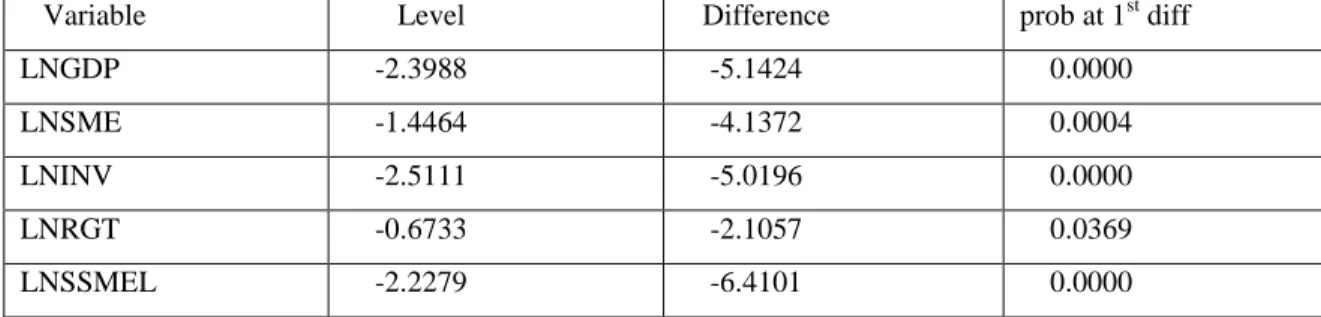
The regressed model is analyzed using the ordinary least square OLS and vector error correction model (VECM). The ADF test and other time series diagnostic tests are employed like: Histogram normality test, serial correlation LM test, ARCH effect test and endogeneity test as well. Based on the above tests, it is revealed that, the estimated model is stable and efficient to provide good explanation in relation to SMES effect in the long run on Nigerian economic growth.
31
CHAPTER FOUR
Attainment of predetermined target indisputably means the focus of every Research which demands absolute accentuation of cautiousness so as to prevent Chancy result that might turn the entire work useless. It (the research) has to conspicuously present the data collected (which must be harmonious with the objectives and the research hypothesis/question of the study), analyze and interpret it, which is the main deal of this chapter.
4.0 Small and Medium Scale Enterprises (SME) and Economic Growth with SMES proxied by Share of Employment
The table below depicts the result of ordinary least square OLS. The variables are shown while the figures in the second column show the result for the OLS estimates. The way the equation (2) is specified, the coefficient represents the dependent variable elasticity for each explanatory variable. The log of per capita gross domestic product GDPPC is the dependent variable.