ANKARA UNIVERSITY
A THESIS PRESENTED BY MELTEM AT AY
TO THE INSTITUTE OF ECONOMICS AND SOCIAL SCIENCES IN PARTIAL FULFILLMENT OF THE REQUIREMENTS
FOR THE DEGREE OF MASTER OF ARTS IN TEACHING ENGLISH AS A FOREIGN LANGUAGE
BILKENT UNIVERSITY JULY 2000
&
'р\Ъ 1 2 ο ο ό
І'ѵ '-V г f*
students at the Faculty of Political Sciences at Ankara University.
Author: Meltem Atay
Thesis Chairperson: Dr. James Stalker
Bilkent University, MA TEFL Program Committee Members: Dr. Bill Snyder
Dr. Hossein Nassaji John Hitz
Bilkent University, MA TEFL Program
The purpose of this study was to examine the English language needs of Management students at the Faculty of Political Sciences at Ankara University.
Students’ perceptions of their own language needs, teachers’ perception of their students’ needs and administrators’ perceptions of students’ needs were investigated.
Data were collected through questionnaires and interviews with three groups of informants consisting of 50 fourth-year Management students, nine teachers and three administrators.
Data were initially analyzed by using descriptive statistics like frequencies and percentages. Then chi-square tests were conducted on the students’ responses to see whether the differences among their choices was significant or not. Administrators’ responses were also included in the discussion of results, indicating points of agreement and disagreement.
The main similarities between the perceptions of the groups are on the necessity of English for a mastery of subject matter in Management and on the most important reason for learning English, which is to have a future career. The students and
the teachers agree on the most important writing skill and areas of difficulty in writing. All the groups of participants agreed on the fact that the English program in the Faculty of Political Sciences does not provide the students with enough speaking practice. Moreover, the students and the teachers agree that the students’ lack of specific vocabulary in their field causes difficulty in reading, writing and listening.
There are major differences between the groups when the skills are considered. The students pointed out speaking, the teachers reading and the
administrators speaking, reading and listening as the most important skills. Furthermore, the students believe that their ability level has to be higher in order to be successful than the teachers do. Although students stated that the program did not provide them with the necessary terminology and content for their departmental courses, the teachers felt that they provide the students with enough practice on field-specific terminology and content. Like the teachers, the administrators pointed out that English courses provide the students with essential terminology and content, but these areas should be emphasized.
In the light of the findings, the researcher presents pedagogical implications such as setting clear cut objectives, planning and organizing the courses based on these objectives and informing the students about what performance level should be expected in all skills in order to address the language of the needs of Management students more effectively. Recommendations on how to improve the English program at the Faculty of Political Sciences include increasing the hours of English language classes and giving more emphasis to the presentation and practice of the terminology and content in
Business English. In addition to these, specific ideas on how to develop students’ language proficiency in all four language skills are presented.
MA THESIS EXAMINATION RESULT FORM July 5, 2000
The examining committee appointed by the Institute of Economics and Social Sciences for the thesis examination of the MA TEFL student
Meltem Atay
has read the thesis of the student.
The committee has decided that the thesis of the student is satisfactory.
Thesis Title
Thesis Advisor
; An English language needs assessment of Management students at the Faculty of Political Sciences at Ankara University
: Dr. Bill Snyder
Bilkent University, MA TEFL Program Committee Members : Dr. James Stalker
Bilkent University, MA TEFL Program Dr. Hossein Nassaji
Bilkent University, MA TEFL Program John Hitz
We certify that we have read this thesis and that in our combined opinion it is fully adequate, in scope and in quality, as a thesis for the degree of Master of Arts.
Dr. Hossein Nassaji (Committee Member)
John Hit
(Committee Member)
Approved for the
Institute of Economics and Social Sciences
Ali Karaosmanoglu Director
Institute of Economics and Social Sciences r ·
I am indebted to the people who have helped me both directly and indirectly in preparing this thesis. I can only mention a few of them here. I would like to express my special thanks to my thesis advisor, Dr. Bill Snyder, for his helpful guidance and contributions during the research process and the construction of the thesis.
I have also benefited from Dr. James Stalker, Dr. Hossein Nassaji and John Hitz and I would like to thank the faculty members for their kind assistance throughout my studies.
The administrators at Ankara University who encouraged me and gave me permission to attend the Bilkent MATEFL program; the administrators at the Faculty of Political
Sciences, who gave me the opportunity to administer the questionnaires; the English language teachers and Management students who spent their invaluable time completing the
questionnaires really deserve many thanks.
I owe special thanks to my family members who have encouraged and supported me throughout my life and in this program. Without my family this study would be impossible. Thanks go to my friends Yalım Soyer, Dilara Okan, Adil Korkmaz, Gözde Akmenek, Simten Kutan, Umur Çelikyay for their help and moral support.
TABLE OF CONTENTS
ACKNOWLEDGEMENTS... vii
LIST OF TABLES... x
LIST OF FIGURES... xii
CHAPTER 1 INTRODUCTION... 1
Background of the Study... 1
Statement of the Problem... 2
Significance of the Problem... 3
Research Questions... 5
Organization of the Study... 5
CHAPTER 2 REVIEW OF THE LITERATURE... 6
Introduction... 6
Historical Background of Teaching E S P ... 7
Definitions of English for Specific Purposes... 11
Definition of N eed... 13
Definition of Needs Assessment... 14
Who Should Identify the Needs?... 15
Why is Needs Assessment Necessary?... 19
Steps in Needs Assessment... 21
Recent Studies on Needs Assessment in Turkey... 23
CHAPTER 3 METHODOLOGY... 26 Introduction... 26 Participants... 27 Materials/Instruments... 28 Procedure... 33 Data Analysis... 34
CHAPTER 4 ANALYSIS OF THE DATA... 36
Introduction... 36
Analysis of the Questionnaires... 37
Analysis of the items in Part II in Students’ and in Teachers’ Questionnaires... 37
CHAPTERS CONCLUSION... 81
Overview of the Study... 81
Summary of the Results... 82
Results of the Management students’ perceptions of their English language needs:... 82
Results of the teachers’ perceptions of their students’ English needs:... 84
Results of the administrators’ perceptions of their students’ English needs:... 86
Discussion... 87
Pedagogical Implications... 90
Limitations of the Study... 92
Future Research... 92
REFERENCES... 94
APPENDICES... 97
Appendix A: Questionnaire for Students... 97
Appendix B: Questionnaire for Teachers...103
1 The Categorization of the Items in the Students’ Questionnaire 31 2 The Categorization of the Items in the Teachers’ Questionnaires 32 3 Students’ and Teachers’ Perceptions of the Necessity of
Learning English... 38 4 Students’ and Teachers’ Perceptions of Students’ Reasons for
Learning English... 39 5 Students’ and Teachers’ Perceptions of the Most Important
Skills in English... 40 6 Teachers’ Perceptions of Their Competencies in
Teaching English... 41 7 Students’ and Teachers’ Perceptions of the Relationship
Between Mastery of English and Subject Matter in Management.. 42 8 Students’ and Teachers’ Perceptions of the Necessity of
Business English... 43 9 Students’ and Teachers’ Perceptions of Whether the Students’
Learn and Practice Necessary Terminology for Their Majors... 44 10 Students’ and Teachers’ Perceptions of the
Most Important Materials for Students to be Able to Read and Understand in English... 46
11 Students’ Perceptions of their Frequency of
Reading in English... 47 12 Students’ Perceptions of How Well They Read in English... 48 13 Students’ and Teachers’ Perceptions of How Well the Students
Need to Read in English in Order to be Successful in the Faculty.. 49 14 Students’ Perceptions of the Kind of Literature They Read
in Their Field... 50 15 Students’ and Teachers’ Perceptions of the Necessary Reading
Skills for the Students... 51 16 Students’ and Teachers’ Perceptions of Which Reading Skills
are Practiced in English Classes... 52 17 Students’ and Teachers’ Perceptions of the Areas of
Difficulty in Reading... 54 18 Students’ and Teachers’ Perceptions of the Reasons for
Difficulties in Reading... 55 19 Students’ and Teachers’ Perceptions of Whether the Students
Have Enough Practice in Business English Terminology... 56 20 Students’ Perceptions of their Frequency of Writing in English 57 21 Students’ Perceptions of How Well They Write in English... 58 22 Students’ and Teachers’ Perceptions of How Well the Students
23 Students’ and Teachers’ Perceptions of the Most Essential
Types of Writing for the Students... 61 24 Students’ and Teachers’ Perceptions of the Most Difficult Areas
for Students in Writing... 62 25 Students’ Perceptions of Their Frequency of Speaking in English 63 26 Students’ Perceptions of How Well They Have to
Speak in English... 64 27 Students’ and Teachers’ Perceptions of How Well the Students
Need to Speak in Order to be Successful in the faculty... 65 28 Students’ and Teachers’ Perceptions of the Most Essential
Speaking Subskills for Students... 66 29 Students’ and Teachers’ Perceptions of Whether the Students
Have Enough Speaking Practice in English Courses... 68 30 Students’ Perceptions of the Frequency of Attending Conferences
or Listening to the Lectures in English Outside the Class... 69 31 Students’ Perceptions of How Well They Understand
Spoken English... 70 32 Students’ and Teachers’ Perceptions of How Well the
Students Need to Understand Spoken English
33 Students’ and Teachers’ Perceptions of the Frequency of the Students’ Difficulties in Understanding Specific
Topics in English... 72 34 Students’ and Teachers’ Perceptions of the Situations
when the Students Have Difficulty in Understanding
Specific Topics in Business English... 73 35 Students’ and Teachers’ Perceptions of the Frequency
with which Supplementary Materials are Used by the Teachers ... 75 36 Students’ and Teachers’ Perceptions of the Usefulness of
Translation in Learning English the Students Need... 76 37 Students’ and Teachers’ Perceptions of whether the Program
Provides the Students with Enough Practice on
Four Language Skills 77
38 Teachers’ Perceptions of the Major Changes that They
LIST OF FIGURES
FIGURE PAGE
1 Categories of ESP... 12 2 An Approach Centered on the Learner... 17 3 A Triangle for Needs Assessment... 19
In the twentieth century, there have been many changes in the approaches to language teaching and these different approaches have produced important changes in the world of language teaching. In recent years, the importance of the learners in the educational process was recognized. The focus in language teaching has shifted from the nature of language to the learner; the learner is seen at the center of the learning and teaching process. This implies that curricula should differ for different learner types because it is impossible for a traditional curriculum to meet many different needs of learners. Hutchinson and Waters (1987) point out that a needs- based curriculum, where the content of the courses is chosen to meet the needs of the students; best serves the educational objectives of a particular learner.
The realization of the importance of learners’ needs calls for the identification of their needs in a systematic way. This systematic way is known as needs
assessment. Jordan (1997) defines needs assessment as “the process of determining the needs for which a learner requires a language and arranging the needs according to priorities” (p. 20). Thus, needs assessment is a two-stage process, one of
determining needs, followed by prioritizing them.
One of the educational domains which uses needs assessment as the basis of program formation is English for Specific Purposes (ESP). Hutchinson and Waters (1987) define ESP as “an approach to language teaching, course design, and
materials development in which all decisions as to context and method are based on the learners’ reason for learning” (p.l9). Needs assessment in ESP involves
that by identifying elements of students’ target English situations and using them as the basis of ESP instruction, teachers will be able to provide students with the specific language they need to succeed in their courses and future careers. Statement of the Problem
In this study, I want to explore what students, teachers and administrators perceive the Management students’ needs to be in the Faculty of Political Sciences at Ankara University. The aim in this study is not designing an English for Specific Purposes curriculum but to borrow needs assessment as a tool from ESP in order to evaluate the needs of the students in our Faculty. This study is a starting point, not a conclusion. In my institution, Ankara University Faculty of Political Sciences, there are five departments: Management, Economics, International Relations, Public Administration and Finance. The English program is based on three main courses; Grammar, Reading, and Translation. A proficiency exam is given before the beginning of every academic term. The students who are not successful on the proficiency exam have grammar courses for two years at two different levels.
Students who are successful are instructed only in two skills, reading and translation. Listening, speaking and writing skills are not addressed directly in our English program.
An important problem that the teachers are faced with is students’ attendance in English classes. Attendance is not obligatory; therefore, teachers take no records. As a result, very few students attend the classes regularly, which is a clear indication of their lack of motivation. Most of the students do not need to attend the classes
classes. The students who attend the classes are either Private or State High School graduates who recognize the importance of English as a foreign language and their need for formal instruction to better their English as well as their knowledge of terminology in Business English. In the informal interviews I did with the students, I learned that they are not motivated to come to the classes because they could take the reading passages and the texts to be translated, work on their own and get a grade good enough to pass the exams. Therefore, each year fewer students attend the classes and choose “Elective English” classes, where more advanced business texts are translated.
In the light of my observations and the informal interviews with the students, there is evidence of general dissatisfaction with the English program in our faculty. In particular the English program in our faculty does not offer formal instruction in writing and practice in speaking skills; therefore, the students are not motivated enough to attend the English classes. I carried out this research in order to have concrete evidence to support these impressions. I am looking for accurate
perceptions of students’ needs from students’, teachers’ and administrators’ points of view.
Significance of the Problem
Needs assessment is the systematic collection and analysis of all relevant information necessary to satisfy the language learning requirements of students (Strevens, 1988). Needs assessment should be the starting point for curriculum development. In order to devise syllabuses, courses and materials appropriate for
answer the language requirements of the students (Brown, 1995). Since, in our institution the students taking English courses have specific academic needs, it is the responsibility of the teachers to discover the needs of these students and to design a curriculum that provides courses which are suitable to meet them.
The present English program in our faculty addresses the immediate needs of the students to some extent. The Grammar, Reading and Translation courses provide instruction to answer the short-term needs of the students. Our students need English not only in their university education but also in their future careers. The students’ informal feedback also supports the position that they need formal instruction in writing and speaking to be successful in their future career or jobs. After graduation, the students will need an advanced level of English for MA and Ph.D. studies in foreign countries or in English medium universities in Turkey and academic careers; they will have to take the TOEFL and GMAT exams. In order to find their future jobs, the students will have to take examinations in English including grammar,
vocabulary, reading and writing sections. In addition to this, interviews are generally in English and some of the students may fail because of their lack of speaking ability. Moreover, the terminology related with Business English is only presented through reading passages and texts to be translated. In order to develop a range of
terminology in their field, the students might need further presentation and practice on field-specific vocabulary. These are some of the deficiencies in our existing program based on observations and informal interviews These observations need to be formalized and needs assessment is a way to do this. Research on needs
order to answer both the short and long-term needs of our students. My research on the perception of students’ needs from the students’, teachers’ and administrators’ points of view will fill this gap and may lead to fiiture action.
Research Questions
The following constitute the research questions of the study;
1. What do the Management students at Ankara University perceive their English language needs to be?
2. What do English teachers in the Faculty of Political Sciences at Ankara University perceive the Management students’ English language needs to be? 3. What do the administrators in the Faculty of Political Sciences perceive
Management students’ English language needs to be? Organization of the Study
The first chapter of the study presents the reader with background of the study, the statement and the significance of the problem, the research questions. The second chapter covers the review of the literature, including the historical
background of ESP, definitions of ESP and needs assessment, the importance of needs assessment and the steps in assessing needs. Recent needs assessment studies carried out in Turkey are also presented in this chapter. In Chapter 3, the
methodology used to collect and analyze the data is discussed. This is followed by the data analysis in Chapter 4. Chapter 5 includes the discussion of the results of the analysis and a summary of the study.
The use of English for communication in science, commerce, technology and other areas has resulted in learners having specific purposes for learning English. Thus, curriculum designers have to know the learners’ purposes as well as the sorts of language skills, content and vocabulary required for the situation in which the learners will use English. For successful teaching these needs should be identified and the curriculum should be designed according to them (Richards, 1984). ESP courses are those in which the syllabus and materials are essentially determined by the analysis of the communication needs of the learner rather than by non-learner- centered criteria such as the teacher’s or the institution’s predetermined preference for general English (Munby, 1978). According to Hutchinson and Waters (1978), ESP is not different in kind from any other form of language teaching in that it is based on principles of effective teaching and efficient learning. They believe that the foundation of ESP is the simple question: Why does this learner need to learn a foreign language?
This chapter presents the information gathered from a review of the literature on ESP and needs assessment and consists of four major sections. In the first
section, the historical background of ESP is reviewed; in the second section
definitions and subcategories of ESP are presented; in the third section a definition of needs assessment and its importance are given, as well as the steps to be followed in conducting a needs assessment. In addition, different steps in data collection are reviewed. Finally, in the fourth section, the role and importance of needs assessment in curriculum design are reviewed and discussed.
languages had not been one of the considerations of the language teachers. Knowing a foreign language had generally been considered a sign of a good education. People had learned English and other languages for pleasure or for prestige. However, after the Second World War, great developments in scientific, technical and economic fields have been achieved. Relationships among nations increased and these developments forced people to look for an international language. During this period, the United States became the economic power of the world and therefore English became an important factor in international trends in technology and commerce. The importance of English created a group of learners who knew what they needed English for. ELT professionals had to meet these new requirements (Johns & Dudley-Evans, 1996).
As the demand grew for language courses prepared for specific needs, new ideas began to emerge in the study of language. Traditional approaches to foreign language teaching focused on language analyses and successful language teaching depended on imparting abstract language rules. The content of the particular course was determined based on the selection of vocabulary items and grammar structures. Then, these items were sequenced and taught (Richards, 1984). While teaching English based on the traditional approaches, the teachers do not consider the learners in this process. Their needs were not addressed while deciding on the contents of the courses.
With the change in conditions, the importance of the learners in the teaching process was realized. Discovering the ways in which language is actually used in
the reasons for learning English differ from person to person. This view shaped the development of English courses for specific groups of learners (Hutchinson 1978; cited in Hutchinson and Waters 1987). Hutchinson and Waters (1987) point out that “the idea was simple: if language varies from one situation of use to another, it should be possible to determine the features of specific situations and then make the features the basis of the learners’ course” (p.7).
As Hutchinson and Waters (1987) mention, the traditional goal of linguistics, which was to describe the rules of English usage, went through radical changes in the period after the Second World War. This was the result of the work of linguists who focused on the description of language use in real life situations varying according to the needs of the individuals in different areas. This change led designers to the identification of needs of individuals in different fields. “Tell me what you need English for and I will tell you the English that you need” (p.8) became the guiding principle of ESP.
From its early beginnings in 1960’s, ESP has undergone different phases of development. Hutchinson and Waters (1987) present the development of ESP in five stages: (a) the concept of specialized language, (b) rhetorical or discourse analysis, (c) target situation analysis, (d) skills and strategies and, (e) the learning-centered approach.
The first stage, the concept of specialized language, started in the late 1960’s and early 1970’s. The basic principle underlying the need for a specialized English language is that different registers demand specific linguistic forms. In register
field of study. For example, English for electrical engineering demands the use of specific linguistic forms, which are different from those of Biology and of General English. In register analysis, the frequency of particular forms such as the present simple tense and the passive voice in field-specific registers are identified. Teaching materials in this type of syllabus are then based on the linguistic features identified.
In the second stage, known as rhetorical or discourse analysis, the attention was shifted from the sentence level to a level above the sentence. The concern of ESP research was to identify the organizational patterns in texts and to specify the linguistic means by which these patterns are signaled. These patterns would then form the syllabus of the ESP course. Throughout this stage, the target situations in which learners would use the language were identified and linguistic features of those situations were outlined. A detailed profile of the learners in terms of communicative purposes, setting, means of communication, language skills, functions, and structures was prepared by the researchers. In this approach, it is assumed that the rhetorical patterns of text organization differ significantly between specialized areas of use. For example, the rhetorical structure of science texts was regarded as different from that of commercial texts. Subject-specific texts should be used to make observations about discourse in general. The learners’ needs should be considered while choosing the academic texts to be used. This development laid the foundation of needs analysis processes in syllabus design.
The third stage, target situation analysis, focuses on a language analysis
situation or work situation. In this process, the curriculum designer learns the needs of the learners and designs the syllabus accordingly. This is known as needs analysis or target situation analysis. The most detailed explanation of needs analysis is the system presented by John Munby. As Munby (1978) points out “This is a dynamic processing model that starts with the learner and ends with his target communicative competence. It is the detailed syllabus specification, the target communicative competence, which constitutes the essence of what should be embodied in the course materials” (p.3-4). The Munby Model produces a detailed profile of the learners’ needs by determining the learners’ purpose in using the target language, the settings in which the target language is used, means of communication, the need for language skills and the grammatical structures and functions.
The fourth stage, the skill and strategies stage, is concerned with language skills that will enable the learner to cope with the demands required by the target situation. For example, in the area of engineering, students may need to acquire reading skills along with the associated cognitive strategies such as inferencing, locating details and decoding detailed factual information.
The authors called the fifth stage, the learning-centered approach stage, the most important of all stages. The learning-centered approach focuses on four concepts: (1) What is ESP? (2) Course design, (3) Application, and (4) The teacher. Each section represents decisions that have to be made before the teacher or
curriculum planner can take a series of actions. This approach takes into account the needs, abilities and interests of each learner in order to determine the content of the ESP course curriculum.
To find how ESP differs from other forms of ELT, it should not be taken as a particular product, but as an approach to language learning and teaching, which is directed by special and obvious reasons for learning by the learner (Hutchinson and Waters, 1987). ESP does not have a particular kind of knowledge, methodology or teaching material, but should be considered an approach to language learning based on learner needs.
Definitions of English for Specific Purposes
ESP holds a position of importance in the field of language teaching. Thus, it is essential to define ESP and specify why it is important. According to Strevens (1977, cited in Johns, 1991), “Broadly defined, ESP courses are those in which the aims and the contents are defined, principally or wholly, not by criteria of general education, but by functional and practical English language requirements of the learner.’Xp. 90) Harvey (1984) offers a more specific definition “The purpose of ESP is to increase and develop, in a short time, the linguistic potentialities of either tertiary students who need the language to acquire or update knowledge in their specialties (English for Academic Purposes) or adults who need the language for job- related activities (English for Vocational Purposes)”(p.24).
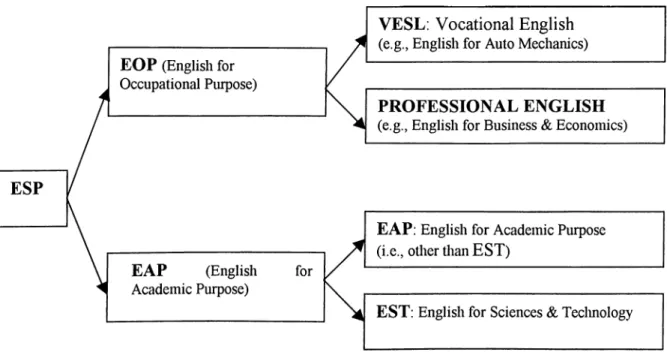
Therefore, in general, it is possible to distinguish ESP courses as occupational or educational courses. Occupational ESP courses (EOP) are job-related and can either be highly technical or specific in nature; for example, English for airline stewardesses, businessmen and laboratory technicians is all occupational ESP (Harvey, 1984). The educational ESP programs, also known as English for
Academic Purposes (EAP) are generally related to the study of a particular discipline such as chemistry, computer engineering or economics. EAP is taught within
educational institutions to students who need English for their studies (Jordan, 1997). Because there are many learners with different purposes, further divisions of ESP are possible. The following diagram shows further subcategories of ESP.
Figure 1: Categories of ESP.
Note: From Strevens, 1977, cited in Johns, 1991, p.71.
Since both types of the courses mentioned above are ESP in nature and the
purpose o f ESP programs is to satisfy the needs o f the learners, the content o f these
courses have to be determined through an analysis of the activities the learners will be performing in the foreign language they learn . That is why the needs assessment procedure in ESP has great importance and is regarded as the first step to be taken in ESP course design (Robinson, 1980).
ESP course designers have to be very carefial in setting up procedures for determining learners’ communicative needs. Lombardo (1988) points out the fact
that many ESP learners are adults, working or seeking a specific kind of employment and aware of their needs, which makes it easier for the ESP course designer to obtain reliable data in needs analysis. However, it is not enough for a designer to determine the learners’ needs. It is often of equal importance to analyze the characteristics of the target situation in which English will be used (Schleppegrell, 1994).
The main concern of ESP is the focus on needs. Hence, it is necessary to know what need is in order to understand the importance of the needs assessment in ESP courses explicitly. After defining need, this study will deal with the systematic identification of needs and why a detailed identification of needs is crucial. Definition of Need
Berwick (1984) sees need as a gap or measurable discrepancy in what learners need and what they receive in language programs. He defines gap as the
inconsistency between the target situation and the present situation Determining the learners’ needs in order to achieve the desired target situation is seen as the target of any needs analysis process. However, Richterich and Chancerel (1983) argue that it is difficult to find a simple definition of needs. They point out that needs develop and change; therefore finding a definition of needs is a continuous process.
According to Nunan (1998), needs are categorized as felt needs and perceived needs. They are also called objective and subjective needs respectively. Felt needs are the wants, desires and expectations of learners. Perceived needs refer to teachers’ and administrators’ perceptions of students’ needs. If learners, administrators and teachers know why the learners need English, that awareness will influence the content of target language classes. The perceptions of teachers and administrators of the needs of learners cannot be ignored in determining the goals and the objectives of
a language program, especially as this may effect student motivation (Hutchinson and Waters, 1987). Jordan (1997) also highlights the subjective needs of learners and adds that we cannot neglect the students’ expectations if we want higher motivation in the learning process.
From a different point of view. Waters and Hutchinson (1989) invoke the terms
necessities, lacks, and wants, while defining needs. Necessities is defined as the
things the learner has to learn in order to use language more effectively when needed.
Lacks describes the gap between the current knowledge and the ideal level of the
learners. Finally, they describe wants as the subjective perceptions of learners about their own needs.
It is very important to take learners’ own wishes in determining the goals of the program and the objectives of the lessons. Learners can have valuable ideas about their own learning (Nunan, 1986; Kennedy & Bolitho, 1984). However, Brown (1995) states that it is generally difficult to meet the wants and the expectations of the learners, which may vary from person to person. The perceptions of all the learners about their own needs may change. If new and different students enter the program, both language needs and situation needs may change. A number of different views have defined need.
In this particular study, Berwick’s (1984) definition of needs is taken as the basis of needs assessment.
Definition of Needs Assessment
Robinson (1991) points out that the realization of the importance of learners’ needs calls for the identification of their needs in a systematic way. This systematic method through which needs are identified by comparing the present state of the
learners and the desired or target state in which learners have to survive with the language they learn, is called needs assessment. Thus, needs assessment is a method of comparison, which compares information from two sources: the present situation and the target situation. If the information from the two sources does not match, this indicates lack of instruction or inadequate instruction with respect to the needs of the intended group of learners. Smith (1990) clarifies needs assessment as follows:
It is a process for identifying the gaps between the educational goals that have been established for students and students’ actual
performance. These gaps can be used to determine students’ needs. Then, needs can be identified by comparing goals, objectives and expectations of a system with the data that shows the current performance (p.6).
Needs assessment involves two levels: first, finding the present status of the students and second, comparing this status to acceptable norms in order to identify gaps or needs. Certain recommendations are made as to how to fill the probable gaps. (Dubin, Eskey and Grabe, 1987; Kaufman, cited in Berwick, 1989). However, the act of filling these gaps or needs indicated is not the aim of needs assessment. According to Kaufman, before jumping to solutions, gaps are to be defined correctly by educational personnel: teachers, administrators and learners. Who should define those gaps will be explained in detail in the next section.
Who Should Identify the Needs?
All parties involved in the teaching and learning process are equally
responsible for the identification of learners’ needs. Richterich and Chancerel (1980) suggest the identification of needs should be done by the learners themselves, the
teaching establishment and the user institution. The authors define the user institution as “any structured social unit such as firms or businesses and
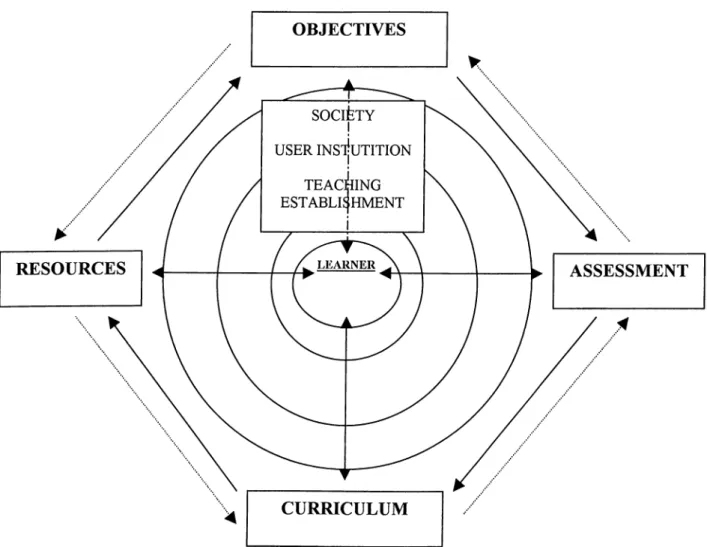
administrative bodies where learners will study or be employed” (p.38). They insist that the learners, the teachers and the administrators should reach a consensus on a program that will best address the language needs of the students. Richterich and Chancerel (1980) believe that needs assessment is an effective way of seeking this agreement because needs assessment can elicit information from these three groups and can look at the shared and different points of view. All components of this system should operate in coordination. Figure 2 shows this system and the relationships of the essential elements of the system. They put the learner in the center of the system and view him/her as an integral part because the system has interdependent levels. These levels are society, user institution and teaching establishment. As the arrows, which go both ways, illustrate, teaching/learning process starts from the learner and goes back to him/her.
Figure 2: An Approach centered on the learner (from Richterich and Chancerel, 1980, p.4)
This figure also shows the sources of information necessary for needs assessment. The learners, teaching establishment and user institution should be consulted. There are four reasons for these consultations. First of all, information obtained from the learner may create learners’ awareness about their own resources and objectives. This kind of information gives curriculum developers information about the student-perceived needs for English. Secondly, information collected from the teaching establishment may help the teachers to determine how they can adapt their resources, objectives and curricula to the learners’ expectations, requirements and objectives. This information may also help the teachers to suggest curricula
appropriate to both learners’ and their resources. Thirdly, information from the user institution will provide the curriculum planners with information about the
expectations of the institution, about facilities and equipment available for the teaching situation and also about funds available for materials and equipment. Finally because the society affects the learners’ learning and desires, information from the society is necessary in order to examine the characteristics, requirements and facilities of the society in which the learner lives (Richterich and Chancerel, 1980).
The National Center for Industrial Language Training (NCILT) (as cited in Me Donough, 1984) state that the same groups who play a crucial role in needs
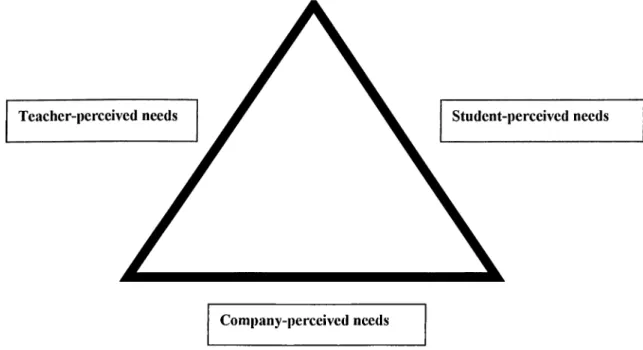
assessment, the learners, teachers and administrators, must create an effective curriculum. They argue that information from these three sources is contributory rather than conflicts with the teaching process and propose a triangle for needs assessment as follows:
Company-perceived needs
Figure 3: A triangle for needs assessment (from Me Donough, 1984, p.38) The word company stands for the institutional system that also includes administrators.
Why Is Needs Assessment Necessary?
Needs assessment is an important basis for determining the objectives of the curriculum and organizing the content of the programs in ESP (Richards, 1990). When the needs of learners are identified, they can be stated in terms of goals and objectives. The information gathered from needs assessment can be used for
determination of pedagogic purposes. Tests, materials and teaching activities can be designed based on the needs of the students (Brown, 1995; Richterich 8c Chancerel, 1980). After formulating objectives, content is selected and organized. Instructional objectives can be sequenced in order of priority after needs assessment has been conducted. Finocchiaro and Brumfit (1983) suggest that curriculum should provide an analysis of general aims of the program and then a progression of units which
guides the teacher by indicating what aspects of the language are to be concentrated on at any given stage. The statement of general aims of the program can only be achieved through needs assessment. This indicates the crucial role of needs assessment in discovery of instructional objectives.
If suitable materials are chosen and used by the teachers, this will motivate the students for learning. One advantage of appropriate selection of materials is that the gap between the materials used in the classroom and those needed to be used in real life may get smaller (Johns, 1991). Thus, needs assessment is an integral part of systematic material development. Materials could be devised by the teacher in such a way that they lend themselves to real life usage related to a certain area of study (Munby, 1978).
Moreover, assessing the needs of the learners is also a unique way of finding criteria for reviewing and evaluating the existing curriculum (Richards, 1984), as needs assessment is a means of gathering detailed information about learners, the institution and the teaching staff It can also give thorough information about learning conditions of learners. Richterich and Chancerel (1980) argue that, since assessment is an ongoing process, so it may also be reasonable to conduct a needs assessment during the course and after the course. This may be necessary to check whether the curriculum is operating in a way that will achieve the predetermined objectives. As Brown (1995) emphasizes: “Since sound needs analysis forms a rational basis for all the other components of a systematic language curriculum, examining the aims, procedures and the applications of needs assessment will create a sound foundation for further discussion of the curriculum.”(p.35).
Richterich and Chancerel (1980) clarify the overall contribution of needs assessment to the curriculum process as follows:
It is necessary to identify needs in order to become aware of the learning conditions of individuals or groups and to align these with their physical, intellectual and emotional possibilities as well as to devise learning materials which will approach the real use of language taught; thus, to define the pedagogical objectives through negotiation with the learners, (p. 72)
Needs assessment is the first step in setting up the goals and the objectives for language program. Curriculum planners progress systematically from needs
assessment to goals and objectives, then the specification of the instructional content of the program and the determination of the materials.
Steps In Needs Assessment
The steps involved in needs assessment are presented by Smith (1990) and Schütz and Derwing (1987). When these two models are considered, they both consist of a preparation stage that covers defining the purpose, identifying the target population, determining the scope of the investigation and deciding on the data collection techniques. In the preparation phase, the purpose of the analysis - whether learning needs or target needs will be revealed - should be determined. Then, the target population, that is, the people from whom the necessary data will be gathered, should be stated. Data for needs assessment can be collected in terms of six different perspectives: subject teacher, institution, English language teacher, learners’ needs, learners’ wants and local features of the environment ( Holliday and Cooke 1986, cited in Adams and Smith 1986).
The next step is the actual collection of data by using the pre-determined techniques. Questionnaires, interviews, observations, texts and informal
consultations with sponsors and learners can be used for data gathering (Hutchinson and Waters; 1987). Brown (1995) provides a list of the instruments to be used while analyzing the language needs of the participants. They can be grouped as: meetings (advisory, interest groups, review); tests (achievement, diagnostic, proficiency, placement); behavior observation; interviews (group, individual); surveys and questionnaires (opinion, biodata); ratings (self, judgmental); Delphi technique and, finally, systems analysis. He also categorizes the instruments to be used according to the role of the needs analyst. While using existing information, tests or observations, the needs analyst is in the position of being an outsider passively looking at the existing program. On the other hand, interviews, meetings and questionnaires pull the needs analyst into the process. Here, the analyst is the facilitator who gathers or draws out information from the participant.
Following this step, the data should be analyzed to obtain the results of the investigation. The next step in both of these models is the interpretation of the results and the discussion. The analysis and interpretation of the results need to be reported in order to be used in curriculum design. Schütz and Derwing (1987) add one more step, which does not exist in Smith’s (1990) model: the critique of the project. In this step a general evaluation of the project is done.
For this particular needs assessment three major steps were followed. In the first step, which was a preparation step, based on the earlier observations on the program and informal interviews with students, the items in the students’ and teachers’ questionnaires were constructed. Students, teachers and administrators
were the target populations from whom data were collected. I preferred to give questionnaires to the students and the teachers in order to be able to compare their perceptions. Due to the limited number of administrators, interviews were
conducted. When the role of the researcher is considered, I was a part of this research actually gathering information from the participants. In the second step, data were collected by administering the questionnaires and conducting the
interviews. Finally in the third step, the collected data were analyzed using statistical techniques and interpreted.
The major aim of needs assessment is to design a curriculum around learners’ needs. Identifying them by using needs assessment is crucial for curriculum design since only by conducting a needs assessment learners’ needs can be revealed.
In the next section, recent studies on needs assessment in Turkey will be introduced and two of these studies that are parallel (in scope and the methods used) to this particular needs assessment study will be discussed.
Recent Studies On Needs Assessment In Turkey
There are a number of studies carried out on needs assessment in different institutions in Turkey. Some of the examples are: the English language needs assessment of the students of the Medical Faculty of Cumhuriyet University in Sivas which was carried out by Elkılıç (1994) and the analysis of the needs of Veterinary Medicine students at Selçuk University in Konya by Alagözlü (1996). Boran (1994) carried out a research on needs analysis for the ESP classes at the Tourism Education Department of the Trade Business and Tourism Education Faculty of Gazi University in Ankara. Another example of determination of the specific needs for an ESP course is conducted at Osmangazi University in Eskişehir by Tezcan (1998). In
addition to these, Gok§in (1991) carried out a research on assessment of teacher- perceived needs of ESP students in the Faculty of Economics and Administrative Sciences at Erciyes University in Kayseri. Elkiliç’s (1994) and Alagôzlü’s (1994) studies will be discussed in detail since the scope of these studies and the methods used to collect the data are parallel with this particular needs assessment carried.
The first study was carried out by Elkiliç (1994) to determine the English
language needs of the students of Veterinary Medicine at Selçuk University. In order to carry out this study, 67 students, 15 subject professors and 5 English teachers were given questionnaires, which were designed to elicit information about students’ language needs. The students’ version of the questionnaire consisted of 22 items, the subject professors’ version, 16, and language teachers’ version, 17. All groups were requested to rank the four language skills according to importance. Reading was unanimously selected as the most important skill. There were mixed opinions concerning the importance of the other three skills. Listening, however, was considered to be the second most important. The students, subject professors and language teachers also stated that reading was important in order to be able to understand scholarly journals, magazines and reports as well as to translate materials from English to Turkish. Based on these results, the researcher made
recommendations for improving the English language curriculum at Selçuk University.
In Alagôzlü’s (1994) study, the main concern was to reveal the English language needs of fourth-year Medical students at the Faculty of Medicine of Cumhuriyet University. Student’, teachers’ and administrators’ perception of students’ needs were investigated. Data were collected through questionnaires and interviews and
the perceptions of these people were compared. The four major results of this study were as follows: First; reading and translation are the most required language skills for medical students because of the large proportion of medicine-related readings are available only in English. Second, the instructional materials are not suitable, which implies a revision of instructional materials in use. Third, a need for in-service training in teaching ESP was revealed. Finally, it was seen that the focus in language classes and the perceived needs of the students by medical students, language
teachers and administrators do not match. Thus, medical students’ needs were not being fully met by the present curriculum. Based on these results, recommendations were made as to what elements of the curriculum should be changed and what a new curriculum should include.
CHAPTER 3; METHODOLOGY Introduction
The concern of this study is to reveal what the parties in the teaching and learning process, the students, the teachers and the administrators, in the Faculty of Political Sciences at Ankara University perceive English language needs of
Management students to be.
Since the purpose of this study was to find out students’ needs, a needs
assessment involving students, instructors and administrators was conducted. All the parties in the teaching/learning process were included in this study to see the
perceptions of students’ needs from three different points of views. This is a descriptive study in which data related to the perceptions of groups involved were collected through administration of questionnaires and interviews.
This chapter consists of four sections. The first section introduces the participants. The second section gives information about the instruments used to gather the data. In the third section, the procedure is explained. Finally, how the data were analyzed is presented in the fourth section.
Participants
Since this study deals with the students’ perceptions of their own needs and the perceptions of students’ needs from teachers’ and administrators’ points of view, three groups were involved in this study. The first group consisted of fifty fourth- year students in the Management Department at Ankara University. Although there are five departments in the Faculty of Political Sciences, only one of these.
choice: it would have been impossible to carry out this research with all 2763 students enrolled in all departments. Time constraints and access to the students in this limited time would have made it difficult to carry out this research. Therefore the researcher limited the scope of this study to only one department. The other reason is that the researcher had taught Management students the previous year and it enabled an easier access to the students and higher cooperation. Moreover, the informal interviews done prior to the study about the deficiencies in the English language program were carried out with Management students.
The total number of students in the Management Department is 456 (first-year: 56 students, second-year: 112 students, third-year: 135 students and fourth-year: 153 students). Out of 153 fourth-year students, 50 of them were chosen as the subjects of this study. In Section 1 of the students’ questionnaire, the students are asked to give information about their age, gender, the kind of high school graduated from and the duration of their English study. Student’s ages ranged from 20 to 23, with an average of 21. Twenty-four of these students are male, 24 of them are female. Two of these students did not fill in the gender part. Twenty-four of the students
graduated from Public High Schools, 14 of them are from Anatolian High Schools, 10 of these students are Private High School graduates, and 2 of them are Vocational High School graduates.
All the student participants were solicited from a class with permission of the Faculty administration. Fourth-year students were chosen and were given
questionnaires in the second term because, by then, the participants had a general overview of the English program in our faculty and as they had covered most of the departmental program, they were aware of the demands of their courses.
The second group consisted of 9 English language instructors in our faculty. As the Foreign Language Department is composed of just 9 English teachers, no random selection could be done; all were included in this study. Although the number of the teachers involved is limited, the researcher elicited the information needed by using questionnaire technique again. The aim of the researcher was to obtain information similar in form from both the students and the teachers in order to show the
similarities and the differences between their perceptions of students’ needs. As in the students’ questionnaire, the teachers are asked questions to elicit bio-data information in Section 1 of the questionnaire. Teachers are asked two questions in this part: “How long have you been teaching English?” and, “How long have you been teaching English at the faculty of Political Sciences?” The results show that the average length of teaching English is 17 years ranging from one year to 30 years and the average length of teaching at the Faculty of Political Sciences is seven years ranging from two months to 16 years.
The third group was the administrators. They were included in this study because they could make necessary changes in the curriculum if needed. The Head of the Foreign Language Department, the Head of the Management Department and the Dean of the Faculty were interviewed.
Materials/ Instruments
This was a descriptive study in which data related to the perceptions of the groups involved were collected through questionnaires and interviews. The researcher preferred the questionnaire technique because of the number of the students involved in this study. This is a valuable technique for eliciting detailed information on perceptions of language skills and materials that were the essential
information for this study. As Brown (1995) suggests, when compared with other techniques, questionnaires are more efficient for gathering information on a large scale. In order to elicit detailed information, questionnaires can be designed to accomplish any of the following purposes: biodata surveys, opinion surveys, self- ratings, and judgmental ratings (Kennedy & Bolitho, 1984). With the help of the questionnaires given to the students and the teachers, the researcher was able to elicit detailed information on perceptions of language skills and materials, which were the essential information for this study. The students’ and teachers’ questionnaires are based on the models of Elkihg’s (1994) and Alagozlii’s (1994) theses and Benesch’s (1996) and Leki and Carson’s (1994) articles on needs assessment. I developed my own questions by taking the above-mentioned sources as references. The
questionnaires consisted of multiple-choice, rank order, open-ended questions, and questions in which more than one option could be chosen. The researcher translated the questions to be given to the students into Turkish. In order to ensure that the meanings of the items in Turkish conveyed the same meaning as the items in the original English questionnaires, the questions were checked and proofread three times by four different colleagues. The teachers’ questionnaire was in English.
The student questionnaire (see Appendix A for the original English version) consisted of two parts: Part I has four items soliciting demographic data: age, sex, background information on their education and the length of their study in English. Part II consisted of 33 items. In items 1 to 2, students were asked to give their purposes in learning English and to rank the reasons in the order of importance. Item 3 elicited information on the skills which they consider the most important. Items 4
to 6 consisted of questions about their subject-matter in Management and the
material which is most important for them to be successful in English. Items 8 to 15 elicited information on reading skills. These included their purpose in reading, which reading skills are needed and practiced in English courses and the difficulties encountered in reading texts in Business English. Items 17 to 21 asked information on the writing abilities of the students and their difficulties in writing. Items 22 to 26 concentrated on speaking skills, including the frequency of use of this skill and whether the students have enough practice or not. Items 27 to 30 obtained
information on listening abilities of the students and the students were asked to rank these skills in the order of importance. The students were also asked to indicate their difficulties in understanding spoken English. Item 31 was about the supplementary materials used by the teacher. Item 32 was about translation and its usefulness. The last item was about the language program in their faculty.
Table 1 below shows the categorization of the items in the students’ questionnaire.
Items in the Students’ Questionnaire Under Categories Table 1 Category Items (1) Departmental English 1, 2, 3, 4, 5, 6 (2) Reading 7, 8, 9, 10, 11, 12, 13, 14, 15, 16 (3) Writing 17, 18, 19, 20, 21 (4) Speaking 22, 23, 24, 25, 26 (5) Listening 27, 28, 29, 30 (6) Instructional Materials 31 (7) Translation 32 (8) Curriculum 33
The teacher’s version of the questionnaire consisted of 26 items (see Appendix B for the whole questionnaire). Most of the questions are parallel to the questions in the student’s questionnaire. This questionnaire sought English language teachers’ perceptions of student’s language needs. In Part I, two questions are asked about their teaching experience and the length of their teaching at the faculty. In Part II, in items 1 and 2 teachers are asked to indicate the importance of English for their students and the perceptions of students’ reasons for learning English. Item 3 elicited information on the skills which teachers consider most important for students. Item 4 was about their competence in teaching General and Business English. Items 5 to 7 consisted of questions about the student’s subject matter in Management. Items 8 to 13 were about reading skills, their importance and the
students’ difficulties in them. Items 15 to 17 elicited information on writing. Items 18 to 20 were about speaking and the teachers were asked to rank the sub-skills that are most essential for their students. Items 21 and 22 dealt with listening and the difficulties encountered in listening by the students. Item 23 was about the materials used in the class. Item 24 obtained information about the usefulness of translation. The last two items were about the curriculum in our faculty.
In order to learn how administrators perceive the students’ needs, interviews were conducted with the Dean of the Faculty, the Head of the Management Department and the Head of the Foreign Language Department. The interviewees were asked questions about the importance of English for their students and their perceptions of the students’ reasons for learning English. They were also asked about the importance of different language skills and the difficulties the students come across using these skills in English courses. Finally, they were asked questions about their expectations from the program and suggestions for improving the English program at the Faculty of Political Sciences.
Table 2 below shows the categorization of the items in the teachers’ questionnaire.
Items in the Teachers’ Questionnaire Under Categories Table 2 Category Items (1) Departmental English 1, 2, 3, 4, 5, 6, 7 (2) Reading 8, 9, 10, 11, 12, 13, 14, 15 (3) Writing 16, 17 (4) Speaking 18, 19, 20, 21 (5) Listening 22 (6) Instructional Materials 23 (7) Translation 24 (8) Curriculum 25, 26 Procedure
The questionnaires for both the students and the teachers were piloted on sample groups of participants. Questions for students were piloted on ten third-year students from Management Department and questions for teachers were piloted on five teachers from MA TEFL program in order to determine whether there should be changes in the final versions of the questionnaires. The piloting was completed on the last week of March. According to the results of piloting, necessary changes were made.
The first group, the students, completed their questionnaires in the first week of April. The questionnaires were administered to the students in their classrooms. In
addition to the introduction part in the questionnaire, I explained the reasons for the study. The administration of the questionnaire took 40 minutes. I collected all questionnaires immediately afterwards.
The second group, the teachers, completed the questionnaires in the second week of April. They completed the questionnaire in the teacher’s lounge. I
explained the reasons for the study again. As a follow-up, I had informal interviews with some of the teachers. This helped me to clarify the answers given and to get detailed information about their perceptions and feelings.
Certain problems arose in the administration of the questionnaires, especially in rank order and open-ended question types. Most of the students and teachers had difficulty in ordering the choices from the most important to the least important. The majority of the participants indicated only the most important items; therefore only
the responses for the most important items were taken into consideration in
analyzing these items. And some of the teachers, for unknown reasons, did not give information in open-ended questions.
The last step was the interviews with the Dean of the Faculty, the Head of Foreign Language Department and the Head of Management Department, which took place on April 28, 2000. The interviews were in Turkish. They were tape- recorded and transcribed.
Data Analysis
In analyzing the data in the students’ and teachers’ questionnaires, first the frequencies and percentages of the responses were determined for each item. Then, the chi-square value and the Significance Level were calculated for each item in the
students’ questionnaires in order to see whether there is a significant difference among the choices or not. The significance level for this test is taken as 0.05. For the items in the teachers’ questionnaire, no statistical analysis was conducted because of the limited number of the teachers (9).
The calculations for each item are displayed in tables and explained in prose. For parallel questions in the students’ and teachers’ questionnaires, the tables are displayed and explained together in order to compare the perceptions of teachers and students. Most of the tables cover data from both groups, so that comparisons of these results for Management students and English language teachers were possible. Other questions were treated separately.
In the analysis of the data from the interviews with administrators, no quantitative analysis was used, because the number of administrators (3) was not sufficient to calculate percentages. Administrators’ responses were also included in the discussion of the results, indicating points of agreement and disagreement.
In order to display and explain the results for each item in an organized way, each item in each questionnaires was put in one of eight categories: (1) Departmental English, (2) Reading, (3) Writing, (4) Speaking, (5) Listening, (6) Instructional Materials, (7) Translation and (8) Curriculum.
CHAPTER IV: ANALYSIS OF THE DATA Introduction
This study aimed at investigating the perceptions of the English language needs of the Management students in the Faculty of Political Sciences at Ankara
University. In this Chapter, data collected from fifty students, nine English language teachers and three administrators through questionnaires and interviews are
presented. The students and the teachers completed questionnaires, whereas the three administrators were interviewed.
In analyzing the data from Part II in the students’ and teachers’ questionnaires, first the frequencies and percentages of the responses were calculated for each item. Then, the chi-square value and the Significance Level were calculated for each item in students’ questionnaire in order to see whether there are significant differences among their choices or not. For the items in teacher’ questionnaire chi-square Test cannot be conducted because of the limited number of the teachers (9). The
significance level for this test is taken to be 0.05.
The calculations for each item are displayed in tables and explained in prose. For parallel questions in the students’ and teachers’ questionnaires, the tables are displayed and explained together in order to compare the perceptions of teachers and students. Most of the tables cover data from both groups, so that comparisons of these results for Management students and English language teachers were possible. Other questions were treated separately.
In the analysis of the data from the interviews with administrators, no numerical techniques were used, because the number of the administrators (3) was not sufficient to calculate percentages. These interviews are discussed separately.
Administrators’ responses were also included in discussion of the results indicating points of agreement and disagreement.
Analysis of the Questionnaires
There were two questionnaires: one administered to Management students and one administered to English language teachers. The students’ questionnaire consists of thirty-three items and the teachers’ questionnaire consists of twenty-six items. Twenty-three of these questions were parallel items seeking the same kind of information. The results of these items were displayed in the same tables. They are analyzed and discussed together. The questionnaires given to students were in Turkish, whereas the teachers’ questionnaires were in English.
Analysis of the items in Part II in Students’ and in Teachers’ Questionnaires
In item 1, the participants are asked whether English is necessary for a mastery of subject matter in Management or not. See Table 3 for the results.
Students’ and Teachers’ Perceptions of the Necessity of Learning English Table 3 Student (n=50) Teacher (n=9) f % f % Very Necessary 39 78 9 100 Necessary 9 18 0 0 Somewhat Necessary 1 2 0 0
Not Necessary at All 1 2 0 0
chi-square (students) 78
P < .001
Thirty-nine students (78%) think that English is very necessary. The chi- square result shows that for students, there is a significant difference among the choices. Nine teachers (100%) stated that English is very necessary for their
students. According to the results, all of the teachers and a significant majority of the students agree that English is very necessary for the mastery of subject matter in Management. This reflects the fact that there are real demands for using English in Management classes.
In item 2, the participants are asked to rank their reasons for needing English. Only the frequencies for rankings as the most important reason are reported. See Table 4 for the results.
Students’ and Teachers’ Perceptions of Students’ Reasons for Learning English Table 4 Student (n=50) Teacher (n=9) f % f % 3 6 2 22 2 4 0 0 8 16 2 22 0 0 0 0 28 55 5 56 1 2 0 0 7 14 0 0 1 2 0 0 To Understand Lectures To Participate in Classes To Read Literature To Write Reports To Have Future Career To Have Further Education To Interact With People Others
chi-square (students) P <
77
.001
Twenty-eight students (55%) voiced the most important reason being to have a future career. There is a difference among the choices for the students. The same choice is preferred by 5 teachers (56%). Similar perceptions of the students’ and the teachers’ stated that reading literature is an important reason for learning English. However, overall the students offered a broader range of reasons for studying in English. Notably, 7 students (14%) indicated that interacting with people was an important reason whereas no teachers chose this option. It can be concluded that