A PRACTICAL MULTIPLE FACTOR INDEX MODEL FOR
SHOPPING CENTER INVESTMENT DECISIONS IN ISTANBUL
DURSUN ONUR İLHAN
Ph.D.
IŞIK UNIVERSITY
2020
A PRACTICAL MULTIPLE FACTOR INDEX MODEL FOR
SHOPPING CENTER INVESTMENT DECISIONS IN ISTANBUL
DURSUN ONUR İLHAN
Bachelor of Arts, International Relations, Koç University, 2009 Master of Science, East Asian Business, University of Sheffield, 2010
This thesis has been presented to the Işık University Social Sciences Institute for Doctor of Philosophy (PhD) degree.
IŞIK UNIVERSITY 2020
i
İSTANBUL’DAKİ ALIŞVERİŞ MERKEZİ YATIRIM KARARLARI İÇİN PRATİK BİR ÇOKLU FAKTÖR ENDEKS MODELİ
ÖZET
Günümüzde İstanbul alışveriş merkezi piyasası, ticari taraftaki güçlüklere ek olarak, sosyal ve çevresel alanlardaki problemlerle de yüzleşmektedir. Bu tez, tüm paydaşlar tarafından kullanılabilecek özgün bir çoklu faktör değerlendirme modeli ortaya koymakta; bunu yaparken de güçlü sürdürülebilirlik paradigmasını ve sürdürülebilir kalkınma prensiplerini kendisine temel olarak almaktadır. Bu doğrultuda öncelikle kapsamlı bir literatür taraması yapılmıştır. Bu bağlamda model, Ticari, Sosyal ve Çevresel Sacayakları üzerine oturtulmuş ve bu sacayaklarının alışveriş merkezi tipolojisi özelinde ne gibi alt faktörlere sahip oldukları (dokuz adet alt faktör, toplamda yirmi altı adet alt başlık içerir) tespit edilmiştir. Ardından, işbu sacayaklarından, alt faktörlerden ve alt başlıklardan oluşan bir analitik hiyerarşi prosesi (AHP) anket modeli geliştirilmiş ve İstanbul’da geliştirdiği en az bir alışveriş merkezini halen uhdelerinde bulunduran yirmi bir (uygun şartlara sahip yirmi beşi arasından cevap verenler) Alışveriş Merkezleri ve Yatırımcıları Derneği (AYD) üyesi firmanın üst düzey yöneticilerine yüz yüze görüşme yöntemi ile uygulanmıştır. Yöneticiler, %58,1 oranında Ticari Sacayağını en önemli birleşen olarak görmüş; Sosyal ve Çevresel Sacayakları ise sırasıyla %22,8 ve %19,1’de kalmıştır. Bu sonucun ardından, daha objektif bir zemin yaratabilmek için ek bir birincil araştırma kurgulanmıştır. Bu sefer, sürdürülebilirlik temelli çalışmalar yürüten üç adet uzmandan oluşan bir panel oluşturulmuş ve her biriyle iki adet açık uçlu sorudan oluşan yapılandırılmış yüz yüze mülakatlar düzenlenmiş ve kayıt altına alınmıştır. Buradan toplanan ve literatür taraması ile örtüşen yapıcı içgörüler ışığında, modelin Sosyal ve Çevresel Sacayaklarına etik koruma getirilmesi uygun bulunmuştur. Bu karara modelin görsel tasvirinde yer verilmiştir. Model ayrıca tüm paydaşların kullanımına açık, pratik bir Proje Kontrol Listesi de oluşturmuştur. Çalışmada, sürdürülebilirliğin temelleri, alışveriş merkezlerinin gelişimi, İstanbul’un kentleşme süreci ve kentin alışveriş merkezi piyasası hakkında da bir bakış sunulmaktadır.
ii
A PRACTICAL MULTIPLE FACTOR INDEX MODEL FOR SHOPPING CENTER INVESTMENT DECISIONS IN ISTANBUL
ABSTRACT
Istanbul shopping center market is currently dealing with problems in the social and environmental spheres, in addition to its challenges at the commercial side. This thesis presents a genuine multi-factor evaluation model that can be used by all stakeholders of the market. While doing so, the model has its base on the paradigm of strong sustainability and the principles of sustainable development. First of all, an extensive literature review has been conducted in this respect. Accordingly, the model is built on Commercial, Social and Environmental Pillars and their industry-related sub-factors (nine sub-factors that are corresponding to a total of twenty-six underlying headlines) are determined. Afterwards, an analytical hierarchy process (AHP) survey model has been developed based on these pillars, sub-factors and underlying headlines and it is performed face-to-face on the top decision-makers of twenty-one (out of twenty-five eligible entities that answered back) members of the Council of Shopping Centers Turkey (AYD) which have at least one self-developed Istanbul shopping center in their portfolio. Commercial Pillar has been selected by the decision-makers as the most important component with %58.1; while Social and Environmental pillars stayed behind with 22.8% and 19.1% respectively. Following this result, another primary research setup has been formulated in order to create a more objective ground. This time, a panel comprised of three experts working on the field of sustainability is assembled and individual structured face-to-face interviews which included two open-ended questions are conducted and recorded with each participant. As a result of the constructive insights that have been in line with the literature review, assigning ethical protection to the Social and Environmental Pillars of the model is deemed reasonable. This decision is also reflected in the visualization of the model. The model also offers an open source, practical Project Checklist. This thesis also acts as an overview of the foundations of sustainability, development of shopping centers, Istanbul’s urban development and its shopping center market.
iii
Teşekkür
Hayatımın yazarı sevgili eşim Elif’e, bana verdiği içten destek ve gösterdiği anlayış için teşekkür etmek istiyorum. Bu siyah mürekkepte dahi kendisine olan aşkım hep ışıl ışıl parlamaya devam edecek. Akıl hocam ve tez danışmanım sayın Prof. Dr. Ali Murat Ferman’a ise, bana araştırmayı öğrettiği ve kafamdaki bölünmüş fikirlerden böyle bir akademik çalışma yaratmamı sağladığı için yürekten teşekkür ediyorum. Kendileriyle anket ve mülakatlar gerçekleştirmeme izin veren tüm profesyonellere ve uzmanlara da teker teker teşekkür ediyorum.
iv
v
Önsöz
“İstanbul’daki Alışveriş Merkezi Yatırım Kararları için Pratik Bir Çoklu Faktör Endeks Modeli” başlıklı bu tez, Işık Üniversitesi Sosyal Bilimler Enstitüsü Çağdaş İşletme Yönetimi Doktora Programı kapsamında hazırlanmıştır.
29 Temmuz 2019’da çok önemli bir şey oldu. O gün, yegâne evimiz olan dünyanın, tüm yıl boyunca uğraşarak yerine koyabileceği ekolojik kaynakların tamamen sonuna geldik. Doğanın çeşitli mucizeleriyle ancak on iki ayda yerine koyabileceği muazzam büyüklük ve çeşitlilikteki kaynaklar, yedi ayda bitti. Geriye kalan beş ayı, bir yandan onulamaz bir hızda doğal alanları ve kaynakları tüketmeye devam ederek, bir yandan da atıklarımızla, çevre kirliliğiyle ve karbon salınımı ile doğaya daha da fazla zarar vererek geçirdik. Dünya Limit Aşım Günü, her geçen yıl biraz daha erken geliyor. Çevresel sorunlara ek olarak, küresel çapta toplumsal sorunlarla da boğuşmaktayız. Bu iki ilintili katmandaki sorunları çözebilmek için bakmamız gereken ilk yerlerden biri de mevcut küresel ekonomik sistem olmalıdır. Yeni binyılın ilk çeyrek asrını geride bırakmak üzere olduğumuz bu dönemde, istisnasız her alanda eşitlikçi ve yaratıcı yaklaşımlara daha önce hiç olmadığı kadar çok ihtiyaç duyuyoruz.
Yapılı çevremiz için de durumun farklı olduğunu söyleyebilmek pek mümkün değil. Bir mıknatıs gibi kitleleri kendilerine çeken ve sürekli büyüyen kentlerimiz, ele alınması gereken alanların da başında geliyor. İşbu tez, geride kalan on yıllarda kent hayatının vazgeçilmez unsurlarından biri haline gelen alışveriş merkezlerinin penceresinden yapılı çevremizin dikte ettiği girift ekonomik, sosyal ve çevresel sistemler ağını masaya yatırmaktadır. Bunun için de insanlık tarihinin en kadim kentlerinden biri olan İstanbul’a yoğunlaşmıştır. Alışveriş merkezileri ile kompleks bir ilişkisi olan bu metropol, bu alanda çok değerli içgörüler sunmaktadır.
İstanbul örneği üzerinden ilerleyen, ancak sürdürülebilir kalkınma anlayışını ve güçlü sürdürülebilirlik kurgusunu kullanarak çok daha evrensel ve özgün bir analiz modeli ortaya koyan tez, değişimin bir tercih değil de bir zaruret haline geldiği günümüz dünyasında, konunun paydaşları için faydalı bir referans olacaktır.
vi
Contents
Özet i Abstract ii Teşekkür iii İthaf iv Önsöz v Table of Contents viList of Tables viii
List of Figures ix
1. Introduction 1
2. Theory and Practice of Sustainable Development 12
2.1. Environmental and Social Impacts of the Modern Economic System 14
2.2. Sustainability, Negative Externalities & Sustainable Development 17
2.3. Real Estate’s Global Impact 22
2.4. Environmental Impacts of Shopping Centers 23
2.5. Socioeconomic Impacts of Shopping Centers 26
3. History and Evolution of Shopping Centers 30
3.1. Historical Development of Social and Commercial Hubs 30
3.2. Emergence of Shopping Centers 32
3.3. Shopping Center Generations 35
4. Istanbul: Urbanization & Shopping Centers 39
4.1. Recent History of Urbanization in Istanbul 41
4.2. Historical Development of Shopping Centers in Istanbul 44
4.3. Macro Outlook of the Istanbul Shopping Center Market 48
5. Multi-Factor Model: Structure, Research & Results 51
5.1. A Comprehensive Explanation of the Model 53
5.1.1. Commercial Pillar 55
5.1.2. Social Pillar 67
vii
5.2. AYD Decision-makers Face-to-face Survey 86
5.2.1. A Short Description of the AHP Technique 86
5.2.2. Explanation of the AHP Survey Structure 89
5.2.3. Survey Results 93
5.3. Expert Panel 97
5.3.1. Interview Structure 98
5.3.2. Expert Panel Participants 99
5.3.3. Results of the Expert Panel 100
5.4. Project Checklist for the Model 102
5.5. Limitations and Future Research 106
6. Conclusion 110
References Resume
119 145
viii
List of Tables
1. Recent Growth of the Turkish Shopping Center Industry 4
2. AYD Participant Companies and Their Portfolios 9
3. Expert Panel Members 10
4. Mainstream Narratives vs. Environmental Historians 19
5. The United Nations Sustainable Development Goals 21
6. CO2 Emissions via a Base Case Calculation of Major Variables 25
7. The Role of Public Space through History 31
8. Continental Shopping Center Sizes and Number of Projects 34
9. Ranking of Shopping Centers in Europe by the Leading Developers 34
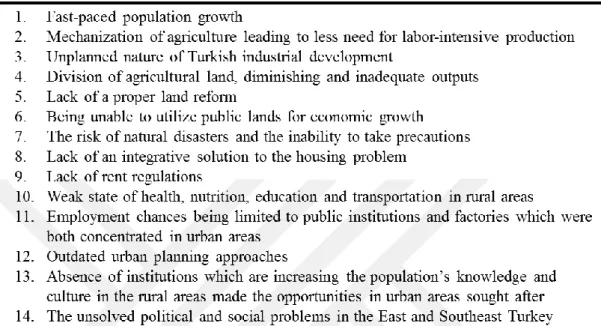
10. Main Driving Forces of the “Gecekondu” Problem 42
11. Negative News on Galleria Shopping Center from Milliyet Archives 45
12. Basic Shopping Center Feasibility Model 65
13. ULI Community Catalyst Report: Implementation Plan 72
14. Living Building Challenge 3.1 Standards Overview 77
15. Scoring System in AHP 87
16. Survey Setup and Flow Used for all Participants 91
17. AYD Participant Companies and Their Portfolios 94
18. AYD Survey’s Final Weights for Pillars and Sub-factors 94
19. Expert Panel Members 99
20. Expert Panel Results Overview 102
ix
List of Figures
1. Common Visualizations of Weak Sustainable Development 5
2. Sustainable Development Based on Strong Sustainability 5
3. Simple Visualization of the Study’s Model 6
4. Economy as a Pie 12
5. Social Impact Ecosystem 28
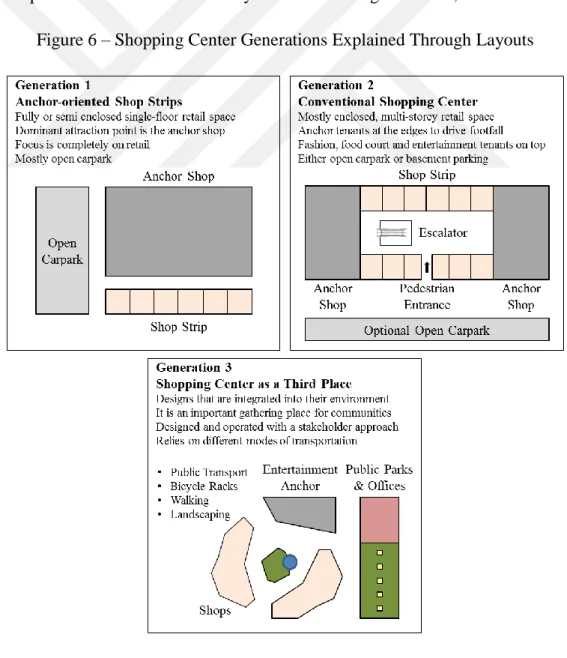
6. Shopping Center Generations Explained Through Layouts 37
7. Urban Development in Istanbul 43
8. Major Shopping Center Openings in Istanbul 47
9. Inter-connected Stagnation Scenario 49
10. m2 GLA Sales Performance Data for July 2016-2019 50
11. Simple Visualization of the Study’s Model 54
12. Basic Calculation of the Retail Demand Potential 58
13. Drive Time and Radial Catchment Area Approaches 58
14. Methods of Transportation of the Turkish Visitors 60
15. Ridiculing the Public Investments in the Road Networks 61
16. Optimized Land Use for a Sustainable Urban Life 80
17. Straightforward Decision-making vs. AHP-backed Decision-making 88
18. Description Page for the Model’s Pillars and Sub-factors 90
19. Sample Calculation for the Final Sub-factor Scores 92
20. Digital Stakeholder Realm Draft Proposal 108
21. “Campbell's Soup Cans” by Andy Warhol 114
1
Chapter 1
Introduction
Over decades, shopping centers have become the staples of contemporary urban life; inevitably accompanied by numerous prophecies of rise and fall along the way. Sometimes simultaneously, sometimes successively, they have been glorified and parodied, seen as modern marvels and obsolete remnants of a long-gone age… At a time when cities throughout the world tend to become more and more similar to one another, it is virtually impossible to analyze shopping centers as an isolated or regional incident. In this respect, being accustomed to shopping centers and truly understanding them as a typology are two completely different things.
The increasing similarities among different cities are not the sole issue here. Cities and their quasi-natural byproducts such as shopping centers are also growing in size every day; in one form or another. Concurrently, concerns have been increasing and intensifying too. As expressed in this study, these concerns are not only limited to the economics and mechanics of the related business models either. There are more fundamental issues at stake here; issues that are overlooked for so long. This study puts forth these issues through the lens of sustainable development and the paradigm of strong sustainability, while focusing on the shopping center business. This field of commercial real estate development is facing a new breed of challenges that can take place concurrently or individually in the majority of the geographical markets around the world.
Istanbul is far from being an exception in this respect. Accelerated and strategic action is needed for rehabilitating and improving the city’s immense shopping center market –which does not only pose risks in a commercial sense but also in the equally important social and environmental aspects. Accordingly, this study puts forward a practical multiple factor index model for the shopping center investment decisions in Istanbul. Main components of this model are based on the sustainability approach and they rely on both primary and secondary research. This entire structure is designed in a way that would be practical for all stakeholders to use as a strategic revelation document. Following three chapters covering the foundation work, the model is demonstrated and explained in full detail in Chapter 5.
2
It is important to cover the basics first. Shopping center is a commercial building typology that has its roots in the American suburbia; a post-WWII time glorifying single family houses and family cars. Yet, it has managed to become a global phenomenon and seemingly an inseparable part of so many cities all around the world. Shopping center is an object of desire and hate simultaneously (Barber 2015, Newsweek Staff 2005). After all, by 1987, 13% of the US’ gross domestic product (GDP) and 8% of its employment were coming from the shopping center market (Feinberg and Meoli 1991); leading to the belief that it must have been a modern economic miracle. However, a more recent study from Australia (McGreevy 2016) states that new shopping centers actually negatively affect the economy by cutting down local businesses and employment (starting slowly in the short-term and becoming a serious issue with the following snowball effect).
It is visible that, even via the limited lens of commerce, wholly and objectively evaluating the shopping center business is a challenge and commercial perspective alone is no longer enough. In line with the growing environmental and social problems, sustainability concerns and sustainable development strategies are gaining serious momentum. According to Cambridge Dictionary, sustainability is “the quality of being able to continue over a period of time”. One can easily think about the qualities of this planet as a whole with its wonderfully complex ecosystems and with humanity’s socioeconomic and cultural treasures. Degradation of this planet’s natural realm and capital, together with the severe issues at the socioeconomic side are both strikingly apparent. Sustainable development is an end-product of this revelation. It offers a set of principles which are aimed at re-balancing the ongoing negative trajectory by creating a new stakeholder perspective and by offering an integrated combination of new social, environmental and economic targets for attaining a just future and a sustainable coexistence. The concept of negative externalities should also be evaluated in relation to sustainable development. Such externalities occur when the individual benefits and costs resulted in a business scenario differ from the gross environmental and social burden.
This study, in order to narrow down the focus for attaining the most meaningful results possible, is looking at a specific city (i.e. Istanbul) and a specific market (i.e. shopping centers) through; (1) decoding the sustainable development principles and
3
the paradigm of strong sustainability, (2) conducting detailed secondary research and (3) realizing two separate primary research endeavors. Neither Turkey nor Istanbul, as the country’s economic and cultural capital, is exempt of the world’s problems. Even though the local shopping center market has a visible presence, it is clear that the shopping center typology is just one part of the complicated urban sprawl mechanisms. Even without its existence, Turkey and Istanbul would have to tackle other major sustainability-related challenges. Either way, shopping centers are here. As of year-end 2018, there have been 431 projects all around the country that correspond to 12.92 million m2 gross leasable area (GLA) and 123 of those (with 4.75 million m2 GLA, 37% of the entire national supply) are located in Istanbul; leading up to 316 m2 retail space per thousand Istanbulites (JLL 2019).
Shopping centers do not filter carbon, generate the vital oxygen, clean the soil or act as a home to the wildlife; which are the natural positive inputs of the forests that have been taken for granted for so long. Actually, shopping centers are net consumers of land and resources (both finite) and they leave large carbon footprints and pollutants behind them. Social issues constitute another crucial topic. In her research on the 20th century consumerism, Lizabeth Cohen (2003) shows that fusing citizenship and consumerism through suburban growth and shopping centers had been once seen as a way to create a prosper and equal society but the results of this social experiment were not that positive. Also in Turkey’s experience, shopping centers are accused of discriminating certain demographic groups and harming traditional craftsmen and the old socio-commercial areas (Erkip and Özduru 2015). Both social and environmental concerns are more serious in Istanbul, the largest shopping center sub-market in Turkey. More than thirty years have passed since the opening of the first Western style shopping center in Istanbul. In due course, shopping centers have become a dominant force in the megacity’s fabric –by not only changing how urban dwellers engage in economic and social activities but also by redefining the urban landscape and by creating a new social and environmental narrative. In Istanbul, an investment rush had taken place in 2000s with 48 projects being opened in a ten-year span (the year 2008 leading with 13 openings). The following decade also started with a similar push but as a result of the internal and external shifts (e.g. the subprime mortgage crisis, the following global tensions and
4
the eventual stagnation of Turkish real estate ecosystem), this trend is slowly but reassuringly coming to an end.
Table 1 – Recent Growth of the Turkish Shopping Center Industry (JLL 2014, 2015, 2016, 2017, 2018, 2019)
Following the national economic turbulence of the summer months, September 2018 saw the Presidential Resolution putting a hold on foreign currency lease contracts; removing the most crucial selling point of Turkish shopping center investments as a stable hard currency income generator. By that time, market saturation was already a serious topic in Istanbul (especially in and around the more sought-after areas such as Levent-Maslak CBD and the dense residential zones such as Bakırköy). Also, base rents and investment yields were and still are shattering, while operational costs and turnover performances are also continuing to show a negative trend.
At this point, it should be reaffirmed that this study is not only aiming at the commercial side of the deal. It is a common mistake to evaluate commercial real estate investments exclusively through the lens of their investors, financiers, service providers and tenants. This half-done approach also tends to see urban dwellers simply as customers, while leaving the environmental concerns almost entirely outside of the equation. Actually, Istanbulites (both as individuals and as members of various communities) and the environment are crucial stakeholders that must be more visible in the decision-making processes concerning the future of the city. In this respect, this study has created the much-needed sustainable development multi-factor model for the shopping center business –with a specialized approach towards Istanbul. As stated in the beginning, this model is following the paradigm of strong sustainability (i.e. putting environment -and natural capital- at the heart of its
Report Year # of centers m2 GLA 2013 352 9,5 mio 2014 344 10,0 mio 2015 368 10,9 mio 2016 375 11,2 mio 2017 401 12,2 mio 2018 431 12,9 mio
5
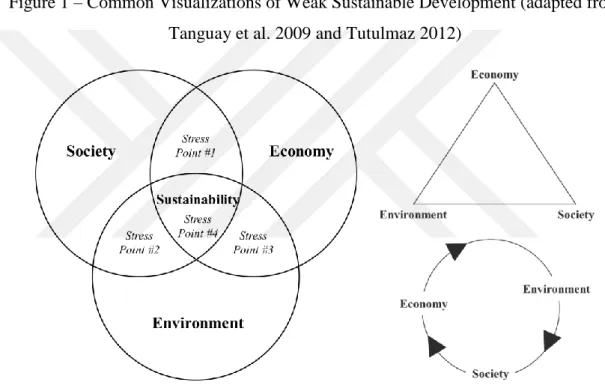
structure as the outermost and most crucial circle). According to this paradigm, everything is an integral part of the environment and the natural capital it embodies is lethally finite and non-replaceable (Noël and O’Connor 1998). Environment’s inner circle is society. Commerce, as the innermost circle, is actually just a set of anthropic structures. Some mainstream sustainable development approaches tend to visualize environment, society and economy as individual topics that are only partially interacting with each other (i.e. weaker correlation and higher interchangeability between different pillars). The basic visual comparison between weak and strong sustainability approaches can be seen below;
Figure 1 – Common Visualizations of Weak Sustainable Development (adapted from Tanguay et al. 2009 and Tutulmaz 2012)
Figure 2 – Sustainable Development Based on Strong Sustainability (adapted from Cato 2012)
6
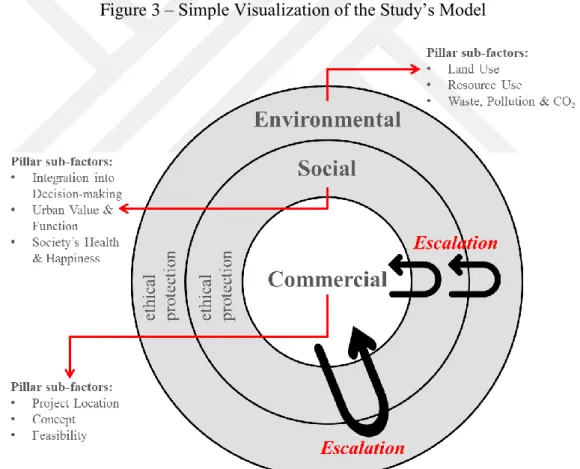
This study’s model makes the following additions to the discussion; (1) it identifies, through secondary research, the crucial shopping center industry-specific sub-factors of each sustainability pillar (three sub-factors for each pillar, nine in total), (2) it details the industry-specific headlines that are positioned below each pillar, (3) it establishes the inter-related action-reaction relationship between Environmental, Social and Commercial Pillars of sustainable development (e.g. any misconduct in one of the spheres can negatively impact others and all of these cumulative impacts can also later hit back to the original sphere –this perspective is visualized in the model through its genuine loop-back escalation arrows) and (4) it highlights that all three pillars must be working in an irreplaceable correlation and accordingly assigns ethical protection to the spheres of environment and society in the light of its primary and secondary research findings.
Figure 3 – Simple Visualization of the Study’s Model
The path leading to the model is laid down and expanded on through comprehensive literature review. During this process, certain fields have been checked; (1) weak vs. strong sustainability, (2) negative externalities, (3) sustainable development, (4) shopping centers as a global phenomenon and (5) the trajectory of Istanbul’s urbanization and its shopping center market. However, it must be stated that there is
7
a serious lack of publicly available, sufficient and comparable data for the Istanbul shopping center market. Both private (i.e. investors, financiers, service providers and tenants) and public (i.e. municipalities, central government and other public offices) sectors either do not have the relevant data themselves or they are not willing to share what they have. This model is neither an investment calculator nor a spatial endeavor. In this respect, it shall serve as a practical evaluative tool that can be utilized by all stakeholders – something that is urgently needed for developing a new, inclusive and strategic perspective for assured long-term sustainability.
Still, the principle visualization (see “Figure 3”) is just one part of the overall model. The other crucial component comes in the shape of a checklist (i.e. Project Checklist) that organizes all of the related evaluative elements into a practical analysis tool. In this new tool, each sub-factor has equal (i.e. four) maximum points for a potential total of thirty-six points for all listed elements. All sub-factors have certain headlines (a total of twenty-six) that are also determined through literature review. Qualified majority approach is used for the final “checklist pass grade” (two-thirds majority in this case). In a nutshell, Project Checklist; (1) upholds all three pillars of sustainable development, (2) gives them equal weight and importance, (3) expects a final score that would pass as a qualified majority without principally failing in any of the pillars and (4) operates as a readily-available, practical medium for all stakeholders.
Chapter 5 contains detailed definitions of all major pillars, sub-factors and headlines. Since every building needs a purpose that it can successfully fulfill, this study also takes a constructive look the related commercial issues. The Commercial Pillar has the following sub-factors; (1) Project Location which looks at the catchment area, competition, accessibility and micro-location traits, (2) Concept which is designed for successfully reading the ever-changing wants and needs of the target customers and innovatively, flexibly and humanely reflecting these in all aspects and (3) Project Feasibility which defines the profitable balance point between income and cost sides, while also looking at the long-term stability and availability of a sound exit strategy. While numerous studies have a deeper look at the commercial issues and mostly end up with this narrow perspective, this study elaborates on all relevant aspects of shopping center development. This has led to the formulation of a 360-degree approach that also contains Social and Environmental Pillars. Social Pillar offers the
8
following sub-factors; (1) society’s integration into the decision-making processes regarding shopping centers (i.e. defining a reasonable and operable middle ground for more active and solution-minded participation by the communities at all stages of the investment), (2) creating urban value and function that shall showcase the mutual qualities and sustainable coexistence of form (i.e. a line of deep-rooted intangible requirements and taste elements) and function (i.e. a building’s utility, ability and practicality) and (3) social health and happiness that are generated through equitable, civilized and healthy living grounds that are fully connected to nature and human emotions via green and responsible design, construction and operation.
Of course, the model would not be complete without the Environmental Pillar –the all-encompassing outermost circle in this study’s structure. Environmental Pillar has the following sub-factors; (1) Land Use (i.e. the initial decision to build a shopping center that would be the initiator of all following environmental concerns, while also being a risky move for the already fragile urban-nature areal balance), (2) Resource Use (i.e. the impact of resource use during extracting, processing, transporting and implementing) for the entire building life cycle of a shopping center and (3) the gross negative environmental impact (i.e. all the air, water and soil pollution, waste and CO2 emissions that shall be generated). As a result of the depleting natural resources,
there is a growing tendency towards strictly limiting Greenfield endeavors (i.e. not developing on a site that is not already a part of the existing built environment) and giving utmost care to limit and, better still, reverse the negative impacts of current and future real estate developments.
As previously stated, this study is not solely dependent on secondary research but it also utilizes the merits of two primary research endeavors. Through the setup that is established during the secondary research process, primary data was gathered from two different sources with two different methods; (1) a survey based on the pillars and sub-factors of the abovementioned model that follows Saaty’s (2008) analytical hierarchy process model (AHP) which was applied face-to-face to the top decision-makers of 84% (twenty-one companies replied out of twenty-five eligible ones) of AYD members which currently hold at least one self-developed Istanbul shopping center in their portfolio and (2) a panel comprised of three experts working on different fields of sustainability in which all participants answered two
pre-9
determined open-ended questions in structured face-to-face interviews. AYD participants represent 43% of the entire Istanbul market in terms of m2 GLA.
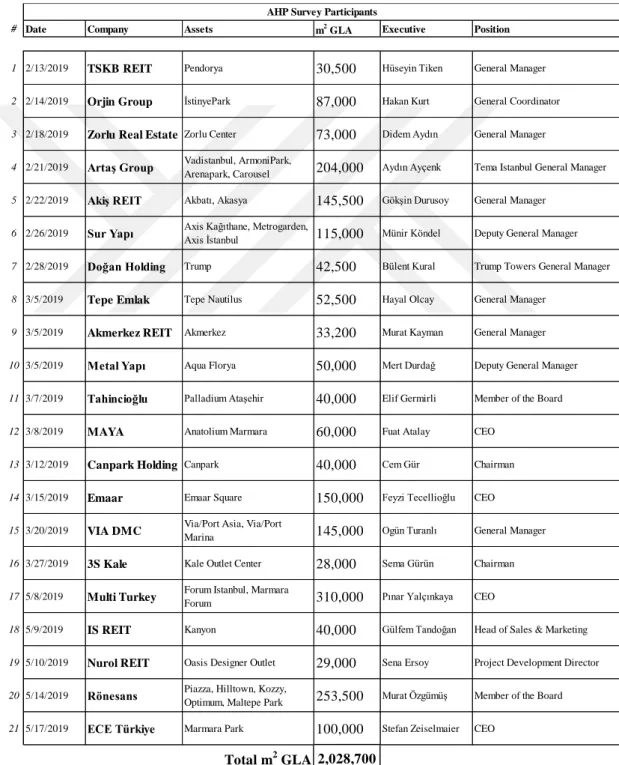
Notably, this is also the first time that a study based on Istanbul shopping center market is (1) reaching out to the top level of the industry and (2) fortifies its stance through additional research endeavors. Participant details can be seen below;
Table 2 – AYD Participant Companies and Their Portfolios
# Date Company Assets m2 GLA Executive Position
1 2/13/2019 TSKB REIT Pendorya 30,500 Hüseyin Tiken General Manager
2 2/14/2019 Orjin Group İstinyePark 87,000 Hakan Kurt General Coordinator
3 2/18/2019 Zorlu Real Estate Zorlu Center 73,000 Didem Aydın General Manager
4 2/21/2019 Artaş Group Vadistanbul, ArmoniPark, Arenapark, Carousel 204,000 Aydın Ayçenk Tema Istanbul General Manager 5 2/22/2019 Akiş REIT Akbatı, Akasya 145,500 Gökşin Durusoy General Manager
6 2/26/2019 Sur Yapı Axis Kağıthane, Metrogarden,
Axis İstanbul 115,000 Münir Köndel Deputy General Manager
7 2/28/2019 Doğan Holding Trump 42,500 Bülent Kural Trump Towers General Manager
8 3/5/2019 Tepe Emlak Tepe Nautilus 52,500 Hayal Olcay General Manager
9 3/5/2019 Akmerkez REIT Akmerkez 33,200 Murat Kayman General Manager
10 3/5/2019 Metal Yapı Aqua Florya 50,000 Mert Durdağ Deputy General Manager
11 3/7/2019 Tahincioğlu Palladium Ataşehir 40,000 Elif Germirli Member of the Board
12 3/8/2019 MAYA Anatolium Marmara 60,000 Fuat Atalay CEO
13 3/12/2019 Canpark Holding Canpark 40,000 Cem Gür Chairman
14 3/15/2019 Emaar Emaar Square 150,000 Feyzi Tecellioğlu CEO
15 3/20/2019 VIA DMC Via/Port Asia, Via/Port Marina 145,000 Ogün Turanlı General Manager
16 3/27/2019 3S Kale Kale Outlet Center 28,000 Sema Gürün Chairman
17 5/8/2019 Multi Turkey Forum Istanbul, Marmara Forum 310,000 Pınar Yalçınkaya CEO
18 5/9/2019 IS REIT Kanyon 40,000 Gülfem Tandoğan Head of Sales & Marketing 19 5/10/2019 Nurol REIT Oasis Designer Outlet 29,000 Sena Ersoy Project Development Director 20 5/14/2019 Rönesans Piazza, Hilltown, Kozzy, Optimum, Maltepe Park 253,500 Murat Özgümüş Member of the Board 21 5/17/2019 ECE Türkiye Marmara Park 100,000 Stefan Zeiselmaier CEO
Total m2 GLA 2,028,700 AHP Survey Participants
10
Table 3 – Expert Panel Members
Visibly against the findings of this study’s extensive literature review, it has been observed that AYD participants heavily favor the commercial aspects of the Istanbul market (see “Chapter 5” for the details). This is why the sustainability expert panel is added to the overall structure; leading to a two-tier primary research endeavor. Three leading experts of this special purpose panel are working on a line of sustainability-related causes. The participants have identified the social and environmental risks encircling the shopping center market and the proposed ways and means to minimize these risks. Significantly, panelists have put forward numerous highly similar and/or sequential ideas during this process. This additional dataset reassures the results of the literature review, brings overall balance to the study and leads to the final version of the model that specifically highlights the joint importance of Social and Environmental Pillars. In the end, it is proposed that no existing or future project shall skip the related requirements in terms of the inter-related cornerstones of commercial, social and environmental sustainability.
Much has to be covered before going into the details of the model and this study’s detailed findings. This introductory chapter is followed by three crucial supporting chapters, then a full chapter on the model (i.e. structure, findings, limitations and future research topics) and a concluding chapter for fully covering the topic and opening the way for future research. The supporting chapters are; (1) theory and practice of sustainable development, (2) history and evolution of shopping centers in general and (3) shopping centers’ place in Istanbul’s urbanization and the sub-market’s dynamics. Accordingly, this study offers a new perspective both for newcomers and experts of sustainable development and/or the shopping center industry –with a detailed look at Istanbul and its sub-market. However, this study’s audience is not limited to these groups. Hopefully, readers that are interested in decision-making processes and urban planning would also find it rather enthralling.
11
Before going into more detail, let’s remember Thorstein Veblen. In his inspirational work on the “leisure class”, among many things, Veblen (1899) also looks at the artificial positive correlation that the society forms between high price and quality. Veblen points out that the actual form and function of objects (i.e. traits of quality) are not directly related to the anthropic aspects such as money and status. In recent years, quite interestingly, luxury objects have become more abundant (thus, less stratifying) and they are consequently losing their preeminence and leaving the top spot to the new upper-class belief systems that separate the fortunate from the struggling on a much more pressing moral, psychological manner (Henderson 2019). Regardless of all these periodical changes, Veblen’s statements on the inner workings of society are still fundamentally valid in our age –even though Veblen developed these ideas at a time when nature had not been understood as this lethally important but finite and fragile element yet. Now, humanity’s (and therefore the world’s) trajectory is way more alarming than ever with its inclusion. There is not much time left to leave all forms of the leisure class behind and focus on things that are actually important for the sustainability of this majestic planet. There is a serious need to establish an aware and responsible society and to seriously reshape our economic doctrine for the wellbeing of all stakeholders. This study, even in all its intensity and subject focus, shall also help the readers in this respect.
12
Chapter 2
Theory and Practice of Sustainable Development
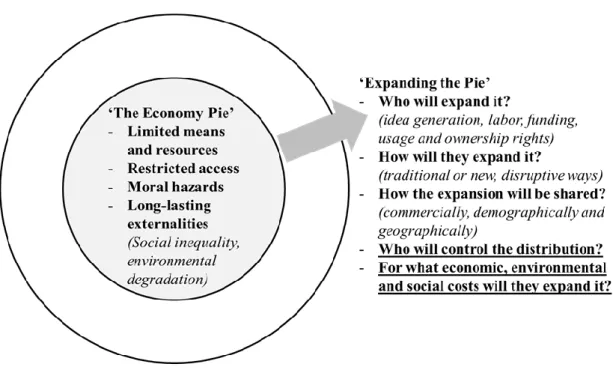
The global economic system have been metaphorically identified as a divisible and expandable pie on numerous occasions –for example, among many more, in Sinha and Sheth’s (2018) take on the emerging markets and how to expand the pie, in Angelis and Levesque’s (2006) comparison of a bigger slice and a larger pie from the lens of new firms and even in Bazerman et al.’s (2001) reasonably built critique of the hidden agendas of states and state officials in their popular book “You Can’t Enlarge the Pie”. It is important to understand the inner workings of this metaphor; as this would also support the upcoming discussion on the current global economic system. For that matter, economy as a pie would be finite, even when the expansion potential is considered. The growth is not equitably distributed or accessed by all social strata –because of the shortcomings and/or blank spots at individual, social and environmental levels (Cohen 2016). The control, ownership and expansion of this pie are also highly debatable. How and by whom this so-called pie is currently controlled, divided and expanded? Who gets the most benefits out of it; especially when many stakeholders inescapably face the negative aspects? “Figure 4” is a visual representation of these concerns regarding the pie metaphor.
13
Individuals, communities and organizations –be it a for-profit, an NGO, a state, a trade union or an educational institute– are the more easily recognizable stakeholders and people tend to analyze them predominantly through their economic relationships. Apparently, this is the more dominant tendency, even when a critical argument is put forward. This is also currently happening with statistical measurements such as gross domestic product (GDP). Actually, GDP is not a fully fitting benchmark for truly understanding the modern social mechanisms; as it is focusing solely on the narrative of economic growth (Gertner 2010). According to one estimate, the wealth of the richest one percent of the world is growing twice as fast as the wealth of the rest of the global population and this may potentially lead up to a 2030 scenario in which the richest one percent would own two-thirds of the entire wealth (Savage 2018). This is at odds with the ongoing rhetoric regarding the alleged decrease in the global inequality since 1970s. However, that drop has happened only in relative terms and since the poorest people started on such a low point, after so many decades, the inequality has actually increased in absolute terms (UNU 2016).
Another pressing problem is the degradation of nature (both from areal and quality sides) amid its role as a key stakeholder. While the environmental concerns are growing, most of the global actors are still trying to find new ways to pursue their old economic goals and even choose to counter these concerns with marketing gimmicks (i.e. building a green front that hides the major problems from those concerned; an act that is casually called “greenwashing”) (Brenner 2014).
Humanity’s striking pace has been increasing its pressure on the environment. Even though Industrial Revolution and its aftermath had created vast economic growth, majority of the spoils actually went to the creation of the Western industrial capital and this colossal shift has been leading to widespread and intense social and environmental degradation throughout the globe (Bergquist 2017). This trend can also be analyzed under the negative externalities umbrella. It is known that such externalities occur when the individual benefits and costs resulted in a business scenario differ from the gross environmental and social burden (e.g. neither the steel factory nor the shopping center investor is held responsible for the waste, pollution and CO2 emissions generated during the production of the necessary steel for the
14
steel). Thinking purely in economic terms (i.e. not properly taking into account the externalities) and trying to by-pass social and environmental responsibilities have become extremely unsustainable (The Union of Concerned Scientists 2016, Müller 2019).
Since 1970s, sustainable development has been steadily increasing its importance under these critical circumstances. Basically, it is a set of principles and applications that can rebalance the world’s negative trajectory through an integrated combination of new social, environmental and economic targets for the sustainable coexistence of all stakeholders. Economy is not something that can be conceptualized out of the realm of society; instead, it is completely embedded in social structures (Machado 2011). Societies and all of their systems are also unbreakably tied to environment. Nothing can be a real enclosed, offline case in such a connected structure. Even the actions that are taken subconsciously (such as visiting a shopping center or buying a plane ticket) can have negative environmental outcomes.
However, more detail is needed before proceeding further with the research premise. Therefore, this chapter takes a deeper look at the major elements; (1) the environmental and social impacts of the modern economic system, (2) sustainability, negative externalities and sustainable development (for understanding the essential theoretical and practical approaches), (3) real estate’s global impact (for a basic understanding of the built environment and urbanization) and (4) the environmental and social impacts of the shopping center business (for a case-specific overview).
2.1 Environmental and Social Impacts of the Modern Economic System
A recent Asian Development Bank (ADB) report pointed out that global perceptions and business methods regarding economic growth must change to tackle climate change; otherwise the frequency of natural and manmade disasters and the burden of social degradation would both continue to increase (Thomas and Lopez 2015). This imbalance created by the climate change has its source in global CO2 emissions that
are mostly a result of fossil fuel extraction, processing and use. According to the interactive environmental dataset of Ritchie and Roser (2017), at the beginning of Industrial Revolution around 1760, the annual global CO2 emissions had been just 11
15
CO2 is constantly piling up in the atmosphere as the human civilization has emitted a
staggering amount of 2100 Gt (gigatonnes; i.e. 1.000.000.000 metric tonnes) already; with just a 800 Gt margin remaining (i.e. only enough for around 20 years with the world’s current economic pace) for managing to limit the average global temperature increase for the whole 21st century around 2° C above the pre-industrial levels as per the Paris Agreement of 2015 (Peters 2017). However, the world’s governments are short of achieving this goal; as the current pace can even end up in a temperature increase as high as 3.2° C by the year 2100 (Miller 2018).
Yet, from an environmental perspective, there are many other problems in addition to climate change. There are also pollution and waste problems alongside with the loss of natural areas and resources. Outdoor air pollution had increased by 8% in urban areas around the world between 2011 and 2016 alone and with 3 million deaths each year; it evolved into the most deadly individual hazard (Vidal 2016). At the other end, water pollution claims around 1.8 million lives annually, while both manmade water contamination (because of radioactive substances, oil pollution, sewage and wastewaters) and water’s excessive use also seriously threaten the long-term sustainability of global ecosystems (Denchak 2018). According to a WRI report (Luo et al. 2015), if countries cannot find more sustainable ways to preserve their water resources and go on to proceed as they currently do, out of 167 countries analyzed, 33 would face “extremely high water stress” (including Turkey), while another 26 countries would face “high water stress” by 2040.
Of course, all of these immediate threats have been understood and analyzed from a predominantly human-centric perspective. This can be useful to trigger a demand for more substantial change but it is ultimately inadequate. One has to also think about the sea life and the life on and above land –endless amounts of organisms that have the right to prosper as much as humans do. Sadly, the ongoing loss of natural areas is not helping in this respect. Strikingly, 10% of the world’s wilderness had been lost between 1993 and 2016 (around 3.3 million km2); further limiting the global carbon storage capacities and creating an existential risk (Vaughan 2016). Currently, a similar story is also unfolding at the side of natural resources. Global Footprint Network annually calculates the global human consumption and compares it with our planet’s capacity to regenerate. They calculated that, by 1 August 2018 (i.e. Earth
16
Overshoot Day), the humanity had already consumed more than the planet could have regenerated for the entire 2018 (meaning that around 1.7 Earths are needed for the current pace) and some experts think that even these terrifying assumptions can very well be understatements (Richardson 2018).
The modern economic system misguidedly looks at the nature’s realm as a source of raw material and an area to be cleared for the expansion of the built environment. As a result, countless different industries create substantial amounts of end products each year and some of these instantly turn into waste. This is another crucial problem. Each waste item that is not separated at its source and not transferred to a treatment facility to be reused or recycled would create new environmental problems. Even when the EU countries are considered (representing a highly-developed part of the world), it is seen that they can only recycle 36% of their waste (WHO 2015). There is another dangerous trend among developed countries involving the transfer of large sums of waste to countries like China for recycling. Yet, there are valid concerns regarding the actual fate of the shipped waste; as some shipments are seemingly not treated at all (O'Neill 2017).
Environmental degradation created by economic activities is actually harming the societies all around the world; way beyond health problems, deaths and disasters. Just to give some examples; (1) environmental degradation has a huge impact on the quality, quantity and just distribution of agricultural products (Ackerman and Stanton 2013) and (2) economic activities that lead to environmental degradation tend to create their own vicious circles as they have net winners and losers that create even larger wealth and power inequalities, which then lead to even more degradation and inequality (Boyce 1994). Thus, through the misuse of environment, especially the people in disadvantaged regions and communities are constantly affected negatively. Even for the most essential needs, the outlook is bleak. Thus, it is no surprise that some of the most deep-rooted social problems are connected to the sphere of environment in one way or another.
Even when the environment is taken out of the equation (i.e. exclusively focusing on the relationship between economy and society), the situation does not get brighter. Even though its results have been speculated, Oxfam issued a striking report based on the Credit Suisse data in 2016 that outlined that the richest one percent of the
17
world’s population has accumulated more wealth than the rest combined for the first time in history; with tax havens keeping $7.6 trillion of wealth hidden, while the income of the poorest people rose by less than $3 per annum during the past quarter of a century (Oxfam 2016). Keeping the reservations about these findings aside, this means that the economic system is failing to prevent the wide-ranging inequality. It is natural to assume that national policies and economic trajectories highly matter in this respect. Yet, research shows that economic inefficiency is not something exclusive to poorer nations. People in the US and Europe are also critical of poverty, weakening of democratic values and unfairness (Starmans et al. 2017). As a source of this displeasure, bottom half of the US citizens have captured just 3% of the growth generated since 1980 (Porter and Russell 2017). According to Kristof (2015), neoliberal policies in the country are playing their part in the deteriorating education levels and the concurrent rise of inequality, incarceration and family breakdowns. Growing trade volumes, new routes and global interconnectedness are also among the most praised features of the current economic system. Yet, they are not exempt of criticism either. Even though global trade should theoretically support and enable countries that are experiencing problems such as food shortages, the research suggests that it may also lead to; (1) overproduction in exporter countries, (2) unfair competition for the farmers in the importer countries and (3) countries with limited food resources nonetheless exporting their production overseas (D’Odorico et al. 2019). Arguably, World Trade Organization’s (WTO) policies are harming poorer nations as tariffs and agricultural subsidies are not welcomed in the name of worldwide trade liberalization (Narula 2010).
2.2 Sustainability, Negative Externalities & Sustainable Development
AtKisson and Hatcher (2001) are on the spot by saying that sustainability is a large, utopic, far-reaching goal that would always create competing definitions but it shall almost always be about the long-term integrated efficiency and coexistence of nature, economy, people’s lives and their social structures. Sustainability has its source at the growing imbalance and rapid degradation that limits this planet’s chances of survival. According to Liu (2017), sustainability can be found between the monotonous aspects related to the duality of increases and decreases. Constructing
18
one more building (i.e. increased urbanization and more wealth for the developers) and, thus, ripping the nature off its realm and resources a little more (i.e. decreased nature) may also mean displacing local communities and/or harming their existing socioeconomic structures (i.e. decreased social wellbeing). Therefore, if this new building would not be constructed at all or the supposed needs would be sorted out through a truly sustainable manner, everything shall continue to be in a balance as they are –free from zero-sum increases and decreases.
Situations in which an entity is experiencing a decrease because of an increase unrelated to its prosperity have become a crucial economic stigma. This phenomenon is called negative externalities. IMF’s Thomas Helbling (2010) states that economic activities also affect the parties that are not part of the actual transaction and such effects can be negative and not necessarily limited to the economic sphere either. Helbling gives the example of pollution; as a polluter only thinks about the direct costs and opportunities and leaves out the indirect costs incurred by those outside of his/her business deal. Water, soil and air pollution generally harms those who have little or nothing to do with their source. Helbling also stresses the importance of public and environmental good and the ability to trace negative externalities back to their sources and quantifying them (e.g. in terms of additional taxation and/or burdens for the causing parties), while also accepting the fact that uncertainties would make these processes highly challenging. Still, successfully internalizing the externalities through different taxing strategies has the potential to annul the competitiveness deficit of real sustainable firms –especially because it would also remove the unjust price differences (Nguyen et al. 2016).
Bangladesh is a good example in this respect. The country’s coastal agriculture areas have been heavily affected by the negative impacts of climate change (a phenomenon that the country itself is not a significant contributor to); forcing people who have never even heard of global warming to make a losing bet between staying in their devastated homelands or moving to the cities to work in highly challenging blue collar jobs (McDonnell 2019).
Negative externalities concept is important for better understanding why Industrial Revolution’s legacy and the concept of economic growth have different meanings for different people –a duality of total dominance and subjugation. At one side of this
19
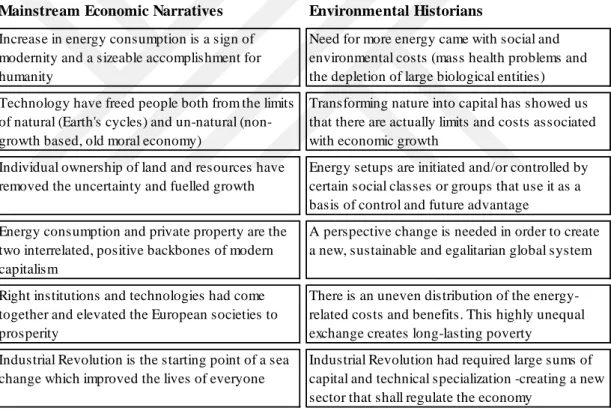
duality, neoclassical economic approaches are located. They are openly criticized by a newer generation for allegedly defending certain grave assumptions, such as; (1) only the materials that are exchanged in a market are to be recognized, (2) consumption would create no waste (i.e. consumed objects would disappear in the calculation) and (3) non-economic goods such as water and air should be completely left out of the economic analysis (Centemeri 2009). In order to visualize the differences between the old and the new, Barca’s (2011) comparison between the post-Industrial Revolution economic narratives (that are still dominating the discussion) and the much newer narratives developed by environmental historians can be analyzed;
Table 4 – Mainstream Narratives vs. Environmental Historians (Barca 2011)
The concept of necessitated balance is an important part of the sustainability thought. This creates a legitimate concern regarding future economic growth; especially for individuals, communities, companies and countries that have not been able to “develop” before the essentiality of sustainability kicked in. To attain prosperity and assume a purpose in life, everyone needs a chance for growth and self-realization (Campagnolo 2018). However, the way growth has been conceptualized since the Industrial Revolution onwards is dangerous for all stakeholders.
Mainstream Economic Narratives Environmental Historians Increase in energy consumption is a sign of
modernity and a sizeable accomplishment for humanity
Need for more energy came with social and environmental costs (mass health problems and the depletion of large biological entities) Technology have freed people both from the limits
of natural (Earth's cycles) and un-natural (non-growth based, old moral economy)
Transforming nature into capital has showed us that there are actually limits and costs associated with economic growth
Individual ownership of land and resources have removed the uncertainty and fuelled growth
Energy setups are initiated and/or controlled by certain social classes or groups that use it as a basis of control and future advantage
Energy consumption and private property are the two interrelated, positive backbones of modern capitalism
A perspective change is needed in order to create a new, sustainable and egalitarian global system
Right institutions and technologies had come together and elevated the European societies to prosperity
There is an uneven distribution of the energy-related costs and benefits. This highly unequal exchange creates long-lasting poverty
Industrial Revolution is the starting point of a sea change which improved the lives of everyone
Industrial Revolution had required large sums of capital and technical specialization -creating a new sector that shall regulate the economy
20
Sustainable development concept is gaining momentum partly because of such concerns and dilemmas. This concept had been recognized for the first time in a United Nations conference in 1972 but its importance increased as a result of the famous Brundtland Report titled “Our Common Future” in 1987 and a global summit in 1992 (National Assembly for Wales 2014). With the mounting negative socioeconomic and environmental problems, slowly but emphatically, sustainable development is now leaving the realm of intellectual discussions and becoming mainstream; a core topic for ordinary people as well as for NGOs, states and companies. The main premise of the concept is rather straightforward; human-made structures should be arranged in such a way that there must be a long-term balance between environment, society and economy. Therefore, sustainability is not a way to attack growth but, instead, a way to change the widespread understanding of the economic growth patterns.
It is observed that different entities are thinking differently about how to apply the transformative sustainable development principles; even though they principally agree on the sustainable development’s basic premise. These differences can be reduced to a simple comparison; weak sustainability vs. strong sustainability. Weak sustainability is a paradigm which defends that manufactured capital and natural capital are direct alternatives of each other and the value they shall create would not be different (Noël and O’Connor 1998). On the other hand, strong sustainability puts environment at a central and irreplaceable position. Pelenc and Ballet (2015) have a three-step rationale against the defenders of weak sustainability; (1) the quality difference (i.e. while the manufactured capital is highly reproducible and its loss would not be unrecoverable, natural capital is the opposite –its essentiality and rareness makes it an existential subject), (2) the incomplete transformation (i.e. natural capital is essential for creating manufactured capital and there is no way that the end product would substitute for the tangible biological and intangible social values of the natural capital) and (3) increased future problems (i.e. consumption of manufactured capital today shall create an even worse natural status quo for future generations).
While it has been discussed on numerous occasions (even though in a more limited fashion when compared to the rest of sustainability literature), strong sustainability is
21
still in need of a practical, operable framework (Neto et al. 2018). Nonetheless, with lines blurred and giant wheels of life are turning at an alarming pace, supporters of strong sustainability paradigm argues that their cautious approach towards natural capital brings additional long-term value (Dietz and Neumayer 2007). The notion of thinking beyond the constraints of “capital” (as nature can easily be conceptualized as a larger mechanism than such economic terms) and focusing less on human-centric views (for justifying the necessity of sustainability) are also highly important (Ang and Van Passel 2012). Last but not least, it must be noted that sustainable economic growth is highly dependent on mutual, concurrent success at social and environmental sides (Hediger 2006).
Manufactured capital is indispensable for economic activities and how the societies work. However, it comes with its own dangers and defects. Clearly, overproduction, pollution and waste are major environmental inefficiencies of the modern economic system (Emas 2015) and the moral results of focusing purely on economic growth should not be overlooked (Friedman 2006).
In line with this, the UN’s 17 sustainable development goals (i.e. “2030 Agenda”) takes into consideration economic, social and environmental aspects inter-relatedly (e.g. energy should not only be affordable but also sustainable for a deep-lasting impact on the current situation). Within the scope of “2030 Agenda”, the UN Secretary-General Guterres has stressed how dire and urgent the global problems are and that everybody should collaborate to realize these sustainable development goals (UN 2018a). An overview table (“Table 5”) is given below;
22
It is true that these goals feel more like a wish list rather than an action plan. They are also predominantly human-centric; thus, they are mostly applying an inside-out philosophy (i.e. starting from economy, then tying it to society and treating the environment occasionally as an outside topic). Four years on, the list is also seen more as rhetoric rather than as an actual action plan (Kroll 2019) but it is important for highlighting the global headlines related to the ongoing interrelated economic, social and environmental challenges.
2.3 Real Estate’s Global Impact
Buildings are responsible for consuming 32% of the global energy resources, while also causing 25% of all the human-related CO2 emissions each year (WRI 2016).
Construction is among the core motivations behind extracting and using non-renewable minerals and fossil fuels that cause high environmental damage (Graham 2005) and possibly up to 30% of the building materials delivered to a construction site end up turning into waste (Osmani 2011). Yet, problems do not end when the construction phase is over. Only 20% of the CO2 emissions occur because of the
better-known building life cycle steps (production, transportation, construction, maintenance and demolishment), while the remaining vast majority of CO2 emissions
are a result of the long operational periods (UNEP SBCI 2009). Illumination, air-conditioning and other high energy-consuming devices and zones are among the main emission generators.
Then again, emissions are just one part of the equation. There are other problems such as waste, pollution (air, water, soil) and natural resource and area use. Be it a farm, a factory, a hotel, an office, a shopping center or a complex urban settlement, a substantial part of the environmental threats is coming from the buildings.
Problems are not only related to the nature. Research shows that the immediate built environment also has a huge impact on the psychological and physical wellbeing and healing processes (Huisman et al. 2012). Again at the socioeconomic side of the issue, it is seen that real estate has left the field of providing shelter and key utilities –essential goods for each person– and entered into the field of business development and financial speculation for increasingly high profits; a situation that is threatening both macro and micro level blocks of human civilization (Moore and Schindler
23
2015). At the slightest, periodical waves of optimism and/or moral hazards created by the real estate market players proved to be dangerous for the long-term stability as they tend to create bubbles that may later turn into disastrous banking busts (Herring and Wachter 1998). This is what had happened in the aftermath of the subprime mortgage crisis in the US. Unemployment doubled and a sizeable portion of the net worth of households had been lost (e.g. one in every four households lost three-fourths of their wealth; a phenomenon which concentrated mostly on low-income, low-education and minority households) (Christelis et al. 2015, Pfeffer et al. 2013). Social and environmental harm that has been caused by market speculation and the built environment can reach to new heights, especially if the output is not utilizable. According to a recent study, even without taking into consideration the pipeline projects, China now has a world-leading residential vacancy rate of 22.4% that corresponds to more than 50 million empty units (Bloomberg 2018). This means that huge amounts of resources both in terms of building materials, manpower and capital have been inefficiently spent –while also causing environmental degradation. Similar problems are experienced all around the world with varying magnitudes; the number of finished but unsold residential units was recently recorded as 2.374 in London and one of the main explanations put forward was that an average house would cost a Londoner 14.5 years of its paycheck (Smyth 2018) –while at that time the same figures were around 187.000 residential units (BloombergHT 2018a) and 12.5 years (TUVİMER 2017) respectively for Istanbul. In this example, Istanbul has around 80 times more vacant residential stock than that of London’s, regardless of the relative affordability being higher in the former. These figures show that long-term strategic planning is at least as important as pricing.
Yet, such anomalies are not exclusive to the housing sector. It is just one of the ways of portraying real estate related socioeconomic problems –like industrial production which is the traditional scapegoat for the overall environmental problems. In reality, other real estate sectors are also prone to generating similar problems.
2.4 Environmental Impacts of Shopping Centers
Shopping centers need a complete re-thinking. Form an environmental standpoint; (1) they expand the reach of urbanization to the disadvantage of nature, (2) huge
24
amounts of building materials and energy are required during their construction processes, while even more is needed during their long operational periods and (3) they also create substantial amounts of waste, pollution and CO2 emissions
throughout their building life cycles. It is neither sustainable nor feasible to keep them as traditional consumption hubs for any longer; more production-orientation and efficiency in area and resource use are desperately needed (Máté 2012).
According to İlhan and İlhan (2018), around 2016, the total global shopping center GLA had already been well above a billion m2, while the average lettable area per project was approximately 20.305 m2. In other words, only the leasable portion of the global shopping center stock (i.e. even without large customer circulation areas and other non-leasable portions that would roughly correspond to 30% of the total retail building area and the parking spaces that can sometimes be as large as the retail area itself) would cover the floor space of around 2.580 of Boeing’s iconic Everett Factory, probably the largest factory building in the world.
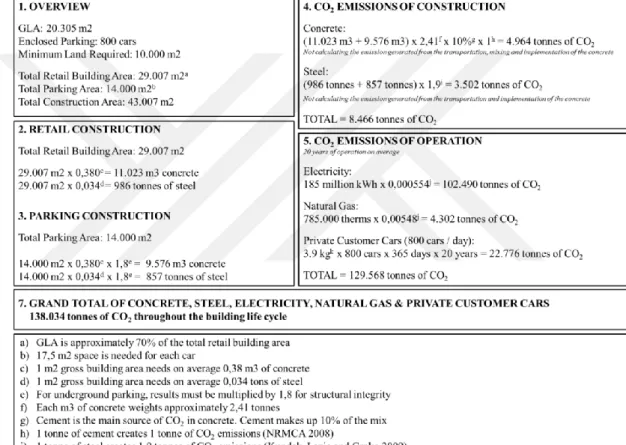
In line with this, shopping centers also use sizeable amounts of land (some individual projects have land plots larger than 100.000 m2). It is extremely important that such high levels of urban land use would be thoroughly planned in the most efficient, justifiable way (Beyard et al. 2006). In relation to the overall durability of buildings, once the urban land is inefficiently used, it shall almost certainly remain inefficient for a long period of time (Kono and Joshi 2019). It is projected that the nature’s realm would continue to shrink in size as the global urban population is expected to be 6.7 billion people (i.e. 68% of the future global population) by 2050 (UN 2018b). However, absolute sizes and urban sprawl are not the only issues here. Resources that shopping centers use and their final weight on other environmental problems are also as crucial. In order to put this into perspective, “Table 6” shows the impact of an average-size shopping center (i.e. 20.305 m2 GLA) in terms of its CO2 emissions via
a base case calculation of major variables (concrete, steel, electricity, natural gas and private customer cars); as it is not possible to measure the full impact of all internal and external variables (e.g. the negative impacts of; all other building materials, operational supply chain items, delivery trucks, decrease and degradation of ground waters, lack of urban resilience features). Major variables alone would produce 138.034 tonnes of CO2 emissions during the building life cycle of an average project.