w w w . i c o e s t . e u
ICOEST
SARAJEVO
5TH INTERNATIONAL CONFERENCE ON
ENVIRONMENTAL SCIENCE AND TECHNOLOGY
OCTOBER 09-13, 2019
Organized by
Partners
5th INTERNATIONAL CONFERENCE ON ENVIRONMENTAL SCIENCE AND TECHNOLOGY
(ICOEST)
ISBN 978-605-81426-2-6
ISSN - 2687-2439
PROCEEDINGS OF THE
5th INTERNATIONAL CONFERENCE ON ENVIRONMENTAL SCIENCE AND TECHNOLOGY
(ICOEST)
09-13 October 2019, Sarajevo, Bosnia-Herzegovina
Edited by
Prof. Dr. Özer Çınar
©CNR Group, 2019
Published by:
[email protected]
www.icoest.eu
www.cnrgroup.eu
CNR Group Laboratuvar ve Arge Hizmetleri Sanayi Ticaret Limited Şirketi Çifte Havuzlar Mah., Eski
Londra Asfaltı Cad., Kuluçka Mrk., A1 Blok, 151/1C, Iç Kapı No:1 B-20, Esenler / Istanbul, 34220
This work is subject to copyright. All rights are reserved, whether the whole or part of the material is
concerned. Nothing from this publication may be translated, reproduced, stored in a computerized
system or published in any form or in any manner, including, but not limited to electronic,
mechanical, reprographic or photographic, without prior written permission from the publisher. The
individual contributions in this publication and any liabilities arising from them remain the
responsibility of the authors. The publisher is not responsible for possible damages, which could be a
result of content derived from this publication.
ISBN 978-605-81426-2-6
ISSN - 2687-2439
SCIENTIFIC COMMITTEE
1. Prof.Dr. Adisa Parić – University of Sarajevo - Bosnia and Herzegovina 2. Prof.Dr. Ana Vovk-Korže - University of Maribor - Slovenia
3. Prof.Dr. Arslan Saral – Yıldız Technical University - Turkey 4. Prof.Dr. Ayşegül Pala – Dokuz Eylül University - Turkey 5. Prof.Dr. Cumali Kınacı - İstanbul Technical University - Turkey 6. Prof.Dr. Dragan Vinterhalter - University of Belgrade - Serbia 7. Prof.Dr. Dragutin T. Mihailović - University of Novi Sad - Serbia
8. Prof.Dr. Edina Muratović – University of Sarajevo - Bosnia and Herzegovina 9. Prof.Dr. Esad Prohic - University of Zagreb - Croatia
10. Prof.Dr. Hasan Merdun - Akdeniz University - Turkey
11. Prof.Dr. Jasna Huremović – University of Sarajevo - Bosnia and Herzegovina 12. Prof.Dr. Lada Lukić Bilela – University of Sarajevo - Bosnia and Herzegovina 13. Prof.Dr. Lukman Thalib - Qatar University - Qatar
14. Prof.Dr. M. Asghar Fazel - University of Environment - Iran 15. Prof.Dr. Mehmet Kitiş - Süleyman Demirel University - Turkey
16. Prof.Dr. Muhammad Arshad Javed - Universiti Teknologi Malaysia - Malaysia 17. Prof.Dr. Noureddine Djebli - Mostaganeml University - Algeria
18. Prof.Dr. Nuri Azbar - Ege University - Turkey
19. Prof.Dr. Özer Çınar - Yıldız Technical University - Turkey
20. Prof.Dr. Rifat Skrijelj - University of Sarajevo - Bosnia and Herzegovina 21. Prof.Dr. Samir Đug - University of Sarajevo - Bosnia and Herzegovina 22. Prof.Dr. Suad Bećirović - International University of Novi Pazar - Serbia 23. Prof.Dr. Tanju Karanfil - Clemson University - USA
24. Prof.Dr. Vladyslav Sukhenko - National University of Life and Environmental Sciences of Ukraine (Kyiv) - Ukraine
25. Assoc. Prof.Dr. Alaa Al Hawari - Qatar University - Qatar
26. Assoc. Prof.Dr. Cevat Yaman - Gebze Technical University - Turkey
27. Assoc. Prof. Dr. Kateryna Syera - National University of Life and Environmental Sciences of Ukraine (Kyiv) - Ukraine
28. Assoc. Prof.Dr. Mostafa Jafari - Research Institute of Forests and Rangelands - Iran 29. Assoc. Prof.Dr. Nusret Drešković - University of Sarajevo - Bosnia and Herzegovina
30. Assoc. Prof.Dr. Yuriy Kravchenko - National University of Life and Environmental Sciences of Ukraine (Kyiv) - Ukraine
31. Assist. Prof.Dr. Ahmad Talebi - University of Environment - Iran 32. Assist. Prof.Dr. Ahmet Aygün - Bursa Technical University - Turkey 33. Assist. Prof.Dr. Mostafa Panahi - Islamic Azad University - Iran
34. Assist. Prof.Dr. Rishee K. Kalaria - Navsari Agricultural University - India 35. Assist. Prof.Dr. Sasan Rabieh - Shahid Beheshti University - Iran
36. Assist. Prof.Dr. Ševkija Okerić - University of Sarajevo - Bosnia and Herzegovina 37. Dr. Hasan Bora Usluer - Galatasaray University - Turkey
38. Dr. Zsolt Hetesi - National University of Public Service, Budapest - Hungary 39. Dr. Zsolt T. Németh - National University of Public Service, Budapest - Hungary
ORGANIZATION COMMITTEE
Chairman(s) of the Conference
Prof. Dr. Özer Çınar – Yıldız Technical University
Members of the Committee
Prof. Dr. M. Asghar Fazel (Co-Chairman) – University of Environment
Dr. Gábor Baranyai (Co-Chairman) – National University of Public Service, Budapest
Prof. Dr. Samir Đug, University of Sarajevo
Assist. Prof. Dr. Sasan Rabieh Shahid Beheshti University
Assist. Prof. Dr. Ševkija Okerić - University of Sarajevo
Assist. Prof. Dr. Nusret Drešković - University of Sarajevo
Assist. Prof. Dr. Ranko Mirić - University of Sarejevo
Musa Kose - Zenith Group Sarajevo
Ismet Uzun - Zenith Group Sarajevo
Alma Ligata - Zenith Group Sarajevo
WELCOME TO ICOEST 2019
On behalf of the organizing committee, we are pleased to announce that the 5th International
Conference on Environmental Science and Technology (ICOEST-2019) is held from October 09
to 13, 2019 in Sarajevo. ICOEST 2019 provides an ideal academic platform for researchers to
present the latest research findings and describe emerging technologies, and directions in
Environmental Science and Technology. The conference seeks to contribute to presenting novel
research results in all aspects of Environmental Science and Technology. The conference aims to
bring together leading academic scientists, researchers and research scholars to exchange and
share their experiences and research results about all aspects of Environmental Science and
Technology. It also provides the premier interdisciplinary forum for scientists, engineers, and
practitioners to present their latest research results, ideas, developments, and applications in al
lareas of Environmental Science and Technology. The conference will bring together leading
academic scientists, researchers and scholars in the domain of interest from around the world.
ICOEST 2019 is the oncoming event of the successful conference series focusing on
Environmental Science and Technology. The scientific program focuses on current advances in th
eresearch, production and use of Environmental Engineering and Sciences with particular focus
on their role in maintaining academic level in Science and Technology and elevating the science
level such as: Water and waste water treatment, sludge handling and management, Solid waste
and management, Surface water quality monitoring, Noise pollution and control, Air pollution
and control, Ecology and ecosystem management, Environmental data analysis and modeling,
Environmental education, Environmental planning, management and policies for cities and
regions, Green energy and sustainability, Water resources and river basin management. The
conference's goals are to provide a scientific forum for all international prestige scholars around
the world and enable the interactive exchange of state-of-the-art knowledge. The conference will
focus on evidence-based benefits proven in environmental science and engineering experiments.
Best regards,
Prof. Dr.Özer ÇINAR
CONTENT
COUNTRY PAGEIndustry 4.0 and Autonomous Ships Effects on Marine Environment
Turkey
1
The Effects of Marine Sciences on Maritime Transportation and
Marine Environment at Turkish Straits
Turkey
9
Determination of cancer risk for maximum PM10 values in Izmir
vicinity
Turkey
16
Examination of Diesel Engine Particle Emissions and Filters
Turkey
21
Preparation and Characteristics of Activated Carbon Supported
Fe-Based Catalyst from Biomass Mixture
Turkey
29
Effect of Sunflower Seed Shells Ash on Properties of Self-compacting
Concrete
Croatia
36
Biosurfactant Production Using Industrial Wastes from Bacteria
which is Natural and Clinical Isolates
Turkey
44
Determination of PGPR Properties of RhizosphericPseudomonas
Strains
Turkey
48
Evaluation of an Industrial Park Wastewater Treatment Plant
Environmental Performance by Using Life Cycle Analysis
Turkey
51
44
Biosurfactant Production Using Industrial
Wastes from Bacteria which is Natural and
Clinical Isolates
Fatih Sezer
1, Fatima Masume Uslu
1, Sadik Dincer
1,2Abstract
Many microorganisms synthesize biosurfactants of different structures in different culture environments. Biosurfactants are amphilic compounds capable of reducing surface and internal surface tension between solids, liquids and gases. In this study, production of biosurfactant was be carried out using waste frying oil and corn steep liquor by bacillus sp. isolated from soil, clinical isolates Pseudomonas aeruginosa and Escherichia coli. These bacteria were incubated for 72 hours at 37 oC in the corn steep liquor(CSL) and
LB broth containing 5% waste oil. Then, these produced biosurfactants were detected by oil spreading technique. All samples with a zone diameter exceeding 1.5 cm were considered positive. Biosurfactant from bacillus sp. incubated in the oil waste has showed 8.6 cm zone diameter which is even higher than tween 80 used as a control. Surface tension of biosurfactants were determined using pendant drop method. It has been determined that the biosurfactants obtained can reduce the surface tension range %23.6 to %44.8 for vegetable oil waste and range to %3 to 18% for corn steep liquor. As a result, it is shown that industrial wastes are appropriate growth mediums for biosurfactant production from microorganisms.
Keywords: Bacillus, Biosurfactant. industrial waste, Pseudmonas, Escherichia coli
1. INTRODUCTION
Biosurfactants are chemicals which have both hydrophilic and hydrophobic groups that are synthesized by microorganisms in the cell membrane and released outside the cell and act on the interfaces. It is used in many industrial fields such as food, cosmetics, pharmaceutical, petroleum industry and environmental technologies due to their properties that increase the solubility and biodegradability of hydrophobic pollutants and emulsion properties [1].
Environment pollution with hydrophobic hydrocarbons is serious problem that requires development of efficient strategies that would lead to bioremediation of contaminated areas. One of the common methods used for enhancement of biodegradation of pollutants is the addition of biosurfactants [2]. Especially when they are released into the environment as extracellular emulsify hydrocarbons and when they are located in the structure of the cell wall facilitate the penetration of hydrocarbons periplasmic surface. For these reasons, the use of biosurfactants comes to the forefront [3].
In this study, production of biosurfactant was be carried out using waste frying oil and corn steep liquor by
Bacillus sp. isolated from soil, clinical isolates Pseudomonas aeruginosa and Escherichia coli strains.
2. MATERIALS AND METHODS.
2.1. Microorganisms
Bacillus sp. used in the study was isolated from soil samples were collected from different regions of the
Cukurova University campus.
For the isolation of Bacillus spp. strains, 5 g from each soil samples were weigthed and homogenized in 10 ml serum physiologic by vortexing then, soil suspension were incubated for 15 min at 85 ° C to eliminate
non-1 Cukurova University, Science and Letter Faculty,Biology Department, Balcalı/ADANA, Turkey 2 Corresponding author: [email protected]
45
spore forming bacteria. At the end of the incubation, 100 µl from each samples were seeded onto nutrient agar plate by spread method and incubated for 24 hours at 37 ° C. Colonies grown on nutrient agar were selected and identified as Bacillus sp. by gram stain and biochemical tests.
Pseudomonas aeruginosa and Escherichia coli strains used in the study were obtained from the Balcali Hospital
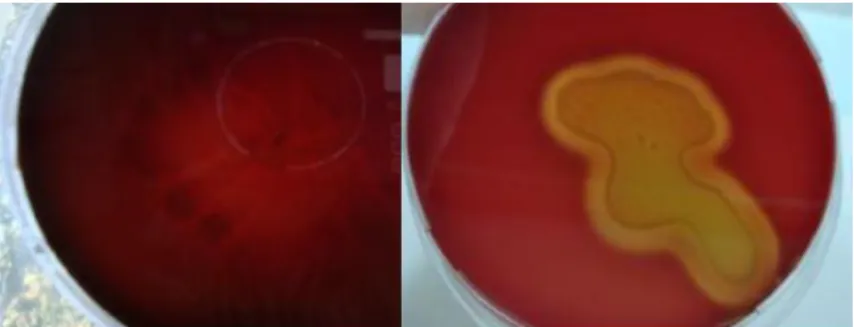
of Cukurova University. In the former studies it was determined that the strains have high hemolytic activity. In order to detect biosurfactant producing Bacillus sp., the isolates were planted on blood agar and incubated at 37 ° C for 2-7 days to see if there was hemolytic activity. [4] The strains with hemolysis zone formed around the colonies at the end of incubation were evaluated as biosurfactant positive.
2.2. Biosurfactant Production
Biosurfactant production was carried out on rotary shaker incubator at a volume of 150 mL in conical flasks of 250 mL for 72 hours at 37 °C and 150 rpm . The growth medium were, for each bacteria both Corn Steep Liquor (CSL) and LB broth containing 5% waste oil.
2.3. Biosurfactant Extraction
Precipitation method with ethyl acetate was used for biosurfactant extraction. In this method, at the end of the incubation period, the cells were removed by centrifugation.The pH of the clear fraction was adjusted to 2.0 with 6 M HCl and taken to the separating funnel and an equal amount of ethyl acetate was added. The mixture was shaken for several minutes until phase separation occurred. The organic phase was removed and the process was repeated 3 times. The organic fractions were then combined and treated with anhydrous sodium sulfate to remove water. After the water was removed, it was concentrated on a rotary evaporator to obtain biosurfactant extract [5].
2.4. Oil Spreading Technique
Presence of biosurfactant produced determination by oil spreading technique. 25 mL of distilled water was added to petri dishes (9 cm in diameter) and 10 μL of crude oil was dropped into the middle of the water with a plastic pipette then, 10 μL supernatant was dropped in the middle of the dispersed oil and formed zone diameter was measured [6,7].
2.4. Surface Tension
Surface tension were determined using Optical Contact Angle / Surface Tension Meter (TD1C LAUDA) by Du Nouy ring method.[8].
3. RESULTS AND DISCUSSION
3.1. Hemolytic Activity
Hemolysis activity of bacillus strain selected for using in the study is given in figure 1.
46
3.2. Oil Spreading Technique
The results of the determination of the presence of biosurfactant produced by oil spreading technique are shown in Table 1
Table 1. Zone diameters of biosurfactants according to Oil Spreading Technique
Corn Steep Liquor Waste Oil
Incubation time 48 h 72 h 48 h 72 h
Bacillus sp 3 cm 2.5 cm 5 cm 8.6 cm
P. aeruginosa 1 cm 2.5 cm 0.5 cm 5.5 cm
Escherichia coli 1 cm 2.3 cm 3.5 cm 5 cm Zone diameters formed by tween 80 and tween20 were measured as 8 cm and 7 cm respectively
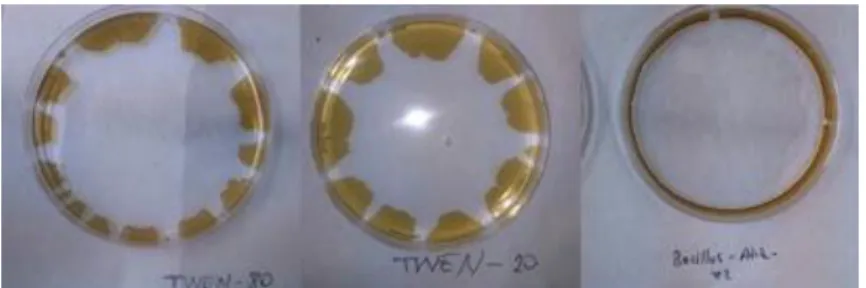
At the end of 72 h, biosurfactant from bacillus sp. that incubated in the oil waste has showed 8.6 cm zone diameter which is even higher than tween 80 and tween 20 used as a control.
Figure 2. Comparioson of chemical surfactant with biosurfactant from bacillus according to oil spreading capacity
3.3. Surface Tension
The surface tension results measured according to the Du Nouy ring method are shown in table 2. It has been determined that the biosurfactants obtained can reduce the surface tension range %23.6 to %44.8 for vegetable oil waste and range to %3 to 18% for corn steep liquor.
Table 2. Surface tension measurements of biosurfactants
Waste Oil (mN/m) Corn Steep Liquor (mN/m)
24 h 36 h 72 h 24 h 36 h 72 h Distile Water 69 69 69 69 69 69 CSL - - - 46,8 46,8 46,8 LB 50,4 50,4 50.4 - - - Bacillus sp. 34,4 29,02 27.8 14,8 41,3 41,7 P. aeruginosa 34,9 37,2 40 45,6 45,7 38,6 E. coli 36,6 38,5 35.4 41,3 46,4 40,6 4. CONCLUSIONS
In today's society, great importance is given to issues such as recycling of wastes, especially recycling them into valuable products.
In this study it is shown that industrial wastes are appropriate growth mediums as inducer for biosurfactant production from bacteria. The synthesis of biosurfactants using microorganisms is a developing field. Microorganisms have been preferred due to easy extraction processes, ability growth on wastes as well as simple production conditions.
In the future studies, it is recommended to investigate the production capabilities of other microorganism species and to make optimization studies of biosurfactant production.
More studies on surface tension reducing properties of produced biosurfactants should be performed.it is also considered that the determination of the chemical structures of the obtained biosurfactants is important for better detection of their usage field.
47
ACKNOWLEDGMENT
The authors acknowledge to the BAP Unit of Cukurova University for the financial support. The project code is FLY-2017-8708.
REFERENCES
[1]. M. Sumengen, S. Dincer, “Bacillus subtilis kullanilarak atik ekmeklerden alkali proteaz ve biyosurfektan uretimi, ” C.U. Fen ve Muhendislik Bilimleri Dergisi ,2016 Cilt:34-6. p:70-79.
[2]. J. Breckling, Ed.,. Kaczorek, E., Pacholak, A., Zdarta, A., & Smułek, W, The impact of biosurfactants on microbial cell properties leading to hydrocarbon bioavailability increase. Colloids and Interfaces, 2018, 2(3), 35.
[3]. M.E. Mercadé, M.A. Manresa, M. Robert M.J. Espuny, C.De. Andrés, J. Guinea, Olive Oil Mill Effluent (OOME). “ New Substrate for Biosurfactant Production”. Bioresource Technology, 1993, 43, pp. 1-6.
[4]. G.D. Noudeh, M.H. Moshafi, P. Khazaeli, , F. Akef, “Studies on Bioemulsifier Production by Bacillus licheniformis PTCC 1595 ” African Journal of Biotechnology, 2010, Vol. 9(3), pp. 352-356
[5]. H. Yin, J. Qiang, Y. Jia, J. Ye, H. Peng, H. Qin, N. Zhang, , B. He, “Characteristics of biosurfactant produced by Pseudomonas Aeruginosa S6 isolated from oil-containing wastewater”. Process Biochemistry, 2009, 44, pp.302-308. [6]. N.H. Youssef, K.E. Duncan, D.P. Nagle, K.N. Savage, R.M. Knapp, M.J. Mcinerney, “Comparison of Methods to
Detect Biosurfactant Production by Diverse Microorganisms ”. Journal of Microbiological Methods, 2004, 56, 339-347.
[7]. L. Karthik, G. Kumar, K.V.B. Rao, “Comparison of methods and screning of biosurfactant producing marine actinobacteria isolated from nicobar marine sediment ” . The IIOAB Journal, 2010, Vol. 1; Issue 2, 34-38.
[8]. F.R. Accorsini, M.J.R. Muttan, E.G.M. Lemas, M. Benincasa, “ Biosurfactant production by yeasts using soybean oil and glycerol as low cost substrate ”, Brazillian Journal of Microbiology, 2012, 116-125.