SOSYAL BİLİMLER ENSTİTÜSÜ
İNGİLİZ DİLİ VE EDEBİYATI ANABİLİMDALI
İNGİLİZ DİLİ VE EDEBİYATI BİLİMDALI
ACQUISITION OF ENGLISH ARTICLES BY TURKISH CHILD
FOREIGN LANGUAGE LEARNERS
Yüksek Lisans Tezi
Hazırlayan
DERYA ARIBAŞ
SOSYAL BİLİMLER ENSTİTÜSÜ
İNGİLİZ DİLİ VE EDEBİYATI ANABİLİMDALI
İNGİLİZ DİLİ VE EDEBİYATI BİLİMDALI
ACQUISITION OF ENGLISH ARTICLES BY TURKISH CHILD
FOREIGN LANGUAGE LEARNERS
Yüksek Lisans Tezi
Hazırlayan
DERYA ARIBAŞ
Tez Danışmanı
Yrd. Doç. Dr. Filiz ÇELE
ACKNOWLEDGEMENTS
First of all, I would like to express my deepest appreciation to my thesis advisor Ass. Prof. Dr. Filiz Çele for her vision, determination, professional advice, guidance, understanding and irreplaceable encouragement throughout the preparation of this study. It has been a privilege to have the opportunity to learn from her. I am also very thankful to my two committee members Assoc. Prof. Dr. Türkay Bulut and Ass. Prof. Dr. Ferma Lekesizalın for their insightful suggestions, genuine interest, and words of encouragement.
This thesis would not have been possible without the invaluable support of the principles Ayşenur Yavuz, Elif Durukan, Didem Veyisoğlu, Gülseren Hızarcıoğlu and Mr. Bradley who welcomed me in their schools. Of course, very special thanks go to all of my participants.
I also wish to extent my gratitude to Ass. Prof. Dr. Ramazan Zengin for his professional advice and support at the initial stage of my thesis.
In addition, I would like to express my thanks to my friend Yasemin Vatan who has always been there for me.
I was very lucky to have my family by my side throughout the whole experience. So, I also wish to extend my thanks to my family “Neşe Şekerci Aslan, Can Şekerci, Gökce Arıbaş, Kazım Şekerci, Ahmet Bülent Arıbaş, Döne Şekerci, Ayşe Müjgan Arıbaş” for their constant encouragement and supports.
Finally, I would like to express my deepest thanks to my husband Emre Arıbaş who supported and encouraged me throughout the preparation of this thesis. This thesis is affectionately dedicated to my beloved husband, Emre Arıbaş, who has always been there for me.
CONTENT
ACKNOWLEDGEMENTS... i
CONTENT... ii
ABBREVIATIONS... v
LIST OF TABLES... vii
LIST OF FIGURES... viii
CHAPTER 1 INTRODUCTION Introduction ………..……...………..……..1 CHAPTER 2 SYNTACTICAL BACKGROUND 2.1. Introduction ……….……….……….8 2.2. Turkish……….……….……….9 2.2.1.Introduction………..9 2.2.2. Definiteness in Turkish ………..………..…14 2.2.2.1. Word Order ………...15 2.2.2.1.1. NPs in Subject Position………...………15 2.2.2.1.2. NPs in Object Position……….17 2.2.2.2.Word Stress………...………...….23
2.2.2.3.Tense Aspect Modality……….……….………..25
2.2.3. Specificity in Turkish….………...26
2.3. German ……….……….……..30
2.3.1. Introduction ……….…….…………...31
2.3.2. Definiteness in German……….………35
2.3.3. Specificity in German……….……….……….…38
2.3.4. Referentiality and Definiteness……….………....44
2.3.4.1. Referential definites [+SR /+HK] ……….44
2.3.4.2. Non-referential definites [-SR /+HK] ……….…………..…45
2.3.4.3. Referential indefinites [+SR /-HK] ……….………….….…46
2.3.4.4. Non- referential indefinites [-SR /-HK] ………...47
2.3.4.5. Additional Uses……..……..……….……….…………48
2.4. English ……….……….……..49
2.4.1. Introduction ……….……….………50
2.4.2. Definiteness in English……….…….…………...52
2.4.3. Specificity in English……….………...54
2.4.4. Referentiality and Definiteness……….……….………...56
2.4.4.1. Referential definites [+SR /+HK] ………….………57
2.4.4.2. Non – referential definites [-SR /+HK] ….………58
2.4.4.3. Referential indefinites [+SR /-HK] ….………..58
2.4.4.4. Non- referential indefinites [-SR /-HK] ……….…………...59
CHAPTER 3 LITERATURE REVIEW
3.1. Introduction ………...………..64
3.2. Cross linguistic transfer ……….………...65
3.2.1. Introduction……….………..65
3.2.2. Studies and hypotheses on cross linguistic transfer………...66
3.2.3. Variables effecting transfer……..….………....68
3.2.3.1. Typological distance/ Similarity of languages…..…….……69
3.2.3.2. L2 Status……….……….…...70
3.2.3.3. Age, (meta-)linguistic awareness, length of residence and exposure to a non-native language environment……….….…..…….71
3.2.3.4. Proficiency…….………72
3.2.3.5. Recency……….……….73
3.2.3.6. Language mode……….……….73
3.2.3.7. Context……….……….……….75
3.2.4. Summary………...75
3.3. Studies on article semantics……….…..………….……….…76
3.3.1. Introduction………...…77
3.3.2. Bickerton’s (1981) Binary Semantic System and earlier studies …….77
3.3.3. Nominal Mapping Parameter by Chierchia (1998) ……….….………81
3.3.4. Definiteness by Lyons (1999) ……….……….83
3.3.5. Article Choice Parameter and Fluctuation Hypothesis by Ionin et al. (2004) and recent studies……….84
3.3.6. Studies on L3 acquisition of articles….…….…………..……….88
3.3.7. Summary………...90
CHAPTER 4 METHODOLOGY 4.1. Introduction ………...………...92
4.2. Subjects………94
4.2.1. L2 English learners with L1 Turkish………...……….………94
4.2.2. L2 German learners with L1 Turkish………..……….………….……95
4.2.3. Monolingual English speakers………..…………97
4.3. Material………...….98
4.3.1. Proficiency tests……….………...…98
4.3.2. Forced- choice elicitation task…...………...99
4.3.2.1. [ +Definite/ + Specific] ……….………99
4.3.2.2. [ +Definite/ - Specific] ……….……….…………..…100
4.3.2.3. [-Definite/ + Specific] ……….……….………...101
4.3.2.4. [-Definite/ - Specific] ….……….101
4.3.2.5. Additional items ……….……….102
4.3.3. Written production task………..………...………..102
CHAPTER5 RESULTS
5.1.Introduction……….105
5.2. Forced- choice elicitation task results………....106
5.2.1.Overall results from the forced– choice elicitation task…...……..….107
5.2.2. Results from the forced- choice elicitation task by the two L2 German groups with L3 English A1 level……...………...…...111
5.3. Written production task results……...………..……….115
5.3.1. Overall written production task results by experimental groups…....115
5.3.2. Results from written production task by L2 German proficiency levels with L3 English A1 level……….……….119
5.4. Summary………121
CHAPTER 6 DISCUSSION AND CONCLUSION 6.1. Discussion ……….123
6.2. Conclusion………...127
References………..………..……….130
APPENDIX A ....……...………...137
Forced- choice Elicitation Task …...………...………...………...131
APPENDIX B …...………...………....…144
Written Production Task ……….………...………...144
APPENDIX C ………...…...146
Categorized Forced- choice Elicitation Task Items……….….146
APPENDIX D………...…156
Oxford Quick Placement Test Version 2……….….156
Tez Özeti……….…..164
Thesis Abstract………..166
ABBREVIATIONS * ungrammatical construction 1 1st person 3 3rd person ABL ablative ACC accusative
ACP Article Choice Parameter
AOR aorist ARG argument CAUS causative CONT continuous COUNT countable DAT dative DEF definiteness DP determiner phrase
ELF English as a foreign language
ENUM numeral
ESL English as a second language
GEN genitive
HK Hearer Knowledge
IKW Ionin, Ko and Wexler
L1 native language
L2 first foreign language
L3 second foreign language
L4 additional languages L5 additional languages LOC locative NEG negative NOM nominative NP noun phrase
Ø null article
PASS passive
PAST past tense
PL plural
POSS possessive
PRED predicate
PRES present tense
PROG progressive
REL relative pronoun
S singular
SG singular
SLA Second Language Acquisition
SOV subject object verb
SPEC specificity
SR Speaker Referent
TLA Third Language Acquisition
UG Universal Grammar
VP verb position
ZDJ Zentral Deutsch Jugend (Goethe B1 test)
IDS Indefinite; Specific
IDNONS Indefinite; Non-specific
DS Definite; Specific
DNONS Definite; Non-specific
M Mean
LIST OF TABLES
Table 1. Cases and case endings in the Turkish language………..…..…..11
Table 2. Division of German articles ……….32
Table 3. Declination of German definite articles - article inflections………...……..33
Table 4. Declination of German indefinite articles - article inflections……..……...35
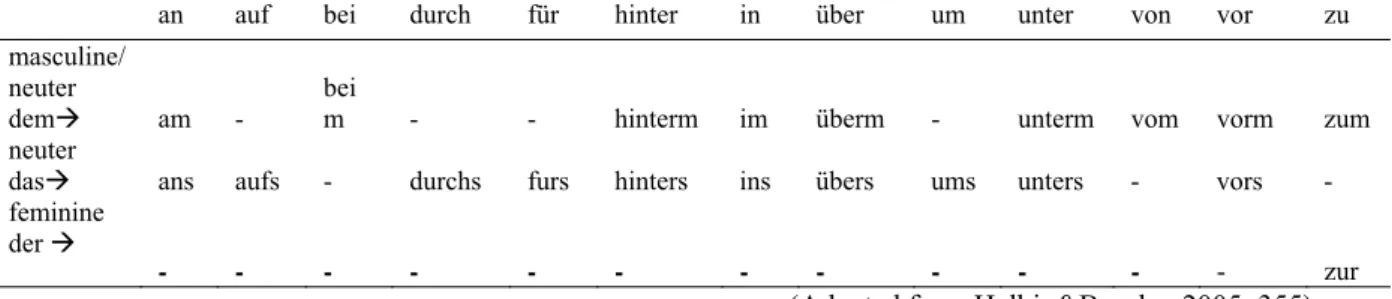
Table 5. Distribution of merged prepositions with definite dative and/ or accusative case-marked articles in singular ………...…..42
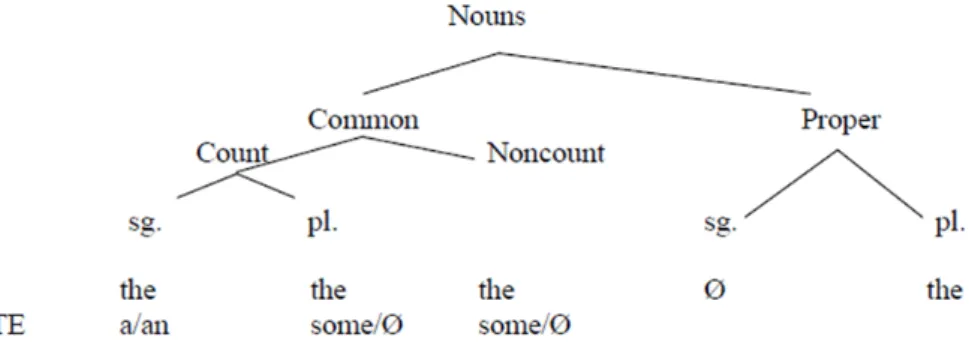
Table 6. Articles and types of nouns in English………...52
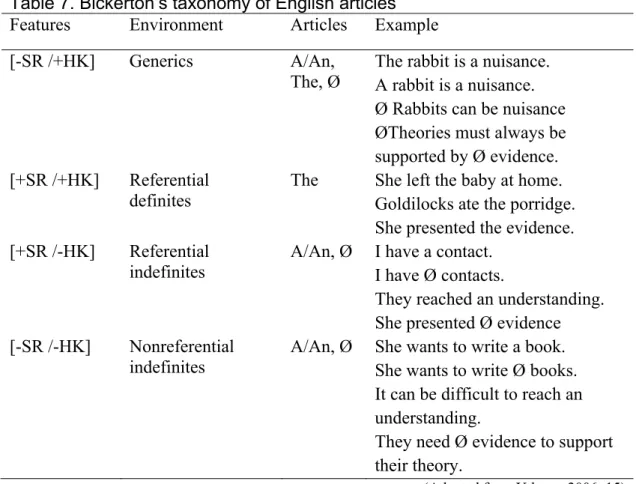
Table 7. Bickerton’s taxonomy of English articles……….61
Table 8. The Nominal Mapping Parameter……….82
Table 9. Article Settings cross linguistically………..…84
Table 10. Possible Article grouping………....86
Table 11. Background information of L2 English with L1 Turkish………...…95
Table 12. Grouping of L2 English learners with L1 Turkish according to L2 English proficiency levels………...95
Table 13. Background information of L2 German learners with L1 Turkish……….96
Table 14. Grouping of L2 German learners with L1 Turkish according to L3 English proficiency levels………...96
Table 15. Grouping of L2 German learners with L1 Turkish according to L2 German and L3 English proficiency levels………...97
Table16. Monolingual English children’s background information………...97
Table 17. Overall mean accuracy scores for article use in four contexts………….108
Table 18. Mean accuracy scores by L2 German groups with L3 English level A1..112
Table19. Overall mean accuracy scores for article use by experimental group.…..117
Table 20. Mean accuracy rates for article use in IDNONS and DS by L2 German proficiency with L3 English A1 level ………..119
LIST OF FIGURES
Figure 1. The Germanic branch of the Indo-European family of languages…..……52
Figure 2. Noun classification for article use………...53
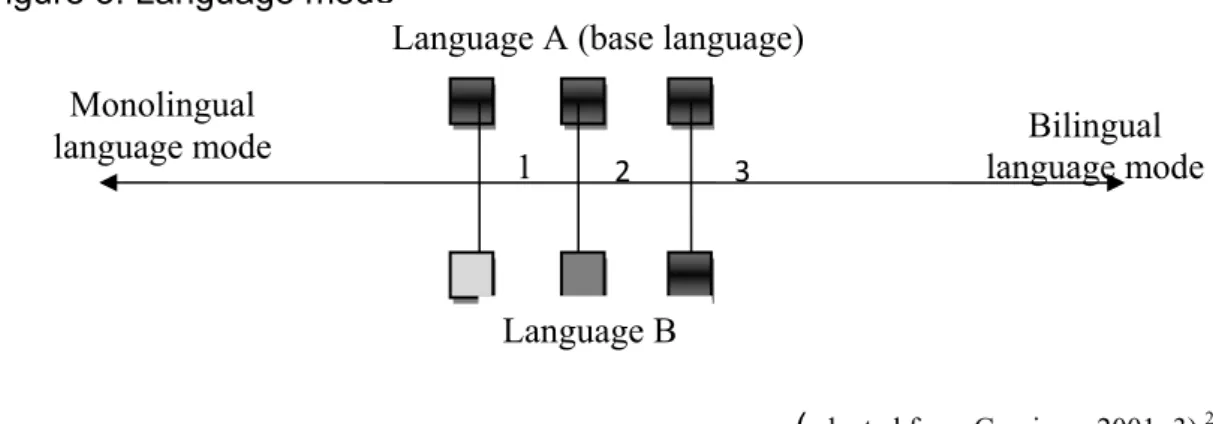
Figure 3. Language mode………...……....76
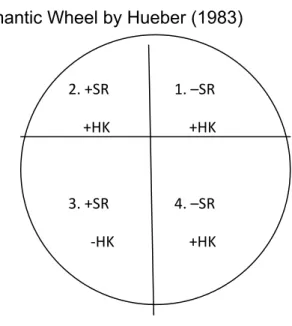
Figure 4. Semantic Wheel by Hueber(1983)………...80
Figure 5. Overall mean accuracy scores for article context types ………..….111
Figure 6. Mean accuracy scores by German proficiencies and control group……..115
Figure 7. Overall mean accuracy scores by L2 German and L2 English learners…118 Figure 8. Overall mean accuracy scores on article context types by L2 German proficiency with L3 English A1………....120
CHAPTER1 INTRODUCTION
Acquisition of articles in English is a complex phenomenon not only for native (L1) speakers but also for second (L2) language learners. It also poses a challenge for third (L3) language learners of English. It has been the focus of many researchers in L2 acquisition research for many years. The fact that native (L1) speakers of languages which have no articles or other morphological markers for definiteness, must first establish two aspects when learning a second language with articles; the distributional properties of articles, (where they can be used, where they must be used and where none are required); and the semantic or pragmatic properties of articles (what these articles mean in the context of the utterance) (Jaensch, 2008) attracted the attention of researchers on both, syntactical and semantic matters in article acquisition.
Most studies on acquisition of English articles in child L1 and L2 (e.g., Brown, 1973; Cziko, 1986; Maratsos, 1976; Schaeffer & Matthewson, 2005; Warden, 1976) have found that children overuse the definite article the in [-definite; +specific] contexts. There have been various attempts in the light of Piaget’s (1926) egocentricity term to account for the children’s overuse as maturational/pragmatic issues (Maratsos, 1976; Warden 1976) or the lack of the concept of Non-Shared Assumption (Schaeffer & Matthewson, 2005) which assumes that children ignore hearer’s knowledge of a referent.
Other early research on the acquisition of articles in the 1980s also concentrated on the distributional properties of articles and morphosyntactical matters (Brown, 1973; Cziko, 1986; Maratsos, 1976; Warden, 1976; Chierchia, 1998; Huebner, 1985; Thomas, 1989 among many others). Celce-Murcia and Larsen- Freeman (1999) put importance on the classification of the English noun system and the distribution of the articles a, the and null articles accordingly depending on the various numbers of nouns. Others went beyond this and stressed the value of discourse related
references determining the definiteness of NPs (Bickerton, 1981; Lyons, 1999; among others). In this context, Bickerton’s binary semantic system (1981) was the first proposal which grouped the English articles into four contexts depending on two semantics parameters, referentiality and definiteness of an NP. This system was further investigated and developed by various other researchers (Cziko, 1986; Hueber, 1983; Leung, 2005; Maratsos, 1974 & 1976; Parrish, 1987; Thomas, 1989; Warden, 1976) sharing similar findings that learners of L2 English overused the definite article ‘the’ in contexts in which the indefinite article ‘a’ was required. In opposition, Leung (2001) however in similar studies found an overuse of the indefinite article ‘a’ in definite contexts. Thus, contrary to this maturational / pragmatic view, some child and adult L2 studies suggest that the problem is linguistic in nature, causing fluctuation between specificity and definiteness features (Ionin, 2003; Ionin et al 2004)
Other more current studies especially in second language (L2) learning address the issue of article semantics and cross – linguistic transfer within the framework of Universal Grammar (UG), which is assumed to constrain the developmental patterns in article use in L2 grammar (Ionin et al, 2004; Ionin et al, 2008; Hawkins, 2006; Lardiere, 2004). Ionin et al’s (2004) investigations on article semantics helped constitute the Article Choice Parameter which suggests that article use is regulated by a semantic parameter in UG. This parameter is built on two settings for article choice, the definiteness setting and the specificity setting, which accounts cross- linguistically in some ways in all languages. More specifically, Ionin et al (2004) suggest that languages with two articles encode their articles either on the basis of the definiteness setting (like in English) or the specificity setting (like in Samoan). In this context, for Ionin et al. (2004: 5) definiteness refers to“…If a Determiner Phrase (DP) of the form [D NP] is … [+ definite], then the speaker and the hearer presuppose the existence of a unique individual in the set denoted by the NP…” Specificity on the other hand refers to “…If a Determiner Phrase (DP) of the form [D NP] is … [+specific], then the speaker intends to refer to unique individual in the set denoted by the NP and
considers this individual to possess some noteworthy property …” (Ionin et al, 2004: 5)
With reference to the Article Choice Parameter and to control for L1 transfer effects Ionin et al (2004) investigated the acquisition of the English articles in L2 by adult L1 Russian and L1 Korean speakers (both languages without articles). Results showed a misuse of the indefinite article in definite – non-specific contexts and the definite article ‘the’ in indefinite-specific contexts. Ionin et al (2004) proposed the Fluctuation Hypothesis to account for the error patterns in the article use in L2 English which actually derived from the Article Choice Parameter (Ionin et al, 2004). The Fluctuation Hypothesis suggests:
a. L2 learners have full access to UG principles and parameter-settings.
b. L2 learners fluctuate between different parameter-settings until the input
leads them to set the parameter to the appropriate value.
(adopted from Ionin et al, 2004: 17)
The Fluctuation Hypothesis (FH) was widely tested by various researchers (Ionin, Zubizarreta and Maldonado, 2008; Hawkins et al., 2006; Lardiere, 2004; among others). Ionin, Zubizarreta and Maldonado (2008) further tested the Fluctuation Hypothesis (FH) in the presence of possible L1 transfer effects and investigated the acquisition of the English articles by L2 learners with L1 Spanish and L1 Russian speakers (Spanish is a language with articles based on the definiteness setting, whereas Russian is a language without articles). Ionin et al (2008) proposed that the results of the L1 Spanish group showed evidence for transfer from L1 Spanish to L2 English due to the L1 Spanish speakers’ ability to transfer L1 knowledge positively to L2 English. L1 Russian speakers, however, regarding the Universal Grammar access fluctuated between the specificity and definiteness settings of the Article Choice Parameter. As a result Ionin et al
(2008) concentrated on three variables influencing the acquisition of the English articles which are L1 transfer, L2 input and UG.
A comparatively new field of third language (L3) acquisition of article systems also investigates the issue of transfer effects. In a study, Leung (2005) tested a group of adult Cantonese speakers with L2 English and a group of L1 Vietnamese learners on article choice in French. Cantonese and Vietnamese are languages without articles while English and French are typologically similar languages and have overt article systems basing article choice on the definiteness setting. Results led to the conclusion that L2 English had a positive effect on the acquisition of L3 French. In another study, Jaensch (2008) also tested the issue of L2 English influence on the L3 German article acquisition by L1 Japanese speakers. English and German are typologically similar languages and have an overt article system basing article choice on the definiteness setting. The main result offered evidence for positive influence of L2 English on L3 German.
Studies on the influence of L2 on the acquisition in a third language were conducted on adults rather than children and findings may not be compatible with children. The interesting question of the present study is to test the influence of L2 on L3 in children in the initial stage of acquisition. For that reason this study examines whether there is a positive transfer from second language (L2) German to third language (L3) English during initial stage of acquisition of the article system in L3 English by Turkish child learners. The fact that Turkish does not have identical surface structures marking definiteness (Kornfilt, 1997) and that German and English overtly realize and share the semantic conceptualization of articles (Lyons, 1999; Jaensch, 2008) provides an ideal testing case for this study. In addition, with reference to the Fluctuation Hypothesis (Ionin et al, 2004) this study also tests whether Turkish child learners of L2 English fluctuate between the two settings of the Article Choice Parameter, the definiteness setting and the specificity setting, in the initial stage of article acquisition for the reason that Turkish does not have an article system in the way English does. In order to determine fluctuation Turkish learners are expected to fluctuate between the
specificity setting and definiteness setting in their article choice in indefinite – specific (IDS) contexts and definite – nonspecific (IDNONS) as the Fluctuation Hypothesis (Ionin et al, 2004) suggests.
Thus, for examining the issue of L2 German influence on L3 English and the issue whether L2 English learners fluctuate, Turkish child learners of L2 German and L2 English are included in this study. There are also 10 native speakers of English who serve as a control group. Hereby, the focus of attention is the L2 German and L2 English learners’ appropriate article choice in four article contexts (indefinite – specific (IDS) contexts; indefinite – non-specific (IDNONS); definite – specific (DS); and definite – nonspecific (IDNONS)) in a forced – choice elicitation task and supply of appropriate articles in a written production task in English both adapted from Ionin et al (2004).
Having participants from the same age groups between 11 and 12 will control for the age factor and offer comparable data considering the participants’ L2 proficiencies. Testing participants on four article contexts will help determine fluctuation by L2 English learners. Having L2 German and L2 English learners will make it possible to compare results and identify the influence of L2 German on L3 English. Including native speakers of English will help determine the differences in article choice among all groups. Two different written tasks are included to obtain data for article use in controlled and in naturalistic language production.
In order to obtain results the stress of this study has been put on two research questions inspired by Jaensch (2008):
1. With reference to the L2 effect; do the different levels, elementary (A1) and pre-intermediate (B1), of L2 German proficiency have a positive effect on the child learners’ judgment of articles in the L3 in the initial stage? In particular, will child learners of equal English (A1) but a higher German proficiency (B1) outperform those with lower German proficiency (A1)?
Since German and English are similar in overtly realizing both articles, the definite and indefinite articles, and sharing the same semantic conceptualization, it is expected that L2 German will have a positive effect on these learners’ judgment of articles in the L3 English. In addition, for the reason that L3 learners of English have previously experienced German as an L2 and L2 German learners with higher proficiency (B1) have higher awareness towards the feature of definiteness, it is also expected that the learners with lower L3 English proficiency (A1) but higher L2 German proficiency (B1) will outperform the learners with equal (A1) English and German proficiency in the forces – choice elicitation task and the written production task.
2. Considering the Fluctuation Hypothesis; do the child learners of L2 English whose native language is Turkish fluctuate between the two settings of the Article Choice Parameter, definiteness and specificity, in the initial stage?
With reference to the second research question it is expected that the L2 English learners fluctuate between the two settings of the Article Choice Parameter, the definiteness setting and the specificity setting (Ionin et al, 2004) in both task types, the forced – choice elicitation task as well as the written production task for the reason that the article system in Turkish does not correspond to the article system in English.
The overall results of both tasks (the forced – choice elicitation task and the written production task) showed that the indefinite – specific contexts (IDS) were significantly the most difficult article contexts compared to the remaining three other contexts (indefinite – non-specific, definite – specific, definite – non-specific) for all tested groups. The results also showed that L2 German learners were more accurate than L2 English learners in the four article context types (indefinite – specific, indefinite – non-specific, definite – specific, definite – non-specific) which were examined in this study. They also showed that the L2 German learners with an A1 Level in L3 English but a B1
level in German performed significantly better than the L2 German learners with an equal English and German proficiency level of A1 in both task types. Lastly, data results also demonstrated that the performances of the L2 English learners were not significantly different on context type with low accuracy rates. These findings will be discussed within the transfer view of L2 effects and with reference to the Fluctuation Hypothesis by Ionin et al (2004).
The rest of the study is organized as follows: Chapter 2 offers a detailed presentation of the syntactical background of articles in Turkish, German and English. Chapter 3 gives an overview of literature on transfer and previous studies on the acquisition of the English article system. Chapter 4 presents methodology of this study, including research questions, subjects, materials, procedure of the study. Chapter 5 reports accuracy results of the four article contexts (indefinite – specific, indefinite – non-specific, definite – specific and definite – non-specific) presented in a forced – choice elicitation task and a written production task. Chapter 6 presents the discussion of the results of the conducted tests, conclusion, implications, and limitations of this study.
CHAPTER 2
SYNTACTICAL BACKGROUND
2.1. INTRODUCTION
Languages differ from each other on the basis of the presence of the article system and their discourse related different features. Thus, there have been ways of classifying them into categories as suggested by Juvonen (2000); Chierchia (1998); Bickerton (1981) and Ionin et al (2004). The three languages in this section, Turkish, German and English, therefore, can also be distinguished on this basis in how they encode articles.
Along with Juvonen (2000: 14), who proposed a categorization of the languages with respect to their definiteness setting, states that there are four types of languages: (1) some languages only have the category of definite articles; (2) other languages only have the category of indefinite articles; (3) some other languages have the categories of both, definite and indefinite articles; (4) and there are some other languages with neither articles. With reference to Chierchia (1998) Nominal Mapping Parameter languages can be grouped into three depending on their [+arg, +pred] features similar to Juvonen (2004).
Taking Bickerton’s (1981) binary semantic system into account article choice depends on two aspects; referentiality, whether or not an NP has a specific referent; and definiteness, whether the noun of the given context is already known or recognized by the hearer.
With regards to Ionin et al (2004) building on those previous studies assume in their Article Choice Parameter that languages use articles to encode either definiteness, whether or not the speaker and the hearer are familiar with the referent, or specificity, whether or not the speaker refers to a specific individual represented in his/ her mind.
In co-relation to Ionin et al. (2004) and all earlier studies it can be concluded that the two semantic settings of Universal Grammar, specificity
and definiteness, are actualized by all languages in a certain way. Lyons (1999: 52) supports by pointing out that “…The most fundamental cross-linguistic distinction relating to the articles is, of course, that between languages which have them and languages which do not. All languages have demonstratives and personal pronouns, which are perhaps inherently definite, so it could be claimed that the feature [+Def] is represented in some form in all languages…” Some languages might have a morphological determiner to represent those features whereas other might not. Those languages which have no overt morphological determiner can still realize those two settings through different ways such as word order, stress or even case markers (Chesterman, 1991:3).
German and English are languages that fall into the category of languages with realizing both article categories, the definite and indefinite articles. They both have overt determiners, the definite and indefinite article categories, to represent specificity and definiteness, whereas it seems to be important at this point to emphasize that the article choice of these two languages happen according to definiteness rather than specificity. Turkish, however, can be categorized as a language with the indefinite article category only. The different semantic conceptualizing of articles between these three languages, namely Turkish, German and English, offers an ideal setting to investigate about the influence of those languages on each other regarding the acquisition of the L3 English article system.
In order to gain more insights about the conceptualization of articles in these three languages a detailed description of the Turkish, German and English article system is offered in this chapter accompanied by examples from each language.
2.2. TURKISH
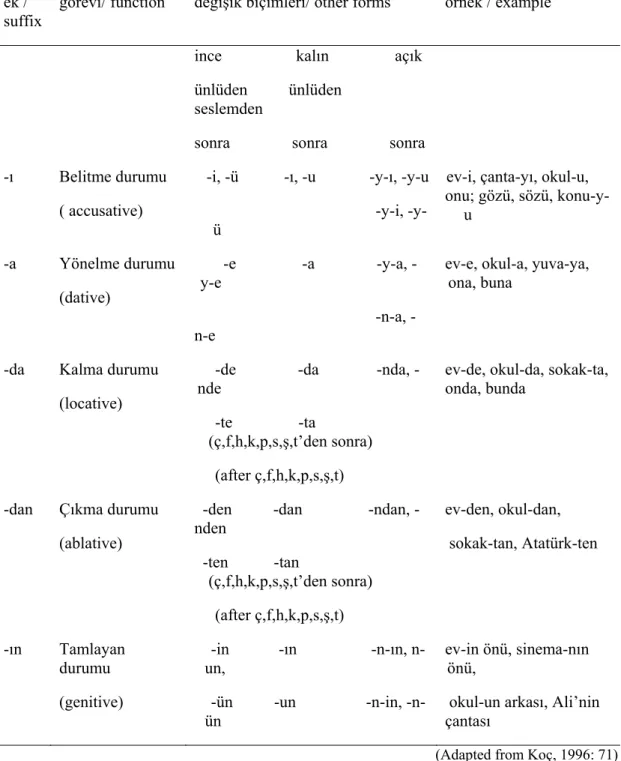
The Turkish language is a member of the Turkic language group and belongs to the larger Altaic family. It is an agglutinative language, which means that endings are added one by one to the root of a word to produce the desired meaning. In addition, it is a left-branching language and thus a language with a head final position. In a syntactical framework, it is categorized as a SOV although the word order is flexible depending on pragmatic aspects (Erguvanlı, 1984; Koç, 1996). It is also a language which lacks an overt definite article but with the category of an (optional) indefinite articles (Goad& White, 2009). In addition, it is a language rich of nominal and verbal inflections (Erguvanlı, 1984) which have an important role in conveying tense, case and other morphological features through suffixes. Regarding nominal inflections there are five different cases in the Turkish language besides the nominative case. These are accusative, dative, locative, ablative and genitive. The following Table 1 illustrates the cases and case endings in the Turkish language:
Table 1. Cases and case endings in the Turkish language ek /
suffix
görevi/ function değişik biçimleri/ other forms örnek / example ince kalın açık
ünlüden ünlüden seslemden
sonra sonra sonra
-ı Belitme durumu ( accusative)
-i, -ü -ı, -u -y-ı, -y-u i,
-y-ü
ev-i, çanta-yı, okul-u, onu; gözü, sözü, konu-y-u -a Yönelme durumu (dative) e a ya, -y-e na, -n-e
ev-e, okul-a, yuva-ya, ona, buna
-da Kalma durumu (locative)
de da nda, -nde
-te -ta (ç,f,h,k,p,s,ş,t’den sonra) (after ç,f,h,k,p,s,ş,t)
ev-de, okul-da, sokak-ta, onda, bunda
-dan Çıkma durumu (ablative)
den dan ndan, -nden -ten -tan (ç,f,h,k,p,s,ş,t’den sonra) (after ç,f,h,k,p,s,ş,t) ev-den, okul-dan, sokak-tan, Atatürk-ten -ın Tamlayan durumu (genitive) -in -ın -ın, n-un, -ün -un in, -n-ün ev-in önü, sinema-nın önü,
okul-un arkası, Ali’nin çantası
(Adapted from Koç, 1996: 71)
Those case inflections have an important function in determining definiteness and specificity on an NP which will be explained later on.
Görgülü (2009:2) points out “…The interaction between case morphology and definiteness as well as specificity has been widely investigated in those languages such as Turkish where there is no overt
morphological determiner (i.e. no definite article) on a given NP. The earlier studies go back as old as Erguvanlı (1984) and Dede (1986) who discuss the function of accusative marking in Turkish and argue that it is one of the strategies to mark NPs as definite…”
Another way to realize a determiner in Turkish is the use of the cardinality/ numeral word ‘bir’ which resembles on one hand a numerical classification ‘one’ but on the other hand indefiniteness in the Turkish system (Kornfilt, 1997) and ‘a/ an’ can be treated as indirect equivalents in English. Lyon (1999:93) in that sense points out “…the indirect signaling of indefiniteness by a cardinality word is extremely widespread….and the numeral ‘one’ is found in many languages…Turkish ‘bir’…” is used in this sense. However, Lyons (1999) states that the free lexical item ‘bir’ is a quasi indefinite article for the reason that it functions only indirectly and resembles the numeral ‘one’. “… Turkish, in which the quasi-indefinite article is segmentally identical to the numeral ‘one’, with the form bir …Turkish, also agrees with many other language in that, generally, no determiner is used with predicative indefinites. Bir is, however, usually included when a singular noun used predicatively is modified…” (Lyons, 1999: 96)
(1)Biz-im misafir-imiz yaman bir adam-dır. we GEN guest 1PL remarkable a man is ‘Our guest is a remarkable man.’
(Lyons, 1999: 96)
“…In general, bir is only used when the indefinite noun phrase refers to a particular entity, that is, when it is a specific indefinite….Where there is no specific referent (i.e. I’m looking for a reliable car, where I do not have a particular car in mind), or where the identity of the thing referred to is of no importance for the discourse, Turkish has the option of using the bare noun, without determiner, an without number marking…” (Lyons, 1999: 96)
Taking a further look to the from-related aspect of the NPs in Turkish involving the bare nouns and the quasi- indefinite article ‘bir’ helps
determining a classification for article environments. In Turkish, under the category of common nouns, countable nouns can occur with ‘bir’, but can also be bare:
(2)a. Ali mektup yaz-ıyor Ali letter write PROG Ali is writing letters/ a letter.
b.Ali bir mektup yaz-ıyor. Ali one letter write PROG Ali is writing a letter
(Erguvanlı, 1984: 23)
But at the same time, compared with English, Turkish countable nouns can be precieved as mass nouns:
(3)a. Birkaç kitap al-dı-m.
A few book buy-PAST-1S ‘I bought a few books.’
b. Biraz kitap al-dı-m. A little book buy-PAST-1S *I bought a little book.’
(Tura, 1973: 90)
Uncountable nouns, under the category of common nouns, are used as bare nouns, but they can also occur with ‘bir’ in Turkish. Likewise, are abstract nouns:
(4) Para koltuğ-un alt-ı-na düş-müş. money couch-GEN bottom –POSS3DAT fall-PAST ‘The money has fallen under the couch’
(Erguvanlı, 1984: 27) (5) a. Mobilya/bir mobilya Ø furniture/*a furniture b. Ödev/bir ödev Ø homework/*a homework c. Bilgi/bir bilgi Ø information/*an information (Yılmaz, 2006: 38)
(6) Anlaşmazlık/ Bir anlaşmazlık çöz-ül-dü.
Disagreement/ A disagreement solve-PASS-PAST ‘The disagreement/A disagreement was solved.’
(Yılmaz, 2006: 39)
Considering the semantic aspect of article usage, the Turkish language realizes indefiniteness, when the NP is unfamiliar to the hearer and at the same time specific (see example above), when the referent is not specific and the speaker isn’t referring to a particular entity or when the referent is not important and co-occurs with ‘bir’, which indirectly resembles ‘a/an’ or ‘one’ in English (Kornfilt, 1997).
On the other hand an NP in Turkish is definite, when the referent is known by the speaker and the hearer and is expressed through many ways.
2.2.2. Definiteness in Turkish
Turkish is a language that still marks definiteness although there is no overt morphological maker for it. Some ways to identify definiteness is through word order, stress, case markers, adjectival modifiers and other
aspects. In addition, using the (quasi-) indefinite article ‘ bir’ is one way to mark an NP as indefinite besides others (Goad& White 2009).
2.2.2.1. Word order
Word order is just one of the above listed constituents to set definiteness in Turkish. The position of the NP in subject or preverbal position sets out to make a difference in the interpretation of the NP either as definite or indefinite.
2.2.2.1.1. NPs in subject position
A bare noun at the beginning of a sentence in the Turkish language, for example, is always identified as definite as Lyons (1999: 96) supports “…the restriction of sentence – initial position to topics in Turkish will ensure that a bare noun occurring initially is interpreted as definite, but in non – initial position ambiguity is possible…” unless the NP is marked with ‘bir’. This can be fully understood by the following examples by Lyons (1999) and Tura (1973):
(7)Yer-de çocuk yat-ıyor-du. (Ambiguous; Definite or indefinite) ground- LOC A child lie-PROG-PAST-3S
‘A/ The child was lying on the ground.’ ‘Children were lying on the ground.’
(8) Yer-de bir çocuk yat-ıyor-du. (Indefinite) ground- LOC A child lie-PROG-PAST-3S ‘A child was lying on the ground.’
(9) Çocuk yer-de yat-ıyor-du. (Definite) Child ground-LOC lie-PROG-PAST- 3S ‘The child was lying on the ground.’
(10)Bir çocuk yer-de yat-ıyor-du. (Indefinite) A child ground- LOC lie-PROG-PAST-3S ‘A child was lying on the ground.’
(Tura, 1973: 102-103)
(11)Bir kitap arı-yor-um. (Indefinite) a book look-for CONT 1SG ‘I am looking for a book.’
(Lyons, 1999: 96)
In example (7) ‘çocuk’ has a non – initial position in the sentences and thus, can be interpreted either as definite or indefinite, whereas the non – initial positioned ‘bir çocuk’ in example (8) is restricted to indefinite reading. In comparison to examples (7) and (8), ‘Çocuk’ in example (9) has an initial position in the sentences and thus, is directly interpreted as definite, whereas ‘Bir çocuk’ in example (10) encodes indefiniteness as it is the same for ‘Bir kitap’ in example (11). The NP’s in examples (8), (9) and (10) are marked with ‘bir’ and therefore, have an indefinite reading. Considering the examples (8) and (10) a further interpretation is possible. Even though these examples include similar words and parallel to the reading an indefinite interpretation, the word order implies more details. While the NP in pre-verbal position in example (8) identifies only indefiniteness or just determines a certain type child, the NP in sentence initial/ subject position in example (10), besides indefiniteness, also conveys another interpretation of determining that a certain child, which is partly definite to the speaker but not to the hearer.
Another set of similar examples is given by Tura (1973:102), in which the word order judges upon definiteness and indefiniteness:
letter yesterday Ankara – ABL come –PAST
‘The letter came from Ankara yesterday.’ (Definite reading)
b. Ankara’ –dan dün mektup gel - di. (Preverbal position) Ankara –ABL yesterday letter come-PAST
‘A letter came from Ankara yesterday.’ (Indefinite reading)
(Tura, 1973: 102)
In Example (12a) the bare NP ‘mektup’ has an initial/ subject position in the sentence and is definite, while the bare NP ‘mektup’ in (12b) has got a pre-verbal position and is identified as indefinite.
One last example is given by Göksel and Kerslake (2005: 384) regarding the same case of definite and indefinite reading:
(13) Bura –dan hırsız gir - miş. (Preverbal position) here – ABL burglar get in – PAST
‘A burglar got in through here. / Burglars got in through here.’ (Indefinite reading)
(14) Hırsız bura – dan gir - miş. (Initial position) burglar here- ABL enter – PAST
‘The burglar got in through here.’ (Definite reading)
(Göksel and Kerslake, 2005:384)
2.2.2.1.2. NP s in object position
The first case is an example of indefiniteness in object NP position and reaffirms that ‘bir’ added to the NP has an indefinite reading like in example (8) in subject NP:
President a car ask for-PAST-1S ‘The President asked for a car.’
(Tura, 1973:123)
Even NPs in object position can differ in their definiteness depending on various aspects. The following example is just one case of how the position of the function word ‘bir’ can have a determining influence. With the given example it is shown that, if ‘bir’ follows an adjectival modifier, it is interpreted as indefinite:
(16) a. bir çürük elma (Numeral) one rotten apple
‘one rotten apple’
b. çürük bir elma (Indefinite reading) rotten an apple
‘a rotten apple’
(Kornfilt, 1997: 275)
To clarify, in example (16b) ‘bir’ follows the adjectival modifier and is interpreted as indefinite, but example (16a) shows that, if ‘bir’ is followed by the adjectival modifier as it is here ‘çürük’; it takes the role of the numeral and is representing ‘one’ rotten apple. The next example illustrates the same context:
(17) a. Sınıf – ta güzel bir kız var. (Indefinite reading) class –LOC beautiful one girl there is
‘There is a beautiful girl in the class.’
b. Sınıf – ta bir güzel kız var. (Numeral) class-LOC one beautiful girl there is.
(Johanson and Csato, 1998: 218)
To clarify, in example (17a) ‘bir’ follows the adjectival modifier and is interpreted as indefinite, but example (17b) shows once again that, if ‘bir’ is followed by the adjectival modifier as it is here ‘güzel’; it takes the role of the numeral and is representing ‘one’.
Not only is the position of the function word ‘bir’ significant in identifying definiteness, but also other aspects as the general position of the object NP within the sentence structure and case makers or inflections.
If the object NP has an accusative case marker, then it is to be interpreted as definite (Erguvanlı, 1984; Tura, 1973). On the other hand, if the object NP is bare, that means the NP is unmarked, then it has an indefinite reading as mentioned in the earlier part of this chapter (see NPs in Subject position). Görgülü (2009: 2) puts together “…The earlier studies go back as old as Erguvanlı (1984) and Dede (1986) who discuss the function of accusative marking in Turkish and argue that it is one of the strategies to mark NPs as definite…” and the following examples by Tura (1973: 123) illustrate this comprehensively:
(18) Müdür araba -y - ı iste- di. (Definite; case-marked) president car -ACC ask for –PAST
‘The president asked for the car.’
(19) Müdür araba iste - di. (Indefinite; bare) president car ask for –PAST
‘The president asked for a car.’
(Tura, 1973:123)
In the first example (18) the object NP is case-marked as ‘araba -y – ı’, and is definite since it is specific and thus familiar to both speaker and hearer, whereas in the second example (19) it is a bare object NP and is indefinite for it doesn’t refer to a specific entity.
If the object NP appears with ‘bir’ in a preverbal position in Turkish, it is indefinite as in the example (17) ‘güzel bir kız’:
(20) Çekmece-de bir defter bul-du-k. (Indefinite; preverbal) Drawer-LOC a notebook find-PAST-1PL
‘We found a notebook in the drawer.’
(Göksel & Kerslake, 2005:373)
In this example (20) the NP is indefinite and introduces a new entity unfamiliar to the speaker as well as to the hearer.
The object NP realized in plural has an indefinite reading as well:
(21) Çekmece-de defter-ler bul-du-k. (Plural; preverbal) Drawer- LOC notebook-PL find-PAST-1PL
‘We found notebooks in the drawer.’
(Göksel & Kerslake, 2005:373)
In this example (21) the NP including a plural suffix has a preverbal position and is interpreted as indefinite since it refers to a newly introduced entity.
Furthermore, an object NP that is accompanied by a cardinality word is also indefinite:
(22) Çekmece-de dört (tane) defter bul-du-k. (Cardinality word) Drawer-LOC four ENUM notebook find-PAST-1PL
‘We found four notebooks in the drawer.’
(Göksel & Kerslake, 2005:373)
Another important point is, that case-marked NPs are not limited to a preverbal position they can also be placed in sentence initial position in comparison to bare object NPs that have a preverbal restriction only
(Aygen-Tosun, 1999; Erguvanlı, 1984; Göksel & Kerslake, 2005; Ketrez, 2005; Tura, 1973). As Aygen-Tosun (1999:1) points out “…The structure in [example (23) Ben belki kitap okurum.] is a case of noun incorporation (NI) or bare DP is situ. The ungrammaticality of [(24) *Ben kitap belki okurum] indicates that indefinite object DPs cannot appear in a VP- external position…”:
(23) a. Ben belki kitap oku-r-um. (Grammatical; bare) I maybe book read-AOR-1S
‘I may read/do book reading.’
b. *Ben kitap belki okur-um. (Ungrammatical; bare) I book maybe read-AOR-1S
(Aygen-Tosun, 1999:1)
Case-marked NPs in Turkish can appear in both, initial sentence position and preverbal position, as Aygen-Tosun supports (1999: 2) “…the definite DP is outside its VP-internal position…”
(23) c. Ben belki kitab- ı oku-r-um. (Preverbal) I maybe book-ACC read- AOR-1S AGR ‘Maybe I read the book.’
d. Ben kitab-ı belki oku-r-um. (Initial position) I book-ACC maybe read-AOR-1S
‘I may read the book.’
(Aygen-Tosun, 1999:1)
In addition, there are some other cases where the NP is naturally definite. Görgülü (2009: 2) defines and identifies them”…There are certain classes of NPs that are naturally definite. For example, proper names of people, places and institutions, most pronouns, pronominal…” quantifiers
that occur as objects and some others like object NP co-occurring with demonstratives and wh-words (Göksel & Kerslake, 2005; Kornfilt, 1997):
(24) Zeynep Ali-yi / on-u/adam-ı gör-dü (Proper name/ pronoun/ noun) Zeynep-NOM Ali-ACC he-ACC man-ACC see-PAST
‘Zeynep saw Ali/him/the man.’
(25) Zeynep *Ali / *o / *adam gör-dü. (Proper name/ pronoun/ noun) Zeynep-NOM Ali / he / man see-PAST
Intended reading: ‘Zeynep saw Ali/ him/the man.’
(Görgülü, 2009: 2)
Görgülü (2009: 2) “…In (24) the proper name, the pronoun and the accusative marked NP respectively refer to definite descriptions and require overt case marking. Their non-accusative marked counterparts, on the other hand, are not grammatical as shown in (25)…”
(26) Ömer herkes-i/ *herkes sinirlen-dir-di. (Pronominal quantifier) Ömer everyone-ACC/*everyone get angry-CAUS-PAST-3S
‘Ömer got on everyone’s nerves.’
(Göksel & Kerslake, 2005:371-372)
(27) Bu pasta-yı/ *bu pasta beğen-me-di-m. (Demonstrative) This cake-ACC/ *this cake like-NEG-PAST-1SG
‘I didn’t like this cake.’
(Kornfilt, 1997:313)
To sum up, the definiteness of a subject or object NP depends on the realization of the given context and various above mentioned aspects. The familiarity of both, the speaker and the hearer contribute to the utterance.
2.2.2.2. Word stress
We have seen that word order plays a significant role in determining definiteness on an NP in Turkish. Word stress is another way to encode definiteness in Turkish. Erguvanlı (1984: 23) claims that ‘bir’ also identifies indefiniteness when this word is unstressed independent from the NP by stating “…the numeral bir ‘one’ functions as an indefinite article when it is not stressed…”:
(28)Bir adam gel – di. (Indefinite) one man come –PAST ‘A man came’
(29)Bir1adam gel - di. (Definite, Number) one man come –PAST
‘One man came.’
(Erguvanlı, 1984: 23)
In example (28) the NP is marked with ‘bir’ and has a neutral stress; therefore, it can be interpreted as indefinite because the entity is unfamiliar to both speaker and hearer, whereas, example (29) identical with example (28) but carrying a stress on ‘bir’ identifies one specific man in number.
Taking a further look on the sentence stress some more examples can be given, that have a distinguishing role on the definiteness of the NP in the sentence. Kerslake and Göksel (2005: 385) state that in short sentences, if the stress is put on the verb, the NP is identified as definite but, if the stress is on the NP, the NP is interpreted as indefinite including plural NPs.
(30) a. Çocuk ağl-ıyor. (Definite; verb-stress) Child cry-PROG-3S
1 underscoring represents word stress
‘The child is crying.’
b. Çocuk ağl-ıyor. (Indefinite; noun-stress) Child cry-PROG-3S
‘There is (some) child-crying.’
c. Bir çocuk ağl-ıyor. (Indefinite; noun-stress) A child cry-PROG-3S
‘There is a child crying.’ ‘What is crying is a child.’
d. Bir çocuk ağl-ıyor. (Verb-stress) A child cry-PROG-3S
‘A child is crying.’
‘A certain child is crying.’
(Tura, 1973:99-100)
The verb stress in example (30a) causes ‘Çocuk’ in initial position to be interpreted as definite as discussed earlier. (30b), though, with the stress been put on the NP ‘Çocuk’ is described by Tura (1973: 100) as an utterance which may be the answer to the question ‘What is this noise?’ and because the NP is stressed specifies the type of child and not another being. The reading of example (30c) is, unlike example (29), indefinite since the child is unfamiliar to the speaker and hearer
The verb stress in example (30d) causes the reader to think that the speaker is already familiar with the child and thus, is definite to some extent (Tura, 1973: 102).
Agreeing on that, that the stress on the verb of the sentence causes a definite reading, Kerslake and Göksel (2005) additionally claim that an NP with plural suffixes is included to the same way of interpretation as well.
(31) Rapor-lar yaz –ıl- dı. (Indefinite; noun-stress) Report- pl write-PASS- PAST
‘Reports were written.’
(32) Raporlar yaz – ıl- dı. (Definite; verb-stress) Report-pl write-PASS- PAST
‘The reports were written.’
(Göksel and Kerslake, 2005: 385)
The first example (31) shows that if the stress is put on the plural suffix of the NP, then the NP is interpreted as indefinite, but if the stress is put on the verb inflection, it is definite like in example (32).
2.2.2.3. Tense aspect modality
Another aspect that has an important role on the definiteness of an NP is the tense applied on the verb. Kerslake and Göksel (2005) assert that the tense-aspect-modality determines the NP as generic when the verb appears with the aorist morpheme ‘– (a/ı) r/ - maz’ which has a general indefinite reading; and as definite when the verb appears with a perfective aspect marker ‘-dı/ -mış‘ or a future aspect marker ‘-acak’ supported by the examples by Erguvanlı (1984: 27):
(33) Çocuk - lar çabuk yorul- du. (Definite; perfective) child -PL fast get tired –PAST
‘The children got tired fast.’
(34) Çocuk - lar çabuk yorul- ur. (Indefinite; generic) Child -PL fast get tired –AOR
‘Children get tired fast.’
2.2.3. Specificity in Turkish
Specificity in literature has got many different definitions but all deal with the referentiality of the mentioned entity. Ionin et al (2004: 1) confirm “…Although the term specificity has received multiple definitions in the literature, we use it …in a very precise sense, specificity as speaker intent to refer…” Aygen- Tosun (1999: 2) further asserts “…Specificity presupposes the existence of a set of individuals; the set of individuals is discourse linked and refers to a previously mentioned set. This also means that both, the speaker and hearer, are involved in the discourse and have an immediate effect of the interpretation of the discourse.
Regarding specificity feature [-/+ specific] it can be stated that; if the NP is [+ specific], the given entity in a discourse is known by the speaker and the hearer; and if the NP is [– specific], it presupposes that the given entity in a discourse is neither familiar to the speaker nor to the hearer (Aygen- Tosun, 1999; Enç, 1991; Fodor & Sag, 1982)
As mentioned earlier the Turkish language does not have the same article system as German and English and therefore does not have any direct determiners to express definiteness as well specificity. Nevertheless, there are ways of conveying specificity in Turkish. Specificity in Turkish is expressed through the accusative case marking morpheme on the noun and the morpheme ‘bir’. Aygen- Tosun (1999: 2) supports “… Specificity is marked on object DPs with the quantifier bir and accusative marker. All definite DPs are specific …Indefinite can be specific or non-specific. Specific object DPs occur with an accusative marker and may occur with weak determiners such as bir/a or birkaç / a few…” The following two examples by Aygen- Tosun (1999: 2) illustrate this more specifically:
(35) a. Ben bir kitap oku-du-m. (Non –specific) I a book read-PAST-1S
b. Ben bir kitab-ı oku-du-m. (Specific) I a book-ACC read-PAST-1S ‘I read one of the books.’
(Aygen-Tosun, 1999:2)
Besides both sentences have an indefinite interpretation, the object NP in the first example (35a) is non- specific and does not refers to a specific entity, whereas the object NP in the second example (35b) is specific and refers to one of the definite entities.
Likewise are the examples by Görgülü (2009: 4):
(36) a. Bugün bir avukat-ı gör-üyor-um (Specific) today one lawyer-ACC see-PROG-1SG
'I am seeing a (particular) lawyer today.’
b. Bugün bir avukat gör-üyor-um (Non-specific) today one lawyer see-PROG-1SG
‘I am seeing a lawyer today (some lawyer or other).’
(Görgülü, 2009: 4)
As seen in the above object NP can have a specific or a
non-specific reading and the example (36a)shows that non-specific object NP have an accusative marking. Without accusative marking the object NP becomes non-specific (36b). Görgülü (2009: 4) explains “…Turkish marks non-specific direct objects with accusative case marking. Without accusative marking, objects gets a non-specific reading. In [(36a)] the NP bir avukat -ı ‘a lawyer-ACC’ gets a specific reading; while in [(36b)] the NP bir avukat ‘a lawyer’ is interpreted as non-specific…”
Enç (1991) argues that certain constructions in which NPs are accusative-marked always have a specific reading since the referent of specific NPs is presupposed as familiar in the discourse. As a consequence, all accusative marked NPs in Turkish are necessarily interpreted specific and
NPs without accusative marker are obligatorily non-specific. The following examples by Enç (1991: 6) illustrate this reading:
(37) Odam-a birkaç çocuk gir-di. (Specific) My room-DAT several child enter-PAST ‘Several children entered my room.’
(38) a. İki kız-ı tanı-yor-du-m. (Specific) two girl-ACC know-PROG-PAST-AGR ‘I knew two girls.’
b. İki kız tanı-yor-du-m. (Non- specific) two girl know-PROG-PAST-AGR ‘I knew two girls.’
(Enç, 1991: 6)
Kerslake and Göksel(2005: 375) further claim that the accusative case maker help to overcome ambiguous object NP interpretations , whether specific or non-specific, and provide a specific reading:
(39) Gürcistan folkloruyla ilgili bir kitap arı- yor- um. (Indefinite/Non-specific)
Georgia folklore about one book look for-PROG-1SG ‘I am looking for a book about Georgian folklore.’
(40) Gürcistan folkloruyla ilgili bir kitab-ı arı- yor - um. (Indefinite/ Specific)
Georgia folklore about one book-ACC look for-PROG-1SG ‘I am looking for a (particular) book about Georgian folklore.’
Similarly, the presence of the ablative case marking on an object NP has a definite and specific reading. Its absence results in an ungrammatical utterance. The presence of the genitive case marking on an object NP has a definite and specific reading as well. In the following examples it can be observed that ablative and genitive cases have an impact on determining definiteness and specificity:
(41) Ali köpek-ten/*köpek kork-tu.(Ablative) Ali dog-ABL/ *dog get/be afraid-PAST-3S ‘Ali got afraid of the dog.’
(42) a. Kalem-in kutu-su (Genitive) pencil-GEN box-1S
‘the box of the pencil’
(Öztürk, 2008:417)
The absence of the genitive case maker in the same example results in a compound noun which has a non-specific reading in comparison to example (43a) which is specific:
(43)a. Kalem-in kutu-su (Genitive; specific) pencil-GEN box-1S
‘the box of the pencil’
b. Kalem kutu-su (Non-specific) pencil box-1S
pencil box
(Öztürk, 2008: 417)
In some other genitive cases which express possessions like pronouns or proper names, the case marker cannot be omitted because
otherwise it would lead to ungrammaticality. Here are two examples including a pronoun and a proper name which have a definite- specific reading:
(44)a. Ben- im/* Ben kalem-im (Pronoun) I-GEN/ * I pencil-1S
b. Ali-nin/ *Ali kalem-I (Proper name) Ali-GEN/*Ali pencil-3S
(Öztürk, 2008:417)
In summary, considering all detailed descriptions and examples from literature in this field definiteness as well as specificity on NPs in the Turkish language can be expressed in different ways. The aspect of definiteness depends on the speaker and hearer of the discourse and their familiarity to the given entity. Subject NPs in sentence initial position and accusative case-marked object NPs are always interpreted as definite unless they are case-marked with the quasi indefinite article ‘bir’. Non-marked accusative object NPs in each case are indefinite as well as accusative case-marked object NPs with the (quasi-) indefinite article.
The feature of specificity depends on the speaker’s and hearer’s familiarity of the given entity as well. An accusative case-marked object NP in general and an accusative case-marked object NP with a stressed indefinite article ‘bir’ in Turkish are specific, whereas a object NP without marking but accompanied with a stressed indefinite article ‘bir’ is non-specific.
2.3. GERMAN
The German language is a member of the sub-family of Germanic in the category of Indo-Germanic language family. It is a right-branching language and has a head initial position. In a syntactical framework, it is categorized as basically SVO in main clauses although its word order changes depending on sub-ordinate clauses. It is a language which has an overt realization of definite articles and indefinite articles on nouns. The ‘Duden’ (2005: 288) identifies ‘der, die, das’ as ‘definiter Artikel‘ which is the counterpart for the definite article ‘the’ in English and ‘ein, eine’ as ‘indefiniter Artikel’ which resembles the indefinite article ‘a/ an’ in English. Besides those articles the Loll (2007: 4) ‘Duden’ does not explicitly identify the null article as a separate class of articles, but only points out that the indefinite article in German ‘ein’ only occurs in singular and that some identify the null article as the result of the a plural substantive. The following sentences support this:
(45) Er hat einen Freund.– Er hat Freunde. (Indefinite article – Null article)
he has a friend-ACC – he has friend -PL ‘He has a friend. – He has friends. ‘
(Helbig &Buscha, 2005: 325)
Gerhard Helbig und Joachim Buscha (2005: 320ff.) identify the categories for German articles as definite (der), indefinite (ein) and the null article (Ø) (Helbig& Buscha, 2005: 32). Hereby, Helbig& Buscha (2005: 329) state that the definite, indefinite and the null article do not have a clear distinguishing meaning like various demonstrative pronouns, for example, this. Their use is dependent on different semantic, syntactic and discourse related aspects.One important step towards the form-related aspect is made by the noun classification which helps determining the use of articles. According to the German classification of nouns, all nouns appear to be either common nouns (das Mädchen-girl) or proper nouns (Hans- a German
name). An additional division is made for common nouns which can be
individuals (das Kind – child), names of substances(die Milch – milk) or collective nouns (das Gepäck – luggage) or abstract nouns which are not perceptible entities like properties (die Klugheit – intelligence, wisdom), relations (die Ehe – marriage) states and processes (die Hoffnung – hope; die Arbeit – work) or mental things ( die Physik- Physics; die Theorie – theory) (Helbig& Buscha, 2005: 206; Vater, 1979:48).
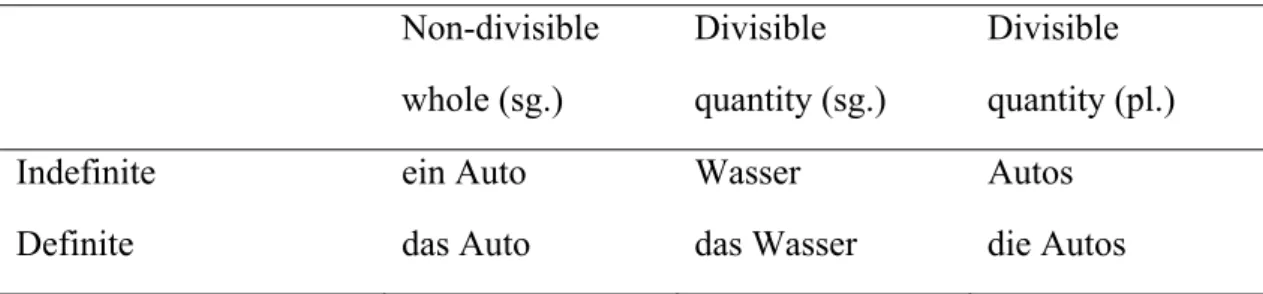
Taking a further look, concrete nouns in singular mostly appear with the definite and indefinite article in German and seldom are realized as bare nouns. Except for names of substances, since they do not have any plural realization they often co- occur with the null article or the definite article, whereas the indefinite article is seen only exceptionally. Abstract nouns have no plural forms and the distribution of the three articles is the same as for the names of substances (Helbig& Buscha, 2005: 207). Chesterman (1991: 129) illustrated the German article division as in the following Table 2:
Table 2. Division of German articles
Non-divisible whole (sg.) Divisible quantity (sg.) Divisible quantity (pl.)
Indefinite ein Auto Wasser Autos
Definite das Auto das Wasser die Autos
(Adapted from Chesterman, 1991:129)
Besides, noun classification which has a preliminary role on article use, the specific properties of a noun itself have an equal amount of importance in applying the appropriate article in terms of genus and case which seems to be more complex in German compared to English. Since there has to be a total article- noun agreement with the reference noun, the noun has to be identified in number; whether singular or plural, case; whether it is a nominative, accusative, dative or genitive noun and genus; whether it is
masculine, feminine or neuter in order to apply the appropriate definite article in German. The other way around, the definite article helps determining the identification of entities as well (Höhne, 1994: 173).
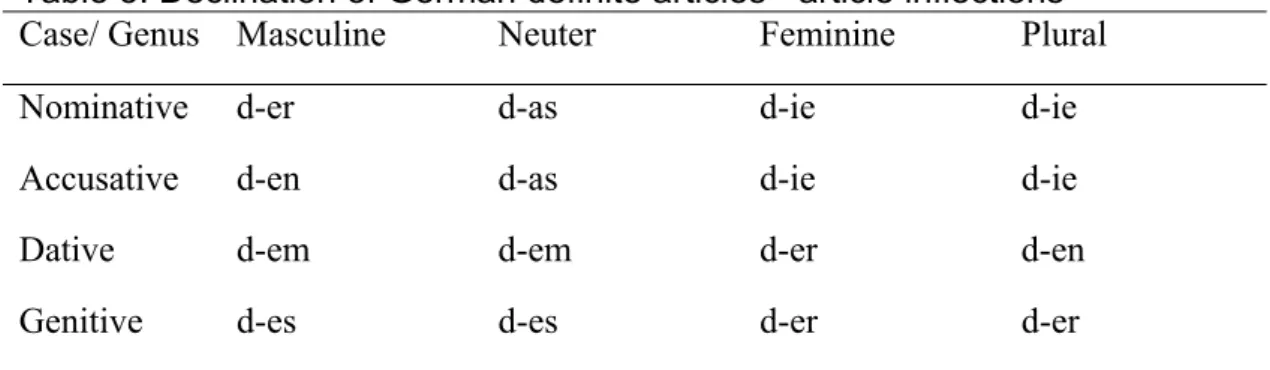
Helbig& Buscha (2005: 324) point out that the distinction between the article stems and their inflections are important and add that the definite article’s stem is ‘d-‘. There are six inflections assignable to the stem ‘d’ : +er, +es, +em, +en, +as, and +ie. Combinations of the articles and these articles perform to define genus in German where - in a non-traditional manner – the plural is identified as a German genus, and thus it will dispense with the notion of number. Hereby, Helbig& Buscha refers to the different cases in German including singular and plural forms as illustrated in the Table 3 adapted from Helbig& Buscha (2005: 324):
Table 3. Declination of German definite articles - article inflections
Case/ Genus Masculine Neuter Feminine Plural
Nominative d-er d-as d-ie d-ie
Accusative d-en d-as d-ie d-ie
Dative d-em d-em d-er d-en
Genitive d-es d-es d-er d-er
(Adapted from Helbig& Buscha, 2005: 324)
Considering the distribution of the articles inflections it can be concluded that different genus; masculine, neuter, feminine, require different numbers of cases. The masculine genus reveals four different cases. The neuter genus and plural require three different article cases and the feminine genus needs two different article cases in total which are dependent on the nouns (Wilhelm, 2002: 4).
The indefinite article ‘ein/-e’ in German helps determining the indefiniteness of an entity. It must be totally agreeing with the genus and case of the noun (Höhne, 1994: 175) since there is no plural form of an indefinite article. Helbig& Buscha (2005: 325) state that the indefinite article
’ein/-e‘ representing ‘a/an‘ in English does not have a plural form since it refers to singular items and that it is obligatorily replaced by the null article. Helbig& Buscha (2005: 325) illustrate this with the following example:
(46)Gib mir bitte ein / irgendein Buch! – Gib mir bitte irgendwelche Bücher!
give me please a/ any book – give me please any books (Indefinte article / irgendein= any – any)
‘ Please give me a / any book! / Please give me any books*’
(Helbig& Buscha, 2005: 325)
Lyons (1999:93) regarding the indefinite articles points out “…the indirect signaling of indefiniteness by a cardinality word is extremely widespread….and the numeral ‘one’ is found in many languages…German ‘ein’…” is used in this sense. Lyons (1999: 96) also states that the indefinite article is a quasi-indefinite and this “…quasi-indefinite article is segmentally identical to the numeral ‘one’. Wilhelm (2002: 4) supports in German “ …der sog. indefinite Artikel ist mit dem Zahlwort für die Zahl 1 identisch. Im Deutschen hat er keine eigene Pluralform…”.
(47) Er hat gestern ein Buch gekauft (Singular) (Indefinite article) he have-PRE-3SG yesterday a book buy-PP
‘ He bought a book yesterday.’
Er hat gestern Bücher gekauft (Plural) (Null article) he have-PRE-3SG yesterday book-PL buy-PP
‘ He bought books yesterday.’
(Wilhelm, 2002: 70)
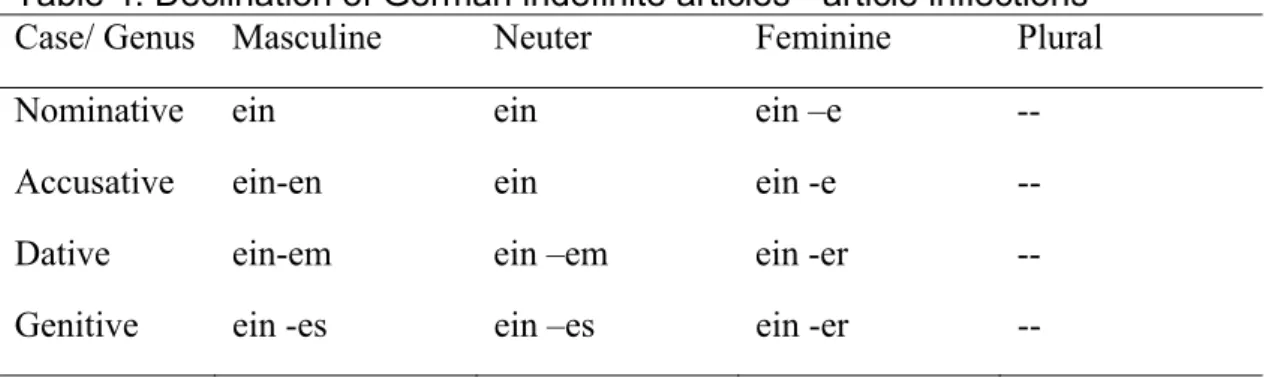
The following Table 4 illustrates the declination of the German indefinite article:
Table 4. Declination of German indefinite articles - article inflections
Case/ Genus Masculine Neuter Feminine Plural
Nominative ein ein ein –e --
Accusative ein-en ein ein -e --
Dative ein-em ein –em ein -er --
Genitive ein -es ein –es ein -er --
(Adapted from Höhne, 1994: 175)
Considering the distribution of the indefinite articles inflections it can be concluded that different genus, masculine, neuter, feminine, require different numbers of cases. The masculine genus reveals four separate cases. The neuter genus requires three different cases and the feminine genus two different article cases which are dependent on the nouns.
The null article in German functions in different ways. Partly, it is used to replace indefinite and definite articles in German, partly, it is obligatory due to some semantic reasons and partly, due to some specific syntactic constructions. Moreover, it is applied on proper nouns (in particular proper names and geographical names) as Helbig& Buscha (2005: 338) state the same in German “ Der Nullartikel wird in vielfältiger Weise verwendet. Teils dient er als Ersatzform für den unbestimmten oder bestimmten Artikel, teils ist er durch semantische Gruppierungen von Substantiven, teils durch bestimmte syntaktische Konstruktionen bedingt. Außerdem steht er bei Eigennamen( vor allem Personennamen und geographischen Namen)…“
Besides the form- based distribution of the articles in German a further point of importance is that German marks definiteness in its article system overtly which is supported by Lyons (1999:48) who states “… The greatest concentration of languages marking definiteness today is in Western Europe…”