Comparison of before and after COVID-19 urology practices of a
pandemic hospital
Department of Urology, İstanbul Medipol University Faculty of Medicine, İstanbul, Turkey Submitted:
03.06.2020 Accepted: 17.08.2020
Available Online Date: 01.10.2020 Corresponding Author: Mustafa Soytaş E-mail: [email protected] ©Copyright 2020 by Turkish Association of Urology Available online at www.turkishjournalofurology.com
Mustafa Soytaş , Mustafa Yücel Boz , Vahit Güzelburç , Gökhan Çalık , Rahim Horuz , Ziya Akbulut , Selami Albayrak
Cite this article as: Soytaş M, Boz MY, Güzelburç V, Çalık G, Horuz R, Akbulut Z, et al. Comparison of before and after COVID-19 urology
practices of a pandemic hospital. Turk J Urol 2020; 46(6): 474-80.
ORCID iDs of the authors: M.S. 0000-0002-3474-3510; M.Y.B. 0000-0002-0159-2090; V.G. 0000-0001-9988-2944; G.Ç. 0000-0002-9976-9666; R.H. 0000-0001-8014-2321; Z.A. 0000-0001-7146-4767; S.A. 0000-0002-4245-7506 ABSTRACT
Objective: The aim of this study is to compare the effects of COVID-19 on urology practice using pre- and
post-pandemic data of a pandemic hospital.
Material and methods: March 11 is considered as the beginning of COVID-19 and, changes in the number
of the outpatient clinic examinations, non-surgical procedures, and surgery in the 8-week period before and during the pandemic were evaluated by weeks. Age, gender, and comorbid diseases of the operated patients were compared statistically. The symptoms, complaints, mortality, and morbidity conditions of the patients were recorded by contacting them. Descriptive data and chi-square test were used.
Results: The number of COVID-19 cases has been reported as 8,916 for the hospital, 88,412 for the city and
150,593 for the country. The mean age of the operated patients before and after 11 March was 51 and 47, and comorbidities were 79 and 40, respectively, and there was no statistically significant difference(p<0.05). The number of patients examined was 2,309 and 868, the number of operated patients 173 and 94, the number of patients undergoing non-surgical procedures were 371 and 174, respectively. The names and numbers of surgical and non-surgical procedures are listed according to European Association of Urology (EAU) prior-ity classification. In follow-up, no complication because of COVID-19 was observed in any patient.
Conclusion: Our study showed that, although the numbers have decreased, similar operations can be
per-formed in daily urology practice without any contamination and mortality during the pandemic compared to the prepandemic period, by taking precautions and following the algorithms.
Keywords: Coronavirus; coronavirus disease 2019; pandemic hospital; severe acute respiratory syndrome
coronavirus 2; urology
Introduction
The severe acute respiratory syndrome coro-navirus 2 (SARS-CoV-2) outbreak was named by the World Health Organization (WHO) as coronavirus disease 2019 (COVID-19).[1] The first cases were seen in Turkey on March 11, 2020 and on the same day the WHO declared the disease as a pandemic.[2,3] The disease is highly contagious and its main clinical symp-toms are fever, dry cough, fatigue, muscle pain, and shortness of breath.[4] According to data as on date, the number of patients infected with the virus is 4,837,772, there are 317,310 deaths, and the number of recovered patients is 1,873,677.[5] It is unclear how long the process
will continue, or the possibility of a second or third wave of infection. In addition, a variety of foresight theories have been introduced for this topic.[6] However, these prediction models do not give confidence because of the mutation of the virus and its different virulence.[7]
In this process, many hospitals in the affected countries have been converted to pandemic hospitals and, daily patient examinations and elective surgeries other than COVID-19 have been stopped completely. With the prolonga-tion of the process and the relative stabilizaprolonga-tion of the number of cases, hospitals had to adapt to a working order separating the pandemic from the non-pandemic. In the hospital where
we work, a new plan has been made since the beginning of the pandemic and elective surgeries and daily urology practice have continued in a controlled manner unlike in many pandemic hos-pitals. In this study, we aimed to present the effects of COV-ID-19 on urology practice by comparing the number of patient examinations, non-surgical interventions, and surgeries before and during the pandemic.
Material and methods
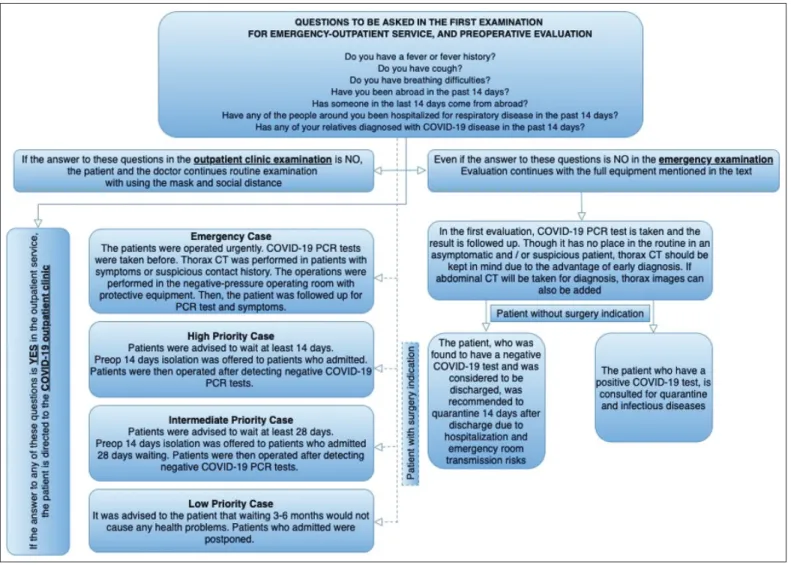
COVID-19 patients were evaluated in the hospital, city, and coun-try during the pandemic. The first COVID-19 patient in Turkey was reported on March 11 and this date is considered as the begin-ning of the pandemic and, changes in the number of the outpatient clinic examinations, non-surgical procedures, and surgery in the 8-week period before and during the pandemic were evaluated by weeks. Age, gender, and comorbid diseases of the operated pa-tients were compared statistically before and after the pandemic. Descriptive data analysis and chi-square test were used as statisti-cal methods. The study was approved by the lostatisti-cal Istanbul Medi-pol University Ethics Committee (2020/428). In the first 2 weeks after March 11, the patient evaluation strategy was provided with intraclinical consensus, and EAU, AUA, and ASCO recommenda-tions were also taken into consideration. Patients who underwent surgical and non-surgical procedures during the pandemic were divided into 4 groups as Low Priority, Intermediate Priority, High Priority, and Emergency according to EAU recommendations. In addition to the surgical consent form, the COVID-19 information and consent form prepared by us was also signed by the patients who underwent non-surgical procedures and surgery during the pandemic process. All of our patients were evaluated as per the COVID-19 patient evaluation algorithm (Figure 1). According to this algorithm, emergency patients were accepted as COVID-19 (+) and evaluated with full equipment, COVID-19 polymerase chain reaction (PCR) tests were performed, and they were oper-ated upon in a negative pressure operating room without waiting for the PCR results. Priority cases were operated upon after CO-VID-19 PCR (-) was detected and after an average of 5 days of
the prodromal period passed without symptoms. All patients un-derwent COVID-19 quarantine and follow-up for at least 2 weeks at home for possible hospital transmission. The symptoms, com-plaints, mortality, and morbidity conditions of the patients were recorded by contacting them.
Statistical analysis
Descriptive data analysis and chi-square test were used as statis-tical methods. Mean, standard deviation, median, frequency, and ratio values were used in the descriptive statistics. The distribu-tion of variables was assessed with the Kolmogorov-Smirnov test. IBM Statistical Package for the Social Sciences version 26.0 (IBM SPSS Corp.; Armonk, NY, USA) version was used in the analyzes.
Results
In the 8-week period since 11 March, when the first case was reported, the number of COVID-19 cases of the hospital has been reported as 8,916, in the city as 88,412 and in the country as 150,593. In our hospital, COVID-19 (+) patients were treat-ed in a different block with an intensive care unit (ICU) and
• COVID-19 has destroyed our daily planning in urology as in all areas of life. Outpatient clinic examinations stopped, and surgeries became impossible.
• This disruption in daily urology practice has forced us to de-velop a different planning and algorithm as well as many clin-ics. Simultaneously, associations have published COVID-19 algorithms as in clinical guideline.
• With the help of the algorithm developed by our clinic, we did not experience mortality and morbidity due to COVID-19 in any patient who underwent surgery or surgical intervention, although the numbers decreased compared to before the pan-demic.
Main Points:
Table 1. Procedures numbers and demographics-comor-bidities of surgical procedures
Before
pandemic pandemicDuring p
Surgical Procedures (n) 173 94
Age, (mean, year±std) 51±17.3 47±14.7 N/A
Sex (n) 0.759
Male 109 61
Female 64 33
Comorbidities (n)/% 79/45.6 40/ 42.5 0.577 Malignancy 31/17.9 14/14.8
Chronic kidney disease 13/7.5 8/8.5
Hypertension 6/3.4 6/6.3 Diabetes 9/5.2 5/5.3 Cardiovascular disease 10/5.7 3/3.1 Chronic obstructive pulmonary disease 3/1.7 2/2.1 Cerebrospinal disease 2/1.1 1/1 Others 5/2.8 1/1
Non-surgical procedures (n) 403 151 N/A Outpatient examinations (n) 2.309 868 N/A N/A: not applicable; p<0.05.
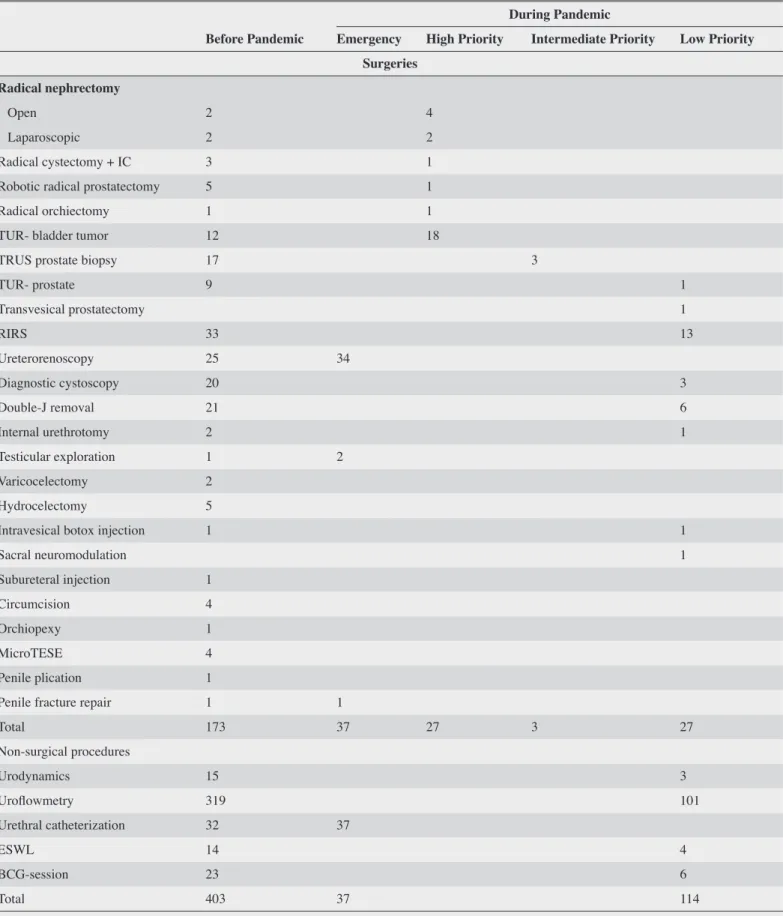
Table 2. Surgical and non-surgical interventions before and during the pandemic
Before Pandemic
During Pandemic
Emergency High Priority Intermediate Priority Low Priority
Surgeries Radical nephrectomy
Open 2 4
Laparoscopic 2 2
Radical cystectomy + IC 3 1
Robotic radical prostatectomy 5 1
Radical orchiectomy 1 1
TUR- bladder tumor 12 18
TRUS prostate biopsy 17 3
TUR- prostate 9 1 Transvesical prostatectomy 1 RIRS 33 13 Ureterorenoscopy 25 34 Diagnostic cystoscopy 20 3 Double-J removal 21 6 Internal urethrotomy 2 1 Testicular exploration 1 2 Varicocelectomy 2 Hydrocelectomy 5
Intravesical botox injection 1 1
Sacral neuromodulation 1 Subureteral injection 1 Circumcision 4 Orchiopexy 1 MicroTESE 4 Penile plication 1
Penile fracture repair 1 1
Total 173 37 27 3 27 Non-surgical procedures Urodynamics 15 3 Uroflowmetry 319 101 Urethral catheterization 32 37 ESWL 14 4 BCG-session 23 6 Total 403 37 114
IC: ileal conduit; RIRS: retrograde intrarenal surgery; TUR: transurethral resection; TRUS: transrectal ultrasonography; ESWL: extracorporeal shock wave lithotripsy, BCG: Bacillus Calmette-Guérin.
computed tomography unit reserved only for them. Although relatively decreased, the mean age of the operated patients be-fore and after 11 March was 51 and 47, respectively (Table 1). Before and during the pandemic, gender numbers were 109 and 61 men, 64 and 33 women, and comorbidity num-bers were 79 (45.6%) and 40 (42.5%), respectively; there was no statistically significant difference between them (p<0.05). For the 8-week period before and during the pandemic, the number of patients examined were 2,309 and 868, the number of operated patients 173 and 94, and the number of patients undergoing non-surgical procedures (Urodynamics, uroflow-metry, urethral catheterization, extracorporeal shock wave lithotripsy, intravesical Bacillus Calmette-Guérin) were 371 and 174, respectively (Table 1). The distribution of patients by weeks before and during the pandemic was examined (Figure 2). The names and number of surgical and non-surgical proce-dures before and during the pandemic are listed according to the EAU priority classification. (Table 2) In the follow-up, no complication due to COVID-19 was observed in any patient
during the postoperative period. In one patient, fever was ob-served after Retrograde intrarenal surgery, in one patient with TUR-bladder tumor, postoperative hemorrhage occurred and endoscopic bleeding control was performed, and 2 patients who underwent radical cystectomy and radical nephrectomy + vena cava thrombectomy were followed up at the ICU for 1 day postoperatively.
The work schedule was adjusted for the pandemic process. The urology staff were divided into 2 teams. The staff consisted of 7 specialists and 3 residents. During this period, 2 specialists (MS, RH) were infected with COVID-19, returned to the clinic after treatment and became immune plasma donors to 8 ICU patients in total. Specialists have worked for COVID-19 outpatient ex-amination, and residents have worked also for service duty in the COVID-19 building, and this assignment is ongoing. On the 5th day after the assignment, the COVID-19 PCR tests of the staff are carried out, and after the result is found negative, they continue the urology practice.
Discussion
The world entered 2020 with news of an infection from China. Several cases of pneumonia of unknown etiology were reported in Wuhan city of Hubei province of China.[8] Initially, the infec-tion was only in one region of China, and it was unlikely to spread to other countries. However, the virus has spread world-wide because of its extremely contagious nature and the world- wide-spread transportation age we are in. Currently, 99% of the coun-tries have encountered this virus.[9] WHO reported that there have been 3,925,815 confirmed cases of COVID-19, including 274,488 deaths according as on date.[10]
The first case in Turkey appeared on March 11 when the day WHO declared COVID-19 as a global pandemic, and the first death occurred on March 17.[11] With number of cases increas-ing, almost all hospitals were designated as the pandemic hos-pitals. Except for emergency surgeries, all surgeries and patient examinations were postponed indefinitely.
COVID-19 mortality rates vary by age group and country.[5] CO-VID-19 death rate for infected cases in Turkey is 2.1%, and the highest and lowest death rates have been reported as 15.2% and 0.8% in France and Russia, respectively.[12] In a study of 425 pa-tients by Li et al.[13], there were no patients under 15 years. 56% of patients were male, and the majority were 45 years old and
above. In later studies, it was observed that the disease was more severe in older patients and male patients. Based on this infor-mation, it is obvious that we should be more cautious than many other branches since the patients who approach urologists are relatively older and male. In our study, the mean age before the pandemic was 51, and during the pandemic it decreased to 47. In order to protect elderly people during the pandemic, a curfew was imposed on elderly people aged 65 and above. In addition, elective surgeries of patients in this age group were postponed. Gender-wise, the number of female patients were 64 and 33, and the number of male patients were 109 and 61 before and during the pandemic, respectively.
Surgical patient care, especially for cases requiring urgent inter-vention, has to continue during the pandemic. Considering the rate of spread of the disease and the ways of transmission, both patients and healthcare personnel are at risk of this disease. In the second month of the epidemic in China, approximately 2000 healthcare professionals (HCPs) were reported to be infected with this disease.[14] In our country, 7,428 HCPs are infected and 2 specialists from our clinic joined this list.[11]
Operating rooms generally have positive pressure technology in the work area and are separated from other areas by doors. However, when the doors are opened, the well-directed laminar airflow is disturbed, and particles and aerosols in the operating
Figure 2. Patient and procedure distribution by weeks before and during the pandemic
room air can be displaced. For this reason, if possible, negative pressure operating rooms are recommended instead of positive pressure operating rooms.[15] We accepted all of our emergency cases as COVID-PCR (+) and operated them fully equipped in the negative pressure operating room. According to the EAU classification, 37 patients were included in the emergency cate-gory during the pandemic period, and 34 of the operated patients had acute ureteral obstruction and the other 3 had testicular tor-sion and penile fracture.
There are concerns about transmission because of CO2 leak dur-ing urological surgery, resultdur-ing from the production of potential SARS-CoV-2 contaminated aerosol with the use of energy de-vices.[16] While we made laparoscopic intervention in 7 patients before the pandemic, this number decreased to 3 during the pan-demic. To avoid this exposure, a smoke evacuation system was used when performing laparoscopic and robotic surgeries. Thus, breathing in of the gas in the operation room by the health staff is minimized.
The highest risks in terms of COVID-19 mortality for the oper-ated patients are posed by the incubation period and the pres-ence of comorbidity.[13,17] In our patient series, comorbidity rates in the before and during the pandemic period were 45.6% and 42.5%, respectively, and there was no statistically significant difference. The average incubation period is reported as 5 days in COVID-19 transmission except for some cases.[18,19] In a study of 34 patients operated upon during the COVID-19 incubation period, intensive care hospitalization was required for 15 (41%) patients, and approximately half (20.8%) of these patients died. [20] This high mortality rate was taken into account, and we did not operate upon any patients, except emergency cases, without waiting for the 5-day asymptomatic period and without the CO-VID-19-PCR (-) test result. During follow-up, COVID-19 was not detected in any patient.[21]
The pandemic has negatively affected assistant training as well as daily urology practice.[22] Many educational meetings and congresses have been postponed or moved to the virtual world. Many associations have started online smart-learning circuits, webinars, and video calls in this regard.[23-25] The 3 residents working in our clinic were assigned to the pandemic clinic and returned to urology practice after the completion of the task after the COVID-PCR (-) test result was seen. They took part in 173 surgeries before the pandemic over a 2-month period and in 94 surgeries in the same period during the pandemic. Despite a 50% reduction, this number can be considered good for a difficult pe-riod such as the pandemic duration. Although theoretical lessons and article presentations could not be held in the meeting room, resident presentations and examinations were continued using internet applications as in previous plans.
In conclusion, we do not know how long the pandemic will con-tinue or whether there will be other waves of infection. Due to this uncertainty, elective surgeries, non-surgical interventions, and patient examinations should be performed as in the prepan-demic period but in a controlled manner, taking precautions. Our study showed that, although the numbers have decreased, similar operations can be performed in daily urology practice without any contamination and mortality during the pandemic compared to the prepandemic period, by taking precautions and following the algorithms.
Ethics Committee Approval: Ethics committee approval was received
for this study from the ethics committee of İstanbul Medipol University (2020/428).
Informed Consent: In addition to the surgical consent form, the
COV-ID-19 information and consent form prepared by us was also signed by the patients who underwent non-surgical procedures and surgery during the pandemic process.
Peer-review: Externally peer-reviewed.
Author Contributions: Concept - M.S., S.A.; Design - M.S., R.H.;
Supervision - M.Y.B., S.A.; Resources - G.C., V.G.; Materials - Z.A., M.Y.B.; Data Collection and/or Processing - M.S., R.H.; Analysis and/ or Interpretation - S.A., M.S.; Literature Search - M.S., R.H.; Writing Manuscript - M.S., G.C.; Critical Review - S.A., Z.A.
Conflict of Interest: The authors have no conflicts of interest to declare. Financial Disclosure: The authors declared that this study has received
no financial support.
References
1. Park SE. Epidemiology, virology, and clinical features of severe acute respiratory syndrome-coronavirus-2 (SARS-COV-2; Coro-navirus Disease-19). Korean J Pediatr 2020;63:119-24. [Crossref]
2. World Health Organization. WHO Timeline - COVID-19. World Health Organization. Available from: https://www.who.int/news-room/ detail/08-04-2020-who-timeline-covid-19. Accessed May 21, 2020. 3. T.C. Sağlık Bakanlığı Halk Sağlığı Genel Müdürlüğü. COVID-19
(SARS-CoV-2 Enfeksiyonu) Rehberi Bilim Kurulu Çalışması. Available from: https://covid19bilgi.saglik.gov.tr/depo/rehberler/ COVID-19_Rehberi.pdf. Accessed May 21, 2020.
4. Huang X, Wei F, Hu L, Wen L, Chen K. Epidemiology and Clini-cal Characteristics of COVID-19. Arch Iran Med 2020;23:268-71.
[Crossref]
5. World Health Organization. Coronavirus Disease 2019 (CO-VID-19): Situation Report − 105. WHO. Coronavirus Disease 2019 (COVID-19): Situation Report − 105. Available from: https://www.who.int/docs/default-source/coronaviruse/situation-reports/20200504-covid-19-sitrep-105.pdf?sfvrsn=4cdda8af_2. Accessed May 21, 2020.
6. Predictive Monitoring of COVID-19. Available from: https://ddi. sutd.edu.sg/when-will-covid-19-end/. Accessed May 21, 2020. 7. Lu R, Zhao X, Li J, Niu P, Yang B, Wu H, et al. Genomic
characterisa-tion and epidemiology of 2019 novel coronavirus: implicacharacterisa-tions for vi-rus origins and receptor binding. Lancet 2020;395:565-74. [Crossref]
8. Zhou P, Yang X Lou, Wang XG, Hu B, Zhang L, Zhang W, et al. A pneumonia outbreak associated with a new coronavirus of prob-able bat origin. Nature 2020;579:270-3. [Crossref]
9. World Health Organization. Coronavirus disease (COVID-19) pandemic. Available from: https://www.who.int/emergencies/dis-eases/novel-coronavirus-2019. Accessed May 21, 2020.
10. World Health Organization. Available from: https://covid19.who. int/---WHO Coronavirus Disease (COVID-19) Dashboard. Ac-cessed May 21, 2020.
11. Sağlık Bakanlığı. Yeni Koronavirüs Hastalığı (COVID-19). Available from: https://covid19bilgi.saglik.gov.tr/tr/. Accessed May 21, 2020. 12. Bulut C, Kato Y. Epidemiology of covid-19. Turk J Med Sci
2020;50:563-70. [Crossref]
13. Li Q, Guan X, Wu P, Wang X, Zhou L, Tong Y, et al. Early transmission dynamics in Wuhan, China, of novel coronavi-rus-infected pneumonia. New England Journal of Medicine. 2020;382:1199-207. [Crossref]
14. World Health Organization-China Joint Mission on Coronavirus Disease 2019. Available from: https://www.who.int/docs/default- source/coronaviruse/who-china-joint-mission-on-covid-19-final-report.pdf. Accessed May 21, 2020.
15. Ti LK, Ang LS, Foong TW, Ng BSW. What we do when a COV-ID-19 patient needs an operation: operating room preparation and guidance. Can J Anesth 2020;67:756-8. [Crossref]
16. Mallick R, Odejinmi F, Clark TJ. Covid 19 pandemic and gynaeco-logical laparoscopic surgery: knowns and unknowns. Facts Views Vis Obgyn 2020;12:3-7.
17. Wang T, Du Z, Zhu F, Cao Z, An Y, Gao Y, et al. Comorbidities and multi-organ injuries in the treatment of COVID-19. Lancet 2020;395:e52. [Crossref]
18. Guan WJ, Ni ZY, Hu Y, Liang WH, Ou CQ, He JX, et al. Clinical Characteristics of Coronavirus Disease 2019 in China. N Engl J Med 2020;382:1708-20. [Crossref]
19. Lauer SA, Grantz KH, Bi Q, Jones FK, Zheng Q, Meredith HR, et al. The Incubation Period of Coronavirus Disease 2019 (COVID-19) From Publicly Reported Confirmed Cases: Es-timation and Application. Ann Intern Med 2020;172:577-82.
[Crossref]
20. Lei S, Jiang F, Su W, Chen C, Chen J, Mei W, et al. Clinical char-acteristics and outcomes of patients undergoing surgeries during the incubation period of COVID-19 infection. EClinicalMedicine 2020;5:100331. [Crossref]
21. Stahel PF. How to risk-stratify elective surgery during the COV-ID-19 pandemic? Patient Saf Surg 2020;14:8. [Crossref]
22. Ficarra V, Novara G, Abrate A, Bartoletti R, Crestani A, De Nunzio C, et al. Urology practice during COVID-19 pandemic. Minerva Urol Nefrol 2020;72:369-75. [Crossref]
23. European Association of Urology. Available from: https://uroweb. org/education/online-education/ Accessed May 21, 2020.
24. Türk Üroloji Derneği Şubeleri Ortak Toplantısı. Available from: https://www.uroturk.org.tr/etkinlikler/44/periyodik-toplanti- lar/823/turk-uroloji-dernegi-subeleri-ortak-toplantisi-tips-and-tricks-bolum-i. Accessed May 21, 2020.
25. Surgery in Motion School. Available from: https://surgeryinmo-tion-school.org/ Accessed May 21, 2020.