The Economic Impact of Weeds and Their Control in Turkey
Yakup Erdal ERTÜRK1İlhan ÜREMİŞ2 Ahmet ULUDAĞ3
Abstract
Weeds are among limiting factors in maize production, which is an important crop in Turkey. There are common problematic weeds in all maize producing regions of Turkey although there are some different problems in some regions due to varying climate and soil factors, and cropping practices. When weeds are left for interfering with maize during entire cropping season, 31-65 % of crop lost depending on locations and years. The cost of weed control in maize in Turkey in 2011 was assessed as roughly 154 million TL (1 €= 2.322 TL as average in 2011) which might caused saving 50 % of current maize production of Turkey which was 4 200 000 tons in 2011. The return was calculated as over one billion TL due to weed control in maize.
INTRODUCTION
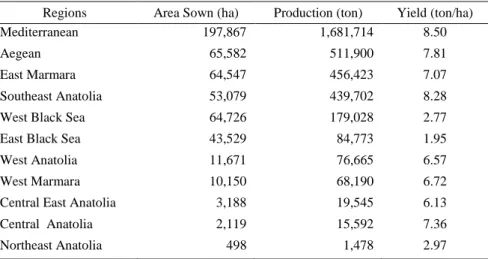
Maize is an important crop with its various uses from animal husbandry to industry. It is mainly a fodder crop with its 64% use worldwide. However, it is produced 45% for human consumption in Turkey, which is 19% only worldwide (Turgut, 2002). The Black Sea, the Marmara, the Aegean, the Southeast Anatolia and the Mediterranean Regions of Turkey are main maize producing regions although it is sown all over Turkey for farmers’ own consumption (Table 1).
Table 1. Maize producing regions of Turkey their share in area and production in 2007 (Source: Ozcan, 2009)
Regions Area Sown (ha) Production (ton) Yield (ton/ha)
Mediterranean 197,867 1,681,714 8.50
Aegean 65,582 511,900 7.81
East Marmara 64,547 456,423 7.07
Southeast Anatolia 53,079 439,702 8.28
West Black Sea 64,726 179,028 2.77
East Black Sea 43,529 84,773 1.95
West Anatolia 11,671 76,665 6.57
West Marmara 10,150 68,190 6.72
Central East Anatolia 3,188 19,545 6.13
Central Anatolia 2,119 15,592 7.36
Northeast Anatolia 498 1,478 2.97
The world maize areas reached to 163 million hectares with 8.7% increase and production 824 million metric tons with 15.4% in the last 5 years. Bioethanol production, increase in fodder demand, climatic factors such as drought and raise in crop prices are among main drivers of increases in maize areas and productions (Daşdan et al. 2011).
1
Assist. Prof. Dr., Department of Agricultural Economics, Igdir University
2
Prof. Dr., Department of Plant Protection, Mustafa Kemal University
3
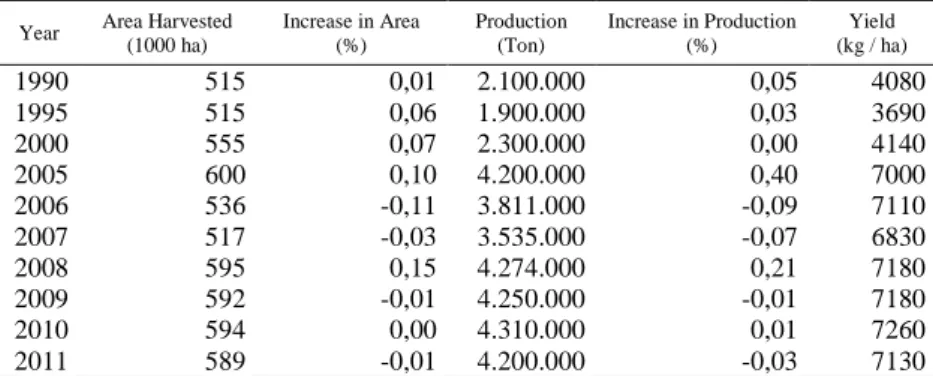
Maize producing area in Turkey has been about 600 000 hectares since 1960s in spite of year by year fluctuations (FAO, 2012). The area decreased in late 1980s but mainly it as ascended for last decade (Table 1). Maize yield have had a steady increase since 1960s. The yield was 1400 kg/ha in 1961 and over 7 tons in 2010 (FAO, 2012). It was almost doubled after mid 2000s (Table 2) due to some financial and technical support systems.
Table 2. Maize production in Turkey (1990-2011) (Source: Ministry of Agriculture) Year Area Harvested
(1000 ha) Increase in Area (%) Production (Ton) Increase in Production (%) Yield (kg / ha) 1990 515 0,01 2.100.000 0,05 4080 1995 515 0,06 1.900.000 0,03 3690 2000 555 0,07 2.300.000 0,00 4140 2005 600 0,10 4.200.000 0,40 7000 2006 536 -0,11 3.811.000 -0,09 7110 2007 517 -0,03 3.535.000 -0,07 6830 2008 595 0,15 4.274.000 0,21 7180 2009 592 -0,01 4.250.000 -0,01 7180 2010 594 0,00 4.310.000 0,01 7260 2011 589 -0,01 4.200.000 -0,03 7130
Pests are among factors causing crop losses in quantity and quality and requiring extra costs to control them. It has been known that there are over 400 pests, 60 diseases and some weed species interfere with maize production worldwide. Pests in Turkey in maize show similarity with common pests worldwide. Ostrinia nubilalis, Sesamia nonagrioides, Agrotis spp., Helicoverpa armigera, Rhopalosiphum spp., Spodoptera spp., Tetranychus spp., Mythimna spp. and Nezara viridula are important pests in maize in Turkey. Helminthosporium spp. and Fusarium spp. are main disease agents in Turkey’s maize production.
Weeds also cause crop losses in maize if they are not controlled. Weeds could cause potentially 37% crop loss in the world production. There has been 10% (5 to 17% depending on regions) actual crop loss worldwide in spite of application of weed control measures (Oerke and Dehne, 2004)
The aim of current paper is to review weed problem in maize production and assess economic impact of weeds and weed control in Turkey.
WEED PROBLEM IN MAIZE IN TURKEY
Due to climatic, geographic, and edaphic differences in maize producing areas of Turkey and varying cropping techniques, field sizes, and economical levels, foremost weed species change region to region. However, there are many common species.
In the Samsun province in the Black Sea Region, weed species reduced from 43 species in 1973 to 30 species in early 2000s (Mennan and Isik, 2003; Ozduman, 2005). Sorghum halepense (L.) Pers. and Cynodon dactylon (L.) Pers. were among important species in 1973. No narrow leaf species except Alopecurus myosuroides Hudson was among important species in 2000s where Artemisia vulgaris L. and Convolvulus arvensis L. were only important perennials. Inner part of the Black Sea Region (Kazova area), C. arvensis was only perennial species in top 10 common species (Kacan et al. 1997). Echinochloa crus- galli (L.) P. Beauv. , Setaria spp. and Digitaria sanguinalis (L.) Scop. were narrow leaf species.
In the Cukurova plain in the Mediterranean Region of Turkey, 18 species were mentioned most common and dense species (in the alphabetical order): Amaranthus albus L., A. retroflexus, Amaranthus viridis L., Chrozophora tinctoria (L.) Rafin., Convolvulus arvensis L., Cyperus rotundus L., Echinochloa colonum (L.) Link, E. crus-galli, Euphorbia chamaesyce L., Hibiscus trionum L.,
Paspalum paspalodes (Michx.) Schrib., Physalis alkekengi L., Portulaca oleracea L., Prosopis farcta (Banks and Sol.) Macbride, Setaria viridis L., Solanum nigrum L., S. halepense, Xanthium strumarium L. (Orel, 1996). Other studies in the region give the same species with different importance orders (Gonen, 1999; Oksar, 2000).
Actualy maize in the Cukurova plain as well as the Aegean and the South Anatolian Regions was produced as main crop or the second crop following small grain harvest in general. The second crop maize consists 26% of the total maize production of Turkey (Dagdelen and Gurbuz, 2008). Farmers’ view for the most problematic species for the both cropping type was similar for two types of productions in the Cukurova Region. Echinochloa spp., Amaranthus spp., Sorghum halepense, Setaria spp. and Portulaca oleracea were the top five problematic species in the main crop maize while Setaria spp., Xanthium strumarium, Echinochloa spp., Amaranthus spp., and Sorghum halepense in the second crop maize in the order of magnitude by farmers (Gungor, 2005). In the field surveys in the second crop maize those species were detected over 50% of fields except Setaria viridis. However, S. viridis was the densest species in the region. Cyperus rotundus was among the most common and dense species, which was in the sixth rank as farmers’ preference.
There has been no study about weed problem in maize in the other maize producing regions. However, similarities problematic weeds in other summer crops such as cotton in those regions, problematic weeds in the Southeast Anatolia, the Aegean and the Marmara Regions are similar to Mediterranean Region where also later two are located in the same phyto-geographic region with Mediterranean and the former is next to Mediterranean Region.
If weeds were left during entire season, studies with natural weed stands, which were mainly common weeds of the regions of Turkey, showed that maize yield can be reduced 34-65% depending on year in the main crop corn in the Aegean Region and 49% in the second crop maize (Dogan et al. 2004). In the Cukurova plain crop loss changed from 38 to 61% in the second crop maize due to season-long weed competition (Uremis et al. 2009).
WEED CONTROL IN MAIZE IN TURKEY
Critical period for weed control (CPWC) was found 3 to 10 leaf stage in the Aegean Region (Dogan et al. 2004). CPWC in the second crop maize was calculated in the Mediterranean Region as 131 to 927 growing degree days (GDD) after sowing in 1996, 337 to 731 GDD in 1997 and 266 to 551 GDD in 1998 for 10% yield loss; for 2.5 - 5% yield loss, the critical period starts with germination and lasts longer (Uremis et al. 2009). They suggested that preemergence (PRE) or presowing (PPI) herbicides would be preferred to avoid higher yield losses. However, a postemergence (POST) herbicide can be applied in the second week after crop sowing, and the field should be kept weed free for 4 or 5 weeks if a farmer can tolerate 10% yield loss.
Hand hoeing, interrow tillage and herbicide applications are the common weed control methods in maize production. The effect of methods on maize yield differs. In fact, weedy treatments yielded less than sole hand hoeing, interrow tillage with hand hoeing, and herbicide application at 17.6, 19.9, and 37.9%, respectively, in the Southeast Anatolian Region (Oktem et al. 2004). Some farmers apply interrow tillage twice, hand hoeing is common practice of small farmers. In addition earthen can be considered a weed control method although weeding is not the main aim (Uremis, 1993)
Farmers chose different methods and their combinations. Sole hand hoeing was chosen by only 2% of farmers while interrow tillage by 27%, interrow tillage with hand hoeing by 47%, PRE herbicides by 8% and POST herbicides by 16% in the Hatay Province of the Mediterranean Region (Gozubenli et al. 2000).
The number of herbicides applied was changed depending on crop type and year in the Çukurova Region (Gungor, 2005). One herbicide applied by 28, 44, 34% of main crop maize producers and 20, 32, 40% by the farmers producing second crop in 2002, 2003, and 2004, respectively. The percentage of farmers who applied herbicides more than once was less: 8, 14, and 2% in main crop and 2, 5, 9% in the second crop depending on growing years above mentioned. Herbicide application time choice of farmers showed fluctuations year by year (Gungor, 2005). PRE was chosen 46.88, 44.93, and 68.42% by main crop maize producing farmers and 28.00, 16.28, and 29.82% by the second crop producers in 2002, 2003, and 2004, respectively. Remaining of farmers who applied herbicides chose POST application. Herbicide choice of farmers not only affected by cost and weed species; but also regulations, companies’ marketing techniques and farmers’ habits. The main crop maize producers’ main choice was acetochlor followed by nicosulfuron and foramsulfuron. In the second crop maize 2,4-D and rimsulfuron also applied beside above three herbicides (Gungor, 2005). It is surprising that farmers mainly used few herbicides among many registered choices in those years. Due to prohibition by Turkish Ministry of Agriculture, few choices, especially PRE, remained. Currently Isoxaflutole, Linuron, Acetochlor, and Pendimethalin for PRE, 2.4-D, Florosulam, Bromoxynil, Pyridate, Rimsulfuron, Nicosulfuron, Foramsulfuron, Iodosulfuron, Isoxadifen, Mesotrione, Tritosulfuron, Dicamba for POST are available registered herbicides as solo and/or mixtures.
COST OF WEED CONTROL
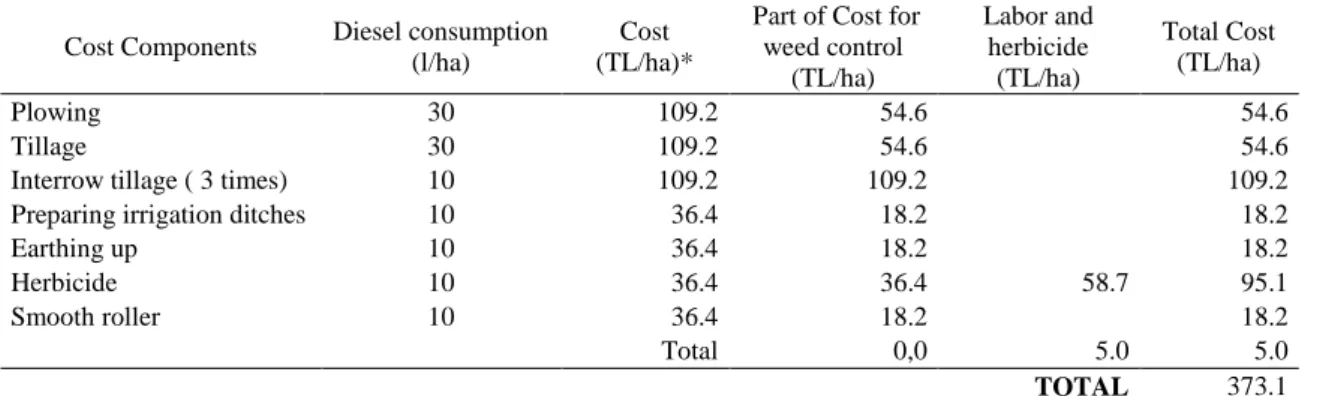
Main production and cost components of maize production are presented in Table 3. Among activities showed in the table, weed control under plant protection and interrow tillage/rotatilling directly aim weed control. However, Plowing, tillage in spring, disking, harrowing for seedbed preparation, earthing up and preparation of irrigation ditches requires special attention if weed pressure is high in the given field. Under such a condition, all those activities can be considered as weed control technique. But we added only half of the cost as weed control cost for those processes. The compiled list of weed control techniques in maize and their costs are given in Table 4. Consumption of diesel was taken from a report of Cukurova Irrigation Association (CSB, 2009) and price of rural diesel, which was average 3.64 TL per litre for 2011, obtained from Energy Market Regulatory Authority (EPDK, 2012). We assumed a flat rate 5 TL per ha for labor. Indeed, Labor cost was 3.6% of overall maize production costs (Aktas and Yurdakul, 2005). Total cost of weed production for maize was calculated as 373.1 TL for 2011 /Table 4).
Table 3. Main cost components of maize production (Anonymous, 2011)
Components for Maize Production Field Lease
Plowing in Autumn Tillage in Spring
Disking-harrowing (up to 3 times) Seed purchasing
Seeding with pneumatic machine Smooth roller (up to 2 times) Fertilizer and Fertilizing
Interrow tillage - Rotatilling - Earthing up - Preparing irrigation ditches Water and irrigation
Plant protection (Weeds, Pests) Harvest
Transportation of produce Guard
Table 4. Calculation of weed control costs in maize
Cost Components Diesel consumption (l/ha)
Cost (TL/ha)*
Part of Cost for weed control (TL/ha) Labor and herbicide (TL/ha) Total Cost (TL/ha) Plowing 30 109.2 54.6 54.6 Tillage 30 109.2 54.6 54.6
Interrow tillage ( 3 times) 10 109.2 109.2 109.2
Preparing irrigation ditches 10 36.4 18.2 18.2
Earthing up 10 36.4 18.2 18.2
Herbicide 10 36.4 36.4 58.7 95.1
Smooth roller 10 36.4 18.2 18.2
Total 0,0 5.0 5.0
TOTAL 373.1
*1€=2.322 TL average of entire year for 2011
No all farmers apply the same processes. Some farmers practice less than 3 times interrow tillage. Farmers used herbicide in the Cukurova Region where is the most pesticide consuming for a given area part of Turkey were about 36% mostly (Gungor, 2005). Regarding to those data and observations, we might say one third of maize farmers spent 373.1 TL for weed control. It can be assumed the remaining might spend 205.2 TL per hectare for weed control excluding herbicide costs and reducing interrow tillage costs. The area sown in 2011 was 589 000 ha. Using these assumptions, the cost of weed control in maize in Turkey in 2011 was roughly 154 million TL.
Regarding to crop loss data from Dogan et al (2004) and Uremis et al (2009), weeds without any control measure can reduce maize yield from 34 to 65% depending on year. We might assume 50% maize crop loss as average. It means 2 100 000 ton maize was gained applying weed control techniques, which the maize production of Turkey was 4 200 000 tons in Turkey in 2011. The monetary value of saved crop for 2011 was assessed 1,323,000,000 TL(average price of maize was 0.63 TL/kg), which means over 1 billion TL return was obtained by farmers. However, average 10% loss is still occurs under weed control measures worldwide (Oreke and Dehne, 2004). It means, probably under ideal weed control measurements, it would have saved another 500 000 tons maize, roughly.
References
Aktas, E.,Yurdakul, O., 2005. Destekleme ve Teknoloji Politikalarının Cukurova Bolgesinde Misir Tarimi Uzerine Etkisi. Journal of Agricultural Faculty, University of Cukurova , 20 (2) 19-28.
Anonymous, 2011. 2011 Yili Misir Urunu Maliyet Cizelgesi. Aydin Ziraat Odasi, Aydin-Turkey.
CSB, 2009. Mısır Ekim İstatistiği at internet: http://cukurovasulama.gov.tr/files/MISIR%20EKiM%20 iSTATiSTiGi.pdf. (accessed on 10 July 2012).
Dagdelen N., Gurbuz T., 2008. Aydin Kosullarinda Ikinci Urün Misirin Su Tuketimi. Adnan Menderes Üniversitesi, Ziraat Fakültesi Dergisi, 5 (2) 67-74..
Dasdan, K., Cetin, F. ve Gurer, B. 2011. Misir Durum ve Tahmin 2011-2012. Tarimsal Ekonomi ve Politika Gelistirme Enstitusu (TEPGE), TEPGE Yayin No: 193, Ankara-Turkey.
Dogan M.N., Boz O., Unay A., Albay F., Determination of Optimum Weed Control Timing in maize (Zea mays L.) ,Turkish Journal of Agriculture and Forestry, 28:349-354, 2004.
EPDK, 2012. Akaryakıt Bayi Fiyatı Raporu at internet: https://ppbp.epdk.org.tr/Rapor/Akaryakit/Paylasim/Fiyat Listesi.aspx?RaporTip=5 (accessed on 10 July 2012).
FAOSTAT, 2012. Statistical Database at internet http://faostat.fao.org/site/567/default.aspx (accessed on 10 July 2012).
Gonen, O., 1999. Cukurova Bolgesi Yazlik Yabanci Ot Turlerinin Cimlenme Biyolojileri ve Bilgisayar ile Teshise Yonelik Morfolojik Karakterlerinin Saptanmasi, C.Ü. Fen Bil. Ens.Doktora Tezi, Adana, 233 s.
Gozubenli, H., Sener, O., Konuskan, O., Sahinler, S. ve Kılınc, M., 2000. Hatay’da Misir Tariminin Genel Durumu, Sorunlari ve Cozum Onerileri. M.K.Ü. Ziraat Fakültesi Dergisi, 5(1-2), 41-48.
Gungor, M., 2005, Adana Ili Misir Ekim Alanlarinda Yabanci Otlara Karsi Uygulanan Kimyasal Mucadelenin Onemi ve Ortaya Cikan Sorunlarin Arastirilmasi, C.Ü. Fen Bil. Ens., Yüksek Lisans Tezi, Adana, 191 s Kacan, K., Tursun, N., Onen, H., Ozer, Z., 1997. Kazova (Tokat)’da Misir (Zea mays L.) Ekim Alanlarinda Sorun Olan Yabanci otlar. Türkiye ΙΙ. Herboloji Kongresi. (1- 4 Eylül 1997, Ayvalık ve İzmir) 189-194. Mennan, H., Isik, D., 2003. Samsun Ili Ekim Alanlarinda Son 30 Yilda Gorulen Floral Degisiklikler ve Bunlarin
Nedenlerinin Arastirilmasi. Türkiye Herboloji Dergisi, 6 (1) 1-7.
Oerke, E.C., Dehne, H.W. 2004. Safeguarding Production—Losses in Major Crops and the Role of Crop Protection. Crop Protection, 23; 275–285.
Oksar, M., 2000, Cukurova’daki Yabanci Otlar ve Bunlarin Biyolojik Mucadele Olanaklari, C.Ü. Fen Bil. Ens., Yüksek Lisans Tezi, Adana, 86 s.
Oktem, A., Ulger, A.C., Coskun, Y., 2004. Harran Ovasi Kosullarinda Bazi Yabanci Ot Kontrol Yontemlerinin Misir Bitkisinde (Zea mays L.) Tane Verimi ve Verim Unsurlarina Etkisi. Harran Universitesi Ziraat Fakultesi Dergisi, 5 (1-2), 51-57.
Orel, E., 1996. Cukurova Bolgesi Bugday ve Misir Ekim Alanlarinda Bazi Ekolojik Faktorlerin Gostergesi Olabilecek Yabanci Ot Turlerinin Saptanmasi. C.Ü. Fen Bil. Ens.,Yüksek Lisans Tezi, Adana, 133 s. Ozcan, S. 2009. Modern Dunyanin Vazgecilmez Bitkisi Misir: Genetigi Degistirilmis (Transgenik) Misirin
Tarimsal Uretime Katkisi. Turk Bilimsel Derlemeler Dergisi 2(2): 01-34.
Ozduman, A., 2005, Samsun'da Misir Ekim Alanlarindaki Yabancı Ot Florasinin Belirlenmesi ve Mısır ve Soyanın Karisik Ekim Sisteminde Domuz Pıtrağı (Xanthium strumarium L.)'nın Verime Etkisi, Ondokuz Mayıs Universitesi. Fen Bil. Ens.,Yüksek Lisans Tezi, Samsun, 57 s
Turgut, I., 2002. Silajlık Misir Yetistiriciligi. Silaj Bitkileri Yetistirme ve Silaj Yapimi (2. Bolum). Hasad Yayincilik Ltd. Sti, s.11, Istanbul-Turkey.
Uremis, I, 1993. Adana’da Misir Ekilislerinde Ucakla Herbisit UygulamalarI Uzerinde Bir Arastirma, C.Ü. Fen Bil. Ens., Yüksek Lisans Tezi, Adana, 95 s.
Uremis, I., Uludag, A., Ulger A.C., Cakir, B., 2009. Determination of Critical Period for Weed Control in the Second Crop Corn Under Mediterranean Conditions. African Journal of Biotechnology, 8 (18) 4475-4480.