Evaluation of paradoxical vocal cord motion and
differential diagnosis
Vokal kordun paradoks motilitesinin ve ay›r›c› tan›s›n›n de¤erlendirmesi
Esin Yalç›nkaya1, ‹smail Güler2, Sinan Kocatürk21
Yüksek ‹htisas University Koru Hospital, Ankara, Turkey 2
Department of Otorhinolaryngology, Faculty of Medicine, Ufuk University, Ankara, Turkey
Paradoxical vocal cord motion (PVCM) is defined as closure of vocal cords improperly in inspirium.[1]
The patients gen-erally have obstructive airway complaints such as stridor, wheezing, dyspnea and cough while breathing.[1,2]
As it is a rarely seen functional disorder, generally misdiagnoses and treatments are made.[2,3] PVCM is basically diagnosed by
adduction of vocal cords in inspirium and observation of a rectangular posterior glottic fissure during laryngoscopic examination during an attack.[3,4]
However, there are publica-tions notifying that the disease can be detected by applying provocative maneuvers which induce paradoxical vocal cord motions in the patients during asymptomatic period.[3,5,6]
Özet
Amaç: Çal›flman›n amac›, paradoks vokal kord motilitesi hastal›¤›n›n, ay›r›c› tan›da en büyük s›kl›kla hesaba kat›lmas› gereken ast›m, larengo-garengeal reflü ve anksiyete bozuklu¤u ile iliflkisini de¤erlendirmektir.
Yöntem:Bu çal›flmaya akci¤er hastal›klar›, gastroenteroloji, psikiyatri ve respiratuar semptomlar nedeniyle kulak burun bo¤az polikliniklerine baflvuran 100 (64 kad›n ve 36 erkek) hasta dahil edilmifltir. Asemptoma-tik dönemde inspiratuar addüksiyona ba¤l› paradoks vokal kord motili-tesine ve provokatif manevralar sonras›nda videolarengoskopik muaye-nede gözlemlenen posterior glotik fissüre tan› konmas› planlanm›flt›r.
Bulgular:Hastalar›n yafl ortalamas› 44.7±7.3 (kad›n: 36.3±4.5, erkek: 52.3±3.2) idi. Hastalar›n %57’si akci¤er hastal›klar›, %24’ü gastroen-teroloji, %12’si psikiyatri ve %7’si KBB polikliniklerine baflvurmufltu. Asemptomatik dönemde provokatif manevralar sonras› yap›lan vide-olarengoskopik muayenede 99 hastada paradoks vokal kord motilitesi saptanmam›flt›r. Videolarengoskopik muayene s›ras›nda atak oluflan bir hastada paradoks vokal kort motilitesi saptanm›flt›r.
Sonuç:Paradoks vokal kord motilitesi nadiren görülen bir hastal›k olmas›na ra¤men tan› konmam›fl hastalarda ciddi sorunlara yol açar. yol açar. Çal›flmam›zda, bu hastal›¤›n tan›s›n›n, asemptomatik dö-nemde gerçeklefltirilen provokatif manevralardan ziyade, atak s›ras›n-da konabilece¤i sonucuna vard›k.
Anahtar sözcükler:Paradoks vokal kord motilitesi, ast›m, larengo-farengeal reflü, anksiyete bozuklu¤u.
Abstract
Objective:To evaluate the relationship between paradoxical vocal cord motion (PVCM) disease and the diseases such as asthma, laryngopha-ryngeal reflux and anxiety disorder that should be taken into consider-ation most frequently in differential diagnosis.
Methods:The study included 100 patients (64 females and 36 males) who had applied to the polyclinics of pulmonary diseases, gastroenterol-ogy, psychiatry and ear nose throat due to respiratory symptoms. In asymptomatic period, it was planned to diagnose paradoxical vocal cord motion due to inspiratory adduction and posterior glottic fissure observed in videolaryngoscopic examination made after provocative maneuvers.
Results:The mean age of the patients was 44.7±7.3 (female: 36.3±4.5, male: 52.3±3.2). 57% of the patients applied to pulmonary diseases, 24% to gastroenterology, 12% to psychiatry and 7% to ENT polyclinics. No paradoxical vocal cord motion was detected in 99 patients invideolaryn-goscopic examination made after provocative maneuvers performed in asymptomatic period. Paradoxical vocal cord motion was detected in one patient who had attack during videolaryngoscopic examination.
Conclusion:Although PVCM is a rarely seen disease, it leads to seri-ous problems in non-diagnosed patients. In our study, we concluded that PVCM can be diagnosed during an attack rather than provocative-maneuvers performed during asymptomatic period.
Keywords:Paradoxical vocal cord motion, asthma, laryngopharyn-geal reflux, anxiety disorder.
Correspondence: Esin Yalç›nkaya, MD. Yüksek ‹htisas University Koru Hospital,
Ankara, Turkey.
e-mail: [email protected]
Online available at: www.jmedupdates.org doi:10.2399/jmu.2014003004 QR code:
It has been reported that PVCM can be confused with laryngopharyngeal reflux, asthma and anxiety disorders and it can be also triggered by these diseases. The present study investigated the prevalence of PVCM in the society and its relationships with asthma, laryngopharyngeal reflux and anxiety disorders.
Materials and Methods
The study protocol was approved by the ethics committee of our university. Informed consent forms were taken from all patients. The study population was composed of the patients who had applied to pulmonary diseases, gas-troenterology, psychiatry or ear nose throat (ENT) outpa-tient clinics due to vocal changes or respiratory symptoms. Among these patients, those with vocal changes, respirato-ry disorders, chronic coughs, episodic dyspnea, wheezing, inspiratory stridor symptoms or findings were directed to ENT polyclinics. Anamnesis and additional patient infor-mation of these patients were recorded. The patients with underlying neurologic deficit, history of upper respiratory tract operation which might lead to vocal cord dysfunction or the patients who rejected videolaryngoscopic examina-tion or required mechanical ventilaexamina-tion were excluded from the study. The patients were subjected to videolaryn-goscopic examination by ENT department and vocal cord motions were recorded by applying maneuvers, which provoke paradoxical vocal cord motions (deep and fast breathing, holding the breath, sniffling and fonation) dur-ing examination. Detection of posterior glottic fissure in inspiratory adduction during laryngoscopic examination was accepted as “paradoxical vocal cord adduction”. All patients with paradoxical vocal cord motions were planned to be evaluated by gastroenterology, pulmonary diseases and psychiatry departments. In the selected patient popu-lation, it was planned to examine the prevalence of para-doxical vocal cord motions and the relationships between this functional disorder and asthma, laryngopharyngeal reflux and anxiety disorders.
Results
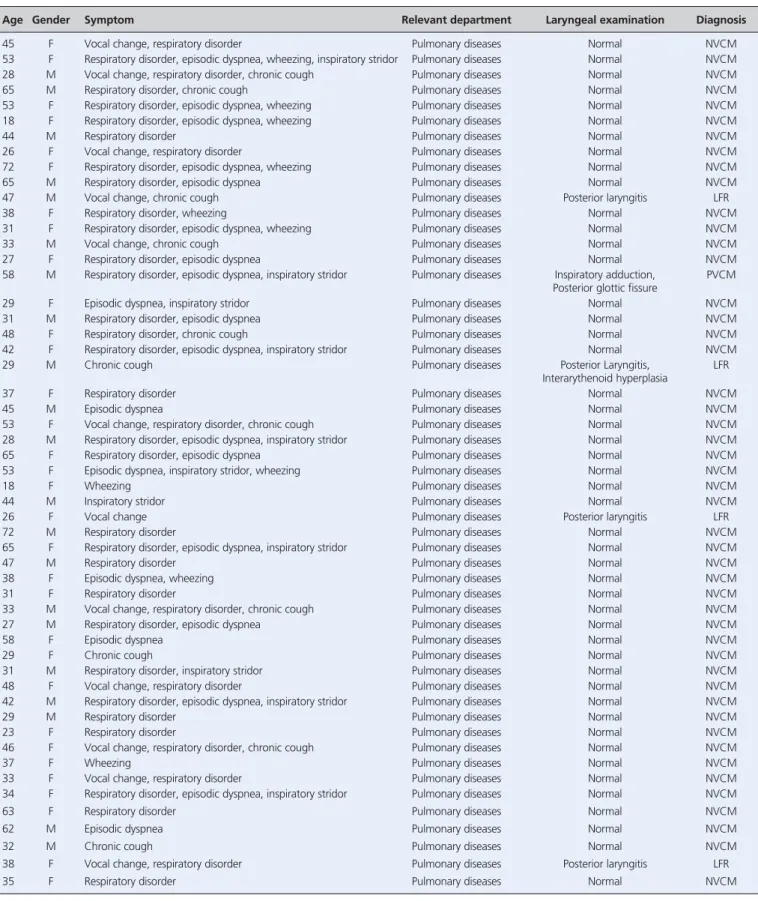
The study included a total of hundred patients: 36 men and 64 women (Table 1). The mean age of the patients was 44.7±7.3 years while mean ages of women and men were 36.3±4.5 and 52.3±3.2 years, respectively. The patients with asthma (n=57) were referred to department of chest diseases, cases with gastroesophageal reflux (n=12) to gastroenterology and anxiety disorders (n=12) to psy-chiatry departments. Seven patients with vocal cord
dys-function applied to ENT polyclinics (Table 1). Except for asthma, gastroesophageal reflux and psychological disor-ders no other systemic disorder caused vocal cord dysfunc-tion.
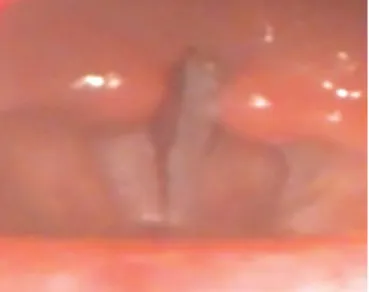
All patients showed one of the symptoms or findings of vocal change (58%), respiratory disorder (62%), chronic cough (43%), episodic dyspnea (28%), wheezing (13%) and inspiratory stridor (7%) (Table 1). Only one patient had asthma attack during videolaryngoscopic examination who was monitored during the attack. In endoscopic lar-ynx examination, radix linguae and laryngeal regions of all patients were normal. When evaluated in terms of vocal cord function, inspiratory adduction and posterior glottic fissure were detected only in the patient who had attack during examination (Fig. 1). The patients with PVCM were evaluated by pulmonary diseases, gastroenterology and psychiatry departments.
Respiratory function test results and pulmonary find-ings were normal. After endoscopic examination applied to the patient with dyspeptic complaints, gastroesophageal reflux was diagnosed and the treatment was initiated. During psychiatric examination of the patient, anxiety induced by attacks was detected and use of sedative treat-ment was planned. Vocal cord functions of all other patients were considered as normal. It was seen that provocative exercises during asymptomatic period did not trigger vocal cord dysfunction.
Discussion
Larynx is an organ functioning as a valve between trachea and esophagus.[7]
The muscle primarily responsible for vocal cords is posterior cricoarythenoid muscle. Adduction is basically ensured with lateral chricoarythenoid muscle.[7,8]
Glottic fissure during normal inspirium is controlled by medullar respiratory area by means of vagal nerve. Therefore, vocal cord abduction is ensured with contraction of posterior cricoarythenoid muscles. During normal expi-ration, tonic activity of the posterior cricoarythenoid mus-cle decreases and rima glottis constricts 10% and 40% with the contraction of lateral cricoarythenoid muscle. This nar-rowing starts immediately before expiration and continues during approximately 95% of the expiratory phase.[8,9]
It is known that the receptors in respiratory tracts lead to closure of vocal cords and coughing as a part of glottic closing reflex. This reflex is triggered with the stimulants which cause irritation. It is considered that these stimulations in the airways lead to development of glottic closing reflex in the individuals with hypersensitivity.[9–11]
Paradoxical vocal cord motility was first introduced by Christopher as vocal cord dysfunction.[9]
In the literature, it is defined with the terms “paradoxical vocal cord adduction, episodic paroxysmal laryngospasm, irritable larynx syn-drome and respiratory dystonia”.[12–14]Stimulation of airway
receptors is caused by some factors such as laryngopharyn-geal reflux, allergy, asthma, psychological disorders, rhinos-inusitis and inhalation of irritating substances.[15,16]
Organic and non-organic factors were indicated in the etiology of PVCM disease.[17]
It was stated that organic reasons are less frequently encountered than non-organic reasons. Organic reasons include brain stem compression, cortical or upper motor neuron damage, gastroesophageal reflux, nuclear or lower motor neuron damage while non-organic reasons include simulative behaviors and conver-sion disorders.[18–20]
PVCM is most frequently seen in young women.[19]
In our study, 64% of the patients were female and their mean age was 36.3±4.5 years.
There are many case reports in the literature about vocal cord dysfunction. These cases are generally related to patients with attacks characterized by respiratory tract symptoms such as long-lasting coughing, dyspnea, vocal change, wheezing and stridor.[18,20,21]
The gold standard in the diagnosis of PVCM is monitorization of vocal cords during an attack by means of videolaryngoscopy.[22,23]
Some publications have suggested establishment of diagnosis with stimulation of symptoms by provocative exercises during asymptomatic period.[6,23,24]In a study performed with
asth-ma patients, Yelken et al. stimulated vocal cord motions during asymptomatic period with attack simulation and var-ious maneuvers. They stated that 20 of 96 patients had PVCM.[6]Some authors have concluded that PVCM cannot
be diagnosed with provocative exercises performed during asymptomatic period but it can be diagnosed during laryn-goscopic examination made at the time of an attack or dur-ing exercise.[24,25]
Heimdal et al. developed ‘continuous laryngoscopy’ technique applied during treadmill exercise and stated that it was useful in establishment of the diagno-sis of PVCM during asymptomatic period.[25] In our study,
99 of 100 patients were subjected to provocation maneuvers during asymptomatic period, however any PVCM was not encountered. In one of our patients who had attack during the examination, inspiratory adduction and posterior glottic fissure were detected at the time of vocal cord motions.
In differential diagnosis, asthma, laryngopharyngeal reflux and anxiety disorders should be taken into consider-ation.[26,27]The symptoms of asthma include wheezing,
dys-pnea, feeling of pulmonary stress and cough as a result of immediate narrowing of small airways in the lungs.
While beta agonist medication is effective in the recov-ery of asthma symptoms, it is not effective on PVCM symptoms.[28]
It is considered that gastroesophageal reflux is one of the most frequent reasons, which trigger PVCM disease. Contact of stomach contents with laryngopharyn-geal structures may lead to increased parasympathetic activity in internal laryngeal muscles and paroxysmal attacks. In a dog study, it was stated that a pH value lower than or equal to 2.5 had sensitized chemoreceptors in laryngeal mucosa and laryngospasm had occurred with the stimulation of the vagal nerve.[26]It is known that anxiety
and emotional stresses do also trigger PVCM diseases. It was stated that the patients with PVCM disease are perfec-tionist, ambitious individuals with high anxiety level.[27]In
our study, 57% of the patients had asthma, 24% gastroe-sophageal reflux and 12% anxiety disorders.
Treatment methods include application of heliox, neb-ulized lignocain, anticholinergic inhalation, positive air pressure, sedative and anxiolytic agents at the time of the attack.[28,29]
In some publications it has been indicated that psychotherapy, talking therapies and injection of botilini-um toxin can be useful chronic treatment modalities.[30,31]
The asthma treatment applied to our patient with PVCM disease was given up and talking therapy (6 sessions) was initiated in addition to a stomach protective therapy (pro-ton pump inhibitor) and a sedative agent (sero(pro-tonin recep-tor antagonist). It was reported that attacks of the patient did not recur during the 6-month follow-up period. Fig. 1.Videolaryngoscopic image of the patient with paradoxical vocal cord motion at the time of attack. Inspiratory adduction, posterior glot-tic fissure.
Age Gender Symptom Relevant department Laryngeal examination Diagnosis
45 F Vocal change, respiratory disorder Pulmonary diseases Normal NVCM
53 F Respiratory disorder, episodic dyspnea, wheezing, inspiratory stridor Pulmonary diseases Normal NVCM
28 M Vocal change, respiratory disorder, chronic cough Pulmonary diseases Normal NVCM
65 M Respiratory disorder, chronic cough Pulmonary diseases Normal NVCM
53 F Respiratory disorder, episodic dyspnea, wheezing Pulmonary diseases Normal NVCM
18 F Respiratory disorder, episodic dyspnea, wheezing Pulmonary diseases Normal NVCM
44 M Respiratory disorder Pulmonary diseases Normal NVCM
26 F Vocal change, respiratory disorder Pulmonary diseases Normal NVCM
72 F Respiratory disorder, episodic dyspnea, wheezing Pulmonary diseases Normal NVCM
65 M Respiratory disorder, episodic dyspnea Pulmonary diseases Normal NVCM
47 M Vocal change, chronic cough Pulmonary diseases Posterior laryngitis LFR
38 F Respiratory disorder, wheezing Pulmonary diseases Normal NVCM
31 F Respiratory disorder, episodic dyspnea, wheezing Pulmonary diseases Normal NVCM
33 M Vocal change, chronic cough Pulmonary diseases Normal NVCM
27 F Respiratory disorder, episodic dyspnea Pulmonary diseases Normal NVCM
58 M Respiratory disorder, episodic dyspnea, inspiratory stridor Pulmonary diseases Inspiratory adduction, PVCM
Posterior glottic fissure
29 F Episodic dyspnea, inspiratory stridor Pulmonary diseases Normal NVCM
31 M Respiratory disorder, episodic dyspnea Pulmonary diseases Normal NVCM
48 F Respiratory disorder, chronic cough Pulmonary diseases Normal NVCM
42 F Respiratory disorder, episodic dyspnea, inspiratory stridor Pulmonary diseases Normal NVCM
29 M Chronic cough Pulmonary diseases Posterior Laryngitis, LFR
Interarythenoid hyperplasia
37 F Respiratory disorder Pulmonary diseases Normal NVCM
45 M Episodic dyspnea Pulmonary diseases Normal NVCM
53 F Vocal change, respiratory disorder, chronic cough Pulmonary diseases Normal NVCM
28 M Respiratory disorder, episodic dyspnea, inspiratory stridor Pulmonary diseases Normal NVCM
65 F Respiratory disorder, episodic dyspnea Pulmonary diseases Normal NVCM
53 F Episodic dyspnea, inspiratory stridor, wheezing Pulmonary diseases Normal NVCM
18 F Wheezing Pulmonary diseases Normal NVCM
44 M Inspiratory stridor Pulmonary diseases Normal NVCM
26 F Vocal change Pulmonary diseases Posterior laryngitis LFR
72 M Respiratory disorder Pulmonary diseases Normal NVCM
65 F Respiratory disorder, episodic dyspnea, inspiratory stridor Pulmonary diseases Normal NVCM
47 M Respiratory disorder Pulmonary diseases Normal NVCM
38 F Episodic dyspnea, wheezing Pulmonary diseases Normal NVCM
31 F Respiratory disorder Pulmonary diseases Normal NVCM
33 M Vocal change, respiratory disorder, chronic cough Pulmonary diseases Normal NVCM
27 M Respiratory disorder, episodic dyspnea Pulmonary diseases Normal NVCM
58 F Episodic dyspnea Pulmonary diseases Normal NVCM
29 F Chronic cough Pulmonary diseases Normal NVCM
31 M Respiratory disorder, inspiratory stridor Pulmonary diseases Normal NVCM
48 F Vocal change, respiratory disorder Pulmonary diseases Normal NVCM
42 M Respiratory disorder, episodic dyspnea, inspiratory stridor Pulmonary diseases Normal NVCM
29 M Respiratory disorder Pulmonary diseases Normal NVCM
23 F Respiratory disorder Pulmonary diseases Normal NVCM
46 F Vocal change, respiratory disorder, chronic cough Pulmonary diseases Normal NVCM
37 F Wheezing Pulmonary diseases Normal NVCM
33 F Vocal change, respiratory disorder Pulmonary diseases Normal NVCM
34 F Respiratory disorder, episodic dyspnea, inspiratory stridor Pulmonary diseases Normal NVCM
63 F Respiratory disorder Pulmonary diseases Normal NVCM
62 M Episodic dyspnea Pulmonary diseases Normal NVCM
32 M Chronic cough Pulmonary diseases Normal NVCM
38 F Vocal change, respiratory disorder Pulmonary diseases Posterior laryngitis LFR
35 F Respiratory disorder Pulmonary diseases Normal NVCM
Age Gender Symptom Relevant department Laryngeal examination Diagnosis
44 F Episodic dyspnea Pulmonary diseases Normal NVCM
47 F Vocal change, respiratory disorder, chronic cough Pulmonary diseases Normal NVCM
37 F Vocal change, respiratory disorder, chronic cough Pulmonary diseases Normal NVCM
45 M Episodic dyspnea Pulmonary diseases Normal NVCM
48 F Vocal change, respiratory disorder, chronic cough Pulmonary diseases Normal NVCM
39 F Respiratory disorder Pulmonary diseases Normal NVCM
37 M Chronic cough Gastroenterology Normal NVCM
53 F Vocal change, chronic cough Gastroenterology Posterior laryngitis LFR
Disorder in vocal fold epithelium
28 M Vocal change, chronic cough Gastroenterology Normal NVCM
65 F Vocal change, respiratory disorder, chronic cough Gastroenterology Interarythenoid hyperplasia, LFR
Disorder in vocal fold epithelium
53 F Chronic cough Gastroenterology Posterior laryngitis LFR
18 F Vocal change, respiratory disorder, chronic cough Gastroenterology Posterior laryngitis, LFR
Interarythenoid hyperplasia
44 M Chronic cough Gastroenterology Interarythenoid hyperplasia, LFR
Disorder in vocal fold epithelium
26 F Vocal change, respiratory disorder, chronic cough Gastroenterology Normal NVCM
72 F Vocal change, respiratory disorder, chronic cough Gastroenterology Normal NVCM
65 F Chronic cough Gastroenterology Normal NVCM
47 F Vocal change, respiratory disorder, chronic cough Gastroenterology Interarythenoid hyperplasia, LFR
Disorder in vocal fold epithelium
38 M Vocal change, respiratory disorder, chronic cough Gastroenterology Interarythenoid hyperplasia, LFR
Disorder in vocal fold epithelium
31 F Chronic cough Gastroenterology Posterior laryngitis LFR
33 M Chronic cough Gastroenterology Posterior laryngitis LFR
27 F Vocal change, respiratory disorder, chronic cough Gastroenterology Posterior laryngitis, LFR
Interarythenoid hyperplasia
58 F Vocal change, respiratory disorder, chronic cough Gastroenterology Posterior laryngitis, LFR
Interarythenoid hyperplasia
29 F Vocal change, respiratory disorder Gastroenterology Posterior laryngitis LFR
31 F Vocal change, respiratory disorder, chronic cough Gastroenterology Normal NVCM
48 M Respiratory disorder Gastroenterology Normal NVCM
42 F Vocal change, respiratory disorder, chronic cough Gastroenterology Normal NVCM
29 F Vocal change, chronic cough Gastroenterology Posterior laryngitis, LFR
Interarythenoid hyperplasia
23 M Vocal change, chronic cough Gastroenterology Posterior laryngitis LFR
46 F Vocal change, chronic cough Gastroenterology Posterior laryngitis LFR
37 M Vocal change, respiratory disorder, chronic cough Ear Nose Throat Normal NVCM
33 F Vocal change, respiratory disorder, chronic cough Ear Nose Throat Normal NVCM
34 M Vocal change Ear Nose Throat Disorder in vocal fold epithelium LFR
63 F Vocal change Ear Nose Throat Normal NVCM
62 F Vocal change, respiratory disorder, chronic cough Ear Nose Throat Normal NVCM
32 F Vocal change, respiratory disorder, chronic cough Ear Nose Throat Normal NVCM
38 F Vocal change Ear Nose Throat Left vocal cord paramedian fixation Vocal cord paralysis
35 F Respiratory disorder, episodic dyspnea Psychiatry Normal NVCM
44 M Respiratory disorder, episodic dyspnea Psychiatry Normal NVCM
47 F Respiratory disorder, episodic dyspnea Psychiatry Normal NVCM
37 M Vocal change, respiratory disorder, chronic cough Psychiatry Normal NVCM
45 F Respiratory disorder, inspiratory stridor Psychiatry Normal NVCM
48 M Episodic dyspnea, inspiratory stridor Psychiatry Normal NVCM
39 F Respiratory disorder, episodic dyspnea Psychiatry Normal NVCM
37 M Vocal change, respiratory disorder, chronic cough Psychiatry Posterior laryngitis, LFR
Interarythenoid hyperplasia
49 F Respiratory disorder, episodic dyspnea Psychiatry Normal NVCM
37 F Respiratory disorder, episodic dyspnea Psychiatry Normal NVCM
35 F Episodic dyspnea Psychiatry Normal NVCM
F: female, LFR: laryngopharyngeal reflux, M: male, NVCM: normal vocal cord motions, PVCM: paradoxical vocal cord motions.
In conclusion, ‘paradoxical vocal cord motions’ are gen-erally mistaken with asthma and misdiagnoses are made and faulty treatments are applied. Although PVCM is a rarely seen disease, it should be taken into consideration by the cli-nicians as it may lead to serious problems in non-diagnosed patients. The present study shows that PVCM can be diag-nosed by provocative exercises performed at the time of the attack, not during asymptomatic period.
Conflict of Interest: No conflicts declared.
References
1. Matrka L. Paradoxic vocal fold movement disorder. Otolaryngol Clin North Am 2014;47:135–46.
2. Forrest LA, Husein T, Husein O. Paradoxical vocal cord motion: classification and treatment. Laryngoscope 2012;122:844–53. 3. Christopher KL, Wood RP 2nd, Eckert RC, Blager FB, Raney
RA, Souhrada JF. Vocal cord dysfunction presenting as asthma. N Engl J Med 1983;308:1566–70.
4. Brugman SM. The many faces of vocal cord dysfunction. Am J Resp Crit Care Med 2003;167:A588.
5. Yilmaz A, Guven M, Eyibilen A, Aladag I. Paradoxical vocal fold motion dysfunction in asthma patients. Respirology 2009;14: 729–33.
6. Yelken K, Güven M, Alada¤ I, Eyibilen A. Relations between symptoms, durations and triggers of attacks and concurrent dis-eases in paradoxical vocal fold movement disorder. [Article in Turkish] Kulak Burun Bogaz Ihtis Derg 2009;19:16–21.
7. O’Connell M. Vocal cord dysfunction: ready for prim-time? Ann All Asthma Imm 2006;96:762–3.
8. Mathers-Schmidt BA. Paradoxical vocal cord motion: a tutorial on a complex disorder and the speech language pathologist’s role. Am J Speech Lang Pathol 2001;10:111–25.
9. Christopher KL. Understanding vocal cord dysfunction: a step in the right direction with a long road ahead. Chest 2006;129:842–3. 10. Dogan S, Eryuksel E, Karakurt S. Paradoxical vocal cord adduc-tion: a case report. Medscape Allergy Clin Immunol 2002;2:1–7. 11. Murkami Y, Kirchner J. Mechanical and physiological properties
of reflexlaryngeal closure. Ann Otol 1972;81:59–72.
12. Jain S, Bandi V, Officer T, et al. Role of vocal cord function and dysfunction inpatients presenting with symptoms of acute asthma exacerbation. J Asthma 2006;43:207–12.
13. Kenn K, Willer G, Bizer C, et al. Prevalence of vocal cord dys-function in patients with dyspnoea. First prospective clinical study. Am J Respir Crit Care Med 1997;155:A965.
14. Kenn K, Balkissoon R. Vocal cord dysfunction: what do we know? Eur Respir J 2011;37:194–200.
15. Brugman SM, Simon SM. Vocal cord dysfunction: don’t mistake it for asthma. Physician Sports Med 1998;26:63–74.
16. Bahrainwala AH, Simon MR. Wheezing and vocal cord dysfunc-tion mimicking asthma. Curr Opin Pulm Med 2001;7:8–13. 17. O’Connell MA, Sklarew PR, Goodman DL. Spectrum of
presen-tation of paradoxical vocal cord motion in ambulatory patients. Ann All Asthma Imm1995;74:341–4.
18. Powell DM, Karanfilov BI, Beechler KB, et al. Paradoxical vocal cord dysfunction in juveniles. Arch Otolayngol Head Neck Surg 2000;126:29–34.
19. Ayers JG, Gabbott PLA. Vocal cord dysfunction and laryngeal hyperresponsiveness: a function of altered autonomic balance? Thorax 2002;57:284–5.
20. Selner JC, Staudenmayer H, Koepke JW, et al. Vocal cord dys-function: the importance of psychological factors and provocation challenge testing. J Allergy Clin Immunol 1987;79:726–33. 21. Bahrainwala AH, Simon MR. Wheezing and vocal cord
dysfunc-tion mimicking asthma. Curr Opin Pulm Med 2001;7:8–13. 22. Newman KB, Mason UG, Schmaling KB. Clinical features of
vocal corddysfunction. Am J Respir Crit Care Med 1995;152: 1382–6.
23. Jain S, Bnadi V, Zimmerman J, et al. Incidence of vocal cord dys-function inpatients presenting to emergency room with acute asthma exacerbation. Chest 1999;116:243.
24. Ibrahim WH, et al. Paradoxical vocal cord disorder: past, present and future. Postgrad Med J 2007;83:164–72.
25. Heimdal JH, Roksund OD, Halvorsen T, Skadberg BT, Olofsson J. Continuous laryngoscopic exercise test: a method for visualizing laryngeal dysfunction during exercise. Laryngoscope 2006;116: 52–7.
26. Suttithawil W, Chakkaphak S, Jaruchinda P, et al. Vocal cord dys-function with a nutcracker esophagus and the role of gastroe-sophageal reflux disease. Ann All Asthma Imm 2006;96:373–5. 27. Kisson N, Kornick JB, Frewen TC. Psychogenic upper airway
obstruction. Pediatrics 1988;81:714–17.
28. Balkissoon R, Kenn K. Asthma: vocal cord dysfunction (VCD) and other dysfunctional breathing disorders. Semin Respir Crit Care Med 2012;33:595–605.
29. Ibrahim WH, Gheriani HA, Almohamed AA, Raza T. Paradoxical vocal cord motion disorder: post, present and future. Postgrad Med J 2007; 83: 164–72.
30. Karaman E, Duman C, Alimoglu Y, Isildak H, Oz F. Paradoxical vocal cord motion-haloperidol usage in acute attack treatment. J Craniofac Surg 2009;20:1602–4.
31. Garibaldi E, LeBlance G, Hibbett A, et al. Exercise induced para-doxical vocal cord dysfunction: diagnosis with videostroboscopic endoscopy and treatment with Clostridium toxin. J Allergy Clin Immunol 1993;91(1 Part 2):200.
This is an open access article distributed under the terms of the Creative Commons Attribution-NonCommercial-NoDerivs 3.0 Unported (CC BY-NC-ND3.0) Licence (http://creativecommons.org/licenses/by-nc-nd/3.0/) which permits unrestricted noncommercial use, distribution, and reproduc-tion in any medium, provided the original work is properly cited.
Please cite this article as: Yalç›nkaya E, Güler ‹, Kocatürk S. Evaluation of paradoxical vocal cord motion and differential diagnosis. J Med Updates