arXiv:1506.00546v2 [hep-ex] 8 Aug 2015
M. Ablikim1 , M. N. Achasov9,f, X. C. Ai1 , O. Albayrak5 , M. Albrecht4 , D. J. Ambrose44 , A. Amoroso48A,48C, F. F. An1 , Q. An45,a, J. Z. Bai1, R. Baldini Ferroli20A, Y. Ban31, D. W. Bennett19, J. V. Bennett5, M. Bertani20A, D. Bettoni21A, J. M. Bian43, F. Bianchi48A,48C, E. Boger23,d, O. Bondarenko25
, I. Boyko23
, R. A. Briere5
, H. Cai50
, X. Cai1,a, O. Cakir40A,b, A. Calcaterra20A, G. F. Cao1
, S. A. Cetin40B, J. F. Chang1,a, G. Chelkov23,d,e, G. Chen1
, H. S. Chen1
, H. Y. Chen2 , J. C. Chen1, M. L. Chen1,a, S. J. Chen29, X. Chen1,a, X. R. Chen26, Y. B. Chen1,a, H. P. Cheng17, X. K. Chu31, G. Cibinetto21A, D. Cronin-Hennessy43
, H. L. Dai1,a, J. P. Dai34
, A. Dbeyssi14 , D. Dedovich23 , Z. Y. Deng1 , A. Denig22 , I. Denysenko23
, M. Destefanis48A,48C, F. De Mori48A,48C, Y. Ding27
, C. Dong30
, J. Dong1,a, L. Y. Dong1
, M. Y. Dong1,a, S. X. Du52, P. F. Duan1, E. E. Eren40B, J. Z. Fan39, J. Fang1,a, S. S. Fang1, X. Fang45,a, Y. Fang1, L. Fava48B,48C, F. Feldbauer22, G. Felici20A, C. Q. Feng45,a, E. Fioravanti21A, M. Fritsch14,22, C. D. Fu1, Q. Gao1, X. Y. Gao2, Y. Gao39, Z. Gao45,a, I. Garzia21A, C. Geng45,a, K. Goetzen10
, W. X. Gong1,a, W. Gradl22
, M. Greco48A,48C, M. H. Gu1,a, Y. T. Gu12 , Y. H. Guan1 , A. Q. Guo1 , L. B. Guo28 , Y. Guo1 , Y. P. Guo22 , Z. Haddadi25 , A. Hafner22 , S. Han50 , Y. L. Han1 , X. Q. Hao15 , F. A. Harris42 , K. L. He1 , Z. Y. He30 , T. Held4
, Y. K. Heng1,a, Z. L. Hou1
, C. Hu28
, H. M. Hu1
, J. F. Hu48A,48C, T. Hu1,a, Y. Hu1
, G. M. Huang6
, G. S. Huang45,a, H. P. Huang50
, J. S. Huang15 , X. T. Huang33 , Y. Huang29 , T. Hussain47 , Q. Ji1 , Q. P. Ji30 , X. B. Ji1 , X. L. Ji1,a, L. L. Jiang1 , L. W. Jiang50
, X. S. Jiang1,a, X. Y. Jiang30
, J. B. Jiao33
, Z. Jiao17 , D. P. Jin1,a, S. Jin1, T. Johansson49, A. Julin43, N. Kalantar-Nayestanaki25, X. L. Kang1, X. S. Kang30, M. Kavatsyuk25,
B. C. Ke5
, P. Kiese22
, R. Kliemt14
, B. Kloss22
, O. B. Kolcu40B,i, B. Kopf4
, M. Kornicer42 , W. K´’uhn24 , A. Kupsc49 , J. S. Lange24 , M. Lara19 , P. Larin14 , C. Leng48C, C. Li49 , C. H. Li1 , Cheng Li45,a, D. M. Li52 , F. Li1,a, G. Li1 , H. B. Li1 , J. C. Li1, Jin Li32, K. Li13, K. Li33, Lei Li3, P. R. Li41, T. Li33, W. D. Li1, W. G. Li1, X. L. Li33, X. M. Li12, X. N. Li1,a,
X. Q. Li30
, Z. B. Li38
, H. Liang45,a, Y. F. Liang36
, Y. T. Liang24 , G. R. Liao11 , D. X. Lin14 , B. J. Liu1 , C. X. Liu1 , F. H. Liu35 , Fang Liu1 , Feng Liu6 , H. B. Liu12 , H. H. Liu16 , H. H. Liu1 , H. M. Liu1 , J. Liu1
, J. B. Liu45,a, J. P. Liu50 , J. Y. Liu1
, K. Liu39
, K. Y. Liu27
, L. D. Liu31
, P. L. Liu1,a, Q. Liu41
, S. B. Liu45,a, X. Liu26
, X. X. Liu41
, Y. B. Liu30 , Z. A. Liu1,a, Zhiqiang Liu1
, Zhiqing Liu22 , H. Loehner25 , X. C. Lou1,a,h, H. J. Lu17 , J. G. Lu1,a, R. Q. Lu18 , Y. Lu1 , Y. P. Lu1,a, C. L. Luo28 , M. X. Luo51 , T. Luo42 , X. L. Luo1,a, M. Lv1 , X. R. Lyu41 , F. C. Ma27 , H. L. Ma1 , L. L. Ma33 , Q. M. Ma1 , T. Ma1 , X. N. Ma30 , X. Y. Ma1,a, F. E. Maas14
, M. Maggiora48A,48C, Q. A. Malik47
, Y. J. Mao31
, Z. P. Mao1 , S. Marcello48A,48C, J. G. Messchendorp25, J. Min1,a, T. J. Min1, R. E. Mitchell19, X. H. Mo1,a, Y. J. Mo6, C. Morales Morales14
, K. Moriya19
, N. Yu. Muchnoi9,f, H. Muramatsu43
, Y. Nefedov23
, F. Nerling14
, I. B. Nikolaev9,f, Z. Ning1,a, S. Nisar8
, S. L. Niu1,a, X. Y. Niu1
, S. L. Olsen32
, Q. Ouyang1,a, S. Pacetti20B, P. Patteri20A, M. Pelizaeus4
, H. P. Peng45,a, K. Peters10, J. Pettersson49, J. L. Ping28, R. G. Ping1, R. Poling43, V. Prasad1, Y. N. Pu18, M. Qi29, S. Qian1,a, C. F. Qiao41,
L. Q. Qin33
, N. Qin50
, X. S. Qin1
, Y. Qin31
, Z. H. Qin1,a, J. F. Qiu1
, K. H. Rashid47 , C. F. Redmer22 , H. L. Ren18 , M. Ripka22 , G. Rong1 , Ch. Rosner14 , X. D. Ruan12
, V. Santoro21A, A. Sarantsev23,g, M. Savri´e21B, K. Schoenning49 , S. Schumann22, W. Shan31, M. Shao45,a, C. P. Shen2, P. X. Shen30, X. Y. Shen1, H. Y. Sheng1, M. R. Shepherd19 W. M. Song1
, X. Y. Song1
, S. Sosio48A,48C, S. Spataro48A,48C, G. X. Sun1
, J. F. Sun15
, S. S. Sun1
, Y. J. Sun45,a, Y. Z. Sun1 , Z. J. Sun1,a, Z. T. Sun19
, C. J. Tang36 , X. Tang1 , I. Tapan40C, E. H. Thorndike44 , M. Tiemens25 , D. Toth43 , M. Ullrich24 , I. Uman40B, G. S. Varner42, B. Wang30, B. L. Wang41, D. Wang31, D. Y. Wang31, K. Wang1,a, L. L. Wang1, L. S. Wang1, M. Wang33
, P. Wang1
, P. L. Wang1
, S. G. Wang31
, W. Wang1,a, X. F. Wang39
, Y. D. Wang14
, Y. F. Wang1,a, Y. Q. Wang22 , Z. Wang1,a, Z. G. Wang1,a, Z. H. Wang45,a, Z. Y. Wang1
, T. Weber22 , D. H. Wei11 , J. B. Wei31 , P. Weidenkaff22 , S. P. Wen1 , U. Wiedner4, M. Wolke49, L. H. Wu1, Z. Wu1,a, L. G. Xia39, Y. Xia18, D. Xiao1, Z. J. Xiao28, Y. G. Xie1,a, Q. L. Xiu1,a, G. F. Xu1, L. Xu1, Q. J. Xu13, Q. N. Xu41, X. P. Xu37, L. Yan45,a, W. B. Yan45,a, W. C. Yan45,a, Y. H. Yan18, H. X. Yang1, L. Yang50 , Y. Yang6 , Y. X. Yang11 , H. Ye1 , M. Ye1,a, M. H. Ye7 , J. H. Yin1 , B. X. Yu1,a, C. X. Yu30 , H. W. Yu31 , J. S. Yu26 , C. Z. Yuan1 , W. L. Yuan29 , Y. Yuan1 , A. Yuncu40B,c, A. A. Zafar47
, A. Zallo20A, Y. Zeng18
, B. X. Zhang1
, B. Y. Zhang1,a, C. Zhang29, C. C. Zhang1, D. H. Zhang1, H. H. Zhang38, H. Y. Zhang1,a, J. J. Zhang1, J. L. Zhang1, J. Q. Zhang1, J. W. Zhang1,a, J. Y. Zhang1
, J. Z. Zhang1 , K. Zhang1 , L. Zhang1 , S. H. Zhang1 , X. Y. Zhang33 , Y. Zhang1 , Y. N. Zhang41 , Y. H. Zhang1,a, Y. T. Zhang45,a, Yu Zhang41
, Z. H. Zhang6
, Z. P. Zhang45
, Z. Y. Zhang50
, G. Zhao1
, J. W. Zhao1,a, J. Y. Zhao1, J. Z. Zhao1,a, Lei Zhao45,a, Ling Zhao1, M. G. Zhao30, Q. Zhao1, Q. W. Zhao1, S. J. Zhao52, T. C. Zhao1, Y. B. Zhao1,a, Z. G. Zhao45,a, A. Zhemchugov23,d, B. Zheng46
, J. P. Zheng1,a, W. J. Zheng33
, Y. H. Zheng41
, B. Zhong28 , L. Zhou1,a, Li Zhou30
, X. Zhou50
, X. K. Zhou45,a, X. R. Zhou45,a, X. Y. Zhou1
, K. Zhu1
, K. J. Zhu1,a, S. Zhu1
, X. L. Zhu39 , Y. C. Zhu45,a, Y. S. Zhu1, Z. A. Zhu1, J. Zhuang1,a, L. Zotti48A,48C, B. S. Zou1, J. H. Zou1
(BESIII Collaboration) A. P. Szczepaniak19,53,54, P. Guo19,53 1
Institute of High Energy Physics, Beijing 100049, People’s Republic of China 2
Beihang University, Beijing 100191, People’s Republic of China
3 Beijing Institute of Petrochemical Technology, Beijing 102617, People’s Republic of China 4
Bochum Ruhr-University, D-44780 Bochum, Germany 5
Carnegie Mellon University, Pittsburgh, Pennsylvania 15213, USA 6 Central China Normal University, Wuhan 430079, People’s Republic of China
7 China Center of Advanced Science and Technology, Beijing 100190, People’s Republic of China 8
COMSATS Institute of Information Technology, Lahore, Defence Road, Off Raiwind Road, 54000 Lahore, Pakistan 9
G.I. Budker Institute of Nuclear Physics SB RAS (BINP), Novosibirsk 630090, Russia 10GSI Helmholtzcentre for Heavy Ion Research GmbH, D-64291 Darmstadt, Germany
11
Guangxi Normal University, Guilin 541004, People’s Republic of China 12
GuangXi University, Nanning 530004, People’s Republic of China 13 Hangzhou Normal University, Hangzhou 310036, People’s Republic of China 14
Helmholtz Institute Mainz, Johann-Joachim-Becher-Weg 45, D-55099 Mainz, Germany 15
Henan Normal University, Xinxiang 453007, People’s Republic of China
16 Henan University of Science and Technology, Luoyang 471003, People’s Republic of China 17
Huangshan College, Huangshan 245000, People’s Republic of China 18
Hunan University, Changsha 410082, People’s Republic of China 19 Indiana University, Bloomington, Indiana 47405, USA
20(A)INFN Laboratori Nazionali di Frascati, I-00044, Frascati, Italy; (B)INFN and University of Perugia, I-06100, Perugia, Italy
21
(A)INFN Sezione di Ferrara, I-44122, Ferrara, Italy; (B)University of Ferrara, I-44122, Ferrara, Italy 22Johannes Gutenberg University of Mainz, Johann-Joachim-Becher-Weg 45, D-55099 Mainz, Germany
23
Joint Institute for Nuclear Research, 141980 Dubna, Moscow region, Russia 24
Justus Liebig University Giessen, II. Physikalisches Institut, Heinrich-Buff-Ring 16, D-35392 Giessen, Germany 25 KVI-CART, University of Groningen, NL-9747 AA Groningen, The Netherlands
26
Lanzhou University, Lanzhou 730000, People’s Republic of China 27
Liaoning University, Shenyang 110036, People’s Republic of China 28 Nanjing Normal University, Nanjing 210023, People’s Republic of China
29
Nanjing University, Nanjing 210093, People’s Republic of China 30
Nankai University, Tianjin 300071, People’s Republic of China 31
Peking University, Beijing 100871, People’s Republic of China 32
Seoul National University, Seoul, 151-747 Korea 33
Shandong University, Jinan 250100, People’s Republic of China 34
Shanghai Jiao Tong University, Shanghai 200240, People’s Republic of China 35 Shanxi University, Taiyuan 030006, People’s Republic of China 36
Sichuan University, Chengdu 610064, People’s Republic of China 37
Soochow University, Suzhou 215006, People’s Republic of China 38Sun Yat-Sen University, Guangzhou 510275, People’s Republic of China
39
Tsinghua University, Beijing 100084, People’s Republic of China 40
(A)Istanbul Aydin University, 34295 Sefakoy, Istanbul, Turkey; (B)Dogus University, 34722 Istanbul, Turkey; (C)Uludag University, 16059 Bursa, Turkey
41
University of Chinese Academy of Sciences, Beijing 100049, People’s Republic of China 42
University of Hawaii, Honolulu, Hawaii 96822, USA 43 University of Minnesota, Minneapolis, Minnesota 55455, USA
44
University of Rochester, Rochester, New York 14627, USA 45
University of Science and Technology of China, Hefei 230026, People’s Republic of China 46 University of South China, Hengyang 421001, People’s Republic of China
47 University of the Punjab, Lahore-54590, Pakistan 48
(A)University of Turin, I-10125, Turin, Italy; (B)University of Eastern Piedmont, I-15121, Alessandria, Italy; (C)INFN, I-10125, Turin, Italy
49 Uppsala University, Box 516, SE-75120 Uppsala, Sweden 50
Wuhan University, Wuhan 430072, People’s Republic of China 51
Zhejiang University, Hangzhou 310027, People’s Republic of China 52Zhengzhou University, Zhengzhou 450001, People’s Republic of China 53
Center for Exploration of Energy and Matter, Indiana University, Bloomington, IN 47403, USA 54
Theory Center, Thomas Jefferson National Accelerator Facility, Newport News, VA 23606, USA
a Also at State Key Laboratory of Particle Detection and Electronics, Beijing 100049, Hefei 230026, People’s Republic of China
b Also at Ankara University,06100 Tandogan, Ankara, Turkey cAlso at Bogazici University, 34342 Istanbul, Turkey
dAlso at the Moscow Institute of Physics and Technology, Moscow 141700, Russia e Also at the Functional Electronics Laboratory, Tomsk State University, Tomsk, 634050, Russia
f Also at the Novosibirsk State University, Novosibirsk, 630090, Russia g Also at the NRC ”Kurchatov Institute, PNPI, 188300, Gatchina, Russia
h
Also at University of Texas at Dallas, Richardson, Texas 75083, USA i Currently at Istanbul Arel University, 34295 Istanbul, Turkey
(Dated: June 1, 2015)
An amplitude analysis of the π0π0 system produced in radiative J/ψ decays is presented. In particular, a piecewise function that describes the dynamics of the π0π0 system is determined as a function of Mπ0π0 from an analysis of the (1.311 ± 0.011) × 109 J/ψ decays collected by the BESIII detector. The goal of this analysis is to provide a description of the scalar and tensor components of the π0π0system while making minimal assumptions about the properties or number of poles in the
amplitude. Such a model-independent description allows one to integrate these results with other related results from complementary reactions in the development of phenomenological models, which can then be used to directly fit experimental data to obtain parameters of interest. The branching fraction of J/ψ → γπ0
π0
is determined to be (1.15±0.05)×10−3, where the uncertainty is systematic only and the statistical uncertainty is negligible.
PACS numbers: 11.80.Et, 12.39.Mk, 13.20.Gd, 14.40.Be
I. INTRODUCTION
While the Standard Model of particle physics has yielded remarkable successes, the connection between the quantum chromodynamics (QCD) and the complex structure of hadron dynamics remains elusive. The light isoscalar scalar meson spectrum (IGJP C = 0+0++), for
example, remains relatively poorly understood despite many years of investigation. This lack of understand-ing is due in part to the presence of broad, overlappunderstand-ing states, which are poorly described by the most accessible analytical methods (see the “Note on scalar mesons below 2 GeV” in the PDG) [1]. The PDG reports eight 0+0++
mesons, which have widths between 100 and 450 MeV. Several of these states, including the f0(1370), are
char-acterized in the PDG only by ranges of values for their masses and widths.
Knowledge of the low mass scalar meson spectrum is important for several reasons. In particular, the lightest glueball state is expected to have scalar quantum num-bers [2–5]. The existence of such a state is an excellent test of QCD. Experimental observation of a glueball state would provide evidence that gluon self-interactions can generate a massive meson. Unfortunately, glueballs may mix with conventional quark bound states, making the identification of glueball states experimentally challeng-ing. The low mass scalar meson spectrum is also of inter-est in probing the fundamental interactions of hadrons in that it allows for testing of Chiral Perturbation Theory to one loop [6].
The scalar meson spectrum has been studied in many reactions, including πN scattering [7], p¯p annihilation [8], central hadronic production [9], decays of the ψ′ [10],
J/ψ [11–13], B [14], D [15], and K [16] mesons, γγ for-mation [17] and φ radiative decays [18]. In particular, a coupled channel analysis using the K-matrix formalism has been performed using data from pion production, p¯p and n¯p annihilation, and ππ scattering [19]. Similar investigations would benefit from the inclusion of data from radiative J/ψ decays, which provide a complemen-tary source of hadronic production.
An attractive feature of a study of the two pseu-doscalar spectrum in radiative J/ψ decays is the rela-tive simplicity of the amplitude analysis. Conservation of parity in strong and electromagnetic interactions, along with the conservation of angular momentum, restricts the quantum numbers of the pseudoscalar-pseudoscalar pair. Only amplitudes with even angular momentum and posi-tive parity and charge conjugation quantum numbers are accessible (JP C = 0++, 2++, 4++, etc). Initial studies
suggest that only the 0++ and 2++ amplitudes are
sig-nificant in radiative J/ψ decays to π0π0. The neutral
channel (π0π0) is of particular interest due to the lack
of sizable backgrounds like ρπ, which present a challenge for an analysis of the charged channel (π+π−) [20].
Radiative J/ψ decays to π+π−have been analyzed
pre-viously by the MarkIII [21], DM2 [22], and BES [23] ex-periments. Decays to π0π0 were also studied at Crystal
Ball [24] and BES [25], but these analyses were severely limited by statistics, particularly for the higher mass states. Each of these analyses reported evidence for the f2(1270) and some possible additional states near
1.710 GeV/c2and 2.050 GeV/c2. More recently, the
BE-SII experiment studied these channels and implemented a partial wave analysis [20]. Prominent features in the re-sults include the f2(1270), f0(1500), and f0(1710).
How-ever, this analysis, like its predecessors, was limited by complications from large backgrounds and low statistics. Due to statistical limitations, the π0π0channel was used
only as a cross check on the analysis of the charged chan-nel.
Historically, amplitude analyses like that in Ref. [20] have relied on modeling the s-dependence of the ππ inter-action, where s is the invariant mass squared of the two pions, as a coherent sum of resonances, each described by a Breit-Wigner function. In doing so, a model is built whose parameters are resonance properties, e.g. masses, widths and branching fractions. A correspondence ex-ists between these properties and the residues and poles of the ππ scattering amplitude in the complex s plane; however, this correspondence is only valid in the limit of an isolated narrow resonance that is far from open thresholds (cf. Ref. [1]). For regions containing mul-tiple overlapping resonances with large widths and the presence of thresholds, all of which occur in the 0++ ππ spectrum, an amplitude constructed from a sum of Breit-Wigner functions becomes an approximation. While such an approximation provides a practical and controlled way to parameterize the data – additional resonances can be added to the sum until an adequate fit is achieved – it is unknown how well it maintains the correspondence be-tween Breit- Wigner parameters and the analytic struc-ture of the ππ amplitude that one seeks to study, i.e., the fundamental strong interaction physics. Often sta-tistical precision, a lack of complementary constraining data, or a limited availability of models leaves the simple Briet-Wigner sum as a necessary but untested assump-tion in analyses, thereby rendering the numerical result only useful in the context of that assumption. In the context of this paper we refer to the Breit-Wigner sum
as a “mass dependent fit”, that is, the model used to fit the data has an assumed s dependence.
In this analysis we exploit the statistical precision pro-vided by (1.311 ± 0.011) × 109J/ψ decays collected with
the BESIII detector [26, 27] to measure the components of the ππ amplitude independently for many small re-gions of ππ invariant mass, which allows one to con-struct a piecewise complex function from the measure-ments that describes the s- dependence of the ππ dy-namics. Such a construction makes minimal assumptions about the s-dependence of the ππ interaction. We refer to this approach in the context of the paper as a “mass independent fit”.
The mass independent approach has some drawbacks. First, due to the large number of bins, one is left with a set of about a thousand parameters that describe the amplitudes with no single parameter tied to an individual resonance of interest. Second, mathematical ambiguities result in multiple sets of optimal parameters in each mass region. If only J = 0 and J = 2 resonances are signif-icant, there are two ambiguous solutions. However, in general, if one includes J ≥ 4 the number of ambiguous solutions increases resulting in multiple allowed piecewise functions. Finally, in order to make the results practi-cally manageable for subsequent analysis, the assump-tion of Gaussian errors must be made – an assumpassump-tion that cannot be validated in general. Similar limitations are present in other analyses of this type, e.g., Ref. [7]. In spite of these limitations, which are discussed further in Appendices B and C the results of the mass indepen-dent amplitude analysis presented here represent a mea-surement of ππ dynamics in radiative J/ψ decays that minimizes experimental artifacts and potential system-atic biases due to theoretical assumptions. The results are presented with the intent of motivating the devel-opment of dynamical models with reaction independent parameters that can subsequently be optimized using ex-perimental data. All pertinent information for the use of these results in the study of pseudoscalar-pseudoscalar dynamics is included in the supplemental materials (Ap-pendix C).
II. THE BESIII DETECTOR
The Beijing Spectrometer (BESIII) is a general-purpose, hermetic detector located at the Beijing Electron-Positron Collider (BEPCII) in Beijing, China. BESIII and BEPCII represent major upgrades to the BE-SII detector and BEPC accelerator. The physics goals of the BESIII experiment cover a broad research pro-gram including charmonium physics, charm physics, light hadron spectroscopy and τ physics, as well as searches for physics beyond the standard model. The detector is described in detail elsewhere [28]. A brief description follows.
The BESIII detector consists of five primary compo-nents working in conjunction to facilitate the
reconstruc-tion of events. A superconducting solenoid magnet pro-vides a uniform magnetic field within the detector. The field strength was 1.0 T during data collection in 2009, but was reduced to 0.9 T during the 2012 running period. Charged particle tracking is performed with a helium-gas based multilayer drift chamber (MDC). The momentum resolution of the MDC is expected to be better than 0.5% at 1 GeV/c, while the expected dE/dx resolution is 6%. With a timing resolution of 80 ps (110 ps) in the barrel (endcap), a plastic scintillator time-of-flight (TOF) de-tector is useful for particle identification. The energies of electromagnetic showers are determined using informa-tion from the electromagnetic calorimeter (EMC). The EMC consists of 6240 CsI(Tl) crystals arranged in one barrel and two endcap sections. With an angular cov-erage of about 93% of 4π, the EMC provides an energy resolution of 2.5% (5%) at 1.0 GeV and a position resolu-tion of 6 mm (9 mm) in the barrel (endcap). Finally, par-ticles that escape these detectors travel through a muon chamber system (MUC), which provides additional infor-mation on the identity of particles. The MUC provides 2 cm position resolution for muons and covers 89% of 4π. Muons with momenta over 0.5 GeV are detected with an efficiency greater than 90%. The efficiency of pions reaching the MUC is about 10% at this energy.
Selection criteria and background estimations are stud-ied using a geant4 Monte Carlo (MC) simulation. The BESIII Object Oriented Simulation Tool (boost) [29] provides a description of the geometry, material compo-sition, and detector response of the BESIII detector. The MC generator kkmc [30] is used for the production of J/ψ mesons by e+e−annihilation, while besevtgen [31]
is used to generate the known decays of the J/ψ accord-ing to the world average values from the PDG [1]. The unknown portion of the J/ψ decay spectrum is generated with the Lundcharm model [32].
III. EVENT SELECTION
In order to be included in the amplitude analysis, an event must have at least five photon candidates and no charged track candidates. Any photon detected in the barrel (endcap) portion of the EMC must have an en-ergy of at least 25 (50) MeV. Four of the five photons are grouped into two pairs that may each originate from a π0
decay. The invariant mass of any photon pair associated with a π0 must fall within 13 MeV/c2 of the π0 mass.
A 6C kinematic fit is performed on each permutation of photons to the final state γπ0π0. This includes a
con-straint on the four-momentum of the final state to that of the initial J/ψ (4C) and an additional constraint (1C) on each photon pair to have an invariant mass equal to that of a π0.
Significant backgrounds in this channel include J/ψ de-cays to γη (η → π0π0π0) and γη′ (η′ → ηπ0π0; η → γγ).
Restricting the χ2 from the 6C kinematic fit is an
Events with a π0π0 invariant mass, M
π0π0, below KK threshold (the region in which these backgrounds are sig-nificant) must have a χ2 less than 20. Events above KK
threshold need only have a χ2 less than 60. To reduce
the background from J/ψ decays to ωπ0 (ω → γπ0), the
invariant mass of each γπ0pair is required to be at least
50 MeV/c2 away from the ω mass [1]. Finally, in order
to reduce the misreconstructed background arising from pairing the radiated photon with another photon in the event to form a π0, the invariant mass of the radiated
photon paired with any π0 daughter photon is required
to be greater than 0.15 GeV/c2.
If more than one permutation of five photons in an event satisfy these selection criteria, only the permuta-tion with the minimum χ2 from the 6C kinematic fit is
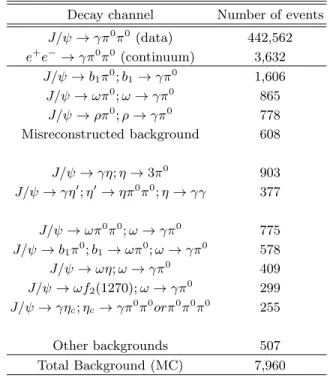
retained. After all event selection criteria are applied, the number of events remaining in the data sample is 442,562. MC studies indicate that the remaining back-grounds exist at a level of about 1.8% of the size of the total sample. Table I lists the major backgrounds.
Backgrounds from J/ψ decays to γη(′) are well
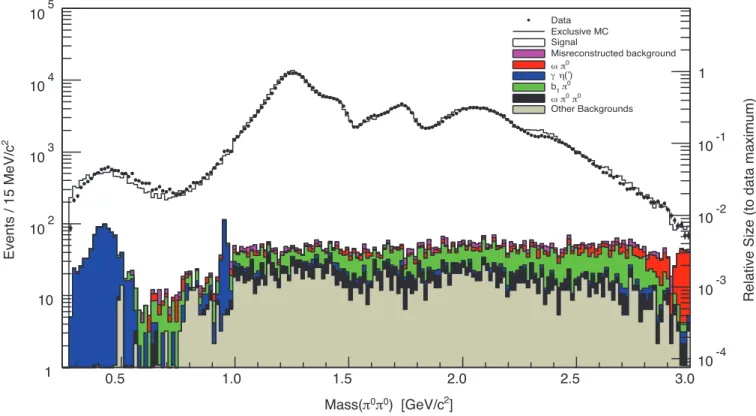
un-derstood and are studied with an exclusive MC sample, which is generated according to the PDG branching frac-tions for these reacfrac-tions. Other backgrounds are studied using an inclusive MC sample generated using besevt-gen, with the exception of the misreconstructed back-ground, which is studied using an exclusive MC sample that resembles the data. The latter MC sample was gen-erated using a set of Breit-Wigner resonances with cou-plings determined from a mass dependent fit to the data sample. The Mπ0π0 spectrum after all selection criteria have been applied is shown in Fig. 1. The reconstruction efficiency is determined to be 28.7%, according to the re-sults of the mass independent amplitude analysis. Con-tinuum backgrounds are investigated with a data sample collected at a center of mass energy of 3.080 GeV. The continuum backgrounds are scaled by luminosity and a correction factor for the difference in cross section as a function of center of mass energy. When scaled by lumi-nosity, only 3,632 events, which represents approximately 0.8% of the signal, survive after all signal isolation re-quirements.
IV. AMPLITUDE ANALYSIS
A. General Formalism
The results of the mass independent amplitude anal-ysis of the π0π0 system are obtained from a series of
unbinned extended maximum likelihood fits. The ampli-tudes for radiative J/ψ decays to π0π0 are constructed in the radiative multipole basis, as described in detail in Appendix A.
Let UM,λγ represent the amplitude for radiative J/ψ decays to π0π0,
UM,λγ(~x, s) = hγπ0π0|H|J/ψi (1)
TABLE I. The number of events remaining after all selection criteria for each of a number of background reactions is shown in the right column. The backgrounds are broken into three groups. The first group contains the signal mimicking de-cays. The second lists the remaining backgrounds from J/ψ decays to γη(′
), while the third group lists a few additional backgrounds. The backgrounds explicitly listed here represent about 93% of the total background according to the MC sam-ples. The misreconstructed background includes those events in which one of the daughter photons from a π0decay is taken as the radiated photon.
Decay channel Number of events
J/ψ → γπ0 π0 (data) 442,562 e+e− →γπ0π0 (continuum) 3,632 J/ψ → b1π 0 ; b1 →γπ 0 1,606 J/ψ → ωπ0; ω → γπ0 865 J/ψ → ρπ0 ; ρ → γπ0 778 Misreconstructed background 608 J/ψ → γη; η → 3π0 903 J/ψ → γη′ ; η′ →ηπ0π0; η → γγ 377 J/ψ → ωπ0 π0 ; ω → γπ0 775 J/ψ → b1π0; b1→ωπ0; ω → γπ0 578 J/ψ → ωη; ω → γπ0 409 J/ψ → ωf2(1270); ω → γπ 0 299 J/ψ → γηc; ηc→γπ0π0orπ0π0π0 255 Other backgrounds 507 Total Background (MC) 7,960
where ~x = {θγ, φγ, θπ, φπ} is the position in phase space,
s = M2
π0π0 is the invariant mass squared of the π0π0pair, M is the polarization of the J/ψ, and λγ is the helicity
of the radiated photon. For the reaction under study the possible values of both M and λγ are ±1. The amplitude
may be factorized into a piece that contains the radiative transition of the J/ψ to an intermediate state X and a piece that contains the QCD dynamics
UM,λγ(~x, s) = X
j,Jγ,X
hπ0π0|HQCD|Xj,Jγi × hγXj,Jγ|HEM|J/ψi,
(2)
where j is the angular momentum of the intermediate state and Jγ indexes the radiative multipole transitions.
The sum over X includes any pseudoscalar-pseudoscalar final states (ππ, K ¯K, etc) that may rescatter into π0π0.
We assume that the contribution of the 4π final state to this sum is negligible, with the result that rescattering effects become important only above the K ¯K threshold. The amplitude in Eq. (2) may be further factorized by
0.5 1.0 1.5 2.0 2.5 3.0 1 10 2 10 3 10 4 10 5 10 Data Exclusive MC Signal Misreconstructed background 0 π ω (’) η γ 0 π 1 b 0 π 0 π ω Other Backgrounds R e la ti ve Si ze (t o d a ta ma xi mu m) -4 10 -3 10 -2 10 -1 10 1 2 Eve n ts / 1 5 Me V/ c ] 2 ) [GeV/c 0 π 0 π Mass(
FIG. 1. The Mπ0π0 spectrum after all selection criteria have been applied. The black markers represent the data, while the histograms depict the backgrounds according to the MC samples. The signal (white) and misreconstructed background (pink) are determined from an exclusive MC sample that resembles the data. The other backgrounds are determined from an inclusive MC sample (see Table I). The components of the stacked histogram from bottom up are unspecified backgrounds, ωπ0π0, b
1π0, γη(′
), ωπ0
, the misreconstructed background, and the signal.
pulling out the angular distributions, UM,λγ(~x, s) = X j,Jγ,X Tj,X(s)ΘM,λj γ(θπ, φπ) × gj,Jγ,X(s)Φ M,λγ j,Jγ (θγ, φγ), (3)
where gj,Jγ,X(s) is the coupling for the radiative decay to intermediate state X. The functions ΘM,λγ
j (θπ, φπ)
and ΦM,λγ
j,Jγ (θγ, φγ) contain the angular dependence of the decay of the X to π0π0and the radiative J/ψ decay,
re-spectively. The part of the amplitude that describes the π0π0dynamics is the complex function T
j,X(s), which is
of greatest interest for this study. However, this func-tion cannot be separated from the coupling gj,Jγ,X(s). Instead the product is measured according to
Vj,Jγ(s) ≈ X
X
gj,Jγ,X(s)Tj,X(s). (4)
This product will be called the coupling to the state with characteristics j, Jγ. Note here that, if rescattering
ef-fects are assumed to be minimal (the only possible X is ππ), all amplitudes with the same j have the same phase. The effect of rescattering is to break the factorizability
of Eq. (4). Finally, the amplitude may be written
UM,λγ(~x, s) =X j,Jγ Vj,Jγ(s)A M,λγ j,Jγ (~x), (5) where AM,λγ
j,Jγ (~x) contains the piece of the amplitude that describes the angular distributions and is determined by the kinematics of an event.
Any amplitude with total angular momentum greater than zero will have three components (the 0++amplitude
has only an E1 component). Thus, three 2++amplitudes,
relating to E1, M2, and E3 radiative transitions, are in-cluded in the analysis. While any amplitude with even total angular momentum and positive parity and charge conjugation is accessible for this decay, studies show that the 4++amplitude is not significant in this region. In
par-ticular, no set of four continuous 15 MeV/c2 bins yield a
difference in −2 ln L greater than 28.8 units, which corre-sponds to a five sigma difference, under the inclusion of a 4++ amplitude. As no narrow spin-4 states are known,
this suggests that only the 0++ and 2++ amplitudes are significant. The systematic uncertainty due to ignoring a 4++amplitude that may exist in the data is described
B. Parameterization
The dynamical function in Eq. (4) may be parameter-ized in various ways. A common parameterization, dis-cussed in the introduction, is a sum of interfering Breit-Wigner functions,
Vj,Jγ(s) = X
β
kj,Jγ,βBWj,Jγ,β(s), (6)
where BWj,Jγ,β(s) represents a Breit-Wigner function with characteristics (mass and width) β and strength kj,Jγ,β.
To avoid making such a strong model dependent as-sumption, we choose to bin the data sample as a function of Mπ0π0 and to assume that the part of the amplitude that describes the dynamical function is constant over a small range of s, UM,λγ(~x, s) =X j,Jγ Vj,JγA M,λγ j,Jγ (~x). (7)
For the scenario posed in Eq. (7), the couplings may be taken as the free parameters of an extended maximum likelihood fit in each bin of Mπ0π0. It is then possible to extract a table of complex numbers (the free parameters in each bin) that describe the dynamical function of the π0π0 interaction.
The intensity function, I(~x), which represents the den-sity of events at some position in phase space ~x, is given by I(~x) = X M,λγ X j,Jγ Vj,JγA M,λγ j,Jγ (~x) 2 . (8)
The incoherent sum includes the observables of the re-action (which are not measured). For the rere-action un-der study, the observables are the polarization of the J/ψ, M = ±1, and the helicity of the radiated photon, λγ = ±1. The free parameters are constrained to be the
same in each of the four pieces of the incoherent sum. In the figures and supplemental results that follow, the intensity of the amplitude in each bin is reported as a number of events corrected for acceptance and detector efficiency. That is, for the bin of Mπ0π0 indexed by k and bounded by sk and sk+1(the boundaries in s of the bin)
we report, for each amplitude indexed by j and Jγ, the
quantity Ik j,Jγ= Z sk+1 sk X M,λγ Vj,Jk γA M,λγ j,Jγ (~x) 2 d~x. (9)
In practice, we absorb the size of phase space into the fit parameters. In doing so we fit for parameters eVk
j,Jγ which are the Vk
j,Jγ scaled by the square root of the size of phase space in bin k.
C. Background subtraction
The mass independent amplitude analysis treats each event in the data sample as a signal event. For a clean sample, the effect of remaining backgrounds should be small relative to the statistical errors on the amplitudes. However, the backgrounds from J/ψ decays to γη(′)
in-troduce a challenge. Both of these backgrounds peak in the low mass region near interesting structures. The background from J/ψ decays to γη lies in the region of the f0(500), which is of particular interest for its
impor-tance to Chiral Perturbation Theory [1, 33]. The γη′
background peaks near the f0(980), which is also of
par-ticular interest due to its strong coupling to K ¯K and its implications for a scalar meson nonet [34]. Therefore, the effect of these backgrounds is removed by using a background subtraction method.
If a data sample is entirely free of backgrounds, the likelihood function is constructed as
L(~ξ) = Nsig data Y i=1 f (~xi|~ξ), (10)
where f (~x|~ξ) is the probability density function (pdf) to observe an event with a particular set of kinematics ~x and parameters ~ξ = { eVk
j,Jγ}. The total number of parameters in the mass independent analysis is 1,178 (seven times the number of bins above K ¯K threshold and five times the number of bins below K ¯K threshold). The number of events in the pure data sample is given by Ndatasig .
Now, the likelihood may be written
L(~ξ) = Nsig data Y i=1 f (~xi|~ξ) Nbkg data Y j=1 f (~xj|~ξ) Nbkg data Y k=1 f (~xk|~ξ)−1, (11)
where an additional likelihood, which describes the re-action for background events, has been multiplied and divided. Consider now a more realistic data sample that consists not only of signal events, but also contains some number of background events, Ndatabkg. Then the product of the first two factors of Eq. (11) are simply the likeli-hood for the entire (contaminated) data sample, but the overall likelihood represents only that of the pure signal since the background likelihood has been divided. For a given data set, any backgrounds remaining after selection criteria have been applied are difficult to distinguish from the true signal. Rather than using the true background to determine the background likelihood, it is therefore necessary to approximate it with an exclusive MC sam-ple. That is,
Ndatabkg Y i=1 f (~xi|~ξ)−1≈ NMCbkg Y i=1 f (~xi|~ξ)−wi, (12)
where the weight, wi, is necessary for scaling purposes.
expected background, a weight factor of 0.5 is necessary. Finally, the likelihood function may be written
L(~ξ) = NYdata i=1 f (~xi|~ξ) Nbkg MC Y j=1 f (~xj|~ξ)−wj. (13)
In practice, this likelihood distribution is multiplied by a Poisson distribution for the extended maximum likeli-hood fits such that
L(~ξ) = e −µµNdata Ndata! NYdata i=1 f (~xi|~ξ) Nbkg MC Y j=1 f (~xj|~ξ)−wj. (14)
An exclusive MC sample for the backgrounds due to J/ψ decays to γη(′) is generated according to the
branch-ing fractions given by the PDG [1]. This MC sample is required to pass all of the selection criteria that are ap-plied to the data sample. Any events that remain are included in the unbinned extended maximum likelihood fit with a negative weight (−wj= −1 in Eq. (13)). In this
way, the inclusion of the MC sample in the fit approxi-mately cancels the effect of any remaining backgrounds of the same type in the data sample.
D. Ambiguities
Another challenge to the amplitude analysis is the presence of ambiguities. Since the intensity function, which is fit to the data, is constructed from a sum of absolute squares, it is possible to identify multiple sets of amplitudes which give identical values for the total inten-sity. In this way, multiple solutions may give comparable values of −2 ln L for a particular fit. For this particular analysis, two types of ambiguities are present. Trivial ambiguities arise due to the possibility of the overall am-plitude in each bin to be rotated by π or to be reflected over the real axis in the complex plane. These may be partially addressed by applying a phase convention to the results of the fits. Non-trivial ambiguities arise from the freedom of amplitudes with the same quantum numbers to have different phases. The non-trivial ambiguities rep-resent a greater challenge to the analysis and cannot be eliminated without introducing model dependencies.
While it is not possible in principle to measure the absolute phase of the amplitudes, it is possible to study the relative phases of individual amplitudes. Therefore in each of the fits, one of the amplitudes (the 2++E1 ampli-tude) is constrained to be real. The phase difference be-tween the other amplitudes and that which is constrained can then be determined in each mass bin.
As mentioned above, a set of trivial ambiguities arises due to the possibility of the overall amplitude in each bin to be rotated by π or to be reflected over the real axis in the complex plane. Each of these processes leave the intensity distribution unchanged. This issue is partially resolved by establishing a phase convention in which the
amplitude that is constrained to be real is also con-strained to be positive. The remaining ambiguity is re-lated to the inability to determine the absolute phase. The phase of the total amplitude may change sign with-out inducing a change in the total intensity. Therefore, when a phase difference approaches zero, it is not pos-sible to determine if the phase difference should change sign. The amplitude analysis results are presented here with the arbitrary convention that the phase difference between the 0++amplitude and the 2++ E1 amplitude is
required to be positive. One may invert the sign of this phase difference in a given bin, but then all other phase differences in that bin must also be inverted.
The presence of non-trivial ambiguities is attributed to rescattering effects, which allow for amplitudes with the same quantum numbers, JP C, to have different phases.
The couplings, gj,Jγ,X(s), in Eq. (4) are real functions of s. Since the dynamical amplitude, Tj,X(s), does not
depend on Jγ, its phase is the same for each of the
am-plitudes with the same JP C (in particular, the 2++ E1,
M2 and E3 amplitudes). However, if more than one in-termediate state, X, is present, differences between the couplings to these amplitudes may result in a phase dif-ference. Therefore, in the region above the K ¯K threshold the 2++amplitudes may have different phases. However,
below K ¯K threshold the phases of these amplitudes are constrained to be the same. That is, rescattering through 4π is assumed to be negligible.
By writing out the angular dependence of the intensity function, it is possible to show that the freedom to have phase differences between the components of a given am-plitude (2++ E1, M2, and E3, for example) generates an
ambiguity in the intensity distribution. For this chan-nel and considering only 0++ and 2++ amplitudes, two
non-trivial ambiguous solutions may be present in each bin above K ¯K threshold. The knowledge of one solu-tion can be used to mathematically predict its ambiguous partner. In fact, some bins do not exhibit multiple so-lutions, but have a degenerate ambiguous pair. A study of these ambiguities (Appendix B) shows consistency be-tween the mathematically predicted and experimentally determined ambiguities. Both ambiguous solutions are presented, because it is impossible to know which rep-resent the physical solutions without making some addi-tional model dependent assumptions. If more than two solutions are found in a given bin, all solutions within 1 unit of log likelihood from the best solution are compared to the predicted value derived from the best solution and only that which matches the prediction is accepted as the ambiguous partner.
E. Results
1. Amplitude intensities and phases
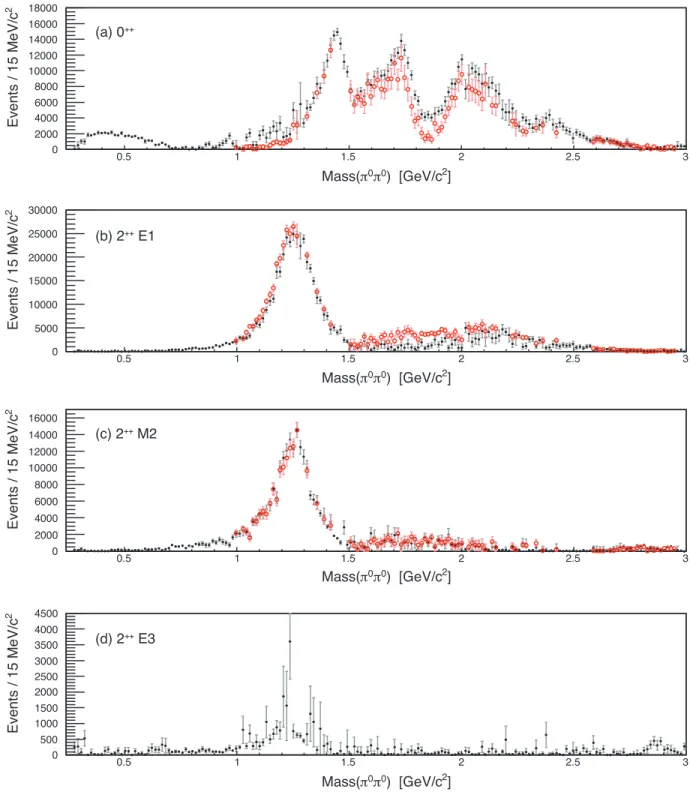
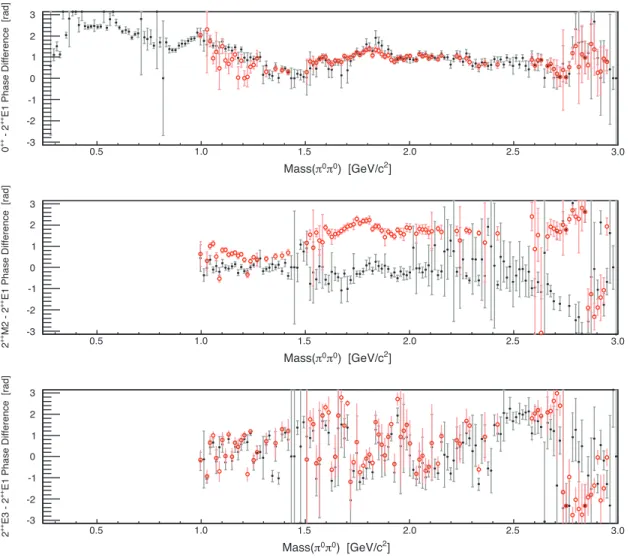
The intensity for each amplitude as a function of Mπ0π0 is plotted in Fig. 2. Each of the phase differences with
re-spect to the reference amplitude (2++ E1), which is
con-strained to be real, is plotted in Fig. 3. Above the K ¯K threshold, two distinct sets of solutions are apparent in most bins as expected. The bins below about 0.6 GeV/c2
also contain multiple solutions, but with different hoods and are attributed to local minima in the likeli-hood function. The nominal solutions below 0.6 GeV/c2
are determined by requiring continuity in each intensity and phase difference as a function of Mπ0π0. Only sta-tistical errors are presented in the figures.
It is apparent that the ambiguous sets of solutions in the nominal results are distinct in some regions, while they approach and possibly cross at other points. The most powerful discriminator of this effect is the phase difference between the E1 and M2 components of the 2++ amplitude (see the middle plot of Fig. 3). Re-gions in which the solutions may cross are apparent at 0.99 GeV/c2, near 1.3 GeV/c2, and above 2.3 GeV/c2.
Since the results in each bin are independent of their neighbor, it is not possible to identify two distinct, smooth solutions at these crossings.
2. Discussion
The results of the mass independent analysis exhibit significant structures in the 0++ amplitude just below
1.5 GeV/c2 and near 1.7 GeV/c2. This region is where
one might expect to observe the the states f0(1370),
f0(1500), and f0(1710) which are often cited as being
mixtures of two scalar light quark states and a scalar glueball [35, 36]. A definitive statement on the number and properties of the scattering amplitude poles in this region of the spectrum requires model-dependent fits to the data. The effectiveness of any such model-dependent study could be greatly enhanced by including similar data from the decay J/ψ → γKK in an attempt to iso-late production features from partial widths to KK and ππ final states.
Additional structures are present in the 0++amplitude
below 0.6 GeV/c2and near 2.0 GeV/c2. It seems
reason-able to interpret the former as the σ (f0(500)). The latter
could be attributed to the f0(2020). The presence of the
four states below 2.1 GeV/c2 would be consistent with
the previous study of radiative J/ψ decays to ππ by BE-SII [20]. Finally, the results presented here also suggest two possible additional structures in the 0++ spectrum
that were not observed in Ref. [20]. These include a struc-ture just below 1 GeV/c2, which may indicate an f
0(980),
but the enhancement in this region is quite small. There also appears to be some structure in the 0++ spectrum
around 2.4 GeV/c2.
In the 2++ amplitude, the results of this analysis
in-dicate a dominant contribution from what appears to be the f2(1270), consistent with previous results [20].
However, the remaining structure in the 2++ amplitude
appears significantly different than that assumed in the model used to obtain the BESII results [20]. In
particu-lar, the region between 1.5 and 2.0 GeV/c2was described
in the BESII analysis with a relatively narrow f2(1810).
One permutation of the nominal results (the red markers in Fig. 2) indicates that the structures in this region are much broader, while the other permutation (the black markers in Fig. 2) suggests that there is very little con-tribution from any 2++ states in this region.
The tensor spectrum near 2 GeV/c2 is of interest in
the search for a tensor glueball. Previous investiga-tions of the J/ψ → γπ0π0 channel reported evidence
for a narrow (Γ ≈ 20 MeV) tensor glueball candidate, fJ(2230) [25]. While a model-dependent fit is required
to place a limit on the production of such a state using these data, we note that based on the reported value of B(J/ψ → γfJ(2230)) [23], one would naively expect to
observe a peak for the fJ(2230) with an integral that is
of order 4 × 10⁵ but concentrated only in roughly two
bins of M (π0π0), corresponding to the full width of the
fJ(2230). Such a structure seems difficult to
accommo-date in the extracted 2++ amplitude.
F. Branching fraction
The results of the mass independent amplitude analy-sis allow for a measurement of the branching fraction of radiative J/ψ decays to π0π0, which is determined
ac-cording to:
B(J/ψ → γπ0π0) =Nγπ0π0− Nbkg ǫγNJ/ψ
, (15)
where Nγπ0π0 is the number of acceptance corrected events, Nbkg is the number of remaining background
events, ǫγ is an efficiency correction necessary to
extrap-olate the π0π0spectrum down to a radiative photon
en-ergy of zero, and NJ/ψ is the number of J/ψ decays in
the data. The number of acceptance corrected events is determined from the amplitude analysis by summing the total intensity from each Mπ0π0 bin. The number of remaining background events is determined according to the inclusive and exclusive MC samples. The frac-tional background contamination in each bin i, Rbkg,i,
is determined before acceptance correction. The number of background events is then determined by assuming Rbkg,i is constant after acceptance correction such that
the number of background events in bin i, Nbkg,i, is given
by the product of Rbkg,i and the number of acceptance
corrected events in the same bin, Nγπ0π0,i. Note that the backgrounds from to J/ψ decays to γη(′) are removed
during the fitting process and are not included in this factor. The efficiency correction factor, ǫγ, is determined
by calculating the fraction of phase space that is removed by applying the selection requirements on the energy of the radiative photon. This extrapolation increases the total number of events by 0.07%. Therefore, ǫγ is taken
to be 0.9993.
The backgrounds remaining after event selection fall into three categories. The misreconstructed backgrounds
2 Eve n ts / 1 5 Me V/ c 0.5 1 1.5 2 2.5 3 0 5000 10000 15000 20000 25000 30000 ] 2 ) [GeV/c 0 π 0 π Mass( 2 Eve n ts / 1 5 Me V/ c 0.5 1 1.5 2 2.5 3 0 2000 4000 6000 8000 10000 12000 14000 16000 ] 2 ) [GeV/c 0 π 0 π Mass( 2 Eve n ts / 1 5 Me V/ c 0.5 1 1.5 2 2.5 3 0 500 1000 1500 2000 2500 3000 3500 4000 4500 ] 2 ) [GeV/c 0 π 0 π Mass( 2 Eve n ts / 1 5 Me V/ c 0.5 1 1.5 2 2.5 3 0 2000 4000 6000 8000 10000 12000 14000 16000 18000 ] 2 ) [GeV/c 0 π 0 π Mass( (a) 0++ (b) 2++ E1 (c) 2++ M2 (d) 2++ E3
FIG. 2. The intensities for the (a) 0++
, (b) 2++
E1, (c) 2++
M2 and (d) 2++
E3 amplitudes as a function of Mπ0π0 for the nominal results. The solid black markers show the intensity calculated from one set of solutions, while the open red markers represent its ambiguous partner. Note that the intensity of the 2++
E3 amplitude is redundant for the two ambiguous solutions (see Appendix B). Only statistical errors are presented.
are determined from an exclusive MC sample that re-sembles the data. Events that remain in a continuum data sample taken at 3.080 GeV after selection criteria have been applied are also taken as a background. Fi-nally, the other remaining backgrounds are determined
using the inclusive MC sample. Each of these back-grounds is scaled appropriately. In total, the acceptance corrected number of background events, Nbkg, is
deter-mined to be 35,951. The number of radiative J/ψ decays to π0π0, N
0.5 1.5 2.5 E1 Ph a se D if fe re n ce [ra d ] ++ - 2 ++ 0 -3 -2 -1 0 1 2 3 E1 Ph a se D if fe re n ce [ra d ] ++ M2 - 2 ++ 2 -3 -2 -1 0 1 2 3 -3 -2 -1 0 1 2 3 ] 2 ) [GeV/c 0 π 0 Mass(π ] 2 ) [GeV/c 0 π 0 π Mass( ] 2 ) [GeV/c 0 π 0 π Mass( E1 Ph a se D if fe re n ce [ra d ] ++ E3 - 2 ++ 2 1.0 2.0 3.0 0.5 1.0 1.5 2.0 2.5 3.0 0.5 1.0 1.5 2.0 2.5 3.0
FIG. 3. The phase differences relative to the reference amplitude (2++ E1) for the (a) 0++, (b) 2++ M2, and (c) 2++ E3 amplitudes as a function of Mπ0π0 for the nominal results. The solid black markers show the phase differences calculated from one set of solutions, while the open red markers represent the ambiguous partner solutions. An arbitrary phase convention is applied here in which the phase difference between the 0++and 2++E1 amplitudes is required to be positive. Only statistical errors are presented.
The branching fraction for this decay is then determined to be (1.151 ± 0.002) × 10−3, where the error is statistical
only.
V. SYSTEMATIC UNCERTAINTIES
The systematic uncertainties for the mass independent analysis include two types. First, the uncertainty due to the effect of backgrounds from J/ψ decays to γη(′)
are addressed by repeating the analysis and treating the background in a different manner. The second type of systematic uncertainty is that due to the overall normal-ization of the results. Sources of systematic uncertainties of this type include the photon detection efficiency, the total number of J/ψ decays, the effect of various back-grounds, differences in the effect of the kinematic fit be-tween the data and MC samples and the effect of model
dependencies. The uncertainty on the branching fraction of π0 to γγ according to the PDG is 0.03% [1], which
is negligible in relation to the other sources of uncer-tainty. The systematic uncertainties are described below and summarized in Table II. These uncertainties also ap-ply to the branching fraction measurement. Finally, sev-eral cross checks are also performed.
A. J/ψ → γη and J/ψ → γη′ Background
Uncertainty
The amplitude analysis is performed with the assump-tion that all backgrounds have been eliminated. Stud-ies using Monte Carlo simulation indicate this is a valid assumption for most of the Mπ0π0 spectrum. However, significant backgrounds from J/ψ decays to γη and γη′
than inflating the errors of these bins according to the un-certainty introduced by these backgrounds, which would not take into account the bin-to-bin correlations, a set of alternate results is presented in which the γη(′)
back-grounds are not subtracted.
The fraction of events in J/ψ decays to γη(′) that
sur-vive the event selection criteria for the γπ0π0 final state
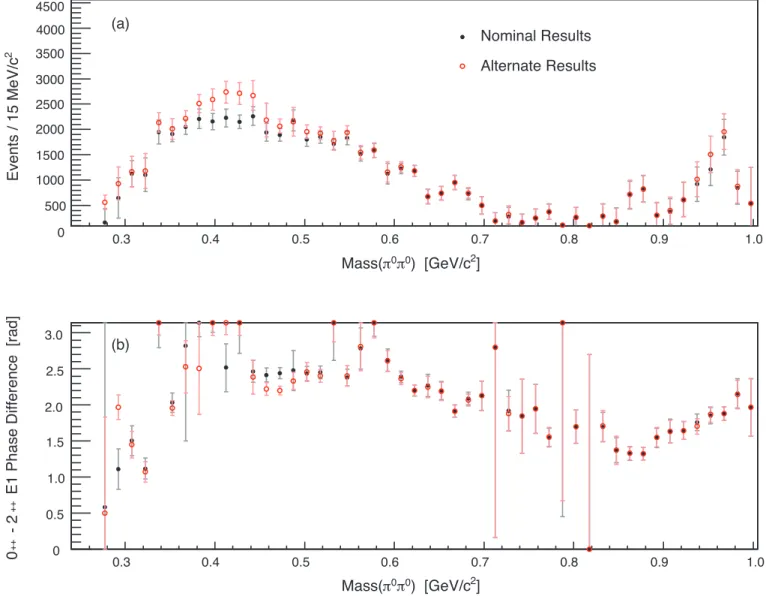
is very small (about 0.02%). Minor changes to the mod-eling of these decays may therefore have a large effect on the backgrounds. The difference between the nominal results and the alternate results, which treat the back-grounds differently, can be viewed as an estimator of the systematic error in the results due to these backgrounds. The distinctive feature of the alternate results is an enhancement in the 0++ intensity in the region below
about 0.6 GeV/c2 and near the η′ peak. This may be
interpreted as the contribution of the events from J/ψ decays to γη(′), which are being treated as signal events.
A comparison of the 0++ amplitude for nominal results
and the alternate results is presented in Fig. 4. The re-sults for the other amplitudes are consistent between the two methods. Any conclusion drawn from these data that is sensitive to choosing specifically the alternate or nominal results is not a robust conclusion.
B. Uncertainties in the overall normalization 1. Photon Detection Efficiency
The primary source of systematic uncertainty for this analysis comes from the reconstruction of photons. To account for this uncertainty, the photon detection effi-ciency of the BESIII detector is studied using the so called tag and probe method on a sample of J/ψ de-cays to π+π−π0, where the π0 decays into two photons.
One of these final state photons is reconstructed, along with the two charged tracks, while the other photon is left as a missing particle in the event. This information can then be used to determine the region in the detec-tor where the missing photon is expected. The photon detection efficiency is calculated by taking the ratio of the number of missing photons that are detected in this region to the number that are expected. The numbers of detected and expected photons are determined with fits to the two photon invariant mass distributions.
The systematic uncertainty due to photon reconstruc-tion is determined by investigating the differences be-tween the photon detection efficiencies of the inclusive MC sample and that of the data sample. This difference is measured to be less than 1.0%, which is taken to be the systematic uncertainty per photon. For the five pho-ton final state the overall uncertainty due to this effect is therefore taken to be 5.0%.
An additional source of uncertainty, which is due to mismodelling of the photon detection efficiency as a func-tion of the angular and energy dependence of the radia-tive photon, was studied using the same channel. The
phase space MC samples used for normalization in each bin of the mass independent amplitude analysis were modified to account for differences in the photon detec-tion efficiency between the data and inclusive MC sam-ples. The mass independent analysis was then repeated using the modified phase space MC samples. Neither the differences in angular nor energy dependence had a sig-nificant effect on the results of the analysis. The effects of mismodelling of this type are therefore taken to be negligible.
2. Number of J/ψ
The number of J/ψ decays is determined from an anal-ysis of inclusive hadronic events
NJ/ψ=
Nsel− Nbg
ǫtrig× ǫψ(2S)data × fcor
, (16)
where Nsel represents the number of inclusive events
re-maining after selection criteria have been applied and Nbgis the number of background events estimated with a
data sample collected at 3.080 GeV. The efficiency for the trigger is given by ǫtrig, while ǫψ(2S)data is the detection
ef-ficiency for J/ψ inclusive decays determined from ψ(2S) decays to π+π−J/ψ. Finally, f
correpresents a correction
factor to translate ǫψ(2S)data to the efficiency for inclusive de-cays in which the J/ψ is produced at rest. To obtain Nsel,
at least two charged tracks are required for each event. Additionally, the momenta of these tracks and the visible energy of each event are restricted in order to eliminate Bhabha and di-muon events as well as beam gas inter-actions and virtual photon-photon collisions. The total number of J/ψ decays in the data sample according to Eq. (16) is determined to be (1.311 ± 0.011) ×109events,
which results in an uncertainty of 0.8% [26, 27].
3. Background Size
According to the inclusive MC sample, the total num-ber of background events that contaminate the signal is about 1.5%. These do not include the misreconstructed backgrounds nor the backgrounds from J/ψ decays to γη(′), both of which are addressed in a separate
system-atic uncertainty. Additionally, backgrounds from non-J/ψ decays yield a contamination of approximately 0.8%. Conservative systematic uncertainties equal to 100% of the background contamination are attributed to each of the inclusive MC and continuum background types.
4. Uncertainty in the acceptance corrected signal yield One of the largest remaining backgrounds after signal isolation and background subtraction is the signal mim-icking decay of J/ψ to ωπ0, where the ω decays to γπ0.
0.3 0.4 0.5 0.6 0.7 0.8 0.9 1.0 0 500 1000 1500 2000 2500 3000 3500 4500 0.3 0.4 0.5 0.6 0.7 0.8 0.9 1.0 E1 Ph a se D if fe re n ce [ra d ] ++ - 2 ++ 0 0 0.5 1.0 1.5 2.0 2.5 3.0 Nominal Results Alternate Results (a) (b) 2 Eve n ts / 1 5 Me V/ c ] 2 ) [GeV/c 0 π 0 π Mass( ] 2 ) [GeV/c 0 π 0 π Mass( 4000
FIG. 4. A comparison of the (a) 0++
intensity and (b) phase difference relative to the 2++
E1 amplitude for the nominal results and the alternate results, in which the γη(′
) backgrounds have not been subtracted from the data. The solid black markers show the nominal results, while the red markers represent the alternate results. Only statistical errors are presented.
The nominal method to address this background is to re-strict the γπ0invariant mass to exclude the region within
50 MeV/c2of the ω mass. An alternative method is to
in-clude an amplitude for the ωπ0final state in the analysis.
The results of this alternative method are quantitatively no different than the nominal results, suggesting that the exclusion method is an effective means of addressing the background from J/ψ decays to ωπ0. The difference in the branching fraction using the signal yield for the alter-native method compared to the nominal method is about 0.8%.
As discussed above, backgrounds due to J/ψ decays to γη(′) are addressed in the fitting procedure itself by
adding an exclusive MC sample to the data, but with a negative weight. The systematic uncertainty do to this background is determined by using the data alone. In this way, contributions from these backgrounds are treated as signal and inflate the signal yield and background size
in Eq. (15). The difference in the branching fraction is 0.03%, which is considered a negligible contribution to the systematic uncertainty.
Differences in the effect of the 6C kinematic fit on the data and MC samples may cause a systematic difference in the acceptance corrected signal yield. This effect was investigated by loosening the restriction on the χ2 from
the 6C kinematic fit. For events with a Mπ0π0 above KK threshold, this restriction was relaxed from less than 60 to be less than 125. Events with an invariant mass below KK threshold are required to have a χ2less than 60 rather than less than 20. The difference in the branching fraction for the results with the loosened χ2 cut relative
to that of the nominal results is about 0.1%.
Another source of systematic uncertainty in the branching fraction is the difference between the nomi-nal results and those obtained by applying a model that describes the ππ dynamics. To test this effect, a mass
dependent fit using interfering Breit-Wigner line shapes was performed. The difference in the branching fraction using the acceptance corrected yield of the mass depen-dent analysis compared to the nominal results is about 0.3%.
The effect of the remaining misreconstructed back-grounds on the results is studied by performing a closure test, in which the mass independent amplitude analysis is performed on an exclusive MC sample. This MC sam-ple was generated according to the results of a mass de-pendent amplitude analysis of the data and includes the proper angular distributions. After applying the same selection criteria that are applied to the data, the MC sample is passed through the mass independent analy-sis. This process is repeated after removing the remain-ing misreconstructed backgrounds from the sample. The difference in the branching fraction between these two methods is 0.01%. The effect of these backgrounds is therefore taken to be negligible.
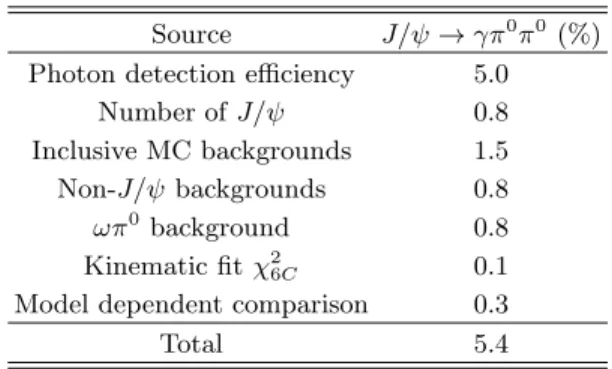
TABLE II. This table summarizes the systematic uncertain-ties (in %) for the branching fraction of radiative J/ψ decays to π0π0.
Source J/ψ → γπ0
π0 (%) Photon detection efficiency 5.0
Number of J/ψ 0.8 Inclusive MC backgrounds 1.5 Non-J/ψ backgrounds 0.8 ωπ0 background 0.8 Kinematic fit χ2 6C 0.1
Model dependent comparison 0.3
Total 5.4
C. 4++
amplitude
As discussed above, the only π0π0 amplitudes that
are accessible in radiative J/ψ decays have even angu-lar momentum and positive parity and charge conjuga-tion quantum numbers. The mass independent analysis was performed under the assumption that only the 0++
and 2++amplitudes are significant. To test this
assump-tion, the analysis was repeated with the addition of a 4++ amplitude. No significant contribution from a 4++
amplitude is apparent.
To test the effect of a 4++amplitude that may exist in the data and is ignored in the fit, an exclusive MC sample was generated using a model constructed from a sum of resonances each parameterized by a Breit-Wigner func-tion in a way that optimally reproduces the data. One of the resonances was an f4(2050), which was generated
in each component of the 4++ amplitude. The relative size of the 4++ amplitude was determined from a mass
dependent fit to the data, in which the 4++ amplitude
contributed 0.43% to the overall intensity. A mass
inde-pendent amplitude analysis, which did not include a 4++
amplitude, was then performed on this sample. The re-sults indicate that the intensities and phases for the 0++
and 2++ amplitudes deviate from the input parameters
at the order of the statistical errors from the data sample in the region between 1.5 and 3.0 GeV/c2. Therefore, the
systematic error due to the effect of ignoring a possible 4++ amplitude is estimated to be of the same order as
the statistical errors in the region from 1.5 to 3.0 GeV/c2.
VI. CONCLUSIONS
A mass independent amplitude analysis of the π0π0
system in radiative J/ψ decays is presented. This anal-ysis uses the world’s largest data sample of its type, col-lected with the BESIII detector, to extract a piecewise function that describes the scalar and tensor ππ ampli-tudes in this decay. While the analysis strategy employed to obtain results has complications, namely ambiguous solutions, a large number of parameters, and potential bias in subsequent analyses from non-Gaussian effects (see Appendix C), it minimizes systematic bias arising from assumptions about ππ dynamics, and, consequently, permits the development of dynamical models or param-eterizations for the data.
In order to facilitate the development of models, the results of the mass independent analysis are presented in two ways. The intensities and phase differences for the amplitudes in the fit are presented here as a function of Mπ0π0. Additionally, the intensities and phases for each bin of Mπ0π0 are given in supplemental materials (see Appendix C). These results may be combined with those of similar reactions for a more comprehensive study of the light scalar meson spectrum. Finally, the branching fraction of radiative J/ψ decays to π0π0 is measured to
be (1.15 ± 0.05) × 10−3, where the error is systematic
only and the statistical error is negligible. This is the first measurement of this branching fraction.
ACKNOWLEDGMENTS
The BESIII collaboration thanks the staff of BEPCII and the IHEP computing center for their strong sup-port. This work is supported in part by National Key Basic Research Program of China under Contract No. 2015CB856700; National Natural Science Founda-tion of China (NSFC) under Contracts Nos. 11125525, 11235011, 11322544, 11335008, 11425524; the Chinese Academy of Sciences (CAS) Large-Scale Scientific Facil-ity Program; the CAS Center for Excellence in Particle Physics (CCEPP); the Collaborative Innovation Center for Particles and Interactions (CICPI); Joint Large-Scale Scientific Facility Funds of the NSFC and CAS under Contracts Nos. 11179007, U1232201, U1332201; CAS un-der Contracts Nos. KJCX2-YW-N29, KJCX2-YW-N45; 100 Talents Program of CAS; INPAC and Shanghai Key
Laboratory for Particle Physics and Cosmology; German Research Foundation DFG under Contract No. Collab-orative Research Center CRC-1044; Istituto Nazionale di Fisica Nucleare, Italy; Ministry of Development of Turkey under Contract No. DPT2006K-120470; Russian Foundation for Basic Research under Contract No. 14-07-91152; U. S. Department of Energy under Contracts Nos. FG02-04ER41291, FG02-05ER41374, DE-FG02-94ER40823, DESC0010118; U.S. National Sci-ence Foundation; University of Groningen (RuG) and the Helmholtzzentrum fuer Schwerionenforschung GmbH (GSI), Darmstadt; WCU Program of National Research Foundation of Korea under Contract No. R32-2008-000-10155-0; U.S. Department of Energy under Grant No. DE-FG02-87ER40365. This research was supported in part by Lilly Endowment, Inc., through its support for the Indiana University Pervasive Technology Institute, and in part by the Indiana METACyt Initiative. The
Indiana METACyt Initiative at IU is also supported in part by Lilly Endowment, Inc.
Appendix A: Amplitudes
The amplitude for radiative J/ψ decays to π0π0 can
be determined in different bases depending on the infor-mation of interest. For example, in the helicity basis, the amplitude depends on the angular momentum and helicity of the π0π0 resonance as well as the angular
mo-mentum and polarization of the J/ψ. It is also possible to relate the amplitudes to radiative multipole transitions. Such a basis is useful because it may allow implementa-tion or testing of dynamical assumpimplementa-tions. For example, a model may suggest that the E1 radiative transition should dominate over the M2 transition.
In the radiative multipole basis, the amplitude for ra-diative J/ψ decays to π0π0is given by
UM,λγ(~x, s) = X j,Jγ,µ NJγNjD J M,µ−λγ(π + φγ, π − θγ, 0)D j µ,0(φπ, θπ, 0) 1 2 1 + (−1)j 2 hJγ− λγ; jµ|Jµ − λγi 1 √ 2[δλγ,1+ δλγ,−1P (−1) Jγ−1]V j,Jγ(s) (A1)
where the parity, total angular momentum, and helicity of the pair of pseudoscalars are given by P , j, and µ, respectively. The D functions are the familiar Wigner D-matrix elements. The angular momentum of the pho-ton, Jγ, is related to the nuclear radiative (E1, M2, E3,
etc.) transitions. Each amplitude is characterized by the angular momentum of the photon and the angular mo-mentum of the pseudoscalar pair. The possible values of Jγ are limited by the conservation of angular momentum.
The helicity of the radiative photon is given by λγ. The
total angular momentum and polarization of the J/ψ are given by J and M, respectively. Finally, Nj =
q
2j+1 4π is
a normalization factor.
The angles (φγ, θγ) are the azimuthal and polar angles
of the photon in the rest frame of the J/ψ, where the direction of the J/ψ momentum defines the x-axis. The angles (φπ, θπ) are the azimuthal and polar angles of one
π0 in the rest frame of the π0π0 pair, with the -z axis
along the direction of the photon momentum and the x-axis is defined by the direction perpendicular to the plane shared by the beam and the z-axis.
Parity is a conserved quantity for strong and elec-tromagnetic interactions. Hence, for J/ψ radiative de-cays, P = (−1)j must be positive. This means that the
only intermediate states available have jP = 0+, 2+, 4+, etc. Additionally, isospin conservation in strong inter-actions requires IG for the intermediate state to be 0+
(isoscalar). The complex function Vj,Jγ(s) describes the
π0π0 production and decay dynamics. In order to
min-imize the model dependence of the mass independent analysis, the dynamical amplitude is replaced by a (com-plex) free parameter in the unbinned extended maximum likelihood fit. Thus, the amplitude, in a region around s is given by UM,λγ(~x, s) =X j,Jγ Vj,JγA M,λγ j,Jγ (~x), (A2) where AM,λγ j,Jγ (~x) =NJγNjD J M,µ−λγ(π + φγ, π − θγ, 0) Dµ,0j (φπ, θπ, 0)1 2 1 + (−1)j 2 hJγ− λγ; jµ|Jµ − λγi 1 √ 2[δλγ,1+ δλγ,−1P (−1) Jγ−1], (A3)
and {j, Jγ} represents the unique amplitudes accessible
for the given set of observables, {M, λγ}.
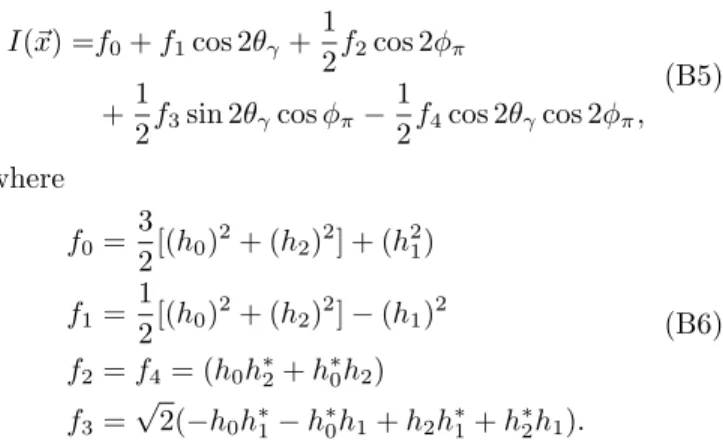
Appendix B: Ambiguities
One of the challenges of amplitude analysis is the issue of ambiguous solutions, two solutions that give the same distribution (eg. Ref. [7]). In this section, the ambiguous solutions for radiative J/ψ decays to π0π0 are studied.